HAL Id: hal-01228861
https://hal.archives-ouvertes.fr/hal-01228861
Submitted on 20 Nov 2015
HAL is a multi-disciplinary open access
archive for the deposit and dissemination of
sci-entific research documents, whether they are
pub-lished or not. The documents may come from
teaching and research institutions in France or
abroad, or from public or private research centers.
L’archive ouverte pluridisciplinaire HAL, est
destinée au dépôt et à la diffusion de documents
scientifiques de niveau recherche, publiés ou non,
émanant des établissements d’enseignement et de
recherche français ou étrangers, des laboratoires
publics ou privés.
A Model for Safety Case Confidence Assessment
Jérémie Guiochet, Quynh Anh Do Hoang, Mohamed Kaâniche
To cite this version:
Jérémie Guiochet, Quynh Anh Do Hoang, Mohamed Kaâniche. A Model for Safety Case Confidence
Assessment. 34th International Conference on Computer Safety, Reliability and Security
(SAFE-COMP), Sep 2015, Delft, Netherlands. �10.1007/978-3-319-24255-2_23�. �hal-01228861�
A Model for Safety Case Confidence Assessment
Jérémie Guiochet1,2, Quynh Anh Do Hoang1,2, and Mohamed Kaaniche1,21
LAAS-CNRS, 7 avenue du colonel Roche, 31031 Toulouse, France 2
Université de Toulouse, France
{guiochet, qdohoang, kaaniche}@laas.fr
Abstract. Building a safety case is a common approach to make expert judge-ment explicit about safety of a system. The issue of confidence in such argumen-tation is still an open research field. Providing quantitative estimation of confi-dence is an interesting approach to manage complexity of arguments. This paper explores the main current approaches, and proposes a new model for quantitative confidence estimation based on Belief Theory for its definition, and on Bayesian Belief Networks for its propagation in safety case networks.
Keywords: Safety Case · Confidence · Uncertainty · Quantitative estimation · Bayesian Belief Network · Belief Theory
1
Introduction
Safety cases are used in several critical industrial sectors to justify safety of installations and operations. As defined in the standard [6]: "a Safety Case is a structured argument, supported by a body of evidence, that provides a compelling, comprehensible and valid case that a system is safe for a given application in a given environment". An important research work has also been initiated to deliver guidelines to document safety cases. An initial work developed at York University [19], based on an adaptation of Toulmin argumentation model [25], led to the proposal of the Goal Structuring Notation (GSN). Other proposals such as CAE for Claims-Argument-Evidence [3] and KAOS (Knowl-edge Acquisition and autOmated Specification) [5], but they did not reach the maturity of GSN [14]. The Object Management Group (OMG) has also delivered a metamodel for the argumentation approach [22]. The goal of these approaches is to make more explicit the supporting arguments for a top-level claim.
Given a claim and a supporting argument, an important and growing issue is to un-derstand how much confidence one could have in the claim and how the different argu-ments contribute to such confidence. For instance, let us consider the classical example of the claim "{System X} is safe", supported by the evidence that all specific hazards have been eliminated as presented in Figure 1. Main concepts of GSN are presented here: goals present claims forming part of the argument; Strategies describe the nature of inferences that exist between a goal and its supporting sub-goal(s); Solutions present a reference to an evidence item (results of a fault tree analysis for instance); Contexts present contextual artifacts (they could be a reference to contextual information, or statements). Other elements are used in GSN but not presented here as our proposal focuses on these main components of GSN. Each element of such an argument may
be subject of uncertainties, such as "do all the hazards have been identified?" or "is the treatment of hazard n effective?". Moreover, considering that argument structures tend to grow excessively, it may become too complex for third parties to analyse the argu-ment. Therefore, appropriate methods to assess confidence in the argument structures and supporting evidence are required. Three main challenges are of particular interest: how confidence could be formally defined, how confidence could be quantitatively esti-mated, and how confidence in argument leaves could be propagated to assess the impact on the main claim confidence.
In this paper we mainly address the first and third issues by introducing a new method for defining and propagating a quantitative estimation of confidence of a safety case. After presenting related work in Section 2, we introduce our definition of confi-dence based on belief theory in Section 4. This definition is used in Section 5 where details about confidence propagation are given. Finally, in the conclusion we will dis-cuss about first results and open issues in this area.
S1 : Argument by claiming addressed all identified plausible hazards G2 : {Hazard H1} has been addressed Goal G1 : {System X} is safe Goal Strategy G3 : {Hazard H2} has been addressed Goal
… Gn : {Hazard Hn} has been addressed Goal
isSupportedBy
C1: List of identified hazards for {System X} Context Sn1: reference to an evidence item Solution Sn3: reference to an evidence item SnX: reference to an evidence item Sn4: reference to another evidence item inContextOf
Fig. 1. GSN example adapted from Hazard Avoidance Pattern [20]
2
Related Work
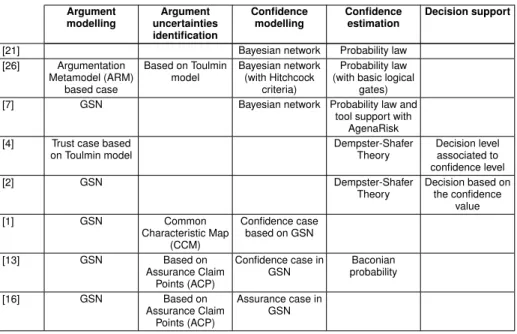
The issue of confidence in argument structures has already been addressed by several works, with slightly different objectives and scopes. Table 1 presents a common frame-work to analyze some relevant related frame-work considering the following dimensions:
– Argument modelling: construction of the "case" which may be based on GSN or other notations
– Argument uncertainties identification: uncertainties in inferences and arguments elements are identified
– Confidence modelling: construction of a confidence case, with explicit representa-tion of dependencies between the uncertainties
– Confidence estimation: theoretical framework for quantitative estimation of the confidence
– Decision support: provide support based on the quantitative estimation in order to make a decision for the acceptability of the argument, or its improvement.
Table 1. Different approaches for managing confidence in safety case
Argument modelling Argument uncertainties identification Confidence modelling Confidence estimation Decision support
[21] Bayesian network Probability law [26] Argumentation Metamodel (ARM) based case Based on Toulmin model Bayesian network (with Hitchcock criteria) Probability law (with basic logical
gates) [7] GSN Bayesian network Probability law and
tool support with AgenaRisk [4] Trust case based
on Toulmin model Dempster-Shafer Theory Decision level associated to confidence level [2] GSN Dempster-Shafer Theory Decision based on the confidence value [1] GSN Common Characteristic Map (CCM) Confidence case based on GSN [13] GSN Based on Assurance Claim Points (ACP) Confidence case in GSN Baconian probability [16] GSN Based on Assurance Claim Points (ACP) Assurance case in GSN Qualitative Approaches
In [16], the inventors of GSN address the confidence issue, by proposing to split a traditional safety case in two pieces. The first is the safety argument, showing all evi-dences, and the second is a confidence argument that addresses confidence in evievi-dences, contexts, and individual inferences. This confidence argument is also represented with GSN. It starts by adding to the safety case some possible uncertainty sources, which are called Assurance Claim Points (ACP), that are attached to inferences (the arrows con-necting claims), contexts (explanatory information), or solutions. Then, for each ACP, an argumentation mainly focuses on demonstrating that the ACP is trustworthy and ap-propriate, which is built using GSN. Another proposal [1], is based on the ACP but only focuses on Context and Solution elements. The authors propose to use a map (Common Characteristic Map) as a check list to identify sources of uncertainties, with recursive dependencies. For instance, if a safety case includes a solution which is a "Process re-sult", they propose the generic uncertainties related to "the use of a language", "the use
of a tool", "the use of a mechanism", "the involved artifacts", etc. All those characteris-tics are then refined, with possible recursive dependencies.
The proposed approach in [12] is quite similar, adapting the defeater concept from Defeasible Reasoning theory introduced by [24]. These defeaters that could be com-pared to previous ACP, or weaknesses in the argumentation, are then analyzed to be reduced one by one.
Both previous proposals focus on the identification of the weaknesses in an argu-mentation, and present methods for a well structured approach. Nevertheless, such ap-proaches may lead to complex confidence cases. Although controversial, we believe that quantitative estimation approaches may help to analyze the safety case confidence. For instance, it can support sensitivity analyses to identify the weak elements of an argumentation.
Quantitative Approaches
This group of approaches tries to apply mathematical formalism to capture lack of confidence in argument elements. Apart from some proposals based on simple math-ematical models as in [13] where the number of uncertainties is estimated, two main ways of approaching the problem can be identified:
– Bayesian Belief Networks (BBNs): in this case the uncertainty is interpreted as a probability. BBNs are then applied to deduce the confidence in a goal from cred-ibility of its backing arguments. Some authors directly use BBNs for modeling arguments and confidence. For instance, in [18], they only use BBNs and com-mercial tools to calculate "trustworthy", which is actually a conditional probability. With a similar approach, authors of [21] particularly focus on the diversification in argumentation, calculating how a "multilegged" argument (a claim is supported by two evidences) impacts the probability (interpreted as a confidence level) of achiev-ing the main claim. However, they directly use BBNs, without any safety case. On the contrary, [26] propose to apply to each claim of a Toulmin model argument, a Bayesien network pattern showing relationships between uncertainties in the argu-mentation based on Hitchock criteria [17]. However, confidence propagation is not clearly analyzed and justified. In [7], the authors present an interesting approach to build a BBN from the safety case, and use the work of [11], to define a distribution of confidence for each argument element, but they do not propose transformation rules between safety case in GSN and the confidence BBN. The confidence propa-gation formulas are also not justified.
– Dempster–Shafer (D-S) theory of evidence. These approaches are based on the be-lief theory developed by P. Dempster in 1967, and extended by G. Shafer in 1976. A common justification for its use, is that probability theory does not make difference between epistemic and aleatory uncertainties [10]. In the D-S approach, belief, dis-belief and epistemic uncertainty are explicitly quantified. An important work by [4] is based on this theory. The authors, propose to build "Trust cases" based on Toul-min concepts, and to directly associate levels for belief and uncertainties, linked with a decision to accept or not an argument element. In this case, they do not build a confidence case, but directly propose a method and a tool for decision support.
As presented later, they do not explicitly take into account confidence in the in-ferences of the argument. Authors of [2], directly reuse the previous work, with a limited version, only considering that for each argument element it exists a level for "sufficiency".
In summary, defining and measuring confidence in assurance claims is an impor-tant and open issue. A framework for determining confidence is needed, and this paper presents some initial steps to fulfill this objective.
3
Proposed Approach Overview
Our objective is to propose a method to identify weaknesses in safety case, in order to improve it. Referring to Table 1, our contribution focuses on the following steps presented Figure 2:
– Argument modelling: the safety case is built using GSN
– Confidence modelling: we propose to annotate the GSN models and transform them into a confidence network
– Confidence estimation: confidence in the network leaves are estimated and propa-gation formulas are used
– Sensitivity analysis: impact of confidence variations is analyzed to identify weak-nesses of the safety case.
Argument modelling (safety case in GSN) Confidence modelling and estimation Sensitivity Analysis (Tornado graph) modifications
Fig. 2. Overview of the proposed method
4
Measuring Confidence
Confidence may be used as a common concept for different theories, including prob-ability, and D-S. As in [1, 4], we define confidence using the D-S approach. In this theory, a belief function is defined from the powerset P(Ω) of possible events into [0; 1]. For instance, let ω be the state of an indicator light that can have two values on and of f , then Ω = {on, of f } and P(Ω) = {{on}, {of f }, {on, of f }, ∅}. In this ex-ample the belief function Bel, is defined as the mass m of belief such as Bel({on}) represents the credibility of the light to be ON . As an example, a possible estima-tion would be Bel({on}) = m({on}) = 0.2, Bel({of f }) = m({of f }) = 0.5 et
m({on, of f }) = m(Ω) = 0.3. When events are Boolean, like in this example, we can sum-up the D-S concepts with the Figure 3 (Plausibility is another D-S concept which will not be included in this paper).
disbelief
Bel(¬A) uncertain Bel(A)belief 1
plausible Pl(A)
Fig. 3. D-S theory concepts, with a Boolean set
We will consider in a safety case that all elements leaves are observed, and that they cannot be false. Hence, for an element A, Bel(A) = 0. This led us to define confidence and uncertainty as the belief functions:
m(A) = Bel(A) = g(A) ∈ [0, 1] : conf idence m(A, A) = 1 − g(A) ∈ [0, 1] : uncertainty m(A) = 0
(1)
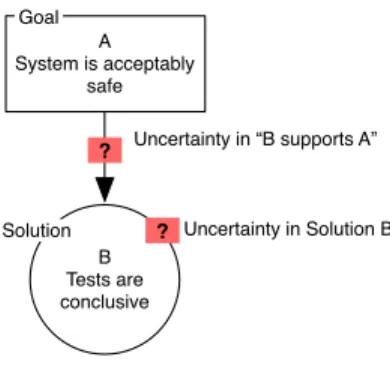
In the context of safety case, we consider two types of uncertainty sources, which are similar to those presented in [16] named "appropriateness" and "trustworthiness". For instance, in the very simple safety case presented in Figure 4, two sources of uncer-tainties may be identified:
– uncertainty in the fact that B is appropriate for the inference "A is Supported by B" – uncertainty in the solution B itself : are the tests trustworthy?
A System is acceptably safe B Tests are conclusive Goal Solution
Uncertainty in “B supports A”
Uncertainty in Solution B ?
?
5
Propagating Confidence
5.1 Argument Types
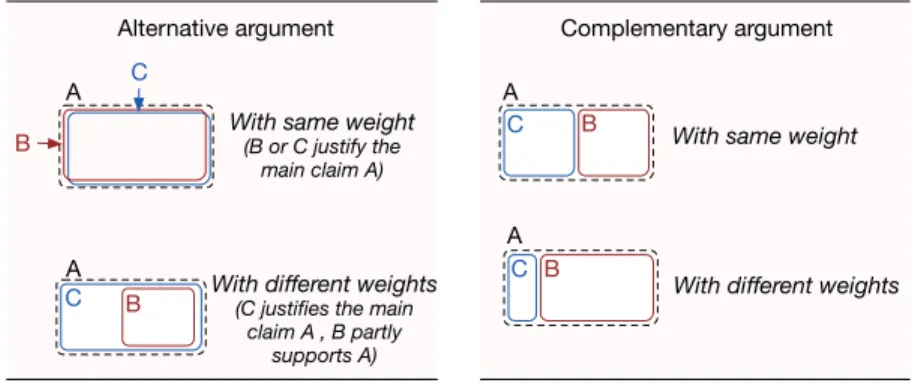
The very basic inference is the simplest one, "A is Supported by B". Nevertheless, most of arguments are more complex than direct one-to-one inference. For instance, let us consider the example presented with the main claim "A: System is fit for use", supported by both "B: Tests are conclusive" and "C: Formal verification has been performed". In that case, we can expect that both evidences independently increase the level of confidence in A. This concept is presented as "alternative argument" in [4]: even if there is no confidence in B, the fact that C also independently supports A will preserve some level of confidence.
An another form of inference, is presented in the GSN «Hazard Avoidance Pattern» proposed in [20], presented Figure 1. In that case, the main Goal "System is Safe", depends on all the sub goals together (we do not consider "Strategy" as a node, because it is only a descriptive element). Each of the premises covers a part of the goal. [4] propose to name such an argument a "complementary argument".
Figure 5 present those two types of arguments, with the inference "A supported by B and C". We also illustrate the fact that in both types of argument, the sub nodes may have a different weight in the overall confidence in the claim A. Other types of arguments may be included, as introduced in [2, 4], but they are not included in this paper.
Alternative argument
With same weight
(B or C justify the main claim A)
With different weights
(C justifies the main claim A , B partly
supports A)
B
C
Complementary argument
With same weight
With different weights
A A B C A A C C B B
Fig. 5. Alternative and complementary arguments 5.2 Simple Argument
The basic inference, "A is supported by B" can apply to the cases (a) a goal is refined into a subgoal and (b) a goal is supported by an evidence, as presented in Figure 6. In this case, the confidence network is represented like a BBN, using two nodes and one edge. We propose to use the following table to describe the confidence propagation:
g(B) 0 1
A B Goal Solution A Goal B Goal B A Confidence network Safety case in GSN (a) (b)
Fig. 6. (a) GSN Simple argument transformation into confidence network and (b) g(A) in func-tion of g(B), for p ∈ [0; 1]
In this table, the confidence in A is estimated when there is no confidence in B (i.e. when g(B) = 0), then g(A) = 0, and when there is a maximum confidence in g(B). In this case, the confidence in A depends on a factor p, which represents the confidence in the inference "A is supported by B". The final confidence is obtained using this table as a probability table: g(A) = p ∗ g(B). The result is a linear dependency g(A), illustrated in Figure 6 considering different values for p and g(B).
5.3 Alternative Arguments
As presented Figure 5, several arguments may support a claim with an independent in-fluence. It is important to note that in this Figure, we do not represent the confidence, but the way each argument supports the main claim. In this case, the confidence in A, may be increased by the confidence in both B and C. Such approach could be applied to Solutions or sub-goals as presented Figure 7. The Strategy node is not part of the con-fidence network, as it only gives explanations on the choices made for argumentation.
We chose for this argument type to use a leaky noisy-or as defined in probability theory [8]. It was originally introduced in [23], and it is based on a logical OR between parent nodes (Yi) and a child node(X), but it includes the fact that the relationship
between parents and the child node are not necessary deterministic. The leaky effect corresponds to the fact that even when both parents (B and C) have 0-value probability, there is still a "leaky" probability for the child node. For probabilities, the mathematical function is, with Yvthe set of Yiin state {T rue}:
P (X = {T rue}|Yi) = 1 − (1 − l) ∗
Y
Yi∈Yv
(1 − pi) (2)
with pi = P (X|Yi, {Yi}j6=i). In its application to confidence, we do not consider the
leaky effect, it is indeed obvious that if there is no confidence in B and C (g(B) = g(C) = 0), then the confidence in A is zero, i.e. g(A) = 0. Consequently, we obtain the following equation:
g(X|Yi) = 1 −
Y
Yi∈Yv
A C A B B A
GSN safety case Confidence Network
B C A B C C Solution Solution Goal Strategy Goal Goal Goal Goal Goal Goal <<alternative>> <<alternative>> <<alternative>>
Fig. 7. Alternative argumentation transformation into confidence network According to 3, the resulting table for two parents is:
g(B) 0 1
g(C) 0 1 0 1
g(A) 0 q p 1-(1-p)(1-q)
This leads to the confidence formula g(A) = p∗g(B)+q∗g(C)−g(B)∗g(C)∗p∗q. p and q respectively represent the confidence in A in case one only has confidence in B or C. Figure 8 illustrates the evolution of confidence g(A) for different situations:
– Figure (a) where p = q = 1 illustrates that increasing the confidence in g(B) alone or g(C) alone, automatically increases g(A). For instance, for g(C) = 0.75 and g(B) = 0.5, the resulting confidence is 0.875. Confidence of 1 for A, occurs only if g(B) or g(C) reaches 1.
– Figure (b) shows influence of p on g(A). For a low confidence p in the inference "A is supported by B", the confidence in A only depends on confidence in C (g(A) is constant for p = 0).
– Figure (c) shows that for a low value of g(C) (0.1), the variation of q, which is the confidence in the inference "A supported by C", has no effect on g(A).
5.4 Complementary Arguments
Complementary arguments are used when a set of solutions or subgoals are required simultaneously for supporting the main goal. However, a weight for each element is assigned to rate its relative importance. For instance, in the "Hazard Avoidance Pattern", some hazards may have a less impact on the overall safety, and the lack of confidence in
g(C) ∈[0;1] p ∈[0;1] q ∈[0;1]
(a) (b) (c)
Fig. 8. Alternative argument: g(A), in function of g(B), g(C), p and q
their treatment, may induce less reduction in the main confidence, than for other more severe hazards. Several models are used in the literature for such arguments, such as simple And-gate [26], weighted mean [7], or Noisy-And [18]. In our case, after several simulations, we decided to define our own Noisy-And, to obtain the trends that are relevant for complementary argumentation. In this case, we based our calculation on the uncertainty as defined in equation 1 and using the leaky noisy-or defined in equation 2, but taking for the leak v = 1 − l. We then obtain the following confidence table:
m(B, B) 0 1
m(C, C) 0 1 0 1
m(A, A) 1 − v 1 − v.(1 − q) 1 − v.(1 − p) 1 − v.(1 − p).(1 − q) To calculate the confidence table, we apply the relation g(X) = 1 − m(X, X), and we also decided to fix g(A) = 0 when g(B) = g(A) = 0 (which should be obtain for whatever weight of B and C). We thus obtain the following table:
g(B) 1 0
g(C) 1 0 1 0
g(A) v v.(1 − q) v.(1 − p) 0
One main difference with other research works, lies in the interpretation of the pa-rameters. In our case, p and q represent the weight of B and C to decrease confidence (increase uncertainty). In the context of confidence calculation, we also propose to in-troduce a relation between leak value v, p,and q such as: v = (p + q)/2. Indeed, when p and q are lower than 1, it means that the confidence in the inference is less than one. The generalization of this constraint to a complementary argument with n parents is:
v = 1 n n X i=1 pi (4)
The values in the confidence table are:
g(X|Y1, ..., Yk) = v. k
Y
i=1
(a) (b) (c) Fig. 9. Complementary argument: g(A) in function of g(B), p and q
where pi represent the weight of Yi in the argument. We consider in the following
discussion that having a value of 0, for any confidence is not considered, has such an element (no confidence at all), will be removed from a safety argument. Figure 9 presents the result for 2 parents, B, and C, and one child, A. In (a) and (b) we illustrate that when q decreases (q=1, q=0.5) then the influence of g(C) decreases. On the figure, the lines for different values of g(C) are close depending only on g(B) (with a value of 0.5, not presented here due to limitation space). We also illustrate in (b), that when p and q are less than 1, we obtain a residual confidence when g(B) = 0 and g(C) > 0. This is actually an expected result, because, when the weights are less than one, this means that the argument is not a perfect AND gate. In (c), p is low (0.1), which is interpreted as a low influence of g(B), and characterized by the fact that all lines are nearly horizontals (i.e. with no influence of g(B)). A complete analysis of limits, which is not presented here, has demonstrated that the variations of g(A) are compliant with a complementary argument [9].
5.5 Mixed Arguments
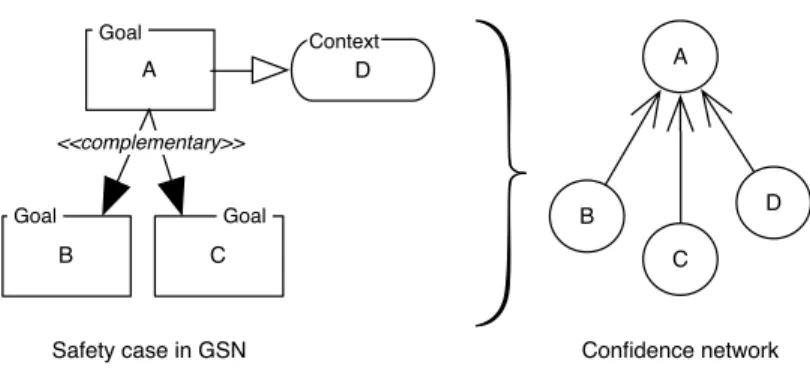
The previous arguments could be used also to integrate the confidence in the GSN "Con-text" element. Indeed, a context is actually a complementary element for the considered argument. Figure 10 presents a complementary argument, where a context has also been defined. In this case, the resulting network, is a node A, with three parents (B, C, D), and a noisy-and table for node A. When an alternative argument is used between B and C, then, an intermediate node I_BC is included, with an alternative table for B and C. The confidence table in A is a noisy-and between D and I_BC.
5.6 Sensitivity Analysis
We propose to perform a sensitivity analysis using a tornado graph. It is a simple sta-tistical tool, which shows the positive or negative influence of basic elements on main function. Basically, considering a function f (x1, ...xn), where values X1, ..., Xn of
the variables xi have been estimated, the tornado analysis consists in the estimation
B Confidence network A B C C Goal Goal D Context Safety case in GSN D A Goal <<complementary>>
Fig. 10. Mixed argumentation 1
f (X1, ..., Xi−1, Xmax, Xi+1, ...Xn), where Xminand Xmaxthe maximum and
mini-mum admissible values of variables xi. Hence for each xi, we get an interval of possible
variations of function f . The tornado graph is a visual presentation with ordered inter-vals. In our case, we estimate the intervals of g() with Xmin= 0 and Xmax= 1.
If we take the example of alternative argument, with arbitrary values q = 0.7 and p = 0.9, we get the following table:
g(B) 0 1
g(C) 0 1 0 1
g(A) 0 0.7 0.9 0.97
If we choose the values of g(B) = 0.8 and g(C) = 0.7, the confidence table leads to the value g(A) = 0.8572, also computed with the tool AgenaRisk3, presented
Figure 11. In this example, to determine the sensitivity to g(B), we keep all the values
C Uncertainty Confidence A 14.28% 85.72% 20% 80% 30% 70% B Uncertainty Confidence Uncertainty Confidence 0.4 0.5 0.6 0.7 0.8 0.9 1 g(B) p g(C) q 0.8572
Fig. 11. (a) Example of an alternative argument with the tool Agenarisk and (b) Corresponding Tornado graph
for p, q, and g(C), and only calculate the values g(A) for g(B) = 0 and g(B) = 1 (we obtain the values 0.49 and 0.949).
The same approach is used for other variables p, q, and g(C). The result is presented Figure 11 (b). In this tornado graph, g(B) appears to be the most influent parameter to decrease or increase the confidence in A. The left part is between 0.49 and 0.872, which
means that if g(B) is equal to its lower limit, then the confidence in A could be reduced to 0.49. On the opposite, with a maximum value of g(B), then confidence in A could reach 0.949.
Such an analysis leads to identify some sensitive points in a confidence network. This could be used to increase the confidence focusing first on the most positive sensi-tive points, or to focus on the elements where confidence should never be decreased (to consolidate the safety case confidence). Nevertheless, two main limits appear: it is not possible to identify combination of confidence variations, and such a diagram does not identify which variables are the easiest to increase. For instance, even if g(C) appears to be less influent, it may be easier to increase its confidence than the one in g(B). Our approach does not focus on those aspects, but they are important points to study.
6
Conclusion
This paper proposed a new approach for the definition and estimation of confidence in a safety case. We argue that it is important to have a separation between the safety case and the confidence case. Our aim is to analyze uncertainties that may be present in a safety case, using a sensitivity analysis. Our approach is based on the Dempster-Shafer theory for the definitions of confidence and uncertainty. But the constraint m(X, X) = 0, brings the main benefit of letting use mathematical tools, such as BBN. Hence, we proposed for most common safety case models in GSN, some transformation rules into a confidence network. We particularly introduce the use of noisy-or for alternative ar-guments, and an adapted version of noisy-and for complementary arguments. An ex-periment on a real case study of a rehabilitation robot [15] has been carried out [9]. A confidence graph of 65 nodes has been identified with only two alternative arguments (all the others were complementary). The complete analysis is still under development but, we were able to compute the complete graph and get a tornado graph in few min-utes with the AgenaRisk tool with consistent results. In this paper, we only focus on the feasibility of a quantitative estimation of confidence, and its propagation in a confidence network. But this is obviously completely dependent on the determination of the con-fidence values themselves. As already mentioned, this important issue is not addressed in this paper, but is part of our future work.
References
1. Anaheed, A., BaekGyu, K., Insup, L., Oleg, S.: A systematic approach to justifying sufficient confidence in software safety arguments. In: Frank, O., Peter, D. (eds.) Computer Safety, Re-liability, and Security Lecture Notes in Computer Science. vol. 7612, pp. 305–316. Springer Berlin Heidelberg (2012)
2. Anaheed, A., Jian, C., Oleg, S., Insup, L.: Assessing the overall sufficiency of safety ar-guments. In: 21st Safety-critical Systems Symposium (SSS’13), Bristol, United Kingdom (2013)
3. Bishop, P., Bloomfield, R., Guerra, S.: The future of goal-based assurance cases. In: DSN Workshop on Assurance Cases : Best Practices, Possibles Obstacles, and Future Opportuni-ties. Florence, Italy (July 2004)
4. Cyra, L., Górski, J.: Support for argument structures review and assessment. Reliability En-gineering and System Safety 96(1), 26–37 (2011)
5. Dardenne, A., Fickas, S., van Lamsweerde, A.: Goal-directed requirements acquisition. In: Science of Computer Programming. vol. 20, pp. 3–50 (1993)
6. DefStan 00-56: Defence standard 00-56 issue 3: Safety management requirements for de-fence systems. UK Ministry of Dede-fence (2004)
7. Denney, E., Habli, I., Pai, G.: Towards measurements of confidence in safety cases. In: Pro-ceedings of the 5th International Symposium on Empirical Software Engineering and Mea-surement (ESEM’11). Banff, Canada (September 2011)
8. Díez, F.J., Druzdzel, M.J.: Canonical probabilistic models for knowledge engineering. Tech. rep., Research Center on Intelligent Decision-Support Systems. UNED. Madrid, Spain (2007)
9. Do Hoang, Q.: Analyse et justification de la sécurité de systèmes robotiques en interaction physique avec l’humain (in French). Ph.D. thesis, INP Toulouse, LAAS-CNRS (2015) 10. Felipe, A., Mohamed, S., Walter, S., Siqi, Q.: On the distinction between aleatory and
epis-temic uncertainty and its implications on reliability and risk analysis. In: European Safety and Reliability Conference, ESREL 2013 (2013)
11. Fenton, N., Neil, M.: Risk Assessment and Decision Analysis with Bayesian Networks. CRC Press, Taylor and francis Group (2012)
12. Goodenough, J., Weinstock, C., Klein, A.: Eliminative induction: A basis for arguing sys-tem confidence. In: 35th International Conference on Software Engineering (ICSE2013). pp. 1161–1164 (May 2013)
13. Goodenough, J.B., Weinstock, C.B., Klein, A.Z.: Toward a theory of assurance case confi-dence. Tech. rep., Software Engineering Institute, Carnagie Mellon University (2012)
14. GSN-Standard: GSN COMMUNITY STANDARD VERSION 1.
http://www.goalstructuringnotation.info [Online; accessed Decembre 18th 2014] (2011) 15. Guiochet, J., Do Hoang, Q.A., Kaaniche, M., Powell, D.: Model-based safety analysis of
human-robot interactions: The MIRAS walking assistance robot. In: Rehabilitation Robotics (ICORR), 2013 IEEE International Conference on. pp. 1–7 (2013)
16. Hawkins, R., Kelly, T., Knight, J., Graydon, P.: A new approach to creating clear safety arguments. In: Proceedings of 19th Safety Critical Systems Symposium. Southampton, UK (February 2011)
17. Hitchcock, D.: Good reasoning on the toulmin model. Argumentation 19(3), 373–391 (2005) 18. Hobbs, C., Lloyd, M.: The application of bayesian belief networks to assurance case prepa-ration. In: Proceedings of the 20th Safety-Critical Systems Symposium, Bristol, UK. pp. 159–176. Springer London (2012)
19. Kelly, T.P.: Arguing Safety – A Systematic Approach to Managing Safety Cases. Ph.D. the-sis, University of York (1998)
20. Kelly, T., McDermid, J.: Safety case construction and reuse using patterns. In: 16th Interna-tional Conference on Computer Safety and Reliability (SAFECOMP97) (1997)
21. Littlewood, B., Wright, D.: The use of multilegged arguments to increase confidence in safety claims for software-based systems: A study based on a BBN analysis of an idealized exam-ple. IEEE Trans. Software Eng. 33(5), 347–365 (2007)
22. OMG-ARM: Structured assurance case metamodel (SACM), version 1. Object Management Group (2013)
23. Pearl, J.: Probabilistic reasoning in intelligent systems: networks of plausible inference. Mor-gan Kaufmann Publishers Inc. San Francisco, USA (1988)
24. Pollock, J.: Defeasible reasoning. Reasoning: Studies of Human Inference and Its Founda-tions pp. 451–469 (2008)
25. Toulmin, S.: The uses of argument. Cambridge University Press (1958)
26. Zhao, X., Zhang, D., Lu, M., Zeng, F.: A new approach to assessment of confidence in assurance cases. In: SAFECOMP Workshops. pp. 79–91 (2012)
![Fig. 1. GSN example adapted from Hazard Avoidance Pattern [20]](https://thumb-eu.123doks.com/thumbv2/123doknet/14423663.513792/3.918.254.660.448.795/fig-gsn-example-adapted-from-hazard-avoidance-pattern.webp)