HAL Id: hal-01723236
https://hal.inria.fr/hal-01723236
Submitted on 5 Mar 2018
HAL is a multi-disciplinary open access
archive for the deposit and dissemination of
sci-entific research documents, whether they are
pub-lished or not. The documents may come from
teaching and research institutions in France or
abroad, or from public or private research centers.
L’archive ouverte pluridisciplinaire HAL, est
destinée au dépôt et à la diffusion de documents
scientifiques de niveau recherche, publiés ou non,
émanant des établissements d’enseignement et de
recherche français ou étrangers, des laboratoires
publics ou privés.
Delphine Demange, Yon Fernández de Retana, David Pichardie
To cite this version:
Delphine Demange, Yon Fernández de Retana, David Pichardie. Semantic reasoning about the sea
of nodes. CC 2018 - 27th International Conference on Compiler Construction, Feb 2018, Vienna,
Austria. pp.163-173, �10.1145/3178372.3179503�. �hal-01723236�
2 3 4 5 6 7 8 9 10 11 12 13 14 15 16 17 18 19 20 21 22 23 24 25 26 27 28 29 30 31 32 33 34 35 36 37 38 39 40 41 42 43 44 45 46 47 48 49 50 51 52 53 54 55 57 58 59 60 61 62 63 64 65 66 67 68 69 70 71 72 73 74 75 76 77 78 79 80 81 82 83 84 85 86 87 88 89 90 91 92 93 94 95 96 97 98 99 100 101 102 103 104 105 106 107 108 109 110
Semantic Reasoning about the Sea of Nodes
Delphine Demange
Univ Rennes / Inria / CNRS / IRISA France
Yon Fernández de Retana
Univ Rennes / Inria / CNRS / IRISA France
David Pichardie
Univ Rennes / Inria /CNRS / IRISA France
Abstract
TheSea of Nodes intermediate representation was introduced by Cliff Click in the mid 90s as an enhanced Static Single As-signment (SSA) form. It improves on the initial SSA form by relaxing the total order on instructions in basic blocks into explicit data and control dependencies. This makes programs more flexible to optimize. This graph-based representation is now used in many industrial-strength compilers, such as HotSpot or Graal. While the SSA form is now well under-stood from a semantic perspective – even formally verified optimizing compilers use it in their middle-end – very few se-mantic studies have been conducted about the Sea of Nodes. This paper presents a simple but rigorous formal seman-tics for a Sea of Nodes form. It comprises a denotational component to express data computation, and an operational component to express control flow. We then prove a fun-damental, dominance-based semantic property on Sea of Nodes programs which determines the regions of the graph where the values of nodes are preserved. Finally, we apply our results to prove the semantic correctness of a redundant zero-check elimination optimization. All the necessary se-mantic properties have been mechanically verified in the Coq proof assistant.
CCS Concepts • Software and its engineering → For-mal language definitions; Compilers; ForFor-mal software verification;
Keywords Intermediate Representation, Semantics, Sea of Nodes, SSA, Verified Compilation
ACM Reference Format:
Delphine Demange, Yon Fernández de Retana, and David Pichardie. 2018. Semantic Reasoning about the Sea of Nodes. InProceedings
of 27th International Conference on Compiler Construction (CC’18). ACM, New York, NY, USA,11pages.https://doi.org/10.1145/3178372.
3179503
1
Introduction
Compiler designers seek for suitable program intermediate representations (IR) that will at the same timesimplify the design of advanced program optimizations and also enable a veryefficient implementation of these transformations.
An important breakthrough in the IR landscape is the Static Single Assignment (SSA) form, introduced by Rosen, Wegman and Zadeck [19] in the late 80s. Programs in SSA
CC’18, February 24–25, 2018, Vienna, Austria 2018. ACM ISBN 978-1-4503-5644-2/18/02. . . $15.00
https://doi.org/10.1145/3178372.3179503
form have all their variables statically assigned exactly once. This apparently simple property makes program easier to analyze and optimize, as it makes unambiguous the link between the unique definition of a variable and its usage. In contrast, analyzing a non-SSA program requires to reason on all possible reaching definitions. SSA is now widely adopted in many modern compilers (e.g., GCC or LLVM) or code generators [13]. There, the SSA form is built on top of a control-flow-graph representation of the program, with basic blocks holding instruction lists.
Another important milestone in optimization-dedicated program IR is the Sea of Nodes, introduced by Cliff Click in his PhD thesis [7]. This IR was first implemented in the Java HotSpot [14] compiler – where it remains an important build-ing block. It has inspired a lot of variants, in particular in the LibFirm [4] library, and the IR of the Graal framework [12]. In addition to be a SSA form, the salient property of the Sea of Nodes is that it makes program dependencies more explicit, while removing unnecessary constraints in the pro-gram control-flow graph. In particular, the total order be-tween instructions of a basic block is relaxed. Instead, elemen-tary instructions are linked to theirimmediate predecessors for data and control-flow dependencies. As an example, for a program fragment likeif b then {x= −a; y = c + 1}, the assignmenty= c + 1 will float in a graph node linked only to the definition of the variablec (data dependence) and to another node representing the evaluation of the boolean conditionb to true (control-flow dependence). Here, the program ordering between the assignments tox and y is unnecessary, and hence simply erased in the IR. It is only later in the compiler back-end that instructions arescheduled : instructions are ascribed a specific basic block, and a total order on instructions is decided within each basic block. As pointed at by Braun et al. [4], having in the IR dependencies only is what renders some optimizations simplyinherent to the program. Some other fast, combined optimizations [6] can also be performed that directly operate on the data and control dependencies.
SSA in Verified Compilers. During the last ten years, the formal verification of realistic compilation techniques has become reality, inspired and piloted by the advent of the CompCert compiler [17], a formally verified C compiler. The SSA representation is arrived more lately in this landscape with the independent efforts around CompCertSSA [1] and Vellvm [23,24]. The CompCertSSA [1] project uses a com-plete, verified validator, for the generation of pruned-SSA, based on dominance frontiers [9]. The Vellvm project proves
111 112 113 114 115 116 117 118 119 120 121 122 123 124 125 126 127 128 129 130 131 132 133 134 135 136 137 138 139 140 141 142 143 144 145 146 147 148 149 150 151 152 153 154 155 156 157 158 159 160 161 162 163 164 165 166 167 168 169 170 171 172 173 174 175 176 177 178 179 180 181 182 183 184 185 186 187 188 189 190 191 192 193 194 195 196 197 198 199 200 201 202 203 204 205 206 207 208 209 210 211 212 213 214 215 216 217 218 219 220 in [23,24] a simplified version of the LLVM SSA
genera-tion, based on register promotion. Recently, the generation algorithm proposed by Braun et al. [3] has been formal-ized in Isabelle/HOL [5]. Apart from the generation itself, some progress has also been made on the formalization of the useful invariants and properties of SSA that ease the reasoning when it comes to proving optimizations. For in-stance, [1,11,23] formalize the strictness semantic invariant, basic equational reasoning and dominance-region reasoning. These are semantic tools that allow proving formally the correctness of Sparse Conditional Constant Propagation and Common Subexpression Elimination based on Global-Value-Numbering [11], or Copy Propagation and micro memory optimizations [23].
Sea of Nodes Execution Model. The Sea of Nodes repre-sentation has not yet been used in a compiler verification context. In [7], Click proposes a Petri net execution model for the control part of its representation. It is only informally described with prose, and has not been, to our knowledge, manipulated in correctness proofs.
Most of the compiler verification literature advocates the use of operational semantics to ease the reasoning about compiler IRs and transformations in a proof assistant. The Petri net model from [7] does not suit this need, and we are not aware of any compiler optimization formalization that directly operates on a dependency graph a la Sea of Nodes. Interestingly, the earliest mechanized formalization of the SSA form, dating back to the work of Blech et al. [2], investi-gates how to reflect data-dependencies in the semantics of SSA. Through the use of eitherterm graphs or relational sets, they respectively try to capture syntactic dependencies in-side expressions, or the partial order defining an evaluation strategy for SSA basic blocks. This early work is an interest-ing outlook on data-dependencies, but it is limited to basic SSA only (with instructions bound to their basic blocks), and they deal in their proof with a simple code generation from asingle basic block.
In contrast, we want to explore the full-fledged Sea of Nodes from anoptimizing compilation perspective. In par-ticular, the “floating” nature of many nodes in the represen-tation, while allowing for more flexibility for optimizations, raises several interesting questions. This includes designing a new semantics, necessarily different from the SSA semantics found in verified optimizing compilers, that should i) ac-count for sharing between common subexpression graphs, and ii) reflect the floating nature of nodes. In turn, this new semantics calls for new semantic properties, and optimiza-tion proof techniques.
Contributions. In this work, we propose a formal semantics for a Sea of Nodes form, that could serve as a basis for its in-tegration in a verified compiler infrastructure. This requires identifying the important semantic properties that this IR provides, and that justify formally the semantic correctness
of program analyses and optimizations. More precisely, we make the following contributions:
• We define a semantics for a Sea of Nodes form (Sec-tion2). First, the evaluation of data nodes uses an intuitive denotational semantics, that closely matches the natural interpretation of data nodes as expressions. Second, the main execution propagates from one re-gion of the graph to the next according to a small-step, operational semantics, as a natural extension of the CompCertSSA [1] or Vellvm [23] semantics.
• We prove a fundamental, semantic property on Sea of Nodes graphs (Section3): during program execution, the value given to a data nodex keeps valid in all regions that are dominated byx.
• We illustrate this property by proving the semantic correctness of a fast redundant zero-check elimination algorithm that directly operates on the dominator tree of the Sea of Nodes program (Section4).
Our formal development within the Coq proof assistant is available athttp://www.irisa.fr/celtique/ext/sea-of-nodes/.
2
Sea of Nodes Syntax and Semantics
In this section, we give a syntax and semantics for a Sea of Nodes intermediate representation.
2.1 Syntax
We represent a Sea of Nodes function with a directed graph д. In this graph, nodes represent instructions or auxiliary helpers for the control flow. The edges represent dependen-cies between nodes: an edge from a noden to a node n′means thatn′depends onn. Intuitively, evaluating n′is necessary for evaluatingn. The node n is called an input or predecessor ofn′, andn′is called anoutput, or successor ofn.
Each node has a unique identifier in the graph, and is further defined by its kind (defined below), and the list of its input nodes. For a node with identifiern, if its kind is Node, and its inputs aren1andn2, we will use the following
graphical representation:
n: Node
n1: Node n2: Node
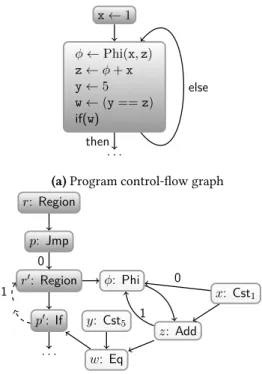
In the rest of the paper, to ease visual reading, we use differ-ent shades of gray to distinguish the kinds of nodes. Illustrative Example. Before we go further into the tech-nical definition of the Sea of Nodes IR, let us illustrate it on a simple example. Figure1gives an example of a simple SSA program in a basic-block control-flow graph (Figure1a), and its corresponding Sea of Nodes graph (Figure1b).
Let us focus on Figure1a. The program consists of a loop incrementing an integer counter. The counter is initialized to 1 and incremented of 1 at each iteration, until it reaches the value 5. Note that the program is in SSA form. Indeed,
221 222 223 224 225 226 227 228 229 230 231 232 233 234 235 236 237 238 239 240 241 242 243 244 245 246 247 248 249 250 251 252 253 254 255 256 257 258 259 260 261 262 263 264 265 266 267 268 269 270 271 272 273 274 275 276 277 278 279 280 281 282 283 284 285 286 287 288 289 290 291 292 293 294 295 296 297 298 299 300 301 302 303 304 305 306 307 308 309 310 311 312 313 314 315 316 317 318 319 320 321 322 323 324 325 326 327 328 329 330 t 1 S?B(t, x) x + t v 5 r (v == x) B7UrV . . . i?2M 2Hb2
(a) Program control-flow graph r: Region p: Jmp r0: Region p0: If φ: Phi w: Eq y: Cst5 z: Add x: Cst1 . . . 0 0 1 1
(b) Sea of Nodes graph. We indicate the indices of predecessors of phi-nodes and region nodes on arrow labels.
Figure 1. Example of an SSA program and its corresponding Sea of Nodes graph.
each variable is assigned at most once. To ensure this single assignment property at control-flow join points, we recall that, in SSA, for a junction point withm predecessors, a phi-instructionx ← Phi(x1, x2, . . . , xm) selects at run-time,
according to the control-flow path executed, the right defini-tion to use among all definidefini-tionsxi reaching that junction point. The correspondingxk is then assigned tox. In the program example, the control-flow join point is at the loop header, and the phi-instructionϕ ← Phi(x,z) is used to select the right definition of the counter (amongx and z). Hence, when entering the loop body for the first time,x will be selected. Starting from the second iteration of the loop,z will be selected. To define the semantics of phi-instructions, one must consider, in one way or the other, that predeces-sors of a juntion point are ordered, so as to select the right argument of the phi-instruction.
Let us now describe Figure1b, and highlight important aspects of the Sea of Nodes form. There are nodes for both data computations (light-grey nodes in Figure1b) and for control-flow execution (dark-grey nodes in Figure1b).
As an example of data nodes,z corresponds to the pseudo-code z←ϕ + x, its inputs are nodes ϕ and x. Similarly, w is a data node corresponding to the pseudo-code w←(y== z). Nodes related to control-flow execution are more involved. Region nodes are analogous to basic-blocks in SSA. In the example graph, there are two such nodes,r and r′, one for
each of the basic blocks in the pseudo-code program. Now, in order to transit from one region node to another, Sea of Nodes resorts oncontrol nodes (p and p′nodes in the example). Control nodes mark the “end” of a region, similarly to branching instructions found at the end of a basic block. Another point to note is that nodeϕ has region r′as an input: we need this dependency edge to define the value computed byϕ. As for the SSA form, predecessors of re-gion nodes as well as data node inputs of Phi nodes are supposed to be ordered, and their rank is used to trigger the evaluation of the right Phi node input. In figures, for clarity, predecessors index appears as label on dependency edges (see Figure1b). The dotted arrow from nodep′to noder′ abstracts an auxiliary control node, namely aprojection node, that we explain in the next paragraph.
Apart from Phi nodes, data nodes do not depend, at least directly, on a region node (see e.g., data nodesx and y), and are hence considered as "floating" in the graph. In particular, no constraint says whether nodex has to be evaluated before or after nodey, unlike the pseudo-code version could have led us to think.
Formal Definition of Nodes Table1gathers the formal definition of a Sea of Nodes graph. A graph is a (partial) map from node identifiers, and each node carries, in its very syntax, the identifiers of its input nodes.
In the table, and in the rest of the paper, we rely on nota-tional conventions to express the kind of a node in its iden-tifiers (e.g., data nodes range overx,y, z . . . , region nodes range overr, r′. . . ).
Data nodes represent instructions that compute a numeri-cal value. These include:
CstN corresponds to a constantN . This node does not depend on a region node (it is floating).
binop(x1, x2) corresponds to binary arithmetic
opera-tions. It has two data input nodesx1andx2. We
con-sider only arithmetic operations that do not raise ex-ceptions (such as division by zero). These nodes do not depend, at least immediately, on a region node. Phi(r, x1, . . . , xm) corresponds to a phi-instruction. It
depends on a region noder, and onm input data nodes x1, . . . , xm. The dependence onr is intrinsic to SSA: the
value of a Phi node is determined by the predecessor ofr that lead there.
We turn now our attention to the description of nodes related to the control-flow of the program.
Region(p1, . . . , pm) a region node withm predecessors
as input. Region predecessors are control nodes (see below). Only one region in the graph has no input: it is the entry point of the graph.
There are three kinds ofcontrol nodes ( Jmp, If, Return). For each region node, there is exactly one control node that depends on it. Such a node marks the exit of the region and
331 332 333 334 335 336 337 338 339 340 341 342 343 344 345 346 347 348 349 350 351 352 353 354 355 356 357 358 359 360 361 362 363 364 365 366 367 368 369 370 371 372 373 374 375 376 377 378 379 380 381 382 383 384 385 386 387 388 389 390 391 392 393 394 395 396 397 398 399 400 401 402 403 404 405 406 407 408 409 410 411 412 413 414 415 416 417 418 419 420 421 422 423 424 425 426 427 428 429 430 431 432 433 434 435 436 437 438 439 440 Table 1. Sea of Nodes: graph, node syntax, and notations
Graph g∈ id,→ node graph id= N node identifier Nodes node ::= data region control branch
data ::= CstN numerical constant
binop binary operation
phi
binop ::= Add(x,y) addition
Eq(x,y) boolean equality test
phi ::= Phi(r, x1, . . . , xm) ϕ-node
region ::= Region(p1, . . . , pm) region
control ::= jump cond
Return(r, x) return
jump ::= Jmp(r ) jump
cond ::= If(r, x) conditional
branch ::= IfT(if) then
IfF(if) else
Notations
id ∋x,y, z, w fordata
∋ϕ forphi
∋r forregion
∋c forcontrol
∋ if forcond
∋ p forjump or branch
∋n, n′ fornode
correspond to the branching instructions traditionally found at the end of a basic block.
Jmp(r) Control node depending on a region r and corre-sponding to a jump at the end ofr to another region. If(r, x) Control node depending on a region r and
corre-sponding to a conditional branch with conditionx. Return(r, x) Control node depending on a region r. It
terminates the execution of the function, returning the value of input data nodex.
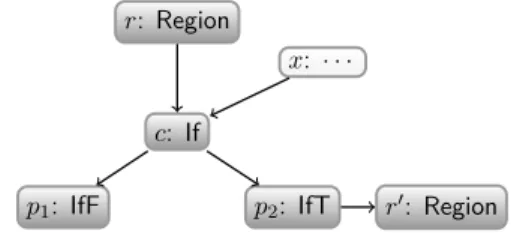
There are also two auxiliary branch nodes forthen and else branches of an If node, the so-called projection nodes [8], whose purpose is to distinguish the two possible outcomes of the boolean condition of the If node. This is a syntactical method for handling the If result, which is intuitively multi-value, with one value for thethen branch, and one for the else branch. It makes explicit the control dependence of the two If branches and it is useful for optimisations that want to analyse differently thethen branch from the else branch. As proposed by Click [8], we do not attach this information by labeling outgoing edges, but with two extra nodes. This
r: Region
c: If
x: · · ·
p1: IfF p2: IfT r0: Region
Figure 2. Conditional and Projections Nodes
projection nodes where previously omitted in Figure1for clarity.
IfF(if ), If T(if )
Projection node depending on an If nodeif. An IfF node corresponds to the entry of the branch taken in the case where the If condition isfalse, and the If T node corresponds to the case where it istrue.
Let us illustrate this feature with Figure2. The figure shows two regionsr and r′. The control node depending onr is an If node. This node has two projection successors: IfF and If T nodes. The evaluation of nodex determines which projection will be evaluated. If this evaluation gives atrue value, then the If T node is evaluated, and as a result execution will move from regionr to region r′.
Well-formedness conditions. The syntactic definitions we give in Table1do not reflect all the syntactic constraints that a Sea of Nodes graph should satisfy to have a well-defined semantics. We list now these well-formedness conditions. SSA-constraints In standard SSA form, the arity of theϕ
operators found at entry of a basic block must be equal to the number of incoming edges to this block. In Sea of Nodes, as shown in Figure1b, this constraint is now expressed by the fact that for eachϕ node Phi(r, x1, . . . , xm) that depends on a region noder, the
number of predecessors ofr is equal to m, the number ofϕ’s input data nodes.
Determinism Each region exits must be unambiguous: for each control nodec, there must exist a unique suc-cessor regionr′that depends onc. For a conditional control nodeif, this condition is chained in the fol-lowing way: there exists exactly one If T branch node and one IfF branch node that depend onif and both of them have unique successor regions.
Well-founded data dependencies The sub-graph of data dependencies between non-Phi data nodes must be acyclic. Cycles would prevent the evaluation of data node values.
Strictness The classical SSA strictness propery must still hold here: each variable use must be dominated by the unique definition of that variable. In Sea of Nodes, the meaning ofuse, dominated and definition must be
441 442 443 444 445 446 447 448 449 450 451 452 453 454 455 456 457 458 459 460 461 462 463 464 465 466 467 468 469 470 471 472 473 474 475 476 477 478 479 480 481 482 483 484 485 486 487 488 489 490 491 492 493 494 495 496 497 498 499 500 501 502 503 504 505 506 507 508 509 510 511 512 513 514 515 516 517 518 519 520 521 522 523 524 525 526 527 528 529 530 531 532 533 534 535 536 537 538 539 540 541 542 543 544 545 546 547 548 549 550 adapted but the property remains crucial to ensure that
each data node can be given a value during execution. Extensions In this paper, we do not model function calls. Their treatment is routine, and could be done as in any other intermediate representation. We hence only consider pro-grams with one single function.
In the paper, we also omit for clarity operations related to memory, although the Coq development handles them. Sea of Nodes requires to handle memory loads and stores with an SSA discipline. We hence introduce a specific memory value which represents the different versions of the memory during execution and explictly assigns SSA variables that represent the current value of the memory after each load and store. These two extra instructions do not alter the results we present in this paper.
2.2 Semantics
We now give a semantics to our Sea of Nodes IR. We use a denotational semantics to evaluate data nodes, while we use a small-step semantics for propagating execution from one region node to another. We fix a Sea of Nodes function with graphд, and all nodes are nodes of this graph д.
Environment. The denotational evaluation of data nodes makes use of an environmentρ, a partial mapping from ϕ-node to values. Indeed, ϕ-nodes are the only data nodes whose value depends directly on the control-flow, and as such they require special treatment. Other data nodes (con-stants and binary operations) values do not need to be stored in the environmentρ.
The small-step semantics updates the environment each time it reaches a junction point: for eachϕ-node of the target region, its value is updated, in a spirit similar to that of the CompCertSSA [1] semantics.
Notations. In the rest of the section, we refer to a numerical value returned by an instruction corresponding to a data node byv. The special values false and true are aliases for 0 and 1.
Execution states of a function, writtenσ, are of the form Start (initial state), Exec(r, ρ) (intermediate execution state), or Ret(v) (return state), where:
• r represents the current region node
• ρ is a partial mapping from ϕ-nodes to values • v is the return value of the function
We use the following notation too: op
binop(v1,v2): underlying function of a binop node. For
example, if the node is an Add, this function is the binary arithmetic operator+.
Data node denotational semantics. The evaluation of data nodes closely matches the natural interpretation of data nodes as expressions in Sea of Nodes. Indeed the sub-graph rooted in a data nodex, and composed of data-dependency
edges of non-Phi data nodes, is a directed acyclic graph (dag), where constants andϕ-nodes are leaves, and binop nodes play the role of internal nodes. As shown in Figure1b, the sub-graph rooted inw is composed of all light-grey nodes. This dag structure exactly matches the classic expression rep-resentation, but with sub-tree sharing. Theϕ-nodes should be seen as the variables of such an expression.
Thanks to the data dependency well-foundedness con-straint we explained in Section2.1, we can recursively com-pute the valueJxKρ of a data nodex, using the values of ϕ-nodes in the current environment ρ.
JxKρ= N ifд(x) = CstN ρ(x) ifд(x) = Phi(. . .) op binop(Jx1Kρ, Jx2Kρ) ifд(x) = binop(x1, x2)
For example, for the nodew of Figure1bwe obtain: JwKρ= (5 == ρ(ϕ) + 1)
The data dependency well-foundedness ensures the ter-mination of the computation ofJxKρ, but we also need to ensure that, for allϕ belonging to x’s expression-dag, ρ(ϕ) is defined. This is where the strictness assumption comes into play: during a function execution, in every region where we will need to evaluateJxKρ, the regions where all these ϕ nodes belong will already have been reached. Therefore, thoseϕ nodes will be defined in ρ.
Operational semantics for region evaluation. We now describe the execution of a Sea of Nodes function with graph д using an operational semantics −→step. The relation takes
the formσ −→step σ
′, which corresponds to evaluating a
region, and moving execution from one state to another. The environmentρ in a state Exec(r′, ρ) must be updated when reaching a regionr with more than one predecessors ( junction point with a list ofϕ-instructions). This update uses a parallel evaluation semantics, and affects all theϕ-nodes that depends on regionr.
Formally, we writep, r, ρ →ϕρ′the judgment that speci-fies how an environmentρ is updated into a new environ-mentρ′when the execution reaches regionr, coming from predecessorp of r. The judgment is defined by the following rule:
PHIS
philist(r ) = [ϕ1, . . . , ϕm] index(p, r ) = k
∀i = 1, . . . ,m, ntharg(ϕi, k) = xi JxiKρ = vi p, r, ρ →ϕρ[ϕi 7→vi for alli]
Ifn is an input of n′in the graph, we write index(n, n′) the index ofn among the list of inputs of the node n′. We write ntharg(ϕ, k) the k-th input data node of a Phi node ϕ, and philist(r ) the list of Phi nodes that directly depend on r (i.e., r is their first input).
The rule reads as follows: we update each Phi node that depends onr with the value computed for their k-th input
551 552 553 554 555 556 557 558 559 560 561 562 563 564 565 566 567 568 569 570 571 572 573 574 575 576 577 578 579 580 581 582 583 584 585 586 587 588 589 590 591 592 593 594 595 596 597 598 599 600 601 602 603 604 605 606 607 608 609 610 611 612 613 614 615 616 617 618 619 620 621 622 623 624 625 626 627 628 629 630 631 632 633 634 635 636 637 638 639 640 641 642 643 644 645 646 647 648 649 650 651 652 653 654 655 656 657 658 659 660 data node, wherek is the index of the predecessor p among
the inputs of regionr.
In the example of Figure1, this rule is used to successively update the environment at the loop header. When execution arrives fromp to r′initially, we have index(p, r′) = 0, so environment is updated so thatρ0(ϕ) = JxKρ = 1. Then,
whileJwKρ
i = false, execution loops from p′tor′. Because in this case index(p′, r′) = 1, we successively get for the next three iterations: firstρ1(ϕ) = JzKρ0 = 2, then ρ2(ϕ) = JzKρ1 = 3 and finally ρ3(ϕ) = JzKρ2 = 4.
Updating the values ofϕ nodes when reaching the region where they belong is a design choice that allows for a non-instrumented state: if environments were updated at the beginning of a region evaluation, it would be necessary to keep track of the region’s predecessor in execution states.
We now describe in detail the different rules for the op-erational semantics→−step. We write entry(д) to refer to the
entry point of the graphд. To alleviate notations, we simply writer, ρ for execution states of the form Exec(r, ρ), as it does not incur any possible confusion.
The first rule, START, corresponds to the start of execution of the function, and initializes the state: the starting region is entry(д) and the starting environment is the partial function ρempty, whose domain is empty.
START
entry(д) = r0 Start→−stepr0, ρempty
Next, we present rules for intermediate execution states. The common pattern of these rules is the following: i) eval-uate the control node of the current region ii) determine the successor region iii) update the environmentρ on the ϕ nodes of that successor region.
In the JMP rule, the control node ofr is a Jmp node. In this case, the step simply goes to the successor regionr′– remember it is uniquely determined, according to our well-formedness conditions. JMP д(c) = Jmp(r ) д(r′ )= Region(. . . ,c, . . .) c, r′, ρ → ϕρ′ r, ρ −→stepr ′, ρ′
The environment update can be applied because we know from which precedecessor ofr′ execution comes, in this case fromc (second premise). This pattern for updating the environment is found in every rule for control nodes with successors, i.e., it doesn’t apply for Return nodes.
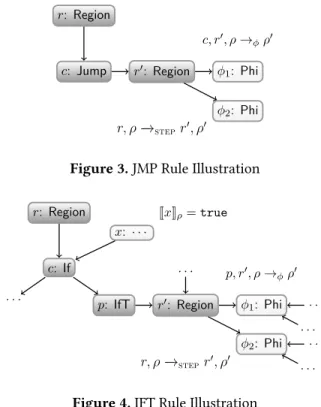
The JMP rule is illustrated in Figure3. The figure shows two region nodesr and r′. Regionr has a Jmp as control node, that induces evaluation ofr′. Then environment is updated forϕ-nodes depending on r′.
The IFF and IFT rules apply when the control node of the current region is an If node with projection nodes IfF and If T. Both rules are similar to the JMP rule, except that the environment update considers the projection node, rather
r: Region
c: Jump r0: Region φ1: Phi
φ2: Phi
c, r0, ρ→ φρ0
r, ρ−→stepr0, ρ0
Figure 3. JMP Rule Illustration r: Region c: If x: · · · . . . p: IfT r0: Region . . . φ1: Phi . . . . . . φ2: Phi . . . . . . JxKρ=true p, r0, ρ→φρ0 r, ρ−→stepr0, ρ0
Figure 4. IFT Rule Illustration
than If node, as the predecessor of the next region.
IFF
д(if ) = If(r, x) JxKρ = false
д(p) = IfF(if ) д(r′)= Region(. . . ,p, . . .) p, r′, ρ → ϕρ′ r, ρ −→stepr ′, ρ′ IFT д(if ) = If (r, x) JxKρ = true д(p) = IfT(if ) д(r′ ) = Region(. . . ,p, . . .) p, r′, ρ → ϕ ρ′ r, ρ −→stepr ′, ρ′
Figure4illustrates the rule IFT. The figure shows two region nodesr and r′. The first has an If as control node. The node x evaluates to true, so the IfT branch is evaluated. Then environment is updated forϕ-nodes depending on r′.
Finally, there is the RET rule, applicable when the control node of the current region is a Return. It corresponds to a function return, and the value of the input data node is returned as part of the state.
RET
д(c) = Return(r, x) JxKρ= v
r, ρ −→stepRet(v)
Function execution. We have a single START rule, and a rule RET for function return. The execution of a function is thus of the form Start→−step · · · −→stepRet(v).
In this paper, to alleviate the presentation, we use the return value as the unique observable behavior of a termi-nating execution of a function. The proofs presented here can naturally be extended to lists of observable events, as would be produced by e.g., a Print instruction.
661 662 663 664 665 666 667 668 669 670 671 672 673 674 675 676 677 678 679 680 681 682 683 684 685 686 687 688 689 690 691 692 693 694 695 696 697 698 699 700 701 702 703 704 705 706 707 708 709 710 711 712 713 714 715 716 717 718 719 720 721 722 723 724 725 726 727 728 729 730 731 732 733 734 735 736 737 738 739 740 741 742 743 744 745 746 747 748 749 750 751 752 753 754 755 756 757 758 759 760 761 762 763 764 765 766 767 768 769 770
3
Validity Domains for Values
Many compiler optimizations, e.g., GVN [19], constant prop-agation, or redundant null-pointer checks elimination [16] require reasoning, statically, about the possible values that variables or expressions may have at certain places in the program. In practice, such optimizations rely on the control-flow structure of programs, using notions like dominance, in order to ease the description of where, in the program, a particular value is valid, or preserved.
In this section we give, in terms of dominance, a funda-mental property that is useful for such reasonings in the context of a Sea of Nodes IR. In Section4, we illustrate how this property allows to prove the semantics preservation of a redundant zero-check elimination.
3.1 Value Preservation Property
We now give the conditions under which the value of a data node is preserved along an execution path. We fix a Sea of Nodes function with graphд from now on.
Phi dependencies of a data node. We use the notation phideps(x) to refer to the set of all ϕ-nodes appearing in the expression associated tox. More formally:
phideps(x) = ∅ ifд(x) = CstN {x} ifд(x) = Phi(. . .) phideps(x1) ∪ phideps(x2) ifд(x) = binop(x1, x2)
In the example graph of Figure1, we have phideps(x) = ∅, phideps(y) = ∅, phideps(z) = {ϕ}, and phideps(w) = {ϕ}.
The following lemma states that the value of a data node only depends on the value of the Phi nodes it depends on.
Lemma 3.1. Letx be a data node of a graph д. Let ρ and ρ′be two environments. If for allϕ ∈ phideps(x) we have
ρ(ϕ) = ρ′
(ϕ), then JxKρ= JxKρ′.
Proof. First we note that the hypothesis, thanks to well-formedness of data dependencies, ensures thatJxKρis de-fined, because allρ(ϕ) for ϕ ∈ phideps(x) are defined. The proof is done by induction on the definition ofJxKρ: the base case of induction is ensured by the fact that both evaluations
match onϕ-nodes. □
The next lemma states that the value of a data nodex is preserved as long as execution does not move to a region whose correspondsϕ nodes belong to phideps(x).
Lemma 3.2. Let
Exec(r0, ρ0) · · · −→step Exec(rm, ρm)
be an execution path. Letx be a data node such that JxKρ 0 is defined. Assume that, for allϕ ∈ phideps(x), and for all i = 1 . . .m, ϕ < philist(ri). ThenJxKρ0= JxKρm.
Proof sketch. We prove by induction on the execution path from Exec(r0, ρ0) to Exec(rm, ρm), that for allϕ ∈ phideps(x),
ρ0(ϕ) = ρm(ϕ). The main argument involves noticing that
in applications of the PHIS rule along the execution path, noϕ ∈ phideps(x) is involved, thanks to the hypothesis.
Lemma3.1allows to conclude the proof. □
3.2 Dominance-Based Formulation
Dominance is a useful notion to describe control-flow proper-ties when proving the correctness of some optimizations, in particular those involving elimination of redundant compu-tations or run-time checks. In this section we define such a notion for our Sea of Nodes representation, and reformulate Lemma3.2in terms of dominance, so that it is easier to apply in proofs of optimizations.
First, we give an analogue of the standard basic-block CFG on Sea of Nodes.
Definition 3.3 (CFG). We call CFG of a Sea of Nodes graph д, the directed graph whose nodes are region nodes, and where there is an edge from noder to node r′if the control node depending onr is:
• a Jmp node whose output isr′,
• or an If with an output projection node that hasr′as output.
This allows to define on the Sea of Nodes CFG an analogue to the standard dominance relation as follows:
Definition 3.4 (Dominance). A region noder dominates a region noder′if every path in the CFG from the entry point ofд to r′passes throughr. The dominance is strict if r , r′. This dominance relation applies to region nodes only : it is defined at a coarser level than what is done in traditional basic-block CFG. Below, we extend this notion so that it handles data nodes as well. Informally, for a data node to dominate a region noder, all of its ϕ dependencies should belong to regions that dominater. Formally:
Definition 3.5. (Data node dominance) A data nodex domi-nates a region noder if, for all ϕ and r′
ϕsuch asϕ ∈ phideps(x) andд(ϕ) = Phi(r′
ϕ, . . .), we have that rϕ′ dominatesr. The dominance is strict ifr′
ϕ, r for all such ϕ.
Dominance and evaluability. In the literature on SSA for-malization, the so-called equational lemma from [1] is of particular importance. It states that the equation defining a variablex is valid at the points dominated by the defini-tion point ofx. Here, in a Sea of Nodes function, data nodes (excluding Phi nodes) have no real definition point – they float. Yet, this particular property, the equational lemma, is in fact baked in the data node evaluation semantics: data node values are always valid, so to say. They only need to be defined. The following lemma allows to characterize, using dominance, the regions in a Sea of Nodes graph where a data node is indeed defined.
771 772 773 774 775 776 777 778 779 780 781 782 783 784 785 786 787 788 789 790 791 792 793 794 795 796 797 798 799 800 801 802 803 804 805 806 807 808 809 810 811 812 813 814 815 816 817 818 819 820 821 822 823 824 825 826 827 828 829 830 831 832 833 834 835 836 837 838 839 840 841 842 843 844 845 846 847 848 849 850 851 852 853 854 855 856 857 858 859 860 861 862 863 864 865 866 867 868 869 870 871 872 873 874 875 876 877 878 879 880 Lemma 3.6. Let Exec(r, ρ) be a reachable state. Let x be a
data node such thatx dominates r. Then JxKρis defined. Proof sketch. Letπ be an execution path from state Start to state Exec(r, ρ).
We prove first the property for a nodeϕ with д(ϕ) = Phi(r′, . . .). The fact thatϕ dominates r means in this case thatr′dominatesr. Hence, there exists ρ′such that a state Exec(r′, ρ′) appears inπ. As a result, our semantics for ϕ-node evaluation when coming to regionr′ensures thatρ′(ϕ) is defined, and since the environment updating semantics only extends the domain of environments during execution, ρ(ϕ) is also defined.
Now, for the other forms of data nodex, it is true that for everyϕ ∈ phideps(x), ρ(ϕ) is defined, because, by definition, such aϕ dominates r too. We conclude the proof with
well-foundedness of data node dependencies. □
Note that this specific lemma is not strictly necessary for the other semantics proofs of the paper, and has not been mechanically verified.
Application to value preservation. We obtain the follow-ing corollary of Lemma3.2for value preservation in terms of dominance.
Theorem 3.7. Let
Exec(r0, ρ0) · · · −→step Exec(rm, ρm)
be an execution path. Letx be a data node such that JxKρ 0 is defined. If, for alli = 1 . . .m, x strictly dominates ri, then JxKρ0= JxKρm.
Proof sketch. Becausex strictly dominates ri, we know that for allϕ ∈ phideps(x), we have ϕ < philist(ri). We can
therefore apply Lemma3.2. □
This theorem states that, as long as execution remains in a particular area of the graph, the area dominated byx, the value ofx remains unmodified. As an example, an application of this result to prove semantics preservation of a redundant zero-check transformation can be found in the next section. Theorem3.7is a little less general than Lemma3.2because it is restricted to execution path where each region is under the dominance of a given data nodex, while executions in Lemma3.2can continue outside the dominance zone ofx, as long as they do not reachϕ-nodes in conflict with phideps(x). But we believe the dominance characterization used in this theorem is closer to compiler designer intuition.
4
Redundant Zero-Check Elimination
Languages with rich and precise exception mechanisms of-ten require the injection in the compiler IR of numerous explicit checks – for null-pointers typically, to guarantee a safe execution of the program. This dramatically reduces the
scope program optimizations (and impacts the program exe-cution running time). Redundant checks elimination allows to mitigate this issue.
In this section, we illustrate how to justify formally the se-mantic correctness of a redundant zero-check elimination on the Sea of Nodes form, using the results of previous sections.
4.1 Language Extension: ZeroCheck Nodes
We extend our Sea of Nodes form with a new control node, ZeroCheck(r, x ). It executes like a jump to its successor, unless its input data nodex evaluates to zero. In this case the execution goes to an error state Ret(fail). Here, fail is a new special value, introduced to model failure during program execution.
This gives the following two semantic rules:
ZCHK1 д(c) = ZeroCheck(r, x) д(r′) = Region(. . . ,c, . . .) c, r′, ρ → ϕ ρ′ JxKρ= v , 0 r, ρ −→stepr ′, ρ′ ZCHK2 д(c) = ZeroCheck(r, x) JxKρ= 0
r, ρ −→stepRet(fail)
Figure5gives an example of Sea of Nodes graph with two ZeroCheck nodesc1andc3. This example graph has a loop
and three conditionals. We use it in this section to illustrate the presentation.
4.2 Criteria for Redundancy
Deciding whether a ZeroCheck is redundant or not is equiv-alent to deciding if an arbitrary data node never evaluates to zero, which is undecidable in general.
Therefore, we need an approximation. Here, we use the following structural criteria for redundancy:
Definition 4.1. A regionr has a redundant ZeroCheck if the following holds:r is a region node whose control node is a ZeroCheck(r, x), and there exists a region node r′strictly dominatingr whose control node is a ZeroCheck(r′, x).
For example, in Figure5, the criteria is satisfied forr3:
indeed, it is strictly dominated byr1, and both region nodes
have a ZeroCheck control node whose input data node isx.
Value preservation applied to zero-checks. The results of the previous section on validity domains for values can be used to justify the intuition behind our criteria. We have the following corollary of Theorem3.7:
Corollary 4.2. Let Exec(r′, ρ′) be a reachable execution state.
Letr be a region node whose control node is a ZeroCheck(r, x). Ifr strictly dominates r′, thenJxKρ′, 0.
Proof sketch. By hypothesis, there exists an execution path π to state Exec(r′, ρ′
). Becauser dominates r′, there exists a state inπ whose region is r. Let us consider the most recent
881 882 883 884 885 886 887 888 889 890 891 892 893 894 895 896 897 898 899 900 901 902 903 904 905 906 907 908 909 910 911 912 913 914 915 916 917 918 919 920 921 922 923 924 925 926 927 928 929 930 931 932 933 934 935 936 937 938 939 940 941 942 943 944 945 946 947 948 949 950 951 952 953 954 955 956 957 958 959 960 961 962 963 964 965 966 967 968 969 970 971 972 973 974 975 976 977 978 979 980 981 982 983 984 985 986 987 988 989 990 r0: Region c0: If p0: IfF p1: IfT r1: Region c1: ZeroCheck r2: Region c2: If p2: IfF p3: IfT r3: Region c3: ZeroCheck r4: Region c4: If p4: IfF p5: IfT r5: Region c5: Return . . . . . . . . . . . . x: Add φ: Phi . . . . . .
Figure 5. Dominance and Redundant ZeroCheck Illustration
state, inπ, whose region node is r. Namely, we can consider the endπ′ofπ:
Exec(r, ρ) · · · −→stepExec(r ′, ρ′
)
such that for every other state Exec(r′′, ρ′′) after Exec(r, ρ) inπ′,r′′, r . The following fact holds: for every such r′′,r dominatesr′′. Indeed, any pathπ1from the entry point to
r′′
can be extended to a pathπ1·π2from the entry point to
r′, whereπ
2is a suffix ofπ
′. Sincer dominates r′,r belongs
toπ1·π2, butr does not belong to π′(neither toπ2), sor belongs toπ1. It proves thatr dominates r
′′.
Moreover, well-formedness properties ensure that a node dominates its usages, so in particularx dominates r. Hence, x dominates strictly any such r′′(dominance is a transitive
relation). Because there is a ZeroCheck atr and execution does not end there, ZCHK1 was applied, soJxKρ , 0. By Theorem3.7, we haveJxKρ = JxKρ′. Therefore,JxKρ′, 0. □ This corollary gives hypotheses, in terms of dominance and reachability, under which we know a node evaluates to a non-zero value for a particular environment. Ifr′has a ZeroCheck as control node, the configuration is exactly that of our redundancy criteria: the ZeroCheck ofr′is redun-dant. This corollary is indeed key to prove formal semantics preservation (subsection4.4).
4.3 Redundant Zero-Check Detection Algorithm
The algorithm we consider here is a recursive variant of the one found in the Go compiler [18,20]. It is based on a single traversal of the dominator tree. We just adapted it to fit our IR. In particular, the dominator tree encodes the dominance relation between region nodes of a Sea of Nodes graph. We define it precisely now.
Definition 4.3 (Immediate Dominator). A region noder is an immediate dominator of a region noder′ifr , r′,r dominatesr′, andr does not dominate any other dominator ofr′.
For example, in Figure5, noder2is an immediate domina-tor of noder3, butr1is not, becauser1dominatesr2.
A standard property states that there is at most one imme-diate dominator for every node. This is the basis for ensuring that the dominance relation among the nodes of a graph can be encoded in a tree structure.
Definition 4.4 (Dominator tree). The dominator tree of the CFG of a Sea of Nodes graph is a tree where nodes are the region nodes, and where the children of a node are the region nodes it immediately dominates.
The algorithm we consider is given in Figure6. In a nut-shell, the algorithm performs a single depth-first traversal of the dominator tree (domtree(д)), maintaining two maps from nodes to booleans. The first one,nonZero, keeps track of whether data nodes are non-zero (true) or may evaluate to zero (false). The second map, redundantZC, flags, for each region nodes, whether they have a redundant ZeroCheck control node.
Both maps are initialized toemptymap(node, bool), i.e., all nodes are mapped tofalse. Then, during the tree traver-sal, each time a region with a ZeroCheck control node is en-countered, the ZeroCheck node is flagged as being non-zero in the dominator subtree (i.e., the region nodes it dominates). In the algorithm, this is done with a three-step process. First, we save the current value of nonZero[x] (Line7). Second, we setnonZero[x] to true (Line9) and explore the subtree (Line11). Finally, we restore the old value ofnonZero[x] once subtrees have been traversed (Line12). When travers-ing the subtree, any ZeroCheck node on thesame data node will in turn be flagged as redundant (Line8).
For example, in the case of Figure5, when processing node r1, a ZeroCheck(r1, x) node c1 is found with inputx. The
algorithm then recalls this information when processing the nodes dominated byr1, that isr2andr3. While processingr3,
the algorithm finds a ZeroCheck(r3, x) node c3with the same
inputx, it knows it is redundant according to our criteria. We prove that the algorithm in Figure6indeed computes our redundancy criteria for region nodes.
Lemma 4.5. Let redundantZC= Analyse(д) and r such as redundantZC[r] = true. Then r has a redundant ZeroCheck in the sense of Definition4.1.
991 992 993 994 995 996 997 998 999 1000 1001 1002 1003 1004 1005 1006 1007 1008 1009 1010 1011 1012 1013 1014 1015 1016 1017 1018 1019 1020 1021 1022 1023 1024 1025 1026 1027 1028 1029 1030 1031 1032 1033 1034 1035 1036 1037 1038 1039 1040 1041 1042 1043 1044 1045 1046 1047 1048 1049 1050 1051 1052 1053 1054 1055 1056 1057 1058 1059 1060 1061 1062 1063 1064 1065 1066 1067 1068 1069 1070 1071 1072 1073 1074 1075 1076 1077 1078 1079 1080 1081 1082 1083 1084 1085 1086 1087 1088 1089 1090 1091 1092 1093 1094 1095 1096 1097 1098 1099 1100 1 Analyse(g): 2 sdom ← domtree(g)
3 nonZero ← emptymap(node, bool) 4 redundantZC ← emptymap(node, bool) 5 DepthFirst(r):
6 if control(g, r) matches ZeroCheck(r, x):
7 nz ← nonZero[x] 8 redundantZC[r] ← nz 9 nonZero[x] ← true 10 for r' in sdom.successors(r): 11 DepthFirst(r') 12 nonZero[x] ← nz 13 else: 14 for r' in sdom.successors(r): 15 DepthFirst(r') 16 DepthFirst(entry(g)) 17 return redundantZC
Figure 6. Redundant ZeroCheck Detection
The reciprocal of the previous lemma holds too: if a region node with a ZeroCheck control node satisfies our dominance-based redundancy criteria, then the analysis detects it. For in-stance, on the graph in Figure5, we obtainredundantZC[r3]=
true. More formally:
Lemma 4.6. Let redundantZC= Analyse(д). If r has a re-dundant ZeroCheck, thenredundantZC[r] = true.
4.4 ZeroCheck Elimination: Semantic Correctness LetredundantZC= Analyse(д). The redundant ZeroCheck Elimination optimization proceeds by replacing, in the graph д, every ZeroCheck(r, x) for which redundantZC[r] = true with a simple Jmp(r ) node. We write д′the graph resulting from this transformation. In the case of Figure5, the analysis gives us thatredundantZC[r3]= true, so д
′is obtained from
д by changing the node c3by Jmp(r3).
We prove that this transformation is correct semantically. Namely, that the initial and transformed graphs have the same semantics. We write→−stepд to mean that the step is
done in within a graphд. The theorem we prove is as follows. Theorem 4.7. We have Start · · · −→stepд Ret(v) if, and only
if, Start· · · −→stepд′ Ret(v).
We prove the above theorem by establishing a simula-tion relasimula-tion between the two graphs. In the case of the Redundant ZeroCheck Elimination, the link between both execution states is strong: both states are simply equal at each step of the execution.
Given a stateσ, the predicate reachableд(σ ) means that there exists an execution path from Start toσ in д.
Lemma 4.8. Letσ be state such that reachableд(σ ). For all
σ′, we have
σ −→stepд σ
′if, and only if,σ −→ stepд′ σ
′
Proof sketch. The only subtle case is the case whereσ = Exec(r, ρ) and the control node of r in д is a ZeroCheck(r, x) that has been optimized into a Jmp(r ) in д′.
If it was optimized, then it must be thatredundantZC[r] = true. Lemma4.5ensures that there existsr′strictly domi-natingr whose control node is a ZeroCheck(r′, x).
Supposeσ −→stepд σ
′. We know thatσ is a reachable state,
so we can apply Corollary4.2. Hence,JxKρ = v with v , 0, and the ZeroCheck passes (the applicable rule is ZCHK1), andд′can match the step anyway by executing its Jmp node (which has the same successor).
Now, ifσ −→stepд′ σ
′through the Jmp node, we match this
step inд with rule ZCHK1, which we know is applicable (by Corollary4.2, becauseσ is reachable in д).
□
5
Conclusion and Future Work
In this paper, we have proposed a formal semantics for a Sea of Nodes representation. The salient aspects of the seman-tics are twofold. First, it doesn’t bind data computation to a particular region node. Rather, data nodes (and their de-pendencies) are evaluated on demand, using a denotational semantics in an environment that keep tracks of the current values of phi-nodes. Second, the control-flow execution of a Sea of Nodes is defined operationally, using a small-step semantics between region nodes. During the course of our formalization work, we relied on a prototype interpreter reflecting the semantic rules so as to make sure that our formalization was indeed executable.
On top of this semantics, we proved a fundamental prop-erty of validity domain for value information of nodes in an area of the graph in terms of dominance. We used this property to prove the semantics preservation of a redundant zero-check elimination algorithm. We think that the same property, and similar reasoning would allow to prove the semantics correctness of other optimizations, such as Global Value Numbering, which require to justify that some nodes have the same value at two different places.
Our Coq development also includes a formalization of a Simple Constant Propagation algorithm. The simulation argument is similar to the one of the ZeroCheck elimination, but does not involve fundamental properties from a Sea of Nodes point of view (e.g., dominance).
An important question not studied in this paper is the generation of the Sea of Nodes form. Click et al. [8] propose an incremental algorithm for building the SSA form while doing parse-time optimizations. As a first step towards its formal verification, an easier approach would be to rely on previous works on SSA generation [1,22], and to generate the Sea of Nodes from a basic-block based SSA: the transfor-mation would just need to remove superfluous control-flow dependences, keeping only relevant data and control depen-dences.
1101 1102 1103 1104 1105 1106 1107 1108 1109 1110 1111 1112 1113 1114 1115 1116 1117 1118 1119 1120 1121 1122 1123 1124 1125 1126 1127 1128 1129 1130 1131 1132 1133 1134 1135 1136 1137 1138 1139 1140 1141 1142 1143 1144 1145 1146 1147 1148 1149 1150 1151 1152 1153 1154 1155 1156 1157 1158 1159 1160 1161 1162 1163 1164 1165 1166 1167 1168 1169 1170 1171 1172 1173 1174 1175 1176 1177 1178 1179 1180 1181 1182 1183 1184 1185 1186 1187 1188 1189 1190 1191 1192 1193 1194 1195 1196 1197 1198 1199 1200 1201 1202 1203 1204 1205 1206 1207 1208 1209 1210 Another interesting topic is the transformation out of the
Sea of Nodes form, towards an IR closer to assembly. A pos-sible approach to tackle this difficult problem is to split it into three phases. The first phase is Global Code Motion [6]. In order to actually generate code, it is necessary to ascribe a region to every data node. Our Sea of Nodes representation semantics is not a sequential one: non-ϕ data nodes do not depend on a particular region node, and are evaluated with a denotational semantics. This raises an interesting question, because in order to prove that Global Code Motion is correct, we would need to prove equivalence between our seman-tics, and a basic-block based semantics. The second phase schedules instructions within basic-blocks. Blech et al. [2] give a basic-block based semantics to instruction evaluation that explicitly integrates dependencies and scheduling into their semantics. Their work allows for a transition between a semantics using only necessary data dependencieswithin a basic-block and a semantics using extra dependencies corre-sponding to a complete scheduling of the basic-block. Their work could possibly be used for this second part. In the third phase, it would remain to implementϕ-nodes, i.e., destruct-ing the SSA form. Here, we could possibly make use of some previous work done within the CompCertSSA project [10]. We are confident the work presented here is a solid base to at-tack these future works, and paves the way to an intregration of Sea of Nodes in formally verified compilers.
More generally, it would be worth investigating whether the results presented here could be applied to other similar intermediate representations [21], such as the Value State Dependent Graph [15].
Acknowledgments
This material is based upon work supported by the Agence Nationale de la Recherche under Grant No. ANR-14-CE28-0004.
References
[1] G. Barthe, D. Demange, and D. Pichardie. 2014. Formal Verification of an SSA-Based Middle-End for CompCert.ACM TOPLAS 36, 1 (2014), 1–35.
[2] J.O. Blech, S. Glesner, J. Leitner, and S. Mülling. 2005. Optimizing Code Generation from SSA Form: A Comparison Between Two Formal Correctness Proofs in Isabelle/HOL. InProc. of COCV’05 (ENTCS). Elsevier, 33–51.
[3] M. Braun, S. Buchwald, S. Hack, R. Leißa, C. Mallon, and A. Zwinkau. 2013. Simple and Efficient Construction of Static Single Assignment
Form. InProc. of CC’13 (LNCS), Vol. 7791. Springer, 102–122. [4] M. Braun, S. Buchwald, and A. Zwinkau. 2011.Firm—A Graph-Based
Intermediate Representation. Technical Report 35. Karlsruhe Institute of Technology.http://digbib.ubka.uni-karlsruhe.de/volltexte/1000025470 [5] S. Buchwald, D. Lohner, and S. Ullrich. 2016. Verified Construction of
Static Single Assignment Form. InProc. of CC’16. ACM, 67–76. [6] C. Click. 1995. Global Code Motion / Global Value Numbering. InProc.
of PLDI’95. 246–257.
[7] C. Click and K. D. Cooper. 1995. Combining Analyses, Combining Optimizations.ACM TOPLAS 17, 2 (1995), 181–196.
[8] C. Click and M. Paleczny. 1995. A Simple Graph-Based Intermediate Representation. InProc. of IR’95. 35–49.
[9] R. Cytron, J. Ferrante, B.K. Rosen, M.N. Wegman, and F.K. Zadeck. 1991. Efficiently computing static single assignment form and the control dependence graph.ACM TOPLAS 13, 4 (1991), 451–490. [10] D. Demange and Y. Fernandez de Retana. 2016. Mechanizing
Conven-tional SSA for a Verified Destruction with Coalescing. InProc. of CC’16 (CC 2016). 77–87.
[11] D. Demange, L. Stefanesco, and D. Pichardie. 2015. Verifying Fast and Sparse SSA-based Optimizations in Coq. InProc. of CC’15 (LNCS), Vol. 9031. 233–252.
[12] G. Duboscq, T. Würthinger, L. Stadler, C. Wimmer, D. Simon, and H. Mössenböck. 2013. An Intermediate Representation for Speculative Optimizations in a Dynamic Compiler. InProc. of VMIL’13. ACM, 1–10. [13] B. Dupont de Dinechin. 2014. Using the SSA-Form in a Code Generator.
InProc. of CC’14 (LNCS), Vol. 8409. Springer, 1–17.
[14] HotSpot 1999. Homepage of the project. http://openjdk.java.net/
groups/hotspot.
[15] N. Johnson and A. Mycroft. 2003. Combined Code Motion and Register Allocation Using the Value State Dependence Graph. InProc. of CC’03 (CC 2003). Springer-Verlag, 1–16.
[16] M. Kawahito, H. Komatsu, and T. Nakatani. 2000. Effective Null Pointer Check Elimination Utilizing Hardware Trap. InProc. of ASPLOS’00. 139–149.
[17] X. Leroy. 2009. A Formally Verified Compiler Back-end.JAR 43, 4 (2009), 363–446.
[18] Nilcheck elimination in Go 2017. Source code. https:
//github.com/golang/go/blob/release-branch.go1.9/src/cmd/compile/ internal/ssa/nilcheck.go.
[19] B. K. Rosen, M. N. Wegman, and F. Kenneth Zadeck. 1988. Global Value Numbers and Redundant Computations. InProc. of POPL’88. 12–27. [20] The Go programming language 2012. Homepage of the project. https:
//golang.org/.
[21] The SSA Book 2015. Latest release. http://ssabook.gforge.inria.fr/latest/book.pdf.
[22] J. Zhao. 2013.Formalizing an SSA-based compiler for verified advanced program transformations. Ph.D. Dissertation. University of Pennsylva-nia. Advisor(s) Zdancewic, Steve.
[23] J. Zhao, S. Nagarakatte, M. Martin, and S. Zdancewic. 2013. Formal verification of SSA-based optimizations for LLVM. InProc. of PLDI’13. ACM, 175–186.
[24] J. Zhao, S. Zdancewic, S. Nagarakatte, and M. Martin. 2012. Formal-izing the LLVM Intermediate Representation for Verified Program Transformation. InProc. of POPL’12. ACM, 427–440.