HAL Id: hal-00297185
https://hal.archives-ouvertes.fr/hal-00297185
Submitted on 10 Oct 2006
HAL is a multi-disciplinary open access
archive for the deposit and dissemination of
sci-entific research documents, whether they are
pub-lished or not. The documents may come from
teaching and research institutions in France or
abroad, or from public or private research centers.
L’archive ouverte pluridisciplinaire HAL, est
destinée au dépôt et à la diffusion de documents
scientifiques de niveau recherche, publiés ou non,
émanant des établissements d’enseignement et de
recherche français ou étrangers, des laboratoires
publics ou privés.
CF3Br in aircraft applications
Y. Li, K.O. Patten, D. Youn, D.J. Wuebbles
To cite this version:
Y. Li, K.O. Patten, D. Youn, D.J. Wuebbles. Potential impacts of CF3I on ozone as a replacement for
CF3Br in aircraft applications. Atmospheric Chemistry and Physics, European Geosciences Union,
2006, 6 (12), pp.4559-4568. �hal-00297185�
Atmos. Chem. Phys., 6, 4559–4568, 2006 www.atmos-chem-phys.net/6/4559/2006/ © Author(s) 2006. This work is licensed under a Creative Commons License.
Atmospheric
Chemistry
and Physics
Potential impacts of CF
3
I on ozone as a replacement for CF
3
Br in
aircraft applications
Y. Li, K. O. Patten, D. Youn, and D. J. Wuebbles
Department of Atmospheric Sciences, University of Illinois, Urbana, IL 61801, USA Received: 20 April 2006 – Published in Atmos. Chem. Phys. Discuss.: 26 June 2006 Revised: 29 September 2006 – Accepted: 1 October 2006 – Published: 10 October 2006
Abstract. Iodotrifluoromethane (CF3I) has been considered
to be a candidate replacement for bromotrifluoromethane (CF3Br), which is used in aircraft for fuel inerting and for
fire fighting. In this study, the chemical effects of aircraft-released CF3I on atmospheric ozone were examined with the
University of Illinois at Urbana-Champaign two-dimensional chemical-radiative-transport (UIUC 2-D CRT) model. Using an earlier estimate of the aircraft emission profile for tank inerting in military aircraft, the resulting equivalent Ozone Depletion Potentials (ODPs) for CF3I were in the range of
0.07 to 0.25. As a sensitivity study, we also analyzed CF3I
emissions associated with fuel inerting if it were to occur at lower altitudes using an alternative estimate. The model calculations of resulting effects on ozone for this case gave ODPs≤0.05. Furthermore, through interactions with the Na-tional Institute of Standards and Technology (NIST), we an-alyzed the potential effects on ozone resulting from using CF3I in fire fighting connected with engine nacelle and
aux-iliary power unit applications. The scenarios evaluated using the NIST estimate suggested that the ODPs obtained by as-suming aircraft flights occurring in several different latitude regions of the Northern Hemisphere are extremely low. Ac-cording to the model calculation, the altitude where CF3I is
released from aircraft is a dominant factor in its ozone deple-tion effects. On the assumpdeple-tion that the CF3I emission
pro-file is representative of actual release characteristics, aircraft-released CF3I has much lower impacts than CF3Br.
1 Introduction
Bromotrifluoromethane (CF3Br), also referred to as Halon
1311 or H-1311, has been used for aircraft fire extinguishing systems because of its high fire suppression efficiency, low cost, and low toxicity. However, CF3Br is known as an ozone
Correspondence to: D. J. Wuebbles
depletion chemical with a lifetime of about 65 years (WMO, 1999) so that tropospheric release will make its way into the stratosphere. For this reason, substitute chemicals must be considered for replacing CF3Br usage in aircraft uses.
H-1311 has been used both as a fuel inerting agent in mili-tary aircraft and as a fire-fighting agent in a number of mil-itary and commercial aircraft. Iodotrifluoromethane (CF3I),
a close chemical cousin of CF3Br, has been considered to be
a potential replacement, even though iodine is extremely re-active with oxygen because it is photolytically rere-active and easily degraded by solar radiation in the atmosphere, result-ing in an atmospheric lifetime of CF3I that is extremely short,
approximately on the order of hours to days.
CF3I photolyzes rapidly to form reactive iodine atoms
even under visible light conditions. Therefore, it could be treated as a potential significant source of atmospheric io-dine and its effects on atmospheric ozone depend strongly on iodine chemistry related to ozone destruction processes (e.g., Solomon, 1994a). CF3I emissions from aircraft can
occur both in the troposphere and lower stratosphere. Since the emissions, even in the troposphere, can be transported upwards by convection in the tropics and mid latitudes and spread over the stratosphere globally, both tropospheric and stratospheric chemistry and physics need to be considered for the purpose of evaluating the effects of aircraft-released CF3I on atmospheric ozone. The possible role of iodine
species in tropospheric chemistry has been previously dis-cussed in several papers (e.g., Chameides and Davis, 1980; Davis et al., 1996). In the troposphere, iodine species gen-erated from photolysis of many sources deplete tropospheric ozone through complex chemical cycles and are finally re-moved through the relatively inactive reservoir species by dry and wet depositions. Several studies have shown that io-dine reaching the stratosphere can be potentially effective at destroying stratospheric ozone. Solomon et al. (1994a) first postulated the possibility that iodine-containing compounds could be transported to the stratosphere by convective trans-port in the tropics. Once these gases and their reaction
by-products reach the stratosphere, they can release iodine atoms rapidly via photolysis. Because the reservoir species of iodine are much more photolytically unstable, iodine-containing compounds in the stratosphere are almost en-tirely in reactive forms (I, IO) and thus their reactions with BrO, ClO, and HO2can contribute significantly to the ozone
depletion via chemical catalytic cycles in the lower strato-sphere. However, iodine chemistry was not well under-stood and rate coefficients of several key reactions were not known and assumed to be quite large values at the time of the Solomon et al. (1994a) study. As a consequence, these results may have been inaccurate in estimating the impact of iodine on the ozone depletion. Recently, numerous ki-netic studies on iodine compounds have been carried out and the understanding of iodine chemistry has improved consid-erably (e.g., Turnipseed et al., 1997; Gilles et al., 2000). As a result, in this study, we have attempted to reevaluate the role of iodine chemicals on the ozone depletion using the updated evaluations of iodine chemistry.
Several estimates of aircraft release of fire extinguishing agents with altitude have been considered. A previous study of surface CF3I emissions (Solomon et al., 1994b) suggested
that iodine compounds should not impact ozone significantly. However, as the laboratory results on iodine reactions keep being updated and the understanding of chemical processes of iodine chemistry improves, reevaluation of CF3I
emis-sions is a necessity. In addition, emisemis-sions from aircraft may have a larger impact than emissions from the Earth sur-face, because iodine species have much longer lifetimes at the higher altitudes. Moreover, the role that CF3I emissions
from aircraft play in the ozone depletion is not known yet and needs to be studied carefully using the newest available chemistry.
In this study, we have used the University of Illinois at Urbana Champaign two-dimensional chemical-radiative-transport model. This model has the benefit of being com-putationally efficient and past studies have demonstrated its usefulness in studies of interactions of physical and chem-ical processes in the troposphere and stratosphere. How-ever, at the same time, we recognize the limitations of two-dimensional models, particular in representing tropospheric processes. The next stage for further analysis of CF3I
im-pacts on ozone would be to perform similar studies with a three-dimensional chemistry-transport model of the tropo-sphere and stratotropo-sphere.
2 Model description and updates
The University of Illinois at Urbana-Champaign two-dimensional chemical-radiative-transport (UIUC 2-D CRT) model is a zonally-averaged model of the chemistry and physics of the global atmosphere (e.g., Wuebbles et al., 2001). The model has been used extensively to study human related and natural forcings on the troposphere and
strato-sphere. However, the analysis of tropospheric processes is limited due to its zonally-averaged nature.
In Rupnik et al. (2002), an earlier 2002 version of the UIUC 2-D CRT model was used to evaluate the effects from potential using CF3I as an fuel inerting agent. In this study,
the model has been updated, referred to as the 2004 version with the latest improvements of atmospheric chemistry and dynamics. The current version of the model determines the atmospheric distribution of 89 chemically active atmospheric trace constituents with 70 photolytic reactions, 189 thermal reactions, and heterogeneous reactions. Reaction-rate con-stants and photochemical data in the model are primarily based on the recommendations compiled by the NASA Panel for Data Evaluation (DeMore et al., 1997; Sander et al., 2003). The model domain extends from pole to pole and from the ground to 84 km in altitude. A grid box is 5 degrees of latitude and 1.5 km in log-pressure altitude.
Recent laboratory studies have improved the understand-ing of atmospheric chemical processes of iodine chemistry. Table 1 summarizes chemical reactions and rate coefficients related to iodine chemistry being used in the 2004 version of the UIUC 2-D CRT model. The complete list of refer-ences for this chemistry is found also in Table 1. It should be noted that many iodine-related chemical reactions are still highly debatable (e.g., OIO photolysis). This is discussed in detail later. Reactive iodine species generated from pho-todissociation of CF3I should react with atmospheric ozone.
Major chemistry updates of the 2-D model that could im-pact effects of CF3I on atmospheric ozone concentrations
include: CF3I and CH3I absorption cross-sections for
pho-tochemical reactions, thermal reaction-rate coefficients of CH3I+OH→I+H2O+CH2O, and of reactions of IO with ClO
or BrO and I with O3, HO2or O. Section 3 will further
de-scribe the effects of this chemistry on ozone.
The UIUC 2-D CRT model uses the Transformed Eulerian- Mean (TEM) formulation in log-pressure coordi-nates (Garcia et al., 1992) for investigations of tracer trans-port. The latest version of the model has some key improve-ments incorporated in it. Major upgrades were made through better representation of the effects of planetary waves and a more accurate method for determining residual mean merid-ional circulation. Planetary waves for wave numbers 1 and 2 are parameterized with better data-based boundary topogra-phy and boundary winds and stratospheric values of horizon-tal diffusion coefficient Kyy are calculated using the
plane-tary wave dissipation rate and vorticity for both wave num-ber 1 and 2 (Nathan et al., 2000). Values of vertical dif-fusion coefficient Kzz due to gravity waves are evaluated.
Larger diffusion coefficients are specified to the troposphere to mimic fast tropospheric mixing. The model uses a season-ally varying tropospheric Kyy. Convective transport in the
model is based on the climatology of Langner et al. (1990). Climatological latent heating and the sensible heat flux are specified based on more physically meaningful analyses. An accurate and fast longwave radiation code (Olaguer et al.,
Y. Li et al.: Potential impacts of CF3I on ozone 4561
Table 1. Major iodine chemical reactions in the UIUC 2-D CRT model.
Table 1. Major iodine chemical reactions in the UIUC 2-D CRT model
Thermal Reactions A E/R 300K References I + O3 = IO + O2 2.30e-11 870. 1.27e-12 [Sander et al.,2003]
I + HO2 = HI + O2 1.50e-11 1090. 3.96e-13 [Sander et al.,2003]
I + ClO = IO + Cl 4.40e-11 0. 4.40e-11 [Bedjanian et al., 1997] I + OClO = IO + ClO 9.70e-12 1190. 1.84e-13 [Bedjanian et al., 1997] I + BrO = Br + IO 1.45e-11 0. 1.45e-11 [Bedjanian et al., 1998] I2 + O = IO + I 1.40e-10 0. 1.40e-10 [Atkinson, 1997]
I2 + OH = HOI + I 1.80e-10 0. 1.80e-10 [Atkinson, 1997]
I2 + NO3 = I + IONO2 1.50e-12 0. 1.50e-12 [Atkinson, 1997]
I2 + Cl = I + ICl 2.10e-10 0. 2.10e-10 [Bedjanian et al., 1997]
I2 + Br = I + IBr 1.20e-10 0. 1.20e-10 [Bedjanian et al., 1998]
IO + O = I + O2 1.20e-10 0. 1.20e-10 [Sander et al.,2003]
IO + HO2 = HOI + O2 8.40e-11 0. 8.40e-11 [Sander et al.,2003]
IO + NO = I + NO2 9.10e-12 -240. 2.03e-11 [Sander et al.,2003]
IO + ClO = I + OClO 2.81e-12 -280 7.15e-12 [Bedjanian et al., 1998] IO + ClO = I + Cl + O2 1.28e-12 -280 3.26e-12 [Bedjanian et al., 1998]
IO + ClO = ICl + O2 1.02e-12 -280 2.59e-12 [Bedjanian et al., 1998]
IO + Br = I +BrO 2.30e-11 0 2.30e-11 [Bedjanian et al., 1998] IO + BrO = I + Br + O2 8.75e-12 -260 2.08e-11 [Gilles et al., 1997]
IO + BrO = IBr + O2 1.63e-11 -260 3.88e-11 [Gilles et al., 1997]
IO + IO = I2 + O2 5.00e-12 0 5.00e-12 [Harwood et al., 1997]
IO + IO = I + OIO 3.05e-11 0 3.05e-11 [Harwood et al., 1997] IO + IO = 2I + O2 6.35e-11 0 6.35e-11 [Harwood et al., 1997]
HI + OH = H2O + I 3.00e-11 0. 3.00e-11 [Sander et al.,2003]
INO + INO = I2 + 2NO 8.40e-11 2620. 1.35e-14 [Sander et al.,2003]
INO2 + INO2 = I2 + 2NO2 2.90e-11 2600. 4.99e-15 [Sander et al.,2003]
CH3I + OH = I + H2O + CH2O 2.90e-12 1100. 7.41e-14 [Sander et al.,2003]
(Three body Troe expression)
K0[300] n K∞[300] f g
I + NO = INO 1.80e-32 1.0 1.70e-11 0.0 0.0 [Sander et al.,2003] I + NO2 = INO2 3.00e-31 1.0 6.60e-11 0.0 0.0 [Sander et al.,2003]
IO + NO2 = IONO2 5.90e-31 3.5 9.00e-12 1.5 0.0 [Sander et al.,2003]
Photolysis reactions* Height=0 km Height=20 km Height=50 km Jun Dec Jun Dec Jun Dec IO + hv = I + O 1.87*10-1 1.57*10-1 2.47*10-1 2.33*10-1 1.01*10-1 7.89*10-2 [Atkinson, 1997] HOI + hv = I + OH 3.10*10-3 1.59*10-3 8.32*10-4 3.19*10-4 3.72*10-4 2.03*10-4 [Atkinson, 1997] INO + hv = I + NO 1.20*10-1 9.79*10-2 8.46*10-2 6.53*10-2 3.42*10-3 2.32*10-3 [Atkinson, 1997] INO2 + hv = I + NO2 3.07*10 -2 2.57*10-2 2.17*10-2 1.67*10-2 8.23*10-4 5.59*10-4 [Atkinson, 1997] IONO2 +hv= I +NO3 1.04*10 -3 7.83*10-4 7.65*10-4 5.74*10-4 4.25*10-5 2.93*10-5 [Atkinson, 1997] IONO2+hv=IO+NO2 2.54*10 -3 1.92*10-3 1.87*10-3 1.41*10-3 1.04*10-4 7.18*10-5 [Atkinson, 1997] OIO + hv = O + IO 4.74*10-2 1.90*10-2 2.54*10-1 2.11*10-1 1.65*10-4 1.01*10-4 [DeMore et al., 1997] ICl + hv = I + Cl 1.82*10-4 9.35*10-5 2.09*10-2 1.27*10-2 1.17*10-4 7.26*10-5 [DeMore et al., 1997] IBr + hv = I + Br 2.45*10-4 1.28*10-4 2.79*10-2 1.69*10-2 1.56*10-4 9.64*10-5 [DeMore et al., 1997] I2 + hv = I + I 6.80*10 -4 3.63*10-4 7.71*10-2 4.66*10-2 4.31*10-4 2.66*10-4 [Tellinghuisen, 1973] CH3I + hv =CH3 + I 3.01*10 -6 1.24*10-6 2.43*10-6 1.67*10-6 1.36*10-4 8.78*10-5 [Sander et al.,2003] CF3I + hv = CF3 + I 1.34*10 -5 5.74*10-6 1.82*10-5 1.26*10-5 1.81*10-4 1.24*10-4 [Sander et al.,2003]
* Photochemical rates (s-1) are provided at 30°N assuming evenly distributed surface CF
3I emissions at NH.
1992) for the height of surface to 60 km is adopted in the radiation part of the model. The net heating rates are thus obtained from specified latent heating and calculated long-wave and shortlong-wave heating with the temperature and chem-ical species distributions. Wet deposition is incorporated for water-soluble species including the inorganic bromine/iodine species BrO/IO, HBr/HI, HOBr/HOI, and BrNO2/IONO2
based on the rainout rate of nitric acid. The zonally averaged temperature and wind fields are specified based on 6-year climatology of the United Kingdom meteorological Office (UKMO) reanalysis data (Swinbank and O’Neill, 1994; Coy
and Swinbank, 1997). In addition, background diffusion co-efficients, which cannot be explicitly obtained in the model, are also tuned for the “leaky pipe” model in the tropics and the model barrier between mid-latitude and polar regions.
3 Atmospheric chemistry related to CF3I
3.1 Degradation of CF3I
CF3I has been considered to be a potential substitute for
the replacement of halon fire extinguishing agents because
Table 2. Iodine catalytic cycles.
Table 2. Iodine catalytic cycles a. Iodine self-catalytic cycles
Cycle1
Cycle 2
Cycle 3
b. Iodine catalytic cycles with HOx Cycle 4
c. Iodine catalytic cycles with NOx Cycle 5
d. Iodine catalytic cycles with ClO/BrO Cycle 6 Cycle 7 Cycle 8 2 3 2 2 3 2 2 2 O O O I IO IO O IO O I → + → + + → + 2 3 2 2 3 2O O O O I O IO O IO O I → + + → + + → + 2 3 2 2 2 3 2 2 3 3 2O O I OH hv HOI O HOI HO IO O IO O I O HO O OH → + → + + → + + → + + → + 2 3 2 3 3 2 2 2 2 3 2 2 3 3 2O O O NO hv NO NO I hv IONO IONO NO IO O IO O I O NO O NO → + → + + → + → + + → + + → + 2 3 2 2 2 2 3 3 2 2 O O I hv I O I IO IO O IO O I → → + + → + + → + 2 3 2 2 3 2 3 3 2O O O Cl I ClO IO O ClO O Cl O IO O I → + + → + + → + + → + 2 3 2 2 3 2 3 3 2O O O Br I BrO IO O BrO O Br O IO O I → + + → + + → + + → + 2 3 2 2 3 2 3 3 2O O Cl I hv ICl O ICl ClO IO O ClO O Cl O IO O I → + → + + → + + → + + → +
of its short atmospheric lifetime; CF3I absorbs solar
radia-tion efficiently in the wavelength range from 220 to 340 nm (Solomon et al., 1994b) and thus can be photodissociated rapidly in the troposphere. As a consequence, the photoly-sis lifetime of CF3I is extremely short, on the order of hours
to days. However, photolysis of CF3I produces iodine atoms
that can destroy ozone. We, therefore, need to further exam-ine the products of the photodegradation process to evaluate the total impact of CF3I release. Other chemical pathways
of CF3I degradation, such as reactions with O and OH, could
further decrease its lifetime. The newest kinetics study on the reaction of CF3I with OH has been carried out by Gilles
et al. (2000). Their results showed a very small rate coeffi-cient value and a negligible role in the atmospheric removal of CF3I. Similarly, for the reaction of CF3I with O, Teruel
et al. (2004) showed that the rate coefficient of this reaction was quite small and would not impact the lifetime of CF3I.
As a result, only photolysis has been considered to be the degradation mechanism of CF3I for this study.
3.2 Relevant chemical processes
Previous studies on iodine chemistry are quite limited. Most of them have concentrated on tropospheric iodine species originated from a marine environment where the major
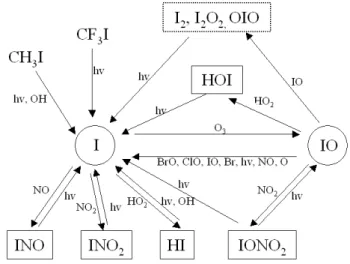
nat-Fig. 1. Chemical processes of iodine compounds in the UIUC 2-D CRT model. Circles represent reactive iodine species, solid boxes represent reservoir species, dotted boxes represent iodine species that photolyze rapidly after formation.
ural iodine emissions occur (Alicke et al., 1999; Chameides et al., 1980; Chatfield et al., 1990; Davis et al., 1996). In the troposphere, iodine atoms generated from photolysis of iodine-containing compounds react with ozone to form io-dine oxides, which are further involved in complex catalytic cycles to destroy tropospheric ozone. Iodine is removed from the troposphere through reservoir species such as IONO2,
HI and HOI by rainout and dry deposition. Due to the in-complete understanding of iodine chemistry, the study on the impact of iodine compounds in the atmosphere is still in the initial stage, especially for the stratosphere. Solomon et al. (1994b) postulated that iodine chemicals transported to the upper atmosphere are almost entirely in reactive forms I and IO, therefore impacting stratospheric ozone via chemi-cal catalytic cycles. Since iodine reservoir species photolyze rapidly in the stratosphere, reactive iodine compounds are much more effective on ozone destruction than in the tropo-sphere. Therefore, iodine reaching the stratosphere has the potential to impact ozone significantly. In order to evaluate the effects of CF3I emissions from aircraft on atmospheric
ozone, detailed and updated atmospheric chemistry needs to be considered and driving mechanisms of ozone depletion need to be investigated.
Figure 1 shows the current understanding of the main fea-tures of iodine chemistry. In the modeling studies presented here, chemical compounds and free radicals generated from CF3I emissions are considered to be I, I2, IO, OIO, HI, HOI,
INO, INO2, IONO2, ICl, and IBr. Among these, I and IO are
the reactive iodine radicals that can potentially destroy ozone and HOI, HI, INO, IONO2and INO2are the major reservoir
species. The extensive cycling of these species can be ev-ident by noting the reactions listed in Table 1. In general,
Y. Li et al.: Potential impacts of CF3I on ozone 4563
1 10 100
Percent of reactive halogen radicals 0 10 20 30 40 50 60 km Dec,10N--solid Jun,10N--dotted Dec,40N--dashed Jun,40N--dash dot Dec,40N (Cl+ClO)/Cly (I+IO)/Iy
Fig. 2. The fraction of reactive free radicals (I+IO, Cl+ClO) among total iodine or chlorine species (Iy, Cly) based on the calculation
with the UIUC 2-D CRT model for background atmosphere for the current model year (the same for Fig. 3 and 4). Results are shown for 10◦N and 40◦N in June and December to illustrate the latitudi-nal and seasolatitudi-nal impact.
iodine atoms released from the photodissociation of CF3I
and CH3I as well as the reaction of CH3I with OH act as
the starting point of iodine chemistry, which in turn leads to reactions of I with oxides (O3, ClO, BrO) to form IO and
with HO2 to form HI. IO reacts with various compounds,
such as ClO/BrO/IO/Br, NO, and O, as well as photolyzes to produce O2and iodine atoms, which completes the chemical
catalytic cycles. As a consequence, IO and I are reactants in several catalytic cycles with other species, such as HOx, NOx
and halogen (Cl/Br/I). This is discussed in detail in Sect. 3.3. At night, I and IO react with HO2or NO2to form reservoir
species, but most reservoir species of iodine are photodisso-ciated rapidly when exposed to solar radiation. The reservoir species are then scavenged out of the atmosphere by rain or dry deposition, which is the essential sink of iodine com-pounds.
In terms of ozone depletion, reactive free radicals (I, IO) play the most important role among all iodine species. Fig-ure 2 illustrates the ratio of these reactive species to total iodine species (Iy) in comparison with the ratio of reactive chlorine to total chlorine as a function of altitude. It is appar-ent that reactive iodine radicals are a large fraction of the to-tal iodine in the upper troposphere and above. This is mainly because the iodine reservoir species decompose almost im-mediately in much of the stratosphere, where photolysis is a much more dominant pathway of degradation of iodine com-pounds. In the troposphere, reactive iodine species are much lower fraction of total iodine, especially at night when reser-voir species could form relatively easily. In contrast, even the lowest fraction of reactive iodine radicals in the
tropo-10-20 10-18 10-16 10-14 10-12
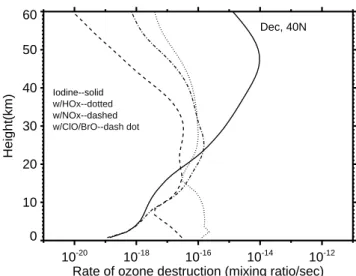
Rate of ozone destruction (mixing ratio/sec) 0 10 20 30 40 50 60 Height(km) Iodine--solid w/HOx--dotted w/NOx--dashed w/ClO/BrO--dash dot Dec, 40N
Fig. 3. The rates of ozone destruction for iodine catalytic cycles with different chemical species. In the legend, “Iodine” refers to iodine self-catalytic cycles, “w/HOx” refers to catalytic cycles of
iodine with HOx, “w/NOx” refers to catalytic cycles of iodine with
NOx, and “w/ClO/BrO” refers to catalytic cycles of iodine with ClO
and BrO. Results are calculated by the UIUC 2-D CRT model for 40◦N in December.
sphere is comparable to the highest fraction of reactive chlo-rine radicals in the stratosphere. The analysis above indicates that iodine is much more effective for ozone destruction than chlorine and the largest impact of iodine species on ozone should be in the stratosphere where the fraction of reactive iodine radicals is extremely high.
3.3 Iodine catalytic cycles
Catalytic cycles refer to cycles that have reactive halogen species in the atmosphere and act as catalysts in a series of reactions that are closely linked with ozone. Catalytic cycles are the primary mechanism for destruction of ozone in the stratosphere. In this section, we focus on the most important catalytic cycles of reactive iodine radicals with themselves, NOx and HOx, as well as halogens. An explicit list of all
the major catalytic cycles related to iodine species is orga-nized in Table 2. We categorized the iodine catalytic cycles into four groups: self-catalytic, with HOx, with NOx, and
with ClOx/BrOx. This shows the individual effects of
cy-cles with some major atmospheric reactive species. Figure 3 shows the calculated ozone loss rates due to the four groups at 40◦N in December with the UIUC 2-D CRT model. For
this analysis, we found that the iodine self-catalytic cycles were the dominant cycles in ozone loss from iodine in the middle and upper stratosphere at approximately 30 km and above. In contrast, the catalytic cycles with HOx were of
most importance in the troposphere, which compares well with the results by Stutz et al. (1999) and Carpenter (2003). Catalytic cycles with Cl and Br halogen were relatively less
90S 60S 30S EQ 30N 60N 90N Latitude 10 20 30 40 50 Altitude(km) 10 10 20 20 50 50 100 100 100 200 200 200 500 500 500 1000
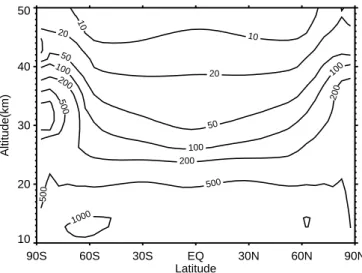
Fig. 4. Annually averaged ozone destruction efficiency of iodine chemicals relative to chlorine chemicals with latitude and altitude by the UIUC 2-D CRT model.
efficient at the latitudes in Fig. 3 but are important in the upper troposphere and lower stratosphere (UTLS) where the catalytic mechanisms are most complicated due to the com-petition between several categories of catalytic cycles. Fig-ure 3 further illustrates the significant role of iodine in the stratosphere and the variability with altitude of several cat-alytic cycles involving iodine. It is worthy to notice that re-actions of IO with itself, O, NOx, HOx and ClO/BrO, are
all negatively dependent on temperature or independent of temperature. Therefore, the low temperature in the upper at-mosphere would not decelerate the rates of iodine catalytic cycles if these reactions were rate-limiting steps. However, the reaction of I with ozone molecules, which is the initial reaction of all major iodine chemical cycles, is positively de-pendent on temperature. As a result, in the cold sections of UTLS with relatively low ozone abundance, iodine catalytic cycles are not very effective since IO production is limited. A previous study by Solomon et al. (1994b) suggested that io-dine catalytic cycles with ClO/BrO were the dominant ozone depletion mechanism of iodine, but the chemical reaction-rate coefficients of ClO+IO and BrO+IO were unavailable at that time and assumed to be 1×10⁻¹⁰cm3mole−1s−1and the self-catalytic cycles discussed in this study were not consid-ered. New laboratory results (Bedjanian et al., 1998; Gilles et al., 1997) showed that the chemical reaction-rate coefficients of these two reactions are an order of magnitude smaller than the assumed values in the work of Solomon et al. (1994b). 3.4 Ozone Depletion Efficiency (ODE) and Ozone
Deple-tion Potential (ODP)
CF3I is photolytically reactive in the troposphere and can be
quickly decomposed by absorption of solar radiation. Prod-ucts containing iodine are removed via rainout processes if
the iodine resides in lower levels of the troposphere. Thus only about 0.1from surface emissions. On the other hand, when reaching the stratosphere, iodine-containing chemicals can destroy ozone dramatically through catalytic ozone de-pletion cycles. Figure 4 shows altitude-and-latitude depen-dent annually averaged Ozone Depletion Efficiency (ODE) of Iodine compounds (Iy) relative to Chlorine compounds
(Cly). The ODE here is defined to account for all the ozone
loss procedures involving a chemical from thermal and pho-tochemical reactions. Therefore, ODE is always employed to assess the instantaneous local chemical efficiency of a chem-ical for ozone destruction. From Fig. 4 it is obvious that iodine compounds generated by CF3I could destroy ozone
much more efficiently than chlorine compounds, especially in the lower and middle stratosphere where most of strato-spheric ozone resides. Even though chlorine compounds have been considered to be the major driving forces of the past ozone depletion (e.g., WMO, 1999), chemicals with io-dine such as CF3I could potentially have large impact on
stratospheric ozone. If released at the Earth’s surface, only very small amount of CF3I could be transported to the
strato-sphere directly. Taking the short atmospheric lifetime of CF3I into account, more iodine is likely to reach the
strato-sphere indirectly from CF3I reaction products. Much of the
reactive iodine from the photolysis of CF3I will be released
at an altitude and latitude near the locations the emissions occur. In the case of CF3I from aircraft emissions, if many
of them were released in the lower stratosphere or higher tro-posphere above the altitude where they could be rained out efficiently, then the reactive iodine could have much stronger effects on ozone than those released near the surface.
The concept of ODPs are defined to evaluate relative cu-mulative effects on ozone of the emission of a gas, relative to one of the gases of most concern to ozone change, namely CFC-11 (CFCl3)(e.g., Wuebbles et al., 1983, 1995, 2001;
Solomon et al., 1992; WMO, 1995, 1999). To obtain the ODPs of a gas, a certain amount of emission perturbation that depletes 1% total ozone at steady-state needs to be put into the model run. The ODP provides a single-valued, rela-tive evaluation for a given compound and therefore is a useful scientific index for public policy. ODPs are a vital part of the current U.S. Clean Air Act, in which 0.2 is the upper bound of ODP values of any chemical that is not controlled. Ad-ditionally, chemicals with ODPs of 0.05 or larger should be considered carefully, according to the U.S. EPA. Tradition-ally, ODPs have been evaluated on the basis that most chem-icals evaluated for ODPs have long enough lifetime to spread all over the atmosphere globally. However, as a chemical with extremely short lifetime, on the order of several days, CF3I is not expected to be well mixed in the atmosphere and
thus has ODPs that should be dependent on location. There-fore, a more thorough study to investigate ODPs of CF3I
as a function of location (latitude, altitude, etc.) needs to be carried out using a three-dimensional model as suggested by Wuebbles et al. (2001). As a result of the temporal and
Y. Li et al.: Potential impacts of CF3I on ozone 4565
Table 3. Surface emission scenarios for CF3I and its impact on
global ozone.
Flux Scenario τCF3I Percent ozone depletion ODP
(days) per mass unit (%/Tg)
Northern Hemisphere/Surface 3.7 7.158 0.013
30◦–60◦N/Surface 3.8 4.600 0.011
5◦S–30◦N/Surface 1.0 9.629 0.018
Table 4. Estimated ozone depletion effects of CF3I using the
origi-nal estimate (Rupnik et al., 2002) of the CF3I emission profile.
Run Description τCF3I Ozone depletion ODP
(days) per mass unit (Pg/Tg)
0◦–10◦N/aircraft emission 0.7 137.4 0.254
30◦–40◦N/aircraft emission 1.2 44.53 0.084
55◦N–60◦N/aircraft emission 7.1 37.63 0.071
spatial variation, CF3I emissions from aircraft are expected
to have rather different ODP values from the ones derived from surface emissions.
Several earlier studies have evaluated potential effects of CF3I on ozone, particularly stratospheric ozone in terms of
ODPs. Assuming CF3I emissions from the Earth surface
only, early studies obtained extremely small ODPs of CF3I,
which were <0.008 by Solomon et al. (1994b) and 0.006 by Connell et al. (1996). Using the 2004 version UIUC 2-D CRT model, we have determined an ODP for surface emissions of CF3I that was 0.013, based on the assumption
that emissions were evenly spread throughout the Northern Hemisphere. Table 3 summarizes ODP values from several scenarios of surface emissions of CF3I by the UIUC 2-D
CRT model. In general, ODP values of CF3I from surface
emissions distribute in the range of 0.01 to 0.02.
However, as a chemical with an extremely short lifetime, the ODPs for CF3I depend on altitude and latitude as
dis-cussed before. Therefore, emissions of CF3I from aircraft
could have rather different ODPs from the ones presented above. We discuss this in detail in Sect. 4.
4 ODP for CF3I in different applications
“Fuel-inerting” refers to the safety action to protect fuel tank that contains highly flammable material, by pumping some inert gas or vapor, such as CF3Br, into its air space in order
to displace oxygen. As a candidate replacement of CF3Br,
CF3I released from aircraft for fuel inerting and its relevant
impact on ozone need to be assessed scientifically. The orig-inal estimate of CF3I emissions from F-16 military aircraft
by Rupnik et al. (2002) indicated that most of the emissions
0 20 40 60 80 100
Emission profile of CF3I from aircraft in percent unit 0 5 10 15 20 Height(km)
Rupnik et al. estimate (solid)
Van Horn et al.estimate (dashed)
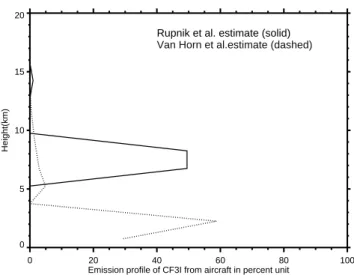
Fig. 5. The vertical profiles of CF3I emissions for fuel inerting in
military aircraft by Rupnik et al. (2002) and Van Horn et al. (1999). Percent unit is mass-weighted.
occur in the middle upper troposphere, where a large fraction of reactive iodine could reach the stratosphere through verti-cal atmospheric transport processes. Specifiverti-cally, the emis-sion profile is: 99% between 21 000 and 30 000 kft imately 6 km–9 km), and 1% at about 45 000 kft (approx-imately 13.5 km), roughly even distributed (Rupnik et al., 2002). As a response to the critique of Rupnik et al. (2002) by Banister et al. (2002), we further considered a different CF3I emission profile from F-16 military aircraft described
by Van Horn et al. (1999), which we call the Van Horn esti-mate. The Van Horn estimate, in which most of CF3I
emis-sions for fuel inerting were released at much lower altitudes, was employed to do a sensitivity study by the UIUC 2-D CRT model. Figure 5 illustrates the difference between these two estimates. Note that most of CF3I emissions in the original
estimate reside near the tropopause and therefore have a bet-ter chance to survive rainout and reach the stratosphere where the reactive iodine radicals fraction is of its largest values. In contrast, in the Van Horn estimate, a large amount of CF3I
emissions is located in the middle or lower troposphere. With the goal of evaluating the effects of CF3I emissions from
air-craft comprehensively, we have done 3 case studies based on both of the original and Van Horn estimates above using the 2004 version UIUC 2-D CRT model. The three cases were designed to simulate flights occurring in three different lat-itude regions: 0◦–10◦N, 30◦–40◦N, and 55◦–65◦N, which represented tropics, lower midlatitudes and higher midlati-tudes. All the model runs were scaled to deplete 1% global total ozone from the background atmosphere, which was without aircraft-released CF3I perturbation, for the purpose
of calculating ODPs of CF3I emissions. Results of these
cal-culations were shown in Tables 4 and 5.
Table 5. Estimated ozone depletion effects of CF3I using the
alter-native estimate (Van Horn et al., 1999) of the CF3I emission profile.
Run Description τCF3I Ozone depletion ODP
(days) per mass unit (Pg/Tg)
0◦–10◦N/aircraft emission 0.1 26.62 0.050
30◦–40◦N/aircraft emission 3.4 10.17 0.019
55◦–65◦N/aircraft emission 8.9 13.18 0.025
For the original estimate, the resulting ODPs were in the range of 0.07 to 0.25, above the EPA value of concern of 0.05. With respect to the Van Horn estimate, all the resulting ODPs were less than or at most equal to 0.05. Given the fact that aircraft are typically operated at mid-latitudes (case 2 and 3 in this study) in the Northern Hemisphere, where most of the population resides, CF3I emissions following the Van
Horn estimate would not have a substantial impact on ozone. Based on the comparison of the results from two different estimates, we determined that both the altitude and latitude where the CF3I emissions from aircraft occur could play a
role on the effects of CF3I on ozone. The altitude factor may
be more important since it affects the ODE of iodine com-pounds dramatically.
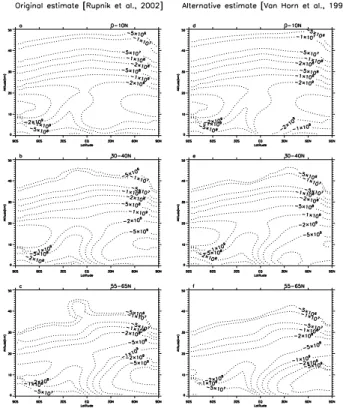
Figure 6 illustrates the ozone concentration changes in the three cases for both estimates of aircraft-released CF3I
emission profile. As shown in the figure, for the original estimate, major ozone depletion occurs in the lower strato-sphere and upper tropostrato-sphere. For the Van Horn estimate, the largest amount of ozone concentration decrease takes place at about the same altitudes but with a smaller amount, plus there is substantial ozone depletion near the altitudes where most of CF3I is released. The general circulation in
the atmosphere moves iodine around the world, and thus car-ries iodine species, which survive rainout processes, into the stratosphere from lower latitudes to higher latitudes. Be-cause all the reactions of IO with itself, O, NOx, HOx and
ClO/BrO are all negatively dependent or independent on tem-perature, iodine catalytic cycles are particularly effective in the cold regions but abundant with iodine-containing com-pounds. Therefore, the largest ozone destruction occurs in polar regions in the stratosphere, where iodine-containing compounds accumulate in a very cold environment. Figure 6 also indicates that iodine in the stratosphere can stay much longer than in the troposphere.
As discussed above, the major difference in the vertical profile of CF3I emissions between estimates by Rupnik et
al. (2002) and Van Horn et al. (1999) causes a large disparity in the ODPs of CF3I aircraft emissions. Nonetheless, the
ODP calculations based on both estimates showed that the ODP of CF3I emissions would not exceed the upper limit
value of 0.2 in the U.S. Clean Air Act, given the fact that most aircraft flights tend to occur at mid latitudes in the Northern Hemisphere.
Fig. 6. Annually averaged ozone concentration changes in unit of molecule.s−1.cm−3relative to background atmospheric conditions without CF3I emissions from aircraft. Results from three cases (0◦–
10◦N, 30◦–40◦N, 55◦–65◦N) shown here are based on two differ-ent estimates (the original estimate, Rupnik et al., 2002, left col-umn; the alternative estimate, Van Horn et al., 1999, right column) of CF3I emission profiles. All the model runs were scaled to deplete
1% global total ozone from background atmosphere.
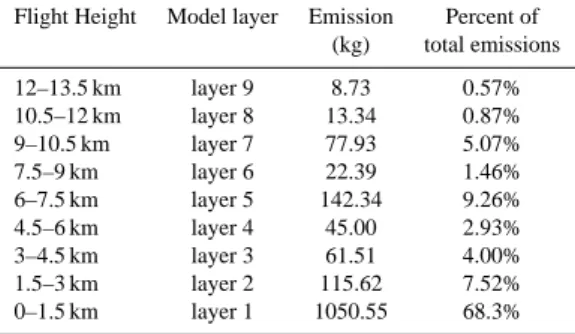
Through interactions with Donald Bein at the National Institute of Standards and Technology (NIST) (unpublished data, 2005), we attempted to do an evaluation of the poten-tial effects on ozone resulting from using CF3I in fire
fight-ing connected with engine nacelle and auxiliary power unit applications. Table 6 shows the CF3I emission profile from
NIST in detail. Similarly, we designed three cases (0◦–10◦N, 30◦–40◦N, 55◦–65◦N) for the latitudes where the emissions occur. The results are shown in Table 7. For the tropical case (0◦–10◦N), the resultant ODP was 0.084. The other two cases assuming mid latitudinal aircraft emissions gave ODPs smaller than 0.05. All the resulting ODPs were well below the control value of 0.2 in the U.S. Clean Air Act.
Though under different assumptions, the discussion of the effects on ozone resulting from aircraft-released CF3I for
fuel inerting could also apply here. In general, since most of CF3I emissions in this estimate occur at lower altitudes, they
do not tend to deplete atmospheric ozone. Therefore, pro-vided the CF3I emission profile from NIST is representative
to the actual release characteristics, CF3I released from
Y. Li et al.: Potential impacts of CF3I on ozone 4567
Table 6. The NIST estimate of the CF3I emission profile for fire
fighting.
Flight Height Model layer Emission Percent of (kg) total emissions 12–13.5 km layer 9 8.73 0.57% 10.5–12 km layer 8 13.34 0.87% 9–10.5 km layer 7 77.93 5.07% 7.5–9 km layer 6 22.39 1.46% 6–7.5 km layer 5 142.34 9.26% 4.5–6 km layer 4 45.00 2.93% 3–4.5 km layer 3 61.51 4.00% 1.5–3 km layer 2 115.62 7.52% 0–1.5 km layer 1 1050.55 68.3%
layer and thus can be considered a qualified substitute for CF3Br in fighting fires in engine nacelles.
5 Uncertainties in the study
Since iodine chemistry is not as well understood as that of its cousins, such as chlorine and bromine, there are still vari-ous uncertainties in the study, besides the needs for accurate estimates of the vertical profile and locations of CF3I
emis-sions we discussed above. For instance, the photolysis of OIO is highly debated. Hoffmann et al. (2001) proposed that self-reaction of OIO could form low-volatility iodine oxides with stable structures and thus result in a much longer life-time. While Ashworth et al. (2002), as used in our study, suggests that OIO is unlikely to be an important reactant in iodine chemistry as a consequence of its extremely short photolysis lifetime. If self-reactions of OIO are important mechanisms for particle formation, which would lead to effi-cient loss through rainout processes, the effects of aircraft-released CF3I on atmospheric ozone would be further
de-creased. On the other hand, heterogeneous reactions between reactive iodine and other active atmospheric reactants on the surface of aerosols could accelerate ozone destruction rate of iodine catalytic cycles (Larin et al., 2002). This mecha-nism could result in much larger ODPs of CF3I. However, the
role of this much faster heterogeneous process is still under further investigation. As mentioned earlier, further interest in CF3I use in aircraft would require extensive studies
us-ing a three-dimensional global transport model of the tropo-sphere and stratotropo-sphere. Nonetheless, recent modeling stud-ies have been much improved by more observational data as well as improved laboratories experiments and thus the abil-ity of models to simulate the real atmosphere has been largely enhanced.
6 Summary and conclusion
Compatibility of CF3I as a replacement of CF3Br in aircraft
engine nacelles for fuel inerting and fire extinguishing has
Table 7. Estimated ozone depletion effects of CF3I using the NIST
estimate of the CF3I emission profile.
Run Description τCF3I Ozone depletion ODP
(days) per mass unit (Pg/Tg)
0◦–10◦N/aircraft emission 0.1 45.08 0.084
30◦–40◦N/aircraft emission 1.9 14.93 0.028
55◦–65◦N/aircraft emission 9.0 19.30 0.036
been evaluated using the UIUC 2-D CRT model. Iodine chemistry related to CF3I emissions has been discussed. We
find that iodine self-catalytic cycles dominate the ozone de-pletion mechanism in the stratosphere among the four io-dine catalytic cycles groups. Due to the extremely short lifetime of CF3I and the high ozone depletion efficiency of
iodine species in the stratosphere, locations (altitudes, lati-tudes, etc.) where CF3I emissions are released can impact
the potential effects of iodine species on atmospheric ozone significantly. For the usage of CF3I for fuel inerting, two
es-timates of CF3I emission profile have been considered.
Re-sults showed that ODPs of CF3I emissions should be less
than 0.2 except for emissions in the troposphere. For the ap-plication of CF3I for fire extinguishing, ODPs of CF3I
emis-sions indicated the ozone depletion effects depend on latitude and altitude of emissions, but assuming the NIST altitude dis-tribution is correct, ODPs should be less than 0.08.
Acknowledgements. This study was supported in part by the
National Institute for Standards and Technology through contract SB1341-04-W-0879.
Edited by: J. Abbatt
References
Alicke, B., Hebestreit, K., Stutz, J., and Platt, U.: Iodine oxide in the marine boundary layer, Nature, 397, 572–573, 1999. Ashworth, S. H. and Allan, B. J.: Plane JMC high resolution
spectroscopy of the OIO radical: Implications for the ozone-depleting potential of iodine, Geophys. Res. Lett., 29(10), doi:10.1029/2001GL013851, 2002.
Atkinson, R.: Gas-phase tropospheric chemistry of volatile organic compounds, J. Phys. Chem. Ref. Data, 26, 215–290, 1997. Banister, W., Basinger, W., Dlugogorski, B., Grossl, P., Kennedy,
E., Kibert, C., Lauterbach, A., O’Bryon, J., Ober, G., Rubenstein, R., Vitali, J., and Wakayama, E. (Eds.): Critique of the Report Suitability of CF3I to Replace Halon 1301 as the Inerting Agent
in Wing Fuel Tanks on the F-16 Aircraft, Performed by Hydro Geologics, Inc., Contract Number DACA39-99-C-0002 for the Director of Defense Research and Engineering, 2002.
Bedjanian, Y., LeBras, G., and Poulet, G.: Kinetics and mecha-nism of the IO+ClO reaction, J. Phys. Chem. A, 101, 4088–4096, 1997.
Bedjanian, Y., LeBras, G., and Poulet, G.: Kinetics and mechanism of the IO+BrO reaction, J. Phys. Chem. A, 102, 10 501–10 511, 1998.
Carpenter, L. J.: Iodine in the marine boundary layer, Chem. Rev., 103(12), 4953–4962, 2003.
Chameides, W. L. and Davis, D. D.: Iodine: Its possible role in tropospheric photochemistry, J. Geophys. Res., 85, 7383–7398, 1980.
Chatfield, R. B. and Crutzen, P. J.: Are there interactions of iodine and sulfur species in marine air photochemistry?, J. Geophys. Res., 95, 22 319–22 341, 1990.
Connell, P. S., Kinnison, D. E., Bergmann, D. J., Patten, K. O., Wuebbles, D. J., Daniel, R. G., Williamson, C. K., Miziolek, A. W., and Huie, R. E.: Environmental Aspects of Halon Re-placements: Considerations for Advanced Agents and the Ozone Depletion Potential of CF3I, Proc. Conf. on the Halon Options
Technical Working Conference (HOTWC) in Albuquerque, NM, 1996.
Coy, L. and Swinbank, R.: Characteristics of stratospheric winds and temperatures produced by data assimilation, J. Geophys. Res, 102, D22, 1997.
Davis, D., Crawford, J., Liu, S., McKeen, S., Bandy, A., Thornton, D., Rowland, F., and Blake, D.: Potential impact of iodine on tro-pospheric levels of ozone and other critical oxidants, J. Geophys. Res., 101(D1), 2135–2147, 1996.
DeMore, W. B., Sander, S. P., Golden, D. M., Hampson, R. F., Kurylo, M. J., Howard, C. J., Ravishankara, A. R., Kolb, C. E., and Molina, M. J.: Chemical Kinetics and Photochemical Data for Use in Stratospheric Modeling, Evaluation Number 12, Jet Propulsion Laboratory (JPL) Publication 97-4, Pasadena, Cali-fornia, 1997.
Garcia, R. R., Stordal, F., Solomon, S., and Kiehl, J. T.: A new nu-merical model of the middle atmosphere, 1. Dynamics and trans-port of tropospheric source gases, J. Geophys. Res., 97, 12 967– 12 991, 1992.
Gilles, M. K., Turnipseed, A. A., Burkholder, J. B., Ravishankara, A. R., and Solomon, S.: Kinetics of the IO radical. 2.Reaction of IO with BrO, J. Phys. Chem. A, 101, 5526–5534, 1997. Gilles, M. K., Talukdar, R. K., and Ravishankara, A. R.: Rate
co-efficients for the OH+CF3I reaction between 271 and 370 K, J.
Phys. Chem. A, 104, 8945–8950, 2000.
Harwood, M. H., Burkholder, J. B., Hunter, M., Fox, R. W., and Ravishankara, A. R.: Absorption cross sections and self-reaction kinetics of the IO radical, J. Phys. Chem. A, 101, 853–863, 1997. Hoffmann, T., O’Dowd, C. D., and Seinfeld, J. H.: Io-dine oxide homogeneous nucleation: An explanation for coastal new particle production, Geophys. Res. Lett., 28(10), doi:10.1029/2000GL012399, 2001.
Langner, J., Rodhe, H., and Olofsson, M.: Parameterization of sub-grid scale vertical tracer transport in a global two-Dimensional model of the troposphere, J. Geophys. Res., 95, 13 691–13 706, 1990.
Larin, I. K., Spasskii, A. I., Trofimova, E. M., and Turkin, L. E.: Ex-perimental evidence for acceleration of reaction between iodine monoxide and chlorine monoxide at the reactor surface, Kinet. Katal., 44, 202–210, 2003.
Nathan, T. R., Cordero, E. C., Li, L., and Wuebbles, D. J.: Effects of planetary wave-breaking on the seasonal variation of total col-umn ozone, Geophys. Res. Lett., 27, 1907–1910, 2000. Olaguer, E. P., Yang, H., and Tung, K. K.: A reexamination of the
radiative balance of the stratosphere, J. Atmos. Sci., 49, 1242– 1263, 1992.
Rupnik, J., Bowman, R. G., and Berrill, P.: Suitablility of CF3I to Replace Halon 1301 as the Inerting Agent Wing Fuel Tanks on the F-16 Aircraft, HydroGeoLogic, Inc., Herndon, VA, 2002. Sander, S. P., Friedl, R. R., Golden, D. M., Kurylo, M. J., Huie,
R. E., Orkin, V. L., Moortgat, G. K., Ravishankara, A. R., Kolb, C. E., Molina, M. J., and Finlayson-Pitts, B. J.: Chemi-cal kinetics and photochemiChemi-cal data for use in atmospheric stud-ies, NASA/JPL Publication 02-25, Pasadena, California, 334pp, 2003.
Solomon, S. and Albritton, D. L.: Time-dependent Ozone Depletion Potentials for short- and long-term forecasts, Nature, 357, 33–37, 1992.
Solomon, S., Garcia, R. R., and Ravishankara, A. R.: On the role of iodine in ozone depletion, J. Geophys. Res., 99(D10), 20 491– 20 499, 1994a.
Solomon, S., Burkholder, J. B., Ravishankara, A. R., and Garcia, R. R.: Ozone depletion and global warming potentials of CF3I, J.
Geophys. Res., 99(D10), 20 929–20 935, 1994b.
Stutz, J., Hebestreit, K., Alicke, B., and Platt, U.: Chemistry of halogen oxides in the troposphere: Comparison of model cal-culations with recent field data, J. Atmos. Chem., 34(1), 65–85, 1999.
Swinbank, R. and O’Neill, A.: Quasi-biennial and semi-annual os-cillations in equatorial wind fields constructed by data assimila-tion, Geophys. Res. Lett., 21, 2099–2102, 1994.
Tellinghuisen, J.: Resolution of the visible-infrared absorption spectrum of I2into three contributing transitions, J. Chem. Phys.,
58, 2821–2834, 1973.
Teruel, M. A., Dillon, T. J., Horowitz, A., and Crowley, J. N.: Reac-tion of O(3P) with the alkyl iodides: CF3I, CH3I, CH2I2, C2H5I,
1-C3F7I and 2-C3F7I, Phys. Chem. Chem. Phys., 6, 2172–2178,
2004.
Turnipseed, A. A., Gilles, M. K., Burkholder, J. B., and Ravis-hankara, A. R.: Kinetics of the IO radical. 1. Reaction of IO with ClO, J. Phys. Chem.A, 101(30), 5517–5525, 1997. Van Horn, S. R., Vitali, J., Capt. Tucker, J., Delgado, M., and
Ro-driguez, B.: CF3I Agent for Fire Extinguishment in
Unoccu-pied Areas – Aircraft Fuel Tank Inerting Application, Technol-ogy Transition Briefing, AFRL# 99P10VA, ASC Program #292, ASC Validated Technology # 131, 1999.
World Meteorological Organization: Scientific Assessment of Ozone Depletion: Global Ozone, Research and Monitoring Project, Report 37, Geneva, 1995.
World Meteorological Organization: Scientific Assessment of Ozone Depletion: Global Ozone, Research and Monitoring Project, Report 44, Geneva, 1999.
Wuebbles, D. J., Lutcher, F. M., and Penner, J. E.: Effects of cou-pled anthropogenic perturbations on stratospheric ozone, J. Geo-phys. Res., 88, 1444–1456, 1983.
Wuebbles, D. J.: Weighing functions for ozone depletion and green-house gas effects on climate, Annual review of energy and envi-ronment, 20, 45–70, 1995.
Wuebbles, D. J., Patten, K. O., Johnson, M. T., and Kotamarthi, R.: The new methodology for Ozone Depletion Potentials of short-lived compounds: n-propyl bromide as an example, J. Geophys. Res., 106, 14 551–14 571, 2001.