EUROPEAN IOURNALOF PUBLIC HEALTH 2001; 11: 425-430
I N F E C T I O U S D I S E A S E S
HIV and hepatitis virus infections among
injecting drug users in a medically controlled
heroin prescription programme
THOMAS STEFFEN, RICHARD BLATTLER, FELIX GUTZWILLER, MARCEL ZWAHLEN *Background: In Switzerland, 1,035 patients were accepted for admission to the medically controlled prescription of narcotics programme (PROVE) from 1 January 1994 until 3 1 December 1996. Heroin, methadone, and morphine were prescribed. This paper presents the prevalence and incidence of HIV and hepatitis B/C infections in the sociomedical context of the participants. Methods: Admission criteria were a minimum age of 20 years, at least a two-year duration of daily heroin consumption, a negative outcome of at least two previous treatments, and documented social and health deficits as a consequence of their heroin dependence. The patients were examined at admission and every six months. A serological test was carried out at the same time for HIV and hepatitis B/C. Results: Serological testing on admission could be performed in more than 80% of the entrants and documented a very high seroprevalence of antibodies against HBCOre (73%) and HCV (82%). The prevalence of HIV and hepatitis
B/C increased with duration of drug intake. In the follow-up analysis of seronegative individuals, a halving of the risk of viral hepatitis infection was shown when comparing the first six months with the period greater then six months after PROVE entry. Conclusion: The tests conducted showed high prevalence and incidence rates of HIV and hepatitis B/C among patients who had consumed intravenous drugs for years. The descriptive analysis in heroin-assisted treatment showed a reduction in infection risk for viral hepatitis corresponding to the lower risk behaviour of patients.
Keywords: AIDS, hepatitis B, hepatitis C, heroin, injecting drug users, public health, prevention
T,
he number of drug users in Switzerland who consume opiate and cocaine was estimated at the outset of the 1990s at about 30,000 people, representing about 0.6% of the population between 15 and 39 years of age.1Serious individual health and social problems are often linked with this drug use for example evidenced in a limited social network, an increased delinquency, and in poor housing and job conditions.2 The prevalence of
various somatic and psychological ailments was shown to be substantial among intravenous drug consumers.-'"-' Infections with hepatitis B, hepatitis C and Human immunodeficiency virus (HBV, HCV and HIV) among drug addicts are epidemic.6'7 In Switzerland about 40% of
all newly reported AIDS cases during 1996 were among drug-injecting people. It is estimated that each fifth HIV infection occurred among a drug-injecting person. More than 40% of all registered hepatitis B infections and about 60% of registered hepatitis C infections are accounted for today by intravenous drug users.8"10
• T. Steffen1-2, R. Blattler1, F. Gutzwiller2, M. Zwahlen3
1 Addiction Research Institute, Zurich, Switzerland
2 Institute for Social and Preventive Medicine, University of Zurich, Switzerland
3 Swiss Federal Office of Public Health, Switzerland
Correspondence: Dr Thomas Steffen, MD, MPH, Giornicostr. 98, CH-4059 Basel, Switzerland, tel. +41 61 3315700, fax +41 61 3338135, e-mail: [email protected]
Since the 1980s various interventions have aimed to improve the situation of drug addicts in Switzerland. Additionally, a great variety of therapeutic measures have been established to treat opiate-dependent patients in Switzerland. About 1,700 stationary treatment slots are available for addiction withdrawal. Since 1997, roughly 15,000 patients have received methadone within the framework of maintenance treatments.
Despite the availability of a wide range of treatment programmes, not all drug addicts with serious health and social problems could be motivated to enter treatment. This core group is characterized by numerous social and medical deficiencies.
In an attempt to reach more drug users, 800 slots for heroin prescription were provided in 1994-1996 within the framework of a programme for medically prescribed narcotics. Based on the experience from therapy with oral methadone, it was argued that drug users who could not be treated sufficiently in the past might be reached with such new treatment forms.12"14
As mentioned, the epidemic of HIV infection in the 1980s as well as the continuing risk of hepatitis B and C infections was one reason for considering heroin-assisted treatment programmes in addition to other treatment options. Current HIV and hepatitis transmission data was collected within the framework of this programme.
EUROPEANJOURNALOFPUBLICHEALTHVOL.il 2001 NO. 4 Correlations related to the medical and social situation of
intravenous drug users could be analysed more closely to built the basic for new evidence-based interventions. In addition, the question arises, can a medically controlled heroin prescription programme lower the rate of new infections by the reduction of risk behaviour? This article shows a descriptive analysis of the HIV and hepatitis B/C infections in individuals in the heroin-assisted treatment programme in Switzerland during 1994-1996.
METHODS Patients
In Switzerland from the beginning of 1994 to 30 June 1996, 1,146 individuals entered the treatment pro-gramme for medical prescription of narcotics (PROVE). Of these, 1,035 were accepted for admission to the cohort study.12 One hundred and eleven participants were
disqualified for the following reasons: 84 left treatment before completing the admission test, and 27 failed to fulfil the inclusion criteria. The patients were admitted to 18 project centres in mainly urban areas. Women com-prised 30% of those admitted to treatment. The average age at admission was 30.8 (SD 5.7) years.
Assessments
The study was approved by the federal government and was restricted to drug addicted patients who had not been treated sufficiently and successfully in the past. The de-tails of the study design are described elsewhere.12 Briefly,
the patients entering the study had to fulfil the following criteria:
• a minimum age of 20;
• at least two years of opiate dependence (injecting drug users);
• at least two unsuccessful treatment attempts;
• documented deficiencies in a medical and/or social area. Fulfilment of the admission criteria were recorded for each patient before the onset of treatment. The indica-tion for treatment was determined by an experienced physician based on the current anamnesis, current results of medical testing, and the medical record. The indication was reviewed by two independent offices for each case.
Social and medical data
The social data were gathered by standardized interviews carried out by trained interviewers. The questionnaires were consistent with the EuropASI.15
Upon admission and every six months thereafter study participants were scheduled for thorough medical exam-inations by attending physicians. There, the somatic and psychological status of patients was recorded in stand-ardized form. Additionally, patients were tested for HIV and hepatitis B and C. Serological testing upon admission was performed in more than 80% of study entrants (HIV: 87%, hepatitis B: 83%, hepatitis C: 83%). It is noteworthy that 64% of study entrants who were not tested for HIV were HIV positive according to anamnestic data. Fre-quent reasons for failure to conduct the serological test iM during the course were difficulties in taking blood samples
among long-term I.V. drug users and patient refusal. The following tables each indicate missing data (md). An anti-HIV test was carried out during the serological examination including Western Blot analysis for con-firmation of positive test, according to the Swiss HIV test recommendations.
Serological examinations were also carried out in keeping with the study protocol to determine the hepatitis B and C rates. For hepatitis B virus the presence of the anti-HBc igG was determined. For hepatitis C virus the anti-HCV antibodies was determined.
Treatment
Treatment was determined according to individual indications. Heroin was usually prescribed as were methadone and morphine (daily average dose of heroin i.v., 471 mg; methadone i.v., 87 mg; morphine i.v., 442 mg). Application normally occurred intravenously and orally. Patients received intensive social medicine monitoring at the project centres. Study participants were given regular medical examinations and were treated somatically and emotionally. Social assistance was offered. Of the 100 patients, an average of 6.6 gained full-time jobs (social work, 2.0 jobs; medical service, 1.8; administration, 1.65; dispensing team, 0.75; other services, 0.4).
Statistical analyses
Chi, Phi, and Cramer's V tests were used to analyse differences between groups. A p-value of 0.05 or less was considered statistically significant. The SPSS statistical programme and Epilnfo 6.0 were used for statistical cal-culations.16'17
Calculations of incidence were based on patients with a negative laboratory finding at the start of each six months interval. Patients with a seroconversion during treatment were disqualified for follow-up incidence calculations. In the case of missing laboratory findings, the patient was not considered in incidence calculations for the periods involved.
Also taken into consideration were those leaving the programme prematurely and those not remaining long enough to have had a next follow-up visit with serological tests. The six-month incidence was calculated in the following way. The numerator was the number of new infectious diagnosed between follow-up visit Ti and Tj+j.The denominator was the sum of the new infections (between T; and T,+i) and all those individuals who were followed up to follow-visit at Ti+i. For example, the HIV incidence in the first six months was calculated as 5/(557+5) (table 3). The relative risk comparing the first six months with the period greater than six months was calculated by pooling the later periods.
Confidence intervals (95%) and p-values for the relative risk calculations were obtained from Epiinfo 6.0. RESULTS
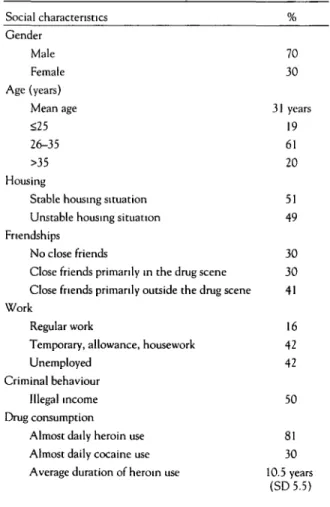
Table I shows the social characteristics of all patients newly admitted to treatment. Some 70% of the
HJV and hepatitis virus infections
participants were men. On average the patients had consumed heroin for 10.5 years (SD 5.5). On admission the participants' average age was about 31 years. Only 16% of admissions had a regular job. The housing situation was unstable for about half, and 13% were homeless. Half of the patients indicated having income from illegal activities.
According to the serological test, 15% of patients were HIV positive on admission, while 73% had hepatitis B
antibodies (anti-HBCOre), and 82% had hepatitis C
antibodies (table 2). Only 11% of admissions were negative for HIV as well as hepatitis B and C, and 13% had a positive test result for all three pathogens. More men than women tested positive for hepatitis B on admission. No gender difference was observed for HIV and HCV. The prevalence of all three pathogens increased with increasing duration of use. Among patients with addiction surpassing 15 years, almost all had hepatitis C antibodies.
During the follow-up, 52 seroconversions were observed among 50 patients within the treatment cohort group. Of those 30 seroconversions appeared during the first six months of treatment, and 22 new infections in the follow-ing months of treatment.
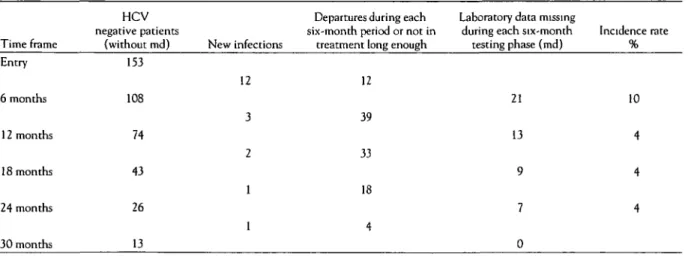
Tables 3-5 show the number of newly diagnosed HIV and
hepatitis B/C infections during the first 30 months of treatment.
Table 1 Social characteristics of patients on admission in the Swiss medically controlled prescription of narcotics programme 1994-1996 (n=l,035)
During the observation period a total of 11 HIV sero-conversions were diagnosed (table 3), five in the first six months. The incidence rate during the first 18 months of treatment was 1% per half year (follow-up periods). There was no significant reduction in infection risk between the first period (six-month laboratory tests) and later laboratory periods.
There were 22 newly diagnosed hepatitis B and 19 new hepatitis C infections during treatment (tables 4 and 5). In the first six months of treatment for both hepatitis B and C, the estimated incidence was 10% per half year. The risk of a hepatitis infection (B or C) was halved during the course of treatment (relative risk 0.51 [0.28-0.93] p<0.05), when comparing the first six months of follow-up to the subsequent follow-up periods. This risk reduction was also observed for HCV infections.
Table 6 shows the patients' important characteristics with
and without new infections. A direct assessment of incidence in the subgroups is not possible because of the two cohort groups' varying susceptibility.
The comparison of patients with and without seroconver-sion showed no gender differences (table 6). In accord with the lower prevalence on admission, more serocon-versions occurred among patients who had been opiate-addicted for only a few years. More new infections were tallied among patients with a less favourable social situ-ation (illegal income) and regular cocaine consumption. DISCUSSION
In keeping with admission criteria, 1,035 opiate addicts
Social characteristics Gender Male Female Age (years) Mean age <25 26-35 >35 Housing
Stable housing situation Unstable housing situation Friendships
No close friends
Close friends primarily in the drug scene Close friends primarily outside the drug scene Work
Regular work
Temporary, allowance, housework Unemployed
Criminal behaviour Illegal income Drug consumption
Almost daily heroin use Almost daily cocaine use Average duration of heroin use
% 70 30 31 years 19 61 20 51 49 30 30 41 16 42 42 50 81 30 10.5 years (SD5.5)
for the 1994-1996 cohort study on heroin-assisted treat-ment. The admission situation
tion is not representative of all
described in this popula-of drug addicts in Switzer-land. Instead the data given represent the
Table 2 Seroprevalence at admission
living situation
i by gender and duration of heroin use (n=l,035) in the Swiss medically controlled prescription of narcotics programme
HIV positive 0/ 70 All patients" 15 n=138 md=136 t Gender Male 15 Female 16 p-value n.s. Duration of heroin use 2—4 years 3 5-9 years 9 10-15 years 22 >15 years 25 p-value15 p<0.001 1994-1996 Hepatitis B positive 0/ /o 73 n=625 nd=181 75 68 p<0.05 47 69 79 87 p<0.001 Hepatitis C positive 0/ /o 82 n=706 md=176 82 82 n.s. 55 76 90 98 p<0.001
a: 136, 181, and 176 patients were not tested at entry for HIV, HBV, and HCV.
b. Phi / Cramer's V test. md: missing data
EUROPEAN JOURNAL OF PUBLIC HEALTH VOL. 11 2001 NO. 4
of long-term opiate addicts who previously lacked access to successful forms of treatment.
Serological data on more than 80% of the patients were available at admission. Not all patients could be examined every six months, even during course testing.
Table 3 HIV incidence during course of treatment
Problems during blood sampling were typically the reason for missing laboratory tests. Due to the special situation of the participants studied, the degree of completeness obtained should be termed satisfactory in comparison with experiences from other Swiss studies.
HIV Departures during each Laboratory data missing
negative patients six-month period or not in during each six-month Incidence rate Time frame (without md) New infections treatment long enough testing phase (md) % Entry 6 months 12 months 18 months 24 months 30 months 761 557 407 226 138 60 5 4 2 0 0 71 193 219 90 107 128 81 41 39 12 RRT7-30/T1-6 = 0.81 (0.25-2.63) n.s. (chi-square test)
Table 4 Hepatitis B incidence during course of treatment
HBV Departures during each Laboratory data missing
negative patients six-month period or not in during each six-month Incidence rate Time frame (without md) New infections treatment long enough testing phase (md) %
28
55
66
19
23
RRT7-3o/Ti-« = 0.60 (0.26-1.35) p=0.21 (chi-square test).
Entry 6 months 12 months 18 months 24 months 30 months 229 117 74 37 23 8 13 6 1 1 1 71 53 23 17 10 8 3 4
Table 5 Hepatitis C incidence during course of treatment
HCV Departures during each Laboratory data missing
negative patients six-month period or not in during each six-month Incidence rate Time frame (without md) New infections treatment long enough testing phase (md) %
12 39 33 18 4 Entry 6 months 12 months 18 months 24 months 30 months 153 108 74 43 26 13 12 3 2 1 1 1 21 13 9 7 0 10 4 4 4 RR T7-30 / T,_6 = 0.43 (0.17-1.06) p=0.06 (chi-square test).
HIV and hepatitis virus infections
At study entry we observed in this population a high seroprevalence for hepatitis B (73%) and hepatitis C (82%). In 1991 a prevalence of 57% for hepatitis B and 62% for hepatitis C was found at Zurich's Platzspitz.19 The
observed HIV seroprevalence (15%) was higher than reported from other therapy programmes in Switzerland with figures between 4 and 5%. • These differences were in part expected as PROVE participants had a long average duration of drug use and, seen in this and in other studies, increasing duration of drug use is associated with increasing seroprevalence for all three infections (HIV, HBV, HCV). Yet, the fact that after 2-4 years of drug use HBV and HCV seroprevalence already approach 50% is evidence of a continuing risk of HBV and HCV infection in the mid-1990s.
Accordingly, during the first months of treatment a hepa-titis B and C risk of about 10% was observed. A halving of the risks of a hepatitis infection occurred after the first six months. The risk reduction coincided with a decrease in general risk behaviour over the treatment time. For example, a substantial decline in consumption of illegal heroin was observed for the first months of treat-ment.12 After 18 months of continued participation in
the programme, 74% of patients reported no illegal heroin consumption, and the rate of cocaine abstinence in-creased from 15% at entry to 41%. At admission 16% of the patients reported sharing needles with others during the previous six months. During the course of treatment, less than 5% of patients indicated needle sharing. Signi-ficant declines in visits to the drug scene and illegal income were also observed.22
When interpreting the HBV and HCV risk during the first six months one has to be aware of the window phase of newly infected individuals, resulting in positive anti-body tests several weeks after actual time of infection.23
Table 6 Comparison of social situation on admission of patients with and without new infections during treatment
Gender Male Female Duration of heroin use 2-4 years 5-9 years 10-15 years >15 years Cocaine use No consumption Occasional Almost daily Criminal behaviour Illegal income a- Phi/Cramer's V test Non-seroconverters in treatment n=985 % 70 30 10 39 29 22 25 45 28 50 Seroconverters in treatment n=50 % 66 34 24 36 24 16 12 42 46 73 p-valued n.s. <0.05 <0.05 <0.01
Therefore the risk after HBV and HCV seroconversion observed between study entry and follow-up at six months can be considered to reflect in part risk of infection before treatment started. The stated risk for HBV and HCV seroconversion after follow-up at six months can then be considered to reflect the risk of infection under the treat-ment situation. It is noteworthy that, as treat-mentioned, the risk reduction after six months is in agreement with self-reported reduction in risk behaviour during treat-ment. However, a selection effect caused by premature departures of high-risk individuals cannot be ruled out completely. Yet the predictors found for premature departures from treatment (e.g. long opiate addiction, AIDS-related illnesses) provided no evidence of such an effect.12'2'* The risk reduction observed for hepatitis B
and C was not found for HIV infections. However, the small number of cases permits no conclusive inter-pretation.
In conclusion, participants entering the Swiss medically controlled prescription of. narcotics programme (PROVE) during 1994 to 1996 had a high seroprevalence for HIV, HBV, and HCV infection at entry and contin-ued to have a substantial risk of infection. However, during the course of treatment the risk of HBV and HCV was halved for patients remaining in treatment. The observed reduction in new infections parallel to the de-cline in risk behaviour of the cohort group treated permits the assumption of a favourable effect of heroin-assisted treatment on infection risk. This decline in the incidence rate of HBV and HCV occurred during the first months of treatment. Then the incidence rate remains stabilized at this lower level. This suggests a rapidly appearing effect of treatment. Clinical control group trials would be desirable for further analyses; however, these are very difficult to carry out with patients addicted to drugs. The high prevalence and incidence rates in treatment for hepatitis B/C and HIV also show that additional efforts are needed in this area. Successful prevention of these infections is not easy to achieve. • Future interventions should pay special attention to young and poorly integrated patients.
1 Rehm J. Konsumformen und Verbreitung illegaler Drogen in der Schweiz. In: Fahrenkrug H, Rehm J, Muller R, et al., editors, llegale Drogen in der Schweiz 1990-1993. Zurich: Seismo-Verlag, 1995:13-33.
2 Bergmann R. Soziale Folgen des Drogenkonsums. In: Goltz J, editor. Der drogenabhangige Patient. Munich: Urban und Schwarzenberg, 1999:88-92.
3 Goltz J, editor. Der drogenabhangige Patient. Munich: Urban und Schwarzenberg, 1999.
4 Cherubin C, Sapira J. The medical complications of drug addiction and the medical assessment of the intravenous drug user: 25 years later. Ann Int Med 1993; 119:1017-28.
5 Dinwiddie S, Reich T, Cloninger C. Psychiatric comorbidity and suicidality among intravenous drug users. J Clin Psychiatry 1992; 53:364-9.
6 Crofts N, Nigro L, Oman K, Stevenson E, Sheman J. Methadone maintenance and hepatitis C virus infections among injecting drug users. Addiction 1997;92:999-1005.
EUROPEAN JOURNAL OF PUBLIC HEALTH VOL. 11 2001 NO. 4
Brunet J-B. The HIV epidemic associated with injecting drug use in Europe: geographic and time trends. AIDS 1997; 11:1365-74.
8 Steffen T, Gutzwiller F. Hepatitis B und C bei intravenos Drogenkonsumierenden in Schweiz. Medizinische Rundschau PRAXIS. 1999;1937-44.
9 Gebhardt M. Aids und HIV in der Schweiz: Epidemiologische Situation Ende 1996. Berne: BAG, 1997.
10 Muller R, Meyer M, Gmel G, editors. Alkohol, Tabak und illegale Drogen in der Schweiz 1994-1996. Lausanne: SFA 1997:85-7.
11 Klingemann H. Harm Reduction and Abstinence: Swiss Drug Policy at a Time of Transition. In: Klingemann H, Hunt G, editors. Drug treatment systems in an international perspective. Thousand Oaks: SAGE Publications, 1998:94-111.
12 Uchtenhagen A, Dobler-Mikola A, Steffen T, Gutzwiller F, Blattler R, Pfeifer S. Prescription of narcotics for heroin addicts: main results of the Swiss National Cohort Study. Basel: Karger Verlag, 1999. •
13 Uchtenhagen A, Gutzwiller F, Dobler-Mikola A, editors. Versuche fur eine arztliche Verschreibung von
Betaubungsmitteln: Synthesebericht. Zurich: ISF/ISPMZ report, 1997.
14 Rihs-Middel M. The Swiss Federal Office of Public Health's Research Strategy and the Prescription of Narcotics.
In-Rihs-Middel M, editor. The medical prescription of narcotics. Berne: Hogrefe & Huber Publisher, 1997.
15 Blanken P, Henriks V, Pozzi G, et al. European Addiction Severity Index EuropASI: a guide t o training and administering EuropASI interviews. Brussels: COST A6, 1994.
16 SPSS Inc. SPSS base system user's guide. Chicago: SPSS Press, 1994.
17 Dean AG, Dean JA, Coulombier D, et al. Epi Info, Version 6. Atlanta: Centers for Disease Control and Prevention, 1994.
18 Somaini B, Wang J, Perozo M, et al. High refusal rates for
serological re-testing among drug users in opiate substitution clinics: The Zurich Prometheus Study (12th World AIDS Conference Record 43135). Faribault: Marathon Multimedia, 1998:874.
19 Scheitlin T, Joller-Jemelka H, Grob P. Hepatitis und HIV-lnfektionen bei Benutzern und Benutzerinnen illegaler Drogen. Schweiz Med Wschr 1992;122:1432-45.
20 Christen L, Christen St, Grob P. Eintntt- und Verlaufsmerkmale von Teilnehmern und Teilnehmennnen an einer methadongestutzten Behandlung mit niederschwelligem Eintritt. Zurich: ARUD report, 1996.
21 Grichting E, Dobler-Mikola A, Reichlin M.
Der Forschungsverbund stationare Suchttherapie FOS im Jahr 1997. Zurich: ISF report No. 56, 1998.
22 Steffen T, Christen S, Blattler R, Gutzwiller F, and PROVE team. Infectious diseases and public health: risk taking behaviour during participation in the Swiss Programme for a Medical Prescription of Narcotics (PROVE). Subst Use Misuse 2001 ;36:71-89.
23 Dienstag JL, Isselbacher KJ. Acute viral hepatitis. In: Fauci AS, Braunwald E, Isselbacher KJ, et al., editors. Harrison's principles of internal medicine. New York: McGraw-Hill, 1998:1677-92.
24 Dobler-Mikola A, Steffen T, Blattler R, Pfeifer S. Soziale und gesundheitliche Situation derTeilnehmenden. In:
Uchtenhagen A, Gutzwiller F, Dobler-Mikola A, editors. Versuche fur eine arztliche Verschreibung von Betaubungsmitteln. Zweiter Zwischenbericht der Forschungsbeauftragten ISF/ISPM Zurich 1996:21-195.
25 Coutinho RA. HIV and hepatitis C among injecting drug users. BMJ 1998,317:433-7.