Koster et al. : Pterin-4a-carbinolamine dehydratase
Pteridines
Vol. 6, 1995, pp. 123-125
Short Communication
Characterization of Human Pterin-4a-carbinolamine
Dehydratase/Dimeri-zation Cofactor of Hepatocyte Nuclear Factor-la
,
and of the Cys81-mutant
Involved in Hyperphenylalanincemia
Sandra Koster#, Beat Thonyt, Peter Macheroux#, Hans-Christoph Curtius#, Claus W. Heizmann t and Sandro Ghisla#§
= Department of Biology, University of Konstanz, P.O. Box 5560, D-78434 Konstanz, Germany • Division of Clinical Chemistry, Department of Pediatrics, University of Zurich, CH-8032 Zurich,
Switzerland
(Received June 15, 1995)
Introduction
Human pterin-4a-carbinolamine dehydratase/ di-merization cofactor of hepatocyte nuclear factor-l a
(in the following abbreviated PC D) is a small pro-tein, which has two apparent functions: It assists the phenylalanine hydroxylase (PAH) reaction in that
it catalyzes the dehydration of the intermediate
pterin-4a-carbinolamine
(
1
)
,
and it has been pro-posed to induce dimerization of the named factor-la (2). The amino acid sequence of the protein has been solved (3), and its 3D-structure has been re-ported (4). Its CysSIArg mutant has been proposed to cause hyperphenylalaninremia (5) and to be at the origin of the high content of 7-pterins in the patient. We report here on some properties of PCD which has been expressed in E. coli and purified, as well as of two CysSI mutants (Ser and Arg). Details of the present work have been submitted to EJB for publication (6).Materials and Methods
A pGEMEX-2-derived vector (Promega) expres-sing the 104 residues encoding wildtype peD (wt-PCD) starting with methionine and having six C-terminal histidine residues (His-tag) was generated
§ Author to whom correspondence should be addressed.
Pteridines / Vol. 6 / No.3
by PCR-cloning using the human liver cDNA as a template (see Figure 1; (7». To express the mutant proteins C8IS-PCD and CSIR-PCD, PCR-directed mutagenesis was performed using specific oligonu-cleotides with corresponding mismatches (Figure I). Cloning ofPCR products into pGEMEX-2-Nde was performed analogously as for the wild-type PCD.
Recombinant expression of wt-PCD, CSIS-PCD, and CSIR-PCD was achieved in E. coli BL21 (DE3) pLysS following a description by Promega. The His-tagged PCD proteins were isolated in a stan-dard one-step affinity purification procedure using a Ni-NTA (nickel-nitrilotriacetic acid) sepharose
column (Quiagen).
Results
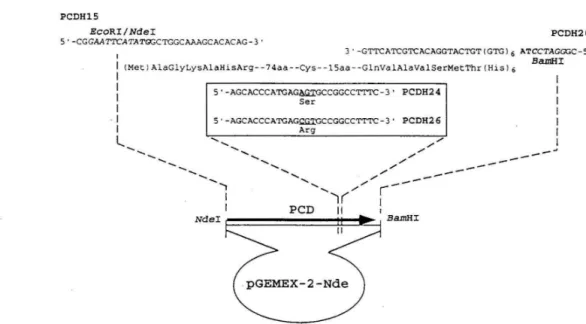
Details of the expression vectors for wt-PCD,
CSIS-PCD and CSIR-PCD are given in Figure 1. Analysis by ESI-MS of the three affinity purified PCD proteins, and in case of the wt-PCD amino terminal amino acid sequence determination, re-vealed that they had the N-terminal methionine cleaved off. Thus, these C-terminal poly histidine tagged proteins started with alanine as the first
amino acid, similarly to what was found for the
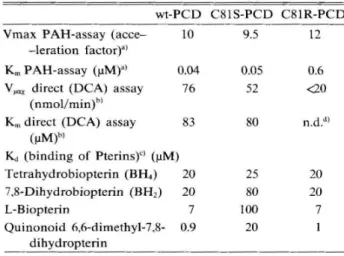
mature form of the human (and rat) enzyme (3). The prominent catalytic properties of PCD and of its two mutants are summarized in the Table.
124
PCDH15
ECoRI/NdeI
S'-CGGAATTCATATGGCTGGCAAAGCACACAG-3'
Koster et al. : Pterin-4a-carbinolamine dehydratase
PCDH20 I 3' -GTTCATCGTCACAGGTACTGTIGTGi6 AT~~:'C-S' I IMetiAlaGlyLysAlaHisArg--74aa--Cys--15aa--GlnValAlaValSerMetThriHisi6 I I I I ·1 I 5'-AGCACCCATGAG~CGGCCTTTC-3' PCDH24 Ser S'-AGCACCCATGAGQGTGCCGGCCTTTC-3' PCDH26 Arg l ... _ _ ... /'/'/'
--
"'~ / / ... "' ; '---~ ---... ...'... / / /
---I ... / ' I I i ( I I peD II I NdeI BamHI pGEMEX-2-Nde
Figure 1. Construction of vectors for expressing wt-PCD, C8IS-PCD, and C81R-PCD Histagged proteins. The wt-PCD expression vector was generated by first performing standard PCR amplification with primers PCDHI5 and PCDH20 and the human PCD-cDNA as template. Primer PCDHl5 contains an EcoRI and a Ndel site (italics), the ATG start codon (bold) plus the codons for the first 6 residues of the mature form of PCD. The amino terminal methionine is in parenthesis because it was found to be cleaved off following recombinant expression in E. coli. Primer PCDH20 encodes the C-terminal seven amino acids of PCD followed by six codons for histidine residues plus a stop codon (bold) and a BamHI restriction site (italics) at its 5'-end. The PCR product encoding the 110 amino acids for the recombinant His-tag PCD was digested with Ndel/BamHI endonucleases and ligated into the expression vector pGEMEX-2-Nde (Promega; a second NdeI site present in the original vector was removed by site-directed mutagenesis). To generate the vectors for expression of mutant proteins. PCR-directed mutagenesis was performed using primer PCDH24 (for Cys to Ser exchange) or PCDH26 (for Cys to Arg exchange) in combination with primer PCDH20 (see boxed inset; nucleotide exchanges are in bold and relevant codons are underlined). The PCR products were gel purified and used as primers for a second round of PCR in combination with primer PCDHI5. Products from these second PCR were cloned into pGEMEX-2-Nde in an analogous way as described above.
They show that PCD and both mutants expressed in E. coli are active both using the PAH-linked assay (8) and the synthetic substrate
6,6-dimethyl-pterin-4a-carbinolamine (DCA). Importantly, the activity
values are indistinguishable from those obtained
using PCD provided to us by Ficner et al (4), which does not carry the His-tag at the C-terminus. This demonstrates that the His-tag does not affect the catalytic properties or binding of our PCD. These recombinant PCD's all bind biopterin at its three oxidation states and also quinonoid 6, 6-dimethyl-7,8-dihydropterin, suggesting the presence of a spe-cific recognition site. PCD contains a single Cys81
sulfbydryl residue. Since the corresponding Ser
mutant has closely similar properties, a direct role of Cys81 in catalysis can be excluded. Most impor-tantly the Cys81Arg mutant has lower activity and a significantly higher Krn value in the PAH linked
assay or using the synthetic substrate DCA
com-pared to wild-type PCD or its Cys81Ser mutant. This is in keeping with the proposal (5) that this mutation is the origin of the reported genetic
dis-Pteridines / Vol. 6 / No.3
order. On the other hand, when the phenylalanine hydroxylase reaction was carried out using 0.1 f.lM
Cys81Arg-PCD as the stimulant, the production of
7-pterins was effectively suppressed as is the case with wild-type PCD.
Acknowledgements
This work was supported by grants from the Deutsche Forschungsgemeinschaft to S.G. (Gh2/7-1) and from the Swiss National Science Foundation (project No. 31-33897.92).
References
1. Lazarus RA. Benkovic SJ. Kaufman S. Phenylalanine Hydroxylase Stimulator Protein Is a 4a-Carbinolamine Dehydratase. J. BioI. Chern. 1983: 258: 10960-10962 2. Mendel D.B. Khavari P.A. Conley P.B. et al.
Character-ization of a Cofactor That Regulates Dimerization of a Mammalian Homeodomain Protein. Science, 1991: 254: 1762-1767
S. Koster et al. : pterin-4a-carbinolamine dehydratase
Table 1. Selected properties of PCD and of its Cys81Ser and Cys81Arg mutants
wt-PCD
Vmax PAH-assay (acce- 10 -leration factor)a)
Km PAH-assay (J.1M)") 0.04 V"QX direct (DCA) assay 76
(nmollmin)b)
Km direct (DCA) assay 83 (J.IM)bl Kct (binding of Pterins)<) (J.1M) Tetrahydrobiopterin (BH.) 20 7,8-Dihydrobiopterin (BH2) 20 L-Biopterin 7 Quinonoid 6,6-dimethyl-7,8- 0.9 dihydropterin C81S-PCD 9.5 0.05 52 80 25 80 100 20 C81R-PCD 12 0.6 <20 n.d.d) 20 20 7
aI Calculated from the increase in velocity observed upon
addition of PCD to the PAH-assay (8). The assay was car
-ried out in 50 mM Tris-HCI, pH 8.3, 20l1g catalase, 0.5 units dihydropteridine reductase, 2.9 nmol BH4, 100 nmol
NADH and I 11M phenylalanine at 25°C. The activity was determined by observation of the NADH consumption at 340 nm.
"1 Calculated from the dehydration rate of
6,6-dimethyl-pte-rin-4a-carbinolamine (DCA). The observed rates have been
corrected for the spontaneous decay of the DCA. The ex-periments were carried out in 10 mM Tris-HCI, pH 8.5 at
4°C with variable concentrations of DCA.
"Obtained by titration of the enzyme with pterin and ob-servation of the quenching of the tryptophan fluorescence at 334 nm (Aexe280 nm) according to the method of Rebrin
et al.(9). Conditions: 1.1 11M PCD in 100 mM Tris-HCl,
pH 8.4. Addition of pterin leads to essentially complete quenching of the tryptophan fluorescence emission.
d) n.d.; not determined.
4.
5.
125
Hydroxylase-stimulating Protein/
Pterin-4a-carbinol-amine Dehydratase from Rat and Human Liver. J. BioI.
Chern., 1993: 268: 4828-483l.
Ficner R. Sauer U.W. Stier G. Suck D.
Three-dimen-sional structure of the bifunctional protein PCD/DCoH,
a cytoplasmic enzyme interacting with transcription fac-tor HNFl. EMBO Journal, 1995: 14: 2034-2042.
Citron B.A. Kaufman S. Milstien S. Naylor E.W. Greene
C.L. Davis M.D. Mutation in the 4a-Carbinolamine Dehydratase Gene Leads to Mild Hyperphenylalanine-mia with Defective Cofactor Metabolism. Am. J. Hum. Genet, 1993: 53: 768-774.
6. Koster S. Thony B. Macheroux P.Curtius H.-Ch. Heiz-mann C.W. Ghisla S. Human pterin-4a-carbinolamine
dehydratase/dimerization cofactor of hepatocyte nuclear
factor-Ia: Characterization and kinetic analysis of
wild-type and mutant enzymes. Eur. J. Biochem.: 1995: 231: 414-423.
7. Thony B. Neuheiser F. Blau N. Heizmann C.W.
Cha-racterization of the human PCBD gene encoding the
bifunctional protein pterin-4a-carbinolamine
dehydra-tase/dimerization cofactor for the transcription factor HNF-lu. Biochem. Biophys. Res. Comm. 1995: 210: 966-973.
8. Citron B.A. Davis M.D. Milstien S.et al. Identity of
4a-carbinolamine dehydratase, a component of the
phenyl-alanine hydroxylation system, and DCoH, a
transregul-ator of homeodomain proteins. Proc. Natl. Acad. Sci., 1992: 89: 11891-11894.
9. Rebrin 1. Curtius H.-Ch. Ghisla S. Herrmann F.H. Spec-troscopic Characterization Of The Human Liver Pterin 4a-Carbinolaminc Dehydratase In: Ayling J.E. Nair M.
G. Baugh C.H. eds. Chemistry and Biology of Pteridines
and Folates. New York: Plenum Press. 1993: 338: 111-114.