Investigations of an SLA Support System for Cloud Computing
(SLACC)
Guilherme Sperb Machado Communication Systems Group CSG Department of Informatics IFI University of Zürich
Binzmühlestrasse 14 CH-8050 Zürich Switzerland [email protected]
Guilherme Sperb Machado received his M.Sc. degree from the
Federal University of Rio Grande do Sul (UFRGS, Brazil) in 2009, and his B.Sc. degree from the Pontifical Catholic University of Rio Grande do Sul (PUCRS, Brazil) in 2006, both in Computer Science. In 2008, he worked as an intern at HP Labs Bristol, U.K., addressing the area of IT change management. In April 2009 he joined the University of Zürich, Switzerland, Communication Sys-tems Group CSG, where he currently works as a junior research and Ph.D. student, supervised by Prof. Stiller. His Ph.D. topic is in the area of SLA management and estimation of SLA parameters for distributed systems and services, e.g., Cloud Computing. His areas of interest include accounting in distributed systems, Cloud Computing, IT service management, protocol design, network se-curity, and semantic Web in network management.
Burkhard Stiller
Communication Systems Group CSG Department of Informatics IFI University of Zürich
Binzmühlestrasse 14 CH-8050 Zürich Switzerland [email protected]
Prof. Dr. Burkhard Stiller chairs as a full professor the Communi-cation Systems Group CSG, Department of Informatics IFI at the University of Zürich UZH since 2004. He holds a Computer Sci-ence Diplom and a Ph.D. degree of the University of Karlsruhe, Germany. During his research locations of the Computer Labo-ratory, University of Cambridge, U.K., the Computer Engineering and Networks Laboratory, ETH Zürich, Switzerland, and the Uni-versity of Federal Armed Forces, Munich, Germany his main re-search interests cover, including current CSG topics, charging and accounting of Internet services, economic management, systems with a fully decentralized control (P2P), telecommunication eco-nomics, and biometric management systems. He participates in a number of European, industrial, and Swiss research projects, co-ordinates FP7 SmoothIT and SESERV, and serves as a technical program committee member as well as chair of several confer-ences.
Abstract
Cloud Providers (CP) and Cloud Users (CU) need to agree on a set of parameters expressed through Service Level Agree-ments (SLA) for a given Cloud service. However, even with the existence of many CPs in the market, it is still impossi-ble today to see CPs who guarantee, or at least offer, an SLA specification tailored to CU’s interests: not just offering per-centage of availability, but also guaranteeing, for example, specific performance parameters for a certain Cloud applica-tion. Due to (1) the huge size of CPs’ IT infrastructures and (2) the high complexity with multiple inter-dependencies of resources (physical or virtual), the estimation of specific SLA parameters to compose Service Level Objectives (SLOs) with trustful Key Performance Indicators (KPIs) tends to be inac-curate. This paper investigates an SLA Support System for CC (SLACC) which aims to estimate in a formalized method-ology – based on available Cloud Computing infrastructure parameters – what CPs will be able to offer/accept as SLOs or KPIs and, as a consequence, which increasing levels of SLA specificity for their customers can be reached.
1
Introduction
In the recent past Cloud Computing (CC) received an atten-tion from the ICT (Informaatten-tion and Communicaatten-tion Technol-ogy) community due to the conjunction of key aspects, which formed an innovative concept for dynamic provisioning of scalable and virtualized resources over the Internet. Mainly, features like self-service, virtualization, by-use (or pay-on-demand), scalability, high availability, and easy dynamic resource allocation makes CC applicable and a solution for, e.g., processing huge data sets for genetics sequencing and Customer Relationship Management (CRM) services [8].
Within CC environments, a Service Level Agreement (SLA) needs to exist between two parties: Cloud Providers (CP) and Cloud Users (CU), e.g., organizations or individ-uals. These two parties need to agree on a set of parame-ters expressed through the SLA. However, even with the ex-istence of many CPs in the market (e.g., Amazon, SalesForce, Rackspace, or Google), it is still impossible today to see CPs, who guarantee or at least offer an SLA specification tailored to CU’s interests. However, this is of great importance for tomorrow’s CC, since very general requirements (such as the “availability needs of a given service” [13], [1], [18], [17]) do not match commercial needs for guaranteed CC services. Thus, CPs need accurate definitions of objective values. An example of a specific SLA parameter is the Return to Oper-ation (RTO) time, in case of virtual machine failures. If the RTO is estimated, CPs can compose a Service Level Objec-tive (SLO) offering guarantees of Key Performance Indicators
(KPI) with a higher precision (e.g., RTO under 3 minutes, measured by the bootstrap time of virtual machines). Never-theless, due to (1) the huge size of CPs’ IT infrastructures and (2) the high complexity with multiple inter-dependencies of resources (physical or virtual), the estimation of specific SLA parameters to compose SLOs with trustful KPIs tends to be inaccurate. This inaccuracy can result in penalties for a CP, if an unrealistic set of values was proposed. Therefore, the lack of an automated system that maps and aggregates low-level measures into SLOs is the key barrier for (a) less risky and (b) customer-specific SLA-based CC service provisioning.
As far as known today (cf. Section 2), there is no work addressing the problem of mapping low-level measures of in-terdependent resources into SLOs inherent to typical Cloud services. Moreover, solutions like SLA assessments [10] and SLA monitoring [2] that provide an approach of SLA assess-ment, do not take into consideration the CC infrastructure as whole, but very specific network parameters only.
Therefore, this paper investigates the SLA Support System for Cloud Computing (SLACC) – decision support system for CC – in order to estimate in a formalized methodology, based on available CC infrastructure parameters, what CPs will be able to offer/accept as SLOs or KPIs and which increasing levels of SLA specificity for their customers can be reached.
The remainder of this paper is organized as follows. Sec-tion 2 presents related work and SecSec-tion 3 describes a related use case. Section 4 defines the set of major requirements for SLACC, while Section 5 introduces relevamt building blocks. Section 6 contains the architecture proposal. Finally, Sec-tion 7 provides a summary, also discussing a table for com-paring the new approach to related work.
2
Related Work
To address the background of the CC area the case of com-mercially available systems is considered. 25% of large en-terprises today – those that have more than 1.000 employ-ees – are already spending money on IaaS (Infrastructure-as-a-Service) via an external CP and those who are not using Cloud services today may consider to use it in a near fu-ture [8]. Thus, CC addresses small and medium companies as well as large enterprises. Moreover, another interesting aspect pointed by [8] is that “the interest in use production applications in the Cloud is nearly as high as for test or de-velopment purposes”. Therefore, commercial demands for CC can be derived, which is stated as a trend on moving im-portant parts of the business into the Cloud.
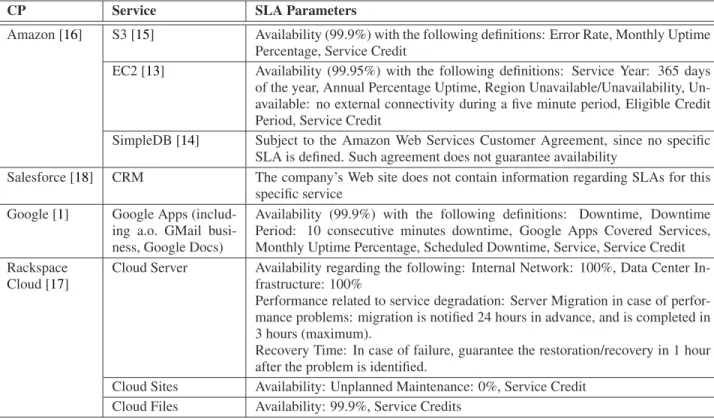
With the deployment of sensitive services (in terms of business criticality, technical robustness and security, or performance-wise) for end-users and providers, a well-defined and specific SLA is necessary. However, most CPs nowadays just offer general SLA parameters, such as avail-ability. Therefore, Table 1 outlines four large CPs with selected services offered, and for each service listed an overview of its SLA parameters is also presented.
It can be observed that the “availability” appears predom-inantly in all Cloud SLAs, just with Rackspace offering per-formance and recovery time guarantees, which determines the only exception. Such a situation is understandable, since
assessing other non-trivial parameters may increase the risk of occurring SLA violations and CPs should try to avoid un-certainty. However, offering non-specific SLAs is extremely business critical to CUs. Customers do not demand availabil-ity guarantees only, but also the confidence that, e.g., database queries will run in less than n seconds on the top of a certain SaaS (Software-as-a-Service) product. This kind of guarantee is a refined SLA parameter, which impacts highly CUs’ busi-nesses, especially when CUs use a service in a distributed manner, e.g., a large health insurance company using CC-based CRM in multiple countries, where the rate of querying information about its customers is considerably high. Today, this level of SLA specificity is not offered in the CC.
In the scope of current research, a small number tries to solve problems inherent to SLA management in CC environ-ments. In that respect the SLA@SOI project [6] is focused mainly on dynamic SLA monitoring for diverse distributed systems and provides three main benefits in that CC area: – Predictability and Dependability: Quality characteristics
of services can be predicted/enforced at run-time. – Transparent SLA Management: Service level agreements
(SLAs) defining the exact conditions under which ser-vices are provided/consumed can be transparently man-aged across the whole business and IT stack.
– Automation: The entire process of negotiating SLAs, de-livery, and monitoring of services is automated allowing for dynamic/scalable service consumption.
Inside the SLA@SOI context, SLOs – beforehand agreed upon – are constantly monitored, and the system is able to predict at run-time the occurrence of SLA violations. The RESERVOIR project [7] proposes an SLA Protection sys-tem, which detects and predicts SLA violations at run-time and takes actions interacting with the Service Lifecycle Man-ager (SLM). The SLA Protection system monitors SLA pa-rameters to take actions in case of a possible violation (SLA prediction), like reallocating virtual machines or adjusting re-sources. The SLM deals with low-level components and per-forms changes in the deployment of Virtual Machines to re-spect SLA parameters. This SLA Protection system can esti-mates risks and acts pro-actively to prevent penalties.
The TrustCOM project [12] looked deeply into the subject of SLA negotiation and monitoring, and produced a reference implementation. In the negotiation part, the project does not use an SLA assessment/estimation technique. However, SLA parameters are monitored and a component called SLA Per-formance Logger accumulates historical data on the perfor-mance of SLAs for future evaluation and use.
The AssessGrid project [5] focuses on SLAs and risk man-agement. The architecture brings a Risk Assessment com-ponent, which interacts with the monitoring system (having historical data) to check risks of an SLA under negotiation. AssessGrid provides an approach to develop risk values re-lated to existent SLOs and KPIs, e.g., the probability of SLA penalties, if a given SLA is agreed upon. However, Assess-Grid does not estimate KPIs in case of lacking knowledge to negotiate SLA parameters, e.g., SLOs and/or KPIs that can be offered. These two distinct approaches are needed: assess-ing risks of SLOs and KPIs, previously generated by a deci-sion support system as SLACC, diminish possible upcoming
CP Service SLA Parameters
Amazon [16] S3 [15] Availability (99.9%) with the following definitions: Error Rate, Monthly Uptime Percentage, Service Credit
EC2 [13] Availability (99.95%) with the following definitions: Service Year: 365 days of the year, Annual Percentage Uptime, Region Unavailable/Unavailability, Un-available: no external connectivity during a five minute period, Eligible Credit Period, Service Credit
SimpleDB [14] Subject to the Amazon Web Services Customer Agreement, since no specific SLA is defined. Such agreement does not guarantee availability
Salesforce [18] CRM The company’s Web site does not contain information regarding SLAs for this specific service
Google [1] Google Apps (includ-ing a.o. GMail busi-ness, Google Docs)
Availability (99.9%) with the following definitions: Downtime, Downtime Period: 10 consecutive minutes downtime, Google Apps Covered Services, Monthly Uptime Percentage, Scheduled Downtime, Service, Service Credit Rackspace
Cloud [17]
Cloud Server Availability regarding the following: Internal Network: 100%, Data Center In-frastructure: 100%
Performance related to service degradation: Server Migration in case of perfor-mance problems: migration is notified 24 hours in advance, and is completed in 3 hours (maximum).
Recovery Time: In case of failure, guarantee the restoration/recovery in 1 hour after the problem is identified.
Cloud Sites Availability: Unplanned Maintenance: 0%, Service Credit Cloud Files Availability: 99.9%, Service Credits
Table 1 Overview of SLA parameters from large cloud providers. penalties and enable CPs to be more competitive in a CC
ne-gotiation market. Moreover, the need of assessing parame-ters in SLAs was observed by [2] and [10]. [2] is part of the SLA@SOI project and this approach to assess SLA parame-ters takes into consideration historical data, i.e., what was ac-counted for and monitored in a Cloud. For SLA hierarchies the assessment can also consider different levels of contracted SLAs (e.g., SLAs with Internet Providers or all SLAs inher-ent to the good functionality of a given service). [10] is aware of the fact that most of SLAs parameters are monitored – and kept as historical data – or assessed. However, [10] proposed an approach that relies on the statement that an accurate es-timation of network Quality-of-Service (QoS) parameters is not required in most cases: it is sufficient to be aware of ser-vice disruptions (i.e., when the QoS provided by the network collapses). [10] proposes an algorithm for a disruption de-tection of network services. [10] sees an estimation of SLA parameters as critical, it concludes in a higher-level that ad-vantages may be exploitable.
3
Use Case
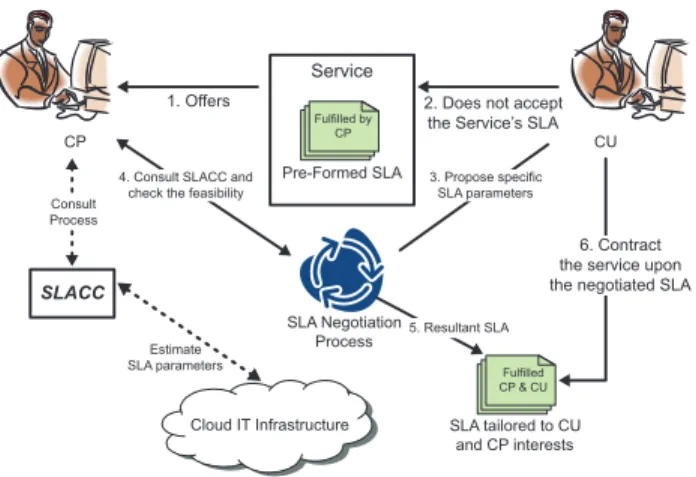
Since SLACC’s main objectives include (1) CPs will ben-efit from SLACC to propose accurate SLA parameters and SLOs/KPIs beforehand and (2) once CPs receive CU requests for dedicated SLOs/KPIs, the CP can evaluate, if such values can be guaranteed in his CC infrastructure, SLACC takes into consideration inter-dependencies of resources inside the CC infrastructure. Thus, the following example describes a use case for a better understanding of the SLACC approach to be proposed. Figure 1 illustrates the use case in a high-level view.
Considering that a CU wants to contract a service with a CP, usually, the most common situation for end-users, is when the CP offers (Figure 1, step 1) a pre-formed – ready for establishment – SLA for specific services (with all SLOs and KPIs determined). Depending on CP, the CU can either accept the pre-formed document or reject it proposing a nego-tiation phase (Figure 1, step 2). Note that as seen in Section 2, no large commercial CP mentions the possibility to enter in a SLA negotiation phase. Such negotiation tends to be inac-curate (and consequently risky for CPs) due to the huge size of CPs’ IT infrastructures and the high complexity with multi inter-dependencies of resources. How the negotiation itself is conducted is out of the scope of SLACC, since the focus is on the estimation of appropriate knowledge and its optimization to the CP to compose valuable and specific SLAs. In other words, SLACC system supports the SLA negotiation process with highly suited values.
During the negotiation, the CU can propose new SLA parameters, e.g., “Minimum Web Service Query Processing Time” (Figure 1, step 3). The SLO for this parameter is “The Query Processing Time related to the Web Service X should be less than 2 seconds”. The CP will consult SLACC to know if the proposed SLO is possible with the given values (Fig-ure 1, step 4). Assuming that the SLA and SLO are described in a machine-readable manner (respecting a model) point-ing to existent resources in the CC IT infrastructure, SLACC implements an estimation algorithm that infers, looking to Accounting Records databases and the current infrastructure state, if such value (here, 2 seconds) can be satisfied.
After the negotiation phase, the expected result is an SLA that is tailored to CP and CU interests (Figure 1, step 5). It means that CUs may result on contracting the service having
Figure 1 SLACC solution overview.
a more specific SLA than a pre-formed one (Figure 1, step 6). Therefore, the CP may satisfy customer’s needs also having a less risky contract related to penalties.
4
SLACC Requirements
Based on the presented use case, the following list of require-ments was derived and defines the main functional and perfor-mance properties that the SLACC decision support systems needs to comply to:
– The SLACC solution has to be able to estimate KPIs hav-ing as output a unique value, or a set of values in case that an SLO requires it.
– Geographical resource locations and their distribution must be taken into account, since the CC IT infrastruc-ture can be dispersed world-wide. The Cloud Infrastruc-ture Model has to be aware of that, since geographically dispersed resources can impact, for example, the perfor-mance estimation.
– The design and implementation of SLACC should be flex-ible in order to work with any KPI based on SLA require-ments and specified SLOs. The system should evaluate – by estimating – if, e.g., the bootstrap time of virtual ma-chines (in this case, the KPI) can satisfy the SLO that is set to n minutes.
– The SLACC solution has to be scalable in the sense that even within a larger CC IT infrastructure, estimates can be calculated and provided in a plausible amount of time. For example, the SLACC system must not interfere negatively in SLA negotiations due to a possible larger delay in esti-mates processing.
SLACC needs to offer a system interface to the operator, where objectives – related to the estimation – can be adjusted. E.g., the CP may want to estimate the minimum time value for a specific query operation in a CC application, consid-ering using a minimal amount of virtual database instances. Therefore, in this case, the objective related to the estimation will be “the use of less possible resources”.
5
SLACC Building Blocks
SLACC considers a wider range of parameters inside the CC IT infrastructure, balancing historical information, current IT infrastructure status (e.g., servers load, network bandwidth at the moment), and how the Cloud is organized internally, in-cluding all its IT inter-dependencies, e.g., a physical server depends on some switches that are connected at the core net-work, or virtual machines that have some applications which depends on a set of databases. Thus SLACC building blocks include:
– Integrated Architecture: SLACC requires an integrated architecture, where all components combine an end-to-end solution in the scope of CC. These components can interact with existent components by defining clear interfaces be-tween SLACC functionality and CC infrastructures. Such an integrated architecture determines the basis for the next four building blocks.
– Cloud-specific and Multi-level SLA Model: Most of the CPs tackle general SLA parameters, such as availability and other service-unspecific performance parameters. Ex-istent SLA languages or models (e.g., SLAng [3], WSLA [11]) should be taken into consideration to design an auto-mated approach to derive SLA parameters for typical CC services inherent to different levels: from IaaS to SaaS lev-els. The benefit of this approach is that CPs and CUs can define SLA requirements in a higher level of abstraction, while describing SLOs/ KPIs that are typically in the lower level.
– IT Infrastructure Model: SLACC has to be based on a formal model reflecting general and typical CC IT infras-tructures. Existent approaches, like the Common Informa-tion Model (CIM) [4], should be considered and extended to match SLACC’s needs. E.g., one extension foreseen to-day includes the separation of what the CP IT infrastruc-ture is and what the CU infrastrucinfrastruc-ture is, considering virtu-alization and Operational Systems (OS) that can run mul-tiple other OSs.
– Algorithms to Estimate SLA Parameter Values: An es-timation algorithm takes as an input a set of SLA parame-ters from CUs and CPs, and generates as the output a re-quired range of values that the CP will be able to offer – described in terms of SLOs – to the requesting CU. Such an estimation algorithm will be based on estimation the-ory [9].
– Estimates Repository: For practical purposes SLACC must be able to record in a secured and legally compli-ant manner, which estimations were taken into account at a certain point of time. Thus, an estimates repository needs to be designed to fit commercial and business support sys-tem’s needs. In turn, it can be used for (a) future estima-tions, (b) keeping track on how the system acted in the past, providing analytics, and (c) allowing for future fine adjustments in case of lessons learnt.
6
Architecture and Estimation Approach
SLACC will estimate SLA parameters, e.g., KPIs based on SLOs, to enable the design of more specific SLA documents.
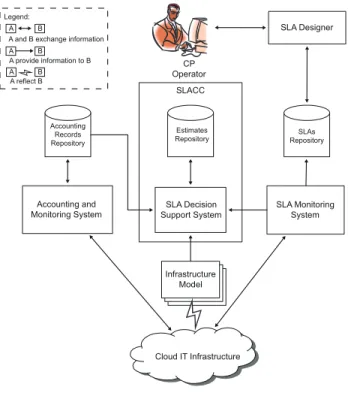
Figure 2 SLACC architecture.
The system will map high-level requirements into low-level factors that, combined together in a balanced manner, form an estimation. Thus, the following steps are investigated: an integrated architecture, a well-defined Cloud IT Infrastructure Model, and an estimation algorithm.
Figure 2 shows the abstract view of the SLACC archi-tecture, which serves as the starting point for SLACC de-velopments. SLACC interacts with the Accounting Records Repository, the SLA Monitoring System, and the Infrastruc-ture Model. The InfrastrucInfrastruc-ture Model component enables an updated view of all inter-dependencies of the Cloud IT In-frastructure. It is important to reflect exactly the organiza-tion of the physical IT environment, otherwise the SLA Deci-sion Support System (DSS) will not estimate SLA parameters in an accurate manner. The Infrastructure Model component provides an updated status information of the managed items inside the Cloud infrastructure (e.g., memory used of a given virtual server). The CP Operator interacts with the SLA De-signer in order to build a well-defined SLA, using an SLA model/language. The SLA DSS can be split into sub com-ponents: the estimation engine (implementing an estimation algorithm) and others. These sub components’ interfaces are defined by an API (Application Programming Interface) to interact with other components of the SLA management ar-chitecture. This API will serve as the CPs openness factor and the supporting interface for inter-domain interactions.
The key mechanism within SLACC is the design and de-velopment of the algorithm estimating with a defined level of confidence SLA parameters, such as the “minimum database query time” for a given application. The principle operation of the estimation algorithm is as follows. The CU proposes an SLA with a specific SLO, e.g., “RTO of Virtual Machines un-der 3 minutes”. It is known that the Return Time to Operation
can be measured in different ways, but the KPI associated to this SLO is measured by a composition of low-level values inherent to the bootstrap of virtual machines.
SLACC consults CC’s IT Infrastructure knowledge base (represented by the infrastructure model) to check “what are factors that matter for a successful bootstrap of a virtual ma-chine?”. Based on relations defined in the Infrastructure Model, a set of factors are determined. In this case it can be assumed that the following factors were mapped:
– Network bandwidth from the virtual machine’s template repository to the physical server, which the virtual machine will be hosted on – assuming a transfer from the repository to the assigned physical server;
– Processing capacity from the physical server, which hosts the virtual server;
– Average workload of the physical server in an interval pe-riod of time;
– Time to deploy and configure the specific requested virtual machine template in the virtual server;
– Time to (re)configure the deployed virtual machine in the load balancing front-end of the CP.
The estimation algorithm considers a viable distribution to compose and balance these factors to estimate the final result. The challenge here is to balance different factors like “the processing capacity of a give server” with “the average work-load” to come up with a value that can be trusted. At the last step, the CP can evaluate based on known facts, if the SLO “RTO of Virtual Machines under 3 minutes” proposed by the CU can be guaranteed by the CP, or if the CP has to negotiate, in this case, this parameter’s value to a higher value, or if the CP has to offer different parameter(s).
In order to evaluate the benefits of SLACC, it must be shown that the system can provide accurate estimates to CPs in order to better enhance its SLAs. Based on the estimates for some SLA parameters, these will be monitored in order to evaluate the confidence level of such generated values. Moreover, to prove the scalability of the proposed solution, comparisons between estimates generated by humans and by SLACC should be taken into consideration.
7
Summary and Comparison
This work identifies and describes the problem in CC SLA management, detailed related work, and presents a set of key requirements. Moreover, it proposes the SLACC architec-ture with a brief discussion on an estimation approach for SLAs, and a system overview and its building blocks. In turn, SLACC will increase the level of SLA specificity, not handling service’s availability only, but also a wider range of specific performance parameters.
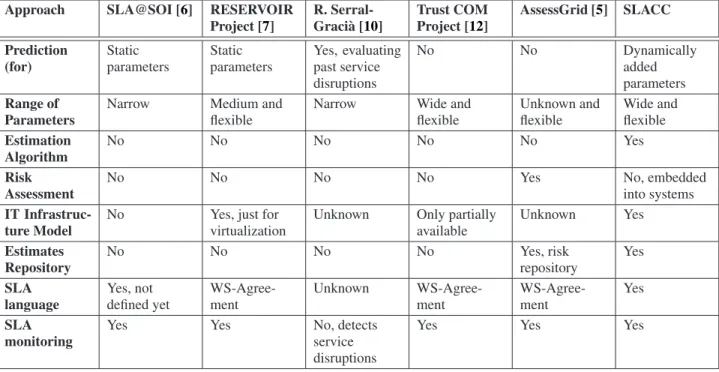
Taking into consideration related work and its major mensions of technical functionality, the majority of these di-mensions have been collected and applied to a comparison as summarized in Table 2. This table indicates the properties of the SLACC decision support system. As this comparison shows, SLACC composes different features into one system. Therefore, it can be highlighted that the utilization of a IT
In-Approach SLA@SOI [6] RESERVOIR Project [7] R. Serral-Gracià [10] Trust COM Project [12] AssessGrid [5] SLACC Prediction (for) Static parameters Static parameters Yes, evaluating past service disruptions No No Dynamically added parameters Range of Parameters
Narrow Medium and
flexible
Narrow Wide and
flexible Unknown and flexible Wide and flexible Estimation Algorithm No No No No No Yes Risk Assessment
No No No No Yes No, embedded
into systems IT
Infrastruc-ture Model
No Yes, just for
virtualization
Unknown Only partially available Unknown Yes Estimates Repository No No No No Yes, risk repository Yes SLA language Yes, not defined yet WS-Agree-ment Unknown WS-Agree-ment WS-Agree-ment Yes SLA monitoring
Yes Yes No, detects
service disruptions
Yes Yes Yes
Table 2 Detailed comparison summary.
frastructure model is suited for CC. Furthermore, the estima-tion algorithm uses balanced infrastructure factors produces relevant results, and the flexibility of adding KPIs and SLA parameters to the system (which can be estimated in a later moment) is backed by an estimate repository.
The respective and general architecture of the SLACC sys-tem was described, presenting key components and explain-ing its roles. Moreover, key aspects concernexplain-ing the estima-tion algorithm were discussed, also presenting key differ-ences from other approaches in the area of SLA management. The upcoming steps for a successful implementation of the SLACC system includes the development of each build-ing block as presented in Section 5. A CC IT Infrastruc-ture Model will be defined and utilized for the implemen-tation as well as the Cloud-specific SLA model. The core of SLACC will be based on such models, which reflect the actual IT infrastructure state and an agreed upon SLA docu-ment. Furthermore, it is fundamental to gain a wide knowl-edge of which parameters inside a CC IT infrastructure matter to ensure an optimal performance in those scenarios and be-yond. Thus, it will be possible refine the estimation algorithm balancing several factors in a correct way, without producing values within acceptable thresholds.
References
[1] Google.com Apps: Google App Service Level Agree-ment. Available at: http://www.google.com/apps/intl/ en/terms/sla.html. Last visited on February 2010. [2] M. Comuzzi, C. Kotsokalis, G. Spanoudakis, R.
Ya-hyapour: Establishing and Monitoring SLAs in Com-plex Service Based Systems, IEEE International Con-ference on Web Services (ICWS2009), IEEE Computer
Society, Washington, DC, USA, 6–10 July 2009, pp 783–790. doi:10.1109/ICWS.2009.47
[3] D.D. Lamanna, J. Skene, W. Emmerich: SLAng: a lan-guage for defining service level agreements, The Ninth IEEE Workshop on Future Trends of Distributed Com-puting Systems, 2003. FTDCS 2003, 28–30 May 2003, Vol. 1, pp 100–106.
[4] Distributed Management Task Force (DMTF) Web-site: Common Information Model (CIM). Available at: http://www.dmtf.org/standards/cim. Last Visited on May 2010.
[5] J. Padgett, I. Gourlay, K. Djemame (eds), AssessGrid Deliverable 1.3: System Architecture Specification and Developed Scenarios, Version 0.30, December 2006. [6] SLA@SOI Project Website: Empowering the service
industry with SLA-aware infrastructures. Available at: http://sla-at-soi.eu. Last visited on February 2010. [7] RESERVOIR Project Website: Service Manager
Scien-tific Report. Available at: http://www.reservoir-fp7.eu/ fileadmin/reservoir/deliverables/A4_ServiceManager_ ScientificReport_V1.0.pdf. Last visited on February 2010.
[8] Forrester Research Website: Conventional Wisdom is Wrong About Cloud IaaS. Available at: http://www. forrester.com/rb/Research/conventional_wisdom_is_ wrong_about_cloud_iaas/q/id/47102/t/2. Last visited on February 2010.
[9] J. Rice: Mathematical Statistics and Data Analysis, Duxbury Press, 2nd Edition, 1st June 1994, ISBN 0-534-209343.
[10] R. Serral-Gracià, Y. Labit, J. Domingo-Pascual, P. Owezarski: Towards an Efficient Service Level Agree-ment AssessAgree-ment, IEEE Infocom, Rio de Janeiro, Brazil, 19–25 April 2009.
[11] Web Service Level Agreements (WSLA) Project: SLA Compliance Monitoring for e-Business on demand. Available at: http://www.research.ibm.com/wsla. Last visited on February 2010.
[12] The TrustCOM project. Deliverable 64: Final Trust-CoM Reference implementation and associated tools and user manual, Version 3.0, June 2007.
[13] Amazon.com Web Services: Amazon Elastic Compute Cloud (EC2) Service Level Agreement. Available at: http://aws.amazon.com/ec2-sla. Last visited on Febru-ary 2010.
[14] Amazon.com Web Services: Amazon SimpleDB. Avail-able at: http://aws.amazon.com/simpledb. Last visited on February 2010.
[15] Amazon.com Web Services: Amazon Simple Storage Service (S3) Service Level Agreement. Available at: http://aws.amazon.com/s3-sla. Last visited on February 2010.
[16] Amazon.com Web Services: Products and Services. Available at:http://aws.amazon.com/products. Last vis-ited on February 2010.
[17] RackspaceCloud Website: RackspaceCloud Ser-vice Level Agreements. Available at: http://www. rackspacecloud.com/legal. Last visited on February 2010.
[18] SalesForce.com Website: The Leader of Customer Re-lationship Management (CRM) and Cloud Computing. Available at: http://www.salesforce.com. Last visited on February 2010.