People’s Democratic Republic of Algeria Ministry of Higher Education and Scientific Research
8 MAI 1945 UNIVERSITY / GUELMA ةملاق / 1945 يام 8 ةعماج FACULTY OF LETTERS AND LANGUAGES تاغللا و بادلآا ةيلك DEPARTMENT OF LETTERS & ENGLISH LANGUAGE ةيزيلجنلإاةغللا و بادلآا مسق
Investigating the Effect of the U.S.-Saudi Relations on the
New Saudi “Openness” Tendency
A Dissertation Submitted to the Department of Letters and English Language in Partial Fulfillment of the Requirements for the Degree of Master in Language and Culture
BOARD OF EXAMINERS
Chairwoman: Mrs. ZEMITI Asma (MA.A) University of 8 Mai 1945- Guelma Supervisor: Mr. ZEMMOURI Layachi (MA.A) University of 8 Mai 1945- Guelma Examiner: Mrs. AMIAR Mounira (MA.A) University of 8 Mai 1945- Guelma
Submitted by: Supervised by:
ADJABI Imad Mr. ZEMMOURI Layachi
Dedication
Imam as-Sadiq (peace be upon him) says: “The best deeds are: Salat in its stipulated hour, goodness towards parents and Jihad in the way of Allah”. Even though we know very well that there are no words to describe our gratitude to them, yet we would be honored to dedicate this humble dissertation to our dear parents who raised us well and supported us unconditionally during this long journey.
To our brothers and sisters, adorable friends, and to everyone who showed us support and love. You make our lives a wonderful experience, this dissertation is dedicated to you.
Last but not least, we are privileged to dedicate this work to every teacher from primary school to the last year of our educational career at university.
Acknowledgments
In the Name of Allah, the Most Gracious, the Most Merciful
First and foremost, we thank God Almighty for giving us vision, knowledge, capability, strength and opportunity to undertake this dissertation. Without His blessings, this achievement would not have been possible.
We are very hopeful that this modest piece of research will be a successful venue for our dear colleagues at the University of Guelma and even to readers from beyond its walls.
In our quest for knowledge we have acquainted a great teacher, inspirer and a role model, Mr. ZEMMOURI Layachi. Because of his heartfelt support, valuable guidance, constant
encouragement and insightful comments, he helped us achieve this moment, without any obstruction, while always keeping us in course. We are tremendously grateful and thankful for everything you have done for us during this year.
Finally, we are honored to extend our gratitude to the jury members, who dedicated their valuable time to assess our work and give us further guidance.
Abstract
This dissertation examines and investigates the effect of the U.S.-Saudi relation on the newly adopted modernization plan in the Kingdom of Saudi Arabia. Initially, it explores this latter’s history of establishment and describes its institutions, culture, education, labor and life style, such as family, art, poetry and music. In order to assess this relationship, this research runs a
background check on the history shared between Saudi Arabia and the United States. This latter was the one to discover oil in Saudi Arabia, which augmented its interest in the region. It provides vital statistics regarding oil production of Saudi Arabia. It also demonstrates the extent to which the U.S. needs oil. Further, it exhibits, with statistics, oil production as well as consumption status of the United States. In addition to that, it analyzes and exemplifies, to an extent, the U.S. support to the Kingdom during intense events, such as military protection and arms deals. In a different context, this research defines and analyzes the globalization era and attempts to relate it to the recent events occurring in Saudi Arabia. The objective behind building a historical overview in this dissertation, is to validate the relationship between U.S.-Saudi political ties and their influence on the social change happening in the Kingdom. Thus, this research digs deep to the roots of this sudden change. It explains the way Bin Salman came to power, and his strategic plan to reform Saudi Arabia’s social lifestyle in particular. Furthermore, the U.S. support to Bin Salman indicates that it is implementing its soft power strategies in order to tighten its grip over Saudi Arabia socially. Hence, this dissertation links the dots and gathers evidence to demonstrate the United States’ ideological strategy and its benefits from culturally invading Saudi Arabia.
صخلملا ةنرصعلا ةسايس راطإ يف ةكلمملا هجهتنت يذلا ديدجلا هجوتلا ىلع ةيدوعسلا ةيكيرملأا تاقلاعلا ريثأت ثحبلا اذه ىرحتي ينب يتلا ةيميلعتلاو ةيفاقثلاو ةيعامتجلاا تاموقملا فصت امك ،ةيدوعسلا ةكلمملا سيسأت خيرات ةركذملا لوانتت ثيح .حاتفنلااو اذكو ،يدوعسلا عمتجملا اهيلع هذه تناك ثيح .ةيكيرملأا ةدحتملا تايلاولاو ةيدوعسلا نيب عمجت يتلا ةقلاعلل ةيخيراتلا ةعيبطلا يدوعسلا يلورتبلا جاتنلإل ةبسنلاب ةمهم تايئاصحإ ثحبلا اذه مدقي .ةيدوعسلا ءارحصلا يف لورتبلا فشتكا نم لوأ ةريخلأا .ةيويحلا ةداملا هذهل يكيرملأا كلاهتسلإاو جاتنلإا اذكو ةقاطلا ىلع أ.م.ولل لصاوتملا نامدلإا ىدم ىلإ تايئاصحلاا هذه ريشتو صخي اميف نيتلودلا نيب يميلقلإاو يجيتارتسلاا نواعتلا ىدم ،ةلثمأ ميدقت عم ،ثحبلا اذه للحيو نيبي ،ىرخأ ةيحان نم .ةيلورتبلا ةقلاعلا ريثأت ثحبلا اذه سردي ةصاخ ةفصبو .ةيركسعلاو ةيسايسلا تافلاحتلا تارييغتلا ىلع نيتلودلا نيب عمجت يتلا ةديطولا عورشم اميسلا ،ناملس نب دمحم اهكلس يتلاو ،ةكلمملا يف ًاثيدح ةمئاقلا ةيفاقثلاو ةيداصتقلااو ةيعامتجلاا تاحلاصلإاو “ ةيؤر 2030 ” رت دلانود سيئرلا ،يكيرملأا هريظن نم دودحم ريغ معدبو ،ةكلمملا يف دهعلا ةيلاوب رفظ نأ دعب ، لواحي ،يلاتلابو .بما قرط لامعتساب ،ةيكيرمأ تاهيجوتب ةكلمملا اهجهتنت يتلا حاتفنلاا ةطخ ىلع ءوضلا طيلستب معدلا اذه ريسفت ثحبلا اذه “ ةوقلا ةمعانلا ” طسولأا قرشلا يف ةوقب ةقبطملا .
List of Abbreviations and Acronyms
ADIPEC Abu Dhabi International Petroleum Exhibition & Conference ARAMCO Saudi Arabian Oil Company
CASOC California-Arabian Standard Oil Company
CE Common Era
CFR Council of Foreign Relations CIA Central Intelligence Agency COVID-19 Coronavirus Disease 2019
EIA Energy Information Administration FBP Fiscal Balance Program
FTA Free Trade Agreement
GPD Gross Domestic Product
ID Identity
IPR Intellectual Property Rights KSA Kingdom of Saudi Arabia
MbS Mohammed Bin Salman
MENA The Middle East and North African countries NTP National Transformation Program
OPEC The Organization of the Petroleum Exporting Countries
PBUH Peace Be Upon Him
QIZ Qualified Industrial Zone QME Qualitative Military Edge
TIFA Trade and Investment Framework Agreements
TV Television
U.S. United States
UAE United Arab Emirates
UNESCO The United Nations Educational, Scientific and Cultural Organization
US United States
USA United States of America
USS United States Ship
List of Tables
Table. 1. Early Childhood Education in Saudi Arabia………25
Table. 2. The Increase in the Number of Aramco Workers from 1935 till 2000………27
Table. 3. Saudi vs non-Saudi Labor Force between 1975 and 2000………...28
Table. 4. World’s Top 10 Oil Producers………...………..50
List of Figures
Fig. 1. Saudi Arabia Region Map……….………….………..8
Fig. 2. Family Tree…………..……….………….………11
Fig. 3. Number of Divorce Cases in Saudi Arabia from 2011 to 2017………...……….……...18
Fig. 4. Saudi Nationals’ Participation in each of the Private and Public Sectors…...……….…30
Fig. 5. Saudi vs non-Saudi Participation in both of the Private and Public Sectors….………...31
Fig. 6. The Rate of Saudi and non-Saudi Workers in Labor Force………..…………..……….31
Fig. 7. Unemployment Rate by Gender in Saudi Arabia, 1999-2017……….………..………..33
Fig. 8. Rate of Native Saudi Workers by Gender………..….33
Fig. 9. The United States is Now the Largest Global Crude Oil Producer………….……….…49
Fig. 10. Texas Surpasses each of Iraq and Iran in Oil Production in 2019…………..……..….50
Fig. 11. U.S. Imports from Saudi Arabia of Crude Oil per Decade……….……..….53
Fig. 12. Top Crude Oil Exporter to the United States in 2019………...….54
Fig. 13. Top Four Arms Suppliers to the Middle East………..…….…….60
Fig. 14. Global Share of Major Arms Exports by the 10 Largest Exporters 2015-2019…….…63
Fig. 15. Global Share of Major Arms Imports by the 10 Largest Importers 2015-2019……….64
Fig. 16. Global Economic Openness (130 countries)……….…...69
Fig. 17. U.S. Trade Imports from MENA Countries……….…....72
Fig. 18. U.S. Exports to MENA Countries……….…...73
Fig. 19. Saudi Arabia’s Revenues and Expenditures since the 1970s………..…..75
Table of Contents
Introduction……….……….1
Chapter One: The Historical Evolution of the Saudi Arabian Cultural Life…….………7
1. Prospects for the Birth of Saudi Arabia……….………….8
1.1. Emergence of Saudi Arabia...………...………….………...9
1.2. Ruling Family………...…….….……...11
2. Institutions of the Society……….…………13
2.1. Family……….……….…..13 2.1.1. Marriage ……….………14 2.1.2. Polygamy……….…………...15 2.1.3. Divorce……….……..…....16 2.2. Mosque………..…18 2.3. Tribe……….…….20
3. Education and Labor in Saudi Arabia……….…..21
3.1. Education in Saudi Arabia……….……….…...23
3.2. Labor in Saudi Arabia……….……….………..26
4. Food, Clothing and Art……….………....…….……34
4.1. Food……...……….……….…...34
4.2. Clothing……...……….……….…….……37
4.3. Art………...……….……….…….…….39
4.3.1. Poetry and Music……….….……...39
Chapter Two: An Overview on the U.S.-Saudi Relation……….…….……...…42
1.2. Oil Discovery in Saudi Arabia……….………..45
1.3. The United States’ Dependence on Saudi Oil……….………...47
1.3.1. The United States’ Oil Production Status…….……...…………....48
1.3.2. Is the United States still Dependent on Saudi Oil?...52
2. Protection, Assistance and Arms Sales in the New Millennium……….………..56
2.1. Middle Eastern Demand for Arms and the American Dominance….…………....58
2.2. The U.S. Protection and Assistance to Saudi Arabia……….………….…60
2.2.1. U.S.-Saudi Arms Trade Relation in the New Millennium….….….61 2.2.2. The 2017 U.S.-Saudi Arms Deal, War in Yemen and Congress Reaction……….…….….64
Chapter Three: Saudi Road Map Towards Openness……….……..67
1. Openness in the Globalization Era……….…….67
2. Openness as part of America’s New Middle East Project?...70
3. MBS’ Vision 2030: An Open Saudi Arabia on the Horizon.…………..……….…….…..73
3.1. Vision 2030’s Economic Plans……….…….….74
3.2. Vision 2030’s Political Plans……….…….…78
3.3. Vision 2030’ Social Plans………...78
4. Mohammed Bin Salman’s Rise to Power and Donald Trump’ Boundless Support……....83
5. Internal Reactions to MBS’ plans………....87
6. What does the U.S. Benefit from the Kingdom’s Openness?...95
Conclusion………....99
Introduction
It is the largest state in Western Asia, predominated by a Muslim Wahhabi population that speak Arabic, Saudi Arabia, a land that hosts the holiest city for Muslims and a place that
witnessed both the birth of Prophet Muhammed (PBUH) and the cradle of Islam 14 centuries ago. It is a land full of legendary tales and famous stories that carry a whole civilization in its pocket. This country, before its establishment, had known a lot of tribal and religious disputes; however, once it was established by Abdul Rahman Al Saud on 23 September, 1932, much ink has been spilled about it ever since.
The discovery of oil was like a breath of fresh air for Saudi Arabia. The new Middle Eastern blood kept the Saudi heart alive, while made the American mind plot for new geopolitical plans that shall serve both near and long-term agendas. The U.S. invested in Saudi Arabia’s economy and sought for political and strategic cooperation during a long-life history shared between the two states. It cannot just be overlooked that Saudi Arabia was a pillar of support to the United States; while this latter was the former’s tower of strength. It is, however, highly important to note that this relation was, since the beginning, built upon costs and benefits. Hence, history gathered the two states in a room full of overlapping mutual interests and goals that serve them reciprocally.
Saudi Arabia and the United States were for the most part of their diplomatic, military and economic relationship, in the same side of the ring. Despite some bumps along the road, the Saudi-American relation proved its resilience over history. It is common in the world of politics to encounter an electrified atmosphere over religious or historic controversial sites; however, it does not seem to comply to orthodox methods of hard power. Hence, the United States, after dominating the Kingdom both economically and politically, laid an eye on the Saudi social norms
values. Over history, Saudis were always known for their strong religious ties; a problem that could hinder the American influence on the largest country in the Arabian Peninsula. In the meanwhile, the United States is up for new challenges in order to access the public through a more or less soft power.
Even though many assume that the Middle East has always been a focal point of war and terror, not one super power seemed to hesitate in capturing any opportunity to overarch its dominance over it; a theory that begs loads of questions regarding the value of the region, both economically and politically. Similarly, the United States had many incentives to be a major player in the region. Thus, far from media lenses, the two states closed many important political and arms deals.
In a different context, the American soft, if not manipulative, power is considered to be a support to the hard power, which can be expressed to the public through words like: adjusting, modernizing, civilizing and so on and so forth. These streams of changes cannot come out of thin air, as economy and intelligence are the two pillars that permit the U.S. to operate and implement its geopolitical/ideological plans and policies for further exploitation.
This research needs to be conducted because of the recent and the totally unexpected cultural reforms in Saudi Arabia. They are not just any casual reforms in a government
seeking the betterment of the Saudi lifestyle, nor is the pace compared to the number of changes. However, various reasons lay behind this drastic change in the Kingdom’s moral policies, which begs further questions regarding the matter. Therefore, this research is conducted objectively in order to explore and fully comprehend this drastic change and its outcomes. It investigates the extent to which economy and politics are involved in the matter.
This research runs a background check on the shared history between the two nations in order to fully comprehend the turns this relation had to take through the decades. Further, it
examines the way, American imperialist economic policies towards Saudi Arabia, developed dramatically through the years. It explains and exemplifies the firm control on the Saudi internal affairs as well as foreign policies, which may evidently be demonstrated in the recent cultural reforms. A living proof is portrayed in the Saudi Crown Prince, who is ready to put everything at stake for the sake of the bilateral relation with the USA—even if that means derailing the Saudis from their standards and morals, which they have rooted in their blood since the cradle of Islam.
This research attempts to answer some inquiries regarding the impact of the U.S.- Saudi economic relations on the Saudis cultural lifestyle. Among the other inquiries that will be examined in this work are: How was life in Saudi Arabia before conducting
economic relations with the U.S.? How did Saudi Arabia come to the world map? How is Saudi Arabia’ social structure shaped? What is the status of work and labor in Saudi Arabia?
What are the details of oil discovery in the Kingdom? Is the United States dependent on Saudi oil? What is the United Sates status of oil production and consumption? Does the United States protect and military assist Saudi Arabia? What is openness in the globalization era? What are the goals of Vision 2030? Did the United States support MbS during his different campaigns? What was the reaction of the Saudi public after the application of alien social reforms? Does the United States benefit from the social reforms in Saudi Arabia?
The topic is controversial, yet very interesting, even at the highest levels, from politicians, officials, economists, sociologists, to scholars and researchers. Therefore, before this research can be further examined, it is highly important to state previous works conducted about the topic. It is important to state a brief literature review to shed light on previous works that dealt with the similar aspects found in it.
foreigners about it. Moreover, they explore its land, history, food, entertainment and even work. In the same context, William A. Rugh, in his article “Education in Saudi Arabia: Choices and Constrains”, describes the Saudi educational system and the constraints both students and teachers face during their careers. Similarly, in their article “Saudi Arabian educational history: impacts on English language teaching”, Tariq Elyas and Michelle Picard analyze the status of English language in Saudi Arabia’s educational system, clarifying the difficulties both teachers and students encounter because of the country’s conservative nature and refusal to the language of ‘disbelievers’. They exemplify how religion creates difficulties for education and language apprehension in particular.
Al-Asmari, M.G.H, inhis article entitled “Saudi Labor Force: Challenges and Ambitions”, discusses in depth the most common constraints in Saudi labor force, while providing key
statistics to enrich the study. In a different context, Sorkhabi Rasoul, in his article entitled “The Emergence of the Arabian Oil Industry” profoundly investigates the details of oil discovery in the Middle East, while focusing on Saudi Arabia as his area of interest.
Christopher M. Blanchard, a specialist in Middle Eastern Affairs, discusses in his congressional document “Saudi Arabia: Background and U.S. Relations”, the trends in the U.S.-Saudi relations, the priorities and prospects between the two governments, while presenting, in statistics, the bilateral interactions in regards of economy and military support. Similarly, Thomas Clayton, in his congressional report “Arms Sales in the Middle East: Trends and Analytical Perspectives for U.S. Policy” investigates and reports from both official and unofficial open sources recent state-to-state arms sales from the United States to the Middle East, especially Saudi Arabia, providing vital statistics to the research.
In order to draw a clear picture regarding Mohammed Bin Salman’s rise to power, it is imperative to refer to Ben Hubbard’s article “MBS: The Rise of a Saudi Prince” on The New
York Times, which happens to be the title of his book too. In his article, Hubbard narrates the growth of Mohammed Bin Salman since his childhood to the day he reaches his position as Crown Prince. He reports a very detailed description of Mohammed’s personal life and
emphasizes on his relation with some politicians, his wealth extravagance and his involvement in suspicious matters.
This research is conducted through the historical and the qualitative methods. It aims at understanding and analyzing the impact of the Saudi-American economic relations on the Saudi lifestyle. On the one hand, the historical method is important to explore past events regarding the topic, through a detailed chronological research on the emergence of Saudi Arabia, its economy and culture. On the other hand, the qualitative method is important to explicate the impact of the U.S.-Saudi economic relation on cultural reforms in KSA.
This dissertation includes three chapters. The first chapter entitled “The Historical Evolution of the Saudi Arabian Cultural Life” deals with the historical progress of the Kingdom, its emergence and the different cultural aspects that makes it a unique state, such as religion, food, art, etc. Further it examines the status of both work and labor in Saudi Arabia and their ties to the Islamic teachings. Moreover, it explores women’s participation in the labor force and clarifies the Saudi need for the integration of women in the national economy. The second chapter entitled “An Overview on the U.S.-Saudi Relation” deals with the U.S.-Saudi economic relationship. It investigates oil discovery in the peninsula and later loop the circle around Saudi Arabia. It also demonstrates the U.S. status regarding oil production and consumption and its dependence on it. Finally, it explores and exemplifies the U.S. political and military assistance to Saudi Arabia and the congressional reactions concerning the matter. The final chapter entitled “Saudi Road Map Towards Openness” deals with the openness tendency in the globalization era.
introduces MbS’ Vision 2030. Furthermore, it explores in depth the new cultural reforms, the
reasons behind them and the public reaction. Finally, it demonstrates the influence and the gain of the United States from these reforms.
Chapter One
The Historical Evolution of the Saudi Arabian Cultural Life
Saudi Arabia is the largest country in the Arabian Peninsula as it occupies 2,149,690 square kilometers; an area large enough to cover the majority of the Peninsula (Verner 18). Further, despite the large size of the country, its population is relatively small, as the Kingdom’s estimated population was around 33,091,113 Saudi in 2018 (US Cong. Research Service 2). Saudi Arabia shares borders with Jordan, Iraq and Kuwait from the North, the Persian Gulf, Qatar, the United Arab of Emirates and Oman from the east with a part of Oman from the Southeast, in addition to Yemen from the South and Southwest, the Red Sea and the Gulf of Aqaba from the West, which makes a total border length of 4,000 km (Ochsenwald et al).
Because of its vast desert, Saudi Arabia is one of the hottest countries in the world. Further, in spite of its land’s size, the country is divided into four main areas: Hijaz, Asir, Najd, and the Eastern Province (Al-Hasa). The western coast is a set of two mountain ranges separated by a gap around the area of Mecca. Additionally, Hijaz stretches along the Red Sea from the Gulf of Aqaba in the north to Asir under the holy city of Mecca. Starting from south of Mecca, Asir also stretches along the Red Sea, to the borders of Yemen. Moreover, Najd is the largest region in Saudi Arabia, which hosts the capital of the country, Riyadh. Furthermore, a highland rises from 600 meters in the east to approximately 1500 meters in the west. Al-Hasa, the eastern province was named after the huge oasis, which is to be found in that region with its enormous springs of water (Library of Congress 51-53). Finally, The Eastern Province extends along the Persian Gulf. See (fig. 1).
Fig.1. Saudi Arabia Region Map
Source: “Saudi Arabia Region Map.” Global City Map. Web. Accessed 28 Apr. 2020.
1. Prospects for the Birth of Saudi Arabia
The land in which today’s Saudi Arabia was established, was the very land that hosted the cradle of Islam hundred years ago. Consequently, Islam shaped the history and reality of Saudi Arabia. Historically, the birth of the Kingdom dates back to the 18th century, when both Imam Muhammad Bin Abd Al Wahhab (1703 - 1792) and Muhammad Bin Saud (1697- 1765) formed a resilient alliance (Etheredge 45).
1.1. Emergence of Saudi Arabia
The Muslim scholar, Muhammad Bin Abd Al Wahhab, preached against leaders, scholars and traditions that were deviating from the teachings of the Quran and Sunna, while advocated to return to the original Islam. As a result, scholars opposed Abd Al Wahhab‘s views, wronged and oppressed him. Thus, he sought protection in Ad-Dariyah, from Al Saud—Muhammad Bin Saud was the leader of Ad-Dariyah (Cordesman, Saudi Arabia Enters 14). In 1744, they formed an alliance and took an oath to restore the true practices of Islam in Arabia (I. Bowen 59). In light of this event, Bin Saud and Bin Abd Al Wahhab established the first Saudi state under the Wahhabi spiritual guidance and Al Saud’s political rule (Cordesman, Saudi Arabia Enters 13, 14).
Further, in 1765, Abdul Aziz Bin Muhammad took over his deceased father’s mission. By 1773, he captured Riyadh, and for fifteen years, he continued to expand, until he ruled over the whole Najd region. By the early 19th century, the Saudi-Wahhabi state controlled most of the Arabian Peninsula, including the two holy cities, Makkah and Medinah (“History of the Kingdom”). These conquests (capturing the holy cities) echoed to the Ottoman Empire and the Islamic world. During 1812-1813, the Ottoman Empire ordered the Egyptian forces to regain control over the holy cities and the Hejaz region. Later, in 1818, it sieged the capital of the Saudi-Wahhabi state, Ad-Dariyah, and turned it into an uninhabitable land, through the destruction of the water wells and cutting down date palms (Cordesman, Saudi Arabia Enters 14; “ The Kingdom of Saudi “). Consequently, the event marked the end of the first Saudi state.
Turki (1755–1834), a cousin of Saud Bin Abdul Aziz established the second Saudi state few years after the decline of the first one. Cordesman adds that in 1824, Al Saud Family regained control over the central region of Arabia. Moreover, Turki ruled Najd region for ten years and changed its capital to Riyadh. In 1834, Faisal succeeded his assassinated father, Turki.
over Najd (15). The following five years witnessed the Egyptian declaration of independence from the Ottoman rule and withdrawal of its forces from Najd region. Consequently, Faisal managed to escape from his captivity in Cairo and returned to Najd in order to reclaim his
rightful reign. Al Saud family remained in control and protected Arabia from any external threats (“History of the Kingdom”). Yet, the internal conflicts over the throne had weakened the Saudi state.
By 1871, Muhammad Bin Rashid, a tribal leader in Hail, had established a political body that had been spreading its influence to Northern Najd. He came to an agreement with the
Ottomans to capture Al-Hasa from Al Saud (“History of the Kingdom”). In 1891, with the help of the Ottoman Empire, Al Rashid house captured the capital of the Saudi state, and forced Abdul Rahman Bin Faisal—ruler at that time—and his family out of their fortress. Finally, House Al Rashid terminated the second Saudi state, while Abdul Rahman, sought refuge with Bedouin tribes of the Empty Quarter. Later he traveled to Kuwait and stayed there with his son Abdul Aziz until 1902 (“The Kingdom of Saudi “).
According to Vassiliev, the establishment of the last Saudi state (the modern state) was quite an event. Abdul Aziz Bin Abdul Rahman Al Saud, was born on 15 January 1876 in Riyadh and spent his early life with his father in exile in Kuwait. In December 1901, Abdul Aziz and some of his men (around forty Wahhabi warriors) started marching from Kuwait to Riyadh with the goal of recapturing the Saud family’s stronghold from Al Rashid. They arrived, raided and captured Riyadh in January 1902 (The History of Saudi). Since then, he settled in Riyadh, and sought after Wahhabi connections. Besides, he declared himself as the head of Al Saud and a Wahhabi imam. For the next twelve years, he spread his conquest around Riyadh in Najd region, and forced the weakened Ottomans out of the eastern region of Al-Hasa. Abdul Aziz was
Hejaz region together with the holy cities. Finally, on 23 September 1932, The Kingdom of Saudi Arabia became an official Islamic state. It chose Arabic as its national language and the Holy Quran as its constitution (US Cong. Fed. Research Div., Saudi Arabia 21).
Fig.2. Family Tree
Source: “Family Tree.” House of Saud, 14 Sept. 2014. Web. Accessed 12 May 2020.
The family tree above displays all the rulers of Al Saud and the period of their rule starting from the first Saudi state until present day. In red are the rulers of the first Saudi state; in blue are the rulers of the second state; and in green are the kings of modern Saudi Arabia. See (fig. 2).
1.2. Ruling Family
After the establishment of the country in 1932, Abdul Aziz ruled Saudi Arabia as a monarch until his death in 1953. After that, six of his sons succeeded him: Saud, Faisal, Khalid, Fahd, Abdullah, and Salman—the current king—respectively. After Abdul Aziz’ death in 1953,
his son Saud succeeded him. Moreover, Saud’s time in power was marked for his government’s
financial corruption, extravagant spending and distribution of wealth. By 1964, the royal family and clerics, responded to the public’s dissatisfaction by removing Saud from power and
appointing his half-brother Faisal as king. Afterwards, Faisal promoted modernization, adopted Western technology and improved public education. During the period between 1947 and 1973, Saudi Arabia remained neutral towards the Arab-Israeli conflict; however, it joined the Arab oil boycott of the United States. Despite his efforts, Faisal’s reign was not satisfactory (both from inside and outside the country) and in 1975 his nephew assassinated him; therefore, Crown Prince Khalid was crowned king of Saudi Arabia. During his reign, revenues from oil were by hundreds of billions and the government started a series of building schools and infrastructures (US Cong. Fed. Research Div. “Country Profile” 3).
In 1979, Juhayman al-Utaybi accompanied with several hundreds of Wahhabi
descendants took over the great mosque of Makkah. He accused Al Saud of corruption because of their transactions with the West, and called for the return to the original practice of Islam. Two weeks later, the great mosque was recovered from the insurgents. Saudi authorities beheaded the survivors in their hometowns (“A Chronology: The House of Saud”). Moreover, in 1982, King Khalid passed away, and was succeeded by King Fahd—ex-crown prince. After his coronation, King Fahd continued to develop the infrastructure. Unfortunately, the mid-80s had witnessed an oil prices crush and brought about the Middle Eastern economy to a tough spot. In 1988, Iraq and Iran came to an agreement whereby both states stipulate to a ceasefire; yet, Iraq invaded Kuwait—one of the Gulf Cooperation Council members—on 2 August 1990. In 1991, after the Gulf War broke out, King Fahd refused Osama Bin Laden’s offer to help fight back Iraq and asked the U.S. and a multinational coalition for reinforcements to defend the Saudi Arabian
borders. In 1992, he announced the country’s first written constitution (US Cong. Fed. Research
Div. “Country Profile” 4).
Abdullah was the sixth King of Saudi Arabia. He ruled from 1995 to 2005 as de-facto replacement ruler, when his half-brother Fahd was incapable of leading the country due to his health condition. Further, Abdullah was crowned King as soon as his brother Fahd met his death on 1 August 2005 (Hahn 14). Good relations with the United States and Britain, especially in arms sales, marked his reign. Moreover, the newly crowned king granted women more rights, such as the right to participate in Olympics and the right to vote in the municipal elections (“Kings of Saudi Arabia”). Earlier, before 09/11 attacks, Abdullah visited the United States several times and formed good relations with President George W. Bush and his family.
Therefore, despite the media’s attempts to magnify the news of the 15 Saudi hijackers in order to
shakedown the special relationship, Saudi Arabia and the United States had proved the tight diplomatic relation and sought for demolishing “Islamic extremism” (US Cong. Fed. Research Div. “Country Profile” 4).
2. Institutions of the Society
Besides all physiological needs, such as air, water, food, sleep, clothing, and reproduction, as well as, safety needs, such as personal security, health, etc., humans are in need for love and belonging. Emotional and spiritual stability is as much important as the physical one, through the development and growth of a healthy society based on institutional norms and customs. In Saudi Arabia, these social guidelines are primarily taught in family, mosques and tribes.
2.1. Family
North and Tripp view the Saudi family as a large, extended group of people composed of several related generations, three to four generations, living under the same roof—the head of the
family is the oldest one. The younger generations ought to build a relationship based upon respect towards the elders, while also take care of them when they become too old. Since, foreign labor is available in cheap prices in Saudi Arabia, most Saudi families, both rich and working classes, tend to hire servants of Indonesian, Philippines, or Egyptian origins (52). Moreover, the Saudis build high walls in order to protect their properties from sandstorms, which are very common in the region, while also to protect their families from any undesired outdoor contact. Therefore, this protectionist nature of Saudis might isolate members of the family—especially females—from any alien connection. In the same context, Saudi parents expect their children to live with them even after reaching adulthood. Moreover, married men are even supposed to share their parents’ house or at least live in the same neighborhood (52).
2.1.1. Marriage
Marriage is an important aspect in the Muslim family, and is critical in understanding conjugality in the Saudi culture. Conventionally, and unlike western countries, Saudi families opt for arranged marriage within the same tribe or family, i.e. young men and women are encouraged to marry cousins or other relatives, typically first cousins, from the father’s side, or second cousins, from the mother’s side, as a secondary choice. Exceptionally, marriage outside the tribe or family can happen at times, in order to serve a higher purpose, usually with the intention of settling disputes and differences between rival tribes (Rahaman 5). In the same context, according to McKay Betsy, marriage between close relatives is very common in Saudi Arabia, which
eventually results in several and different types of chronic diseases. For example, “it causes type two diabetes (affects about 32% of adult Saudis); hypertension (affects 33%); and higher rates of severe genetic diseases such as, cystic fibrosis or Thalassemia – a blood disorder, sickle cell anemia, spinal muscular atrophy, deafness and muteness” (qtd. in Rahaman 5). Despite the fact
that mothers used to influence, or even choose their sons’ future wives (sometimes at a very
young age); recently, Saudi men favor choosing their brides out of their own choice (Al-Saif qtd. Achoui 5).
Further, Achoui assumes that marriage in Saudi Arabia yields to the Sharia law, as the husband is required religiously as well as legally to offer his future-wife a dowry regardless of its value. Usually, the dowry is a set of jewels and/or other valuable items, in order to assist her in hard times. In addition, the responsibility of providing lies on the husband’s shoulders, even if his wife works and is rich, unless she decides voluntarily to support her husband financially, he has no right to reach into her purse (5).
2.1.2. Polygamy
For several reasons, Islam has permitted polygamy; Prophet Muhammad (PBUH) himself had several wives together after the death of his first wife Khadija. Thus, Quran and Sunna stipulate that any Muslim has the right to marry up to four women at a time as long as he is able to be just and equal in his treatment towards them. This is clearly stated in Quran:
And if you fear that you cannot deal justly with orphans, then marry from the women who seem good to you, two or three or four. But if you fear that you cannot do justice (to so many), then one (only) or, the (captives) that your right hand possesses. Thus it is more likely that ye will not do injustice (An-Nisa: 03). And you will never be able to be equal [in feeling] between wives, even if you should strive [to do so]. So do not incline completely [toward one] and leave another hanging. And if you amend [your affairs] and fear Allah - then indeed, Allah is ever forgiving and Merciful. (An-Nisa: 129)
Arguably, scholars question the legitimacy given to polygamy through these Quranic verses; yet, others believe that polygamy was a custom to a particular period to resolve a specific issue (Yamani 12-13).
Achoui argues that polygamy in modern Saudi Arabia is no longer common as it used to be in times of war and conquests. It is decreasing due to a number of factors namely,
urbanization, development, education, and cost of living. Generally, educated and working women refuse the idea of polygamy and tend to stipulate monogamy in marriage contracts. In Islam, men are the ones to provide financially for their families, whether they are monogamous or polygamous. It is imperative for them to treat and to provide equally for their wives and children (5-6). In 1989, Al-Saif’ statistics showed that only 4.8% of Saudi parents are open to giving their daughters’ hands as a second wife (Achoui 6). Furthermore, and in 1991 Gharib made a research
whereby he concluded that 86.8% of husbands in the Gulf are monogamous, 9.6% have two wives, 1.1% have three wives, while only 0.33% have four wives (Achoui 6).
2.1.3. Divorce
Considered that Saudi Arabia is the cradle of Islam and most of its population is Muslim, its divorce rules are built on the Islamic rules extracted from the Holy Quran and the Prophet’ Sunna. According to the latter rules, any married Muslim couple should preserve their marriage and fight for its success, so theyspend their lives together in peace and harmony. However, if the couple could not hold onto their marriage and everything is falling apart, where problems and issues are left unsolved, they may divorce each other respectfully and in accordance with the Islamic rules regarding divorce (Bahammam and Rezzouk 218). In the patriarchal Saudi Arabia, A man may divorce his partner unilaterally and with no restrictions just “by pronouncing talaq”, while the woman may divorce her husband only through court and in a limited number of
situations. First, through “faskh”, in which the woman requests to divorce her husband from the court. Second, through (khul’) or “redemptive divorce” where the woman pays an amount of money to the husband, which they agreed on, to get her divorce. Moreover, women in Saudi Arabia renounce their financial rights to avoid disagreements and obtain their divorce faster. In addition, matrimonial assets do not exist in Saudi Arabia (“Thematic Report” 21).
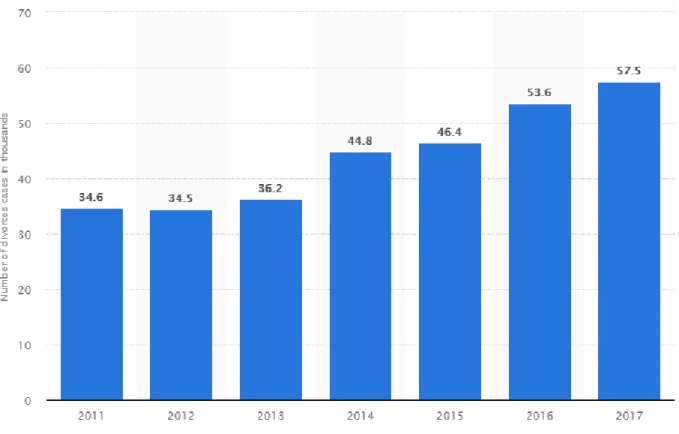
For the last decade, divorce cases in Saudi Arabia have grown significantly despite the awareness campaigns carried out by the government. The number of cases has known a
continuous increase each year from 34.6 thousand cases in 2011 to reach 57.5 thousand cases in 2017 as shown in the graph below (see Fig. 3). Moreover, an article by the Daily Times reports that the home quarantine and curfew to prevent the spread of the COVID-19 pandemic helped Saudi women discover their husbands’ acts of polygamy, which made divorce cases in Saudi
Fig. 3. Number of Divorce Cases in Saudi Arabia from 2011 to 2017
Source: “Number of Divorce Cases in Saudi Arabia from 2011 to 2017”. Statista. Web. Accessed 06 Sept. 2020.
2.2. Mosque
Every religion has its peculiar, sacred building devoted to worship whatever its adherents believe in. Likewise, Muslims have their own sacred place in which they worship their God. This special place is known as Al Masjid, which literally translates into the “mosque” in English. Mahmud asserts that Saudis (mainly men) carry out their daily prayers, weekly Jumu’ah and the two Feasts prayers in mosques. Even though Islam in present time is still a lifestyle, where its laws and regulations are parts of every Saudi’s life, mosques are solely oriented to serve specified purposes. In addition to being a holy place to practice daily prayers, mosques generally play the
role of a preschool for Saudi children, as they are taught Islamic morality, ethics, and values (280).
Formerly, Prophet Muhammad (PBUH) made his own house Islam’s first mosque after he and his followers emigrated to Yathrib– Medina in modern day Saudi Arabia– in the seventh century. The Prophet (PBUH) emigrated from Mecca to Medina because people from his mother tribe oppressed him and his followers and even killed some of them (Collins 8). His home was a typical Arabian style house with a large courtyard surrounded by long walls, and a roof supported by columns, which inspired mosque building for centuries (Weisbin). Furthermore, the mosque did not function only as a place for prayer and education; it was a place for the poor to get food and alms, and served military purposes such as strategizing and distributing bounties on the Prophet’s followers; and finally it satisfied the judicial needs of the new community. The second
mosque in Islam came to existence after few years from the establishment of the first one, precisely in 628 after the Prophet (PBUH) and his followers conquered Mecca and destroyed the idols inside the Kaaba (Collins 10).
Moreover, Saudi Arabia is the homeland of the two holy cities for Muslims, Mecca and Al Medina, where they hold respectively the two holy mosques, the Great Mosque (Masjid Al-Haram) and the Prophet’s Mosque (Al-Masjid an-Nabawi). The first is the largest mosque in the world and the second mosque to come to existence. It surrounds Kaaba, the direction of prayer, and the destination of millions of Muslims around the world for pilgrimage (Hajj) in the twelfth month of the lunar calendar. The second is the site where Muslims visit the Prophet
2.3. Tribe
According to Merriam-Webster dictionary, a tribe is a social group comprising numerous families, clans, or generations together with slaves, dependents, or adopted strangers (“Tribe”). The tribe is central to every Bedouin social identity, considering the numerous tribal associations Bedouins had experienced. However, not all tribal people are Bedouins; they can be agriculture or urban individuals. Generally, a tribe or a tribal group brings together those of the same patrilineal lineage so it createsa solid association in order to defend its individuals and enforce law and justice through applying order over chaos. Furthermore, lineage is what links nomadic people to their tribes. For example, when someone is forsaken by his lineage, he is to cut all links with his tribe. Although all lineages within a tribe are equal in status, tribes are not. Despite the fact that adopting strangers from lower-status tribes violates the patrilineal lineage, it became a casual event. For examples, when a man from a lower-status tribe joins his wife’s tribe, their children will take their mother’s descent (Library of Congress 68).
Every tribe in Saudi Arabia has a leader, known as ‘sheikh’. Every sheikh has to be well familiar with tribal matters, known for his good reputation, wisdom, and excellence in problem solving. Moreover, like any leader, the sheikh is expected to be just, capable in management and decision-making. Further, whenever there is a public matter, a general agreement is imperative, yet the final word comes back to the sheikh (69). That is to say, the sheikh listens to every side of his tribesmen’s arguments, about a particular issue, then he makes a final decision which meets their expectations that justice will be served. Moreover, way before the establishment of the Saudi Kingdom, raiding was common as an income and a source of wealth and status; however, some sheikhs saved their people a lot of trouble, by paying stronger allies in the region in exchange for protection. In fact, the sheikh of the protector tribe cannot accept to protect a weaker tribe, unless he distributes the payment among his tribesmen. During the 1920s, Abd al
Aziz challenged the protector-protected relationships between tribes, and freed weaker tribes from payment (70). By the rise of the new country, tribes became less independent from the government, and the settlement of nomads undermined their trade and industry profits. In spite of the decline of the tribe’s economic importance, it (the tribe) is critical to the construction of the Saudi identity (70).
The relationship between the ruling family and the leaders of the tribes is similar to the relationship between the sheikh and his tribesmen. While a sheikh is expected to solve disputes and give good advice to his folks, the ruling family is expected to intervene in disputes between tribes, and to ensure the wellbeing of citizens. Likewise, the ruling family opts for a consensus policy regarding domestic affairs, where general agreements are required. Precisely, the king and the governors of provinces gather and hold a hearing session, so citizens’ voices can be heard. Furthermore, the King can express indirectly his deepest gratitude to the sheikh, through
institutions of the state. For example, the King can offer free healthcare, good wages, and grants for nomads to settle in houses (69, 70).
3. Education and Labor in Saudi Arabia
Since Saudi Arabia is one of the fewest nations that is still attached to Islamic teachings, it is evident that its position vis-à-vis education and work is similar to that of Islam (Cavendish 96). Therefore, in order to comprehend how the Saudi Kingdom views both education and work, it is highly important to note the way Islam views both concepts.
First, education is a core value in the Islamic religion, as it occupies a significant position in every Muslim’s life. It is transparent in the Prophet of Islam’ (PBUH) saying (Hadith): “Every Muslim, man and woman, is duty-bound to acquire learning” (M. W. Khan). Moreover, the Islamic religion frequently emphasizes the importance of learning. For instance, Quran orders
who created. 2. Created man from a clot. 3. Read: And your Lord is the Most Generous. 4. He who taught by the pen. 5. Taught man what he never knew”. in Surat al-Baqarah Allah says: “And He taught Adam the names, all of them; then he presented them to the angels, and said, “Tell Me the names of these, if you are sincere.” (Itani 1-238). Furthermore, historically Muslims framed learning according to four main aspects:
1. Time: “Seek knowledge from the cradle to the grave”, 2. Place: “Seek knowledge even if it is far as China”,
3. Gender: “Seeking of knowledge is a duty of every Muslim”, and
4. Source: “Wisdom is the lost property of the believer, he should take it even if he finds it in the mouth of a mushrik” (Rizvi).
Each one of these aspects magnifies the value of knowledge in Islam, and urges every Muslim— by any means possible— “even if it is far as China”, to dig deep into the different sciences weather they are material or spiritual, and to peruse all avenues possible that lead to valuable knowledge.
Second, work, and unlike the western view towards it as a necessity to one’s survival, Islam has a broader view regarding this concept. Hence, it (Islam) not only urges Muslims to work, it also considers work as an obligation and a duty—excluding those, who are
mentally/physically unable to work. Moreover, because of work’s utmost significance in the Islamic religion, the word ‘amal’ which literally translates into ‘work’ in Arabic, is mentioned in 360 Quranic verses (Mufti). Furthermore, Islam enumerates various advantages of work. First, it grants every Muslim individual/state with financial independence, as it is mentioned in the Prophet Muhammed’ saying: “Nobody has ever eaten a better meal than that which one has earned by working with one's own hands. The Prophet of Allah, David (PBUH), used to eat from the earnings of his manual labor.” [Sahih al-Bukhari 2072, Book 34, Hadith 25] (Stefan 75).
Second, according to Prophet Muhammed (PBUH), those who work and help others will be rewarded by God: “Never does a Muslim plant, or cultivate, but has reward for him for what the beasts eat, or the birds eat or anything else eats out of that.” [Sahih Muslim 1552 c, Book 22, Hadith 9] (Kheyamy). Finally, work will exempt anyone from begging or pleading other people for mercy and food to feed themselves and their loved ones, as Prophet Muhammed says: “It is better for anyone of you to take a rope (and cut) and bring a bundle of wood (from the forest) over his back and sell it and Allah will save his face (from the Hell-Fire) because of that, rather than to ask the people who may give him or not.” [Sahih al-Bukhari 1471, Book 24, Hadith 74] (M.K.R. Khan).
Saudi Arabia has derived all its laws and values from Qur’an and Sunnah—the collection of practices of the Prophet Muhammad(PBUH)—and “has adopted the Qur’an as its
constitution”. They are these values which highlight the obligation, duty and importance, as an area of interest, education and work has in the Kingdom since its establishment. (North, and Tripp 67-68).
3.1. Education in Saudi Arabia
Since the 7th century, Muslim preachers in the Arabian Peninsula taught young boys and girls Qur’an and the teachings of the Prophet in mosques and ‘Kuttab’ (equivalent of schools nowadays), in the western region of Hijaz (W. A. Rugh). In the past, education in the peninsula was of two lineages, traditional and formal. The former, usually produces an individual who masters Qur’an and Hadith, which are till now the center of their educational system, while also masters his regions’ history and the art of survival in the desert. However, the latter was chiefly directed for religious and simple courses including basic math and Arabic language (Trial and Winder 122).
According to Dakhiel the very first school that was established on the Saudi land was called Alsulatiyah School in 1872. Moreover, in the beginning of the 20th century, Mecca was known for three types of schools: schools that were established by the Ottomans in 1905; Hashimite schools that were established in 1913; private schools that were established after the first two ones. In 1924, the department of general knowledge (Modeeriat Al-Maarif Al-Ammah), supervised the first establishment of a formal educational system. Later on, in 1945 King Abdul-Aziz Bin Abdulrahman Al Saud ordered his government to establish new schools, as education was accessible exclusively to the children of wealthy people. Subsequently, Saudi Arabia— announced the establishment of the Ministry of Education in 1953. The policies of the ministry and Modeeriat Al-Maarif Al-Ammah, were derived from the general policy of the country, which necessitates the integration of Islamic values and traditions (71). Moreover, it was not until 1964 that education was provided for girls, followed by building schools all over the Kingdom by the end of 1990s (Rabaah et al. 3).
Since the Wahabi movement is the first to encourage education (mainly religious), it was hard for girls to get proper education. To them, members of society should educate themselves in accordance with the laws of Islam (Sharia); thus, women are supposed to know ‘enough’ to be good wives and mothers and nothing more. However, in the 1960s, Crown Prince Faisal’s wife, Iffat, inspired him to fund and promote girls’ education in the Kingdom (Library of Congress 97). Decades later, and according to a study made by UNESCO in 2010/11, statistics proved that females’ status in education in Saudi Arabia is no longer as it used to be in the past, and that they make almost half of the total students in all levels. (qtd in. Rabaah et al 3- 4) See (Table. 1)
Table.1. Early Childhood Education in Saudi Arabia.
Level Age Number of Students
Pre-primary education 3-5 Total: 106,301 in 1,521Kindergarten Primary School 6-12 Total: 2,493,125 Girl: 1,227,699 Intermediate School 12-15 Total: 1,188,342 Girls: 553,415
General Secondary School 15-18
Total: 1,096,174 Girls:490,122
University and college 18-22
1 Million in 2010/11 Compared to 7.000 in the 70s
Source : Rabaah, Alqassem., et al. “Early Childhood Education in Saudi Arabia: Report.” World
Journal of Education, 22 Sept. 2016, Pdf. Accessed 4 May 2020.
Despite the remarkable progress achieved in the field of education, the Kingdom’s educational system received harsh criticism. For instance, Elyas and Picard believe that rote learning is highly adopted as a learning method. This latter hinders the learner’s level of critical thinking. Further, this sort of uncalculated decisions might seem as small fragments compared to the huge size of the other educational material, yet the collateral damage it prints in the
unconscious mind of children will forcibly lead to radicalism (137). Hence, the Saudi
educational system needed quality rather than quantity, and deduction rather than memorization; however, the reluctance did not stop at this point
Since the Kingdom was unenthusiastic about modernist approaches and alien notions to its educational system, the use of the English language was severely opposed. For some
preachers, the use of English signifies the abundance of Islamic teachings (Azuri). Hence, teaching English should be stripped off any cultural connotation, which would be nearly impossible for any language instructor to apply it that way. In the same context, W. Rugh confirms that “Pedagogy in most Arab schools and universities is typically based more on rote learning than it is on critical thinking, problem solving skills, analysis and synthesis of
information, and learning how to learn” (408). Therefore, teachers of English language in Saudi Arabia suffer from a teacher-centered pedagogy, the lack of cognitive skills and problem solving, which promote for memorization and absence of authenticity in teaching a foreign language. In other words, the educational setting encouraged in Saudi Arabia promoted for a
“decontextualized or even Islamized English” (Elyas and Picard 143).
Later on, despite the anti-English voices and opposition to any western cultural
integration in Saudi educational programs, the international community and political atmosphere, as well as the economic necessity, pressured the Kingdom to promote English. As this latter is a lingua franca, and since Saudi Arabia’s economy is one of the largest in the world, it is evident that teaching English is unavoidable to administer and control multi-national oil and gas companies alongside with investments abroad (Alzahrani 6-7).
Finally, this is a famous saying amongst Muslim:
“همركم نم أ موق ةغل لمعت نم”
“He whoever learns other people’s language will be secured from their cunning”. This saying is used in Saudi Arabia as a motto to promote learning foreign languages, for what benefits it can bring to them (Elyas and Picard 141).
3.2. Labor in Saudi Arabia
Away from urbanism, and the complexity of the western industry, the Saudi labor force has gone through a tremendous journey since oil discovery. The majority of the population has had a traditional nomadic lifestyle, which did not require any special training nor a high college degree (Fallatah and Syed 8). However, the rapid development and growth in the energy sector obliged the Saudi government to take firm action to sustain and create new jobs for the locals (Library of Congress 133). The first wage of workers in Saudi Arabia came to existence after the creation of the Arabian-American Oil Company (ARAMCO). This latter opened the door for further side projects, such as: railroads, small factories, etc. Furthermore, Aramco was the main reason behind the increase in Saudi and non-Saudi labor forces, as statistics show the magnificent growth in the number of workers in the company since 1935 (Al-Asmari 21-22). See (Table. 2). Table. 2. The Increase in the Number of Aramco Workers from 1935 till 2000.
Year Number of workers
1935 141 1940 3050 1945 11196 1950 16866 1955 20534 1987 43481 2000 62676
Source: Al-Asmari, M.G.H. “Saudi Labor Force: Challenges and Ambitions.” KAU: Arts &
According to Wilson, in the beginning of the 1970s the Kingdom adopted a ‘five-year development plan’, which paved the way for new methods and mechanisms to create a healthy industry and job opportunities. He assumes that because of oil riches, Saudi Arabia started constructing airports, schools, and hospitals, etc. (178). Moreover, Al-Asmari believes that the success of Saudi Arabia, since adopting this plan, depended on the capital of Saudi Arabia and the expatriate employees. In the same context, the same author claims that foreign work force was considered to be better than its Saudi counterpart, which explains the heavy dependence on foreigners from neighboring Arab countries, such as: Yemen, Syria, Egypt, Lebanon, and Palestine; as well as, non-Arab countries, such as: Pakistan, India, Japan and Philippines, etc. (22). The following table illustrates the Saudi and non-Saudi labor force increase between the years 1975 and 2000. The number of workers is in thousands. See (Table. 3)
Table. 3. Saudi vs non-Saudi Labor Force between 1975 and 2000.
Year/% Saudi Non-Saudi Total
1975 1439.7 484 1923.7 % 74.8 25.2 100 1980 1818.7 1694 3512.7 % 52.7 47.3 100 1985 1621.1 2721 4342.1 % 37.3 62.7 100 1990 1923.2 3848.6 5771.8 % 33.3 66.7 100 1995 2357.1 3628.2 5985.3 % 39.4 60.6 100
2000 3172.9 4003.4 7176.3
% 44.2 56.8 100
Source: Al-Asmari, M.G.H. “Saudi Labor Force: Challenges and Ambitions.” KAU: Arts &
Humanities, 2008, Pdf. Accessed 5 May 2020
During the oil boom, Saudi Arabia’ substantial development and industrialization, demanded a huge number of workers (Budhwar and Mellahi 107). Consequently, the
employment rate skyrocketed between the years 1970-1995 (Al-Asmari 23). Furthermore, the majority of workers were foreigners who did not abide to the Saudi values nor practiced their Islamic devotions. Therefore, the Saudi population as well as the government were concerned about the aftermath of the new inhabitants’ impact on the Saudi social lifestyle. Thus, Saudi Arabia decided to limit their visas, “… the Saudis adopted the practice of controlled labor
contracts whereby foreign workers are brought into the Kingdom for stipulated periods of time on specific jobs, under block visas. Many Yemenis have entered on this basis and are increasing as a percentage of the foreign work force” (23).
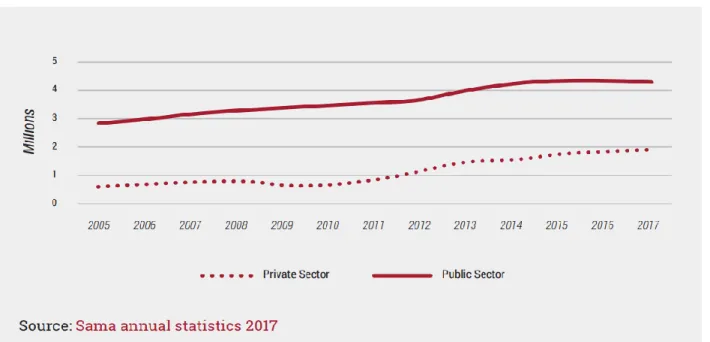
A considerable progress has been made since the 1980s, as the Kingdom sought for the Saudization in the labor market. In the developmental plan of 1985-1995, the Kingdom worked through reducing the number of the foreign labor force. Moreover, during the same period, only 20% of foreigners were employed in the public sector; whereas, 90% of them were employed in the private one. As a result, the Saudi government instructed all private firms and companies to reduce the non-Saudi employees at a rate of 5% per year, while replacing them with Saudi employees accordingly (Mahdi, Barrientos 75). Despite the measures taken by the government— which enhanced to some degree the Saudi participation in the private sector—statistics show the majority of Saudi nationals work in the public sector. See (Fig. 4.).
Fig. 4. Saudi Nationals’ Participation in each of the Private and Public Sectors
Source: “The Labor Market in Saudi Arabia: Background, Areas of Progress, and Insights for the Future”. HarvardKennedySchool. Web. Accessed 6 May 2020.
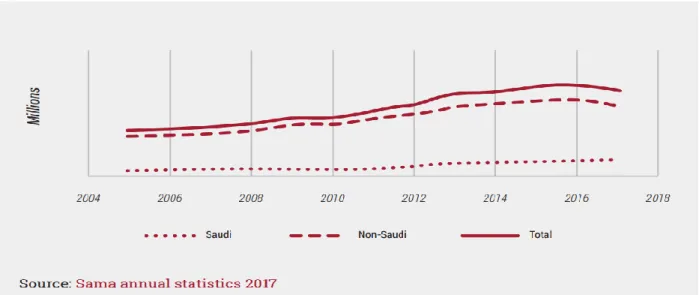
The native Saudi workers were massively dominated by expatriates in the private sector, which gave them (expatriates) precedence in the general percentage of working force (total number of workers in both sectors combined). Further, from the beginning till the end of the new millennium, foreign workers sustained their superiority over their Saudis counterparts. See (Fig. 5)
Fig. 5. Saudi vs non-Saudi Participation in both of the Private and Public Sectors
Source: “The Labor Market in Saudi Arabia: Background, Areas of Progress, and Insights for the Future”. HarvardKennedySchool. Web. Accessed 06 May 2020.
In the same context, regarding the last quarter of 2019, stats show that the total number of civil workers in Saudi Arabia is 13,390,975, most of which are non-natives. The following graphic representation illustrates the Saudi dependency on expatriates. See (Fig. 6)
Fig. 6. The Rate of Saudi and non-Saudi Workers in Labor Force
Source: “The General Authority for Statistics”. Maal, 13 Apr. 2020. Web. Accessed 06 May 2020. 23.7% 76.3% 0 20 40 60 80 100 SAUDI NON-SAUDI
Rate of workers in Saudi Arabia
Saudi Non-Saudi
It is no secret that the Kingdom developed its educational system over the years; yet, the foreign labor force is still invading the country. This situation begs the following question; why does Saudi Arabia need this tremendous number of expatriates? In order to answer this question, we have to analyze briefly the social structure of the Kingdom.
To begin with, Saudi Arabia is patriarchal and conservative, both religiously and traditionally. Further, it is also full of gender stereotyping, orthodox cultural values, and social constraints. For example, Saudi conservatives believe that women’s primary job is to be good wives, mothers and householders, or else practice a work that serves the Saudi social nature, such as teaching or nursing (Alwedinani 169). Moreover, the conservative nature of the Saudi
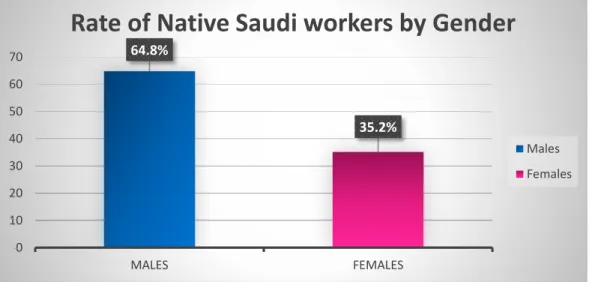
community considers any working woman as deviant to the cultural norms, which causes her social issues. Ironically, the Sharia law, which is the main source of most of the traditional values in Saudi Arabia, does not prohibit women from working nor studying (Al-Asfour et al. 186). Furthermore, according to Human Development Report in 2015, the constraints of Sharia law, such as the prohibition of mixed gatherings in workplaces/schools, as well as, the regressive traditional norms of the Saudi community, result in the lack of women’s participation in the economy of the country. As a result, Saudi Arabia prevents itself from gaining an extra 20% of workforce (qtd. in Al-Asfour, 186). Moreover, the General Authority for Statistics shows that unemployment rate among women is relatively high compared to men, in the period between 1999 and 2017. See (Fig. 7). The same source proves that men are still the dominant gender in native Saudi labor force. See (Fig. 8).
Fig. 7. Unemployment Rate by Gender in Saudi Arabia, 1999-2017
Source: “The Labor Market in Saudi Arabia: Background, Areas of Progress, and Insights for the Future”. HarvardKennedySchool. Web. Accessed 06 May 2020.
Fig. 8. Rate of Native Saudi Workers by Gender
Source: “The General Authority for Statistics”. Maal, 13 Apr. 2020. Web. Accessed 06 May 2020. 64.8% 35.2% 0 10 20 30 40 50 60 70 MALES FEMALES
Rate of Native Saudi workers by Gender
Males Females
To conclude, education and work are highly interrelated, and each one serves the other reciprocally. Saudi Arabia aims to come up with new developmental plans to reduce the number of Saudi workers in the public sector in its 2030 vision. Moreover, the feminine category’ school enrolment rates are raising, thus, women will have all the means to contribute in the development and Saudization of the Saudi economy. Finally, Saudi Arabia is running through developmental plans in order to achieve economic, political, and mostly social reforms, gearing towards a dynamic change in different sectors.
4. Food, Clothing and Art
Food and clothing of Saudi Arabia reflect its history, traditions, religion and the lifestyle of its people. For centuries, Arabs of the Peninsula have traded with many different regions of the world, including Africa, India, central Asia and the Levant countries. Moreover, Makkah,
Madinah, Jiddah and Taif, in the western Arabia, were the most common routes for trading.
4.1. Food
Trade with other countries has not only been economically beneficial for Arabia, but it also brought new ingredients and dishes to its humble cuisine. Furthermore, the Bedouin’s basic diet, dates and milk, developed in urban centers into dishes made with a steadily increasing range of ingredients, and a variety of flavorful Saudi dishes soon emerged. Of higher importance, additionally, the emergence of Islam affected Arabia’s cuisine. First, it prohibited some foods and drinks, such as, pork and alcohol, as it is clearly stated in these two Quranic verses: “He has only forbidden to you dead animals, blood, the flesh of swine, and that which has been dedicated to other than Allah. But whoever is forced [by necessity], neither desiring [it] nor transgressing [its limit], there is no sin upon him. Indeed, Allah is Forgiving and Merciful” (Surah Al-Baqarah: 173), and “O you who have believed, indeed, intoxicants, gambling, [sacrificing on] stone alters
[to other than Allah], and divining arrows are but defilement from the work of Satan, so avoid it that you may be successful” (Surah Al-Maidah: 90), and provided a method to slaughtering animals (Dhabiha). Second, pilgrims to Makkah and Madinah were from places that are more distant and much greater in number compared to pagans who used to come for the annual pagan festival. Moreover, emigrants from different regions stayed in Arabia for different reasons; therefore, they collectively left their unique imprint on the culture and cuisine of the Hijaz region. The nomadic lifestyle and mobility nature of Saudi traders was a vital element in the spread of the newly adopted dishes to most of the Arabian Peninsula.
First, Hijaz region became an urban areawhereby foreign cuisine blended in and became indistinguishable from the Hijazi native dishes. Furthermore, Makkan cuisine specializes in meat recipes made of lamb, vegetables, spices, and rice. In special occasions, Makkan professional cooks, typically cook mabshur, lamb pressed onto skewers, grilled and served on top of a bed of rice and a yogurt salad called samn baladi. In religious holidays, marriages, funerals, during the month of Ramadan, and when receiving special guests, traditional rice dishes are very popular (Anishchenkova 286). Meanwhile, people of Jeddah show their hospitality through serving their guests different dishes of fish in the same meal “beginning with a fish soup, and fish salad, accompanied with fish patties, fish cooked Indonesian style in coconut milk, and fish baked with tamarind sauce tahinah or coriander leaf (cilantro), and ending with sayadiyah or biryani with fish or shrimp” (Nawwab). According to Anishchenkova, Hijaz region is rich with local desserts made of dairy products such as “labaniyyah, a sweet made with milk; jubniyyah, a delicacy made with Taif goat cheese; and ridha al-walidayn, a milk pudding” (287). In addition to Syrian, Egyptian, Indian and Euro-American desserts, Turkish desserts also prevail due to the strong presence of the Ottoman Empire then.
Second, Najd is the central region of Arabia, located between the Hejaz region and the eastern province. Isolated by its deserts of red sand, it maintained its local characteristics until the advent of Islam—many of the inhabitants went as far as China to spread the religion, while traders went to different countries to exchange merchandises (287).Subsequently, these factors contributed in the development of the Bedouin’s diet into a unique cuisine. According to Anishchenkova, Najdis are known for their time-consuming cookery, because they usually combine rye bread or whole-wheat with meat and vegetables in a decent amount of their dishes. Evidently, Najdis share plates with other regions of the Arabia, but they have many variations of all dishes. Haris, for instance, is prepared all around the Arabia, but Najdis put more time and effort in preparing it (287). Additionally, according to Nawwab, in celebrations or when welcoming a special guest, Najdis usually serve a spit-roasted lamb dish called kuzi, in which they stuff the lamb with saffron-tinted rice cooked with nuts and raisins, hard-boiled eggs, and chickens stuffed with cooked macaroni. After, they sew the lamb and roast it until the meat is mushy. Then, they slice the lamb to reveal the stuffing, and finally serve it in large trays with a green salad. Similarly, the hospitality attribute of Najdis is that they usually do not eat until their guest has finished, just in case he needs anything. Evidently, people of Najd adopted different foreign sweets as well; however, more than a few still desire the local ones, which are mainly made of dates.
The Eastern Province, as its name suggests, is located far in the east coast of the Kingdom of Saudi Arabia. Some of its inhabitants were anglers and divers who relied on treasures of the sea (Nawwab). She adds that other elements of the population lived in villages around oases, in addition to the nomads who relied on these villages for essential products such as dates.
Moreover, like other parts of the country, the population comprised of merchants, who traded with neighboring countries and traveled overseas for goods. They merchandised with countries