PSYCHOLOGICAL ASPECTS OF
ARTIFICIAL PROCREATION
CECILE ERNST*
ABSTRACT
Research on infertile couples applying for treatment is scanty. Their education and socioeconomic status are above average and their marriages extraordinarily stable. Allowing for the stress of infertility and its treatment, they appear in psychological tests and psychiatric interviews very similar to controls. As prognosis on the quality of later parenthood for persons in the grey zone between complete psychological normalcy and definable psychiatric disorder is imposs-ible, self selection for artificial procreation rather than selection by a team of psychologists and social workers should take place. A decision not to treat because of the presence of evident psychiatric disorder should be taken on the investigating physicians' own responsibility and explained to the couple. Very little as well is known about the development of children conceived by AID or IVF. There is no rationale for the belief that extraordinary expectations by their parents will impair their psyehosocial development. The literature on adopted children puts the importance of so-called genealogic bewilderment in true perspective. Still the access to non-identifying information on donors could be useful for children and parents. As proof of genetic risk factors for major and minor psychiatric disorder is rapidly accumulating, a careful psychiatric screen-ing of donors is recommended. By artificial procreation parenthood can be extended to widows, to single women and to homosexual couples. Epidemiologic studies in child and adult psychiatry make it evident that the quality of emotional relationship within a family is more important for psyehosocial development of children than family structure. Today the rate of single parents is rapidly increasing. Nonetheless artificial procreation should not be used to promote social change and to create new structures. While fully acknowledging that the conventional family is neither of divine origin nor an anthropological necessity, a cautious attitude would be to wait until new structures arc so well established and generally accepted that they attract the average person and make up an average environment for a child. Though a pluralistic society tends in the field of artificial procreation to shift from ethical to psychological arguments, the latter cannot be validly used against these techniques.
Psychology and psychiatry play an important part in contemporary discussion of'artificial procreation'. (This expression is used to include
• Psychiatric University Clinic, Postfach 68, CH 8029 Zurich, Switzerland.
Acknowledgement, this article is based on a paper given at the UKN'CCL colloquium held at Cambridge in September 1987.
90 C E C I L E E R N S T
artificial insemination by donor, AID, and in vitro fertilization and embryo transfer, IVF). Its opponents often draw their arguments from these specialties. Since there is no longer any consensus about the nature of marriage ('AID is adultery'), human relations ('artificial procreation disconnects conception from love') or human beings in general ('artificial procreation is against nature') psychology and psychiatry are used to furnish objections against these new techniques.
Three psychological arguments usually appear in discussions of arti-ficial procreation: it is said
(1) that using these methods, infertile couples forcibly break an unconscious barrier against a parenthood for which they are not ready; that infertile couples seeking AID or IVF are neurotic, immature and narcisstic and are unable to raise children and that the reason for their infertility is a certain wisdom of the body, which obeys an unconscious wish not to be burdened with a child. Usually these reproaches are directed against wives rather than husbands, although AID, and in some cases IVF, are treatments of male infertility;
(2) that children born through artificial procreation will suffer from parental discord and familial tension because their parents are unconsciously unable to accept them; that they will be subjected to extreme expectations because their parents used extraordinary means to create them; that in the case of sperm and/or egg donation, children will have three, four or (if there is a surrogate mother) even five parents and suffer from genealogic bewilderment;
(3) that artificial procreation may extend parenthood beyond the heterosexual couple to widows, single women who have no sexual partner arid to lesbian couples. Through surrogacy single men and male homo-sexuals may become fathers. The creation of these unfamiliar conditions for bringing up children is usually opposed by an argument that is again taken from developmental psychology: that it is best for children to grow up with both father and mother within a normal family.
In the following pages the psychological aspects of artificial procreation will be discussed in the context of a survey of the literature. Unfortunately well-controlled studies of representative samples using reliable and valid methods are extremely rare.
I. PSYCHOPATHOLOGY IN INFERTILE COUPLES
1.1 Data on Infertile Couples seeking Treatment
Data on the frequency of involuntary childlessness are difficult to find. The literature reveals a common assumption of a rate of 10 to 15 per cent of couples as being involuntarily childless. This rate is probably far too high. Hopflinger (1987, 168) has published the rates of adult women born between 1940 and 1950 up to age 49 who are in all probability
perma-nently childless. In several European countries this rate amounts to 10-15 per cent. However, this includes the unmarried and the voluntarily childless. On the other hand, in a representative survey of married women in France, Leridon (in David, 1980) found that after age 35 probable definitive childlessness was reported by only 2.5 per cent. This rate includes the voluntarily childless. The wish for medical treatment of infertility may be less frequent than is usually believed.
Couples seeking infertility treatment are not representative of the general population. It is regularly found that their education and socio-economic standard is somewhat above the average (Stauber, 1979; Bourgeois, 1977; Manuel el al, 1983; Snowdon el al, 1983; Haseltine, 1985). A follow-up study of couples presenting for AID revealed a quite extraordinarily low divorce rate (Berger, 1982).
The opinion that presentation for artificial procreation almost implies psychiatric disorder has been mentioned earlier. Although the relation-ship between infertility and psychological difficulties is little understood and may not be simple, the suggestion that psychological problems are as a rule the primary cause of infertility is not well founded. The opinion that the infertile, particularly infertile women, subconsciously wish to be infertile and need psychotherapy rather than somatic treatment is mainly based on anecdotal evidence and on unsubstantiated hypotheses of destructive early childhood influences that lead to later infertility (Kemeter el al, 1985; Stauber, 1979; Benda-Report, 1985, dissenting opinion).
There may be a complex interaction between psychological difficulties and infertility. There exists a group of couples whose infertility remains unexplained even when all possible diagnostic tests have been completed. Two contradictory facts make it difficult to evaluate the importance of psychological factors. First, in unexplained infertility of one-year's dura-tion, the chance of spontaneous pregnancy or of pregnancy after a non-therapeutic investigation is quite high. Second, increasing knowledge about the physiology of conception reduces the rate of unexplained infertility. Sperm-auto-antibodies and cervix-hostility have been dis-covered. Specialists think that 'normal' sperm counts are not very reliable, and IVF makes it possible to observe subtle mechanisms that hinder the fertilization of the egg-cell by normal sperm (Pepperell, 1975; Mahadevan el al, 1983; Edelmann el al, 1986).
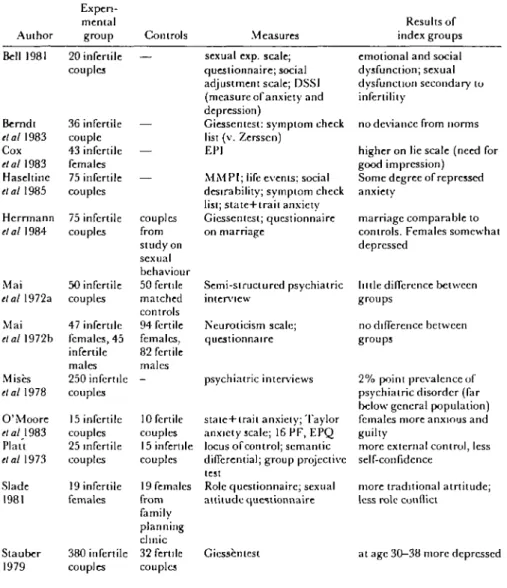
As infertile couples seeking treatment usually have to undergo some psychological or psychiatric screening, several studies compare test results of these men and women either with test norms or with the results of a control group (Table 1). The inspection of this table shows several methodical problems, which have been discussed by Edelmann el al (1986). Numbers are small, the impact of duration of infertility on psychological health is often neglected, and there is a lack of a clear rationale of the measures employed. As these investigations stand, they do
92 C E C I L E E R N S T
Table I. Comparison of infertile groups with test norms or controls (Edelmann it al 1986, modified)
Author Bell 1981 Bemdt etal 1983 Cox rfa/1983 Haseltinc dal 1985 Herrmann elal 1984 Mai elal 1972a Mai </<2/l972b Miscs dal 1978 0'Moore dal 1983 Plan dal 1973 Sladc 1981 Stauber 1979 Experi-mental group 20 infertile couples 36 infertile couple 43 infertile females 75 infertile couples 75 infertile couples 50 infertile couples 47 infertile females, 45 infertile males 250 infertile couples 15 infertile couples 25 infertile couples 19 infertile females 380 infertile couples Controls — — couples from study on sexual behaviour 50 fertile matched controls 94 fertile females, 82 fertile males -10 fertile couples 15 infertile couples 19 females from family planning clinic 32 fertile couples Measures sexual exp. scale; questionnaire; social adjustment scale; DSS1 (measure of anxiety and depression)
Giesscntest: symptom check list (v. Zcrsscn)
EPI
MM PI; life events; social desirability; symptom check list; state+trait anxiety Giesscntest; questionnaire on marriage Semi-structured psychiatric interview Neuroticism scale; questionnaire psychiatric interviews
statc+trail anxiety; Taylor anxiety scale; 16 PF, EPQ locus ofcontrol; semantic differential; group projectivc test
Role questionnaire; sexual altitude questionnaire
Giesscntest
Results of index groups emotional and social dysfunction; sexual dysfunction secondary to infertility
no deviance from norms higher on lie scale (need for good impression)
Some degree of repressed anxiety
marriage comparable to controls. Females somewhat depressed
little difference between groups
no difference between groups
2% point prevalence of psychiatric disorder (far below general population) females more anxious and guilty
more external control, less self-confidence
more traditional atrtitudc; less role conflict
at age 30-38 more depressed
not support the hypothesis that psychological factors play a large part in the etiology of infertility. Couples under treatment are in a considerably worse position than the few fertile control groups. Being infertile may be felt as a major life stress (Edelmann el al 1986 propose using couples who have had their first child as a control group, because they are equally under stress), and diagnostic investigations and therapies may interfere with the couples' intimate relationship.
After successful treatment, on the other hand, anxiety and depression tend to abate (Stauber, 1979; Chatel, 1981; Snowdon etal, 1983, 81, 133; Semenov <?/a/, 1980). Though these longitudinal studies are few and by no
means representative, they are in line with the favourable reports of the psychological effects of other forms of treatment which attack symptoms without aiming at a change of personality, such as behavioural therapy for symptoms of anxiety and sexual disorder (Smith el al, 1980).
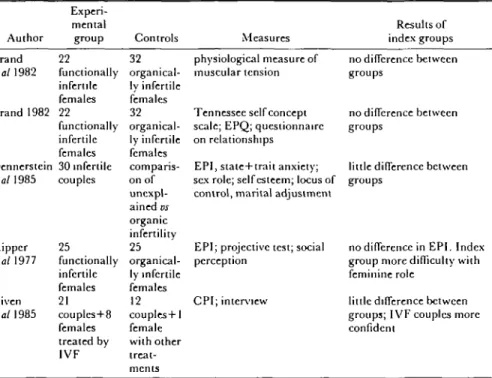
The few studies that compare couples suffering from unexplained infertility with the organically infertile do not find large differences in psychological disorder, and couples choosing IVF do not appear more damaged than those treated by other methods (Table 2).
Table 2. Comparison of couples suffering from unexplained infertility with organically infertile couples. (Edelmann et al 1986, modified)
Author Brand W a/1982 Brand 1982 Dennerstein da/1985 Kipper etal 1977 Given « / < J / I 9 8 5 Experi-mental group 22 functionally infertile females 22 functionally infertile females 30 infertile couples 25 functionally infertile females 21 couples+8 females treated by IVF Controls 32 organical-ly infertile females 32 organical-ly infertile females comparis-on of unexpl-ained vs organic infertility 25 organical-ly infertile females 12 couples+1 female with other treat-ments Measures physiological measure of muscular tension
Tennessee self concept scale; EPQ; questionnaire on relationships EPI, state+trait anxiety; sex role; self esteem; locus of control, marital adjustment
EPI; projectivc test; social perception CPI; interview Results of index groups no difference between groups no difference between groups
little difference between groups
no difference in EPI. Index group more difficulty with feminine role
little difference between groups; IVF couples more confident
1.2 Psychiatric screening of infertile couples
Artificial procreation is different from all other treatments for infertility in that the goal of medical treatment is immediate conception. Physicians feel a certain degree of responsibility for the potential child and do not want it to grow up in less than average conditions. They feel a higher degree of involvement than in the case of hormonal treatment or an operation on the Fallopian tubes. On the other hand, screening couples for treatment may be a pretext for refusing a treatment that is fundamen-tally unacceptable to the physician.
94 C E C I L E E R N S T
questioned. Screening is seen as an exercise of'medical power', as 'social engineering' or as interfering with the right to a very personal decision (Bissery, 1978; Berger, 1982; Noaves, 1983; McGuire et al, 1985). The authors of the Benda-Report, a team working under the direction of the German Ministry of Justice, are of the opinion that 'the physician is not authorized to decide on the possible happiness of the child in the place of husband and wife' (12, transl CE).
These objections give some urgency to the question whether there is a sufficient scientific data base which psychologists and psychiatrists can use to divide infertile couples into those who will raise a reasonably normal child and those who will not. Ideally the data should consist of longitudinal studies of successfully treated couples and their children and relate the psychosocial status of the children (possibly at adult age) to the results of the pretreatment examination. This method would allow us to isolate risk factors for an undesirable development of children conceived by unusual means.
It is scarcely necessary to say that such studies do not exist and probably never will. Parents of children conceived (for instance) by AID are by no means keen to collaborate in longitudinal studies which remind them of a stage in their lives and of experiences they wish to forget. Even among fifteen successfully treated older couples who remained in grateful contact with a practitioner of AID, for many years one in four refused an interview
(Snowden et al, 1983, 95).
Any attempt to screen infertile couples for their ability to bring up children has to be considered against the background of current genetic counselling in psychiatry. The life-time risk of schizophrenia in children born to a schizophrenic parent is 12 per cent; the life-time risk for affective disorder of children born to a parent hospitalized for affective disorder is 10-40 per cent, according to the severity of the illness. In sons of alcohol-dependent parents and of sociopathic fathers, the life-time risk of the same disorder is also considerable (Tsuang, 1978; Bleuler, 1985, 303). Yet no active measures are taken to exclude persons who suffer from major psychiatric disorder from procreation. Genetic counselling in psychiatry today is non-directive; patients are thoroughly informed and then the counsellor ideally assists them to reach a decision that is their own (Revely, 1985).
As longitudinal studies on children conceived by unusual means are lacking, we have to fall back on epidemiological studies of child-hood psychiatric disorder (based on investigations within the general population). Some such studies have investigated the relationship between emotional and behavioural disorder in children and psychiatric disorder in their parents (Rutter, 1982; Steinhausen, 1985). They show that those parental disorders which lead to long-lasting parental discord and to constant irritability and hostility towards the child (eg alcohol dependence, antisocial personality and other major personality disorders, and chronic
PSYCHOLOGICAL ASPECTS OF ARTIFICIAL PROCREATION 95 schizophrenia with bizarre behaviour) are the most detrimental to children.
When such well-known risk factors are present, the empirical data justify physicians refusing treatment. On the other hand it does not seem probable that alcohol-dependent or anti-social personalities or persons suffering from schizophrenia will appear frequently among the infertile seeking treatment. The data presented above (1.1) show that, as regards psychiatric symptoms or diagnosable psychiatric disorder, these couples do not deviate significantly from the general population.
1.3 Advocacy of self-selection
Most treatments of infertility have a low success rate (Soules, 1985) and the diagnostic procedures are long and tedious. Several authors are of the opinion that these factors by themselves operate to select determinate and psychologically stable personalities (Bissery, 1978; Bourgeois, 1977). Of course the low success rate has to be part of the information given before initiating treatment.
The rate of drop-out from treatment is high. Even in the case of the technically uncomplicated AID given in the familiar atmosphere of a private practice, 39 per cent of all couples gave up within five or fewer inseminations and 60 per cent within ten or fewer (Snowdon et al, 1983, 64).
The decision not to go on was usually taken quite soon. Drop-out rates are probably higher with more complicated and painful techniques. Self-selection is also promoted if the diagnostic and therapeutic procedures follow a rather slow course. It is particularly recommended to put.in an 'interval of reflection' between diagnosis and treatment. Diagnosis means that the couple learns 'who is guilty' or, in the case of incompatibility, that husband and wife could be fertile with another partner. Under the impact of this disturbing knowledge a couple may be tempted to rush a decision to be treated. Time to think the situation over, to envisage other solutions and the possibility of non-directive counselling will avoid the pitfalls of applying for a cure through feelings of guilt or in order to save an already dissolving marriage (Berger, 1980; van Hall, 1983). The importance of the opportunity to be counselled is also stressed by the Warnock Report (Department of Health, 1984).
It does not seem essential and may not even be advantageous to employ a team of psychologists, psychiatrists and social workers to diagnose a possible incapacity for parenthood. Like most human beings, infertile couples move in the large grey zone between full normalcy and psychiatric disorder where minor and minimal symptoms may be present, particu-larly under stress, whose relevance for child-rearing is absolutely unknown. In this grey zone self-selection should take place.
If the treating physicians do not screen-out the probably rare gross psychosocial disorders themselves, nor leave the screening to time, but
% CECILEERNST
use a team of 'experts' for screening, this will inevitably have conse-quences. The team will need to prove its indispensability in the procedure and will venture into selection within the grey zone of minor disorders even though it has no proper grounds to do so. The screening will end in sheer arbitrariness and in damage to the infertile men and women screened-out. They will have to live with the information that they are not only infertile but 'not good enough' to have a child.
'The scientific knowledge that we have today is so poor in regard to prediction of successful child-rearing in this field of psychopathology (of infertile couples) that it is easy to imagine that the percentage (of refusals of treatment) can vary from 0 to 100 in function of the theoretical prejudice or originality of the psychiatrist' (Poyen et al, 1980). Besides being unfounded, selections in the grey zone will lead to a black market of artificial procreation. AID technique is simple enough to be used by almost anyone. It should be remembered that a black market for adoptive children has developed because official adoption has become extremely difficult.
1.4 Who will take that responsibility of refusing treatment?
Major and minor psychiatric disorders are caused by a variety of genetic and non-genetic factors. In this they are similar to disorders like juvenile diabetes or coronary heart disease or hypertonia. Even though the presence of a drug or alcohol-dependent father or of a mother suffering from chronic depression is a risk-factor for the psychological health of their child, the chance that this child will grow up without disorder is statistically quite high. He or she may develop protective mechanisms or find these in the environment. The case is not as unequivocal as in the case of a patient suffering, for example, from Huntington's disease where his children have a 50 per cent life-time risk of succumbing to a devastating and fatal neurological illness.
Because our knowledge of the outcome to a child even in a case where gross psychological disorder is present is so uncertain, the physician who decides not to treat must take personal responsibility for the decision. He should explain to the couples his reasons for refusing treatment and that to treat would be incompatible with his conscience. The couple should not go away with the impression of having being condemned by an anonymous power. The Warnock Report also strongly recommends that the decision not to treat should be personal, rational and explained to the couple (Department of Health, 1984, 12).
PSYCHOLOGICAL ASPECTS OF ARTIFICIAL PROCREATION 97
2 . PSYCHOPATHOLOGY AND GENEALOGIC BEWILDERMENT IN CHILDREN CONCEIVED BY ARTIFICIAL PROCREATION
2.1 Extraordinary expectations
In the context of artificial procreation, the expression 'the messianic child' has been coined to refer to the situation where the parents are believed to expect the complete solution to their individual and marital problems from the birth of their child. These expectations are supposed to lead to exorbitant demands on the child, to great stress for the child and ultimately to disappointment.
This argument has to be evaluated in the perspective of social change since the beginning of industrialization. Maternal and child mortality have sharply decreased. While in the families of the pre-industrial era children appeared and disappeared and stepmothers took the place of mothers, the modern family consists of a limited number of persons with a very high life expectancy. The foreseeable number of years that will be spent together may be a condition for emotional attachment. At the same time the modern family has ceased being a self-sufficient community producing its own food and clothes, teaching its children and nursing the sick and the old. (This remark should not imply an idealization of our forefathers' living conditions). The modern family is mainly the place where its members relax, regenerate and experience their most important emotional relationships. Children in pre-industrial times were an eco-nomic asset; now they have become an ecoeco-nomic liability but an emo-tional asset. Today's parents, when questioned on their motives for wanting children, give emotional reasons: children give pleasure, children can be loved, they connect you with the future, they provide a purpose for life (Hoffmann-Novotny, 1984). So there is a continuum between the attitude of a couple who decides at a given point to stop prevention and to have a child and infertile couples for whom having a child is so much part of the life they want to live that they request treatment.
Unfortunately there are at present no controlled studies on the develop-ment of IVF children. A small study by Mushin (1986) at age 12-20 months shows that problems were present only in the severely premature and that the families were generally coping well.
2.2 Genealogical bewilderment
Thousands of children are born each year as a result of AID, but still catamnestic studies on their psychosocial development are missing. Jizuka et al (1968) in Tokyo followed up 40 AID-children at two to eleven years of age. The authors used intelligence and developmental tests and found the children above average on both measures. There are other comments upon the favourable development of small children born after AID (Bourgeois, 1977; Manuel et al, 1980; Semenov, 1980; Calyton,
98 C E C I L E E R N S T
1981). Data on how these children were selected are not given. The children are very young and numbers are quite insufficient for any conclusions. We must fall back on another group of children growing up with 'social' parents, who are not their biological parents: this is the case with adoptees (Humphrey et al, 1986).
Data on adoptees abound and usually show that adoption is a very successful social institution. On average, adoptees do not differ in their psychosocial development from non-adoptees and are less disturbed than children who grow up with their own psychosocially disordered parents (Bean, 1984;Bohman, 1970). Adopted children have no genes in common with their social parents. Children conceived by AID or heterologous IVF have 50 per cent of their genes in common with one parent. In the probably rare cases of egg and sperm donation they would have the same genetic status as adopted children. Common sense could lead one to expect that the outcome for children conceived by artificial procreation would be even better than that of adopted children, because usually at least one of the social parents is also a biological parent, a fact which could enhance the parent-child relationship.
Several authors do not share this optimism. The Benda-Report (1985, 21, 24, 36) foresees problems of identity in children conceived by AID or IVF. The same report rejects surrogacy on the ground that the narrow mother-child-relationship developing during pregnancy is important for the child's later psychosocial development and should not be interrupted by the child's transfer after birth to another woman.
Adopted children are often given away by their biological parents very quickly after birth and brought up by a woman who did not carry the child in .pregnancy. Still, on average they are not plagued by problems of identity (Triseliotis, 1984). The psychosocial success of adoption leaves little room for the apprehension that children conceived by unusual means should suffer because they share to a certain degree the situation of adopted children. Surrogacy should not be avoided because of psycho-logical objections but because it leads to serious legal problems. It should also be observed that the concept of 'identity' is too complex and ill-defined to form the subject of empirical investigation.
23 The Anonymity of Donors
The Benda-Report (1985, 24) recommends that the donor be individually revealed to persons conceived by AID or heterologous IVF. The following rationale is given: 'To know one's origin is of considerable importance for finding one's identity and in consequence for the development of per-sonality, (transl CE). This argument is founded on psychological assump-tions. Translated into a refutable hypothesis it reads: 'Children who do not know their biological parents are at higher risk of developing psychiatric disorder than those who do'.
PSYCHOLOGICAL ASPECTS OF ARTIFICIAL PROCREATION 99 children grow up without their biological parents and usually do not know them as individuals. Their psychosocial development has been thoroughly investigated. It depends on two factors: (a) their genetic vulnerability to psychiatric disorder, which is transmitted to them by their biological parents. Studies of adoptees and their biological parents support the presence of genetic risk factors in schizophrenia, affective disorder, alcoholism, sociopathy and also in minor psychiatric disorders
(Vandenberg<r/a/, 1986; Schulsinger, 1985); (b) the qualities oftheir adoptive home. Influences such as alcoholism or severe personality disorder of adoptive parents, lasting parental discord and its consequence, divorce, are connected with psychiatric disorder in adoptees (Cadoret et al, 1985; Kety, 1985; Knorring et al, 1983).
In comparison with these two powerful factors, the possibility to know and meet one's biological parents would seem of minor importance. This hypothesis is confirmed by empirical studies of adoptees: the paramount environmental factor for their psychological development is the human relations in the adoptive home. Where these are good the adopted child usually is told about his or her origin and the interest in meeting his/her biological parents is minimal. Since 1975 in England and Wales adoptees have at the age of eighteen the right of access to their original birth certificates. This step was accompanied by much publicity. There are about 600,000 adoptees in England and Wales who could request access. About 2 per cent of them have done so during the first three years. In Scotland, where access has been possible for the last fifty years, 7 per cent of the population of adult adoptees has requested it.
An author who has studied the weight of various influences on adoptee development concludes: 'Though there is curiosity and a deep psychologi-cal need in every adoptee to know about his background and personal history, the need for access to records and for meetings with birth parents is frequently a characteristic
- of those who were not given reasonable explanations and informations about their origin,
- of those who have recently gone through some major event or crisis in their lives,
- of those who may have experienced unsatisfactory growing up circumstances.
Contrary to some assumptions identity confusion does not necessarily go with adoption. Studies have shown that a vast majority of adopted people have a firm and secure sense of self (Triseliotis, 1984).
In the light of these observations it is difficult to believe that the mere fact that for adoptees their biological and 'social' parents are not identical damages their psychosocial development. If knowledge of their biological parents were psychologically important, they would search for the latter in larger numbers. Why should it be otherwise for persons conceived by AID of heterologous IVF? Several studies of the psychosocial
develop-100 C E C I L E E R N S T
ment of illegitimate children show that it is most favourable in an adoptive home, less favourable in a foster home and least so when the children grow up with their biological mother (Tizard, 1977; Pongratz, 1964; Bohman, 1971). The probability of an unimpaired development- all other condi-tions being equal - is inversely related to the contact with a biological parent. This fact is a weighty argument against the opinion that this contact is an asset per se.
One might even speculate that safeguarding to a degree the anonymity of donors as individuals may be of an advantage to children conceived by unusual means. The knowledge that sooner or later the donor may have a personal contact with the child may be a burden to the parents, especially to the 'social' father in the case of AID. Infertility in males even today is often felt to be a matter of shame and ridicule (Snowden?/ al, 1983, 128). The possibility that the donor could be individually contacted might put stress on the relations within the family, lead to a kind of psychological 'menage a trois' and do more harm to the child than any good which the possibility of individually knowing his or her biological father could do (Smith, 1983).
It is evident that the right of a child to meet the biological parents cannot reasonably be grounded upon psychological arguments. This does not preclude the possibility of storing non-identifying personal data of donors. Information about their appearance, character traits and genetic make-up could be at the disposition of their biological children. This is also the recommendation of the Warnock Committee (Department of Health, 1984, 4). Laws, on the other hand, which would force on persons conceived by AID of heterologous IVF information about their origins would change the whole situation of infertile couples and of donors. We have no reason to expect that this change would be for the better. The assertion that this measure would lead to 'better donors' is as yet completely unproved. It could only be proved by extensive longitudinal studies of AID-children before and after the prohibition of anonymity.
2.4 The Selection of Donors
The selection of donors may be more important for psychosocial develop-ment of children conceived by AID or heterologous IVF than personal contact. There is at least one study giving evidence that donors are not as carefully selected as they should be. Curie-Cohen et al (1979) sent a questionnaire to all USA physicians practising AID. The return rate was 66 per cent. Information on donor selection showed that the screening was quite insufficient (Smith, 1983). Ackman et al (1980) recommend more thorough methods: the exclusion of infections and of any disorder with a major genetic component, a physical examination and a careful personal and familial history evaluated by a medical geneticist. Among the disorders with a genetic component they include schizophrenia. They should have gone further. There is strong evidence from twin and
PSYCHOLOGICAL ASPECTS OF ARTIFICIAL PROCREATION 101 adoptive studies that not only major psychiatric disorders such as schizophrenia, sociopathy and alcohol dependence have a genetic com-ponent but so also do minor disorders such as phobia, general anxiety and minor depression (Zerbin-Rudin, 1980). For manic-depressive disorder an autosomal dominant gene with 60-70 per cent penetrance has been found in a large USA family, leaving large scope for environmental influences. In a Jewish family a gene for the same disorder was localized on the X-chromosome. The discovery that a major psychiatric disorder may be genetic and heterogenous could mark the beginning of a genetic revolution in psychiatry (Egeland et al, 1987; Baron et al, 1987).
A careful psychiatric screening of donors has a scientific rationale. Not being able to donate sperm or egg for reasons of psychosocial health or of heritable psychiatric disorder in first-degree relatives is far less important for one's life history than being refused infertility treatment for psychiatric reasons.
Official AID-centres could be attractive for donors because of a thorough health examination free of charge, and would be safer for the infertile than the black market because they would be certain of finding healthy donors. As AIDS is spreading, this need could become even more pressing.
3. PARENTHOOD OF SINGLE WOMEN AND HOMOSEXUAL COUPLES
The Warnock Report (Department of Health, 1984, 11) excludes fertiliza-tion of persons not living in a stable heterosexual relafertiliza-tionship because a family consisting in two parents 'is better for a child'. This statement may not be as self-evident as it appears at first sight. Epidemiologic studies in child and adult psychiatry show with surprising regularity that a home broken by divorce is a risk factor for psychiatric disorder in childhood and adult life. Growing up in a home broken by death, on the other hand, does not entail more risk than growing up in an unbroken home with both parents (Ernst et al, 1985). This finding, which might be called a law of psychiatric epidemiology, signifies nothing less than that the relationship between caregiver and child is more important than the structure of a family.
Divorce may be a risk factor for mental health for three reasons: — Psychosocially unstable parents (eg alcohol dependent or sociopathic
personalities) will transmit a certain genetic risk to their children and are at the same time prone to divorce.
— Parental discord invariably precedes and usually follows divorce. — One-parent families, particularly those headed by a woman, often live
under economic strain.
Parental discord and economic hardship are well-known risk factors in child psychiatry (Rutter et al, 1976). In the industrialized world family
102 C E C I L E E R N S T
structure is rapidly changing. Divorce, common-law households and illegitimate births are increasing, and the rate of children living in atypical familial situations is also growing. In conservative Switzerland, two out of eleven children now grow up either with one parent only or in a common law household (Eidg Komm, 1987). In the USA, 45 per cent of the children born in the mid-seventies live or will live prior to reaching eighteen with one parent (McGuire et al, 1984). If this development should continue and divorce become more or less a part of the normal life course, its impact on mental health will probably disappear. It is not the one-parent family that is a risk factor per se, but rather the conditions which are still connected with divorce.
There is no reason why being brought up by a stable and friendly single woman should entail more risk for the psychosocial development of a child than being brought up by a widow. There is no reason why, all other conditions being equal, the insemination of a widow after the death of her husband should damage her child. (The Warnock Report rightly brings forward legal reasons in order to discourage this procedure.) There is no reason why the sexual orientation of a man or a woman who brings up a child should have a negative influence if the person in question is responsible, stable and friendly and if the family is not ostracized because of his/her orientation.
Modern developmental psychology and psychiatry stress the import-ance of genetic endowment and lasting relationships with responsible and friendly caregivers. The latter condition, however, could furnish reasons for presently restricting artificial procreation to couples living in a stable heterosexual relationship. We do not know whether the development of one parent families or common law households will take place in all social classes and ethnic groups and at what rate. In many parts of the industrialized world the married couple may for a long time still be the typical and most valued form of the family. We do not know whether at present the psychosocial adjustment of single women who prefer insemination even to a transient heterosexual relationship differs from the average and in what way. Homosexual men who acquire a child through surrogacy are deviating so far from what public opinion considers right, that living conditions for a child may become very difficult.
If medical men and women feel responsible for giving the child-to-be at least average conditions, they may do well to use artificial procreation within the present family structures and not as a motor for social change. It is not family structure by itself which influences the psychosocial development of a child, it is the persons selecting themselves at a given historical
time into certain structures. These structures are bound to change; they are neither of divine origin nor an anthropological necessity.
Nonetheless caution suggests waiting until new structures are so well established and generally accepted that they attract the average man and woman and there is a reasonable chance that children born into the new
PSYCHOLOGICAL ASPECTS OF ARTIFICIAL PROCREATION 103 structures will experience average conditions and will not suffer signifi-cant social or economic deprivation.
In the first sentences of this paper the opinion was stated that in resisting artificial procreation, a pluralistic society tends to displace ethical considerations by psychological arguments. Perhaps the reader will now agree with the author that these arguments are not valid and that a pragmatic approach, asking how these new techniques will influence the way people live together, could be more useful.
R E F E R E N C E S
Ackmann, C. F. D.,Rioux,J. E. (1980) 'Artificial insemination and the genetic defect crisis', in David,
G., Price, W.D. (eds): Human artificial insemination and semen preservation, Plenum Press, New York. Baron, M., Risch, N. et al (1987) 'Genetic linkage between X-chromosome markers and bipolar
affective illness', Nature 326, 289-91.
Bean, Ph. (ed) (1984) Adoption, essays in social policy, law and sociology. Tavistock Publications, London. Bell, J. S. (1981) Psychological problems among patients attending an infertility clinic. Psychosom
Res 25, 1.
Benda-Report (1985) Bericht da Arbeitsgruppe in vitro-Fertilisation, Genomanalyse Genthtrapu, Bundesministerium der Justiz der BRD, (unpubl).
Berger, D. (1980) 'Infertility. A psychiatrist's perspective', CanJ Psychial 25, 553.
Berger, D. M. (1982) 'Psychological aspects of donor insemination', Internal J Psychial in Medicine 12 49-57.
Bernt, H., Sudik, R., Bernt, W. D. (1985) 'Psychologische Untersuchungen steriler Ehepaarc im Rahmen einesJVF-Programms', Zentralblatt Gynakol 107, 1424-31.
Bissery, J., Semenov, G., Mises, R. et al (1978) 'Les couples demandeurs d'insemination artificiclle par donneur', Revue de Medeane psychomatique 20, No 2.
Bleuler, M. (1985) Lthrbuch der PsyckatrU, 15 Aufl Springer.
Bohman, M. (1970) Adopted children and their families. A follow-up study, Proprius, Stockholm. Bohman, M. (1977) 'Alternatives to biological parenting', in Graham, P.J. (ed.) Epidemiological
approaches in child psychiatry, Academic Press, London.
Bourgeois, M. (1977) 'Insemination artificielle par donneur', Ann Mid Psychol 135, 294-312. Brand, H. J. (1982) 'Psychological stress and infertility. Part 2: Psychometric test data', BritJ Med
psychol 55, 385-8.
Cadoret, R. J. etal (1985) 'Genetic and environmental factors in major depression',J Affect Disorders 9, 155-64.
Chatel, A. (1983) 'Aspects psychologiques', in Rioux, J.E., Baudoin, J.L. el al (eds), Insemination
artificielle Iherapeutique, Les presses de PUniversite Laval, Quebec, 69-110.
Cox, D., Reading, A. E. (1983) 'Personality profiles of women attending an artificial insemination by donor clinic', Personality and individual differences 4, 213—14.
Curie-Cohen, M., Lesleigh, L., Shapiro, S. (1979) 'Current practice of artificial insemination by donor in the USA', Sew England J Med 300, 585-90.
Dennerstein, L., Morse, C. (1985) 'Psychosocial issues in JVF', Clin Obstet Gyntcol 12, 835-46. Dept Health Social Security, Report of the committee of inquiry into human fertilization and embryology
(Warnock Report), July 1984, London, HMSO.
Edelmann,J.,Conolly, K.J. (1986) 'Psychosocial aspectsofinfertility", flnV^/ty^o'59, 209-19. Egeland, J., Gerhard, D. S. et al (1987) 'Bipolar affective disorder linked to DN A-markers', Nature 325,
78S-7.
Eidg Kommission fur Frauenfragen (1987) Frauen und Manner, Bericht, 65, 79. Ernst, C , Luckner, N. (1985) SulU die FnMindheit die Wcichen? Enke Stuttgart.
Given, J . E., Jones, G. S., McMillen, D.S. (1985) 'A comparison of personality characteristics between in vitro fertilization patients and other infertile patients', J In vitro Fert Embryo Transfer 1, 49-51.
Haseltine, F. P. et al (1985) 'Psychological interviews in screening couples undergoing in vitro fertilization', Am NY Acad Sciences 442, 504-22.
10+ C E C I L E E R N S T
von Ehepaaren vor der artificiellen Insemination mit Donoren, GeburtshUfe-Frauenheilkunde 44, 719-23.
Hoflinann-Novotny, H.J., Hopflinger, F. etal(\9&4) PlanspitlFamUie. Ruegger Verlag, Diessenhofen. Hopflinger, F. (1987) Wandel der Familienbildung in Westeuropa, Campus, Frankfurt a.M. Humphrey, M., Humphrey, H. (1986) 'A fresh look at genealogical bewilderment', BrJ med Psychol
59, 133-40.
Jarriage, A., Maron, P. (1982) 'Aspects psychologiques de I'insemination artificielle par donneur',
Psychology Medicale 14, 1209-13.
Jizuka, R., Sawada, Y., ua (1968) 'The physical and mental development of children born following artificial insemination', ltd J Fertility 13, 24-32.
Johnston, W. H., Oke, K. etal (1985) 'Patient selection for IVF: Physical and physiological aspects',
Ann NY Acad Sciences 442, 490-95.
Judes, U. (1983) In-Vitro-Fertilisation and Embryo transfer, Wissensch. Verlagsgesellschaft, Stuttgart. Kemeter, P., Eder, A., Springer, M. (1985) 'Psychosocial testing and pretreatment in women for in
vitro fertilization', Ann NY Acad Sciences 442, 523-32.
Kety,S. S. (1985) 'Interactions between stress and genetic processors', in Zales, M. R. Stress in Health
and disease, Brunner Mazel, New York.
Kipper, D. A., Zigler, Z., Serr, D.M., Insler, V. (1977) 'Psychogenic infertility, neuroticism and the feminine role',,/ Psychosom Research 21, 353-8.
Knorring v., A. L., Cloninger, R., Bohman, M. (1983) 'An adoption study of depressive disorder',
Arch Gen Psychiat 40, 943-55.
Leridon, H. (1980) 'Public opinion and sterility' in: David, G., Price, W.S. (eds) Human artificial
insemination and semen preservation, Plenum Press, New York, S.513—19.
Mahadevan, M. M., Trounson, A. O. et al (1983) 'The relationship of tubal blockage, infertility of unknown cause, suspected male infertility and endometriosis to success in IVF + ET', Fertil Steril 40, 55-62.
Mai, F. M. M. et al (1972c) 'Psychosomatic and behavioral aspects in psychogenic infertility'. BrJ
Psychiatry 120, 199.
Mai, F. M. M.,Rump, E. E. (1972b) 'Are infertile men and women neurotic?' AustrJ Psychol 24,83-6. Mai, F. M. M., Munday, R. N., Rump, E. E. (1972a) 'Psychiatric interview comparisons between
infertile and fertile couples'. Psychosomat Med 34, 431-8.
Manuel, Ch., Czyba, J. Ch. (1980) 'Follow-up study of children born through AID', in: David, G.,
Price, W. S. (eds) Human artificial insemination and semen preservation, Plenum Press, New York.
Manuel, C , Choquet, M., Czyba, J. Ch. (1983) 'Aspects sociaux, medicaux et psychologiques des grossesses et accouchements des meres par IAD', in: Manuel, C , Czyba, J. Ch. (eds) Aspects
psychologiques de I'inseniination artificielle. SIMEP, Lyon. S. 114-34.
McGuire, M., Alexander, N.J. (1985) 'Artificial insemination of single women', Fertil Steril 43, 182-4. Mists, R.,Semenov, G., Huerre, P. (1978) 'Problemes psychologiques lies a I'insemination artificielle
par donneur', Confrontations psychiatriques 16, 219-36.
Mushin, D. N., Barrcda, M. C , Spenstey, J. C. (1986) 'In vitro fertilization children: early psychosocial development', f in vitro Fert Embr Trans 3, 247-52.
' Noaves, S. (1983) 'La procreation par insemination artificielle', Social Science Information 22, 139-O'Moore, A. M. elal (1983) 'Psychosomatic aspects in idiopathic infertility', J Psychosom Research a,
145-51.
Pepperell, R.J., McBainJ. C. (1975) 'Unexplained fertility, a review', Brf Obstet Gynaecol 92,569-80. Platt.J. J., FichterJ., Silver, M.J. etal (1973) 'Infertile couples', Fertil Steril 24, 972-6.
Pongratz, L. (1964) Prostituiertenkinaer, Fischer, Stuttgart.
Poyen, J . C , Penochet, S. et al (1980) 'Is there a right to AID?' in: David, G., Price, W.S. (eds) Human
artificial insemination and semen preservation, Plenum Press, New York.
Revely.A. (1985) 'Genetic counselling for schizophrenia', Brf Psychiatry 147, 107-12.
Rutter, M., Quinton, D., Yule, W. (1982) Family pathology and disorder in children, Wiley and Sons, London.
Semenov, G., Mists, R., Bissery.J. (1980) 'Attempt at follow-up of children born through AID', in:
David G., Price, W. S. (eds) Human artificial insemination and semen preservation, Plenum Press, New
York.
Schulsinger, F. (1985) "The experience from the adoption method in genetic research', Medical
Genetics, Alan R. Liss Incorp.
Slade, P. (1981) 'Sexual attitudes and social role orientation in infertile woman',./ Psychosom Res 25, 183-6.
PSYCHOLOGICAL ASPECTS OF ARTIFICIAL PROCREATION 105 Smith, G. P. (1983) 'The razor's edge of human bonding: artificial fathers and surrogate mothers',
Western New England Law Review 4, 639-66.
Smith, M. L., Glass, G. V., Miller, J. T. (1980) The benefits of psychotherapy, Johns Hopkins Univ Press, Baltimore.
Snowden, R., Mitchell,G. D.,Snowden, E. M. (1983) Artificialreproduction. A socialinvestigation,George Allen and Unwin, London.
Soules, M. R. (1985) 'The in vitro fertilization pregnancy rate', Fertility and Sterility 43, 511-13. Stauber, M. fl979) Psychosomatic der sterilen Ehe, Grosse Verlag, Berlin.
Steinhausen, H. C. (1985) 'Psychiatric disorder in children and family dysfunction', Soc Psychiat 20, 11-16.
Tizard, B. (1977) Adoption, a second chance, Open Books, London.
Triseliotis, J. (1984) 'Obtaining birth certificates', in: Bean, P. Adoption, essays in social policy, law and
sociology, Tavistock Publications, 38-53.
Tsuang, M. T. (1978) 'Genetic counselling for psychiatric patients and their families', Am J Psychiat 135, 1465-75.
Vandenberg, S., Singer, S. M., Pauls, D. L. (1986) The inheritance of behaviour disorders, Plenum Medical Books Comp, New York.
Van Hall, E. V. (1983) 'Psychosocial and emotional aspects of infertility', J Psychosom ObstetGynecol2, 251-5.
Zerbin-Rudin, E. (1980) 'Psychiatrische Genetik', in: Psychiatrie der Gegenwart, 1/2, 2. Aufl Springer Berlin, 545-617.