Zeitschrift fürPhysikalischeChemie,Bd. 201, S. 151-158 (1997) ©by R. Oldenbourg Verlag, München 1997
Local Structure of
Cu2+
in the
(C2H5NH3)2MCl4:Cu2+ (M
=Cd,
Mn)
Layer
Perovskites.
Influence
of
Hydrostatic
Pressure in the
0-60 kbar
Range*
By
B. A.Moral',
F.Rodriguez'**,
R.Valiente',
M. Moreno1 and H.U. Güdel21 DCITIMAC, Facultadde
Ciencias,Universidad de Cantabria, E-39005 Santander,Spain
2 Institut füranorganischeundphysikalischeChemie,
UniversitätBern,
Freiestrasse3,CH-3000 Bern 9,Switzerland
(ReceivedAugust 24, 1996)
Charge-transfer
spectroscopy
IHydrostatic
pressureICuClt
complex
I(C2HJSIH3)2CdCh
I(C2HsNH3)2MnCl4
This paper deals with the effects of pressure on the charge-transfer spectra ofCuCl¿
complexesformed in Cu2'
doped
(C2H5NH,)2MC14(M = Cd,Mn). A pressure-induced
redshift is observed forthe firstcharge-transferband in bothcrystals. While the shift is continuous for the Mn crystal at a rate of —40cm '/kbar in the 0
—
60 kbar range, it
experiences an abrupt jumpof
—
1400cm ' around 26kbar for the Cd crystal. Such a
discontinuous behaviour is interpreted in terms of a structural change in the CuCl2r
coordination geometry from an axially elongated octahedron to a more compressed
geometry. The present results are compared with those reported for the pure
(C2H5NH,),CuCl4crystal.
Introduction
The aim of this work isto
investigate
the local structureofCuCl4,-
complex-es formed in the
(C2H5NH3)2MC14 (M
=Cd, Mn)
crystals
doped
withCu2+and its
dependence
onthehydrostatic
pressurethrough
theCharge-Transfer
(CT)
spectra.
Attention ispaid
on whether the formation ofcompressed
*
Presented at the 13th International
Symposium
on Electrons and Vibrations in Solidsand Finite Systems(Jahn-TellerEffect) Berlin 1996.152 B. A.Moral, F.Rodríguez, R. Valiente,M. MorenoandH. U. Güdel
CuCl4,-
complexes,
unusual for chlorides[1, 2],
ispossible
or not in theselayer perovskites,
and whether anelongated complex
can be transformedinto a
compressed
oneby applying hydrostatic
pressures. The selected crys-tals are suitable systems for such astudy
sincethey provide compressed
octahedron sites for
accommodating
substitutionalimpurities.
Inparticular,
theequatorial
and axial M—Cl distances of thecompressed
MCI4,"
octa-hedra are
/?eq
= 2.67Â
andflax
= 2.52Á
for(C2H5NH3)2CdCl4 [3]
whilefor
(C2H,NH3)2MnCl4
the distances areRcq
= 2.59Á
andflax
= 2.47Á
[4].
In contrast, pure(CnH2n+1NH3)2CuCl4
compounds
display
anin-plane
antiferrodistortive structure of
axially elongated
CuCl4-[5].
Infact,
theelongated
octahedron is the usual coordination structure forCuCl4,"
either in purecupric
chlorides or indoped
compounds.
Exceptions
to this be-haviour are found in(enH2)MnCl4:Cu2+
[6,
7]
and,
ingeneral,
inlayer
perovskites
(CnH2n+1NH3)2MnCl4:Cu2+ [8]
where acompressed
D4h
co-ordination geometrywas
proposed
forexplaining
the intense CTabsorption
band at 21000cm"'.
Nevertheless,
recentinvestigations performed
onisomorphous
Cdcrystals
[8, 9]
reveal thatCuCl4,"
iselongated
rather thancompressed,
eventhough
this is the actualsymmetry
of thereplaced
Cd2+site. In order to
clarify
the different behaviour exhibitedby
the Cd and Mncrystals,
we have studied the effect ofthehydrostatic
pressure on the CT spectracorresponding
to these Cu2+doped layered perovskites. Apart
from the selective character of the CTbands,
theirhigh
oscillatorstrengths
(f~
10 '—10~2) [8]
makeit suitableprobes
fordetecting
structuralchanges
around Cu2+ in diluted materials(<1%)
subjected
tohydrostatic
pressure.Interestingly,
the results obtained on these dilutedsystems
compare wellwith those
recently
obtained in the pure(C2H5NH3)2CuCl4
crystal
[10],
in which theoccurrence ofapressure-induced phase
transition around 40 kbar wasinterpreted
in terms ofdisappearance
of thein-plane
lattice distortionof CuCl4"
•
Experimental
The
single crystals
of(C2H,NH3)2MnCl4
and(C2H5NH3)2CdCl4
doped
with Cu2+(about
0.2 mol%)
arethesame onesemployed
in Ref.[8].
Hydrostatic
pressure
experiments
have beenperformed
onmicrocrystals
of about100 X100X20
pm3 using
asapphire
anvil cell attached to aspecially
designed
double beamspectrometer.
Details of theexperimental
setup
aregiven
elsewhere[11].
Paraffin oil was used as pressure transmitter and thepressure was calibrated
through
the shifts of theruby
R-lines.Ruby
luminescence was excited
by
a 568nm Coherent I-302-KKrypton
laser.Results and discussion
Fig.
1 shows theoptical absorption
(OA)
spectra
of thetwotitlecompounds
atatmospheric
pressure. Ananalysis
of thecorresponding
spectra
isgiven
Local Structure ofCu2+ in the(C2H5NH,)2MCl4:Cu2f LayerPerovskites 153 6000 5000 4000 3000 2000 Í 1000 3 U h 1500 a 1000 500 40000 35000 30000 25000 20000 WAVENUMBER(cm')
Fig.1.Optical absorptionspectraof(C2H5NH3)2MnCl4:Cu2+and(C2H,NH,)2CdCl4:Cu2'
atatmosphericpressureandroomtemperature. Thespectrawereobtained withpolarized light propagating alongthecdirection (perpendiculartothe layer).
in Refs.
[6-9].
In bothcrystals,
theabsorption
bands have beenassigned
toCL—»Cu2+ CT transitions of theformedCuCl4,"
complex.
Thespectrum
of the Cd
crystal
is similar to those found inCdCl2:Cu2+, LiCl:Cu2+,
(C2H5NH3)2CuCl4
whereCuCl4,"
complexes display
anelongated
octa-hedron structure[12
—
15].
Inparticular
the two intense bands at 25100 and 35700 cm"' observed in(C2HsNH3)2CdCl4:Cu2+
areassigned
within an
elongated
complex
ofD4„
symmetry to CT transitionsfrom the
bonding mainly
Cl"eu(7r
+<7)
andeu(<7
+jr)
molecular orbitals(MO)
to theantibonding
mainly
Cu2+blg
(x2-y2)
MO,
respectively.
In(C2H,NH3)2MnCl4:Cu2+
however the intense band at 21000 cm"1 isasso-ciated with a CT transition from the
equatorial
Cl"eu(7t
+f7)
MO to theCu2+
alg(3
z2
—
A)
MO within a
compressed
CuCl4,"
complex
with the shortaxial bond
perpendicular
to thelayer
[6—8].
Nevertheless,
this model is unabletoexplain
the presence of the narrowerbandat 25000 cm"1. Recentinvestigations
carried outon the mixed(CH3NH3)2MnlCd1_vCl4:Cu2+
crys-35700cm' 25100cm1
154 B. A. Moral.F. Rodríguez, R.Valiente,M. Morenoand H. U. Güdel
(C2H5NH3)2CdCl4:
CuWAVENUMBER
(cm1)
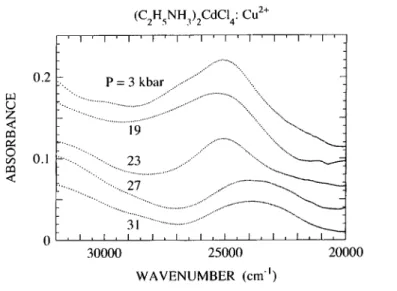
Fig. 2. Influenceofthe hydrostaticpressure uponthe firstCl" —» Cu2+ chargetransfer
band in (C,H5NH,)2CdCl4:Cu2+.
tal series
point
out the relevance of the Mn2+ notonly
forexplaining
the enhancement ofabsorption intensity
onpassing
from x = 0 to x = 1 aswell as its thermal
dependence,
but also forexplaining
the presence of the25000cm"'
band
although
in such a case an additionalD2h
orthorhombicdistortion for the CuCl4" was assumed
[9].
The effect of the
hydrostatic
pressure on the OAspectra
of(C2H5NH3)2MCl4:Cu2+ (M
=Cd,
Mn)
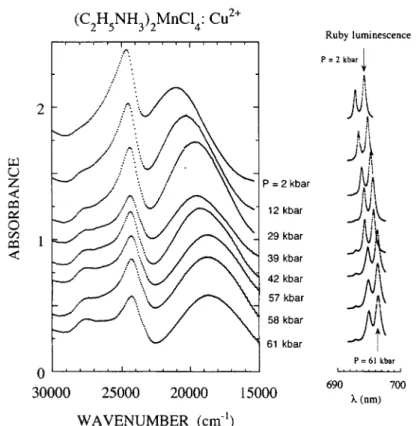
is illustrated inFigs.
2 and 3. Thecorresponding
variations of thepeak
energy with pressure areplotted
inFigs.
4 and 5. Notethatin bothcrystals
the CT bands shifttolowerenergies
uponincreasing
pressure,although
thevariation,
E(P)
is rather different in each case. While a continuous redshift is observed for the 25000 and21000 cm"' bands at shift rates,
AEIAP,
of -6.1 and -40cm'/kbar,
respectively,
for the(C2H5NH3)2MnCl4:Cu2+,
this variation for the(C2H5NH3)2CdCl4:Cu2+ crystal undergoes
anabrupt
shift of -1400cm"1around 26 kbar. From
atmospheric
pressure to 25kbar,
the CT bandexperi-ences a small redshift of about -100 cm"1. The
steep
variation exhibitedby
the first CT band at 26 kbar isnoteworthy.
This reflects structuralchanges
of theCuCl4,"
complexes
which areprobably
associated with ashortening
of thein-plane
axial bond(and
likely
alengthening
of thein-plane
shortbonds)
leading
to a morecompressed
geometry
where theshortestCu—Cl bonds are
perpendicular
tothelayer.
Thecomparison
ofthepresent
results with those obtainedby
Moritomoetal. in(C2H5NH3)2CuCl4
using
OA and Ramanspectroscopy
supports
this view[10].
These authorsreport
the existence ofapressure-induced
structuralphase
transition around UJ O 5 o ir, <Local Structure of Cu2' inthe (C2H5NH,)2MCl4:Cu2' LayerPerovskites 155
(C2H5NH3)2MnCl4:
Cu2+ u z < PQ c < Rubyluminescence P=2kbarI 30000 25000 20000 15000 WAVENUMBER(cm1)
i iilill
4
JA
690 700 X(nm)Fig.3. Variation oftheoptical absorptionspectraof(C2H,NH,)2MnCl4:Cu2'
with
hydro-static pressure atroomtemperaturein the 0-61 kbarrange. Thecorrespondingvariation
ofthe Rubyluminescence used for pressurecalibration,is shown onthe rightside.
40 kbar that involves the deactivation of the Raman
peaks
associated with thestretching
vibrations of thein-plane
axial andequatorial
bonds of theelongated
CuCl4,"
complexes (Ä„
= 2.98Á
andR«,
= 2.28Á)
[5].
Theoccurrenceof such a
phase
transition isimportant
since it wouldimply
thedisappearance
of the antiferrodistortive structuredisplayed by
theCuCl4,"
complexes
and,consequently
achange
in themagnetic
behaviour of thecrystal
fromferromagnetic
toantiferromagnetic
should beexpected
above 40 kbar[10].
The variation of the CT energy upon pressurereported
in that work resembles those observed for thepresent
dilutedsystems
but in differ-ent pressure ranges. The redshift of -3200 cm"1 observed between 15 and 30 kbar in(C2H5NH3)2CuCl4
is similar to the variation shown inFig.
3 for(C2H5NH3)2CdCl4:Cu2^ although
a smaller shiftis observed for the present case. Above 40 kbar the CT band of the purecrystal experiences
a156 B.A. Moral, F.Rodriguez, R. Valiente,M. Moreno and H. U. Giidel
(C2H5NH3)2CdCl4:
Cu2+ E 25000 Wg
24000è
a, 23000 "i i i r/
E=25120- 4.3 P P=26 kbar 10 20 30 PRESSURE(kbar)
Fig.4. Variation of thepeakenergy of the first CT band in(C2H,NH,)2CdCl4:Cu2+ with the hydrostatic pressure. The straight line corresponds to the least square fit in the
0—25 kbar range.
(C2H5NH3)2MnCl4:
Cu2+ 24000 a >h 22000I
20000 18000 SecondCT band E=24660-6.1 P First CT band E=21000-40P 10 20 30 40 50 PRESSURE(kbar)
60 70Fig.
5. Pressuredependence
of CT bands at 21000 and 25000 cm"' in(C2H5NH,)2MnCl4:Cu2t.The
straight
linesare least square fits.21000 cm"' band in
(C2H,NH3)2MnCl4:Cu2+ (Fig.
5).
Moreover the CT energy of(C2H5NH3)2CuCl4
at 90kbar,
E = 21500cm',
is near the CTLocal Structure of Cu2+ in the(C2H,NH,)2MC14:Cu2' LayerPerovskites 157
These two facts suggest that the CT band observed in the
high-pressure
phase
of the purecrystal
and in the Mncrystal
atatmospheric
pressure isprobably
associated with similar CTstates ofcompressed
CuCl4,"
complex-esof either
tetragonal
(D4h)
ororthorhombic(D2h)
symmetry.Consequently,
the variations
experienced by
the first CT band upon pressure in the three relatedcrystals
can bereasonably explained
in terms of structuralchanges
ofCuCl4,"
taking
into account that the effect of pressure on theelongated
CuCl4,"
complex
ismainly
toreducesignificantly
the axialCu—Cldistance,
andonly
slightly
(or
evenincrease)
thein-plane
short Cu-Cldistance,
leading
to a morecompressed
geometry
with the shortest Cu—Cl bondsperpendicular
tothelayer.
Thisanisotropic
compression
of theCuCl4,"
com-plex
upon pressure ispropably responsible
for the observed CT band red-shifts. A structuralstudy
of thehigh-pressure phase
of the pure Cucrystal
using
diffractiontechniques
would beveryusefultoclarify
the coordinationgeometry
of CuCl4" in thisphase.
Finally,
it mustbe noted that the narrow bandappearing
at 25000 cm-1 in the OA spectrumof(C2H,NH3)2MnCl4:Cu2+,
is notobserved in thehigh
pressurephase
of either(C2H5NH3)2CdCl4:Cu2+
or(C2H5NH3)2CuCl4.
Thisfeature is consistent with the
interpretation given
in[9]
for such aband asdue to an electronic transition
involving
both Cl" — Cu2+ CT states of theCuCl4"
complex
and the4A,4E(G)
excited state of theexchange-coupled
Mn2+neighbours, although
in such a case, an additional orthorhombicD2h
distortion was assumed forCuCl4,".
The similarpressure-induced
shiftrates measured for this band
(AEIAP
=—
6
cm"'/kbar)
and for the4A,4E(G)
peak
inMnCl2
(AEIAP
= -5cm"'/kbar) [16]
supportsthatinter-pretation.
From the pressure shift of the broad band at 21000
cm"',
weestimate that the pressure
required
to shift the first CT band from(C2H,NH3),CdCl4:Cu2+
to(C2H,NH3)2MnCl4:Cu2+
is about 100kbar.Summary
Hydrostatic
pressureexperiments
carried out in(C2H5NH3)2CdCl4:Cu2+
show the existence ofa structural
change
in the CuCl4"complex
from anelongated
octahedron to anearly compressed
one at above 25 kbar. Thischange
is evidencedthrough
theabrupt
shift of -1400 cm"1undergone
by
the first CT band around that pressure. Thecomparison
of these results with those available for(C2H,NH3)2CuCl4
indicates that thehigh-pressure
structureof the
CuCl4,"
in thiscrystal
isprobably
similartothat attained for(C2H5NH3)2MnCl4:Cu2+
atatmospheric
pressure. Thepresent
hydrostatic
pressureexperiments
performed
on theseCu2+-doped
layer perovskites
pro-vide direct epro-vidence about the redshift
undergone by
the first CT band of158 B. A.Moral, F.Rodríguez, R. Valiente,M. Moreno and H. U.Gtidel
Further work in order to
investigate
whether the steep redshift around 26 kbar is associated witha structuralphase
transition ofthehostcrystal
orwhether is
just
a pure localphenomenon, using
diffractiontechniques
isunder way.
Acknowledgments
Financial
support
fromCaja
Cantabria and CICYT(Project
No.PB92-0505)
isacknowledged.
References
1. M. A. Hitchman, CommentsInorg. Chem. 15(1994) 197. 2. D. Reinen and M. Atanasov,Magn. Res. Rev. 15(1991) 167. 3. G. Chapuis, Phys. StatusSolidi A43(1977)203.
4. W. Depmeier,ActaCrystallogr. B 32(1976) 303.
5. J. P. Steadman and R. D.Willett, Inorg.Chim. Acta4 (1970)367.
6. U. Schmid,H. U. Giidel and R. D.Willett,Inorg.Chim. 21(1982)2977.
7. J. A. Aramburu and M.Moreno, J. Chim. Phys. 86(1989) 871.
8. B. Baticle,F. Rodriguez and R. Valiente,Radiât. Eff. Def. Solids 135 (1995) 89.
9. R. Valiente and F. Rodriguez,J.Phys.Chem. Solids 57(1996) 571. 10. Y. Moritomo and Y. Tokura,J.Chem.
Phys.
101 (1994) 1763.11. B. A. Moral and F. Rodriguez, Rev. Sei. Instrum. 66(1995)5178.
12. K. Kan'no, S. Naoe, S. Mukai and Y Nakai,Solid State Commun. 13(1973) 1325.
13. S. Hirako and R. Onaka,J. Phys.Soc.Jpn. 51 (1982) 1255.
14. S. R.Desjardins, K. W.Penfield, S. L.Cohen, R. L. Musselman and E. I. Solomon,
J. Am. Chem. Soc. 105 (1983)4590.
15. J. A.Aramburu and M.Moreno, J. Chem.Phys. 83(1985) 6071.