Chemical Senses Vol.14 no.l pp.75-79, 1989
Isolation and characterization of pentadin, the sweet
principle of Pentadiplandra brazzeana Baillon
H.van der Wei, G.Larson1, A.Hladik2, C.M.Hladik3, G.Hellekant1 and D.Glaser4
van Beethovenlaan 5, 3161RV Rhoon, The Netherlands,
'Department of Veterinary Science and Wisconsin Regional Primate Center, University of Wisconsin, 1655 Linden Drive, Madison, WI 53706, USA,
2CNRS, Ecotrop Museum-Ecologie, 4 Avenue du Petit Chateau, 91800
Brunoy, 3CNRS, 'Anthropologie Alimentaire Differentielle', 4 Avenue du
Petit Chateau, 91800 Brunoy, France and 4Anthropologisches Institut der
Universitat Zurich-Irchel, CH-8057 Zurich, Switzerland
Abstract. An aqaeous extract from the pulp of the plant Pentadiplandra brazzeana Baillon (Pentadiplandraceae)
yielded a strong sweet-tasting material. This sweet principle was isolated by water extraction, ultrafiltration and gel filtration. The conclusion that this substance must be of a proteinaceous nature was based on amino acid analysis, characteristic UV-absorption spectrum and positive colour reaction with Coomassie brilliant blue. The mol. wt of the subunit of the sweet protein was estimated to be - 1 2 000 daltons. The sweetness intensity of the whole protein was - 5 0 0 times that of sucrose on a weight basis. The taste response in a Rhesus monkey to a 0.1 % solution was comparable to the response to a 0.02 % monellin solution. We propose the name 'pentadin' for this sweet-tasting protein and present a few comments about the possible origin of such sugar mimics.
Introduction
The search for non-carbohydrate sweeteners from natural sources has led to the discovery of many interesting intensely sweet-tasting substances. The sweet proteins thaumatin and monellin constitute a very interesting class (van der Wei, 1986). This communica-tion reports another sweet protein from the fruits of Pentadiplandra brazzeana, a species described as a Tiliacae by Baillon (1868), presently classified in the Pentadiplandraceae, a family created by Hutchinson (1928). This plant is an endemic climbing shrub found in tropical Africa, bearing red globular berries of ~ 5 cm in diameter. Under a thick epicarp, these berries contain one to five reniform seeds surrounded by a thick soft layer of red pulp which is locally known, especially in Gabon, for its strong sweet taste.
Methods and Results
The fruits were collected in Gabon (voucher specimen in the Paris Herbarium: A.Hladik no. 4139). Seeds were extracted from the epicarp and dried in an oven at 80°C without attempting to separate the adhesive soft pulp.
One dried seed (1.37 g) with the attached dried pulp was soaked overnight in 100 ml distilled water at 4°C. Following this, the softened pulp around the seed was disrupted and the slurry filtered. The yellowish coloured filtrate had a strong sweet taste. After freeze-drying, 98.5 mg of material was obtained.
Ten mg of this material was subjected to ultrafiltration on a YM-2 membrane (Amicon, exclusion limit of MW 1000). Any sweet-tasting material was excluded and only the © IRL Press 75
0.01 - 1 4 . 2 -II • b e d « « • •rkcrt
J
Fig. 1. Gel filtration on Sephadex G75 of 1.5 mg of ultrafiltered fruit extract, and electrophoresis (inset) of gel filtration fractions. Gel filtration: column bed, 1.6 x 55 cm; flow-rate, 12.3 ml/h; fraction volume, 3.0 ml; eluant, 0.02 M NaCl (pH 6.5). Fraction (c) was the sweet fraction. Electrophoresis: gel filtration fractions a - d were run on an SDS poly aery lamide gel (15% acrylamide) in the presence of 5% 2-mercaptoethanol. Mol. wt markers were obtained from Sigma, St Louis, MO. Samples were loaded at the top of the pictured gel.
Table I. Amino acid composition of pentadin
Amino acid Aspartic acid Glutamic acid Serine Proline Glycine Alaninc Cysteine Valine Methionine Isoleucine Leucine Tyrosine Phenylalanine Lysinc Arginine Histidine Tryptophan n.d. = not determined. Number of residues per protein molecule 14 12 5 15 5 3 n.d. 5 1 3 5 13 2 12 12 4 n.d.
Isolation and characterization of pentadin
l i n g 170103
k
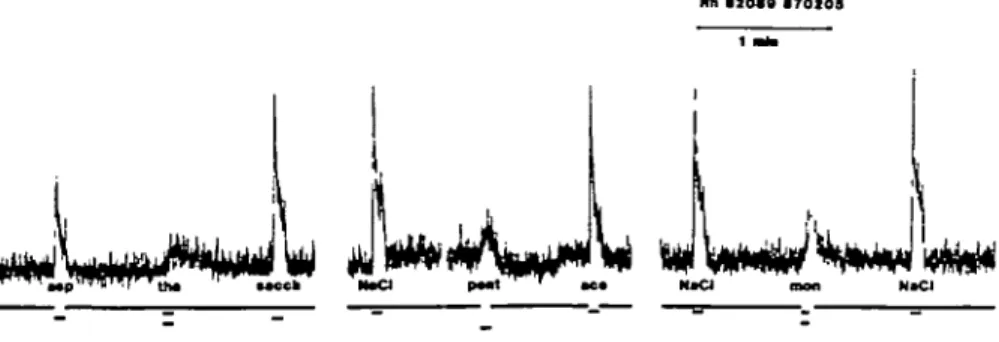
Fig. 2. The summated activity in the chorda tympani proper nerve of a Rhesus monkey recorded during
stimulation of the tongue by different sapid solutions. The signal at the bottom indicates the periods during which the flow of artificial saliva was interrupted for taste stimulation with one or other of the following solutions. Abbreviations: Asp, 0.0018 M aspartame; tha, 0.02% thaumatin; sacch, 0.0016 M Na-sacchann; NaCl, 0.3 M NaCl; pent, 0.1% pentadin; ace, 0.0035 M acesulfam-K; mon, 0.02% monellin.
yellow colour of the extract passed through the filter. The washing procedure was repeated four times and the ultrafiltered concentrate was freeze-dried. A 1.5 mg sample of ultrafiltered concentrate was dissolved in 0.2 ml of 0.02 M NaCl (pH 6.5) and fractionated on a Sephadex G75 column (1.6 x 55 cm) with 0.02 M NaCl (flowrate 12.3 ml/h, fractions of 3 ml). The elution profile is shown in Figure 1. Fractions 13-15 (a), 2 2 - 2 6 (b), 2 7 - 3 1 (c), and 3 2 - 4 2 (d) were pooled, freeze-dried, and desalted on a Sephadex PD-10 (Pharmacia) column. The desalted fractions a—d were freeze-dried and dissolved in distilled water as follows: (a) dissolved in 100 /tl, (b) in 200 /tl, (c) in 300 /tl, and (d) in 100 /tl. Only (c) had a distinctly sweet taste. UV absorption measurements from 200—500 nm showed a gradual continuous decrease for the crude extract. For fraction (c), a typical protein spectrum with a maximum at 278 nm was observed.
Fractions a—d were subjected to electrophoresis (Figure 1, inset) on an SDS poly-acrylamide gel (15% poly-acrylamide) in the presence of 5% 2-mercaptoethanol, with mol. wt markers according to Laemmli and Favre (1973). Coomassie brilliant blue R-250 was used to stain the protein bands. Fractions (a) and (d) did not stain, probably because insufficient quantities of the samples were loaded onto the gel. The mol. wt of the subunit in the sweet fraction (c) was — 12 kd. The same fraction (c), subjected to electrophoresis in the absence of 2-mercaptoethanol (not shown), indicated a much higher mol. wt but also showed three or four bands in the region between 2 2 - 4 1 kd. This indicates the presence of subunits coupled by disulphide bonds. Although fraction (c) was not com-pletely pure, as evidenced by the slight streaking seen on the SDS poly acrylamide gel in Figure 1, amino acid analysis of fraction (c) was carried out according to Cohen
et al. (1986) to further prove the hypothesis that the sweet principle in fraction (c) is
a protein. Table I shows the amino acid composition of fraction (c).
The sweetness intensity of fraction (c) was determined in a ranking test and appeared to be —500 times sweeter than sucrose on a weight basis. Psychophysically, its sweetness had a slow onset and decline similar to monellin and thaumatin, but its sweetness pro-file was more similar to monellin than to thaumatin.
In order to study the taste characteristics of this sweet principle 'pentadin' and to compare them with those of other sweeteners, the summated nerve responses from the
chorda tympani proper nerve in two Rhesus monkeys and rats were recorded during taste stimulation. Surgery, stimulation and recording methods were those described by Hellekant et al. (1985).
No response to pentadin was recorded with the rat but a response was recorded with the monkey. In Figure 2, the responses of the monkey to stimulation with 0.02% thaumatin, 0.1% pentadin and 0.02% monellin are shown. Each protein stimulation was interspersed with a series of more 'conventional' stimuli of which those immediately preceding and following the protein sweeteners are included in the Figure 2.
These results showed that the response to pentadin was similar to that of monellin and thaumatin, but had a steeper onset and faster decline. Due to scarcity of material, behavioral tests to verify the sweetness of pentadin were not performed.
Discussion
The characteristic UV spectrum, amino acid composition and Coomassie blue staining formed the bases for the conclusion that the sweet principle of P. brazzeana is of a protein-aceous nature. We proposed the name 'pentadin' for this sweetener.
Due to the lack of material, it was not possible to purify the protein further. Therefore, the amino acid analysis results are tentative. However, the results do show that pentadin is a protein, which was the purpose of this analysis.
Because the fruits were dried in an oven, it is possible that pentadin was denatured by heating, making exact mol. wt determination difficult. We are hopeful that fresh fruits will be obtained in order to complete the characterization of pentadin, the initial results of which have been published here.
The similarity between the sweetness profile for pentadin and those of monellin and thaumatin is interesting and raises the question, what is the cause of this commonality? However, results from previous experiments with small molecular size high intensity sweeteners indicate that the slow onset of response is not necessarily related to the molecular size. This question has to await further data.
The occurrence of sweet-tasting proteins such as pentadin, thaumatin and monellin, in the pulp or arils of fruits of various rain forest species can be associated in terms of mimicry in taste. For example animals, especially insects, may closely imitate shape and colour of a venomous species (Batesian mimicry) in order to discourage predators. If a plant species mimics the sweetness of saccharides by producing a sweet protein in its fruits, it will be more likely to be selected by frugivorous animals, and the seeds of its fruits will be more efficiently dispersed.
The mimicry of saccharides is most likely to occur in places where plant diversity and production of fruits with a high sugar content is sufficient to maintain a large popula-tion of frugivorous species, such as the African rain forest. Primate species, especially chimpanzees, are efficient seed dispersers (Hladik, 1973), and it is possible that the primate taste bud could have been the initial target for 'taste mimicry' in the genera
Pentadiplandra, Thaumatococcus and Dioscoreophyllum. Accordingly, the ability to
taste the corresponding sugar mimics in Old World primates and man is not surprising. The large number of food types included in the primate diet suggests that several other natural sweeteners might still be found among rain forest plant species. In this context it is worthwhile to mention here that sweet-tasting proteins from the plants of Capparis
Isolation and characterization of pentadin
masaikai Levl, locally named 'mabinlin', belonging to the Capparidaceae have been
recently reported. These plants can be found growing in the subtropical region of the Yunan province of China (Hu Zhong, 1986).
Acknowledgements
This article was supported by NIH grant NS17021 to G.Hellekant.
References
Baillon.H. (1868) Bull. Soc. Linn. Paris, 1, 611.
Cohen,S.A., Bidlingmeyer.B.A. and Tarvin.Th.L. (1986) PITC derivatives in amino acid analysis. Nature,
320, 769-770.
Hellekant.G., Hard af Segerstad.C, Roberts,!"., van der Wel.H., Brouwer^.N., Glaser.D., Haynes.R. and Eichberg.J.W. (1985) Effects of gymnemic acid on the chorda tympani proper nerve responses to sweet, sour, salty and bitter taste stimuli in the chimpanzee. Ada Physiol. Scand., 124, 399-408. Hladik.C.M. (1973) Alimentation et activity d'un groupe de Chimpanzes rfintroduits en forei Gabonaise.
La Terre et la Vie, 27, 343-413.
Hutchinson.J. (1928) Pentadiplandraceae. In Hutchinson.J. and Dalziel.J.M. (eds), Flora of West Tropical
Africa. 1, 461.
Laemmli.U K. and Favre.M. (1973) Maturation of the head of bacteriophage T4. J. Mol. BM., 80, 575-599. van der Wel,H. (1986) The sweet proteins. In Hudson,B.J.F. (ed.), Developments in food proteins 4. Elsevier,
London, pp. 219-245.
Zhong,Hu. (1986) The sweet proteins from the seeds of Capparis masaikai Levl. Proc. Munchcn-Shanghai
Symp. Peptide Protein Chem., (in press).
Received on October 10, 1987; accepted on December 6, 1988