Introduction
Solid-oxide fuel cells (SOFCs) are electrochemical devices that convert chemical energy from a fuel into electrical energy with high effi ciency (see the Introductory article in this issue). The small environmental impact, fuel fl exibility, and wide scalability are among the most appealing advantages of this technology, making SOFCs important players for the
develop-ment of a global sustainable power generation system. 1
The main drawback of this technology is the limited lifetime of the fuel cell stack. This is due to the high operating temperature (above 800°C) required to promote suffi cient catalytic activity for the oxygen reduction reaction (ORR) at the cathode and adequate ionic conductivity across the electrolyte. Materials instability (degradation, segregation, inter-diffusion) is the direct consequence of such high operating temperatures, which hinder the full exploitation of SOFC technology. Many efforts are being devoted to overcome this problem by trying to identify a suitable coupling between cathodes and electrolytes, allowing effi cient cell operation in the so-called
low temperature range (LT, 400–600°C). 2 A reduction of the
SOFC operating temperature down to this range would provide enormous advantages, widening the range of suitable materials while still preserving good catalytic activity, including direct hydrocarbon reforming at the electrodes.
Concerning the electrolyte materials, two approaches can be followed to decrease ohmic losses at reduced temperatures:
Decreasing the electrolyte thickness and/or using alternative materials with higher ionic conductivities in the low and inter-mediate temperature range.
Current SOFC technology is based on oxygen-ion conducting electrolytes, such as yttria-stabilized zirconia (YSZ) or doped ceria. As an alternative, high-temperature proton conductors (HTPCs) can be used as electrolyte materials in SOFCs
(H + -SOFCs). 3 HTPCs are conductive oxide materials, where
protons are the dominant charge carriers when exposed to
a humidifi ed and/or H 2 -containing gaseous environment.
Typical HTPC materials are barium-based perovskite oxides (cerates or zirconates), as well as rare-earth ortho-niobates and tungstates. These materials show activation energies for proton mobility between 0.4 and 0.6 eV, signifi cantly lower than that of oxygen-ion conducting electrolytes. This means that larger conductivities may be achieved at lower temperatures
using HTPCs. Moreover, H + -SOFCs produce water as the
by-product at the cathode side instead of the anode, therefore avoiding the dilution of the fuel and minimizing re-oxidation of the anode.
Proton-conducting electrolyte materials
Perovskite oxides
The most studied HTPCs are oxides with the
perovskite-type structure (ABO 3 ), where the A-cation is an alkaline
earth element, such as Ba, Sr, and Ca, while the B-cation is
cells based on proton-conducting
electrolytes
Emiliana Fabbri , Anna Magrasó , and Daniele Pergolesi
The need for reducing the operating temperature of solid-oxide fuel cells (SOFCs) imposed by cost reduction has pushed signifi cant progress in fundamental understanding of the individual components, as well as materials innovation and device engineering. Proton-conducting oxides have emerged as potential alternative electrolyte materials to oxygen-ion conducting oxides for operation at low and intermediate temperatures. This article describes major recent developments in electrolytes, electrodes, and complete fuel cell performance for SOFCs based on proton-conducting electrolytes. Although the performance of such fuel cells is still relatively modest, signifi cant improvements in the power density output have been made during the last couple of years, and this trend is expected to continue.
Emiliana Fabbri , Electrochemistry Laboratory , Paul Scherrer Institute , Switzerland ; [email protected]
Anna Magrasó , Catalan Institute of Nanoscience and Nanotechnology , Spain ; and Department of Chemistry , University of Oslo SMN/FERMiO , Norway ; [email protected] Daniele Pergolesi , Paul Scherrer Institute , Switzerland ; [email protected]
a tetravalent element, usually Ce or Zr. To promote protonic conductivity, the B-site is partially substituted with trivalent elements such as Y, In, or Gd, leading to the formation of oxygen vacancies. Proton conduction occurs mostly through the dissociation of water from the gas phase into a hydroxide ion and a proton; the former fi lls an oxygen va-cancy, while the latter forms a hydrogen bond with lattice
oxygen. 3 The reaction generates two protonic defects. These
protons can be highly mobile and migrate by a hopping mech-anism from one oxygen atom to the next ( Figure 1 a).
According to the most accepted model, 4 – 6 thermal vibrations
of the perovskite BO 6 octahedra lead to chaotic fl uctuations
in the vicinity of the O atoms involved in the hydrogen bonding. Then, the distance between two adjacent oxygen atoms can briefl y become short enough to allow the hydrogen to overcome the potential barrier and hop to the neighboring oxygen (proton transfer). At the same time, thermal vibrations also favor local elongations of the O–H link, which becomes weaker and eventually breaks, leaving the proton free to bond with another oxygen atom (re-orientation and rotational diffusion). These two mechanisms complement each other, resulting in
continuous low-energy proton-diffusion pathways. 5 The
ener-getics of these two mechanisms is consistent with an activation energy of about 0.15 eV or lower. However, in cubic perovskite
oxides, the experimental activation energy is ∼ 0.4–0.6 eV. 4
Such a discrepancy has been experimentally rationalized by
the effect of proton trapping. 7 In the case of Y-doped barium
zirconate, the incorporated protons are trapped at the dopant sites, adding an additional potential barrier for long-range diffusion.
The most investigated HTPCs are 10–20 at.% Y-doped barium
zirconate (BZY) and barium cerate (BCY). 3 BZY exhibits
good chemical stability in fuel cell operating conditions and
high grain interior (bulk) conductivity, but the grain boundary regions block the proton migration. Moreover, BZY is a high-ly refractory material, and generalhigh-ly very high temperatures (above 1700°C) are required to sinter dense ceramic pellets. Such high temperatures lead to BaO evaporation, and the Ba loss favors the Y substitution into the A sites of the perovskite structure. As a result, oxygen vacancies are consumed, thereby reducing the number of charge carriers. Lower sintering temperatures, suitable for preserving the required composition, lead to high porosity and/or low average grain size with extended grain boundary regions. As a consequence, the total electrical conductivity of BZY sintered pellets is too low for practical applications. On the other hand, BCY sintered pellets have overall good conducting properties, but the main drawback is the low chemical stability in the operating environment for SOFCs, since BCY reacts with water vapor and CO 2 . 3
Many efforts have emerged to either improve the chemical stability of BCY or the sinterability of BZY. The latter strategy turned out to be particularly effective, since an experimental protocol for the synthesis of BZY ceramic pellets without the use of sintering aids and leading to an average grain size in
the micrometer range has been recently reported. 8 The
litera-ture also reported the fabrication of highly ordered (grain boundary free) BZY thin fi lms grown by pulsed laser deposition, which allows direct access to the very high bulk conductivity
of this material. 9 , 10 The proton conductivities in the LT range
of BZY (as sintered pellets with micrometer grain size and as an epitaxial thin fi lm) are reported in Figure 1b .
Non-perovskite materials
After the discovery of proton conductivity in perovskites, alternative materials were studied with the aim of fi nding other compositions that could combine high proton conductivity and chemical stability. Ternary oxides with A-site rare-earth cations (La or other rare-earth elements but avoiding basic alkaline cations, such as Ba or Sr) caught the interest of researchers based on literature reports of considerable proton conductivities in several families of materials, including rare-earth niobates and tungstates.
Acceptor-doped lanthanum ortho-niobate
(Ca-doped LaNbO 4 ) exhibits a phase transition
from monoclinic (Fergusonite-type structure) to a tetragonal phase (Scheelite phase) around 500°C and shows proton conductivity on
the order of ∼ 5 × 10 –4 S cm –1 at 600°C (see
Figure 1b ). 11 According to fi rst-principle
cal-culations, the rate-determining process for
proton migration in LaNbO 4 is the rotation
and hopping between two adjacent tetrahedra (inter-tetrahedral proton transfer). Activation enthalpies of proton mobility are about 0.36 and 0.59 eV in the tetragonal and the monoclinic
Figure 1. (a) Sketch of a possible proton transfer mechanism from the oxygen ion I to
oxygen ion II in a high-temperature proton conductor (HTPC) perovskite oxide. The red sphere represents the B site cation of the perovskite structure, the larger blue spheres represent oxygen ions, while the small blue spheres represent protons. Reproduced with permission from Reference 3. © 2010 Royal Society of Chemistry. (b) Conductivities versus reciprocal temperature for selected HTPC electrolytes: BaZr 0.8 Y 0.2 O 3– δ (BZY) large-grained pellet 8 and fi lm, 9 1% Ca-doped LaNbO
4 (Ca-LNO) pellet, 11 and La 28– x W 4+ x O 54+ δ ( x ∼ 0.85) (LWO) pellet. 17
phases, respectively. 12 This material exhibits dominant proton
conductivity under wet conditions below ∼ 850°C and is stable
in atmospheres containing CO 2 under fuel cell operation. 13
This promising discovery initiated research efforts to study this material further and search for the optimal cation
compo-sition. However, LaNbO 4 is a so-called line compound
(i.e., which does not tolerate large non-stoichiometries), thus implying that the solubility for acceptor doping or tolerance toward segregation of phases is quite limited. Even though various doping strategies have been attempted, the protonic
conductivity could not be increased further. 14
Lanthanum tungstate with a fl uorite-type structure has been reported to be proton conducting by hydration at low
temperatures. 15 , 16 Early work reported that this fl uorite phase
corresponded to a stoichiometry of La 6 WO 12 , but this phase
is not stable and must be prepared La-defi cient to be single
phase. 17 The established composition nowadays is La
28– x W 4+ x O 54+ δ (LWO), where nearly one tungsten dissolves in lanthanum
sites to form a stable solid-state electrolyte. 18 The protonic
conductivity of undoped LWO is above 10 –3 S cm –1 at 600°C. 16
However, as shown in Figure 1b , this value is still lower than that reported for the best Ba-based perovskites.
An advantage of LWO versus LaNbO 4 is that the former does
not exhibit any phase transition with temperature or by hydration
and remains cubic from room temperature up to 800°C. 19
Additionally, LWO tolerates variations in the La/W ratio without
segregation of phases (i.e., it is not a line compound). 17
Electrode materials
In H + -SOFCs, water is produced at the cathode side; the
cathodic oxygen reduction reaction has much slower kinetics
than the hydrogen reduction at the anode side (when H 2
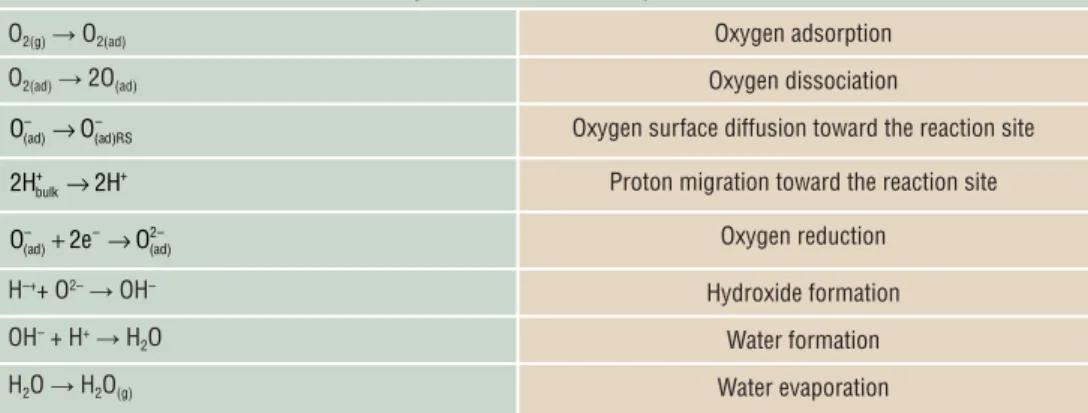
is used as the fuel), and therefore the cathode is generally the source of the largest overpotential associated with the electrode reactions. The oxygen reduction at the cathode comprises several reactions steps, summarized in Table I , which
can vary depending on the cathode material. 20 As shown in
Figure 2 , molecular oxygen adsorption occurs at the cathode surface followed by oxygen dissociation. In the case of a mixed
O 2– /e – conducting cathode ( Figure 2a ) or a composite cathode
made of a mixed O 2– /e –
con-ductor and a proton conduc-tor ( Figure 2c ), the adsorbed oxygen can diffuse on the
sur-face of the mixed O 2– /e –
con-ductor toward the reaction area, where it reacts with two elec-trons and two protons to form
water. For a mixed H + /e −
con-ducting cathode ( Figure 2b ), the oxygen does not need to migrate toward the reaction site because protons and elec-trons can migrate within the whole cathode material.
Only recently have research efforts been oriented toward the development of specifi cally designed cathode materials
for H + -SOFCs. 20 While the use of a mixed oxygen-ion/electron
(O 2– /e – ) conductor results in confi nement of the reaction sites
to the electrode/electrolyte interface ( Figure 2 a), a mixed
proton/electron (H + /e – ) conductor would allow extending the
reaction area to the whole cathode surface, thus facilitating the evaporation of the water by-product ( Figure 2b ). An alternative way to extend the reaction area is the development
of composite cathodes made of a mixed O 2– /e – conductor and
a H + -conducting oxide ( Figure 2c ). 20
In the case of perovskite-type electrolytes, growing interest has recently been directed toward the development of mixed
H + /e – conducting oxides. Mixed H + /e – conductivity in a wet
oxidizing atmosphere can be obtained by doping the B-sites
of BaZrO 3 with Y and Pr, due to the mixed 3+ and 4+ valence
state of Pr. As an example, the composition BaZr 0.6 Pr 0.3 Y 0.2 O 3− δ
showed good chemical stability and a mixed H + /e –
conduc-tivity in humidifi ed air. 21 Consistent results were also obtained
doping BaZrO 3 with Pr and Gd, with an optimized composition
of BaZr 0.6 Pr 0.3 Gd 0.1 O 3– δ . 22 , 23 Following a similar strategy, transi-tion metals such as Co and Fe were introduced into the lattice
of BaCeO 3 and BaZrO 3 perovskites. 24 – 26 However, the value
of the partial electronic conductivity, where reported, of such
mixed H + /e – conductors is too low for application as a
single-phase cathode material. Recently, it has been suggested that typical cathode materials used in SOFCs based on oxygen-ion
conducting electrolytes, besides being mixed O 2– /e –
conduc-tors, might also present some level of proton conductivity. 27 , 28
In particular, it has been proposed that perovskites with sig-nifi cant oxygen defi ciency, such as Ba 0.5 Sr 0.5 Co 0.8 Fe 0.2 O 3– δ and
PrBaCo 2 O 5– δ , might allow the largest degree of proton
inser-tion. 28 However, the suggestion of proton conduction in mixed
O 2– /e – conductors is still controversial, and further
investiga-tions are required to unambiguously prove the presence of a protonic contribution to the total conductivity.
Encouraging results were also reported on the devel-opment of composite cathode materials. For example, a
relatively low area specifi c resistance (ASR) of 0.16 Ω cm 2
was obtained at 600°C for a composite cathode made of Table I. Possible elementary cathode reaction steps in a H + -solid-oxide fuel cell.
O 2(g) → O 2(ad) Oxygen adsorption
O 2(ad) → 2O (ad) Oxygen dissociation
– – (ad) (ad)RS
O →O Oxygen surface diffusion toward the reaction site
+ + bulk
2H →2H Proton migration toward the reaction site
– – 2– (ad) (ad) O +2e →O Oxygen reduction H –+ + O 2– → OH – Hydroxide formation OH – + H + → H 2 O Water formation H 2 O → H 2 O (g) Water evaporation
La 0.5 Sr 0.5 Co 0.6 Fe 0.4 O 3– δ and BaZr 0.5 Pr 0.3 Y 0.2 O 3– δ , 29 where the
former is a mixed O 2– /e – conductor, and the latter is a mixed
H + /e – conductor.
The microstructure also plays an important role in achieving low overpotentials. Advanced cathode microstructures were obtained at relatively low processing temperatures, avoiding
cation interdiffusion, by infi ltration of LaCoO 3 into a porous
backbone of Ba-Ce-Zr-based oxide. 30
Regarding the anodic electrode, most of the H + -SOFCs
utilize composite anodes fabricated by mixing NiO with the same material used for the electrolyte. Conversely, anodes for the LWO electrolyte cannot be prepared in this “traditional” manner, as it reacts with NiO, and alternative fabrication routes
have been reported. 31 Two general drawbacks are associated
with the use of Ni for the fabrication of the anode. First, Ni tends to agglomerate, resulting in deterioration of anode performance with time. Additionally, when hydrocarbons are used as the fuel, coke formation strongly hinders Ni-based anode performance. Moreover, the chemical stability of the
H + -conducting phase in the anode is obviously a further
important issue when carbon-containing compounds are used as a fuel.
Fuel cell performance
As outlined previously, the main issues related with reducing SOFC operating temperature are the increased electrolyte resistivity and electrode polarization. In addition to improving the electrolyte conduction properties and electrode kinetics, modifying the fuel cell design might also assist in overcoming these drawbacks. Making the anode the supporting structure for SOFC fabrication allows the electrolyte to be implemented as a thin layer, thereby minimizing ohmic loss. Several ceram-ic processing methods have been proposed to fabrceram-icate
anode-supported H + -SOFCs. Most of the tested H + -SOFCs on the
laboratory scale are fabricated by a co-pressing and co-fi ring
technique, 32 which generally allows a minimum electrolyte
thickness (capable of preventing reactant cross-over) of ∼ 15 μ m to be supported on a porous anode structure, as shown in Figure 3 . 33
The development of anode-supported H + -SOFCs based
on doped-BaZrO 3 electrolytes is complicated by the poor
sinterability of this material. This problem has been addressed following different approaches; by using doping elements able to favor the sinterability (i.e., BaZr 0.7 Pr 0.1 Y 0.3 O 3– δ , 34 BaZr 0.7 Sn 0.1 Y 0.3 O 3– δ , 35 BaZr 0.8/0.7 In 0.2/0.3 O 3– δ 36 , 37 ), by the addition
of sintering aids, 38 – 40 or by using anodes able to promote
electrolyte sinterability. 41 , 42 Several H + -SOFCs have also been
developed using a solid solution of barium zirconate and barium cerate (e.g., BaCe 0.7 Zr 0.1 Y 0.2 O 3– δ ) as an electrolyte. 32 However, it has been recently shown that even by lowering the Ce content down to 50 at.%, the solid solution between barium zirconate and cerate presents severe stability limitations in a
wet atmosphere. 43
The highest power density outputs for H + -SOFCs using
chem-ically stable BaZrO 3 -based electrolytes are around 250 mW cm –2
at 600°C 32 , 35 —still not suffi ciently competitive with the
perfor-mance of SOFCs based on oxygen-ion conducting electrolytes. 1
The performance of fuel cells based on Ca-doped LaNbO 4 as
the electrolyte is even lower, mainly ascribed to the poor kinetics
of several tested cathode materials 13 and the lower protonic
conductivity of this material compared to the best perovskites. In
addition, the fabrication of a complete cell using LaNbO 4
avoid-ing detrimental phase segregation is very challengavoid-ing. Unless
these remaining issues are addressed, LaNbO 4 will not be the
ultimate electrolyte choice for fuel cell applications. Concerning the LWO electrolyte, tailor-made anodes and cathodes with ASRs ∼ 0.3–0.5 Ω cm 2 have been proposed, 31 , 44 , 45 but electrode-supported fuel cells have not yet been tested.
Figure 2. Possible reactions at the cathode using (a) a mixed O 2 -ion/e − conductor, (b) a mixed H + /e − conductor, and (c) a composite cathode made of a proton conductor phase and a mixed O 2– /e − conductor phase. The dark gray spheres represent a mixed O 2– /e − conductor phase, the light blue sphere is a mixed H + /e – conductor, while the light gray sphere is a H + conductor. The red semicircles represent the reaction sites where the oxygen reduction takes place. Figure adapted from Reference 20.
Using different fuel cell designs, promising results for H + -SOFCs have been obtained by fabricating polycrystalline BZY freestanding membranes on Si chips by thin-fi lm deposition and microfabrication technologies. A peak power density
output of 186 mW cm –2 at 450°C has been achieved. 46 These
results, coupled with the high conductivity of BZY epitaxial thin fi lms with reduced grain boundary regions, open new
possibilities for the development of miniaturized H + -SOFCs.
Summary and perspectives
HTPC-sintered polycrystalline pellets, as well as highly ordered thin fi lms, have shown conductivity values in the same range or even larger than those of the best performing (and chemically stable) oxygen-ion conductors at low temperatures. Moreover, composite cathode materials, mixed protonic and electronic conductors, specifi cally designed for HTPC electrolytes, have been developed showing comparable performance as the typi-cal cathodes used for oxygen-ion conductors.
In spite of the good performance of the individual cell components, the power density output reported so far for
H + -SOFCs is signifi cantly lower compared to SOFCs based
on oxygen-ion conductors. The reason for this relatively limited performance is not clear, but it might be due to poorer electrode kinetics, especially in the cathode. It must
be highlighted here that research and development on H +
-SOFCs is still relatively limited. Improved cell design and microstructural optimization may render the key solution. The good performance of the individual cell components holds the promise of obtaining larger power density output, and clearly indicates the need for more scientifi c and technological efforts for full exploitation of the potential of HTPCs.
Figure 3. Scanning electron microscope image of the fractured
cross-section of an anode-supported H + -SOFC (solid-oxide fuel cell). Four layers are clearly visible: the supporting anode, the anode functional layer, the electrolyte (BaZr 0.7 Pr 0.1 Y 0.2 O 3– δ ), and the composite cathode. Reproduced with permission from Reference 33. © 2011 Wiley.
Acknowledgments
E.F. gratefully acknowledges the Swiss National Foundation (SNF) within the Ambizione project for fi nancial support. A.M. would like to acknowledge continuous funding from the Research Council of Norway and the Nordic Top-Level Research Initiative. D.P. would like to acknowledge for fi nancial support the European Community’s Seventh Frame-work Programme (FP7/2007–2013) under Grant No. 290605 (COFUND: PSI-FELLOW).
References
1. E.D. Wachsman , K.T. Lee , Science 334 , 935 ( 2011 ).
2. D.J.L. Brett , A. Atkinson , N.P. Brando , S.J. Skinner , Chem. Soc. Rev. 37 , 1568 ( 2008 ).
3. E. Fabbri , D. Pergolesi , E. Traversa , Chem. Soc. Rev. 39 , 4355 ( 2010 ). 4. K.D. Kreuer , Annu. Rev. Mater. Res. 33 , 333 ( 2003 ).
5. B. Merinov , W.A. Goddard , J. Chem. Phys. 130 ( 2009 ).
6. M.S. Islam , R.A. Davies , J.D. Gales , Chem. Mater. 13 , 2049 ( 2001 ). 7. Y. Yamazaki , F. Blanc , Y. Okuyama , L. Buannic , J.C. Lucio-Vega , C.P. Grey , S.M. Haile , Nat. Mater. 12 , 647 ( 2013 ).
8. Y. Yamazaki , R. Hernandez-Sanchez , S.M. Haile , Chem. Mater. 21 , 2755 ( 2009 ).
9. D. Pergolesi , E. Fabbri , A. D’Epifanio , E. Di Bartolomeo , A. Tebano , S. Sanna , S. Licoccia , G. Balestrino , E. Traversa , Nat. Mater. 9 , 846 ( 2010 ).
10. Y.B. Kim , T.M. Gur , H.J. Jung , S. Kang , R. Sinclair , F.B. Prinz , Solid State
Ionics 198 , 39 ( 2011 ).
11. R. Haugsrud , T. Norby , Nat. Mater. 5 , 193 ( 2006 ).
12. H. Fjeld , K. Toyoura , R. Haugsrud , T. Norby , Phys. Chem. Chem. Phys. 12 , 10313 ( 2010 ).
13. A. Magraso , M.L. Fontaine , R. Bredesen , R. Haugsrud , T. Norby , Solid State
Ionics 262 , 382 ( 2014 ).
14. A. Magraso , M.L. Fontaine , Y. Larring , R. Bredesen , G.E. Syvertsen , H.L. Lein , T. Grande , M. Huse , R. Strandbakke , R. Haugsrud , T. Norby , Fuel Cells 11 , 17 ( 2011 ).
15. T. Shimura , S. Fujimoto , H. Iwahara , Solid State Ionics 143 , 117 ( 2001 ). 16. R. Haugsrud , Solid State Ionics 178 , 555 ( 2007 ).
17. A. Magraso , C. Frontera , D. Marrero-Lopez , P. Nunez , Dalton Trans. 46 , 10273 ( 2009 ).
18. A. Magraso , J.M. Polfus , C. Frontera , J. Canales-Vazquez , L.E. Kalland , C.H. Hervoches , S. Erdal , R. Hancke , M.S. Islam , T. Norby , R. Haugsrud , J. Mater.
Chem. 22 , 1762 ( 2012 ).
19. A. Magraso , C.H. Hervoches , I. Ahmed , S. Hull , J. Nordstrom , A.W.B. Skilbred , R. Haugsrud , J. Mater. Chem. A 1 , 3774 ( 2013 ).
20. E. Fabbri , D. Pergolesi , E. Traversa , Sci. Technol. Adv. Mater. 11 ( 2010 ). 21. E. Fabbri , I. Markus , L. Bi , D. Pergolesi , E. Traversa , Solid State Ionics 202 , 30 ( 2011 ).
22. A. Magraso , C. Frontera , A.E. Gunnaes , A. Tarancon , D. Marrero-Lopez , T. Norby , R. Haugsrud , J. Power Sources 196 , 9141 ( 2011 ).
23. A. Magraso , C. Kjolseth , R. Haugsrud , T. Norby , Int. J. Hydrogen Energy 37 , 7962 ( 2012 ).
24. M. Shang , J.H. Tong , R. O’Hayre , RSC Adv. 3 , 15769 ( 2013 ).
25. Y.Y. Rao , S.H. Zhong , F. He , Z.B. Wang , R.R. Peng , Y.L. Lu , Int. J. Hydrogen
Energy 37 , 12522 ( 2012 ).
26. C.J. Zhang , H.L. Zhao , Electrochem. Commun. 13 , 1070 ( 2011 ).
27. A. Grimaud , F. Mauvy , J.M. Bassat , S. Fourcade , M. Marrony , J.C. Grenier , J. Mater. Chem. 22 , 16017 ( 2012 ).
28. A. Grimaud , F. Mauvy , J.M. Bassat , S. Fourcade , L. Rocheron , M. Marrony , J.C. Grenier , J. Electrochem. Soc. 159 , B683 ( 2012 ).
29. E. Fabbri , L. Bi , D. Pergolesi , E. Traversa , Energy Environ. Sci. 4 , 4984 ( 2011 ). 30. S. Ricote , N. Bonanos , F. Lenrick , R. Wallenberg , J. Power Sources 218 , 313 ( 2012 ).
31. C. Solis , V.B. Vert , M. Balaguer , S. Escolastico , S. Roitsch , J.M. Serra , ChemSusChem 5 , 2155 ( 2012 ).
32. E. Fabbri , L. Bi , D. Pergolesi , E. Traversa , Adv. Mater. 24 , 195 ( 2012 ). 33. E. Fabbri , L. Bi , H. Tanaka , D. Pergolesi , E. Traversa , Adv. Funct. Mater. 21 , 158 ( 2011 ).
34. E. Fabbri , L. Bi , J.L.M. Rupp , D. Pergolesi , E. Traversa , RSC Adv. 1 , 1183 ( 2011 ).
35. W.P. Sun , M.F. Liu , W. Liu , Adv. Energy Mater. 3 , 1041 ( 2013 ). 36. W.P. Sun , Z.W. Zhu , Z. Shi , W. Liu , J. Power Sources 229 , 95 ( 2013 ). 37. L. Bi , E. Fabbri , Z.Q. Sun , E. Traversa , Solid State Ionics 196 , 59 ( 2011 ). 38. Z.Q. Sun , E. Fabbri , L. Bi , E. Traversa , J. Am. Ceram. Soc. 95 , 627 ( 2012 ). 39. P. Babilo , S.M. Haile , J. Am. Ceram. Soc. 88 , 2362 ( 2005 ).
40. J. Tong , D. Clark , M. Hoban , R. O’Hayre , Solid State Ionics 181 , 496 ( 2010 ). 41. L. Bi , E. Fabbri , Z.Q. Sun , E. Traversa , Energy Environ. Sci. 4 , 409 ( 2011 ). 42. L. Bi , E. Fabbri , E. Traversa , Electrochem. Commun. 16 , 37 ( 2012 ). 43. A. Slodczyk , M.D. Sharp , S. Upasen , P- Colomban , J.A. Kilner , Solid State
Ionics , January 2014 , http://doi.org/10.1016/j.ssi.2013.12.044 .
44. M. Balaguer , C. Solis , F. Bozza , N. Bonanos , J.M. Serra , J. Mater. Chem. A 1 , 3004 ( 2013 ).
45. E. Quarez , Y. Oumellal , O. Joubert , Fuel Cells 13 , 34 ( 2013 ).
46. Y.B. Kim , T.M. Gur , S. Kang , H.J. Jung , R. Sinclair , F.B. Prinz , Electrochem.
Commun. 13 , 403 ( 2011 ).
nDemand
®www.mrs.org/ondemand
Select MRS Award Talks Technology Innovation Forum VII
Fred Kavli Distinguished Lectureship in Nanoscience Women in Materials Science & Engineering Breakfast Select Symposium X Talks
7 Tutorial Sessions
Select Talks from 25 Technical Sessions
Plus, view interviews, news and highlights from the 2014 MRS Spring Meeting via MRS TV.
NEW CONTENT AVAILABLE
MRS OnDemand now includes a large sampling of the rich materials science content from the 2014 MRS Spring Meeting. Watch presentations
from the MeetingFREE, for a limited
time, complete with audio and presentation materials.
The 2014 MRS Spring
Meeting OnDemand
Visit www.cameca.com/new/LEAP5000.aspx
to learn more & request your complimentary CAMECA Periodic Table Wall Poster!
Introducing...
LEAP
®5000
Atom Probe Microscope
CAMECA‘s latest, cutting-edge atom probe model provides unmatched three-dimensional subnanometer compositional information across a wide variety of metals, semiconductors and insulators.
3D analysis of the source-drain region of a 28nm transistor.
3D nanoscale chemical information collected from a microscale dataset.
Now with 40% improvement in detection efficiency at twice the speed!