People’s Democratic Republic of Algeria
Ministry of Higher Education and Scientific Research Mentouri University of Constantine 1
Faculty of Letters and Languages
AMERICAN NEOCONSERVATISM AND ITS
NEO-ORIENTALIST CONSTRUCTIONS OF ISLAM AND THE ARAB MUSLIM WORLD
A DISSERTATION SUBMITTED TO THE DEPARTMENT OF LETTERS AND ENGLISH LANGUAGE IN CANDIDACY FOR THE DEGREE OF
DOCTORAT ES SCIENCES IN
AMERICAN CIVILIZATION
Submitted by Supervised by
- Salim KERBOUA - Prof. Brahim HAROUNI
- Prof. Pierre GUERLAIN (co-)
Board of Examiners:
- Chair: Dr. MAGHERBI Nacereddine; Mentouri University Constantine 1 - Rapporteur: Prof. HAROUNI Brahim; Mentouri University Constantine 1
- Examiner: Prof. BENDJEDOU Mohamed Yazid; Badji Mokhtar University Annaba - Examiner: Prof. BOUREGBI Salah; Badji Mokhtar University Annaba
- Examiner: Prof. TOLGUI Eladi; University of Guelma
- Examiner: Prof. ELAGOUN Abdelhak; University of Guelma 2017
ii
MENTOURI UNIVERSITY OF CONSTANTINE 1
AMERICAN NEOCONSERVATISM AND ITS
NEO-ORIENTALIST CONSTRUCTIONS OF ISLAM AND THE ARAB MUSLIM WORLD By
Salim KERBOUA
A DISSERTATION SUBMITTED TO THE DEPARTMENT OF LETTERS AND ENGLISH LANGUAGE IN CANDIDACY FOR THE DEGREE OF
DOCTORAT ES SCIENCES IN
AMERICAN CIVILIZATION
i
Dedication
To the memory of my father To my family:
Mom, Sihem, Hadil, Mouatezbillah, Roumeissa, Chima, and my sister Fatima To my two brothers
ii
Acknowledgements
My sincere thanks and deep respect are due to all the people along the path that has led me here.
First and foremost, I am indebted to my supervisors, Professor Brahim Harouni, of Mentouri University of Constantine 1, and Professor Pierre Guerlain, of Université Paris Ouest, Nanterre; two men from whom I have learned greatly in the course of writing this dissertation. Both of them have helped and guided me in my research these past few years, and I am sincerely grateful. Both have spent amounts of their precious time talking with me, reading and commenting my work, and I am better off because of it. Professor Harouni‘s intellectual rigor and patience are inspiring, and his example is one against which I fall embarrassingly short, yet nevertheless strive for. Professor Guerlain’s indispensable advice, constructive critique, and attention to the big picture and the key details have made him an ideal supervisor. His intellectual insights will guide me long in years ahead. Both of them combined constructive criticism and encouragement for my research project, and their help has been an invaluable and personally illuminating part of my journey.
I also wish to thank the members of the board of examiners, Prof. Nacereddine Magherbi, Prof. Mohamed Yazid Benjeddou, Prof. Salah Bouregbi, Prof. Eladi Tolgui, and Prof. Abdelhak Elagoun who have kindly accepted to take from their precious time to evaluate this dissertation and make insightful comments on it.
Special thanks are also due to Professor Cornelius Crowley, Head of the Centre de Recherches Anglophones (CREA) at Université Paris Ouest for his precious help, his warm welcome to the CREA, and his valuable advice during our conversations. I also thank Professor John J. Mearsheimer, of the University of Chicago, who was very kind in giving me his opinions and in answering my questions during my short stay in the US. I am also indebted to Professor Laura Sjoberg, of the University of Florida, who provided me with many valuable sources.
I am grateful to my friends and colleagues, Dr. Fatima Hamadouche, Dr Ahmed Chawki Hoadjli and Dr Ramdane Mehiri for their encouragement that mattered much more than they know. Many thanks also go to all the people of the English Division at Biskra University, and especially Dr Boudiaf Naima and Ms
iii
Nachoua Hassina, for their professional and personal support. I should also thank all
the people of the Department of Letters and English Language at Mentouri University, Constantine, for their help during my graduate studies.
Finally, these acknowledgements would be incomplete without mentioning my wife Sihem who has helped and encouraged me in more ways that I can possibly list here.
iv
Abstract
Since the beginning of the twenty-first century, new representations of Islam and Muslims have invaded the American and Western public spaces. These representations construct Islam-related social objects as the source of Western ontological insecurity. The present dissertation examines the emergence of American Neoconservatism as one of the sources of those constructions; constructions that are embodied in a twenty-first century neo-Orientalism. The thesis of the dissertation looks into the neoconservative movement and reconsiders it as an identity and ideologically motivated school of thought. Based on a set of interdisciplinary approaches, the dissertation contends that since the beginning of the twenty-first century, the neoconservative school of thought has been imposing a new foreign policy and international (and intercultural) relations paradigm that is mainly inspired from Bernard Lewis and Samuel Huntington’s Clash of Civilizations thesis. This imposed paradigm is a framework of thinking that operates according to a renewed (or neo-) Orientalism. It constructs Islam, Muslims, and the Arab-Muslim World as existential threats to Western civilization and as the sources of its ontological insecurity. The neoconservative discourse generates biased knowledge; and its Manicheism, its essentialism, and its conflation of issues such as terrorism, Islamism, Islam, and Muslims in the West and in Muslim societies, have been some of the constructed causes of contemporary intersubjective suspicion and hatred towards Muslims in the West and in the Muslim World. Additionally, the dissertation argues that this twenty-first century neo-Orientalism is relayed and propagated in the American (and Western) public space by pro-Israeli actors, mainly neoconservatives and their like-minded allies. This neoconservative neo-Orientalism is thus essentially instrumental for it espouses the pro-Israeli narrative in its antagonism towards the peoples of the region, and it aims at promoting Israel’s agenda in the Near and Middle East.
v
Résumé
La présente thèse étudie le néoconservatisme américain comme source principale d’un
néo-orientalisme contemporain. En se basant sur une recherche et des approches
interdisciplinaires, la thèse analyse cette école de pensée et maintien qu’elle est
essentiellement identitaire et idéologiquement motivée. La thèse soutient que depuis
le début du vingt-et-unième siècle, l’école de pensée néoconservatrice s’attache à
tenter d’imposer un nouveau paradigme dans les domaines de la politique étrangère,
et des relations internationales et interculturelles. Ce paradigme s’inspire
essentiellement de la thèse du clash des civilisations telle que formulée par Bernard
Lewis et Samuel Huntington. Il s’agit d’un schéma de pensée qui opère selon un
orientalisme renouvelé – un néo-orientalisme – qui construit l’Islam et le monde
arabo-musulman comme menace existentielle et comme source d’insécurité
ontologique du monde occidental. Le néoconservatisme développe un discours
manichéen, essentialiste et amalgamant sur les questions du terrorisme, de l’Islam, de
l’islamisme, et des musulmans en occident et dans le monde arabo-musulman. Ce discours produit un savoir biaisé qui est l’une des principales causes intersubjectives
et construites du sentiment de suspicion et/ou de haine envers le musulman, qu’il soit résident en occident ou dans le monde arabo-musulman. Enfin, la thèse maintient que
ce discours néoconservateur et néo-orientaliste est principalement relayé et propagé
dans l’espace public occidental par des réseaux pro-israéliens (tout particulièrement les réseaux néoconservateurs aux Etats Unis et en Europe). Ce néo-orientalisme
néoconservateur est donc essentiellement instrumental en ce sens qu’il adopte le récit
pro-israélien et qu’il a pour but d’imposer la vision et l’agenda israéliens au Proche et
vi
صخلم
ايسيئر اردصم مهركف رابتعاب ددجلا نيظفاحملا ةحورطلأا هذه سردت
ةددعتم ةسارد ىلع ءانبو .رصاعملا ديدجلا قارشتسلال
تابراقملا
,
ةحورطلأا
صحفت
م اهنأ ىلع ةيركفلا ةسردملا هذه
ةينب
و ةيوهلا ىلع
نا
ةيجولويديأ اهعفاود
ةتحب
امك .
رقلا ةيادب ذنم هنأ ةحورطلأا هذه نيبت
ددجلا نيظفاحملا ةسردمو نورشعو دحاولا ن
ةيلودلا تاقلاعلاو ةيجراخلا ةسايسلا لاجم يف ديدج يركف جذومن ضرف لواحت
.ةيفاقثلا تاقلاعلاو
ثيح
ىلع جذومنلا اذه دنتسي
ةركف
امك تاراضحلا مادطصا
اهمدق
لمعي ريكفتلا نم طمن يف لثمتيو ،نوتغنتنه ليئومصو سيول درانرب
ج قارشتساك
يدوجو ديدهت هنأ ىلع يملاسلإا ملاعلاو ملاسلإا دسجي يذلاو ديد
ظفاحملا .يبرغلا ملاعلا يف يجولوطنلأا نملأا مادعنلا ردصمو
نو
نوعنصي ددجلا
رشلاو ريخلا ةيئانث ىلع سسؤم يأ( يونام باطخ
مداصت ىرحلااب وا
تاراضحلا
)
،
يوهام
لا يف نيملسملاو ملاسلإا ،باهرلإا اياضق نيب طلخي
ملاع
.برغلا يفو يملاسلإا يبرعلا
ساسحلإل ةيسيئرلا بابسلأا دحأ وه باطخلا اذه
رخلآا هاجتا ةكرتشملا ةيتاذلا ةيهاركلاو كشلاب
)
ملسملا
(
ءاوس ،
ناك ا
يقم
ام
ملاعلا يف
.برغلا يف وأ يملاسلإا يبرعلا
،ظفاحملا باطخلا اذه نأ كلذك ةحورطلأا دكؤتو
نمو لقانتم ديدجلا يقارشتسلإا
تاكبش فرط نم يبرغلا ماعلا ءاضف يف رشت
وه ديدجلا قارشتسلاا اذه .ابورأو ةيكيرملأا ةدحتملا تايلاولا يف ددجلا نيظفاحملا
ساسلاا يف
ادأ
ة
ةدنجلأاو ةيؤرلا ضرف هفدهو ةيليئارسلإا ةياورلا ىنبتي هنلأ ،
.طسولأا قرشلا يف ةيسايسلا ةيليئارسلإا
vii
Contents
Dedication i Acknowledgements ii Abstracts (En-Fr-Ar) iv Contents vii List of Figures x List of Abbreviations xi Introduction 1Background and Research Problem Research Aims
Research Gap and Originality Sources and Methodology Structure of the Dissertation
Chapter 1: 11
Thinking about Constructivism and Culturalism: The Self and the Other in International Affairs
1.1. Introduction
1.2. The Broad Sense of the Constructivist Theory 1.3. Constructivism, IR, and Foreign Policy Analysis 1.4. Constructivism, Identity, and Ontological Security
1.5. Constructivism, Culturalism, and the Clash of Civilizations Thesis 1.6. Conclusion
Chapter 2: 49
From Orientalism to Neo-Orientalism:
Early and Contemporary Constructions of the Arab-Muslim World 2.1. Introduction
2.2. Early Orientalism: Construction and Imperial Domination 2.3. Criticizing Orientalism: Academic Arguments
viii
2.4. Criticizing Orientalism: Ideological Outrage 2.5. The Cold War Paradigm: American Orientalism
2.6. The War on Terror Paradigm: Neo-Orientalism and Islamophobia 2.7. Conclusion
Chapter 3: 101
Neoconservatism Reconsidered: Intellectual Inception, Identity, and Israel 3.1. Introduction
3.2. Genealogy of Neoconservatism 3.3. Neoconservatism as Anti-Liberalism 3.4. Commentary and Neoconservative Identity 3.5. Neoconservative Identity and Israel
3.6. Neoconservatism and/in/as American Conservatism 3.7. Conclusion
Chapter 4: 158
Neoconservatism: Intellectual Agency in US Foreign Policy 4.1. Introduction
4.2. Niebuhr, Strauss, and Neoconservative Foreign Policy Thinking 4.3. Neoconservative Agency in the Cold War Era
4.4. Post-Cold War Neoconservative Foreign Policy Agency 4.5. Neoconservatism and the Israel Lobby Theory
4.6. The Neo-Orientalist Outlook of the Bush Administration 4.7. Conclusion
Chapter 5: 218
Neo-Orientalist Neoconservatism: The Construction of an Ontological Threat 5.1. Introduction
5.2. Post-9/11 Views on Islam and the Muslim World 5.3. Neo-Orientalist Neoconservatism: Actors and Allies 5.4. “Eurabia” and the Islamization of the West
5.5. The Invention of “Islamofascism” 5.6. Other Neo-Orientalist Themes 5.7. Conclusion
ix
Conclusion 278
Summary of Arguments
Future Research and Implications
Bibliography 284
Glossary 339
x
List of Figures
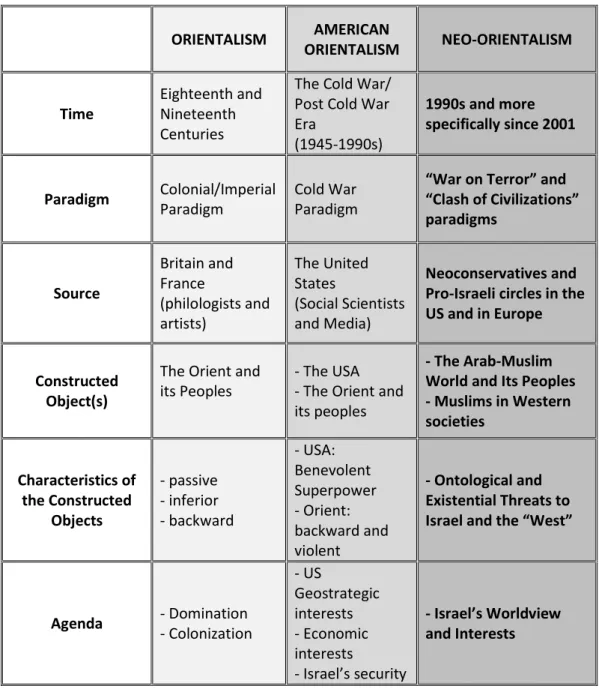
Figure 1: Overview of the Different Types of Orientalism 99
Figure 2: Neoconservative Agency: a Historical Development 111
Figure 3: Neoconservatism in Post-Cold War US Grand Strategy Approaches 199
Figure 4: US Public Opinion on the Compatibility of Muslim and Western Civilizations 220
Figure 5: The US Political Divide on Views toward Muslims and Islam 221
Figure 6: Causes of Tensions between the West and the Muslim World 223
Figure 7: Religious Groups and Discrimination in the United States 224
Figure 8: Americans Holding Unfavorable Views towards Islam and Muslims 225
Figure 9: Neo-Orientalist Neoconservatism: Activists and Intellectuals 228
xi
List of Abbreviations
ABCFM: American Board of Commissioners for Foreign Missions ADA: Americans for Democratic Action
ADL: Anti- Defamation League AEI: American Enterprise Institute
AIPAC: American Israeli Public Affairs Committee AJC: American Jewish Committee
CAIR: Council of American Islamic Relations
CAMERA: Committee for Accuracy in Middle East Reporting in America CDM: Coalition for a Democratic Majority
CIA: Central Intelligence Agency
CIDFMW: Center for Islam, Democracy, and the Future of the Muslim World CMPDP: Committee to Maintain a Prudent Defense Policy
CPD: Committee on the Present Danger (I, II, and III) CSP: Center for Security Policy
CUFI: Christians United For Israel
CWAR: Committee on World Area Research DPG: Defense Planning Guidance
ECI: Emergency Committee for Israel EMET: Endowment for Middle East Truth EPPC: Ethics and Public Policy Center
FDD: Foundation for the Defense of Democracies FII: Friends of Israel Initiative
FPA: Foreign Policy Analysis HJS: Henry Jackson Society
IR: International Relations Theory ISL: Independent Socialist League
JINSA: Jewish Institute for National Security Affairs
JS: Jerusalem Summit
MEF: Middle East Forum MEI: Middle East Institute
xii
MEMRI: Middle East Media Reporting Initiative MESA: Middle East Studies Association NYI: New York Intellectuals
PNAC: Project for a New American Century SALT: Strategic Arms Limitation Talks (I and II) SPLC: Southern Poverty Law Center
SSRC: Social Science Research Council US/USA: United States/United States of America WASP: White Anglo-Saxon Protestant
WINEP: Washington Institute of Near East Policy
WP: Workers Party
1
Introduction
Background and Research Problem
In the aftermath of September 11, 2001 attacks, policymakers within the
United States administration of the period designed and adopted a
neoconservative-inspired strategy to wage what they called the “Global War on Terror.” Since then,
several wars in the Arab and Muslim Worlds have taken place, with great instability
and violence sweeping the region of the Near and Middle East. Wars and efforts to
reshape states through regime changes such as in Afghanistan, Iraq, then in Libya, and
the one attempting to take place in Syria, have created a great deal of instability,
institutional and social collapses, and the rise and expansion of violent extremism
allegedly acting on behalf of the Muslim faith. This dialectic has brutally imposed
itself on the peoples of the Arab-Muslim world with much harshness, dreadful
contingencies, and ongoing painful consequences.
Simultaneously, a new phenomenon has emerged in the United States of
America and in Europe. The image of the Islamic faith and the Muslim has seriously
deteriorated in the eyes of the Western public opinions. Large segments of Western
societies hold negative views towards the Islamic faith and cultures. They also see the
Muslim as a malevolent and potentially threatening Other. Peculiar portrayals of
Islam and Muslims have invaded the Western public space. Peoples belonging to the
Arab-Muslim world or western citizens of Muslim and Arab origins are viewed as an
ominous threat not only to western individuals or countries but also to the very
existence of what some intellectuals and pundits call “Western Civilization,” its
2
In the United States and in Europe, some individual public figures, and
political and social groups have been developing a discourse targeting sometimes
Islamism, other times Islam, Muslims, and the Arab-Muslim world, as the new enemy
or as the principal source of insecurity. These images of Islam and the Muslim Other
are processed through essentializations and Manichean characterization that are very
similar to the one worked out during the Cold War. The sources of these distorted
constructions can be identified in right wing and neoconservative circles.
In light of the above-mentioned research contextualization, the dissertation
probes the following primary research question:
- How and why does American (and Western) Neoconservatism produce and
propagate peculiar constructions of Islam and the Arab-Muslim world?
This principal question is itself investigated through the following secondary
questions:
- How have constructions of the Muslim Other developed to fit specific identity and
ideological western concerns?
- Why is Neoconservatism so concerned with propagating constructions of the
Muslim Other?
- On what ideational and identity-related bases does American (and Western)
Neoconservatism construct Islam, the Arab Muslim World, and Middle-Eastern issues?
- How and why are they portraying Islam and the Muslim World as a threat to
Western values and even existence?
The above questions are crucial in the sense that they tackle sensitive
present-day issues such as those of contemporary terrorism, its portrayal in the Western public
space, and its alleged link with the Muslim faith and people. They tackle also other
3
the promotion of an alleged irrepressible civilizational conflict between two
constructions: Islam and the West.
Research Aims
The principal aim of the present dissertation is to shed light on the American
neoconservative school of thought and its constructions of Islam and the
Arab-Muslim world as well as its views on how the Western world and the United States at
its lead must behave accordingly. The study argues that, among a myriad of American
collective actors, Neoconservatism is a movement of political thought that has been
playing an influential intellectual social role in the post-9/11 negative constructions of
Islam and the Arab-Muslim World. Since the tragic September 11, 2001 events, the
neoconservative elite together with political figures, pundits, political activists, and
supposed experts of Islam and the Muslim World have been contributing in the
propagation of those constructions in the United States and European public spaces.
The thesis developed in this dissertation is that the neoconservatives and their
like-minded and tacit allies are creating a new knowledge, providing – via an
essentialist and culturalist discourse and anecdotal evidence – peculiar constructions
of the Arab-Muslim World. These constructions do not come out of the blue, but they
originate from what this dissertation considers critical neoconservative ideational and
identity concerns. Additionally, they are mainly instrumental for they aim at imposing
a specific international relations and inter-civilizational paradigm.
It is worth mentioning that academia and researches in the social sciences
often rightly draw the difference between the Arab World and the Muslim World.
Nevertheless, the present research examines neoconservative constructions on both
realms as if they were one since, as it is going to demonstrate, neoconservative
4
instrumental in the sense that the constructed object (Arab and/or Muslim Other)
changes according to neoconservative chief concern (which itself remains constant,
namely, Israel’s interests and the propagation of its worldview).
This dissertation does not deal with the United States’ War on Terror per se;
nor does it account for and detail US military engagements in Afghanistan, Iraq, the
different United States postures towards the Arab-Muslim World, and the Arab-Israeli
conflict over the Palestinian question. This work attempts to offer an analysis of a
significant and influential school of thought in American politics and of its
constructions of Islam and the Arab-Muslim world in the wake of the September 2001
attacks on the United States. The research also aims at probing the motivations behind
those constructions.
Research Gap and Originality
A great deal of literature has attempted to examine Neoconservatism, its
history, aspects of its ideological credo, and its relationship with US foreign policy
and military engagements during the presidency of George W. Bush (2001-2008).
Furthermore, the social constructivist approach has also been the subject of research
in many disciplines (sociology, international relations, education). In addition, much
scholarly research has studied questions such as those of otherness and Western
constructions of the Orient within the postcolonial approach and in a wide array of
domains.
However, the aforementioned theoretical frames have been examined or have
operated in scholarly research quasi-independently from one another or at least
without any reference to Neoconservatism. Moreover, when some researches explore
present-day distorted representations of Islam and the Arab-Muslim world, they do so
5
originality of the present dissertation lies in its endeavor to integrate them to explore
and analyze Neoconservatism not solely as an influential agent in foreign policy
making, but also and most importantly as the main identity and ideologically
motivated source of neo-Orientalism that is committed to promote and impose a Clash of Civilization paradigm in the Western public space. Relying on the different
approaches and theories aforementioned, the dissertation is the outcome of an
interdisciplinary investigation that studies Neoconservatism from a specific social
constructivist-based perspective regarding its identity and contemporary agenda. It
explores how and why the neoconservative school of thought conceives Islam and the
Arab and Muslim peoples. This work aims thus at filling a segment of the knowledge
gap in the aforementioned issues.
Sources and Methodology
Due to the complexity of the different themes and concepts examined in the
dissertation, and since the line of argument is developed on the basis of a huge
quantity of sources, their analysis and discussion, I have deemed it necessary not to
clutter the main text with parenthetical citations. These would have disrupted the text
flow, the readers’ thought processes, and his/her understanding of my argumentation.
This is why I have found it more relevant to use footnotes instead of in-text
(parenthetical) citations. All along the dissertation, sources are thus cited in
accordance with the 16th edition of the Chicago Manual of Style (CMS, 2010).
Additionally, the bibliography at the end of the dissertation follows the
recommendations of the CMS above mentioned.1 It thus does not divide sources into
primary and secondary, nor does it provide a categorization into short works (articles,
6
book chapters), long works (books) or reference books. This indiscrimination of
sources has been made on purpose. First, I have endeavored to make the bibliography
reader-friendly. Sources are thus arranged in a single alphabetical list that enables the
reader to refer frequently from notes to bibliography through a direct targeting of the
author and his/her work(s). Second, my object of study is neoconservative and
neo-Orientalist ideas per se. Since these ideas are formulated in books and articles in
periodicals, I consider the latter as primary sources of study; and their dispersal in
different sections would have created much inconvenience to the reader.
Like any other doctoral work, the present dissertation relies on both primary
and secondary sources. Primary sources are mainly (but not exclusively) used to make
my case all along the dissertation. These primary sources mainly consist of
neoconservative writings produced by intellectuals and activists of the school of
thought as well as philosophers and thinkers they inspire from (Chapters 3 and 4).
Another body of primary sources deals with important philosophical and sociological
concepts (Chapters 1 and 2) and key issues in US foreign policy (Chapter 4). The
body of secondary sources is used all along the dissertation. Its main purpose is to
confront to each other the different ideas in relation to constructivism, security,
identity, Orientalism and neo-Orientalism, Islamophobia, and western representations
of Islam and the Arab-Muslim World.
Additionally, it is worth mentioning that my research has led me to analyze
and discuss a significant number of articles published in the leading neoconservative
magazine Commentary. Those articles can be considered as primary sources since the
main aim of the dissertation is to discuss neoconservative identity and ideas. These
7
dissertation rely on online posts and articles retrieved from the different websites of
neoconservative and neo-Orientalist organizations (in Chapter 5 for example).
The dissertation is the outcome of an interdisciplinary research involving
political sociology, political science, and political and intellectual history. It has been
thus necessary to employ interpretive methods of research within a constructivist
research framework. The dissertation bases upon the historical method blended with
critical analysis. The first two chapters intend to set the conceptual and theoretical
framework of the object of study. However, it has been necessary to integrate aspects
of the thesis within those two chapters, and this in order to show the links that exist
between some research concepts (constructivism, identity, ontological in/security,
Clash of Civilizations, neo-Orientalism, and Islamophobia), and with the guiding
theme of my dissertation.
The nature of the subject has needed an interdisciplinary conduct integrating
approaches and theories from quite different disciplines such as social constructivism,
International Relations theory (IR), Foreign Policy Analysis (FPA), intellectual
history, and their relationship to culturalism, Orientalism and the metamorphosis of
this latter into a twenty-first century neoconservative-led neo-Orientalism. Chapter 2
discusses a segment of the subject through the lens of post-colonial approach.
Additionally, critical analysis and interpretation of Neoconservatism/ the Israel Lobby
as a collective identity agent is undertaken in Chapters 3 and 4. Finally, Chapter 5
relies first on a more descriptive method, but then shifts to a critical analysis of
8 Structure of the Dissertation
As previously mentioned, the dissertation consists of a body of five chapters
(in addition to this introduction, a conclusion, a glossary of terms, and a list of
selected appendices).
The first chapter paves the way for a theoretical and conceptual understanding
of the following chapters. It looks into constructivism as an approach attempting to
link social world, human intersubjectivity, and how groups create images of the Other
on the basis of their own identity and interests. In that sense, it gives a broad overview
of the social constructivist approach and links it to other concepts tackled in the
dissertation. The chapter thus emphasizes the implementation of social constructivism
in the fields of International Relations (IR) and Foreign Policy Analysis (FPA),
especially regarding the role and function of domestic agency in foreign affairs. It also
explores the concepts of collective identity and ontological insecurity. A brief but
critical introduction of the concepts tackled in the dissertation includes works such as
of Husserl, Weber, Berger, Luckman, and Burr, for the social constructivist approach.
It also includes, respectively, the work of Hudson, the seminal works of Wendt, and
of Buzan, for constructivism in the field of political science, international relations,
and critical security studies. Finally, and importantly, the tie is made between
constructivism and cultural realism with a special and necessary focus on Samuel
Huntington’s “Clash of Civilizations” thesis.
In addition to social constructivism, Edward Said's postcolonial theory offers
some logic on how to investigate how states, human groupings, or identity-based
interest groups see others from a self-centric, culturalist reading grid. The second
chapter blends theory and historical analysis. It discusses the paradigmatic shifts that
9
and most crucial today to understand what can be called a contemporary
neo-Orientalism. The chapter first accounts for the main tenets of the theory and the
historical contexts of empires and their hegemonic discourse as asserted by Said. It
also deals with Said's main neoconservative/ neo/Orientalist detractors (Bernard
Lewis, Martin Kramer, and other neoconservatives and pro-Israeli actors). Chapter 2
then projects the theory on what can be called a Cold War “American Orientalism,”
and its sources and agenda. Chapter 2 ultimately moves on to introduce and discuss
the most important constituting element of the thesis: what can be nowadays called a
Post 9/11 Neo-Orientalism towards Islam and the Arab Muslim World. My argument
is that identity-inspired collective agents – mainly belonging to the neoconservative
school of thought – propagate this instrumental neo-Orientalism with some political
objectives in mind.
The third chapter undertakes a historical and critical analysis of the
neoconservative school of thought, and the genesis, development, and identity-based
transformations of its main tenets. The main line of argument is that Neoconservatism
is not only a US school of political thought but also, and more importantly, an
identity-based and ideologically motivated collective actor that came to birth and
developed in the public scene to defend and promote the Zionist narrative and the
Israeli worldview. It then sees social world exclusively through the lens of Israeli
interests.
Chapter 4 historicizes the ideas and agency of Neoconservatism in the United
States’ foreign policy and behavior on the world stage. It discusses the role of neoconservative individual and collective actors since the Cold War, and how they
10
world. This chapter too emphasizes Zionism and Israel as a core concern of
Neoconservatism.
Chapter 5 relies on the preceding chapters and inventories and classifies
neoconservative and neo-Orientalist actors (collective and individual) that construct
Islam, Muslims, and the Arab-Muslim World, from a collective identity standpoint,
and as an existential and ontological threat to what they call the Western World. In
that respect, special focus is put on the myriad of highly influential neoconservative
organizations, think tanks, and advocacy groups, their members, and their pervasive
influence in the Western public space. Finally, the chapter discusses some
neo-Orientalist neologisms employed by neoconservative and pro-Israel actors to
construct Muslims and the Arab-Muslim World.
The conclusion consists of a summary of arguments, a few implications
regarding international and intercultural relations, and suggestions for future research.
The dissertation ends with a bibliography, a glossary of terms, and a list of appendices
that enable the reader to understand the power and pervasiveness of neoconservative
11
Chapter 1
Thinking about Constructivism and Culturalism:
The Self and the Other in International Affairs
People use politics not just to advance their interests but also to define their identity. We know who we are only when we know who we are not and often only when we know whom we are against.
- Samuel Huntington1
Social threats are constructed, not natural.
- Alexander Wendt2
1.1. Introduction
The principal aim of this chapter is to bring some understanding on Social
Constructivism, first as a philosophical approach to knowledge, then as it has been
deployed in the field of International Relations theory (IR) and how it can be applied
to Foreign Policy Studies and intercultural relations. This sheds lights on how the
neoconservative ideology conceives how the Western World, and the United States at
its lead, should behave towards the Muslim Arab World. It also gives a reading grid a
bit different from the interpretations previously provided by some scholars.
A study of the neoconservative conception of Islam and the Muslim World can
then be undertaken through the constructivist paradigm. It is the analysis of how a
significant segment of the United States intellectual and political elite views the
nature and attributes of Islam and the Arab-Muslim World. It is also how what they
call the "Western World," and at its lead the United States of America, must behave
1
Samuel P. Huntington, The Clash of Civilizations and the Remaking of World Order (New York: Simon and Schuster, 1996), 74.
2 Alexander Wendt, “Anarchy Is What States Make of It: the Social Construction of Power Politics.” International Organization 46:2 (Spring 1992), 405.
12
and articulate its foreign policy accordingly. The study later links that constructivist
approach to the neo-Orientalist reading grid within which Neoconservatism is
entrapped to perceive and construct Islam and the Muslim World.
First, the present chapter explores the character of constructivism as a
philosophical approach that puts human understanding of real world as the key
element of any ontological perception of one’s own self and surrounding. Social constructions are then decisive in any epistemological inquiry and interpretation. This
chapter offers a reading grid that is necessary to probe the questions developed in the
following chapters. The chapter clarifies social constructivism in its broader sense and
from a philosophical and sociological viewpoint. Then it discusses the constructivist
approach in IR theory, foreign policy analysis, and the importance it places on
identity and ontological security. Finally, the chapter connects social constructivism
and cultural realism in international affairs. A special emphasis is put on Bernard
Lewis and Samuel Huntington’s “Clash of Civilizations” thesis, its main line of
argument, its inconsistencies, and how it can be seen as subjective, erroneous, and
culturalist construction of antagonistic others, i.e. an “Us vs Them” theory (the West versus the Arab-Muslim World). The aim of the chapter is not to detail this approach
in the fields aforementioned. Rather, the guiding theme of this chapter is to draw the
nexus between social constructivism, group identity – and the case of the present
dissertation, namely neoconservative identity – and their role in collective agency’s
culturalist representations of the Self and the Other. All this helps understand how
some individuals, human groupings, and ideological movements perceive and
13
1.2. The Broad Sense of the Constructivist Theory
What does it mean that something is socially constructed? Constructivism
purports that social facts are social institutions and/or beliefs that have no reality
outside Man’s subjective understanding. Rather, they present themselves as if they were an objective reality.
Essentially, constructivism derives from the early twentieth century’s anti-positivist thinking of scholars such as German philosopher Edmund Husserl and
social scientist Max Weber. Those early thinkers within the constructivist paradigm
viewed the need for a social science that primary concern would be to investigate the
world created by human beings and the meanings these latter assign to their
experience in the social world. This man-created social world can consist of social
institutions, value systems, language, cultural outlooks, religious beliefs, and so on.3
Husserl’s discipline of phenomenology – and basically the two concepts of “intentionality” and “intersubjectivity” – laid the foundation for a constructivist interpretation of social facts and objects in real world.
Broadly defined, phenomenology is the study of lived or experiential meaning.
This philosophical discipline attempts to describe and interpret meanings in the ways
that they emerge and how they are shaped by human consciousness, language, or
cognitive and non-cognitive sensibilities. It emphasizes the role of Man’s
pre-understandings and presuppositions. In that sense, Husserl’s phenomenology attempts to describe the way that knowledge comes into being in consciousness
3 Tracie E. Costantino, “Constructivism,” in Lisa M. Given, ed. The Sage Encyclopedia of Qualitative Research Methods, Vol. 1 (Thousand Oaks, Ca: Sage, 2008), 116-19.
14
and clarifies the assumptions upon which all human understandings are
grounded.4
Husserl’s philosophical concept of “intentionality” refers to human being’s mental ability to construct representations. It is “the power of minds to be about, to
represent, or to stand for, things, properties and states of affairs.” 5
As for
“intersubjectivity,” it presupposes that human beings – individually or collectively – share common constructed meanings and implicitly and consciously or unconsciously
agree on the significations of those meanings. Intersubjective meanings are then
building blocks of interpersonal and inter-group relations because they “give a people
a common language to talk about social reality and a common understanding of
certain norms.”6
The idea of intersubjectivity is then essential to comprehend the
constructivist representations of the social world.7 It has been greatly emphasized by
the German philosopher in his works on phenomenology.8
Weber for his part is among the first to emphasize and develop the importance
of agency in human experience. He views Man’s actions as guided by their own values and the meaning they ascribe to those actions. To him the main objective of
human science is to interpretively comprehend the meaning an action has for an
individual. This understanding is essential for trying to explain why an action occurs
4
Catherine Adams and Max van Manen, “Phenomenology,” in Given, ed. Sage Encyclopedia of Qualitative Research Methods, 614-15. John J. Drummond, “Husserl, Edmund” (2005) in Donald M. Borchert, ed., Encyclopedia of Philosophy vol. 3. 2nd ed. (Farmington Hills: Thomson-Gale, 2006), 522.
5 Pierre Jacob, “Intentionality.” Stanford Encyclopedia of Philosophy (Aug 31, 2010). http://www.science.uva.nl/~seop/entries/intentionality/ (Accessed on 02 January 2013).
6 Charles Taylor, “Interpretation and the Sciences of Man,” in Paul Rabinow and William Sullivan, eds. Interpretative Social Science: A Reader (Berkeley: University of California Press, 1979), 51.
7
Alexander Gillespie and Flora Cornish, “Intersubjectivity: Towards a Dialogical Analysis,” Journal for the Theory of Social Behaviour 40 (2010), 18-19.
8 Edmund Husserl, Cartesian Mediations: an Introduction to Phenomenology. Trans. Dorion Cairns, 7th ed. (The Hague: Martinus Nijhoff, 1982), 41, 42, 89, 95, and 96.
15
and how it occurs the way it does. Thus, Weber endeavors to link understanding and
explanation of social facts as aims for social science from the perspective of man’s
own subjectivity. Weber’s concern deals with the relativism and subjectivism of the knowledge that may be constructed based on an actor’s description of his or her own motivation.9 To him,
‘action’ ...is meant the human behaviour when and to the extent the
agent or agents see it as subjectively meaningful ... the meaning to
which we refer may be either (a) the meaning actually intended either
by an individual agent on a particular historical occasion or by a
number of agents on an approximate average in a given set of cases, or
(b) the meaning attributed to the agent or agents, as types, in a pure type
constructed in the abstract. In neither case is the 'meaning' thought of as
somehow objectively 'correct' or 'true' by some metaphysical criterion.
This is the difference between the empirical sciences of action, such as
sociology and history, and any kind of a priori discipline, such as
jurisprudence, logic, ethics, or aesthetics whose aim is to extract from
their subject-matter ‘correct’ or ‘valid’ meaning.10
Weber’s other contribution is his clear-cut differentiation between cultural and historical knowledge on the one hand and scientific (i.e. hard and positivist science)
knowledge on the other.11 Constructivists, whatever the academic field in which they
evolve, also draw this distinction. They highlight the difference between theory in the
9 Constantino, “Constructivism,” 117.
10 Max Weber, The Nature of Social Action, in W.G. Runciman, ed. Weber: Selections in Translation (Cambridge: Cambridge University Press, 1991), 7.
11
Sung Ho Kim, “Max Weber,” in Edward N. Zalta, ed. The Stanford Encyclopedia of Philosophy (Fall 2012 Edition), URL = <http://plato.stanford.edu/archives/fall2012/entries/weber/>. (Accessed on 02/02/2013).
16
natural and hard sciences (such as biology, chemistry, or physics) as opposed to
theory in the humanities and social sciences. As a matter of fact, the laws of physics
are independent from Man’s own thinking and behavior. They are independent from human beings’ individual or collective intersubjectivity and intentionality. A single but illustrative example is the fact that “gravity will force a dropped book to the
ground regardless of whether we think this will or should happen.” However, the clear-cut boundary between theory and behavior is inexistent in the social realm. In
the humanities and social sciences there is a close relationship between what people
think about how the world works and how they choose to behave in that world.12
Another twentieth century key anti-positivist philosopher whose works enable
comprehend the constructivist approach is critical theorist Jürgen Habermas of the
Frankfurt School. Habermas criticizes the positivist approach that assimilates all
sciences to a natural-scientific model. He stresses the “intimate relationship between
the social sciences and history, and the fact that they are based on a situation-specific
understanding of meaning that can be explicated only hermeneutically.”13
To
Habermas, history and anthropology are cultural sciences; and as such, their aim is to
comprehend the complexities of subjectively created ways of life. This is why their
study necessitates interpretive models. His position does not differ with regard to
other disciplines of the social sciences. He views the task of the social scientist as to
understand the ideologically distorted subjective situations of individual or collective
agents and to explore the forces that have generated those situations.14
12 Keith L. Shimko, International Relations: Perspectives and Controversies, 3rd ed. (Boston: Wadsworth, 2010), 56.
13
William Outhwaite, Habermas: Key Contemporary Thinkers, 2nd ed. (Cambridge: Polity Press, 2009), 22.
14 John S. Dryzek, “Critical Theory as a Research Program,” in Stephen K. White, ed. Cambridge Companion to Habermas (New York: Cambridge U P, 1995), 98-99 (97-119).
17
Throughout the twentieth century, the development of the constructivist
approach in the humanities and social sciences scholarships emerged more explicitly
with the works of social scientist Karl Mannheim,15 and philosopher of social sciences
Alfred Schutz (himself a disciple of Husserl). This latter relies on the works of Weber
and Husserl to explore and examine human action and its “intended meaning.” Schutz stresses the importance of subjective meaning in the understanding of human beings.16
More specifically, social constructivism came into view during the second half
of the twentieth century with the scholarship of Peter Berger and Thomas
Luckmann.17 These latter have made subjective consciousness the key element of any
understanding of social reality. Berger and Luckmann developed the idea that social
objects are not given in the world but “constructed, negotiated, reshaped, adapted and arranged by human beings in their effort to make sense of what happens in the
world.”18
The culminating point of the constructivist theory is then the abandonment of
the classical distinction between the subject and the object. The object is no more
independent from the subject but a construction of it. This premise leads to a
redefinition of the commonly called status of “objective reality.” In fact, from a constructivist perspective, it is plausible that there is no a priori objective reality
(though Berger and Luckman do not deny its existence or importance). Rather, real
world is appropriated by an individual or a group of individuals; it is then
15
Karl Mannheim, Utopie et idéologie (1929, 1995), Trans. Jean-Luc Evard (Paris : Editions de la maison des sciences de l’homme, 2006), Chap. 1, 11-26.
16 Alfred Schutz, The Phenomenology of the Social World (Evanston, IL: Northwestern University Press, 1967).
17
Peter Berger and Thomas Luckmann, The Social Construction of Reality: A Treatise in the Sociology of Knowledge (Garden City, NY: Anchor Books, 1966).
18
reconstructed within their cognitive system and integrated by a value system that is
derived from the individual’s or group’s own history, identity, and the social and
ideological contexts that surround them. This appropriated and restructured – or better
say reconstructed – reality in its turn constitutes what the actor/agent – whether
individual or collective – regards as an objective reality.19
For his part, social scientist Vivien Burr gives a more nuanced explanation.
Burr argues that a clear single definition of social constructivism is quite difficult to
establish since it derives from and shapes studies in various disciplines. Nonetheless,
he purports that the social constructivist approach holds four characteristics. First, it
takes a critical posture towards knowledge that otherwise is usually taken for granted.
Second – and that is worth mentioning for the understanding of the following chapters
– constructivism emphasizes the historical and cultural specificity of knowledge. Third, constructivism asserts that knowledge is mostly created and sustained by social
processes. Finally, and this point is also important, knowledge and social action
cannot be detached from one another.20 Burr goes even farther in assuming that
knowledge cannot not be based on neutral observations or interpretations of what can
be seen as “natural.” Furthermore, and that is worth noticing, he argues that from a constructivist viewpoint, “all knowledge is derived from looking at the world from
some perspective or another, and is in the service of some interests rather than
others.”21
The aforementioned identification of knowledge is of great importance
19 Peter Berger et Thomas Luckmann, La construction sociale de la réalité (Paris : Armand Colin, 1996), Chap. 2 (« La société comme réalité objective »). For a critique of Berger and Luckmann’s scholarship see Mohamed Chahid, « Le constructivisme social : notes critiques sur la thèse de Berger et Luckmann ». http://mchahid.files.wordpress.com/2011/03/le-constructivisme-social.pdf
20 Vivien Burr, An introduction to Social Constructionism (London: Routledge, 2003), 2-5. 21 Ibid, 6.
19
since it tackles our object of study and helps probe the research question and
understand the thesis developed in this dissertation.
Social Constructivism is then an approach that puts human subjectivity,
ideational constructs, and meanings as key inspiring forces behind the perception and
production of knowledge, and driving forces behind human agency and behavior. This
approach has been one of the philosophical assumptions upon which rely some studies
within several social sciences disciplines such as sociology, education, and of course
political science and international relations theory. The two latter disciplines are of
great importance in the present research.
1.3. Constructivism, IR, and Foreign Policy Analysis
This section intends to add another element to the conceptual and theoretical
background of the study. The research cannot be fully explored and analyzed without
an interdisciplinary conduct integrating approaches and theories from quite different
disciplines such as International Relations theory (IR), Foreign Policy Analysis (FPA),
post-colonial studies, critical studies, and/or communication theory.
In order to undertake an analysis of the neoconservative view of world affairs,
and ultimately of its conception of Islam and the Muslim World, I propose to integrate
a set of theoretical assumptions, which, each from a different perspective and
explaining a different aspect of the study, all converge to the understanding of my
thesis. These theoretical assumptions also enable comprehend how the
neoconservative credo has taken shape on the ground at the United States' domestic
level and the subjective bases upon which it operates (discussed in Chapters 3 and 4).
Among these theoretical assumptions, constructivist IR theory and foreign policy
20
As aforementioned, a fundamental principle of social constructivist theory
is that people act towards objects and others, on the basis of the meanings that these
latter have for them.22 More specifically, constructivists, both at the domestic level
or at the supra-state level, view the course of international relations primarily shaped
by ideational constructs and identity preferences within and through a process
involving interactions between agency and structure. Agency is the behavior and
practices of individuals or group actors, human beings or collective entities such as
interest groups, corporations, organizations, or governments. Ideas of agents (or actors)
such as individuals, groups, social, economic, or political associations, and states, and
communication among them serve to create systemic structures in the sense that they
generate elements of the structure: agreements, rules, legislations, national and
international organizations, and other elements of national and international systems.
These structures, in turn, shape the ideas of the agents and communications between
them.23 Consequently, the nature and power of the agents are more inclined to
generate a structure that protects, propagates, and benefits their worldview.
Alexander Wendt and his seminal work Social Theory of International Politics
(1999) has been the first to formulate a comprehensive scheme of the constructivist
approach to the International Relations (IR) theory. He successfully points out the
shortcomings of structuralist IR theories (Realism and Idealism/Liberalism) in the
sense that they provide an inadequate or at least insufficient conception of the role of
ideational social constructs in analyzing and interpreting state behavior in the
international arena.24 Indeed, classical realists (such as Hans Morgenthau), neorealists
22 Wendt, “Anarchy Is What States Make of It,” 396-97.
23 John T. Rourke and Mark A. Boyer. International Politics on the World Stage 8th ed. (New York: McGraw-Hill, 2010), 26.
21
(Kenneth Waltz, Robert Jervis), and liberalists (Joseph Nye, Robert Keohane), despite
their fundamental theoretical divergences in the field of IR, all concur to emphasize
the roles of structures and the state as the agent determining interstate relations.
Furthermore, they conceive international politics as an arena in which only states (as
monolithic entities) are players. Power and interests as put forward by the realist (and
the neorealist) approach, or cooperation and interdependence as emphasized by the
liberal/idealist approach, are therefore solely defined from a state-based perspective
and by reference to the structure of the system.25 For his part, Wendt proposes a new
theory governing IR studies. He points out that the decisive roles of ideas and
identities have often been neglected in classical (i.e. structuralist) IR scholarships. He
contends that ideas construct preferences and interests. He also emphasizes the need
to understand the critical role of identities and interest-formation of states.26
The core debate between constructivists, such as Wendt, and their realist and
liberalist counterparts revolves then around a wide range of empirical and theoretical
questions. Among these, the nature of social agency and its ideational influence on the
structure, the relative importance of normative versus material forces (the
predominant debate within structuralists between idealists and realists), and the
balance between continuity (a principle of realism) and transformation (a principle of
constructivism) in world politics.27
25 For more in-depth analysis of classical realism, see Hans Morgenthau, Politics Among Nations: The Struggle for Power and Peace (New York: Knopf, 1948); and for a better understanding of the main precepts of structural realism, see Kenneth Waltz, Man, the State, and War (New York: Columbia University Press, 1959) and Theory of International Politics (New York: McGraw Hill, 1979). See also the glossary for a brief description of these IR schools.
26
Wendt, “Anarchy Is What States Make of It,” 393-94. 27
Scott Burchill, Andrew Linklater, Richard Devetak, Jack Donnelly, Matthew Paterson, Christian Reus-Smit, and Jacqui True, Theories of International Relations 3rd ed. (New York: Palgrave Macmillan, 2005), 202.
22
However, according to many Foreign Policy Analysis (FPA) scholars, an
inadequacy of Wendt's work is its sole emphasis on the supra-state systemic level. He,
like the classical realists and neo-realists he criticizes (principally and respectively,
Hans Morgenthau and Kenneth Waltz), put the state as the elemental subject of his
study and the international system as the sole environment within which states operate
as actors. Paradoxically, Wendt's theory emphasizes the role of ideas and social
constructs but it does not stress the role of human beings. Wendt makes his case
arguing about states having “enemies” and “friends,” making “calculations,” and having “intersubjective understandings and expectations.” He also emphasizes the “distribution of knowledge” that composes “states’ conceptions of self and other.” 28
Powerful concepts are here put forwards by Wendt: ideas, identities, and knowledge.
Additionally, as he admits, Wendt draws an analogy between the individual
human being and the state, and he confers to the latter anthropomorphous
characteristics 29 such as having intentions, desires, and beliefs. 30 He thus
conceptualizes the state as an actor that cannot be reduced to its part.31 Yet, Wendt
does not go lower than the state in the international system; he does not open the
black box. He does not go down the infra-state stratum, does not explore domestic
agency and does not go deeper than the state-level analysis. And here lies the
contention between his thesis and that of some constructivist Foreign Policy scholars.
28 Wendt, “Anarchy Is What States Make of It,” 397. 29 Ibid. Footnote 21, 397.
See also Alexander Wendt, “The State as a Person in International Theory,” Review of International Studies 30:2 (2004), 289–316. For the debate over this issue of the anthropomorphous state, see Peter Lomas, “Anthropomorphism, Personification and Ethics: a Reply to Alexander Wendt,” Review of International Studies 31 (2005), 349–55; and Alexander Wendt, “How not to Argue against State Personhood,” Review of International Studies 31 (2005), 357–60.
30 Wendt, Social Theory of International Politics, 197, 215-24. 31 Ibid.
23
Indeed, Foreign Policy Analysis contends that ideational constructs are the
products of human beings, not states. In fact, these latter are only abstract entities
elaborated by and for human preferences. Only human beings, individually or
collectively, can generate ideas and hold values, can create or believe in
self-elaborated identities, and act on those subjective bases.32 Thus, to FPA scholars, any
constructionist analysis of inter-state relations and/or state foreign policy behavior
should pay attention to human agency at the infra-state level rather than looking into
the state as a monolithic and homogeneous entity. Though Wendt rightfully asserts
that identities and interests are constituted by “collective meanings” that are always in process,33 he does not mention who generates those collective meanings or how
they are maintained, developed, propagated, or erased.
Unlike Wendt, some FPA scholars such as Jack Snyder, Jeffrey Frieden, and
Helen Milner34 emphasize the role of human agency, domestic perception of foreign
issues and the interaction between domestic politics and international affairs. They
show the implication of the human element in identity formation and promotion in
state behavior. Those scholars assert that an essential current concern of the
constructivist approach is how different human groups and communities conceive
their identities and interests. They have undertaken research on how some interest
groups in the domestic arena can distort and reshape the pattern of state preferences in
32 Valerie M. Hudson, Foreign Policy Analysis: Classic and Contemporary Theory (Lanham, MD: Rowman and Littlefield, 2007), 10-11.
33 Wendt, “Anarchy Is What States Make of It,” 407.
34 Helen V. Milner, “Rationalizing Politics: The Emerging Synthesis of International, American, and Comparative Politics.” International Organization 52:4 (autumn 1998), 759–786. See also Interests, Institutions, and Information: Domestic Politics and International Relations (Princeton: Princeton U P, 1997).
Jeffrey Frieden, “Actors and Preferences in International Relations.” in David A. Lake and Robert Powell, eds., Strategic Choice and International Relations (Princeton: Princeton U P, 1999), 39-75. Jack Snyder, Myths of Empire: Domestic Politics and International Ambition (Ithaca, NY: Cornell U P, 1991), 1-20.
24
order to promote some specific most-favored behavior in foreign policy issues at the
international level.35 Indeed, interest groups are collective agents in the domestic
political arena and they have political, social, or cultural identities that are essentially
mental representations of who these agents are, and how they should behave. They
believe that nonmaterial factors such as ideology, values, and cultural outlooks should
play a central role in the policymaking process. So, FPA constructivists place
significant emphasis on the internal political processes within the state and how
domestic dynamics create and shape a country's perceptions of the world and
interactions with it.36 Of course, the shaping and/or distortion of state preferences
occur at the infra-state level, not at the international systemic level.
Moreover, this preferences formation is principally undertaken through the
formulation and propagation of ideas and meanings. Here enter language, discourse,
and communication. These three elements create a subjective reality that actors/
agents take or mistake for an objective reality and that shapes and sustains their
identity and credo. The whole process causes them to create structures that reinforce
their distorted perceptions of real world.37 Indeed, the ways in which agents
communicate through oral (speeches and statements) and in written forms (texts,
reports), or any other means, and the way they think about the world and their place in
it shape both their preferences and their behavior. In that sense, an important feature
of IR and FPA constructivists is their belief that language (and more specifically
discourse38) creates social objects. To them, the use of specific labels or terms such as
35 Stephen Walt, “International Relations: One World, Many Theories,” in John C. Pevehouse and Joshua S. Goldstein, eds. Readings in International Relations (New York: Pearson Longman, 2008), 9. 36
Rourke and Boyer, International Politics on the World Stage, 26. 37
Ibid, 30. Also, Joseph S. Nye Jr., Understanding International Politics (New York: Pearson Longman, 2007), 7.
25
“foreigner,” “enemy,” “friend,” “threat,” or “ally” to qualify social objects, is primarily generated by the extent to which individual or collective agents attach
special values to those labels. Socially and politically speaking, the subjective choice
of labels is critical in the sense that agents' behavior derives from what objects mean
to them.39 Moreover, labelling objects leads to specific behavior towards them.
It should nonetheless be mentioned that Foreign Policy Analysis does not
emphasize the role of ideational constructs in explaining foreign policy making,
and/or state and/or group behavior in the international scene. FPA constructivists do;
but other trends in Foreign Policy studies have developed and emphasized the
importance of other models to explain decision making in some foreign policy
issues.40 For example, the rational approach (and its deriving models of the same
name), the bureaucratic models, or the poliheuristic approach to foreign policy
decision making assume that actors’ perceptions and behaviors are culture-free and do not originate from identity and self-conception.
Drawing from the constructivist approach towards both domestic politics,
international politics, and the sources and influence of the former on the latter, it is
then feasible to cast not only some interest and lobby groups within the category of
agents in policy making but also wider or fuzzier political movements or schools of
political thought. Within the wide array of categories, Christian Evangelicals, US
Zionist movements and organizations as well as broader intellectual and political
movements such as Neoconservatism or what Mearsheimer and Walt call the “Israel
39
Rourke and Boyer, International Politics on the World Stage, 27.
40 Alex Mintz and Karl DeRouan Jr., Understanding Foreign Policy Decision Making (New York: Cambridge U P, 2010), 55-73.