HAL Id: hal-03086441
https://hal-cnrs.archives-ouvertes.fr/hal-03086441
Submitted on 5 Jan 2021
HAL is a multi-disciplinary open access
archive for the deposit and dissemination of
sci-entific research documents, whether they are
pub-lished or not. The documents may come from
teaching and research institutions in France or
abroad, or from public or private research centers.
L’archive ouverte pluridisciplinaire HAL, est
destinée au dépôt et à la diffusion de documents
scientifiques de niveau recherche, publiés ou non,
émanant des établissements d’enseignement et de
recherche français ou étrangers, des laboratoires
publics ou privés.
Characterization of the S locus genes, SLG and SRK, of
the Brassica S3 haplotype: identification of a
membrane-localized protein encoded by the S locus
receptor kinase gene
Valerie Delorme, Jean-Loic Giranton, Yves Hatzfeld, Aline Friry, Philippe
Heizmann, Maria Jose Ariza, Christian Dumas, Thierry Gaude, J. Mark Cock
To cite this version:
Valerie Delorme, Jean-Loic Giranton, Yves Hatzfeld, Aline Friry, Philippe Heizmann, et al..
Char-acterization of the S locus genes, SLG and SRK, of the Brassica S3 haplotype: identification of a
membrane-localized protein encoded by the S locus receptor kinase gene. Plant Journal, Wiley, 1995,
7 (3), pp.429-440. �10.1046/j.1365-313x.1995.7030429.x�. �hal-03086441�
The Plant Journal (1995) 7(3), 429-440
Characterization of the S locus genes,
SLG and
SRK,
of the
Brassica $3 haplotype: identification of a
membrane-localized protein encoded by the S locus
receptor kinase gene
Valerie Delorme t, Jean-Loic Giranton t, Yves Hetzfeld, Aline Friry, Philippe Heizmann, Maria Jos6 Ariza, Christian Dumas, Thierry Gaude and J. Mark Cock*
Reconnaissance Cellulaire et Amelioration des Plantes, UMR 9938 CNRS-INRA-ENSL, Ecole Normale Supdrieure de Lyon, 46 a/lee d'ltalie, 69364 Lyon Cedex 07, France
Summary
The S locus, which controls the self-incompatibility response in Brassica, has been shown to contain at least two genes. SLG encodes a secreted S locus glycoprotein whilst SRK encodes a putative S locus receptor kinase.
SRK has been shown potentially to encode a functional kinase and genetic evidence indicates that this gene is essential for the self-incompatibility response. Here the characterization of the SRK and SLG genes of a Brassice line homozygous for the S 3 haplotype is described. A 120 kDa glycoprotein was identified in stigmas and several lines of evidence indicated that this protein is encoded by the SRK 3 gene. First, the 120 kDa glycoprotein was recognized by antibodies raised against peptides based on the SRK 3 gene sequence. Secondly, this protein is polymorphic and, in an F 2 population segregating for the
$3 haplotype, was expressed only in plants possessing the
$3 haplotype. Thirdly, the 120 kDa protein was expressed specifically in stigmas. Finally, the 120 kDa protein was only extracted from stigmas in the presence of detergent indicating that it is anchored in the membrane. SRK has been predicted to encode a transmembrane glycoprotein based on the deduced amino acid sequence. Located on the membrane, SRK is in a position to interface between an extracellular recognition event between pollen and pistil and an intracellular signal transduction pathway which initiates the self-incompatibility response.
Introduction
Self-incompatibility (SI) in Brassica involves a process of specific cell-cell interaction between pollen and the papillar cells of the stigma. The SI response is controlled by a
Received 5 August 1994; revised 7 November 1994; accepted 25 November 1994.
*For correspondence (fax +33 72 72 86 00). *These authors contributed equally to this study.
single, highly polymorphic locus, the S locus. Normally, when the pollen grain and the papillar cell express the same Sallele, fertilization is rapidly aborted either because the pollen does not germinate or because the pollen tube does not penetrate the stigma surface. Efforts to understand the molecular mechanism of the rejection reac- tion have concentrated on the identification of genes linked to the S locus. The two genes which have been identified to date encode the S locus glycoprotein (SLG; Nasrallah et al., 1987) and a putative S locus receptor kinase (SRK; Stein et al., 1991). SLG is an abundant stigma protein which is highly polymorphic in different S locus genotypes (Nasrallah eta/., 1987) consistent with it playing a role in the SI response. SLG gene transcription has also been detected in anthers but at a much lower level than in the stigma (Sato et al., 1991). The SRK gene is predicted to encode a transmembrane receptor protein kinase with an extracellular domain (the S domain) that is highly similar to SLG, a single transmembrane domain and an intracellular kinase domain. Although the SRK gene has not yet been shown to be expressed at the protein level in vivo, the kinase domain has been shown to be potentially functional by expression in Escherichia coil (Goring and Rothstein, 1992; Stein and Nasrallah, 1993). Like SLG, SRK appears to be highly polymorphic and is expressed in both pistils and, at a lower level, in anthers. SLG and SRKare members of a multigene family. Two other members of this family, the S locus-related genes SLR1 and SLR2, have also been shown to be expressed specifically in stigmas (Boyes et aL, 1991; Lalonde et al., 1989).
Cloning and sequencing of a number of SLG alleles has demonstrated a divergence of up to 36% at the amino acid level. SLG alleles have been divided into two classes based on the immunoreactivity of their products with an antibody raised against SLG s (Kandasamy et aL, 1989) and on sequence comparison. Interactions between S alleles can involve co-dominance or dominance/recessiveness in the stigma or in the pollen. Class I alleles tend to be dominant and to correspond a strong SI reaction whereas class II alleles tend to be recessive and associated with a weak SI response. Interestingly, when the deduced amino acid sequence of an SLG is compared with that of the S domain of SRK from the same S haplotype, sequence similarity is generally greater than 84% (Goring and Rothstein, 1992; Goring et aL, 1993; Stein et aL, 1991). SLG and SRK genes within an S haplotype, therefore, appear to have co-evolved 429
430
Val~rie Delorrne
et al.despite the generation of a high level of polymorphism between different S haplotypes indicating that there may be a functional interaction between the two proteins.
In this study, we have identified the
SLG
andSRKgenes
of the class I, pollen-dominant
S 3
haplotype. Antibody probes have been used to show that both SLG and SRK are expressed in the stigma. TheSRK
gene was shown to encode a 120 kDa, membrane-associated glycoprotein. The data presented here are consistent with the proposed role for SRK, perhaps acting in combination with SLG, in coupling pollen-stigma recognition to an intracellular sig- nal transduction pathway involving protein phosphoryla- tion (Steineta/.,
19911.Results
Cloning and sequence analysis of the
SLGand
SRKgenes
of the
$3haplotype
The
B, oleracea
line P57 Si (described in GaudeetaL,
1993) has recently been shown to be homozygous for theS 3
haplotype based on two criteria, First, P57 Si has been
shown to exhibit an
$3
phenotype in cross-pollinations with tester lines carrying different S alleles (Ockendon, personal communication). Secondly, the pattern of SLG isoforms detected by an anti-SLG antibody following sep- aration of stigma proteins by IEF was the same for P57 Si as for anSiS3
tester line (Gaude, unpublished data). For the sake of clarity, P57 Si will be subsequently referred to simply as the S3/S 3 homozygous line.Cloning of cDNAs corresponding to the
SLG3
gene based on their hybridization to BS29-2(SLG29
cDNA; Trick and Flavell, 1989) and to an oligonucleotide derived from the N-terminal, amino acid sequence of the SLG3 protein has been described (Gaudeet al.,
1993). One of these clones was sequenced (Figure 11 and was shown to be related toSLG
genes from other S haplotypes by comparison with sequences in the database.A mixed probe consisting of part of this cDNA and part of the
SRK3 S
domain obtained by PCR amplification from genomic DNA was used to screen a genomic library con- structed from DNA of theSiS3
homozygous line. Genomic clones corresponding toSLG3and SRK3were
obtained. PCR(a)
S L G 3 F~S II
--
I
S R K 3 i%a ' , E'::::::::~:ii r ' / ] SIP S TM JM K C(b)
G~TGAAA~AT~aAJUUkACCTACGAT~TT~TTACA~CTCCTGTTTGCTTQTCTTTTTCGTCTT~TTCTATTTCGCCCTGCCTTTTCGAT~AA~A~TT 1 ~ R K Q % R K T Y O N S Y T S C L L V F F V L I L F R P A F S I N T TQTCGTCTA~T~TCTTAC~TCTc~AG~CA~TCGTATCTC~AT~TAGT~CTT~QA~T~G~CTTCTTCA~CC~CTC~GTTCTCGTTGGTATC 2 ~ L $ S T E S L T I S S N R T L V S P C S N F E L Q F F R T N S S S R V y T ~ Q G & A T A T ~ g T ~ G A A A T T ~ T ~ T ~ A G A A ~ T A T ~ T A T ~ T T ~ C ~ A G A ~ A T ~ C C C T T T ~ T C C ~ C T C C A T T G G ~ C C T C ~ A A T C T C A G ~ T A A T C 316 L G ] W Y K K L S N R T Y V W V A N R O N P L S N S ] G T L K I S G N N TTQTCCTCCTT~TcACTCC~TA~TCA~TTT~T~C~Ub`TCTTACTA~AAAATQA~QATCCACAGT~TCQCA~A~TTCT~QCT~TQ~AAACTTC~T~ 424 L V L L g H S N R $ V V S T N L T R E N E R S T V Y A E L L A N g N F V TGC~A~gT8~TTCTTQT~JUU~GTTT~ATTA~TA~A~TACTTTQCTA~AGA~T~AJUkCT~8QTTACQAC~TCAAAACAgQGCTQ~CA~TTCC 532 R R D A S G F L W Q 8 F D Y P T D T L L P E M K L G Y D L K T G L N R F TT~CATC~Te~GAAQ~CAGAT~TCCATC~QCg~TTTCTC~TAC~TC~AAACCC(L~Lk~CTTCCT~TTTTATATATC~T~TCTTTCTATTGT 6 ~ L T S W R S S D D P S S a D F S Y K L E T R R L P E F . Y 1 S S G V F L L ATC~TQ~cCAT~GAAT~gAATACQATATA~TQ~CATA~TAQ~C~AAAAgTTG~ACAT~TGTAC~TTTC~A~Q~TA~TQAA~AAGT~GCTTATA 7 ~ Y R S Q P V N G | R Y 8 G 1 L E O 0 K L N Y R V Y N F T E N S E E ¥ A y ~ A T T ~ T Q A ~ A A C A 8 ~ A T ~ T A C T ~ A ~ T G A C A c T ~ T T T ~ T ~ T A T T T T G ~ A ~ G T G G A A T C ~ C A T T A ~ G G A T g T G G A A ~ G T G T T A T 8se T F R R T N N S 1 Y S R L T L S F S g Y F E R O T ~ N P A L G R ~ N V L ~GTCTCTTCCATTC~CTCACAgTGC~TACGTACAQGAT~TGT~CCTTACTCTTACT~T~C~TGA~CACATCACC~TTT~T~CTGTATCC~P~TTCAATC ~ ~ S L P F 0 S 0 C D T Y R R C ~ P Y S Y C O V S T S P ] C N C 1 Q G F N C C T ~ T ~ T ~ A ~ i C A ~ T ~ Q ~ T C A ~ T T C ~ T ~ T C A ~ T ~ g T g T A T ~ g ~ g ~ A C g C ~ T T A g ~ T ~ C A ~ T ~ g A ~ T ~ T T T T A C C A ~ T G A ~ A A T A T G ~ G T 1072 P S N V G 0 W D O S S ~ S ~ ~ C I R R T R L S C S G D G F T R H R N R K TACCA~A~kCTA~QAT~TTQTC~C~A(~kTT~T~TGAAA~TGT~GAAG~GT~CTTA~ACT~T~TTGTACCGC~TTTTC~ATGCG~ATATCC 1180 L P E T T R A ! V D R R I g Y K E C E K K C L 8 D C N C T A F 8 N A D ) GGAAT~T~(~AT~T~T~TTT~CC~C~TT~AC~ATAT~C~GAATTACGTTGCT~ACCAC~T~AAGATCTTTATGTCA~ATTGGCCGCT~CTGACC 1286 R N 8 G H G C V ] V T g R L O O R R N Y V A O H G Q 0 L Y V R L A A A D TTGTTTAgCTCTTTCTCTTAJUkATAML4~AC~ATCC~CTATGTTATC~A~AAATCCGGATAT~AGACGC~CTATCTAAATATGTC~ACCCTTAATGTATTTCT~ 1 3 ~ L V - AGC~T/U~`AGATATACAGATC~TATC~ATCC~T~T~CATGCCATgTAAAATAC~CAT~TTT~ATTATA~TATTTTGCCG~AAAA~ 1491 Figure 1. Sequence analysis of the SLG3 and SRK 3 genes.(a) Schematic representation of the predicted SLG3 and SRK 3 proteins showing the percentage similarity between S domains. SP, signal peptide; S, S domain; TM, transmembrane domain; JM, juxtamembrane domain; K, kinase domain; C, C-terminal domain.
(b and c) Nucleotide sequences of the SLG3 cDNA and the SRK 3 gene. The deduced amino acid sequences of the SLG3 and SRK 3 proteins are shown below the coding sequences. Introns are indicated by lower case letters. Asterisks indicate termination codons at the end of each coding sequence and a termination codon in the first intron of SRK3 described in the text. Sequences are numbered from the first base of the ATG initiation codon. SRK3 poiyadenylation sites, identified by RACE-PCR, are indicated with a dot. The EMBL Data Library accession numbers for the SLG 3 cDNA and the SRK3gene sequences are X79431 and X79432, respectively.
S locus receptor kinase protein
431C ) ATGCAAG~TGTACGATACATC TATCATCATTCTTACACCTTACTCGTCTT¢GTTGTCATGATTCTATT~GTCCT~CC~TC~TC TACGTC~¢ACTTTGTCGT£T 108
R Q G V R Y 1 Y H H If Y T L L V F Y V R I L F R P A L If I Y ¥ N T L S 8
ACAGAJkTATC TTACAAT¢ TCAAACAACAAAACACTT;TATCTCCCGCTGATCTCTTCGA~CTCGGTTTCTTCAAAACCACCTCAAGTTC TCGTTGGTATC TC GGTATA 216 T E Y L T ] If N N K T L V If • G 0 Y F £ L ; F F I( T T If 8 II If V Y L G I TGCTACAA GACA TTGTC¢ GAC AGAACC TATGTA TGGATTGC ¢AACAGAGATAAC¢C TATA TC ¢AAC TCCACTGGAACC¢ TCAAAATC TCAGr, CAATAA TC TTGTC¢ TC $24
V Y K T L If D R T Y V V I A N If 0 N P | If N 8 T G T L I( | If G N N L V L
CT TGGT GACTCC AATAAACC TGT TTGGTC GAC~L4TC TAACTAmkAGAAG TGAGAGATCTCCAGTI-~IfTCGCAGAGCTTC TC ~¢AAC GGAAAC TTCG T GA TGCGAGAC 4if~ L G D If N K • V ¥ If T N L T R R If £ R If P V V A [ L L A N G N F Y H R D TC CAACAACAAC U TGCAAG TCAATTTTTATGCCAAAGTTTCGATTAC CC TACAGATACTTTGC TTCC TGACAII~IULAC TGGGTTACGAC¢ TAAAA&CAG~d-~CTGCAC 640
If N N N D A If JO F L V O If F 0 • P T O T L L P O H K L G • D L ir T G L O AGAT •~TTA~AT~AT~A~AAGTTTA~ATGATc~TCAAGC~G~AATTT¢TC~TACA~G~T~GAA~C~GAAAGTTTC~TG~ATTT TATTTAAGGAG•GGGATCTTT 048
R F L T If V If 8 L D D P 8 S G N F If Y If L I~ T If mr F P £ F Y L R 8 G I F
AGAGTGCATC GGAGTGGTCCA TGGAATGGAATC CGAT TTAGTGGCATACCAGATGA¢CAAAAGTTGAG TTACATGGTTTACAATTTCACAGATAATAG TGAAGAAGTC 7 U R V H R 8 G P V N G I If F 8 G I P O D 0 I( L $ Y I! V Y N I r T D N 8 £ ( Y GC TTATACAT TCCGAA TGACCAACAACA¢CA TTTACTC~Snar. TGACAGTAAGTTTCTTAGGGCATTTTGJULCGTCACA¢GTG84ATCCGTCA TTAGGGA TGTG~AAC 1~4
A • T F R II T N N If I Y If R L T V If F L G H F ( II n T W N P 8 L G fl V N GCCTTCT~GTCTTTTATATTGGACTCACAGT~CGATATATACAAGATGTGT~GGCCTTAC~'CTTACTGTGACGTGAACA~ATCGCCGATTTGTAA~TGTAT~CAAC-Gi`. 972
A F V If F I L D 11 Q C D I Y K H C G • Y A Y ¢ 0 Y N T S P I C N C [ Q G
TT CAATCC C TCGGA TC TGCAGCAGTGGC~ TC GGAGATC¢ TCGGCAGGT GGGT£TAT asGGAG84CG¢GGC TT&GC TGCAGTGGAGATGG TT TTACAAGGA Tr.AAGAAT IOIK) F N • $ D V ( Q V D R R S V A G G C I R R T It L If ¢ If G 0 G F T R fl I( N AT CAAC TT GC CAGAAACTAC GAT ~CAATTGTC 84CC GCAGTATTGGTGT84AAr.AATCTGA84AGAAGTGCC TTJ~CGAC TGTAATTGTACC GC GT T TTCAAA TGCG I 188
R I( L P £ T T R A I V O It If I G ¥ K £ C £ K I( C L 8 0 C N C T A F $ N A
GA TA TC CGGA&TGGTGGGATGGGTTGTCTGATTTGGAC¢ GGAC GGC TTGACGATATGC GGAATTACGCTGCTGACGtTCAA84TC TTTATTTCAGAT TGGCTGCAGTT 1296
D I R N G G R C C V I V T G R L If D II II N Y A A O G O O / y F R L A A •
GACC TC C,9 t t o g c t t c c g c t a t a t t t ooogc t a t o ¢ o a o t o t c c m g o t c t o t acooc~ocggot t c t g t t c c g t t teq;tocmoooocaot c~gt aaa©t ~ t a t g 1404 0 L •
o t gt o t t t t t a t cmagtaat t a t g c t a t t o t t t o t t t g o a t a t o o o g t © t o o t a c m g c t a t o c o o a t o t t c t o a t g a c g t c l a t t t o t ~ t t t c o t t g t t ~ t t 1612 c a c t oocmct oaoo©t t t t o © o £ t o t o a t ao¢ogot t a o c g c o c ~ t 9gooot ooooct ogot tocmtogotoocmot ol:t t ~ o t a t ~ t o t o t a t g t o t p ~ t620 gc©t t t t o o t t t ~ t t t t©aactgoac~llcagocloatclgt t t t o t a ~ t t g t t t t g g t a a a t g c c r t t t t t©oacstaotaot ¢ g c ~ i t o t ~ c c t t t ~ t o t o 17~J t o t o t g t a t o t e t o t t t g t t t o t o t t t t t ¢ a t t 9 g g i f t ~ c ~ l l t t t t e a a o t a t tclgt t o t c g o a e g t ¢tgoc¢cmotogoct t c g a a t t t t t cmtat t t t c t c a g 11136 t o t g t © t t t o t g a c a t ¢ ¢ t t t a c t g a g o t t a a t e m t t g a t t t © t t t c c t o t t o t g o t t t t t t 9 t c t a t g o c a t ¢ ¢ t t t g c t g o g n t t ¢ ¢ W o t o t ~ t ~ t w 1844 o 9 9 c t a a t t o ( m o t ~ ¢ t o g t cmsocototsogocgootot t o o s g t m c c t o t a t a t o o t o g t o £ t g o a o t a t t o £ t t t ca4lctaoostgotcoot t o o t t o t o t g g o 2042 o o o t t g t o g g t t c o t o o o o g t c o r o t t c g c o o o t o c t t t t t o g g o o t t t t t ¢ o c c t t t t¢ccgocosTTAAGAASJ~IUtA¢~&ATTGGAAAATCATAAGTTT84CT 2160 v K K If N A N V K I I If L T GTTGGAGTTAC TGTTCTGCTTCTTC TGATCATGTTCTGCCTCTGGAAAAGAAAACAAAAGCGAGCGAAAGCAA&TGCAACATCTATTGgtoot t t t t t t t 9 t t t g g t a 2 2 ~ • G V T V L L L L I H F C L ~ K R K 0 K R A K A N ~ T 8 I
a t t o t oot o o c t t t g o t t cgt o o c t ¢ i a t t t a t o t gt ooot t t Cgot t t t a t at t t t t o c t o t t tcggtgtctggotslgooocogTGAATCGA£AGAGAAACCAAAAC 2376
V N R O R N O N TTGC~CTAT~AACC`d~GAT~TACTATCAAGCAAGA~A~4GTTTT~T~'AAC~AGAACAAAATTGA~GAA~T~AA~TT~¢ATTGATAGATT•~4AACTGTT~T~AAAGC• 2484
L • H N ~ R • L If 8 K T ( F | E ~ N K I E £ L ~ L • L | 0 L ( T • V K A
AC C GAAAA TT TC TCCAAC T~ TAACAAACTCGGACAAGGT GG TTTTGGTAT TG•TTACAAGgt ogooot a t a t a c ~ t ¢ t g o o o o c o t a t o c a g o o t c t o c c o t t o t g £ t ~6o9 • E N F If N C N K L G O ~ G F G I V Y I(
o t oc©t t o t gaagt a t gt 9c t e t ~gGGAAGAT TACTTGATGGGAAAGAAATCGCGGTAAAAAGGTTGTCAAAGACGTCAGTTCAAGGGAC T84TGAG TT TA TGAA TG 2700
G R L L D G K E I A Y K It L 8 I( T 8 Y O G T n ( F R N &GGTGACATTAATCGCGAGGCTT~AGCATATA~4A~TTG~T~AAATTATTG~CTGTTGCATT84GG~A84~GAGA~ATGCTGATATATGAGTATTTGGAAAATTTAA E • T L I A R L Q H I N L ¥ Q I I G C C I r A 0 ( K H L I Y ( • L ( N L
GCCTCGATTC TTTTCTCTTCCgt t o g o ~ ¢ t t c o t t c t t t t o o o o g t t o t g t a c o m : o g t t o o o t g t c g c t o s l o o o t o o g c t o o t c t g o t t t g g o t gt g o t t g o t t t g t 2916 If L O If F L F.
og84AAAAC T CCAAG~ TC TAA GC TAAA TTGGAAGGAGAGAT TC 84C ATTACCAATGGT~TTGCTCGAGGGCTTTTATATCTTCAC CAAGAC TCAC GG T TTAGGATAAT 3024
G K T R R If K L N V K r R F 0 I T N G V A R G L L Y L H O O If R F R I I
¢CACAGAGAT TT P, AAAGTAAC TAAC AT TTTGC T TGATAAAAATATGATCC CAAAGATC TC GGATTT TGGGATGGCCAGGATGTTTGCAAGGGAGGAi;ACC 8AAGCTAG $132 H R D L K V S N I L L D Jr N fl I P K I $ O F g H A If R F A It £ E T E A If £ACAAT84&GGTGG TTGGAA¢ TTAgt o09¢oot ¢oom~t a t cocoo~¢ot ¢ogt o t £t t t re:moot ocooogoitot o g t s t ggtooc¢cot o o c t c t o c o t o 4 t c o t a 3~40
T R K Y V G T f
a t £ t t t a t 9 t t t o o t t t t t t 9 ¢ t Oct ¢OgCeGC TACATGTCCC ¢GGAGTACGCA&TGCATg~GATATTCT¢Gn~KaA_a.AT£TGATi-~TTTTCAGTTTTGGAGT£&TAGTT H
G • R If • E Y A fl H G I F If [ • It 0 ¥ F • F G • I V
CT TGAAAT TG TTAC TGGAAAGAG84ACAGCGGATTCAATAACTTGAAC TACGAA84CCATCTTC TCAACTATgtoogtotgoOa¢coot r o t o r t ¢got c t g t t t t cc 3466 L £ I V T G K It N $ G F N N L N Y ( D H L L N Y
o0o~ t g o t caoacaot t t aoacg£t t t t o t ¢ t t t o c t OOOCagGCATGGAGT£ACTGGAAGGAAGGAAAAGCGCTS_ns~ aT¢GTAGA TCCAGTAACC GTAGA TTCA TT A V 8 H V Jr £ ~ K A L £ I V If P V T • 0 S L ~ CATCAACATTTCAAAAACAA~AA GT CC TAAAAT~CATCCAGAT T~TC TC TTGTGTGTTCAAGAAC TTGCAGA84ACAC, AC ¢AACAA TGTC GTCTG TGGT T T ~ A T :11172
P $ T F Q K Q £ • L i( C I Q I G L L C Y 0 ( L A £ N It P T H If If • Y V R GC TTGGKAGTGAAGCAA£AGAGATTCC TC AGCC TAAACC ~C¢GGGTTA TTGCATT¢ GAAGAAGTCC TTAT~,AACT TGATC¢ TT£AT£AAGTAG~CAG TACGA£AAC GA $7it0
L G If I~ A T E I • Q P K • • G Y C I R II If P Y £ L D P If If | R Q Y 0 N D TGAATGGA£GGTGAAC CAGTA£ACC TG£ TCATTCA T£ GATGCC £G~ TAATATGAAACC T~ACT~AT TC AATA T C A T G T G T G ~ ~ A C G~ATT£ TC ~
E V T V N O Y T C If F I D A If '
TAC'ATAAGTATATTTTTTTTTCTGTTTTTTTGGGTCAAAGATAAGTAATGCAATTT£££TTTTTTTTTTTTAAACTA~TT£TTGTTATTTT~TT~'CG~TTGC£ACTAT H TTAAATATATTATATA~TATT~TTTGAGGATTAAAT~G~ATAATATTTTGTAATTTATeAATTTGTATGTTTTTGG¢TTG~TGTTTTTAAAATCTAAATT&TAGAG ~ 4104 ATATGTTAGCATGTT~GC TTTTGTATTTTT~TTGATG~TTGTAT84GTTGT~ATTA~TT~ATAATT£TTT~TTTTAGTGC~ACTAGATTTCTTTTCACTC£A¢AGAT 4~12
4 3 2 Val6rie D e l o r m e e t al.
SRK 3 SRK63
- 6 1 3 TAAAG~ACAAT~rTT~CT~TA~AACT~TTCGA~ATTTG~TTGTTCAAG~TACGCTTTACTCCTTCTGGTGGGA~TAAGAA - 5 6 5 AGTTT. GATT. AC..TTACATTTGAAA..AAGTTG. A A . . C A . ATTTCAC. A T T . . . T T . T . . . T C T T . TTTG . . .
SRK 3 -533 SRK63 -485 SRK 3 -457 SRK63 -406 SLG13 -208 SLR1 -35q SRK 3 SRK63 SLG13 SLRI CCGGTTCTTAAC . . . . TATTTTCTTTGTTAAAGTTAAGAACCGGTTCTTAAATTACGCTAAGAATCTCATCTCTAATAAC . . A A , . T C A . CTCTGG..GG . . . TCCTCTAG. CCA. C. ATTC. A . . . T G A . . T T A T . A A A T C - A . . G . . C . . A TCCTATTAATCA-TGGTCTTT-AGACTTTTGAATGTATCGAAGGATAGACTTGAAAGCACCACTCTTG--CTGAACAA•A . G G . . C A . C A . . G . TT . . . C . T . G . . . A . . . A . . . . G . A , . A . . A . . C . . - - . C . . . T.
ATT. TCTAACAG. CTT. GATGCAC. T - - G C . . . TTTTA. GTCAAAC..AAGGA . . . - 3 8 1 TATGTTATGTCGGTTGTTCTGAAAAGATCATATGTTATGTCCG-•CGCGTGAGAAATTAACCACATGTAGATTTGAAAGC - 3 2 8 . . . - . . . . . . . - . . T . C . C . . . - . C . . . . C . . . T . . . A . . . - 2 5 2 . . C . . . . T G C T G . . C . C . . . T G . - . A . G . . . T . . . G . . . A. A G . . . T - 3 2 7 . . . . A . . . T - - A . . . C A . TTGGTCCAA. A. CACA . . . . T A C G T T . . A . . . C . . T T T . . C . . - - - - G G T . . G . T SRK 3 - 3 0 2 AGTTGACAAATGATAAAAGTTT-GTGGAAATGA-TTAATTGGAAGGATGGAAAAGTC-ACGGAA . . . . TATGGAATGCAC SRK63 - 2 5 9 . A . . . C . . . T . . . - . . . A.G . . . C . T . . . . TGAA . . . G . A . . . SLG13 - 1 8 7 . . . A . . . T.G . . . . - . . . . G .. . . . A . . . C. ATG . . . A . . . - . T C . . . - - - - C . . . T . . C A . CA SLR1 - 2 5 3 TAC . . . . C . . . C . . T . . . - . . T A . . . G .. . . . -. A G T . . C . . . - . . . - . T A . . . - - - - . G . . . ATA. A B o x [ B o x ] ] B o x I I ! B o x IV SRK 3 -229 CATTTTGCTTGTCTGCTAGGTTCGTAATAATAAATGAAATTTCCAAATTTTTGCGAACG-TAAGTTAGGATTTACC~ATT SRK63 - 1 8 0 . . . G .. . . - . . . T . . . . T . . . . A A A . . . G G T . . . C . . . T . . G . . . - - . . . . SLG13 - 1 1 3 . . . A . . . G . . . G . CGT. T . . . AGAT. CG. GA . . .
SLR1 - 1 8 1 A . A . . . T . . . G. AAAGTAT . . . TC. AC . . . . AAG. C..AAACCATGCAAA. T. AAATCA. ACC, T. CTCA B o x V SRK 3 - 1 5 0 TATATATAAATATGCAATATAGAACCAGAA-•TAATTTCACTGG•TTAGGT•AAT•GTA•GTGAAAAAGTTAA•AAATAT SRK63 - 1 0 3 . . A . . . - - - - . . . . G . . . . A . , G . . A . . A . . G . . . - - . . . . SLG13 - 6 2 . . . . . . . A . T . T . . . SLR1 - 1 0 1 •TAGGT•TGCA•AT•T•ATA•AG••ATA••GTCCA•A•GTAACAA••TTT•TCTATAA•TAACGGGC-.AC••TGC•••G SRK 3 -71AAAAAAAAAAACACAAAAAAAAGAAAGAAAGTAGGGAGGTGAAGTGACCGAAAAAGAAAGAGAGAGAGATG SRK83 - 2 9 . . . . . T . . G . . C . . . - . . . . . . . A T G SLG13 - 4 5 GC .. . . G G G G . - - - . GGGG..GA . . . - . . . . . . . G . G . G . . . AATG SLR1 - 2 2 A A . . T T . . . . . . G T . GTGA . . . ATG
Figure 2. Nucleotide sequence ~ the SRK 3 promoter aligned with the prom~er regions of the SRK~ SLG13 and SLR1 genes.
Dots indica~ residues conse~ed with respe~ to the SR~ promote5 dashes represent gaps introduced to optimize alignment. Sequences are numbered from the first base of the ATG initiation codon which is shown in itali~. Regions corresponding to the five boxes identified by Dzelzkalns et aL (1993) are underlined. The arrowhead marks the 5' limit of the region c o n ~ e d between the promoters ~ SR~and SRK~ The SLG13 and SLRI prom~er sequences are from Dzelzkalns et al. (1993), SRK63 promoter: accession number Z18921.
a m p l i f i c a t i o n f r o m t h e SLG 3 c D N A a n d g e n o m i c c l o n e s u s i n g o l i g o n u c l e o t i d e s w h i c h p r i m e f r o m t h e 5' a n d 3' e n d s o f t h e c D N A w a s used t o s h o w t h a t t h e c D N A a n d g e n o m i c c l o n e s w e r e c o - l i n e a r and, t h e r e f o r e , t h a t the SLG3 g e n e c o n t a i n s no i n t r o n s in t h i s r e g i o n (data n o t s h o w n ) . T h e SRK 3 g e n e w a s s u b c l o n e d i n t o a p l a s m i d v e c t o r a n d D N A s e q u e n c e w a s d e t e r m i n e d f o r a r e g i o n o f 5345 b p (Figures l c a n d 2). In o r d e r t o i d e n t i f y t h e p o s i t i o n s o f t h e e x o n s , an SRK3 c D N A w a s i s o l a t e d by PCR a m p l i f i c a t i o n f r o m s t i g m a c D N A u s i n g o l i g o n u c l e o t i d e s b a s e d o n the SRK 3 g e n e s e q u e n c e (see E x p e r i m e n t a l p r o c e d u r e s ) . C o m - p a r i s o n o f t h e SRK3gene a n d c D N A s e q u e n c e s r e v e a l e d t h e s a m e a r r a n g e m e n t o f s e v e n e x o n s s e p a r a t e d b y six i n t r o n s (Figu re l c ) as has b e e n r e p o r t e d f o r t h e SRK6and SRK2genes
(Stein et al., 1991). T h e p o s i t i o n s o f t h e i n t r o n s in SRK 3
c o r r e s p o n d e x a c t l y w i t h t h o s e o f SRK8 a n d t h e sizes o f cor- r e s p o n d i n g i n t r o n s are v e r y similar. In a d d i t i o n , as has b e e n f o u n d f o r SRK6and SRK 2 (Stein et aL, 1991), t h e f i r s t i n t r o n o f t h e SRK 3 g e n e c o n t a i n s an i n - f r a m e s t o p c o d o n w h i c h c o u l d be u s e d t o p r o d u c e a t r u n c a t e d SLG-like p r o t e i n f r o m an a l t e r n a t i v e t r a n s c r i p t w h i c h r e t a i n s t h e f i r s t intron. Evid- ence f o r t h e e x i s t e n c e o f such t r a n s c r i p t s has been r e p o r t e d p r e v i o u s l y (Stein etal., 1991). RACE-PCR ( r a p i d a m p l i f i c a t i o n o f c D N A e n d s b y PCR; F r o h m a n et al., 1988) w a s used t o i d e n t i f y p o l y a d e n y l a t i o n sites a t t h e 3' e n d o f t h e SRK3gene. T h r e e a l t e r n a t i v e p o l y a d e n y l a t i o n sites w e r e i d e n t i f i e d s p r e a d o v e r a r e g i o n o f 130 bp. T h e d e d u c e d a m i n o acid s e q u e n c e o f t h e SRK 3 S d o m a i n is h i g h l y s i m i l a r t o SLG 3 (82.6% s i milar it y , F i g u r e la). C o m p a r i s o n w i t h o t h e r g e n e s in t h e d a t a b a s e i n d i c a t e d t h a t SLG 3 and $RK 3 are m o r e
similar to class I than to class II S locus genes, for example, the deduced amino acid sequence of SLG 3 is 84.6% similar to the class I SLG6 protein but only 64.4% similar to the class II SLG2 protein.
The sequence data obtained for the SRK 3 gene included 1090 bp upstream of the ATG initiation codon. This sequence was compared with the promoter region of the SRK63 gene and a highly conserved region (74.6% identical) was identi- fied extending 540 bp upstream of the ATG initiation codon (Figure 2). No significant sequence similarity was found upstream of this region. Alignment of the SRK 3 promoter sequence with the promoter regions of the SLG73 and an
SLRI (S locus related) gene revealed that the conserved region of the SRKpromoters includes five conserved 'boxes' identified by Dzelzkalns etal. (1993) in the promoters of other members of the S gene family (Figure 2). This is consistent with the similar patterns of tissue-specific expression observed for SLG, SLR1 and SRK(Hackett etaL, 1992; Sato
etal., 1991; Stein etal., 1991 and see below)
S locus receptor kinase protein 433
Transcription of the SLG 3 and SRK3 genes
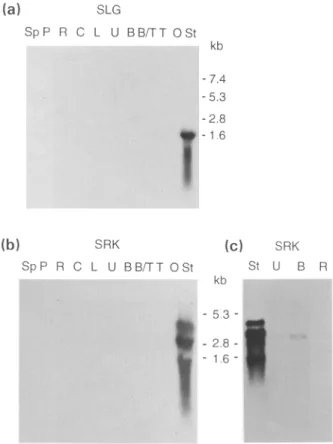
RNA blot analysis was used to look at expression of SLG3 and SRK 3 transcripts in a number of vegetative and floral tissues. A probe corresponding to the 3' untranslated region of the SLG 3 gene hybridized to a single band in a Southern blot of genomic DNA (see Figure 7b) indicating that it is gene-specific. This probe detected a 1.6 kb mRNA in stigmas (Figure 3a) but no signal was obtained with anther RNA even if the sensitivity was increased by loading up to 5 lig of poly(A) + RNA (Figure 3a and data not shown). A 1246 bp Ps~/Clal fragment from the kinase domain of the SRK 3 cDNA was used to detect SRK 3 expression. This probe also detects a single fragment in genomic DNA digests (see Figure 7a) and is hence gene-specific. When 25 I~g of total RNA from a range of different tissues were electrophoresed on a gel and probed, SRK 3 transcripts were detected only in stigmas (Figure 3b). If the sensitivity was increased by loading several micrograms of poly(A)+ RNA, SRK 3 mRNA was also detected in anthers at both the unicellular and bicellular microspore stages, although at much lower abundances than in stigma (Figure 3c). SRK 3 transcripts were not detected in root poly(A) + RNA indicat- ing that the low levels detected in anthers nonetheless result from an induction of gene expression. The SRK 3 probe detects a major transcript of 3.0 kb in stigma RNA plus slightly less abundant transcripts of 4.1, 2.2 and 1.3 kb. A single transcript of 2.8 kb, slightly shorter than the major transcript in stigmas, was detected in anther RNA (Figure 3c).
Sato et al. (1991) have shown by RNA blot and 13- glucuronidase reporter gene fusion experiments that the
SLG13 gene is expressed in anthers. As described above,
SLG3 mRNA was not detected in anthers by RNA blots and
Figure 3. Analysis of expression of the SLG3and SRK 3 genes.
RNA blot analysis of SLG3 (a) and SRK 3 (b and c) transcripts in a range of tissues. Each lane was loaded with either 25 I~g of total RNA (a and b) or 2-4 lig of poly(A)+ RNA (c). The gene-specific DNA probes were derived
from the 3' untranslated region of SLG 3 (a) or the kinase-encoding domain of SRK 3 (b and c). The autoradiographs shown in (b and c) were exposed
for longer than that in (a). Comparison of the intensity of hybridization indicated that SLG3mRNA was at least 10 times more abundant in stigmas
than the SRK 3 mRNA. Sp, sepal; P, petal; R, root; C, cotyledon; L, leaf;
U,B,B/T,T, anthers containing unicellular, bicellular, intermediate bicellular/ tricellular or tricellular microspores respectively; O, ovary; St, stigma. RNA size markers are shown in kilobases (kb).
we were therefore interested to determine whether SLG 3 is expressed in this organ. SLG3 cDNAs were therefore PCR amplified and cloned from anther mRNA. DNA sequen- cing of three anther-derived SLG 3 cDNAs allowed the identification of errors introduced during the PCR ampli- fication but otherwise revealed no differences between anther and pistil SLG3 cDNAs. In order to rule out the possibility that the SLG 3 mRNA detected in anthers was due to a low level of contamination with pistil tissue, mRNA was directly extracted from single organs and the PCR amplification repeated (Figure 4). Using this pro- ceedure, an SLG 3 PCR product was observed following amplification of cDNA from single anthers and single pistils but not from single petals. No amplification occurred if reverse transcriptase was omitted. PCR amplification of
hsp70 sequences was carried out to verify that cDNA had been synthesized in the presence of reverse transcriptase (Figure 4). The degenerate oligonucleotides used are
434 Valdrie Delorme et al.
Figure 4. Detection of SLG3 transcripts in anthers by reverse transcriptase-PCR.
Poly(A) + RNA was extracted from a single petal (P), anther (A) or stigma (St) of the $3/S 3 homozygous line and a reverse transcriptase reaction was carried out in the presence (+) or absence (-) of reverse transcriptase enzyme. PCR amplification was then carried out using either SLG3-specific
(upper panel) or 70 kDa heat shock protein (hspTO)-specific (lower panel) oligonucleotides. DNA size markers are shown in kilobasepairs (kbp). predicted to amplify products from both constitutive and heat shock-induced hspTO genes. The results of these experiments demonstrate that the SLG3 gene is expressed in anthers and that the SLG 3 mRNA expressed in anthers is not significantly different from that found in the pistil.
Expression of SLG3 and SRK3 at the protein level
The N-terminal amino acid sequence of the SLG 3 glycopro- tein has been reported (Gaude et al., 1993). An antibody (anti-SLG3N-ter) was raised against a peptide correspond- ing to this N-terminal sequence (Gaude, Rougier, Heiz- mann, Ockendon and Dumas, manuscript in preparation) and used to probe an i m m u n o b l o t of proteins extracted from a range of tissues and separated by SDS-PAGE. Figure 5(a) shows that antibody anti-SLG3N-ter detects a triplet of bands of 60.0, 61.5 and 63.5 kDa. A similar pattern
Figure 5. Detection of SLG3 and SRK 3 antigen in proteins extracted from a range of tissues and separated by SDS-PAGE.
(a and b). The primary antibody was either anti-SLG3N-ter (a) or Mab 85- 36-71 (b). Molecular mass markers are shown in kilodaltons (kDa). The molecular mass of the SRK protein, calculated with reference to molecular mass markers, is shown in kilodaltons (kDa) in (b). Sp, sepal; P, petal; R, root; C, cotyledon; L, leaf; U,B,B/T,T, anthers containing microspores/pollen grains at the unicellular, bicellular, intermediate bicellular/tricellular or tricellular stages, respectively; O, ovary; St, stigma.
(c) Detection of SRK antigen in stigmas of an $3/$3 homozygous line (S 3) and of P57 Sc (Sc) with either MAb 85-36-71 or with the anti-SRK3C-dom antibody. Molecular masses of SRK proteins, calculated with reference to molecular mass markers, are shown in kilodaltons (kDa).
has been reported for other S haplotypes and the different molecular mass forms have been shown to be the result of different glycoforms of the SLG protein (tsogai et aL,
1987; Umbach et aL, 1990). SLG3 glycoproteins were detected only in stigmas and hence, taking into account the sensitivity of this assay, exhibited the same tissue- specificity as the SLG3 transcript (Figure 5).
In order to assay SRK 3 expression at the protein level it was necessary to have an antibody which recognized SRK3. The first 10 amino acid residues at the N-terminus of the mature SRK 3 protein (IYVNTLSSTE) are predicted to be very similar to the N-terminus of the SLG protein (SLG-Sc) of the self-compatible B. oleracea line P57 Sc (IYVNTLSSSE; Gaude et al., 1993). A monoclonal antibody raised against this latter sequence (MAb 85-36-71; Gaude et aL, 1993) was shown to recognize a protein of 120 kDa on an i m m u n o b l o t of stigma proteins separated by SDS-PAGE (Figure 5b and c). In addition to the 120 kDa protein MAb 85-36-71 cross-reacted weakly w i t h t w o proteins of approximately 62 kDa in stigma extracts of the $3/S 3 line (data not shown). The nature of these latter proteins is unknown. To confirm that the 120 kDa protein corresponded
to SRK 3, a second antibody (anti-SRK3C-dom) was raised against a synthetic peptide corresponding to part of the C- terminal domain of SRK 3. This antibody was shown to recognize a fusion protein containing the kinase and C- terminal domains of SRK 3 expressed in E.
coil
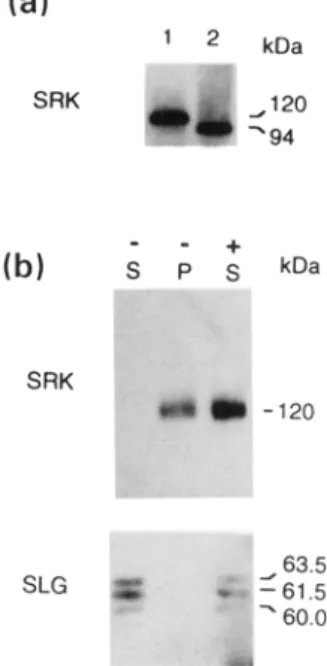
(data not shown). When used as a probe against total stigma pro- teins, the anti-SRK3C-dom antibody also recognized a pro- tein of 120 kDa (Figure 5c) providing strong evidence that the protein detected by these two antibodies is SRK 3.Based on the gene sequence, SRK3 is predicted to pos- sess a polypeptide backbone of 94 kDa which may be modified by glycosylation at nine potential glycosylation sites. Following deglycosylation of stigma proteins, MAb 85-36-71 detected a protein of 94 kDa (Figure 6a), providing further evidence that this antibody detects the SRK 3 protein. The peptide against which the anti-SRK3C-dom antibody was raised corresponds to a region of the C-terminal domain of the SRK3 protein which is predicted to be both highly antigenic and, due to the variable nature of the sequence in this region with respect to other SRK proteins, allele-specific. This prediction was supported by the fact that, using the anti-SRK3C-dom antibody, a 120 kDa protein was detected in stigma proteins of the
$3/$3
line used in this study but not in stigma proteins of two lines homozy- gous for other S haplotypes, P57 Sc (Figure 5c) and S25/S25 (data not shown). MAb 85-36-71, on the other hand, recognized 120 kDa proteins inS~/S 3
and P57 Sc stigmas (Figure 5c) but not in$25/$25
stigmas (see the parental$25
plant in Figure 7c). This latter result indicates that, whilst MAb 853671 does not recognize all allelic forms of the SRK protein, it may be of general use for a subset of
SRK
alleles. For instance, based on their deduced amino acid sequences, SRK 2 is predicted to possess the epitope recog- nized by MAb 85-36-71 whilst SRK 6 is not.
Membrane localization of the SRK 3 protein
SRK has been predicted to be a membrane-spanning pro- tein based on its deduced amino-acid sequence (Stein
et al.,
1991). In order to test this hypothesis, we extracted proteins from pistils in a Tris-HCI, NaCI, EDTA buffer either with or without triton X-100 added to 3%. Tantikanjanaet al.
(1993) have used a similar approach to show that an alternative transcript of theSLG2
gene encodes a membrane-anchored protein. These authors, however, reported the presence of a low level of membrane-anchored SLG 2 in extracts carried out in the absence of detergent and this was ascribed to the presence of membrane vesicles in the extract. A similar problem was initially encountered when extracting the SRK 3 protein. An ultracentrifugation step was therefore included to remove membrane vesicles before separation of the proteins on an SDS polyacrylamide gel. Proteins in the supernatant fractions and in the pellet obtained following centrifugation of the extract in bufferS locus receptor kinase protein
435(a}
SRK
(b)
SRK
SLG
Figure 6.
SRK
3
encodes a membrane-localized glycoprotein.(a) Deglycosylation of SRK 3. Untreated (lane 1) and deglycosylated (lane 2) stigma proteins were separated by SDS-PAGE and transferred to nitrocellulose. SRK protein was detected with MAb 85--36-71.
(b) Membrane-localization of SRK3. Stigma proteins were extracted either in the presence (+) or absence (-) of 3% Triton X-100 and separated by SDS-PAGE. The primary antibody was either MAb 86-36-71 (upper panel) to detect SRK 3 antigen or anti-SLG3N-ter (lower panel) to detect SLG 3 antigen. The molecular masses of the SRK3 and SLG3 proteins, calculated with reference to molecular mass markers, are shown in kilodaltons (kDa). S, supernatant; P, pellet following ultracentrifugation.
without added detergent were then separated on an SDS polyacrylamide gel, blotted on to a nitrocellulose filter and probed with Mab 85-36-71. To verify that protein had been extracted under the two extraction conditions, the same immunoblot was reprobed with antibody anti-SLG3N-ter which recognizes the SLG 3 protein. Figure 6(b) shows that SLG 3 protein was present in the supernatant fraction of extractions carried out both in the presence and in the absence of detergent whereas the 120 kDa protein was detected in the supernatant only when extraction was carried out in the presence of detergent. A small amount of SRK 3 protein was detected in material pelleted from the minus-detergent extract by ultracentrifugation and this was presumed to be protein associated with membrane vesicles. These results indicate that SRK 3 is located in the membrane.
Linkage of the
SLG 3and
SRK3genes to the S locus
In order to confirm that the
SLG3
andSRK3
genes described above reside at the S locus, gene-specific DNA probes were used to detect restriction fragment length polymorphisms (RFLPs) in an F2 population of 22 plants segregating for the S 3 and$25
haplotypes. Results obtained for the two436 Val~rie Delorrne et al.
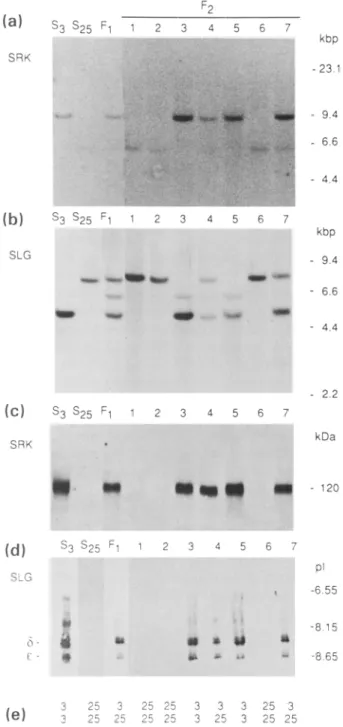
parental lines, an F 1 hybrid and for seven representative progeny are illustrated in Figure 7. The SRK 3 kinase domain probe hybridized to an EcoRI fragment of 9.4 kbp which was present only in DNA of plants carrying the S 3 haplotype. An identical pattern of hybridization was obtained with a probe corresponding to the 3' untranslated region of SRK 3 (data not shown). The SLG3 3' untranslated region probe hybrid- ized to single fragments of 4.8 kbp and 7.2 kbp in EcoRI- digested DNA of the $3/S 3 and S2JS2s homozygous lines, respectively. The 4.8 kbp EcoRI fragment corresponds to the
SLG3 g e n e w h i l s t the 7.2 kbp EcoRI fragment presumably
corresponds to the SLG25gene. In the F 1 and F2 progeny, the presence or absence of these two fragments corresponded exactly with the presence or absence of the corresponding S haplotype. A third EcoRI fragment of 5.9 kbp was detected in DNA of some progeny. This fragment was presumed to be a partial digestion product of the SLG25 gene.
We assayed for expression of the SRK 3 protein in plants of the same F 2 population with the antibodies MAb 85-36- 71 (Figure 7c) and anti-SRK3C-dom (data not shown). With both antibodies, the presence of the 120 kDa protein in stigma extracts corresponded exactly with the presence of the S 3 haplotype. Similarily, the anti-SLG3N-ter antibody detected SLG 3 protein only in stigmas of plants shown genetically to carry the $3 haplotype (Figure 7d). The two major glycoforms of SLG3 detected by anti-SLG3N-ter (labelled (5 and E in figure 7d) correspond to abundant stigma glycoproteins characteristic of the SiS3 line (Gaude
et aL, 1993). Taken together, these results demonstrate that
both the SLG3 and SRK3 genes and expression of the SLG3 and SRK 3 proteins shows tight genetic linkage to the S 3 locus phenotype.
D i s c u s s i o n
Characterization of the SLG and SRK genes of the S 3
haplotype
We describe here the characterization of the SLG and
SRK genes of the S3 self-incompatibility haplotype. DNA
sequence analysis has shown that these two genes are most similar to genes of class I, pollen-dominant S haplo- types. In addition, the deduced amino acid sequence of the S domain of SRK 3 is highly similar to SLG 3 (82.6%; Figure la,) a feature typical of SLG/SRK gene pairs which originate from the same S haplotype. Within each S haplo- type, the SLG and SRK genes appear to have evolved concertedly whilst the different S haplotypes were diver- ging with respect to one another (Goring and Rothstein, 1992; Goring et al., 1993; Stein et al., 1991). The general similarity between an SRK Sdomain and the corresponding SLG suggests that these two proteins may function in a similar manner. If this is the case, then as more SLG and SRK sequences become available, it may be possible to
Figure 7. The SRK 3 and SLG 3 genes, and expression of the SRK 3 and SLG 3
proteins, are genetically linked to the S 3 locus.
(a and b) Ten micrograms of genomic DNA were digested with either EcoRV (a) or EcoRI (b) and separated on 0.8% agarose gels. After transfer to a nylon filter, the blots were hybridized with DNA probes corresponding to either the kinase-encoding domain of SRK 3 (a) or to the 3' untranslated
region of the SLG3cDNA (b).
(c and d) Detection of SRK 3 (c) and SLG 3 (d) antigen in stigma proteins. For detection of SRK 3 protein, stigma proteins were separated by SDS-PAGE and probed with MAb 85-36-71. For detection of SLG 3 protein, stigma proteins were separated by IEF and probed with the anti-SLG3N-ter antibody. (e) S locus phenotypes of the plants analysed in (a)-(d) as determined by genetic crosses. The presence of the $3 and/or the $25 haplotype is indicated by 3 and 25 respectively.
identify conserved residues which are potentially important for protein function by comparing pairs of genes from the same S haplotype. If, as has been suggested (Nasrallah and Nasrallah, 1993), the recognition event which leads to the self-incompatibility response results from the inter- action of SRK with a ligand, it is likely that this interaction involves both a gene-specific component (common to all S haplotypes) and a haplotype-specific component. This is the case for an analogous self/non-self-recognition system in Ustilago maydis (Gillissen et al., 1992). We have com- pared the pairs of SLG and SRK sequences of the S haplotypes that have been characterized but were unable to identify haplotype-specific motifs at the primary structure (amino acid sequence) level. In particular, neither the variable region between amino acid residues 182 and 275, which has been suggested to have a role in haplotype specificity (Nasrallah et a/., 1987), nor the arrangement of potential glycosylation sites show any obvious haplotype- specificity. The identification of haplotype-specific motifs may require determination of the three-dimensional struc- ture of these proteins.
Sequence conservation between the SRK3 promoter and promoters of other S gene family members
DNA sequence extending 1090 bp upstream of the ATG initiation codon was obtained for the SRK 3 gene. Part of this sequence was shown to be highly similar to a con- served region identified in the promoters of other members of the S gene family. This region is shown in Figure 2 and the five conserved elements, Box I to Box V, identified by Dzelzkalns et aL (1993) in SLG and SLR1 promoters are marked. The observation that there is a conservation of structure between the promoters of SRKand SLG is consist- ent with the similar tissue-specificity and temporal patterns of expression of the two genes. It should also be borne in mind that, as a result of the similarity between the SLG and SRK promoters, genes which epistatically control expression of the SLGgene may also pleiotrophically affect SRK expression. Mutations in genes unlinked to the S locus which lead to suppression of the self-incompatibility response (for example, see Nasrallah, 1974) apparently by suppressing SLG expression may therefore exert their effects via modification of either SLG and/or SRK expres- sion. However, in one case (Nasrallah et aL, 1992) such a mutation has been shown to affect SLG mRNA abundance without affecting SRK.
Comparison of the SRK 3 and SRK63 promoters showed that the sequences are conserved upstream as far as -540 bp, after which they diverge. As sufficient upstream sequence data were available only for the two SRK pro- moters, the significance of this observation is unclear, however, it is interesting to note that Dzelzkalns et aL (1993) have shown that an SLG13 promoter fragment
S locus receptor kinase protein 437 extending -411 bp upstream from the initiation codon functions in an identical manner to a 3.65 kbp promoter fragment. Thus the region conserved between the two SRK promoters may corresponds with the limits of the functional promoter.
Transcription of the SLG3 and SRK 3 genes
At the mRNA level, the SLG and SRK genes of the S3 haplotype are expressed with the same pattern as has been reported for other S haplotypes (Goring and Rothstein, 1992; Sato et aL, 1991; Stein et aL, 1991). Both genes are expressed specifically in stigmas and anthers with mRNA levels significantly higher in stigmas compared with anthers (Figures 3 and 4). We were unable to detect SLG 3 mRNA in anther tissue by an RNA blot procedure indicating that this gene is expressed at a lower level in anthers than has been reported for the SLG73 gene (Sato et aL, 1991). SLG3transcripts were, however, detectable in anthers using a reverse transcriptase-PCR procedure which involved extraction of poly(A) + RNA from single organs to avoid possible problems of contamination with stigma tissue (Figure 4). Sequencing of cDNAs corresponding to SLG3anther transcripts indicated that they encode a protein with an identical amino acid sequence to the stigma SLG3. The SRK 3 kinase domain probe detected four transcripts in stigma mRNA (Figure 3c) with the same sizes and relative abundances as the transcripts detected in stigmas of an S 6 haplotype (Stein et aL, 1991). Using probes corresponding to different domains of the SRKsgene, Stein et aL (1991) obtained data indicating that these transcripts result from alternative splicing of the SRK e gene. The conservation of this expression pattern in the S3 haplotype indicates that the production of alternative transcripts and their relative abundance may be important to SRK function.
The SRK 3 gene encodes a 120 kDa protein in stigmas An immunochemical strategy, based on the use of two antibodies directed, respectively, against the N-terminal and the C-terminal end of SRK 3, allowed the identification of a 120 kDa protein specifically expressed in stigmas (Figure 5). Deglycosylation of the 120 kDa protein reduces its molecular mass to 94 kDa (Figure 6a), consistent with the predicted molecular mass for the SRK 3 polypeptide and with the presence of nine potential N-glycosylation sites in the S domain. Moreover, in an F 2 population segregating for the S 3 and <325 haplotypes, the 120 kDa protein was detected only in stigmas of plants carrying the SRK 3 gene and expressing the S 3 phenotype (Figure 7). Taken together, these data provide strong evidence that the 120 kDa protein is an expression product of the SRK3gene.
The protein detected in extracts of the self-compatible line P57 Sc had a smaller molecular weight than that of
438 Val~rie Delorme et al.
the $3/S 3 homozygous line (116 kDa compared with 120 kDa; Figure 5C)o Expression of this protein correlates with the presence of the P57 Sc S haplotype in an F 2 population (Auger and Gaude, unpublished results) indicating that this protein corresponds to the SRK of the P57 Sc line. P57 Sc is a self-compatible line which possesses a class II-type SLG gene (Gaude eta/., 1993). We are currently investigating the possibility that the smaller molecular weight of the SRK protein of this line is related either to the self-compatible phenotype or to the presence of a class II S haplotype.
The SRK 3 protein is localized in the membrane
Based on deduced amino acid sequence, SRK has been predicted to span the plasma membrane. We have shown that the 120 kDa protein is extracted from stigma tissue only in the presence of detergent indicating that this protein is indeed localized in the membrane (Figure 6). Further work will be aimed at determining specifically whether SRK is located in the plasma membrane. In addition, the availability of two antibodies which recognize either the predicted extracellular domain or the predicted intracellular domain will provide a useful tool to confirm the predicted orientation of the SRK protein in the membrane. The observation that SRK is localized in the membrane, taken together with the demonstration that the SRK protein has a protein kinase activity (Goring and Rothstein, 1992; Stein and Nasrallah, 1993), strongly indicates that SRK functions as a membrane-spanning receptor kinase. Recently pub- lished genetic evidence that a functional SRK gene is essential for the Sl response (Nasrallah et aL, 1994) sup- ports the hypothesis that the role of this receptor is as a component in the signal transduction pathway leading from recognition of self-pollen by the stigma to inhibition of the fertilization process. These data also support the hypothesis that a number of other genes which exhibit sequence homology to SRK also function as receptor kinases. These genes include ARKI, RLK1 and RLK4 in
Arabidopsis thaliana and ZmPK1 in Zea mays (Tobias et aL,
1992; Walker, 1993; Walker and Zhang,1990), genes which have been shown to be expressed in vegetative tissues and which therefore presumably play a role in processes quite different from that of SRKin pollen-pistil recognition.
Experimental procedures
Plant material, genetic crosses and determination of incompatibility phenotype
The Brassica oleracea var. acephala homozygous lines P57 Si (SJ
$3 homozygous) and P57 Sc have been described (Gaude et aL,
1993). Seeds of Brassica oleracea var. alboglabra homozygous for the S2s haplotype were a gift from Dr David J. Ockendon (HRI, Wellesbourne, UK). An F1 heterozygous plant, the result of a cross between the SiS3 and the $2s/$25 homozygous line, was self-
fertilized to generate F2 progeny for RFLP analysis. The incompatib- ility phenotype of the F2 progeny was determined by
self-pollina-
tion and by crosses to tester plants as previously described (Gaude
et a/., 1993).
Cloning of the SLG 3 cDNA
The construction and screening of a cDNA library from mature stigmas of a B. oleracea var. acephala $3/S 3 homozygous line (P57 Si) has been described previously (Gaude et aL, 1993). The
SLG3 cDNA was one of two clones which hybridized both to a
BS29-2 (SLG2g) probe and to an oligonucleotide (5'-TCGATCAACA- CT'I-rGTCG-3') based on the N-terminal sequence of the SLG3 protein (Gaude et aL, 1993). The SLG 3 cDNA was sequenced on both strands.
Construction and screening of a n S3/S 3 genomic library
Genomic DNA was extracted (Choumane and Heizmann, 1988) from $3/S 3 homozygous plants and a genomic library of size-
fractionated Sau3A restriction fragments was constructed (Sambrook et aL, 1989)in lambda Dash (Stratagene, LaJolla, CA). One million plaques were screened with a mixed probe consisting of the first 1.2 kbp of the SLG3 cDNA and a portion of the S domain of SRK obtained by PCR amplification from genomic DNA of the SiS3 homozygous line. Positive phage were purified by several rounds of plaque purification. Several SLG3 clones and one SRK 3 clone were obtained. The SLG3 genomic clone was shown to be co-linear with the SLG 3 cDNA by PCR amplification using two oligonucleotides corresponding to the 5' and 3' ends of the SLG3 cDNA (5'TGGCTCGAGAGATGAAAGGCATAAGAAAAAC- 3' and 5'AGGGAGATCAAATTTATGTGTA'I-rTrACATGG-3', respect- ively). A 9 kbp Smal fragment carrying the SRK 3 gene was subcloned into pBluescript-SK + (Stratagene, La Jolla, CA) and 5345 bp of DNA was sequenced. Exon/intron boundaries within the SRK 3 gene were identified by sequencing an SRK 3 cDNA obtained by PCR amplification with Pfu thermostable DNA poly- merase (Stratagene, La Jolla, CA) of mature stigma cDNA using two oligonucleotides: 5'-CGACAGAACCTATGTATGGATrGCC-3' and 5'-GGCGGATCCTAAAAACAGCAAG CCAAAAAC-3'. SRK 3
mRNA polyadenlyation sites were identified by RACE-PCR (Frohman et aL, 1988).
PCR cloning of SLG3 transcripts expressed in anthers
Poly(A) + RNA was extracted directly (Jakobsen et al., 1990) from a single anther or petal from flowers at the unicellular stage of microspore development or from a single mature stigma and purified by hybridization to magnetic beads carrying oligo(dT)25 (Dynal AS, Oslo). A DNase digestion was carried out to remove any contaminating DNA and the poly(A) + RNA was reverse tran- scribed (1st strand cDNA synthesis kit; Stratagene, La Jolla, CA). PCR amplification of SLG3 cDNA was carried out with two specific oligonucleotides, C: 5'-TGGCTCGAGAGATGAAAGGCATAAGAAA- AAC-3' and D: 5'-AGGGAGATCAAATTTATGTGTAT'I-FTACA- TGG-3', which prime at the 5' and 3' ends of the SLG3 cDNA, respectively. Two degenerate oligonucleotides, 5'-GGGAATT- CGGNGGNGGRGAYT'I-YGA-3' and 5'-GGGAATTCACNCCNGGYT- GRTTRTC-3', were used for PCR amplification of hspTO (heat shock protein 70) cDNA. PCR amplification was carried out with AmpliTaq DNA polymerase according to the instructions of the supplier (Perkin-Elmer, N J) for 38 cycles of 94°C for 1 min denaturation, 55°C for 1 min annealing and 72°C for 4 min extension, followed
by a final extension for 10 min. For cloning, PCR amplification was carried out from anther cDNA as above. The PCR product was treated with Klenow DNA polymerase to create blunt ends and phosphorylated with polynucleotide kinase. The desired prod- uct was purified by excision from an agarose gel and digestion of the agarose with Gelase (Epicentre Technologies, Madison, Wl). The purified DNA was ligated into EcoRV-digested, dephosphoryl- ated pBluescript-SK + plasmid DNA and positive clones were sequenced on both strands.
DNA sequencing, RNA gel blot analysis and Southern blot analysis
Sequencing was carried out by the dideoxy-nucleotide chain termination method (Sanger et aL, 1977) using the Sequenase system (version 2.0; U.S. Biochemicals) and custom-synthesized oligonucleotides. Sequence data were analysed using Lasergene sequence analysis software (DNASTAR, London, UK). For RNA gel blots, total RNA was extracted by the method of Jackson and Larkins (1976). Cotyledons, leaves and roots were harvested from 3-week-old seedlings, all other tissues were from mature, flower- ing plants. The developmental stage of anthers was determined by fluorescence microscopy observation of DAPI-stained micro- spores. Poly(A) + RNA was purified from 100 I~g batches of total RNA by hybridization to magnetic beads carrying oligo(dT)2s (Dynal AS, Oslo, Norway). RNA was separated on formaldehyde gels and transferred to nylon filters for hybridization. For Southern blots, total genomic DNA was extracted from leaves of Brassica
plants as described by Choumane and Heizmann (1988). DNA probes were prepared using a random priming DNA labelling kit (Boehringer Mannheim). Hybridizations were carried out under standard conditions and filters were washed at high stringency (Sambrook eta/., 1989).
S locus receptor kinase protein 439
Antibody production and immunodetection on protein blots
The anti-SLG3N-ter and anti-SRK3C-dom antibodies were produced by injecting mice or rabbits, respectively, with peptides cross- linked to ovalbumin as described (Gaude eta/., 1993). The peptides had the sequences INTLSSTESLY and SSRQYDNDEWT, respect- ively. Antigen/antibody complexes were visualized using goat anti- mouse antibody or goat anti-rabbit conjugated either to alkaline phosphatase (Promega, Madison, USA) or horseradish peroxidase (Amersham) as secondary antibodies. For alkaline phosphatase development, nitroblue tetrazolium and 5-bromo-4-chloro-indolyl phosphate were used as colour development substrates. For horseradish peroxidase, ECL detection kit reagents (Amersham) were used.
Expression of the SRK 3 kinase domain in E. coli
The kinase-encoding domain of SRK3was isolated as a Bcll/BamHI
fragment of the SRK3 cDNA described above and cloned into the BamHI site of pQE-32 (Qiagen Inc., Chatsworth, CA) to create a
fusion protein containing a poly-histidine sequence followed by residues 459-850 of SRK~ Expression of the fusion protein in E.
coliand purification on a nickel-nitrilo-tri-acetic acid (Ni-NTA) resin was essentially as described by the supplier (Qia-expressionist kit, Qiagen Inc., Chatsworth, CA). Briefly, fusion gene expression was induced by addition of 2 mM isopropyl ~-thiogalactoside to a 1 I bacterial culture and the cells harvested 2 h 30 min later. Cells were lysed by sonication in 50 mM NaH2PO4 pH 8.0, 0.3 M NaCI, 1% Triton X-1O0, 1 mM PMSF, 10 mM ~-mercaptoethanol, centrifuged at 15 000 g and the supernatant mixed with Ni-NTA resin. After rinsing the resin, bound protein was eluted in the presence of imidazole and the SRK fusion protein detected by immunoblotting.
Protein extraction and electrophoretic analysis
Protein extraction, separation of proteins by isoelectric focusing (IEF) or SDS-PAGE, electrotransfer on to nitrocellulose membranes and detection of antigen with antibodies was as described previ- ously (Gaude et al., 1993). For the identification of membrane- localized proteins, protein was extracted from stigmas in TBS buffer (20 mM Tris-HCI pH 8.0, 150 mM NaCI, 1 mM EDTA) with or without added 3% (w/v) Triton X-100. Diluted protein extracts were centrifuged at 100 000 gfor 1 h at 4°C and then concentrated by ultrafiltration on Centricon-30 filters (Amicon, Beverly, USA) and precipitated with cold acetone before loading on an SDS polyacrylamide gel as described (Gaude et al., 1993).
Deglycosylation of proteins
Following extraction of stigma proteins in TBS buffer with 3% (w/ v) of Triton X-100 as described above, the protein solution was diluted with 30 volumes of TBS and ultrafiltrated on a centricon 30 filter (Amicon, Beverly, USA) before lyophilization. Protein deglycosylation and subsequent recovery was performed mainly as described by Karp et aL (1982). Briefly, 250/lg of lyophilized protein were deglycosylated in 50 p_l of TMFS/Anisole (9 vol./ 1 vol.) on ice for 3 h with magnetic stirring of the reaction mixture. After dialysis against 0.1 M NH4HCO 3, deglycosylated proteins were lyophilized and resuspended in loading buffer for SDS-PAGE electrophoresis.
Acknowledgements
We thank Dr David J. Ockendon (HRI, Warwick, UK) for supplying us with SiS3 tester and $25/$25 Brassica lines and for help with determining the SI genotype of the P57 Si line; Dr Martin Trick (John Innes Institute, UK) for the gift of the BS29-2 clone; Dr Elizabeth Bates for the gift of hsp70-speciflc oligonucleotides; Monique Estienne and Richard Blanc for technical assistance and Pierre Audenis for photographic work. T.G. and P.H. are members of the Centre National de la Recherche Scientifique, J.M.C. is a member of the Institut National de la Recherche Agronomique. This work was supported by the EEC BRIDGE programme.
References
Boyes, D.C., Chen, C.H., Tantikanjana, T., Esch, J.J. and Nasrallah,
J.B. (1991) Isolation of a second S-locus-related cDNA from
Brassica oleracea: Genetic relationships between the S-locus and two related loci. Genetics, 127, 221-228.
Choumane, W. and Heizmann, P. (1988) Structure and variability of nuclear ribosomal genes in the genus Helianthus. Theor. Appl. GeneL, 76, 481-489.
Dzelzkalns, V.A., Thorsness, M.K., Dwyer, K.G., Baxter, J.S., Balent, M.A., Nasrallah, M,E. and Nasrallah, J.B. (1993) Distinct cis-
acting elements direct pistil-specific and pollen-specific activity of the Brassica S locus glycoprotein gene promoter. Plant Cell,