HAL Id: hal-00529922
https://hal.archives-ouvertes.fr/hal-00529922
Submitted on 27 Oct 2010
HAL is a multi-disciplinary open access archive for the deposit and dissemination of sci-entific research documents, whether they are pub-lished or not. The documents may come from teaching and research institutions in France or abroad, or from public or private research centers.
L’archive ouverte pluridisciplinaire HAL, est destinée au dépôt et à la diffusion de documents scientifiques de niveau recherche, publiés ou non, émanant des établissements d’enseignement et de recherche français ou étrangers, des laboratoires publics ou privés.
Andrée Tiberghien, Jacques Vince, Pierre Gaidioz
To cite this version:
Andrée Tiberghien, Jacques Vince, Pierre Gaidioz. Design-based research: case of a teaching sequence on mechanics. International Journal of Science Education, Taylor & Francis (Routledge), 2009, 31 (17), pp.2275-2314. �10.1080/09500690902874894�. �hal-00529922�
For Peer Review Only
Design-based research: case of a teaching sequence onmechanics
Journal: International Journal of Science Education Manuscript ID: TSED-2008-0158.R1
Manuscript Type: Research Paper
Keywords: classroom, curriculum, design study, inquiry-based teaching, science education
Keywords (user): modelling, theoretical approach, teaching sequence
For Peer Review Only
Design-based research: case of a teaching sequence on mechanics
Abstract
Design-based research, and particularly its theoretical status, is a subject of debate in the science education community. In the first part of this paper, a theoretical framework drawn up to develop design-based research will be presented. This framework is mainly based on epistemological analysis of physics modelling, learning and teaching hypotheses. It includes grand theories, a specific theory that following Cobb & al. (2003) is a ‘humble theory’ in the sense that it does ‘real work’, and tools for design. In the second part, we will show how this specific theory and its tools led designers to develop teaching resources in the case of a teaching sequence on mechanics (grade 10). We will explain how the components of the specific theory and tools guide the design at different levels; the conceptual structure of the teaching sequence, the chronology of the activities, the various choices of the type of activity and their wording. This presentation makes the bases of designing teaching resources explicit and therefore allows for scientific debate.
3 4 5 6 7 8 9 10 11 12 13 14 15 16 17 18 19 20 21 22 23 24 25 26 27 28 29 30 31 32 33 34 35 36 37 38 39 40 41 42 43 44 45 46 47 48 49 50 51 52 53 54 55 56 57 58 59 60
For Peer Review Only
Introduction
Design-based research is an object of debate in the science education community. An issue of the International Journal of Science Education was devoted to this question (Méheut & Psillos, 2004, invited editors). In their editorial these authors underlined the emergence of this type of research with particular difficulty in making explicit the assumptions and decisions often implicit in the design of teaching sequences and, more widely, teaching materials. They think that:
“it may be due to craft knowledge involved in the teaching and handling of specific
content, or to a lack of widely accepted tools for representing teaching; a situation that
warrants further study” (p.516) [our italics].
This difficulty is also discussed in an issue of the Educational Researcher (January-February 2003), particularly the theoretical research status of such studies. The article introducing this issue signed by “the design-based research collective” suggests that proper design-based research enhances some characteristics as follows:
“...Research on designs must lead to sharable theories that help communicate relevant implications to practitioners and other educational designers” (p.1) [our italics]. And in the same issue, Cobb, Confrey, diSessa, Lehrer & Schouble (2003) characterized the status of the theoretical component of such studies by their role: “they are accountable to the activity of design. The theory must do real work” (p.10) [our italics] and consider that the general philosophical orientations like constructivism “often fail to provide detailed guidance in organising instruction” (p.10).
The distance between general orientation or grand theory and designed teaching materials is large; so it is not surprising that diSessa (2006) notes that different grand theories “often
3 4 5 6 7 8 9 10 11 12 13 14 15 16 17 18 19 20 21 22 23 24 25 26 27 28 29 30 31 32 33 34 35 36 37 38 39 40 41 42 43 44 45 46 47 48 49 50 51 52 53 54 55 56 57 58 59 60
For Peer Review Only
advocate similar instructional strategies. […] The use of instructional analogies, metaphors, and visual models is widespread and not theory-distinctive” (p. 276).
It seems necessary to distinguish between general philosophical grand theories and the theories that do real work. The “real work” to design teaching sequences is diverse, there is a variety of decisions to be made relating to the specific teaching content, to the structure of its main aspects, to the order in which they are introduced, to the instructional strategies, and so on (Lopes, Silva, Cravino, Costa, Marques, & Campos, 2008). In particular, the type of classroom activity, the respective roles of the teacher and students, the teaching resources, the various possibilities of class organisation, the approximate duration of each activity, etc, should be decided according to the specific content to be introduced. Therefore the theoretical framework that does real work should include a variety of theoretical components.
In this paper, the status of the different components of a theoretical framework for design-based research in teaching sequences and their role in the design are discussed in relation to a specific case: the design of a teaching sequence in mechanics for the first year of upper secondary school (grade 10) in France. Then this paper aims to present a theoretical contribution to the field of science education design; it contributes more specifically to constructing a theoretical background for designing teaching resources. This theoretical contribution has emerged from considerable experience of designing teaching resources (more than ten years). This design activity was initially based on teachers’ and researchers’
experience. This means that the research results and methods known by the researchers were
proposed and used by them to contribute to the design. The design was therefore not carried out in the perspective of testing a theory but of ensuring that research serves the design of teaching resources and more generally contributes to improving science teaching. The theoretical proposal presented in this paper has emerged from this design experience in interaction with the evolution of research studies and new research trends on design.
3 4 5 6 7 8 9 10 11 12 13 14 15 16 17 18 19 20 21 22 23 24 25 26 27 28 29 30 31 32 33 34 35 36 37 38 39 40 41 42 43 44 45 46 47 48 49 50 51 52 53 54 55 56 57 58 59 60
For Peer Review Only
Following Bannan-Ritland &Baek (2008), this proposal can be called an “emergent theory” (p. 301).
Theoretical framework leading to theories that do real work in designing
teaching sequences
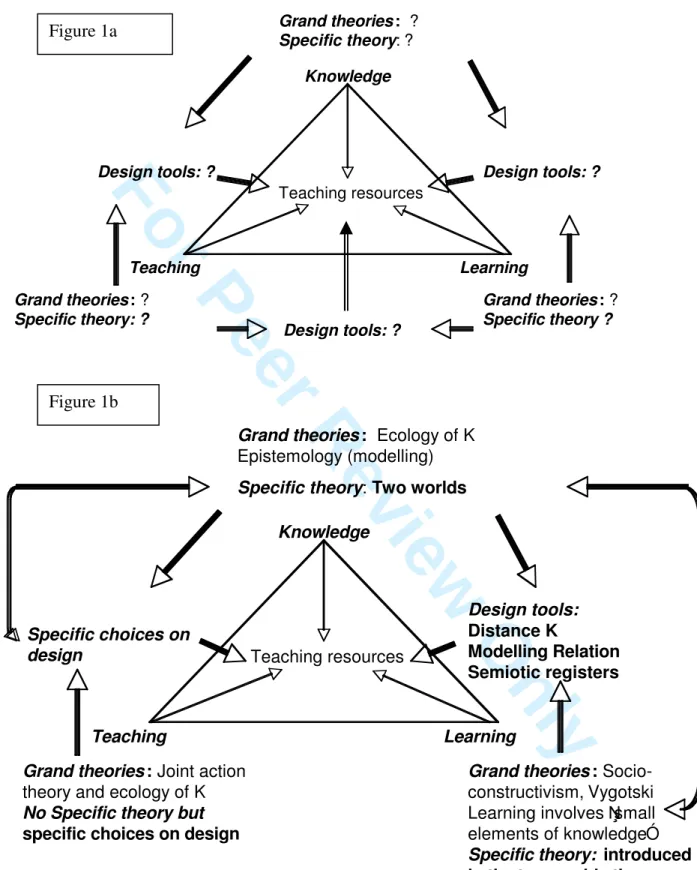
As proposed by Cobb, the designers, who, as researchers, aim to make their choices and productions explicit and debatable, have to construct specific theoretical elements and, in some cases, specific tools that are directly operational. However, these specific constructions depend on grand theories that can come from several disciplinary fields. To present the way to go from the grand theories to teaching resources we start from the didactic triangle as presented in Figure 1a. Most of the grand theories involved in the design of teaching resources emphasize one of the three poles of the didactical (or pedagogical) triangle; knowledge, learning and teaching, without ignoring the others. We use ‘learning’ and ‘teaching’ instead of ‘student’ and ‘teacher’ to remain as close as possible to a theoretical approach. These grand theories cannot do real work; specific theories become necessary to design teaching resources. At present such theories are constructed by researchers in science education and are not currently shared by the community. This leads to our first research question dealing with the construction of specific theories from the grand theories to design teaching sequences (Figure 1a). What are the grand theories chosen? How do they contribute to a specific theory? Does a specific theory come from several grand theories? Our second question follows the first one in the design process; it deals with the way in which the specific theories “do real work” to design teaching sequences. More specifically, on what components of the teaching sequence do the specific theories do real work directly? Do they need specific tools to be operational?
For each pole, we will present in turn the grand theories and the specific theories and choices.
3 4 5 6 7 8 9 10 11 12 13 14 15 16 17 18 19 20 21 22 23 24 25 26 27 28 29 30 31 32 33 34 35 36 37 38 39 40 41 42 43 44 45 46 47 48 49 50 51 52 53 54 55 56 57 58 59 60
For Peer Review Only
Due to the wider development of the knowledge pole, we will present it in two parts, (1) grand theories and (2) specific theories. This presentation by pole does not mean that the grand theories are exclusively related to one pole; in fact they can involve other poles.
Insert figures 1a and 1b about here
Knowledge: Grand theories
The grand theories mainly related to the knowledge pole deal with two fields: sociology and epistemology of knowledge.
Sociology of knowledge: the grand theory of ecology of knowledge
This grand theory deals with the relations between the educational system, the scientific community and everyday society. Its perspective involves a political level where the objectives of education are defined. But even at the design level where the official curriculum is defined, this sociological perspective plays a role in the designers’ interpretation of the curriculum and then on the way they implement it.
In this theory (Chevallard, 1991) there are social conditions for knowledge to exist; knowledge can only stay alive if it is studied and/or used, if not it dies1. Here knowledge takes a broad meaning, it is not only declarative knowledge but also the processes of its elaboration and it includes skills. Chevallard (1991) states that knowledge is alive in a group and that the
meaning of knowledge depends on the group. For example, energy conservation does not have
the same meaning in a high-energy research group as in an ecology group or in a physics classroom in an upper secondary school. He also makes a distinction between the types of
1
This perspective is currently shared among people involved in sustainable archives: to be sustainable, an 3 4 5 6 7 8 9 10 11 12 13 14 15 16 17 18 19 20 21 22 23 24 25 26 27 28 29 30 31 32 33 34 35 36 37 38 39 40 41 42 43 44 45 46 47 48 49 50 51 52 53 54 55 56 57 58 59 60
For Peer Review Only
relationships to knowledge that a group of people has: production, use, etc. (a researcher and
an engineer do not have the same relationships to knowledge) and he analyses the migration
of a part of knowledge from a group towards another. This migration is called transposition;
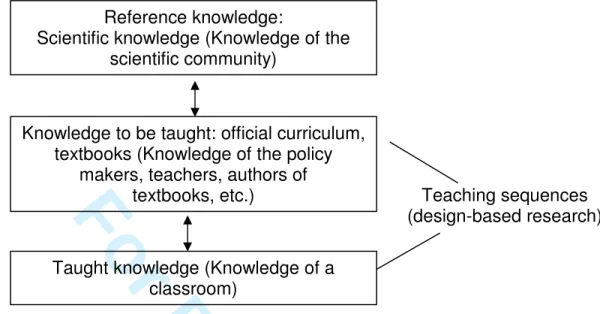
it implies necessarily that the meaning of the part of knowledge that migrates will change since it is alive in different groups of people. Didactical transposition consists of the migration of knowledge in the community of reference, called the reference knowledge, towards the knowledge that is alive in the classroom and is called taught knowledge. In physics teaching at upper secondary school, the reference knowledge is the physics knowledge. However, in the case of scientific literacy, several communities of reference can be involved; the scientific communities and the society at the level of a region or country. This allows the designers to introduce social questions such as those raised by the environment. This transposition includes two main steps (Figure 2): (1) from the reference knowledge to the knowledge to be taught, and (2) from the knowledge to be taught to the taught knowledge. The knowledge to be taught can be found in a community of policy makers, teacher trainers and teachers; it mainly consists of official curricula, textbooks or similar materials. This knowledge is usually written for people who are familiar with the knowledge to be taught. The texts are meant for teachers who are specialists of the discipline to be taught. Taught knowledge lives in a classroom and is necessarily associated with a particular class. The class is considered as a system where taught knowledge is a joint production of the teacher and the students and is therefore specific to a classroom (Mercier, Schauber-Leoni & Sensevy, 2002). Let us note that this way of considering a classroom is related to the teaching pole.
[Insert figure 2 about here]
3 4 5 6 7 8 9 10 11 12 13 14 15 16 17 18 19 20 21 22 23 24 25 26 27 28 29 30 31 32 33 34 35 36 37 38 39 40 41 42 43 44 45 46 47 48 49 50 51 52 53 54 55 56 57 58 59 60
For Peer Review Only
This grand theory of the ecology of knowledge (Figure 1b) is particularly important in our design because it states the difference between the disciplinary knowledge, the knowledge to be taught (official curriculum, textbooks) and the taught knowledge in a given classroom (Figure 2).
Within this perspective, the designed teaching sequences are a part of the knowledge to be taught (like a textbook). They are also close to the taught knowledge because the design includes written texts that are directly aimed at students together with comments for teachers on classroom management. These sequences contribute to narrowing the gap between the knowledge to be taught and taught knowledge.
Epistemology of knowledge: modelling
Here the epistemology concerns not only disciplinary knowledge but also everyday knowledge. The reason for this comes from the grand theory of learning that we have chosen; socio-constructivism. From this grand theory, the students’ initial knowledge plays a major role in learning; it is therefore important to better understand how everyday knowledge works. Thus our epistemological choice is also related to the learning pole (Figure 1b).
All the teaching sequences designed in our group have the same epistemological grand theory (Figure 1b). We have chosen to favour the basic processing of physics: modelling. In the following we will introduce our epistemological view on modelling in physics and in everyday situations.
View of modelling in physics
Let us note that this analysis is carried out in order to be used as a reference in the transposition process from scientific knowledge to taught knowledge and not to study experimental science in itself. Our choice is based on the works of several epistemologists (Bunge, 1973; Bachelard, 1979; Giere, 1988) who have considered that modelling of the
3 4 5 6 7 8 9 10 11 12 13 14 15 16 17 18 19 20 21 22 23 24 25 26 27 28 29 30 31 32 33 34 35 36 37 38 39 40 41 42 43 44 45 46 47 48 49 50 51 52 53 54 55 56 57 58 59 60
For Peer Review Only
material world is at the heart of physics. To characterize this process we will refer to Hacking (1983/2005). We retain the following main points:
- Theories are not easy to define; analysing the Faraday effect, Hacking shows that “at least six different levels of theory” (ibid, p.212) are involved. For him “theories cover lots of productions” (p.212). For example physicists can use different theories, more or less mathematical, to interpret the same facts.
- Observations are not necessarily driven by physics theory. There have been important observations in the history of science that have included no theoretical assumptions. We share Hacking’s view in the following statement:
“Now of course Bartholin, Grimaldi, Hooke and Newton were not mindless empiricists without an ‘idea’ in their heads. They saw what they saw because they were curious, inquisitive, reflective people. They were attempting to form theories. But in all these cases it is clear that the observations preceded any formulation of theory.” (ibid, p.156)
Let us notice that this position is neither the positivist one nor that of philosophers like Lakatos, Feyerabend who, even though their opinions may differ, “were saying that there are no purely observation statements because they are all infected by theory” (ibid, p.171). Hacking insists on the idea that observation and experimentation cannot be replaced by linguistic entities (observation sentences). For us, this aspect is important for the transposition from this scientific community level to the secondary teaching level.
- Theory and experiments cannot be directly articulated. Hacking has proposed two main reasons for this:
“Most initial speculations [theories] hardly mesh with the world at all. This is for two reasons. One is that one can seldom directly deduce from a speculation
3 4 5 6 7 8 9 10 11 12 13 14 15 16 17 18 19 20 21 22 23 24 25 26 27 28 29 30 31 32 33 34 35 36 37 38 39 40 41 42 43 44 45 46 47 48 49 50 51 52 53 54 55 56 57 58 59 60
For Peer Review Only
consequences that are even in principle testable. The other is that even a proposition which is in principle testable is often not testable, simply because no one knows how to conduct the test. New experimental ideas and new kinds of technology are required.” Then there is “an enormously wide-ranging intermediary activity best called model-building.” (p.216)
- The same idea of the difficulty of articulation is also reinforced by the analyses of Bachelard (1979) and Hacking (1983/2005), who consider that there are two processes
in model building: a process from the theory, which makes the theory more concrete
or visible and a process from the experiment, which makes the experiment more abstract. In this epistemological analysis we will call a ‘model’ the result of this
double process (the word ‘model’ will be used with a different meaning in the design
activity we present below) and ‘modelling’ this double process (with the same meaning in the design activity). The model is an intermediary between theory and experiment. It can be considered as having two facets, one from the theory and the other from the experiment. Let us note that this double modelling process, according to the scientists and/or the time period, is not unique; it can lead to different models.
View of modelling in everyday situations
Our grand theory on learning (socio-constructivist with Vygotski, figure 1b), as we discuss below, has led us to analyse the distance between physics modelling and the processes involved in everyday knowledge. To assess this distance we will also analyse everyday knowledge in terms of modelling.
Epistemologists have studied physics cognition for several centuries but they have not studied everyday cognition. Various disciplines have approached this field, in particular anthropology, cognitive science, ethnology, linguistics, psychology and science education. We do not claim to review all the existing works; we will just provide some of the main
3 4 5 6 7 8 9 10 11 12 13 14 15 16 17 18 19 20 21 22 23 24 25 26 27 28 29 30 31 32 33 34 35 36 37 38 39 40 41 42 43 44 45 46 47 48 49 50 51 52 53 54 55 56 57 58 59 60
For Peer Review Only
elements that have led us to draw up our theoretical framework. Let us first note that everyday knowledge is not commonly recognized as knowledge that could be an object of study in itself; there are no epistemologists of everyday knowledge, or very few. It is more often aimed at understanding how people live and how they speak, think, etc. We will consider five main aspects:
- Categorisation is a fundamental component of interpretation of the material world. Psychologists have studied this thinking process as well as anthropologists and ethnologists such Levy-Strauss (1962).
- Causality is also a fundamental component of explaining the material world. Piaget and, more recently, researchers in cognitive science and science education have studied causality (Piaget & Garcia, 1971; Tiberghien, 2004; Saxe & Carey, 2006). - From birth, individuals construct their own knowledge of the material world before
even language acquisition (Spelke, Phillips & Woodward, 1995). As in the case of observation in physics, we will consider that perception plays a major role. Communication and language also play a major part in the construction of knowledge of the material world; the richness of everyday language, particularly with its metaphors and the polysemy of words, helps this understanding. Then there is also a cultural transmission of this knowledge.
- Our understanding of the material world includes some general approaches such as
categorisation and causality and more specific components that form a kind of set of
theories (Vosniadou & Brewer, 1992). In this matter we do not share diSessa’s approach of “knowledge in pieces” (2006), even though we widely acknowledge the interest excited by P-prime. This set of theories is individual and collective as part of a shared culture, particularly when involved in a common language.
3 4 5 6 7 8 9 10 11 12 13 14 15 16 17 18 19 20 21 22 23 24 25 26 27 28 29 30 31 32 33 34 35 36 37 38 39 40 41 42 43 44 45 46 47 48 49 50 51 52 53 54 55 56 57 58 59 60
For Peer Review Only
- In everyday knowledge the questions that are raised about the material world,
including artefacts, are driven mainly by our uses and do not aim at understanding the
world as in physics. Everyday language is very rich, particularly with the polysemy of words.
Our analysis leads us to consider that modelling processes are involved in everyday knowledge. They involve a set of knowledge elements that we call theories in the sense that they allow people to explain a large variety of behaviours of the material word (objects and events). This set includes general approaches like causality, categorisation and more specific elements of knowledge that can deal with local behaviours of the material world. We are well aware that using the word “theory” is a radical choice; it does not mean that these theories are similar to the theories in physics, they merely play a similar role in the explanation of a large part of the material world involved in everyday situations. Moreover there is a wide
difference in the modelling process, whereas in physics the relations between theories and
experiments are not at all direct as we have shown above. In everyday knowledge the “theoretical elements” can very often be related directly to the behaviour of the material world.
Knowledge: Specific theory of the two worlds
From our grand theories on modelling in physics and in everyday knowledge, we have worked out a theoretical framework in order to use it when designing teaching sequences. We will present this framework firstly for physics knowledge at school, then for everyday knowledge. To do this, we take into account the relationship between knowledge and the two poles learning and teaching (Figure 1b).
3 4 5 6 7 8 9 10 11 12 13 14 15 16 17 18 19 20 21 22 23 24 25 26 27 28 29 30 31 32 33 34 35 36 37 38 39 40 41 42 43 44 45 46 47 48 49 50 51 52 53 54 55 56 57 58 59 60
For Peer Review Only
The two worlds of physics knowledge to be taught
In the transposition process we will keep to the elementary physics that is taught until the first year of university. In this case, there is macroscopic physics in which objects and events are almost directly observable because they are investigated with rather simple instrumentation. There is also microscopic physics in which particles associated with events are not directly observable; in this case the objects (particles) and events have to be constructed as belonging to the material world with the intermediary of simulation in some cases. The cases in which the experimental field is studied with complex instrumentation, for example studies of particles (high energies, etc) are not considered.
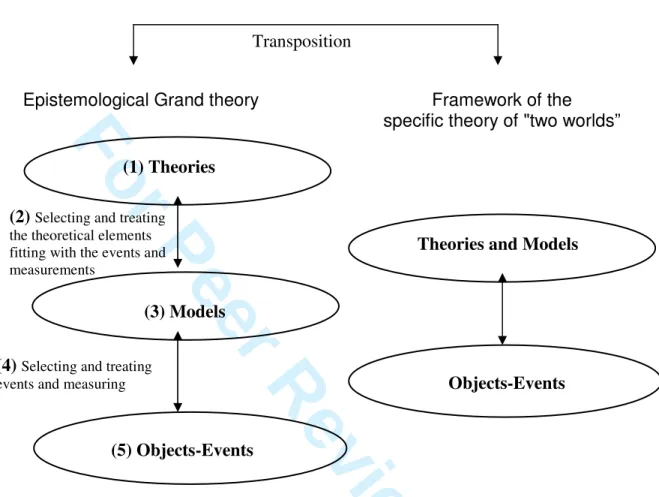
The main point for us is that, even in the case of elementary physics, the relation between theory and experimentation is not direct at all and includes several modelling processes. Then the question is raised of how to deal with the model, which is an intermediary between theory and experiment (Hacking, 1983/2005; Bachelard, 1979). In this intermediary role, let us consider how to transpose the process going from theory to experiments and the reverse (see the left part of Figure 3). When analysing the usual physics teaching content, the theory is not differentiated from the model, particularly from the components of the model that come from the theory.
[Insert figure 3 about here]
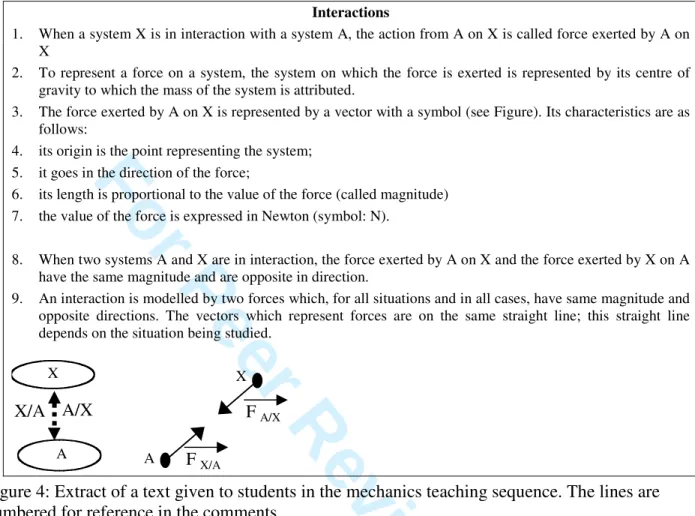
In the case of mechanics, for example, Figure 4 presents a short extract from a text given to the students with the status of theory in the case of the teaching sequence on mechanics. This text, associated with formal language (vector in this case), presents Newton’s third law in natural language, and also introduces the rules to represent a force vector. The text presenting Newton’s law is part of the theory (lines 1 and 8), but the second part of the text on the force is not strictly theory; this second part presents the modelling process that comes from the
3 4 5 6 7 8 9 10 11 12 13 14 15 16 17 18 19 20 21 22 23 24 25 26 27 28 29 30 31 32 33 34 35 36 37 38 39 40 41 42 43 44 45 46 47 48 49 50 51 52 53 54 55 56 57 58 59 60
For Peer Review Only
theory and helps to construct a model from measurements and observations of a material situation. The two sentences: (1) line 6: “length is proportional to the value of force” or (2) line 9: “The vectors which represent forces are on the same straight line; this straight line depends on the situation being studied" introduce “slots” to be filled by the results of measurement of the force or the observation of a straight line.
[Insert figure 4 about here]
Regarding the material world, we have chosen to bring together observation and experimentation. The main reason for this is that both provide information on the behaviour of the material world depending on the conditions of experimentation or observation. This statement is relevant because of the rather elementary physics level of secondary school as discussed above. Concerning the modelling process starting from experimentation or observation, our position is the following: event and measurement readings (thermometer, ruler, voltmeter, etc.) belong to the material world in the sense that information is picked up by perception (any modality). On the other hand, as soon as the values of the measurement are involved in treatment, we consider that they are intermediaries and close to the theory/model part; in fact they are on the facet of the model dealing with the experimentation/observation side.
We obtain five components of modelling, among them two (2 and 3) deal with actions of modelling (left part of Figure 3):
1) Theoretical physics statements / Relation between physics concepts
2) Selecting and processing the theoretical elements that fit the selected events and measurements 3 4 5 6 7 8 9 10 11 12 13 14 15 16 17 18 19 20 21 22 23 24 25 26 27 28 29 30 31 32 33 34 35 36 37 38 39 40 41 42 43 44 45 46 47 48 49 50 51 52 53 54 55 56 57 58 59 60
For Peer Review Only
3) Model built from the components 3 and 4 4) Selecting and treating events and measuring
5) Observation of and experimenting on objects and events
At secondary school level, we consider that modelling consists of going back and forth between these components: the order given does not mean that modelling implies all components or that only successive components can be related; all relations are possible. Based on different research studies, in particular those who studied the learning pathway (introduced by Scott, 1992) along a teaching sequence (Tiberghien, 1980; Niedderer & al., 2007; Clement et Rea-Raminez,. 2008), we considered that to give a physics meaning to
theoretical statements and to observation / experimentation, it is necessary to distinguish between them and to relate them. In physics teaching, the relations are often between the
observations of the selected events and/or the actions of measurements on one hand and their formal treatments on the other hand (Tiberghien & al. 2001). These two components are not
the aim of modelling; they are a way to relate theory and observation in order to understand
physics.
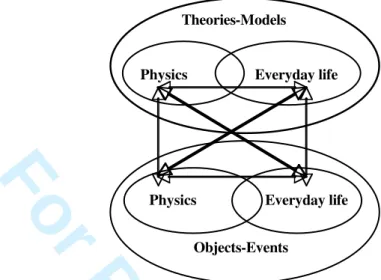
This analysis leads us to group the four components into two sets: one, the world of objects and events, including observations and measurements which, due to the physics teaching level, can be done directly; and two, the world of theories and models which involve theoretical statements and modelling components, including treatments of measurements and/or of selected events.
At the beginning of our work on transposition of modelling, we wanted as researchers to make a distinction between theory and model. However, the teachers working with us in the design thought that it would be too difficult for the students and even for the teachers who do not participate in the design; then we rapidly chose the two worlds (Figure 3).
3 4 5 6 7 8 9 10 11 12 13 14 15 16 17 18 19 20 21 22 23 24 25 26 27 28 29 30 31 32 33 34 35 36 37 38 39 40 41 42 43 44 45 46 47 48 49 50 51 52 53 54 55 56 57 58 59 60
For Peer Review Only
The world “theories and models” includes theory and modelling elements, allowing us to relate theory to the observed and selected event or measurement readings as in the example presented in Figure 4. The world “objects and events” includes the material (inanimate) world and the observation and description of objects and events including measurement readings.
The two worlds of everyday knowledge
Our analysis of everyday knowledge allows us to structure this knowledge in two similar sets to match with physics modelling in order to better understand the distance between the physics to be taught and everyday knowledge. We consider that in everyday life, explanations or interpretations of material situations are guided by ideas with some general common approach like categorisation and causality and more local theories associated to specific sets of situations such as the well-known student conceptions in mechanics; for example, considering a force (like power) to be necessary to a motion (Viennot, 1996), a conception which is related to causality, whereas another conception that “the Earth is flat” is related to categorisation. We therefore lay down the hypothesis that, in everyday life, there is also a modelling activity of the material world. This means that when a person or group explains or interprets the material world or makes a prediction, a modelling activity is involved (Tiberghien, 2000). This hypothesis can be related to mental models in cognitive activity whatever the type of knowledge involved (Gentner & Stevens, 1983). Clement and his colleagues have widely developed this perspective in science teaching (see the recent publication: 2008). In our theoretical framework we emphasize that modelling activity involves explanatory ideas that we associate with a theoretical level on the one hand and with observation, perception and possible measurement (such as ambient temperature) of objects and events on the other hand. This leads us to a similar structure to that involved in physics knowledge at school. This similarity of structure should not hide the fact that in everyday knowledge the relations between explanatory ideas (equivalent to physics theory) and objects
3 4 5 6 7 8 9 10 11 12 13 14 15 16 17 18 19 20 21 22 23 24 25 26 27 28 29 30 31 32 33 34 35 36 37 38 39 40 41 42 43 44 45 46 47 48 49 50 51 52 53 54 55 56 57 58 59 60
For Peer Review Only
and events are almost straightforward. There is therefore a huge difference between everyday and physics knowledge.
In conclusion, we obtain a double categorization of knowledge: everyday and physics knowledge, and for each of these categories, theories/models and descriptions/observations in terms of objects and events of a material situation are distinguished (Figure 5); obviously an element of knowledge belongs to a given category depending on the context of use. In particular, a notion like “action” (used in the text of Figure 4) is firstly a concept of the teaching sequence because the students have to conceptualize the contact between two objects as the idea that an object acts upon another, called “action”. Then secondly, when the students are familiar with this “view” of material situations, the notion of action can be considered as describing a type of fact.
We are well aware that the words ‘theory’ and ‘model’ are used in relation to everyday knowledge with a broader meaning than in physics.
[Insert figure 5 about here]
In Figure 5, six bidirectional arrows show the multiple relations between the different types of knowledge that can be used for designing teaching sequences. Students can establish relationships between their everyday descriptions of objects/events and theoretical elements of physics knowledge that have been learnt. Students can also identify relationships between their everyday theories about the behaviour of the material world and some elements of the physics theory that are presented during teaching sessions. This specific theory of the ‘Two Worlds’ is further developed with our specific choices on learning (next paragraph).
3 4 5 6 7 8 9 10 11 12 13 14 15 16 17 18 19 20 21 22 23 24 25 26 27 28 29 30 31 32 33 34 35 36 37 38 39 40 41 42 43 44 45 46 47 48 49 50 51 52 53 54 55 56 57 58 59 60
For Peer Review Only
In the cases of school-taught physics or everyday life, relying on modelling to analyse different types of knowledge processing is a theoretical choice which entails methodological consequences. It leads the researcher to separate knowledge into two main categories: theories and models on the one hand and objects and events on the other hand.
Learning: grand theory and specific choices
Socio-constructivism has been chosen as the grand theory (Vygotski 1934/1997) (Figure 1b). Starting from socio-constructivism, we have emphasized the dynamics between the two inter- and intra-psychological plans:
“Any function in the child’s cultural development appears twice, or on two planes. First it appears on the social plane, and then on the psychological plane. First it appears between people as an inter-psychological category, and then within the child as an intra-psychological category” (Vygotsky cited by Wertsch (1985) p. 60).
For us the classroom allows students to construct meaning on a social plane where the cultural development can take place. The students’ cultural development is favoured by the mediation of language and other people, particularly the teacher and other students.
The proximal development distance is another aspect of the Vygotskian theory that we have emphasized. This aspect can also be related to Piagetian constructivism, on which many studies of student conceptions have been based.
Our position on learning has been reinforced with a series of research studies in science and mathematics education. We have focused on studies relating to students’ learning in the classroom during a teaching sequence. These studies deal with the individual student’s learning pathway (Psillos & Kariotogou, 1999, Küçuközer, 2000, 2005; Givry, 2003; Givry and Roth, 2006). From these results, we deduce that this pathway follows neither a rational decomposition of disciplinary knowledge nor the order of introduction of taught knowledge in
3 4 5 6 7 8 9 10 11 12 13 14 15 16 17 18 19 20 21 22 23 24 25 26 27 28 29 30 31 32 33 34 35 36 37 38 39 40 41 42 43 44 45 46 47 48 49 50 51 52 53 54 55 56 57 58 59 60
For Peer Review Only
the classroom. The pathway towards understanding the relationships between concepts does not necessarily start by understanding each concept; the learner’s construction of his/her own understanding may involve simultaneously this relationship and each one of its terms. Moreover, most of the time students, at the end of the teaching sequence, construct intermediary knowledge between initial and target knowledge.
Insert figure 6 about here
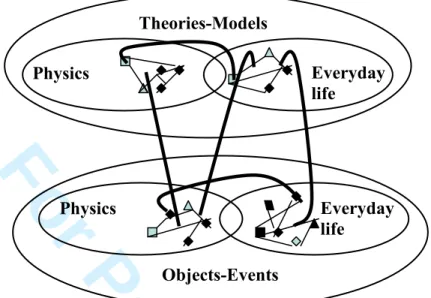
The students’ construction of knowledge during a teaching sequence can be well interpreted if the analysis of the classroom and students’ discourse is done at several granularities of knowledge, including a micro level (Tiberghien and Malkoun, 2007). As illustrated in Figure 6, learning can consist of relating an element of knowledge involved in the taught knowledge to a set of elements of knowledge already acquired, that is not necessarily the set in which this
element has been inserted in the taught knowledge. Therefore the meaning of an element of
knowledge constructed by a student can be different from that in the taught knowledge. We set down the following position on learning: constructing the understanding of a concept or notion requires establishing new relations between elements of knowledge; these elements can
be “small”. The relations constructed by students between small elements of knowledge can be different from those involved in the taught knowledge and students can therefore acquire
elements of the taught knowledge without an overall conceptual understanding.
This position on knowledge is compatible with several grand theories and particularly with our choice of socio-constructivism. It only supposes the importance of prior knowledge. It also, but more implicitly, supposes the importance of the situation in which the knowledge is introduced because the learner constructs relations between a new element of knowledge and his/her prior elements of knowledge according to his/her overall understanding of the
3 4 5 6 7 8 9 10 11 12 13 14 15 16 17 18 19 20 21 22 23 24 25 26 27 28 29 30 31 32 33 34 35 36 37 38 39 40 41 42 43 44 45 46 47 48 49 50 51 52 53 54 55 56 57 58 59 60
For Peer Review Only
situation. Consequently, a teaching sequence should give students the opportunity to “tune” their understanding of a new element of knowledge better, owing to the possibility of re-using it in successive classroom activities. This position emphasizes the role of small elements of knowledge, even if they are included in a general approach like when a teacher introduces new laws or experiments. This position therefore has consequences because it becomes necessary when designing teaching sequences to pay particular attention at the fine level of knowledge granularity.
Teaching: theories of didactical situations and joint actions
The French theory of didactical situations (Brousseau, 1998) considers the classroom as a system which is characterized by several concepts. This theory has been further developed by Mercier, Schubauer-Leoni & Sensevy (2002) and Sensevy (2007). In this theory the
classroom is viewed as a community of practice involving two simultaneous actions: teaching and learning. Therefore in a classroom the teacher and the students co-construct the taught
knowledge; they act together.
We will limit ourselves to the two main concepts of this theory that we have used in our framework.
Chronogenesis accounts for the evolution of knowledge during teaching. In the classroom
perspective, this evolution takes place over an academic year. Let us note that chronogenesis can also be used to study the evolution of the curriculum for a given discipline such as physics along the whole schooling process. Chronogenesis is not limited to a particular time scale.
The didactical contract introduced by Brousseau (1998) meets with the reciprocal expectations that the teacher and the students may have. It forms a system of norms, some of which are generic and will be lasting, and others are specific to elements of knowledge and
3 4 5 6 7 8 9 10 11 12 13 14 15 16 17 18 19 20 21 22 23 24 25 26 27 28 29 30 31 32 33 34 35 36 37 38 39 40 41 42 43 44 45 46 47 48 49 50 51 52 53 54 55 56 57 58 59 60
For Peer Review Only
need to be redefined with the introduction of new elements. For example, after the teacher has introduced the concept of force, his/her expectations of the students’ interpretations of material situations will be different from before.
The concept of didactical contract is close to what Cobb et al. (in press) call normative identity:
“The two central constructs of the analytic approach that we propose are the normative identity as a doer of mathematics that is established in the classroom, and
the personal identities that individual students develop as they participate in classroom activities. […].” (Cobb, in press) (our italics).
As in the concept of didactical contract, normative identity refers to class phenomena, whereas personal identity refers to an individual in a community.
In this study we have not developed a specific theory for teaching itself but we have made a clear choice which we draw directly from the concept of didactical contract and which deals with classroom management and the role played by students’ proposals. These proposals, whether or not they are right, are considered as potentially relevant and can be publicly presented and debated in classrooms. This means that the teacher expects answers and justifications for answers from the students and that the students expect to be understood. The teaching activities should therefore allow teachers to let students make their own proposals, write and debate them, and compare them with the physics proposals. Students will then be able to take responsibility for constructing new elements of knowledge. Later on, these elements will have to be institutionalized by the teacher.
Other aspects of teaching design are still a kind of craft knowledge. In the case of our design, we consider the teacher’s role as threefold: a mediator, a person in charge of maintaining the
3 4 5 6 7 8 9 10 11 12 13 14 15 16 17 18 19 20 21 22 23 24 25 26 27 28 29 30 31 32 33 34 35 36 37 38 39 40 41 42 43 44 45 46 47 48 49 50 51 52 53 54 55 56 57 58 59 60
For Peer Review Only
scientific story and, thirdly, a guide for the development of classroom discussion (Dumas-Carré & Weil-Barais, 1998; Mortimer &Scott, 2000; Leach & Scott, 2002).
In conclusion, our theoretical framework is particularly developed on the knowledge aspects; relations between learning knowledge and teaching knowledge. It is less developed in relations between learning and teaching, and in particular on aspects dealing with classroom management.
We will now deal with the second question concerning how this theoretical framework may guide the design of a teaching sequence. As we have already mentioned, we will present this guidance in the case of a teaching sequence in mechanics (grade 10). This sequence has been designed using the specific theory of the Two Worlds; however, there has been a strong interaction between designing it and making this theory explicit. Before presenting how the specific theory guides the design, we introduce the social context of this design.
Context of the research development of the sequence in mechanics
Our research team (ICAR, COAST group) has been working on research development projects for over ten years. These projects have been carried out by groups of one or two researchers with four to six teachers working together to construct teaching sequences based on the official curriculum. A series of sequences on different topics and at several levels (grades 10, 11, 12, and recently 7, 8) have been developed (Gaidioz & Tiberghien, 2003; Gaidioz, Vince & Tiberghien, 2004; Le Maréchal et al., 2004a; Le Maréchal, Perrey, Roux, Jean-Marie, 2004b). More specifically, each sequence is designed by a group of researchers and teachers who have met regularly over two or three academic years (weekly or twice a month). Each group participated in creating the sequence and in the first year, each of the designed activities was tested by some of the teachers in the group; then in the second year the teachers of the group used the whole sequence and discussed it during meetings in order to
3 4 5 6 7 8 9 10 11 12 13 14 15 16 17 18 19 20 21 22 23 24 25 26 27 28 29 30 31 32 33 34 35 36 37 38 39 40 41 42 43 44 45 46 47 48 49 50 51 52 53 54 55 56 57 58 59 60
For Peer Review Only
modify either a given activity or the order of activities or even the structure of the sequence itself. For some sequences, a PhD student contributed.
We recall that our design activity began with the aim of proposing teaching resources to improve science teaching, particularly to improve students’ physics understanding. Our aim was not to test a theory; the theory has emerged from this design activity in interaction with research activity. Therefore testing the teaching resources did not consist of testing a theory and was carried out in complex ways including two main stages. The first stage, called the ‘local impact evaluation phase’ by Bannan-Ritland & Baeck (2008), is characterized by iterative refinement processes. The second stage consists of evaluating the impact of a teaching sequence on students’ acquisitions. This last stage can only be carried out when the sequence is finalised and used by teachers who did not participate in its design. We do not develop this stage in the present paper; that would necessitate another study. In particular, this evaluation implies a change of scale from a few classes to a larger number of classes. We just mention that, for some of the sequences, questionnaires were given out before and after the sequence in several classes that used the sequence and in a similar number of “ordinary” classes (Tiberghien & Malkoun, 2007).
The first stage involved two aspects related to teaching and learning, particularly at the level
of an activity (or task). The first aspect was focused on the usability and relevance of the teaching resources for the teachers in the classroom; it was central when a group of designers
was creating the initial design of the activities to be given to the students in the class. The teachers participating in the group tested the activities in their classrooms, and their feedback played a major role in the improvements. The second aspect concerned the validity of the teaching resources for students’ learning. It involved the research studies investigating students’ learning in the classroom when the teachers taught these designed activities; it also played a major role in the refinement process. These studies used video data of the classroom.
3 4 5 6 7 8 9 10 11 12 13 14 15 16 17 18 19 20 21 22 23 24 25 26 27 28 29 30 31 32 33 34 35 36 37 38 39 40 41 42 43 44 45 46 47 48 49 50 51 52 53 54 55 56 57 58 59 60
For Peer Review Only
For video recording of the classroom, the same two students were in the field of one camera (most of the time two cameras were used in the class; one on a group of students and a part of the class and the other on the teacher and a part of the class or on another group of students). The focus of these research studies was not only the students’ understanding of the activities but also the way students were involved in them or, in other words, how these activities allow
students to be autonomous and to take the responsibility of knowledge to carry them out. The
overall research question of the studies was to better understand the students’ learning pathway in relation with teaching. With this orientation, the research results for each designed activity were at a fine granularity level. Even if these studies used a case study methodology and then observed a small number of students, they made in-depth analyses of the role of each activity: the way the statement was formulated, the role of key words, the role of the chosen experiments, etc. These analyses are particularly rich for the design of each activity that is focused on the students’ and teachers’ possible actions during teaching. Let us note that the relevance of the research studies is all the more important given that the teachers who participated in the group and who tested the designed activities in their own classes cannot analyse such data. Therefore the teachers’ experience in the classroom and the researchers’
analyses were complementary, providing feedback on the implementation in class. Moreover,
the researchers, who were in the classrooms, also contributed by giving feedback on these implementations. During the two or three years after this first phase of elaboration, when the researchers analysed all the data during the whole teaching sequence, the feedback was focused on the students’ main difficulties of conceptual understanding, the chronology of the new elements of knowledge introduced in the sequence in relation with the possible learning pathways. The teachers who are more familiar with the sequence also give feedback on difficulties in carrying out specific activities in terms of classroom organization, material constraints or on how to take into account students’ ideas in the classroom debates. This
3 4 5 6 7 8 9 10 11 12 13 14 15 16 17 18 19 20 21 22 23 24 25 26 27 28 29 30 31 32 33 34 35 36 37 38 39 40 41 42 43 44 45 46 47 48 49 50 51 52 53 54 55 56 57 58 59 60
For Peer Review Only
improvement process can range over several years and is typical of design activity (Lijnse, 2000; Viennot & Raison, 1999). Let us note that this process is particularly in line with the use of digital dissemination (website) allowing modifications.
More specifically, the SESAMES sequence2 on mechanics, grade 10, discussed in this paper has been involved in different research studies. Küçüközer (2000) first studied students’ understanding during teaching as they were students working in small groups and the teacher was a member of the design group. The other studies have dealt with diagnostic evaluation (Coulaud, 2005), the evolution of taught knowledge in two classrooms, one using the SESAMES mechanics teaching sequence and the other using a sequence created by the teacher (both following the official curriculum) (Malkoun, 2007), an evaluation of the mechanics teaching sequences by means of questionnaires before and after teaching in 20 classes (Malkoun, Vince & Tiberghien, 2007) and, lastly, a study of how a teacher who did not take part in a research development group used the designed sequence for the first time (Jeannin, 2006).
These resources were made available on the official educational website of our area (http://www2.ac-lyon.fr/enseigne/physique/sesames/). A website for teachers called PEGASE (http://pegase.inrp.fr) was also created. These groups of secondary teachers and researchers have been in charge of in-service teachers’ professional development for several days every year.
2
From the very beginning, the research development projects have had several names; the current name SESAMES has been used for six years, so we will refer to the mechanics teaching sequence as a SESAMES sequence.
3 4 5 6 7 8 9 10 11 12 13 14 15 16 17 18 19 20 21 22 23 24 25 26 27 28 29 30 31 32 33 34 35 36 37 38 39 40 41 42 43 44 45 46 47 48 49 50 51 52 53 54 55 56 57 58 59 60
For Peer Review Only
How do specific theories and choices guide the design of teaching content?
We have presented the structure and content of our theoretical framework; the grand theories, the Two-World specific theory, and the specific choices dealing with knowledge, learning and teaching. Now we will introduce the way in which the design has been carried out. To do this we have constructed two complementary tools. The Knowledge Distance tool guides the framing and sequencing of the teaching content, while the Modelling Relations tool guides the design of specific teaching activities with a finer grain size. Moreover, the need to describe each activity and to involve several representations led us to use research results in the field of multiple representations. Among others, a French researcher (Duval, 1995) has developed a theory on “semiotic registers and intellectual learning”. Our tool called “semiotic registers” derives from this theory and is also compatible with others. The tool deals with semiotics and has been called “semiotic registers”.
The design tool: knowledge distance
The tool called “knowledge distance” makes explicit the difference between the knowledge to be taught and students’ knowledge as analysed in terms of modelling (Buty, Tiberghien, & Le Maréchal, 2004). It comes from the Two-World theory and from the grand theory on learning concerning the zone of proximal development.
[Insert table 1 about here]
This tool (Table 1) combines the analyses of students’ prior knowledge (everyday and school physics knowledge) and of the knowledge to be taught in terms of modelling. It is well adapted to a granularity of knowledge elements like a notion or concept. We present it in the case of action and force.
3 4 5 6 7 8 9 10 11 12 13 14 15 16 17 18 19 20 21 22 23 24 25 26 27 28 29 30 31 32 33 34 35 36 37 38 39 40 41 42 43 44 45 46 47 48 49 50 51 52 53 54 55 56 57 58 59 60
For Peer Review Only
The first column refers to the two worlds and their relations; the second and third columns lead the designers to make their hypotheses on the students’ everyday knowledge as well as the already acquired physics knowledge explicit. In the last column, the designers should specify what the students have to learn. In all cases the theoretical components of knowledge and the knowledge related to observation of the material world are differentiated. In the teaching sequence in mechanics, the choice of introducing action and a model of interactions with symbolic representations aims to help students dissociate the overall relationships, particularly the idea that force (like power) is a necessary cause for a motion, called “causality-force”, and the idea that associates force and motion, called “force-motion”.
The design tool: Modelling relations
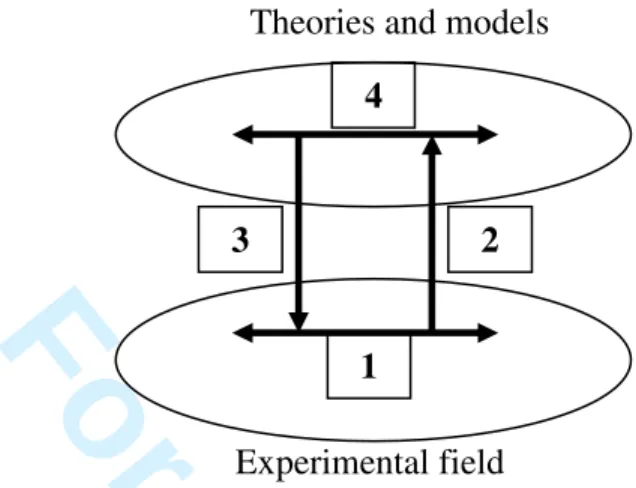
The second tool makes explicit the kinds of relationships that this teaching should lead students to establish. Figure 7 summarises four different kinds of relations between the worlds of theories and models, and objects and events:
1. Relations between objects and events
2. Relations from objects and events to theories and models 3. Relations from theories and models to objects and events 4. Relations between theories and models
According to the specific Two Worlds theory, the designers conceive teaching activities for which students have to construct relationships of types 1, 2 and 3 (in two directions between theoretical elements and objects or events), and 4 (Figure 7).
[Insert about here figure 7]
3 4 5 6 7 8 9 10 11 12 13 14 15 16 17 18 19 20 21 22 23 24 25 26 27 28 29 30 31 32 33 34 35 36 37 38 39 40 41 42 43 44 45 46 47 48 49 50 51 52 53 54 55 56 57 58 59 60
For Peer Review Only
The necessity of differentiating theory/models and objects/events led the designers, for each main part of a teaching sequence, to make explicit the theoretical elements and the associated modelling actions with a text. In the case of the mechanics sequence, two examples are given in Figures 4 and 8. This text, called a “model” in the teaching practice, is given to each student and constitutes a common reference for the class. It allows the teacher to depersonalize physics knowledge by using the text as a reference when evaluating students’ proposals. The text also helps the teacher to give responsibility to students to evaluate a variety of proposals with reference to physics theory. The text is used by the students for several activities or exercises; this allows students to construct a more relevant understanding of the elements of knowledge involved in the text to the extent that they have more opportunities to establish relations between them and with other elements of the situation. This last consideration is related to the learning choices included in the specific Two Worlds theory.
[Insert about here figure 8]
The model can be introduced either before the activity, at a specific point during the activity or as a conclusion to the activity; in the latter case, it is involved in the following activity.
The design tool: semiotic registers
Another way of analysing knowledge is semiotics. The written description of the experimental field and theory in physics and chemistry invariably involves a variety of what Duval (1995) calls semiotic registers: natural language, vector register, algebraic register, drawings and pictures. Duval (1995) stated that different semiotic registers associated with a concept should be used and related to construct its meaning. Figure 8 gives an example of
3 4 5 6 7 8 9 10 11 12 13 14 15 16 17 18 19 20 21 22 23 24 25 26 27 28 29 30 31 32 33 34 35 36 37 38 39 40 41 42 43 44 45 46 47 48 49 50 51 52 53 54 55 56 57 58 59 60
For Peer Review Only
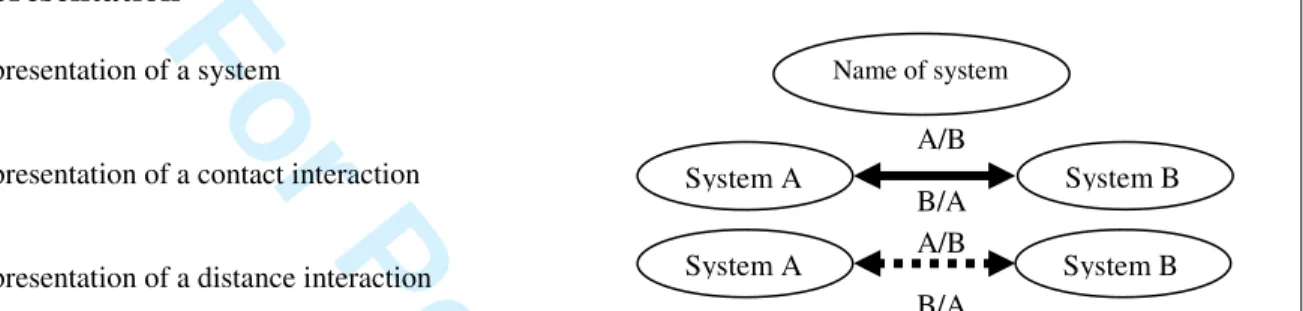
these registers: natural language, a diagram (two ellipses and the arrow) representing interaction, and the vectors representing forces in a specific case of interactions between two objects. The role of natural language is essential; it has to be used in the passage between different semiotic registers, such as from schemas to the vectors.
Designing the teaching sequence
A teaching sequence involves several components, in particular its structure, the didactical organisation, each activity, and the comments for teachers. In this section, we have presented the design process in the case of a teaching sequence on mechanics (grade 10) called a “SESAMES sequence” and we have introduced wider teaching resources for teachers based on our specific Two Worlds theory, choices and tools (Figure 1b).
Didactical organisation
As shown in Table 2, a major difference between this SESAMES sequence and usual physics teaching is that there is no lecturing to introduce and structure knowledge. New knowledge is introduced through activities that students have to carry out in small groups. For each activity, there is a statement (often a written sheet) and, for some of them, the students are given a model as presented above (examples in Figures 4 and 8). Then, after working in small groups, there is a crucial phase involving classroom discussion about the students’ procedures and solutions; during or at the end of this phase, the teacher states the relevant physics knowledge and institutionalises it. This design is related to our specific choice on the didactical contract. This comparison with the current practice is essential in the French context in that it is the practice used by the majority of teachers. Our practice must therefore be explained in comparison to the current one, to enable teachers to understand it. Let us note that our choice is related to the socio-constructivist grand theory.
3 4 5 6 7 8 9 10 11 12 13 14 15 16 17 18 19 20 21 22 23 24 25 26 27 28 29 30 31 32 33 34 35 36 37 38 39 40 41 42 43 44 45 46 47 48 49 50 51 52 53 54 55 56 57 58 59 60
For Peer Review Only
[Insert about here Table 2]
Structure of the teaching sequence
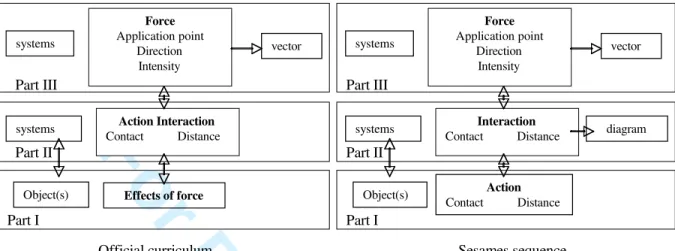
The Two-World specific theory guides the design process of the sequence due to the necessity of differentiating between theoretical elements and objects or events. In the case of the mechanics teaching sequence, this guidance appears when compared with the structure of the official curriculum (Figure 9). The difference is shown in the first rectangles at the bottom (Part I, figure 9).
The official programme introduces force through its effect. It implies that, having a twofold status, force belongs to the world of objects and events since it has observable effects and at the same time it begins to be a physics concept. In the research-based design activity, the distinction between the two worlds has led the designers to introduce the notion of action as a description of what is happening between material objects at the level of objects and events.
[Insert about here Figure 9]
In the second part (II) of both cases, the concept of interaction was introduced and then the concept of force. However, in the SESAMES sequence, an intermediate model of interaction is explicitly introduced (part II) before introducing force. This intermediate model was added to avoid introducing the effects of force as proposed in the official curriculum. The main event related to the concept of force is the action between objects, even if they are motionless. When two objects A and B are in contact, there is an action of A on B and of B on A. Then, as previous research studies suggested (Guillaud, 1998), the event of action is introduced; this is the aim of the intermediary model.This model includes a symbolic representation (diagram in
3 4 5 6 7 8 9 10 11 12 13 14 15 16 17 18 19 20 21 22 23 24 25 26 27 28 29 30 31 32 33 34 35 36 37 38 39 40 41 42 43 44 45 46 47 48 49 50 51 52 53 54 55 56 57 58 59 60
For Peer Review Only
Figure 8). Then two elements of knowledge: action between objects (event) and force exerted by a system on another system (model of this event) are clearly distinguished (see Table 1). For the second part of dynamics concerning Newton’s laws, the specificity of the SESAMES sequence is shown in the way laws are formulated, as they include four logical implications between compensation (or not) of forces and the type of motion. For example: “If there is motionless or constant velocity then forces compensate each other” and “If forces compensate each other then there is motionless constant velocity”. The development in four logical implications is related to our learning choice that students’ understanding can be made easier if elements of knowledge are small. There are two other statements related to change of motion and force. Let us note that according to the official curriculum, acceleration is not introduced and force is related to the velocity change.
Type of activities according to the Two-World specific theory
As presented before, the case-based research studies give an in-depth analysis for each teaching activity of a group of two students and of the classroom work during correction. The group was analysed during the whole teaching sequence; each activity is not analysed in an isolated way. Furthermore, in the whole class, when the teacher asks the students to present their solution and leads a debate, the students’ work and arguments of the observed students are compared to others. The analyses of the two students are therefore situated in the whole class. Moreover, these analyses are proposed to the teachers of the group who can compare them to what happens in their own classes. These results have allowed the researchers to
better understand the potential of the activity on two main points: (1) to help students use the
elements of knowledge and reasoning that the activity intended them to use, and (2) to allow the whole class to co-construct the new elements of knowledge that the activity is supposed to introduce. Such case studies have only allowed basic hypotheses, but they offer the advantage
3 4 5 6 7 8 9 10 11 12 13 14 15 16 17 18 19 20 21 22 23 24 25 26 27 28 29 30 31 32 33 34 35 36 37 38 39 40 41 42 43 44 45 46 47 48 49 50 51 52 53 54 55 56 57 58 59 60
For Peer Review Only
of providing detailed information on the potential of most of the activities that have been designed.
In the following, we will illustrate the relationships (Figure 7) by teaching activities. Relationships 2 and 3 are often both involved in the activities. Most of the time an activity has too large a granularity of knowledge to involve only one of them. This is why we present two activities, one illustrating mainly type 2 relationships and the other illustrating mainy the relationship between the theory/model and the objects/events (types 2 and 3).
Activity about relationships at the objects and events level (type 1)
This type of activity is not common in ordinary teaching at upper secondary level. Most of the time, teachers consider that such activities are too easy for the students.
Designed teaching activity
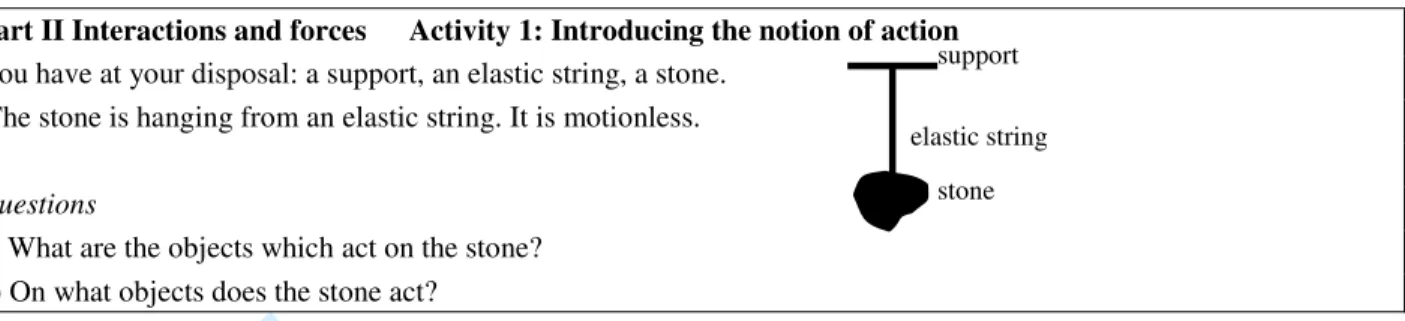
This modelling approach has led the designers to consider that students have to learn how to describe material situations in terms of objects and events in a way which is relevant to physics, since this description is different from descriptions made spontaneously by the students. Particularly in mechanics, motionless situations are described in different terms in everyday life and in physics. Since there is no observable change, interpretation of the motionless situation in everyday life is not interesting. In physics, motionless has to be interpreted in the framework of laws in which motionless and rectilinear motion are similar depending on the frame of reference. As we introduced before, the designers therefore decided to teach how to describe motionless situations with the word ‘action’ and its associated verb ‘to act’ (Guillaud, 1998, Küçüközer, 2000). In such a description, these words have a different meaning from the one they have in everyday situations where they imply a change. This activity given in Figure 10 is in part II of the SESAMES sequence (Figure 9).
3 4 5 6 7 8 9 10 11 12 13 14 15 16 17 18 19 20 21 22 23 24 25 26 27 28 29 30 31 32 33 34 35 36 37 38 39 40 41 42 43 44 45 46 47 48 49 50 51 52 53 54 55 56 57 58 59 60
For Peer Review Only
In this activity the students are more or less guided to use the verb "to act". This should lead them to conceptualize the situation in terms of action. As we have already mentioned, at this stage, action is a conceptual construction for students, whereas later on, in the sequence and in physics, it will be at the level of objects and events.
Let us note that the choice of an ordinary object like a stone, and not of an object from a physics laboratory like a “weight” used in a Roberval scale, and the choice of the verb “to act” are at a fine level of granularity of knowledge.
[Insert about here Figure 10]
Example of students’ work in class
As mentioned above, a research study was carried out in a classroom during the design of the sequence, the teacher being a member of the design group. This case study was aimed at studying how the students’ understanding evolves during the teaching sequence (Küçüközer, 2000).
Regarding the students’ use and understanding of the verb ‘to act’, different analyses carried out in several classrooms have shown that students tried to use this verb and associate it with a thought experiment; for example, if we cut the elastic string, the stone will fall so the string supports the stone, or they might say sentences like “the earth pushes the stone downwards”. This type of activity helps students to associate ‘to act’ with potential changes and to use it to describe motionless situations even though nothing happens in the situation (which is an important step in learning). This language of description of the material world belongs to physics knowledge. 3 4 5 6 7 8 9 10 11 12 13 14 15 16 17 18 19 20 21 22 23 24 25 26 27 28 29 30 31 32 33 34 35 36 37 38 39 40 41 42 43 44 45 46 47 48 49 50 51 52 53 54 55 56 57 58 59 60