HAL Id: tel-01488971
https://tel.archives-ouvertes.fr/tel-01488971
Submitted on 14 Mar 2017HAL is a multi-disciplinary open access archive for the deposit and dissemination of sci-entific research documents, whether they are pub-lished or not. The documents may come from teaching and research institutions in France or abroad, or from public or private research centers.
L’archive ouverte pluridisciplinaire HAL, est destinée au dépôt et à la diffusion de documents scientifiques de niveau recherche, publiés ou non, émanant des établissements d’enseignement et de recherche français ou étrangers, des laboratoires publics ou privés.
Evaluation of conservation efficiency for gorgonian
species at a regional scale based on an existing Marine
Protected Area network and modeling scenarios
accounting for hydrodynamical connectivity
Mariana Padron
To cite this version:
Mariana Padron. Evaluation of conservation efficiency for gorgonian species at a regional scale based on an existing Marine Protected Area network and modeling scenarios accounting for hydrodynamical connectivity. Oceanography. Université Pierre et Marie Curie - Paris VI; Università degli studi (Bologne, Italie). Dipartimento di scienze della terra e geologico-ambientali, 2015. English. �NNT : 2015PA066652�. �tel-01488971�
Université Pierre et Marie Curie
Università di Bologna
Ecole doctorale des Sciences de l’Environnement d’Ille de France
Laboratoire d’Ecogéochimie des Environnements BenthiquesEvaluation of conservation efficiency for gorgonian species
at a regional scale based on an existing Marine Protected
Area network and modeling scenarios accounting for
hydrodynamical connectivity
Par Mariana Padrón
Thèse pour l’obtention du grade de docteur en océanographie biologique
Dirigée par:
Katell GUIZIEN, CNRS, UMR 8222 UPMC LECOB
Marco ABBIATI, UB, Dipartimento di Scienze Biologiche, Geologiche ed Ambientali (BiGeA).
Présenté et soutenue publiquement le 24 Novembre 2015
Devant un jury compose de (par ordre alphabétique):
Marco ABBIATI Professeur, UB Co-‐‑directeur Didier AURELLE Maître de conferences, HDR Rapporteur
Lorenzo BRAMANTI Chercheur contractuel Responsible scientifique Federica COSTANTINI Maître de conferences, UB Examinatrice
Katell GUIZIEN Chargé de recherches, CNRS Directrice Claire PARIS Professeur, University of Miami Rapporteur Eric THIEBAUT Professeur, UPMC Président
WHEN I heard the learn’d astronomer, When the proofs, the figures, were ranged in columns before me, When I was shown the charts and the diagrams, to ad, divide,
and measure them, When I, sitting, heard the astronomer, where he lectured
with much applause in the lecture room, How soon, unaccountable, I became tired and sick, Till rising and gliding out, I wander’d off by myself, In the mystical moist night-‐‑air, and from time to time, Look’d up in perfect silence at the stars. Walt Whitman Leaves of Grass
that has, in any way, helped you or accompanied you in the process of achieving a goal in life. There are so many faces in the recollection of memories…so many people to thank.
I guess I will start by commemorating the past. After all, I wouldn’t be here writing these pages if it wasn’t for all of the choices I made and, of course, the big contribution of serendipity that lead me to this point in my life. I thank you all, the good and the not so good moments and all of the people that, most likely without knowing it, have helped me gain experience both personally and professionally.
To my sweet and wonderful Matt, thank you so much for following me in this journey! I’m so grateful for all the joy, the laughs and unconditional support. All this work and stress were only bearable thanks to your amazing patience and love.
A mis papas, que aún desde la distancia consiguen envolverme de magia y hacerme sentir segura y confiada como cuando era niña. Gracias por ese apoyo inquebrantable ante mi decision de salir a aventurar por el mundo, y por alimentar mi argentinito en los momentos de dudas.
To my supervisors, I honestly couldn’t have asked for better guidance and support. You have showed me a great deal of determination and strength. I feel very fortunate for having the opportunity to have worked and learned from you. Thank you for taking me in, I will consider you life-‐‑long colleagues and friends. To the French team (Katell and Lorenzo), thanks for the freedom to develop my own ideas, and the bossing around when I needed some pressure. That balance kept me motivated, and it is a rare quality to find in an advisor. I particularly appreciate our long discussions about science and life. Your enthusiasm for what you do is truly inspiring. To the Italian team (Marco and Federica), I couldn’t be more grateful for the support and trust that you put in me. You made me feel so welcome in your lab! Thanks for the guidance and the lab meetings that allow me to interact and learn more about what you do.
To my friends from Banyuls, Italy, MARES, Venezuela and San Francisco, enjoying work would have been much more difficult if you didn’t take the time to have a pause café, a drink, send a message or a Skype call with me. Thank you! You are way too many to make a list, and I don’t trust my memory with such a task anyway so, you know who you are! I’m sure I have let you know by now. Thanks for listening when I needed to vent, for telling me to shut up when I complained for no reason, for the laughs, the tears, the swimming, the dancing… And thank you Banyuls for the summer!!!
Connectivity is expected to strongly influence the dynamics and persistence of marine populations. Studying the development and maintenance of connectivity patterns among marine populations is, thus, essential for spatial planning and the proper design and management of Marine Protected Areas (MPAs). However, understanding the complex processes driving marine population connectivity requires the use of tools that integrate bio-‐‑physical models with information regarding the demographic and genetic linkages resulting from the larval exchange among populations. Therefore, the aim of this PhD dissertation is to evaluate the patterns of genetic connectivity among gorgonian populations at a regional scale, and disentangle the processes that shape the observed connectivity by using model simulations accounting for hydrological, demographic and genetic connectivity. The first chapter presents a spatially explicit metapopulation model that, using stochastic connectivity matrices, assesses the effect of demography on allele frequencies in a marine metapopulation of sessile benthic species. The model is then used to evaluate the effect of demographic traits and connectivity structure on the genetic diversity of a marine metapopulation. The second chapter examines the patterns of genetic connectivity of two common and widely distributed gorgonian species at a regional scale: Paramuricea clavata in the Ligurian Sea, and Eunicella singularis in the Gulf of Lions. Both species exhibit strong patterns of genetic structure at a regional scale, although the dispersal capacity of each species does not seem limited (>100 m). The third chapter discerns among the potential processes shaping the realized connectivity of E. singularis in the Gulf of Lions by applying the model presented in Chapter 1, and comparing the modeled patterns of genetic structure to the results obtained from empirical genetic data in Chapter 2. Modeled and empirical results show similar patterns of genetic structure among populations of E. singularis in the region. Genetic and demographic differentiation among populations is demonstrated to result from the spatial structure of dispersal alone. The ability to evaluate the expected development of genetic structure among populations under different demographic and hydrological scenarios using the seascape model presented in Chapter 1 provides a useful tool with relevance for marine spatial planning and the persistence of marine populations.
Keywords: connectivity, marine metapopulation, population genetics, genetic structure,
spatially-‐‑explicit model, seascape genetics, gorgonians, demography, larval dispersal, Gulf of Lions, Ligurian Sea, Paramuricea clavata, Eunicella singularis, Marine Protected Areas, marine spatial planning.
La connectivité est supposée influencer fortement la dynamique et la pérennité des populations d’organismes marins. Ainsi, étudier l’évolution et le maintien des patrons de connectivité au sein des populations marines semble essentiel pour la planification spatiale, la création et la gestion des Aires Marines Protégées (AMP). Cependant, comprendre la complexité des processus régissant la connectivité entre les populations marines nécessite l’utilisation d’outils, qui associent des modèles biophysiques et des informations caractérisant les relations entre démographie et génétique, résultant des échanges larvaires entre les populations. L’objectif de cette thèse de doctorat est donc, d’évaluer les patrons de connectivité génétique au sein des populations de gorgones à une échelle régionale et d'ʹexplorer les processus induisant la connectivité observée, grâce à des simulations de modèles prenant en compte les connectivités hydrologique, démographique et génétique. Le premier chapitre présente un modèle de métapopulation spatialement explicite qui, grâce à l’utilisation de matrices de connectivité stochastique, permet d’évaluer l’effet de la démographie sur la fréquence des allèles dans une métapopulation d’espèces marines benthiques sessiles. Le modèle est alors utilisé pour déterminer l’effet des traits démographiques et de la structure de connectivité sur la diversité génétique de la métapopulation. Le deuxième chapitre présente une analyse des patrons de connectivité génétique de deux espèces communes et largement répandues de gorgones, à une échelle régionale : Paramuricea clavata en mer de Ligure et Eunicella singularis dans le Golfe du Lion. Les deux espèces présentent de forts patrons de structure génétique à l’échelle régionale, bien que leur capacité de dispersion ne semble pas limitante (>100m). Le troisième chapitre vise à tester si la dispersion larvaire seule permet d'ʹexpliquer la connectivité réalisée d’E. singularis dans le Golfe du Lion, en appliquant le modèle présenté dans le Chapitre 1, et en comparant les patrons de structure génétique modélisés, aux résultats obtenus dans le Chapitre 2, par les méthodes empiriques d’analyse de données génétiques. Les patrons de structure génétique modélisés en ne prenant en compte que la structure spatiale de dispersion sont similaires à ceux observés entre les populations d’E. singularis dans cette région, suggérant le rôle prépondérant de la connectivité hydrologique dans la distribution régionale de l'ʹespèce, tant au niveau démographique que génétique. La capacité d’évaluer le développement des structures génétiques entre populations, sous différents scénarios démographiques et hydrologiques, avec le modèle de paysage sous-‐‑marin présenté dans le Chapitre 1 s'ʹavère donc un outil efficace pour la planification spatiale et la pérennité des populations marine.
Mots clés : connectivité, métapopulation marine, génétique des populations, structure génétique, modèle spatialement explicite, génétique des fonds marins, gorgones, démographie, dispersion larvaire, Golfe du Lion, Mer de Ligure, Paramuricea clavata, Eucnicella singularis, Aires Marines Protégées, planification spatiale marine.
La connettività sembra influenzare fortemente la dinamica e la persistenza delle popolazioni marine. Comprendere l’evoluzione e il mantenimento dei pattern di connettività tra le popolazioni è perciò essenziale per la pianificazione spaziale marittima e per la creazione e la gestione delle Aree Marine Protette (AMPs). Ciononostante, analizzare la complessità dei processi che guidano la connettività delle popolazioni marine richiede l’utilizzo di strumenti che integrino modelli bio-‐‑fisici con informazioni derivanti dalle relazioni tra demografia e genetica che derivano dagli scambi larvali tra le popolazioni. Lo scopo di questa tesi di dottorato è quindi quella di valutare i pattern di connettività genetica tra popolazioni di gorgonie ad una scala spaziale regionale, e di comprendere i processi che determinano la connettività osservata attraverso simulazioni di modelli che tengano conto dei pattern idrodinamici, demografici e genetici. Il Primo Capitolo presenta un modello spazialmente esplicito di metapopolazione, che, attraverso l’utilizzo di matrici stocastiche di connettività, permetta di comprendere gli effetti della demografia sulle frequenze alleliche di una metapopolazione di specie marine bentoniche sessili. Il modello è stato poi utilizzato per valutare gli effetti delle caratteristiche demografiche e della connettività sulla diversità genetica di una metapopolazione marina. Il Secondo Capitolo esamina i pattern di connettività genetica su scala regionale di due specie di gorgonie ampiamente distribuite lungo le coste del Mar Mediterraneo: Paramuricea clavata nel Mar Ligure e Eunicella singularis nel Golfo del Leone. Entrambe le specie mostrano forti pattern di strutturazione genetica su scala regionale anche se la capacità dispersiva di tali specie non sembra essere particolarmente ridotta (>100 m). Il Terzo Capitolo cerca di comprendere quali sono i processi che determinano l’effettiva connettività tra le popolazioni di E. singularis del Golfo del Leone attraverso l’utilizzo del modello presentato nel Primo Capitolo e confrontando tali risultati con quelli ottenuti nel Capitolo 2 attraverso l’utilizzo di dati genetici empirici. I pattern di struttura genetica modellizzati prendendo in considerazione solo la struttura spaziale di dispersione sono simili a quelli osservati empiricamente. Questo suggerisce che la connettivita idrodinamica debba svolgere un ruolo importante nella distribuzione regionale della specie cosi come nella sua struttura genetica e demografica. La capacità di valutare l’evoluzione della struttura genetica tra le popolazioni sotto differenti scenari demografici e idrodinamici attraverso l’utilizzo del modello presentato nel Capitolo Primo rappresenta un ottimo strumento per la pianificazione spaziale marittima e per la persistenza delle popolazioni marine.
Parole chiave: connettività, metapopolazione marina. Genetica di popolazione, struttura genetica, modello spazialmente esplicito, genetica del paesaggio marino, gorgonie, demografia. Dispersione larvale, Golfo del Leone, Mar Ligure, Paramuricea clavata, Eunicella singularis, Aree Marine Protette, pianificazione spaziale marittima.
List of Figures . . . xvii
List of Tables . . . . xix
Introduction . . . . 1
Larval dispersal and marine connectivity . . . . 4
Methods to estimate marine connectivity . . . . 8
References . . . . 14
Chapter 1: Modelling the effect of demographic traits and connectivity on the genetic structuration of marine metapopulations of sedentary benthic inver-‐‑ tebrates . . . . 19
1.1 Abstract . . . 21
1.2 Introduction . . . . 22
1.3 Methods . . . . 24
1.3.1 A seascape genetic model for benthic invertebrates with a pelagic larval phase . . . . 24
1.3.2 Test cases . . . . 28
1.3.3 Metrics and statistics . . . . 31
1.4 Results . . . . 32
1.4.1 Do differences in demographic parameters affect genetic diversity in closed populations? . . . . 32
1.4.2 Do different patterns of connectivity affect the maintenance of genetic diversity in a metapopulation . . . . 36
1.4.3 How does local population stability affect hetero-‐‑ zygosity in a metapopulation? . . . . 38
1.5 Discussion . . . . 40
1.6 Acknowledgements . . . . 45
1.7 References . . . . 46
1.8 Supplementary material . . . . 51
Chapter 2: Genetic connectivity of gorgonian species at a regional scale . . . 55
Introduction . . . . 57
2.1 Connectivity helps marine coastal populations recover from climate-‐‑induced threats . . . . 67
2.1.2 Introduction . . . . 70
2.1.3 Material and Methods . . . . 73
2.1.3.1 Sampling . . . . 73
2.1.3.2 Microsatellite genotyping . . . . 74
2.1.3.3 Genetic diversity . . . . 76
2.1.3.4 Population genetic structure . . . . 76
2.1.3.5 Migration and genetic drift . . . . 78
2.1.4 Results . . . . 79
2.1.4.1 Genetic diversity . . . . 79
2.1.4.2 Population genetic structure . . . . 81
2.1.4.3 Migration and genetic drift . . . . 83
2.1.5 Discussion . . . . 85
2.1.5.1 Do disturbed populations show a signal of reduced genetic diversity? . . . . 86
2.1.5.2 Did connectivity play a role in the recovery of the affected populations? . . . . 87
2.1.5.3 Implications of connectivity in a climate change scenario . . . . 88
2.1.6 Acknowledgements . . . . 89
2.1.7 References . . . . 89
2.2 Genetic connectivity of the white gorgonian, Eunicella singularis, in the Gulf of Lions . . . . 99
2.2.1 Abstract . . . . 101
2.2.2 Introduction . . . . 102
2.2.3 Material and Methods . . . . 104
2.2.3.1 Study area and regional hydrodynamics . . . . . 104
2.2.3.2 Sampling . . . . 105
2.2.3.3 DNA extraction and microsatellite genotyping . 108
2.2.3.4 Genetic diversity . . . . 108 2.2.3.5 Genetic structure . . . . 108 2.2.3.6 Migration patterns . . . . 110 2.2.4 Results . . . . 111 2.2.4.1 Genetic diversity . . . . 111 2.2.4.2 Genetic structure . . . . 111 2.2.4.3 Migration patterns . . . . 115 2.2.5 Discussion . . . . 116
Chapter 3: Testing processes of genetic structuration for Eunicella
singularis in the Gulf of Lions . . . . 135
3.1 Abstract . . . . 137
3.2 Introduction . . . . 137
3.3 Methods . . . . 140
3.3.1 Hydrological connectivity . . . . 141
3.3.2 Demographic connectivity . . . . 143
3.3.3 Seascape genetics model . . . . 145
3.3.4 Realized connectivity: genetic population structure . . 146
3.4 Results . . . . 147
3.4.1 Hydrological connectivity vs. realized connectivity . . 147
3.4.2 Demographic connectivity vs. realized connectivity . . 152
3.4.3 Modeled genetic connectivity vs. realized connectivity 153 3.5 Discussion . . . . 155
3.6 Acknowledgements . . . . 158
3.7 References . . . . 159
3.8 Supplementary material . . . . 163
Conclusion and perspectives . . . . 165
References . . . . 172
Introduction
1 Schematic representation of the metapopulation concept . . . . 4 2 Schematic representation of the successive processes along a benthic species life cycle driving realized connectivity . . . . 5 3 Representation of a connectivity matrix . . . . . . . . 11 Chapter 1
1.1 Schematic representation of seascape genetic model . . . . 25
1.2
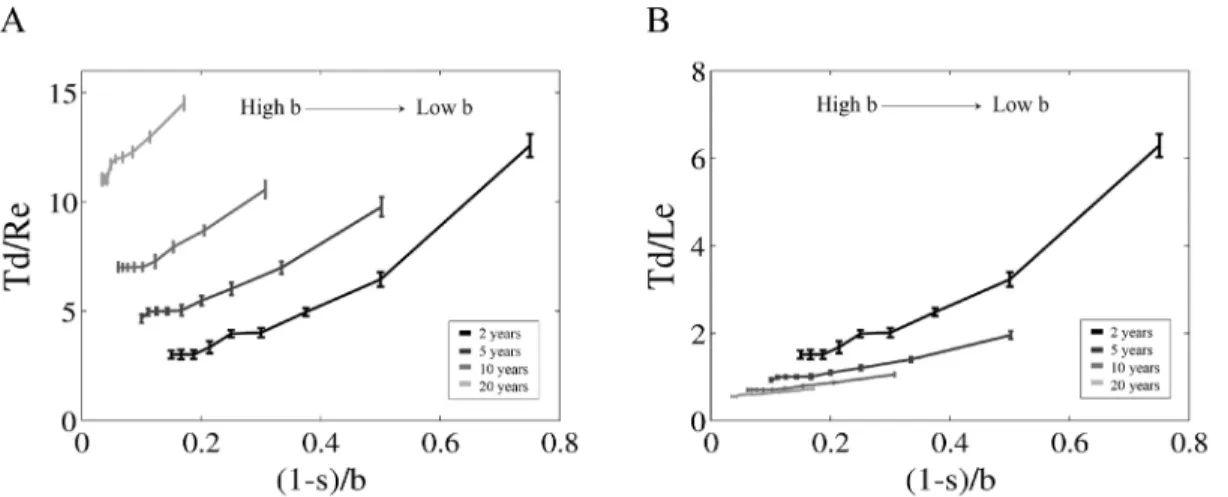
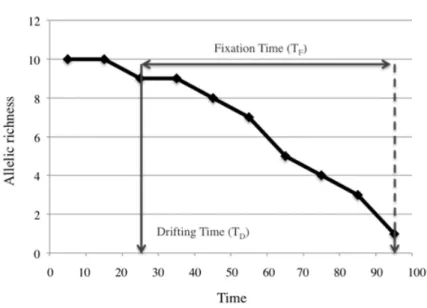
Effect of different life expectancies on the loss of genetic diversity foran isolated population at initial saturating capacity . . . . 33
1.3
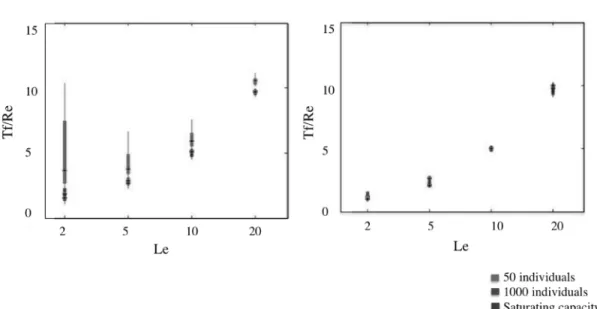
Effect of population growth rate over allele fixation time (Tf) for three different initial conditions of population abundance . . . . 35 1.4 Effect of different initial population abundances on the loss of genetic diversity . . . . . . . . 361.5
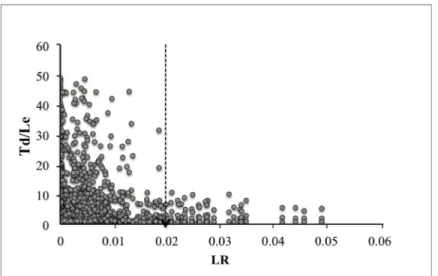
Spatial pattern of genetic diversity caused by distinct connectivitystructures . . . . . . . 37 1.6 Relationship between local retention (LR) and the number of population turnovers to start loosing genetic diversity (Td/Le), in a metapopulation over time . . . . . . . 38 1.7 Effect of fluctuations in local population stability on heterozygosity over time . . . . . . . . 39 Chapter 2
2.1 Two of the most common gorgonian species in the Mediterranean Sea . 58 2.1.1 Map of the seven sampling locations of Paramuricea clavata in the
Ligurian Sea . . . . . 74 2.1.2 Population genetic structure of Paramuricea clavata in the Ligurian Sea, as revealed by the software Structure . . . . 81 2.1.3 Autocorrelogram based on the kinship coefficient of Loiselle, estimated
for multilocus genotypes within 13 spatial distance classes . . . . 83 2.1.4 Pattern of contemporary migration of Paramuricea clavata in the Ligurian Sea . . . . . . . . 85 2.2.1 Regional hydrodynamics and sampling locations of the populations of Eunicella singularis in the NW Mediterranean . . . . 106 2.2.2 Population structure of E. singularis in the Gulf of Lions and Spanish
Catalan Coast . . . . 113 2.2.3 Plots of principal coordinate analysis from genetic distance matrix
2.2.4 Migration patterns of Eunicella singularis in the NW Mediterranean . . 115 2.2.5 Autocorrelogram based on the kinship coefficient of Loiselle . . . . . . 116 Chapter 3
3.1 Conceptual model of the seascape genetic approach . . . . 141 3.2 Geographic distribution of eight sites considered for the release of
larvae in Lagrangian model of larval dispersal in the Gulf of Lions . . 142 3.3 Schematic representation of use of connectivity matrices to calculate
hydrological distance among populations of E. singularis in the Gulf of Lions . . . . 143 3.4 Connectivity and hydrological distance matrices resulting from a
biophysical model of larval dispersal of E. singularis in the Gulf of
Lions . . . . 149 3.5 Population structure of E. singularis in the Gulf of Lions, as revealed
by Structure software . . . . 150 3.6 Graphic representation of migration patterns and migration rates
among sampled populations of E. singularis in the Gulf of Lions . . 151 3.7 Analysis of Isolation By Distance (IBD) for both geographical and
hydrological distances of samples of E. singularis in the Gulf of Lions 151 3.8 Fluctuations in population density of E. singularis in the Gulf of Lions
over time, as resulted from metapopulation dynamics modelling. . . 152 3.9 Heterozygosity values among populations of E. singularis in the Gulf
of Lions . . . . 153 3.10 Principal Coordinate Analysis (PCA) of genetic distance among sites of E. singularis in the Gulf of Lions, as resulted from model simulations 154
Chapter 1
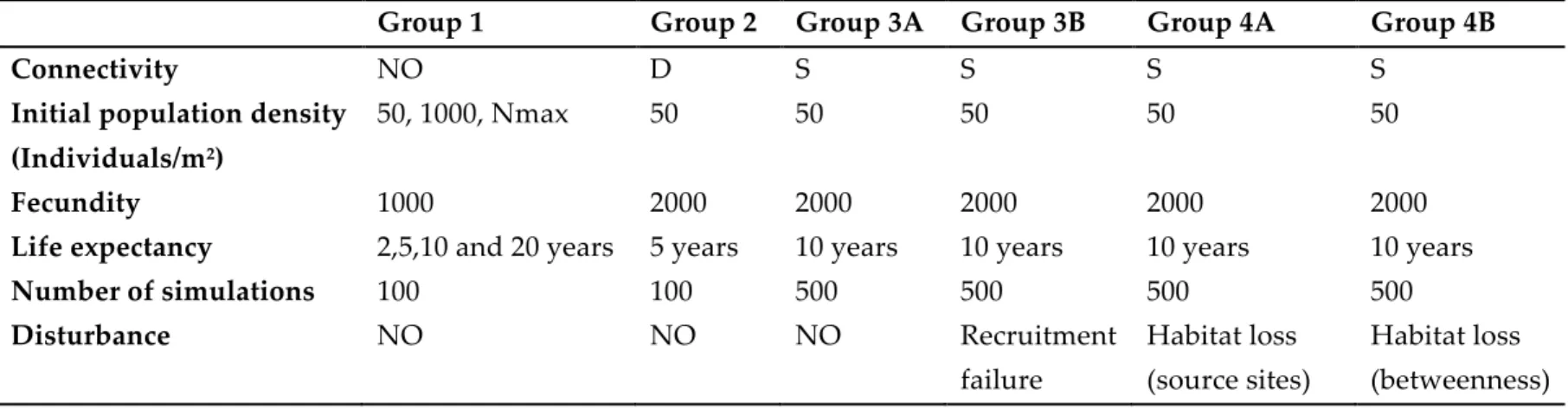
1.1 Settings of six simulation groups . . . . 30 Chapter 2
2.1.1 Sampling locations of Paramuricea clavata in the Ligurian Sea . . . . 75 2.1.2 Parameters of genetic diversity for 12 sites of P. clavata at six micro-‐‑
satellite loci . . . . . 80 2.1.3 Pairwise FST values among sites in the Ligurian Sea . . . . 82 2.2.1 Description of sampling locations of Eunicella singularis in the NW
Mediterranean . . . . . . . 107 2.2.2 Parameters of genetic diversity of E. singularis at eight microsatellite loci in 30 sites along the Gulf of Lions and Spanish Catalan coast . . . . 112
Introduction
stressors. A large range of land and ocean-‐‑based activities, coupled with human population expansion and migration towards the coast, are rapidly causing the modification and/or degradation of the ocean’s functions and biodiversity (Lubchenko 2003). Coral bleaching, fisheries collapse, changes in species composition and mass mortality events are a few among the severe consequences of the progressive alteration of the marine ecosystems around the world (Halpern et al., 2008).
Within this context, the need of ensuring the persistence of marine species’ populations becomes evident, as so does the realization that the resilience of these ecosystems will partly depend on our ability to establish appropriate management measures for conservation. As a consequence, growing concern regarding the number and efficiency of Marine Protected Areas (MPAs) has been evidenced in the scientific literature (Agardy 1994; Babcock et al., 2010; Edgar et al., 2014; Lagabrielle et al., 2014). Furthermore, the Convention on Biological Diversity (CBD) has set a target of protecting 10% of the coastal and marine areas by 2020, which has led to a rapid increase in the creation of MPAs worldwide.
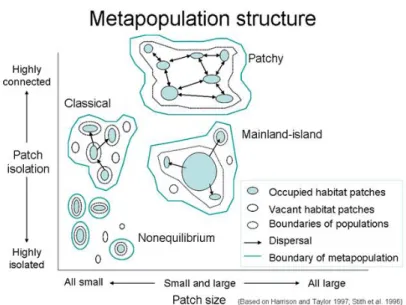
Our ability to effectively protect marine biodiversity, however, depends as well on our understanding of the species’ ecology, dynamics, and its interactions with the environment. In the marine environment, species habitats are usually discontinuous either for natural reasons (e.g. coral reef patches, seagrass beds) or due to climatic or anthropogenic disturbances (e.g. hurricanes, coastal development). This discontinuity or fragmentation of habitat leads to the geographical separation of marine populations. The maintenance of the spatial distribution of these discrete populations suggest that they must be more or less connected by the exchange of individuals among them, forming what is commonly known as a metapopulation (Hanski 1999) (Figure 1).
The degree of connectivity, as well as the temporal and spatial scales of the connections among populations are, thus, key to the functioning of metapopulations. Theoretical studies suggest that population connectivity plays a fundamental role in
local and metapopulation dynamics, community dynamics and structure, genetic diversity, and the resilience of populations to human exploitation (Hastings and Harrison, 1994; Botsford et al., 2009). Previous studies have demonstrated how connectivity may enhance the persistence of a metapopulation after disturbances, by enhancing their recovery and/or recolonization (Hastings and Botsford 2006; Guizien et al., 2014). Therefore, understanding the degree and patterns of connectivity among populations is also central to the success of conservation management strategies, like the design of MPAs (Sale et al., 2006).
Figure 1.-‐‑ Schematic representation of the metapopulation concept.
Larval dispersal and marine connectivity
The exchange of individuals among populations can occur over different times during a species life cycle: dispersal of larvae, and movement of juveniles and/or adults. However, for benthic sessile species, dispersal can only take place during their larval phase. Therefore, larval dispersal defines the spatial scale of connectivity for these species (Cowen and Sponaugle 2009).
Several biophysical processes influence larval dispersal. Hydrodynamical features and environmental forcing at the location and timing of spawning will determine the
(PLD) and larval behavior may also alter the vertical distribution of the larvae in the water column, exposing it to different hydrodynamic conditions and potentially modifying their dispersal patterns (Butler et al., 2011). Moreover, larval mortality can dilute the larval pool and limit connectivity (Paris et al., 2007).
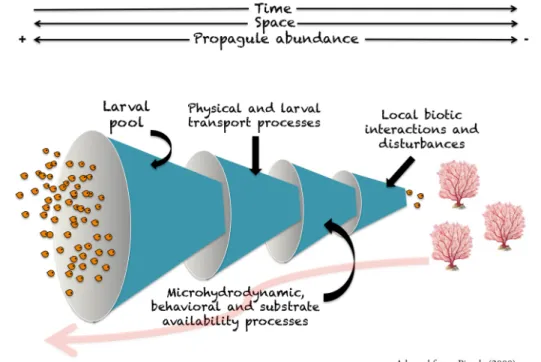
Connectivity patterns resulting from larval dispersal will also be affected by several processes acting at different temporal and spatial scales during the different stages of dispersion, from spawning to reproduction of the settled larvae (Pineda 2007) (Figure 2).
Figure 2.-‐‑ Schematic representation of the successive processes along a benthic species life cycle driving realized connectivity.
It is important to highlight that, after transport, not all of the arriving larvae will be able to settle. As highlighted by Pineda (2000), settlement rate is not a function of the number of larvae arriving. The availability of suitable substrate can also limit the exchange of individuals among populations. Also, post-‐‑settlement mortality will affect the effective connection among populations, as the larvae that successfully settle will
still face local biotic interactions and potential disturbances before it reaches sexual maturity and is able to reproduce (Chesson 1998). Furthermore, adult demography can vary reproductive output over time and space and thus control the number of larvae available to disperse.
Taking into account the variability in the spatial and temporal scales at which all of these processes act on population connectivity, it is then important to distinguish between the different types of connectivity that can be found according to the different processes that drive them. An understanding of larval dispersal can only determine population connectivity until the moment of larval settlement, which is known as larval connectivity or potential connectivity (Pringle 2003). Knowledge of larval connectivity may be useful for some objectives related, for example, to the persistence of a metapopulation. However, it only provides partial information regarding the exchange of individuals that will eventually reproduce (Pineda et al., 2007).
For connectivity to enhance metapopulation persistence, the sum of births and immigration in a population must be equal or exceed the sum of deaths and emigration (Pineda et al., 2007). When the contribution from the exchange of individuals among populations is large enough to influence the demographic parameters of a population, it is referred as demographic connectivity (Sale et al., 2010). Within an ecological temporal scale, persistence is, therefore, only possible if the level of demographic connectivity among populations allows the replacement of an adult individual that is able to reproduce, even if its population of origin is not self-‐‑persistent (Burgess et al., 2014). In an evolutionary scale, on the other hand, when we refer to the exchange of genes among populations over several generations, we talked about genetic connectivity. The patterns of genetic connectivity in marine species will determine the level of genetic differentiation among populations, which could influence local adaptation and eventually speciation (Banks et al., 2013). However, the level of exchange of individuals necessary to maintain genetic connectivity and even genetic homogeneity among populations, unlike demographic connectivity, are much lower (Greenbaum et al., 2014).
fundamental role in driving the connectivity patterns, their relative importance to connectivity and metapopulation dynamics can vary depending on the system and species-‐‑specific properties. For a long time, the relative homogeneity of the marine environment, coupled with a perceived lack of conspicuous barriers lead to the expectation that marine populations were highly connected (Caley et al., 1996). The characteristic of these “open” populations would, however, depend on the school of thought. For some researchers, they would be characterized by high recruitment of larvae coming from external sources, although at a level that would still allow populations to fluctuate below saturating capacity. While for others, density-‐‑dependent processes acting after settlement would control the excess of incoming larvae (Hixon et al., 2002). However, a growing body of evidence has revealed that patterns of dispersal can limit demographic exchange among populations and that, in fact, marine populations rarely constitute fully open or closed systems (Sponaugle et al., 2002). In 2000, Cowen et al, using numerical simulations of larval dispersal, showed that larval retention at a small scale was possible. An assertion that was later confirmed by field studies showing high levels of self-‐‑recruitment in coral reef systems (Almany et al., 2007; Planes et al., 2009; Gilmour et al., 2013).
As an attempt to discern the processes behind these observations, several studies evaluated the fit of Larval Pelagic Duration (PLD) as a proxy to explain the dispersal potential and population connectivity of marine species. However, the results have been contradictory. Shanks et al. (2003) and Siegel et al. (2003) found a strong correlation between PLD and inferred dispersal distance. Conversely, other studies demonstrated strong population subdivision in species with long PLD (Thomas et al., 2013; Damerau et al., 2014). Whether limited dispersal capacity, regional hydrodynamics, or perhaps local demography, are responsible for the high levels of larval retention and/or self-‐‑ recruitment observed in many marine species it is still unclear, and remains a scientific challenge. Quantifying the spatial scale of connectivity and identifying the factors that
regulate it has now become crucial for the establishment of appropriate management measures for the conservation of marine populations (Kritzer and Sale 2004; Pineda et al., 2007; Jones et al., 2009).
Methods to estimate marine connectivity
Our ability to measure connectivity by tracking larvae and following their movements between two populations is very limited. The classical techniques of physical tagging, although the most accurate, are just not feasible when dealing with such a large amount of very small size individuals (Thorrold et al., 2002). Nonetheless, this type of direct tracking could not provide relevant information at an evolutionary time scale (Kool et al., 2013). In order to overcome these limitations, other methods for estimating connectivity have been developed, which can be grouped into two main categories: empirical and modelling.
Within the empirical category of methods to assess connectivity among marine populations, chemical and genetic tools have been commonly used in a wide variety of fish and invertebrate species (Hedgecock et al., 2007; Campana 1999). The chemical methods are based on the property of certain calcified tissues (e.g. shells and otoliths) to permanently incorporate chemical elements from the environment during their development. Notoriously among the techniques of chemical tagging, the method developed by Thorrold et al. (2006), allows the transgenerational transference of the chemical tag (a stable isotope of 137Barium) from the mothers to their offsprings by an
injection in the abdominal cavity of the individual. However, the use of this method is limited to species with calcified tissue, therefore, its application has been mostly limited to the analysis of otoliths in fish species.
Genetic tools, on the other hand, have been applied for the evaluation of population connectivity for a wide variety of marine taxa. Genetic inferences of gene flow among populations contribute to our understanding of the evolutionary consequences of dispersal. Furthermore, population genetics provides a mean to evaluate population connectivity integrated over many generations, which would not be
population genetics allow both direct and indirect estimates of connectivity by assessing changes in the frequency of alleles (defined as alternative forms of a gene), and the assignment of individuals to their population of origin, respectively (Hedgecock et al., 2007).
Changes in allele frequency are due to synergistic action of four main evolutionary forces: the mutation of genes, the stochastic fluctuations in finite populations called random genetic drift, the gene flow that results from the migration of individuals among populations, and selection. Over long periods of time, random genetic drift and selection can cause population differentiation, while migration acts to homogenize genetic diversity among populations (Roughgarden 1979). This effect of migration on allele frequencies is the basis of the usefulness of population genetics in inferring connectivity. However, it is important to highlight that the indirect methods estimate gene flow from the level and the pattern of genetic divergence among populations, under the assumption that the populations are at drift-‐‑gene flow equilibrium (Slatkin 1987). This assumption, of a balance between the influence of genetic drift driving the fixation on an allele in all populations, and the opposite effect of gene flow bringing new alleles to the populations, if not met, will generally lead to the overestimation of the current amount of gene flow (Lowe and Allendorf 2010).
In fact, most indirect methods used for inferring connectivity rely on theoretical models of population structure, like the Wright’ Island Model (Wright 1931), an unrealistic model that assumes equal gene flow among populations of the same size. Therefore, it is important to understand the limitations of these indirect methods when inferring connectivity patterns. These methods can estimate connectivity over evolutionary scales, but are incapable of estimating contemporary exchange among populations (Hedgecock et al., 2007). The most common metrics of genetic differentiation obtained from these methods are FST (a standardize variance of allele frequencies among
More recently, in order to overcome some of the shortcomings from unrealistic model assumptions and take advantage of variable molecular markers, methods that allow the direct estimation of gene flow by assigning individuals to their populations of parents of origin have been developed, and are considered to be analogous to non-‐‑ genetic approaches of estimating migration among populations (Lowe and Allendorf 2010). Based on the expected frequency of its multilocus genotype, the probability that an individual originated from a given population or set of parents can be calculated (Manel et al., 2005). Maximum Likelihood and Bayesian approaches, assuming only Hardy-‐‑Weinberg equilibrium and Linkage disequilibrium and, therefore, providing higher accuracy estimates, can also calculate inferred rates of migration among populations (Wilson and Rannala 2003). Nonetheless, assignment tests are sensitive to sample size and do not work well at high levels of gene flow, when population differentiation becomes difficult (Hedgcock et al., 2007).
Although empirical methods of assessing population connectivity can provide estimates of the spatial and temporal variability of the observed connectivity patterns, these approaches are costly and labor intensive, which limits their wide application over several scales. Moreover, the fact that the observed patterns of genetic connectivity are integrated over multiple generations brings additional challenges when attempting to discern the processes that influenced them over time. In that regard, the use of numerical simulations of larval dispersal and connectivity enhances the testing of hypothesis over multiple and large temporal and spatial scales (Kool et al., 2013).
As any other field, modelling tools are not free of challenges and, as a consequence, the models used to assess marine connectivity have evolved and greatly improved over time. Currently, biophysical models allow to quantify connectivity by simulating larval dispersal at different temporal and spatial scales. The incorporation of 3-‐‑dimensional coastal circulation models and spatially-‐‑explicit Individual Based Models (IBMs) are used to project individual (Lagrangian) larval trajectories under realistic conditions while, in some cases, taking into account some biological traits of the larvae
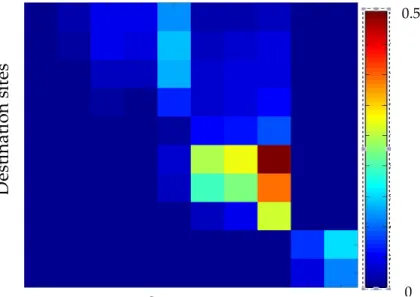
estimate connectivity from larval dispersal trajectories (Kool et al., 2013). However, the most commonly used in the literature is the study of connectivity matrices (Figure 3). The connectivity matrix resulting from a biophysical model can provide essential information for understanding persistence in a marine metapopulation. With origin locations along the columns and destination locations along the rows, each one of the cells represents the probability that an individual produced at a given origin location either settles in the same location or disperses to settle in a given destination location at any given time (Burgess et al., 2014). However, the use and interpretation of data resulting from biophysical models depends on the spatial and temporal resolution of the model, as well as the biological characteristics attributed to the larvae (Paris et al., 2007).
Figure 3.-‐‑ Representation of a connectivity matrix
With so many different methods (empirical and modelling) available to estimate the different types of connectivity (larval, demographic and genetic) over a species life cycle, a true understanding of how spatial management can maintain the persistence of populations calls for a need to integrate multiple approaches. Furthermore, the
D
es
tin
ati
on
s
ite
s
Source sites
0.5 0combination and comparison of connectivity patterns resulting from the use of different tools could allow to disentangle the relative role of the seascape processes shaping the observed connectivity patterns among marine populations.
The integration of ecological and genetic metapopulation models has been shown to be an important tool for understanding the complexities of population connectivity (Levin 2006; Epperson et al., 2010). Previous studies have attempted to link biophysical dispersal models and population genetic structure (Galindo et al., 2006; Foster et al., 2012). However, these models do not seem to explain the observed connectivity patterns in sessile marine species at small spatial scales, a mismatch that could be explained by the lack of integration of the demographic dynamics of their populations, and/or the interaction between larval dispersal and population genetics.
Within this context, the objective of my research thesis is to discern the seascape processes responsible for driving and maintaining genetic connectivity in sessile invertebrate species at a regional scale, by confronting the observed realized connectivity to a combined approach of modelling methods that integrate connectivity over several stages of a species life cycle.
In Chapter 1, I present the development of a coupled seascape genetics model that allows to project the evolution of allele frequencies in a metapopulation over time, taking into account demographic traits and connectivity variability. With the application of this model I examine how: 1) demographic traits influence the development of genetic structure in closed populations over time, 2) different patterns of connectivity affect the loss or maintenance of genetic diversity at a regional scale in a metapopulation, 3) fluctuations in local population density help maintain genetic diversity over time and 4) local population demographic stability impacts genetic diversity to provide relevant information for conservation decisions in the Gulf of Lions, France.
In Chapter 2, I used a combination of direct and indirect genetic methods to evaluate the connectivity patterns of two gorgonian species in two regional scales. I analyse the genetic population structure of the red gorgonian (Paramuricea clavata) in the
the history of mass mortality events recorded for P. clavata in the Ligurian Sea, I attempt to answer: 1) whether disturbed populations show a signal of reduced genetic diversity, and 2) if connectivity may have played a role in the recovery of the populations. In the case of E. singularis in the Gulf of Lions, I aim to answer the following questions: 1) does E. singularis have dispersal capacity?, 2) is there genetic differentiation between the populations inside and outside the Gulf of Lions?, and 3) can the pattern of genetic population structure be explained by the regional hydrodynamics?.
In Chapter 3, I attempt to identify the underlying processes driving the observed patterns of genetic connectivity for E. singularis in the Gulf of Lions by comparing the observations to the modelled patterns of connectivity resulting from the coupled seascape genetic model presented in Chapter 1. The main question rose for this analysis was: can larval dispersal alone drive the patterns of genetic connectivity of E. singularis in the Gulf of Lions?.
References
Agardy, M. 1994. Advances in marine conservation: the role of marine protected areas. Trends in Ecology & Evolution, 9: 267–270.
Almany, G., Berumen, M., Thorrold, S., Planes, S., and Jones, G. 2007. Local replenishment of coral reef fish populations in a marine reserve. Science, 316: 742– 744.
Babcock, R., Shears, N., Alcala, A., Barrett, N., Edgar, G., Lafferty, K., McClanahan, T., et al. 2010. Decadal trends in marine reserves reveal differential rates of change in direct and indirect effects. Proceedings of the National Academy of Sciences, 107: 18256–18261.
Banks, S., Cary, G., Smith, A., Davies, I., Driscoll, D., Gill, A., Lindenmayer, D., et al. 2013. How does ecological disturbance influence genetic diversity? Trends in Ecology & Evolution, 28: 670–679.
Botsford, L., White, J., Coffroth, M., Paris, C., Planes, S., Shearer, T., Thorrold, S., et al. 2009. Connectivity and resilience of coral reef metapopulations in marine protected areas: matching empirical efforts to predictive needs. Coral Reefs, 28: 327–337. Burgess, S., Nickols, K., Griesemer, C., Barnett, L., Dedrick, A., Satterthwaite, E.,
Yamane, L., et al. 2014. Beyond connectivity: how empirical methods can quantify population persistence to improve marine protected-‐‑area design. Ecological Applications, 24: 257–270.
Butler, M. J., Paris, C., Goldstien, J., Matsuda, H., and Cowen, R. 2011. Behavior constrains the dispersal of long-‐‑lived spiny lobster larvae. Marine Ecology Progress Series, 422: 223–237.
Caley, M., Carr, M., Hixon, M., Hughes, T., Jones, G., and Menge, B. 1996. Recruitment and the local dynamics of open marine populations. Annual Review of Ecology and Systematics, 27: 477–500.
Campana, S. 1999. Chemistry and composition of fish otoliths: pathways, mechanisms and applications. Marine Ecology Progress Series, 188: 263–297.
Ecology, 23: 234–240.
Cowen, R. 2000. Connectivity of marine populations: open or closed? Science, 287: 857– 859.
Cowen, R., and Sponaugle, S. 2009. Larval dispersal and marine population connectivity. Annual Review of Marine Science, 1: 443–466.
Damerau, M., Matschiner, M., Salzburger, W., and Hanel, R. 2013. Population divergences despite long pelagic larval stages: lessons from crocodile icefishes (Channichthyidae). Molecular Ecology, 23: 284–299.
Edgar, G., Stuart-‐‑Smith, R., Willis, T., Kininmonth, S., Baker, S., Banks, S., Barrett, N., et al. 2014. Global conservation outcomes depend on marine protected areas with five key features. Nature, 506: 216-‐‑220.
Epperson, B., McRae, B., Scribner, K., Cushman, S., Rosenberg, M., Fortin, M., James, P., et al. 2010. Utility of computer simulations in landscape genetics. Molecular Ecology, 19: 3549–3564.
Foster, N., Paris, C., Kool, J., Baums, I., Stevens, J., Sanchez, J., Bastidas, C., et al. 2012. Connectivity of Caribbean coral populations: complementary insights from empirical and modelled gene flow. Molecular Ecology, 21: 1143–1157.
Galindo, H., Olson, D., and Palumbi, S. 2006. Seascape genetics: A coupled oceanographic-‐‑genetic model predicts population structure of Caribbean corals. Current Biology, 16: 1622–1626.
Gilmour, J., Smith, L., Heyward, A. J., Baird, A. H., and Pratchett, M. S. 2013. Recovery of an isolated coral reef system following severe disturbance. Science, 340: 69–71. Greenbaum, G., Templeton, A., Zarmi, Y., and Bar-‐‑David, S. 2014. Allelic richness
following population founding events – A stochastic modeling framework incorporating gene flow and genetic drift. PLoS ONE, 9: e115203.
Guizien, K., Belharet, M., Moritz, C., and Guarini, J. M. 2014. Vulnerability of marine benthic metapopulations: implications of spatially structured connectivity for
conservation practice in the Gulf of Lions (NW Mediterranean Sea). Diversity and Distributions: 1–11.
Guizien, K., Brochier, T., Duchêne, J. C., Koh, B. S., and Marsaleix, P. 2006. Dispersal of Owenia fusiformis larvae by wind-‐‑driven currents: turbulence, swimming behaviour and mortality in a three-‐‑dimensional stochastic model. Marine Ecology Progress Series, 311: 47–66.
Halpern, B. S., Walbridge, S., Selkoe, K. A., Kappel, C. V., Micheli, F., D'ʹAgrosa, C., Bruno, J. F., et al. 2008. A global map of human impact on marine ecosystems. Science, 319: 948–952.
Hanski, I. 1999. Habitat connectivity, habitat continuity, and metapopulations in dynamics landscapes. Oikos, 87: 209–219.
Harrison, S., and Taylor, A. 1997. Empirical evidence for metapopulation dynamics: a critical review. In: Metapopulation Dynamics: ecology, genetics and evolution (Eds. Hanski, I and Gilpin, A.) Academic Press, San Diego, CA. 27-‐‑42.
Hastings, A., and Botsford, L. 2006. Persistence of spatial populations depends on returning home. Proceedings of the National Academy of Sciences, 103: 6067–6072. Hastings, A., and Harrison, S. 1994. Metapopulation dynamics and genetics. Annual
Review of Ecology, Evolution, and Systematics, 25: 167–188.
Hedgecock, D., Barber, P., and Edmands, S. 2007. Genetic approaches to measuring connectivity. Oceanologica Acta, 20: 1–10.
Hixon, M., Pacala, S., and Sandin, S. 2002. Population regulation: historical context and contemporary challenges of open vs. closed systems. Ecology, 83: 1490–1508.
Kool, J., Moilanen, A., and Treml, E. 2013. Population connectivity: recent advances and new perspectives. Landscape Ecology, 28: 165–185.
Kritzer, J., and Sale, P. 2004. Metapopulation ecology in the sea: from Levin'ʹs model to marine ecology and fisheries science. Fish and Fisheries, 5: 131–140.
Lagman, M., Crochelet, E., Andrello, M., Schill, S., Arnaud-‐‑Haond, S., Alloncle, N., and Ponge, B. 2014. Connecting MPAs -‐‑ eight challenges for science and management.