AVIS
Ce document a été numérisé par la Division de la gestion des documents et des archives de l’Université de Montréal.
L’auteur a autorisé l’Université de Montréal à reproduire et diffuser, en totalité ou en partie, par quelque moyen que ce soit et sur quelque support que ce soit, et exclusivement à des fins non lucratives d’enseignement et de recherche, des copies de ce mémoire ou de cette thèse.
L’auteur et les coauteurs le cas échéant conservent la propriété du droit d’auteur et des droits moraux qui protègent ce document. Ni la thèse ou le mémoire, ni des extraits substantiels de ce document, ne doivent être imprimés ou autrement reproduits sans l’autorisation de l’auteur.
Afin de se conformer à la Loi canadienne sur la protection des renseignements personnels, quelques formulaires secondaires, coordonnées ou signatures intégrées au texte ont pu être enlevés de ce document. Bien que cela ait pu affecter la pagination, il n’y a aucun contenu manquant.
NOTICE
This document was digitized by the Records Management & Archives Division of Université de Montréal.
The author of this thesis or dissertation has granted a nonexclusive license allowing Université de Montréal to reproduce and publish the document, in part or in whole, and in any format, solely for noncommercial educational and research purposes.
The author and co-authors if applicable retain copyright ownership and moral rights in this document. Neither the whole thesis or dissertation, nor substantial extracts from it, may be printed or otherwise reproduced without the author’s permission.
In compliance with the Canadian Privacy Act some supporting forms, contact information or signatures may have been removed from the document. While this may affect the document page count, it does not represent any loss of content from the document.
Finding genetic elements that lead to the autistic phenotype
Par
Robert Francis Fraser Gillis
Programmes de Biologie Moléculaire Faculté de Médecine
Mémoire présenté à la Faculté de Médecine en vue de
r
obtention du grade de MaîtriseDécembre, 2007
Ce
mémoire intitulé:Finding genetic elements that lead to the autistic phenotype
P
l Iresente par:
Robert Francis Fraser Gillis
a été évalué(e) par un jœycomposé des personnes suivantes:
Dr Patrick û>ssette président-rapporteur Dr Guy Rouleau directeur de recherche Dr Eric Shoubridge membre du jury
direct and efficient method to lInderstand the molecular components of diseases with a genetic basis. ln this thesis, an attempt is made at lInraveling the mysterious nature of the genetic architecture of autism by comparing the traditional polygenic model for the genetics of autism with a model based on de novo mutations in multiple genes that is largely unaccepted by the scientific community, followed by a scientific write up of two experiments.
Under a polygenic pretense, a transmission disequilibrium test (TOT) was performed on 185 trios. Twenty six SNPs spanning 820Kb of the GABAA receptor subunit cluster at
15q 12 were selected based on minor allele frequency >0.05, spacing, and coverage. This led to the identification of three SNP's in transmission disequilibrium: rs6606905, rs2078439, as weil rs2873027 whose association has already been show'n in previous studies.
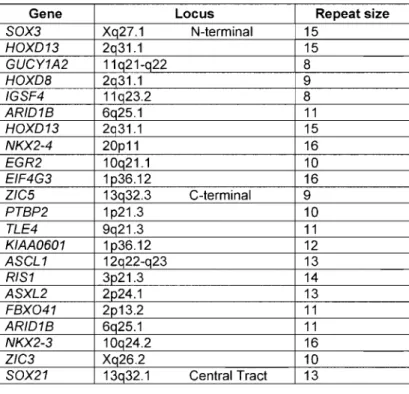
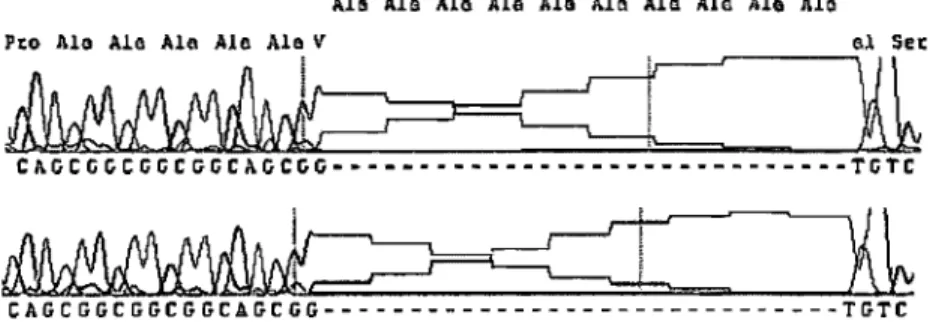
Polyalanine trinucleotide repeats are under increasing scrutiny as they have been discovered to be involved in an increasing number of genetic disorders. ln this study, 56 alanine tracts were screened and compared between 192 patients and 192 controls. This led to four distinct groups: one group which revealed no variation in cases or control s, one group in which fouI' tracts revealed a high degree of polymorphîsm for which no identifiable wild type cou Id be discerned, one group whose variants were matched in cases and control s, and one group that contained four alanine tracts from ZIC2, TBLXRJ, ARlDJA, FOXD3 and POU3F3 whose rare variants were unmatched in a larger number of controls and may warrant future functional studies.
Keywords: genetics of autistic disorder, de novo mutation, polygenic inheritance, association study, GABAA receptor subunit, alanine repeats/expansion/contraction
méthode la plus directe et efficace de déterminer et comprendre les composants moléculaires de ces affections. Cette thèse tente de dénouer la nature mystérieuse de l'architecture génétique de l'autisme, en comparant le modèle polygénique traditionnel avec un modèle basé sur des mutations de nova dans des gènes multiples, qui n'est pas largement accepté dans la communauté scientifique. Par la suite, deux expériences sont exécutées, l'une basée sur tin modèle polygénique et l'autre basée sur un modèle de mutations de nova.
Une étude de déséquilibre de transmission a été effectuée sur 185 trios. Vingt-six SNPs comprenant 820 Kb de l'agrégat du récepteur sous-unité GABAA à 15q 12 ont été sélectionnés basées sur leurs fréquences allèles mineures (>0,05) et leur espacement. Trois SNPs avec une association significative ont été identifiés: rs6606905, rs2078439, ainsi que r52873027 dont l'association a déjà été démontrée dans des études précédentes.
Pour la deuxième expérience, 56 tractus d'alanine ont été examinés et les variants ont été comparés entre 192 patients et 192 contrôles. Quatre groupes distincts ont résulté: un groupe n'ayant démontré de variation ni dans les cas affectés, ni dans les contrôles, un groupe dans lequel quatre tractus ont révélé un degré élevé de polymorphisme pour lequel aucun allèle de type sauvage ne pouvait être discerné, un groupe dont la fréquence des variants rares était semblable dans les cas affectés et les contrôles, et lin groupe dont les membres pourraient mériter de futures études fonctionnelles, comme quatre tractus alanine contenus dans ZIC2, TBLXRJ, ARIDJA. FOXD3 et POU3F3 possédaient des variants génétiques non-observés dans les contrôles.
Mots clés: désordre autistique, mutation de nova, héritage polygénique, études d'association, récepteur sous-unité GABAA, expansions/contractions des tractus d'alanine
List of Tables and Figures ... iii
Acknowledgments ... iv
1.0 General Introduction ... 6
1.1 Pathology ... 10
1.2 Evidence that genetic factors lead to the AD phenotype ... Il 1.3 The polygenic model, common disease/common variant ... 13
1.4 The multi-10cus monogenic model dominated by low transmission of de novo mutations (DNM model) ... 14
2.0 The strength of each model at predicting and explaining factors influenced by underlying genetic architecture ... 18
2.1 Twin studies and sibling recurrence ... 18
2.2 Wide clinical spectrum associated with AD ... 20
2.3 Failure of linkage and association studies to identify genes involved in AD ... 23
2.4 Consistent global preva1ence ... 25
2.5 Skewed male to female AD ratio ... 27
2.6 Presence of autistic features in first degree relatives ... 29
2.7 Lack offamily history in majority of patients diagnosed with AD ... 31
2.9 Which model is more consistent with the data? ... 32
2.10 Environmental component analyzed with both models ... 33
3.0 Strategies and tools for gene identification ... 34
3.1 Linkage analysis ... 35
3.2 Family based association studies ... 37
3.3 High resolution analysis of de novo copy number variation ... 38
3.4 Medical re-sequencing ... 39
3.5 Bioinformatics ... 39
3.6 Validation of genetic variants ... 40
3.7 The French Canadian population as a sample cohort for AD ... 42
4.0 Association study of the GABAA receptor subunit cluster at 15q12 in the French Canadian population ... 44
4.1 Abstract ... 44
4.2 Introduction and rationale ... 44
4.3 Materials and Methods ... 46
4.4 Results ... 50
4.5 Discussion ... 53
4.6 Conclusion ... 55
5.0 Investigating the role ofpolyalanine expansions/contractions in AD ... 57
5.1 Abstract ... 57
5.2 Introduction and rationale ... 57
5.3 Materials and Methods ... 62
5.4 Results ... 64
5.5 Discussion ... 71
5.6 Conclusion ... 79
Afterword ... 80
List of Abbreviations
A Adenine
AA AminoAcid
AD Autistic Disorder
ADI-R Autism Diagnostic Interview Revised
ADOS-G Autism Diagnostic Observed Schedule Generic
ARX Aristaless X
AS Asperger Syndrome
ASD Autism Spectrum Disorder
C Cytosine
CGH Comparative Genomic Hybridization
CNV COpy Number Variation
DNA Deoxyribonucleic Acid
DNM De novo mutation
DSM-IV Diagnostic and Statistical Manual
DZ Di-Zygotic
FC French Canadian
G Guanine
GABA Gamma amino butyric acid
GABA(A) GABA Receptor Type A
ICD-10 International Classification of Disease
Kb Kilobase
LOD Log Of Odds
MECP2 Methyl Cytosine Binding Prote in 2
MMR Measles, Mumps, Rubella
mRNA MessenQer Ribonucleic Acid
MZ Mono-zW:Jotic
NF1 Neurofibromatosis type 1
NLGN Neuroligin
NRXN Neurexin
OPMD Ocular Pharyngeal Muscular Dystro~h~
PABPN1 PolyA Binding Protein 1
PCR Polymerase Chain Reaction
POO-NOS Pervasive Developmental Disorder Not Otherwise Specified
RNA Ribonucleic Acid
SHH Sonic Hedgehog
SNP Single Nucleotide Polymorphism
T Thymine
TOT Transmission Disequilibrium Test
TRD Trinucleotide repeat disorder
TSC Tuberous Sclerosis
UTR ion
List of Tables and Figures
List of Tables
Table 1: Theoretical summary of the proportion of
transmission patterns that lead to the observed twin study and
sib-pair values ... 19
Table II: TDT results for GABAA receptor subunit cluster. ... 51
Table III: TDT results for additional trios at rs2873027 ... 52
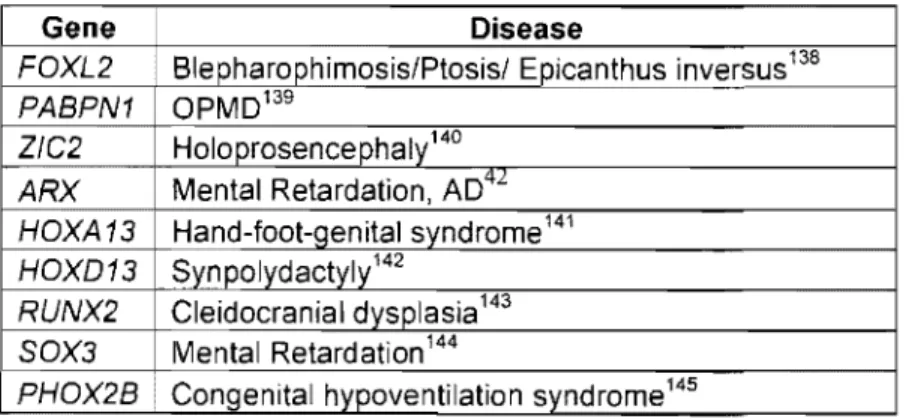
Table IV: Conditions known to be caused by alanine repeats ... 61
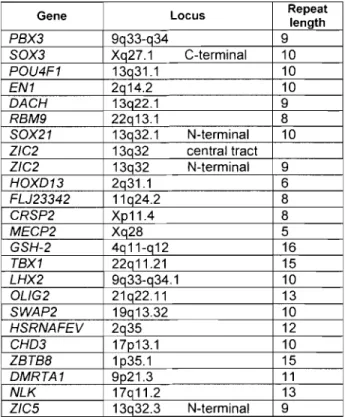
Table V: Alanine tracts showing no polymorphism ... 65
Table VI: Alanine tracts showing high degree of polymorphism ... 65
Table VII: Alanine tracts with variants matched in controls ... 66
Table VIII: Alanine tracts with rare variants unmatched in controls ... 66
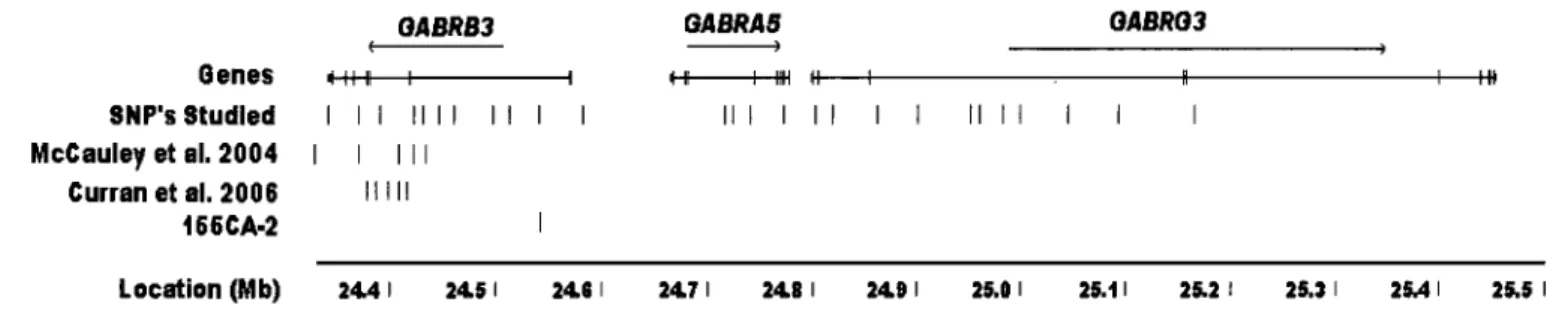
List of Figures Figure 1: SNP distribution across GABAA cluster. ... .48
Figure 2: Alanine deletion in ZIC2 ... 68
Figure 3: Alanine expansion from TBLXRi lIRAi ... 69
Figure 4: Haplotype construction ofregion surrounding the IRAi expansion in three French Canadian families ... 70
Acknowledgments
1 would like to thank Dr. Guy Rouleau first for giving me the opportunity to work in his lab, and for providing me with key insight into problem solving that 1 will take with me wherever 1 go. 1 would also like to thank Claudia Gaspar who also played a key role in my supervision and helped all of my work and projects progress during my time at the labo
Julie Gauthier also helped me throughout my studies and her hard work initiated this project in the lab and provided the samples upon which several other projects are based. Nathalie Girard provided me with great lab supervision upon my arrival. There are also several people that worked on these projects with me such as Judith St. Onge whose hard, meticulous work was integral to the progression of the alanine project, as well as Lan Xiong, and Nathalie Gauthier. Sandra Laurent taught me many lab skills and showed much patience, kindness and care during the process of the GABA project and Jean Baptiste Riviere was very helpful in teaching the UNPHASED software package, SNP selection and general advice.
Several people helped me at many points during my time at the lab such as Paul Valdmanis who was always able to provide insightful comments on the projects 1 was involved in, as well as CUITent scientific literature in general as well as Dominique Verlaan who was very helpful as a project organizer and mentor. 1 would like to thank everyone in general at the Rouleau lab, all students and
Furthermore, l would like to thank all of my family and friends who se guiding hands and support helped me get through many of the steps that led to this point, particularly the four people that guided my growth and development: my parents as well as my sister Heather Gillis and her husband Darcy Trefiak. l wou Id also like to thank Marina Amato who has provided me with motivation in everything l do.
1.0 General Introduction
In 1943, Leo Kanner published a case report describing Il children with subtle phenotypic similarities he termed "autistic disturbances of affective contact"l. In this report, Kanner compared and contrasted many phenotypic and background commonalities among these children taking note of several features, many of which have developed into the modem diagnostic guidelines for autism.
One of Kanner's contemporaries, a pediatrician from Vienna named Hans Asperger, described children with similar developmental difficulties one year after Kanner, also using the term autistic to describe his patients2. This may
initially seem like a startling coincidence, however autism or autistic had been a commonly used term in psychology dating back to 1910 to describe human behaviour in which the patient is in social withdrawal, a feature used primarily to describe a phenotypic symptom of schizophrenia3. The concurrent clinical
characterization of autism within this short time frame should not be recognized as either a sudden outbreak of a new disorder, or that patients modemly diagnosed as autistic did not exist prior to this. It simply represented a shifting cultural climate in the psychological features that psychiatrists focused on to categorize and diagnose human mental disorders. These guidelines have experienced several revisions over the years with many more likely to come as continuing research in multiple fields will shed light on this mysterious condition and begin to homogenize patients currently diagnosed with autism into different clinical categories.
Due to the work of anthropologist Margaret Mead in the early 1900'S4, it
was a commonly held belief that the human brain and associated personality was
a blank slate, with little to no contribution from genetic factors5. Therefore, most
psychiatric conditions had a large bias towards examining the parents of affected
individu ais to determine the cause of the disorder. When autism was initially described, the search began for the environmental component that led to this
disease. Unfortunately, scientific rigor in the field of psychology was applied
loosely during this period, therefore weak observations often led to dominating
theories regarding the cause of autism. Observations of socially reticent mothers
of autistic children led to the "refrigerator mother" theory of autism, a theory that
posited that infants that do not get the proper care from the mother will experience
developmental delays resulting in autism. In 1957, Leon Eisenberg reported that
often the fathers of autistic children were socially isolated, which led to the idea
that perhaps the behaviour of both parents cou Id lead to the autistic phenotype in
their children6. This idea was held as common belief for much of the mid 1900's
and was not completely abolished until early twin studies in 1977 had definitively
shown a genetic basis for the disorder7, although the concept likely remained
embedded within the general public for several years afterwards.
Autism has become the focus ofmuch more publicity and research as data
amassed between 1991-1997 resulted in a reported 556% increase in the
prevalence8, a dramatic increase that sparked public concem. A crisis developed
to the measles, mumps, rubella (MMR) vaccine as the causal agent behind the outbreak. However, there is no epidemiological evidence to suggest that the MMR vaccine conf ers any risk to developing the autism phenotype9• Afterwards
it was suggested that perhaps thimerosal, a mercury containing preservative used in vaccines, was associated with autism 10, although recent studies have refuted
this hypothesis 11, 12. Furthermore, no evidence at this point supports an increased
incidence of the disease, as studies reporting an increased prevalence did not control for changes in diagnostic criteria for autism that took place in 199413,
Currently, the general term autism has been replaced with autistic spectrum disorder (ASD) and is diagnosed in accordance with the classifications set forth in the Diagnostic and Statistical Manual of Mental Disorders, Fourth
Edition, Text Revision 7 (DSM-IV) and the International Classification of Diseases, Tenth Revision (ICD-lO) 14, IS. According to these diagnostic manuals,
ASD is characterized by impairments in three behavioral domains: 1) social interaction; 2) language, communication, and imaginative play; and 3) range of interests and activities. ASD has been further subdivided into five subtypes according to the varying clinical presentations of the above three phenotypic characteristics: 1) the prototypical Autistic Disorder (AD) 2) Asperger Syndrome (AS), which is generally recognized as a milder form of AD without the associated language delay 3) Pervasive Developmental Disorder Not Otherwise Specified (PDD-NOS) 4) Childhood Disintegrative Disorder, a rarely diagnosed condition where a childhood experiences dramatic regression between two and ten
years of age after normal development and 5) Rett Syndrome (RS) a genetic disorder of postnatal brain development, caused by a single-gene defect predominantly affecting girls.
This thesis will focus on the disco very of genetic elements that lead to the phenotypes in categories 1-3, AD, AS and PDD-NOS. Although psychiatrists have developed these diagnostic criteria in an attempt to categorize and homogenize patients in a meaningful way, there is no evidence that these classifications homogenize patients based on the underlying genetic mutations involved. Due to the subtle differences between these categories the profound impact of differential diagnosis, as well as differing clinical presentations that depend on the age of the child during examination, the same mutation can lead to a variable diagnoses on the autistic spectrum. In fact, this has been shown for the known genetic mutations that lead to the AD phenotype. In one instance a sibling pair discovered to share a single gene defect in the NLGN3 gene, each received a different diagnosis; one with AD, the other with AS 16. In another example, a
large multiplex pedigree with 13 affected individuals shared a fully penetrant mutation in NLGN4 with perfect x-linked segregation, which resulted in multiple diagnoses including AD, PDD-NOS as well as X-linked mental retardation (XLMR)17. Therefore, for the purpose of discovering genes that lead to the
autistic phenotype, the three clinical categories that are focused on in this thesis can be treated as one, and will be referred to as autistic disorder (AD).
1.1 Pathology
Symptoms of AD generally begin to appear between 12-36 months after birth. This is usually preceded with no phenotypic symptoms or signs until the age of onset, which makes this disorder both mysterious and distressing. However, the age of onset reveals the importance of this molecular developmental time period of the nervous system, as it coincides with the appearance of spatial and temporal transcriptional cascades that lead to remodeling and elaboration of neuronal circuitryI8,19. The discovery of genes that lead to the AD phenotype should provide insight into this process. To date, neuroscientists have discovered very few physical abnormalities in the brains of autistic children, none of which are hallmark signatures common to all patients diagnosed with AD. Increased hippocampal and amygdala volumes have been reported in sorne children and sorne adults with autism20. Furthermore, damage to the amygdala has been hypothesized to play a role in the onset of the disorde?l, 22, although this theory has received less attention in recent years. Hyperserotonemia has been observed in children as weIl as families of children with AD23, 24, which has led to several examinations of polymorphisms within the serotonin transporter gene25-28, although the se studies have failed to conclusively determine any association with AD28. Macrocephaly (head circumference > 95th percentile) is observed in approximately 20% of patients with AD29, as weIl as epilepsy in approximately 30%30,31.
1.2 Evidence that genetic factors lead to the AD phenotype
Familial aggregation studies have shown that the sibling recurrence rate of AD is approximately 2-8%, with the most commonly accepted value currently at 4.5%32,33, whereas the population prevalence is currently estimated at 0.5-0.6%34. This information reveals that there is a higher tendency for autism to c1uster in families, however does not point exc1usively to a genetic origin, as it does not mIe out a shared environment unless combined with data from twin studies. To date, three twin studies of AD have been performed, each using small sample sizes 7, 35,
36. Combining these three studies, the total number of twin pairs is 66, with 36
monozygotic (MZ) pairs and 30 di-zygotic (DZ) pairs. The average MZ
concordance rate is 70%, with values ranging from 60-90%, compared with a DZ
rate of 0%. The observed rate of 0% is a chance finding that likely results from
the small number of DZ pairs in these studies. This is based on the observance that concordant DZ twin pairs do exist, therefore the DZ concordance rate is likely c10ser to the sibling recurrence rate of ~4-5%, considering DZ twin pairs share the same environment and proportion of genetic content. Although a shared environment cannot be eliminated for studies involving sibling recurrence, the much higher concordance rate between MZ and DZ twins suggests that genetic factors are the dominant factor in the development of the disease.
Finding the genetic elements that lead to human disease represent a powerful "bottom up" approach to understanding human disorders that have a genetic component. Insight into the genetic mutations responsible will provide
infonnation on the molecular pathology of human disease and also be seamlessly integrated into neurological, physiological and clinical data. The discovery of these genetic elements that lead to the autistic phenotype is likely to be the most direct route towards early detection, as well as assembling a pennanent cure that alleviates all associated autistic phenotypes.
The most important consideration wh en attempting to discover genetic factors that lead to disease, is to first understand the inheritance mechanism or genetic architecture of the disorder in order to detennine the appropriate gene identification strategy. For example, in the case of a genetic condition resulting from a simple single-gene mendelian disorder, a family based linkage study can be perfonned and combined with other linkage studies to refine the segregating chromosomal region containing the mutation. However, it was clear from the beginning of the twin studies that AD is not a simple mendelian disorder, as one mutation in one gene would result in a MZ concordance rate closer to 100% and DZ concordance closer to 50%. The actual MZ and DZ concordance rates have led researchers to pursue gene identification strategies based on a polygenic model with as many as 2-15 genes interacting to produce the AD phenotype that dominates the literature today. However another model based on de nova
mutations has been largely ignored by the scientific community and will be presented and contrasted within this thesis.
1.3 The polygenic model, common disease/common variant
The po1ygenic mode1 for autism posits that multiple functional allelic variants are present within the global gene pool that each contribute to the autistic phenotype. The exact proportion, distribution, and genes involved within each patient will vary under this mode1, producing a large array of phenotypes under the autistic spectrum. This model was originally intuitive to the scientific community given the data from twin studies: if the MZ concordance is ~90% and the DZ concordance/sib1ing recurrence is ~4-5%, it is quite 10gical to assume a polygenic model for autism, given that the concordance will be essentially ha1ved for each additionallocus involved. For example, if five loci are involved then the probability of a twin pair being concordant for autism is MZ=l 00%, DZ= (0.5)5 = 3.125%, which is very close to the observed value. It would also follow that in the twin that failed to meet diagnostic threshold there may be a broader spectrum. For example, ifthis twin inherited 2/5 of the AD conferring alleles rather than the entire suite, he or she may be partially affected. This is also the case as the twin studies report that discordant twins often show symptoms of the broader phenotype. The intuitive nature of this model for AD has led to countless sib-pair linkage and association studies, however these strategies have yet to identify a causal genetic variant or mutation that leads to the AD phenotype.
1.4 The multi-locus monogenic model dominated by low transmission of de
novo mutations (DNM model)
The limitations of current sequencing technologies have made it difficult to accurately assess the rate and role of new mutations in complex genetic disorders. Although obtaining precise, multi-generational genome-wide sequence information is not currently plausible, it is still possible to examine the empirical data that are directly influenced by the underlying genetic architecture, to deduce the potential contributions de nova mutations may provide to the overall proportion of diagnosed AD cases.
The DNM model posits that the genetic basis of AD can be explained by monogenic de nova mutations in numerous genes across several molecular pathways in the absence of other predisposing variants. These de nova mutations would be highly penetrant, and rarely transmitted to offspring due to the strong negative selection against the phenotype. It has been well established that large scale de nova chromosomal anomalies occur frequently in patients with AD, explaining approximately 5-10% of cases37, 38, inc1uding a recent report showing a
strong association with de nova copy number variation (CNV)39. It is also believed that techniques providing higher resolution of CNV will likely identify smaller de nova copy number variants responsible for an even higher overall proportion of AD cases40. The remaining unidentified cases are currently
believed to result from polygenic inheritance with multiple common and rare allelic variants contributing to the phenotype. However, little consideration has
been given to the possibility of even higher resolution de nova mutations (point mutations, expansions/contractions of repeated genomic segments of DNA, de
nova epigenetic mutations).
To date, the mutations that have been discovered in individuals displaying the AD phenotype have arisen de nova, and are primari1y involved in synaptic
bl ' h m ' d l " 16 17 40 41 M . h 1 b
esta lS ent, mamtenance an p astI cIty , , , . utatlOns ave a so een
described in transcription factors expressed in the fetal brain in the case of ARX42 ,
RNA binding translational repression in the case of FMRl (the gene responsible for fragile-X syndrome43,44), transcriptional regulation in the case of MECP2 and
Rett syndrome, as weIl as the tumour suppressor genes TSCl and TSC244, 45.
These represent dysfunction in a vast array of molecular pathways and functional structures, aIl leading to the same general phenotype, implicating thousands of potential candidate genes. For example, using conservative numbers, there are approximate1y 5,000 genes expressed at the synapse that contribute to synaptic function, countless more are brain-expressed embryonic transcription factors, translational repressors and tumour suppressors. Certainly, mutations in aIl of these candidate genes and their downstream targets are not likely to produce the AD phenotype, however there is clearly a potential for the same phenotype to arise as a result of monogenic mutations in any one of several hundred genes.
Although not aIl amino acid substitutions will have a functional effect, a significant fraction will lead to disease. It has been estimated that in every zygote, there are approximately 1-3 new deleterious mutations that lead to an altered
ammo acid per genome, this is on average 1 new mutation per 10,000 genes/zygote46,47,48. Therefore, for a disease such as AD that may result from dysfunction in any one of hundreds of different genes, new mutations may be responsible for a significant fraction of cases. Examining conditions for which genes have previous1y been identified, it is evident that new mutations are common. For example, 1/6,000 live births harbor a novel mutation causing neurofibromatosis type 1 (NF1)49,5o. The frequency of new point mutations in Duchenne Muscular Dystrophy is similar: III 0,500 live births51. These are large genes allowing for a high mutation rate, however their total genomic size is a small fraction compared to the genomic size of the hundreds of potential genes that may all produce the same general AD phenotype. Examining a smaller gene, Rett syndrome is a c1inically characterized phenotype within the ASD spectrum, and results from mutations in the small MECP2 gene involved in transcriptional regulation. The incidence of Rett syndrome is one in 10,000-15,000 females, and 99-99.5% of all cases are sporadic resulting from new mutations; this represents a new mutation rate of one in 5,000-7,500 live births for this small gene of 498 amino acids52,53,54.
It has been estimated that the mutation rate of a repetitive stretch of genomic DNA is approximately 100,000 fold more frequent than common point mutations55. These stretches can code for poly-amino acid tracts, which are found in hundreds of genes throughout the genome, or for regulatory elements such as
factor expressed in the fetal brain, produces a broad spectrum of disorders
inc1uding epilepsy, mental retardation and the AD phenotype42, 56. In the case of
FMR1, an expansion of the repeat within the upstream regulatory region leads to
hypermethylation and silenced gene expression57. Given the ubiquitous dispersal
of repetitive stretches of DNA located throughout the genome within coding
regions or regulatory genetic elements, de nova expansions or contractions of
these repetitive elements cou Id account for an appreciable fraction of AD cases as
weIl.
The male:female ratio of mutation rate is estimated at about 4-6:1,
presumably due to a higher number of germ-cell divisions with age in males.
Therefore, the DNM model would predict that de nova mutations arising in the
germ line would more frequently come from males, particularly with advancing patemal age58. The higherpatemal origin of de nova mutations has been shown for
many diseases, inc1uding Apert syndrome59, Crouzon syndroméO, NF161,
Alexander disease62 and Rett syndrome63,64. Sorne authors have even predicted a
high incidence ofmale-derived novel mutations in human mental disorders65,66. A
recent review has actually highlighted the association between advancing patemal
age and autism 67, just as the DNM model predicts.
Considering the complete penetrance of the previously described
mutations discovered in patients diagnosed with c1assic forms of AD16, 17,41, it is
likely that these mutations produced phenotypic effects without the presence of
can occur with a high enough frequency to explain the relatively high incidence of AD, as
weIl as act dominantly to do so. Mutations in known genes for AD currently explain a
small fraction of cases. Under the DNM model, over time, more monogenic mutations will
be discovered in different genes, each contributing a small portion of the overall disease
incidence. Eventually, a rare causal monogenic mutation could be identified for the
majority of patients diagnosed with AD.
2.0 The strength of each model at predicting and explaining
factors influenced by underlying genetic architecture
As previously mentioned, determining which model more accurately explains aIl
of the data influenced by the underlying genetic architecture is extremely important as it
will have a profound influence on the type of strategy employed to discover these genetic
elements. Therefore, before beginning it is necessary to examine aIl of the recent literature
relevant to the field of genetics and examine the power each model has at explaining the
data.
2.1 Twin studies and sibling recurrence
As mentioned above, the MZ twin concordance rate for AD is 70-90% and
the DZ concordance is similar to the sibling recurrence rate of 0-10%, with the
extreme values likely representative of smaller sample sizes7,35,68. Given these
numbers, there are two possible explanations for the data; a polygenic model
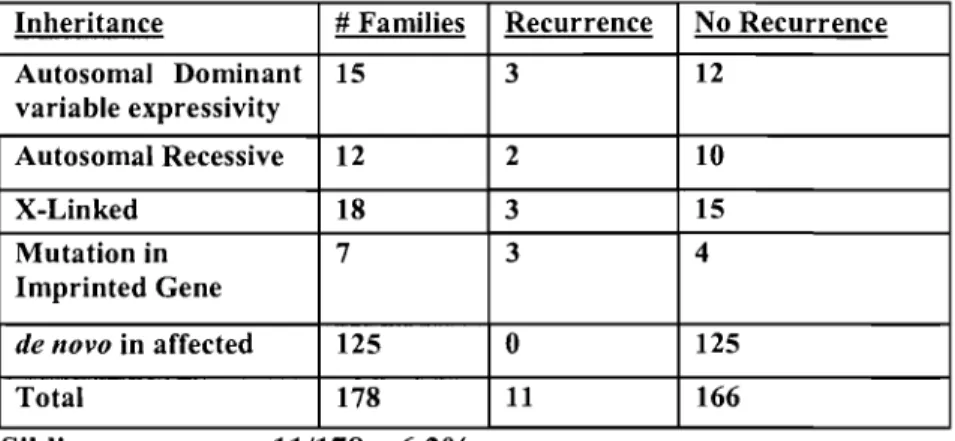
mutations model mentioned above. An example of how the DNM model could hypothetically provide the observed sibling recurrence rate is shown in Table 1.
Table 1 : Hypothetical example of an AD patient cohort that leads to the empirically observed values for sibling recurrence.
Inheritance # Families Recurrence No Recurrence Autosomal Dominant 15 3 12 variable expressivity Autosomal Recessive 12 2 10 X-Linked 18 3 15 Mutation in 7 3 4 Imprinted Gene de novo in affected 125 0 125 Total 178 11 166 Sibling recurrence 11/178
=
6.2%The majority of these de nova mutations will occur in the affected
individuals and not be transmitted; however, they can be transmitted from unaffected parents to multiple affected siblings as a result of maternaI transmission of mutations on the X chromosome to male offspring16, 17 or of
gonadal mosaicism40, 41, which wou Id aU result in higher sibling recurrence rates.
In fact, the transmission pattern of the four genes discovered to be mutated in patients with AD (NLGN3, NLGN4, SHANK3, and NRXNl) aU fall within one of
the above categories. Furthermore, it is also theoreticaUy possible for transmission to occur from asymptomatic parents via autosomal recessive inheritance patterns, as well as through mutations in imprinted genes although specific examples of such are yet to be discovered.
Although perfect concordance is not observed between autistic MZ twins, this does not necessarily imply that a contribution of environmental factors must play a role in producing the AD phenotype in the affected twin. With the DNM model, discordance would occur as a result of X-linked inactivation69, predicting
that female MZ twin pairs will be more discordant than males, we are unaware of any data reporting separate concordance rates for male or female twin pairs.
Discordance between MZ twins would also occur from somatic mosaicism for a de novo mutation that occurred early in development in only one of the two
developing zygotes, or autosomal dominance with variable expressivity potentially resulting from stochastic events during embryogenesis.
These novel considerations of the DNM model present implications for genetic counseling. Parents of autistic children are often informed that the sibling recurrence rate of autism is between 5-10% when planning for their next chi Id. The DNM model predicts that the probability of future siblings being affected with autism is much higher when a second child is born with AD, as it shows that the underlying defect is being transmitted from one of the parents via one of the unknown transmission patterns mentioned in Table l (page 19).
2.2 Wide clinical spectrum associated with AD
Psychiatrists and psychologists are burdened with the task of collecting clinical information and developing diagnostic criteria for brain disorders. When examining a transient position on a scale of conti nuit y, su ch as a poorly
developing child with global brain dysfunction and a fluctuating vocabulary, it
becomes difficult to develop clinical categories and thresholds that will apply on
the genetic level. This is especially true when attempting to account for the
shifting landscapes of brain development into adolescence and adulthood.
Therefore, a wide clinical spectrum is present in ASD, where sorne individuals are
high functioning college students with above average IQs70, sorne can perfonn
astonishing memory feats and calculations 71, while others are non-verbal with
severe mental retardation involving self injurl. Co-morbidity with epilepsy is
estimated at approximately 30%30, 31, while a strict definition of macrocephaly is
observed in approximately 20% of children diagnosed with AD29.
This wide variation in clinical presentation is currently explained with polygenic inheritance of many common alle1es at multiple loci. These alle1es are
thought to combine in numerous pennutations to produce a vast array of hannful
phenotypes, the logistics ofwhich will be confronted in a later section.
When accounting for this clinical variation with the DNM model, the wide
variation in clinical presentation would be explained by new mutations in
numerous genes that function in multiple molecular pathways producing
phenotypes on a large spectrum. This spectrum makes it impossible to detennine
a boundary or threshold that will homogenize patients on the genetic level.
The clinical difficulty of homogenizing patients is even present in families
where a single mutation is responsible for the phenotype. The large family
a11eles to produce the AD phenotype, or are they more simply a reflection of the clinical difficulties surrounding the ability to define AD on a level that is consistent with the underlying biological origin? Linkage analysis of this family identified a single mutation in NLGN4 segregating in perfect X-linked transmission through a11 affected individuals, including obligate carriers with 100% penetrance17• This seems to indicate that this mutation is acting
monogenically, and the diagnostic disparities are more likely confounded by varying stages of development at diagnosis and clinical heterogeneity rather than the presence of additional alleles that produce the AD phenotype.
Admittedly, the DNM model does not apply to high functioning adults leading relatively normal lives. Many individuals are suggested to faU within the broad ASD spectrum based on personality characteristics that are held in common with some patients diagnosed with AD, such as social difficulties and the inability to accept changes in their lifestyle. Although the wanton eye may he able to identify parallels on the phenotypic level between a high functioning asocial coUege student and an individual with mental retardation that requires constant supervision, this does not necessarily mean that there is a connection between their conditions on the genetic level. Many of the se high functioning adults diagnosed with AD may carry a specific combination of common variants shrouded by environmental events that lead to social difficulties, just as any other individual may have a mix of common variants and environmental components that lead to their own hehavioural quirks. It thus becomes a philosophical question
as to whether their behaviour lies within the normal range of human variation.
This model is only meant to apply to individuals with a clear phenotypic developmental delay and mental retardation that progress into adulthood.
2.3 Failure of linkage and association studies to identify genes involved in AD There have been a very large number of association studies perfonned with the goal of identifying the common alleles that contribute to the autistic phenotype under the pretense of a polygenic model72• None of these have been
able to identify a single gene or variant with any considerable level of consistency. There have also been numerous linkage studies combining multiple small families that have produced inconsistent results, with linkage peaks spattered across the entire genome72• Although sorne regions have been replicated
across studies, none of them have ever been replicated consistently in all studies involved. The explanation provided for the inadequacy of these studies to produce digestible results involves the addition of more and more allelic variants that contribute a smaller and smaller portion of the phenotype. The infonnation gleaned from combining small families to perfonn linkage studies does in fact tell us that multiple loci are involved. Even under a monogenic model, a smal1 number of genes will produce consistent linkage peaks if the majority of cases resulted from low transmission of de novo mutations occurring on different
linkage peaks have not been observed, multiple loci throughout the genome must be involved, wh ether one considers a polygenic model or the DNM model.
A problem arises wh en one considers the utility of using association studies to identify AD genetic variants under both models. When viewed from the perspective of a polygenic model, association studies should be the ideal method to identify the loci that contribute to the AD phenotype, especially considering the recent validation of the technique in other complex traits 73-75. However, it should
be noted that the genetic variants identified using this technique were represented in adult onset disorders, in which little selection occurs against the phenotype.
Assuming the polygenic model explains the majority of cases, the inability to globally replicate association studies must result from either choosing the wrong loci to study, or from a high number of loci that only contribute small percentages of the phenotyPe which can vary based on the cohort of patients involved in the study. The solution to this problem would be to increase power by adding more patients to these studies as well as the investigation of many more loci in an effort to identify these variants. However, under the DNM model, it is evident that association studies will fail to identify these variants, as new penetrant mutations that are strongly selected against will never become in linkage disequilibrium with any genomic marker.
The inability of association and small family linkage studies to identify genetic variants can always be explained by adding additional contributing loci under a polygenic model. The question that must be posed is how much further
should this approach be taken before an alternative genetic mechanism IS
considered?
2.4 Consistent global prevalence
Obtaining complete, global disease prevalence data for AD has not been accomplished, as diagnostic disparities coupled with little clinical investigation of AD in certain regions is difficult. However, to date epidemiological studies have failed to conclusively reveal an uneven distribution of AD from any ethnic or socioeconomic background34, 76. One of the many perplexing aspects of AD is its
genetic basis, however an un-even global distribution is not observed. Under a polygenic model this could only be reconciled by the existence of allelic variants that confer a susceptibility to AD dating back to a common founder population for an of humanity, otherwise many pockets of the globe would be void of individuals with AD. These variants would have had to be spread globally through small human populations as they migrated to various locations around the world. Information gleaned from the International Hapmap project has shown that a considerable amount of human genetic variation is common between several populations around the globe, indicating that a substantial proportion of variants date back to a common founder population77. Therefore, on the surface the
concept seems plausible.
In small isolated founder populations, such as those likely found in our ancestral environment, the genetic variation is reduced with a concomitant
increase in homozygosity at all loci. This would mean that under a polygenic
model, the allelic variants that produce the AD phenotype must have combined
more frequently to produce individuals that would be modernly diagnosed as
autistic. In order for these variants to have remained globally consistent, there
could not have been any selection acting against them, nor any fixation by genetic
drift during small population migrations and settlements, otherwise an uneven
disease distribution would be presently observed.
Considering the refusaI of female chimpanzees to raise offspring that fail
to develop a maternaI bond, it is conceivable that there was a high degree of
selection against the autism phenotype in our evolutionary ancestral environment. It has even been proposed that parental selection played a large role in human
evolution, as raising children would have been difficult and expensive for hunter
gatherer communities78. It is noteworthy that the decision to care for and raise an
autistic chi Id is still difficult for many parents in the recent western cultural
environment, exemplified by the number of autistic children that are placed in
psychiatric homes. In our modem environment, autistic individuals frequently
survive to adulthood, yet strong negative selection still occurs against the
phenotype evidenced by the low AD reproductive rates79•
A gene pool is a reflection of successful reproductions between ancestral
genomes that were composed of allelic variants whose collective actions
conferred advantages to their historical possessors. The persistence of allelic
populations disagrees with evolution at the genetic level and would require an explanation. Considering the low transmission of the AD conferring allelic variants, it is thus very unlikely that a polygenic model could explain an ev en disease distribution around the globe.
It is possible that particular variants present in the maternaI and paternal lineage functioned properly/co-operated well separately in the ancestral gene pool, but can not execute the proper function when co-expressed in the same genome. For example, a poor fit between a corn mon neurotransmitter variant from one population, and a variant present within its receptor in another population could result in altered neurotransmission. In fact, this would be predicted in a species with many isolated populations where there is a considerable amount of genetic variation within populations rather than between populations. However, this is not the case with humans, and there is no evidence suggesting that parents of mixed ethnie backgrounds are more likely to have autistic children than families with homogenous ethnie backgrounds.
Analyzing this observed feature using the DNM mode 1, an even disease distribution is actually predicted, as mutation rates should not be considerably different between any specifie global populations.
2.5 Skewed male to female AD ratio
It is already commonly understood that males are more prone to developing the autistic phenotype than females, by a ratio of ~ 4: 132. Under a
polygenic model, it has been suggested that intrinsic differences between male and female brains on the psychologicallevel may account for the reasons why one sex is more vulnerable to the AD conferring allelic variants80. However, there is
currently no strong evidence to support this. Furthermore, there has been little evidence from the neuroscience field to explain how inherent anatomical differences between males and females would predispose one sex to the AD phenotype, given the same genetic background and relative proportion of genetic variants.
The DNM model wou Id actually predict an uneven sex ratio between males and females. When diploidy arose in our cellular ancestor, it likely conferred a selective advantage due to its protective mechanism against de nova mutations. The majority of de nova mutations that result in the production of a faulty protein will not display a phenotype, as its effects can be masked by the expression of the other allele. This is the case with aIl of the autosomes, however, in males the hemizygous X chromosome is exposed to the effects of every de
nova mutation that occur. It would also be predicted that females with only one
X-chromosome, such as a patient with Tumer's syndrome, would be at an increased risk for AD compared to other women, although we are unaware if su ch a study has been performed.
Furthermore, de nova mutations occurrmg on the X chromosome in females can be briefly transmitted to produce affected males, unless unfavourable X-inactivation produces a phenotype in females. However, it would be rare for the
transmission to occur through multiple generations, as the penetrant mutation is unlikely to be transmitted from male offspring.
2.6 Presence of autistic features in first degree relatives
Many studies have observed that first degree relatives of individuals diagnosed with AD can often show sorne of the phenotypic symptoms of autism as we1l81, 82. These studies have been carefully conducted with proper controls
and are able to consistently achieve statistical significance.
A polygenic model would explain this in terms of allelic AD variants for every autistic trait circulating in the population. The child diagnosed with AD would be considered unfortunate to have acquired by chance a higher number of these allelic variants, which caused him/her to surpass the threshold in the phenotypic triad (social interactions, language/communication and range of interests and activities). The existence and transmission ofharmful allelic variants through multiple generations has been discussed in a previous section.
It has also been suggested that the allelic variants predisposing to the phenotypic triad are inherited separatell3. However, this poses a perplexing
question: how do the allelic variants predisposing to the phenotypic triad tend to co-occur? The existence ofnumerous tightly linked haplotypes located throughout the genome containing c1usters of AD-conferring allelic variants that have managed to evade natural selection is unlikely. There could be an unknown mechanism that leads to this higher than expected co-segregation, or a synergistic
relationship between them. However, mutations in several genes have already been discovered whose global brain expression results in global deficits in all
hr d . . h h ' b ' c: h Il l' . 16 17 40 41 h' h
t ee omams Wlt out t e contn utlOn lrom ot er a e IC vanants ' , , ,w IC
questions the necessity of investigating this avenue.
Under the DNM model, the examples of clearly identifiable, carefuIly controlled observation of milder forms of autistic symptoms in first degree relatives cou Id result from X-linked inactivation in females, as weIl as autosomal dominant inheritance with variable expressivity. X-linked inactivation will produce a diverse array of phenotypes in female patients, dependent on the location of inactivation of the favorable chromosome. It is easy to imagine the implications of this if stochasticity resulted in the inactivation of the unaffected chromosome in only a portion of the brain of female carriers. This would conceivably result in various phenotypes depending on the function of the gene as weIl as the proportion and location of the expression of the mutant copy.
Autosomal dominant mutations in genes that are involved in embryonic development can result in an incredibly diverse array of phenotypes. Mutations in the Sonic Hedgehog protein (SHH), for instance, result in holoprosencephaly, a condition whose behavioural and cognitive phenotype can be similar to AD. Mutations in this gene can result in dramaticaIly different phenotypes, from cyclopia in one family member to slight midline abnormalities in the next84. If
the phenotype of mutant SHH-associated holoprosencephaly were defined on narrowed thresholds, there would undoubtedly be pure cases of
;, " i; li 1: Il ,
holoprosencephaly, with siblings showing the broader spectrum of holoprosencephalic features. The mechanism that leads to a phenotype with variable expressivity at most loci is unknown; it is therefore possible that other genetic variants as weIl as environmental factors may influence the AD phenotype when such a gene is mutated.
2.7 Lack of family history in majority of patients diagnosed with AD
The frequent occurrence of AD with no family history could be explained on multiple levels, depending on the particular family in question. In sorne families, the fluctuating diagnostic criteria as well as the difficulty of defining AD in adults that were not clinically assessed in their infancy, presents clear historical difficulties. However, in many families there is no history of mental retardation, or any phenotypes that could be confused with AD.
Under a polygenic model, multiple allelic variants would be assumed to be present within the maternaI and paternal lineages that culminate in an offspring with no symptoms ever described in distant relatives, the logistics of which have been dealt with in a previous section.
The DNM mode l, on the other hand, would predict that the majority of individuals diagnosed as autistic would have no family history because their mutation would be an isolated event. If this is the case, offspring of individuals with AD would have a much higher frequency of AD. However, no data have
been generated or analyzed in this regard since, as previously mentioned, the reproductive rate of autistic individuals is very low79.
2.9 Which model is more consistent with the data?
The DNM and polygenic models were presented separately as a means to show that the DNM model has the power to explain all of the data and observations surrounding the AD phenotype, whereas the polygenic model has several inconsistencies. However, this does not mean that polygenicity cannot play a role in AD. In fact, a polygenic model and the DNM model are not mutually exclusive. However, wh en coupled with the DNM model, the proportion of cases that will be explained by polygenic inheritance as well as the number of interacting variants must be far lower than is currently believed.
Although ASD represent a continuum on the phenotypic level, this does not necessarily imply the presence of a continuum at the genetic level. It is possible that numerous monogenic, dis crete genetic mutations can produce a large spectrum of inextricable phenotypes. This would make it almost impossible to create phenotypic subsets of patients that correspond to the underlying genetic mutation without the conceit of hindsight provided after the genetic mutation is identified in a particular patient. Evidence has already shown that de nova mutations play a role in the onset of AD; the current remaining question IS
2.10 Environmental component analyzed with both models
Several environmental agents have been studied for a potential association with AD, including the measles, mumps, rubella (MMR) vaccine, obstetric complications85, intrauterine bleeding, infection, caesarian deliverl6, as well as
the exposure to hannful substances such as Thalidomide87. To date, there are no
environmental agents or exposures that have been consistently replicated and definitively proven to lead to the AD phenotype, however examination of the DNM and polygenic models for AD can reveal the potential role for an environmental source or component.
Under a polygenic model for AD, it could be hypothesized that an environmental component may contribute to the phenotype by interacting with the disease causing alle1es. In fact, under a polygenic model one must envi sion individual cases in which an unknown environmental component is solely responsible for the phenotype given that the concordance rate between MZ twins is less th an 100%. It must be mentioned that individual cases where an environmental component is the sole causal factor is not mutually exclusive to the DNM model, however under this model the factors outlined in section 3.1 are more likely to create this imperfect concordance.
The DNM model largely precludes the role of an interaction between common genetic variants with an environmental component to produce the phenotype, however this does not eliminate an environmental component to AD. Environmental mutagens may raise a regional mutation rate, therefore predicting
that in regions such as Chemobyl, Nagasaki, and Hiroshima where an elevated level of environmental mutagens are present, a slightly increased incidence of AD would be discovered, although it is unlikely that such specifie localized epidemiological information has been tabulated. This also has an implication with respect to the recent increased prevalence observed with ADJ3. Future
studies may definitively determine whether an increased incidence of AD is at least slightly responsible for an increased global prevalence of AD, and not entirely due to fluctuating diagnostic criteria. The DNM model wou Id imply that this increase would be due to an environmental agent that influences the mutation rate, although this contribution is likely to be slight. Examining other monogenic disorders that result largely from de nova mutations is unlikely to produce significant results as the genomic size upon which the specifie mutation may arise is very narrow. However, with AD, where hundreds of genes may produce a vast spectrum of similar phenotypes, an increased mutation rate would likely influence the overall incidence of the disease. AIso, in the case of an autosomal dominant mutation that produces variable expressivity, environmental components may influence the phenotype and expression of the mutant allele.
3.0 Strategies and tools for gene identification
As previously mentioned, the importance of determining the genetic architecture is extremely important as different strategies will be used in different scenarios. Under the polygenic model, association studies will be the method of
choice, with linkage studies ideally restricted to larger families. Under the genetic architecture of the DNM model, different strategies must be employed to identify mutations in genes that produce the AD phenotype, as linkage and association studies are based on linkage disequilibrium, which cannot be fruitful unless there is transmission of these genetic variants.
To date, most research attempts to discover the underlying genetic component of AD have been based on a polygenic model using linkage analysis and association studies.
3.1 Linkage analysis
A general description of a classic linkage study is performed by examining the segregation of genome wide markers, either polymorphic micro satellite loci or single nucleotide polymorphisms (SNPs), through a large multiplex pedigree of affected and non-affected individuals. If these markers are examined in tandem, they allow the researcher to construct haplotypes whose transmission can be easily observed through the pedigree, and whose size becomes smaller with each transmission resulting from recombination events during meiosis. The selective transmission of sorne haplotypes to affected individuals vs. non-affected individuals allows the researcher to employa statistical analysis to determine the log of odds (LOD) that the disease allele, or mutation that causes the disease, is located within a given chromosomal loci on a specific haplotype. The LOD score will vary based on several conditions including the penetrance of the disease and
the type of analysis performed, and most importantly, the number of individuals in the pedigree.
Large multiplex pedigrees are exceedingly rare for AD which would either result from the low penetrance and requirement of multiple disease alleles in the case of the polygenic model, or the low reproductive rates of individuals with highly penetrant de nova mutations in the case of the DNM model. Only one
pedigree large enough to refine a haplotype interval to the point of mutation discovery has been identified worldwide, and was used to reconfirm the role of
NLGN4 as one ofmany causal genes for ADl7. The lack oflarge pedigrees has led
to a linkage strategy that involves combining sib-pairs from multiple families to examine the co-occurrence of haplotype sharing between affected siblings, regardless of whether the shared haplotype is common between different families (as mutations in the same gene on different haplotypes could lead to the AD phenotype). This strategy has been historically effective at identifying mutations in genes that lead to single gene disorders in which the phenotype is highly selected against, however in the case of AD this strategy has led to severallinkage peaks scattered throughout the genome, none of which are corn mon to every study. The distinction must be made at this point to c1arify the difference between a single gene disorder of which the phenotype is clinically homogenous, and the
DNM model for AD which states that a monogenic cause in multiple genes will account for the large spectrum observed in the clinically heterogeneous
reports at several loci scattered throughout the genome. There are certain loci that have been replicated in more than one study located at 7q21.2-q36.2, 16p12.1-p13.3, 6q14.3-q23.2, 2q24.1-q33.1, 17ql1.1-q21.2, lq21-q44 and 3q21.3-q2972•
3.2 Family based association studies
Association analysis is a powerful tool that can be used to identify common alleles in the population that may confer a risk for developing a particular disease. AIl association studies are based on the premise that a particular common marker in the gene pool (ideally a tandem segment of a particular arrangement of SNPs termed a haplotype) will be associated with the disease or in linkage disequilibrium with another variant that is associated with the disease. The most common type of association analysis used in AD research is the transmission disequilibrium test. This method examines the transmission of SNPs located within candidate regions from heterozygous unaffected parents to affected offspring. Transmission of a particular heterozygous SNP, perhaps a Cor T would be random, each allele being transmitted with a probability of 50%. However if only affected individuals are examined, an excess transmission of a C or T may be observed if a particular variant either contributes to the disease or is in linkage disequilibrium with a different contributing variant. This experimental strategy is beneficial as the effects of population stratification and requirement of population matched controls are eliminated, which can create false positives with traditional association analyses. This strategy bas been utilized in approximately
70 studies of AD cohorts as of August 2007 without leading to the identification of a single variant that is definitively associated with autism.
3.3 High resoJution anaJysis of de novo copy number variation
During the process of meiotic recombination, genetic information 1S
exchanged between the maternaI and paternal chromosomes. This process IS
beneficial from the evolutionary perspective as it breaks down linkage disequilibrium al10wing beneficial variants to escape negative selection of detrimental variants. However, it can often lead to cytogenetic anomalies su ch as duplications, deletions, and translocations. Depending on the genomic location and size that may affect several genes in tandem or in sorne cases may only involve a single gene. In many instances, the deletion or disruption of a gene may lead to the same phenotype as a point mutation that truncates the protein sequence. Therefore, techniques that provide high resolution of de novo copy
number variation and chromosomal anomalies can he used to identify a region containing a gene of interest. The coding regions of this gene can then he sequenced in a cohort of autistic patients for the presence of point mutations as a means of validation. This strategy has heen successfully employed to identify mutations in SHANK341•
3.4 Medical re-sequencing
If the DNM model accounts for the majority of patients with AD, large scale multi generational candidate gene sequencing projects would be the most efficient approach to identify mutations that produce the AD phenotype. Although financial restrictions may currently be prohibitive, it is now possible to identify a subset of candidate genes that may confer susceptibility to AD. For example, direct sequencing of candidate genes based on interactome maps, or genes belonging to a specific pathway or cellular structure, such as the synapse are currently plausible, whereas whole genome re-sequencing of 192 patients is currently out of the scope of all research labs. The success of this strategy relies heavily on the number of genes being screened as well as the number of subjects used in the study, which is unfortunately a direct reflection of the amount of financial assistance available. As sequencing costs decrease, the identification of
de novo mutations using sequencing technologies coupled with efficient
functional validation will ultimately be the future of gene identification strategies for idiopathic genetic disorders under strong negative selection.
3.5 Bioinformatics
The sequencing, mapping and subsequent online availability of the human genome project in 2001 has led to greater simplicity in identifying genetic variants and mutations that lead to disease88, 89. This project has led to a