Sedentary Behavior in Children by Wearable
Cameras: Development of an Annotation Protocol
Johanna M. H
€anggi, MSc,
1,2Simon Spinnler, MSc,
3Efstathios Christodoulides, PhD,
4Elke Gramespacher, PhD,
1Wolfgang Taube, PhD,
2Aiden Doherty, PhD
5,6Introduction:
There is increasing evidence that not all types of sedentary behavior have the same harmful effects on children’s health. Hence, there has been a growing interest in the use of wearable cameras. The aim of this study is to develop a protocol to categorize children’s wearable camera data into sedentary behavior components.Methods:
Wearable camera data were collected in 3 different samples of children in 2014. A develop-ment sample (3 children aged 4−8 years) was used to design the annotation protocol. A training sam-ple (4 children aged 10 years) was used to train 3 different coders. The independent reliability samsam-ple (14 children aged 9−11 years) was used for independent coding of wearable camera images and to esti-mate inter-rater agreement. Data were analyzed in 2018. Cohen’s k was calculated for every rater pair on a per-participant basis. Means and SDs were then calculated across per-participantk scores.Results:
A total of 41,651 images from 14 participants were considered for analysis. Inter-rater agreement over all raters over all the sedentary behavior components was almost perfect (mean k=0.85, 95% CI=0.83, 0.87). Inter-rater reliability for screen-based sedentary behavior (mean k=0.72, 95% CI=0.62, 0.82) and nonscreen sedentary behavior (k=0.69, 95% CI=0.65, 0.72) showed substantial agreement. Inter-rater reliability for location (k=0.91, 95% CI=0.88, 0.93) showed almost perfect agreement.Conclusions:
A reliable annotation protocol to categorize wearable camera data of children into sedentary behavior components was developed. Once applied to larger samples in children, this protocol can ultimately help to better understand the potential harms of screen time and sedentary behavior in children.Am J Prev Med 2020;59(6):880−886. © 2020 American Journal of Preventive Medicine. This is an open access article under the CC BY license (http://creativecommons.org/licenses/by/4.0/).
INTRODUCTION
R
elatively little is known so far about the potential
harmful or beneficial effects of screen time
1−3and sedentary behavior (SB).
4−6One reason for
this lack of knowledge is the limitation in the current
methods to assess different components of SB.
Compo-nents of SB are also called facets of SB, as described by
the Taxonomy of SB.
7For example, accelerometers are
unable to provide reliable information on the activity
type, posture, context, or location of SB, and self-report
methods have shown insuf
ficient validity in children.
8,9Wearable camera data provide information on SB
com-ponents in adults
10−15and are feasible for data collection
in large samples of children.
16−21From the1School of Education, University of Applied Sciences Northwest-ern Switzerland, Brugg, Switzerland; 2Movement and Sports Science, Department of Neurosciences and Movement Sciences, University of Fri-bourg, FriFri-bourg, Switzerland;3Department of Sport, Exercise and Health, University of Basel, Basel, Switzerland;4Sport and Exercise Science, School of Science, University of Central Lancashire (UCLan) Cyprus, Larnaca, Cyprus;5Big Data Institute, Li Ka Shing Centre for Health Information and Discovery, University of Oxford, Oxford, United Kingdom; and
6National Institute of Health Research Oxford Biomedical Research
Cen-tre, Oxford University Hospitals NHS Foundation Trust, John Radcliffe Hospital, Oxford, United Kingdom
Address correspondence to: Johanna M. H€anggi, MSc, Department of Epidemiology and Public Health, Swiss Tropical and Public Health Institute, Socinstrasse 57, 4051 Basel, Switzerland. E-mail:johanna.haenggi@swisstph. ch.
0749-3797/$36.00
https://doi.org/10.1016/j.amepre.2020.06.033
The process of annotating wearable camera data to
identify a certain component of SB is based on subjective
decisions made by the data analyst. Previous studies
assessing SB or other behavior components by wearable
cameras
13,14,16,19each developed an independent
anno-tation protocol. These studies aimed to categorize
physi-cal activity type,
13SB,
14travel behavior,
16and exposure
to food marketing.
19Up to now, no rigorous protocols
exist to extract reliable measures of components of
screen time SB, nonscreen time SB, and location from
cameras in children. Rigorous protocols are needed to
extract reliable measures of screen and nonscreen SB
components in children.
The aim of this study is to develop a standardized
pro-tocol to categorize children’s wearable camera data into
components of SB by applying existing categories
7and
exploring children
’s wearable camera data. The SB
com-ponents of interest were screen- and nonscreen-based
leisure-time SB and the location where the SB takes
place. The aim is to evaluate the inter-rater reliability of
this annotation protocol in the assessment of screen
time, SB, and location in children.
METHODS
Study Population
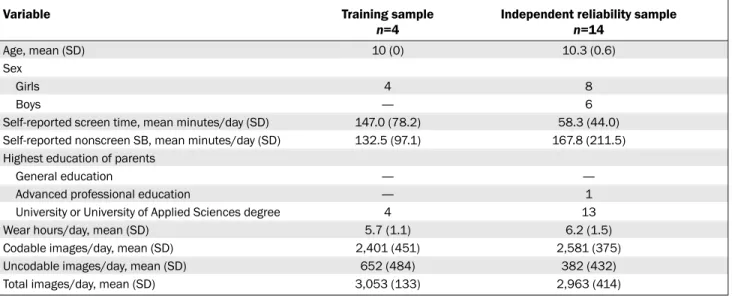
In 2014, a total of 336 children were asked to participate in the study to investigate contexts of activity behavior in children. The aim was to collect data from 40 children in 2 schools in Basel, Switzerland. The study was reviewed by the Ethics Review Board of the canton Aargau and granted an exemption from requiring ethics approval. To comply with data protection and privacy rules of participants and third parties, the study was reviewed by the Federal Data Protection and Information Commissioner in Swit-zerland. The procedures of this study adhered to the ethical framework proposed by Kelly et al.22for the use of wearable cam-eras in health-related research. A total of 3 researchers, 2 research-ers from Switzerland (JH, SS) and 1 researcher from Cyprus (EC) were involved in the development and application of the annota-tion protocol using different samples described inTable 1.
Measures
Data were collected from May to December 2014. SB was assessed by a wearable camera (Autographer). The Autographer captures
everyday life activities through afirst-person point-of-view per-spective.23,24It is a lightweight digital camera, worn around the neck, which automatically captures photographs throughout the day. The camera has a claimed battery life of 16 hours of continu-ous recording if capturing images once per minute and a storage capacity capable of approximately 32,000 images (8 GB). To cap-ture spontaneous movement patterns of children,25,26the image sampling rate was set to the highest rate of approximately 7 sec-onds. Children were asked to wear the camera for 7 consecutive days during leisure time. To respect the privacy of participants, their parents, and third parties, participants were allowed to (1) switch the camera off, (2) close the lens of the camera, or (3) remove the camera at any time. Children were told not to wear the camera during school time, in changing rooms, in common bathrooms, or in other situations where it might be inappropriate to wear a camera and third parties might be disturbed. All chil-dren were provided an information leaflet to carry with them dur-ing data collection in case they were asked about the camera. This gave third parties the possibility to contact the study investigators to ask questions or delete unwanted images. Self-reported screen time and nonscreen SB was assessed by the Adolescent Sedentary Activity Questionnaire.27
Development of the Coder Protocol
The annotation protocol was developed on the basis of the Inter-national Taxonomy of SB7 and the Compendium of physical activities in children.28The Taxonomy of SB refers to adult SB.
First, 3 researchers collected wearable camera data and screened their own images to identify visual cues for the annotation proto-col categories. Annotating self-proto-collected data offers the advantage of the researcher being more likely to deduce what behavior a set of images should be annotated with. Second, children’s image data of the development sample were screened to adapt the Tax-onomy of SB for child-specific behaviors, choose relevant annota-tion categories, and adapt visual cues.
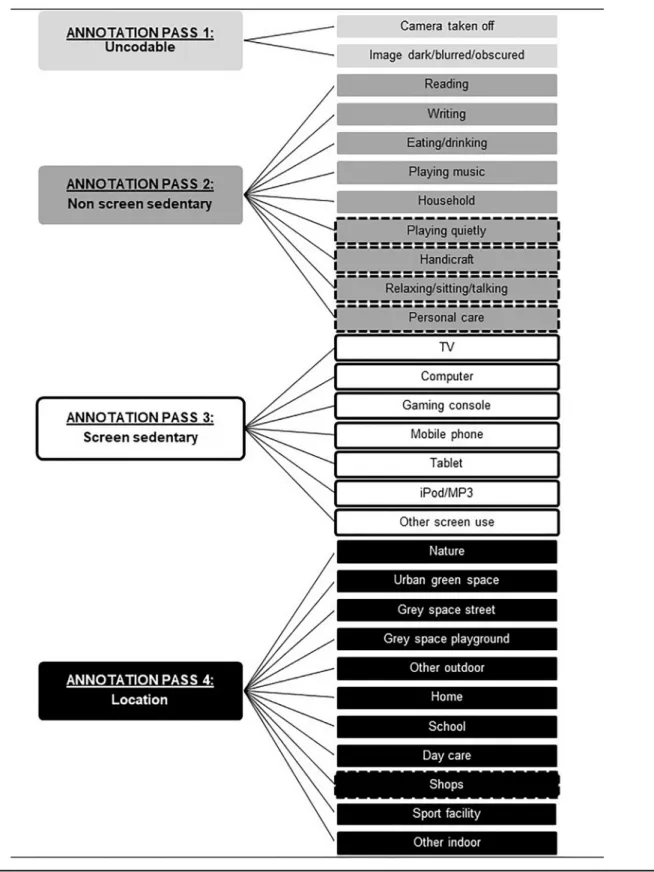
The annotation protocol was structured into different annota-tion passes (Figure 1). An annotation pass is an annotation cycle where a researcher goes through all the images and categorizes only the SB components specific to that pass. Except for the first pass, the uncodable pass, which discards all images that are not codable, each annotation pass referred to an SB subcomponent as described in the Taxonomy of SB. The second annotation pass was a sedentary nonscreen type, which included the subcompo-nents reading/memorizing, writing, eating/drinking, playing music, spiritual, household, playing quietly, handicraft, relaxing/ sitting/talking/lying down, and personal care. The third annota-tion pass was a sedentary screen type including the
Table 1. Samples Included in the Development, Training, and Reliability of the Children’s SB Annotation Protocol
Sample Purpose Recruitment Age range, years n
Development sample Data screening/Development
of coder manual
Convenience sample 30‒33
4‒8
3 researchers 3 children
Training sample Coder training 2 primary schools in Basel,
Switzerland 10 4 children 4 girls 0 boys Independent reliability sample Investigation of inter-rater reliability
2 primary schools in Basel, Switzerland
9‒11 14 children
8 girls 6 boys
Figure 1. Components and subcomponents annotated by the children’s SB wearable camera annotation protocol.
Note: Components surrounded by a dashed line are newly included components that were not included in the Taxonomy of SB by Chastin et al.7
An annotation pass is an annotation cycle where a researcher goes through all the images and categorizes only the SB components specific to that task. A total of 1 annotation pass looks only at 1 component at a time, which should make annotating the images easier for raters. This allows a rater to look only at certain subcomponents at a time and discard other components for the moment. This structure allows images to be annotated with multiple (sub)components. For example, an image can be annotated for the location in 1 annotation pass and simultaneously for screen-based behavior in the other annotation pass.
subcomponents watching TV, computer use, gaming console use, mobile phone use, tablet use, iPod/MP3 player use, cinema, and other. The fourth annotation pass was location including the out-door locations nature; urban green space; gray space street; other/ mixed; and the indoor locations home, school, daycare, shops, sports facility, and other.
After afirst version of the annotation protocol was developed, raters were asked to annotate data of the development sample. Wearable camera data were annotated using the Oxford wearable camera browser.29 This browser allows a researcher to view images, create behavioral episodes, and then annotate them as belonging to a certain SB component. Episodes can be annotated by applying the target SB category. On the basis of nominal group technique, which refers to an interactive cycle of blind coding fol-lowed by discussing all disagreement, which is resolved by group consensus,30the annotation protocol was continuously adapted, improved, and enhanced. Visual cues were defined to facilitate and objectify image annotation.
The annotation of events of≥5 consecutive images was chosen and not image by image. The advantages are that this is less time consuming than image-by-image annotation and longer episodes of SB will not be lost if they are interrupted by<5 images. The 5-image rule was defined as the following: activities will be split into episodic events, each containing≥5 images. The start of an event is thefirst image in a set of 5 (or more) consecutive images that depict the same component or where the researcher is almost cer-tain that the same component is occurring across the images. An event ends when an annotation component is no longer visible/ happening or interrupted by>5 images that show a different com-ponent.Appendix Figure 1(available online) displays an example of how events are split. This means that events of SB<5 images (approximately 35 seconds) are not captured.
Coder Training
Training of coders should result in a high inter-rater agreement between images annotated independently by different raters. This step included the annotation of the coder training sample of 4 children according to the children’s SB wearable camera annota-tion protocol. After the annotaannota-tion of every participant, image-by-image inter-rater reliability was calculated by a weighted Cohen’s k statistic.31A cross table was created to display disagreement
among raters. After discussing disagreements among raters and correcting annotations, adapting or clarifying the annotation pro-tocol, and visual cues, the calculation of Cohen’s k was repeated to see whether thek statistic improved. This process was repeated until the agreement between raters achieved a score of ≥0.81, which is considered an almost perfect level of agreement.32The final protocol is detailed inAppendix Text 1(available online).
Independent Reliability Sample
The aim was to evaluate the inter-rater reliability of this annota-tion protocol in the assessment of screen time, SB, and locaannota-tion in children when 3 different raters annotated each image indepen-dently. After coder training was completed, images of the inde-pendent reliability sample (n=14) (Table 1) were independently annotated by 3 different raters.
Statistical Analysis
Data were analyzed in 2018. Cohen’s k was calculated for all com-binations of rater pairs (rater A versus B, rater A versus C, and rater B versus C), on a per-participant basis, within and across all passes. Means and SDs of all the 3 rater pairs were then calculated across the relevant per-participantk scores. Statistics were calcu-lated using SPSS, version 24. Inter-rater reliability was interpreted using the guidelines of Landis and Koch.32
RESULTS
A total of 53,864 images were collected across 18 days in
14 participants aged 9−11 years.
Table 2
shows the
dem-ographics, mean number of images collected, and mean
wearable camera wear time per day for the training and
independent reliability samples.
For the independent reliability sample, 41,651 images
were independently annotated by 3 different raters. The
number of images annotated by each rater in each
anno-tation category is available in
Appendix File 2
(available
online).
Table 3
shows the number of images annotated
by each rater and the rater agreement for each and
over-all annotation passes. The average agreement across over-all
categories was
k=0.85 (95% CI=0.83, 0.87), which is
con-sidered almost a perfect agreement.
32An agreement of
k=0.91 (95% CI=0.88, 0.93) for location, k=0.72 (95%
CI=0.62, 0.82) for screen SB,
k=0.69 (95% CI=0.65, 0.72)
for nonscreen SB, and
k=0.73 (95% CI=0.63, 0.83) for
the uncodable category was observed.
DISCUSSION
In this study, an annotation protocol to categorize
wear-able camera data of children into components of SB was
applied. Substantial to almost perfect inter-rater
reliabil-ity was found across 3 different raters for almost all
annotation categories when applying the annotation
protocol on a sample of 14 children. Substantial to
almost perfect rater agreement was also found for the
separate annotation passes of the protocol. This
annota-tion protocol provides a tool that systematically guides
through the categorization process of wearable camera
data. It was demonstrated that different raters can apply
the same annotation protocol and achieve strong rater
agreement, which demonstrates face validity. This
sup-ports the use of wearable cameras for assessing SB
objec-tively.
A method to extract SB components from children’s
wearable camera data with high inter-rater reliability
was developed. The only annotation passes
<0.81 were
the sedentary nonscreen pass and the uncodable pass.
32Self-reports have shown limited validity in the
assess-ment of SB in children,
9and accelerometers are not able
to assess SB components; for example, the type of
behavior. Wearable cameras offer a new possibility to
assess SB components that are of strong interest because
current evidence indicates that not all types of SB have
the same negative health effects.
33,34An annotation protocol was developed by applying
the categories of the International Taxonomy of SB
7and
the exploration of wearable camera images observed in
free-living environments. A strength of this study was
that the development of the coding protocol was guided
by the structure of the Taxonomy of SB over which there
is a consensus among researchers for the description of
SB components.
7These components were adapted for
child-speci
fic behavior by exploring children’s wearable
camera data. This helped investigators to avoid missing
activities that could be of relevance in children’s
behav-ior and are not described by the Taxonomy of SB.
Another strength of the study is that the protocol was
developed on the basis of wearable camera data of
slightly younger children than those included in the
independent reliability sample. Younger children’s SB is
more interrupted, and episodes of continuous SB are
shorter. Interruptions of longer episodes of SB make
wearable camera data more dif
ficult to annotate and
therefore offer a good sample to stress test the
develop-ment of this annotation protocol. The good inter-rater
reliability indicates that 2 independent raters obtain a
comparable result when applying the coding protocol,
independent of the age group. This annotation protocol
can be used pragmatically in children aged
≥4 years.
Limitations
Not all SB components were assessed in this paper,
such as purpose, posture, and social components.
Nevertheless, this annotation protocol could assess
different types of leisure, screen time, and
environ-ment, which can help improve the understanding of
different components of SB. Although the annotation
protocol does allow the annotation of multitasking
behavior across different annotation passes, it does
not facilitate this within an annotation pass. For
example, eating while TV viewing can be annotated
in the nonscreen sedentary pass as eating and
simul-taneously as TV viewing in the screen time sedentary
pass, but using the mobile phone while watching TV
Table 2. Participant Demographics and Wearable Camera Wear Time for the Training and Independent Reliability Samples
Variable Training sample Independent reliability sample
n=4 n=14
Age, mean (SD) 10 (0) 10.3 (0.6)
Sex
Girls 4 8
Boys — 6
Self-reported screen time, mean minutes/day (SD) 147.0 (78.2) 58.3 (44.0)
Self-reported nonscreen SB, mean minutes/day (SD) 132.5 (97.1) 167.8 (211.5)
Highest education of parents
General education — —
Advanced professional education — 1
University or University of Applied Sciences degree 4 13
Wear hours/day, mean (SD) 5.7 (1.1) 6.2 (1.5)
Codable images/day, mean (SD) 2,401 (451) 2,581 (375)
Uncodable images/day, mean (SD) 652 (484) 382 (432)
Total images/day, mean (SD) 3,053 (133) 2,963 (414)
SB, sedentary behavior.
Table 3. Inter-rater Agreement After Independent Annotations of 14 Children’s SB Components by 3 Different Raters
Variable All passes,
Annotation pass 1: uncodable, Annotation pass 2: sedentary nonscreen, Annotation pass 3: sedentary screen, Annotation pass 4: location, k Mean (SD) k Mean (SD) k Mean (SD) k Mean (SD) k Mean (SD)
Raters A versus B 0.84 (0.07) 0.73 (0.40) 0.66 (0.08) 0.82 (0.27) 0.89 (0.12)
Raters A versus C 0.86 (0.06) 0.74 (0.28) 0.68 (0.12) 0.69 (0.32) 0.93 (0.07)
Raters B versus C 0.85 (0.05) 0.71 (0.33) 0.72 (0.10) 0.65 (0.38) 0.90 (0.08)
Averagea 0.85 (0.06) 0.73 (0.33) 0.69 (0.10) 0.72 (0.32) 0.91 (0.09)
aOver 42 observations (14 participants X 3 rater comparisons).
cannot be annotated simultaneously because these
activities belong to the same pass. In this case, the
primary activity has to be identified and annotated.
The average wear time in this study was only
approx-imately 6 hours per day owing to the setting of image
capture to a high frequency that resulted in shorter
battery life. This represents a relatively low wear
time, which means that some of the SB components
might not be captured fully. Other studies have
shown a median wear time of 10−13 hours per day
when
collecting
wearable
camera
data
in
children.
19,20,35Given the large amount of data that
wearable cameras produce, it would be helpful to
develop automated techniques to replace the
labor-intensive manual annotation process. Recent advances
in automated techniques for medical image
annota-tion have shown promise, and similar techniques
could be developed for wearable camera data.
36CONCLUSIONS
An annotation protocol for the annotation of SB
compo-nents in children was developed, and this study showed
that it is reliable and has face validity. Once applied to
larger samples in children, this protocol can help to
bet-ter understand the potential harms and benefits of
screen time and SB in children.
ACKNOWLEDGMENTS
The authors thank all participants and their parents for agree-ing to volunteer in this research. The authors also thank the school directors of the schools involved and the teachers who supported the study.
JH, EC, and EG were supported by the Federal Office of Sport in Magglingen, Switzerland and the School of Education at the University of Applied Sciences Northwestern Switzerland. SS was an external master student from the Department of Sport, Exercise and Health, University of Basel and worked without pay for his master thesis. EF was a visiting researcher at the University of Applied Sciences Northwestern Switzerland, work-ing without pay. WT is supported by the University of Fribourg, Switzerland. Equipment (wearable cameras and accelerome-ters) was founded by the University of Fribourg, Switzerland. AD is supported by the NIH Research Oxford Biomedical Research Centre.
JH and AD conceived the idea for the research. JH collected the data. JH, SS, and EC developed the annotation protocol. JH, SS, and EC annotated the image data. JH and AD conducted the statistical analysis. JH and AD drafted the manuscript. All authors contributed the editing and approving of thefinal ver-sion of the paper.
Nofinancial disclosures were reported by the authors of this paper.
SUPPLEMENTAL MATERIAL
Supplemental materials associated with this article can be found in the online version at https://doi.org/10.1016/j. amepre.2020.06.033.
REFERENCES
1. Orben A, Przybylski AK. The association between adolescent well-being and digital technology use. Nat Hum Behav. 2019;3(2):173–182.
https://doi.org/10.1038/s41562-018-0506-1.
2. The Lancet. Social media, screen time, and young people’s mental health. Lancet. 2019;393(10172):611. https://doi.org/10.1016/S0140-6736(19)30358-7.
3. Warburton W, Highfield K. Children and technology in a smart device world. In: Grace R, Hodge K, McMahon C, eds. Children, Families and Communities. South Melbourne, Victoria: Oxford Uni-versity Press, 2017:195‒221.
4. Stamatakis E, Ekelund U, Ding D, Hamer M, Bauman AE, Lee IM. Is the time right for quantitative public health guidelines on sitting? A narrative review of sedentary behaviour research paradigms and findings. Br J Sports Med. 2019;53(6):377–382. https://doi.org/ 10.1136/bjsports-2018-099131.
5. Chaput JP, Olds T, Tremblay MS. Public health guidelines on seden-tary behaviour are important and needed: a provisional benchmark is better than no benchmark at all. Br J Sports Med. 2020;54(5):308–309.
https://doi.org/10.1136/bjsports-2018-099964.
6. Stamatakis E, Ding D, Hamer M, Bauman AE, Lee IM, Ekelund U. Any public health guidelines should always be developed from a con-sistent, clear evidence base. Br J Sports Med. 2019;53(24):1555–1556.
https://doi.org/10.1136/bjsports-2018-100394.
7. Chastin SFM, Schwarz U, Skelton DA. Development of a consen-sus taxonomy of sedentary behaviors (SIT): report of Delphi round 1 [published correction appears in PLoS One. 2014;9(1)]. PLoS One. 2013;8(12):e82313. https://doi.org/10.1371/journal. pone.0082313.
8. Hidding LM, Altenburg TM, Mokkink LB, Terwee CB, Chinapaw MJM. Systematic review of childhood sedentary behavior question-naires: what do we know and what is next? Sports Med. 2017;47 (4):677–699.https://doi.org/10.1007/s40279-016-0610-1.
9. Lubans DR, Hesketh K, Cliff DP, et al. A systematic review of the validity and reliability of sedentary behaviour measures used with chil-dren and adolescents. Obes Rev. 2011;12(10):781–799.https://doi.org/ 10.1111/j.1467-789X.2011.00896.x.
10. Kelly P, Doherty A, Berry E, Hodges S, Batterham AM, Foster C. Can we use digital life-log images to investigate active and sedentary travel behaviour? Results from a pilot study. Int J Behav Nutr Phys Act. 2011;8:44.https://doi.org/10.1186/1479-5868-8-44.
11. Gemming L, Rush E, Maddison R, et al. Wearable cameras can reduce dietary under-reporting: doubly labelled water validation of a camera-assisted 24 h recall. Br J Nutr. 2015;113(2):284–291.https://doi.org/ 10.1017/S0007114514003602.
12. Pettitt C, Liu J, Kwasnicki RM, Yang GZ, Preston T, Frost G. A pilot study to determine whether using a lightweight, wearable micro-camera improves dietary assessment accuracy and offers information on macronutrients and eating rate. Br J Nutr. 2016;115(1):160–167.
https://doi.org/10.1017/S0007114515004262.
13. Doherty AR, Kelly P, Kerr J, et al. Using wearable cameras to catego-rise type and context of accelerometer-identified episodes of physical activity. Int J Behav Nutr Phys Act. 2013;10(1):22. https://doi.org/ 10.1186/1479-5868-10-22.
14. Kerr J, Marshall SJ, Godbole S, et al. Using the SenseCam to improve classifications of sedentary behavior in free-living settings. Am J Prev Med. 2013;44(3):290–296. https://doi.org/10.1016/j.amepre.2012.11. 004.
15. Leask CF, Harvey JA, Skelton DA, Chastin SF. Exploring the context of sedentary behaviour in older adults (what, where, why, when and with whom). Eur Rev Aging Phys Act. 2015;12:4. https://doi.org/ 10.1186/s11556-015-0146-7.
16. Kelly P, Doherty AR, Hamilton A, et al. Evaluating the feasibility of measuring travel to school using a wearable camera. Am J Prev Med. 2012;43(5):546–550.https://doi.org/10.1016/j.amepre.2012.07.027. 17. Beltran A, Dadabhoy H, Ryan C, et al. Dietary assessment with a
wearable camera among children: feasibility and intercoder reliability. J Acad Nutr Diet. 2018;118(11):2144–2153.https://doi.org/10.1016/j. jand.2018.05.013.
18. Signal LN, Smith MB, Barr M, et al. Kids’Cam: an objective methodol-ogy to study the world in which children live. Am J Prev Med. 2017;53 (3):e89–e95.https://doi.org/10.1016/j.amepre.2017.02.016.
19. Signal LN, Stanley J, Smith M, et al. Children’s everyday exposure to food marketing: an objective analysis using wearable cameras. Int J Behav Nutr Phys Act. 2017;14(1):137. https://doi.org/10.1186/s12966-017-0570-3.
20. Chambers T, Pearson AL, Kawachi I, et al. Kids in space: measuring children’s residential neighborhoods and other destinations using activity space GPS and wearable camera data. Soc Sci Med. 2017;193:41–50.https://doi.org/10.1016/j.socscimed.2017.09.046. 21. Smith C, Galland BC, de Bruin WE, Taylor RW. Feasibility of
auto-mated cameras to measure screen use in adolescents. Am J Prev Med. 2019;57(3):417–424.https://doi.org/10.1016/j.amepre.2019.04.012. 22. Kelly P, Marshall SJ, Badland H, et al. An ethical framework for
auto-mated, wearable cameras in health behavior research. Am J Prev Med. 2013;44(3):314–319.https://doi.org/10.1016/j.amepre.2012.11.006. 23. Doherty AR, Hodges SE, King AC, et al. Wearable cameras in health:
the state of the art and future possibilities. Am J Prev Med. 2013;44 (3):320–323.https://doi.org/10.1016/j.amepre.2012.11.008.
24. Hodges S, Berry E, Wood K. SenseCam: a wearable camera that stimu-lates and rehabilitates autobiographical memory. Memory. 2011;19 (7):685–696.https://doi.org/10.1080/09658211.2011.605591. 25. Bailey RC, Olson J, Pepper SL, Porszasz J, Barstow TJ, Cooper DM.
The level and tempo of children’s physical activities: an observational study. Med Sci Sports Exerc. 1995;27(7):1033–1041.https://doi.org/ 10.1249/00005768-199507000-00012.
26. Baquet G, Stratton G, van Praagh E, Berthoin S. Improving physical activity assessment in prepubertal children with high-frequency accel-erometry monitoring: a methodological issue. Prev Med. 2007;44 (2):143–147.https://doi.org/10.1016/j.ypmed.2006.10.004.
27. Hardy LL, Booth ML, Okely AD. The reliability of the Adolescent Sed-entary Activity Questionnaire (ASAQ). Prev Med. 2007;45(1):71–74.
https://doi.org/10.1016/j.ypmed.2007.03.014.
28. Butte NF, Watson KB, Ridley K, et al. A youth compendium of physical activities: activity codes and metabolic intensities. Med Sci Sports Exerc. 2018;50(2):246–256.https://doi.org/10.1249/MSS.0000000000001430. 29. Doherty AR, Moulin CJA, Smeaton AF. Automatically assisting
human memory: a SenseCam browser. Memory. 2011;19(7):785–795.
https://doi.org/10.1080/09658211.2010.509732.
30. Potter M, Gordon S, Hamer P. The nominal group technique: a useful consensus methodology in physiotherapy research. N Z J Physiother. 2004;32(2):70–75.
31. Fleiss JL, Cohen J. The equivalence of weighted kappa and the intraclass correlation coefficient as measures of reliability. Educ Psychol Meas. 1973;33(3):613–619.https://doi.org/10.1177/001316447303300309. 32. Landis JR, Koch GG. The measurement of observer agreement for
cat-egorical data. Biometrics. 1977;33(1):159–174.https://doi.org/10.2307/ 2529310.
33. Carson V, Hunter S, Kuzik N, et al. Systematic review of sedentary behaviour and health indicators in school-aged children and youth: an update. Appl Physiol Nutr Metab. 2016;41(6 suppl 3):S240–S265.
https://doi.org/10.1139/apnm-2015-0630.
34. Stamatakis E, Coombs N, Jago R, et al. Type-specific screen time associations with cardiovascular risk markers in children. Am J Prev Med. 2013;44(5):481–488. https://doi.org/10.1016/j.amepre. 2013.01.020.
35. Zhou Q, Wang D, Mhurchu CN, et al. The use of wearable cameras in assessing children’s dietary intake and behaviours in China. Appetite. 2019;139:1–7.https://doi.org/10.1016/j.appet.2019.03.032.
36. Li L, Liu Z, Huang H, Lin M, Luo D. Evaluating the performance of a deep learning-based computer-aided diagnosis (DL-CAD) system for detecting and characterizing lung nodules: comparison with the per-formance of double reading by radiologists. Thorac Cancer. 2019;10 (2):183–192.https://doi.org/10.1111/1759-7714.12931.