HAL Id: tel-02539162
https://tel.archives-ouvertes.fr/tel-02539162
Submitted on 9 Apr 2020HAL is a multi-disciplinary open access archive for the deposit and dissemination of sci-entific research documents, whether they are pub-lished or not. The documents may come from teaching and research institutions in France or abroad, or from public or private research centers.
L’archive ouverte pluridisciplinaire HAL, est destinée au dépôt et à la diffusion de documents scientifiques de niveau recherche, publiés ou non, émanant des établissements d’enseignement et de recherche français ou étrangers, des laboratoires publics ou privés.
Full-field multi-fidelity surrogate models for optimal
design of turbomachines
Tariq Benamara
To cite this version:
Tariq Benamara. Full-field multi-fidelity surrogate models for optimal design of turbomachines. Mechanics [physics.med-ph]. Université de Technologie de Compiègne, 2017. English. �NNT : 2017COMP2368�. �tel-02539162�
Par Tariq BENAMARA
Thèse présentée
pour l’obtention du grade
de Docteur de l’UTC
Full-field multi-fidelity surrogate models for optimal
design of turbomachines
Soutenue le 7 juillet 2017
Spécialité
:Mécanique Numérique : Unité de recherche en
Mécanique - Laboratoire Roberval (FRE UTC - CNRS 2012)
Université
de Technologie de Compiègne
École
Doctorale
Sciences pour l’Ingénieur
T
H È S E
En vue de l’obtention du grade de
Docteur
en Mécanique Numérique
de
l’ Université de Technologie de Compiègne
Soutenue le 7 Juillet 2017 par
Tariq
Benamara
Full-field
M ulti-Fidelity Surrogate
Models
for Optimal Design of
Turbomachines
Co-directeurs:
Piotr Breitkopf (Laboratoire Roberval - UTC)
Caroline Sainvitu (Minamo Team - Cenaero)
Jury :
Président:
Pierre Duysinx
- ULg
Rapporteurs:
Florian De Vuyst
- CMLA - ENS Paris-Saclay
Christian Gogu
- Institut Clément Ader
Éxaminateur:
Emmanuel Le François - UTC
Invités:
Virgile Marguin
- Safran Aircraft Engines
Christian Rey
- Safran Corporate Research Center
I would like to dedicate this thesis to: my father, Smaïl, my mother, Nacera, my loving wife, Ikram, and my delightful children Sofia and Smaïl,
Remerciements
Après le long et laborieux chemin parcouru, vient maintenant la partie la plus naturelle de ce travail car ces trois dernières années auront été tout sauf un voyage solitaire. Il est donc temps pour moi de remercier toutes les personnes qui ont participé à la réussite de ce projet tant sur les plans technique qu’humain.
Mes premiers remerciements iront à mes co-directeur et co-directrice de thèse Pr. Piotr Breitkopf et Dr. Caroline Sainvitu pour leur encadrement tout au long de ces trois années. Merci à eux pour leur disponibilité (parfois lors de relectures dans des délais improbables) et pour avoir su trouver le juste équilibre entre liberté d’action et rappel de la direction et des priorités. Nos nombreuses discussions, et leurs remises en question répétées auront participé très largement à la réussite de ce projet.
Je tiens également à remercier les membres de mon jury de thèse pour avoir accepté d’évaluer mes travaux et pour les nombreuses questions et discussions sur les résultats présentés. Plus particulièrement Pr. Pierre Duysinx pour avoir assuré la présidence de ce jury, Dr. Christian Gogu et Pr. Florian De Vuyst pour avoir assuré la lourde tâche de rapporteurs, ainsi que Pr. Emmanuel Le François pour avoir accepté de relire également mon manuscrit et pour les conseils enrichissants prodigués lors de l’analyse de mes résultats numériques. Je remercie également Virgile Marguin et Pr. Christian Rey pour l’intérêt industriel qu’ils ont manifesté en acceptant de participer à ce jury. Enfin, je tiens particulièrement à remercier Dr. Ingrid Lepot pour avoir cru en mes capacités et avoir poussé ma candidature lors de la mise en place de ce sujet de thèse. Ses questions et remarques toujours pertinentes auront participé, tout au long de ces trois années, à la réussite de ce projet et à la mise en place et l’analyse du cas test industriel de cette thèse.
Comment pourrais-je oublier également les nombreuses questions addressées à Pr. Pierre Villon qui aura su tempérer mon optimisme débordant lorsque nécessaire, mais aussi raviver ma confiance et mon intérêt dans les justifications
mathématiques ponctuant ce manuscrit. Merci pour sa disponibilité et pour l’estime qu’il a toujours porté à mes questions et travaux, y compris lorsque je le dérangeais en congé avec des questions d’étudiant aux lacunes théoriques innombrables. Je profite de ces lignes pour remercier également mes collègues du laboratoire Roberval pour leur aide et avec qui j’ai pris plaisir à échanger, nommément Liang Xia, Liang Meng, Anna Madra, mais aussi Profs Catherine Vayssade, Pierre Feissel, Delphine Brancherie, Alain Rassineux pour ses précieux conseils en matière de formation et Brigitte Duch pour ses indications et rappels dans les différentes tâches administratives.
Je remercie également mes collègues de Cenaero (passés ou présents), tout d’abord Philippe Gueuzaine et Caroline Sainvitu pour m’avoir respectivement accepté au sein du laboratoire et intégré à l’équipe Minamo. Je remercie également mes compagnons de fortune et d’infortune dans l’équipe de développe-ment, “Cha” Beauthier, “Chr” Dumeunier, “Paulo” Beaucaire et “Dédé” Chocat pour avoir rendu ces trois années agréables tant in-situ qu’à distance. Merci également pour vos encouragements dans les périodes les plus sombres de ces travaux et bien-entendu pour votre aide que ce soit pour comprendre comment la “constness” d’un attribut de classe virtuelle référencé par un poin-teur intelligent pouvait créer une erreur de compilation trois fois par semaine passé 19h30, comprendre les subtilités des différentes méthodes d’optimisation découvertes au gré de ma recherche bibliographique ou encore m’expliquer et m’expliquer encore la différence entre optimisation robuste et fiabiliste... Il me serait également impossible d’oublier les différentes explications reçues (parfois tard le soir) sur l’écoulement dans les turbomachines, la CFD, la mécanique, l’art de la compilation, et bien d’autre sujets... Je souhaite donc saluer ici toutes les personnes (en m’excusant auprès de celles que j’oublierai) que j’ai dérangé par mes questions incessantes et qui ont toujours répondu avec le sourire : Farid Benyoucef, Ash Mahajan, Koen Hillewaert, Lieven Baert, Michaël Leborgne, Timothée Lonfils, Jean-François Thomas, Chloé Dumont, Pierre Schrooyen, Michel Rasquin, Nicolas Poletz, Danielle Coulon, Kevin Mailleux, Laurent Brognara... Enfin, je souhaite addresser un “tout grand merci” à mes collègues de Cenaero qui rendent les journées de travail très agréables et qui ont supporté mes plaintes incessantes parfois en pleine pause café : Eric Wyart, Benoit Wucher, Larbi Arbaoui, Olivier Pierard, Rebecca Nakhoul, Laurent Cadet, Jean-Pierre Lefèbvre, Florent Grisonnet, Séver-ine QuSéver-inet, Landry De Wulf, et Benoit Dompierre qui n’a parfois eu comme covoitureur qu’un loir ou qu’un râleur fustigeant son code ou (et) celui des autres... Les financements octroyés par l’Association Nationale Recherche Technologie
v et le groupe Safran ont permis le déroulement de cette thèse. Je souhaite remercier plus précisément l’ensemble de l’équipe méthodes de Safran Aircraft Engines pour les diverses interactions, et plus particulièrement Mickaël Meu-nier, Jean Coussirou et Abdelkader Otsmane pour leur encadrement respectif. Certains professeurs ou encadrants ont laissé une empreinte particulière dans mon cursus universitaire, et m’ont implicitement ou explicitement guidés vers une thèse de doctorat. Je tiens ici à remercier certains d’entre eux, en commençant par rendre hommage au professeur Pierre Comte dont les cours passionnés et passionnant ont eu un impact certain sur mes choix de carrière. Je veux égale-ment remercier professeurs Jacques Borée, Eric Lamballais, Yves Gervais, Guillermo Paniagua, Jean-Camille Chassaing, et Arnaud Antkowiak.
Je remercie également mes amis qui se sont intéressés à mes discussions parfois déconnectées et ont prêté une oreille attentive à mes questionnements de thésard, plus particulièrement Fodhil Sidi-Moussa pour sa curiosité sans faille et nos nombreux échanges techniques, Erwan Audebert qui a osé se lancer dans la relecture d’un manuscrit en pleine ébauche, Bertrand M Bondo qui a relu consciencieusement mes articles avant soumission, et Mehdi Houhou qui m’a fait le plaisir de venir me supporter lors de ma soutenance.
Enfin je tiens ici à remercier ma famille sans qui ce travail n’aurait pas été possible. Je remercie tout d’abord mes parents pour leur soutien inconditionnel malgré des choix parfois “inexplicables”. Avoir avec moi ma mère le jour de ma soutenance aura été source d’une joie sans limite. Enfin une pensée particulière pour ma femme Ikram qui m’a suivi et supporté dans cette aventure, ainsi que nos deux enfants Sofia et Smaïl. Ce travail n’aurait pas été possible sans son dévouement et je lui suis reconnaissant pour son soutien malgré toutes les contraintes que cela a pu engendrer. Je remercie également nos enfants pour m’avoir permis de garder le sens des priorités dans les moments les plus difficiles, et m’avoir gratifié de fous rires rafraichissants. Vous avoir avec moi le jour de ma soutenance en fera un souvenir inoubliable.
Abstract
Optimizing turbomachinery components stands as a real challenge despite recent advances in theoretical, experimental and High-Performance Computing (HPC) domains. This thesis introduces and validates optimization techniques assisted by full-field Multi-Fidelity Surrogate Models (MFSMs) based on Proper Orthogonal Decomposition (POD). The combination of POD and Multi-Fidelity Model-ing (MFM) techniques allows to capture the evolution of dominant flow features with geometry modifications.
Two POD based multi-fidelity optimization methods are proposed. The first one consists in an enrichment strategy dedicated to Gappy-POD (GPOD) models. It is more suitable for instantaneous low-fidelity computations which makes it hardly tractable for aerodynamic design of turbomachines. This method is demonstrated on the flight domain study of a 2D airfoil from the literature.
The second methodology is based on a multi-fidelity extension to Non-Intrusive POD (NIPOD) models. This extension starts with a re-interpretation of the Constrained POD (CPOD) concept and allows to enrich the reduced space definition with abondant, albeit inaccurate, low-fidelity information.
In the second part of the thesis, a benchmark test case is introduced to test full-field multi-fidelity optimization methodologies on an example presenting features representative of turbomachinery problems. The predictability of the proposed Multi-Fidelity NIPOD (MFNIPOD) surrogate models is compared to classical sur-rogates from the literature on both analytical and industrial-scale applications. Fi-nally, we employ the proposed tool to the shape optimization of a 1.5-stage booster and we compare the obtained results with standard state of the art approaches.
Résumé
L’optimisation des différents composants d’une turbomachine reste encore un sujet épineux, malgré les récentes avancées théoriques, expérimentales ou informatiques. Cette thèse propose et investigue des techniques d’optimisation assistées par méta-modèles vectoriels multi-fidélité basés sur la Décomposition aux Valeurs Propres (POD). Le couplage de la POD à des techniques de modélisation multi-fidélité permet de suivre l’évolution des structures dominantes de l’écoulement en réponse à des déformations géométriques.
Deux méthodes d’optimisation multi-fidélité basées sur la POD sont ici proposées. La première consiste en une stratégie d’enrichissement adaptée aux modèles multi-fidelité par Gappy-POD (GPOD). Celle-ci vise surtout des prob-lèmes associés à des simulations basse-fidélité à coût de restitution négligeable, ce qui la rend difficilement utilisable pour la conception aérodynamique de turbomachines. Elle est néanmoins validée sur une étude du domaine de vol d’une aile 2D issue de la littérature.
La seconde méthodologie est basée sur une extension multi-fidèle des modèles par POD Non-Intrusive (NIPOD). Cette extension naît de la ré-interprétation du concept de POD Contrainte (CPOD) et permet l’enrichissement de l’espace réduit par ajout important d’information basse-fidélité approximative.
En seconde partie de cette thèse, un cas de validation est introduit pour valider les méthodologies d’optimisation vectorielle multi-fidélité. Cet exemple présente des caractéristiques représentatives des problèmes d’optimisation de tur-bomachines. La capacité de généralisation des méta-modèles par NIPOD multi-fidélité proposés est comparée, aussi bien sur cas analytique qu’industriel, à des techniques de méta-modélisation issues de la littérature. Enfin, nous utilisons la méthode développée au cours de cette thèse pour l’optimisation d’un étage et demi d’un compresseur basse-pression et comparons les résultats obtenus à des approches à l’état de l’art.
Contents
Remerciements iii Abstract vii Résumé ix Table of Contents xi List of Figures xvList of Tables xix
List of Notations xxi
Abbreviations . . . xxi
Mathematical symbols . . . xxii
Aerodynamic notations . . . xxiv
1 Introduction 1
1.1 Background and motivations . . . 1
1.1.1 Motivation 1: Combine different levels of fidelity into MDO cycles . . . 3
1.1.2 Motivation 2: Develop multi-level enrichment of full-field surrogate models . . . 4
1.1.3 Motivation 3: Propose mulfi-fidelity optimization techniques 4
1.2 Outline . . . 5
2 Literature review 9
2.1 Aircraft engine and turbomachinery design . . . 9
2.1.1 Secondary flows in turbomachines . . . 12
2.2 Surrogate Based Optimization . . . 13
2.2.1 Provably convergent surrogate model management techniques 14
2.2.2 Gradient Based Optimization . . . 15
2.2.3 Evolutionary Algorithm based optimization . . . 15
2.3 Multi-fidelity surrogate modeling . . . 16
2.3.1 Corrective multi-fidelity surrogate models . . . 17
2.3.2 Co-Kriging related methods . . . 19
2.3.3 Radial Basis Function Network and Artificial Neural Net-work related methods . . . 19
2.3.4 Space Mapping techniques . . . 19
2.4 Reduced Order Models . . . 20
2.5 Surrogate Based Optimization in turbomachinery design . . . 22
2.6 Conclusions . . . 23
I
Theoretical development and methodology
25
3 POD based methodologies 27 3.1 Non-Intrusive POD . . . 273.1.1 Basics of POD . . . 28
3.1.2 Surrogates of the projection coefficients . . . 29
3.2 Constrained POD . . . 31
3.3 Gappy POD-based multi-fidelity modeling . . . 32
3.3.1 Multi-fidelity modeling and associated Gappy-POD technique 33 3.3.2 Illustration of the Gappy-projection operator . . . 35
4 Multi-Fidelity POD based model 39 4.1 Bi-level Proper Orthogonal Decomposition . . . 40
4.1.1 Concept introduction . . . 40
4.1.2 High-fidelity decomposition and centering snapshot selection 42 4.1.3 Low-fidelity enhancement . . . 43
4.2 Algorithmic implementation . . . 48
4.2.1 Multi-fidelity hierarchised basis construction . . . 48
4.2.2 Multi-fidelity surrogate models of the projection coefficients 49 4.3 Concluding remarks . . . 52
5 Enrichment criteria for GPOD surrogates 53 5.1 Gappy-POD enrichment criterion . . . 54
5.1.1 Algorithm . . . 55
5.2 RAE2822 Application case . . . 56
5.2.1 Multi-fidelity snapshots . . . 58
5.2.2 Design of Experiments and POD initialization . . . 58
5.2.3 Enrichment criterion . . . 59
CONTENTS xiii
5.3 Concluding remarks . . . 68
II
Industrial-scale surrogate modeling and optimization
of aerodynamic performances
69
6 Implementation of Multi-Fidelity NIPOD and analytical example 71 6.1 Surrogate Based Optimization . . . 726.2 Analytical example . . . 73
6.2.1 Problem definition . . . 73
6.2.2 POD bases comparison . . . 76
6.2.3 Surrogate modeling . . . 79
6.2.4 MFNIPOD assisted optimization . . . 81
6.3 Implementation . . . 83
6.4 Concluding remarks . . . 85
7 3D-rotor case presentation 87 7.1 Physical context . . . 88
7.2 Design space definition . . . 89
7.3 Flow field evaluation and multi-fidelity definition . . . 91
7.4 Design of Experiments . . . 95
8 Surrogate model prediction of 3D-rotor aerodynamic perfor-mances 97 8.1 Validation methodology and snapshot definition . . . 97
8.2 Comparison of single- and multi-fidelity POD bases . . . 99
8.3 Comparison of surrogate models on the prediction of aerodynamic quantities . . . 102
8.4 Discussion and groundwork for rotor optimization . . . 107
9 3D-rotor optimization 109 9.1 High- and low-fidelity driven RBFN assisted optimizations . . . 110
9.2 MFNIPOD assisted optimization . . . 114
9.2.1 Flow field comparison . . . 115
9.2.2 Comparison of shape deformations . . . 118
9.3 Discussion on numerical results . . . 120
Conclusions and perspectives 123
List of Figures
1.1 Distribution of Design Process Fidelity and Level of MDO [Giesing
and Barthelemy,1998]. . . 3
2.1 View of civil aircraft engine. . . 10
2.2 Impact of CFD on SNECMA fan performance, over a period of 30 years (from Escuret et al., 1998; X. D. Wang,2010) . . . 11
2.3 Secondary flows in axial turbomachinery. . . 12
2.4 “Classical” additive multi-fidelity framework for scalar quanti-ties [Balabanov et al.,1998; Perdikaris et al., 2015]. . . 18
2.5 Schematic view of the “Variable-Fidelity POD-based Reduced Order Model (ROM)”(from Mifsud,2008). . . 22
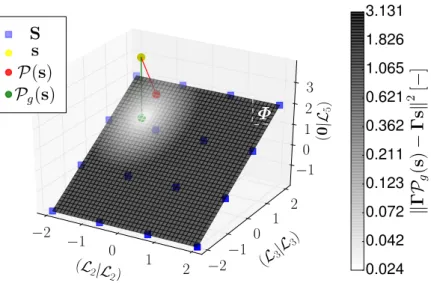
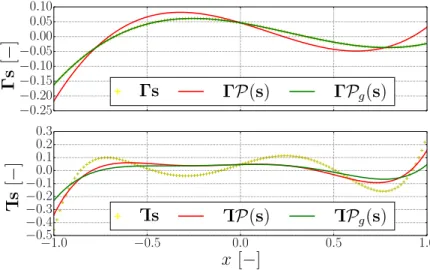
3.1 Illustration of the approximation procedure of the surrogate model. 30 3.2 Comparison of classical and gappy-projection for an arbitrary snap-shot outside the training ensemble of the multi-fidelity POD. . . 36
3.3 Low- and high-fidelity solutions with their classical and gappy-projection. . . 37
4.1 Proposed full-field hierarchised MFNIPOD framework. . . 41
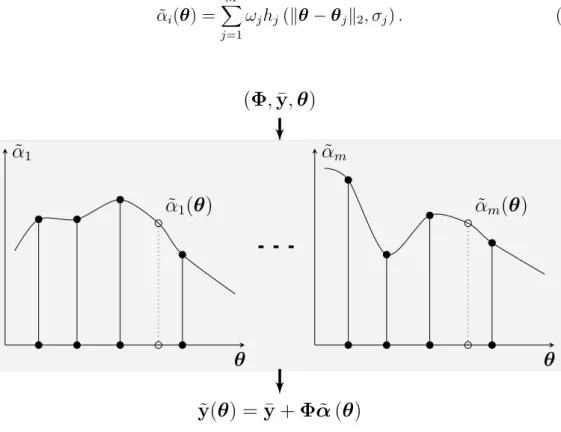
4.2 Illustration of the approximation procedure of the MFSM. . . 51
5.1 Mach number distribution around the airfoil RAE2822, study case 9 [Cook et al., 1979] : α∞= 2.79° and M∞= 0.73. . . . 57
5.2 Initial samples repartition over D and delimitation between shocked and shock-free configurations. . . 59
5.3 Comparison of POD and GPOD errors. . . 60
5.4 Reference criteria. . . 61
5.5 Comparison of enrichment strategies. . . 62
5.6 Low-fidelity (left) and high-fidelity (right) pressure distributions of 3 enrichment points according to the proposed δ-criterion. . . . 63
5.7 Low-fidelity (left) and high-fidelity (right) pressure distributions of 3 enrichment points according to the PBI+ criterion [Guénot et al.,
2013]. . . 64
5.8 Comparison of the evolution of the mean (solid line) and maxi-mal (dotted line) errors along iterations for the different enrichment strategies. . . 65
5.9 GPOD high-fidelity projection errorrk Γ Pg(s)− Γ sk2
k Γ sk2 after 12 iterations of PBI+ enrichment. . . . 65
5.10 Pressure distribution of low-fidelity poorly simulated experiments. . 66
5.11 Influence of the random initialization of 10 initial Design of Exper-iments (DoE) on the evolution of the GPOD prediction error of the high-fidelity data k Γ Pg(s)− Γ sk2
k Γ sk2 along with the enrichment strategy. . 67
6.1 Selection of 6 experiments in D and associated snapshots. . . 75
6.2 Comparison of high- (1st row) and low-fidelity (2ndrow) distribution
of the objective and constraints of Problem 6.3 . . . 76
6.3 Distribution of high-fidelity minimal value (objective) in the design space with hatched constrained areas (see Problem 6.3). . . 77
6.4 Comparison of single- and multi-fidelity POD bases w.r.t. to the 25 first modes of the ideal basis trained with 2601 evenly distributed snapshots. . . 78
6.5 Comparison of modeled constraint w.r.t. high-fidelity (grey and white circles locating respectively low- and high-fidelity training
samples, black line depicting c1 = 0, HAA=high argmin area,
LAA=low argmin area, TLCAS=top left corner added sample). . . 79
6.6 Comparison of computed (low- and high-fidelity) and modeled (NI-POD and MFNI(NI-POD) functions for θ = ( 4.16 , 13.92 ), with minimum points highlighted by colored circles. . . 80
6.7 Comparison of two modeled search spaces after the DoE phase. . . 81
6.8 20 first added new points during Radial Basis Function Net-work (RBFN) assisted (grey) and MFNIPOD assisted (white) inde-pendent optimizations. . . 82
6.9 Convergence history of the optimum value (mean and standard-deviation) with the number of iterations during the optimization processes . . . 82
6.10 Evolution of the distance between the best candidate of i-th itera-tion and the optimal soluitera-tion of Problem 6.3 . . . 83
LIST OF FIGURES xvii 7.1 Safran Aero-Booster’s engine with Low-Pressure Compressor (LPC)
highlighted (from Safran Aero Boosters, 2016). . . 87
7.2 Throughout view of the computational domain. . . 88
7.3 Isentropic Mach number (Mis) across rotor’s 10%-span section
(black line depicting sonic conditions). . . 89
7.4 Hub contouring definition. . . 90
7.5 Comparison of geometries and hub elevation on the rotor. . . 90
7.6 Comparison of low- and high-fidelity meshes (white line depicting
y+ = 1). . . . 92
7.7 Skin velocity profile on the rotor blade suction side. . . 93
7.8 Comparison of low- and high-fidelity near endwall flow behavior and relative helicity downstream the reference rotor blade. . . 94
7.9 Comparison of global objective ηisand contraint Πtotof the 1.5-stage
booster at on-design configuration. . . 95
7.10 Fixed computed and validation DoEs and Random generation of
training DoEs for surrogate model construction. . . 96
8.1 ρe distribution on coarse mesh nodes in the mixing planes (iso-range). 99
8.2 Energy decay of the POD bases ΦF associated to each conservative
variable. . . 101
8.3 Evolution of δ for each mode of ΦF computed for ρw in the mixing
plane R1–OGV. . . 102
8.4 Comparison of ρw distribution in the OGV outlet plane for one specific experiment of the validation DoE ΘV. . . 105
8.5 Comparison of adimensionalised error of relative helicity in the OGV outlet plane for one specific experiment of the validation DoE ΘV. . 106
8.6 RBF based ANalysis of VAriance (ANoVA) of rotor’s pressure ratio. 107
8.7 Difference between former and new post-processing planes and in-terpolation procedure. . . 108
9.1 Comparison of low- and high-fidelity driver for on-design isentropic efficiency optimization. . . 111
9.2 Hub profiling and blade sweep deformation of two low-driven optima (Reference blade in grey). . . 111
9.3 Hub profiling (∆R/s) and blade sweep deformation of two high-fidelity driven optima (Reference blade in grey). . . 112
9.4 Comparison of low- and high-fidelity hub profiling patterns (∆R/hubpitchangle (s)). . . . 112
9.5 Normalized total pressure at design point. . . 113
9.6 History of convergence of RBFN and MFNIPOD assisted optimiza-tions of the on-design isentropic efficiency. . . 114
9.7 Comparison of oil traces on the suction side of the rotor. . . 115
9.8 Comparison of skin velocity profiles at 75%-span on reference and optimized rotor blades. . . 116
9.9 Comparison of tip leakage vortices . . . 117
9.10 Comparison of Hub Corners . . . 118
9.11 Mean chord-scaled stacking deformation (∆X
c ) w.r.t. reference blade.119
9.12 Comparison of pitch-scaled platform deformation for MFNIPOD-and RBF-assisted optima. . . 120
List of Tables
3.1 Multi-fidelity / POD notations. . . 35
5.1 Aerodynamic and free stream conditions. . . 57
6.1 “Cross”-projection coefficients between Φ and Ψ. . . . 78
7.1 Mesh density and computational costs. . . 93
8.1 Compared bases and associated training set . . . 100
8.2 High-fidelity to modeled isentropic efficiency correlations rk
η over the
validation DoE ΘV . . . 103
8.3 High-fidelity to modeled total-to-total pressure ratio correlations rk
Π
over the validation DoE ΘV . . . 104
9.1 Correlation coefficient (r) between low- and high-fidelity estimated performances (1 − r values). . . . 110
List of Notations
Abbreviations
General
e.g. exampli gratia or “for example”
s.t. subject to (for constraint definition)
w.r.t. with respect to
HPC High-Performance Computing
RAM Random Access Memory
CPU Central Processing Unit (usage time defining the evaluation
cost)
UQ Uncertainty Quantification
PDE Partial Derivative Equation
CFD Computational Fluid Dynamics
RANS Reynold Averaged Navier-Stokes
LPC/T Low-Pressure Compressor/Turbine IGV/OGV Inlet/Outlet Guide Vane
Optimization
MDO Multi-Disciplinary Optimization
NLPP Non-Linear Programming Problem
MOO Multi-Objective Optimization
SOO Single-Objective Optimization
DFO Derivative Free Optimization
GBO Gradient Based Optimization
SVM/R Support Vector Machine/Regression RBF(N) Radial Basis Function (Network)
ANN Artificial Neural Network
GP Gaussian Process
DA Diffuse Approximation
(S/MF)DFSM (Single-/Multi-Fidelity) Data Fitting Surrogate Model
GESM Gradient Enhanced Surrogate Model
SMF/T Surrogate Management Framework/Technique
TRMM Trust Region Management Methodology
MFM Multi-Fidelity Model / Modeling (depending on the context)
(MF)SBO (Multi-Fidelity) Surrogate-Based Optimization
EGO Efficient Global Optimization
SQP Sequential Quadratic Programming
EA/O Evolutionary Algorithm/Optimization
(MF)DoE (Multi-Fidelity) Design of Experiments
S/MFSM Single-/Multi-Fidelity Surrogate Model/Modeling
LHS Latin Hypercube Sampling
LCVT Latinized Centroidal Voronoï Tesselation
LOO Leave One Out
ANOVA ANalysis of VAriance POD related acronyms
POD Proper Orthogonal Decomposition
CPOD Constrained POD
GPOD Gappy POD
NIPOD Non-Intrusive POD NIROM Non-Intrusive ROM MFPOD Multi-Fidelity POD HMFPOD hierarchised MFPOD MFNIPOD Multi-Fidelity NIPOD HMFNIPOD hierarchised MFNIPOD
ROM Reduced Order Model
PCA Principal Component Analysis
KLE Karhunen-Loève Expansion
SVD Singular Value Decomposition
Mathematical symbols
Remark: bold lower-case letters indicate vectors whereas bold capital letters indicate matrices. In case of scalar/vector/matrix with index or exponent, the font and case indicate the object type after index/exponent application (e.g. vi
calls the i-th vector v whereas yi refers to the i-th component of vector y).
M number of samples in a database
Mathematical symbols xxiii
S (nH + nL, M) sized matrix of concatenated full-field solutions
Y (n, MH) sized matrix of high-fidelity full-field solutions
Z (n, ML) sized matrix of low-fidelity full-field solutions
s (nH+nL) sized concatenated low- and high-fidelity full-field solution (snapshot)
y (nH) sized high-fidelity full-field solution (snapshot)
z (nL) sized low-fidelity full-field solution (snapshot)
m number of modes after truncation
n dimension of the output space described by χ
p dimension of the design space
Algebra
I(·) Integration function extracting the quantities of interest from a
snap-shot
Im · Image or Span of the basis ·
IR set of real numbers
IN set of nonnegative integers
[[a, b]] list of integers between a and b in IN
0, 0,−→0 zero vector v, v, −→v A vector variable
A, A A matrix variable
Id square identity matrix of dimension d
¯· mean or centering vector
˜· approximate scalar or vector
|·| absolute value of a scalar
k·k vector or matrix norm
k·kF vector or matrix Frobenius norm
Greek Letters
α vector of POD coefficients
β vector of GPOD coefficients
χ discretization of the numerical model yielding the “full-field”
solu-tions
Φ basis of single-fidelity proper orthogonal decomposition
Ψ basis of hierarchised multi-fidelity proper orthogonal decomposition
Φ basis of multi-fidelity gappy proper orthogonal decomposition
ζ a scalar quantity of interest
θ vector of design parameters in IRp
Θ (p, M) sized matrix containing M vectors of design parameters in IRp
Subscripts
L Low-fidelity
·i i-th column of a matrix
Superscripts
H High-fidelity
L Low-fidelity
⊥ matrix projection onto the high-fidelity POD basis
0 deviation from the mean or centering value (¯·)
? optimal value
> matrix transpose operator
Aerodynamic notations
Remark: Aerodynamic notations are mostly used in the examples (Section 5.2
and Chapters 7, 8, and 9).
CD drag coefficient CL lift coefficient
LE blade Leading Edge
P S blade Pressure Side
R hub platform radius
SS blade Suction Side
c blade Chord length
s hub pitch angle
y+ dimensionless wall distance
Greek Letters
Πtot total-to-total pressure ratio
ηis isentropic efficiency
ρe dimensionless internal energy
ρu 1st component of the dimensionless momentum
ρv 2nd component of the dimensionless momentum
ρw 3rd component of the dimensionless momentum
Chapter 1
Introduction
The research presented in this thesis, has been done in the frame of industry’s growing interest for automated optimization techniques. Particularly, the present work is partly funded by the engine manufacturer Safran Aircraft Engines. This introduction will now provide the motivations behind this work, as well as an overview of the thesis’s content.
1.1
Background and motivations
Many simulation-based optimization techniques have been developed and widely employed for the design of engineering systems. Among which, Multi-Disciplinary Optimization (MDO) has revealed itself a very effective tool for least-weight and high-performance designs, especially in aeronautics and aerospace engineering [I.
Kroo et al., 1994; Peoples and Willcox, 2006], or turbomachinery design
[Dorn-berger et al., 2000]. Most of the engineering design applications can be seen as numerical models of design variables θ the designer has control over on one hand and state variables y(θ) describing the physical state of the designed system on the other. The design problem is then formulated as the Non-Linear Programming Problem (NLPP):
min
θ Y(θ, y(θ))
s.t c (θ, y(θ)) ≤ 0. (1.1)
The computational burden associated to the resolution of Problem1.1depends
on many factors:
• the computational cost of the evaluation of y(θ), Y (θ, y(θ)) and c (θ, y(θ)); • the dimension of the design space θ;
• the order of dependence between θ and y. These factors are addressed in the present work.
In the recent years, there is an increasing use of high-fidelity numerical models within MDO frameworks. Nevertheless, as observed in Giesing and Barthelemy,
1998, or more recently in Brezillon et al., 2012, solving MDO problems based
on high-fidelity simulations can be very intricate. Many difficulties remain to be addressed such as
• the coupling of discipline dedicated high-fidelity solvers, • the robustness of remeshing strategies for shape optimization,
• the computational burden hardly fitting the requirements in terms of number of evaluations, especially in high-dimensional design spaces.
To this end, Surrogate-Based Optimizations (SBOs) represent a class of optimization methodologies able to alleviate some of the aforementioned
difficul-ties [Samad and K.-Y. Kim,2009]. As soon as Derivative Free Optimization (DFO)
is concerned, the main target of the designer is to find a gobal solution to the considered optimization problem. The main issue in using SBO in the context of global optimization in wide high-dimensional design spaces resides in the number of training samples required to reach acceptable discrepancy between the surrogate model and the “true” function of interest. Too small training samples could lead to a weak representation of the function to minimize or even introduce
false optima [Mehmani et al., 2015]. In this regard, Multi-Fidelity Surrogate
Modeling (MFSM) has become, in the past two decades, an active field of research within the MDO framework.
Whereas Multi-Fidelity Surrogate Models (MFSMs) are often referred to as hi-erarchised models and tagged as physics-based models, the large majority of Multi-Fidelity Modeling (MFM) techniques are “restrained” to the fusion of scalar data according to pre-defined kernel functions that are disconnected from the physical state of the optimized system. Keeping that in mind, and considering the increas-ing interest for Reduced Order Modelincreas-ing (ROM) techniques able to determine the dominant physical features of the optimized system, one comes up naturally with the idea that building physics based MFSMs can pave the way towards SBO reach-ing high-precision requirements while keepreach-ing the computational burden affordable for industrial problems.
1.1. BACKGROUND AND MOTIVATIONS 3
1.1.1
Motivation 1: Combine different levels of fidelity into
MDO cycles
Traditionally in turbomachinery design, the design cycles involve sequential re-finements of the considered product using simulation tools of increasing accuracy and costs. The first motivation of this work is to answer the need for surrogate models combining coarse and fine-simulations in order to integrate different levels of design in one conception step and make high-fidelity optimizations meet indus-trial requirements. In the case of turbomachinery design, the dimensionality of the optimizations engineers are running on a daily basis has been brought from less than 10 up to more than hundred variables in a few decades. In addition, the environmental and aircraft noise regulations now coerce aircraft engine man-ufacturers into fine tuning local and intricate physical phenomena early in their design cycles. This often involves taking into account flow features that are fully 3D and cannot be predicted by 2D or even quasi-3D simulations [B. Chen and Yuan, 2008], resulting in high-fidelity computations taking up to tens of hours for each experiment and design point. Under these conditions, one can easily
under-stand that observations made by Giesing and Barthelemy,1998 and illustrated on
Fig. 1.1 are at the heart of the first objective of this project.
Figure 1.1: Distribution of Design Process Fidelity and Level of MDO [Giesing and Barthelemy, 1998].
We target here the development of MFSMs able to extract as much informa-tion as possible from “cheap” simulainforma-tions to enable a wide explorainforma-tion of high-dimensional design spaces. Several impediments have to be lifted before
introduc-ing MFSMs into industrially capable SBO software solutions. We give here an attempt to reduce the burden carried out in order to build the surrogate training databases. This involves either reducing the number of training points at a given fidelity or reduce the fidelity of the simulations while maintaining the precision of the surrogate model.
1.1.2
Motivation 2: Develop multi-level enrichment of
full-field surrogate models
The second motivation of the thesis is to elaborate surrogate models able to capture the physics underlying the cost functions any optimization problem is working on (being objectives or constraints). We have this objective to respond designers calls for fast insight into the physical behavior of any experiment in the design space. By comparison to Data Fitting Surrogate Models (DFSMs), physics-based models should be able to build a fast estimate for the scalar quantities of interest of the optimization on the one hand, but also give the designer a rough idea on the physics associated to these estimated performances. Considering Proper Orthogonal Decomposition (POD) based models as best integrators of physics with respect to DFSMs, the target is, here, to propose a POD-based modeling technique coping with high-dimensional design spaces and costly evaluation tools. To this end, we attempt to create an improved POD-based surrogate model enriching sparse high-fidelity information with densely distributed low-fidelity data in the design space. As far as the author knows, this precise target has been enounced
only by Mifsud,2008; Mifsud, MacManus, et al.,2016 where both high- and
low-fidelity information are fused together to construct the POD modal basis regardless of the level of precision of each training full-field simulation. In multi-fidelity modeling, a carefull attention has to be given to the correlation between low- and high-fidelity solutions to build an efficient methodology. Therefore, in order to soften the constraint on low- to high-fidelity correlation, we propose to tag the training snapshots with respect to their level of precision during the POD basis construction.
1.1.3
Motivation 3:
Propose mulfi-fidelity optimization
techniques
The last motivation of this thesis, but not the least, pertains to the efficient inte-gration of the developed MFSMs into online optimization schemes with dedicated infill strategy. This is the cornerstone of any successfull industrial optimization. When dealing with design problems involving very expensive evaluation tools, one has to select the computed experiment parsimoniously. MFSMs are intended to
1.2. OUTLINE 5 enlarge the amount of information used for the model training but trying to build computationally affordable models while ensuring a good precision in every inter-esting area of the design space is pointless as soon as no precise expert knowledge is available. To address this issue, an infill strategy and its associated ranking criterion are proposed. They are both adapted to full-field MFSMs. This last objective will pave the way towards efficient optimization of complex engineering systems. Finally, to demonstrate the reached situation within this thesis project, we target a challenging turbomachinery design.
1.2
Outline
In the current chapter, we have presented the motivations of this research investigating the extension of Reduced Order Models (ROMs) to the multi-fidelity paradigm. The second step targeted in this work is the coupling of full-field MFSMs with Evolutionary Algorithms (EAs) in dedicated SBO strategies and reduce the overall computational burden of turbomachinery design tasks. The work done in this thesis is naturally divided into two parts.
In Chapter 2, we start presenting literature related to the applications and
developments proposed. Section 2.1 reviews the state of the art on aircraft
engine and turbomachinery design. A short introduction to secondary flows
in turbomachinery is given in Section 2.1.1. Sections 2.2 and 2.3 respectively
review SBO techniques and MFSMs. After presenting a choice of ROMs used
in the frame of SBOs in Section 2.4, we finally give literature on SBO applied
to turbomachinery design in Section 2.5. Some rationales behind the strategies
developed in this thesis conclude this chapter.
The first part describes the methodologies developed in this work. The second part pertains to the application of the developed methodology to an industrial-scale turbomachinery optimization problem. The remainder of the thesis is organised as follows:
Part I : Theoretical development and methodology
Chapter 3 primarily presents and re-interprets existing methodologies based on
POD. Section 3.1 describes the POD and Non-Intrusive POD (NIPOD) methods,
along with the chosen notations employed in the proposed extension. Engineering optimizations being usually defined with scalar quantities as objectives or contraints, the Constrained POD (CPOD) has been introduced to interpolate
these quantites despite non-zero truncation error. This technique is presented in Section3.2in order to detail the intellectual grounds of the proposed multi-fidelity
extension. Finally, Gappy-POD (GPOD) is re-interpreted in Section 3.3.1 in
order to propose a dedicated enrichment strategy in the coming chapters.
In Chapter 4, the multi-fidelity extension to NIPOD surrogate models is
developed. The main contribution of this work is then theoretically developed in Section4.1 yielding a hierarchised multi-fidelity extension to NIPOD models. The main steps of the proposed methodology are then wrapped up into algorithms
detailed in Section 4.2 in order to help the interested reader implement the
presented developments. Chapter 4 ends up with some preliminary conclusions
highlighting the main differences with existing approaches.
The performance of a Multi-Fidelity SBO (MFSBO) framework highly depends on the capability of the method to smartly select the level of fidelity needed to maximize, at every iteration of the overall process, the computational cost to surrogate discrepancy reduction ratio. In order to ease the integration
of the multi-fidelity GPOD method proposed by Toal, 2014 within an online
SBO framework, Chapter 5 presents an infill strategy dedicated to this type of
surrogates. The multi-fidelity methodology [Toal, 2014] is primarily described
and reformulated. The GPOD approach [Everson and Sirovich, 1995] is also
illustrated as being the grounds of the investigated multi-fidelity framework. A dedicated enrichment criterion, is then proposed and associated to an infill
strategy summarized in the algorithm in Section 5.1. The proposed enrichment
strategy is tested on the flight domain study of a transonic 2D airfoil. Some
preliminary conclusions end up Chapter 5, as well as perspectives for infill
strategies dedicated to full-field MFSMs as proposed in Chapter4.
Part II : Industrial-scale surrogate modeling and optimization of aero-dynamic performances
Chapter 6 presents the coupling of the proposed full-field MFSM developed in
Chapter 4 within an evolutionary SBO scheme. To our best knowledge, no
analytical example applicable to Multi-Fidelity NIPOD (MFNIPOD) surrogates is referenced in the literature. Therefore, an analytical 2D-example carefully developed to represent key features of turbomachinery optimizations is intro-duced. The proposed MFSBO framework is then used to illustrate the interest of physics-based MFSBO. The chapter ends up with details on the implementation of the proposed multi-fidelity framework within a pre-existing single-fidelity SBO tool, and some preliminary conclusions.
1.2. OUTLINE 7
In Chapter 7, the proposed industrial-scale application test case is introduced. It is derived from a previously published study and deals with the design of a multi-stage booster considering axial stacking and non-axisymmetric hub endwall deformations.
In Chapter 8, the predictability of the proposed multi-fidelity extension to
POD based surrogate models is primarily assessed. The performed analysis is detailed in Section 8.1. Section 8.2 compares the single-fidelity POD and Multi-Fidelity POD (MFPOD) bases in order to quantify the improvement allowed
by low-fidelity enhancement. In Section 8.3, the predictability of the proposed
MFNIPOD model is compared to both existing single- and multi-fidelity tech-niques. This is done on the evaluation of the on-design isentropic efficiency (ηis)
and pressure ratio (Πtot) of the rotating row in the presented booster. Section 8.4
closes the chapter with a discussion on the choices made in order to perform MFSBOs.
Chapter 9 presents the results of Radial Basis Function Networks (RBFNs)
and MFNIPOD assisted optimizations applied to the presented industrial ap-plication. As the chosen low-fidelity simulation is based on mesh coarsening of its high-fidelity counterpart, the impact of this coarsening is evaluated in
Section9.1by performing two RBFN assited optimizations, respectively with
low-and high-fidelity simulations. The presented MFSBO framework is then used in Section 9.2 to optimize the considered rotor blade, with carefull attention given
to the impact of deformations on the aerodynamics of the machine. Section 9.3
closes the chapter with a discussion about the impact of the chosen simulation tool and some concluding remarks.
GeneralConclusions and perspectives on furture research terminate the thesis. The research presented in Chapters 4, 6, and PartII gave rise to two full-size, peer-reviewed conference papers [Benamara, Breitkopf, Lepot, and Sainvitu,
2016b; Benamara, Breitkopf, Lepot, and Sainvitu, 2017], and a peer-reviewed research paper in Structural and Multidisciplinary Optimization [Benamara, Breitkopf, Lepot, Sainvitu, and Villon, 2017]. The content of Chapter 5 is mainly given in Benamara, Breitkopf, Lepot, and Sainvitu, 2016a.
Chapter 2
Literature review
In this chapter, we present literature related to the coming developments and the proposed industrial-scale application. Even though the targeted optimization techniques can be applied to a wide range of engineering systems, the present thesis takes root in the competitiveness of aircraft engine manufacturing domain. Therefore, it seems relevant to present shortly this targeted application first in Section2.1. Section2.1.1introduces literature dealing with secondary flows in tur-bomachines and particularly low-pressure compressors, main focus of this study.
Then, Sections 2.2, 2.3 and 2.4 respectively review Surrogate-Based
Optimiza-tion (SBO) methods, convenOptimiza-tional Multi-Fidelity Surrogate Models (MFSMs), and
a choice of Reduced Order Models (ROMs) with their application. In Section 2.5
turbomachinery optimizations using SBO techniques are reviewed. Finally, Sec-tion 2.6 concludes the chapter with the selected orientations for this research and their underlying rationales.
2.1
Aircraft engine and turbomachinery design
Following the definition given by Gorla and Khan, 2003, a “Turbomachinery is
a device in which energy transfer occurs between a flowing fluid and a rotating element due to dynamic action, and results in a change in pressure and momentum of the fluid”. In axial machines, the rotating element (or rotor) is composed of
several rows of rotating blades and is acting together with inserted static rows of blades composing the stator. Each couple of adjacent stator and rotor rows consists in a stage as illustrated by the red mark on Fig. 2.1b. Figure 2.1 shows a classical turbofan mainly composed of:
1. Fan : ensuring almost 80% of modern engines thrust; 9
2. Compressor : increasing both total pressure and temperature of the air pass-ing through the engine core;
3. Combustor : burning the mixture fuel-compressed air to initiate gas accel-eration;
4. Turbine : transfering kinetic energy to the engine shaft causing the compres-sor’s spin;
5. Exhaust nozzle : mixing hot and fresh bypass air downstream the engine while limiting its noise emission.
(a) Cut view of the PW4000 air-craft engine FAN LPC HPC Spinner Outer Casing Splitter Air Inlet Stage (stator+rotor)
(b) Fan and compressor core of the CFM56-5A turbofan [Piscopo,2013]
Figure 2.1: View of civil aircraft engine.
The stages, mentioned earlier, compose the low- and high-pressure compressors on one hand and turbines on the other. The reader interested in more detailed information on Turbofan propulsion is referred to El-Sayed, 2008.
According to Meher-Homji, 2000, the birth of turbojet engines is located
between 1920 and 1930 and resulted in Sir Frank Whittle’s patent for jet engine. Three periods can be distinguished in nineteen century’s evolution of turbomachinery design. Before mid-1900’s, computational power was too low to consider numerical models higher in precision than 1D approximations. For this reason, engine designs were largely based on experiment and driven by strong asumptions, explaining relatively low performances. Between 1950 and 1980, 2D “through-flow-calculation” became the dominating method for turbomachinery
design [X. D. Wang, 2010]. After 1980’s, the increase in computational power
made turbomachinery studies affordable via newly developed Reynolds Averaged Navier-Stokes (RANS) simulations and their associated turbulence models. As
2.1. AIRCRAFT ENGINE AND TURBOMACHINERY DESIGN 11 simulations used for turbomachinery design “developed from 2D to 3D, from
planar cascade to annular cascade, from single blade passage to whole ring, from single stage to multi-stages”. The switch from 2D to 3D computations allowed
a better control over the blades design, as reported in Dang and Isgro, 1995;
Dang, Damle, et al., 2000. The increase in fidelity is directly correlated to an important increase in the modern engines performance, as illustrated on Fig. 2.2. For a review on the application of CFD for turbomachinery design, the reader is referred to Denton and Dawes, 1998 and Pinto et al.,2016.
Figure 2.2: Impact of CFD on SNECMA fan performance, over a period of 30 years (from Escuret et al., 1998; X. D. Wang,2010)
In their review article, Pinto et al.,2016investigate the computational methods involved in aerodynamic study for turbomachinery. They come to the conclusion that high-fidelity CFD numerical methods have reached a maturity allowing their daily use in engineering offices. The predictive capability of these methods en-ables the restriction of undesired features in the machine like strong secondary flows in turbines or corner separations in compressors. They also highlight the present trend to move from steady state single stage simulations to multistage and unsteady predictions. They finally emphasize the associated computational limitations, as unsteady computations tend to be conflicting with usual numbers
of evaluations required in any optimization campaign. Page et al., 2015 give an
overview of high-fidelity based turbomachinery automated design and optimiza-tion.
2.1.1
Secondary flows in turbomachines
In the recent years, the reduction of both weight and size of axial aircraft compressors has led to high stage loadings. This tends to increase the cross flow intensity as well as three dimensional separation phenomena. Figure2.3shows the expected secondary structures in axial turbomachinery. These structures mainly appear due to the interaction between the boundary layer with the Leading Edge (LE) of the blade.
(a) Secondary flow in a turbine (from Takeishi et al.,1990)
(b) Formation of hub-corner stall with separation lines (from Lei et al.,2008)
Figure 2.3: Secondary flows in axial turbomachinery.
Most of the literature on secondary flows in axial turbomachinery is dealing
with turbines [Denton, 1993; Langston, 2001] as the amplitude of the observed
structures is increased by higher thickness to chord ratios (mainly due to turbine internal cooling constraints), and their impact on the global performances of the machine is strenghtened by the flow acceleration accross the passage. The increase in static pressure in the near-LE stagnating point creates a descending / ascending flow impacting the low-momentum boundary layer on the hub / casing endwall. In the hub vicinity, the radial velocity gradient induces a vortex filament upstream of the rotor LE [Levchenya et al.,2010] that rolls up into the horseshoe
vortex when skirting the blade LE (see Fig. 2.3a and Reising, 2011). Another
overwhelming secondary flow occurs in the blade channel and is known as hub or casing passage vortices. In the low-momentum boundary layer on the bounding walls of the passage, the equilibrium streamlines are overturned yielding a cross
2.2. SURROGATE BASED OPTIMIZATION 13 flow going from the Pressure Side (P S) to the Suction Side (SS) of adjacent
blades [Colombo, 2011, Chapter 1 - Section 3]. Two spiralling motions are thus
originated and result in counter-rotating passage vortices that can also be linked to the corner vortex onset as they impact the boundary-layer on the blade surface. Depending on the inlet massflow rate at the considered operating point, the P S leg of the horseshoe vortex can cross over the passage and further complexify the passage vortex structure on one hand and interact with the SS leg of the horseshoe vortex from the adjacent blade on the other, as illustrated on Fig. 2.3a. The secondary flows in turbine and compressor rotors are slightly different even if the structures remain equivalent. Firstly, the turning observed in compressors is usually far below its turbine design counterpart despite an increase in the turning accross compressor blade rows in the last decades. Secondly, the fluid being accelerated accross the turbine stages, the secondary structures are stretched and their rotating kinetic energy is increased. Therefore, designs that delay the development of hub vortices are improving the turbine efficiency simply by reducing the impact of flow acceleration on the secondary flows. In compressor design, this streching is not observable as the mean axial velocity is reduced accross the compressor stages. On the contrary, the diffusion is responsible for an increased mixing of the vortices with the main stream in the passage. Another phenomenon called “three-dimensional separation” is also observed in
highly loaded compressor stages [Colombo, 2011, Chapter 1 - Section 4]. This
phenomenon occurs when the low momentum fluid in the boundary layer, going from P S to SS of adjacent blades, intersects the low momentum fluid on the suction surface hub corner and can be further induced by a descending flow on the blade surface [Gbadebo et al., 2005]. As illustrated on Fig. 2.3b, the cross flow between P S and SS of adjacent blades triggers the seperation of the fluid. This phenomenon can be further induced by shock-boundary layer interaction in the case of high turnings revealing locally supersonic hub sections.
2.2
Surrogate Based Optimization
Simulation-based optimization has proven to be an efficient tool to explore large design spaces and target important improvements in performances while keeping the design cycle duration within acceptable limits. Nevertheless, the involved computational burden is often shown to be prohibitive for complex industrial applications [Pinto et al., 2016]. In this section, we give an overview of different attempts of industrial optimizations involving SBO techniques aiming at drasti-cally reducing the number of costly evaluations by substituting an approximate
to the high-fidelity computational model. For complete review on the subject, the reader is referred to Keane and Nair, 2005; Queipo et al., 2005; Eldred and Dunlavy, 2006; Forrester, Sóbester, et al., 2007; Forrester, Sóbester, et al., 2008; Forrester and Keane, 2009; Koziel and Ogurtsov, 2014 or Viana et al.,2014.
The SBO paradigm is known to be an efficient approach to optimize cost func-tions estimated from computationally expensive computer codes [Queipo et al.,
2005; Forrester and Keane, 2009]. The main idea is to replace the direct
opti-mization by an iterative process involving the creation, the optiopti-mization and the update of a reasonably accurate analytical representation of the cost function that
is tractable for extensive evaluation [Koziel and X.-S. Yang, 2011, Chapter 3].
Conceptually speaking, the SBO procedure can be summarized as follows:
1. Generate the initial surrogate model trained on an a priori sampling of the high-fidelity model,
2. Obtain an approximate solution to Problem1.1 by optimizing the surrogate,
3. Evaluate the high-fidelity solution of the approximate optimum, 4. Update the surrogate model with the new high-fidelity point(s),
5. Stop the process if the arbitrary terminating conditions are met or go to step 2.
This sequence’s inner loop (steps 2 to 4) can be formulated as an iterative pro-cedure, as in Queipo et al., 2005; Koziel, Bandler, et al., 2006; Koziel and X.-S. Yang,2011:
θ?(i+1) = arg min
θ
˜
Y(i)(θ, yθ)) s.t ˜c(i)(θ, y(θ)) ≤ 0.
(2.1)
2.2.1
Provably convergent surrogate model management
techniques
The optimization subproblem solved at iteration (i) can be associated to a
trust-region constraint ∆(i). Depending on the order of consistency of the surrogate
model in the trust region surrounding the current optimum, the sequence of sub-problems optima is provably convergent as demonstrated in Alexandrov, Dennis, et al., 1998. Being based upon zero- or first-order consistent surrogate models, the SBO strategy can target the optimization of the surrogate of the original objective or an associated merit function, potentially integrating the original
2.2. SURROGATE BASED OPTIMIZATION 15 of SBO methods, we can mention the Approximation Model Management
Op-timization (AMMO) by Alexandrov and R. M. Lewis, 2001, and the Surrogate
Management Framework (SMF) of Booker et al., 1999 or Torczon and Trosset,
1998 associated to “pattern search” [Torczon, 1997] Derivative Free
Optimiza-tions (DFOs) that are more suited to first-order consistent models.
2.2.2
Gradient Based Optimization
Gradient Based Optimization (GBO) is often linked with direct optimization where a local search algorithm is based on the first-order derivative and eventually on the Hessian of the objective function. As mentioned earlier, this kind of strategy is untractable for industrial optimization problems associated to expensive evaluation tools. Nevertheless, we can integrate new types of surrogate modeling related methodologies into the class of GBOs:
• SBO techniques based on Gradient Enhanced Surrogate
Mod-els (GESMs) [Giannakoglou et al., 2006; Laurenceau and Sagaut, 2008;
Han, Görtz, et al., 2013; Zimmermann, 2013; L. T. Leifsson et al., 2016; C. Song et al., 2016]
• GBO methods sped up with the approximate gradient of the surrogate
model [Peri and Tinti, 2012; Bellary and Samad, 2014; Bahamonde et al.,
2016].
2.2.3
Evolutionary Algorithm based optimization
Another class of SBO strategies that originated in the mid-1980’s [Grefenstette and Fitzpatrick, 1985] and gained in popularity within the last two decades per-tains to surrogate assisted Evolutionary Algorithms (EAs). According to Jin,2011, SMFs for fitness evaluation are divided into individual-based [Jin, Olhofer, et al.,
2000; Jin, Olhofer, et al., 2002; Ong et al., 2003; Branke and Schmidt, 2005], generation-based [Ratle, 1998; Bull, 1999; Jin, Olhofer, et al., 2002; Lim et al.,
2006] and population-based [Hamza and Saitou, 2012; Gong et al., 2015]
cate-gories. The basic asumption these techniques are built on is that the surrogate model is accurate enough to support the whole optimization process supposedly yielding a global or near-optimal solution. This kind of Surrogate Management Technique (SMT) is often referred to as off-line surrogate based Evolutionary
Op-timization (EO) [Redmond and Parker, 1996; Bull, 1999; Greenman and Roth,
1999]. Nevertheless this strategy can lead to false optima as illustrated in Jin, Olhofer, et al., 2000. As opposed to previous type of SBO strategies, in that case, the construction of a model management method is much more complicated, and
no proof of convergence is yet associated to this class of techniques [Ong et al.,
2003]. To cope with this issue, more recent developments usually involve online
strategies [Pierret and Van den Braembussche, 1999; Branke and Schmidt, 2005;
Emmerich et al., 2006]. For a complete overview on surrogate assisted EOs, the
reader is referred to Jin, 2005; Jin, 2011.
2.3
Multi-fidelity surrogate modeling
The “multi-fidelity” terminology covers a wide range of concepts and is also referred to as “variable-fidelity” or “multi-level”. Our main focus in this section are surrogate models fusion techniques combining precise, albeit costly, high-fidelity data with abondant, yet less accurate, lower-fidelity data. Nevertheless, it is worth mentioning other strategies combining multiple fidelity codes in a different
way. For example, Burton and Hajela, 2003; Choi, Alonso, and I. M. Kroo, 2005;
Choi, Alonso, I. M. Kroo, and Wintzer,2008; Choi, Alonso, and I. M. Kroo,2009; G. Singh and Grandhi,2010propose to restrain the use of high-fidelity simulations to configurations poorly predicted by the low-fidelity code. Rodríguez et al.,
2001 and Peherstorfer et al., 2016 narrow down the search area by low-fidelity
exploration before increasing the precision in a second phase restricted to a smaller design space.
Multi-fidelity strategies can be found in many disciplines with varying lev-els of fidelity and relation between low- and high-fidelity simulations. According to Fernández-Godino et al., 2016, the fidelity levels relation can be of three differ-ent types:
• complex compared to simplified mathematical model
– modified differential equations : inviscid Euler / viscous RANS – linearization by boundary conditions or geometry simplification
• precise compared to coarse mathematical simulation
– fine compared to coarsened discretization
– converged compared to semi-converged computation
• experimental data compared to modeled physics
The idea of fusing information obtained from different fidelity simulation codes targeting similar physical phenomena has been discussed since the early 90’s. One
2.3. MULTI-FIDELITY SURROGATE MODELING 17 possibility that originally emerged is the concept of additive or multiplicative cor-rection. In this framework, a low-fidelity surrogate model (trained from a large number of samples) is corrected by the addition or scaling of a correction deter-mined from reliable, yet sparse, high-fidelity information [Keane and Nair, 2005]. In the case of low-fidelity computations affordable for extensive evaluation, the correction can be applied directly on the low-fidelity solution, as proposed in Toal,
2014.
2.3.1
Corrective multi-fidelity surrogate models
On Fig. 2.4, we propose a synthetic view of the corrective multi-fidelity
ap-proach [Balabanov et al., 1998; Keane, 2012; Perdikaris et al., 2015].
The model (Fig. 2.4) is an additive correction, but this scheme could be easily applied to multiplicative or linear (also called “comprehensive” in Fernández-Godino et al., 2016) models [Keane, 2012; Perdikaris et al., 2015]. Lets consider two different simulation codes giving access to full-field solutions y and z at two different levels of accuracy. Stating I(·) the integration function yielding the performance indicators of the designed industrial product from its low- or high-fidelity full-field response, Fig. 2.4 illustrates the data flow map in corrective MFSMs. From two nested sets (HF locations evaluated at both HF and LF level) of low- (z) and high-fidelity (y) samples, the performance indicator ζ is computed respectively at low- (ζL) and high-fidelity (ζH) levels. A Data Fitting Surrogate
Model (DFSM) ˜ζL is built from all the low-fidelity information as well as a
bridge function ˜ζH−L (or ˜ζH/L). The fused surrogate model ˜ζ is then obtained
by sumation (or multiplication) of ˜ζL with the scaling function. Depending on
the expected accuracy and the type of constitutive Single-Fidelity Surrogate
Models (SFSMs) ˜ζL and ˜ζH−L, some hyper-parameters can be tuned to increase
the generalization ability of ˜ζ.
Many multi-fidelity frameworks presented in the literature involve additive corrections where the scaling function (Fig. 2.4) hyper-parameters are not
influ-enced by the low-fidelity model training or vice versa [Haftka, 1991; Balabanov
et al., 1998; R. Lewis and Nash, 2000; Choi, Alonso, I. M. Kroo, and Wintzer,
2008]. The multiplicative correction framework is even more present in the
literature than its additive analogue [Chang et al., 1993; Alexandrov, R. M.
Lewis, et al., 2000; Alexandrov, Nielsen, et al., 2000; Madsen and Langthjem,
2001]. Being additive, multiplicative or linear correction, the bridge function can ensure a first- [Alexandrov, Nielsen, et al., 2000] or second-order correction [Gano et al., 2004; Eldred, Giunta, et al., 2004]. Concerning linear or comprehensive
Parametrization DoE Level Selection HF → y LF → z hf lf both Integration : I(y or z) → ζ LFmodel : ˜ζL bridge : ˜ζH−L ζH ζL + accuracy estimator ˜ζ accurate enough? NO NO hyp er-parameters training hyp er-parameters training EndYES
Figure 2.4: “Classical” additive multi-fidelity framework for scalar quantities [Bal-abanov et al., 1998; Perdikaris et al., 2015].
corrections, the scaling term can be non-constant as in Qian and J. C. F. Wu,
2008, even though most of the referenced methods define it as constant [Keane,
2012; Perdikaris et al., 2015].
As demonstrated by Fernández-Godino et al., 2016, after a 20th century
dom-inated by deterministic multi-fidelity approaches, more recent researches tend to
show the rise of “non-deterministic” methods, like Kriging [Kleijnen, 2009] and
more specifically co-Kriging [Forrester, Sóbester, et al.,2007] based methodologies which received a growing interest since the seminal publication of Kennedy and O’Hagan,2000.
![Figure 1.1: Distribution of Design Process Fidelity and Level of MDO [Giesing and Barthelemy, 1998].](https://thumb-eu.123doks.com/thumbv2/123doknet/14690732.745301/31.892.171.670.583.889/figure-distribution-design-process-fidelity-level-giesing-barthelemy.webp)


![Figure 5.1: Mach number distribution around the airfoil RAE2822, study case 9 [Cook et al., 1979] : α ∞ = 2](https://thumb-eu.123doks.com/thumbv2/123doknet/14690732.745301/85.892.235.608.149.491/figure-mach-number-distribution-airfoil-rae-study-cook.webp)