HAL Id: tel-02421086
https://hal.archives-ouvertes.fr/tel-02421086
Submitted on 20 Dec 2019HAL is a multi-disciplinary open access archive for the deposit and dissemination of sci-entific research documents, whether they are pub-lished or not. The documents may come from teaching and research institutions in France or abroad, or from public or private research centers.
L’archive ouverte pluridisciplinaire HAL, est destinée au dépôt et à la diffusion de documents scientifiques de niveau recherche, publiés ou non, émanant des établissements d’enseignement et de recherche français ou étrangers, des laboratoires publics ou privés.
and knowledge integration : application to the
healthcare domain
Gayo Diallo
To cite this version:
Gayo Diallo. Some contributions on large scale heterogeneous data and knowledge integration : ap-plication to the healthcare domain. Artificial Intelligence [cs.AI]. university of bordeaux, 2019. �tel-02421086�
Université de Bordeaux
§
BPH Centre INSERM 1219 - Team ERIAS: Equipe de Recherche en Informatique de Santé
École Doctorale SP2
Discipline : Santé Publique - Informatique de Santé
Some contributions on large
scale heterogeneous data and
knowledge integration
application to the healthcare domain
Par : Gayo DIALLO
Committee:
Rapporteur : Eero Hyvonen, Professor, Aalto University, Finland Rapporteure : Florence Sèdes, Professor, Univ. Paul Sabatier, France Rapporteur : Fernando Ferri, Research Director, IRPPS - CNR Italy Examinateur : Guy Melançon, Professor, Univ. Bordeaux, France Examinateur : Richard Chbeir, Professor, Univ. Pau, France
I would like to sincerely thank here the members of my Jury, my rapporteurs who accepted the difficult work of rapporteurs, my examiners for the time they took to read this manuscript and to enrich the exchanges of the HDR defence.
Many thanks to all the people with whom I have been able to collaborate throughout these years, and for many of them I still continue to collaborate (PhD thesis years, postdoc, MCF). A thank you to the members of ERIAS who welcomed me and facilitated my insertion at the University of Bordeaux. I do not forget the colleagues of the LaBRI who have been welcoming me since 2014. May my colleagues from INSERM 1219 find here the expression of my best feelings for the good atmosphere of the Lab.
My family has been supporting my long working hours, my absences for mis-sions, etc. for many years. May they find here the expression of all my grati-tude.
The defence of an HDR marks a new course. I am delighted to count you among those who will share these new adventures.
A short journey into a multidisciplinary research
as-sociating ICT and Health
I am sitting on my modest knowledge to explore the depth of my ignorance.
[Cerno Samba Mombeya (1765-1852)]
I defended my PhD thesis in December 2006 at Laboratory TIMC IMAG Grenoble (France) on a topic related to Ontology-based homogeneous data access. The addressed questions in this thesis fall into the broad area of Semantic Web (SW) technologies applied to the health domain. At that time, it was clear to me that I wanted to pursue a career in the academic field. The SW was relatively in its infancy with very few solutions in the market. From the lessons learned from my PhD, the Life Sciences domain was one of the promising application field of this new vision brought by SW. I had approached or been approached by some teams for a possible PostDoc as this is a tradition. I ended up joining the UK and City University of London, working on the EU-funded FP6 project, Semantic Web Browser for Life Sciences (SeaLife). My main duty was the development of the background knowledge that will be used within the project and to design a framework for the evaluation of the final implemented prototypes. SeaLife was for me a fantastic opportunity to pursue into the SW field while applying it on use cases related to life sciences and biomedical domain. The SeaLife Browser aimed to offer a new dimension of context-based information integration by dynamically providing contextual information related to the Ontology terms that have been identified.
To me, it was a great opportunity to contribute to a multidisciplinary project which aims at providing easy access to disseminated information and resources in the life scien-ces’ online databases. I started my PostDoc in March 2007 with a one year fixed contract, which I extended for six more months before to chose to go back in France. Beside leading the design and development of the background knowledge in the form of an Ontology for the project, I had in charge introducing some Semantic Web based technologies into the development of the National electronic Library of Infection (NeLI) in UK1. NeLI
is a UK-based digital library bringing together the best available online evidence-based, quality-tagged resources on the investigation, treatment, prevention and control of infec-tious diseases. Given the variety of users of this type of portal, one of the challenges was personalising of provided information according to users’ profile.
I came back in France in October 2008 for a second PostDoc at the Laboratory of Ap-plied Computer Science, LISI/ENSMA at Futuroscope Poitiers, working within the Data Engineering team (Pr. Yamine Aït Ameur). I had the chance then to work in a context which mix personalising information and access to data at the semantic level. This was possible, thanks to the Ontology-Based Database, OntoDB, which was being developed at that time at LISI. I had in charge the supervision of a MSc student and participate in the supervision of the PhD thesis of Dilek Tapucu who focused on information personalising. With the postdoctoral position at LISI I had the opportunity to observe the different
long-term academic job opportunities that could be offered and to better be prepared for the recruitment as Associate Professor in France.
In September 2009 I did accepted the offer for a position "Computer Science and Health" at the Bordeaux Institute of Public Health, Epidemiology and Development (IS-PED)/ University of Bordeaux Segalen (which was the Health related University at that time before the reunification of 2014 which created the University of Bordeaux). With a research activity at INSERM U897 within a young team which was being set up in Health Informatics (2 permanent staff at that time). I was really interested in the chal-lenge to set up a multidisciplinary team in a field which was being renewed in France. It associates both academics with computer sciences background and health professionals (medical doctors). And I have the chance to coordinate currently. The team investigates on providing methods and tools for healthcare data integration, in order to facilitate their secondary use in different aspects of Public Health. Since 2014, with the desire to be close to colleagues in Computer Science (section 27 of the National Steering Committee for University) I am an associate member of the Bordeaux Laboratory in Computer Sciences (LaBRI), the main IT Lab in the Bordeaux campus. One of the challenges from my per-sonal perspective but also at the multidisciplinary team level is to maintain a balance between methodological and theoretical research as in Section 27 and applied research as required in health informatics and public health.
After this brief historical introduction of the beginning of my academic career, let’s report more about the scientific aspect of my activities.
Forword i
I
Research Work Synthesis
1
1 Overview my research work 3
2 Large Scale Biomedical TextMining and Semantic IR 27 3 Large Scale Heterogeneous Knowledge Handling 53 4 ICT as Digital Public Health enabler 77 5 General Conclusion and Research Statement 99
References 121
II
Curriculum Vitae
123
Overview my research work
Contents
1.1 Introduction . . . . 3 1.1.1 Structure of the manuscript . . . 5 1.2 Brief Reminder about my Master and PhD thesis work . . . 6 1.2.1 Overall Objective . . . 6 1.2.2 Thesis Research Work . . . 6 1.3 Postdoctoral Research Work . . . . 8 1.3.1 Semantic Information Retrieval of Infectious Diseases Resources 8 1.3.2 Personalising Information in Ontology-based Databases . . . . 9 1.4 Capitalising on these Previous Experiences . . . . 9 1.4.1 Knowledge Engineering in the Healthcare Domain . . . 9 1.4.2 Semantic Knowledge Integration and Large-Scale Ontology
Ali-gnment . . . 14 1.4.3 Contribution on Large Scale Biomedical TextMining and
Se-mantic Information Retrieval . . . 19 1.4.4 Enabling Digital Public Health in Limited Settings Countries . 23
1.1
Introduction
The recent years have seen an increase in the availability of digital data as never before. This is thanks to the development of new information communication and technologies (ICT) and medias from Web technologies : we have entered the era of Big Data for some time now. The situation is particularly noticeable in the health and life sciences sector. From the health perspective, data are routinely produced and electronic health
records (EHRs) in developing countries particularly, have become the standard for
clinical practice. These data collected by healthcare professionals provides access to a patient follow-up history more easily when the context is the same service or to a lesser extent in the same hospital. However, when it comes to having an integrated view of these data for the purpose of a global perspective from several departments/hospitals, the task becomes more complex. One of the main reason is the implicit meaning that these data convey. It often depends on common knowledge shared by health professionals that may not be explicitly expressed. These leads to the necessity of formal metadata that could be used to describe semantically the data.
From a more public health perspective, where the activities relies on data production and analysis, enabling an efficient use of the widespread available data is of major inter-est. Recently, developed guidelines for improved data availability and reusability-entitled FAIR Principles (Findability, Accessibility, Interoperability, and Reusability) have been proposed to address the issue of reusability of scholarly available data (Wilkinson et al.,
2016). This initiative addresses a part of the problem. An extension has been suggested in (Holub et al., 2018) which would facilitate access to complete provenance information, which is a prerequisite for reproducibility and meaningful integration of the data.
This data reuse issue has been identified since 2007 by the American Medical Infor-matics Association which has emphasised the value of secondary use of medical data (Safran et al., 2007). Further, recently in France, the report of Cedric Villany on Arti-ficial Intelligence, entitled "Donner du sens à l’intelligence artificielle : pour une stratégie nationale et européenne"1 dated last March 2018 has identified the unlocking of health
related data at the local and national level as a powerful leverage for a more personalised medicine. More specifically, AI tools and methods can be used on "the real-time follow-up
of the patient and the logs he/her produces (monitoring of his or her physiological state, description of his or her symptoms, interactions with his environment,...)". It could be
seen in this context that data are to be harvested from various sources, could be
hete-rogeneous in nature, and are not available only within particular in-house information
systems.
Whether at the individual or at the population level, the data that are of interest and that are processed, as can be seen, are heterogeneous in nature. Those from EHRs can be structured on the basis of a pre-identified data schema. However, a majority on them is unstructured. This is the case of free texts. In addition, the pedagogical practice of reading and evaluating the scientific quality of medical literature is inherent to the modern medical practice. Both the free text data from EHRs and those from scientific literature need to be handled properly and in an automated way, thanks to the use of approaches from Information Extraction (IE) and Natural Language Processing
(NLP).
Similarly, there is a need of texts processing approaches for a type of data that has become predominant nowadays : those generated by the population’s activity on the Web. Indeed, social networks (twitter, web forums, etc.) have become common, and constitute an alternative that generates interesting data. It is estimated that about 43% of the world’s population uses social networks, although there is a disparity between so-called resource-limited countries (such as Africa and some South East Asian countries) where there are still barriers, and developed countries. On social networks, users express themselves more freely in familiar, poorly supported or even degraded language. This poses real challenges when it comes to processing and integrating them with more traditional data to answer research questions in the healthcare domain.
In resource limited settings countries specifically, enabling healthcare related po-licies or public health decision making is usually limited by the lack of accurate data. Fortunately, new opportunities are emerging with the very high penetration rate of mo-bile technologies in these countries, particularly in Africa. Africa has become the world’s fastest-growing mobile phone market according to the International Telecommunication Union. As of consequence, a kind of emerging data, which are not health data per-se are
Call Detail Records (CDRs). They are collected passively by mobile network operators
in the course of providing their daily service (Jones et al., 2018). This type of voluminous and passively collected data are increasingly being used in research along with other forms of big data. They have proven their potential for instance with an unprecedented level of detail, the effect that mass gatherings can have on the spreading of some epidemics (Finger et al., 2016).
1. http ://www.enseignementsup-recherche.gouv.fr/cid128577/rapport-de-cedric-villani-donner-un-sens-a-l-intelligence-artificielle-ia.html
Finally, with the emerging and development of Semantic Web (SW)
technolo-gies (T. Berners-Lee et al., 2001) and Linked Data initiative and principles (S. T.
Berners-Lee, 2011), another kind of data has been popularised. These are rather me-tadata that are available in the form of Knowledge Organisation Systems (KOS) (Mazzocchi, 2018) that could include terminologies, structured vocabularies or formal ontologies. They provide the shared understanding and knowledge to encode the data. They provide not only the knowledge to encode data within hospital information sys-tems but also the model for many of the data sources and knowledge bases that could be available online on the Web. They could be used to ensure the (semantic)
interope-rability of the data they encode by the means of identifying and establishing a set of
correspondences, so-called alignment between them.
These different data are key drivers of enabling a digital health. My research work attempts to leverage and integrate, in a multidisciplinary context, these type of data and knowledge at large scale for tackling issues in the healthcare domain. The designed and implemented methods are based on the elicitation (through knowledge formalisation) and exploitation of semantics encoded in KOS. More specifically, I address the challenges posed in this context through the following research topics, some identified as sub-fields of AI : i) Knowledge Engineering in the Healthcare domain and Large Scale Ontology Matching ; ii) Large Scale Biomedical TextMining and Semantic Information
Retrieval; and iii) ICT for Development as digital Public Health enabler.
This work has been carried out within the framework of several international, national and local multidisciplinary projects with numerous collaborations on applications in the field of life sciences and public health : pharmacovigilance and drugs monitoring, infectious diseases and Alzheimer disease and related syndromes, herbal-based medicine, etc. One defended PhD thesis has contributed to this work together with two others in progress. Similarly, several research internships at Master’s or final engineering degree and research engineers have participated in this work. And a PostDoc has just started under an Horizon 2020 Marie Curie MCSA framework.
1.1.1
Structure of the manuscript
The rest of the manuscript will be structured as follows. First of all in the first chapter I give an overview of the work I have done and the context of the projects in which they are included with junior colleagues who contributed either as PhD students, Master (MSc) internships or engineers. Then, in order to keep an overall coherence of the work reported, I detail in the next 3 chapters the work according to the following structure.
— the second chapter focuses on the contributions related to large scale biomedical textmining and semantic information navigation and retrieval. I will detail the work conducted on large scale biomedical literature mining (several million of do-cuments) for the purpose of automated semantic indexing when only partial
information is available; ii) then I will focus on the work dedicated to medical web forums content mining with the purpose of drugs misuse identification in
the context of post-marketing drug monitoring ; an overview of semantic
brow-sing of infectious diseases related resources will be the last part of the chapter ;
— the third chapter is dedicated to the contributions on knowledge integration with the K-Ware knowledge warehouse framework and large scale (biomedical)
onto-logy matching on different sides : i) large scale biomedical ontology matching, ii)
matching ; the issue on handling heterogeneous KOS will be described thereafter with the K-Ware proposal for jointly handling different KOS and their alignment. — the fourth chapter addresses the issue related to the exploitation of ICT and se-mantic technologies in order to contribute to overcoming some public health related issues in countries with limited settings (low and middle income countries). A first focus will be made on the integration and analysis of large CDR data to enable early public health decision making, while the second focus will be on the design and development of knowledge graph (Paulheim, 2016) about medicinal plant (WATRIMed).
— in the last part of the description of the research work, I finish by drawing the conclusion and outlining my research statement as perspective to this work. An extended curriculum vitae completes the document in the second part this manus-cript. As an overview, an extract of some noticeable events and scientific involvements throughout my career since the PhD thesis defence in December 2016 is depicted in Figure 1.1.
1.2
Brief Reminder about my Master and PhD thesis
work
1.2.1
Overall Objective
Information systems are very often designed to operate independently and not for integration purposes. The objective of my early research work (MSc and PhD Thesis) was overall to explore methods and techniques for bringing together information retrieval (IR) and databases technologies in order to semantically access to information dissemi-nated in several sources. Indeed, having specific information at one’s disposal for good decision-making may require access to and cross-checking of information from several sources of information. The work of combining information from the data sources is then done manually. In my work, I was interested in proposing methods and techniques for semantic access to information based on ontologies and technologies developed within the framework of the Semantic Web.
1.2.2
Thesis Research Work
My thesis work focused on the proposal of a unified approach to the management of structured and textual data based on the use of Semantic Web technologies and dif-ferent types of ontologies. This work led to the proposal of an ontology-based integration architecture (Diallo, 2006 ; Diallo, Simonet et al., 2006b).
In this architecture, ontologies are used both for the representation of the global schema and source schemas (Calì et al., 2002) as well as for the semantic characterisa-tion (indexing) of the content of sources through speciality terminologies and structured vocabularies. To do so, I proposed and implemented a hybrid representation approach for textual sources (Diallo, Simonet et al., 2006a) that provides a pivotal representation of these sources. As semantic characterisation may require the use of several external sources of knowledge, which provide different points of view, I was interested in formalising a joint and dynamic management approach for several ontologies that are described in the Onto-logy Web Language (OWL)(McGuinness, Van Harmelen et al., 2004) and Resource
Description Framework (RDF)(Lassila et al., 1998) languages, standards of the World Wide Web Consortium (W3C) for ontologies and metadata description. The approach is based on vector representation model from the Information Retrieval (IR) domain, for indexing and searching ontologies.
The application context of this work was the French Rhône Alpes regional project Bases de Connaissances Coeur Cerveau (BC3). It aimed at extracting and representing
knowledge about two vital organs, brain and heart, from the anatomical and functional perspectives. The project involved several teams from the Rhône-Alpes region2 and the
Neuropsychology Centre of the Pitié Salpêtrière Hospital (Paris).
One of the main challenges for the specific case of the brain was to understand the mechanisms in humans in order to improve the management of brain damaged patients. This understanding means, in particular, building a knowledge base (KB) that makes available anatomical and functional knowledge about the brain, as well as the links bet-ween anatomical areas of the brain and cognitive functions. This KB was based on the anatomical and functional brain Ontology I developed.
It was at this time that I began a multidisciplinary context research work, with a privileged application domain in healthcare.
1.3
Postdoctoral Research Work
1.3.1
Semantic Information Retrieval of Infectious Diseases
Re-sources
As a follow-up to my thesis work on homogeneous access to heterogeneous informa-tion sources, I was interested in my work as a postdoctoral researcher at City University (C.U.) in London in a domain specific access and navigation at Web-scale information and services, in our case the field of infectious diseases. This was part of the FP6 European SeaLife project (Schroeder et al., 2006)). The problem of IE and therefore the identifi-cation and extraction of relevant terms from the domain on a web page being visited by a particular user is an important issue in this context. The proposed approach was the development and use of a structured vocabulary, built with experts in the field (Diallo, Kostkova et al., 2008) to support text mining and Web pages content annotation as well as the description of the different users for personalising information (clinical prac-titioners, microbiologists, clinicians, etc.) (Kostkova et al., 2008). This model is based on the Conceptual Open Hypermedia Service (COHSE) system (Goble et al., 2001), a precursor to current semantic browsers, which is one of the systems on which the SeaLife engine is based, for semantic navigation of the NeLI portal (portal on infectious diseases information and selected scientific publications in UK) developed and maintained by the City eHealth Research Centre group at C.U. where I was working. During my postdoc-toral stay at C.U., I also coordinated the design of the user-centered SeaLife semantic browsers evaluation framework as part of the Work Package of the project dedicated to the evaluation (Oliver et al., 2009).
A description of the work on the annotation of information and the semantic informa-tion retrieval and browsing will be the subject of secinforma-tion 2.4 of chapter 2.
1.3.2
Personalising Information in Ontology-based Databases
Subsequently, and following my City U. Postdoc, my postdoctoral research at the La-boratory of Applied Computer Science (LISI/ENSMA) - Futuroscope Poitiers (11 months) was an opportunity to work more specifically on users profiling (Zayani et al., 2017) in the context of databases. Indeed, I took an interest in Ontology Based Databases (ODBD) with the OntoDB framework which was being developed at LISI (Dehainsala et al., 2007). I contributed in the design of a more generic and persistent model for personali-sing information through user profiling and published in (Tapucu, Diallo, Ait-Aimeur et al., 2009 ; Tapucu, Diallo, Jean et al., 2009).Preferences in the databases domain context used to be defined at logical model, particularly on the values of the columns of the different tables. Depending on the type of metrics, two ways of expressing preferences have been proposed : i) the qualitative approach which allows the user to define (relative) preferences between the tuples of the database (Chomicki, 2003 ; Kießling, 2002) ; the quantitative approach which makes it possible to define scoring functions in order to calculate a numerical score, also known as absolute preference, for each tuple (Agrawal et Wimmers, 2000).
Our designed model defines user preferences at the semantic level (Tapucu, Diallo, Ait-Aimeur et al., 2009) and is based on OntoDB. ODBDs have the advantage of storing in the same infrastructure both data and ontologies that clarify their semantics. To this end, The OntoDB model has been extended with the preference model together with its associated OntoQL language (Jean et al., 2015) with a specific PREFERRING clause after the SELECT clause of OntoQL. Two types of preferences were distinguished : i) the interpreted preferences which are preferences associated with an evaluation procedure or of interpretation ; ii) uninterpreted preferences which correspond to a set of instances of classes or properties from an Ontology that are considered preferred.
The customisation preference model that has been proposed and implemented is in-dependent of any logic data model. The ability to link it to any Ontology model makes it completely flexible. It offers the advantage of storing the defined preference model by offering the possibility of its reuse. In that sense, this work were more generic than the one we conducted in the previous context of the SeaLife browser.
1.4
Capitalising on these Previous Experiences
Since I joined in Septembre 2009 the INSERM BioStatistics and Epidemiology research center, now known as Bordeaux Population Health (BPH) INSERM 1219 research center, the main topic of my research work, in the frame of the work of the ERIAS research group, focuses on how semantics can leverage handling at large scale heterogeneous knowledge and data in the healthcare domain with a main purpose to facilitate their secondary use (epidemiological studies, clinical research, statistics analysis, etc.).
1.4.1
Knowledge Engineering in the Healthcare Domain
The need for a common understanding of the entities in a field of interest has led to the widespread adoption of ontologies as a means of representing knowledge (Gruber, 1995 ; Hoehndorf et al., 2015). This is particularly the case in the biomedical and healthcare domains where the desire to categorise things is a tradition that goes back many centuries. Further, there is an increasing consensus that medical knowledge representation (KR)
should use shareable standards for enabling computational support of data management. The converging of tools and methods is opposed to the richness of domains, concepts, and especially domain terms in a multitude of languages. A broad account for health knowledge representation should therefore be able to formalise knowledge using the following KR assets as basic building blocks :
1. Concepts (aka types, repeatables), i.e. language-independent entities of meaning that normally extend to classes of individual things ;
2. Individuals, i.e. tangible, non-repeatable entities ;
3. Terminologies, i.e. units of human language, denoting entities from a) or b). Glued together by standardised languages (e.g. RDF, SKOS (Miles et al., 2005), OWL (McGuinness, Van Harmelen et al., 2004)) and principles (e.g., linked data(S. T. Berners-Lee, 2011), Open Biological and Biomedical Ontology (OBO) Foundry3), the resulting propositions ideally result in shareable, interoperable, and computable KR as-sets. And that is the purpose of an Ontology, defined as a formal, explicit specification of a shared conceptualisation (Guarino, 1998).
The work pursued on this topic has been carried out successively i) in the context of the FP6 SeaLife European project (the NeLI Ontology) ; ii) in the Semantic BioblioDem Portal project, as part of the PhD thesis of Khadim Dramé (KD) (Nov. 2011 - December 2014), which I co-supervised with my colleague Fleur Mougin ; iii) the French ANR MR-SEI e-ATM and the West African Herbal Based Traditional Medicine Knowledge Graph (WATRIMed) project that I coordinate and which involves the ERIAS research group, the Medical University of Graz in Austria (Pr Stefan Schulz), Nazi Boni University of Bobo Dioulasso in Burkina Faso (Dr Michel Some) and the collaboration with the West African Health Organisation (WAHO, Dr Koffi Busia).
Knowledge Organisation Systems Engineering in the Healthcare Domain
Building a KOS, in particular Ontology, is not a trivial task. In contrast to the da-tabase domain, there is no commonly agreed methodology. The process, which usually involves domain experts, must lead to a clear, coherent, easy to use and extensible arte-fact (Guarino, 1998). Ontology, terminology and other KOS building projects have been undertaken for many decades (see (Gruber, 1995 ; Uschold et Gruninger, 2004) for example). Some methodologies start from scratch while others proceed by learning from texts or reuse existing vocabularies or ontologies. Some (semi-)automated building metho-dology from texts emerged (for instance (Biebow et Szulman, 1999 ; Dramé, Diallo et al., 2014)), as the majority of any organisation’s knowledge is encoded within the textual documents. The general idea is to identify the most important concepts within the texts as well as hierarchical and transversal relationships using NLP and IE tools, sometimes using external knowledge resources.
In the biomedical domain, the Unified Medical Language System (UMLS) (Boden-reider, 2004) which gather more than 160 KOS in the field is widely reused. As of illustration, Hahn and Schulz reused knowledge contained in the UMLS to develop a for-mal model with a more detailed level of conceptualisation (Hahn et Schulz, 2004). While UMLS and the MeSH (Medical Subject Headings) thesaurus are the input resources for building an ontology of cardiovascular diseases in (Gedzelman et al., 2005).
Identifying and establishing correspondences (mappings) between the domain ontolo-gies with foundational (upper level) ontoloontolo-gies (Arp, Smith et Spear, 2015), like the Basic Foundational Ontology (BFO) (Arp et Smith, 2008) is of importance. Founda-tional ontologies, which consists in very general categories that are common for a large set of domains, can enable the interoperability between different domain ontologies. It assists for instance in the organisation and integration of biomedical information and guarantees its interoperability with other biomedical ontologies. I will briefly report the use of an upper level Ontology in the context of our WATRIMed ontological model (Some et al., 2019).
Once designed, the ontology or KOS has to be implemented in a specific language. Edi-tor tools constitute help for this task when all choices have already been made. Protégé4
is one of the tool widely used for Ontology building. The RDF/RDFS (Lassila et al., 1998) and the Web Ontology Language (OWL) (McGuinness, Van Harmelen et al., 2004) are currently the most representative. Similarly, the more recent Simple Knowledge Organisation System (SKOS) (Miles et al., 2005) which is based on RDFS plays nowa-days a key role in semantic description for lightweight KOS (terminologies, vocabularies and other concepts schemes). Such KOS lack the formal, ontological distinctions made in many ontologies used in their pursuit of describing the nature of entities in the world and information about the world. KOS, on the other hand, often simply describe looser conceptual descriptions of the “relatedness” of terms within a domain or how a particu-lar domain is organised by its members, whether or not such an organisation has much bearing on reality. Such KOS are, however, extremely valuable in information retrieval, indexing, information navigation, etc. This is why it has been used for the NeLI Ontology described afterwards.
In the following sections I report the results achieved in this area in three application domains.
The National electronic Library of Infection Ontology. As briefly presented
pre-viously, the National electronic Library of Infection (NeLI) provides a single access point to the best available evidence on all aspects of infection5. The family of NeLI projects
include the National Resource for Infection Control (NRIC)6, Bugs and Drugs on the
Web7 and other infection-related projects. Funded till recently by the UK’s Department
of Health and the Health Protection Agency, NeLI provides the main source of online medical evidence for a wide spectrum of users - clinicians, family doctors (GPs), environ-mental health officers, infection control nurses, and other public health professionals.
The objective of the NeLI Ontology (presented in (Diallo, Kostkova et al., 2008)) that we developed in the context of the FP7 SeaLife project (Schroeder et al., 2006) during the period 2007-2008 is to cover the wide spectrum of infection, including clinical microbiology, clinical infectious disease, infection control, public health, surveillance and populations affected. The infection domain includes the investigation, diagnosis, treatment and control of infectious diseases at a clinical and public health level. From a functional requirement point of view, there is no need to provide clinical diagnostic and decision ma-king support as the library consists of the best available evidence interpreted by doctors rather than providing a clinical decision support system or linking to patient electronic
4. http ://protege.stanford.edu 5. www.neli.org.uk
6. www.nric.org.uk
records. Therefore, formal reasoning for this particular need was not our primary goal. Ins-tead, the Ontology is used for navigation, search and quick access to customised resources for groups of users. The following objectives were identified :
— Semantic annotation of infection resources : in order to support a user-customisable search ;
— Personalising of the NeLI portal : a “one size fit for all” approach for searching and ranking discovered knowledge on the Internet does not cater for the diverse variety of users and user groups with different preferences, information needs and priorities ;
— Browsing of Infection domain related resources. the browsing issue is moti-vated by the development the SeaLife project.
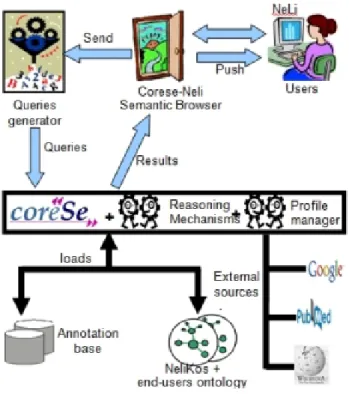
From implementation point of view, NeLI reuses the Medical Subject Headings (MeSH) thesaurus (Lowe et Barnett, 1994) and combines the OWL language with SKOS which offers builtin predicates for preferred (skos :prefLabel) and alternative (skos :altLabel) naming of entities. It has been used as background knowledge for two of the Semantic Web Browsers of the SeaLife project and its usefulness in accessing relevant information evaluated (Oliver et al., 2009). I will briefly describe in chapter 2 an illustration of semantic information retrieval and navigation with the Corese-NeLI semantic web browser which uses the NeLI Ontology as a background knowledge.
The Alzheimer Disease and related Illness Ontology. This work was as part
of the PhD thesis of Khadim Dramé and the Semantic BioblioDem Portal project (SemBip), funded by the Fondation de France/Plan Alzheimer (2011-2013). The SemBiP project, that I coordinated with my colleague Fleur Mougin, is designed to offer a semantic access to scientific resources on Alzheimer’s disease (AD) and related disorders. In parti-cular leveraging the French BiblioDem newsletter and cumulative scientific publications database8. Its objectives were :
— providing a multilingual (mainly English and French) knowledge resource dedicated to the description of Alzheimer’s disease and related illnesses supporting both content indexing and educational purpose. The evolution of this vocabulary has to be managed ;
— providing a semantic portal enabling semantic search and browsing of approved available evidence about Alzheimer’s disease and related disorders ;
— taking into account the specificity and variety of users. According to the user profile, adapted search functionalities should be offered ;
— allowing multilingual access to both the original abstract (and the full paper if freely available) and their critical analysis in order to improve decision making. The multilingual aspects are very important for supporting both indexing and cross-lingual information retrieval in the portal (original articles abstract in English and comments in French).
We were therefore interested in providing semantic access to AD related resources to French clinicians and researchers for the purpose of clinical epidemiology with an ultimate goal to facilitate an evidence based practice. In France, the number of people suffering from AD is estimated at 860,000. Every year, 220,000 new cases are identified in this country. Nearly 350,000 people benefit from care for the long-term complaint of Alzheimer’s-type illness and related disorders.
The solution was to design and develop an AD domain Ontology from existing re-sources and using it for indexing AD related rere-sources and information retrieval in the French and English multilingual context. The work on the knowledge modelling and re-presentation has led to the proposal of a mixed approach combining NLP techniques and the reuse of existing semantic resources (the UMLS) for the construction of a KOS in the form of a termino-ontological resource (TOR) (Dramé, Diallo et al., 2014). On the one hand, NLP offers robust tools to extract ontological knowledge from texts corpora with good accuracy. On the other hand, the reuse of existing TORs reduces the process of building ontologies. These two approaches are therefore complementary and the idea was to combine their advantages. In order to address the issue of multilingua-lism (original scientific articles mainly in English and their critical analysis available in French), we relied on methods from parallel corpora alignment that are widely used particularly for the acquisition and the enrichment of multilingual terminologies. There-fore, a language alignment method based on parallel corpora have been designed and implemented to map terms from different languages (Drame et al., 2012).
This methodology was applied to a case study on the critical reading of articles in the field of AD with the collaboration of the Epidemiology and Neuropsychology of Cerebral Ageing team of the INSERM U897 Epidemiology and Biostatistics Centre in Bordeaux. It made it possible to implement a bilingual Ontology of AD, OntoAD (Dramé, Diallo et al., 2014), used to support the SemBip semantic portal, for managing resources on the AD domain. OntoAD includes 5,899 concepts linked by 7,499 taxonomic relationships and 10,889 non-taxonomic relationships and is freely available on the online BioPortal repository9. BioPortal is a repository which gathers biomedical KOS (Noy et al., 2009). WATRIMED : West African Herbal-Based Traditional Medicine Knowledge Graph. Medical KR formalisms are especially challenged in domains that occupy a
ra-ther marginal position in the KR ecosystem. A typical example is herbal based traditional medicine (TM), which has a significant foothold in large areas of the planet, and which is intertwined with the most diverse cultural heritage of population groups, with large in-fluence on the health status of a population. E.g., the Worl Health Organisation (WHO) estimates that as much as 80% of the population uses TM in some form, and herbal-based Traditional Medicine (HTM) in particular.
From the experience on knowledge engineering I acquired, in collaboration with B. Kamsu Foguem (LGP ENIT Tarbes, France) and as part of my interest on bringing ICT for societal development, in particular for the healthcare domain, we had carried out a first conceptual work on the field of TM which used Conceptual Graphs (Sowa, 2008) to model and reason about African Traditional Medicine (ATM) (Kamsu-Foguem et al., 2013). Thereafter, following an attempt to set an Horizon 2020 proposal in 2017, which brought together partners from 4 European countries and 5 African countries that I coordinated and which was dedicated to bringing Semantic Web and mobile technologies to leverage ATM practices and contribute to increasing safety usage, we have initiate the design and development of the West African Herbal-based Traditional Medicine (WATRIMed) Knowledge Graph (KG) (Some et al., 2019). The work relies on the reuse of materials provided by the supra-national West African Health Organisation (WAHO) and other freely available knowledge bases within the Linked Open Data cloud or online on the Web. Similarly to previous attempts of digitising Chinese TM (Li et al., 2018) and more general African TM (Lô et al., 2017), using a state-of-the art, flexible and shareable knowledge
representation approach, this effort aims at bringing West African TM to the digital world so as to help preserving the TM secular knowledge and contribute to the safely usage of TM thanks to enabling among others phytovigilance (pharmacovigilance about plants) activity for safety purpose. But also to provide an elaborated formal modelling about medicinal plants. As far as we know, there is no formal model available on the topic. However, an intensive effort has been conducted in the context of Traditional Chinese Medicine (TCM)(Li et al., 2018 ; Z. Wu et al., 2008) which leads to the integration of TCM to the upcoming eleven revision of International Classification of Disease (ICD)10
of WHO.
For WATRIMed, a core model, which has been fed with data from the WAHO pharma-copoeia and linked to publicly available external knowledge bases about herbs information, recipes and chemical ingredients has been provided (e.g., DBpedia, PubChem, etc.). Fur-ther, the core model has been mapped to an upper level ontology, BioTopLite2 (BTL2), a light version of the BioTop Upper Level Ontology for the Life Sciences (Schulz et Boeker, 2013). As of result, the graph contains currently about 30,000 facts modelled with an Ontology of 1,129 concepts, 75 properties. WATRIMed is freely available online to the community, with a SPARQL endpoint11. It demonstrates that it is possible to
bring advanced technologies in the context of knowledge modelling in countries with very limited settings.
I have mentioned here some semantic resources in specific project contexts. This type of approach has become common and results in multiple KOS, sometimes for related areas. However, in many cases, it is important to be able to integrate them and therefore identify first possible correspondences (called alignment) between their entities.
1.4.2
Semantic Knowledge Integration and Large-Scale
Onto-logy Alignment
It is commonly accepted that efficient decision-making, particularly in the life sciences and healthcare domain, is based on the access to increasingly voluminous data, stored in many various sources (Gini, Ryan et al., 2013 ; Gini, Schuemie et al., 2016). These sources are often heterogeneous in many respects including their storage formats, co-ding vocabularies (metadata associated with data), languages and formalisms used. The emergence of the Semantic Web and the Web of Data has offered new possibilities for identifying and establishing (automatically) mappings between these heterogeneous data (Shvaiko et Euzenat, 2013). The offered solutions are based on identifying and acces-sing the KOS on which the data sources are based. These KOS are of various natures : domain ontologies for describing and querying data sources, speciality terminologies for indexing and annotation (semantic characterisation) of data sources. Several challenges are posed in this context :
— How to handle and manage jointly this set of KOS with different levels of forma-lism ?
— How to identify links between their entities and qualifying them semantically ? — How to scale up in the presence of increasingly large KOS ? Indeed, in the
bio-medical and healthcare domains in particular, there are increasing resources with several hundred thousand entities (e.g, the SNOMED CT for example, a resource used in the healthcare domain has over 311,000 entities (Lee et al., 2014)).
10. https ://icd.who.int/en/ 11. www.watrimed.org
The links between KOS entities can be of various kinds including equivalence, generality and/or specificity (Shvaiko et Euzenat, 2013). In this respects, an Ontology mapping or more generally a KOS mapping (referred also as match or correspondence) between entities of two ontologies O1, O2 is represented as a 4-tuple < e1, e2, r, c >where e1, e2
are entities from O1, O2 respectively ; r ∈ v, w, ≡ is a semantic relation ; and c is a
confidence value usually within the interval [0...1].
The work I have explored in this context started in 2010-2011 and is part of the gene-ral problem of interoperability and Ontology integration(Pinto et J. P. Martins, 2001) and jointly handling multiple KOS for an easy management of their content in order to facilitate their reuse and understand their different interlinks. It is a natural continuation of the work I started in my thesis as part of the joint and dynamic management of several KOS, which I had set aside for a while according to research opportunities offered by my successive post-docs. The FP7 EU-ADR (Early Detection of Adverse Drug Reaction) project (2009-2012)(Avillach, Dufour et al., 2012 ; Avillach, Mougin et al., 2009 ; Oliveira et al., 2013), my research group was participating in, gave me a good opportu-nity to figure out how present the heterogeneity issue of KOS is in the context of public health when it comes to conducting multi-centre studies.
The EU-ADR project as a multiple KOS alignment use case.
The EU-ADR project worked to develop an innovative computerised system to detect adverse drug reactions (ADRs), supplementing spontaneous reporting systems which are considered limited. The project exploited clinical data from electronic healthcare records (EHRs) of over 30 million patients from several European countries (The Netherlands, Denmark, United Kingdom, and Italy). In this project a variety of textmining, epidemio-logical and other computational techniques were used to analyse the EHRs in order to detect signals (combinations of drugs and suspected adverse events that warrant further investigation). In EU-ADR, we exploited data from eight European healthcare databases and Electronic Health Records for the detection of these signals. As these databases use different KOS, specifically medical terminologies (the WHO ICD-9 and ICD-10 respecti-vely for Italy and Denmark), Read Codes for United Kingdom, International Classification of Primary Care (ICPC for The Netherlands)) to encode their data according to the data-base’s country, mappings were needed to translate a query posed to the global system into queries understandable for the different actual data sources. Performing manual mappings between all the mentioned resources is hardly feasible within a reasonable time. Hence the need for methods and tools for the (semi)automated alignment of these KOS.
This case of EU-ADR is not isolated in the broad area of healthcare, in particular public health, we can also mention the TECSAN RAVEL French ANR funded project (2012-2014) (Diallo, Grabar et al., 2012) where we faced the issue on handling complex queries over complex patients (patients with a long follow-up) from EHR. The observation is that the need of aligning various KOS occurs quite often in various research field (semantic data integration domain (Calvanese et al., 2018), the semantic browsing of information (Kostkova et al., 2008) and web services composition(Claro et al., 2006 ; Hao et Y. Zhang, 2007)).
An extensive work has been conducted in the KOS alignment domain (please see (Kalfoglou et Schorlemmer, 2003 ; Otero-Cerdeira et al., 2015 ; Shvaiko et Euzenat, 2013), for an extensive review). However, until 2011 no or little attention has been paid to the alignment of large KOS, as it could be often the need in the biomedical and healthcare domain. And this is my focus. Aligning large KOS, which involves several
thousand hundreds entities presents several challenges. Let recall in the following section some important one.
Challenges on large scale KOS alignment
— Reducing the search complexity : traditional systems and algorithms that perform alignment tasks on small size ontologies used to compute nXm similarities between respectively the n and m entities of the two input ontologies. This makes them prohibitively inefficient for scaling up. Various techniques and strategies have been adopted to tackle this issue. The most common are : i) the divide and conquer strategy relying on clustering and modularisation (Shvaiko et Euzenat, 2013) ; ii) information retrieval based strategy which relies on indexing techniques (Diallo, 2014). The chapter3 will detail the ServOMap approach that we have proposed and which follows the latter strategy.
— Evaluating and validating the alignment results : while manual validation is possible for relatively small size ontologies alignment tasks, it is not reasonably feasible for large ontologies containing several hundred of thousand entities (like in the biomedical domain).
— User involvement and human interaction : it has been proven that there is a limit, in terms of alignment quality, that is difficult to overcome by solely fully automated Ontology alignment systems (Paulheim et al., 2013). The need to incorporate the user into the alignment process emerged a bit earlier(Falconer et Noy, 2011). The user can review the proposed correspondence candidates and validate those that are correct and to propose additional correspondences that the system would not have found.
— Reducing time complexity : if we assume that n is the size of each input ontology and t the time needed for the matching process of a system, the matching process in a Cartesian product fashion has a time complexity of O(n2Xt). This is
considerable in the case of large ontologies.
Given the number of alignment systems that have emerged, it was necessary to find a framework to assess their effectiveness.
The Ontology Alignment Evaluation Initiative
The Ontology Alignment Evaluation Initiative (OAEI)12 is an international
coordina-ted initiative launched in 2004 and aiming at helping to improve the work on Ontology alignment. Its goals are :
— assessing strengths and weaknesses of alignment systems ; — comparing performance of techniques ;
— increasing communication among algorithm developers ; — improving evaluation techniques ;
The means to achieve these goals are the organisation of a yearly evaluation event since 2004 and the publication of the tests and results of the event for further analysis. OAEI provides datasets and a framework in order to perform a controlled experimental evalua-tion of the different alignment systems. Several tracks and challenges, subdivided in two categories, have been introduced over the years. As an illustration, the track LargeBio has been introduced in 2011 and dedicated to computing alignment between large healthcare
related ontologies (SNOMED CT (Lee et al., 2014), the National Cancer Institute the-saurus (NCI) (Golbeck et al., 2003), and the Foundational Model of Anatomy (FMA) (Rosse et Mejino, 2008)). As noted by the organisers, these ontologies are semantically rich and contain tens of thousands of classes. The UMLS Metathesaurus(Bodenreider, 2004) has been selected as the basis for the track reference alignments. Other tracks in-clude Multifarm (Meilicke et al., 2012) dedicated to multilingual ontologies alignment and the Interactive track (Dragisic et al., 2016) which considers the user involvement during the alignment process. Similarly, for the alignment at instance level and link dis-covery, several datasets have been introduced, like IIMB which is an OWL-based dataset that is automatically generated by introducing a set of controlled transformations in an initial OWL assertion component (Abox). With the recent growing popularity of know-ledge graphs (Paulheim, 2016), a new track dedicated to both aligning schemata and instances is envisioned for the next edition of OAEI which will be held in October 2019 in the context on the International Workshop on Ontology Matching in Auckland (New Zealand) in conjunction with the International Semantic Web Conference13.
Large Scale (Biomedical) KOS Alignment with ServOMap
I summarise in the following section, my main contributions on knowledge integration and large scale Ontology alignment domain, particularly for biomedical ontologies. Several MSc students from 2012 and more recently a collaboration with colleagues from University Bobo Dioulasso and University Tunis El Manar have contributed to this work in the context of the ServOMap project which resulted in several published articles including (Ba et Diallo, 2013 ; Diallo, 2014). The K-Ware knowledge warehouse framework, a natural contribution to this work, and which is introduced below and will be described in Section 3.2 is another contribution as part of the PhD thesis of Bruno Thiao Layel which has started in mid 2018 jointly with the Synapse Medicine start-up14, a spin-off of
the BPH - ERIAS research group, and that I am co-supervising.
The ServO Ontology Server. In order to properly handle heterogeneous KOS and to
enable their alignment, the first realisation was the ServO Ontologies server proposal (Ba et Diallo, 2012 ; Diallo, 2011). It offers a dynamic way to index and query different heterogeneous KOS within the same infrastructure that allows them to be integrated in order to perform a number of meta-operations. These meta-operations include computing alignment between KOS or ; following the Swoogle (Finin et al., 2004) and the Watson system (d’Aquin et Motta, 2011), performing the retrieval or selection of specific KOS or their entities that are appropriate for a specific task (e.g. semantic indexing). ServO is based on a generic metamodel capable of abstracting itself from the heterogeneity due to the different representation languages used by the KOS themselves. Later on, in the context of the MSc internship of Zakaria Mambone, a fully decentralised version based on an algorithm which relies on a peer-to-peer infrastructure has been proposed (Mambone et al., 2015).
ServOMap : Scaling Up in Biomedical Ontology Alignment. In the area of
large-scale Ontology alignment, the work I pursued relies on the exploitation of the ServO Onto-logy Server (Ba et Diallo, 2012 ; Diallo, 2011). In the context of increasing availability
13. http ://iswc2019.semanticweb.org/ 14. http ://synapse-medicine.com/
of data and possibility associated metadata, represented as KOS, identifying matches bet-ween theses KOS and their underlying data is one of the key challenges to ensure semantic interoperability where needed.
The first avenue explored, as part of the MSc internship of Mouhamadou Ba, then Amal Kammoun, was the use of techniques from IR and algorithms developed in the context of ServO, considering each Ontology to be aligned as a corpus of semantic
do-cuments. The Ontology indexing approach implemented in this way has made it possible
to meet the challenge of reducing the search space for alignment and to support large biomedical ontologies containing several hundred of thousand entities in a very short time (Ba et Diallo, 2013). Two similarity algorithms are implemented : a terminological approach that translates each entity to be aligned into a virtual semantic document, and a contextual approach that is based on Machine Learning (ML) strategy, and which takes into account the topological structure of the ontologies being aligned. The idea is to improve the Recall of the matching process by identifying contextual based candidate mappings while preserving the Precision (Diallo, 2014 ; Kammoun et Diallo, 2013).
Subsequently, the challenge was to take into account the user, who is an expert in the field, in the alignment process in order to overcome the limits in terms of performance of a fully automated approach. This is one of the key identified issue for improving the quality of the provided alignment and being able to align large Ontologies (Shvaiko et Euzenat, 2013). We have thus designed and implemented, as part of the MSc intern-ship of Mahamadi Sawadogo and in collaboration with Michel Some (ESI, Univ Bobo Dioulasso), an approach in which the user can intervene in the mapping process either by suggesting initial matches, or by choosing similarity calculation metrics and finally by validating the candidate matches generated by the system (Savadogo et al., 2016). This has substantially improved the performance of our traditional approach in terms of F-score (reaching 20%).
The different algorithms have been implemented as part of the ServOMap system, whose development started in 2012, following that of the ServO Ontology server. It is a large-scale Ontology alignment system that can automatically process ontologies contai-ning hundreds of thousands of entities in a short time. It has successively participated in the 2012, 2013 and 2015 editions of the OAEI challenge15and ranked among the top three
systems for tasks dedicated to the alignment of large ontologies. The 2015 version of the system, ServOMBI, realised as part of the final year engineering degree of Nouha Kheder, introduces an algorithm inspired by (Ait-Kaci et Amir, 2017) for bit-score binary
indexing of the taxonomy of each Ontology being processed in order to optimise the
path and concepts look-up as part of the contextual similarity calculation. In addition, a candidate mappings selection and filtering strategy based on the principle of the Stable
Marriage Problem (McVitie et Wilson, 1971) was proposed.
In the same topic on Ontology alignment, more recently and in collaboration with Ma-rouen Kachroudi and Sadok Ben Yahia from University Tunis El Manar we did focused on cross-lingual Ontology alignment (aligning two Ontologies expressed in different na-tural languages) by bringing together ServOMap algorithms and those from the CLONA system (Kachroudi, Diallo et Ben Yahia, 2016). The resulting system, Kepler, use partition based techniques (Kachroudi, Zghal et al., 2013) coupled with input onto-logies indexing strategy and a language translation engine to perform the alignment task between KOS in a multilingual context. The system has participated in the two last edi-tions of OAEI with Top ranking in aligning same ontologies expressed in different natural
languages (Kachroudi, Diallo et Ben Yahia, 2018 ; Kachroudi, Diallo et Yahia, 2017) with the MultiFarm dataset (Meilicke et al., 2012).
K-Ware : Handling Jointly heterogeneous KOS and their alignments. In the
continuation of the work on large scale Ontology alignment and those on ServO in particu-lar, and in the context of the PhD thesis of Bruno Thiao Layel (who was previously a research engineer and now one of my co-supervised doctoral students, together with Guillaume Blin (Bordeaux Laboratory in Computer Science - LaBRI) and Vianney Jou-het (ERIAS INSERM 1219 and CHU de Bordeaux) we are currently investigating in the design and the implementation of an approach for the transparent management of seman-tic metadata expressed by KOS (Ontologies and Terminologies) as well as their alignments and which is based on a generic metamodel (Thiao-Layel et al., 2016, 2018) with an application in the heterogeneous drug data management domain. The challenge is to be able to handle various heterogeneous KOS with different formalisms and languages (RDF, OWL and SKOS) and integrate them in the same infrastructure. The purpose is to pre-serve the original semantics of these resources while providing a mechanism for accessing the data they annotate. The advantage is to be able to provide a KOS manipulation and visualisation engine exclusively based on the provided metamodel with a preservation of the differentiation between formal ontologies described in Description Logics based lan-guages(Baader et Nutt, 2003), such as OWL, and other structured vocabularies and terminologies. Indeed, for instance while it is possible to perform computational reasoning on the former, it is not suitable for the latter.
KOS are often used as external knowledge background for various NLP and IR tasks. They bring semantics that could contextualise unstructured information.
1.4.3
Contribution on Large Scale Biomedical TextMining and
Semantic Information Retrieval
The growing availability of digital data both at individual and population level opens up new opportunities to carry out relatively more comprehensive studies in the field of health, and public health in particular (Krumholz, 2014). In this context, while heal-thcare professionals produce abundant textual information (e.g. discharge summaries) in their daily clinical practice, there are various other sources, available in unstructured textual format, valuable to be included in healthcare related studies. Thus, scientific lite-rature, social networks data and web forums have become interesting data sources, which could complement the traditional data retrieved from traditional EHR.
Handling these unstructured data properly requires the use of NLP methods and tools and IR techniques. Information Extraction including Named Entity Recognition (NER), ontological entities mention, account among the major activities in the field. I report in the following sections the different approaches applied on documents harvested from large
set of different text genres such as biomedical scientific publications, health portals, and online communities.
Biomedical Literature Mining at Large Scale
The research work pursued in the Biomedical Literature Mining domain has been performed as part of the PhD thesis of Khadim Dramé. More specifically, we focused on the large-scale automatic classification of free text documents. The challenge is to
be able to annotate biomedical scientific articles in an automated way by classifying a large collection of documents (more than 12 million) when only a partial information is available (e.g. for scientific literature, only the title and abstract). The idea is to use solely this partial available information to determine the relevant descriptors of the content of the complete documents. To do so, we proposed two approaches :
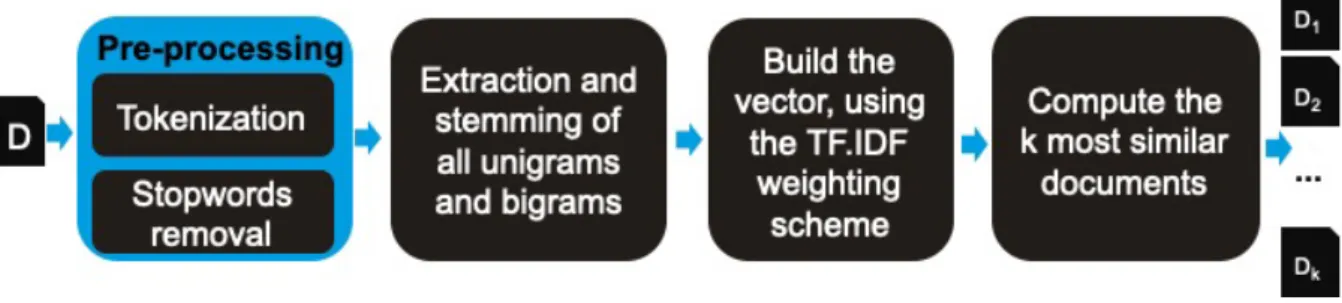
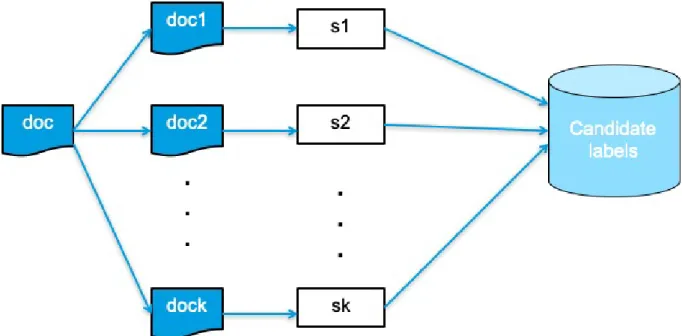
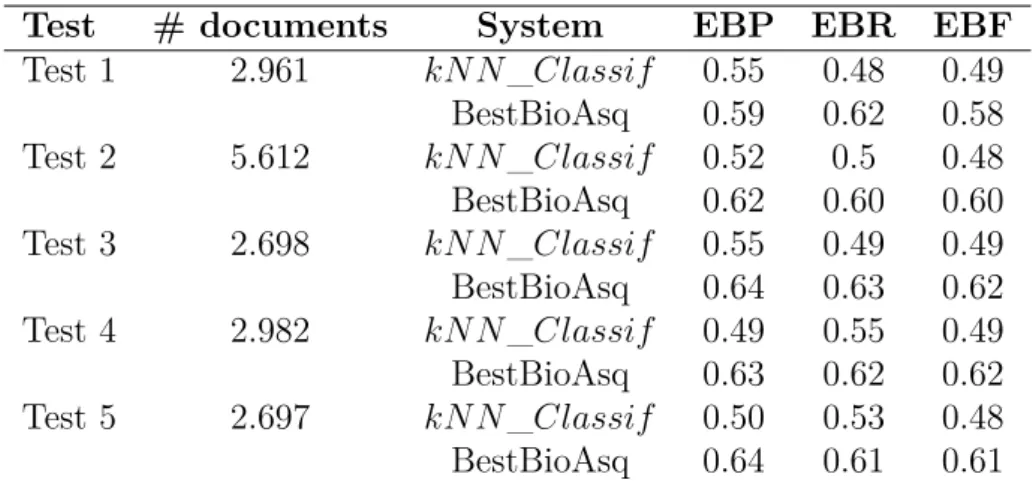
— a method based on the exploitation of the k nearest neighbours (kNN) algorithm (kNN_Classif) (Dramé, Mougin et al., 2016). The idea is to rely on a dic-tionary which is available in the form of a KOS, as a descriptors provider whose entries are used to describe the documents being classified. We explored different techniques for calculating similarity between documents for nearest neighbours identification and relied on Machine Learning algorithms, such as Naives Bayes (Langley et al., 1992) and Random Forest (Kocev et al., 2007).
— a method based on Explicit Semantic Analysis (ESA) (Gabrilovich et Marko-vitch, 2009). ESA is an approach for representing textual documents in a seman-tic way. Documents are represented in a conceptual space constituted of explicit concepts automatically extracted from a given knowledge base. In our case, we used Wikipedia16 as knowledge base and its entries serves as conceptual space into
which documents are projected.
The identification of entities mention within texts relies on an implemented NLP algorithm which retrieve the most specific concepts (from the dictionary being used) into the textual corpora (Dramé, Diallo et al., 2014).
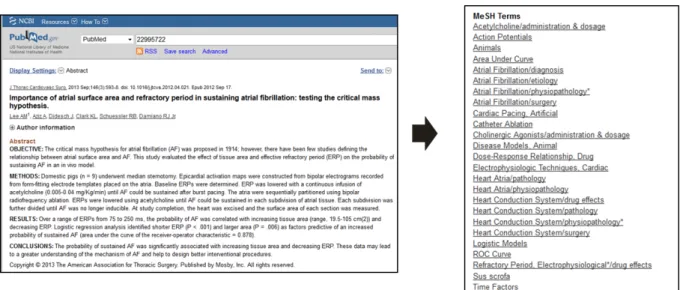
These approaches have been evaluated on a large dataset of several million of docu-ments provided in the context of the international large scale biomedical semantic indexing and question answering (BioASQ) challenge17. BioASQ provides a framework and a large
collection of annotated documents from the online PubMed database18. The documents
are annotated using the descriptors from the MeSH thesaurus (Lowe et Barnett, 1994). In contrast to the ESA approach, kNN_Classif proved to be efficient to identify suitable descriptors when only a partial information is available, when it is trained on a large set of documents with results comparable to similar approaches.
Healthcare Related Web Forums and Social Networks Mining for Drug Misuse Detection
Drugs misuse can be defined in several ways. First, the failure to match the main purpose of the drug’s use with the reason for the individual’s use corresponds to a misuse of the drug and involves risks (for example, taking doliprane to sleep). In this misuse pattern, drugs are often used as narcotic substances, which can lead to serious health problems, including addiction. Then, misuse can be the overuse or underuse of a drug in relation to the recommended doses per hour or per day, the duration of non-compliance with a treatment, or the taking and combination of several drugs reported as harmful if taken simultaneously (the case of drug-drug interaction).
Drugs misuse is a source of iatrogenic pathologies and a significant additional cost to the health budget. The French High Committee on Public Health19considers as iatrogenic
"the undesirable or negative consequences on the state of individual or collective health of any act or measure performed or prescribed by a qualified professional and which aims
16. http ://wikipedia.org
17. http ://bioasq.org/participate/challenges_year_2 18. https ://www.ncbi.nlm.nih.gov/pubmed/
to preserve, improve or restore health". The activity of monitoring and reducing drugs misuse reduces drug-related iatrogeny by decreasing the avoidable portion of this iatrogeny (Bates et al., 1999) (Gurwitz et al., 2003). However, the misuse of drugs in France is not well studied, and is mainly the subject of ad hoc studies. For example, the French Sentinel network has studied the misuse of antiemetics in patients with gastroenteritis (Roussel et al., 2013). Regional Pharmacovigilance Centres (CRPV) only study cases that are reported spontaneously by health professionals. They usually exploit the national notification database of the National Drug Safety Agency (ANSM) and those of the social security system.
In view of the impacts and costs that this may entail, dedicated systems to continuous monitoring, screening, quantification and monitoring of drug misuse therefore appears necessary. In this respect, the development of the use of social networks and health forums, which are nowadays communication channels more widespread, constitutes an opportunity to have an alternative source of information in near real time that could be exploited in order to identify very early signals and to identify new uses hitherto unknown. While some research works have been conducted to identify drugs side effects from this type of data source, the issue of misuse in a generic way has not been addressed. Some academic research work (Bigeard et al., 2018) or some commercial solutions, such as Detect20
from the Kap Code company, attempts to overcome the issue but in a limited settings. We have addressed this issue as part of the health informatics PhD thesis of
Sébas-tien Cossin (2018-2021) that I co-supervise with Vianney Jouhet and in the context of
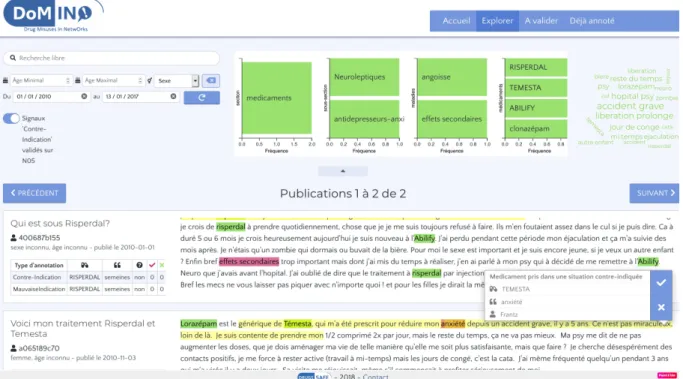
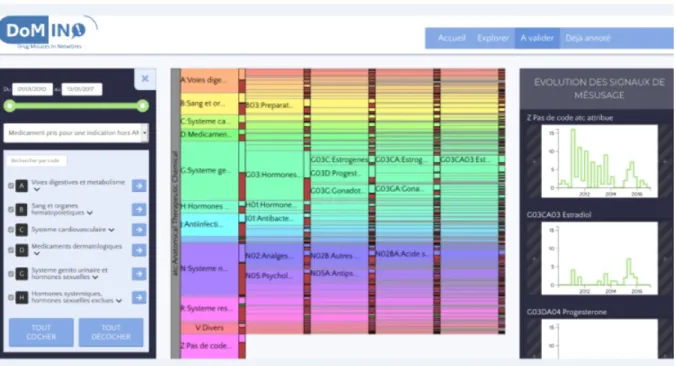
two projects : the regional PEPS project DIMMER (2016-2017, funded by the CNRS and IDEX Bordeaux that I coordinated for the Team ERIAS and conducted in collaboration with three other teams21, and the DOMINO project (coordinated with Frantz Thiessard)
as part of the DRUGS Systematised Assessment in real-liFe Environment (DRUG-SAFE) platform, which has been launched in 2015 and constituted of six research groups22.
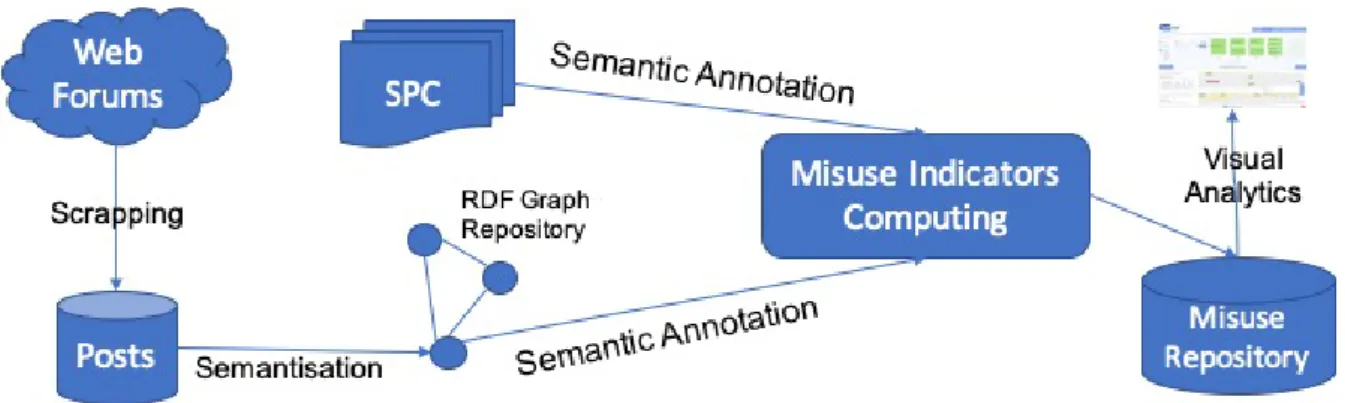
Posts from online forums are characterised by short texts, often expressed in informal, even slang, language, which make their processing very challenging, particularly in the French context. The approach we followed is based on the computation of intersection between knowledge about drugs as declared in official Summary of Product Characteristics (SPC) for marketed drugs and what is expressed in the forum posts by users. The SPC indicates among others the list of indications (clinical sign, pathology or situation affecting a patient), possible side effects, dosage, etc. for each drug. The detail of the approach we developed is as follows.
1. the design and development of a health web forums scrapping approach in order to build a corpus for latter analysis. It has been applied on a popular French health forums23 which allowed the acquisition of a forum posts corpora. These
posts have been included in a semantic platform thanks to the use of the Content Exchange and Semantic Interoperability Between Social Networks (SIOC) model24.
This work has been part of the engineering contract of Thimothée Jourdes and
20. https ://www.kapcode.fr/detect/
21. Pr. Richard Chbeir from LIUPPA research Lab of Pau, Romain Bourqui LaBRI Bordeaux, Antoine Pariente BPH INSERM 1219 and Benjamin Renoust from Unité Mixte Internationale CNRS UMI 3527 JFLI Japan and National Institute of Informatics (NII)
22. The BPH INSERM 1219 teams : Pharmacoepidemiology, Epidemiology of Ageing, IETO, BioSta-tistics and SISTM, ERIAS ; in addition SESSTIM and ORS PACA Marseille UMR 1252. The project is coordinated by Pr Antoine Pariente (BPH INSERM 1219)
23. www.doctissimo.fr/