HAL Id: tel-01315151
https://tel.archives-ouvertes.fr/tel-01315151
Submitted on 12 May 2016HAL is a multi-disciplinary open access
archive for the deposit and dissemination of sci-entific research documents, whether they are pub-lished or not. The documents may come from teaching and research institutions in France or abroad, or from public or private research centers.
L’archive ouverte pluridisciplinaire HAL, est destinée au dépôt et à la diffusion de documents scientifiques de niveau recherche, publiés ou non, émanant des établissements d’enseignement et de recherche français ou étrangers, des laboratoires publics ou privés.
Contribution to a methodology for service systems
modeling and engineering through a model driven
approach : architecture, transormation, and model
simulation
Hassan Bazoun
To cite this version:
Hassan Bazoun. Contribution to a methodology for service systems modeling and engineering through a model driven approach : architecture, transormation, and model simulation. Reactive fluid environ-ment. Université de Bordeaux, 2015. English. �NNT : 2015BORD0166�. �tel-01315151�
THÈSE PRÉSENTÉE POUR OBTENIR LE GRADE DE
DOCTEUR DE
L’UNIVERSITÉ DE BORDEAUX
ÉCOLE DOCTORALE DES SCIENCES PHYSIQUES ET DE L’INGENIEUR SPÉCIALITÉ PRODUCTIQUE
Par Hassan BAZOUN
Contribution to a methodology for service systems modeling and
engineering through a model driven approach
Architecture, transformation, and model simulation
Sous la direction de : Yves Ducq (Co-directeur : Gregory Zacharewicz)
Soutenue le 20 octobre 2015 Membres du jury :
M. CHEN, David Professeur Université de Bordeaux Président
M. CHAPURLAT, Vincent Professeur Ecole des Mines d'Alès Rapporteur
M. TRAORE, Mamadou Kaba Maître de Conférences Université Blaise Pascal Rapporteur M. DUCQ, Yves Professeur Université de Bordeaux Directeur de thèse M. ZACHAREWICZ, Gregory Maître de Conférences Université de Bordeaux Co-directeur de thèse
M. BOYE, Hadrien Ingénieur, HARDIS Group Chef de projet
M. SROUR, Zein Docteur, Ancien directeur de HARDIS Ouest Invité
,
Titre :
Contribution à une méthodologie pour la modélisation des systèmes de services et d'ingénierie grâce à une approche dirigée par les modèles: l'architecture, la transformation et la simulation du modèle.
Résumé :
Cette thèse se situe dans le contexte de l’importante mutation stratégique qu’opère l’Industrie européenne face à l’émergence de nouveaux Marchés. Une caractéristique majeure de ces nouveaux Marchés est la grande variabilité des besoins clients. Cette mutation remplace le produit manufacturé, au cœur des stratégies Métier, par ses services d’accompagnement, en réponse aux nouvelles exigences des clients. Ainsi, les processus Métier, initialement pensés, construits et pilotés autour du produit, doivent aujourd’hui être revus et complétés de manière à intégrer les services. C’est cette question que veut traiter la thèse, à travers une proposition d’architecture d’ingénierie des services dirigée par les modèles, supportée par un environnement logiciel appelé SLMToolBox qui permet la semi automatisation d’une partie de la gestion du cycle de vie d’un service (modélisation, simulation et évaluation de performances). Ce travail de recherche était dans le cadre de projet MSEE, un projet européen de recherche et développement en collaboration avec 18 partenaires de 9 pays européen. Le but de ce projet est de faire évoluer le concept de SSME (Service Science Management and Engineering) vers des systèmes de production et des usines du futur, i.e. d'un point de vue méthodologique, pour adapter, modifier et étendre les concepts de SSME pour les rendre applicables à des entreprises traditionnellement orientées vers une production orientée produit et d'un point de vue implantation, d'instancier les architectures et les plateformes orientées vers les services liés au futur internet pour des systèmes globaux de production de services. La thèse à apporter plusieurs résultats (MDSEA, Etended Actigram Star EA*, Transformation de modele, simulation, et SLMToolBox) pour répondre aux besoins de servitization.
Le MDSEA apporte un cadre méthodologique générique inspiré de l’Ingénierie Dirigée par les Modèles et dont le bénéfice principal est de permettre d’exprimer le traitement de toute question relative au cycle de vie d’un service, au travers de modèles spécifiés à divers niveaux d’abstraction, et reliés entre eux par des mécanismes de transformation de modèle.
Chacun de ces niveaux de modélisation nécessite des langages de modélisation spécifiques. Cette architecture suggère 3 niveaux d’abstraction : (1) un niveau appelé BSM (pour Business Service Model) où sont spécifiés les modèles conceptuels de processus Métier orientés Service à l’aide d’un langage conçu à cet effet, nommé EA* (pour Extended Actigram Star) et inspiré du langage GRAI Extended Actigram ; (2) un niveau appelé TIM (pour Technology Independent Model) où sont spécifiés les modèles détaillés de ces mêmes processus à l’aide du langage BPMN (Business Process Modeling Notation), modèles obtenus par transformation de modèle EA* en BPMN ; et (3) un niveau appelé TSM (pour Technology Specific Model) où sont spécifiés les modèles avec les choix technique spécifique au développement et génération de code. MDSEA ne se limite ainsi pas aux seuls aspects liés aux IT mais aussi aux aspects liés ressources humaines et matérielles devant être prises en compte, créées ou encore achetées pour mettre en œuvre le service attendu et le gérer au long de son cycle de vie.
Extended Actigram Star (EA*) est un langage de modélisation de processus business, développé dans le cadre de cette thèse et inspiré du langage GRAI Extended Actigram. La syntaxe abstraite et concrète de ce langage est décrite de manière détaillée.
La transformation de modèle est basée sur le « mapping » entre méta modèles. Le mapping a appliqué est défini après avoir étudié le langage source et langage cible. Puis on a implémenté les règles de transformation en utilisent « ATLAS Transformation Language » ATL. La transformation de modèle nous permet dans le cadre de MDSEA de passer d’un niveau d’abstraction vers un autre. Deux transformations des modelés sont développées pendant la thèse : EA* vers BPMN et BPMN vers DEVS.
La simulation est un outil d'assistance à l'ingénierie, comme au management ou encore au pilotage de systèmes complexes, DEVS est aussi reconnu comme un concept formalisé et largement usité pour la modélisation et la simulation du comportement de système basé sur une hypothèse de comportement à événements discrets. J’ai travaillé sur les règles de transformation de modèle BPMN 2.0 vers DEVS afin d'en permettre la simulation. Cette simulation a pour objet d'évaluer les performances en termes de coût de de temps mais évoque aussi des performances en termes de qualité et de flexibilité. Ces transformations sont à la base d'une sémantique opérationnelle de BPMN i.e. des règles, éventuellement assorties de probabilités d'évolution, décrivant comment un concept de modélisation interagit avec d'autres concepts et évolue en conséquence d'un état au suivant si l'on adopte une vision dynamique basée sur un modèle à états / transitions et événements comme DEVS. Le modèle finale DEVS est simulé au travers des profils de simulation.
L’outil SLMToolBox intègre les langages adoptés, implémente les règles de transformation de modèle, et offre un environnement de simulation, d’évaluation des performances et d’animation des résultats. Il vient donc en support aux analystes Métier qui, en collaboration avec les experts des différents domaines Métier, peuvent ainsi décrire et évaluer leurs systèmes de services courants (modèles AS-IS), mais aussi concevoir et évaluer de nouveaux services (modèles TO-BE). SLMToolBox est une application Eclipse RCP (Rich Client Platform). C’était développé en java et en utilisent des « Framework » différents : EMF/Ecore (Génération de code et représentation des modèles), EEF (pour gérer les « properties » des objets graphiques), Graphiti (développement des editors graphiques), ATL (Transformation des modèles). La SLMToolBox est un des résultats apprécié dans le projet MSEE. Plusieurs réunions ont eu lieu à Bruxelles pour la création d’une communauté scientifique autour de la SLMToolBox. Le but de cette Communauté est de reprendre le développement de la SLMToolBox pour l’adapter aux besoins différents des clients dans plusieurs domaines. Grace à cette communauté, le SLMToolBox était utilisé dans plusieurs projets (comme NOSCIFel dans le domaine de transport…).
Mots clés :
Servitization, System de Service, MDSEA, Extended Actigram Star, Transformation de modèle, SLMToolBox, Simulation DEVS.
Title:
Contribution to a methodology for service systems modeling and engineering through a model driven approach: Architecture, transformation, and model simulation.
Abstract:
are changing and manufacturers are entering new markets and striving to meet new and changing customer needs. Manufacturers are outsourcing more components and services to suppliers around the world, restructuring their internal operating and information systems, and re-engineering production processes to eliminate waste and lower costs. They are changing the nature of their organizations by partnering with other companies in complex supply chains and business networks that now extend globally. Manufacturing is being redefined by changes in market place and how companies react to them. As a result, many manufacturers wanted to make the shift to services as a solution, but they find themselves trapped in the world of products. At the end of the nineties, the concept of Service in Manufacturing appeared and the evolution from an economy of products towards an economy of services surrounding products became more and more important in manufacturing. The process of creating value by adding services to a tangible product has first been called “servitization”. Based on the problematic of Servitization and service system engineering and in order to reduce effort and time in service system engineering, this thesis (as being part of the MSEE project) contributed in the development of solutions. The contribution of the thesis’s result can be classified into related and connected pillars. The first pillar is the participation in the development of the Model Driven Service Engineering Architecture (MDSEA) which permits Virtual Manufacturing Enterprises (VME) to model their service systems (AS-IS and TO-BE models) starting from modeling the system from business experts angle and then adding more details to reach the developers and technical experts angle. The second pillar is the development of a modeling and simulation tool, the SLMToolBox. This tool is a partial implementation of MDSEA and its name Service Lifecycle Management ToolBox implies a role in the service’s lifecycle. The third pillar is the development of a DEVS graphical editor and simulator integrated in the SLMToolBox.
Keywords:
Servitization, Service System, MDSEA, Extended Actigram Star, Model Transformation, SLMToolBox, DEVS Simulation.
Acknowledgment
After three years working on this thesis, I would like to thank the IMS laboratory for accepting me as part of their team. A Big thanks to Dr. Yves Ducq and Dr. Gregory Zacharewicz for the support and help they offered. Without them I would not be able to finish or even start this thesis. They were always available for my questions which were many at the beginning (when I was lost on how to start) and the end during the writing of the final manuscript. Another special thanks to Hadrien Boye my project manager at Hardis Group during my three years. I learned from Hadrien a lot about organizing my work, how to build my answers and look for solutions, and most important how to always search for the bright side of our work. Without the help of Hadrien I would not be able to deliver the work with the same quality. Besides, I would like to thank my colleges at Hardis with whom we shared a lot of good moments that gave me a positive force to finish this work.
Thanks to my uncle Zein Srour and it’s because of his support and help I finished my masters and PHD studies in France. I learned a lot from you on how to always keep walking under whatever circumstances, to be positive and that hard work pays at the end. You were the source of motivation and light when the journey started to get darker. Thank you for everything you have done for me. Also thanks to all members of my uncle’s family at Nantes for the good times we spent together.
Being a PHD student is not always about being late at work trying to keep it up with deadlines for scientific articles or finding solutions after weeks of being moving around in circles. It’s also about having good friends with whom you spend funny, happy and relaxed moments. Thanks to Ali, Gilberto, Elise, Yaaroub, Varvara, Chouppi, Homam, Charlene, Joe, Bianca, Mouna… and from Lebanon Jana, Tigo, Nassim, Ali B., Ali W., Yazback…
A special Thanks to Clara, the one who gave me everything, she was my best friend, the love in my life and the family I needed. She stood beside me in the darkest moments of the journey and helped me to overcome it with success.
Last but not least, a big thanks to my family in Lebanon, my parents (Fatmeh and Hussein), Dima, Mariam, Amer, Mohammed, Mano, uncles, aunts and cousins for all the love and support you gave me and are still giving.
This thesis is dedicated to my mother for everything she has done and for here unconditional love, to the memory of my grandmother who left us one month before defending my thesis, and to the memory of my father who can rest now after I finished what he started.
GENERAL INTRODUCTION AND PROBLEM TO SOLVE: FROM SERVICE TO SERVICE MODELING IN
VIRTUAL MANUFACTURING ENTERPRISE CONTEXT ... 1
1. CONTEXT ... 1
2. PRINCIPLES OF SERVICE AND SERVICE SYSTEM MODELING ... 2
2.1 FROM SERVICE TO SERVITIZATION ... 2
2.1.1 Characterization of a service ... 3
2.1.2 Product service and PSS ... 3
2.2 MSEESERVITIZATION CONCEPTS ... 4
2.2.1 Extended Product (EP) ... 4
2.2.2 Product+Service and Product2Service ... 5
2.2.3 Service Life cycle Management ... 5
2.3 FROM ENTERPRISE TO MANUFACTURING SERVICE ECOSYSTEM ... 6
2.3.1 From a single Manufacturing Enterprise to a Virtual Manufacturing Enterprise ... 6
2.3.2 From Virtual Manufacturing Enterprise to Manufacturing Service Ecosystem ... 7
2.4 SERVICE SYSTEM AND SERVICE SYSTEM LIFE CYCLE MANAGEMENT ... 8
2.4.1 Service System ... 8
2.4.2 Service System Life cycle Management (SLM) ... 9
2.4.3 Servitization and Service System evolution ... 11
2.5 MODELING OF SERVICE SYSTEM ... 12
2.5.1 Why to model Service System? ... 12
2.5.2 Modeling Service System using System Theory ... 13
2.5.3 Definition of the languages to describe and represent the Models ... 15
2.6 ARCHITECTURE FOR SERVICE SYSTEM ENGINEERING ... 17
2.6.1 Service system engineering ... 17
3. MANUFACTURING SERVICE ECOSYSTEM (MSEE) PROJECT ... 17
3.1 MSEERESULTS ... 18
3.1.1 MSEE Generic Assets ... 18
3.1.2 MSE-Specific Assets ... 18
3.1.3 VME-Specific Assets ... 19
4. CONTRIBUTION OF THE THESIS ... 19
5. ORGANIZATION ... 20
STATE OF THE ART ... 22
1. ENTERPRISE MODELLING... 23 1.1 CIMOSA ... 23 1.1.1 Approach ... 23 1.1.2 Overview ... 24 1.2 GIM ... 26 1.2.1 GIM phases ... 26 1.3 ARIS ... 29
1.3.1 Concept of ARIS architecture ... 29
1.4 CONCLUSION ON ENTERPRISE MODELING ... 29
2. ENTERPRISE INTEROPERABILITY ... 30
2.1 DEFINITIONS ... 30
2.2 DIMENSIONS ... 31
2.3 APPROACHES AND FRAMEWORKS... 32
2.3.1 IDEAS interoperability framework ... 32
2.3.2 LISI approach ... 34
2.3.3 ATHENA interoperability framework ... 35
3. MODEL DRIVEN DEVELOPMENT ... 38
3.1 MDA ... 38
3.1.1 Overview ... 38
3.1.2 MDA for Reuse and Interoperability ... 39
3.2 MDI ... 40
3.3 CONCLUSION ON MODEL DRIVEN DEVELOPMENT ... 41
4. MODELLING LANGUAGES ... 42
4.1 GRAIEXTENDED ACTIGRAM ... 42
4.2 BPMN ... 42
4.3 DEVSFORMALISM ... 44
4.3.1 Atomic DEVS ... 44
4.3.2 Coupled DEVS ... 45
4.4 CONCLUSION ON MODELING LANGUAGES ... 45
5. SIMULATION TOOLS ... 46
5.1 BUSINESS PROCESS SIMULATION TOOLS ... 46
5.1.1 ARIS Simulation ... 46
5.1.2 Protos ... 46
5.1.3 Arena ... 47
5.1.4 Jbpm ... 47
5.1.5 Bonita Open Solution ... 48
5.1.6 Evaluation ... 48
5.2 DEVSSIMULATION TOOLS ... 49
5.3 CONCLUSION ON SIMULATION TOOLS ... 49
MODEL DRIVEN SERVICE ENGINEERING ARCHITECTURE (MDSEA), EXTENDED ACTIGRAM STAR (EA*), AND MODEL TRANSFORMATION ... 51
1. SERVICE SYSTEMS’ MODELING AND MODEL DRIVEN APPROACH ... 52
2. MDSEA ... 52
2.1 BUSINESS SERVICE MODEL (BSM) ... 55
2.2 TECHNOLOGY INDEPENDENT MODEL (TIM) ... 55
2.3 TECHNOLOGY SPECIFIC MODEL (TSM) ... 55
2.4 PROPOSED MODELLING LANGUAGES ... 56
3. EXTENDED ACTIGRAM STAR (EA*) ... 57
3.1 SCOPE ... 57
3.2 OVERVIEW ... 58
3.3 ABSTRACT SYNTAX ... 58
3.3.1 Structure ... 59
3.4 GRAPHICAL REPRESENTATIONS AND NOTATIONS ... 71
3.5 CONNECTIVITY CONSTRAINTS ... 74
4. MODEL TRANSFORMATION ... 75
4.1 PROBLEM ... 75
4.2 METAMODEL APPROACH ... 76
4.3 MAPPING OF CONCEPTS ... 78
4.3.1 Results in the frame of MDSEA ... 78
4.3.2 Results outside the frame of MDSEA (Generalization) ... 83
4.4 EXAMPLE ... 86
5. CONCLUSION ... 90
SIMULATION AND MODEL TRANSFORMATION FROM BPMN TO DEVS ... 91
1. INTRODUCTION ... 92
3. DEVS ... 94
3.1 BASIC DEVS CHARACTERISTICS ... 94
3.2 SIMULATION OF DEVSMODEL ... 94
4. TRANSFORMATION BPMN TO DEVS ... 95
4.1 DEVSMETAMODEL ... 96
4.2 TRANSFORMATION RULES ... 96
4.2.1 BPMN Task to DEVS Atomic Model ... 97
4.2.2 BPMN Event to DEVS Atomic Model ... 98
4.2.3 BPMN Gateway to DEVS Atomic Model ... 103
4.2.4 BPMN Lane, Pool, and SubProcess to DEVS Coupled Model ... 105
4.2.5 BPMN Flow to DEVS Coupling ... 105
5. DEVS SIMULATION ... 105
5.1 EXECUTION ... 106
5.2 SIMULATION’S PROFILE AND RESULTS ... 108
5.3 ANIMATION ... 110
6. EXAMPLE ... 112
7. CONCLUSION ... 114
SLMTOOLBOX ... 115
1. SYSTEM OVERVIEW ... 116
1.1 CONTEXT AND PURPOSE ... 116
1.2 SYSTEM VISION AND TOP LEVEL REQUIREMENTS ... 117
1.3 LOGICAL ARCHITECTURE ... 118
1.4 ACTORS AND ROLES ... 119
1.4.1 Business Actors ... 119
1.4.2 Domain Specific Actors ... 120
1.5 END-TO-END SCENARIOS ... 120
1.5.1 Scenario 1: Design a new service within a single enterprise ... 120
1.5.2 Scenario 2: Design & deploy a new service within a VME ... 121
2. TECHNICAL OVERVIEW ... 122
2.1 TECHNICAL MODULES ... 122
2.2 APPLICATION MODULES... 124
3. IMPLEMENTATION OF MDSEA IN THE TOOLBOX ... 126
3.1 MODELLING ARCHITECTURE OVERVIEW ... 126
3.2 SERVICE MODELLING FEATURES ... 127
3.2.1 Summary of modelling editors ... 127
3.2.2 GraiGrid Editor ... 128
3.2.3 ExtendedActigramStar Editor (BSM Level) ... 129
3.2.4 UML Editor ... 129
3.2.5 BPMN Editor ... 130
3.3 MODEL TRANSFORMATION FEATURES ... 130
4. IMPLEMENTATION OF SIMULATION IN THE TOOLBOX ... 131
4.1 DEVSEDITOR ... 131
4.2 SIMULATION PROFILE ... 132
4.3 SIMULATE DEVS MODEL ... 132
4.4 ANIMATE DEVS DIAGRAM ... 133
4.5 SIMULATION REPORT ... 133
5. INDESIT USE CASE ... 134
5.2 THE PRODUCT+SERVICE IDEA: THE CAREFREE WASHING SERVICE (TO-BESITUATION) ... 138
5.3 SERVICE FUNCTIONALITIES ... 139
5.4 NEW ECOSYSTEM FOR TO-BESITUATION (VE) ... 140
5.5 SCENARIOS AND OBTAINED MODELS ... 141
5.5.1 Design a single service for Indesit ... 142
5.5.2 Design a composite service within the Indesit VME ... 146
5.6 CONCLUSION ON THE INDESIT USE CASE ... 152
6. CONCLUSION ... 153
GENERAL CONCLUSION AND PERSPECTIVES ... 154
1. GENERAL CONCLUSION ... 155
2. PERSPECTIVES ... 158
REFERENCES ... 159
ANNEX-1-METAMODELS ... 167
ANNEX-2-SIMULATION REPORT ... 169
ANNEX-3-ATL AND XSLT CODE ... 175
Figure 1 The Extended Product Concept, adopted from (Thoben et al. 2001) ... 4
Figure 2 Servitization process ... 5
Figure 3 Service Life Cycle ... 6
Figure 4 Virtual Manufacturing Enterprise ... 7
Figure 5 Business Ecosystem Concept ... 7
Figure 6 Manufacturing enterprise vs. service in manufacturing virtual enterprise ... 8
Figure 7 Service delivery system ... 9
Figure 8 Service System lifecycle phases vs. Service System life - adapted from Bernus (1995) ... 10
Figure 9 Virtual Manufacturing Enterprise in different phases of SLM ... 11
Figure 10 The structure of a system ... 14
Figure 11 MSEE as a system of systems ... 15
Figure 12 Enterprise Modelling mapped to the OMG 4 level architecture ... 16
Figure 13 CIMOSA Modelling Approach ... 25
Figure 14 GIM approach ... 27
Figure 15 Order of models realization ... 28
Figure 16 Enterprise Interoperability Framework ... 32
Figure 17 IDEAS Interoperability Framework ... 34
Figure 18 LISI reference model ... 35
Figure 19 Athena Interoperability Reference Architecture ... 36
Figure 20 Structure of the AIF ... 37
Figure 21 OMG’s Model Driven Architecture ... 39
Figure 22 Reference model for MDI ... 41
Figure 23 GRAI Extended Actigram for ‘Painting Check Process’ ... 42
Figure 24 The MDSEA architecture applied in a service network of two enterprises ... 54
Figure 25 MDSEA vs MDA ... 55
Figure 26 Abstract Syntax of Extended Actigram Star ... 59
Figure 27 BaseElement ... 60
Figure 28 Process UML object diagram ... 61
Figure 29 Flow ... 62
Figure 30 ControlFlow ... 63
Figure 31 SupportFlow Example ... 64
Figure 32 ExtendedActivity ... 66
Figure 33 Resource ... 67
Figure 34 LogicalOperator ... 68
Figure 35 Connector ... 70
Figure 36 check material quality example ... 70
Figure 37 Transformation architecture of EA* to BPMN ... 77
Figure 38 Different steps for transformation ... 77
Figure 39 BSM Modelling strategy ... 79
Figure 40 EA* to BPMN collaboration ... 79
Figure 41 EA* e-marketplace purchase process ... 88
Figure 42 BPMN e-marketplace purchase process ... 89
Figure 43 Relation Simulator-Model (b) ... 106
Figure 44 DEVS Message ... 107
Figure 45 Simulation Algorithm ... 108
Figure 46 Calculating probabilities ... 109
Figure 47 Calculating time and cost ... 110
Figure 49 Animation feature ... 112
Figure 50 DEVS e-marketplace purchase process ... 113
Figure 51 initialize simulation profile ... 113
Figure 52 SLMToolBox - Context within the service lifecycle ... 116
Figure 53 Purpose: phases of the service lifecycle to support ... 117
Figure 54 SLMToolBox Logical Architecture ... 118
Figure 55 System Actors ... 119
Figure 56 Design a new service within a single enterprise ... 120
Figure 57 Design & deploy a new service within a VME... 121
Figure 58 Modelling Environment - Technical Architecture Overview ... 124
Figure 59 Application modules ... 125
Figure 60 Modelling architecture’s overview ... 127
Figure 61 Create new wizard ... 131
Figure 62 DEVS editor ... 132
Figure 63 Simulation profile ... 132
Figure 64 Simulation ... 132
Figure 65 Animation ... 133
Figure 66 Indesit Ecosystem ... 137
Figure 67 Use case AS-IS Servitization level ... 137
Figure 68 Use Case TO-BE Servitization level ... 139
Figure 69 Overall service concept (EA*) ... 142
Figure 70 General view (EA*) ... 143
Figure 71 High level system architecture (UML) ... 144
Figure 72 Care free washing machine website (UML) ... 145
Figure 73 WM usage data (UML) ... 146
Figure 74 Smart Detergent Provisioning (EA*) ... 147
Figure 75 Smart Detergent Provisioning (GraiGrid) ... 148
Figure 76 Performance indicators (1) ... 149
Figure 77 Performance indicators (2) ... 149
Figure 78 Performance indicators (3) ... 150
Figure 79 RAW Smart Detergent Provisioning (BPMN) ... 151
Figure 80 Rearranged Smart Detergent Provisioning (BPMN) ... 151
Figure 81 Enriched Smart Detergent Provisioning (BPMN) ... 152
Figure 82 context, problem, and contributions ... 157
Figure 83 BSM Core Metamodel ... 167
Figure 84 TIM Core Metamodel ... 168
Figure 85 ATL Lazy Rule: EA* Process to BPMN Process ... 175
Figure 86 ATL helpers ... 176
Figure 87 XSLT example 1 ... 177
Figure 88 XSLT example 2 ... 178
Figure 89 Global view ... 179
Figure 90 Service Ideation process ... 179
Figure 91 Product-Service System Design ... 180
Figure 92 Product and Service Design ... 180
Figure 93 Service System Design ... 181
Table 1 Evaluation of Business Process Simulation Tools ... 49
Table 2 Model attributes ... 60
Table 3 BaseElement attributes ... 60
Table 4 Process attributes ... 61
Table 5 FlowElement attributes ... 62
Table 6 Flow attributes ... 62
Table 7 OutputInputFlow attributes ... 63
Table 8 ControlFlow attributes ... 63
Table 9 SupportFlow attributes ... 64
Table 10 FlowNode attributes ... 64
Table 11 ExtendedActivity attributes ... 65
Table 12 AtomicExtendedActivity attributes ... 66
Table 13 StructuralExtendedActivity attributes ... 66
Table 14 Resource attributes ... 66
Table 15 Human attributes ... 67
Table 16 Material attributes ... 67
Table 17 IT attributes ... 67
Table 18 LogicalOperator attributes... 68
Table 19 Diverging attributes ... 68
Table 20 DivergingAnd attributes ... 69
Table 21 ConvergingAnd attributes ... 69
Table 22 Converging attributes ... 69
Table 23 DivergingOr attributes ... 69
Table 24 ConvergingOr attributes ... 69
Table 25 InternalConnector attributes ... 71
Table 26 ExternalConnector attributes ... 71
Table 27 ProcessConnector attributes ... 71
Table 28 Organization attributes ... 71
Table 29 Graphical Representations... 72
Table 30 Flow Constraints ... 74
Table 31 EA* to BPMN - Mapping (Collaboration Diagram) ... 80
Table 32 EA* to BPMN - Mapping (Collaboration Diagram) ... 82
Table 33 EA* to BPMN - Mapping (Collaboration Diagram) ... 83
Table 34 BPMN Task to DEVS Atomic Model ... 97
Table 35 BPMN Receive Task to DEVS Atomic Model ... 98
Table 36 BPMN Send Task to DEVS Atomic Model ... 98
Table 37 BPMN Start Event to DEVS Atomic Model ... 99
Table 38 BPMN Message Start Event to DEVS Atomic Model ... 99
Table 39 BPMN Timer Start Event to DEVS Atomic Model ... 100
Table 40 BPMN None Intermediate Event to DEVS Atomic Model ... 101
Table 41 BPMN Message Intermediate throw Event to DEVS Atomic Model ... 101
Table 42 BPMN Message Intermediate catch Event to DEVS Atomic Model ... 102
Table 43 BPMN End Event to DEVS Atomic Model ... 102
Table 44 BPMN Message End Event to DEVS Atomic Model ... 103
Table 45 BPMN Multiple End Event to DEVS Atomic Model ... 103
Table 46 BPMN Exclusive Gateway to DEVS Atomic Model ... 104
Table 47 BPMN Parallel Gateway to DEVS Atomic Model ... 105
Table 48 BPMN SubProcess to DEVS Coupled Model ... 105
Résumé substantiel en français
Cette thèse se situe dans le contexte de l’importante mutation stratégique qu’opère l’Industrie européenne face à l’émergence de nouveaux Marchés. Une caractéristique majeure de ces nouveaux Marchés est la grande variabilité des besoins clients. Cette mutation remplace le produit manufacturé, au cœur des stratégies Métier, par ses services d’accompagnement, en réponse aux nouvelles exigences des clients. Ainsi, les processus Métier, initialement pensés, construits et pilotés autour du produit, doivent aujourd’hui être revus et complétés de manière à intégrer les services. C’est cette question que veut traiter la thèse, à travers une proposition d’architecture d’ingénierie des services dirigée par les modèles, supportée par un environnement logiciel appelé SLMToolBox qui permet la semi automatisation d’une partie de la gestion du cycle de vie d’un service (modélisation, simulation et évaluation de performances). Ce travail de recherche était dans le cadre de projet MSEE, un projet européen de recherche et développement en collaboration avec 18 partenaires de 9 pays européen. Le but de ce projet est de faire évoluer le concept de SSME (Service Science Management and Engineering) vers des systèmes de production et des usines du futur, i.e. d'un point de vue méthodologique, pour adapter, modifier et étendre les concepts de SSME pour les rendre applicables à des entreprises traditionnellement orientées vers une production orientée produit et d'un point de vue implantation, d'instancier les architectures et les plateformes orientées vers les services liés au futur internet pour des systèmes globaux de production de services.
La thèse à apporter plusieurs résultats (MDSEA, Etended Actigram Star EA*, Transformation de modèle, simulation, et SLMToolBox) pour répondre aux besoins de servitization.
Figure 1 MDSEA Enterprise B Enterprise A IT Domain Organisation human Physical means IT Domain Organisation human Physical means
Business Service Model (BSM)
Technology Independent Model (TIM)
Technology Specific Model (TSM)
Business Service Model (BSM)
Technology Independent Model (TIM)
Technology Specific Model (TSM)
Services in Virtual Enterprises Services in Virtual Enterprises
Interoperability at the model level
Interoperability at the service system level Interoperability at the model level
Le MDSEA apporte un cadre méthodologique générique inspiré de l’Ingénierie Dirigée par les Modèles et dont le bénéfice principal est de permettre d’exprimer le traitement de toute question relative au cycle de vie d’un service, au travers de modèles spécifiés à divers niveaux d’abstraction, et reliés entre eux par des mécanismes de transformation de modèle.
Chacun de ces niveaux de modélisation nécessite des langages de modélisation spécifiques. Cette architecture suggère 3 niveaux d’abstraction : (1) un niveau appelé BSM (pour Business Service Model) où sont spécifiés les modèles conceptuels de processus Métier orientés Service à l’aide d’un langage conçu à cet effet, nommé EA* (pour Extended Actigram Star) et inspiré du langage GRAI Extended Actigram ; (2) un niveau appelé TIM (pour Technology Independent Model) où sont spécifiés les modèles détaillés de ces mêmes processus à l’aide du langage BPMN (Business Process Modeling Notation), modèles obtenus par transformation de modèle EA* en BPMN ; et (3) un niveau appelé TSM (pour Technology Specific Model) où sont spécifiés les modèles avec les choix technique spécifique au développement et génération de code. MDSEA ne se limite ainsi pas aux seuls aspects liés aux IT mais aussi aux aspects liés ressources humaines et matérielles devant être prises en compte, créées ou encore achetées pour mettre en œuvre le service attendu et le gérer au long de son cycle de vie.
Figure 2 Extended Actigram Star
Extended Actigram Star (EA*) est un langage de modélisation de processus business, développé dans le cadre de cette thèse et inspiré du langage GRAI Extended Actigram. La syntaxe abstraite et concrète de ce langage est décrite de manière détaillée.
Figure 3 Transformation de model
La transformation de modèle est basée sur le « mapping » entre méta modèles. Le mapping a appliqué est défini après avoir étudié le langage source et langage cible. Puis on a implémenté les règles de transformation en utilisent « ATLAS Transformation Language » ATL. La transformation de modèle nous permet dans le cadre de MDSEA de passer d’un niveau d’abstraction vers un autre. Deux transformations des modelés sont développées pendant la thèse : EA* vers BPMN et BPMN vers DEVS.
La simulation est un outil d'assistance à l'ingénierie, comme au management ou encore au pilotage de systèmes complexes, DEVS est aussi reconnu comme un concept formalisé et largement usité pour la modélisation et la simulation du comportement de système basé sur une hypothèse de comportement à événements discrets. J’ai travaillé sur les règles de transformation de modèle BPMN 2.0 vers DEVS afin d'en permettre la simulation. Cette simulation a pour objet d'évaluer les performances en termes de coût de de temps mais évoque aussi des performances en termes de qualité et de flexibilité. Ces transformations sont à la base d'une sémantique opérationnelle de BPMN i.e. des règles, éventuellement assorties de probabilités d'évolution, décrivant comment un concept de modélisation interagit avec d'autres concepts et évolue en conséquence d'un état au suivant si l'on adopte une vision dynamique basée sur un modèle à états / transitions et événements comme DEVS. Le modèle finale DEVS est simulé au travers des profils de simulation.
X S L
Figure 4 Editeur DEVS
L’outil SLMToolBox intègre les langages adoptés, implémente les règles de transformation de modèle, et offre un environnement de simulation, d’évaluation des performances et d’animation des résultats. Il vient donc en support aux analystes Métier qui, en collaboration avec les experts des différents domaines Métier, peuvent ainsi décrire et évaluer leurs systèmes de services courants (modèles AS-IS), mais aussi concevoir et évaluer de nouveaux services (modèles TO-BE). SLMToolBox est une application Eclipse RCP (Rich Client Platform). C’était développé en java et en utilisent des « Framework » différents : EMF/Ecore (Génération de code et représentation des modèles), EEF (pour gérer les « properties » des objets graphiques), Graphiti (développement des editors graphiques), ATL (Transformation des modèles).
Figure 5 SLMToolBox Architecture Logique
Service Lifecycle Management Tool MDSEA Metamodels Modelling Editors Model Transformation Engineering Simulation Monitoring & Control KPI design
La SLMToolBox est un des résultats apprécié dans le projet MSEE. Plusieurs réunions ont eu lieu à Bruxelles pour la création d’une communauté scientifique autour de la SLMToolBox. Le but de cette Communauté est de reprendre le développement de la SLMToolBox pour l’adapter aux besoins différents des clients dans plusieurs domaines. Grace à cette communauté, le SLMToolBox était utilisé dans plusieurs projets (comme NOSCIFel dans le domaine de transport…).
Mots clés :
Servitization, System de Service, MDSEA, Extended Actigram Star, Transformation de modèle, SLMToolBox, Simulation DEVS.
General Introduction and
Problem to Solve: From
Service to Service
Modeling in Virtual
Manufacturing Enterprise
Context
1. Context
Around one in ten (9.8 %) of all enterprises in the EU-27’s non-financial business economy were classified to manufacturing in 2009, a total of 2.0 million enterprises. The manufacturing sector employed 31 million persons in 2009, generated 5.812 billion Euro of turnover and 1.400 billion Euro of value added. By these measures, manufacturing was the second largest of the NACE sections within the EU-27’s non-financial business economy in terms of its contribution to employment (22.8 %) and the largest contributor to non-financial business economy value added, accounting for one quarter (25.0 %) of the total. Furthermore, SMEs were identified as the backbone of manufacturing industry in Europe. Micro, small and medium enterprises provided around 45 % of the value added by manufacturing while they accounted for around 59 % of manufacturing employment [EFFRA, 2013].
In today’s world of business, manufacturers are facing many challenges. Business strategies are changing and manufacturers are entering new markets and striving to meet new and changing customer needs. Manufacturers are outsourcing more components and services to suppliers around the world, restructuring their internal operating and information systems, and re-engineering production processes to eliminate waste and lower costs. They are changing the nature of their organizations by partnering with other companies in complex supply chains and business networks that now extend globally. Manufacturing is being redefined by changes in market place and how companies react to them. Some key drivers of change are working across international markets:
New and more demanding customers More demanding stakeholders Intense competition
The pace of innovation and development of new technologies
As a result, many manufacturers wanted to make the shift to services as a solution, but they find themselves trapped in the world of products. Their systems, procedures and practices are all structured to support the design and delivery of products, yet increasingly their customers are demanding services and solutions. A revolution has occurred worldwide in the business of manufacturing. Business is responding to the globalization of industrial markets, production systems, supply networks, and competition. Manufacturers no longer see their activities simply in terms of transforming raw materials into components or finished products. Today manufacturing is a system encompassing all the activities that are required to deliver products that meet customer needs and that extends from research, development, design, and engineering to production, finance, sales, marketing, and after sales service. In simple words, manufacturers have started shifting towards servitization in order to compete in the market. Servitization, the term coined by [Vandermerewe, 1988], is now widely recognized as the process of creating value by adding services to products. Since the late 1980s its adoption as a competitive manufacturing strategy has been studied by a range of authors [Baines, et al., 2007] [Oliva & Kallenberg, 2003] [Slack, 2005] who have specifically sought to understand the development and implications of this concept. The intuitive understanding of service is gotten by comparing it with the word product. Products are physical entities that are manufactured from raw materials. Services are non-physical entities that are the applications
of knowledge and skills for the benefit of a party [Vargo and Lusch, 2004]. The most famous characteristics of services distinguishing them from products are intangibility, heterogeneity, inseparability and perishability, now known as the IHIPs [Gummesson, 2007].
For the European manufacturing industry of the future, servitization is regarded as one of the most important trends. Innovative combinations of tangible products with intangible knowledge oriented services make the resulting solution more attractive and beneficial for the user and the consumer especially high wages regions which cannot compete on international scales.
2. Principles of Service and Service System modeling
This chapter introduces the principles and concepts of Service and Service System’s modeling, development, operation, and governance. For this reason we will start by exploring the main characteristics of Service and Service System in the domain of Manufacturing. Then the Service Life cycle Management concept is introduced.
2.1 From service to servitization
Studies and researches in Service’s domain have been mostly devoted to support tertiary sector domains (e.g. banking & finance, tourism, trade, public administration), with an obvious focus on ICT. Demand for high customization and growing competition has led to the situation that satisfying customer needs only through tangible products from the core business activities is no longer possible [Johnston et al, 2008]. At the end of the nineties, the concept of Service in Manufacturing appeared and the evolution from an economy of products towards an economy of services surrounding products became more and more important in manufacturing. A bundling of physical goods and services is required to augment the complexity on the customer side. Increasing attention has to be given to understand the customer problem and create a suitable solution. Services are added to the tangible product in order to support certain phases of its life-cycle (e.g. call center, customer support etc.). They can be provided by the same company offering the tangible product or by a third party. Furthermore, the services can be included in the price of the physical good or invoiced separately. Therefore, the services have to be closely connected to a tangible product, but they don’t have to be necessarily supplied with it.
This evolution is called Servitization and its most tangible effect is the development of
Product Service Systems (PSS). The process of creating value by adding services to a
tangible product has first been called “servitization” by [Vandermerwe and Rada, 1988]. They describe the increasing customer demand-driven offering of product-service “bundles” (consisting of goods, services, support, knowledge and self-service) by modern corporations to create a competitive edge. This requires looking at customer needs as a whole, demanding for new relationships between suppliers and customers. In the beginning, the provision of services has been regarded as a side-show by manufacturing companies. The main value creation was attributed to the tangible product, while services have been added for marketing purposes [Gebauer and Friedli 2005]. However, in many cases services have become as important for the customer as the product itself, so that they are a main differentiating factor for the customer. As a recent development, a larger portion of the added value for the customer is coming from the services, reducing the tangible product to a part of the whole offer [Gebauer et al. 2006]. Different levels of servitization can be identified, reaching from the traditional manufacturer of tangible products, over the provision of service add-ons to the provision of products as a service.
Characterization of a service 2.1.1
The definition of a Service is very difficult. We extracted from the survey of the literature we performed, one definition we estimate significant: “Service is the application of competence for the benefit of another. Service involves at least two entities, one applying competences and another integrating the applied competences with other resources and determining benefit (value co-creation). We call these interacting entities service systems” (Spohrer et al.). Most of the time a service is opposed to a good. The following list characterizes a service (Lovelock, 2004):
A service is not owned, but there is a restricted access. Services have intangible results.
Customers are involved in the service production process.
Other persons than the customers can be involved in the service process as stakeholders, sub-contractors, etc…
Quality in a service is difficult to control. Service cannot be stored.
Service delivery lead time is crucial.
Service delivery integrates physical and electronic way.
Since a decade, new research thinking has been emerging, trying to systematize the multi-disciplinary knowledge involved in service systems. On their web page, IBM describes service science as “a growing multi-disciplinary research and academic effort that integrates aspects of established fields like computer science, operations research, engineering, management sciences, business strategy, social and cognitive sciences, and legal sciences”. In the computer science domain, Service Oriented Architectures (SOA) [Perrey, 2003], have revolutionized information systems, by providing software engineers with powerful methodologies and tools for decomposing complex systems into autonomous components. The final aim of such an evolution is to support enterprise vital processes and workflows, by simple orchestrations and compositions in the hand of business specialists.
Product service and PSS 2.1.2
A product-service is often called a service supplied in addition to a product thus increasing its value for the customers (Furrer, 1997). We can refer also to the SUSPRONET European project (Product services in the need area “Information and Communication”, by Charter, Adams and Clark, Suspronet report (October 30th, 2004), which gives the following definitions:
Product service as a value proposition that consists of a mix of tangible products and intangible service designed and combined so that they are jointly capable of fulfilling integrated final customer needs.
Product-Service System (PSS) as the product-service including the network and infrastructure needed to ‘produce’ a product-service.
A typology of product-service systems has been proposed by different authors that considers three PSS variants [Behrend et al, 2003] [Brezet et al, 2001] [Zaring, 2001]
The second main variant is user-oriented services. Here, the traditional product still plays a central role, but the business model is not anymore geared towards selling products. The product stays in ownership with the provider, and is made available in a different form, and sometimes shared by a number of users.
The last variant is result-oriented services. Here, the client and provider in principle agree on a result, and there is not a pre-determined product involved, i.e. that the product is just a mean to sell a service but the customer pays for the service and not for the product. For instance, most of mobile phone providers offer the phone to sell communication time.
An Industrial Product-Service System (IPS2) is characterized by an integrated and mutually determined planning, development, provision and use of product and service shares including its immanent software components in Business-to-Business applications and represents a knowledge-intensive socio-technical system. Certainly, at the present time, the income generated by the sale of services and product-service systems sales is higher than that generated by product sales. Nevertheless, the evolution towards PSS is neither immediate nor obvious. It implies managerial and organizational changes that are often out of reach for most
Small Manufacturing Enterprises (SMEs) or even large industrial companies. In the next
section we will analyze the PSS in the domain of Manufacturing and its development process (Servitization).
2.2 MSEE Servitization Concepts
Clearly the servitization of manufacturing companies covers different levels of service provision and consequently different stages can be followed to evolve (MSEE, deliverable 52.1). Traditionally in the manufacturing domain, we are used to consider the product as the core element of the service to customers. But due to the market pressure, it is necessary to offer to the customers more services linked to the product, either new services linked to existing products, or new innovate services linked to specific products developed around these services. An appropriate concept to link products, product related services and users’ need is the “Extended Product” (EP) (Thoben et al. 2001).
Extended Product (EP) 2.2.1
The Extended Product concept belongs to the category of Product-Service System. The Extended Product is characterized by a layer model based on manufacturing product and defining the process extensions (Figure 1). The Extended Product is a complex result of tangible and intangible components.
Figure 1 The Extended Product Concept, adopted from (Thoben et al. 2001)
The Core Product is the physical product that is offered to the market; while the Product Shell describes the tangible “packaging” of the product. Supporting Services are intangible additions, which facilitate the use of the product (e.g. adaptive preventive maintenance plans or mobility guarantees). The resulting Extended Product would be a specific solution satisfying the customers demand. As the solution can become very complex, several business
Supporting Services Tangible Product Shell Core Product (Tangible)
partners may be collaborating for the provision of the EP in the frame of an Ecosystem. Thus, the following aspects define the EP concept (Thoben et al. 2001):
Combination of a physical product and associated services.
Intangible extensions that are information and knowledge, extensive collaboration of enterprises in groups / networks to provide value adding services.
Product+Service and Product2Service 2.2.2
The different stages of product and service provision are shown in Figure 2.
Figure 2 Servitization process
The first stage is the selling of a product (Tangible Product). The second stage which
initializes the servitization process and the evolution toward “Product+Service”, starts by adding a simple service (Product and supporting service). In this scenario, the simultaneous offering of the tangible product (Core Product and Shell) extended with proper tailored services is developed. In this case, both physical products and services contribute to the revenues, their balance needs to be adaptively determined and continuous innovation of services assumes a key competitive advantage. For example, a washing machine manufacturer will add a device on the machine-tool to check continuously the functioning of the machine).
The third stage (Product and differentiating service) is an evolution of the previous one. The
service is more elaborated and increases the differentiation. If we use the washing machine example, we can propose to sell the machine plus a service which guaranties a high percentage of availability of this machine. Finally, The fourth stage, Product2Service scenarios are in contrast sharply decoupling manufacturing of goods and selling of services, where in most cases physical goods remain the property of the manufacturer and are considered as investment, while revenues come uniquely from the services (e.g. the previous washing machine manufacturer doesn’t sell the machine-tools but sells hours of running of the machine-tool).
Service Life cycle Management 2.2.3
Service Life cycle Management (SLM) is a concept derived from PLM (Product Lifecycle Management). PLM is concerned with the management of entire life cycle of a product focusing on all product data relating to its design, production, support and ultimate disposal at the end of the life cycle. Similar to PLM, SLM aims at managing all service data relating to its design, implementation, operation and final disposal. The various phases are (Figure 3):
Tangible Product Product+ Service Product2 Service Product and supporting Services Product and differentiating Services Product as a Service
Figure 3 Service Life Cycle
Service identification: identify service’s domain, objectives, and challenges for a transition according the Servitization process.
Service concept: identify and define main concepts.
Service requirement: identify, describe and model end-users required service. Service design: design, specify and simulate the provided service.
Service delivery: describes how the designed service will be delivery.
Between the various phases some feedback loops could happen, in order to answer better to the requirement of the previous phase.
2.3 From Enterprise to Manufacturing Service Ecosystem
In this subchapter we analyze the evolution of the Manufacturing Service System along the various transitions from stage 1 to stage 4 (see Figure 2). In the servitization process the hypothesis is to start from one manufacturing enterprise. We will do a distinction between the transition from stage 1 to stage 2 and 3 on one side and the transition to stage 4 which is certainly more complex.
From a single Manufacturing Enterprise to a Virtual Manufacturing Enterprise 2.3.1
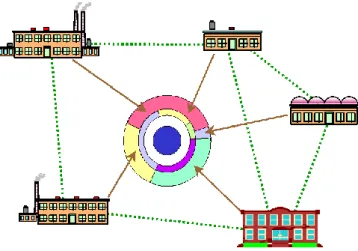
Extension of products in terms of Product+Service will concern physical products as well as the associated accessories or services. Thus, depending on the type and core competencies required to supply the associated services, it will be necessary to involve several business partners collaborating very closely towards the common goal of making the sale of the package attractive, sharing risks and resources (Figure 4). An industrial model for collaboration to exploit the various opportunities without the implementation of a strong integration is a Virtual Manufacturing Enterprise (VME).
Service Identification Service Concept Service Requirement Service Design Service delivery Service Lifecycle
Figure 4 Virtual Manufacturing Enterprise
A VME is an organizational form that marshals more resources than it currently has on its own, using collaborations both inside and outside of its boundaries, presenting itself to the customer as one unit. It is a set of (legally) independent enterprises that share resources and skills to achieve a mission/goal. The main difference between Supply Chain and VME is the type of relation between the enterprises (more integrated in Supply Chain) but also the fact that the VME will be adapted each phase of the SLM.
From Virtual Manufacturing Enterprise to Manufacturing Service Ecosystem 2.3.2
The evolution toward Product2Service is certainly more complex and needs the cooperation of several types of enterprises and organizations in order to develop a strong potential of innovation. The reason is to answer to the strong competition on the market, therefore it is necessary to continuously adapt and improve the VME. To enrich the potentiality of the VME, it is necessary to group different and heterogeneous entities like large OEMs, SMEs, Technical centers, Universities, research centers, individual professionals, employees, citizens and consumers etc. Such an organizational form is called in MSEE project, a Manufacturing Service Ecosystem (MSE). This MSE is left free to evolve and to network as it likes more, just following the market evolutionary law that it is the fittest species which survive. The MSE around supports and encourages this emergent and evolutionary approach by providing those entities with the necessary services round the product (Figure 5). Anyway it will be necessary to give a limit in the expansion and also some rules in order to maintain coherence.
2.4 Service System and Service System Life cycle Management
Services are produced by a Service System which could assume, as we have described previously different organizational forms such as VME or MSE.
Service System 2.4.1
Service science aims to provide theory and practice around service innovation based on the
notion of “joint value creation” among different roles offering and consuming services in a system. In the description of Servitization, we reach to the conclusion that the creation of an Innovative Service is favored and in some cases requires a set of enterprises, research centers, customers etc. It is necessary starting from one manufacturing enterprise which sells one product to create a “System composed of various entities” that we call a MSE (Figure 5). Service system is considered to be the basic unit, in which entities perform actions to their mutual benefit. A service system consists of people and technologies that adaptively compute the knowledge about changing values in the system and adjust to it according (Chesbrough, 2006). To define a Service System in the domain of Manufacturing, we will use a comparison between the production of a product (Product System) and the production of a service (Service System) (Figure 6).
Figure 6 Manufacturing enterprise vs. service in manufacturing virtual enterprise
A Product System is composed of an organization which produces a product and delivers a Product to the Customer. This organization could be a set of enterprises, for example one being an OEM (Original Equipment Manufacturer) and the other being sub-contractors (i.e. Supply Chain). We call this organizational form a “Manufacturing Enterprise” and it is represented in figure 6 by a rectangle with a dotted line. There are relations between the “Manufacturing Enterprise” and customers, but this type of relations is more knowledge exchanges and sometimes they are not strictly necessary. For instance, in the case of the manufacturing “on demand”, the collaboration between the Manufacturing enterprise and the customer is absolutely necessary and it is implemented by several exchanges of data, information and knowledge (e.g. about the product, its management, its usage, its maintenance, its disposal).
In a Service System which produces a Service, the customer is an integrated part: it is impossible to produce a service if the customer is not at the center of the loop (even if in a manufacturing enterprise, the customer can be involved at the beginning of the loop) and data-information-knowledge is constantly shared between producer and consumer. In addition, a
very important phase is the realization/delivery of the service.
The service delivery system corresponds to the systematic and coherent organization of all the physical and human elements of the interface customer/enterprise necessary to the realization of service provisions whose commercial characteristics and quality levels of appreciation have been determined before (Boughnim, 2005) ( Figure 7). The three elements required to deliver a service on a functional point of view are the customer, the contact people and the physical support.
Figure 7 Service delivery system
Service System Life cycle Management (SLM) 2.4.2
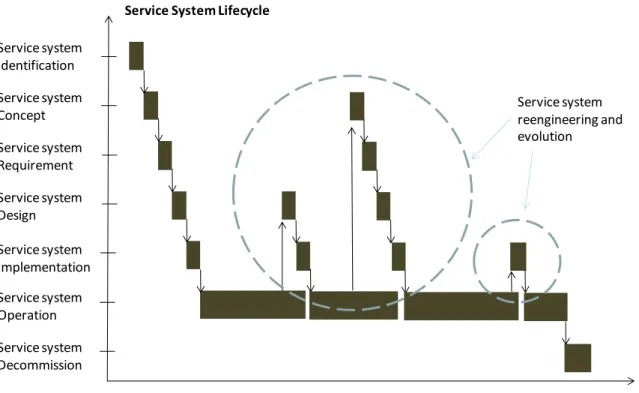
As a basis, MSEE proposes to adopt the ISO 15704 (2000) standard which defines generic entity/system life cycle phases and evolution of the Service System in time. We have chosen this standard because it has a great influence in Enterprise Modelling languages and approaches that are used for each phase and is recognized by ISO. This standard has been developed by ISO TC184 SC5/WG1 (Modeling and architecture) on the basis of several enterprise architectures and methodologies (CIMOSA, PERA [Williams, 1996], GERAM [Williams, 1995], GRAI…). The main steps of this standard have been adapted to Service System lifecycle in the frame of the MSEE project:
Service System identification: identify domain and existing component, objectives, challenges for a transition from product to service (or product + service).
Service System concept: identify and define main concepts (models, functions, and values) to create service around a product.
Service System requirement: identify, describe and model end-users required service system.
Service System design: design, specify and simulate the system that will provide that service.
Service System implementation: describe how the designed service system will be realized, delivered and implemented physically with all components.
Service System operation: service system is operational for use by customers, this includes service consumption and interaction with customers, monitoring, evaluation, and maintenance.
Service System decommission: end of the system service to remove and destruct it and recycle its components.
Figure 8 Service System lifecycle phases vs. Service System life - adapted from Bernus (1995)
Figure 8 illustrates how an implemented Service System evolves in time (Service System lifecycle phases vs. Service System life). From Identification to Implementation, service system is designed and engineered following lifecycle phases. When a Service System is put in operation after implementation, it could be re-engineered several times during its life. Small changes might only need some redesign and implementation actions. Important changes might need to restart at concept phase to identify new/additional concepts and then to re-engineer part of or the whole service system following the lifecycle. At the end activities are also needed to disassemble and decommission the service system. A very important subject will be the link between the PLM and the Service System Life cycle Management particularly when we reach the phase of the reconfiguration of the product and related services.
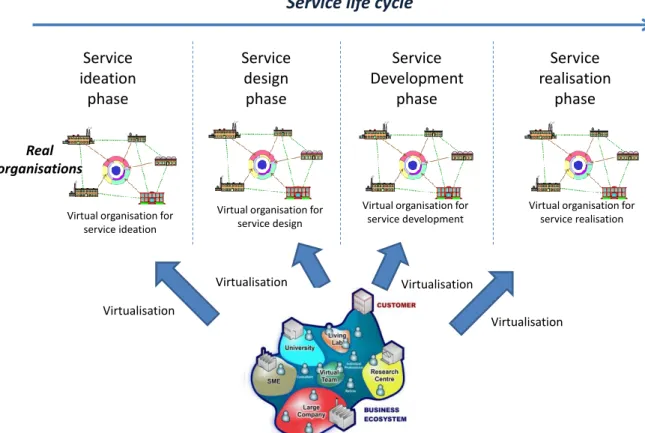
So, the structure of the VME could be different in the Design phase than in the Delivery phase and also of course the partners involved as shown in figure 10 below. For instance universities and research centers will be more involved in the ideation and design phase than in the realization phase. Service system Identification Service system Concept Service system Requirement Service system Design Service system Implementation Service system Operation Service system Decommission
Service System Lifecycle
Service System Life Service system
reengineering and evolution
Figure 9 Virtual Manufacturing Enterprise in different phases of SLM
Servitization and Service System evolution 2.4.3
With respect to the servitization four levels are identified to mark different stages in a servitization process of an enterprise: (1) Extended product, (2) Product +service, (3) Product to service, (4) Product as a service.
According to this process, several transitions are possible even if one company could decide to reach only stage (2) or (3) and not mandatory stage (4):
(1) to (2): Supporting services are identified, defined, realized, and they are offered together with the product.
(2) to (3): Special kinds of services are identified, defined, realized, and these services are recognized by the customer as benefits that differentiate the product from competitors. Such approach requires an environment in which the customer plays an important role with other stakeholder.
(3) to (4): The product is rented to customers and remains the ownership of the enterprise, the service alone is to sell to the customer.
The process of evolution is quite complex. In fact if we start from the stage (1), we could have a System enterprise which will be in an AS IS situation. Based on an innovation process, the enterprise decides to create a service and for that will move to a TO BE situation by cooperating with others System Enterprises (suppliers of services, manufacturers of devices,….) in order to form a Virtual Enterprise (VE). Depending on the market situation or others factors, the Virtual Enterprise which is in a new AS IS situation, will evolve by extending its activities ( based on complex innovation process due to the need to become competitive on the market), requiring the cooperation with Technical centers, Research centers, consultants, plus the implication of other organization as Financial establishments.
Service ideation phase Service Development phase Service realisation phase
Service life cycle
Virtualisation
Virtualisation
Virtualisation Virtual organisation for
service ideation
Virtual organisation for service development
Virtual organisation for service realisation
Real organisations
Virtual organisation for service design
Service design
phase
achieved by a MSE.
The conclusion on the description of the servitization process is that the modeling techniques for Service Systems must allow not only the modeling of enterprise’s system, but also a system of systems, meaning the VE or even the MSE which generated it. In such a case, it will be necessary, by comparing AS IS and TO BE models at each stage, to determine the evolution of the Service System, and in particularly the:
IT system
Organization and Humans supporting this organization,
Physical means as Machines, new devices or physical material.
In order to support the various transitions in the Servitization Process we propose a modeling support for the Service System with Concepts, Models, Tools and Methodology. This support must guide the evolution of the Service System in order to facilitate the determination of the components of the TO BE Service System starting from the AS IS situation.
2.5 Modeling of Service System
Why to model Service System? 2.5.1
We have already defined a Service System which could be a single manufacturing enterprise, a Virtual Manufacturing Enterprise (VME). In comparison, VME has precise objectives to reach in each phase of the SLM, although the Manufacturing Ecosystem is a group of companies without precise dedicated objectives to reach. For instance, a cluster of companies and research centers could be considered as an ecosystem but a particular composition of some members of this cluster in a dedicated project is a VME.
A Service System has the same structure as a Product System of a manufacturing enterprise, but is oriented towards the realization of a service. We need various functions as commercial, planning, accounting, strategy, etc… The difference is the production of Services combined with Products which should be analyzed carefully. We propose to be inspired for Service System modeling by Enterprise Modelling concepts, models, methods and tools. The advantage of this Enterprise Modelling approach is to be able to identify precisely the elements of the models (the concepts or the constructs of the model) using reference models and then to represent, to describe these concepts with adapted languages in order to deliver enterprise models. These enterprise models can be represented with several points of views: functions, decisions, business process, IT.
Enterprise modelling techniques allows in particular:
Facilitating the understanding of enterprise systems and improving communication and knowledge sharing between various stakeholders,
Representing AS-IS (existing situation) and TO-BE (future situation) systems in terms of functions, business processes, physical system, decision system and IT system, and capturing business users requirements,
Elaborating a diagnosis of AS IS i.e. strong points and points to improve, using specific rules and taking in account the strategy of the enterprise in terms of product and service proposition,
Specifying the future system at various levels of abstraction through a model driven approach