HAL Id: tel-00529666
https://tel.archives-ouvertes.fr/tel-00529666
Submitted on 26 Oct 2010HAL is a multi-disciplinary open access
archive for the deposit and dissemination of sci-entific research documents, whether they are pub-lished or not. The documents may come from teaching and research institutions in France or abroad, or from public or private research centers.
L’archive ouverte pluridisciplinaire HAL, est destinée au dépôt et à la diffusion de documents scientifiques de niveau recherche, publiés ou non, émanant des établissements d’enseignement et de recherche français ou étrangers, des laboratoires publics ou privés.
Discovery
Cédric Tedeschi
To cite this version:
Cédric Tedeschi. Peer-to-Peer Prefix Tree for Large Scale Service Discovery. Networking and Internet Architecture [cs.NI]. Ecole normale supérieure de lyon - ENS LYON, 2008. English. �tel-00529666�
Num´ero d’ordre : 480 Num´ero attribu´e par la biblioth`eque : 07ENSL0480
´
Ecole Normale Sup´erieure de Lyon Laboratoire de l’Informatique du Parall´elisme
TH`
ESE
pour obtenir le grade de
Docteur de l’Universit´e de Lyon - ´Ecole Normale Sup´erieure de Lyon
sp´ecialit´e : Informatique
au titre de l’´ecole doctorale de math´ematiques et d’informatique fondamentale de Lyon
Pr´esent´ee et soutenue publiquement le 2 octobre 2008 par
C´
edric
Tedeschi
Peer-to-Peer Prefix Tree
for Large Scale Service Discovery
Directeur de th`ese : Fr´ed´eric Desprez Co-encadrant de th`ese : Eddy Caron Apr`es avis de : Luigi Liquori
: S´ebastien Tixeuil Devant la comission d’examen form´ee de :
Eddy Caron, membre
Ajoy K. Datta, membre Fr´ed´eric Desprez, membre
Luigi Liquori, membre/rapporteur Pierre Sens, membre
Remerciements
Le train bouge, les r´everb`eres `a deux tˆetes qui s´eparent le quai s’alignent et s’´eloignent, ¸ca doit ˆetre signe que c’est fini... Pourtant, j’aimerais faire le voyage en arri`ere, en acc´el´er´e. Je suis assis dans le sens inverse de la marche, suffit peut-ˆetre de synchroniser mon esprit... Juste avant, il y a eu la soutenance. J’aimerais dire merci aux membres du jury, Ajoy K. Datta, Luigi Liquori, Pierre Sens et S´ebastien Tixeuil d’ˆetre venus pour ¸ca, pour leurs questions et leurs retours, pour avoir fait de cette soutenance ce qu’elle a ´et´e. Peu de temps avant, je r´edigeais, et je souhaiterais remercier les rapporteurs, Luigi et S´ebastien, d’avoir accept´e la charge suppl´ementaire de relire cette th`ese.Les derni`eres lumi`eres de la ville s’enfoncent sous le ciel noir, il reste quelques reflets qui dansent `
a la surface du fleuve... Pendant trois ans, mes directeurs de th`eses, Eddy Caron et Fr´ed´eric Desprez ont balis´e une route pour ´eviter que je me perde au milieu de cette jungle. Merci `a Eddy pour avoir soutenu, d´efendu et profond´ement cru en ce que nous avons fait. Pour m’avoir fait r´ep´eter mes slides `a l’autre bout du monde, pour avoir v´erifi´e mes algos `a la main, mˆeme si ¸ca devait prendre la journ´ee. Quoiqu’un doctorant puisse attendre de ses encadrants, il m’a offert bien plus. Merci `
a Fr´ed´eric, pour m’avoir propos´e un sujet de stage il y a 5 ans, pour m’avoir pouss´e `a candidater au Master de l’ENS, pour m’avoir sorti la tˆete du guidon aux bons moments, et pour sa vision de la recherche. Franck Petit est en quelque sorte mon troisi`eme directeur de th`ese, je sais que c’est une chance d’avoir pu travailler avec lui. Merci d’avoir marqu´e ce travail de ta science, et d’avoir toujours r´epondu patiemment, en d´etail, `a mes questions bizarres sur les syst`emes distribu´es. Enfin, merci `a Ajoy, pour avoir eu la patience de m’´ecouter et de comprendre ce qu’on faisait. Merci pour ces heures pass´ees `a essayer de construire un pont entre nos deux communaut´es.
Au milieu de la nuit, le train passe dans la vall´ee, l’air est froid, et la lune ´eclaire les montagnes qui paraissent bleues... Je me souviens que Benjamin et Ga¨el m’ont aid´e `a faire en sorte que la soutenance se passe bien, qu’ils ont travers´e la rue du Vercors sous la pluie pour tester le vid´eoprojecteur quelques heures avant. Un peu plus loin, il y a toujours Ben, des courses de chaises, des arts martiaux avec des tubes en cartons... Merci de m’avoir suivi en moto sur des routes douteuses et humides, jusqu’`a cette chapelle qui domine l’ouest lyonnais. Il y a aussi le Salut le chat band, merci `a Matthieu pour avoir tent´e autre chose que mon ´eternel blues en douze mesures (mˆeme si des fois je le tente en mineur... bon ok, ¸ca compte pas), et `a Aur´elien pour avoir toujours r´eussi `a me suivre malgr´e mes syncopes plus ou moins volontaires. Merci `a Veronika pour m’avoir laiss´e croire que j’´etais fort au squash (surtout en d´efense). Merci `a Rapha¨el, pour m’avoir aid´e deux fois `a d´em´enager... ¸ca paraˆıt tellement plus facile quand c’est toi qui range le camion... Merci `a Emmanuel, pour ces parties d’´echec `a Saint-Georges et pour ces nuits `a stresser ensemble, au laboratoire, `a essayer de savoir s’il y avait une chance qu’on ait ce financement...
Derri`ere, il y a encore des trucs... Merci `a Jean-S´ebastien, pour m’avoir laiss´e sauter `a pied joint sur son bureau, avoir r´epondu une fois sur trois `a mes questions, et pour ces nuits `a errer le long des quais de Saˆone, `a regarder ce poisson stagner en essayant de remonter le courant sous les lumi`eres des ponts... Le lendemain, il a du trouver le chemin de la mer, pendant que je me perdais dans des vapeurs de caf´e teint´ees de vanille, jusqu’`a ce que le soleil d’hiver s’enfonce et que je regarde une derni`ere fois la fontaine et les r´everb`eres oranges s’allumer.
Parfois la famille semble un dernier refuge. Merci `a mes parents, et en particulier `a mon p`ere qui croit en moi plus que moi-mˆeme. `A mes grands-parents et `a Laurent, gardiens d’un certain ´equilibre.
`
A mon fr`ere, Florian, pour avoir ´et´e l`a, entre Nˆımes et Perpignan (et ailleurs), et pour ce qu’il est, simplement. Enfin, `a Lola, pour me permettre d’ˆetre autre chose qu’un fantˆome qui a froid, perdu sous le ciel et les nuages.
Contents
Introduction 9
1 Preliminaries 13
1.1 Grid Computing . . . 13
1.1.1 Remote Cluster Computing. . . 14
1.1.2 Global Computing. . . 15 1.2 Service Discovery . . . 16 1.2.1 Service . . . 16 1.2.2 Discovery . . . 17 1.3 Problem Statement . . . 21 1.3.1 Infrastructure . . . 21 1.3.2 User Requirements . . . 22 1.3.3 Platform Characteristics . . . 22
1.4 Solution Overview and Outline . . . 23
2 Background and Related Work 25 2.1 On the Convergence of Peer-to-Peer and Grid Computing . . . 25
2.2 Peer-to-peer: Definitions and Origins . . . 25
2.3 Unstructured P2P . . . 26
2.4 Distributed Hash Tables . . . 27
2.4.1 Principles . . . 27 2.4.2 Some DHTs . . . 27 2.4.3 Topology Awareness . . . 29 2.4.4 Load Balancing . . . 31 2.5 Complex Queries . . . 33 2.5.1 First Improvements . . . 33 2.5.2 Range Queries . . . 34 2.5.3 Multi-Dimensional Overlay . . . 37
2.6 Computational Grids and Peer-to-Peer Concepts: Software Considerations. . . 38
2.7 Fault-tolerance and Self-Stabilization . . . 39
2.7.1 P2P Traditional Approaches Limits . . . 39
2.7.2 Self-Stabilization . . . 39
2.7.3 System Assumptions . . . 39
2.7.4 Self-Stabilizing Trees. . . 40
2.7.5 Snap-Stabilization . . . 41
3.2 Distributed Structures . . . 44
3.3 Maintaining a Logical PGCP Tree. . . 46
3.3.1 The Insertion Algorithm . . . 47
3.3.2 Service Removal . . . 49
3.3.3 Replication . . . 49
3.4 Querying the PGCP Tree . . . 51
3.4.1 Exact Match . . . 51 3.4.2 Range Queries . . . 52 3.4.3 Cache Optimizations . . . 52 3.4.4 Multi-Attribute Searches . . . 53 3.5 Complexity Discussion . . . 53 3.6 Simulation . . . 55
3.6.1 Building the Tree and Insertion Requests . . . 55
3.6.2 Interrogation Requests and Cache . . . 57
3.7 Discussion . . . 59
3.7.1 PGCP Tree Advantages . . . 59
3.7.2 Advantages and Drawbacks Relative to P-Grid and PHT . . . 59
3.8 Conclusion . . . 60
4 Mapping and Load Balancing 63 4.1 Preliminaries . . . 64 4.1.1 System Model . . . 64 4.1.2 Architecture . . . 64 4.2 Protocol . . . 65 4.2.1 Peer insertion . . . 66 4.2.2 Service registration . . . 67 4.2.3 Load Balancing . . . 69 4.3 Simulation . . . 70
4.4 Comparison to Related Work . . . 73
4.5 Conclusion . . . 74
5 Fault-Tolerance and Self-Stabilization 77 5.1 Reconnecting and reordering valid subtrees . . . 78
5.1.1 Preliminaries . . . 78
5.1.2 Protocol . . . 78
5.1.3 Correctness Proof . . . 80
5.2 Snap-stabilizing Prefix Tree Maintenance . . . 82
5.2.1 Preliminaries . . . 83
5.2.2 Snap-Stabilizing PGCP Tree . . . 85
5.2.3 Simulation Results . . . 89
5.3 Self-stabilizing Message-Passing Prefix Tree Maintenance . . . 91
5.3.1 Preliminaries . . . 91
5.3.2 Protocol . . . 92
5.3.4 Simulation Results . . . 98
5.4 Conclusion . . . 101
6 Prototype Implementation and Applications 107 6.1 A Peer-to-Peer Extension of Network-Enabled Servers. . . 108
6.1.1 The GridRPC Model . . . 108
6.1.2 DIET . . . 109
6.1.3 DIETJ: A P2P extension of DIET . . . 111
6.1.4 Traversing the DIETJ multi-hierarchy . . . 113
6.1.5 Experimenting DIETJ. . . 115
6.2 DLPT Prototype Implementation . . . 118
6.3 Using DLPT for Dynamic Virtual Grid Composition . . . 121
6.3.1 Network-Awareness Using DLPT . . . 124
6.3.2 Results . . . 130
6.4 Conclusion . . . 131
Conclusion and Future Works 133
References 139
Introduction
Solving scientific problems requires more and more computational resources. The amount of data to be computed and the complexity of simulations in areas such as bioinformatics, high energy physics, or cosmology, are still growing. To reduce the time needed for such computations, a first approach consisted in using parallel machines, also known as supercomputers, composed of hundreds, or even thousands of identical processors connected by high bandwidth I/O systems. However, this type of infrastructures is very costly and scientists do not always have the means to acquire a supercomputer. With the emergence of high performance networks, a cheaper alternative has consisted in connect-ing standard computers through a network. When the computers are located in the same place like a university or a company, we use the term cluster. If geographically distributed, these infrastructures are called computational grids.
Problems to Be Solved
Interactions of ocean and atmosphere at the Earth’s surface and frictional forces at work where the air and water interface, like the “El Ni˜no” phenomenon, can result in ecological drastic changes and hu-man disasters. Understanding the underlying mechanisms of climate changes produces a tremendous amount of modeling and simulation requiring a proportional amount of computing power [93].
Setting the parameters of a nuclear reactor contains a lot of dangers and, as every one knows, can result in great disasters if not properly done. That’s why numerical simulation is required beforehand. As explained by Donald B. Batchelor in [27]: “In a magnetic fusion device, [the] plasma is maintained in a largely self-organized state that far from equilibrium the mathematical description of which is characterized by high dimensionality, nonlinearity, extreme range of time and space scales, and sensitivity to geometric details. High-performance computing plays an essential role in fusion research not just to understand the theory and make quantitative comparison to experiments, but also to provide direct support to the experiments by interpreting measurements and designing experiments.”
Understanding the formation of the structures (galaxies) of the universe is one great challenge for which astrophysicists are today ready to engage a lot of energy. Among the means for solving this issue, simulation seems today the most important. As explained by people of the Horizon Project [144], the goal is, neither more nor less, the simulation of the formation of the universe. As you can read on the site of the project, they have made “the largest N-body simulation ever performed”. As a matter of fact, they have simulated a 13.7 Gigayear long evolution of 40963 dark matter particles. This experiment, that would have taken more than a thousand years on a single computer, required running the simulation code for a couple of month on the 6144 processors of the new BULL supercomputer of the CEA (French atomic energy commission) supercomputing center.
DNA translate into chains of amino acids that fold spontaneously into proteins that catalyze chains of reactions in the delicate balance of activity in living cells. Interactions with water, ions, and ligands enable and disable functions with the twist of a helix or rotation of a side chain. The fine machinery of life at the molecular scale is observed clearly only when frozen in crystals, leaving the exact mechanisms in doubt. One can, however, employ molecular dynamics simulations to reveal the molecular dance of life in full detail.” For a few years now, bioinformatics has become one of the most common applications for grid computing.
The Grid Purpose and the Reality
Primary goals of Grid Computing are basically to connect any available computing resource (super-computers, clusters of processors, desktop computers) at any place in the world and aggregate them into a unique virtual entity called the grid. The ultimate purpose of Grid Computing, as expressed by Foster and Kesselman at the very end of the twentieth century [62], is to offer this computing power to anyone (scientists, but also end user at the edge of the Internet) plugged to the network in a transparent way, just as easily as switching the light on after having plugged the jack into the socket.
This ease and transparency are today far from being a reality. Many barriers hinder such a transparency. One of the main concepts behind them is heterogeneity, both in terms of hardware (computing power, network accessibility, or storage space) and software (operating system, commu-nication protocols), making the problem quite delicate. Among the numerous other problems making computational grid quite hard to maintain and use, we find the security issues, such platforms not being spared by attacks, the scheduling, whose goal is to efficiently schedule computing jobs to avoid starvation or unfairness in the distribution of resources to still growing number of users, the fault-tolerance, whose goal is to keep the platform efficient when crash failures occur, the scalability, whose goal is to allow the system to keep working even when highly distributed and when the number of services and requests drastically increases.
Another fundamental issue, a preliminary process of any computing platform, is the connection to be made between a user’s need (expressed through a request) and the different computing abilities available on the platform, gathered under the term services.
Problematic
Service Discovery
A Basic Example. Any device in a computational grid, provide some computing abilities. They are for instance able to multiply matrices. This ability, if offered to the community, can be called a service. Now imagine that somewhere in the world, a user — application or human, needs to multiply two matrices but is not able to do it, for instance because he/she/it does not have any matrix multiplication program locally. As one can imagine, it would be interesting for the user to use the service in a remote mode. But before to be able to do so, the user needs to discover the service and learn how to connect to the service (protocol, address, ports) and how to use it (encoding of the matrices, location of the result). What is missing is a directory of services the user could consult to find what he/she/it needs.
Service-Oriented Architecture (SOA). This notion of service was generalized by the SOA ref-erence model [3], which is an attempt to define a standard architecture for using business computing entities. SOA is introduced as a paradigm for organizing and utilizing distributed capabilities that may be under the control of different ownership domains. The SOA standard describes a service as a mechanism to enable access to one or more capabilities, where the service is accessed using a prescribed interface and exercised consistent with constraints and policies as specified by the service description. This description is what our user is looking for.
Emerging Platforms
Our problematic is to make possible such a service discovery in platforms emerging today which are large (gathering a high number of geographically distributed nodes), heterogeneous (in terms of hardware, operating systems, and network performance), and dynamic (processors are constantly joining and leaving the system without notice). Moreover, in such large environments, the number of services and requests are also constantly growing. Under these conditions, maintaining a view of the available services and answering the requests becomes a far more challenging problem than creating a simple directory. This is this challenge that we address in this dissertation.
The Contribution of the Peer-to-Peer Community
As we said, new infrastructures hosting computational grids become larger and more unstable. As a consequence, they fail to provide a minimum stable set of components that could be able to maintain a global view of the platform. Grid software, initially designed assuming such a stable infrastructure needs to be redesigned, to be able to face the nature of new platforms. Software introduced by the peer-to-peer community, offering purely decentralized techniques to share resources on highly large and dynamic platforms has appeared to be of high interest for the grid community. Peer-to-peer technologies offer more and more robust tools for large scale content distribution (content being possibly information on available services), while addressing failures (leaving processors). As a consequence, it has much to offer to the grid computing community, that addresses infrastructure, but not the scale and the failures. This convergence were initially put in words by Iamnitichi and Foster [83]. Our solution is an example of this convergence.
The Contribution of the Self-Stabilization Community
On platforms where processors are constantly undergoing departures or failures of processors, one requirement is to be able to remain efficient, whatever the number of departures and/or crashes is. Self-Stabilization is a general powerful technique to design a system tolerating arbitrary transient faults. In other words, regardless of the number of crashes, failures (in one word, the arbitrary state of the system), the system will be able to rebuild a consistent one. Our solution calls upon self-stabilization for fault-tolerance.
Dissertation Organization
In Chapter 1, the information required to understand the issue tackled in this dissertation, and how this problem has been approached on early grid computing platforms, is detailed. A concise statement of the problem is provided, along with an overview of our solution and a detailed outline.
vant points (complexities, scale, efficiency according to several parameters, load balancing, fault-tolerance).
Chapters 3, 4, and 5 present the theoretical part of our contribution. In Chapter 3, the basic design of our system is presented. Our solution is a two-layer peer-to-peer architecture. In this first contribution chapter, we focus on the upper layer which is a logical prefix tree indexing the information and built as some services join and leave the system. In Chapter 4, the lower layer of our architecture is studied. The problem of efficiently mapping the upper logical layer indexing the information on services, onto the lower physical one, representing the network is addressed. Finally, our theoretical contributions ends with Chapter 5 where the fault-tolerance issue within our architecture is addressed. Our solution strongly relies on the self-stabilization paradigm.
Chapter 6 presents the practical aspects of our contribution, namely (1) a preliminary peer-to-peer extension of an existing grid software, and (2) the prototype implementation of our solution, its early experimentation and its application to an important emerging problem: network reservation and provisioning.
Chapter 1
Preliminaries
In this chapter, we give the information required to understand the problem tackled in this disser-tation and its context, namely Service Discovery in Grid Computing. In the next section, we briefly recall the genesis of Grid Computing and the two main types of infrastructures it traditionally consid-ers. We illustrate the tremendous amount of efforts in grid software development by some important examples of leading grid middleware projects. In Section 1.2, we present the purpose of Service Discovery, and illustrates it with few relevant traditional approaches for designing and implementing a service discovery system. In Section 1.3, we give a statement of the problem we are dealing with. Finally, in Section 1.4, we introduce the remainder of the dissertation by giving an overview of the solution we have developed.
1.1
Grid Computing
In many areas, such as cosmology, bioinformatics, or high energy physics, new problems involve a lot of simulations and modelling, requiring an exponentially increasing computing power. Local aggregations of processors, called clusters, appear inadequate to solve these problems. At the very end of the twentieth century, this need for a greater computing power, along with the explosion of distributed computing resources connected by high-speed networks gave birth to a new field of computer science, known as Grid Computing.
As early defined by Foster and Kesselman [62], the ultimate purpose of grid computing is to offer an aggregation of these worldwide distributed connected computing resources to the scientific com-munity, governmental institutions or users at the edge of the Internet. As achieved with the electrical power grid, one hundred years earlier, this should be done in a transparent way. Nonetheless, due to several factors, this aggregation is a very challenging issue. Heterogeneity — or even incompatibility, both in terms of hardware (computing power, network accessibility, or storage space) and software (operating system, communication protocols) makes this transparency problem quite delicate.
Within the grid computing area, we can distinct two main types of infrastructures, which ap-peared in parallel, most of the time referred to as Remote Cluster Computing and Global Computing. Software tools aiming at facilitating the exploitation of such infrastructures — aggregating the com-puting power and making it available while hiding heterogeneity and volatility, are known under the general term Grid Middleware. We now review important existing infrastructures along with widely used middleware for both types of grids.
1.1.1 Remote Cluster Computing.
Infrastructures. The Remote Cluster Computing paradigm aims at using the computing power of federations of geographically distributed computer clusters of private, governmental or academic institutions. The physical resources are virtualized and grouped within logical Virtual Organizations (VOs). The purpose of this virtualization is to provide to users an access point to these resources without requiring any modifications in their programs. These grids offer a good level of availability and stability since most of the time dedicated to computing.
TeraGrid. TeraGrid [138] is a good example of such grids. It is an open infrastructure combining leadership class resources at eleven partner sites to create an integrated, persistent computa-tional resource for scientific computing. TeraGrid includes more than 250 teraflops of comput-ing capability and more than 30 petabytes (quadrillions of bytes) of online and archival data storage with rapid access and retrieval over high-performance networks.
LCG. CERN (European Organization for Nuclear Research) has recently chosen grid technology to solve a huge data storage and analysis challenge brought by the LHC (Large Hadron Col-lider ) [4], the world’s largest and highest-energy particle accelerator, which will produce a goldmine for finding traces of new fundamental particles of matter, which in turn will tell physi-cists a lot more about how the Universe was formed and what its future might be. The data production will be about 15 petabytes a year. The LHC Computing Grid project (LCG) [2], which was launched in 2002, has a mission to integrate thousands of computers worldwide into a global computing resource, which will be used to store and analyze the huge amounts of data produced by the LHC.
EGEE. Launched in 2004 and funded by the European Commission, the EGEE project aimed to build on recent advances in grid technology and develop a service grid infrastructure which is available to scientists 24 hours-a-day. The project was primarily concentrated on three core areas [141]: (1) Build a consistent, robust and secure grid network that will attract additional computing resources. (2) Continuously improve and maintain the middleware in order to deliver a reliable service to users. (3) Attract new users from industry as well as science and ensure they receive the high standard of training and support they need. The EGEE project initially focused on two well-defined application areas: High Energy Physics and Biomedical. Today, EGEE is the largest multi-disciplinary grid infrastructure in the world, which brings together more than 120 organizations to produce a reliable and scalable computing resource available to the European and global research community. At present, it consists of 250 sites in 48 countries and more than 68,000 CPUs available to some 8,000 users.
Grid’5000. Grid’5000 [33] is a french research effort to develop a large scale nation wide infrastruc-ture for Grid research. 17 laboratories are involved, nation wide. As large scale distributed sys-tems such as grids are difficult to study from theoretical models and simulators only, Grid’5000 aims at providing the community of grid researchers a testbed allowing experiments in all the software layers between the network protocols up to the applications. Grid’5000 fills the need for real large scale research grid and is currently one of the most advanced research grid. The current plans are to assemble a physical platform featuring 9 local platform (at least one cluster per site), each with 100 to a thousand PCs, connected by the Renater Education and Research Network [149]. All clusters will be connected to Renater with a 10Gb/s link (or at least 1 Gb/s, when 10Gb/s is not available yet). The interconnection and interoperation of Grid’5000
1.1. GRID COMPUTING
with other academic grid research infrastructures like DAS-3 [140] in The Netherlands, or Naregi [143] in Japan are currently under study.
Middleware. We now briefly review two middleware systems to build such grids. They are among the most important in terms of number of people involved and number of users and other middleware projects using it as a building block.
Globus. Globus [61] is an open source project providing a set of tools intended to ease the construc-tion and use of grids built on the model of virtual organizaconstruc-tions. The Globus toolkit includes software (software services and libraries) for security, information infrastructure, resource man-agement, data manman-agement, communication, fault detection, and portability. It is packaged as a set of components that can be used either independently or together to develop applications. Since several years now, Globus has become a widely used solution to build large computing systems. Today, as it intends to provide standard protocols and APIs for grid computing, Globus also serves as a solid and common platform for implementing higher-level middleware and programming tools, ensuring interoperability amongst such high level components. gLite. Born from the collaborative efforts of more than 80 people in 12 different academic and
industrial research centers as part of the EGEE Project, gLite [142] provides a framework for building grid applications tapping into the power of distributed computing and storage resources across the Internet. The gLite grid services follow a Service Oriented Architecture (SOA), meaning that it is intended to easily connect to other grid services. It currently aims at facilitating compliance with upcoming grid services standards, for instance the Web Service Resource Framework (WSRF) [151] from the OASIS consortium [147], a consortium working for the convergence and adoption of standards in information technologies, or the Open Grid Service Architecture (OGSA) [148] from the Open Grid Forum community [5], which gathers a community of grid computing users and developers whose common purpose is the standard-ization of grid computing tools.
1.1.2 Global Computing.
Infrastructures. The Global computing, or Desktop Computing, based on cycle stealing, aims at collecting computing power of worldwide distributed desktop workstations connected to the web, when unused by their owner. As the performance of desktop computers increases and the number of volunteer grows, the amount of computing power collected allows to solve very large problems. Main issues to deal with when building such platforms are related to heterogeneity and volatility. Public-resource computing emerged in the mid-1990s with two projects, GIMPS and Distributed.net. In 1999, SETI@home [15] was launched, which has attracted millions of volunteer worldwide to help the SETI (Search for Extra-Terrestrial Intelligence) project.
Middleware.
Condor. The pioneering system Condor [139] is basically a user-friendly job queueing mechanism for global computing infrastructures. Users submit their serial or parallel jobs to Condor which chooses when and where to run them based upon a policy and monitors their progress until informing the user upon completion. Condor offers a set of techniques to harness wasted CPU power from idle desktop workstations. For instance, Condor can be configured to only
use desktop machines where the keyboard and mouse are idle. Moreover, Condor provides mechanisms to detect activity on workstations and may be able to produce a checkpoint and migrate a job to a different workstation detected as idle.
BOINC. BOINC [14] (Berkeley Open Infrastructure for Network Computing), is a software suite which generalizes the SETI@home approach to any public resource computing projects. Nu-merous @home are emerging these days, using the BOINC software. These projects intend to solve problems of different fields of science, like mathematics (ABC@home [7]), or medicine (World Community Grid [73]).
Computing devices of a grid are featured with some resources (computing power, storage space, files, computing software). If they are installed and ready to be used by other users, the become a service. One key prerequisite to use these resources, independently from the type of infrastructure, is to make these resources visible to potential users. This process of matching needs of users with computing capabilities available on a platform is generally referred to as Service Discovery.
1.2
Service Discovery
This section deals with the concept of service discovery. In a first part, we define the notion of service, and explain what is generally assumed when using the word service in a grid computing context. The second part of this section details a bit further the service discovery process and the traditional approaches developed within early grid middleware.
1.2.1 Service
Notion of Service. Very generally a service can be defined as a network-enabled entity that provides some computing capability. That short definition points out two important facts. First, a service is able to communicate with other entities via a network and second, it answers to a need expressed by a potential user, or client. In other words, a service is provided by an entity - the service provider, or server - for use by others, or clients. Note that the eventual consumers of the service may not be known to the service provider and may demonstrate uses of the service beyond the scope originally conceived by the provider. The Service-Oriented Architecture (SOA)[3] Reference Model is an attempt to define a standard architecture for using business computing entities. SOA is introduced as a paradigm for organizing and utilizing distributed capabilities that may be under the control of different ownership domains. A SOA can thus be seen as a means to match needs of clients with capabilities provided by servers, or services. The SOA standard describes a service as a mechanism to enable access to one or more capabilities, where the access is provided using a prescribed interface and is exercised consistent with constraints and policies as specified by the service description.
Definition. As our context is grid computing, we restrict the notion of service to a remote com-puting resource able to compute a result given a set of parameters (including data to be processed). The client is not interested in pure computing power, but in computing power able to perform some operation. Consider the astrophysicist trying to simulate the past of the universe. He obviously needs computing power, but he mainly needs the software able to provide this simulation. Then, pure computing power or storage space fall out of our definition. We define a service as a software component (scientific libraries, binary code, scientific simulations) provided with some particular
1.2. SERVICE DISCOVERY
characteristics related to the operating system, hardware architecture, capacity (free CPU power, free memory or storage space) and location of the service (cluster, administrative domain).
Examples. Scientific libraries like linear algebra packages are typical basic computational utilities used in computational grids. BLAS [57], LaPACK [16], and ScaLAPACK [32], or the S3L library [6] developed by SUN are well-known examples. Today’s computational grids aim to offer to scientists a platform providing the computational abilities they require. More complex application are found. We can cite as examples any scientific application related to simulation, or analysis and requiring a very large computing power. Sparse Matrix solvers [13, 51] functions are also currently highly studied for availability as a set of services on the grid, like within the GRID-TLSE project [12]. Among the numerous today’s scientific applications and tools already available on grids or candidate for gridification, we can cite physics tools like Adaptive Mesh Refinements [99], cosmological grid-based applications like Enzo [111] or Ramses [38], climate predictions applications [37, 58], or the well known BLAST [11], which is one of the most gridified tool in bioinformatics [41, 124].
Visibility. Visibility refers to the capacity for those with needs and those with capabilities to be able to see each other. This is typically done by providing descriptions for such aspects as functions and technical requirements, related constraints and policies, and mechanisms for access or response. The descriptions need to be in a form (or can be transformed to a form) in which their syntax and semantics are widely accessible and understandable.
Three Actors. That definition lays the first stones of the relations between the three main types of actors in our architecture, i.e., servers, clients, and service management entities, sometimes referred to as agents. These agents are responsible for the mapping between clients’ needs and servers’ offers. It also emphasizes the need for a service description necessary for clients to find and choose the service that corresponds best to their needs among the pool of offers.
1.2.2 Discovery
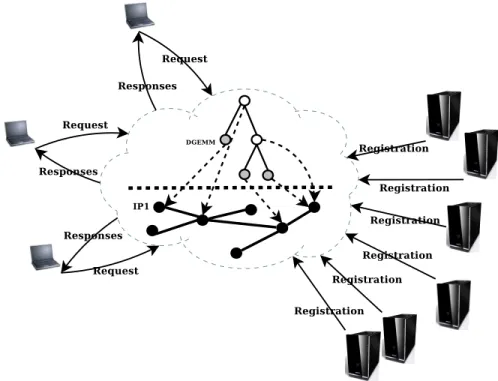
As illustrated on Figure 1.1, Service Discovery is a process taking a query as a parameter and returning a set of available servers satisfying the requirements enounced in the query, along with the information allowing to use the service in a remote mode (basically the address of the server). As also suggested on Figure 1.1, a service discovery systems provide two fundamental features:
1. Service Registration. When a resource or a service joins a network it has to register itself in a registry. This is necessary for the service to be visible. Upon registration a description of the new service is provided and written along with the service in the registry. That description allows the system to match that specific service with a client request. Handled in the same way, a server may decide to unregister one of its service. This part is illustrated on the right part of Figure 1.1 and is most of the time initiated by the servers (except if the system decides to remove a service from the registry in the case the service has an undesired behavior). 2. Service Location. Once a service is registered, the system considers it is available and thus
if any client issues a request that matches that specific service, it will be added to the list of appropriate services that is to be returned to the client. The information returned to the client contains the location of the service and how to access to it. (See the left part of Figure 1.1.) The Location process is made in three phases. First, the client sends its request to the system.
Then, the system collects the information of the services matching the request. Finally, the information found is sent back to the client.
Several tools within several computational platforms paradigm tackles the service discovery issue. To give a better illustration of this problem, we now briefly review two widely used approaches for service discovery, namely MDS2, the Grid Information System of the Globus toolkit version 2, and UDDI, used in the Web Services technology.
Figure 1.1: Service discovery conceptual architecture.
MDS2
Overview. MDS2 is the Grid Information System of Globus Toolkit version 2. An MDS4 version based on Web Services (refer to next section) technology has been integrated in the Globus Toolkit 4. However, the differences between the versions are not related to the core design itself [86]. This grid information service architecture (see Figure 1.2) comprises two fundamental entities: particular information providers and specialized aggregate directory services.
• An information provider (IP) is a software device providing information on a particular resource (designated by the provider of the resource). Together, information providers form a common infrastructure providing access to detailed, dynamic information about grid entities, independently from Virtual Organizations. (A Virtual Organization can be seen as a set of computation abilities grouped to be used by a particular group of people sharing a particular goal.) For example, a provider for a computing resource might provide information about the number of nodes, amount of memory, operating system version number and load average; a provider for a running application might provide information about its configuration and
1.2. SERVICE DISCOVERY
current status. In other words, an information provider gives the raw information about a resource.
• aggregate directories (AD) provide often specialized, VO-specific views of federated re-sources or services, each VO having its own scope. For example, a directory, intended to support application monitoring, might keep track of running applications. Another directory serving the scope of one VO whose scope is to optimize a particular parameter will provide an aggregate directory on which resources will be sorted according to this parameter.
GRPP. Each IP informs ADs of the availability of the information it provides a resource using the GRid Registration Protocol (GRRP). In other words, the GRRP protocol is used to update information contained in AD. GRRP defines a notification mechanism that one server can use to “push” simple information about the existence of a service to another element of the information services architecture. It is a soft-state protocol, meaning in our context that state established at a remote location by a notification (e.g., an index entry for an information provider) may eventually be discarded unless refreshed by a stream of subsequent notifications.
GRIP and LDAP. Getting information from IPs is done through the GRid Information Protocol (GRIP), which relies on the LDAP [80] protocol. LDAP defines a data model, query language, and wire protocol. Aspects of the data model are illustrated in Figure 1.3. Within information providers, information is structured according to the LDAP model. GRIP is used by client to access informations contained in both AD and IP.
Scenario. When a client needs to discover a resource, it first sends a discovery request to a VO-specific AD. This AD serves a given scope and references and presents resources according to this scope. Once the client has received the reference of the service matching his request (and information on how to contact the corresponding IP), it sends a new lookup request using the GRIP protocol to retrieve the detailed information of the resource. See Figure 1.2.
Figure 1.2: MDS architecture overview. Using the GRid Information Protocol (GRIP), users can query aggregate directory services (denoted D) to discover relevant entities, and/or query information providers (P) to obtain information about individual entities. Description services are normally hosted by a grid entity directly, or by a front-end gateway serving the entity.
Figure 1.3: The LDAP data model represents information as a set of objects organized in a hier-archical namespace. Each object is tagged with one or more named types. Each object contains bindings of values to named attributes according to the object type(s).
UDDI, Web Services
Web Services Overview. Web Services, whose general architecture is provided by Figure 1.4 is a system designed to support interoperable machine-to-machine interaction over a network [10]. Web services are frequently just Web APIs, that can be accessed over a network, such as the Internet, and executed on a remote system hosting the requested services. Clients and servers (often businesses providing on-line services) communicate using XML messages that follow the SOAP standard. When one want to make its services available through the web, the information is sent to a set of web-based registries, called Universal Description, Discovery and Integration (UDDI) in which information on web-services are stored. Clients, for discovery, and servers, for registration of their services, communicate with UDDI registries using the Web Services Description Language (WSDL), a standard XML-based language for describing such services.
1.3. PROBLEM STATEMENT
UDDI Overview. UDDI is a group of Web-based registries that expose information about a business or other entity and its technical interfaces (or API’s). These registries are run by multiple operator sites, and can be used by anyone who wants to make information available about one or more businesses or entities, as well as anyone that wants to find that information. By accessing any of the public UDDI Operator Sites, anyone can search for information about Web Services that are made available by or on behalf of a business. The benefit of having access to this information is to provide a mechanism that allows others to discover what technical programming interfaces are provided for interacting with a business for such purposes as electronic commerce. The benefit to the individual business is increased exposure in an electronic commerce enabled world. The information that a business can register includes several kinds of simple data that help others determine the answers to the questions “who, what, where and how”. Simple information about a business, information such as name, business identifiers and contact information answers the question “Who?”. The question “What?” involves classification information that includes industry codes and product classifications, as well as descriptive information about the services that the business makes available. Answering the question “Where?” involves registering information about the URL or email address (or other address) through which each type of service is accessed. Finally, the question “How?” is answered by registering references to information about interfaces and other properties of a given service. These service properties describe how a particular software package or technical interface works.
UDDI API and Architecture. A UDDI programmer’s API has been designed to provide a simple request/response mechanism that allows discovery of businesses, services, and technical service binding information. A set of Web Services supporting at least one part of the API is referred to as a UDDI node. One or more UDDI nodes may be combined to form a UDDI registry. The nodes in a UDDI registry collectively manage a particular set of UDDI data. The architecture of UDDI is hierarchical. It is up to each of the entities to register themselves upon one or several registries. There are mechanisms to replicate information concerning services or any other entity among nodes attached to a same registry. All the nodes of a same registry share the same information, thus when any modification occurs in one of these nodes, it has to be reflected on all the other nodes. Upon modification the node will issue a change notification to all the nodes attached to the same registry so that they reflect that change on their own copy of the shared data.
Until here, we have presented the context of the dissertation (service discovery in grid computing) and have illustrated it with a few examples of service discovery systems picked within traditional computational platforms. We now refine our study and state the problem we address.
1.3
Problem Statement
1.3.1 Infrastructure
Henceforth, we simply consider a set of geographically distributed computing devices, that we call servers. Each of these servers provides a particular set of binaries, libraries, or software components, brought together under the term service. As in any computational platform, the purpose is to make these services available to clients, which are desktop or laptop computers of users who need to do a computation ability missing on their own computer and/or requiring far more power than it is able to offer. Then, users have to specify their requirements following a certain formalism in a query request. As illustrated on Figure 1.1 and already described above, Service Discovery is a process
taking a query as a parameter and returning a set of available servers satisfying the requirements enounced in the query, along with the information allowing to use the service in a remote mode (basically the address of the server). What is behind the cloud of Figure 1.1 can be on a central, powerful computer, or a set of processors of a distributed platform.
1.3.2 User Requirements
Users can specify their needs, dealing with both software and hardware aspects. We now review the main aspects of a service for which a client can request some particular values.
• The Service. Users are basically looking for a service and specify it with a name under which this service is usually referred to as. For instance the DGEMM refers to a routine of the BLAS library [57]. Users may also want to discover any routine of the SUN S3L library [6], whose all names begin with “S3L ”.
• The Operating System. Users often need a particular operating system, compatible with their data to be processed by the computation. Moreover, operating systems do not have the same characteristics and functionalities, inducing performance variations. They also do not offer the same security level. Examples are Linux Fedora, MAC OS X. A query from a user may be “any Linux”, what can be specified with “Linux*”.
• The Processor. Users may specify a particular processor on which they want the service to run, for instance to avoid to send miscoded data (endianess, 64/32 bits architectures) and loose precious time. Examples are Power PC, x86.
• Performance Requirements. Users may require a minimum amount of memory, CPU or storage load under which they will not be satisfied. For instance, a user knows the memory amount needed by the service to complete the computation in a decent time. Examples of such requirements are Memory > 2 Go and Free CPU > 50 %.
To sum up, we want the service discovery system to support multi-attribute queries, range queries, and automatic completion of partial search strings.
1.3.3 Platform Characteristics
Recall that the service discovery service itself must be offered in the kind of platforms that are emerging today. We consider three types of nodes: client nodes, server nodes, and nodes taking part in the discovery process by maintaining the information on available services and answering to clients’ requests. We call them service discovery agents, or simply agent nodes. We can consider two types of computing architectures:
• A platform in which clients, servers and agents are three distinct sets of nodes.
• A pure peer-to-peer computational grids, in which each node can be client, server, and also agent, at different times.
In both cases, agents are run on nodes of a platform having today’s platform characteristics, i.e., several properties that must be taken into account when designing a service discovery service. We now recall these properties:
1.4. SOLUTION OVERVIEW AND OUTLINE
1. The Scale. The number of servers and services, and of clients and requests, is very large. As a consequence, the load generated by the service discovery process is as large. In addition, as we already stated, no stable centralized powerful infrastructure is available. Thus this load must be distributed as much as possible, i.e., among every node of the whole network. Algorithms underlying the discovery process have to be totally decentralized.
2. The Heterogeneity. Moreover, to avoid some nodes to be overloaded and avoid bottlenecks, one has to carefully and fairly distribute the load generated by the service discovery among all nodes involved in the process by taking into account their particular amount of power in terms of bandwidth, CPU and storage load.
3. The Dynamic Nature. In those platforms, nodes are constantly joining and leaving the network without notice. The service discovery must remain efficient as nodes performing it can leave at any time. In other words, the service discovery have to be fault-tolerant.
1.4
Solution Overview and Outline
This dissertation details the diverse aspects of a solution to the above-described problem. First note that traditional approaches that we described above can not be efficient in such platforms since they all require a stable set of powerful processors able to store the information and process requests. Because the peer-to-peer community provides purely-decentralized and fault-tolerant algorithms to retrieve information, peer-to-peer systems have been a new field of investigation for designers of grid middleware. Our solution also calls upon some peer-to-peer concepts. More precisely, our solution relies on the indexing of information on services available on the platform in a particular tree structure, namely a trie, also known as Prefix Tree, or Lexicographic Tree.
Distributed Trie-Based Structure. We have first developed a set of algorithms able to maintain such a structure and the information contained inside in a fully distributed environment, as services of the platform appear and disappear. These algorithms, their complexities, their performance measured by simulation and a first comparison of our solution with similar existing architectures are exposed in Chapter 3.
Mapping the Trie on the Network. The second main point focuses on how to improve the initial design presented in Chapter 3, in terms of throughput, i.e., the amount of requests satisfied especially when this number becomes large. Chapter 4 presents a scheme to efficiently dis-tribute the nodes and links of the tree structure on the processors, i.e., an efficient mapping of the tree on the network. Chapter 4 also proposes some weighted load balancing techniques to dynamically adapt this mapping as the tree grows and the load, i.e., the set of requests processed by a node, fluctuates. An analytical and simulation-based comparison with similar work is provided, establishing the relevance of our approach.
Fault-Tolerance and Self-Stabilization. The third main part of this dissertation is related to the fault-tolerance. The question we deal with in Chapter 5 is how one can ensure the effectiveness of the service discovery as nodes on which it runs are constantly joining and leaving the network. A first replication-based solution is proposed, replicating data, links, and nodes of the tree. Nevertheless, replication is costly and does not formally ensures the recovery of the system after arbitrary failures. From this point on, it remains only to use a best-effort approach, i.e.,
let the tree crash and recover a correct configuration with what remains in the network. To this end, we propose three algorithms, two of which rely on the self-stabilization paradigm. The concept of self-stabilization [54] is a general technique to design a system tolerating arbitrary transient faults. A self-stabilizing system, regardless of the initial states of the processors and initial messages in the links, is guaranteed to converge to the intended behavior in finite time. Our three algorithms are designed using different models and making different assumptions, and have different advantages and drawbacks in theory and practice. They are given with their complete correctness proofs and some simulation results to better capture their efficiency. Middleware Extension, Prototype Implementation and Application. Finally, we detail
our practical contributions in Chapter 6. First, we describe an early work connected to ser-vice discovery, whose aim was to identify and break the barriers to the scalability in a grid middleware. This work, partly independent from the architecture described throughout this dissertation was conducted in 2004, and was the design, implementation, and experimentation of a peer-to-peer extension of a particular grid middleware. Properly related to our architec-ture, we then present a prototype implementation of it. We focus on the software architecture we developed. Finally, we expose the use of such an architecture for the monitoring and pro-visioning of network resources in a distributed fashion and presents preliminary deployment results over the Grid’5000 platform.
The following chapter provides the background and related works for these problems, from the origins of the file retrieval techniques to the most advanced solutions merging self-stabilization and peer-to-peer systems via topology awareness and load balancing in distributed hash tables, and the tremendous amount of papers addressing the expressiveness of queries on top of structured peer-to-peer networks.
Chapter 2
Background and Related Work
In this chapter, we give the background and related work of our solution. In a first Section, we briefly expose the genesis of the convergence between grid computing and to-peer systems and why peer-to-peer has become a field of investigation for designers of grid systems. Then, in Section 2.2, we recall the origins of the peer-to-peer systems and define some useful peer-to-peer concepts. In Section 2.3, we give some example of pioneering peer-to-peer systems, which rely on flooding algorithms. In Section 2.4, we detail the Distributed Hash Tables, their topology awareness mechanisms and the studies of their load balancing properties. In Section 2.5, we describe an important part of our related work, dealing with complex queries in structured peer-to-peer networks. In Section 2.6, we introduce a few recent advances in software considerations for the peer-to-peer and grid computing convergence. Finally, the background for self-stabilization and the recent studies for the use of such a paradigm in peer-to-peer networks is given in Section 2.7.
2.1
On the Convergence of Peer-to-Peer and Grid Computing
As new infrastructures hosting computational grids become larger and more unstable while failing to provide central devices able to monitor the whole platform, grid middleware needs to be redesigned in a fault-tolerant and fully decentralized fashion. Software introduced by the peer-to-peer community, offering purely decentralized techniques to share resources on highly large and dynamic platforms has appeared to be of high interest for grid middleware designers. Peer-to-peer technologies offer more and more robust tools for content distribution, while addressing failures. As a consequence, it has much to offer to the Grid Computing community. This convergence were put in words by Iamnitichi and Foster [83].
2.2
Peer-to-peer: Definitions and Origins
We can find in literature a considerable number of definitions of the term peer-to-peer (P2P), each one encompassing a more or less broad set of systems.
• In their strictest definition, pure P2P systems refer to totally decentralized systems in which all basic entities, called peers, are equivalent and perform the same task. The KaZaA [146] net-work, within which supernodes (mini-servers locally aggregating information) are dynamically assigned, falls out of this definition.
• In a broader and widely accepted definition, notably introduced by Shirky [131], P2P refers to any applications that take advantage of resources — storage, cycles, content, human presence — available at the edge of the Internet. This definition encompasses systems completely relying on a central server for their operation, e.g., volunteer computing systems (@home projects) — refer to Chapter 1, or pioneering file sharing networks like the well-known Napster [109]. File Sharing. The first generation of peer-to-peer file sharing networks relied on a centralized server listing the files available on users’ computers. In this model, the user looking for a file sends a search request to this server and the server sends a response containing a list of online computers providing the requested file back to the user. The most known implementation of this model is Napster, a music file sharing system, which operated between June 1999 and July 2001. Napster encountered several problems.
• Architectural Problems. As the number of connected users increases, the central server becomes unable to manage the amount of requests, what reduces the ability of the system to scale well. The main weakness of the Napster system is that it relies on a central server. In case of a single failure on this server, the whole sharing system becomes inoperative.
• Legal Problems. The free sharing of music files led to accusations of massive copyright violation from the music industry. Although the original service was shut down by court order, it paved the way for decentralized peer-to-peer file-sharing programs, which have been much harder to control.
2.3
Unstructured P2P
The second generation of P2P file sharing systems, notably initiated among others by Gnutella [70], relies on a purely decentralized logical network built on top of the physical network in which all users participate in the forwarding of the search requests, each request flooding the network within a given radius (number of hops) from the source. However, Gnutella does not take advantage of the heterogeneous nature of file sharing networks in which some computers can be far more powerful than others in terms of computing power, storage space, or proximity to network backbones. KaZaA [146] improves this model by introducing a two-layer architecture. A set of supernodes, local servers dynamically assigned considering their power and listing the set of files stored by standard nodes, manages the listing and processes requests for other standard nodes, each standard nodes being assigned to one given supernode.
Despite the KaZaA effort to improve the architecture of unstructured approaches, such networks present several major drawbacks:
• Overhead. Flooding the network for each request generates a high traffic load that may be hard to handle and create poor network conditions. As the number of users grows, the number of messages can become unacceptable.
• Non-Exhaustiveness. The core operation of peer-to-peer systems is efficient location of data items. Scanning the entire network for each request would lead to unacceptable latencies. As a consequence, the search is limited by a given number of hops after which the packet is deleted. This means that there may be a response to the request somewhere in the network that has not been retrieved.
2.4. DISTRIBUTED HASH TABLES
Addressing both high cost and non-exhaustiveness of unstructured peer-to-peer approaches for data item locations, a plethoric amount of work was initiated, by the famous Distributed Hash Tables.
2.4
Distributed Hash Tables
2.4.1 Principles
Distributed Hash Tables (DHTs) are very attractive solutions to distribute and retrieve information in a large and dynamic network. DHTs basically provide one single functionality to the client user, namely the location of data items.
In a hash table, each resource declared is referenced as a (key, value) pair. For instance, one user may declare the resource (musicFile1.ogg, 140.55.123.4) meaning that the computer at the address 140.55.123.4 provides the file musicFile1.ogg. These pairs are physically stored in m memory cells by application of the hashing function h : X → {0, 1, . . . , m − 1} on the key. In the case of distributed systems, the goal is to uniformly distribute the set of pairs among the m nodes of the network while globally optimizing the search for a key from any node in the network. As a result, the hash function must be uniform random with values in a set of logical identifiers with a negligible probability of collision. This is achieved by using cryptographic functions and large values for m.
Distributed Hash Tables maintain an overlay network, i.e., they build a virtual communication network over a physical network, like the TCP/IP Internet protocol. Each processor of the physical network becomes a node of the overlay network. The location of the node representing a processor in the logical/overlay network is decided by applying the hash function on the unique physical address of the processor. A processor joins the overlay network by first using a bootstrap mechanism giving the way to access to a processor or a group of processors that are already in the overlay network. Once the joining processor knows an entry point of the system, it can send a request to be inserted. A new node is inserted using the distributed join procedure, finding its location in the overlay. Objects ((key, value) pairs) are then distributed among these nodes by finding the node whose identifier (in the logical network) is the closest to the key of this object. The lookup function is a common feature of any DHT and allows to retrieve the node responsible for storing the searched key. We now briefly review the main pioneering implementations of such networks, developed around 2001.
2.4.2 Some DHTs
CAN. The overlay network maintained by the Content-Addressable Network [118] is arranged as a virtual d-dimensional Cartesian coordinate space on a d-torus. In other words, the hash functions returns values representing points in this space. When N nodes are in the network, the space is partitioned into N zones, each zone being assigned to a node. Figure 2.1 illustrates such an overlay for N = 5 nodes and d = 2. The first node to join owns the entire CAN space, its zone being the complete virtual space. When the second node joins, the space is split in two and each node gets one half of the space. Each node maintains a state of its neighbors i.e., nodes responsible of zones adjacent to its own, allowing nodes to route messages to their destination node/zone. Consider a new node p joining the network. By applying the hash function on its IP address (for instance), it obtains a point hp in the space and contacts any node already in the network. An insertion request
for this node is then routed to the node responsible — let us denote it r — for the zone in which hp
to h(p). Once found, the destination zone is split in two halves, one being assigned to p, the other to r. Objects are then assigned to nodes using the same routing algorithm.
Figure 2.1: CAN, d = 2.
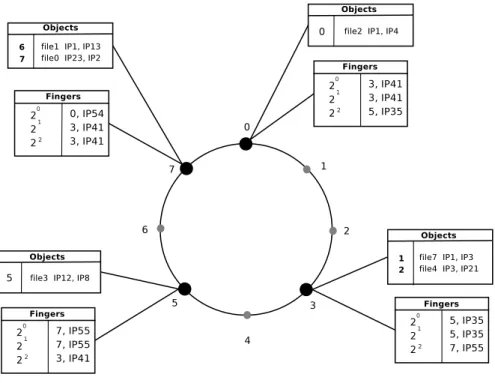
Chord. The Chord overlay network [135] builds a ring on identifiers ordered in an identifier circle modulo 2m. A key k is assigned to the first node on the ring whose identifier is equal to or follows k in the identifier space. This node is called successor of k (succ(k)). In other words, each node is responsible for keys falling between itself and its predecessor on the ring. Such a logical ring is given by Figure 2.2 with m = 3 and the number of nodes N = 4 (black-filled circles). The routing table of a node identified by p is composed of references of nodes, called fingers, whose distance on the ring to the node grows exponentially, the ith entry being succ(p + 2i). To route a request for the key k, a node forwards the request to the highest finger lower than k.
Plaxton Trees, Tapestry and Pastry. The basic principle of routing methods used by Pastry and Tapestry DHTs relies on the Plaxton, Rajaraman, and Richa (PRR) routing scheme [114]. Each node receives a unique identifier of length d (let’s say 160 bit) in a circle identifier. A request for a key k is routed on node p towards a node that shares at least one digit more with k than p does. As a consequence, each node is the root of a spanning tree (consisting of the paths leading down to this node). Pastry and Tapestry differ only in the method by which it handles network locality and replication. The Bamboo DHT [120] follows the same overlay construction pattern as Pastry and Tapestry but focuses on the churn problem. An open source DHT is based on this DHT [52]. Other DHTs. Many other DHTs have been introduced, based on other topologies and offering different improvements and flexibility levels. Among them, we can cite Koorde [89] and D2B [63] re-lying on De Bruijn graphs. Kademlia [105] proposes a routing scheme using the XOR metric between two identifiers. Viceroy creates a DHT using a butterfly topology overlay [101], and Cycloid [130] a cube-connected cycles overlay. Small Worlds [92] gives clues to build large overlay networks, based on the small world principle and Symphony [103] applies their results to the case of ring-overlay networks.
Complexities. Complexities of the previously mentioned DHTs are summarized in Table 2.1. The Linkage column gives the number of nodes each node maintains a connection with, i.e., the size of the routing table, the Update column exposes the cost of an update of the network, e.g., resulting from a
2.4. DISTRIBUTED HASH TABLES
Figure 2.2: Chord, m = 3.
join operation, the Lookup column represents the number of hops required to find the node responsible for a key, and the Congestion column summarizes the expected load of one lookup operation on one node in a search for a random key starting from a random point. n denotes the number of nodes. d denotes both the dimension of the Cartesian space of CAN and the network dimension of Cycloid, where n = d × 2d. k is the number of long links in Symphony.
Other Properties. By design, DHTs have several good properties.
• Load Balancing. Uniform random hash ensures with high probability the uniform distribu-tion of keys among nodes, each node being responsible of the same amount of keys.
• Fault Tolerance. Several mechanisms ensure the consistency of the overlay and prevent from data loss as nodes are leaving the network without notice. Periodic scanning allows to detect that a node has left. By introducing a replication mechanism — each object being replicated k times, the system ensures that k − 1 simultaneous will not lead to the loss of any data. Tuning k should be the best tradeoff between storage space requirements and fault tolerance.
In the remainder of this section, we focus on two problems which are inherent to the DHT design, but that may greatly limit their use on real platforms, namely topology awareness and load balancing.
2.4.3 Topology Awareness
As DHT overlays are built on random logical connections, they break the natural topology of the physical network. It is important to recall that neighbors in the overlay network may be a very long way from one another. As a consequence, it is possible to achieve a world tour even if the destination
Linkage Update Lookup Congestion
CAN [118] O(d) O(d) O(dn1/d) O(dn1/d−1)
Chord [135] O(log n) O(log n) O(log n) O((log n)/n) Pastry [121] O(log n) O(log n) O(log n) O((log n)/n) Tapestry [159] O(log n) O(log n) O(log n) O((log n)/n)
D2B [63] O(1) O(1) O(log n) O((log n)/n)
Koorde [89] O(1) O(1) O(log n) O((log n)/n)
Kademlia [105] O(log n) O(log n) O(log n) O((log n)/n) Small Worlds [92] O(1) O(1) O(log2n) O((log2n)/n) Symphony [103] O(k) O(k) O((log2n)/k) O((log2n)/(nk))
Viceroy [101] 7 O(1) O(log n) O((log n)/n)
Cycloid [130] 7 O(1) O(d) O(d/n)
Table 2.1: Expected performance measures of DHTs.
node is in the same cluster as the initial node. As we will see now, this aspect of DHTs caused a lot of work to be done to inject topology awareness in the way overlays are built.
In order to improve the performance of DHT overlays, many works proposed approaches to make the logical connectivity congruent with the underlying (IP-level) topology. In other words, their goal is to build a logical network in which neighbors are actually closed in terms of latency, administrative domains, or according to any proximity metric, in the IP network. Most of approaches studied rely on a hierarchical design, but we can classify the set of approaches in two distinct groups: supernodes-based and landmarks-supernodes-based.
Supernodes-Based Approaches. Brocade [158] is a two-layer DHT. Its key idea is to let each administrative domain build its own DHT, in which one or several leaders are elected considering characteristics like CPU power, bandwidth, proximity with a backbone or fanout. These leaders then enter an interdomain DHT, connecting local DHTs by high-speed links. This concept has been generalized to any levels [66], and adapted to the IP numbering [68]. The work presented in [152] extends the flexibility of the supernodes approach. When a node joins the network, it chooses itself to be a supernode or not and selects a few existing supernodes to be its neighbors according to some globally known policies. Jelly [81] proposes an architecture in which each joining node either meets the requirements to be a supernode or chooses to be a child of the supernode that minimizes a given metric.
Landmarks-Based Approaches. Another kind of approach, introduced in CAN [118] consists in using a set of stable nodes distributed on the physical network, called landmarks. These landmarks are used to dispatch nodes in virtual bins considering a given metric, such as the latency. The algorithm used to make the distribution is as follows: Let us consider m landmarks. m! orderings on the set of landmarks are possible, each ordering corresponding to one bin. Each node computes the latency between itself and each landmark, sorts them and thus finds its own bin. The intuition behind doing this is that nodes that are close to each other have similar landmark measurements. ECAN [155] extends this approach by building a hierarchy of bins, grouping two close bins at level 1 in the same bin of level 2, and so on. Finally, some papers, like HIERAS [153] adopt a hybrid approach between landmark and supernodes. The Expressway network [152] elects supernodes to