RESEARCH ARTICLE
Impact of load expectations on
neuromuscular and postural strategies during
a freestyle lifting task in individuals with and
without chronic low back pain
Catherine Daneau1☯, Charles Te´treau2☯, Thomas Deroche3,4☯, Camille Mainville2‡, Vincent Cantin2‡, Martin DescarreauxID2☯
*
1 Department of Anatomy, Universite´ du Que´bec à Trois-Rivières, Que´bec, Canada, 2 Department of Human Kinetics, Universite´ du Que´becà Trois-Rivières Que´bec, Canada, 3 Complexite´, Innovation, Activite´s Motrices et Sportives (CIAMS), Universite´ Paris-Sud, Universite´ Paris-Saclay, Orsay Cedex, France,
4 Complexite´, Innovation, Activite´s Motrices et Sportives (CIAMS), Universite´ d’Orle´ans, Orle´ans, France
☯ These authors contributed equally to this work. ‡ CM and VC also contributed equally to this work. *[email protected]
Abstract
Objective
This study aimed to investigate how load expectations modulate neuromuscular and pos-tural strategies in the anticipation of a freestyle lifting task with varying expected loads in individuals with and without chronic low back pain (cLBP).
Methods
Forty-seven participants, 28 with cLBP pain and 19 without, were recruited and completed a series of freestyle lifting trials (3 sets of box lifted for a total of 36 lifts). Verbal cues were used to modulate their expectations about the boxes’ weight: no expectation, lighter or heavier load expectations. Following each set, participants rated their perceived exertion on a visual analog scale. During the lifting protocol, kinematics (time to maximal flexion, angular velocity and joint angles), electromyography muscle activity (erector spinae and quadriceps) and center of pressure displacement were simultaneously recorded.
Results
Results showed that time to maximal knee flexion was modulated by load expectations in both groups (mean lighter load expectations = 1.15± 0.32 sec.; mean heavier load expecta-tions = 1.06± 0.31 sec.). Results also showed a load expectations X group interaction for that time to maximal hip and lumbar flexion. Time to maximal hip flexion decreased with heavier load expectations (mean lighter load expectations = 1.20± 0.36; mean heavier load expectations = 1.16± 0.33) for cLBP only. Time to maximal lumbar flexion increased with heavier load expectation (mean lighter load expectations = 1.41± 0.27 sec.; mean lighter load expectations = 1.46± 0.29 sec.) for participants without LBP. However, no difference in
PLOS
ONE
a1111111111 a1111111111 a1111111111 a1111111111 a1111111111 OPEN ACCESSCitation: Daneau C, Te´treau C, Deroche T, Mainville
C, Cantin V, Descarreaux M (2021) Impact of load expectations on neuromuscular and postural strategies during a freestyle lifting task in individuals with and without chronic low back pain. PLoS ONE 16(2): e0246791.https://doi.org/ 10.1371/journal.pone.0246791
Editor: Xudong Zhang, Texas A&M University,
UNITED STATES
Received: April 7, 2020
Accepted: January 26, 2021
Published: February 8, 2021
Copyright:© 2021 Daneau et al. This is an open access article distributed under the terms of the
Creative Commons Attribution License, which permits unrestricted use, distribution, and reproduction in any medium, provided the original author and source are credited.
Data Availability Statement: Data cannot be
shared publicly due to ethical certification restrictions. Permission to share individual data is needed from the University ethics committee. Request to access data may be sent to
Funding: CT, MD and TD received a grant
(FIR-Clinique UQTR) for this work.https://www.uqtr.ca/
lumbar, hip nor knee angles were observed between groups or conditions. Results
highlighted significant load expectation effects for erector spinae electromyography activity, as lower muscle activations was observed for both groups with heavier load expectations (mean = 0.32± 0.15), compared to lighter load expectations (mean = 0.52 ± 0.27). Force plates analyses did not reveal any significant load expectation effects.
Conclusion
Present findings showed that load expectations modulate movement strategies and muscle activation similarly but not identically in individuals with chronic low back pain and healthy adults during freestyle lifting. Results of the present study partially differ from previous stud-ies and suggest only minor differences in lifting strategstud-ies between healthy individuals and individuals with cLBP experiencing low level of pain and disability. More studies are needed to investigate the potential role of load expectations in the development and persistence of chronic low back pain.
Introduction
According to the 2015 Global Burden of Disease Study, low back pain (LBP) is ranked first as the most disabling musculoskeletal problem in multiple countries [1]. LBP is classified into three different types of pain durations, the chronic form (cLBP) of which is described by pain present for more than twelve weeks [2]. LBP is characterized by ache or muscle tension in the lumbopelvic region, below the costal margin and above the inferior gluteal folds [2], with con-sequential functional impairment [3] frequently associated to reduced function of both the lumbar spine and hips [4]. Lifting task has been widely used to observe the kinematic charac-teristics of the lumbopelvic region and knees [5], and the manner in which these regions are coordinated in chronic LBP, in comparison with healthy individuals [6–8].
The National Institute for Occupational Safety and Health’s Work Practice Guide for Man-ual Lifting reported that vertical positioning of the load at the beginning of the lifting task is one of the determinants to take into account for weight limit [9]. In fact, the location of the load has an impact on the range of motion and lifting capacity during a lifting task [10]. Many lifting behaviors seem to differ between individuals with cLBP and those without. Previous studies showed, for healthy individuals, a significant association between hip movement dur-ing trunk extension from full unloaded flexion and lumbar movement durdur-ing various liftdur-ing positions [11] and a significant influence of weight and trunk flexion angle on lumbar/pelvic angle ratios [12]. In contrast, individuals with cLBP had a decrease in lumbar flexion and an increase in thoracic flexion [6,7], a greater knee flexion and smaller hip flexion [5] and a sig-nificant lower peak velocity of hip and lumbar region [13].
Physiological factors and processes, studied as correlates of LBP in lifting task [14,15], could drive the kinematic and behavioral characteristics of individuals experiencing LBP. The activation of trunk muscles also has its importance while realizing a lifting task. Since muscles are responsible for force production [16], in case of a lifting task, they have to be engaged even before the first phase of the movement. Individuals with LBP seem to experience greater spine compression and shear forces than individuals without LBP when performing a lifting task [15]. Moreover, our pilot study obtained similar results, with significant differences between collection and analysis, decision to publish, or
preparation of the manuscript.
Competing interests: The authors have declared
individuals with and without LBP for erector spinae at L3-L4 and quadriceps (vastus lateralis) muscle activity when performing a freestyle lifting [14].
While some factors may play a role during the entire movement, some factors prepare an individual to realize a specific movement before it is initiated. According to biomechanics, a postural strategy is set in place prior any movement, as described by the anticipatory postural adjustments (APA) [17,18]. It serves three main goals: (1) minimizing the disturbance of bal-ance during movement and (2) of postural orientation of body segments and (3) assisting the movement performance in terms of velocity or force [19]. Growing scientific evidence suggest that APA strategies are altered in LBP patients. For instance, patient with LBP exhibit a reduced capacity to adapt trunk muscle recruitment to an upcoming task [20]. A review by Ruhe et al. (2011) also reports that individuals with LBP presented greater center of pressure (CoP) displacement than healthy individuals, resulting in greater postural standing instability [21]. Since these altered adaptative strategies may play a role in the development and mainte-nance of chronic low back pain, targeted interventions have been developed. Among these, sensory motor training seem promising and although they induce little changes on APA strate-gies, results indicate a positive impact on pain and function [20,22].
LBP is also associated with psychological factors, including anxiety and pain behaviors, resulting in an outward display of pain and guarding [3]. A previous study showed that indi-viduals with cLBP who have a higher score on Pain Catastrophizing Scale (PCS) felt more dis-abled because of their pain and suffered more from psychological distress [23]. Moreover, Pfingsten et al. (2001) showed that when pain anticipation was induced by instruction, levels of behavioral performance was lower, and pain intensity and related fear were increased dur-ing a sdur-ingle leg-flexion task [24]. This can suggest that fear of pain, as a protective strategy, might influence the normal execution of a freestyle lifting task for LBP individuals compared to healthy ones. Our pilot study has observed a relationship between load expectations and perceived exertion responses in freestyle lifting [14]. As reported in this pilot study, modula-tion of load expectamodula-tions triggered modificamodula-tion in the individuals’ percepmodula-tion of exermodula-tion which result in an increased electromyographic activity [14]. It seems interesting to further investigate how psychological factors, including load expectations, can amplify or modulate the maladaptive behaviors observed in LBP patient.
To the best of our knowledge, the previously mentioned pilot study [14] led by our research team, was the first to investigate kinematics (range of motion and angular velocity), postural CoP displacement), physiological (muscle activity) and perceived exertion during a freestyle lifting task in a protocol inducing lower and higher load expectations in individuals with cLBP. Since preliminary results were promising, it became relevant to deepen our investigation in a larger sample by modifying kinematic assessment and focusing on the neuromechanical adaptations preceding the lift. Therefore, the goal of the present study was to investigate how load expectations modulate kinematics and neuromuscular control, during a freestyle lifting task with varying expected loads in individuals with and without cLBP.
Materials and methods
Participants
Participants were recruited through advertisement on the university campus, social media and an on-campus outpatient chiropractic clinic. A total of 47 participants were tested in order to compare results of patients with (28 participants) and without (19 participants) cLBP, and attention was given to matching participants’ characteristics between groups. To be included in the cLBP group, participants had to have experienced recurrent or persistent LBP for at least six months defined as pain or discomfort located below the costal margin and above the
inferior gluteal folds [25], though not at a level limiting their capacity to execute the lifting pro-tocol, the latter consisting of a total of 36 freestyle lifts of a box positioned on the ground weighting between 6.8 kg and 13.6 kg. Individuals in the non-cLBP group should not have experienced LBP in the last five years. Subjects were systematically excluded from the experi-ment if they were currently experiexperi-menting a flare-up episode of LBP or presented health prob-lems such as uncontrolled hypertension, neuromuscular disease, cancer, consumption of psychotropic drugs, as well as specific LBP, including spinal stenosis, herniated disc, back operation or traumatic injury. Additionally, pregnant or breastfeeding women were also excluded. The study was carried out in accordance with the Human Research Ethics Commit-tee of the Universite´ du Que´becà Trois-Rivières who granted ethical certification for the study (CER-15-219-07.12). All subjects provided written informed consent in accordance with the Declaration of Helsinki.
Procedures
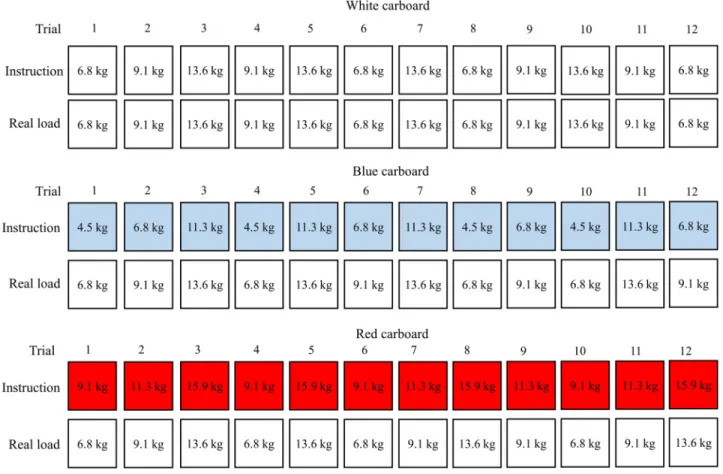
This protocol builds on a pilot study conducted previously [14] to which slight adjustments were made in order to improve kinematic data collection and the modulation of expectations related to the weight of the boxes to be lifted. Patients were invited to the University’s Neuro-mechanics and Motor Control Laboratory; their commitment included a single visit. After the initial measures, including anamnesis, (self-reported) weight and height, questionnaires filling (information on catastrophizing, kinesiophobia, anxiety and functional limitations) and rating of pain on a visual analog scale, participants were instrumented with surface electromyography and kinematics sensors. Maximal voluntary contraction (MVC) of the lumbar erector spinae and of the quadriceps were recorded for normalization before the lifting protocol started. The latter consisted of three sets of twelve box lifts (Fig 1) from the ground, for which the partici-pants received the following verbal instructions: “Lift the box as you would in everyday life while holding both handles located on its sides as naturally as possible”. Each lift started in a standing position. At a self-chosen pace, the participants then leaned forward to reach the box, grabbed it, executed a full knee and hip extension to regain a standing position for two sec-onds, bringing the box with them, and then repositioning the box on the ground. For each lift, the prelifting phase corresponded to the time period before the box was lifted from the force plate. A 30 seconds rest period was allowed between each trial. A total of 9 identical hard plas-tic boxes measuring 42 x 33 x 24 cm (length x width x height) with handles on each side, in which different combination of weight plates, not visible to the participant, were firmly fixed to obtain the desired mass were used for this protocol. The first set of twelve repetitions con-sisted of four lifts of a 6.8-, 9.1- and 13.6-kg boxes on which a white cardboard was affixed to indicate the real weight that was lifted. This first set can be considered as familiarization since only the data from the second and third sets, in which load expectations were manipulated, were analyzed. For the second and third sets of repetitions, randomly counterbalanced between participants, the weights of the lifted boxes were identical however, verbal cues were used in combination to visual information (blue and red cardboards) to reinforce the modula-tion of expectamodula-tions about the weight of the boxes, since these two strategies have been demon-strated to have a cumulative effect [26]. In the heavier load expectations set, a red cardboard placed on the boxes’ lids indicated a weight of 2.3 kg higher than the real boxes’ weight (for example, the red cardboard on the 9.1 kg box indicated 11.4 kg). On the opposite, a weight of 2.3 kg lower than the real boxes’ weight was written on a blue cardboard for the lighter load expectations set (for example, the blue cardboard on the 9.1 kg box indicated 6.8kg). The weights of the boxes were chosen according to the literature evaluating similar task with a LBP population [7], and because our pilot study showed that weights of 2.3, 5.7 and 9.1 kg cause
little exertion to both people with and without LBP [14]. Each set of twelve repetitions lasted around 7 to 8 minutes and participants were given a 10-minute break between each set in order to help limit pain increase for participants with LBP and to separate the different sets by enough time so that participants could hardly realize that they were in fact lifting the exact same weights in the three sets.
Measurements
Kinematics. Kinematics data were collected to evaluate anticipation and lifting strategies.
A motion analysis system (Optotrak Certus; Northern Digital, Waterloo, Ontario, Canada) was used in combination with four kinematics markers placed on anatomical landmarks, three virtual kinematics marker and two clusters of active markers all placed on the subject’s right side. The exact location of these markers were 1) kinematics markers: lateral malleolus, femur’s lateral condyle, T1 and T11, 2) virtual kinematics markers: anterosuperior iliac spine (ASIS), posterosuperior iliac spine (PSIS) and great trochanter and 3) clusters of active markers: cen-tered on mid-sacrum and lateral mid-thigh. These markers allowed the creation of three joint angles: the knee angle (lateral malleolus, femur’s lateral condyle and great trochanter), the hip angle (the intersection between the thigh segment created by the femur’s lateral condyle and the great trochanter, and the pelvis segment created by ASIS and PSIS) and the lumbar spine angle (intersection between lumbar segment created by L1 and T11 and the pelvis segment cre-ated by ASIS and PSIS). This setup was chosen to help tracking markers that could disappear
Fig 1. Illustration of the three sets of twelve box lifts. https://doi.org/10.1371/journal.pone.0246791.g001
because of the arm movement throughout the lifting task as experimented in the pilot study [14]. Time to maximal flexion, angular velocity and joint angles were calculated using Matlab (MathWorks, Natick, Massachusetts). All kinematics recordings were made at 100Hz.
Electromyography. Surface electromyography (sEMG), consisting of bipolar disposable
surface Ag/AgCl electrodes (Bortec Biomedical, Calgary, Alberta, Canada), was used to register muscle activation strategy for lumbar erector spinae at L3 and at vastus lateralis. Skin was pre-pared to reduce skin impedance by shaving body hair, gently abrading with fine-grade sandpa-per (Red Dot Trace Prep; 3M, St. Paul, Minnesota) and wiping with alcohol swabs. Electrodes were then placed bilaterally, and a ground was positioned on the left ASIS completed the setup. A Delsys sEMG sensor recorded data with a common mode rejection ratio of 92dB at 60Hz and an input impedance of 1015O (model DE2.1; Delsys, Inc., Boston, Massachusetts). Data were sampled at 1000Hz with a 12-bit A/D converter (PCI 6024E; National Instruments, Austin, Texas). After the data collection with LabView (National Instruments, Austin, Texas), the sEMG signals were processed by Matlab (MathWorks, Natick, Massachusetts).
Maximal voluntary contraction. Participants realized two or three MVC of the back
extensor muscles on a Roman chair inclined at 45 degrees [27]. To ensure a proper MVC, the participant had to perform a third MVC if his second trial was higher than his first trial and encouragement were provided for each trial in both groups. In a prone position, their iliac crests were aligned with the side of the cushion and their trunk maintained unsupported [27]. They performed the MVC against a belt installed over their shoulders (adjusted for each par-ticipant to ensure a straight position), attached to a load cell (NTEP-87-057A3 class III; Artech, Riverside, CA) and permanently fixed to the ground by a cable. The MVC was composed of two phases: (1) the participants maintained a horizontal position during five seconds then (2) they lifted their trunk until they felt a tension in the belt and performed the maximal isometric back extensions for five seconds. Participants also realized three MVC of the quadriceps seated on a bench, knees at 90 degrees and their feet unsupported. They performed the MVC against a strap placed on the tibia by doing an extension of both knees at the same time for five sec-onds without using their arms for help. Participants were strongly verbally encouraged by team members while performing MVC and rest periods of 60 seconds were allowed between each MVC trial. After a five minutes seated break, the lifting protocol started.
Force plates. Two force plates (AMTI: Model OR6-5-2000, Advanced Mechanical
Tech-nology, Inc., Newton, MA, USA and Bertec: model 4550–08, Bertec Corporation, Columbus, Ohio, USA) were positioned side by side. The first one was used for boxes, and detected the onset of lifting movements, while the second one was used to calculate the participant’s center of pressure position. Floor markers were used to ensure that both the boxes and the partici-pant’s foot were always positioned similarly for each trial. Only vertical forces were collected from the box force plate (to detect the onset of the lift), as opposed to the foot force plate from which vertical, lateral and anteroposterior forces and moments were recorded to assess the CoP displacement and mean CoP velocity. All force plate recordings were made at 100Hz.
Self-administered questionnaire. Before the beginning of the experiment, all participants
filled the French validated translation of the fear-avoidance belief questionnaire (FABQ) [28], the pain catastrophizing scale (PCS) [29], the Tampa scale of kinesiophobia (TSK) [30] and the state-trait anxiety inventory form Y (STAI-Y) [31]. Participants with cLBP also completed the Oswestry disability index (ODI) [32], reported the number of years living with LBP and rated their actual pain on a visual analog scale (VAS) ranging from 0 to 10, representing respectively no pain and the most intense imaginable pain [33].
Perceived exertion. In order to determine if the load expectation manipulation protocol
yielded a significant impact on participant perception, global perceived exertion was collected at the end of each of the three set. A category-ratio scale anchored at 0 representing no effort at
all and 10 representing a maximal effort was used. A previous pilot study [14] indicated that this tool was effective at detecting statistical differences, although clinically small since global exertion ratings were generally very low.
Data analysis
Each of the descriptive variable (Table 1) were compared using unpaired Student’s T-test to assess between group differences. sEMG data were filtered digitally by a 10- to 450 Hz band-pass, zero-lag, and fourth-order Butterworth filter. Modulation of the sEMG amplitude was calculated by using the root mean square (RMS) value across 500-ms windows before lifting for all investigated muscles. Normalized RMS sEMG values (nRMS) were obtained by dividing this 500-ms mean RMS by the 500-ms mean RMS calculated during the peak of the highest MVC of the respective muscle. For all subsequent analyses, nRMS values were used.
Time to maximal flexion was obtained by calculating the time from the onset to the end of the flexion phase individually for each of the knee, hip and lumbar joint. Joint angles for the knee, hip and lumbar joint were calculated by deducting the angle in the most flexed position minus the angle in the initial upright position. Angular velocities were computed by dividing joints angles by time to maximal flexion of the respective joint. CoP displacement was evalu-ated in the antero-posterior axis only and was calculevalu-ated as the difference in positioning between CoP in the initial upright position and CoP before the onset of the lift. Mean CoP velocity was calculated using the first derivate of CoP displacement. The four trials per
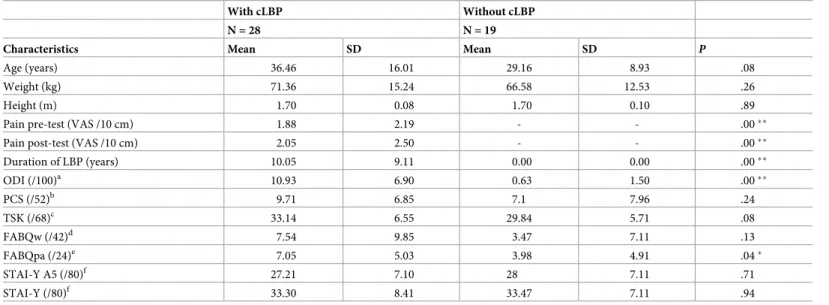
Table 1. Participants’ characteristics.
With cLBP Without cLBP
N = 28 N = 19
Characteristics Mean SD Mean SD P
Age (years) 36.46 16.01 29.16 8.93 .08
Weight (kg) 71.36 15.24 66.58 12.53 .26
Height (m) 1.70 0.08 1.70 0.10 .89
Pain pre-test (VAS /10 cm) 1.88 2.19 - - .00��
Pain post-test (VAS /10 cm) 2.05 2.50 - - .00��
Duration of LBP (years) 10.05 9.11 0.00 0.00 .00�� ODI (/100)a 10.93 6.90 0.63 1.50 .00�� PCS (/52)b 9.71 6.85 7.1 7.96 .24 TSK (/68)c 33.14 6.55 29.84 5.71 .08 FABQw (/42)d 7.54 9.85 3.47 7.11 .13 FABQpa (/24)e 7.05 5.03 3.98 4.91 .04� STAI-Y A5 (/80)f 27.21 7.10 28 7.11 .71 STAI-Y (/80)f 33.30 8.41 33.47 7.11 .94
cLBP, chronic low back pain; SD, Standard deviation; VAS, Visual analog scale.
a
Oswestry Disability Index (ODI) [32].
b
Pain Catastrophizing Scale (PCS) [29].
c
Tampa Scale of Kinesiophobia (TSK) [30].
d
Fear-avoidance Beliefs Questionnaire work subscale (FABQw) [28].
e
Fear-avoidance Beliefs Questionnaire physical activity subscale (FABQpa) [28].
f
State-Trait Anxiety Inventory form Y (STAI-Y) [31]. �p < .05.
��p < .001.
condition were average for each variable and the mean was used for all statistical analysis. The analyses were performed using STATISTICA statistical package version 10 (Statsoft, Tulsa, OK).
The Shapiro-Wilk and the Kolmogorov-Smirnov tests were used to assess each variable for normality. Mixed model ANOVAs (2x2) were conducted using expectations (lighter and heavier loads) and groups (participants with cLBP and those without cLBP) for each of the fol-lowing variables: Perceived exertion (Borg score), lumbar erector spinae and quadriceps mus-cle activity (nRMS), kinematics (time to maximal flexion, angular velocity and angles for the knee, hip and lumbar joint) and force plate data (CoP displacement and mean CoP velocity). Post hoc analyses (LSD test) were conducted whenever necessary. For all analyses, the level of significance was set atp � 0.05.
Results
From the 47 original participants, 7 were excluded of the kinematics analysis because of high loss of data. One participant did not complete all the freestyle liftings due to high apprehension regarding the lifting of heavier weights.
Participants’ characteristics
Both groups were similar in terms of age, weight, height, perceived exertion and different ques-tionnaires (PCS, TSK, FABQw and both IASTA). As expected, pain pre- and post-test, as well as duration of LBP (years) were significantly different between both groups. Means pain rat-ings and ODQ scores indicated that individuals with LBP presented mild LBP and minimal disability levels [34]. Participants’ characteristics (with and without cLBP) are presented in
Table 1and perceived exertion is presented inTable 2.
Kinematics
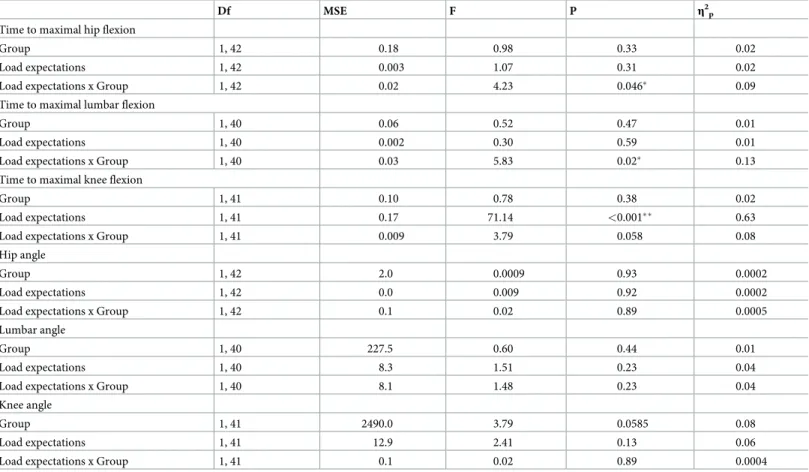
Time to maximal flexion and joint angle. Results showed a significant load expectations
X group interaction (F(1,42) = 4.23,p = 0.046, η2p= 0.09) for time to maximal hip flexion.
Post-hoc analyses revealed that, for cLBP participants, the time to maximal hip flexion decreased with heavier load expectations compared to lighter load expectations (Meanlighter load expectations, with LBP= 1.20± 0.36 sec.;Mean heavier load expectations, with LBP= 1.16± 0.33 sec.)
compared to participant without LBP for which such decreased was not observed (Meanlighter load expectations, without LBP: 1.27± 0.31 sec.; Meanheavier load expectations, without LBP= 1.28± 0.27
sec.). Results showed a significant load expectations X group interaction (F(1,40) = 5.83,
p < 0.020, η2p= 0.13) for time to maximal lumbar flexion. Post-hoc analyses revealed that
par-ticipants without pain increased their time for maximal lumbar flexion with heavier load expectations compared to lighter load expectations (Meanlighter load expectations, without LBP= Table 2. Participants’ perceived exertion.
Df MSE F P η2
p
Group 1, 44 1.81 0.24 0.62 0.005
Load expectations 1, 44 6.76 14.84 <0.001�� 0.25
Load expectations x Group 1, 44 0.35 0.00 0.38 0.02
df, degrees of freedom; MSE, mean square error; F, F statistic; ��p < .001,
η2
p, partial eta squared.
1.41± 0.27 sec.; Meanlighter load expectations, without LBP= 1.46± 0.29 sec.). In contrast, participant
with LBP showed no difference between the lighter and heavier load expectation conditions (Meanlighter load expectations, with LBP= 1.39± 0.31 sec.; Meanheavier load expectations, with LBP=
1.36± 0.27 sec.). Results showed a significant main effect of load expectations (F(1,41) = 71.14,
p < 0.001, η2p= 0.63) for time to maximal knee flexion, indicating that time to maximal knee
flexion was higher with lighter load expectations than heavier load expectations (Meanlighter load expectations= 1.15± 0.32 sec.; Meanheavier load expectations= 1.06± 0.31 sec.). No significant
differences were found concerning the hip, lumbar or knee angles.Table 3presents the main effects and interactions for hip, lumbar and knee time to maximal flexion and angles.
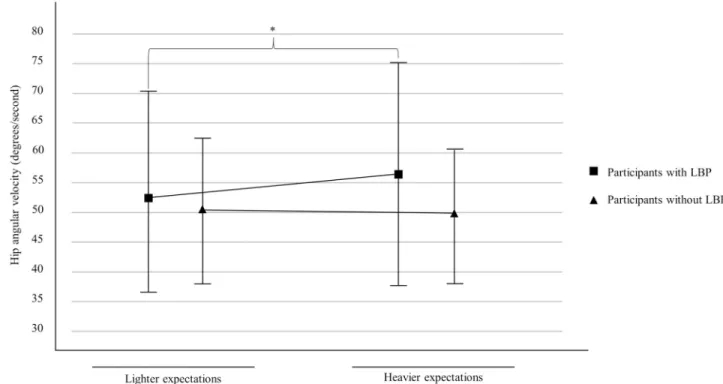
Angular velocity. Results showed a significant load expectations X group interaction
(F(1,42) = 7.62,p = 0.009, η2p= 0.15) for hip angular velocity (Fig 2). Post-hoc analyses
revealed that hip angular velocity, for cLBP participants only, was significantly higher for heavier load expectations compared to lighter load expectations (Meanlighter load expectations, with LBP= 53.71± 7.19; Meanheavier load expectations, with LBP= 56.92± 18.65; Meanlighter load expectations, without LBP= 50.93± 12.80; Meanheavier load expectations, without LBP= 49.13± 11.00).Table 4
pres-ents the main effects and interactions for hip, lumbar and knee angular velocity.
Table 3. Main effects and interactions for hip, lumbar and knee time to maximal flexion and angles.
Df MSE F P η2p
Time to maximal hip flexion
Group 1, 42 0.18 0.98 0.33 0.02
Load expectations 1, 42 0.003 1.07 0.31 0.02
Load expectations x Group 1, 42 0.02 4.23 0.046� 0.09
Time to maximal lumbar flexion
Group 1, 40 0.06 0.52 0.47 0.01
Load expectations 1, 40 0.002 0.30 0.59 0.01
Load expectations x Group 1, 40 0.03 5.83 0.02� 0.13
Time to maximal knee flexion
Group 1, 41 0.10 0.78 0.38 0.02
Load expectations 1, 41 0.17 71.14 <0.001�� 0.63
Load expectations x Group 1, 41 0.009 3.79 0.058 0.08
Hip angle
Group 1, 42 2.0 0.0009 0.93 0.0002
Load expectations 1, 42 0.0 0.009 0.92 0.0002
Load expectations x Group 1, 42 0.1 0.02 0.89 0.0005
Lumbar angle
Group 1, 40 227.5 0.60 0.44 0.01
Load expectations 1, 40 8.3 1.51 0.23 0.04
Load expectations x Group 1, 40 8.1 1.48 0.23 0.04
Knee angle
Group 1, 41 2490.0 3.79 0.0585 0.08
Load expectations 1, 41 12.9 2.41 0.13 0.06
Load expectations x Group 1, 41 0.1 0.02 0.89 0.0004
df, degrees of freedom; MSE, mean square error; F, F statistic; �p < .05;
��p < .001; η2
p, partial eta-squared.
Electromyography
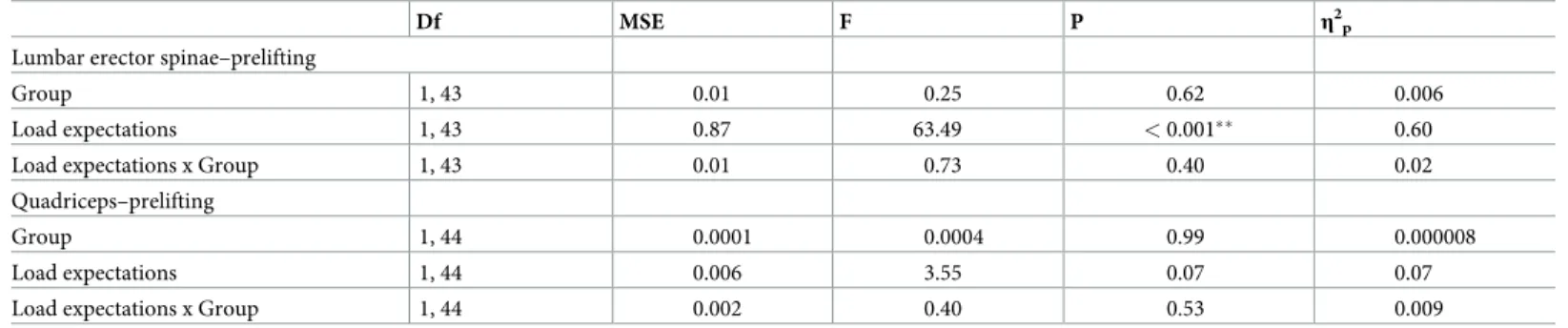
Analysis of sEMG data showed a significant main effect of load expectations (F(1,43) = 63.49,
p < 0.001, η2p= 0.60) during the prelifting phase. It revealed that lumbar erector spinae sEMG
activity was higher with lighter load expectations compared to heavier load expectations (Meanlighter load expectations= 0.52± 0.27; Meanheavier load expectations= 0.32± 0.15). However, Fig 2. Load expectations X group interaction for hip angular velocity. cLBP, chronic low back pain;�p < .05. Bars indicate standard deviation.
https://doi.org/10.1371/journal.pone.0246791.g002
Table 4. Main effects and interactions for hip, lumbar and knee angular velocity.
Df MSE F P η2p
Hip
Group 1, 42 593.5 1.33 0.25 0.03
Load expectations 1, 42 10.5 0.60 0.44 0.01
Load expectations x Group 1, 42 133.7 7.62 0.01� 0.15
Lumbar
Group 1, 38 6.67 0.03 0.87 0.0007
Load expectations 1, 38 4.45 0.70 0.41 0.18
Load expectations x Group 1, 38 0.44 0.07 0.79 0.002
Knee
Group 1, 39 1761.3 1.85 0.18 0.05
Load expectations 1, 39 2.2 0.14 0.71 0.004
Load expectations x Group 1, 39 23.2 1.48 0.23 0.04
df, degrees of freedom; MSE, mean square error; F, F statistic; �p < .05;
η2
p, partial eta-squared.
although mean quadriceps sEMG activity seem to increase with heavier load expectations compared to lighter load expectation (Meanlighter load expectations= 0.87± 0.39; Meanheavier load expectations= 0.89± 0.40), results did not reach statistical significance (F(1,44) = 3.55, p = 0.066,
η2
p= 0.07).Table 5presents the main effects and interactions for the lumbar erector spinae
and the quadriceps sEMG activity.
Center of pressure displacement and velocity
No main effects or interactions were found for the prelifting CoP displacement or for mean CoP velocity.Table 6presents the main effects and interactions for CoP posterior displace-ment and mean CoP velocity.
Discussion
The present study aimed at improving our understanding of mechanisms involved in neuro-muscular and postural control during free lifting tasks by comparing motor and postural strat-egies preceding a freestyle lifting task in healthy individuals and individuals with cLBP. To our knowledge, this is the first study that quantifies the effects of load expectations on prelifting
Table 5. Main effects and interactions for the lumbar erector spinae and the quadriceps sEMG activity.
Df MSE F P η2p
Lumbar erector spinae–prelifting
Group 1, 43 0.01 0.25 0.62 0.006
Load expectations 1, 43 0.87 63.49 < 0.001�� 0.60
Load expectations x Group 1, 43 0.01 0.73 0.40 0.02
Quadriceps–prelifting
Group 1, 44 0.0001 0.0004 0.99 0.000008
Load expectations 1, 44 0.006 3.55 0.07 0.07
Load expectations x Group 1, 44 0.002 0.40 0.53 0.009
df, degrees of freedom; MSE, mean square error; F, F statistic; �p < .05;
��p < .001; η2
p, partial eta-squared.
https://doi.org/10.1371/journal.pone.0246791.t005
Table 6. Main effects and interactions for CoP posterior displacement and mean CoP velocity.
Df MSE F P η2p
Posterior displacement
Group 1, 44 171.80 2.13 0.15 0.05
Load expectations 1, 44 0.65 0.07 0.80 0.001
Load expectations x Group 1, 44 8.06 0.80 0.37 0.02
Mean velocity
Group 1, 44 17.97 0.56 0.46 0.01
Load expectations 1, 44 0.49 0.22 0.64 0.005
Load expectations x Group 1, 44 0.11 0.05 0.82 0.001
df, degrees of freedom; MSE, mean square error; F, F statistic; �p < .05;
η2
p, partial eta-squared.
postural adjustments in a freestyle lifting task in healthy adult participants and participants with cLBP.
As expected, the protocol successfully modified load expectations in both groups, which is consistent with previous studies that have used similar visual and verbal cues to modify expec-tations about lifting weights [14] or expectation of a painful stimulation [35,36]. In the present study, perceived exertion was significantly different between the two sets of instructions for the same weights lifted indicating that load expectations modulated the perception of efforts during lifting.
Results of the study showed that prelifting strategies were similar in individuals with and without cLBP. In fact, there was no significant differences in kinematics, electromyography and center of pressure displacement between individuals with and without cLBP pain as they prepared to lift boxes of varying weights. Such results appear to be in contradiction with the broad-based consensus that cLBP patients present altered anticipatory and compensatory pos-tural adjustments in various tasks [37,38]. However, a recent meta-analysis showed strong evi-dence of a delayed muscle responses in individuals with low back pain but far less evievi-dence suggesting alterations in CoP and kinematics. The authors concluded that changes in timing may not lead directly to impaired movement control [38].
Over the years, several studies have brought up results suggesting adaptations in anticipa-tory postural adjustments of cLBP patients. For instance lower and higher muscle activity of the deep and superficial trunk muscles in supine leg raise [20], delayed and impaired deep trunk muscle activation preceding rapid arm flexion [39] and changes in kinematic strategies in preparation to a lifting task [5] have all been reported. This latter study is particularly rele-vant, since direct comparison can be made with the present study results, as some kinematic variables were assessed in a similar context. Their results indicate that when lifting a load, par-ticipants with LBP, compared to control parpar-ticipants, increase their knee flexion by about 10˚ while reducing hip flexion by about 8˚. Angular displacement were similar for both groups and throughout all conditions in our study and kinematic group differences were rather observed in angular velocity. Such differences between the two studies may be due to instruc-tions given to participants. Rudy et al (2003) instructed their participants to perform multiple lifting for 20 minutes with limited rest period [5]. The number of lifting was significantly lower in the LBP patient group indicating that participants may have prioritize specific strate-gies (e.g. minimizing effort and energetic cost) over others. Pain, fatigue and possible de-con-ditioning probably had limited impact on our results, compared to the results published by Rudy et al. A recent systematic review exploring the differences in kinematics and muscle activity of the trunk and lower limbs in people with and without LBP during freestyle lifting tasks showed that individuals with LBP move differently than healthy individuals [40]. How-ever, the review showed several inconsistencies across studies and trends toward greater changes in strategies in individuals who present more severe LBP. The results of the current project are therefore at least partially in line with findings of this review. Indeed, it is hypothe-sized that the modest differences observed between our LBP and control groups may be explained by the fact that mild LBP patients presenting low level of disability and disturbance of psychological factors related to movement may to behave more similarly to people without LBP than to people with severe LPB.
The present study showed that cLBP participants, in submaximal non-fatiguing lifting tasks are able to perform similarly to healthy adult participants. Additionally, modulating load expectations yielded changes in lifting strategies of mostly medium and large effect sizes sug-gesting that these changes are more than trivial. These changes, however, were consistent in both participants with and without low back pain. For both groups, erector spinae sEMG activ-ity showed less activactiv-ity while quadriceps sEMG activactiv-ity leaned toward increased activactiv-ity when
expectations of heavier loads were triggered. Combined with knee kinematics changes (time to maximal flexion), such results suggest that expectations regarding a weight to lift trigger simi-lar adaptations in patients experiencing mild cLBP and healthy individuals. Although no dif-ference was noted in joint angles, probably due to high heterogeneity and relatively low loads, the current observations seems congruent with the broadly accepted idea that deeper knee flex-ion during squatting technique contributes to the unloading of hip and the back articulatflex-ions [41]. Interestingly, minor differences were found in a few kinematic variables indicating that participants with LBP respond similarly, but not exactly as healthy individuals to load expecta-tions. Although small between group differences in hip angular velocity, time to maximal flex-ion of hip and lumbar joints were observed when participants expected heavier loads, the clinical impact of such differences remains unknown but is probably trivial. As mild differ-ences were observed in psychological factors between LBP and non-LPB groups, mainly fear-avoidance behaviors, it could be hypothesized that they can be a contributing factor to explain why load expectations yielded these minor kinematics adaptations in cLBP patients.
Limitations
Some limitations need to be considered when interpreting the results of the current study. First, a few main and interactions did not reach statistical significance by a very thin margin suggesting that a larger sample may have yielded group differences in knee flexion related vari-ables. In addition, our sample of participants with cLBP was recruited and included in the study only if they were not in an active episode of LBP. This led to the recruitment of func-tional participants with cLBP for whom disability and pain scores were relatively low at the time of testing. Results should therefore be generalized with caution to other cLBP
populations.
Secondly, although weights were increased by 50% following our pilot study, the self-per-ceived exertion remained relatively low during our testing protocol. More challenging tasks may lead to higher effects and expose differences between healthy and cLBP individuals that were not present in this study.
Conclusion
Although the present findings only partially concur with previous evidence, they suggest that healthy individuals and cLBP patients with low level of disability and pain use similar move-ment strategies while performing a freestyle lift of a box from the ground to hip height. The present study showed that load expectations regarding lifting conditions can be successfully modulated in experimental laboratory settings. Inducing load expectations modulated kine-matics and muscle activation similarly in participant of both groups. Although, load expecta-tions triggered minor differences in the lifting strategies between groups our main findings suggest that LBP patients with low levels of disability and pain use similar lifting strategies even when dealing with misleading load expectations. As such results suggest that load expec-tations alter lifting strategies both in low back pain patients and pain free controls, more stud-ies are needed to investigate whether these movement alterations play a role in the
development and persistence of chronic low back pain.
Author Contributions
Conceptualization: Charles Te´treau, Thomas Deroche, Vincent Cantin, Martin Descarreaux. Data curation: Catherine Daneau, Camille Mainville.
Funding acquisition: Charles Te´treau, Thomas Deroche, Martin Descarreaux. Investigation: Catherine Daneau, Charles Te´treau, Camille Mainville.
Methodology: Catherine Daneau, Charles Te´treau, Camille Mainville, Vincent Cantin, Martin
Descarreaux.
Project administration: Charles Te´treau, Thomas Deroche. Supervision: Thomas Deroche, Martin Descarreaux. Validation: Vincent Cantin, Martin Descarreaux.
Writing – original draft: Catherine Daneau, Charles Te´treau, Thomas Deroche, Vincent
Can-tin, Martin Descarreaux.
Writing – review & editing: Thomas Deroche, Martin Descarreaux.
References
1. Vos T, Barber RM, Bell B, Bertozzi-Villa A, Biryukov S, Bolliger I, et al. Global, regional, and national incidence, prevalence, and years lived with disability for 301 acute and chronic diseases and injuries in 188 countries, 1990–2013: a systematic analysis for the Global Burden of Disease Study 2013. The Lancet. 2015; 386(9995):743–800.
2. Furlan AD, Giraldo M, Baskwill A, Irvin E, Imamura M. Massage for low-back pain. Cochrane Database Syst Rev. 2015; 9.https://doi.org/10.1002/14651858.CD001929.pub3PMID:26329399
3. Woolf AD, Pfleger B. Burden of major musculoskeletal conditions. Bulletin of the World Health Organi-zation. 2003; 81:646–56. PMID:14710506
4. Prather H, Cheng A, Steger-May K, Maheshwari V, Van Dillen L. Hip and lumbar spine physical exami-nation findings in people presenting with low back pain, with or without lower extremity pain. journal of orthopaedic & sports physical therapy. 2017; 47(3):163–72.
5. Rudy TE, Boston JR, Lieber SJ, Kubinski JA, Stacey BR. Body motion during repetitive isodynamic lift-ing: a comparative study of normal subjects and low-back pain patients. Pain. 2003; 105(1–2):319–26.
https://doi.org/10.1016/s0304-3959(03)00247-1PMID:14499450
6. Lariviere C, Gagnon D, Loisel P. The effect of load on the coordination of the trunk for subjects with and without chronic low back pain during flexion–extension and lateral bending tasks. Clinical Biomechan-ics. 2000; 15(6):407–16.https://doi.org/10.1016/s0268-0033(00)00006-1PMID:10771119
7. Larivière C, Gagnon D, Loisel P. A biomechanical comparison of lifting techniques between subjects with and without chronic low back pain during freestyle lifting and lowering tasks. Clinical Biomechanics. 2002; 17(2):89–98.https://doi.org/10.1016/s0268-0033(01)00106-1PMID:11832258
8. McGill SM, Grenier S, Kavcic N, Cholewicki J. Coordination of muscle activity to assure stability of the lumbar spine. Journal of electromyography and kinesiology. 2003; 13(4):353–9.https://doi.org/10.1016/
s1050-6411(03)00043-9PMID:12832165
9. Waters TR, Putz-Anderson V, Garg A, Fine LJ. Revised NIOSH equation for the design and evaluation of manual lifting tasks. Ergonomics. 1993; 36(7):749–76.https://doi.org/10.1080/00140139308967940
PMID:8339717
10. Lee T-H. Effects of range and mode on lifting capability and lifting time. International Journal of Occupa-tional Safety and Ergonomics. 2012; 18(3):387–91.https://doi.org/10.1080/10803548.2012.11076941
PMID:22995136
11. Ogata Y, Anan M, Takahashi M, Takeda T, Tanimoto K, Sawada T, et al. Relationships Between Trunk Movement Patterns During Lifting Tasks Compared With Unloaded Extension From a Flexed Posture. Journal of manipulative and physiological therapeutics. 2018; 41(3):189–98.https://doi.org/10.1016/j.
jmpt.2017.09.007PMID:29549889
12. Granata KP, Sanford AH. Lumbar–pelvic coordination is influenced by lifting task parameters. Spine. 2000; 25(11):1413–8.https://doi.org/10.1097/00007632-200006010-00014PMID:10828924 13. Tsang SM, Szeto GP, Li LM, Wong DC, Yip MM, Lee RY. The effects of bending speed on the
lumbo-pelvic kinematics and movement pattern during forward bending in people with and without low back pain. BMC musculoskeletal disorders. 2017; 18(1):157.https://doi.org/10.1186/s12891-017-1515-3
14. Courbalay A, Te´treau C, Lardon A, Deroche T, Cantin V, Descarreaux M. Contribution of Load Expecta-tions to Neuromechanical AdaptaExpecta-tions During a Freestyle Lifting Task: A Pilot Study. Journal of manipu-lative and physiological therapeutics. 2017; 40(8):547–57.https://doi.org/10.1016/j.jmpt.2017.07.004
PMID:29187306
15. Marras WS, Ferguson SA, Burr D, Davis KG, Gupta P. Spine loading in patients with low back pain dur-ing asymmetric liftdur-ing exertions. The spine journal: official journal of the North American Spine Society. 2004; 4(1):64–75. Epub 2004/01/30.https://doi.org/10.1016/s1529-9430(03)00424-8PMID:14749195 16. Kang HG, Dingwell JB. Dynamics and stability of muscle activations during walking in healthy young
and older adults. Journal of biomechanics. 2009; 42(14):2231–7.https://doi.org/10.1016/j.jbiomech.
2009.06.038PMID:19664776
17. Barlaam F, Descoins M, Bertrand O, Hasbroucq T, Vidal F, Assaiante C, et al. Time–Frequency and ERP Analyses of EEG to Characterize Anticipatory Postural Adjustments in a Bimanual Load-Lifting Task. Frontiers in human neuroscience. 2011; 5:163.https://doi.org/10.3389/fnhum.2011.00163PMID:
22232581
18. Toussaint H, Michies YM, Faber MN, Commissaris DM, van Diee¨n JH. Scaling anticipatory postural adjustments dependent on confidence of load estimation in a bi-manual whole-body lifting task. Experi-mental brain research. 1998; 120(1):85–94.https://doi.org/10.1007/s002210050380PMID:9628406 19. Massion J, Ioffe M, Schmitz C, Viallet F, Gantcheva R. Acquisition of anticipatory postural adjustments
in a bimanual load-lifting task: normal and pathological aspects. Experimental Brain Research. 1999; 128(1–2):229–35.https://doi.org/10.1007/s002210050842PMID:10473765
20. Lomond KV, Jacobs JV, Hitt JR, DeSarno MJ, Bunn JY, Henry SM. Effects of low back pain stabilization or movement system impairment treatments on voluntary postural adjustments: a randomized con-trolled trial. The Spine Journal. 2015; 15(4):596–606.https://doi.org/10.1016/j.spinee.2014.10.020
PMID:25452017
21. Ruhe A, Fejer R, Walker B. Center of pressure excursion as a measure of balance performance in patients with non-specific low back pain compared to healthy controls: a systematic review of the litera-ture. European Spine Journal. 2011; 20(3):358–68.https://doi.org/10.1007/s00586-010-1543-2PMID:
20721676
22. McCaskey MA, Wirth B, Schuster-Amft C, de Bruin ED. Postural sensorimotor training versus sham exercise in physiotherapy of patients with chronic non-specific low back pain: An exploratory rando-mised controlled trial. PloS one. 2018; 13(3):e0193358.https://doi.org/10.1371/journal.pone.0193358
PMID:29522571
23. Severeijns R, Vlaeyen JW, van den Hout MA, Weber WE. Pain catastrophizing predicts pain intensity, disability, and psychological distress independent of the level of physical impairment. The Clinical jour-nal of pain. 2001; 17(2):165–72.https://doi.org/10.1097/00002508-200106000-00009PMID:11444718 24. Pfingsten M, Leibing E, Harter W, Kro¨ ner-Herwig B, Hempel D, Kronshage U, et al. Fear-avoidance
behavior and anticipation of pain in patients with chronic low back pain: a randomized controlled study. Pain medicine. 2001; 2(4):259–66.https://doi.org/10.1046/j.1526-4637.2001.01044.xPMID:15102230 25. Vleeming A, Albert HB, O¨ stgaard HC, Sturesson B, Stuge B. European guidelines for the diagnosis and treatment of pelvic girdle pain. European Spine Journal. 2008; 17(6):794–819.https://doi.org/10.1007/
s00586-008-0602-4PMID:18259783
26. Stewart-Williams S, Podd J. The placebo effect: dissolving the expectancy versus conditioning debate. Psychological bulletin. 2004; 130(2):324.https://doi.org/10.1037/0033-2909.130.2.324PMID:
14979775
27. Champagne A, Descarreaux M, Lafond D. Comparison between elderly and young males’ lumbopelvic extensor muscle endurance assessed during a clinical isometric back extension test. Journal of manipu-lative and physiological therapeutics. 2009; 32(7):521–6.https://doi.org/10.1016/j.jmpt.2009.08.008
PMID:19748403
28. Chaory K, Fayad F, Rannou F, Lefèvre-Colau M-M, Fermanian J, Revel M, et al. Validation of the French version of the fear avoidance belief questionnaire. Spine. 2004; 29(8):908–13.https://doi.org/
10.1097/00007632-200404150-00018PMID:15082995
29. Sullivan MJ, Bishop SR, Pivik J. The pain catastrophizing scale: development and validation. Psycho-logical assessment. 1995; 7(4):524.
30. French DJ, Roach PJ, Mayes S. Peur du mouvement chez des accidente´ s du travail: L’E´ chelle de Kine´-siophobie de Tampa (EKT). Canadian Journal of Behavioural Science/Revue canadienne des sciences du comportement. 2002; 34(1):28.
31. Gauthier J, Bouchard S. Adaptation canadienne-franc¸aise de la forme re´vise´e du State–Trait Anxiety Inventory de Spielberger. Canadian Journal of Behavioural Science/Revue canadienne des sciences du comportement. 1993; 25(4):559.
32. Vogler D, Paillex R, Norberg M, De Goumoe¨ ns P, Cabri J, editors. Validation transculturelle de l’Oswes-try disability index en franc¸ais. Annales de re´adaptation et de me´decine physique; 2008: Elsevier.
33. Wlodyka-Demaille S, Poiraudeau S, Catanzariti J-F, Rannou F, Fermanian J, Revel M. French transla-tion and validatransla-tion of 3 functransla-tional disability scales for neck pain. Archives of physical medicine and reha-bilitation. 2002; 83(3):376–82.https://doi.org/10.1053/apmr.2002.30623PMID:11887120
34. Fairbank JC, Pynsent PB. The Oswestry disability index. Spine. 2000; 25(22):2940–53.https://doi.org/
10.1097/00007632-200011150-00017PMID:11074683
35. Henchoz Y, Te´treau C, Abboud J, Piche´ M, Descarreaux M. Effects of noxious stimulation and pain expectations on neuromuscular control of the spine in patients with chronic low back pain. The Spine Journal. 2013; 13(10):1263–72.https://doi.org/10.1016/j.spinee.2013.07.452PMID:24090825 36. Te´treau C, Dubois J-D, Piche´ M, Descarreaux M. Modulation of pain-induced neuromuscular trunk
responses by pain expectations: a single group study. Journal of manipulative and physiological thera-peutics. 2012; 35(8):636–44.https://doi.org/10.1016/j.jmpt.2012.06.008PMID:22906756
37. Hodge P, Richardson C. Inefficient muscular stabilization of the lumbar spine in association with LBA: A motor control evaluation of transverses abdominis. Spine. 1996; 21(22):2640Ā50.
38. Knox MF, Chipchase LS, Schabrun SM, Romero RJ, Marshall PWM. Anticipatory and compensatory postural adjustments in people with low back pain: a systematic review and meta-analysis. Spine J. 2018; 18(10):1934–49. Epub 2018/06/16.https://doi.org/10.1016/j.spinee.2018.06.008PMID:
29906616.
39. Masse´ -Alarie H, Flamand VH, Moffet H, Schneider C. Corticomotor control of deep abdominal muscles in chronic low back pain and anticipatory postural adjustments. Experimental brain research. 2012; 218 (1):99–109.https://doi.org/10.1007/s00221-012-3008-9PMID:22311467
40. Nolan D, O’Sullivan K, Newton C, Singh G, Smith BE. Are there differences in lifting technique between those with and without low back pain? A systematic review. Scandinavian journal of pain. 2019.
41. Fry AC, Smith JC, Schilling BK. Effect of knee position on hip and knee torques during the barbell squat. J Strength Cond Res. 2003; 17(4):629–33. Epub 2003/11/26. PMID:14636100.