HAL Id: tel-02398814
https://tel.archives-ouvertes.fr/tel-02398814v2
Submitted on 5 Jan 2020HAL is a multi-disciplinary open access archive for the deposit and dissemination of sci-entific research documents, whether they are pub-lished or not. The documents may come from teaching and research institutions in France or
L’archive ouverte pluridisciplinaire HAL, est destinée au dépôt et à la diffusion de documents scientifiques de niveau recherche, publiés ou non, émanant des établissements d’enseignement et de recherche français ou étrangers, des laboratoires
Mohamed Morchid
To cite this version:
Mohamed Morchid. Neural Networks for Natural Language Processing. Artificial Intelligence [cs.AI]. Avignon Université, 2019. �tel-02398814v2�
ACADÉMIE D’AIX-MARSEILLE
AVIGNON UNIVERSITÉ
HDR
Defended at Avignon University
to obtain the Habilitation À Diriger des Recherches diploma
DOMAIN: Computer Science
Laboratoire Informatique d’Avignon (EA 4128)
Neural Networks
for
Natural Language Processing
by
Mohamed Morchid
Publicly defended the November 26th2019 front of the jury composed with: Mrs. Dilek Z. HAKKANI-TÜR Senior Principal Scientist, Alexa AI, USA Reviewer Mr. Patrice BELLOT Full Professor, AMU Polytech’, LIS, Marseille Reviewer Mr. Frédéric ALEXANDRE First class Research Director, INRIA, Bordeaux Reviewer
Mr. Yannick ESTÈVE Full Professor, AU, LIA, Avignon Examiner
Mr. Frédéric BÉCHET Full Professor, AMU, LIS, Marseille Examiner
ACADÉMIE D’AIX-MARSEILLE
AVIGNON UNIVERSITÉ
HABILITATION À DIRIGER DES
RECHERCHES
présentée à l’Avignon Université
pour obtenir le diplôme d’Habilitation À Diriger des Recherches
SPÉCIALITÉ : Informatique
Laboratoire Informatique d’Avignon (EA 4128)
Réseaux de Neurones
pour le
Traitement Automatique du Langage
par
Mohamed Morchid
Soutenue publiquement le 26 Novembre 2019 devant un jury composé de : Mme Dilek Z. HAKKANI-TÜR Senior Principal Scientist, Alexa AI, USA Rapporteur M. Patrice BELLOT Professeur, AMU Polytech’, LIS, Marseille Rapporteur M. Frédéric ALEXANDRE Directeur de Recherche INRIA, Bordeaux Rapporteur
M. Yannick ESTÈVE Professeur, AU, LIA, Avignon Examinateur
M. Frédéric BÉCHET Professeur, AMU, LIS, Marseille Examinateur
To my family and Claire and in memory of my beloved father, Belfakih Morchid . . . . . . you will be eternally present here and everywhere, now and always . . .
Summary
This dissertation presents my recents efforts on both neural networks based methods and algorithms, and their applications on real-world tasks for Natural Language Pro-cessing (NLP). This document is organized following my different points of interest from hitherto proposed real-valued neural networks applied to challenging NLP re-lated tasks, to novel complex-valued neural based architectures that seek to address the recent issues related to the learning process. The document presents my main achieve-ments and is organized as follow:
Real-valued Neural Networks. Nowadays, NLP tasks employ massively Neural Net-works (NN) based algorithms to solve challenging real-world tasks and the document: •introduces novel NNs for considering multiple input streams of information during the learning process to better predict the desired output,
•studies the impact of noisy documents from an Automatic Speech Recognition (ASR) system on an encoder-decoder that extracts robust features from spoken documents. Quaternion-valued Neural Networks. Real-valued NN hardly handle inter- and intra-dependencies between input features during the learning. We propose novel Quaternion-valued neural networks (QNN) that consider inter-dependencies between the input features as well as the dependencies between basic elements composing a given feature. In this document we:
•present a Quaternion-valued Convolutional Neural Network (QCNN) that consider alongside the convolution process (inter-dependencies) and the latent relations be-tween basic elements of each feature (inter-dependencies),
• introduce the Quaternion-valued Recurrent Neural Network (QRNN) to encode multi-dimensional input sequences from speech signal.
Ongoing works and futur directions.Real-valued and Quaternion-valued neural net-works are difficult to learn since the amount of data required for learning is potentially large, even huge; moreover, these models are also employed to generate unseen in-formation such as images or documents. Among these models, generative adversarial networks (GAN) have encountered a large success in different natural language pro-cessing (NLP) related tasks. Nonetheless, these models are unstable during the learn-ing process. This part:
•introduces novel parsimonious neural networks that better handle large corpora and consider the long-term dependencies,
•stuies the impact of manual transcripts on automatically transcripts of spoken docu-ments during a NLP task with GAN mapping approach.
Contents
Introduction 11
I Real-valued Neural Networks for Natural Language Processing 25
1 Parallel Recurrent Neural Networks 27
1.1 Introduction . . . 28
1.2 Parallel Long Short-Term Memory (PLSTM). . . 29
1.3 Experiments . . . 32
1.4 Results and Discussion . . . 33
2 Encoder-Decoder Neural Networks 37 2.1 Introduction . . . 38
2.2 Autoencoder neural networks based systems . . . 39
2.3 Experiments . . . 46
2.3.1 DECODA framework . . . 46
2.3.2 Automatic Speech Recognition System . . . 47
2.4 Results and Discussion . . . 48
II Quaternion Neural Networks for Natural Language Processing 51 3 Quaternion Convolutional Neural Networks 53 3.1 Introduction . . . 54
3.2 Motivations . . . 55
3.3 Quaternion algebra . . . 57
3.4 Quaternion Convolutional Neural Networks . . . 57
3.5 Experiments . . . 58
3.6 Results and Discussion . . . 60
4 Quaternion Recurrent Neural Networks 63 4.1 Introduction . . . 64
4.2 Quaternion Recurrent Neural Networks . . . 64
4.3 Experiments . . . 64
5 Parsimonious Neural Networks 71
5.1 Introduction . . . 72
5.2 Parsimonious Memory Unit (PMU). . . 72
5.3 Experiments . . . 76
5.4 Results and Discussion . . . 76
5.4.1 Gates activity of GRU and PMU . . . 76
5.4.2 Short-term dependencies from spoken dialogues. . . 79
5.4.3 Long-term dependencies from 20-Newsgroups documents . . . . 80
6 Generative Adversarial Networks 83 6.1 Introduction . . . 84
6.2 Generative neural models . . . 84
6.3 Experiments . . . 86
6.4 Results and Discussion . . . 88
7 General Perspectives 91
IV Appendix 93
List of illustrations 103
List of tables 105
Introduction
Context
Few words on my research interests
My initial researches have been mostly based on topic models (Blei et al.,2003) applied to Natural Language Processing (NLP) tasks. Among these high-level representations, the latent Dirichlet allocation (LDA) (Blei et al., 2003) based model allows NLP sys-tems to represent relevant content of documents in a abstract latent topics model. We have employed LDA representations to extract robust features from noisy spoken dia-logues. After my Ph.D. thesis, we have been interested to evaluate the benefit of neural networks initialization with latent based features from an LDA model (Morchid et al.,
2015b). It was my first investigation of neural networks for real-world NLP applica-tions. Since 2015, my efforts have been focused on applications of hitherto proposed neural networks for real-life problems such as theme identification of spoken dialogues and on complex-valued neural networks for different pattern recognition related tasks. These interests are at the edge of the Natural Language Processing (NLP) and machine learning (ML) domains composing an important part of the Artificial Intelligence (AI) broad spectrum. Indeed, AI covers a large area of NLP throughout different real-world applications. Among AI based paradigms, connectionist models or Parallel Distributed Processing (PDP) (McClelland et al.,1986;Rumelhart et al.,1986) have been introduced in a large number of domains, ranging from different aspects of language processing to cognitive control from perception to memory. Connectionist models take inspiration from the manner in which information processing occurs in the brain. Processing in-volves the propagation of activation among simple units (artificial neurons) organized in networks, that is, linked to each other through weighted connections representing synapses or groups thereof. Each unit then transmits its activation level to other units in the network by means of its connections to those units. The activation function de-scribes how each unit computes its activation based on its inputs, may be a simple linear function, but is more typically non-linear (for instance, a sigmoid function). These neu-ral networks have encountered a wide success due to their capabilities to code complex abstract structures and patterns in latent sub-spaces. In the context of NLP applications, these neural networks models such as the Multi Layer Perceptron (MLP) have to pro-cess large even huge amount of data due to the rapid growing of sharing platforms on Internet as well as the number of available data-sets. Moreover, the datas available are
cess large amount of multidimensional data have to both be efficient to process quickly this large amount of information and consider multiple dimensions of the document content. Since our work are mostly focused on neural networks based models with applications on NLP, in the last years, we have been interested on other specific appli-cations such as image processing (Parcollet et al.,2019). Nonetheless the last results are still too recent to be mentioned in this document. This thesis reports part of the work done in collaboration with Ph.D. students and colleagues on field of deep learning. In regards to the large number of neural based models and paradigms this chapter focuses on related works and the reader can refer to papers from main AI related conferences and journals for further details.
Brief history of neural networks with some key dates
Figure1presents some main steps throughout the last decades of the neural networks history. The contemporary period started with the advent of GPU cards at 1999 from Nvidea and the CUDA librairies in 2007 to develop the algorithms. These cards allows neural networks based models to drastically reduce the processing time required for learning by 70 (Raina et al.,2009). With the large number of academics and industrials that then employ CUDA to develop machine learning systems, NVidea have released a dedicated set of librairies called cuDNN in 2014.
Deep learning is originated from the availability of large-scale training data-sets and the increased computation power from GPU cards and groups feature learning techniques exploiting artificial neural networks (LeCun et al.,2015) among other algo-rithms. Human being also conducts learning via neural networks based on biological neural networks inside the brain. Neuroscientists have studied how information is processed in human being brain in order to understand it capability of processing in-formation effectively. Neural networks based models and paradigms are able to process data and natural information much better than human being. Deep learning becomes an international strategic issue due to their impressive performances on different do-mains such as human communications, medicine, law, political analytics or military1 2 with unlimited uses. France will be part of these general leaders with recent political efforts 3 4. Among AI models, neural networks have encountered a wide success in different real-world applications. These neural networks are composed with basic arti-ficial neurones. This document is focusing on neural networks and their application on different NLP related tasks.
1
https://www.forbes.com/sites/stratfor/2018/02/07/the-coming-tech-war-with-china/#3a1b6a641cd4
2Russia’s leader, Vladimir Poutine, have claimed that the nations that will develop effective AI
mod-els and applications will lead the world: https://www.cnbc.com/2017/09/04/putin-leader-in-artificial-intelligence-will-rule-world.html
3https://www.economie.gouv.fr/France-IA-intelligence-artificielle
4
1943
Neurophysiologist Warren McCulloch and mathematician Walter Pitts wrote
a paper on how neurons might
work.
1959
Bernard Widrow and Marcian Hoff of Stanford developed "ADALINE" and "MADALINE." (Multiple ADAptive LINear Elements). ADALINE
for recognize binary patterns. 1982 John Hopfield presented his paper on what came to be known as Hopfield Net at the National Academy of Sciences 1969 Minsky and Papert’s book Perceptrons demonstrated the limitation of single layer perceptrons 1986 “Learning representations by back-propagating errors” by David Rumelhart, Geoffrey Hinton, and Ronald Williams . 1989 Convolutional Neural Networks by Yann Lecun, ‘’Back-propagation applied to handwritten zip code recognition’’. 1999 Nvidia invented the GPU in 2007 Nvidia released the CUDA programming platform 2009
Rajat Raina et al. ‘’Large-scale Deep Unsupervised Learning using Graphics Processors’’. 2014 Nvidia released an efficient implementations
for deep neural network primitives,
cuDNN.
Figure 1: Neural Networks in some of the main dates.
Neural Networks
The first definition of artificial neurons or formal neurons has been introduced in ( Mc-Culloch et Pitts,1943). In this definition a neuron has a variable number of weighted inputs simulating the dendrites of biological neurons. All inputs are summed and an activation function is applied to this sum to produce an output value. The first appli-cation of the formal neuron is the perceptron (Rosenblatt,1958) composed of a single neuron and a heavy-side activation function and allows a binary classification. In addi-tion to the neuron a supervised learning method of perceptron is introduced to estimate its weight representing an hyperplane by an iterative process. This hyperplane is op-timized to separate two classes. On the other hand, a perceptron is unable to solve a problem that is not linearly separable. This weakness was highlighted by the problem of “Xor”: Perceptron cannot model the “exclusive or” function. This limitation has slowed down the development of artificial neural networks for several decades. ( Wer-bos, 1974) propose the gradient backpropagation method for learning artificial neural networks. Since 1982, artificial neural networks are able to extract descriptors through unsupervised learning (Kohonen,1982). In these networks, the neurons are arranged in a grid. Each area of this neural grid learns to respond to a particular type of data. Once trained, an adaptive map can be used to either discretize or perform a vector quantiza-tion or to reduce the dimensionality of input data (Chihi,1998;Nasrabadi et Feng,1988). Artificial neural networks whose interneuronal connections form an acyclic graph are
Multilayer Perceptrons (MLPs) (Rumelhart et al.,1985) are supervised networks that can be used for classification, regression or dimensionality reduction. In this architec-ture the neurons are grouped in layers. There are an input layer that receives the infor-mation that the network have to process and an output layer that provides the neural network output prediction. The activation function of the output layer can be chosen according to the task that the network has to perform: the linear activation function is used to learn linear regression models; the sigmoid activation function is employed for logistic regressions or binary classifications; the softmax activation function (Bishop et al.,1995) performs multiclass classifications. A cost function calculates the error be-tween the predicted output and the expected output. A variable number (greater than or equal to 1) of hidden layers with a nonlinear activation function is inserted between input and output layers. Each neuron in a layer is connected to all the neurons of the previous and next layers. On the other hand, there are no connections between neurons from the same layer. The weights of these connections between two succes-sive layers are learned by backpropagating the gradient between the predicted and the expected output. More details on different neural networks throughout the next ded-icated chapters to improve the readability and the understanding of each model in a suitable context.
Research directions
We relate in this section different research directions based on ongoing works on dif-ferent neural networks related models for real world NLP applications. Each of the following sections describes the paradigms and the perspectives of each directions. All these researches are different and close in some regards. Indeed, these directions have a common ground composed of both theoretical (neural networks) and practical (NLP real life applications) components.
Multidimensional models
Available multidimensional data from different mediums are even more large and, in the last decades, scientists from different AI related fields such as language processing or machine learning have given an important efforts to propose efficient algorithms and paradigms to handle large amount of information. Indeed most of the documents avail-able nowadays are composed with different information from different mediums or streams. This is particularly the case for videos that are composed with images, audio and potentially textual content. Sharing platforms such as Youtube5collect large even huge amount of videos per days. Indeed this year statistics on Youtube show that 400 hours of video are uploaded to every minute6and the number of available videos
ex-5www.youtube.com
ceed 7 billion. Different approaches have been studied to process such as multi-streams data (Dai et al., 2004; Babcock et al.,2002) such as the Clustering on Demand (CoD) framework (Dai et al.,2004) or the Data Stream Management System (DSMS) (Babcock et al.,2002). These models reach good results but are mostly based on optimization problems that not retain an internal state to memorize sequences. Artificial Intelligence based algorithms are efficient to learn from seqeunce’s basic element states such as neu-ral networks.
Deep Neural Networks (DNN) allow systems to efficiently process these big data in terms of systems performances and processing time required during the learning pro-cess. Nonetheless, spoken and textual documents processed in Natural Language Pro-cessing (NLP) systems have to take into account sequences made of the words com-posing a sentence or a paragraph. The Recurrent Neural Networks (RNN) (Rumelhart et MacClelland, 1986; Pearlmutter, 1989) is a DNN and is well adapted to sequence data for spoken or textual documents processing in NLP-based systems such as statis-tical parametric speech synthesis (Fernandez et al.,2014;Fan et al.,2014), speech emo-tion recogniemo-tion (Chao et al.,2015;Chen et Jin,2015), facial landmark detection (Chen et al.,2017) and speech recognition (Gajecki,2014;Graves,2012;Siniscalchi et al.,2013). RNNs can be applied to almost any problem with sequential structure. Nevertheless RNNs fail to learn long-term dependencies due to the vanishing gradient problem ( Ben-gio et al.,1994) and gates based units have been introduced to address this drawback like Long Short-Term Memory (Hochreiter et Schmidhuber,1997) or Gated Recurrent units (Chung et al.,2014). These RNN-based models learn the internal state from a se-quence of basic elements and process only uni-dimentionnal data.
Convolutional Neural Networks (CNN) (LeCun et al., 1989) can process multi-dimensional data, such as images (Red, Green and Blue (RGB) pixels) or documents (word/sentence matrix) (Zhang et al.,2015). Nonetheless CNN are limited to 2- or 3-D dimensional feature spaces and the number of available streams for a given information may be larger than 2 or 3. Another drawback of both CNN- and RNN-based models is the manner to compute latent states of multiple parallel inputs during the learning. Indeed recent researches have proposed to learn the latent states in all gates forming the gated RNN (Graves et al.,2007;Graves et Schmidhuber,2009;Stollenga et al.,2015) and applications such as pixel-wise brain image segmentation (Stollenga et al.,2015). The different inputs corresponding to different streams are added within each gate to code latent dependencies of these streams during the learning process of gates as well as the exposed outputs.
Nonetheless all parts of the model (gates for LSTM/GRU) process all streams to bet-ter predict the optimal output while each stream has a particular content. In the case of label prediction of a given stream s, all parallel streams do not contain enough informa-tion on s to propose an efficient candidat as an output of s. We have proposed during the Ph.D. thesis of Mohamed Bouaziz to learn from individual streams an efficient pro-cess called Parallel Long Short-Term Memory (see chapter1) to predict the next label of a given stream knowing the other ones with LSTM-RNN models (Bouaziz et al.,2016). This model allows the system to take into account different streams during the learning process. The experiments show that the proposed RNN-based model reach better per-formances than n-gram models. Nonetheless, all streams are taken into account in the
to find paradigms to better split the information from different streams between gates of RNN based models in regards to the application. In the case of label prediction of a given stream s the forget and output gates have to process all streams but the input gate have to be considered only with the stream s. Indeed, in this particular case, only the stream s can predict an efficient candidat for the next label.
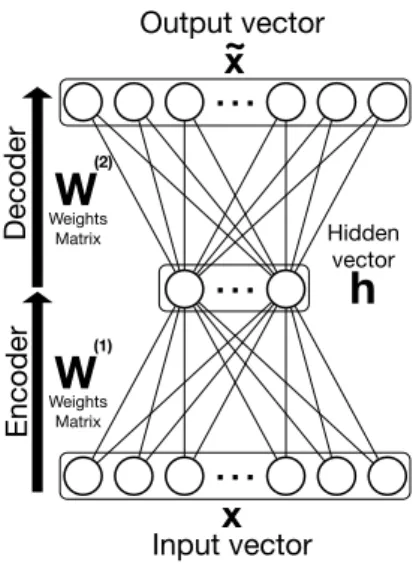
Autoencoder neural networks
Encoder-decoder neural networks or Autoencoders are a special architecture of MLP. In regards to the large, even huge, bibliography on neural networks, this section focuses only on autoencoders and their sub models. One can refer to (LeCun et al.,
2015; Goodfellow et al., 2016) for more information. The term feedforward refers to a set of neural networks with connections between neurons form an acyclic graph. MLP (Rumelhart et al., 1985) are supervised neural networks that can be used for classification, regression or dimensionality reduction. In this architecture the neurons are grouped in layers with an input layer that receives the information as a set of features that the network process; an hidden layer that represents the input vector in a hidden space; and an output layer that contains the network prediction. The activation function of the output layer can be chosen according to the task that the network has to perform. The linear activation function is used to learn linear regression models. The sigmoid activation function is used for logistic regressions or binary classifications. The Softmax activation function (Bishop et al., 1995) is employed for multi-labels classification related tasks. A cost function computes the error between the output produced by the MLP and the expected output. Each neuron contained in a layer is connected to all the neurons of the next layer with no connections between this neuron and the neurons from the same layer. The weights of these connections are learned by back-propagating the gradient of the error between the predicted output and the expected one throughout the layers. An autoencoder is a MLP with the same features for the input layer and the expected output.
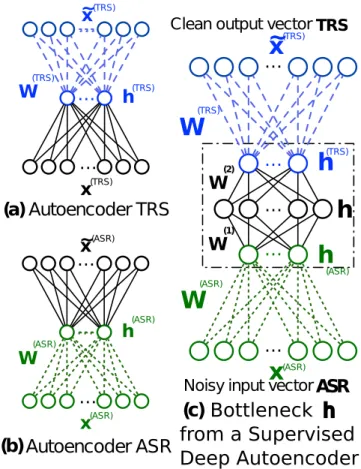
The work presented in Chapter 2 describes the first efforts to process documents on autoencoders to learn the mapping from automatically transcribed spoken docu-ments from an Automatic Speech Recognition (ASR) system to manually transcribed documents. The aim of these studies is to evaluated the potential to neural based systems to learn efficient latent relations between “noisy” documents (from ASR) and “clean” ones (from human transcriptions). These approaches are based on autoen-coders neural networks on either the generative, discriminative or both sub-processes. Our work depicted in Chapter 2, reflect my strong interest on latent variables from autoencoders and we plan to follow the study during the next years in regards to the 7the input gate of the LSTM evaluate how much from the hidden state candidate or memory has to be
considered; the forget gate retain or forget part of the previous hidden state and the output gate decides the proportion of the new hidden state that has to be exposed to the output
promising results obtained by the proposed autoencoders approaches alongside with the enthusiasm generated by GANs. Chapter6reports our first effort on GAN for NLP. One can refer to (Creswell et al.,2018) for more information on autoencoders.
Quaternion-valued neural networks
During my Ph.D. thesis, my work has been focused on the extraction process of robust features from latent spaces such as Latent Dirichlet Allocation (LDA) (Blei et al.,
2003), from i-vectors (Morchid et al., 2015a) or from hyper-complex numbers called Quaternions (Morchid et al.,2013). Quaternions are an extension of complex-numbers and are defined as hypercomplex numbers that contain a real and three separate imaginary components perfectly fitting to three and four dimensional feature vectors such as for image processing, robot kinematics or computer graphics (Sangwine,
1996; Pei et Cheng, 1999; Aspragathos et Dimitros, 1998). Contrary to traditional homogeneous representations, quaternion networks bundle sets of features together. Thereby quaternion numbers allow neural network based models to code latent inter-dependencies between groups of input features during the learning process with fewer parameters than real-valued neural networks by taking advantage of the Hamilton product as the equivalent of the ordinary product but between quaternions. Early applications of quaternion-valued back-propagation algorithms (Arena et al.,
1994, 1997) have efficiently solved quaternion functions approximation tasks. More recently neural networks of complex and hypercomplex numbers have received an increasing attention (Hirose et Yoshida,2012;Tygert et al.,2016;Danihelka et al.,2016;
Wisdom et al.,2016) and some efforts have shown promising results in different appli-cations. In particular a deep quaternion network (Parcollet et al.,2016;Titouan et al.,
2017;Parcollet et al.,2017), a deep quaternion convolutional network (Chase Gaudet,
2017; Titouan et al.,2018) and a quaternion recurrent neural network (Parcollet et al.,
2018c) have been developed and employed by out team from the LIA for different challenging tasks such as images classification, compression and reconstruction or speech recognition.
Motivations to use quaternion neural networks over real-valued ones for quaternion-valued tasks are numerous and well documented (Parcollet et al.,2018c;Isokawa et al.,
2009). The major advantage of any QNN is the more efficient and natural represen-tation of the input information compared to traditional real-valued NNs. Indeed a good neural network model has to represent, encode and learn the nature of the input data. Many realistic tasks involve multi-dimensional features with input elements composed with multiple internally related components. These applications are image processing with three channels describing a single pixel or speech recognition with three values (Mel filter banks and deltas) for a unique time frequency, or human motion recognition with outputs and inputs to be represented in the 3D space with 3D coordinates. To succeed in such multidimensional tasks the employed model needs a specific representation and processing of the features. Indeed traditional real-valued NNs consider internal relations at the same level than contextual and global dependencies. As an example, relations between different pixels are considered
are processed by traditional real-valued NNs as a bag of independent and smaller components, while a natural solution is to process such entities as multidimensional and internally related elements, such as with quaternion neural networks (QNNs). Consequently QNNs have been shown to suit particularly well to these representations and it has been demonstrated that they are perfectly able to learn internal relations describing the multidimensional features, with way less neural parameters (Matsui et al.,2004;Parcollet et al.,2018d). Indeed a 4-number quaternion weight linking two 4-number quaternion units only has 4 degrees of freedom, whereas a standard neural net parametrization has 4×4=16, i.e., a 4-fold saving in memory.
Parsimonious neural networks
Neural architectures are huge and Quaternions allow the models to require less parameters to learn intra- and inter-dependencies between input features but require a 4-dimensional representation to process Hamilton dot product. Most of the NLP related tasks are based on bag-of-words representations, even the use of embeddings are nowadays the usual input representation. Therefore, real-valued neural networks are well suited to process basic document features such as words occurrences or word embeddings. Moreover, real-valued neural networks require a large amount of data to learn latent dependencies in the features space to represent effectively these basic elements throughout enough related contexts. Therefore, the processing time as well as the large number of documents required for learning efficient document represen-tations is closely related too the network architecture; moreover, these represenrepresen-tations have to be robust enough to be effective since unseen documents are processed by the NLP systems by learning different hidden states for different related contexts of sequences for both short- and long-term dependencies. Recurrent Neural Networks (RNN) are a powerful set of architectures that code and store internal hidden states of sequences to learn basic element latent dependencies.
Nonetheless, RNN-based models (Zaremba, 2015) require a large set of patterns to code most of the possible contexts of a given event and are time consuming. It is mostly the case since the task is to reveal latent dependencies between documents event (word occurrences) during a natural language processing (NLP) task. Indeed, a given word has to be encountered in different sentences (contexts) to better understand the latent relations between these basic elements. Nevertheless RNNs fail to learn long-term dependencies due to the vanishing gradient problem (Hochreiter, 1998). RNNs with gates such as Long Short-Term Memory (Wu et al., 2017b; Sundermeyer et al., 2012; Greff et al., 2017) (LSTM) avoid the vanishing gradient problem of the RNN (Hochreiter, 1998) along by taking into account both short- and long-term dependencies of the word properly in different contexts but need to process the information in different memory blocks composed with a set of cell-related gates. Even if the results of LSTM-RNNs are promising the processing time required to treat large documents data sets is quite huge due to the different gates activation sub-processes.
Indeed, LSTM has to decide from a previous state and a candidat state to process dedicated decision processes via gates to update the memory cell. A recent addition to the RNN set of models called the Gated Recurrent Unit (GRU) has been proposed by (Bahdanau et al., 2014; Wu et al., 2017b) to address this issue and has shown good performances in several tasks such as speech recognition (Graves et al.,2013b), machine translation (Sutskever et al., 2014; Cho et al.,2014). Deep internal structures have been proposed to introduce a depth gate (Yao et al.,2015) to better expose internal hidden relations between memories. GRU is very similar to LSTM in that it uses a combination of gates to adjust exposure from input to the hidden states. It does however not use a memory cell instead opting to fully expose its state to the output thereby also doing away with the output gate. Switching between full retention, mixed and forget mode is implemented using a reset gate r and an update gate z. This is the main drawback of the GRU-RNN model in that the role and the management of the GRU gates is not based on the relation between short- and long-term dependencies. For example, the reset of the hidden state is provided by both update and reset gates of the GRU. Moreover, the role of the reset gate of the GRU is to avoid the hidden state candidate but the update gate z can remove this part of the hidden state information without the reset gate r. The minimal gated unit (MGU) (Zhou et al.,2016) is composed with a unique gate to update and reset the cell state. They adapt a GRU with a gate that merges r and z gate of the GRU (r=z) onto a unique gate called f . The authors “prefer an RNN architecture that has the smallest number of gates without losing LSTM’s accuracy benefits” and “propose the Minimal Gated Unit (MGU), which has the smallest possible number of gates in any gated unit. MGU only has 1 gate, which is the forget gate. MGU is based on GRU, and it further couples the input (reset) gate to the forget (update) gate”. The motivation to merge the update and reset gates is not based on an theoretical study of term dependencies. A unique gate f will both reduce the importance of the candidate hidden state and the memory of long-terms dependencies during the processing of the hidden state candidate. This behaviour is close to the leaky unit (Bengio et al.,
2013a) that reduces the hidden state candidate influence when the previous hidden states are considered with a single gate u. The LU is equivalent to the GRU with a single gate and requires less processing time for learning than the GRU and the LSTM. Nonetheless, the LU codes mostly long-term dependencies but reveals little in the way of short-term dependencies. Other papers have studied single gate units such as the MinimalRNN (Chen,2017). The MinimalRNN is a GRU with a single gate and differs from LU by processing the candidate hidden state with the input vector shjm only
(rj(t) =0 in the case of the GRU). Therefore, the authors reduce the number of gate but do not study the behaviour of the gate during the learning process.
These efforts to propose efficient neural based architectures requiring even less processing time is crucial. Indeed, since the large number of documents are available with the grow of Internet and the number of applications are mostly employed on mobile devices such as telephones or tablets, the needs on parsimonious models to process this large amount of information are important with less parameters (for mobile devices for example). Therefore, the neural based models have to process these documents effectively with a small number of parameters and with less processing
Our work started with quaternion neural networks (see chapter 3 and 4) allow NLP systems to require less neural parameters to process effectively big corpus. We have also proposed (see chapter 5) the “Parsimonious Memory Units” (PMU) for RNN that differs from GRU with a reduced number of gates by considering first the behaviour of the gates and the role of the activity of the gates in the learning process of the term dependencies in the hidden state. Moreover, the PMU architecture is based on the assumption that short- and long-term dependencies are related. (Yao et al., 2015) present the depth GRU that allows the internal state to consider latent relations between the memories from different layers and differs from our work which is interested in the best way to manage both short- and long-term dependencies during the learning process. We plan to continue the study of memory behaviour within neural process and provide novel neural based architectures to process large data-sets with less parameters alongside with efficient performances during the AISSPER project (ANR 2019) for wich I am the coordinator that will start on January 2020 in collaboration with LIUM and Orkis. The aim of AISSPER is to provide efficient end-to-end neural based models for Spoken Language Understanding (SLU).
Generative adversarial networks
The obtained results with QNN and autoencoders are promising and generative mod-els will be a main research topic for my future directions. Recently, two promising architectures have been introduced to provide powerful generative models: variational autoencoders (VAE) and Generative Adversarial Networks (GAN). Variational autoen-coders are introduced as a link between variational inference (Fox et Roberts, 2012) and deep neural networks (Kingma et Welling,2013;Gal et Ghahramani,2015). They consider a set of latent random variables z, to capture the variations of the observed variables x. Their joined distribution are defined by:
p(x, z) =p(x|z)p(z) (1) Where the distribution of prior probabilities of p(z)follows a normal distribution and p(x|z)is an observed model whose parameters are calculated by the neural network as a function of z. The non-linear projection of z to x makes it impossible to infer the posterior distribution of p(z|x). For this purpose the VAE uses a variational approxi-mation q(z|x)whose distribution follows a normal distribution. The parameters of this normal distribution (mean and variance) are the output of a non-linear function also learned by the neural network. The generative model p(x|z)and the inference model q(z|x) are learned by backpropagation in order to maximize the lower bound of the likelihood of p(x). They have been used successfully to generate sentences (Bowman et al.,2015), images (Gregor et al.,2015) or to apply rotations on 3D images (Kulkarni et al.,2015).
neural networks. The first network G is a generative network that generates a vector x from a latent representation from documents of the training corpus. The second network D is a discriminant network that predicts the probability that the input sample is generated by G instead of coming from the training corpus. Both networks optimize their weight to find a balance. They have been used mainly to generate images, from constraints of shapes or colors (Zhu et al., 2016) or from textual descriptions (Reed et al.,2016).
Nowadays Generative Adversarial Networks (GAN) became one of the domi-nant approaches for learning latent features from generative models in recent machine learning researches. These models provide a flexible algorithm for learning latent variables describing the data generating processes in which noise is transformed into “clean” data samples on large datasets. A large set of GAN variants are based on autoencoder GANs (AE-GANs). The autoencoders improve GAN training (Nguyen et al., 2017) by combining an autoencoder loss, a GAN loss, and a classification loss defined using a pre-trained classifier. AE-GANs can be broadly classified into three approaches:
• those using an autoencoder as the discriminator, such as energy-based GANs and boundary-equilibrium GANs (Berthelot et al.,2017),
• those using a denoising autoencoder to derive an auxiliary loss for the generator, such as denoising feature matching GANs (Warde-Farley et Bengio,2016), • and those combining ideas from VAEs and GANs such as the variational
au-toencoder GAN (VAE-GAN) (Larsen et al., 2015) that adds an adversarial loss to the variational evidence lower bound objective, the more recent mode-regularized GANs (MRGAN) (Che et al.,2016) or the adversarial generator en-coders (AGE) (Ulyanov et al.,2018).
Recently, these generative adversarial networks (GANs) (Goodfellow et al., 2014) received an astonishing interest due to the remarkable results obtained in computer vision (Zhu et al.,2017;Radford et al.,2015;Kim et al.,2017;Berthelot et al.,2017). The ability of GANs to generate samples that are closely-related to targets ones has also been extended to natural language processing (NLP) tasks, such as text and dialogue generation (Rajeswar et al., 2017; Donahue et Rumshisky, 2018; Li et al., 2017), or neural machine translation (Yang et al., 2017; Wu et al., 2017a). To the best of our knowledge, (Wu et al., 2017a) is the most related work to the problem addressed in this paper. Indeed, (Wu et al.,2017a) proposed a model aiming to generate sentences which are hard to be discriminated from human-translated sentences. Consequently, the GAN model is expected to learn a mapping from one language to another one based on human manual translations. GANs became a specific domain in AI and researchers produce a broad spectrum of related models. an conditional version of the GAN has been proposed in (Mirza et Osindero, 2014) to generate unseen elements (not included in the data set) from unlabeled data. (Makhzani et al., 2015) propose a general approach, called an adversarial autoencoder (AAE) that employ hidden states of an autoencoder and random distributions into a generative model
2014) that matches the aggregated posterior distribution of the latent representation of the autoencoder to an arbitrary prior distribution. This model is close to the CycleGan (Zhu et al., 2017) that also employ an intermediate representation from an autoencoder to learn a GAN model. In regards to rapid grow of this sub-domain of GAN and the large number of papers related to GAN, one can easily find out more details and models in the main conferences and journals related to AI 8. Nonethe-less, GAN does not take into consideration the target classes when generating the samples, since golden-targets (i.e manual transcriptions) are not available at testing time. We are interested in such as models since they allow NLP based systems to both generate unseen representations and extract robust features from the document con-tent. We have starting to follow this way and propose novel architectures to process noisy spoken documents (Titouan et al.,2019a). The task considered in this thesis (see chapter6) replaces the initial language by an automatic transcription of a conversation, and the target language by its manual transcription. Furthermore, we propose to perform classification on top of the generation, as driven by the semi-supervised GAN (SGAN) approach (Odena,2016).
Structure of the thesis
The document relates different research directions followed since my Ph.D. thesis defended at 2014 November. The different chapters thereafter are initiated with Ph.D. students that I have supervised from 2015 to 2019. The first direction followed was related to my interest on machine learning methods for NLP real-world applications. We have started by evaluating hitherto proposed neural networks based models for Natural Language Processing (NLP) tasks. These models have then been extended with original algorithms to improve the efficiency during the NLP related tasks. Then, we have proposed novel neural networks architectures based on hyper-complex algebra to better handle multidimensional information. These approaches have encountered a wide success and interest from different institute and researchers from heterogeneous AI related fields. Alongside to these works, I have started new directions to allow neural network algorithms to process large amount of documents with less processing time and better performances than mere ones. All these research directions will be followed throughout the ANR AISSPER project that will start at January 2020 in collab-oration with the LIUM (Le Mans University) and Orkis (Aix-en-Provence company). Indeed, AISSPER will first employ already proposed neural based architectures and then novel ones for end-to-end SLU tasks.
Part I of the document describes the first works on machine learning for NLP. The aim of this period was to evaluate hitherto proposed neural networks based 8For example, this website gives both papers and codes for a large number of GAN models:
algorithms for real-world NLP applications. We present a research done during the Mohamed Bouaziz’s Ph.D. thesis, in CIFRE convention with the company EDD and co-supervised by Georges Linarès (LIA), Richard Dufour (LIA) and myself between September 2013 and December 2017. Therefore, chapter1 presents an original Long Short-Term Memory-based (LSTM) architecture, called Parallel LSTM (PLSTM), that carries out multiple parallel synchronized input sequences in order to predict an output. The proposed PLSTM could be used for parallel sequence classification purposes. The PLSTM approach is evaluated during an automatic telecast genre sequences classification task. The results show that the proposed PLSTM method outperforms the baseline and the LSTM model. This work correspond to the first step and direction on machine learning for NLP. This effort is followed by a study of encoder-decoder neural networks for NLP tasks. Chapter 2 corresponds to part of the work done during the Killian Janod’s Ph.D. thesis in CIFRE convention with the company Orkis and co-supervised with Georges Lianrès (LIA), Richard Dufour (LIA) from September 2013 to December 2017. This chapter studies different set of features from encoder-decoder neural networks based architectures for the Spoken Language Understanding (SLU) task of DECODA theme identification task of spoken dialogues. These dialogues are transcribed from an Automatic Speech Recognition (ASR) system. These automatic transcripts are affected by errors from automatic transcription process that are especially frequent since speech signal in recorded in noisy conditions. An ASR system induces linguistic errors in features employed for different NLP related applications. This chapter deals with the recovery of corrupted linguistic features in spoken documents by introducing robust features from encoder-decoder neural networks based models evaluated in the real-world application of the DECODA spoken conversation analysis task.
Part II details novel neural networks based architectures partially realized in col-laboration with Montréal Institute of Learning Algorithme (MILA) researchers. Among them, Y. Bengio, M. Ravanelli and others have collaborated on Quaternion valued neural networks for speech processing. We have proposed novel research directions to introduce complex-valued neural networks to better manage internal dependencies between features of a basic element. Therefore, chapter3presents these promising models based on convolutional neural networks and the Quaternion hyper-complex numbers called “Quaternion Convolutional Neural Network” (QCNN). We report in this thesis the QCNN evaluated on an NLP related task (Theme identification task of spoken dialogues). Chapter 4 introduces the Quaternion Recurrent Neural Networks (QRNN) and an extension of the LSTM to Quaternion algebra called QLSTM. These models are evaluated during the speech recognition task of TIMIT. This work have been realized during the Ph.D. thesis of Titouan Parcollet co-supervised with Georges Linarès (LIA) and during the internship of Titouan Parcollet at the MILA (Canada) under the co-supervision of Yoshua Bengio.
Part III of the thesis corresponds to the ongoing and futur research directions. We first present an ongoing research that will lead to part of my futur research. The previous chapters chart the path of my research throughout different neural networks
even huge processing time during the learning process. Chapter 5 introduces novel promising research perspectives for faster and more efficient neural networks based models and exposes a research direction based on a ongoing work for parsimonious recurrent neural network. Nowadays even more real-life NLP related applications are based on deep learning algorithms. These models require a long processing time for the learning phase. The proposed model allow NLP based systems to achieve better results than other RNN architectures with less processing time. The work started on studying encoder-decoder neural networks is extended in chapter 6with the first efforts on proposing novel generative models to extract from noisy spoken documents robust features for SLU. Finally chapter 7 presents future short-term directions on both real and quaternion-valued neural networks, and long-term perspectives on parsimonious neural networks and GAN. Overall, this thesis is an overview of my futur directions in terms of neural based architectures (RNN, GAN, . . . ) and real-world applications (find out more efficient algorithms for NLP tasks) in collaboration with different Ph.D. students, interns and colleagues.
Part I
Real-valued Neural Networks for
Natural Language Processing
Chapter 1
Parallel Recurrent Neural Networks
Contents
1.1 Introduction . . . . 28 1.2 Parallel Long Short-Term Memory (PLSTM) . . . . 29 1.3 Experiments . . . . 32 1.4 Results and Discussion . . . . 33
Abstract
We present in this chapter an original LSTM-based architecture, named Parallel LSTM (PLSTM), that carries out multiple parallel synchronized input sequences in order to predict a common output. The proposed PLSTM could be used for parallel sequence clas-sification purposes. The PLSTM approach is evaluated on the automatic telecast genre sequences classification task. Results show that the proposed PLSTM method outper-forms the baseline n-gram models as well as the state-of-the-art LSTM approach. This chapter corresponds to part of the work done during Mohamed Bouaziz’s Ph.D. thesis, in CIFRE convention with the company EDD and co-supervised by Georges Lianrès (LIA), Richard Dufour (LIA) and myself between September 2013 and December 2017.
1.1
Introduction
The work presented in this chapter is from the collaboration with Mohamed Bouaziz during his Ph.D. thesis in CIFRE1 with the EDD (L’Europèenne de Donnèes) com-pany from Paris (France). EDD processes large amount of multimedia documents and streams to provide for the customers a set of speech and natural language related ser-vices such as documents retrieval and indexation. In this context, the Ph.D. thesis has focused on the prediction of the genre label of telecasts on Electronic Program Guide (EPG) multi-streams of different channels. Nonetheless, the proposed architecture can easily process different multidimensional data or streams. The context of the Ph.D the-sis of EPG prediction, has many concerns related to the difficulty to express an event (telecast genre) given a sequence of previous telecasts that are not taking place at the same time each day. Therefore, the use of different parallel channels gives a more ro-bust context to predict the genre label for a given channel. Moreover, one can find, on the internet, an impressive list of programs available on demand at any time of the day. This forces the original TV channels to diversify their offers and to propose programs that best meet the expectations of viewers regarding the period of the day. However, this large amount of streams needs to be analyzed and organized to allow the consumers and industries to process effectively the mass media content. Scien-tists have been given a certain level of interest to automatic sequence classification of TV channels’ speech in a multi-channel context (Bredin et al., 2014; Bouchekif et al.,
2013). Indeed, recently, automatic sequence classification became an ubiquitous prob-lem, having then encountered a high research interest (Gers et al., 2001; Severyn et Moschitti,2015;Huang et al.,2016). This is due to the need to structure knowledge as a set of dependent localized information alongside with the new computer capabilities to efficiently process large amount of data. Among the recent methods employed to structure these sequences, the machine learning domain provides a set of high-level representations well adapted to automatic sequence classification based on Deep Neu-ral Networks (DNN) such as Convolutional NeuNeu-ral Networks (CNN) (LeCun et al.,
1998) or Recurrent Neural Networks (RNN) (Elman,1990). RNN architectures such as Long Short-Term Memory (LSTM) (Hochreiter et Schmidhuber,1997) and Bidirectional LSTM (BLSTM) (Graves et Schmidhuber, 2005) have gained a particular attention in different domains and tasks including sentence (Sundermeyer et al., 2012) or succes-sive images (Vinyals et al.,2015) processing. Nonetheless, RNNs or RNN-HMM could not be directly employed for sequence classification using multiple inputs from syn-chronous streams such as TV shows coming from different channels. Indeed, RNNs can only be trained to make a set of elements labeled in a single stream of input infor-mation.
We have introduced an original multi-stream neural network architecture, called Par-allel LSTM (PLSTM), that simultaneously takes into account different synchronous streams in order to automatically classify this multi-stream sequence. To evaluate the effectiveness of the proposed PLSTM multi-stream neural network architecture, exper-1The CIFRE convention (Conventions Industrielles de Formation par la REcherche) is a partnership
between academics and industrials for granting a Ph.D. thesis with mainly an real world application pur-pose. More information on the CIFRE convention are available at http://www.anrt.asso.fr/fr/cifre-7843
1.2. Parallel Long Short-Term Memory (PLSTM)
iments are carried out on the LIA’s Electronic Program Guide (EPG) dataset containing 3 years of TV programs from 4 different channels. The PLSTM performance is com-pared with the LSTM as well as a classic n-gram models considered as the baseline. Our PLSTM approach is an important step further for sequence classification since it can be applied to any set of synchronous sequences. The annexe proposes an overview of a couple of RNN architectures.
1.2
Parallel Long Short-Term Memory (PLSTM)
Sequence models, such as LSTM based RNNs, are well known for their capability to classify sequential data. On the other hand, these models can only take into account homogeneous sequential data from a single stream. In the case of additional sources, these models can not be employed. In order to take into account parallel sequences, a solution is to combine these streams viewed as a single sequence. This combination is carried out by two models with a certain number of limits.
(a) Asynchronous input sequences
(b) Alignment of sequences (fusion of events of the same order).
(c) Sequences merging.
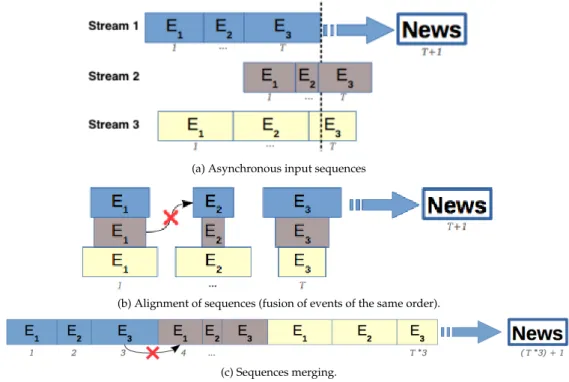
Figure 1.1: Combination of parallel sequences: an illustrative example with 3 streams on the last 3 events : Etcoressponds to the tthevent.
Multi-streams input features of the PLSTM
The first method of combining the parallel sequences consists of a kind of alignment between the different sequences in order to merge the events of the same order within a single event (see Figure1.1-b). It is a question of combining the event terms
(1≤ t ≤ T) of each of the N sequences to form the compound tthevent. The sequence of T compound events is then used as a conventional sequence where each event t is represented by a vector of N events. The limitations of this method ere related to, for example, an LSTM layer will consider a recurrent link between the tthand the(t+1)th composed event. As a consequence, a dependence between the streams will be learned, wrongly, between the tth basic event of the stream n0 and the (t+1)th basic event of another stream n00(n0 6=n00, 1≤ n0 ≤ N and 1≤ n00 ≤ N). In Figure1.1-b, an example of this potentially wrong dependency is between the basic event at t = 1 of stream 2 and the elementary event at t = 2 of stream 1. The first event appends after the second one The second method concatenates the N parallel sequences, each containing T events, to obtain a single unidimensional "super-vector" of length T × N (see Figure1.1-c). the drawback of this method of concatenation is that the vector produced does not represent a sequence but rather a sequence of sequences. Models adapted to sequential data consider any input data as a homogeneous sequence of events. The combination of multi-stream sequential data and their inclusion in sequence models is, in most of the cases, irrelevant. We nevertheless retain the use of the first method of combining the parallel sequences since the latter is more prone to practical order issues. PLSTM model
The Bidirectionnal-RNN (BRNN) neural architecture, presented in the annexe, uses the same sequence x as an input for both forward and backward directions, which is useful for information from a single stream. We propose in this chapter an original neural recurrent neural network, called Parallel RNN (PRNN) presented in Figure1.2, that takes advantage from the BRNN structure in a multistream context. The original PLSTM architecture corresponds to the PRNN description by replacing theHfunction with the LSTM composite function. PLSTM differs from the classical BLSTM by feed-ing forward, not a shared sequence, but different input vectors through a dedicated hidden layer hn for each input vector xn. Moreover, BLSTM employs only 2 hidden layers due to its bidirectional architecture while PLSTM is potentially composed with multiple hidden layers. The input sequences are considered independent and require to be mapped in homogeneous separate subspaces (W matrix from input x to hidden h spaces). Therefore, a single LSTM containing concatenated inputs from different inde-pendent sequences is not theoretically suitable for finding out a common homogeneous subspace to map heterogeneous input representation of parallel sequences. Thus, for each nth stream (1≤n≤ N), the PLSTM takes the input sequence xn= (xn1, xn2, . . . , xNT) and computes the hidden sequence hn = (hn1, hn2, . . . , hTN)and the output vector y by iterating from t=1 to T. hNt = H(WxNhNxNt +WhNhNhNt−1+bNh) (1.1) . . . (1.2) h2t = H(Wx2h2x2t +Wh2h2h2t−1+b2h) (1.3) h1t = H(Wx1h1x1t +Wh1h1h1t−1+b1h) (1.4) yt = N
∑
n=1 Whnyhnt +by (1.5)1.2. Parallel Long Short-Term Memory (PLSTM)
Outputs yt−1 yt yt+1
Nthhidden layer hN
t−1 hNt hNt+1
. . . .
Second hidden layer h2t−1 h2t h2t+1
First hidden layer h1t−1 h1
t h1t+1 First inputs x1t−1 x1 t x1t+1 Scond inputs x2t−1 x2t x2t+1 . . . . Nthinputs xN t−1 xNt xtN+1
Figure 1.2: Parallel Long Short-Term (PLSTM) neural network.
where N is the number of streams. In our experiments, the output vector y takes advantage of the N channels to predict the telecast’s genre for one given channel n (1≤n≤ N).
Therefore, PLSTM feeds forward separate sequences in order to predict a label and codes internal hidden structures between the parallel hidden sequences. (Graves et Schmidhuber,2005) introduces the BLSTM with Back Propagation Trough Time (BPTT) algorithm (Schuster,1999) for training. For our proposed PLSTM architecture, the train-ing takes place over N input sequences:
Forward Pass: feeds all input data for the sequences into the PLSTM and determines the predicted outputs.
• For 1 to T: Forward pass for each of the N hidden layers.
• For all t ∈ [1 . . . T]: perform the forward pass for the output layer using the acti-vation state of the N hidden layers.
Backward Pass: processes the error function derivative for the sequences used in the forward pass.
• For all t∈ [1 . . . T]: perform the backward pass for the output neurons.
• For t from T to 1: perform the backward pass for each hidden layers using the error observed on the output layer.
Updating Weights The update weight for all matrices from each hidden state related to each stream is computed in the same manner than for the mere LSTM (Hochreiter et
Schmidhuber,1997).
1.3
Experiments
Multistream sequence classification is evaluated with the proposed PLSTM architecture (2 and 4 parallel sequences) as well as the classic LSTM network on an automatic TV show genre labeling task. Two n-gram based models (baseline) are also considered for fair comparison. Next sections describe the dataset, the genre sequence classification as well as the neural networks settings.
Multichannel EPG dataset
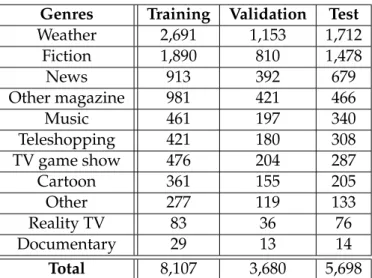
The Electronic Program Guide (EPG) dataset is extracted from 4 French TV channels (M6, TF1, France 5 and TV5 Monde) for 3 years, from January 2013 to December 2015. M6 channel is used in our experiments as the output stream. Data from 2013 and 2014 are merged and split into the training (70%) and validation (30%) datasets using a stratified shuffle split (Pedregosa et al., 2011) in order to preserve the same percentage of samples of each class in the output of both folds, while the 2015 dataset is kept for testing. In order to guarantee a clean experimental environment, labels (i.e. genres) that are absent at least in one of the three folds were removed. Doing so allows us to have equivalent datasets in terms of labels vocabulary. Table1.1shows the genres distribution for M6, the chosen output channel.
Genres Training Validation Test
Weather 2,691 1,153 1,712 Fiction 1,890 810 1,478 News 913 392 679 Other magazine 981 421 466 Music 461 197 340 Teleshopping 421 180 308 TV game show 476 204 287 Cartoon 361 155 205 Other 277 119 133 Reality TV 83 36 76 Documentary 29 13 14 Total 8,107 3,680 5,698
Table 1.1: Genres Distribution for train, validation and test sets in M6 channel output.
Genre Prediction Experiments
For a given input history sequence (composed of the n previous telecast genres), a genre label representing the next M6’s telecast is output. The size of the genre sequences (n) varies from 1 to 4. Then, three input configurations are employed.
1.4. Results and Discussion
Mono-channel input: only M6 history sequences for a baseline n-gram experiment (with a statistical language model from the SRILM toolkit (Stolcke et al., 2002)) and a straightforward LSTM model. Bi-channel input: both M6 and TF1 channel histories are employed as input for P2LSTM (PLSTM with two parallel streams as a BLSTM with forward-forward directions and separate inputs). The aim of this experiment is to move up the context’s information using a similar and rival channel, the two being gen-eralist channels. Multichannel input: History of each of the 4 streams (i.e. channels) is used as input for 4n-gram and P4LSTM experiments (PLSTM with 4 parallel streams). Neural Networks Setup
The mere LSTM, and the proposed P2LSTM and P4LSTM, are composed with 3 layers: input layer x of size varying from 1 to 4, a hidden layer h of size 80 for all LSTM-based models and an output layer y with a size equals to the number of different possible TV genres (11). The Keras library (Chollet, 2015), based on Theano (Bastien et al.,2012) for fast tensor manipulation and CUDA-based GPU acceleration, has been employed to train neural networks on an Nvidia GeForce GTX TITAN X GPU card. The training times, detailed in Table1.2for all models, match with the sequence size of all models. Indeed, even with the most time-consuming configuration, namely P4LSTM with 4 elements history, the training does not last more than 25 minutes.
Sequence size 1 2 3 4 n-gram 1 1 1 1 4n-gram 2 5 17 51 LSTM 51 146 319 362 P2LSTM 259 473 485 439 P4LSTM 536 923 844 1,386
Table 1.2: Training times (in seconds) of models employed during the experiments for different telecast genres sequence sizes.
1.4
Results and Discussion
Table 1.3 shows the overall results, in terms of the standard F1 metric related to the genre prediction task outputs, using each method and for different stream sequence sizes from 1 to 4.
Seq. size n-gram 4n-gram LSTM P2LSTM P4LSTM
1 19.07 59.39 11.60 47.46 47.24
2 51.38 58.35 34.64 54.17 59.54
3 57.41 57.10 50.74 58.69 59.92
4 56.87 57.26 56.47 58.67 60.81
N-gram based models
The multi-channel 4n-gram model outperforms the simple n-gram one for each of the different 4 genre sequence configurations except for 3 sized history. 4n-gram method reaches around 59% of F-score using 1 sized sequences against near 57% for mono-channel n-gram using its best history configuration. The observed results confirm the interest of using multiple streams to predict the next telecast’s genre for a specified channel.
LSTM and PLSTM
One can figure out from Table1.3that mono-channel LSTM does not even outperform the mono-channel n-gram experiment. P4LSTM obtains the best result with an F1 score close to 61% using a sequence of size 4. In order to analyze these results, the Error Rates (ER) are also presented in Table1.4. The overall F1 scores are different from those related to the ER. For example, at its best configuration of a 4 sized sequence, P4LSTM error rate reaches about 23.5%, which corresponds to a correct rate of 76.5% against an F1-measure of only 61%. Moreover, although the range between the lowest and the highest values is almost 12 points for ER, it is only near 4 points for F1-measure. The reason of this is that the F1-metric may be not suitable for the task due to the labels imbalance with different numbers of genre occurrences varying from 14 to 1,712 in the test set.
Seq. size n-gram 4n-gram LSTM P2LSTM P4LSTM
1 51.36 30.29 60.13 36.68 34.35
2 39.06 28.99 48.99 29.38 25.08
3 31.71 29.64 35.73 28.85 24.76
4 35.43 30.5 29.59 28.27 23.52
Table 1.4: Error rates (ER) observed for each n-gram and LSTM models for different sequence sizes.
Discussion
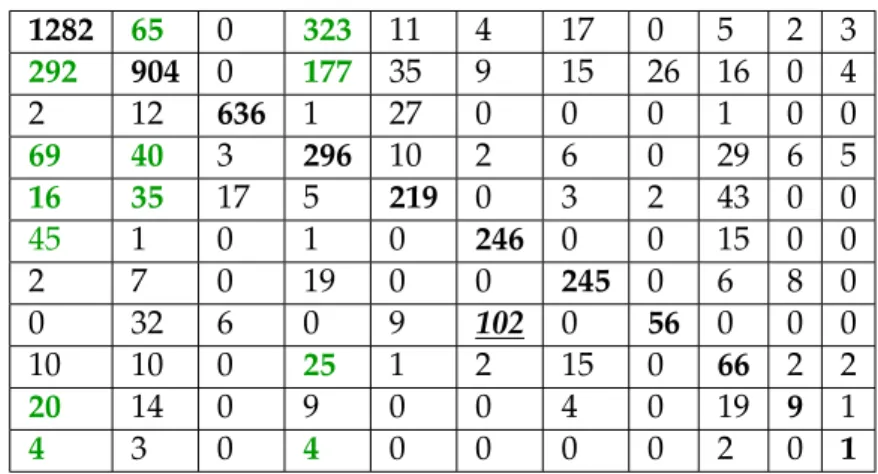
Confusion matrices of 4n-gram and P4LSTM methods are shown in Tables1.5and1.6
to point out benefits of the proposed PLSTM model.
It is worth emphasizing that most of the missed instances in all systems are wrongly labelled as one of the two most frequent classes, Weather and Fiction, as well as the Other Magazine genre (some examples are in green cells). False positives are more recurrent in some small classes such as Other Magazine than in the relatively more frequent class News. The reason is that News is a well defined genre occurring mostly at the same time each day unlike Other Magazine genre that encompasses various telecasts that are broad-cast at several and irregular daytimes. Teleshopping shows are often broadbroad-cast at more nearly the same time of morning than Cartoons and affect dramatically the performance of the 4n-gram model in this context (cf. underlined italic cell in Table1.5). Finally, the confusion matrix of P4LSTM experiment shows also that this system fails to predict the least frequent genres Others, Reality TV, and Documentary. For example, for the two least frequent genres, Reality TV and Documentary, respectively none of the 76 and the
1.4. Results and Discussion 1282 65 0 323 11 4 17 0 5 2 3 292 904 0 177 35 9 15 26 16 0 4 2 12 636 1 27 0 0 0 1 0 0 69 40 3 296 10 2 6 0 29 6 5 16 35 17 5 219 0 3 2 43 0 0 45 1 0 1 0 246 0 0 15 0 0 2 7 0 19 0 0 245 0 6 8 0 0 32 6 0 9 102 0 56 0 0 0 10 10 0 25 1 2 15 0 66 2 2 20 14 0 9 0 0 4 0 19 9 1 4 3 0 4 0 0 0 0 2 0 1
Table 1.5: Confusion matrix for the 4n-gram output: labels are shown according to their decreasing frequency as in Table1.1. 1624 38 0 46 0 2 0 0 2 0 0 375 861 0 188 18 0 18 16 2 0 0 4 0 669 1 5 0 0 0 0 0 0 114 34 0 306 6 0 3 0 3 0 0 15 18 0 1 297 0 7 2 0 0 0 49 15 0 0 0 244 0 0 0 0 0 49 14 0 14 11 0 199 0 0 0 0 25 28 1 0 0 4 0 147 0 0 0 70 3 0 48 0 1 0 0 11 0 0 35 0 0 23 0 0 14 0 4 0 0 8 0 0 5 0 0 1 0 0 0 0
Table 1.6: Confusion matrix for the P4LSTM output: labels are shown according to their decreasing frequency as in Table1.1.
14 instances were correctly found. This leads to a precision of 0 which penalizes the average precision and then the overall F-score. In order to evaluate the impact of the
Seq. size n-gram 4n-gram LSTM P2LSTM P4LSTM
1 23.30 70.32 14.18 58.00 57.74
2 59.47 68.04 42.34 66.21 72.77
3 66.71 66.55 62.01 71.74 73.23
4 65.67 66.77 69.01 71.71 74.32
Table 1.7: F1 score (%) of n-gram and LSTM models, the two least frequent genres Reality TV and Documentary not being included.
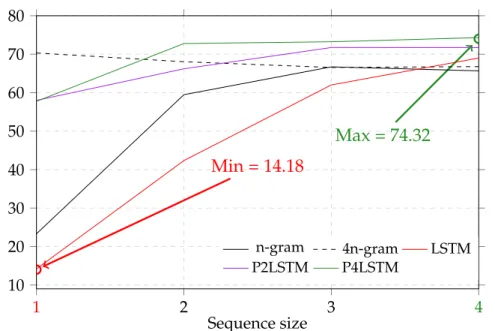
least frequent genres on the F1 measure, especially on the three LSTM based systems, we also reported on Table1.7 the F1 results on the same outputs of the experiments of Table1.3by excluding the two least frequent genres from the averages of precision and recall (Reality TV and Documentary). The state-of-the-art mono-channel LSTM
per-1 2 3 4 10 20 30 40 50 60 70 80 Max = 74.32 Min = 14.18 Sequence size n-gram 4n-gram LSTM P2LSTM P4LSTM
Figure 1.3: F1 score for n-gram and LSTM models, the two least frequent genres Reality TV and Documentary not being included.
formances gradually become closer and closer to the multichannel n-gram model ones (cf. Figure1.3) when the size of sequences moves up with an F1 score of 69%. There-fore, LSTM-based models require longer sequences to learn long term dependencies than the 4n-gram methods. Overall, the results of the PLSTM detailed in Table 1.4
and Figure1.3, demonstrate the benefits obtained at least for history sequences longer than 2 genres with an F1 score greater than 71%. Regarding multichannel P4LSTM approach, the highest performance reaches an F1-measure of about 74% using 4 sized sequences with a gain of about 3 and 4 points compared respectively to P2LSTM and 4n-gram model best performances. With the rapid grow of multimedia documents such as videos, the results observed with the PLSTM are promising and will allow NLP sys-tems to process multidimensional data. Indeed, researchers across pattern recognition domains propose more and more neural networks based systems to process effectively multi streams for image processing (Singh et al.,2016), video classification (Wu et al.,
2016) or speech processing (Ma et al., 2019). This work will be followed to propose novel neural based architectures to better consider each stream in an appropriate con-dition. For example, LSTM cells are composed with gates that manage in different level the knowledge stream. Indeed, some gates are devoted to expose the output or forget the hidden state. Nonetheless, the input gate has to propose a suitable hidden state candidate for a given stream but all streams have not enough information on this given stream to effectively provide part of the hidden state candidate.
Chapter 2
Encoder-Decoder Neural Networks
Contents
2.1 Introduction . . . . 38 2.2 Autoencoder neural networks based systems . . . . 39 2.3 Experiments . . . . 46
2.3.1 DECODA framework . . . 46
2.3.2 Automatic Speech Recognition System . . . 47 2.4 Results and Discussion . . . . 48
Abstract
This chapter corresponds to part of the work done during the Killian Janod’s Ph.D. thesis, in CIFRE (Orkis) where we study different set of features from different encoder-decoder neural networks for the DECODA theme identification task of spoken dialogues. These dialogues are transcribed with an Automatic Speech Recognition (ASR) system and are affected by errors that are especially frequent when speech signal is recorded in noisy conditions.