HAL Id: tel-01750450
https://tel.archives-ouvertes.fr/tel-01750450v2
Submitted on 25 Dec 2013
HAL is a multi-disciplinary open access archive for the deposit and dissemination of sci-entific research documents, whether they are pub-lished or not. The documents may come from teaching and research institutions in France or abroad, or from public or private research centers.
L’archive ouverte pluridisciplinaire HAL, est destinée au dépôt et à la diffusion de documents scientifiques de niveau recherche, publiés ou non, émanant des établissements d’enseignement et de recherche français ou étrangers, des laboratoires publics ou privés.
Routing in Wireless Multimedia Sensor Networks
Houda Zeghilet
To cite this version:
Houda Zeghilet. Routing in Wireless Multimedia Sensor Networks. Networking and Internet Archi-tecture [cs.NI]. Université de Lorraine, 2013. English. �NNT : 2013LORR0196�. �tel-01750450v2�
U.F.R. : Sciences et Techniques Math´ematiques, Informatique et Automatique Ecole Doctorale : IAEM Lorraine
D´epartement de Formation Doctorale : Automatique
Laboratoire de rattachement : Centre de Recherche en Automatique de Nancy
Th`ese en co-tutelle
Pr´esent´ee pour l’obtention du titre de Docteur de l’Universit´e de Lorraine
en Sciences, sp´ecialit´e Automatique, Traitement du Signal et G´enie Informatique Doctorat en Informatique
de l’Universit´e des Sciences et de la Technologie Houari Boumediene (USTHB) Sp´ecialit´e : Programmation et Syst`emes
par Houda ZEGHILET
Intitul´ee
Le Routage dans les R´eseaux de Capteurs Multim´edia
Soutenue publiquement le 08 d´ecembre 2013 Membres du jury :
Rapporteurs:
Pr. Congduc Pham, Universit´e de Pau et des Pays de l’Adour, LIUPPA Dr. Benchaiba Mahfoud (Maˆıtre de Conf´erences/A), USTHB, LSI
Examinateurs:
Pr. Francis Lepage, Universit´e de Lorraine, CRAN (directeur de th`ese) Pr. Nadjib Badache, USTHB, LSI (directeur de th`ese)
Pr. Samira Moussaoui, USTHB, LSI
Abstract
Nowadays, the proliferation of inexpensive hardware such as CMOS cameras and microphones that are able to ubiquitously capture multimedia content has led to the emergence of wireless multimedia/video sensor networks (WMSN/WVSN). As a consequence, a wide spectrum of applications can be projected in many areas and everyday life. Compared to traditional WSNs, WVSNs introduce unique challenges due mainly to the big amount of data to be captured and transmitted over a constrained network. A WVSN may require a certain level of quality of service in terms of delay, bandwidth, jitter, reliability, quality of video perception, etc.
In this work, we aim to deal with the problem of routing video content in a wireless sensor network. Many routing protocols targeted to WSNs have been proposed in the literature and can be qualified from a network organization perspective either as flat or hierarchical. In a flat topology, nodes have same functionalities and each of them can take part in the routing process. However, in a hierarchical architecture, the sensors are organized in clusters allowing for more scalability, less consumed energy and thus longer lifetime for the whole network.
Few of the existing routing protocols considered specifically the transmission of intensive data such as video. In this work, we first propose a cluster-based (hierarchical) routing pro-tocol called ELPC (Energy Level Passive Clustering) where the main objective is to enhance the network lifetime while handling video applications. This is achieved thanks to a load bal-ancing feature where the role of clusterheads is alternated among candidate nodes depending on their energy level.
The second contribution consists in a multipath routing protocol with interference aware-ness. In fact, by allowing concurrent multiple flows, the end-to-end delay gets reduced and the application needs in terms of bandwidth can be satisfied. Instead of completely suppress-ing interferences, our multipath routsuppress-ing protocol tries to minimize them through a simple algorithm without extra overhead. Multiple paths are built at once while minimizing their inter-path interferences thanks to some additional information on neighboring nodes piggy-backed on the route request messages. In addition to interference awareness, we propose a multiqueue multipriority scheme where the influence of data type in a video is considered. Simulation results show that using less interfering paths combined to a multiqueue multipri-ority scheme allows for better video quality.
R´
esum´
e
Aujourd’hui, la prolif´eration de mat´eriel peu coˆuteux tels que les cam´eras et les microphones capables de capturer du contenu multim´edia de fa¸con ubiquitaire a conduit ´a l’´emergence des r´eseaux de capteurs sans fil multim´edia/vid´eo (RCSFM /RCSFV). En cons´equence, un grand ´eventail d’applications peuvent ˆetre projet´ees dans de nombreux domaines de la vie de tous les jours. Par rapport aux r´eseaux de capteurs traditionnels (RCSF), les RCSFVs pr´esentent des d´efis uniques principalement en raison de la grande quantit´e de donn´ees `a capturer et `
a transmettre au-dessus d’un r´eseau contraint en ressources. Un certain niveau de qualit´e de service peut ˆetre exig´e en termes de d´elai, bande passante, gigue, fiabilit´e, qualit´e de perception de la vid´eo, etc.
Dans ce travail, nous visons le probl`eme du routage de donn´ees vid´eo dans un RCSF. De nombreux protocoles de routage ont ´et´e propos´es dans la littrature. Ils peuvent ˆetre qualifi´es de plat ou hi´erarchique en vue de l’organisation du r´eseau. Dans une topologie plate, tous les noeuds ont les mˆemes fonctionnalit´es o`u chacun peut participer au processus de routage. Cependant, dans une architecture hi´erarchique, les capteurs sont organis´es en groupes (clusters) permettant une plus grande ´evolutivit´e, moins d’´energie consomm´ee et donc une plus longue vie pour l’ensemble du r´eseau.
Parmi les protocoles de routage existants, peu consid´erent sp´ecifiquement la transmission de donn´ees intensives comme la vid´eo. Dans ce travail, nous avons d’abord propos´e un proto-cole de routage hi´erarchique appel´e ELPC (Energy Level Passive Clustering) dont l’objectif principal est d’am´eliorer la dur´ee de vie du r´eseau en pr´sence de flux vid´eo. Ceci est obtenu grˆace `a l’´equilibrage des charges au moment de la construction de la topologie o`u le rˆole de tte de groupe est altern´e entre les nœuds candidats en fonction de leur niveau d’´energie.
La deuxi`eme contribution consiste en un protocole de routage multichemin qui prend les interf´erences inter-chemin en consid´eration. En effet, en permettant la transmission de plusieurs flux concurrents, le d´elai de bout en bout se trouve r´eduit et les besoins de l’application en termes de bande passante peuvent ˆetre satisfaits. Au lieu de supprimer compl`etement les interf´erences, notre protocole de routage multichemin tente de les minimiser en se basant sur l’ajout d’informations suppl´ementaires sur les noeuds voisins dans les mes-sages de construction de la topologie. De plus, nous proposons un sch´ema de files d’attente priorit´es multiples o`u l’influence des types de donn´ees dans une vid´eo est consid´er´ee. Les r´esultats des simulations montrent que l’utilisation de chemins moins interf´erents combin´ee `
a un r´gime de multipriorit´e permet une meilleure qualit´e vid´eo.
Acknowledgement
No words can express my gratitude to my parents Hemama Bounebirat and Messaoud Zeghilet. I am forever grateful to them for their love, support, prayers, encouragement, sacrifices, and help throughout my life.
I would like to thank Profs. Nadjib Badache and Francis Lepage, my supervisors for their invaluable support, guidance, and encouragement throughout these years. I feel very privileged to have had the opportunity to learn from, and work with them. I hope I managed to adopt some of their professional attitude and integrity.
I also would like to thank my co-advisor Dr. Moufida Maimour for her support, guidance, and patience. Throughout our work on my Ph.D., Moufida was more than a co-advisor. She taught me how to do research through creative, critical thinking, hard work, and perseverance. Working with her was an immense academic and human experience.
I am very much honored by and grateful to Prof. Samira Moussaoui, Dr. Mahfoud Benchaiba, Prof. Congduc Pham my committee members, for their kind willingness to judge this work.
This work could not have been achieved without the unlimited support and continuous encouragement of my husband. He helped me go through all the tough times. I thank him for all what he did for me. My thanks also go to my sisters and brothers for their support and patience. These have been the driving force behind my accomplishments.
Contents
Abstract i
R´esum´e iii
Acknowledgement v
1 Introduction 1
2 Routing in Wireless Sensor Networks 5
2.1 Introduction . . . 5
2.2 Flat Routing . . . 6
2.2.1 Data-centric Routing . . . 6
2.2.2 Location-based Routing . . . 9
2.2.3 Multipath Routing . . . 10
2.2.4 Quality of Service Routing . . . 12
2.3 Hierarchical Routing . . . 12
2.3.1 Clustering and Routing . . . 12
2.3.2 Clustering Algorithms Taxonomy . . . 16
2.3.3 Pre-established Cluster-based Routing Algorithms . . . 17
2.3.4 On-demand Cluster-based Routing Algorithms . . . 19
2.4 Conclusion . . . 21
3 Routing Multimedia in Wireless Sensor Networks 23 3.1 Introduction . . . 23
3.2 Wireless Multimedia Sensor Networks . . . 24
3.3 QoS Routing Techniques . . . 26
3.3.1 Sufficient Bandwidth Provision . . . 27
3.3.2 Reliability Support . . . 29
3.3.3 Latency Constrained/Real-time Routing . . . 33
3.3.4 Multiple QoS Metrics Routing . . . 34
3.4 Clustering and Routing in WMSNs . . . 37
3.4.1 Heterogeneous Organization . . . 37
3.4.2 Distributed Processing . . . 40 vii
3.5 Conclusion . . . 40
4 Energy Level-based Passive Clustering 43 4.1 Introduction . . . 43
4.2 Energy Level-based Passive Clustering (ELPC) . . . 44
4.2.1 ELPC Description . . . 45
4.2.2 ELPC and Network Lifetime . . . 49
4.3 Simulation Results . . . 50
4.3.1 Scalar Data Transport . . . 52
4.3.2 Video Data Transport . . . 58
4.4 Conclusion . . . 69
5 Multipath Routing with Interference Awareness in WMSNs 73 5.1 Introduction . . . 73
5.2 Interferences and Multipath Routing . . . 74
5.2.1 Interference Modeling . . . 75
5.2.2 Taxonomy of Multipath interference-aware Routing in WSNs . . . 75
5.3 Multipath Routing with Interference Awareness . . . 78
5.3.1 Preliminaries and Assumptions . . . 78
5.3.2 Protocol Overview . . . 79
5.3.3 Paths Discovery Phase . . . 79
5.3.4 Intra-path Interferences . . . 80
5.3.5 Data Transmission Phase . . . 81
5.3.6 Illustrative Example . . . 82
5.4 Evaluation and Simulation Results . . . 83
5.4.1 Preliminary Simulation Results . . . 83
5.4.2 Video Transport Evaluation . . . 84
5.5 Multiqueue Multipriority Scheme . . . 88
5.6 Conclusion . . . 93
6 Conclusion 95
Chapter 1
Introduction
Recent technological advances have led to the emergence of small low-power devices that integrate sensors with on-board processing and wireless communication capabilities. Perva-sive networks of such sensors, called Wireless Sensor Networks (WSNs), open new vistas for a wide spectrum of applications [14]. Recently, the integration of low-power wireless networking technologies with inexpensive hardware such as CMOS (Complementary Metal-Oxide Semi-conductor) cameras and microphones is fostering the development of a particular instance of WSNs referred to in the literature as wireless multimedia sensor networks (WMSNs)[13]. In addition to scalar sensor data, the multimedia sensor devices allow retrieving and communi-cating a multimedia data content. From this perspective, significant benefit to many sensor networking applications are provided in domains like surveillance, target tracking, health care, industrial process control, traffic management, etc.
Wireless Video-based Sensor Network (WVSN) is a particular instance of a WMSN where the scalar WSN is strengthened by introducing the ability of retrieving richer information content through image/video sensors [94, 39]. A WVSN can operate in an ad-hoc manner and hence does not require a network infrastructure adding a much higher level of flexibility and allowing a wider range of applications. In a WVSN’s application, video sensors are deployed at strategic positions with other non visual sensors. A central controller or a base station commonly referred to as the sink is responsible for requesting/analyzing sensed data.
WVSNs generate unique challenging problems and should be designed to satisfy limited resources while providing a good video quality. From a communication point of view, sup-porting multimedia content in WSNs is very demanding. Many types of traffic can flow in the network having different characteristics and quality of service (QoS) requirements. Addi-tionally, multimedia applications dealing with audio/video streams have specific requirements that are difficult to fulfill. In this case, the network should sustain transmission of large burst of data at a high bit-rate. These characteristics need to be addressed efficiently taking into account the severe hardware, bandwidth and power limitations of the sensor nodes.
Designing an efficient routing protocol for WVSNs’ applications is a challenging task. Although, there are many routing solutions proposed in WSNs, these protocols should be rethought to suit the multimedia case [46]. The objective of this thesis is to develop efficient
2 1. Introduction communication protocols in WMSNs (WVSNs). In general, routing protocols proposed in sensor networks can be classified from a network organization perspective into hierarchical and flat routing protocols. Hierarchical topology is achieved through clustering techniques and allows more scalability, less consumed energy and thus longer lifetime for the whole network. In fact, most of the sensing, data processing and communication activities can be restricted within clusters. Moreover, clustering allows data aggregation which reduces congestion and energy consumption and can provide load balancing if appropriately configured. In WVSNs they can be of a great benefit to support the delivery of high volumes of data in these networks. This is why, we propose in this thesis a cluster-based routing protocol called ELPC (Energy Level Passive Clustering) where the main objective is to enhance the network lifetime while handling video applications. This is achieved thanks to a load balancing feature where the role of clusterheads is alternated among candidate nodes depending on their energy level.
When flat routing protocols are considered, multipath routing appears to be an essential solution for supporting the quality of service requirements of WVSNs’ applications by provid-ing load balancprovid-ing. However, the multiple paths may be highly interferprovid-ing if their respective links are too close. Consequently, the overall achieved throughput is far from being the summation of the bandwidth offered independently by the different paths. To deal with the problem of inter-path interferences, we propose a multipath routing protocol where instead of completely suppressing interferences, it tries to minimize them through a simple algorithm without extra overhead. We also suggest the use of a multiqueue multipriority scheme where the influence of data type in a video flow is considered.
This thesis is organized as follows. In chapters 2, we review routing protocols proposed in WSNs. In chapter 2, routing solutions are broadly grouped into two different classes : flat and hierarchical-based routing protocols. Flat routing solutions are further grouped into data-centric, location-based, multipath and QoS protocols [11, 15]. Hierarchical-based routing algorithms are classified into pre-established and on-demand cluster-based routing algorithms. In the former, the routing functionality is performed on already formed hierarchical topology whereas in the latter, the clustered topology is built using the routing packets (and data packets) flowing in the network.
In chapter 3, we review routing techniques in WMSNs. We begin by introducing Wireless Multimedia Sensor Networks (WMSNs) by giving a general architecture and the character-istics of these networks. Then, routing techniques to ensure a given QoS are presented. In this chapter, we present routing solutions that were initially proposed in WSNs which, we believe, suit the multimedia case. Also, routing solutions proposed specifically in WMSNs are presented.
Chapter 4 presents our first contribution namely, Energy Level Passive Clustering (ELPC) algorithm. In this protocol, the network topology is built based on the energy level of nodes. Thus, nodes with more energy elect themselves as clusterheads. This results in higher lifetime for the whole network as a load-balancing among nodes is achieved. We apply the resulting algorithm with a flooding based routing algorithm as a combination to ensure routing in
3 WSNs. This combination shows good performances in terms of network lifetime and delivery ratio. Also, we studied the performances of video transmission over WSNs using our approach and show how the video quality can be enhanced using our clustering protocol.
In chapter 5, we propose a multipath routing protocol in WMSNs with interference aware-ness and study the effect of inter-path interference on video data transmission over WSNs. Our protocol permits interferences between paths but tries to minimize them through a sim-ple algorithm without extra overhead. We propose to implicitly block the neighboring nodes of the nodes belonging to a path already constructed by piggybacking additional information in the route request messages. The sink node is responsible of blocking the nodes using the piggybacked data when it receives route request messages for other paths. Several trans-mission strategies using the built paths are evaluated through simulation. The impact of interference on video data quality is then considered for these different strategies. Finally, we propose a multiqueue multipriority scheme to improve the performances of the network in case of congestion when high data rates are used.
Finally, chapter 6 concludes this thesis, summarizes the main contributions of this work and discusses potential future work directions.
Chapter 2
Routing in Wireless Sensor
Networks
2.1
Introduction
The network layer is responsible for implementing an addressing scheme in the network in or-der to deliver data packets. It mainly establishes paths for data transfer through the network. Compared to traditional ad-hoc networks, routing is more challenging in wireless sensor net-works due to their limited resources in terms of available energy, processing capability and communication, which are major constraints to all sensor networks applications. These con-straints yield frequent topology changes making route maintenance to be a non-easy task. Additionally, the typical mode of communication is many-to-one from multiple sources to a particular sink rather than from one entity to another. Finally, since data related to one phe-nomena may be collected by multiple sensors, a significant redundancy is likely to be present and has to be considered. This is why routing protocols proposed for ad-hoc networks in recent years are not suitable for wireless sensor networks. Alternative approaches that take the above limitations into account with energy-awareness are required. Due to that, multiple routing protocols for wireless sensor networks have been proposed [11, 15].
From network organization perspective, routing protocols can coarsely be classified in two main classes : flat and hierarchical routing. In a flat topology, each node plays the same role and has the same functionality as the other nodes in the network. As opposed to a flat organization, clustering allows a hierarchical architecture with more scalability, less consumed energy and thus longer lifetime for the whole network. This is due mainly to the fact that most of the sensing, data processing and communication activities can be performed within clusters.
In this chapter, we review routing protocols proposed in WSNs. The routing solutions are broadly grouped into two different classes: flat routing solutions and hierarchical-based protocols. Flat routing solutions are further grouped into data-centric, location-based, mul-tipath and QoS protocols [11, 15]. Hierarchical-based routing algorithms are classified into pre-established and on-demand cluster-based routing algorithms. In the former, the rout-ing functionality is performed on already formed hierarchical topology whereas in the latter,
6 2. Routing in Wireless Sensor Networks the clustered topology is built using the routing packets (and data packets) flowing in the network.
2.2
Flat Routing
Flat routing protocols are designed for networks with homogeneous nodes where all the network nodes have the same processing and data transmission capabilities, moreover their packet forwarding role is also similar. Flat routing protocols can be further classified into various classes depending on different criterion like protocol functionality, route construction metrics, design aims, etc.
Data-centric approach appears as a new routing class in WSNs where data is gathered or routed based on the attribute of the data rather than using routes based on the unique identities (ID) of nodes [6, 55]. In order to limit energy consumption due to unnecessary flooded messages, some routing protocols, mainly geographic ones [114, 97, 62, 72] with lo-cation awareness, restrict flooding to localized regions. Quality of Service routing protocols constitute another class of routing aiming to minimize a cost function as a metric of opti-mization which may capture features such as node residual energy, link latency, hop count, and bandwidth usage. Also, multipath routing has also been proposed as an efficient routing solution in WSNs [108, 33, 28]. In this paradigm, many routes are constructed between the source and the destination and are used to route data with more reliability, efficiency and resiliency. It is worth noting that a given protocol may include features from more than one of the cited classes.
2.2.1 Data-centric Routing
Due to the large number of sensor nodes in the network, it is not feasible to assign a global identifier to each node. This consideration has led to data centric routing, where the sink node sends queries to certain regions and waits for data from the sensors located in the selected regions. Since data is being requested through queries, attribute-based naming is necessary to specify the properties of data. Early works on data centric routing, e.g., SPIN and Directed Diffusion [6, 55] were shown to save energy through data negotiation and elimination of redundant data. These two protocols motivated the design of many other protocols which follow a similar concept.
Sensor Protocols for Information via Negotiation (SPIN)
SPIN [6] is a data-centric negotiation-based information dissemination protocol designed for WSNs. The sensor nodes generate meta-data descriptions in order to represent their data about an event. These data are advertised by the sensors using ADV messages. Nodes interested in the advertised data send a request message (REQ) to the nodes holding the data. The same procedure is being repeated in the neighboring region until data has been received by the sink node. SPIN considers the fact that nodes in close proximity have similar data, and
2.2. Flat Routing 7 hence it is required to only distribute data that other nodes do not possess. This is mainly employed to reduce redundancy in the sensor network. The meta-data naming is application-specific and can be used for many types of applications. Also, the meta-data negotiation mechanism proposed by SPIN provides much energy saving than flooding by reducing the dissemination of redundant data. However, the adopted advertisement mechanism cannot guarantee the delivery of data.
Directed Diffusion and its Variants
Directed Diffusion as a data-centric dissemination scheme was proposed in [55]. It deals with several elements. An interest message is a query which specifies what a user is interested in. Each interest contains a description of a sensing task using attribute-value pairs. This scheme is also used to name data generated by nodes. In order to receive data, the interest message is flooded by the sink. When this interest is received by an intermediate node, it sets up a gradient to the neighbor from which it heard the interest. Upon receiving interest messages, nodes start to sense their environment for events (matching data). Once these latter are observed, the nodes become sources and send data to all neighbors to which they have gradients towards the originators of interest. First data messages are flagged as exploratory and are forwarded down multiple paths using a small data rate. Later, when receiving first data messages, the sink reinforces only one or a small set of paths. When these latter are reinforced, the sources start to send data at a higher rate.
Directed Diffusion can be considered as an energy-efficient scheme [28]. It involves appli-cation in sensor-network communiappli-cations to complement the basic dissemination algorithms. This greatly reduces communication cost by replacing communications by computations. Data caching and aggregation are other sources of energy-efficiency since they permit re-ducing the number of messages to be forwarded in the network. Moreover, the on-demand nature of paths construction enables robustness and especially saves energy. However, the scheme still presents some drawbacks, with respect to energy-efficiency. Directed Diffusion relies heavily on flooding to both building and maintaining paths which is very expensive depending on the number of nodes in the network and especially the number of the gradients at each node. Moreover, paths selection using energy aware metrics was not proposed in the original version of the paradigm.
In order to improve Directed Diffusion in terms of energy efficiency (mainly through minimizing flooding), many variants have been proposed. An extension of Directed Diffusion called Rumor Routing is presented in [7] where the queries generated by the sink are delivered to the nodes that have observed an event related to these queries. This is done through the propagation of agents on behalf of the nodes that have detected the events. On reception of agents, nodes can acquire updated information about the events in the network. This knowledge is reflected in the node’s event caches. By using the event cache, a node can conveniently send a query message. Under these circumstances, the query is sequentially propagated to one of the neighbors selected randomly. Once the query arrives at a node
8 2. Routing in Wireless Sensor Networks with an entry related to the demanded event in its event cache, the query is then forwarded through the learned path. This procedure allows for reducing the unnecessary flooding in the network. Rumor Routing is intended for situations where geographic routing criteria are not applicable because a coordinate system is not available or the phenomenon of interest is not geographically correlated.
Gradient Based routing (GBR) [102] is another extension of Directed Diffusion where the number of hops when the interest is diffused through the whole network is memorized and used in query propagation. As such, each node can calculate a parameter called the height of the node, which is the minimum number of hops to reach the sink. The difference between a node’s height and that of its neighbor is considered the gradient on that link. A packet is forwarded on a link with the largest gradient. GBR uses some auxiliary techniques such as data aggregation and traffic spreading in order to uniformly divide the traffic over the network. In GBR, three different data dissemination techniques have been proposed to obtain a balanced distribution of the traffic in the network, thus increasing the network lifetime.
Sensor Network as a Database System
Some data-centric Routing protocols consider the sensor network as a database system. COUGAR [117] is a routing solution that views the network as a huge distributed database system. The key idea is to use declarative queries in order to abstract query processing from the network layer functions such as selection of relevant sensors. The abstraction is supported through an additional query layer that lies between the network and application layers. COUGAR incorporates an architecture for the sensor database system where sensor nodes select a leader node to perform aggregation and transmit the data to the Base station. This later is responsible for generating a query plan, which specifies the necessary information about the data flow and in-network computation for the incoming query and send it to the relevant nodes. The query plan also describes how to select a leader for the query. COUGAR provides energy savings especially when the generated data is huge. However, the addition of query layer on each sensor node may add an extra overhead in terms of energy consumption and memory storage. Also, synchronization among nodes is required to achieve successful in-network processing as the leader nodes should wait for data from all the incoming sources. ACQUIRE (Active Query Forwarding in Sensor Networks) [100] is another routing tech-nique that considers the wireless sensor network as a distributed database. In this scheme, a node injects an active query packet into the network. Neighboring nodes that detects that the packet contains obsolete information, emits an update message to the node. Then, the node randomly selects a neighbor to propagate the query which needs to resolve it. As the active query progresses through network, it is progressively resolved into smaller and smaller components until it is completely solved. Then, the query is returned back to the querying node as a completed response.
2.2. Flat Routing 9
2.2.2 Location-based Routing
The idea of location-based Routing or geographic routing is to use location information available to a node locally for routing. The location of nodes may be available directly by communicating with a satellite, if nodes are equipped with a small low power GPS (Global Po-sitioning System) receiver. Also, relative coordinates of neighboring nodes can be obtained by exchanging such information between neighbors [110]. Moreover, the distance between neighboring nodes can be estimated based on incoming signals strength. This location in-formation is then used to limit the route discovery flooding to a geographic area around the destination [62] [19]. For instance, the sink may request an information from the nodes located in a specific zone. Then, the request is delivered by the neighboring nodes to this zone. Thus, enabling an efficient routing in terms of energy consumption by restricting flood-ing. Moreover, the location information can be used to guide packet forwarding through a simple greedy forwarding. In this latter, each node forwards the packet to a neighbor closer to the destination than itself, until ultimately the packet reaches the destination. This tech-nique can guarantee the delivery of data if nodes have consistent location information [114] [59]. Moreover, with consistent location information, the latency of data delivery can also be reduced.
GPSR: Greedy Perimeter Stateless Routing
GPSR [59], is one of the most famous geographic routing protocols in WSNs. It assumes bidirectional radio reachability, that all nodes know their own position and that sources can determine the locations of their destinations. Packets are marked with their destinations location. GPSR adopts greedy forwarding wherever possible and perimeter forwarding other-wise. In the former, a node can make a locally optimal greedy choice of a packet’s next hop which is the neighbor geographically closest to this packets destination. This scheme is re-peated successively until the destination is reached. In the latter (i.e. perimeter forwarding), the right hand rule is used to avoid voids in the network (absence of communicating nodes). The sequence of edges traversed by the right-hand rule is called a perimeter. GPSR works better in a free open space scenario with evenly distributed nodes but suffers from several problems. For example, in city scenarios, greedy forwarding is often restricted because direct communications between nodes may not exist due to obstacles such as buildings and trees. Geographic and Energy Aware Routing
Yu et al. [114] discussed the use of geographic information when disseminating queries to appropriate regions since data queries often include geographic attributes. The protocol is an extension of Directed Diffusion paradigm that uses energy aware and neighbor selection heuristics to route a packet towards the destination region instead of blindly flooding it in the whole network. Each node in GEAR keeps an estimated cost and a learning cost of reaching the destination through its neighbors. The estimated cost is a combination of residual energy
10 2. Routing in Wireless Sensor Networks and distance to destination. The learned cost is a refinement of the estimated cost that accounts for routing around holes in the network.
There are two phases in the algorithm: First, forwarding packets towards the target region and then forwarding the packets within the region. In the first step, a node, upon receiving a packet, checks its neighbors to see if there is one neighbor, which is closer to the target region than itself. If there is more than one, the nearest neighbor to the target region is selected as the next hop. If they are all further than the node itself, this means there is a hole. In this case, one of the neighbors is picked to forward the packet based on the learning cost function. This choice can then be updated according to the convergence of the learned cost during the delivery of packets. When the packet reaches the target region it can be diffused within the region by either recursive geographic forwarding or restricted flooding.
Energy Aware Greedy Routing (EAGR)
Razia et. al. [48] suggest a location-based protocol that works on geographical information as well as the energy level available in the sensor node. In most of the greedy routing algorithms, only shortest-path is calculated, keeping aside the fact that in this case the node presents in most of the shortest path will loose its energy very quickly. Therefore, it creates a hole in that area and results in dropping packets. In EAGR, all nodes have the same energy level and a threshold energy level is set. Nodes having less than that energy level are considered dead. Then, the algorithm finds out the location of each node. All the nodes having energy level greater than their threshold value get information about their neighbor and create a table of their locations. Based on this table, average distances to its neighbors are calculated. For forwarding data, EAGR selects the node having distance equal to or less to this average distance value and having maximum energy level amongst all the neighbors. By considering energy level in selection, whenever needed, a new node is selected, and no single node gets its energy depleted more quickly, resulting in longer life for the network. In EAGR, packets only get dropped when the destination is dead or there is no further neighbor alive to forward data.
2.2.3 Multipath Routing
Multipath routing protocols enable a source node to discover several paths towards the desti-nation. Traditionally, one of the constructed paths is considered as primary and used for data transmission and the other ones are used when this path fails. Another approach consists in concurrently transmitting data over the discovered paths to allow for better reliability, adequate network resources or load balancing [108].
Resiliency Support through Alternate multipath Routing
In wireless sensor networks, routes can break at any time due to node or link failures. Multi-path routing is used in this case to recover from failure of the data transmission Multi-path. Thereby, a sensor node can use an alternative path to forward its packets towards the sink [28]. A
2.2. Flat Routing 11 multipath extension of Directed Diffusion [55] is proposed in [33]. In Directed Diffusion, many paths are discovered, but only one path is reinforced and used for data transmission whereas the other paths are maintained using periodic low-rate flooding. The work in [33] aimed to restore paths from the source to the sink without periodic flooding by setting up and maintaining alternate paths in advance. A braided multipath routing is proposed and have shown to be more energy efficient compared to the disjoint multipath approach both for independant and geographically correlated failures.
Concurrent Multipath Data Routing
In this class of multipath routing, multiple routes are simultaneously used to transmit data packets. This scheme can be motivated by improving packet reliability, traffic distribution to ensure some QoS requirements and network lifetime enhancement [108]. Achieving packet reliability is a challenging task in wireless sensor networks mainly due to wireless links, nodes and network caracteristics. A simple and intuitive way to improve data reliability is to send the same data over multiple paths. The work in [37] proposes an aggressive and costly fault tolerant technique where data packets are allowed to simultaneously follow multiple paths to a destination. In ReInForm [22], data packets are assigned different priority levels that map to a desired level of reliability. This information (along with other network conditions parameters) is added to the message to deduce the number of copies to be sent. The intermediate nodes use this information to send the required copies along multiple paths until the sink is reached. Accordingly, the reliability of this protocol is achieved at the high cost of energy consumption and bandwidth utilization. Another approach to enhance data transmission reliability is to salvage the lost packets. A distibuted N-to-1 multipath is proposed in [74] that permits to construct multiple disjoint paths from the source to the sink in one route discovery process. A multipath traffic dispersion and per-hop alternate path salvaging of lost packets is also proposed.
Using multiple paths concurrently to send data packets permits to share the communica-tion load between the nodes. In REER [115], a robust and energy efficient multipath routing protocol is proposed. REER proposed the use of the residual energy, node available buffer size, and Signal-to-Noise Ratio (SNR) to predict the best next hop through the paths con-struction phase. In data transmission phase, messages are split up into a number of segments of equal size, coded using a XOR-based error correction scheme, and then transmitted across multiple paths simultaneously. This is mainly done to minimize the end-to-end delay. This method is shown to outperform the one using a single path for data transmission.
Load balancing using disjoint multipath routing is explored in [83]. After constructing paths using a cost metric, the source node transmits data packets with the assigned rates on each path. A traffic allocation algorithm is formulated as an optimization problem to find the appropriate allocated data rate on each path. More energy saving and better delays are noticed compared to Directed Diffusion[55]. Load balancing to control congestion caused by high traffic rates using geographical mutipath routing is addressed in [92]. Repartition
mech-12 2. Routing in Wireless Sensor Networks anisms are proposed to deal with congestion by splitting the traffic up before the congestion area. An End-to-End Packet Scatter (EPS) is also proposed to split the flow at the source and perform rate control to cope with profound congestion.
Expending network lifetime can also be achieved through using multiple paths for data transmission. In fact, multipath routing permits to homogeneously distribute the energy among the nodes [84]. This aspect is addressed in the majority of the solutions presented in this section.
2.2.4 Quality of Service Routing
One of the major design goals of WSNs routing protocols is to ensure reliable data communi-cation under minimum energy depletion to extend the lifetime of the network. In QoS-based routing protocols, the network needs to ensure some QoS metrics besides energy efficiency. The QoS issue in WSNs is introduced in [105] where multiple paths with multiple QoS levels are used to route data in the network. In maximum lifetime routing [25] a cost function is defined as a combination of communication energy and residual energy levels of the two end nodes. A shortest cost path routing algorithm is proposed which uses these link costs to route data between the two end nodes. Other examples of protocols include SPEED [51], Energy Aware QoS Routing Protocol [12] and Minimum cost forwarding [118]. Some of these protocols are discussed further in the next chapter of this thesis.
2.3
Hierarchical Routing
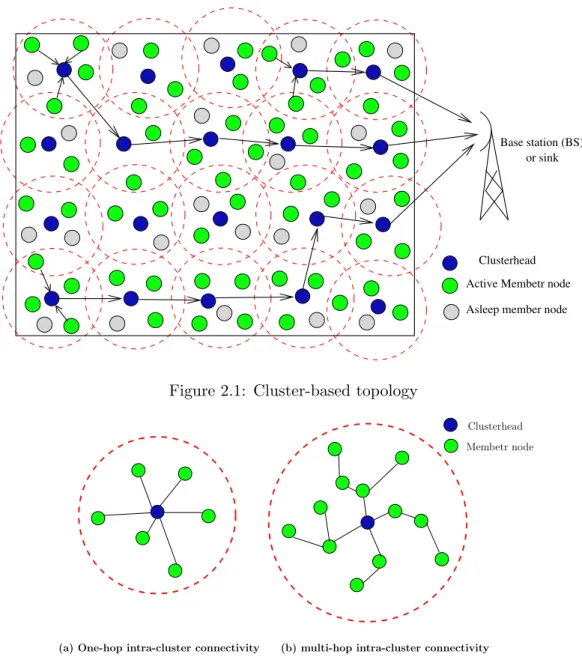
Flat routing protocols are quite effective in relatively small networks. However, they scale very bad to large and dense networks since, typically, all nodes are alive and generate more processing and bandwidth usage. On the other hand, hierarchical routing protocols have shown to be more scalable and energy-aware in the context of WSNs. In hierarchical-based routing, nodes play different roles in the network and typically are organized into clusters. Clustering (Figure 2.1) is the method by which sensor nodes in a network organize themselves into groups according to specific requirements or metrics. Each group or cluster has a leader referred to as clusterhead (CH) and other ordinary member nodes (MNs). The clusterheads can be organized into further hierarchical levels.
2.3.1 Clustering and Routing
From a routing perspective, clustering allows to split data transmission into intra-cluster (within a cluster) and inter-cluster (between clusterheads and every clusterhead and the sink) communication. This separation leads to significant energy saving since the radio unit is the major energy consumer in a sensor node. In fact, member nodes are only allowed to communicate with their respective clusterhead, which is responsible for relaying the data to the sink with possible aggregation and fusion operations. Moreover, this separation allows to
2.3. Hierarchical Routing 13
Clusterhead Active Membetr node Asleep member node
or sink Base station (BS)
Figure 2.1: Cluster-based topology
(a) One-hop intra-cluster connectivity (b) multi-hop intra-cluster connectivity Clusterhead Membetr node
Figure 2.2: One-hop toward the sink
reduce routing tables at both member nodes and clusterheads in addition to possible spatial reuse of communication bandwidth.
Intra-cluster communications
Most of the earlier work on clustering assume direct (one-hop) communication between mem-ber nodes and their respective clusterheads [52, 119]. All the memmem-ber nodes are at most two hops away from each other (Figure 2.2(a)). One-hop clusters makes selection and propagation of clusterheads easy, however, multi-hop intra-cluster connectivity is sometimes required, in particular for limited radio ranges and large networks with limited clusterhead count. Multi-hop routing within a cluster (Figure 2.2(b)) has already been proposed in wireless ad-hoc networks [70]. More recent WSNs clustering algorithms allow multi-hop intra-cluster routing [16, 34].
14 2. Routing in Wireless Sensor Networks 0000 0000 1111 1111 BS Clusterhead Membetr node Distributed GW Common GW CH2 CH1 CH4 CH3
Figure 2.3: One-hop toward the sink
Inter-cluster Routing
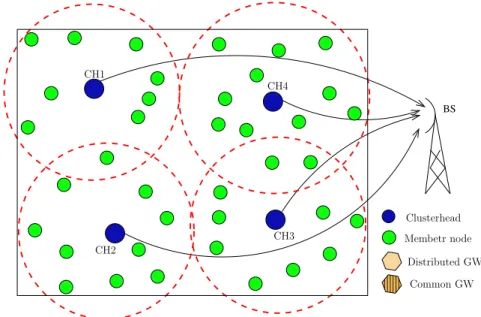
Earlier cluster-based routing protocols such as LEACH [52] assume that the clusterheads have long communication ranges allowing direct connection between every clusterhead and the sink (Figure 2.3). Although simple, this approach is not only inefficient in terms of energy consumption, it is based on irrealistic assumption. The sink is usually located far away from the sensing area and is often not directly reachable to all nodes due to signal propagation problems. A more realistic approach is multihop inter-cluster routing that had shown to be more energy efficient [81]. Sensed data are relayed from one clusterhead to another until reaching the sink (Figure 2.1).
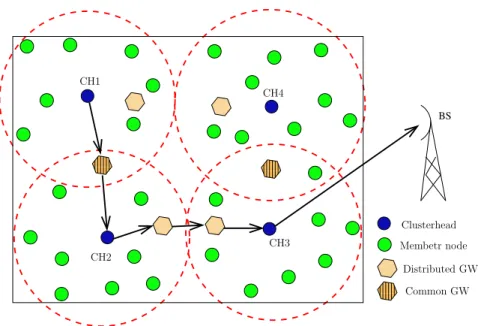
Direct communication between clusterheads is not always possible especially for large clusters (multihop clusters for instance). In this case, ordinary nodes located between two clusterheads could act as gateways (GW) allowing the clusterheads to reach each other (Fig-ure 2.4). A gateway node is either common or distributed. A common (ordinary) gateway is located within the transmission range of two clusterheads and thus, allows 2-hop communi-cation between these clusterheads. When two clusterheads do not have a common gateway, they can reach each other in at least 3 hops via two distributed gateways located in their re-spective clusters. A distributed gateway is only reachable by one clusterhead and by another distributed gateway of the second clusterhead cluster.
Inter-cluster communication in several proposals is achieved through organizing the clus-terheads in a hierarchy (Figure 2.5) as done in [16] and [79]. Multiple level hierarchy allows better energy distribution and overall energy consumption. However, maintaining the hier-archy could be costly in large and dynamic networks where nodes die as soon as their energy supply is completely discharged.
2.3. Hierarchical Routing 15 0000 0000 0000 1111 1111 1111 0000 0000 1111 1111 0000 0000 1111 1111 BS Clusterhead Membetr node Distributed GW Common GW CH2 CH1 CH4 CH3
Figure 2.4: Multi-hop inter-cluster communication
R f g 1 Layer 0 Layer 1 Layer 2 B K A B C D F E J H K G G G
16 2. Routing in Wireless Sensor Networks
2.3.2 Clustering Algorithms Taxonomy
In the literature, there have been several different ways to classify Clustering algorithms for WSNs. In [120], the classification is performed based on parameter(s) used for electing clus-terheads and the execution nature of a clustering algorithm which can be either probabilistic or iterative. In iterative clustering techniques, a node waits for a specific event to occur or certain nodes to decide their role (e.g., become clusterheads) before making a decision. Probabilistic Clustering Techniques enables every node to independently decide on its role in the clustered network while keeping the message overhead low. Considering how the cluster formation is carried out, a clustering algorithm is either executed at a central point or in a distributed fashion at local nodes. Centralized approaches are used by few earlier proposals like LEACH-C [24]. They require global knowledge of the network topology and are ineffi-cient in large-scale topologies. A distributed approach, however, is more scalable since a node is able to take the initiative to become a clusterhead or to join an already formed cluster without global topology knowledge.
Authors of [9] classify clustering algorithms according to their convergence rate into two classes : variable and constant convergence time algorithms. The former algorithms have a convergence time that depends on the number of nodes in the network and thus are more suitable to relatively small networks. Constant convergence time algorithms converge in a fixed number of iterations, regardless of the size of the nodes population.
Clustering algorithms can also be classified into homogeneous or heterogeneous [82] de-pending on the nature of the deployed sensor network. In heterogeneous environments, the clusterhead roles can be preassigned to nodes with more energy, computation and commu-nication resources. In a homogeneous environment, the clusterheads can be designated in a random way or based on one or more criteria. It is worth mentioning, that even in a homoge-neous network, heterogeneity can occur simply in terms of available energy at nodes. As time goes on, some nodes depending on their role and environmental factors, will discharge more quickly their batteries. This is why energy and clusterhead rotation have to be considered in the process of clustering.
In this chapter, we adopt a different classification to present clustering protocols in WSNs. Most proposed cluster-based routing protocols rely on already formed clusters. Afterwards, the inter-cluster communication is generally ensured using traditional flooding among only clusterheads or by recursively executing the clustering algorithm to obtain a hierarchy of clusterheads routed at the sink. We qualify these protocols as pre-established cluster-based routing algorithms. Protocols that build clusters based on packets flowing in the network without a priori construction are qualified as on-demand cluster-based algorithms. It is worth mentioning that the second class had always been omitted in surveys like [120] [9] and [78]. On-demand clustering by exploiting existing traffic to piggyback cluster-related information, eliminates major control overhead of traditional clustering protocols. Besides, there is no startup latency even if there is a transient period before getting maximum performances.
2.3. Hierarchical Routing 17
2.3.3 Pre-established Cluster-based Routing Algorithms
In this section, we review most important clustering algorithms. Even if they are limited only to the clusters formation and do not address explicitly inter-cluster routing. It is generally straightforward to apply on top of the clustered topology a routing protocol taking into account only the clusterheads in the route discovery phase.
Low Energy Adaptive Clustering Hierarchy (LEACH) and its variants
Low-Energy Adaptive Clustering Hierarchy (LEACH) [52] is one of the most popular hier-archical routing algorithms for sensor networks. LEACH is a cluster-based protocol with distributed cluster formation with random clusterhead election. A sensor node chooses a random number between 0 and 1. If this random number is less than a threshold value the node becomes a clusterhead for the current round. Based on the received signal strength of the advertisement, a non-clusterhead node decides to which cluster it will belong for this round and sends a membership message to its clusterhead. Based on the number of nodes in the cluster, a clusterhead creates a TDMA schedule and assigns each node a time slot in which it can transmit. This schedule is broadcast to all the cluster nodes. This is the end of the so-called advertisement or setup phase of LEACH. Then begins the steady state where different nodes can transmit their sensed data.
LEACH is completely distributed and requires no global knowledge of network. However, it forms one-hop intra and inter cluster topology, which is not applicable to large region networks. Clusterheads are assumed to have a long communication range so they can reach the sink directly. This is not always a realistic assumption since the clusterheads are regular sensors and the sink is often located far away. Furthermore, dynamic clustering brings extra overhead due to the advertisements phase at the beginning of each round, which may diminish the gain in energy. Since the decision to elect a clusterhead is probabilistic without energy considerations, LEACH clusterhead rotation assume a homogeneous network and can not ensure real load-balancing in case of nodes initially with different amount of energy. A node with very low energy becomes a clusterhead for the same number of rounds as other nodes with higher energy and will die prematurely. This could affect a zone coverage and network connectivity.
LEACH-C [24] is a centralized version of LEACH where only the advertisement phase differs. At this phase, each node sends information about its current location and residual energy level to the sink. Based on nodes location, the sink builds clusters using the simulated annealing algorithm [87] so the amount of energy required by member nodes to transmit their data to their respective clusterhead is minimized. Collected information about nodes energies allows the sink to discard those with energy below the average network energy. Consequently, energy load is evenly distributed among all the nodes.
18 2. Routing in Wireless Sensor Networks Energy Efficient Hierarchical Clustering (EEHC)
Energy Efficient Hierarchical Clustering (EEHC) [17] can be seen as an extension of LEACH with multi-hop intra clusters and a hierarchy of clusterheads to route data to the sink. In the single-level clustering of EEHC, each sensor in the network becomes a Volunteer clusterhead with probability p. It announces this to the sensors within k hops radio range. Any sensor that receives such advertisements and is not itself a clusterhead joins the closest cluster. If a sensor does not receive a clusterhead advertisement within a certain time duration it can infer that it is not within k hops of any volunteer clusterhead and hence becomes a forced clusterhead. Data transmission to the sink can be performed using multi-hop routing through clusterheads organization in a multi-level hierarchy rooted at the sink. To do so, the single-level clustering is repeated recursively at the single-level of clusterheads. This distributed process allows EEHC to have a time complexity of O(k1+ k2+ ... + kh) where h is the number of levels and ki is the maximum number of hops between a member node and its clusterhead in the ith level of hierarchy. Since spent energy in the network depends on p and k, the authors provide methods to compute the optimal values of these parameters that ensure minimum consumed energy. Simulation results showed significant energy saving when using the optimal parameter values.
Hybrid Energy-Efficient Distributed Clustering (HEED)
Both EEHC and LEACH do not consider energy in selecting clusterheads. HEED [119] brings one more step toward energy-efficient cluster-based routing with explicit consideration of energy. Selected cluster heads in HEED have relatively high average residual energy compared to member nodes. Additionally, HEED aims to get a well-distributed clusterheads set over the sensor field. Indeed, in HEED, the probability that two nodes within the transmission range of each other to be clusterheads is small. It is worth mentioning that the main drawback of LEACH is that the random election of clusterheads does not ensure their even distribution in the sensing field. It is quite possible to get multiple clusterheads concentrated in a small area. In this case, this area sensors are likely to exhaust their energy more quickly which may lead to insufficient coverage and network disconnection. Distributing clusterheads evenly in the sensing area is one important goal to be met in order to ensure load balancing and hence longer network lifetime.
HEED periodically selects clusterheads according to a hybrid of their residual energy and intra-cluster communication cost. Initially, to limit the initial clusterhead announcements, HEED sets an initial percentage Cprob of clusterheads among all sensors. The probability that a sensor becomes a clusterhead is CHprob = Cprob Eresidual/Emax where Eresidual is the current energy in the sensor, and Emax is its maximum energy. Afterwards, every sensor goes through several iterations until it finds the clusterhead that it can transmit to with the least transmission power. If it hears from no clusterhead, the sensor elects itself to be a clusterhead and sends an announcement message to its neighbors. Each sensor doubles its CHprob value and goes to the next iteration until its CHprob reaches 1. Therefore, there are two types of
2.3. Hierarchical Routing 19 status that a sensor could announce to its neighbors: Tentative status and Final status. In the first state, the sensor becomes a tentative clusterhead if its CHprob is less than 1. It can change its status to a regular node at a later iteration if it finds a lower cost clusterhead. In the final state, the sensor permanently becomes a clusterhead if its CHprob has reached 1.
At the final phase, each sensor makes a final decision on its status. It either picks the least cost clusterhead or pronounces itself as clusterhead. Simulation results showed that HEED outperforms LEACH with respect to the network lifetime and energy consumption distribution. However, HEED suffers from a consequent overhead since it needs several iterations to form clusters. In each iteration, a lot of packets are broadcast.
2.3.4 On-demand Cluster-based Routing Algorithms
In this class of cluster-based routing algorithms, the clustering topology is built along with the routing discovery phase. We report here on the most imporatnt protocols belonging to this class of hierarchical routing. Further in this thesis (in chapter 4), we present our contribution that falls into this class.
Passive Clustering (PC)
Passive clustering (PC) [63] is an on demand clustering algorithm. It provides scalability and practicality for choosing the minimal number of forwarding nodes in the presence of dynamic topology changes. PC constructs and maintains the cluster architecture based on outgoing data packets piggybacking cluster related information. Passive clustering eliminates setup latency and major control overhead of traditional clustering protocols by introducing two innovative mechanisms for the cluster formation: “first Declaration wins” rule and “gateway selection heuristic”. With the “first Declaration wins” rule, a node that first claims to be a clusterhead rules the rest of nodes in its clustered area. The “gateway selection heuristic” provides a procedure to elect the minimal number of gateways.
The algorithm defines several states in which a node can be. At cold start, all nodes are in the initial state. Nodes can keep internal states such as clusterhead-ready or gateway-ready to express their readiness to be respectively a clusterhead or gateway. A candidate node finalizes its role as a clusterhead, a gateway (Full-GW or Dist-GW) or an ordinary node. Additional fields suggested by PC in the message header of each packet are :
• id : the identity of the originator of this message, • state : this packer sender status in the network,
• CH1 and CH2 : these two fields are only used by a gateway to announce its two clusterhead addresses,
The reactive nature of PC motivated its combination with on demand routing protocols. Originally, PC was applied to reactive routing protocols like AODV [23] and DSR [57]. The
20 2. Routing in Wireless Sensor Networks major overhead in these routing protocols is caused by the flooding of route queries. It was suggested to allow only non-ordinary nodes to rebroadcast query messages.
The PC algorithm presents some shortcomings that have been targeted by several works. In [95], the authors proposed to add alive packets to keep the cluster stability as it depends highly on the data packet traffic. Also, a sequence numbering to synchronize packets arriving from a source node is proposed. In fact, if packets containing different states arrive out-of-order at the destination (i.e., the sending node changed its state between transmission of multiple packets) then the destination node will be misled about the true state of the source node. In addition, unnecessary rebroadcasts are eliminated when the final destination of the message is a cluster member.
In WSNs, the PC algorithm was proposed in combination with Directed Diffusion (DD) in [50] to mainly achieve energy efficiency. The main idea of the combination is to save energy in the flooding phases by allowing only clusterheads and gateways to participate in them. member nodes are only allowed to send data messages in the data sending phase. Under different network size and load, the combination showed best performances in terms of delivery ratio and average dissipated energy.
Motivated by the results shown in [50] when applying the original PC along with Directed Diffusion paradigm other works have been proposed in order to achieve better performance of the combination. In [88], the selection of clusterheads and gateways are done using a heuristic of residual energy and distance. By using residual energy the flooding nodes are chosen in an energy efficient manner. Distances are used to reduce overlapping region and so the number of gateways. The solution proposes to apply a periodic sleep and awake among cluster members. This technique is similar to the one proposed in LEACH and requires a synchronization process between nodes.
CLIQUE
The work in [40] presents CLIQUE, an approach for cluster head selection based on machine learning (Q-learning). The authors observed that a clusterhead may require less energy than its direct neighbors in a multi-hop intra-cluster topology. They conclude that clusterhead role assignment must take into account not only the current state of the selected clusterheads, but also those of its neighbors and nodes on the paths to the clusterhead. in CLIQUE, clusterhead roles are neither explicitly assigned nor do the nodes need to agree on a clusterhead. Instead, each node decides on a per-packet basis whether to act as clusterhead (aggregating some packets then sending the result to the sinks) or to forward the packet to a better suited neighbor. Authors claimed that this role-free scheme makes the algorithm flexible and robust and eliminates the need for multiple clusterhead selection rounds.
Authors of [40] focused on the clusterheads selection process and assumed that clusters are predefined (rectangular grids) and that each node knows the identity of the cluster to which it belongs. They targeted a traditional, periodic data reporting application and a multiple sinks network. The sinks flood the network with DATA REQUEST packets announcing their
2.4. Conclusion 21 data interest. These packets can carry some routing information that is further used by nodes to estimate the routing cost to the sinks. The routing cost is calculated using a combination of hop counts to reach the sinks and battery status of the nodes on the routes to the sinks. Each sensor node is an independent learning agent, and actions are routing options using different neighbors as the next hop toward the clusterhead. The clusterhead is defined as the cluster node with the best (lowest) routing cost to all sinks.
Even if CLIQUE may incur more energy consumption due to possible coexistence of multiple clusterheads in one cluster, the authors showed through simulations that CLIQUE saves up to 25% of consumed energy thanks to its lower overhead. However, CLIQUE is more suitable for regular data reporting and its performances are to be proved for other types of applications such as event driven ones.
2.4
Conclusion
Routing in WSNs has been an active area of research in the last years. Most of the work have been motivated by the need to design an efficient routing protocol to provide reliabil-ity, load sharing and QoS guarantees while extending the network lifetime. Many routing classifications are proposed in the literature. In this chapter, we reviewed the major flat as well as hierarchical routing solutions proposed in WSNs. Every routing class can be divided into many sub-classes according to different criteria. In flat routing, data-centric approach appears as the most important new routing class that has been proposed in WSNs. Hierar-chical routing solutions have been classified into pre-established and on-demand solutions. In the first sub-class, the routing topology is built prior to the data dissemination phase. In the second one, the routing topology is built passively along with the routing discovery phase.
The emerging multimedia applications of WSNs impose new challenges in design of algo-rithms and communication protocols for such networks. In the view of these challenges, new routing solutions should be proposed to cope with the limitations of such networks. In the next chapter, wireless multimedia sensor networks are introduced and routing solutions that have been proposed especially for them are presented.
Chapter 3
Routing Multimedia in Wireless
Sensor Networks
3.1
Introduction
The proliferation of inexpensive hardware such as CMOS cameras and microphones that are able to ubiquitously capture multimedia content from the environment has led to the definition of wireless multimedia sensor networks (WMSNs) [13]. In addition to scalar sensor data, in WMSNs, video sensor nodes allow retrieving and communicating a rich data content such as video/audio streams and still images. From this perspective, several new applications can be envisaged in many domains such as video surveillance, health care, industrial process control, traffic management, etc.
From a communication point of view, supporting multimedia content in WSNs is very demanding. Many types of traffic can flow in the network having different characteristics and quality of service (QoS) requirements. Additionally, multimedia applications dealing with audio/video streams have specific requirements that are difficult to fulfill. In this case, the network should sustain transmission of large burst of data at a high bit-rate. These charac-teristics need to be addressed efficiently taking into account the severe hardware, bandwidth and power limitations of the sensor nodes.
Designing an efficient routing protocol for WMSNs is a challenging task. Although, there are many routing solutions proposed for WSNs, these protocols should be rethought to suit the multimedia case [46]. In fact, the efficiency of employing data-centric approaches to route multimedia data in WSNs depends on the protocol design and characteristics. In some cases, describing and addressing multimedia content is a difficult task. For example, generating meta-data descriptions, like in SPIN [6], for multimedia data is not a realistic task on power constrained sensors.
Location-based protocols constitute a good solution to multimedia data routing in WSNs. In fact, greedy forwarding in location-aware routing protocols can guarantee the delivery of data if nodes have consistent location information [114] [59]. Moreover, with consistent location information, the latency of data delivery can also be reduced as the shortest paths can easily be discovered. This is extremely important for multimedia data communication
24 3. Routing Multimedia in Wireless Sensor Networks with QoS requirements.
Hierarchical network architectures are proposed in [13] as reference architectures to sup-port multimedia communication in WSNs. However, the hierarchical routing solutions pro-posed initially for WSNs have to be rethought to suit the multimedia case if certain conditions are assumed like the in-network processing. Also, the concentration of data traffic towards a small number of nodes (clusterheads) remains a major threat to the network lifetime for these solutions.
This chapter reviews routing thechniques that are suitable to multimedia applications over WSNs. We begin by introducing Wireless Multimedia Sensor Networks (WMSNs) in Section 3.2 by giving a general architecture and the charateristics of these networks. Then, routing thechniques to ensure a given QoS are presented in Section 3.3. Hierarchical routing organization of a WSN with the aim of handling multimedia is considered in Section 3.4 before concluding.
3.2
Wireless Multimedia Sensor Networks
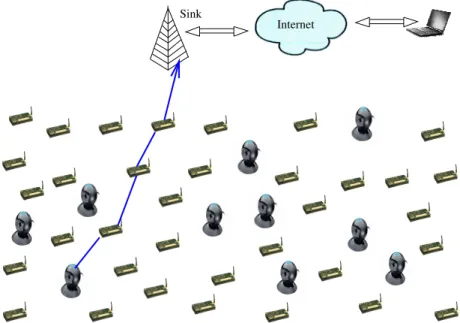
Wireless Multimedia Sensor Networks (WMSNs) are particular instances of WSNs where the scalar WSNs is strengthened by introducing the ability of retrieving richer information content through image/video sensors [94, 39]. A WMSN can operate in an ad-hoc manner and hence does not require a network infrastructure adding a much higher level of flexibility and allowing a wider range of applications. Figure 3.1 depicts a typical WMSN architec-ture where video sensors are deployed at strategic positions with other non visual sensors. A central controller or a base station commonly referred to as the sink is responsible for requesting/analysing sensed data. All nodes collaborate to ensure a given application re-quirements. For instance, low-power scalar sensors only take part in relaying in addition to sensing environmental data. Sensors with higher capabilities could do more such as taking part in a distributed compression task in order to not overwhelm video sensors by all the tasks (capture, compression and transmission).
Multimedia data communication in WSNs has specific characteristics and needs. Gener-ally, multimedia content should be received with a certain level of quality of service (QoS) while optimizing resources utilization. There are many factors and needs influencing the development of communication protocols in wireless multimedia sensor networks :
Energy Requirements
Sensor nodes are power-constrained as they run on small batteries that have limited power. This makes power consumption a fundamental concern in WSNs. In WMSNs, high volumes of data are produced which require, in addition to high data transmission rates, extensive processing. In fact, capturing and/or compression of rich multimedia content (video and audio) require a lot of energy. The power consumption of these tasks may easily dominate the one of communication functionalities [65]. Therefore, protocols and algorithms to maximize
3.2. Wireless Multimedia Sensor Networks 25
Sink
Internet
Figure 3.1: Typical Wireless Multimedia Sensor Network the system lifetime are a critical issue.
High Bandwidth
Video and audio content require transmission bandwidth that is orders of magnitude higher than that supported by currently available sensors. In fact, the nominal transmission rates for sensor nodes may reach a maximum of 250 kbit/s (TelosB [4] using IEEE 802.15.4 compliant). Therfore, hardware and software solutions are necessary to provide sufficient bandwidth for supporting multimedia content in WSNs. Furthermore, the sensor nodes may also relay the packets from the other nodes due to multihop communication paradigm in WSNs which makes managing the available bandwidth more stressful.
Encoding Techniques
Efficient processing techniques for lossy compression are necessary for WMSNs for two reasons [46]. First the limitations of sensor nodes that capture and compress multimedia signals and second the communication efficiency of these techniques is of great importance in optimizing the limited bandwidth utilization. Predictive coding has been widely used in communication networks in the last years [43]. While it can provide many possibities in compression levels and quality, the computational complexity of predictive encoders is unacceptably high for power constrained sensor nodes. Furthermore, predictive coding is error sensitive and should be properly handled in wireless channel lossy environments. The power consumption of solutions (such as redundancy, unequal error correction, MDC [42], etc.) addressing this problem remain an important design issue. On the other hand, it has recently been shown [93] that the traditional balance of complex encoder and simple decoder can be reversed within the framework of the so-called distributed source coding (DSC). This latter is based