THE ACTION OF NATURAL SELECTION ON
THE HUMAN MENSTRUAL CYCLE: A
SIMULATION STUDY
GERARD METRAL
Institute of Anthropology, University of Geneva, Switzerland
Summary. Reproductive performance of the human female is simulated by
Monte Carlo methods. The results clearly suggest the operation of natural selection on the length of the female menstrual cycle, brought about by differential fertility. It is argued that the selection pressure towards a shorter cycle, with a selective advantage of approximately 1% per day of shortening, is balanced by internal physiological determinants preventing excessive shortening, so the result is a situation of stabilizing natural selection.
Introduction
From the point of view of human evolutionary history, it is only very recently that the fecund period of the female's menstrual cycle has been known; this knowledge is moreover limited to a very small portion of mankind. As a consequence, most of humanity has generally been unable to use this knowledge to promote or curtail the birth rate. Fertilization therefore may be considered to have been a purely random phenomenon from time immemorial—all the more so since no outward sign occurs to indicate the physiological condition of the human female, and this is in contrast to what occurs among other primates.
The human female generally produces a single ovum per cycle. In order to achieve a pregnancy, should fertilization fail to take place within any one cycle, it becomes necessary to wait for the next. Such an occurrence is frequent (Leridon, 1973), so it is safe to say that women with short menstrual cycles will be ready sooner for the next attempt at fertilization. As this phenomenon is repeated after each failure (the probability of fertilization seems to be equal for women having long and short cycles) it follows that women with short cycles are more fecund than those with long—excluding from consideration of course all Malthusian and other fertility control practices. Differential cycle length would therefore through differential fertility result in natural selection, favouring shortening of the menstrual cycle in our species.
This article describes a study attempting to measure the force of such selection. 337
338 G. Mitral
Method
A simulation of the reproductive performance of the human female was carried out by means of a computer program using the Monte Carlo method. The program simulates each day's events in the sexual life of the human female over a period of 5 years. The stochastic decisions are: (1) does intercourse occur; (2) if so, does pregnancy follow; (3) does the embryo survive; if it does, for how long; (4) when does the first cycle following the birth commence.
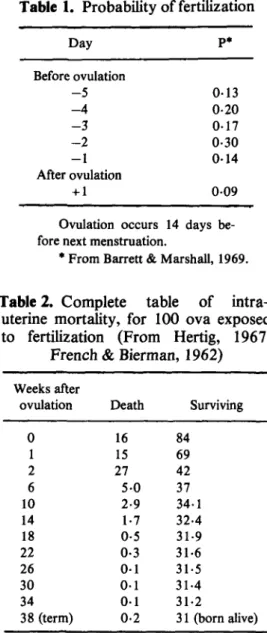
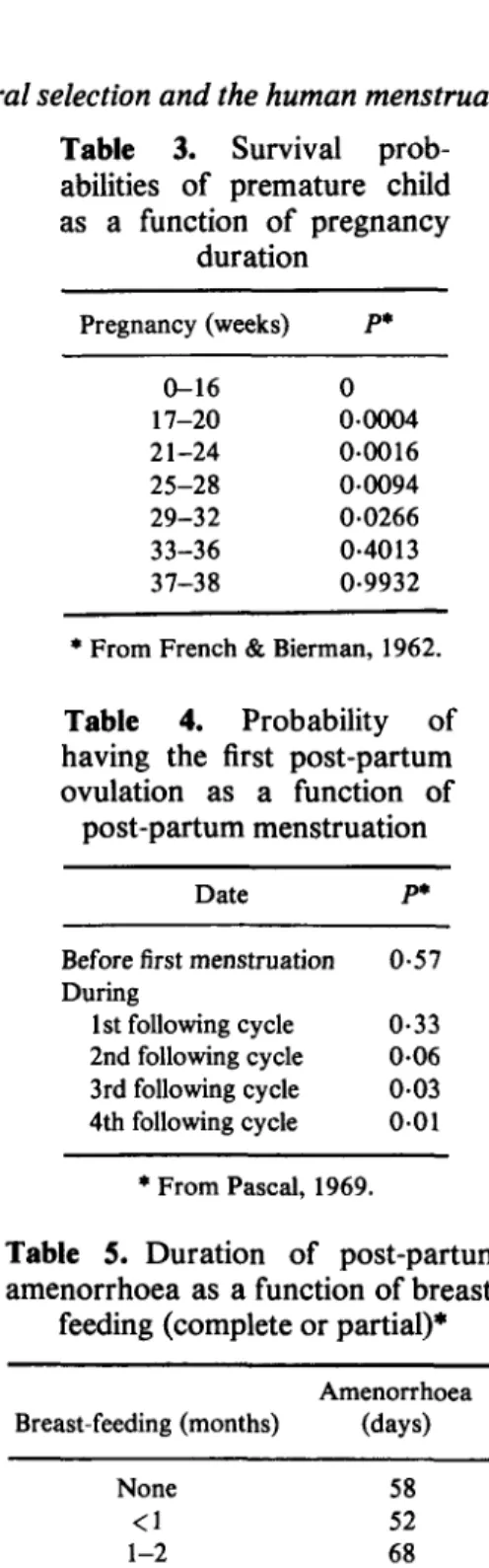
The probabilities used in these decisions are based on actual data, given in Tables 1 to 5, so that the program creates fictitious females whose reproductive
Table 1. Probability of fertilization Day Before ovulation - 5 - 4 - 3 _ 2 - 1 After ovulation + 1 P* 0-13 0-20 0-17 0-30 0-14 0 0 9 Ovulation occurs 14 days be-fore next menstruation.
* From Barrett & Marshall, 1969.
Table 2. Complete table of
intra-uterine mortality, for 100 ova exposed to fertilization (From Hertig, 1967;
French & Bierman, 1962)
Weeks after ovulation 0 1 2 6 10 14 18 22 26 30 34 38 (term) Death 16 15 27 5-0 2-9 1-7 0-5 0-3 0 1 0-1 0 1 0-2 Surviving 84 69 42 37 34-1 32-4 31-9 31-6 31-5 31-4 31-2 31 (born alive)
Table 3. Survival
prob-abilities of premature child as a function of pregnancy duration Pregnancy (weeks) 0-16 17-20 21-24 25-28 29-32 33-36 37-38 P* 0 00004 0-0016 00094 00266 0-4013 0-9932
* From French & Bierman, 1962.
Table 4. Probability of
having the first post-partum ovulation as a function of post-partum menstruation
Date Before first menstruation During 1st following cycle 2nd following cycle 3rd following cycle 4th following cycle P* 0-57 0-33 0-06 0 0 3 0 0 1 * From Pascal, 1969.
Table 5. Duration of post-partum
amenorrhoea as a function of breast-feeding (complete or partial)*
Breast-feeding (months) None <1 1-2 2-3 3 ^ 4-5 5-6 >6 * From Pascal, Amenorrhoea (days) 58 52 68 82 95 115 126 175 1969.
340 G. Mitral
behaviour should conform to reality. This was confirmed by comparing the results of this program with demographic data taken from rural French and Swiss populations of the 18th century, and the results were found to correspond well (Metral, 1979). All the women in the simulation were between 25 and 30 years of age at the beginning of the run, i.e. in the most fertile period of their lives. So also were the women of the real populations used to test the program. Within this age group the effect of age on fertility can be regarded as negligible.
Very rarely is the cycle perfectly regular, so it was considered that a variation of 2 days on either side of the mean duration was a reasonable approximation to reality (Hertig, 1967). Thus a woman with a mean cycle duration of 28 days is regarded in this simulation as having an equi-probable chance of a cycle of 26, 27, 28, 29 or 30 days, one of these five values being chosen at random at the onset of each new cycle; it would have been possible to vary the probability, but for simplicity this was not done.
The frequency of intercourse was taken as twice or three times a week, and it was assumed that the probability of intercourse on a given day follows a Poisson distribution.
For a cohort of 240 women many simulations each covering a 5-year period were carried out. All females in a given simulation had the same mean cycle duration, M. Simulations were carried out at M values of 25 to 55 days, and for each cycle duration there were five simulation runs.
Results
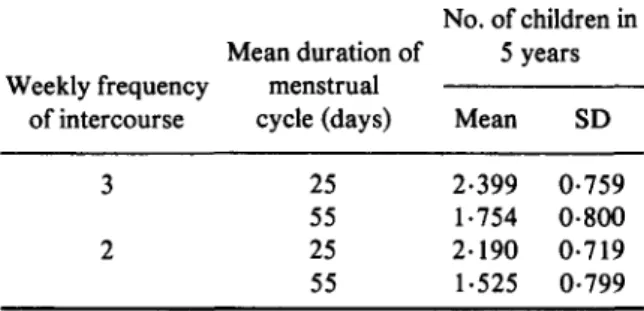
The results for the two extremes of cycle length are given in Table 6, and for these and all intermediate values in Fig. 1, for two frequencies of sexual intercourse. Means plus or minus 1 standard deviation are given for the number of children produced per woman in the 5-year period. There appears a quite regular decline with mean cycle length, amounting over the whole range covered (25-55 days) to a diminution of 26-9% in the number of children produced, an average of 0-89% per additional day of cycle length.
Table 6. Number of children produced in 5
years, as a function of the length of mother's menstrual cycle
No. of children in Mean duration of 5 years Weekly frequency menstrual
of intercourse cycle (days) Mean SD 3 25 2-399 0-759
55 1-754 0-800 2 25 2-190 0-719 55 1-525 0-799
th e c c bo i c a ild r o
i §
Si
s >
S i n 4.0 3.5 3.0 2.5 2.0 1.5 1.0 0.5 n n5 o_ Frequency of sexual intercourse : 2 a week 4.5
-Mean
Standard deviation
25 35 45 Mean length of menstrual cycle in days
55 th e c £ 2
i
chi l o nbe r irio d a n nu i rea r p c a) ^ S i n 5.0 4.5 4.0 3.5 3.0 2.5 2.0 1.5 0.5 0.0Frequency of sexual intercourse : 3 a week
Mean
Standard deviation
25 35 45 Mean length of menstrual cycle in days
55
Fig. 1. Influence of the length of women's menstrual cycle on fecundity; two frequencies of sexual intercourse.
If, as appears reasonable, there is appreciable genetic control of cycle length, these results indicate that there is in non-Malthusian populations selective pressure towards shortening the cycle. The intensity of that pressure increases with increasing cycle length.
In the simulations, all the females considered are fairly young. The reason for this choice is that in all populations throughout the world, present and past, women aged between 25 and 30 have children. The conclusions drawn therefore from simulation of this period of their lives may be considered as applicable to all
humanity. As women become older, not only is there biological decline in fertility, but there also come into operation cultural factors, such as the probability of being widowed and of subsequent re-marriage, which would affect their fertility, so any conclusions drawn from simulation of these older groups would be less generally applicable. However, as a woman becomes older, failure of fertilization will occur more frequently. There is no reason to believe that the probability of such failure is in any way related to the length of the cycle. Consequently for women with short cycles the opportunity for fertilization will recur more rapidly. That is to say they will have a greater possibility of compensating for the failure which has occurred and which was attributable to their age. Therefore the selective advantage of a short cycle, as calculated in the present simulation of younger women, must be considered as a minimal value, and must be greater in populations where women have a long reproductive life.
It would have been possible to extend the effect of this examination to cycle lengths of less than 28 days. But evolution has stabilized cycle length at about this mean value so it may therefore be assumed that there is some obstacle to any further tendency to shortening the cycle. Such an obstacle may perhaps be sought among the diverse physiological mechanisms of follicular maturation, of cellular multiplication, and of hormonal interactions which occur normally during the cycle. It therefore seemed pointless to extend the simulation to cycle lengths below 25 days.
It is appreciated that such considerations are theoretical, for simulation is only an approximation to reality. For the present problem, however, only a large medical survey of non-Malthusian populations, with exact knowledge of cycle length and variability in all the women, could give an answer; achieved fertility would need to be correlated with cycle length and variation. Such a survey is not practicable, so that simulation is the only way to perceive the answer to this problem. It is of course a simplification of the complexity that is human reality, and the results must be accepted with caution. However, as mentioned previously, the model used in this study proved to be very similar to reality when applied to a real population, so the present results may be considered worthy of attention.
In conclusion, there emerges from this study a clear suggestion that the length of the female menstrual cycle shows evidence of the operation of a stabilizing natural selection, brought about by differential fertility. The opposing forces are on the one hand a selective advantage of approximately 1% per day of cycle shortening, and on the other internal physiological determinants which prevent excessive cycle shortening.
References
BARRETT, J.C. & MARSHALL, J. (1969) The risk of conception on different days of the menstrual cycle. Popul. Stud. 23,455.
FRENCH, F.E. & BIERMAN, J.E. (1962) Probabilities of fetal mortality. Publ. Hlth Rep. Wash. 11, 835.
HERTIG, A.T. (1967) The overall problem in man. In: Comparative Aspects of Reproductive
Failure. Edited by K. Bernischke. Springer-Verlag, New York.
METRAL, G. (1979) Polygamie et Fecondite Feminine; Etude de I'Influence de Divers Facteurs au
Moyen de Simulations Monte Carlo. Thesis no. 1915, Faculty of Science, Geneva University,
Switzerland.
PASCAL, J. (1969) Quelques Aspects de la Physiologie du Post-partum. MD thesis, Nancy.