Do individual cognitions mediate the association
of socio-cultural and physical environmental factors
with adolescent sports participation?
Klazine van der Horst
1,2,*, Anke Oenema
1, Saskia J te Velde
3and Johannes Brug
31Department of Public Health, Erasmus University Medical Center, Rotterdam, The Netherlands:2ETH Zurich, Institute for Environmental Decisions (IED), Consumer Behavior, Universitaetstrasse 22, CHN H75.3, CH-8092 Zurich, Switzerland:3EMGO Institute for Health and Care Research, VU University Medical Center, Amsterdam, The Netherlands
Submitted February 2009: Accepted May 2010
Abstract
Objective: To examine the associations of perceived physical environmental factors (availability of physical activity (PA) attributes at home, PA facilities in the neigh-bourhood, neighbourhood pleasantness and safety) and social environmental factors (parental sports behaviour and parental rule regarding sports participation) with adolescent leisure-time sports participation, and to explore whether the associations found were mediated by individual cognitions as derived from the theory of planned behaviour (TPB).
Design: Cross-sectional study.
Setting: In schoolyear 2005/2006 adolescents from seventeen schools in Rotterdam, the Netherlands, completed a questionnaire during school hours that included self-reported measures of leisure-time sports participation, perceived physical envir-onmental factors and TPB variables. Information about parental sports behaviour and parental rule was obtained from a questionnaire that was completed by one parent of the adolescents.
Subjects: Data were collected from 584 adolescent–parent combinations.
Results: Data were analysed with multi-level logistic regression analyses. Availability of PA attributes at home (OR 5 1?26), parents’ sports behaviour (OR 5 2?03) and parental rule (OR 5 1?64) were associated with a higher likelihood of adolescents’ leisure-time sports participation. These associations were partly mediated by attitude and intention.
Conclusions: Adolescents were more likely to engage in leisure-time sports when PA attributes were available at home, when parents participated in sports activities and had a rule about their offspring participation in sports activities. These associations were partly mediated by attitude and intention. These results suggest that parents can importantly promote sports participation among their offspring by making sports activities accessible and a family routine.
Keywords Physical environment Socio-cultural environment Adolescents leisure-time sports
Insufficient physical activity (PA) is a risk factor for a range of chronic conditions, including obesity, among adults as well as adolescents(1,2). Most adolescents do not meet the recommended minimum levels of engaging in at least 60 min of moderate-to-vigorous intensity PA each day(3–6). Adolescents are a particularly important target group to improve PA levels since physically active adolescents are more likely to become active adults(7). To be able to increase PA levels among adolescents, it is important to develop interventions that target the most important determinants of PA. In addition to individual cognitions such as attitude, subjective norm, perceived behavioural control and intention, as derived from the
theory of planned behaviour (TPB),(8)physical and social environmental factors may be important determinants of PA behaviour. Kremers et al.(9), in their Environmental Research framework for weight Gain prevention (EnRG), suggest that environmental factors may have both a direct and indirect association with behaviour. The direct asso-ciation reflects a more automatic and unconscious effect of the environment on behaviours. The indirect influence suggests that environmental factors influence PA via the individual cognitions, e.g. environments that offer appealing and easily accessible opportunities for PA may result in more positive attitudes, perceived behavioural control and intentions towards leisure-time PA, which may result in
higher PA levels. The TPB also assumes that the impact of various external variables such as physical and social envir-onmental factors on behaviour is mediated by attitude, sub-jective norm, perceived behavioural control and intention.
Physical environmental factors, such as the availability and accessibility of PA opportunities, have received most attention in exploring environmental determinants of PA(9–11). However, a recent review indicated that the evidence for the role of social environmental factors is stronger(12–14).
Earlier studies have found that among adults the association of perceived neighbourhood with walking was mediated by attitude(15) and that associations of perceived neighbourhood aesthetics with walking were mediated by attitude and intention(16). De Bruijn et al.(17) found that the association of environmental aesthetics and distance to PA facilities on PA among adolescents was mediated by the intention to be physically active. Motl et al.(18)found that the association of equipment acces-sibility with adolescent girls’ PA was mediated by self-efficacy. These previous studies indicate that some TPB variables may be more likely to serve as mediators in environment–behaviour relationships than others(17,19), with the strongest evidence for attitudes as a potential mediating variable(15–17,19,20). Most previous studies have investigated mediation pathways for physical environmental factors.
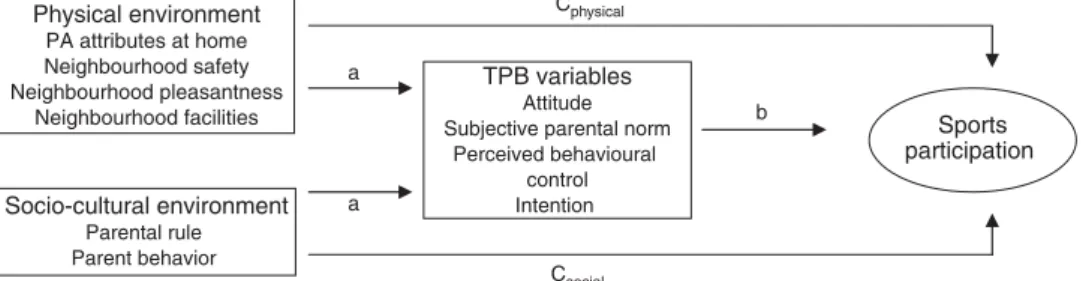
The aim of the present study was to examine the asso-ciations between physical environmental factors (availability of PA attributes at home, PA facilities in the neighbourhood, neighbourhood pleasantness and safety) and social envir-onmental factors (parents’ own sports behaviour and parental rule about sports participation) with adolescents’ leisure-time sports participation and to explore whether these associations are mediated by TPB variables (Fig. 1).
Methods
Study design and sample selection
Baseline data from the ENvironmental Determinants of Obesity in Rotterdam SchoolchildrEn (ENDORSE) study were used(21)for which data were collected among adolescents in the first (12–13-year-olds) and third (14–15-year-olds) years of secondary school. The Medical
Ethics Committee of Erasmus University Medical Center declared no objection to the project. Schools located in the Rotterdam area that participate in the Youth Monitor Rotterdam (n 56) were invited for participation in the ENDORSE study. Subsequently, a random sample of seventeen school locations was drawn from the pool of twenty-four schools that were willing to participate. On average, five classes per school location were randomly selected to participate in the study and 1668 adolescents and their parents were eligible for participation. In the baseline survey, 187 adolescents were absent during the questionnaire assessment. Owing to printing mistakes in the questionnaire, 120 records, including those from one entire school, had to be removed. The response rate for the parent questionnaire was 43 %, resulting in 584 ado-lescent–parent combinations. There were no data available on the parents and adolescents who did not participate in the study and examining response bias was therefore not possible. Compared to the data from the total adolescent sample, in the sample used for the present study adoles-cents with a non-Western ethnic background (36?6 % compared to 50?5 %) and attending vocational schools (49?1 % compared to 56?7 %) were under-represented. Procedure
Parents received a letter announcing and explaining the ENDORSE study and could refuse participation of their child(ren) by sending a note to the adolescent’s teacher. Between October 2005 and May 2006, the students completed the ENDORSE questionnaire in the classroom in the presence of a teacher and a trained research assistant within one school hour (50 min). The adoles-cents were handed a questionnaire with a pre-addressed and stamped envelope for completion by one of their parents. To increase the participation rates, five I-pods were raffled among the parent respondents and two reminders were sent to the parents.
Measures
Leisure-time sports participation
The relevant questions from the Activity Questionnaire for Adolescents and Adults were used to assess leisure-time sports activities(22). The test–retest reliability of this Cphysical a b Csocial Physical environment PA attributes at home Neighbourhood safety Neighbourhood pleasantness Neighbourhood facilities Socio-cultural environment Parental rule Parent behavior TPB variables Attitude Subjective parental norm
Perceived behavioural control Intention Sports participation a
Fig. 1 Conceptual model of the direct and indirect association of physical and socio-cultural environmental factors (PA, physical activity; TPB, theory of planned behaviour)
questionnaire was moderate (intraclass correlations 5 0?30–0?59) and validity with accelerometer data was low (Spearman’s correlation coefficient 5 0?21 for vigorous activities)(22). No validity data were available on sports behaviour. First, the adolescents were asked to write in text boxes in a pre-structured format up to three sports activities that they had engaged in, in the past week. The adolescents were asked to write down the organized and unorganized sports they engaged in. Second, they had to tick on how many days in the past week (1–7 d) they had engaged in this activity. Third, they had to indicate how long, on average, they participated in this activity per occasion, in an open answering format with text boxes to indicate the hours and minutes. The frequency and duration of the activities were multiplied, and then divi-ded by the total number of days to provide the average min/d spent doing leisure-time sports activities. As this variable was highly skewed and the distribution could not be improved through transformation, two categories were created: engaging in leisure-time sports activities for ,30 min/d (coded as 0), or $30 min/d (coded as 1). The cut-off of 30 min was chosen because adolescents are also involved in other activities such as active transport to school and because it was based on the Dutch PA recommendation that children and adolescents should engage in at least moderate activity for 60 min/d(23). Theory of planned behaviour variables
Attitude, subjective parental norm, perceived behaviour control and intention were specifically assessed in relation to participation in leisure-time sports activities. All ques-tions could be answered on a 5-point bipolar answering scale. Attitude was assessed with two items asking whether the adolescent considers sports and PA in leisure time as very good (12) or very bad (22) and as very pleasant (12) or very unpleasant (22). The mean item score (Cronbach’s a 50?79, intraclass correlation 5 0?66) for these items was calculated(35). Subjective norm was assessed with one item: ‘if I engage in sports and PA in leisure time, my parents consider that as very good (12) or very bad (22)’. Perceived behaviour control was assessed with one item asking how easy or difficult it is to engage in sports and PA in leisure time with an answering scale ranging from very easy (12) to very difficult (22). Intention to perform the behaviour was assessed with a single item: ‘Do you intend to engage in sports and PA in leisure time in the next 6 months?’ with an answering scale ranging from Yes, I certainly do (12) to no, I certainly do not (22). Physical environmental variables
We assessed the availability of PA opportunities at home by providing a list of ten sports ‘attributes’ (i.e. bicycle, dog, home trainer/treadmill, running shoes, stationary aerobic equipment, step aerobics, skates, balls, racquets and jumping rope). This list was translated from Sallis et al.(24). The adolescents could tick which of these were available
in their home. A score of PA attributes available at home was calculated by adding up the ‘yes’ responses to these questions. Perceived neighbourhood pleasantness was assessed with two questions: ‘I think my neighbourhood provides a pleasant living environment’, and ‘I think my neighbourhood is attractive’, which could be answered on a 5-point scale ranging from totally agree (12) to totally disagree (22). The mean item score (Cronbach’s a 50?78, intraclass correlation 5 0?64) of these two items was calculated. Perceived neighbourhood safety was assessed with four questions: ‘There is a lot of traffic in my neighbourhood’, ‘It is unsafe to bicycle in my neigh-bourhood’, ‘I feel safe when I am in my neighneigh-bourhood’, and ‘It is unsafe to be outside in my neighbourhood’, using the same 5-point answering scale format as neigh-bourhood attractiveness. The mean item score (Cronbach’s a 50?64) of these four items was calculated. The perceived availability of PA facilities in the neighbourhood was assessed by asking the adolescents to indicate whether or not (yes/no answering format) there were parks, sports clubs, sports/playing grounds present in the neighbourhood where they lived. The yes responses were summed to form one score for these four items.
Social environmental variables
The parental rule about PA was assessed with one ques-tion in the quesques-tionnaire for parents: ‘is it a rule in your household that your child has to participate in sports activities?’ in a yes/no answering format. The parent’s own sports behaviour was assessed in the questionnaire for parents with two questions assessing frequency and duration, using relevant questions from the Short QUestionnaire to ASsess Health-enhancing physical activ-ity (SQUASH) questionnaire(25). Spearman’s correlation for overall reproducibility of the SQUASH was 0?58 (95 % CI 0?36, 0?74), and for correlations for the reproducibility of leisure-time sports it was 0?90. Spearman’s correlation coefficient between activity monitor readings and the total activity score was 0?45 (95 % CI 0?17, 0?66)(25). Frequency was assessed with: ‘How many d/week do you engage in sports activities?’ on a 7-point scale from 1 5 1 d/week to 7 5 every day. The duration was assessed with ‘On a day that you participate in sports activities, how long do you do this on average?’ and hours and minutes could be reported. The frequency and duration of the activities were multiplied, and then divided by the total number of days to provide the average min/d. As this variable was highly skewed, two categories were created: engaging in sports activities (coded as 1) and not engaging in sports activities.
Demographics
To establish ethnicity according to the Statistics Nether-lands definition, the adolescents were asked to report in which country their parents were born(26). Adolescents were considered to be from a Western ethnic background
if both parents had been born in a European country, North America, Oceania, Indonesia or Japan. Based on the socio-economic and cultural position of immigrants in the Netherlands from Oceania, Japan and Indonesia (a former colony of the Netherlands), children from these immigrants were also included in the Western ethnic group. Adoles-cents were considered to be from a non-Western ethnic background if one or both parents had been born in other countries. The school type the adolescents attended was categorized into two levels: vocational schools and higher-level secondary education (pre-academic). The schools provided educational level information. Age was deter-mined based on the date of the measurements and the date of birth that were provided by the schools.
Data analyses
Possible multi-collinearity problems were examined with bivariate correlations and not encountered; all inter-correlations between predictors were below 0?6. Mediation analyses according to the suggestions of MacKinnon(27) were used to identify the total effects, direct effects and mediated effects in the associations of physical environ-mental factors (availability of PA attributes at home, avail-ability of PA facilities in the neighbourhood, perceived neighbourhood pleasantness and safety) and socio-cultural environmental factors (parents’ sports behaviour and par-ental rule about sports participation) with adolescents’ leisure-time sports participation(27). To do so, we explored the associations between the environmental and TPB variables with multivariate linear regression analyses (step 1, path a in Fig. 1). Next, we examined whether the potential mediators from the TPB were associated with leisure-time sports, after adjustment for the environmental variables (step 2, path b in Fig. 1). The total effect of physical environmental and socio-cultural environmental factors on adolescents’ leisure-time sports participation (step 3, path c), and after adjustment for the possible mediator, the direct effect of environmental variables on sports participation (step 4, path c0) were examined in
various models. As suggested by MacKinnon(27)and also
outlined by Cerin and MacKinnon(28), a significant associa-tion between environmental variables (predictor variables) and sports participation (outcome variable) is not a requirement for mediation to occur, since the absence of an overall relationship may be due to suppression effects. Therefore, non-significant environmental factors were also included in the mediation analyses. Steps 2–4 were exam-ined by means of multi-level multivariate logistic regression analyses. All analyses were adjusted for gender, age, ethni-city and school level, as these are possible confounding factors. All analyses were performed with MLwiN version 2.02 (Centre for Multilevel Modelling, University of Bristol, Bristol, UK). A three-level structure was used to take into account that adolescents were nested within classes and classes within schools(29). Owing to the dichotomous out-come variables, there are different scales across the (logistic)
regression analyses that make it incorrect to use the ‘difference-of-coefficients estimate’ as an estimate of the mediation effect(28,30). One solution to overcome this dif-ference in scaling is to standardize the regression coeffi-cients before mediation is estimated(30,31). The standardized coefficients were subsequently used to estimate the pro-portion mediated ((cstandardized2c0standardized)/cstandardized)
and were additionally entered in the Sobel test(32) to formally test the mediation effect.
Results
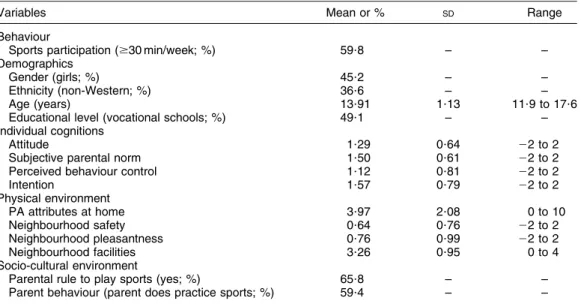
Sixty per cent of the adolescents reported participating in leisure-time sports for at least 30 min/d (Table 1). The adolescents reported positive cognitions regarding leisure-time sports participation. On average, the adolescents reported having four of the listed PA attributes available at home (range: 0–10) and three PA facilities available in their neighbourhood (range: 0–4). They also reported positive perceptions of neighbourhood safety (mean 5 0?64, SD5
0?76) and pleasantness (mean 5 0?76,SD50?99). A
major-ity of parents reported that it was a rule in the household that the adolescent had to participate in some kind of sports (66 %) and 59 % of the parents themselves participated in leisure-time sports activities.
Associations between environmental factors and theory of planned behaviour variables
Multivariate analyses showed that most of the physical and social environmental variables were significantly positively associated with TPB variables (Table 2). No associations were found for neighbourhood facilities with attitude, per-ceived behaviour control and intention. PA attributes at home and neighbourhood safety were not associated with perceived behaviour control. Parents’ sports behaviour was not associated with subjective parental norm.
Associations of theory of planned behaviour variables with adolescents’ leisure-time sports participation
To establish a mediation effect, the potential mediators must be associated with the outcome variable after adjustment for independent environmental variables(28). Multivariate analyses (Table 3) showed that attitude and intention were found to be significantly associated with a higher likelihood of participating in leisure-time sports after adjustment for physical environmental variables (attitude OR 5 2?30; inten-tion OR 5 2?10) and after adjustment for social environ-mental variables (attitude OR 5 2?24; intention OR 5 2?03). Mediating effects of theory of planned
behaviour variables
As neighbourhood facilities were not associated with attitude and intention, this factor was not included in the mediation models (Table 4). The association of PA attributes
at home with a higher likelihood of participating in lei-sure-time sports was partly mediated by attitude (17?4 %) and intention (21?6 %), as indicated by the significant
Sobel test results. The association between neighbour-hood safety and sports participation was significantly mediated by intention; however, both direct and indirect
Table 1 Behavioural, demographic, cognitive and environmental characteristics of the ENDORSE study population (n 584)
Variables Mean or % SD Range
Behaviour
Sports participation ($30 min/week; %) 59?8 – –
Demographics
Gender (girls; %) 45?2 – –
Ethnicity (non-Western; %) 36?6 – –
Age (years) 13?91 1?13 11?9 to 17?6
Educational level (vocational schools; %) 49?1 – –
Individual cognitions
Attitude 1?29 0?64 22 to 2
Subjective parental norm 1?50 0?61 22 to 2
Perceived behaviour control 1?12 0?81 22 to 2
Intention 1?57 0?79 22 to 2 Physical environment PA attributes at home 3?97 2?08 0 to 10 Neighbourhood safety 0?64 0?76 22 to 2 Neighbourhood pleasantness 0?76 0?99 22 to 2 Neighbourhood facilities 3?26 0?95 0 to 4 Socio-cultural environment
Parental rule to play sports (yes; %) 65?8 – –
Parent behaviour (parent does practice sports; %) 59?4 – –
ENDORSE, ENvironmental Determinants of Obesity in Rotterdam SchoolchildrEn; PA, physical activity.
Table 2 Results of multivariate linear regression analyses (unstandardized regression coefficients) of physical and social environmental variables with TPB variables as dependent variables, adjusted for age, gender, ethnicity, school type and clustering within classes and schools
Attitude Subjective parental norm Perceived behaviour control Intention PA attributes at home 0?039** 0?042** 0?026 0?056*** Neighbourhood safety 0?146*** 0?120*** 0?016 0?186*** Neighbourhood pleasantness 0?168*** 0?090*** 0?105** 0?115*** Neighbourhood facilities 0?035 0?059** 0?028 0?049 Parental rule 0?141* 0?121* 0?174* 0?166* Parent behaviour 0?135* 20?001 0?185** 0?180**
TPB, theory of planned behaviour; PA, physical activity. *P , 0?05; **P , 0?01; ***P , 0?001.
Table 3 Results of multivariate logistic regression analysis (OR) examining the association between potential med-iators (TPB variables) and leisure-time sports participation ($30 min), adjusting for the physical (Model 1) and social (Model 2) environmental
factors-Model 1 Model 2
OR 95 % CI OR 95 % CI
Physical environmental factors
PA attributes at home 1?20 1?07, 1?35 – –
Neighbourhood safety 1?22 0?86, 1?73 – –
Neighbourhood pleasantness 0?89 0?68, 1?16 – –
PA facilities in the neighbourhood 1?02 0?83, 1?23 – –
Socio-cultural environmental factors
Parental rule – – 1?37 0?85, 2?20
Parents sports behaviour – – 1?79 1?14, 2?80
TPB variables
Attitude 2?30 1?46, 3?61 2?24 1?48, 3?39
Parental norm 1?21 0?82, 1?80 1?29 0?87, 1?92
Perceived behaviour control 1?00 0?76, 1?33 0?96 0?72, 1?27
Intention 2?10 1?47, 3?02 2?03 1?42, 2?91
TPB, theory of planned behaviour; PA, physical activity.
associations were not significant. The direction of the association between neighbourhood pleasantness and sports participation changed after adjustment for attitude, which suggests an inconsistent mediation model.
The associations of parental rule and parents’ sports behaviour with a higher likelihood of participating in leisure-time sports were also partly mediated by attitude and intention with percentages ranging between 20?1 and 31?7 (Table 5). The associations of PA attributes at home and parent behaviour with leisure-time sports remained statistically significant, while the association of parental rule lost significance in the mediation models.
Discussion
In the present study, associations of socio-cultural and physical environmental factors with adolescents’ leisure-time sports participation were examined and it was explored whether these associations were mediated by individual cognitions such as attitudes and intentions. Results showed that parents’ sports behaviour, parental rule about sports behaviour and availability of PA attri-butes at home were associated with a higher likelihood that adolescents engaged in sports behaviour. We cannot draw conclusions on the findings that resulted from an inconsistent mediation model(33). The inconsistent model is a result of the fact that the direct association between neighbourhood pleasantness and sports participation was weak but positive, while the indirect association was also weak and non-significant, but negative.
Evidence was found for the partial mediation of social and physical environmental factors by attitude and intention. However, a direct significant association also remained of PA attributes at home and parental behaviour with leisure-time sports participation. These findings are in accordance with those of earlier studies in which attitudes were found to be strong mediators of the association between physical environmental factors and PA(15–17,19,20). The results suggest that both direct,
auto-matic influences of the environment and more reasoned cognitive processes are important in adolescents’ sports participation as suggested in the EnRG framework(9). However, as we found rather strong associations of atti-tude and intention with leisure-time sports participation in the present study, adolescents’ leisure-time sports behaviour seems to be, at least partly, also the result of a more reasoned, deliberate process that is not influenced by the environmental factors considered in the present study. This does make sense, since sports activities are less likely to be part of routine habits, more likely needing to be planned in advance and to be dependent on explicit positive motivation than, for example, daily activities. The present results support this hypothesis to a certain extent, as we found significant but small correlations between environmental factors and cognitions. This association of
Table 4 Results of logis tic reg ress ion analys es to examin e the m ediation of the assoc iation betwee n physica l envir onment al factors with leisu re-time spor ts pa rticipatio n ($ 30 min) by attitude (Model 2) and intentio n (Model 3) -M odel 1 Model 2 Sobel test Propor tion medi ated -M odel 3 S o bel test Pro portion m ediated -OR 95 % C I O R 9 5 % CI Z -sco re % O R 9 5 % CI Z -score % Physica l envi ronment al factor s PA attribut es at home 1 ?26 1 ?13, 1 ?42 1 ?24 1 ?10, 1 ?39 2 ?54** 17 ?4 1 ?22 1 ?09, 1 ?37 2 ?86** 21 ?6 Neighb ourhood safety 1 ?28 0 ?93, 1 ?77 1 ?32 0 ?94, 1 ?86 3 ?40*** 2 3 ?4 y 1 ?16 0 ?83, 1 ?63 3 ?37*** 44 ?3 Neighb ourhood pleasan tnes s 1 ?06 0 ?83, 1 ?36 0 ?87 0 ?66, 1 ?13 4 ?40*** 312 ?2 y 1 ?01 0 ?78, 1 ?31 2 ?92** 82 ?2 TPB varia bles Attitude – – 3 ?44 2 ?33, 5 ?08 – – – – – – Intenti on – – – – – – 2 ?71 1 ?93, 3 ?80 – – PA, physical a ctivity; TPB, theory o f p lanned behaviour. -Multivariate logistic regression analyses adjusted for age, gender, e thnicity, school type and clustering w ithin classes a nd schools. -- As calculated with the standardized c oefficients (see Methods section). yNegative results and values . 100 % indicate inconsistent mediation models and the results cannot be interpreted. *P , 0 ?05; ** P , 0 ?01; *** P , 0 ?001.
cognitions, independent of the environmental factors, is not clearly stated in the EnRG framework that focuses on cognitions as mediators of environmental influences. Two of the four cognitions included in the present study, i.e. parental subjective norm and perceived behavioural control, were not found to be associated with sports behaviour. This might indicate that not all cognitions as suggested by the TPB are important mediators or play a role in the suggested reasoned process for this particular behaviour in this population group. On the other hand, the non-significant results might be caused by the limited assessment of these constructs with only one or two items. In accordance with other studies, social factors seem to be more strongly associated with PA behaviour than physical environmental factors(12–14). The direct associa-tions of parents’ sports behaviour and the availability of PA equipment at home support earlier evidence that parental example and support (for instance, through providing good sports equipment at home) are important for PA promotion. The range of social factors considered in the present study was narrow, and factors such as social networks, friends’ support and behaviour and the perceived behaviour of parents should be included in future studies to provide further insight into specific aspects of the social environment that are most important for adolescents’ PA behaviours(18,34). Next to this, future research should address the moderating effects of socio-demographic factors mentioned in the EnRG framework as there are clear gender differences in sports participation and correlates of PA might be different for boys and girls. For example, mothers’ PA appears to be more often asso-ciated with girls’ rather than boys’ physical activity(12).
One possible limitation of the present study was that we used perceptions of the environment instead of more objective measures of the physical environment. Per-ceived environmental factors are, of course, also cognitive representations (i.e. of environmental factors), and dif-ferent mediating pathways may be apparent with more objective assessments of the environment. Evidence points out that perceived and objective environmental factors are different constructs(35)and that perceptions of the environment only partly depend on what is objec-tively available in the environment(36). Studies exploring TPB variables as well as perceived environmental factors as mediators of the associations between objective environmental characteristics and PA behaviour may help to unravel the interplay between individual and envir-onmental factors in influencing energy balance-related behaviours as proposed in the EnRG framework.
The following limitations should be taken into account when interpreting the results of the present study. The cross-sectional design of the study did not allow us to determine causal effects and is an important limitation in research examining mediation pathways. Physically active adolescents might be more aware of PA equipment in their environment and they might select more or less
Table 5 Resu lts of logis tic regress ion analys es to examin e the medi ation of the assoc iation betwee n soc ial envir onment al factors with lei sure-tim e sports particip ation ($ 30 min) by at titude (Model 2) an d inte ntion (M odel 3) -Model 1 Mod el 2 Sobe l test Pro portion mediat ed -Model 3 Sobel test Propo rtion med iated -OR 95 % C I O R 9 5 % CI Z -score % O R 9 5 % CI Z -sco re % Social envi ronment al factor s Pa rental rule 1 ?64 1 ?05, 2 ?56 1 ?51 0 ?95 , 2 ?42 2 ?20* 23 ?11 ?45 0 ?91, 2 ?78 2 ?43 * 3 1 ?7 Pa rent behavio ur 2 ?03 1 ?26, 3 ?25 1 ?85 1 ?19 , 2 ?87 2 ?29* 20 ?1 1 ?80 1 ?16, 2 ?78 2 ?13 * 2 3 ?3 TPB variable s At titude – – 3 ?38 2 ?32 , 4 ?91 – – – – – – In tention –––– – – 2 ?77 2 ?00, 3 ?85 – – TPB, theory of planned behaviour. -Multivariate logistic regression analyses adjusted for age, gender, e thnicity, school type and clustering within classes and schools. -- As calculated with the standardized c oefficients (see Methods section). *P , 0 ?05.
the neighbourhood they are active in by having a specific definition about how large the neighbourhood is. Having positive cognitions towards sports might shape the ado-lescents’ environment. For instance, adolescents might influence their parents by promoting sports activities and asking for more equipment. Next to this, the sample size of the present study was restricted because of the rather low response rate for the parent questionnaire. The fact that adolescents from a non-Western ethnic background and lower educational level were underrepresented in the sample suggests a selection bias. Several limitations relate to the measurement instruments used in the study.
First, adolescents’ sports behaviour was based on self-report and in a validation study with the use of accel-erometers it was shown that the questionnaire had limited validity and that adolescents over-reported their activity levels(22). Second, the TPB variables were assessed with only one or two items leading to limited reliability. The TPB variables, particularly perceived behaviour control, might not have been robust enough to show associations and to show up as a mediator. Environmental constructs were often measured with only one or two items with only moderate reliability. In explorative research, more effort needs to be made to construct better scales that examine all aspects of the perceived environmental factors. More qualitative research is needed to improve the existing measurement instruments and scales. Next to this, only a limited set of perceived environmental variables was used in the present study. Other social environmental influences such as encouragement of parents and friends might espe-cially be important in explaining PA behaviours(12,14,37). Parents’ sports behaviour was also assessed with other questions compared to adolescents’ sports participation, and other cut-off points were used. This could also have affected the associations found. Third, adolescents with overweight or lack of PA might have given socially desirable answers on sports behaviour and on the TPB items as well, which could have influenced the associations between cognitions and behaviour. Nevertheless, this explorative study contributes to the structured examination of the associations between environmental factors and PA and the suggested mediation by TPB variables as supposed by the EnRG framework.
Conclusion
Dutch adolescents were more likely to engage in leisure-time sports when PA attributes were available at home, when parents participated in sports activities and had the rule in their household that the child has to play a sport. These associations were partly mediated by attitude and intention. This indicates that parents are important actors in shaping the environmental factors of interest by making sports activities accessible and a family routine. Therefore, not only adolescents, but also parents should
be targeted in interventions aiming to improve PA among adolescents. However, the cross-sectional design of the present study should be taken into account and the findings have to be verified in longitudinal and experi-mental studies. Efforts need to be made construct better measurement instruments and scales to examine perceived environmental factors.
Acknowledgements
Sources of funding: The present study was supported by grants from ZonMw, the Netherlands Organization for Health Research and Development (Grant no. 2100.0103) and The World Cancer Research Fund – WCRF-NL (Grant no. 2007/47). The present paper has been facilitated by the EU-funded HOPE project: ‘Health-promotion through Obesity Prevention across Europe (the Commission of the European Communities, SP5A-CT-2006-044128). The study does not necessarily reflect the Commission’s views and in no way anticipates the Commission’s future policy in this area’, and was part of CEPHIR: the Center for Effective Public Health in the larger Rotterdam Area. Conflicts of interest declaration: The authors had no conflicts of interest in writing this paper. Authorship responsibilities: K.v.d.H. supervised the data collection, analysed the data and wrote most of the paper. S.J.t.V. contributed to the data analyses and provided feedback on the manuscript. A.O. and J.B. contributed to the study set-up, the design of the paper and provided feedback on the manuscript.
References
1. Boreham C & Riddoch C (2001) The physical activity, fitness and health of children. J Sports Sci 19, 915–929. 2. Wareham NJ, van Sluijs EM & Ekelund U (2005) Physical
activity and obesity prevention: a review of the current evidence. Proc Nutr Soc 64, 229–247.
3. Lampert T, Mensink GB, Romahn N et al. (2007) [Physical activity among children and adolescents in Germany. Results of the German Health Interview and Examination Survey for Children and Adolescents (KiGGS)] Korperlich-sportliche Aktivitat von Kindern und Jugendlichen in Deutschland. Ergebnisse des Kinder- und Jugendgesund-heitssurveys (KiGGS). Bundesgesundheitsblatt Gesund-heitsforschung Gesundheitsschutz 50, 634–642.
4. Scully M, Dixon H, White V et al. (2007) Dietary, physical activity and sedentary behaviour among Australian secondary students in 2005. Health Promot Int 22, 236–245.
5. Tammelin T, Ekelund U, Remes J et al. (2007) Physical activity and sedentary behaviors among Finnish youth. Med Sci Sports Exerc 39, 1067–1074.
6. Centers for Disease Control and Prevention (2006) Youth Risk Behavior Surveillance – United States. MMWR Surveill Summ 55, Suppl. 5, 1–112.
7. Telama R, Yang X, Viikari J et al. (2005) Physical activity from childhood to adulthood: a 21-year tracking study. Am J Prev Med 28, 267–273.
8. Ajzen I (1991) The theory of planned behavior. Organ Behav Hum Dec 50, 179–211.
9. Kremers SP, De Bruijn GJ, Visscher TL et al. (2006) Environmental influences on energy balance-related beha-viors: a dual-process view. Int J Behav Nutr Phys Act 15: 9. 10. Sallis JF & Owen N (2002) Ecological models of health behavior. In Health Behavior and Health Education, 3rd ed., pp. 462–485 [K Glanz, BK Rimer and FM Lewis, editors]. San Fransisco, CA: Jossey-Bass.
11. Stokols D (1992) Establishing and maintaining healthy environments. Toward a social ecology of health promo-tion. Am Psychol 47, 6–22.
12. Ferreira I, van der Horst K, Wendel-Vos W et al. (2007) Environmental correlates of physical activity in youth – A review and update. Obes Rev 8, 129–154.
13. Sallis JF, Prochaska JJ & Taylor WC (2000) A review of correlates of physical activity of children and adolescents. Med Sci Sports Exerc 32, 963–975.
14. Van Der Horst K, Chin a Paw MJ, Twisk JW et al. (2007) A brief review on correlates of physical activity and sedentariness in youth. Med Sci Sports Exerc 3, 1241–1250. 15. Rhodes RE, Brown SG & McIntyre CA (2006) Integrating the perceived neighborhood environment and the theory of planned behavior when predicting walking in a Canadian adult sample. Am J Health Promot 21, 110–118. 16. Rhodes RE, Courneya KS, Blanchard CM et al. (2007) Prediction of leisure-time walking: an integration of social cognitive, perceived environmental, and personality fac-tors. Int J Behav Nutr Phys Act 4: 51.
17. de Bruijn GJ, Kremers SP, Lensvelt-Mulders G et al. (2006) Modeling individual and physical environmental factors with adolescent physical activity. Am J Prev Med 30, 507–512.
18. Motl RW, Dishman RK, Saunders RP et al. (2007) Percep-tions of physical and social environment variables and self-efficacy as correlates of self-reported physical activity among adolescent girls. J Pediatr Psychol 32, 6–12. 19. Van der Horst K, Timperio A, Crawford D et al. (2008)
The school food environment: associations with adolescent soft drink and snack consumption. Am J Prev Med 35, 217–223.
20. van der Horst K, Kremers S, Ferreira I et al. (2007) Perceived parenting style and practices and sugar-swee-tened beverage consumption in adolescents. Health Educ Res 22, 295–304.
21. van der Horst K, Oenema A, van de Looij-Jansen P et al. (2008) The ENDORSE study: research into environmental determinants of obesity related behaviors in Rotterdam schoolchildren. BMC Public Health 8: 142.
22. Slootmaker SM, Schuit AJ, Chinapaw MJ et al. (2009) Disagreement in physical activity assessed by acceler-ometer and self-report in subgroups of age, gender,
education and weight status. Int J Behav Nutr Phys Act 6, 17.
23. Norm Gezond Bewegen (2010) http://www.kiesbeter. nl/gezondleven/bewegen/norm%2Dgezond%2Dbewegen/ (accessed April 2010).
24. Sallis JF, Johnson MF, Calfas KJ et al. (1997) Assessing perceived physical environmental variables that may influence physical activity. Res Q Exerc Sport 68, 345–351. 25. Wendel-Vos GC, Schuit AJ, Saris WH et al. (2003) Reproducibility and relative validity of the short ques-tionnaire to assess health-enhancing physical activity. J Clin Epidemiol 56, 1163–1169.
26. Statistics Netherlands (2010) http://www.cbs.nl/nl-NL/menu/ methoden/begrippen/default.htm (accessed April 2010). 27. MacKinnon DP (2008) Introduction to Statistical Mediation
Analysis. New York: Lawrence Erlbaum Associates, Taylor & Francis Group, LLC.
28. Cerin E & MacKinnon DP (2008) A commentary on current practice in mediating variable analyses in behavioural nutrition and physical activity. Public Health Nutr 9, 1–7. 29. Twisk JWR (2006) Applied Multilevel Analysis: A Practical
Guide. New York: Cambridge University Press.
30. MacKinnon DP, Lockwood CM, Brown CH et al. (2007) The intermediate endpoint effect in logistic and probit regres-sion. Clin Trials 4, 499–513.
31. Jasti S, Dudley WN & Goldwater E (2008) SAS macros for testing statistical mediation in data with binary mediators or outcomes. Nurs Res 57, 118–122.
32. Baron RM & Kenny DA (1986) The moderator-mediator variable distinction in social psychological research: con-ceptual, strategic, and statistical considerations. J Pers Soc Psychol 51, 1173–1182.
33. MacKinnon DP, Krull JL & Lockwood CM (2000) Equiva-lence of the mediation, confounding and suppression effect. Prev Sci 1, 173–181.
34. Brug J, Kremers SP, van Lenthe F et al. (2008) Environ-mental determinants of healthy eating: in need of theory and evidence. Proc Nutr Soc 67, 307–316.
35. McGinn AP, Evenson KR, Herring AH et al. (2007) Exploring associations between physical activity and perceived and objective measures of the built environment. J Urban Health 84, 62–84.
36. Scott MM, Evenson KR, Cohen DA et al. (2007) Comparing perceived and objectively measured access to recreational facilities as predictors of physical activity in adolescent girls. J Urban Health 84, 346–359.
37. Hohepa M, Scragg R, Schofield G et al. (2007) Social support for youth physical activity: Importance of siblings, parents, friends and school support across a segmented school day. Int J Behav Nutr Phys Act 4: 54.