Comparison of European Committee on Antimicrobial Susceptibility
Testing (EUCAST) and CLSI screening parameters
for the detection of extended-spectrum b-lactamase production
in clinical Enterobacteriaceae isolates
Silke Polsfuss†, Guido V. Bloemberg†, Jacqueline Giger, Vera Meyer and Michael Hombach*
Institut fu¨r Medizinische Mikrobiologie, Universita¨t Zu¨rich, 8006 Zu¨rich, Switzerland*Corresponding author. Institut fu¨r Medizinische Mikrobiologie, Universita¨t Zu¨rich, Gloriastr. 30/32, 8006 Zu¨rich, Switzerland. Tel:+41-44-634-27-00; Fax:+41-634-49-06; E-mail: [email protected]
†These authors contributed equally.
Received 22 July 2011; returned 26 August 2011; revised 30 August 2011; accepted 31 August 2011
Objectives: To compare the performance of European Committee on Antimicrobial Susceptibility Testing (EUCAST) and CLSI breakpoints following their revision in 2010, for the detection of extended-spectrum b-lactamase (ESBL) production in Enterobacteriaceae.
Methods: 236 well-characterized clinical isolates (including 118 ESBL producers) were investigated by antibiotic disc testing with cefpodoxime, ceftriaxone, cefepime, cefotaxime EUCAST (5 mg/disc), ceftazidime EUCAST (10 mg/disc), cefotaxime CLSI (30 mg/disc) and ceftazidime CLSI (30 mg/disc) with the Kirby –Bauer method. Additionally, synergy phenomena were recorded between amoxicillin/clavulanic acid discs (20/10 mg/disc) and cefepime (30 mg/disc), EUCAST cefotaxime (5 mg/disc), EUCAST ceftazidime (10 mg/disc), CLSI cefotaxime (30 mg/disc) and CLSI ceftazidime [30 mg/disc; disc approximation method (DAM)].
Results: Overall sensitivity of the cefotaxime EUCAST non-susceptible breakpoint equalled sensitivity of the cefotaxime CLSI ESBL screening breakpoint (99.2%). With the ceftazidime EUCAST non-susceptible breakpoint, 27/118 ESBL-producing isolates were not detected, whereas the ceftazidime CLSI ESBL screening breakpoint missed 41/118 ESBL-producing isolates. For cefpodoxime the resistant EUCAST breakpoint showed higher sen-sitivity for ESBL detection compared with the CLSI ESBL screening breakpoint/disc content (100% versus 98.3%, respectively). Sensitivities of ceftazidime and cefotaxime DAM with CLSI or EUCAST disc contents were compar-able (sensitivities ranging from 84.7% to 89.8%). DAM with cefepime displayed the highest overall sensitivity (96.6%). In AmpC-producing isolates, synergy of amoxicillin/clavulanic acid with cefepime showed sensitivity and specificity for ESBL detection of 100% and 97.4%, respectively.
Conclusions: EUCAST non-susceptible breakpoints for ceftazidime and cefpodoxime detect more ESBL-producing Enterobacteriaceae isolates compared with corresponding CLSI ESBL screening breakpoints. Implementation of the cefepime DAM can facilitate ESBL screening, especially in strains producing an AmpC b-lactamase since the test shows high sensitivity and specificity.
Keywords: breakpoints, cut-offs, Gram-negative
Introduction
The prevalence of extended-spectrum b-lactamase (ESBL) pro-duction in strains of the Enterobacteriaceae family, such as Escherichia coli, Klebsiella spp. and Enterobacter spp., has been increasing continuously during the past decade in Europe and worldwide.1–4 The production on ESBLs can lead to
life-threatening infections with increased morbidity, mortality and healthcare-associated costs.5–8
The Clinical and Laboratory Standards Institute (CLSI) and the European Committee on Antimicrobial Susceptibility Testing (EUCAST) recently changed their recommendations concerning the interpretation and reporting of in vitro drug susceptibility testing (DST) results. These changes apply to penicillins,
#The Author 2011. Published by Oxford University Press on behalf of the British Society for Antimicrobial Chemotherapy. All rights reserved. For Permissions, please e-mail: [email protected]
until 2009 recommended to edit all in vitro susceptible and inter-mediate DST results for penicillins, cephalosporins and monobac-tams to ‘resistant’ (CLSI),9or to change interpretative categories ‘susceptible’ and ‘intermediate’ to ‘intermediate’ and ‘resistant’, respectively (EUCAST).10 In 2010 EUCAST published inhibition-zone diameter susceptibility breakpoints for cephalosporins in Enterobacteriaceae that were significantly higher than CLSI breakpoints up to 2009.11In parallel, CLSI increased zone diam-eter susceptibility breakpoints as well.12Currently, editing of in vitro susceptibility test results for b-lactams in ESBL-producing isolates is no longer recommended.13,14However, for epidemio-logical and infection control purposes, screening for ESBL pro-duction in Enterobacteriaceae is still useful (CLSI)13 or even mandatory (EUCAST).14
In isolates producing an AmpC-type b-lactamase, phenotypic detection of ESBL production is often hampered by the interfer-ence of AmpC with ESBL screening and confirmatory tests leading to false reports to clinicians and, thus, to inadequate therapy.15,16In addition, unnecessary time, effort and cost are generated in the laboratories to further study false-positive ESBL screening tests resulting from the low specificity of ESBL screening methods in AmpC-positive isolates.16 As a tool to counter this problem, cloxacillin-containing Muller –Hinton agar, which inhibits AmpC activity, has been successfully evaluated.17 Furthermore, cefepime may be the most suitable cephalosporin for ESBL detection in AmpC-positive isolates since it is less affected by AmpC than other third-generation cephalosporins, such as ceftazidime, cefotaxime, cefpodoxime and ceftriaxone.15 The rapid advance of molecular methods for the detection of ESBL has raised the question of using these techniques as routine screening methods.18–20 However, implementation in routine clinical diagnostic laboratories is complex and needs personal resources with specialist qualifications. Moreover, the costs of molecular screening methods for multidrug-resistant isolates are still significantly higher than those for phenotypic methods.21
oratories in Europe are currently adopting the EUCAST system, although a direct comparison of the performance of CLSI and EUCAST standards has not yet been reported. EUCAST does not provide specific screening breakpoints for ESBL; therefore, EUCAST inhibition zone diameter clinical breakpoints for third-generation cephalosporins were applied as determinants for ESBL production.
Methods
Clinical isolates
The 236 Enterobacteriaceae clinical isolates used in this study have previously been systematically characterized for the production of ESBL and/or AmpC-type b-lactamases, using phenotypic and molecular methods (for ESBL, S. Polsfuss, G. V. Bloemberg, J. Giger, V. Meyer, E. C. Bottger and M. Hombach, unpublished results).22All isolates had initially
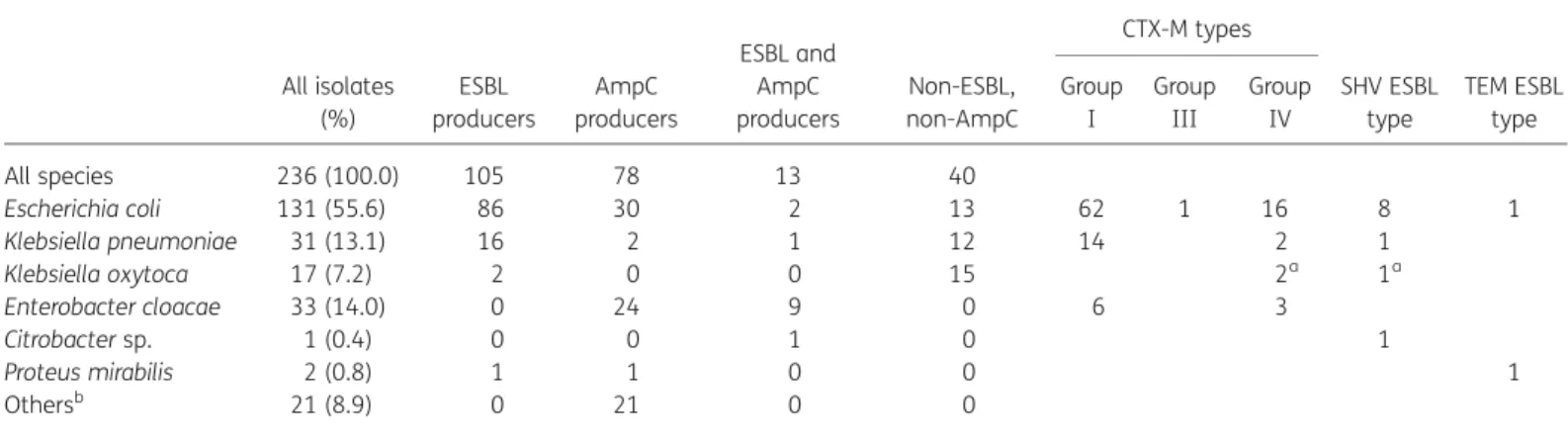
been screened for potential ESBL production on the basis of: (i) positive CLSI screening breakpoint values for ESBL for at least one third-generation cephalosporin (cefpodoxime and/or ceftazidime and/or cef-triaxone and/or cefotaxime); and (ii) observation of a synergy zone between amoxicillin/clavulanic acid and cefpodoxime and/or ceftazidime and/or ceftriaxone and/or cefotaxime. For 118/236 isolates ESBL pro-duction was confirmed by molecular methods, while another 118/236 isolates were ESBL-negative (see Table1).
Susceptibility testing
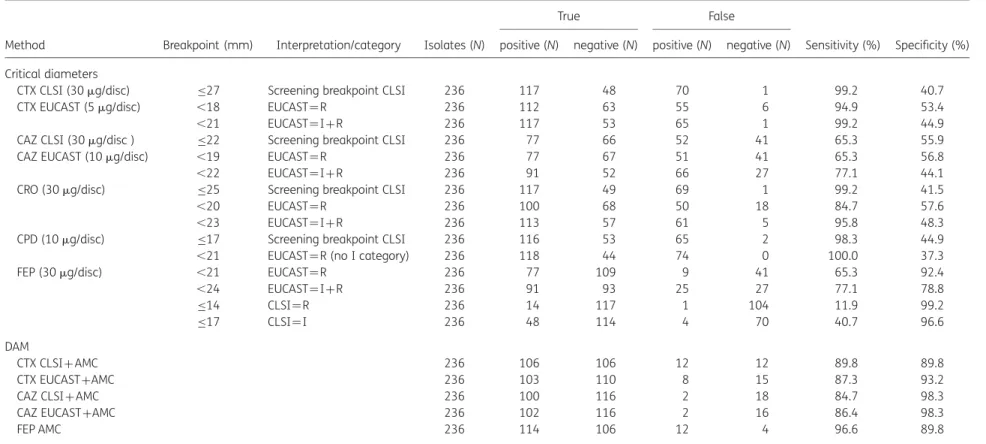
For susceptibility testing the disc diffusion method according to Kirby– Bauer was used. Antibiotic discs (Becton Dickinson, Franklin Lakes, NJ, USA) were selected, and results were interpreted according to the 2011 guidelines of EUCAST and CLSI.13,14 Screening breakpoint values are
shown in Tables2–4.
Susceptibility testing was performed on Mueller–Hinton agar (bioMe´rieux, Marcy L’Etoile, France) using McFarland 0.5 with overnight cultures and incubated at 358C for 16 –18 h.
Table 1. Enterobacteriaceae clinical isolates included in the study
All isolates (%) ESBL producers AmpC producers ESBL and AmpC producers Non-ESBL, non-AmpC CTX-M types SHV ESBL type TEM ESBL type Group I Group III Group IV All species 236 (100.0) 105 78 13 40 Escherichia coli 131 (55.6) 86 30 2 13 62 1 16 8 1 Klebsiella pneumoniae 31 (13.1) 16 2 1 12 14 2 1 Klebsiella oxytoca 17 (7.2) 2 0 0 15 2a 1a Enterobacter cloacae 33 (14.0) 0 24 9 0 6 3 Citrobacter sp. 1 (0.4) 0 0 1 0 1 Proteus mirabilis 2 (0.8) 1 1 0 0 1 Othersb 21 (8.9) 0 21 0 0
Table 2. Performance parameters of critical diameters and DAM for the detection of ESBL production in 236 Enterobacteriaceae clinical isolates
Method Breakpoint (mm) Interpretation/category Isolates (N)
True False
Sensitivity (%) Specificity (%) positive (N) negative (N) positive (N) negative (N)
Critical diameters
CTX CLSI (30 mg/disc) ≤27 Screening breakpoint CLSI 236 117 48 70 1 99.2 40.7
CTX EUCAST (5 mg/disc) ,18 EUCAST¼R 236 112 63 55 6 94.9 53.4
,21 EUCAST¼I+R 236 117 53 65 1 99.2 44.9
CAZ CLSI (30 mg/disc ) ≤22 Screening breakpoint CLSI 236 77 66 52 41 65.3 55.9
CAZ EUCAST (10 mg/disc) ,19 EUCAST¼R 236 77 67 51 41 65.3 56.8
,22 EUCAST¼I+R 236 91 52 66 27 77.1 44.1
CRO (30 mg/disc) ≤25 Screening breakpoint CLSI 236 117 49 69 1 99.2 41.5
,20 EUCAST¼R 236 100 68 50 18 84.7 57.6
,23 EUCAST¼I+R 236 113 57 61 5 95.8 48.3
CPD (10 mg/disc) ≤17 Screening breakpoint CLSI 236 116 53 65 2 98.3 44.9
,21 EUCAST¼R (no I category) 236 118 44 74 0 100.0 37.3
FEP (30 mg/disc) ,21 EUCAST¼R 236 77 109 9 41 65.3 92.4
,24 EUCAST¼I+R 236 91 93 25 27 77.1 78.8 ≤14 CLSI¼R 236 14 117 1 104 11.9 99.2 ≤17 CLSI¼I 236 48 114 4 70 40.7 96.6 DAM CTX CLSI+AMC 236 106 106 12 12 89.8 89.8 CTX EUCAST+AMC 236 103 110 8 15 87.3 93.2
CAZ CLSI+AMC 236 100 116 2 18 84.7 98.3
CAZ EUCAST+AMC 236 102 116 2 16 86.4 98.3
FEP AMC 236 114 106 12 4 96.6 89.8
AMC, amoxicillin/clavulanic acid; CAZ, ceftazidime; CPD, cefpodoxime; CRO, ceftriaxone; CTX, cefotaxime; FEP, cefepime; DAM, disc approximation method; I, intermediate category; R, resistant category.
of
ESB
L
scr
eening
with
EUCAST
and
CLSI
161JA
C
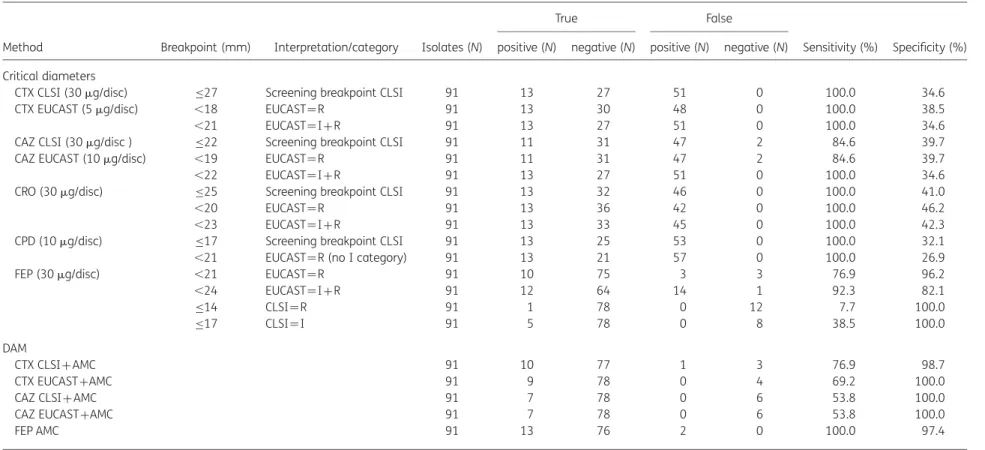
Table 3. Performance parameters of critical diameters and DAM for the detection of ESBL production in 91 AmpC-producing Enterobacteriaceae isolatesa
Method Breakpoint (mm) Interpretation/category Isolates (N)
True False
Sensitivity (%) Specificity (%) positive (N) negative (N) positive (N) negative (N)
Critical diameters
CTX CLSI (30 mg/disc) ≤27 Screening breakpoint CLSI 91 13 27 51 0 100.0 34.6
CTX EUCAST (5 mg/disc) ,18 EUCAST¼R 91 13 30 48 0 100.0 38.5
,21 EUCAST¼I+R 91 13 27 51 0 100.0 34.6
CAZ CLSI (30 mg/disc ) ≤22 Screening breakpoint CLSI 91 11 31 47 2 84.6 39.7
CAZ EUCAST (10 mg/disc) ,19 EUCAST¼R 91 11 31 47 2 84.6 39.7
,22 EUCAST¼I+R 91 13 27 51 0 100.0 34.6
CRO (30 mg/disc) ≤25 Screening breakpoint CLSI 91 13 32 46 0 100.0 41.0
,20 EUCAST¼R 91 13 36 42 0 100.0 46.2
,23 EUCAST¼I+R 91 13 33 45 0 100.0 42.3
CPD (10 mg/disc) ≤17 Screening breakpoint CLSI 91 13 25 53 0 100.0 32.1
,21 EUCAST¼R (no I category) 91 13 21 57 0 100.0 26.9
FEP (30 mg/disc) ,21 EUCAST¼R 91 10 75 3 3 76.9 96.2
,24 EUCAST¼I+R 91 12 64 14 1 92.3 82.1 ≤14 CLSI¼R 91 1 78 0 12 7.7 100.0 ≤17 CLSI¼I 91 5 78 0 8 38.5 100.0 DAM CTX CLSI+AMC 91 10 77 1 3 76.9 98.7 CTX EUCAST+AMC 91 9 78 0 4 69.2 100.0
CAZ CLSI+AMC 91 7 78 0 6 53.8 100.0
CAZ EUCAST+AMC 91 7 78 0 6 53.8 100.0
FEP AMC 91 13 76 2 0 100.0 97.4
AMC, amoxicillin/clavulanic acid; CAZ, ceftazidime; CPD, cefpodoxime; CRO, ceftriaxone; CTX, cefotaxime; FEP, cefepime; DAM, disc approximation method; I, intermediate category; R, resistant category.
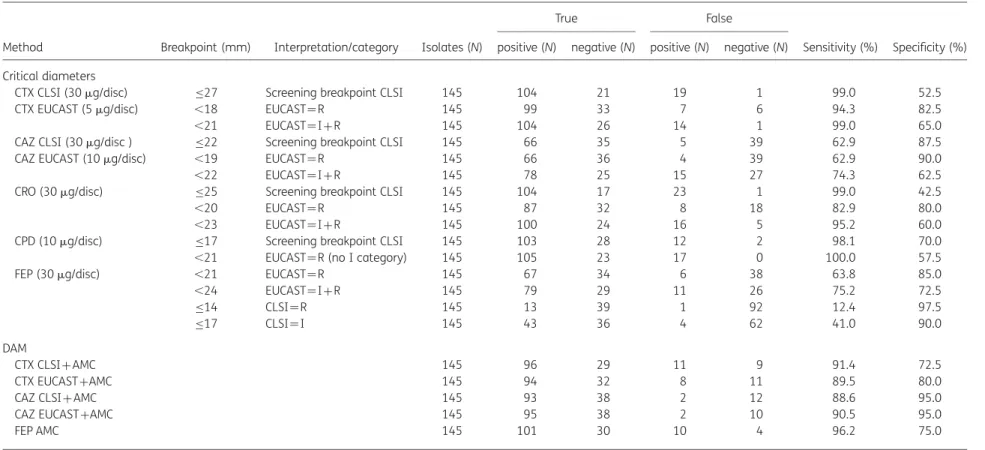
Table 4. Performance parameters of critical diameters and DAM for the detection of ESBL production in 145 Enterobacteriaceae isolates without AmpC productiona
Method Breakpoint (mm) Interpretation/category Isolates (N)
True False
Sensitivity (%) Specificity (%) positive (N) negative (N) positive (N) negative (N)
Critical diameters
CTX CLSI (30 mg/disc) ≤27 Screening breakpoint CLSI 145 104 21 19 1 99.0 52.5
CTX EUCAST (5 mg/disc) ,18 EUCAST¼R 145 99 33 7 6 94.3 82.5
,21 EUCAST¼I+R 145 104 26 14 1 99.0 65.0
CAZ CLSI (30 mg/disc ) ≤22 Screening breakpoint CLSI 145 66 35 5 39 62.9 87.5
CAZ EUCAST (10 mg/disc) ,19 EUCAST¼R 145 66 36 4 39 62.9 90.0
,22 EUCAST¼I+R 145 78 25 15 27 74.3 62.5
CRO (30 mg/disc) ≤25 Screening breakpoint CLSI 145 104 17 23 1 99.0 42.5
,20 EUCAST¼R 145 87 32 8 18 82.9 80.0
,23 EUCAST¼I+R 145 100 24 16 5 95.2 60.0
CPD (10 mg/disc) ≤17 Screening breakpoint CLSI 145 103 28 12 2 98.1 70.0
,21 EUCAST¼R (no I category) 145 105 23 17 0 100.0 57.5
FEP (30 mg/disc) ,21 EUCAST¼R 145 67 34 6 38 63.8 85.0
,24 EUCAST¼I+R 145 79 29 11 26 75.2 72.5 ≤14 CLSI¼R 145 13 39 1 92 12.4 97.5 ≤17 CLSI¼I 145 43 36 4 62 41.0 90.0 DAM CTX CLSI+AMC 145 96 29 11 9 91.4 72.5 CTX EUCAST+AMC 145 94 32 8 11 89.5 80.0
CAZ CLSI+AMC 145 93 38 2 12 88.6 95.0
CAZ EUCAST+AMC 145 95 38 2 10 90.5 95.0
FEP AMC 145 101 30 10 4 96.2 75.0
AMC, amoxicillin/clavulanic acid; CAZ, ceftazidime; CPD, cefpodoxime; CRO, ceftriaxone; CTX, cefotaxime; FEP, cefepime; DAM, disc approximation method; I, intermediate category; R, resistant category.
aDetailed numbers are listed in Table1.
of
ESB
L
scr
eening
with
EUCAST
and
CLSI
163JA
C
EUCAST clinical breakpoints for their ability to detect ESBL-producing clini-cal isolates.13,14EUCAST eliminates the intermediate category for some
antibiotics, such as cefpodoxime. The resulting single breakpoint was used as the ESBL-screening breakpoint. However, for other third-generation cephalosporins, like ceftazidime and cefotaxime, an inter-mediate (or indeterminate) zone is retained, but not specifically men-tioned in the EUCAST breakpoint tables. In such cases EUCAST provides different breakpoints for clinical resistance and susceptibility. For example, with ceftazidime all isolates showing an inhibition zone ≥22 mm are considered clinically susceptible, and all isolates presenting an inhibition zone ,19 mm are considered clinically resistant. Isolates showing an inhibition zone of 19– 21 mm are not specifically categorized in the EUCAST guidelines, and the intermediate zone is only implied. A non-susceptible breakpoint was deduced from the EUCAST susceptible breakpoint, e.g. if EUCAST defines a ceftazidime inhibition zone ≥22 mm as susceptible, a breakpoint of ,22 mm was referred to in this publication as the corresponding non-susceptible breakpoint. Non-susceptible isolates in this definition include, therefore, all intermediate and resistant isolates (see Tables2–4).
Disc approximation method (DAM)
DAM with amoxicillin/clavulanic acid was conducted as described.23 Synergy phenomena were recorded between amoxicillin/clavulanic acid discs (20/10 mg/disc) and/or cefepime (30 mg/disc), and/or EUCAST cefo-taxime (5 mg/disc), and/or EUCAST ceftazidime (10 mg/disc), and/or CLSI cefotaxime (30 mg/disc) and/or CLSI ceftazidime (30 mg/disc) discs. Anti-biotic discs were placed 30 mm apart (centre to centre). b-Lactam inhibitor-mediated enhancement of a third-generation cephalosporin inhibition zone was interpreted as synergy positive. Molecular methods were considered the gold standard for the calculation of performance parameters.
Results
Comparison of CLSI and EUCAST inhibition zone
breakpoints for third-generation cephalosporins
For cefotaxime, overall sensitivity of EUCAST non-susceptible breakpoints for ESBL with corresponding EUCAST loaded discs equalled those of CLSI ESBL screening breakpoints/loads (sensi-tivity 99.2%, see also Table2). If the EUCAST resistant breakpoint was applied, sensitivity decreased from 99.2% (1/118 ESBL-producing isolates not detected) to 94.9% (6/118 ). For ceftazi-dime, sensitivity of the EUCAST non-susceptible breakpoint for ESBL with corresponding EUCAST disc content was higher than that for the CLSI ESBL screening breakpoint/load (77.1% and 65.3% for EUCAST and CLSI, respectively). If the EUCAST resistant breakpoint was applied, sensitivity equalled that of the CLSI breakpoint/disc content. When the EUCAST non-susceptible breakpoint for ceftriaxone was used, sensitivity for ESBL detec-tion compared with the CLSI ESBL screening breakpoint/disc content was lower (95.8% versus 99.2%, respectively). For cefpo-doxime the non-susceptible EUCAST breakpoint showed higher sensitivity for ESBL detection compared with the CLSI ESBL
In AmpC-producing isolates (n ¼145) the EUCAST non-susceptible breakpoint for cefpodoxime was the most sensitive single marker for ESBL production (sensitivity 100%, see Table 4). In comparison, the corresponding CLSI breakpoint showed a sensitivity of 98.1% (2 out of 105 ESBL-producing iso-lates not detected). Sensitivities of EUCAST and CLSI breakpoints for cefotaxime were equal (99.0%, 1 out of 105 ESBL positive iso-lates not detected). For third-generation cephalosporins, only the EUCAST non-susceptible breakpoint for ceftriaxone showed lower sensitivity in non-AmpC-producing isolates than the CLSI ESBL screening breakpoint (sensitivities of 95.2% versus 99.0%, respectively).
Comparison of DAM with CLSI and EUCAST disc contents
Sensitivities of DAM with amoxicillin/clavulanic acid (clavulanic acid serving as the ESBL inhibitor) and ceftazidime or cefotaxime discs with CLSI or EUCAST disc contents, respectively, were similar (ranging from 84.7% to 89.8%, see Table2). Considering all isolates independent of the production of an AmpC-type b-lactamase, DAM with amoxicillin/clavulanic acid and cefepime displayed the highest sensitivity (96.6%). The other combinations had sensitivities less than 90%.In AmpC-producing isolates, synergy of amoxicillin/ clavulanic-acid with cefepime showed a sensitivity and specificity of 100% and 97.9%, respectively. The other DAMs in AmpC-producing isolates showed low sensitivity (Table3).
Discussion
In 2010 EUCAST and CLSI changed their guidelines concerning ESBL detection and interpretation.11,12 Reporting of penicillins and cephalosporins as resistant, independent of in vitro results, is no longer recommended. However, detection of ESBL is still considered useful (CLSI, 2011)13 or even mandatory (EUCAST, 2011)14 for epidemiological purposes. Additionally, it remains controversial as to whether the presence of ESBL-producing bac-terial strains alone is an independent risk factor that may influ-ence the selection of an adequate therapy.24–28CLSI inhibition zone screening breakpoints for ESBL have been evaluated in several studies, as it has for DAM.26,29The current adoption of the new EUCAST guidelines in Europe raises the question of how sensitive and specific EUCAST clinical breakpoints are for third-generation cephalosporins, in comparison with CLSI values, for the detection of ESBL.
Overall, this study shows that EUCAST non-susceptible break-points for cefotaxime and ceftazidime with corresponding EUCAST disc contents may be used without loss of performance compared with CLSI ESBL screening breakpoints. Using the EUCAST non-susceptible breakpoints for ceftriaxone will slightly decrease sensitivity compared with the CLSI ESBL screening breakpoint. However, using the EUCAST non-susceptible
break-Furthermore, EUCAST recommends lower antibiotic disc con-tents for ceftazidime and cefotaxime compared with CLSI. Evalu-ation of the influence of the new disc contents on the performance of the commonly applied DAM for ESBL detection and confirmation was another aim of this study. The sensitivities of DAM with ceftazidime and cefotaxime were found to be inde-pendent of disc contents of CLSI and EUCAST, respectively; however, these are dispensable for routine use, since other markers showed a higher sensitivity. Cefepime DAM and the EUCAST resistant breakpoint for cefpodoxime proved to be the most sensitive markers for screening of potential ESBL producers. Notably, cefepime synergy showed a sensitivity of 100% in iso-lates producing chromosomally encoded or plasmid-encoded AmpC b-lactamases. Our results are in agreement with other studies that found cefepime to be the most suitable substance for screening and confirmation of ESBL-producing isolates that also produce AmpC.30,31Thus, for AmpC-positive isolates such as Enterobacter spp., but also for isolates with plasmid-encoded AmpC, cefepime DAM may be used as a sole screening marker for ESBL. Taking into account the high specificity (97.9%) of the cefepime DAM, positive isolates may even be reported as ESBL-positive without further confirmation.
In conclusion, changing from CLSI to EUCAST breakpoints for ESBL detection will retain or even enhance sensitivity for ESBL detection. The fear that large proportions of ESBL-producing organisms will be reported susceptible to third- and fourth-generation cephalosporins could not be substantiated.
Acknowledgements
We thank Prof. E. C. Bo¨ttger for continuous support and Prof. R. Zbinden for critical discussions.
Funding
This work was supported by the University of Zurich.
Transparency declarations
None to declare.
References
1 Vidal-Navarro L, Pfeiffer C, Bouziges N et al. Faecal carriage of multidrug-resistant Gram-negative bacilli during a non-outbreak situation in a French university hospital. J Antimicrob Chemother 2010; 65: 2455– 8.
2 Coque TM, Baquero F, Canton R. Increasing prevalence of ESBL-producing Enterobacteriaceae in Europe. Euro Surveill 2008; 13: pii¼19044.
3 Potron A, Poirel L, Bernabeu S et al. Nosocomial spread of ESBL-positive Enterobacter cloacae co-expressing plasmid-mediated quinolone resistance Qnr determinants in one hospital in France. J Antimicrob Chemother 2009; 64: 653– 4.
4 Rodriguez-Villalobos H, Bogaerts P, Berhin C et al. Trends in production of extended-spectrum {beta}-lactamases among Enterobacteriaceae of clinical interest: results of a nationwide survey in Belgian hospitals. J Antimicrob Chemother 2011; 66: 37–47.
5 Pitout JD. Infections with extended-spectrum beta-lactamase-producing Enterobacteriaceae: changing epidemiology and drug treatment choices. Drugs 2010; 70: 313– 33.
6 Tumbarello M, Sanguinetti M, Montuori E et al. Predictors of mortality in patients with bloodstream infections caused by extended-spectrum-beta-lactamase-producing Enterobacteriaceae: importance of inadequate initial antimicrobial treatment. Antimicrob Agents Chemother 2007; 51: 1987–94.
7 Schwaber MJ, Navon-Venezia S, Kaye KS et al. Clinical and economic impact of bacteremia with extended-spectrum-beta-lactamase-producing Enterobacteriaceae. Antimicrob Agents Chemother 2006; 50: 1257– 62.
8 Talbot GH, Bradley J, Edwards JE Jr et al. Bad bugs need drugs: an update on the development pipeline from the Antimicrobial Availability Task Force of the Infectious Diseases Society of America. Clin Infect Dis 2006; 42: 657–68.
9 Clinical and Laboratory Standards Institute. Performance Standards for Antimicrobial Susceptibility Testing: Nineteenth Informational Supplement M100-S19. CLSI, Wayne, PA, USA, 2009.
10 European Committee on Antimicrobial Susceptibility Testing. Expert Rules in antimicrobial susceptibility testing. Version 1. EUCAST, 2008. http://www.eucast.org/expert_rules/ (14 September 2011, date last accessed).
11 European Committee on Antimicrobial Susceptibility Testing. Breakpoint tables for interpretation of MICs and zone diameters. Version 1.1. EUCAST, 2010. http://www.eucast.org/clinical_breakpoints/ (1 December 2010, date last accessed).
12 Clinical and Laboratory Standards Institute. Performance Standards for Antimicrobial Susceptibility Testing: Twentieth Informational Supplement M100-S20. CLSI, Wayne, PA, USA, 2010.
13 Clinical and Laboratory Standards Institute. Performance Standards for Antimicrobial Susceptibility Testing: Twenty-first Informational Supplement M 100-S21. CLSI, Wayne, PA, USA, 2011.
14 European Committee on Antimicrobial Susceptibility Testing. Breakpoint tables for interpretation of MICs and zone diameters. Version 1.3. EUCAST, 2011. http://www.eucast.org/clinical_breakpoints/ (14 September 2011, date last accessed).
15 Derbyshire H, Kay G, Evans K et al. A simple disc diffusion method for detecting AmpC and extended-spectrum b-lactamases in clinical isolates of Enterobacteriaceae. J Antimicrob Chemother 2009; 63: 497– 501. 16 Munier GK, Johnson CL, Snyder JW et al. Positive extended-spectrum-lactamase (ESBL) screening results may be due to AmpC beta-lactamases more often than to ESBLs. J Clin Microbiol 2010; 48: 673– 4. 17 Naiemi NA, Murk JL, Savelkoul PH et al. Extended-spectrum beta-lactamases screening agar with AmpC inhibition. Eur J Clin Microbiol Infect Dis 2009; 28: 989–90.
18 Leinberger DM, Grimm V, Rubtsova M et al. Integrated detection of extended-spectrum-beta-lactam resistance by DNA microarray-based genotyping of TEM, SHV, and CTX-M genes. J Clin Microbiol 2010; 48: 460–71.
19 Naas T, Cuzon G, Truong H et al. Evaluation of a DNA microarray, the check-points ESBL/KPC array, for rapid detection of TEM, SHV, and CTX-M extended-spectrum b-lactamases and KPC carbapenemases. Antimicrob Agents Chemother 2010; 54: 3086–92.
20 Hanson ND. Molecular diagnostics could help in coping with hidden b-lactamases. Microbe 2010; 5: 333–9.
21 Wassenberg MW, Kluytmans JA, Bosboom RW et al. Rapid diagnostic testing of methicillin-resistant Staphylococcus aureus carriage at different anatomical sites: costs and benefits of less extensive screening regimens. Clin Microbiol Infect 2011; doi:10.1111/j.1469-0691.2011.03502.x.
165
JAC
beta-lactamases among Enterobacteriaceae by use of semiautomated microbiology systems and manual detection procedures. J Clin Microbiol 2007; 45: 1167– 74.
24 Oteo J, Pe´rez-Va´zquez M, Campos J. Extended-spectrum b-lactamase producing Escherichia coli: changing epidemiology and clinical impact. Curr Opin Infect Dis 2010; 23: 320– 6.
25 Pitout JD, Laupland KB. Extended-spectrum b-lactamase-producing Enterobacteriaceae: an emerging public-health concern. Lancet Infect Dis 2008; 8: 159–66.
26 Pfaller MA, Segreti J. Overview of the epidemiological profile and laboratory detection of extended-spectrum b-lactamases. Clin Infect Dis 2006; 42 Suppl 4: S153–63.
b-lactam antibiotics against CTX-M-producing Escherichia coli. Eur J Clin Microbiol Infect Dis 2011; 30: 981–7.
29 Drieux L, Brossier F, Sougakoff W et al. Phenotypic detection of extended-spectrum b-lactamase production in Enterobacteriaceae: review and bench guide. Clin Microbiol Infect 2008; 14 Suppl 1: 90–103. 30 Apfalter P, Assadian O, Daxbo¨ck F et al. Extended double disc synergy testing reveals a low prevalence of extended-spectrum b-lactamases in Enterobacter spp. in Vienna, Austria. J Antimicrob Chemother 2007; 59: 854–9.
31 Cohen Stuart J, Diederen B, Al Naiemi N et al. Method for phenotypic detection of extended-spectrum b-lactamases in Enterobacter species in the routine clinical setting. J Clin Microbiol 2011; 49: 2711– 3.