PEOPLE’S DEMOCRATIC REPUBLIC OF ALGERIA MINISTRY OF HIGER EDUCATION AND SCIENTIFIC RESEARCH AbdElhafid Boussouf University Centre- Mila
Institute of Literature and Languages
Branch
: English Language
Department of Foreign Languages
A Dissertation Submitted in Partial Fulfillment for the Requirement of the Master Degree in
Didactics of Foreign Languages
Presented bySupervisor
Presented BySupervisor
1)Amel OUARET Dr. Rima HADEF 2) Sana LATRECHE
Board of Examiners
Chairman: Mrs. Sabah BOUGARN Supervisor: Dr. Rima HADEF
Examiner: Mrs. Rima MADJDOUB
Academic Year 2017/2018
The Effect of Listening and Imitation on Learners’ Consonants
Pronunciation
I Dedication
I owe million thanks and a tremendous gratitude to many people who made this Master
dissertation possible. I would like to thank my family, my fiancé and my partner for giving
me unconditional support and encouragement during the course of this research. They are
the special people in my life, to whom I am eternally grateful beyond measure.
II
In the Name of Allah, the Most Gracious, the Most Merciful. All the Praise is due to Allah
alone, the Sustainer of all the Worlds
I dedicate this work to : My dear and precious parents Said &Ghania.
My lovely sisters Selma & Sawsan and my little brother Saif Eddine
I dedicate this work, also to, my partner “Amel”; without her this work would not be done.
To my dear friends with whom I shared the university life with its lights and shadows:
Houda and Ilham.
To the soul of my grandmother “ Massouda” thanks for being a reason in my success.
To all my relatives who prayed for me and were with me in the ups and downs.
To all those who were there for me, I dedicate this humble work to you.
III
Acknowledgments
All the praise goes to Allah for his generous blessings, without which we would not havecompleted this work.
First of all, we would like to express our sincere thanksto our supervisor Dr.Rima HADEF for her encouragement and valuable guidance.
We are also extremely thankfulfor the examination board: Mrs. Rima MADJDOUB and Mrs. Sabah BOUGARN who accepted to read and evaluate this piece of work.
We should not forget to thank the teachers who welcomed us in their classes and gave us the needed time to accomplish our experiment as well as the teachers who answer our questionnaire.
Special thanks go also to first year students of group (5) for their collaboration in the experiment.
Last and not least, we must acknowledge the debt we owe to our families and friendsand all who have stood incredibly supportive and very encouraging.
IV Abstract
The current research confers the problem of poor consonants pronunciation in English as foreign language first year students speaking at AbdElhafidBoussouf University center, Mila. It aims chiefly at investigating the effect of listening to and imitating native speakers on learners‟ consonants pronunciation. To meet this aim, a mixed-method procedure has been
adopted. This latter is a combination of a descriptive qualitative questionnaire and an empirical quantitative experiment. The questionnaire has been administrated to teachers in charge of first year Oral Expression atthe same university. It seeks to look over and analyze their points of view about the usefulness of providing EFL students with native models to listen to and imitate when teaching pronunciation. The empirical study has been carried out with first year EFL students in the department of English. It aims at examining the effectiveness of listening and imitating activities on their pronunciation of certain consonants.The results obtained from both tools confirm the main hypothesis “If learners listen to and imitate native speakers, their consonants‟ pronunciation would be improved”.
V صخهي وذػ تهكشي ثحبنا ازه لواذخَ تَزُهجَلإا تغهنا بلاط فشط ٍي تُكاسنا فوشحنا قطَ ٌاقحإ ًنولأا تُسنا يىخسي , زنا ,سَاسُن مكشب ثحبنا ازه فذهَ ثُح . تهًُب فىصناىب ظُفحنا ذبػ ٍؼياجنا زكشًنا ٍف ىهخساسد ٌىنوازَ ٍَ هصلأا تَزُهجَلإا تغهنا ٍثذحخي ًنإ بلاطنا عاًخسا شُثأح تساسد ًنإ ٍسُئس و ٍُُ ,ىهحاكاحي ا قطَ ًهػ .تُكاسنا فوشحن ,فذهنا ازه قُقحخن )ٌاُبخسا( ٍفصىنا ٍػىُنا جهًُنا ٍُب غًجَ ٌزنا طهخخًنا جهًُناب فشؼَ اي لاًؼخسا ىح يىخسي تبهطن ةساهًنا ِزه سَسذخب ٍُفهكًنا ٌىفشنا شُبؼخنا ةزحاسلأ ٌاُبخسلاا وذق ثُح .)تبشجح( ًٍكنا ٍبَشجخناو ٍف ًنولأا تُسنا تغهنا بلاط ذَوزح تًُهأ لىح ىهءاسآ مُهحح و شظُنا مجا ٍي كنرو ,اهشكر قبس ٍخنا تؼياجنا سفَ ذقف تُبَشجخنا تساسذنا صخَ اًُف ايأ .قطُنا سَسذح ذُػ اهحاكاحيو اهن عاًخسلاا ضشغن تُهصأ جراًُب تَزُهجَلاا لاا تطشَأ لاًؼخسا شُثأح تساسذن تَزُهجَلإا تغهنا تبهط غي جَشجأ ذقو .تُكاسنا فوشحنا قطَ ًهػ ةاكاحًنا و عاًخس فوشحهن بلاطنا قطَ ٍسحخُس" :تُناخنا تُسُئشنا تُضشفنا تحص ثحبنا ٍخهُسو لاك ٍي اهُهػ مصحخًنا جئاخُنا ثذكأ "ىهحاكاحي و ٍُهصلأا تغهنا ٍثذحخي ًنإ عاًخسلااب اىياق ارإ تُكاسنا
VI
List of Abbreviations CD : Compact Disk
CLT : Communicative Language Teaching EFL : English as Foreign Language
ELL: English Language Learning ELT : English language teaching ESL : English as Second Language FL : Foreign Language
GB : Greet Britain
IPA: International Phonetic Alphabet L1: First Language
MP3: Moving Picture Experts Group Layer-3 Audio MT : Mother tongue
RP: Received Pronunciation TL : Target Language US: United States
USA: United States of America i.e. : That is to say
etc : Et Cetera (%): Percentage
VII List of Tables
Table 1.1: Consonants Classification………10
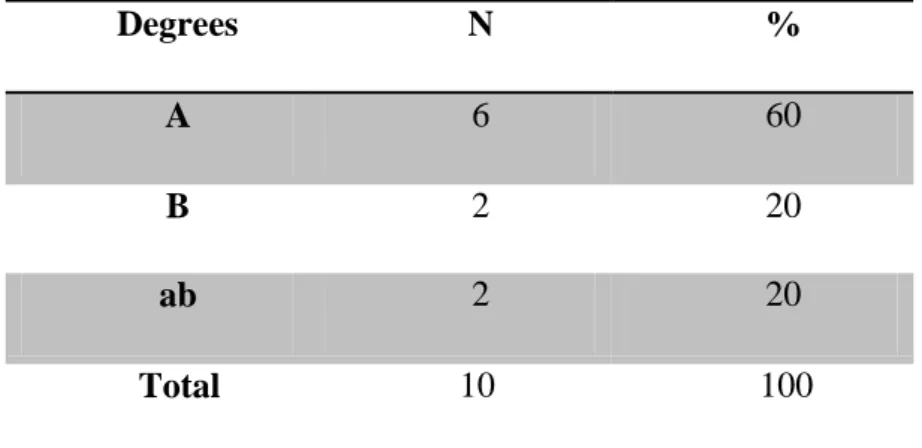
Table 3.1: Teachers‟ Degrees………42
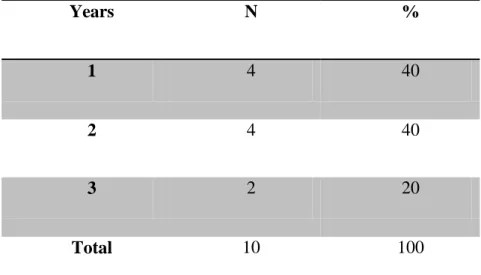
Table 3.2: Teachers‟ Experience in Teaching English………..………43
Table 3.3: Teachers‟ Experience in Teaching Oral Expression Module to 1st Year Students………...………44
Table 3.4: Language Aspects Focused More on When Teaching Speaking……….45
Table 3.5: Teachers‟ Method in Teaching Pronunciation………...47
Table 3.6: Pronunciation Aspects Focused More on When Teaching Pronunciation……...…48
Table 3.7: Language‟ Aspects Learners Shows Difficulties in……….………49
Table 3.8: Pronunciation Features the Learners Show Difficult………..….50
Table 3.9: The Used Activities in Teaching Pronunciation……….52
Table 3.10: Factors that Influence Learners‟ Pronunciation………...54
Table 3.11: The Teachers‟ Use of Listening Activities………55
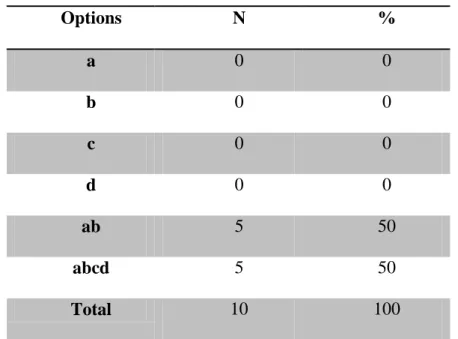
Table 3.12: Teachers‟ Opinions about Listening to and Imitating Native Speakers to Improve Learners‟ Pronunciation………..56
Table 3.13: Teachers‟ Perceptions in Encouraging Students‟ Involvement in Authentic Audio Materials………..………58
VIII
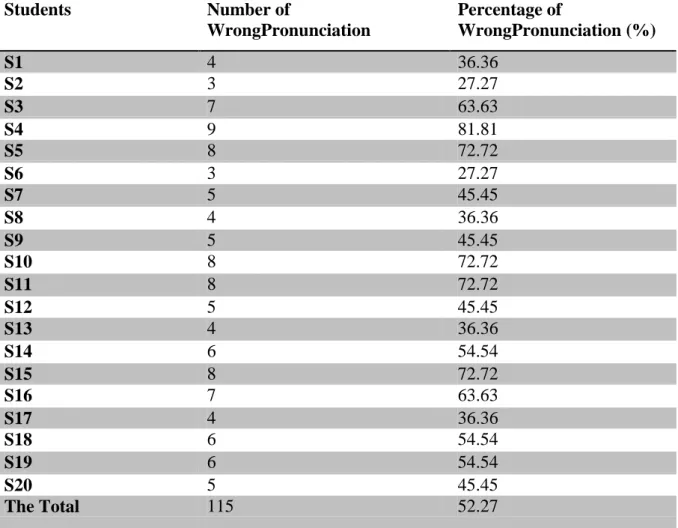
Table 4.1: Numbers and Percentages of Students‟ Wrong Pronunciation
of the Consonant /tʃ/ in the Pre-test……….66
Table 4.2: Numbers and Percentages of Students‟ Wrong Pronunciation
of the Consonant / ŋ / in the Pre-test………67
Table 4.3: Numbers and Percentages of Students‟ Wrong Pronunciation
of the Consonant /ʃ/ in the Pre-test………68
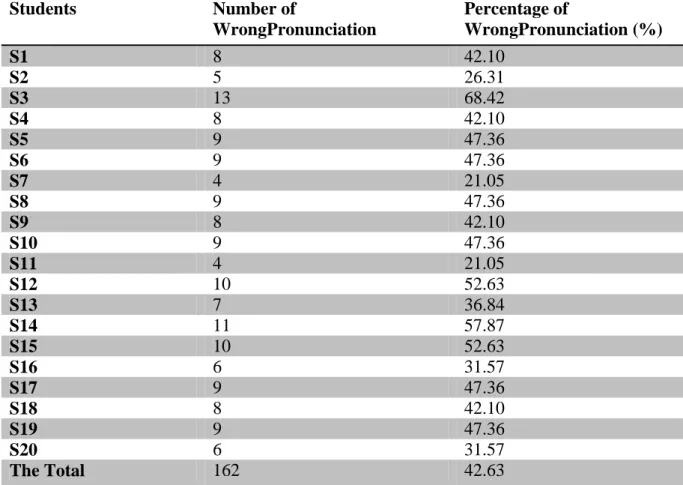
Table 4.4: Numbers and Percentages of Students‟ Wrong Pronunciation
of the Consonant /θ/ in the Pre-test………..………..69
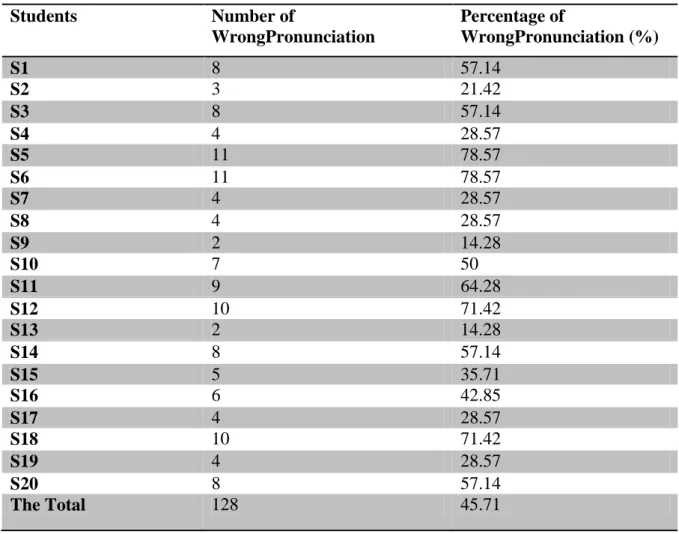
Table 4.5: Numbers and Percentages of Students‟ Wrong Pronunciation
of the Consonant /tʃ/ in the Post-test………...………71
Table 4.6: Numbers and Percentages of Students‟ Wrong Pronunciation
of the Consonant /ŋ/ in the Post-test………...………...72
Table 4.7: Numbers and Percentages of Students‟ Wrong Pronunciation
of the Consonant /ʃ/ in the Post-test………73
Table 4.8: Numbers and Percentages of Students‟ Wrong Pronunciation
of the Consonant /θ/ in the Post-test………..……….74
Table 4.9: Numbers and Percentages of Students‟ Wrong Pronunciation
IX
Table 4.10: Numbers and Percentages of Students‟ Wrong Pronunciation
of the Consonant /ŋ/ in the Pre-test and the post-test……….…..77
Table 4.11: Numbers and Percentages of Students‟ Wrong Pronunciation
of the Consonant /ʃ/ in the Pre-test and the post-test………...78
Table 4.12: Numbers and Percentages of Students‟ Wrong Pronunciation
X
List of Graphs
Graph 3.1: Teachers‟ Degrees……...………42
Graph 3.2: Teachers‟ Experience in Teaching English……….43
Graph 3.3: Teachers‟ Experience in Teaching Oral Expression Module to 1st Year Students...44
Graph 3.4: Language Aspects Focused More on When Teaching Speaking………46
Graph 3.5: Teachers‟ Method in Teaching Pronunciation………47
Graph 3.6: Pronunciation Aspects Focused More on When Teaching Pronunciation………..48
Graph 3.7: Language‟ Aspects Learners Shows Difficulties in………49
Graph 3.8: Pronunciation Features the Learners Show Difficulties in……….51
Graph 3.9: The Used Activities in Teaching Pronunciation………52
Graph 3.10: Factors that Influence Learners‟ Pronunciation……….54
Graph 3.11: The Teachers‟ Use of Listening Activities……….56
Graph 2.12: Teachers‟ Opinions about Listening to and Imitating Native Speakers to Improve Learners‟ Pronunciation……….………57
Graph 3.13: Teachers‟ Perceptions in Encouraging Students‟ Involvement in Authentic Audio Materials………..58
XI TABLE OF CONTENTS Dedication………I Acknowledgement ………...………...….……... III Abstract ………...…….. IV Abstract (Arabic) ………...….:……….. XI List of Abbreviations …………...………...………..………..……....…XI
List of Tables ………..………...………..………...XI List of Graphs………..………...XI Table of Contents ………..…………..………..….……...….. XI
General Introduction
1. Statement of the Problem………2
2. The Aims of the Study ………...………2
3. Research Questions and Hypothesis……...………3
5. Means of Research………..………3
6. Structure of the Study……….3
Chapter One: Pronunciation Introduction 1.1 Definition of Pronunciation……….…………6
1.2 The Sound System of English……….………….6
XII 1.2.1.1 Vowels……….7 1.2.1.2 Consonants………...7 1.2.1.2.1 Place of Articulation………...…8 1.2.1.2.2 Manner of Articulation………..…….8 1.2.1.2.3 Voicing………..…10 1.2.2 Supra-Segmental Features………..…11 1.2.2.1 Stress……….……….11 1.2.2.2 Intonation……….…..11
1.3 Teaching and Learning Pronunciation……….………..12
1.3.1 History of Teaching Pronunciation…..……….….12
1.3.1.1 The Direct Method……….………13
1.3.1.2 The Reform Movement……….….13
1.3.1.3 Audio-lingualism………...………14
1.3.1.4 The Communication Language Teaching (CLT)………..14
1.3.2 Activities of Teaching Pronunciation…….………...…………...………15
1.3.3 Teachers‟ Roles…..……….………..…16
1.3.4 Learners‟ Roles………..…..……….17
1.3.5 Importance of Pronunciation for EFL Learners………..……..…17
XIII
1.3.6.1 The Mother Tongue………...………..18
1.3.6.2 The Amount of Exposure……….………..……….…….19
1.3.6.3 The Learners‟ Motivation………...……….19
1.3.6.4 The Used Activities………..20
Conclusion Chapter Two: Listening and Imitation Introduction 2.1 Definition of the Listening Skill………...….24
2.2 The Status of Listening in Language Teaching/Learning………..25
2.3 Types of Listening………...…………..26
2.3.1 Intensive Listening………26
2.3.2 Extensive Listening………27
2.4 Models of the Listening Process………27
2.4.1 The Bottom-Up Processing Model…………..………...…27
2. 4.2 The Top-Down Processing Model……….………...…….28
2.5 Listening Strategies………...………28
2.5.1 Cognitive Strategies….………...………..………..…29
2.5.2 Meta-Cognitive Strategies………..………...29
XIV
2.6 Listening Activities………...………31
2.6.1 At Word Level………...………….31
2.6.2 At Sentence Level………...……31
2.7 Stages of Listening Activities………32
2.7.1 Pre-listening Stage………...………..33 2.7.2 While-listening Stage………...……..33 2.7.3 Post-listening Stage………...………34 2.8 Listening Assessment………...34 2.9 Imitation………...……….36 2.9.1 Definition of Imitation……..……….………...36
2.9.2 Multiple Dimensions of Imitation……….………....36
2.10 The Importance of Listening and Imitation in Developing Pronunciation…………..37
Conclusion Chapter Three: Teachers’ Questionnaire Introduction 3.1. Description of the Questionnaire…………...………...…………40
3.2. Analysis of the Questionnaire………...41
3.4. Discussion of the Results……..………...………….59 Conclusion
XV
Chapter Four: The Experimental Design
Introduction
4.1 Data Collection………...……...………...……62
4.1.1 Population and Sample…………..……….……..….……62
4 1.2 The Pre-test………...………63
4.1.3 Remedial Sessions……….………63
4.1.3 The Post-test……….………...…..65
4.2 Data Analysis and Discussion……….…...……66
4.2.1 Pre-test Analysis………...…….66
4.2.2 Post-test Analysis………...………71
4.2.3 Comparison of the Pre-test and the Post-test Results………...….75
4.2.4 Discussion of the Results………...………81
Conclusion Pedagogical Implications………83
Limitations of the Study………...………..83
General Conclusion………84
References...86
1
General introduction
1. Statement of the Problem...2
2. The Aim of the Study……….….2
3. Research Questions and Hypothesis………...2
4. Means of Reseach………...3
2
General Introduction
1. Statement of the Problem
Pronunciation is an essential mean for successful communication. To develop it, foreign language learners should focus on many features like consonants, vowels, intonation and stress. Among these parts the pronunciation of consonants is one of the most problematic ones for FL learners. Avery and Ehrlich (1992) agree that the main factor that cause difficulties in the pronunciation of foreign language is the mother tongue. Therefore, FL learners‟
consonants mispronunciation is mainly due to the influence of their native language. Learning and improving consonants pronunciation require oral practice and long time. Although two modules (phonetics and oral expression) are designed to improve pronunciation, learners still face some challenges when learning it. It is a well established fact that teachers of phonetics focus more on theory and ignore the oral practice and teachers of oral expression concentrate their attention on the other aspects of speaking and listening comprehension and teach pronunciation implicitly.
Pronunciation cannot be boosted without providing a reliable source of the target language. Hence, foreign language learners need to be exposed to native input as well as to a variety of repetition-based activities.
2. The Aim of the Study
The main aim of this study is to improve EFL learners‟ consonants pronunciation. We attempt to examine the potential effect of listening to and imitating native speakers on first year EFL learners‟ pronunciation of /ʧ/, /ʃ/, /η/ and /Ɵ/ consonants.
3. Research Questions and Hypothesis
3
1. Do learners face problems in the pronunciation of consonants?
2. Do listening to and imitating native speakers affect learners‟ consonants pronunciation?
In the light of the above raised questions, we hypothesize that:
If learners listened to and imitated native speakers, their consonants‟ pronunciation of
/ʧ/, /ʃ/, /η/ and /Ɵ/ would be improved.
4. Means of Research
To achieve the aim of the research, answer the questions and test the hypothesis,two tools of research are selected. The first is a questionnaire designed for teachers at AbdElhafid Boussouf University Center, Mila and the second is an experimental design done for first year students at the same university. Both means of research are opted to investigate and scrutinize the influence of listening to and imitating native speakers on the development of consonants pronunciation.
5. Structure of the Study
Apart from this general introduction and a general conclusion, the present research comprises four chapters; two chapters cover the literary review and the other ones tackle the practical framework.
The first chapter presents an overview of pronunciation and some related aspects to its teaching and learning. The second one is specified to spot light on listening and imitation as well as their importance on developing EFL learners‟ pronunciation. The third and the fourth
chapters are devoted to the description, the analysis and the discussion of the data collected from the teachers‟ questionnaire and the experiment.
4
Chapter One: Pronunciation
Introduction
1.1 Definition of Pronunciation………6
1.2 The Sound System of English……….6
1.2.1 Segmental Features……….7 1.2.1.1 Vowels……….7 1.2.1.2 Consonants………...7 1.2.1.2.1 Place of Articulation………...………8 1.2.1.2.2 Manner of Articulation………..….8 1.2.1.2.3 Voicing………..………10 1.2.2 Supra-Segmental Features………..…11 1.2.2.1 Stress……….……….11 1.2.2.2 Intonation……….……..11
1.3 Teaching and Learning Pronunciation……….……….….12
1.3.1 History of Teaching Pronunciation…..……….…….12
1.3.1.1 The Direct Method……….………13
1.3.1.2 The Reform Movement……….……….13
1.3.1.3 Audio-lingualism……….………..…14
5
1.3.2 Activities of Teaching Pronunciation………….…...………..………15
1.3.3 Teachers‟ Roles………….……….……..………16
1.3.4 Learners‟ Roles………...……….17
1.3.5 Importance of Pronunciation for EFL Learners………...…………17
1.3.6 Factors Affecting Learners‟ Pronunciation………..……….………...18
1.3.6.1 The Mother Tongue………..….……..…18
1.3.6.2 The Amount of Exposure……….………....19
1.3.6.3 The Learners‟ Motivation………...…….19
1.3.6.4 The Used Activities………..20
6 Introduction
The ultimate aim of learning English as a FL for learners is to communicate effectively. Learners cannot achieve this aim unless they master the sounds system of that language and fulfill an accurate pronunciation.
This chapter is devoted to explore some basic issues about pronunciation. It will start by providing some definitions of pronunciation as well as the elements of English speech sounds (segmental and supra-segmental). It will shed light also on teaching and learning pronunciation including: the history, the methods and the activities of teaching pronunciation. After that, it will discuss the importance of learning foreign language pronunciation and present the teachers‟ and learners‟ roles. The last point in this chapter will explore the factors that affect learners‟ pronunciation.
1.1 Definition of Pronunciation
Pronunciation is the most important aspect in oral. It is defined by Gilakjani (2012) as the combination of segmental and supra-segmental features to form speech. In a similar vein, Dalton and Seidlhofer (1994) state that pronunciation includes “first, attention to the particular sounds of a language (segments); second, aspects of speech beyond the level of the individual sound such as intonation, stress and linking (supra-segmental aspects)”. (as cited in Huwari and Mehawech, 2015, P. 33). So, pronunciation does not deal only with the production of individual sounds which are consonants and vowels, but also covers supra-segmental features such as intonation, stress and linking.
1.2. The Sound System of English
The common idea about pronunciation is merely related to how isolated sounds are articulated in language. However, it is also related to some aspects such as: voicing, stress and
7
and intonation. Saka (2015) confirms that pronunciation does not include only individual sounds such as vowels and consonants (segmental features) but also further characteristics such as stress, linking and intonation (supra-segmental features).
1.2.1 Segmental Features
According to Avery and Ehrlish (1992), segmental features are separate sound units called phonemes divided into two categories: vowel and consonant sounds.
1.2.1.1 Vowels
Vowel phonemes are “sounds in which there is no obstruction of air as it passes from larynx to the lips” (Roach, 1991, p. 10). Vowels then are sounds which are produced with a
free movement of the air.
The English vowel sounds make a total of twenty-five. According to Kelly (2000), all vowel sounds are voiced and they can be single, combined of two single vowel sounds (diphthongs), or three single vowels (triphthongs) as follow:
Twelve single vowels: ( /ɪ/ /ʊ/ /e//ə/ /æ/ /ʌ/ /ɒ/ /i:/ /u:/ /ɜ:/ /ɔ / /ɑ:/ ). Eight diphthongs: (/ɪə//ʊə//eə/ /eɪ//ɔɪ/ /aɪ/ /əʊ/aʊ/ ).
Five triphthongs: ( /aɪə/ /aʊə/ /eɪə/ /əʊə/ /ɔɪə/).
1.2.1.2 Consonants
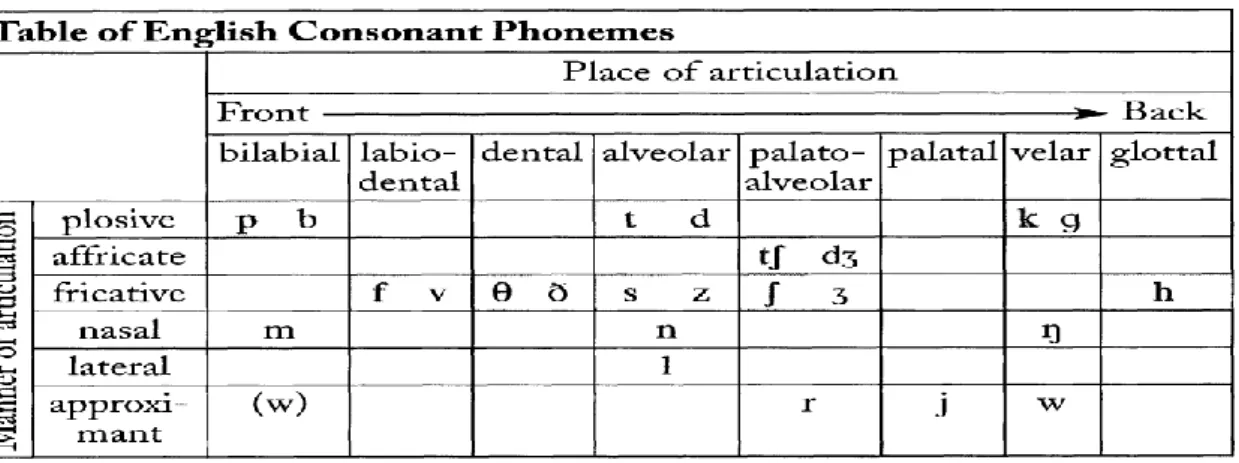
Consonants are the speech sounds which are articulated with complete or partial closure of the vocal tract. They are produced by blocking, then releasing the airstream. There are twenty four consonants in English: /p/, /b/, /t/, /d/, /k/, /g/, /f/, /v/, /θ/, /ð/, /s/ /z/, /ʃ/, / ʒ /, /h/, /tʃ/, /dʒ /, /m/, /n/, /ŋ/, /l/, /r/, /w/, and /j/. Kelly (2000) states that consonants are produced by: interrupting, restricting or diverting the airflow in different ways. He also mentions that there
8
are three criteria that describe English consonants: the place of articulation, the manner of articulation, and the voicing.
1.2.1.2.1 Place of Articulation
It refers to the place where the airstream is obstructed in the vocal tract. According to Underhill (2005), it is the place in which the physical restriction of the air flow takes place. Yule (2010) states that English consonants are produced at seven places in the vocal tract: Bilabials: in bilabial consonants, the upper and the lower lip touch each other. The /p/, /b/ /m/ and/w/ as in “paper”, “bad”, “mother” and “water” are bilabials.
Labiodentals: the lower lip articulates with the upper teeth. The English consonants /f/and /v/ are labiodentals as in “father” and “video”.
Dentals: these sounds are produced when the top of the tongue and the upper teeth act together. The sounds /Ɵ/ and /ð/ as in “through” and “then” are dentals and called inter dental. Alveolars: in alveolar consonants, the top of the tongue touches the alveolar ridge (behind the upper teeth). The English alveolars include: /t/, /d/, /s/, /z/, /n/, /l/ and /r/ as in “ten”, “dead”, “sick”, “zoo”, “net”, “life” and “road”
Palatals: are sounds produced with the tongue and the hard palate. /ʃ/, /ʓ/, /ʧ/, /ʤ/ and /j/ as in “shine”, “pleasure”, “check” and “ginger” are palatals.
Velars: for velar consonants, the back of the tongue articulates with the soft palate. The velars encompass /k/, /g/ and /η/ are the velars as in “kiss”, “game” and “singer”.
Glottal: Glottal consonants are produced at the level of the glottis (the opening between the vocal cords). The glottal consonant is: /h/ as in “horse”.
1.2.1.2.2 Manner of Articulation
Manner of articulation, according to Avery and Ehrlich (1992), refers to how the airflow is constricted; it is the way the airstream is affected as it flows from the lungs out of the mouth. English consonants are divided according totheir manner of articulation into the
9 followings:
Plosives: also called stops. According to Hualde (1996) plosives occur when there is a complete closure in the vocal tract; that is to say, the air coming out from the lungs can be stopped completely. In other words, plosive consonants are produced by stopping the airflow completely using the lips, teeth, or palate, followed by a sudden release of thebreath. The plosive sounds are: :/p/, /b/, /t/, /d/, /k/ and /g/ as in “parent”, “book”, “tea”, “daughter”, “king” and “good” respectively.
Fricatives: Roach (1983, p. 48) states that “fricatives are consonants with the characteristic that, when they are produced, air escapes through a small passage and makes a hissing sound”. Fricatives include /f/, /v/, /Ɵ/, /ð/, /s/, /z/, /ʃ/ and /ʓ/ as in “farm”, “vain”, “thief”, “these”, “sun”, “zebra” and “shine”.
Affricates: Affricates are combinations of two different sounds; “they begin as plosives and end as fricatives” Roach (1983, p. 48). The two affricates in English are /tʃ/ as in “church”,
and /dʓ/ as in “jump”
Nasals: Nasal consonants differ from the previous ones in that the air escapes through the nose instead of the mouth. Yule (2010, p. 32) states that “when the velum is lowered, the
airstream is allowed to flow out through the nose /m/, /n/ and /ŋ/, the sounds are described as nasals”. That is to say, nasals are produced when the soft palate is lowered to allow air to pass
through the nose. There are three nasals in English: /m/, /n/ and /η/ as in “moon”, “night” and “evening”.
Lateral: a lateral consonant, according to Roach (1983), is produced when the air passes between the hard palate and both sides of the tongue and a closure is made between the tongue and the alveolar ridge. The only English lateral consonant is the “l” as in “lion”.
10
Approximants: according to Kelly (2000), approximants occur when one articulator moves close to another, but the closure is not complete to cause a friction or stop the airflow. English approximants are: /r/, as in “routine”, /j/ as in “yellow”, and /w/ as in “window”.
Semi-vowels: also called glides or vowel-like consonants. According to kushwaha (2017, p. 6), “the sounds /j/ and /w/ are known as semi-vowels in English because in some words their function is very like to that of a consonant, whilst in others, it is the same as that of a vowel”.
That is to say, the sounds /j/ and /w/ may play the role of vowels in some words and of consonants in some others. For example, in the words “yellow” and “water” the initial sounds
/j/ and /w/ are consonants. 1.2.1.2.3 Voicing
Voicing is the third dimension in terms of which consonants can be classified. According to Avery and Ehrlich (1992) it refers to the vocal cords vibration; when there is vibration in the vocal cords, consonants are considered to be voiced, and when there is no vibration of vocal cords, consonants are considered to be voiceless.
In summary, the table below presents consonants phoneme in English, classified in terms of manner of articulation, place of articulation and voicing.
11 1.2.2 Supra-segmental Features
Supra-segmental features, according to Avery and Ehrlich (1992), include the aspects of the speech beyond the level of the individual sounds. That is to say; they are not limited to only a single sound but often extended over syllables, words or even phrases and sentences like stress, intonation, rhythm and pitch. Among these different features, stress and intonation are the ones that will be explained in the following titles:
1.2.2.1 Stress
Stress is one of the imperative elements of pronunciation. It refers to the emphasis that is given to a phonetic segment or syllable. According to Crystal (2008, p. 454), stress is “a term
used in phonetics to refer to the degree of force used in producing a syllable. The usual distinction between the stressed and the unstressed syllables is that the former being more prominent than the latter”.
Two kinds of word stress are distinguished: primary (tonic) and secondary. The syllabuses which receive most stress have primary stress, and the ones which have less stress have secondary stress. The difference between the primary and the secondary stress is that the primary is longer and produced with higher pitch than the secondary one (Jensen, 1993). 1.2.2.2 Intonation
Intonation is considered as a fundamental element for proficient pronunciation. Kelly (2000, p. 3) defines intonation as “the way the voice goes up and down in pitch when speaking”. In other words, it refers to the way in which the voice rises and falls. Three main
intonation patterns are distinguished by Crystle (2008): rising, falling, and level. Rising intonation occurs at the end of the utterance in questions requiring yes or no answers as in the example: „are you ready?‟; while falling intonation is used, first, in Wh- Questions such as, „where are you from?‟, second, in giving orders such as, „change your seat!‟ and, last, in a
12
statement such as, „I am doing my home work‟. The third kind of intonation is level and it
refers to the incomplete intonation pattern. 1.3 Teaching and Learning Pronunciation
Pronunciation is the most critical and complicated aspect in teaching and learning EFL. In fact, it is a matter of concern for both teachers and learners. On one hand, it is a very demanding task for learners to acquire the appropriate pronunciation. Some of them naturally acquire it as they go along learning English, but some others fossilize at certain levels. Consequently, they require specific instructions to increase their level of pronunciation (Glibert, 2008). On the other hand, teachers have to choose the appropriate methods and techniques to suit the learners‟ needs and improve their pronunciation.
1.3.1 The History of Teaching Pronunciation
Pronunciation is an important language component; yet, research in the domain of speaking and most teachers do not give it much attention. Kelly (1969), in his comprehensive history of language teaching, gives pronunciation the title of the “Cinderella” area of FL teaching as western philologistsand linguists spent little time studying pronunciation compared to grammar and vocabulary. Pronunciation was then somewhat neglected, the reason why most language teachers focus on grammar and vocabulary more than pronunciation(as cited in Celce Murcia, Brinton, & Goodwin, 1996).
Throughout time, many methods and approaches to foreign language teaching perceived pronunciation differently. Richards and Rodgers (2014) point out that the teaching methods have been changing throughout history which led to changes in what kind of proficiency should be acquired, like moving from reading comprehension towards oral proficiency as the goal of language study. This movement ushered in a new era in the teaching and learning of pronunciation. It was until the beginning of the twentieth century that pronunciation started to be valued within the field of FLT. Some methods targeted the
13
teaching and learning of pronunciation as the importance of pronunciation was unquestionably clear in the acquisition of communicative competence mainly and linguistic competence on the whole. The Direct Method, The Reform Movement, Audio-Lingualism, and Communicative Language Teaching (CLT) are the methods that focused on pronunciation.
1.3.1.1 The Direct Method
This method gained popularity in the end of the nineteenth century and the beginning of the twentieth, i.e, in late 1800s and early 1900s. Celce-Murcia et al. (1996) state that the Direct Method is based on repeating and imitating the teacher or a recording. They explain that the strategy followed in the Direct Method was inspired by the way a child learns his or her first language or how adults learn their second or foreign language and that is through intuition and repetition.
The principles of the method were summarized by Elizabeth and Rao (2004) as follows: Listening precedes speaking: learners required to listen to how sounds are articulated
before producing them
Oral practice is the basis of this method.
Inhibition of the mother tongue: this method suggests teaching the FL without using
mother tongue.
The unit of the speech is a sentence not a word; emphasis is laid on speakingfull
sentences. (p. 54)
1.3.1.2 The Reform Movement
In the 1980s, the first contribution to the teaching of pronunciation appeared under the name of the Reform Movement influenced by phoneticians who created the International Phonetic Alphabet (IPA) (Celce-Murcia et al., 1996). The following points illustrate briefly the principles of the Reform Movement:
14
The oral form of a language is the most important and the first to be taught. International Phonetic Alphabet (IPA) should be integrated to language teaching. Teachers must master the English phonetics.
Learners should be provided with explicit information about the production of sounds
and rhythm of the target language (Celce-Murcia et al., 1996, p.3). 1.3.1.3 Audio-lingualism
The appearance of the Reform Movement helped the emergence of Audio-lingualism in the USA and the Oral Approach in Greet Britain (GB). Both approaches gave great importance to pronunciation which started to be taught explicitly. This change, according to Richards and Rodgers (2014), is traced back to the end of World War II when the United States( US) felt the need to devise a new method to improve emigrants and foreign language learners‟ oral proficiency
The major principles of the Audio-Lingual method are summarized by Richards and Rodgers (2014, p. 58) as follows:
Foreign language learning is basically a process of mechanical habit formation, where
good habits are formed by giving correct responses rather than by making mistakes. The items to be leaned should be presented in the spoken form before the written form
for an effective learning of language skills.
Analogy provides a better foundation for language learning than analysis. Hence the
approach to the teaching of grammar is essentially inductive rather than deductive. Teaching a language requires teaching the cultural aspects of the native speakers of
this language.
3.1.4. Communicative Language Teaching (CLT)
This Teaching method came in the late 1970s. It was based on the belief that language is not a mere system of rules, but a dynamic resource to create meaning. Moreover, CLT sees
15
that it is no more sufficient for learners to know the rules of combining separate sounds to form a word and sentences; instead, they should know how to use these rules appropriately in communicating ideas and expressing themselves (Nunan, 1989). In the 1980s, CLT was widely used and it emphasized the acquisition of communicative competence. Richards and Rodgers (2014, p.83) mention three elements that characterize the principles of a CLT classroom:
The communication principle: activities that promote pronunciation, promote
achieving effective communication.
The task principle: tasks which provide learners with native input of the target
language to boost their pronunciation are the tasks which based on listening to and imitating native speakers.
The meaningfulness principle: the pronounced utterances should not be correct only in
the form, but should be also meaningful. 1.3.2 Activities of Teaching Pronunciation
Many activities are designed to teach pronunciation; some of them are developed for receptive purposes and others are created for productive purposes according to the objective of the course (Kelly, 2000). If the goal of the course is to enable learners to differentiate the significance sounds and patterns of the language, the receptive-based activities are used. Nevertheless, if the aim of the lesson is to lead students to speak or to produce new items based on what they have learnt before, the productive skill is utilized. Kelly (2000) suggests a number of activities to teach pronunciation. Some of them are discussed in the following:
Drilling: is a classroom activity in which the learners are asked to listen to a model
then repeat what have been said. Drilling is an effective technique that helps learners listen to accurate pronunciation and repeat it as it is.
16
Minimal Pairs: itrefers to pairs of words that do not have the same meaning and
differ on only one phoneme such as: choose/shoes. This activity is very helpful for students to distinguish between sounds that seem alike.
Listening Activities: Kelly (2000, p.21) states that “listening exercises […] are often
designed to sound as realistic as possible, with the participant talking at a normal speed and using natural language. This can play a key role in helping students to notice the existence of a pronunciation features”. In other words, listening activities
give learners the chance to listen a native speakers‟ speech. Thus, they can distinguish how natural language is formed and recognize the elements of pronunciation.
Role play: is an activity that learners usually find interesting and enjoyperforming. It
is basically about having them play some roles. They can role-playthemselves in imaginary situations, play a completely different character, or replicatesome written script, authentic story, etc. It is very helpful in EFL classrooms because it is productive-based activity in which the learners produce the language so to practise pronunciation, and receptive- based activity which gives the learners the opportunity to listen to his/her classmates pronunciation and get new knowledge (Revell, 1979). 1.3.4 Teachers’ Roles
Based on Gliner (2008), EFL teachers have some roles to take in order to develop the learners‟ pronunciation of the FL. The teacher then must guide, monitor, support, and
encourage learners to reach higher standards. Additionally,Kenworthy (1987, p. 1) specifies the tasks of the teacher in learning/teaching pronunciation inside the classroom as follows:
Helps learner hear: means aiding them to know the unfamiliar sounds and to better
17
Helps learners make sounds: some FL learners fail to imitate the sounds of English
which do not exist in their native language. The teacher, in this case, is expected to be able to give hints to help learners‟ pronunciation.
Provides feedback: when learning pronunciation, learners pronounce new sounds and
words but they usually cannot determine whether it is correct or not. It is then, the role of the teacher to give them information about their performance with regard to how well they did.
1.3.5 Students’ Roles
When learning pronunciation, learners are expected to make efforts in order to acquire the regularities of the English pronunciation. Kenworthy (1987) argues that the least thing that learners can do when learning pronunciation is to respond to the teacher‟s role although it is not easy. One other important role for learners is to take responsibility of their own learning. That is to say, the chances to improve their pronunciation would be minimal if the learners do not monitor their own efforts towards better results.
1.3.6 The importance of Learning Foreign Language Pronunciation
It is clear that pronunciation has a great importance for EFL learners. According to Pachler, Evans, Redondo and Fisher (2014), there are mainly three reasons why pronunciation is important:
Firstly, focusing on pronunciation will lead not only to correct pronunciation of words,
but also to accuracy in speech.
Secondly, mispronunciation of utterances impedes the speaker from being understood.
So, the mispronunciation of a sound in a word changes the meaning completely which leads to comprehension problems.
18
Lastly, having an accurate pronunciation allows learners to feel more confident when
speaking and motivates them to look for achieving not only speech accuracy but speech fluency as well.
In short, to make a successful communication and deliver clear messages, the speaker needs to correctly produce the sounds. So, pronunciation is not just a decorative piece of the language.
1.3.7 Factors Affecting EFL Learners’ Pronunciation
Many studies in the field of teaching and learning languages investigate the factors that affect pronunciation achievement. These studies confirm that these aspects influence the foreign language phonological acquisition and lead to the failure of learning pronunciation. Among the most influential issues that prevent or inhibit learners‟ pronunciation development
the following ones:
1.3.7.1 The Mother Tongue
Learners‟ L1 is a significant factor that influences their pronunciation of the TL. Researchers
in the domain of FL compare English and other languages to predict non-native speakers‟ problems and difficulties which are the results of the mother tongue interference. According to Shobottom (2012), students who try to acquire a FL which belongs to the same native language family have greater chance to achieve an accurate pronunciation. Whereas, those who try to master a language from a family group that is different from their native laguage have little chance to do so. A language family, according to Thomason (1997), is a set of languages which comprises a significant number of common features in phonology, morphology and syntax. Thus, phonological categories that exist in both the Mother Tongue (MT) and the Target Language (TL) are easier for learners to acquire than those which occur only in the FL. For example, if a sound does not exist in the native language, it makes difficulty for learners to pronounce.
19
Avery and Ehrlich (1992) explain the three issues that the MT affects on the TL pronunciation. First, the difference exists between the MT and the English language at the level of the sound system. Second, the difference is in the combination rules of the sounds between the TL and the learners‟ native language. Finally, learners face problems when
transferring patterns of stress and intonation from their mother tongue and the target language. 1.3.7.2 The Amount of Exposure
Generally, exposure related to the length of time the learners live in the target language environment. According to Gilakjani (2012), the amount of exposure that a learner has to a FL may refer either to the current day-to-day life, or to the amount of prior instruction he receives in the target language. Failure in acquiring native-like level of pronunciation attributes to the minimal exposure to the target language and contact with native speakers (Gilakjani, 2012). According to the language learning theories, learners acquire language primarily from the input they receive (Krashen, 1982), i.e, the more they listen to English, the better their pronunciation will be. Therefore, learners must be provided with large amounts of comprehensible input before they are required to speak. In other words, learners must listen to how the aspects of the target language are pronounced before being expected to speak. In EFL settings, most of the learners, if not all of them, have not been taught by English native teachers. Thus, their teachers should provide them with maximal native models. Additionally, to ascertain that students have opportunities inside the class, language laboratories are used to enable them listen to authentic oral discourse of native speakers. So, teachers should maximize students‟ exposure to the TL inside and outside the classrooms.
1.3.7.3. Learners Motivation
Motivation is the will and the desire that someone has to do something. It is defined as the inspiration that leads someone and urges him/her to reach his/her aim and perform or behave in a certain way (Chambers, 1999). In EFL teaching and learning processes, Gardner (2010)
20
sees motivation as the desire and the efforts learners make to achieve the goal of learning the FL. So, it is noteworthy that motivation is among the important psychological factors which lead to success or failure in learning a language.
Generally, there are two types of motivation namely: intrinsic and extrinsic motivation. Intrinsic motivation according to Dornyei and Schmidt (2001) is doing an activity for its inherent satisfaction rather than for some separable consequences. In other words, it is the internal desire or motive a learner has to achieve a goal. So, learners who are internally motivated and concerned about learning FL pronunciation try as much as they can to master it. Extrinsic motivation is doing an activity only to attain a specific outcome. That is to say, it is the reward the learner gets from the teacher after doing a task (Dornyei& Schmidt, 2001). So, the role that should be played by teachers is to encourage their learners to achieve pronunciation.
In short, a wide range of empirical studies indicate that highly motivated students learn faster and better than unmotivated ones. So, both types of motivation control the process of FLL.
1.3.7.4 The Used Activities
The used activities are the set of the most influential factors that affect pronunciation learning (Kelly 2000). In fact, choosing the appropriate activities to use plays an important role in reaching the objective of the lesson. Generally, teachers select the fitting tasks taking into consideration two principles. The first is that the chosen activities must be consistent with the lesson objective. For example, if the objective of the course is to enable students distinguish between the sound /t/ and /d/, minimal pairs and tongue twisters are the most suitable activities. The second is that the selected activities must be workable with learners‟ individual
differences. Of course, teachers cannot fit all their learners‟ individual differences; but at least, they have to provide all the learners with opportunities to develop their pronunciation.
21
To do so, teachers must use different types of activities during the lesson. Consequently, the learners will be satisfied as well as motivated to learn the pronunciation and the language in general (Keenworthy,1987).
Conclusion
Briefly, learning pronunciation has a significant role in the acquisition of foreign languages. Accurate and comprehensible English pronunciation can be achieved by mastering its features, i.e. mastering not only segmental features (vowels and consonants) but also supra-segmental aspects (stress, intonation, etc.). A learner who has a good pronunciation can achieve an effective communication; however, a learner whose pronunciation is poor cannot be understood. Moreover, there are always factors that control the acquisition of pronunciation. These factors are varied from one learner/teacher to another.
22
Chapter Two: Listening and Imitation
Introduction
2.1 Definition of the Listening Skill………..……….24
2.2 The Status of Listening in Language Teaching/Learning………..25
2.3 Types of Listening………...………..26
2.3.1 Intensive Listening……….………26
2.3.2 Extensive Listening………27
2.4 Models of the Listening Process………27
2.4.1 The Bottom-Up Processing Model…………..……….27
2. 4.2 The Top-Down Processing Model……….……….28
2.5 Listening Strategies………28 2.5.1 Cognitive Strategies…………..……...………29 2.5.2 Meta-Cognitive Strategies…...………...29 2.5.3 Socio-Affective Strategies……….30 2.6 Listening Activities………31 2.6.1 At Word Level……….31 2.6.2 At Sentence Level………31
23 2.7.1 Pre-listening Stage………..33 2.7.2 While-listening Stage………..33 2.7.3 Post-listening Stage………34 2.8 Listening Assessment………..34 2.9 Imitation……….36 2.9.1 Definition of Imitation……..………36
2.9.2 Multiple Dimensions of Imitation……….……….36
2.10 The Importance of Listening and Imitation in Developing Pronunciation…………..37
24 Introduction
The present chapter is devoted to explain some basic issues about the listening skill. It will start with giving some definitions of the listening skill followed by reviewing the status of listening in language teaching and learning, it will highlight the types of listening and its different processing models. After that, some of the prominent listening strategies and activities that are deemed to be helpful for learners‟ comprehension of listening passages will
be brought to the fore. The stages of listening activities and listening assessment are the points which will be discussed in the following subtitles of the present chapter. In the same chapter we will introduce the concept of imitation seen from different angels: its definition and its multiple dimensions. We will attempt also to explore the importance of listening and imitation in the development of pronunciation.
2.1 Definition of Listening Skill
Listening is one of the significant language skills. In the field of EFL teaching/learning, listening has been defined by many researchers. Howatt and Dakin (1974) define the term listening as the ability to identify and understand each other‟s speech in terms of understanding the speaker‟s pronunciation, grammar and vocabulary. West and Turner (2009,
p.187) argue that it is an active process which requires both the listener and the speaker. They add that it goes through four steps: “receiving, recalling, rating, and responding […] messages from another”. Therefore, listening is: accepting the message of the speaker, withdrawing
his/her words, evaluating what s/he said, and then saying something in return.
When we say listening, the first concept that comes to one‟s mind is hearing. It is said that listening and hearing cannot be divided. Nonetheless, Saha (2008) explains that despite that listening and hearing are interrelated; listening encompasses an active process which needs an interpretation of the sounds in contrast to hearing which is only the passive perception of the spoken sounds and words. Anderson and Lynch (1988, p. 6) support the fact
25
that listening is an active process and summarize the characteristic of successful listening by saying that:
understanding is not something that happens only because of what a speaker says; the listener also has a crucial part to play in the process, by activating various types of knowledge, and by applying what he knows to what he hears and trying to understand what the speaker means. (p, 6)
In other words, the listener has to use his/her background knowledge about the phonological, grammatical, lexical and cultural system of the language in order to understand the conveyed message.
2.2 The Status of Listening in Language Teaching/Learning
In the light of the history of listening, it can be noticed that listening has long been ignored in language pedagogy. It was not until the 1960s that listening was believed to have an important role in language teaching and learning (Rost, 1990). As Mendelsohn (1994) states, many EFL programmes paid little attention to the teaching of listening for a long period of time despite its remarkable role in foreign language learning. On one hand, the prevailing theories of the 1940s, 1950s, and 1960s relative to language learning attributed little attention to listening beyond the sound discrimination associated with the learning of pronunciation. The British situational approach and the American audio-lingual approach, on the other hand, paid little interest to listening beyond its role in grammar, vocabulary and pronunciation drills.
Arguments for listening began to be voiced in the mid-1960s and early 1970s by Rivers, who had long been an advocate of listening comprehension, and others who argued for listening comprehension to be developed as an independent skill rather than merely a means
26
for the development of speaking (Morley, 2001). Indeed, as Morley (2001) reports, from the 1970s on, the status of listening started to change steadily from neglect to increasing importance. Parallel to reading, writing, and speaking, the listening skill was incorporated within the contemporary instructional programmes. Functional and communicative approaches brought the importance of listening in foreign language teaching and learning to light during the 1980s. Lately, listening has widely become recognized as a critical skill in foreign language learning and teaching (Brown, 2000).Although modern language teaching researches shed light on the importance of the listening skill, many ESL/EFL programmes have not yet put the appropriate curriculum to teach this basic skill.
2.3 Types of Listening
Researchers in the field of language skills classify listening in terms of the setting in which this process takes place into two main types: intensive and extensive. These two forms are explained as follows:
2.3.1 Intensive Listening
Intensive listening is, conceivably, the most widely used form of listening practices in modern language laboratories and classrooms. It is the type of listening which is according to Rost (2002, p.138) “refers to listening for precise sounds, words, phrases, grammatical units and pragmatic units”. That is to say, the listener in this form of listening should pay attention to all language‟ features starting from isolated sounds to grammar and meaning. Harmer (2001)
states that in a listening comprehension classroom students are presented with a passage to listen to, and asked to use intensive listening skills; meaning that they have to analyze the passage, look for certain information and answer the designed questions. He adds that in intensive listening, students tend to mostly depend on their teacher as sources of guidance in order to develop their own listening.
27 2.3.2 Extensive Listening
Incontrast to intensive listening, this kind of listening (extensive listening) takes place outside the classroom where FL learners use different materials such as CDs, MP3 players, mobiles, etc. The core objective behind this genre of listening is not the acquisition of the skill as much as getting pleased. Accordingly, in this type of listening, students are highly motivated as they are free to make their own choices about what to listen to (Harmer, 2001). Despite that extensive listening is not used exclusively for educational purposes rather it is used for pleasure; it can have dramatic effects on students‟ language development.
Though intensive listening seems to solely account for developing listening proficiency, extensive listening is also of great help as it arouses learners‟ interest in listening. Thus, a combination of both types is recommended.
2.4 Models of the Listening Process
Various models have been constructed to explain how the listening process operates in FL. Generally, there are three well-known models which are the bottom- up, the top- down, and the interactive model.
2.4.1 The Bottom-up Processing Model
The bottom-up processing model is a model developed by researchers in the 1940s and 1950s According to Flowerdew and Miller (2005), the process of comprehension begins by decoding sounds and phonemes which are joined together into words which make up sentences. These sentences, in turn, are linked together to generate ideas and notions. This signifies that meaning is arrived from bottom to top-based on the incoming data, commencing by decoding the smallest meaningful units (phonemes) and ending by understanding the meaning of the sentences and the whole text. That is to say, the listener analyzes the acoustic message at successive levels of organization (sounds, words, clauses and sentences) until s/he gets the intended meaning.
28
In fact, the listener should know that being mindful to all features of the received message is of a great importance in language learning. In this regard, Morley (2001) emphasizes the listener‟s role in being extremely attentive to each and every detail of the listening text. Furthermore, Richard (1990) maintains that the listener‟s lexical and
grammatical competence in foreign languages considered as fundamental to bottom-up processing. This implies that listeners should not involve themselves in any listening unless having a rudimentary knowledge of the different aspects of the foreign language mainly pronunciation grammar and vocabulary.
4.2. The Top-down Processing Model
Unlike the bottom-up model that is, in the processing of auditory texts, based on sounds and words, the top-down processing model according to Nunan (1998) and Vandergrift (1999) stresses the role of prior knowledge of the context in which the listening takes place to understand the messages. Prior knowledge encompasses the awareness of the topic, the text-type, the culture or some other information held in long-term memory.
In an attempt to farther clarify the notion of prior knowledge, Morley (2001) asserts that the listener needs to make use of a range of background information about what s/he is listening to so that “to make predictions about what the incoming message is expected to be at
any point, and how the pieces fit into the whole” (p. 74). That is to say, the previous knowledge possessed by the listener paves the way for him/her not only to understand what s/he has already heard but also to anticipate what the speaker will utter next.
2.4.3 The Interactive Model
To overcome the shortcoming of solely using either the bottom-up or the top-down processing model in listening, Rumelhart (1975); as cited in Flowerdew and Miller, (2005) develops the interactive model to account for both the bottom-up and the top-down processing models. Ellis (2003, p. 45) states that “the interactive model of listening assumes that listeners
29
need access to both: automatic decoding skills and higher-order strategies for processing input”. That is to say, in this model the focus on the recognition of linguistic units such as:
sounds, words and intonation, as well as concentrate on understanding the general ideas of the listened passage basing on their background knowledge and contextual information.
In short, the three models of listening processing support learners in the comprehension of the acoustic input. However, the interactive model is considered the best model as it has succeeded to compensate for the deficiencies of both bottom up and top down models.
2.5 Listening Strategies
Recently, second language listening researches focus on understanding how learners manipulate the language input and stress the role of explicit training in improving students‟ academic listening skills. Vandergrift (1999, p. 176) claims that “strategy development is important for listening training because strategies are conscious means by which learners can guide and evaluate their own comprehension and response”. In other words, learners who make use of certain listening strategies have a good opportunity to cope with the difficulties they may encounter while listening. According to Peterson (2001), listening strategies are the methods learners tend to use in order to guide and examine their own comprehension. O‟Malley and Chamot (1990) classify language learning strategies in three main types:
cognitive, meta-cognitive, and socio-affective strategies. 2.5.1 Cognitive Strategies
Cognitive strategies are those strategies used by learners to skillfully control the language input and facilitate comprehension. They involve deliberate manipulation of language to improve learning. These strategies may include repetition, organizing new language, summarizing meaning, piecing together details, and guessing meaning from context. According to Azmi, Celik, Yidliz, and Tugrul (2014), this strategy is used to understand linguistic input and obtain data. Learners sometimes do not know the meaning of some words
30
and they try to guess the meaning from the context; this is an example of cognitive strategy. Furthermore, cognitive strategies are related to understanding and gathering input in short term memory or long-term memory for later use (Peterson, 2001).The Cognitive strategy is a problem-solving method that learners use to facilitate the learning activity and promote the language learning. (Azmi et al., 2014). In other words, it facilitates the process of learning and makes it easier.
2.5.2 Meta-Cognitive Strategies
Meta-cognition refers to learners‟ conscious knowledge and ability to manipulate the learning process. It plays a very important role in enhancing students learning. Flavell (1979) states that meta-cognition refers to the awareness of the knowledge that an individual has or does not have, and to the ability to monitor and control cognitive activities in learning processes. In other words, meta-cognition allows the individual to manipulate his/her conscious mental activities such as reading, thinking, remembering, and reasoning.
In meta-cognitive strategy, learners are conscious when listening to the text cautiously. That is to say, the conscious use of meta-cognitive strategies helps learners get their attention back when they lose it. This method deals with learning how to plan and how to gather information from listening. It has been claimed that meta-cognitive strategies lead students to think about their learning process by means of using their knowledge about their cognitive activities (O‟Malley and Chamot, 1990).
Additionally, using meta-cognitive instruction in teaching listening enhances the learners‟ confidence, motivation and ability to complete the given tasks. Examples of
meta-cognitive strategies include self-monitoring, selective attention, and planning of meta-cognitive strategies.
31 2.5.3 Socio-Affective Strategies
Socio-affective strategies are the techniques listeners use to collaborate with others. Generally, little attention has been paid to socio-affective strategies; nevertheless, they are of great importance especially during bidirectional listening situations in which the listener has the chance to negotiate meaning with the speaker. This kind of strategies requires affective control over learning such as asking questions for clarification and cooperation between students to reach a specific learning goal (O‟Malley and Chamot, 1990). White (2008) adds that learners, using these strategies, motivate themselves to listen and attempt to minimize anxiety as well as to verify their understanding. Truly, by adopting socio-affective strategies, learners create an appropriate atmosphere which paves the way for comprehension to take place.
2.6 Listening Activities
To boost listening, different activities are designed. These tasks provide students with the aural components of the target language to help them better hear the sounds, utterances as well as develop comprehension. Ur (1984) suggests and classifies listening activities into two levels: word level and sentence level. Each level comprises different sub-activities.
2.6.1 At Word Level
Some listening activities, according to Ur (1984), are based on repetition. At word level, learners are asked to exercise listening and repeating the sounds of separate words the way they are produced by native speakers. The followings are some kinds of activities:
Oral activities: in such a type of activities, learners are more likely to practise
repetition. Acknowledging learners that they have to imitate the sounds they hear will encourage them to focus more on listening in order to hear the intended sounds correctly and imitate them accurately.