HAL Id: tel-02444277
https://tel.archives-ouvertes.fr/tel-02444277
Submitted on 17 Jan 2020HAL is a multi-disciplinary open access archive for the deposit and dissemination of sci-entific research documents, whether they are pub-lished or not. The documents may come from teaching and research institutions in France or abroad, or from public or private research centers.
L’archive ouverte pluridisciplinaire HAL, est destinée au dépôt et à la diffusion de documents scientifiques de niveau recherche, publiés ou non, émanant des établissements d’enseignement et de recherche français ou étrangers, des laboratoires publics ou privés.
Essays on central banking and macroprudential policy
Salim Dehmej
To cite this version:
Salim Dehmej. Essays on central banking and macroprudential policy. Economics and Finance. Université Panthéon-Sorbonne - Paris I, 2015. English. �NNT : 2015PA010009�. �tel-02444277�
1
University of Paris I-Panthéon Sorbonne
Department of Economics, Centre d
Economie de la Sorbonne
Financial regulation laboratory (Labex ReFi)
PhD Thesis
in Economics
Essays on central banking and macroprudential policy
Defence on 4th December 2015 by
Salim DEHMEJ
Jury
Supervisor : Jézabel Couppey-Soubeyran
Associate Professor HDR, University of Paris 1 Panthéon-Sorbonne, Labex Refi Reviewer : Grégory Levieuge
Professor, University of Orléans Reviewer : Laurence Scialom
Professor, University of Paris X Nanterre
Olivier de Bandt
Associate Professor HDR, University of Paris X Nanterre.
Director of Research at Autorité de Contrôle Prudentiel et de Résolution (ACPR)
Christian de Boissieu
Professor, University of Paris 1 Panthéon-Sorbonne, Labex Refi Member of Autorité des Marchés Financiers (AMF) Board
Jean-Bernard Chatelain
Professor, University of Paris 1 Panthéon-Sorbonne, PSE
Leonardo Gambacorta
3
Université Paris I-Panthéon Sorbonne
UFR de Sciences Economiques, Centre d
Economie de la Sorbonne
Laboratoire d’excellence Régulation Financicière (ReFi)
Thèse
pour obtenir le grade de Docteur en Sciences Economiques
Essais sur le central banking et la politique
macroprudentielle
Soutenance le 4 décembre 2015 par
Salim DEHMEJ
Jury de thèse
Directeur de thèse :
Jézabel Couppey-Soubeyran
Maître de conférences HDR, Université Paris 1 Panthéon-Sorbonne, Labex Refi Rapporteur : Grégory Levieuge
Professeur, Université d'Orléans Rapporteur : Laurence Scialom
Professeur, Université Paris X Nanterre
Olivier de Bandt
Maître de conférences HDR, Université Paris X Nanterre
Directeur des Etudes à l’Autorité de Contrôle Prudentiel et de Résolution (ACPR)
Christian de Boissieu
Professeur, Université Paris 1 Panthéon-Sorbonne, Labex Refi Membre du Collège de l’Autorité des Marchés Financiers (AMF)
Jean-Bernard Chatelain
Professeur, Université Paris 1 Panthéon-Sorbonne, PSE
Leonardo Gambacorta
4
L’Université Paris I Panthéon-Sorbonne n’entend donner aucune approbation, ni improbation aux opinions émises dans cette thèse; elles doivent être considérées comme propres à leur auteur.
Ce travail a été réalisé dans le cadre du laboratoire d’excellence ReFi porté par heSam Université, portant la référence ANR-10-LABX-0095.
5
Avertissement
Mis à part l’introduction, les différents chapitres sont issus d’articles de recherche rédigés en anglais et en français, et dont la structure est autonome. Par conséquent, des termes “chapitre” ou “article” y font référence, et certaines informations, notamment la littérature, sont répétées d’un chapitre à l’autre.
Notice
Except the general introduction, all chapters of this thesis are self-containing research articles written in english and french. Consequently, terms “chapter" or “article" are frequently used. Moreover, some explanations, like corresponding literature, are repeated in different places
7
8
9
Contents
General introduction 11
Section 1. Central banking and financial stability 13 Section 2. The ‘lean’ versus ‘clean’ debate revisited: a meta-analysis of theoretical
modelling 15
Section 3. Towards a country-targeted MaP policy in the Euro Zone 17 Section 4. Central bank’s involvement in financial stability: where we are today? 18
Section 5. Limits of macroprudential policy 21
References 22
Chapter 1. The Policy Mix Between Monetary and Macroprudential Policies. What DSGE
Models Tell Us? 25
Section 1. Introduction 27
Section 2. « Approche séparée » versus « approche intégrée » de la combinaison entre politique monétaire et politique macroprudentielle 29 Section 3. Un bref état des lieux des modèles DSGE incorporant à la fois la règle de Taylor
augmentée et la politique macroprudentielle 32
Section 4. Méthodologie 35
Section 5. Résultats 45
Section 6. Conclusion 48
Annexes 50
Références bibliographiques 52
Chapter 2. Towards a Monetary/Macroprudential Policy Mix Promoting Economic and
Financial Stability in the Euro Area. 57
Introduction 59
Section 1. Une mesure des divergences entre le cœur et la périphérie de la zone euro à
partir du "Taylor gap" 60
Section 2. Des « Taylor gaps » accrus dans le cas d’une règle élargie à la stabilité financière 63 Section 3. Combiner la politique monétaire et la politique macroprudentielle pour la
stabilité financière et économique 68
Conclusion 75
Références bibliographiques 76
Chapter 3. Macroprudential Policy in a Monetary Union 83
1 Introduction 85
2 Literature review 87
3 A simple new Keynesian model with credit intermediation 88 4 Optimal monetary and macroprudential policy mix 92
10
5 Conclusion 96
Annex. Solution for the central bank’s optimal interest rate 96
References 97
Chapter 4. Do stress tests have a macroprudential perspective? An assessment through the
lens of the ECB’s exercice. 101
Section 1. Introduction 103
Section 2. Assessing banking system soundness through AQR and stress-tests 104 Section 3. Eurozone banks capital requirements according to regulatory timeline 109 Section 4. Eurozone banks’ ability to meet capital requirements 114
Section 5. Conclusion 117
Appendix 119
11
12
The aim of this thesis, composed of 4 academic papers, is to apply empirical and theoretical analyses to study the involvement of central banks in financial stability – the confidence in the financial system’s ability to facilitate allocation of economic ressources, manage risks, and withstand shocks - and to discuss their recent macroprudential responsibilities. The global financial crisis (GFC) shifted the perspective of financial regulation - rules that financial institutions have to comply with in order to ensure effective risk management and to withstand financial shocks- and supervision - ensuring that financial institutions follow these rules - from a microprudential perspective, based on the resilience of individual institutions, to a macroprudential (henceforth “MaP”) perspective that takes into account the interactions of financial institutions, the externalities related to their decisions, and also the effects of the financial cycle on central bank policy and financial stability. This thesis analyses the policy mix of monetary and macroprudential policies which both have an impact on price stability and financial conditions and which operate through common or overlapping channels. A particular focus is given to the role of MaP policy in heterogeneous monetary union (such as the Euro Zone) in terms of financial and macroeconomic stabilisation. MaP policy could compensate the lack of autonomous monetary policy in each country, since they share many transmission channels, and enhance the optimality’s degree of the currency area.
Macroprudential policy aims at mitigating systemic risk (from both structural and cyclical perspectives). In short, this means preventing future financial crises, or reducing their frequency and severity. Systemic risk may arise (ESRB, 2014) from:
a) excessive credit growth and leverage,
b) excessive maturity mismatch and market illiquidity, c) direct and indirect exposure concentration,
d) misaligned incentives and moral hazard.
This general introduction briefly sketches the main building blocks of this thesis. Section 1 briefly reviews the link between central banking1 and financial stability by describing the risk
taking channel (RTC) and central banks’ involvement in financial supervision. Section 2 introduces a revisited version of the ‘lean’ versus ‘clean’ debate and presents the results of a meta-analysis2 of 23 recent DSGE models that combine monetary policy (augmented Taylor rule by a financial indicator) and macroprudential policy (chapter 1). Section 3 illustrates, using a static counterfactual analysis, that a Taylor rule augmented by a financial indicator (credit or housing) to ensure financial stability would have led to more divergent (Taylor) interest rates (chapters 2). The reason is that financial cycles are more divergent between countries than business cycles. Next, it describes a theoretical, static, New Keynesian model that introduces MaP policy in a monetary union and incorporates some financial frictions (chapter 3). This section highlights the need for a macroprudential policy in the Euro Zone by analysing the suitable policy mix (integrated vs separated) and studying the implementation of macroprudential policy (federal vs national level). Section 4 describes the role of central banks in the new financial stability architecture via macroprudential policy and stress tests. This
1 We can summarize central banks’ mandates by insuring price, economic and financial stability. However, the
relative importance and the modality of achieving each objective are evolving following the economic and political environment.
2 Meta-analysis is a quantitative method that summarizes the empirical literature related to a particular topic. It
presents itself as an alternative to the narrative approach of surveys (Stanley, 2001). First used in medical research, meta-analysis has gradually been developed in social sciences, including in economics.
13
section outlines policy recommendations regarding stress tests (chapter 4), in particular by proposing a MaP touch where stress tests take into account contagion, dynamic balance sheets and analyse the funding and liquidity mismatches. Second, it summarizes an evaluation of the robustness of the European banking system through the lens of the ECB’s comprehensive assessment and the regulatory evolution. Section 5 highlights the limits of macroprudential policy and calls for an integrated policy mix, except fot the Euro Zone, at least during the experimental/transition period.
MaP policy benefits from a new and diversified regulatory toolkit that has been introduced mainly through Basel III. Indeed, Basel III introduces new constraints on lenders such as capital requirements (counter-cyclical capital buffer - CBB, systemic risk buffer for SIFI’s - SRB, sectoral capital requirements - SCR, exposure and leverage limits), and liquidity requirements (stability of funding and liquidity of assets). Outside the Basel framework, some MaP tools constrain borrowers’ capacity to obtain loans such as time-varying loan to value (LTV) and debt to income (DTI) caps. Since the sources of systemic risk are diversified, a toolkit of MaP instruments is necessary. Each source should be targeted by at least one instrument according to the Tinbergen principle (at least as many tools as objectives). It is worth stressing that MaP policy borrows heavily from microprudential instruments and it is usually difficult to distinguish the nature of instruments. In this thesis, we consider that each microprudential instrument that is applied a) to systemic institutions (structural dimension of systemic risk) or b) in a countercyclical manner (cyclical dimension of systemic risk) could be considered as macroprudential. However, MaP instruments are not necessarily microprudential in nature.
Section 1. Central banking and financial stability
Several banking and real estate crises, including the GFC, started in an environment characterized by low inflation and relative economic stability such as the great moderation that preceded the GFC. A widespread consensus suggested the existence of a paradox of credibility where a credible monetary policy that focuses only on inflation can weaken financial stability (Borio et al, 2003), alongside a paradox of tranquillity3 (Minsky 1975) where a long period of economic stability encourages debt’s accumulation and risk taking that end up by destabilising the economy. These notions have raised many questions regarding the coherence of a single objective of price stability in central banks’ mandates. Many researchers, notably at the Bank of International Settlements (BIS), have called for the end of the separation principle between monetary and financial stability (Schwartz, 1995), which assumed that price stability is sufficient to ensure financial stability. They have highlighted a new transmission channel of monetary policy for financial stability: the risk-taking channel (RTC, Borio and Zhu, 2012). The RTC implies that low interest rates for too long encourages banks’ risk taking. As a consequence, the RTC brings banks into the heart of monetary policy transmission to the real economy and attests the existence of a close link between monetary policy and financial stability.
Theoretically, this channel operates through several mechanisms (CAE, 2011). First, low interest rates imply low returns on financial investments. In order to maintain unchanged portfolio profitability, financial institutions invest in more profitable (search for yield), but riskier assets (Rajan, 2006). This increased risk appetite becomes self-sustaining particularly when the enrichment illusion is strong and inflation is under control. Second, since volatility
14
tends to fall and asset valuations increase in the upswing, banks’ perception of risk declines which encourages excess assumption of risk. In addition, low interest rates have a positive impact on investment valuations and expected cash flows that amplify this procyclical tendency (Adrian and Shin, 2009). Third, on the liability side, there is a deep change in the balance sheet as financial markets offer a lower cost source of funding. Indeed, this increases leverage, the balance sheet’s size and asset-liability maturity mismatch (Agur and Demertzis, 2010). Finally, the RTC has several spillovers at the international level from advanced to emerging economies, mainly through massive and volatile capital flows that can profoundly destabilise financial markets or exchange rates (Bruno and Shin, 2013) and create procyclical destabilising amplifications of currency and duration mismatches across both bank lending and capital markets.
Empirically, many studies (Jimenez et al, 2014; Altunbas et al, 2014; Maddaloni and Peydró, 2011) support the view that monetary policy is not neutral from a financial stability perspective. They show that low interest rates for too long reduce the expected likelihood of defaults, leading banks to ease credit extension, especially for risky borrowers.
If there is no clear evidence on the reponsability of central banks alone in the GFC, most economists agree now that central banks should be involved in both monetary and financial stability. The RTC literature attests the impact of monetary policy on systemic risk and supports the new responsibilities of central banks for financial stability through micro and macroprudential supervision and sometimes regulation, including via stress tests.
The literature of central banks’ involvement in microprudential supervision which can be extended to macroprudential supervision provides contrasting conclusions (Goodhart and Schoenmaker, 1995). The literature supporting the integration view which advocates involvement of central banks in supervision and acknowledges that combining monetary and supervision policies under the same roof could generate large economies of scale/scope. It also facilitates informational sharing that would avoid the problems of coordinating the actions of separate authorities and of delayed actions, particularly during crises (Blanchard, 2010). Additionally, the fact that central banks act usually as lender/buyer of last resort argues for involving the central bank in supervision and regulation (Eichengreen and Dincer, 2012). Furthermore, central banks could comfortably and appropriately assume this role since there are credible, independent from governments, relatively robust to lobbying, well suited with highly skilled staff (Lamafalussy, 2010). Central banks have a macroeconomic stability focus, efficient communication skills and frequent interactions with financial markets through open market and unconventional operations.
By contrast, the separation approach advocates separation of the monetary authority from the supervisory authority and addresses concern for whether the central bank's involvement in financial stability endanger its primary goal of price stability. A second concern is about reputational risk of the central bank (Goodhart, 2000). Lower efficiency in its supervisory function - notably the emergence of bank failures with consequences on the real economy - would harm its reputation as a monetary authority. Central banks could also suffer from lobbies’ pressure (Boyer and Ponce, 2011) if they cumulate prudential and monetary policies. Goodhart and al. (2002) show that central bankers who are dominated by economists and a macro perspective, and supervisors, who are dominated by accountants and lawyers and a micro perspective have different cultures. Lastly, the enlargement of central banks’ mandate to financial stability may raise the issue of a democratic deficit which calls for additional transparency and accounting.
15
Empirically, the literature also provides contrasting conclusions on the right degree of separation. A study by Arnone and Gambini (2007), where the degree of compliance with Basel standards is linked to the way these countries have organized supervision, finds evidence in favour of the integration view. Eichengreen and Dincer (2012) find that capital ratios tend to be higher where the central bank rather than another agency of government is the lead supervisor. However, they argue that it is the supervisory independance that matters importantly for outcomes. They indicate that nonperforming loans as a share of GDP are significantly lower in countries where the supervisor has independence from politics, regardless of whether that supervisor is an independent central bank or another independent government agency. Cihák and Podpiera (2007) find that the architectural aspect of microprudential supervision does not really matter for the quality of supervision.
Several arguments against the involvement of central banks in financial supervision work well for microprudential supervision but are much less convincing for macroprudential supervision because of the traditional macro perspective of central banks. In addition, being in charge of prudential supervision is not necessarily associated with being responsible for the regulation of business practices and consumer protection that could be given to another agency (e.g. the FCA in the UK and the CFPB in the USA). We think that focusing only on supervision is misleading since rules that financial institutions have to comply with should be sufficient and well designed to ensure financial stability. Indeed, financial regulation and supervision are both necessary. From a historical perspective, central banks always assumed financial stability missions (Padoa-Schioppa, 2002). In fact, many central banks were established to serve as bulwarks against financial instability episodes. For example, the foundation of the Federal Reserve System in the United States in 1913 was, at least in part, a response to financial stability concerns linked to the 1907 crisis. However, this involvement in stability issues was asymmetric and mainly focused on dealing with financial crises, ex post, by easing interest rate, acting as a lender of last resort (Bagehot, 1873) or using unconventional monetary policies. The severity and long term costs of the GFC highlighted the need for greater emphasis on financial stability than was appreciated in the past and called for an ex ante involvement of central banks in financial stability to prevent future financial crises, or less ambitiously to reduce their frequency and severity.
Section 2. The ‘lean’ versus ‘clean’ debate revisited: a meta-analysis of theoretical
modelling
4To address financial instability, central banks can take three types of actions. They can adjust the main interest rate in response to financial conditions, intervene as macroprudential supervisor/regulator or use a combination of both. In this regard, Chapter 15 introduces a revised version of the debate about leaning against financial fragility, where central banks react
ex ante to asset price bubbles by hiking interest rate in the upswing, versus cleaning up ex post
after the bubble bursts, by easing interest rate, acting as a lender of last resort or using
4 The references below are available respectively in each chapter.
5 “The Policy Mix Between Monetary and Macroprudential Policies. What DSGE Models Tell Us?”. Original title:
“La coordination entre politique monétaire et politique macroprudentielle Que disent les modèles DSGE?” (With Emmanuel Carré and Jézabel Couppey-Soubeyran. Published in Revue Économique, vol 66, issue 3, May 2015).
16
unconventional monetary tools. This debate has been renewed recently, in the context of macroprudential policy adoption and implementation.
This chapter distinguishes between two opposite combinations of monetary and macroprudential policies. In the first option of the policy mix, the interest rate could act primarily on monetary stability, and also act timely on financial stability as a complement to the secondary macroprudential instruments. This is the integrated approach in which interest rate (through a Taylor rule augmented by a financial stability term) and macroprudential instruments are supposed complementary measures. In contrast to this option, the separated
approach6 does not consider that the interest rate can respond at any time to financial stability. This approach advocates for assigning monetary policy solely to monetary stability, and for assigning only MaP, which is presumably effective and sufficient alone, to financial stability. Chapter 1 attempts to answer several questions such as: what it the current state of the art in the new subset of theoretical DSGE models that consider a potential combination of monetary and macroprudential policies to lean against financial fragility? Do the nature, diversity and effectiveness of macroprudential instruments influences the policy-mix? Is the policy mix different between countries?
In order to address these questions, we perform a meta-analysis, using Ordinary Least Squares (OLS) technic with heteroskedasticity-robust errors, of 23 DSGE models7 that all specify the policy mix between monetary policy and macroprudential policy (MaP). These models incorporate macroprudential policies and represent monetary policy through an augmented Taylor rule (“ATR”) which adjusts the interest rate to the inflation gap, the output gap, and a financial gap. It should be noted that until the onset of the financial crisis in 2007-2008, the inclusion of financial frictions in DSGE models was limited to the introduction of a financial accelerator, modelled either by an external finance premium (Bernanke et al., 1999) or by collaterals that restrict the amount of borrowing (Kiyotaki and Moore, 1997; Iacoviello, 2005). This approach did not provide any explicit role of financial intermediation and is limited to the credit demand side. However, the most recent models try to include lending supply, systemic risk by authorising endogenous defaults and nonlinear reactions, and also to introduce MaP policy alongside monetary policy.
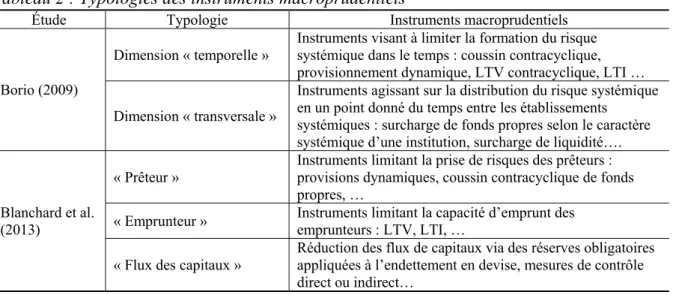
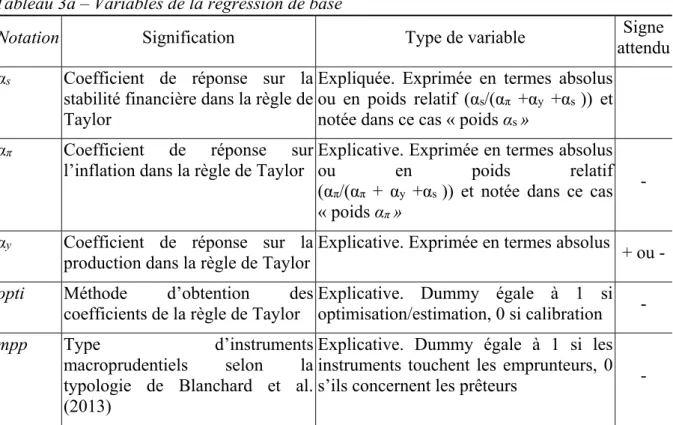
We consider the response to the financial gap in the ATR as our dependent variable because its value is representative of the policy mix between monetary policy and MaP. In the relationship that we test, our explained variable is mainly linked to the type of macroprudential instruments (if they constrain borrowers or lenders), to the magnitude of inflation and output coefficients in the Taylor rule, and to the method for obtaining parameters (by optimization/estimation or calibration). Our results suggest that the type of macroprudential instruments significantly influences the policy mix. In fact, macroprudential instruments constraining borrowers (LTV, LTI) are relatively less favourable to the integrated policy mix, since they are presumably more effective and less prone to leakages. In addition, the more the monetary authority attaches importance to inflation, the less this integration is strong. Finally, economic policy response to financial instability is not universal and depends on country specific constraints.
6 The integrated versus separated approaches in this section are linked to the use of interest rate as a financial
stability instrument, in complement to MaP tools, while the debate in the previous section was about the involvement of central banks in financial supervision/regulation.
17
Section 3. Towards a country-targeted MaP policy in the Euro Zone
In order to analyse the suitable policy mix in the Euro Zone, we use a counterfactual empirical analysis to compare the ECB interest rate policy with a theoretical policy that includes financial stability in the determination of interest rate (chapters 2) and a theoretical, static, New Keynesian model that represents a monetary union and incorporates financial frictions (chapters 3).
The experience of the euro area over the last decade has shown that a single monetary policy does not necessarily promote the economic convergence of countries belonging to a monetary union. The objective of chapter 28 is threefold. First, it seeks, using a counterfactual and static exercise, to illustrate the divergences between countries’ situations using a Taylor gap9 between the ECB interest rate and a standard Taylor rule interest rate, calculated at several levels: the euro area, the core, the periphery, and some individual countries.
Then, we augment the Taylor rule with a financial variable (credit and housing) using two frequently used methods. The first method, with an economic rational, links growth of the financial target on an annual rolling basis with economic growth10. The second method is purely
statistical and uses the Hodrick-Prescott filter to measure historic deviation in the series. We observe that a monetary policy that tries to correct financial imbalances by taking financial stability into consideration could amplify these imbalances. This is because the Euro Zone suffers from asymmetric shocks that are closely linked to the heterogeneity of real estate cycles (Krugman, 2012). Furthermore, business and financial cycles are divergent within and mainly between European countries (Stremmel, 2015) and a unified monetary policy as applied to financial stability can amplify these divergences.
Finally, it explains qualitatively, after reviewing the related literature, how the euro area could benefit from adopting a new policy mix that combines the unique monetary policy with a country-targeted macroprudential policy. For example, the unintended accommodative effect of monetary policy for countries that record higher inflation may be offset by country-adjusted restrictive MaP measures, such as an increased countercyclical capital buffers or lower LTV/DTI caps. It is worth stressing that the macroprudential experience of some emerging countries lacking autonomous monetary policy (e.g. pegging) is instructive for the eurozone. In other words, macroprudential tools are used to manage the “impossible trilemma11” of Robert Mundell. The macroprudential policy seeks to compensate the lack of autonomous monetary policy, since they share many transmission channels.
Using a simple New Keynesian model that represents a monetary union and incorporates financial frictions, chapter 312 provide strong evidence that a country-targeted macroprudential
8 “Towards a Monetary/Macroprudential Policy Mix Promoting Economic and Financial Stability in the Euro
Area”. Original title: “Pour une combinaison politique monétaire / politique macroprudentielle au service de la stabilité économique et financière de la zone euro.” (With Jézabel Couppey-Soubeyran. Published in Revue d’Economie Politique, forthcoming).
9 A Taylor gap is the difference between the effective interest rate set by the central bank (ECB) and the theoretical
interest rate that suits the economy or minimizes the central bank’s loss function (inflation and output gap).
10 The underlying idea is as follows: credit growth of 10% is not excessive if it corresponds to an equivalent
economic growth rate; it is simply responding to economic needs.
11 It means the impossibility of reconciling exchange rate stability, the free movement of capital and an autonomous
monetary policy.
12 “Macroprudential Policy in a Monetary Union” (work in progress, with Leonardo Gambacorta at the Bank of
18
policy could improve financial stability when added to a single monetary policy. Our model consists of four building blocks representing the three “New Keynesian” equations: an IS aggregate demand curve, a Phillips supply curve and a Taylor rule, in addition to a financial friction equation, derived from a micro-founded credit market. We follow the IS-LM-CC model of Bernanke et al. (1988) by distinguishing between the central bank’s rate and a loan rate. MaP policy is modelled as tools that constrain the supply of loans.
We show that MaP policy enhances the optimality’s degree of the monetary union by taming imbalances in the presence of financial shocks and frictions (counter-cyclical credit spread and imperfect transmission of monetary policy to financial conditions). We hypothesize that the credit is countercyclical following the Minsky's financial instability hypothesis (1975). This hypothesis signifies that credit spreads are usually underestimated during boom periods. In other words, as output increases the collateral values are likely to rise and projects' expected default probability decreases which lead banks to distribute more credits. This amplifies the financial and economic cycles and highlights the financial accelerator mechanism. We also introduce a differentiated transmission of monetary policy to financial conditions. This distinction in the pass-through could by justified by a different structure of lending: fixed vs variable rates.
When coordinated with monetary policy, country-targeted macroprudential policy presents several advantages for the set-up of a new policy mix that would allow the achievement of monetary, financial and economic stability. In fact, country-targeted macroprudential policy seems to complement the single monetary policy. These results are even stronger when countries, representing core and periphery, are hit by asymmetric shocks since they cancel out and do not provoke any monetary policy reaction. In addition, we find that unless countries and shocks are fully symmetric, a national implementation of macroprudential policy is systematically more effective than a federal implementation that reacts to the average situation. In case of symmetric financial shock a monetary authority could react alone, but has to modify the nominal interest rate aggressively which may potentially have destabilising effects. Finally, MaP policy could be useful in presence of heterogeneous transmission of monetary policy. It could compensate the imperfect pass through by operating on the credit spreads.
These two chapters evaluate macroprudential policy as a new adjustment tool that enhances the optimality’s degree of the monetary union. They highlight the need for a separated approach where MaP policy is implemented at a country-targeted level.
Section 4. Central bank’s involvement in financial stability: where we are today?
Several evolutions at the institutional level reflect the development of MaP policy with the objective of safeguarding the stability of the financial system as a whole. In the United States, the Dodd-Frank Act, approved in July 2010, has assigned the task of monitoring systemic risk to the Financial Stability Oversight Council (“FSOC”) attached to the U.S. Treasury. The identification of systemic risks and the monitoring of SIFIs are among the main tasks of the FSOC. In the UK, the mandate of the Bank of England has been broadened since the Banking Act of 2009, with increased responsibility for financial stability through establishment within the Bank of a new Financial Policy Committee (“FPC”), alongside the traditional Monetary Policy Committee (“MPC”), and a Prudential Regulatory Authority (“PRA”). The Bank of England was also designated as the UK resolution authority.
19
Within the European Union, the European Systemic Risk Board (ESRB) was established in January 2011, and its national equivalents13 have since progressively been added across each EU member state. The ESRB is responsible for the macroprudential oversight of the financial system within the Union primarily through issuing warnings and recommendations. The Single Supervisory Mechanism (“SSM”) designates the ECB as an important player of the macroprudential framework for the countries that participate in the banking union, mostly those of the Euro Zone. The ECB has the power to request tighter (but not lower) requirements14 than
those set by national authorities, according to Article 5(2) of the SSM Regulation15and to ensure
reciprocity. Furthermore, national authorities must notify the ECB of their intention to implement MaP tools (Article 5(1)) and the ECB can object to them. The asymmetric nature of the powers assigned to the ECB reflects the potential inaction bias of national authorities. In fact, the costs of applying MaP tools are felt immediately, while their benefits are long-term. We note that the coexistence of four layers of decision-making regarding MaP policy in Europe – the ESRB, EBA, ECB and national authorities – makes the institutional architecture rather complex and calls for particular emphasis in coordination and communication. Furthermore, while the ECB is involved in the decision and implementation of MaP measures related to banking activities (through CRD/CRR), some efficient tools (LTV and DTI) remain at the discretion of national authorities.
The ECB is involved in financial stability indirectly since it hosts the ESRB, and also directly via its role as the single supervisory power and first pillar of the banking union (“SSM) with significant power regarding a) macroprudential policy and b) the stress tests which are among the post-crisis supervisory toolkit and are used to both microprudential supervision of individual firms and macroprudential assessments of financial imbalances.
On 4 November 2014, the ECB became the new microprudential supervisor within the framework of the SSM. A few days earlier, on 26 October, the results of a comprehensive assessment (CA) of 130 eurozone banks were published, constituting a preliminary step in the ECB's new mission. Chapter 416 analyses the ECB’s comprehensive assessment composed of an Assets Quality Review (“AQR”) and a stress test.
The ECB stress test’s purely microprudential nature raises the problem of limited credibility. In the chapter 4, we propose to add a macroprudential perspective to stress tests. The tests should take into account the systemic aspect of shocks, second-round effects into dynamic banks' balance sheets, and contagion between banks. The recent financial crisis clearly illustrated the extent of contagion effects on market liquidity and assets fire sales. Furthermore, stress tests must address liability-related vulnerabilities, most notably with reference to the financing structure of banks and the liquidity of bank balance sheets in order to account for vulnerabilities that can lead to events such as the freezing of the interbank market following the collapse of Lehman Brothers. An assessment of liquidity ratios, such as those planned in the Basel III framework including the LCR and NSFR ratios, and a review of the stability of bank
13 There are four institutional models for the allocation of macro-prudential powers: the government, the central
bank, the financial authority and a committee with representatives from these three bodies (ESRB, 2014).
14 Those falling within the scope of the capital requirements directives and regulation CRD/CRR that implement
the Basel III banking regulation.
15 The ECB is required however to notify the national authorities (Article 5(4)) which can object to the measures,
even though objections are not legally binding (ESRB, 2014).
16 “Do stress tests have a macroprudential perspective? An assessment through the lens of the ECB’s exercice”
20
funding such as bank dependency on short term wholesale funding are welcome additions for robust and meaningful stress testing standards17.
The results of the Comprehensive Assessment (“CA”) published by the ECB in October 2015 seem to attest the soundness of the European banking system since only 8 of 130 assessed banks had to raise a mere €6 billion of fresh capital to meet the tests. However, it would be a mistake to conclude that non-failing banks are completely healthy. Using data provided by the ECB and the EBA, and data from the SNL database, we draw some conclusions about the soundness of the European banking system and provide three areas of policy recommendations to resolve remaining shortcomings in the current stress test regime.
First, the assumptions on which the stress tests were based resulted in mild scenarios and requirements. Unlike the Fed and BoE stress tests, ECB stress test and communication about results was restricted to the risk-weighted capital ratio, whereas the leverage ratio paints a more nuanced picture. Our calculations, holding other things equal, of a stressed leverage ratio of 3% show an absolute capital shortfall of €13 billion Tier1 capital, in 2015. Moreover, if we consider a 4% ratio, which will be the case in many countries18 if not higher, the shortfall is estimated at €88 billion Tier1 capital in 2015.
Second, as mentioned by the ECB, this exercise suffers from a problem of comparability between banks which have different risk models and between countries where there are more than 150 different supervisory discretion applied by national regulators. Additionally, the risk-weighted capital ratio cannot be taken literally, because its scope is evolving over the next four years during the transition to fully loaded Basel III requirements. In Basel III, many elements previously classified as equity or assets, such as intangible assets and deferred tax assets, will progressively disappear by 2018. Furthermore, all countries do not maintain the same pace of implementation and Basel compliance schedule can vary as much as three years even within the EU. If we consider now the final deductions of equity, banks need an incremental €130 billion to maintain today’s level of capital CET1.
Third, when transposing the Basel committee recommendations into European law, the EU selected a zero risk weight for all sovereign debt securities of European Union countries, including, for example, Greece, while the Basel regulation offered this possibility only for those sovereign debt securities considered risk-free. An application of Basel risk weight on sovereign exposure leads to a capital shortfall of €34 billion.
From merely observing the alternate stress tests in more robust form, we can see multiples of capital shortfalls relative to the ECB’s October 2015 results. Our work suggests how to add a macroprudential perspective and ensure comparable credible stress tests in line with the regulatory evolution.
17 Since 2012, the Federal Reserve has been conducting a confidential liquidity analysis “Comprehensive Liquidity
Analysis and Review - CLAR”, testing the capacity of the major banks to withstand liquidity disruption. In the UK, the Prudential Regulation Authority’s (PRA) has the supervisory role to examine liquidity and funding risks (PRA, 2015).
18 In the UK, The basic leverage remains at 3%, but will be supplemented by systemic and capital buffers and may
reaches 4.95%. Leverage ratio in the US increased to 5% for major American banks, and even 6% for those participating in the deposit insurance system (BoE, 2014b). Switzerland will apply a 5% (3.5% of CET1) leverage ratio for major banks.
21
Section 5. Limits of macroprudential policy
The implementation of a new framework for financial stability raises a number of challenges analysed in this dissertation. Unlike monetary policy, which has a clear intermediate target, namely stability of inflation around the target of 2% for the major central banks, there is no clear definition of financial stability. One of the main challenges is the evaluation of the effectiveness of MaP policies, especially when more than one tool is activated simultaneously which require fine tuning for successful implementation.
From a practical perspective19, the exercise of macroprudential policy is undoubtedly not an easy task, since it optimally requires both coordination with microprudential and monetary authorities. The first difficulty lies in quantifying systemic risk, despite a substantial academic progress in developing systemic risk indicators (Bisias et al., 2012; de Bandt et al., 2013). A second difficulty lies in calibration of macroprudential instruments and the choice of legal routes since they are not neutral in terms of timing, process of notifications and the capacity of obtaining automatic reciprocity from other countries. The effectiveness of MaP tools remains problematic to assess given the wide range of possible tools, their interactions, and a scarcity of data and practical experience to appraise results. A third challenge is the possibility of leakages to relatively less regulated activities/institutions or countries since MaP instruments are generally targeted. In that regard, MaP regulation and supervision should be extended to shadow banks to ensure that financial stability remains balanced. Otherwise, the blunt interest rate tool remains the only tool that can reach these unregulated institutions leaving macroprudential policy with only half a chance to prove its efficacy.
Policy makers should be careful to avoid overestimation of and overreliance on MaP policy effectiveness. Macroprudential policy execution remains highly contingent on institutional framework. Also, as highlighted by Borio (2014), MaP policy alone cannot be expected to achieve everything and is only part of a comprehensive policy solution for financial stability. Central banks should take into consideration the different spillovers that result from their actions to the financial system and pay a special attention during the transition/testing period of MaP tools to ensure that they have integrated the policy mix in a balanced and effective manner. Our results highlight the initial steps central banks should consider in balanced implementation.
19 This paragraph is based, in part, on my experience as a PhD intern in the Macroprudential Toolkit Team of the
Prudential Policy Directorate at the Bank of England. My project at the Bank is linked to the implementation of sectoral capital requirements to residential and commercial real estates.
22
References
Adrian, T., Shin, H.S., 2009, “Financial intermediation and monetary economics”, Federal Reserve Bank of New York Staff Reports, 398.
Agur, I. and Demertzis M., 2010, "Monetary policy and excessive bank risk Taking", De Nederlandsche Bank Working Paper No. 271.
Altunbas Y., L. Gambacorta, and Marques-Ibanez, D., 2014, "Does Monetary Policy Affect Bank Risk?", International Journal of Central Banking, vol. 10(1), pages 95-136, March. Arnone M. and Gambini A., 2007, “Architecture of Supervisory Authorities and Banking Supervision”, in Masciandaro D. and Quintyn M. (eds.), Designing Financial Supervision Institutions: Independence, Accountability and Governance, 262-308, Cheltenham, Edward Elgar.
Bisias D., Flood M., Lo A. and Valavanis S., 2012, "A Survey of Systemic Risk Analytics", Office of Financial Research, Working Paper 1, January 2012
Bagehot, W., 1873, “Lombard Street: A Description of the Money Market”, H.S. King of London, London.
Blanchard, O, G Dell’Ariccia, and P Mauro, 2010, “Rethinking Macroeconomic Policy”. IMF Staff Position Note, SPN/10/03, 12 February.
Borio, C., English, W. and Filardo, A., 2003, “A tale of two perspectives: old or new challenges for monetary policy?” BIS Working Papers, No 127
Borio, C., Zhu, H., 2012, “Capital regulation, risk-taking and monetary policy: a missing link in the transmission mechanism?”, Journal of Financial Stability, 8 (4), 236-251.
Boyer, P.C. and Ponce J., 2011, ‘Regulatory Capture and Banking Supervision Reform’, Journal of Financial Stability, 8, 206-217.
Bruno, V. and Shin, H.S., 2013, “Capital Flows and the Risk-Taking Channel of Monetary Policy”, BIS Working Paper No. 400, March, 2013).
CAE, 2011, “Central Banks and Financial Stability” by Betbèze, J.P. Bordes, C., Couppey-Soubeyran, J., Plihon, D., No.96. April.
Čihák M. and Podpiera R., 2007, “Experience with Integrated Supervisors: Governance and Quality of Supervision”, in Masciandaro D. and Quintyn M. (eds.), Designing Financial Supervision Institutions: Independence, Accountability and Governance, 309-341, Edward Elgar, Cheltenham.
De Bandt O., Héam J.-C. , Labonne C., and Tavolaro S., 2013, "Measuring Systemic Risk in a Post-Crisis World", Débats économiques et financiers 6, ACPR.
Eichengreen B. and Dincer N., 2012, “The Architecture and Governance of Financial Supervision: Sources and Implications”, International Finance, Vol. 15, No. 3: 309 - 325, 2012. Goodhart, C and Schoenmaker D., 1995, “Should the Functions of Monetary Policy and Banking Supervision be Separated?”, Oxford Econ. Papers Vol 47, p. 539-560
Goodhart, C., 2000, “The Organisational Structure of Banking Supervision”, Financial Stability Institute, Occasional Papers, Number 1.
Goodhart, C., Schoenmaker, D. and Dasgupta, P., 2002, “The Skill Profile of Central Bankers and Supervisors”, European Finance Review 6, 397-427.
23
Jiménez G., Ongena S., Peydró, J.L., & and Saurina, J., 2014, "Hazardous Times for Monetary Policy: What Do Twenty‐Three Million Bank Loans Say About the Effects of Monetary Policy on Credit Risk‐Taking?," Econometrica, Econometric Society, vol. 82(2), pages 463-505, 03. Lamfalussy A., 2010, “The Future of Central Banking under Post – Crisis Mandates”, BIS Papers, 55.
Maddaloni A., and Peydró JL, 2011 "Bank Risk-taking, Securitization, Supervision, and Low Interest Rates: Evidence from the Euro-area and the US Lending Standards", Review of Financial Studies 24: 2121 to 2165.
Padoa-Schioppa, T., 2002,"Central Banks and Financial Stabiilty: Exploring A Land In Between", Second ECB Central Banking Conference Frankfurt am Main 24 and 25 October 2002
Rajan, R., 2006, “Has financial development made the world riskier?”, European Financial Management, 12(4), 313-369.
Schwartz, A.J., 1995, “Why financial stability depends on price stability”, Economic Affairs, 15(4), 21-25.
25
Chapter 1.
The Policy Mix Between Monetary and
Macroprudential Policies.
26
Abstract
We perform a meta-analysis of 23 DSGE models that all specify the policy mix between monetary policy and macroprudential policy (MaP). These models have in common to incorporate macroprudential policies, particularly in the form of rules used to limit financial fluctuations, and represent monetary policy through an augmented Taylor rule (ATR) which adjust the interest rate to the inflation gap, the output gap and a financial gap. We consider the response to the financial gap in the ATR as our dependent variable considering that its value is representative of the policy mix between monetary policy and MaP. In the relationship that we test, our explained variable is mainly linked to the type of macroprudential instruments (if they constrain borrowers or lenders), to the magnitude in the Taylor rule of the coefficients on inflation and the output gap, and to the method for obtaining parameters (by optimization/estimation or calibration). Our results suggest that the type of macroprudential instruments significantly influences the integration degree of the mix between monetary policy and MaP. In addition, the more the monetary policy attaches importance to inflation, the less this integration is strong.
This chapter has been written with Emmanuel Carré and Jézabel Couppey-Soubeyran, and has been published in Revue Économique, vol 66, issue 3, May 2015.
La coordination entre politique monétaire et politique macroprudentielle. Que disent les modèles DSGE?
Résumé
Nous réalisons une méta-analyse de vingt-trois modèles DSGE qui réunissent toutes les caractéristiques permettant d’observer les modalités de la combinaison entre la politique monétaire et la politique macroprudentielle (PMP). Ces modèles ont en commun d’incorporer des instruments macroprudentiels visant à limiter les fluctuations financières et de représenter la politique monétaire au moyen d’une règle de Taylor qui peut faire répondre le taux d’intérêt à la fois à l’écart d’inflation, à l’écart de production et à un écart financier. En considérant la valeur du coefficient de réponse à l’écart financier dans la règle de Taylor comme la charnière du policy-mix entre politique monétaire et PMP, nous en faisons notre variable dépendante. La relation que nous testons fait principalement dépendre cette variable du type d’instruments macroprudentiels choisis, de l’importance relative donnée à l’inflation et à l’output gap dans la règle de Taylor, et des modalités d’obtention (par optimisation/estimation ou par calibration) des coefficients de réponse dans la règle de Taylor. Nos résultats suggèrent que le type d’instruments macroprudentiels choisis influence de manière significative le degré d’articulation entre politique monétaire et PMP et que plus la règle de politique monétaire accorde de l’importance à l’inflation et moins cette articulation est forte.
Mots-clés : policy-mix, politique monétaire, règle de Taylor augmentée, politique macroprudentielle.
27
Section 1. Introduction
Aux États-Unis, en Grande-Bretagne comme dans l’Union européenne, les réformes entreprises pour répondre à la crise enclenchée en 2007-2008 reposent en grande partie sur le renforcement du dispositif prudentiel des banques. Ce dispositif impliquera les banques centrales davantage qu’auparavant. La banque d’Angleterre reprend une grande partie des prérogatives de la
Financial Services Authority en matière de supervision bancaire et voit ainsi son mandat
augmenté de la stabilité financière dans le Banking Act de 2009. De même, la Réserve fédérale américaine (Fed) a désormais en charge la surveillance des établissements systémiques et, dans l’Union européenne, la Banque centrale européenne (BCE) est devenue, en novembre 2014, le superviseur des grands établissements bancaires de la zone euro. Pour le moment, il s’agit donc surtout de confier aux banques centrales une mission microprudentielle de surveillance des établissements bancaires.
Plusieurs avancées sur le plan institutionnel témoignent parallèlement de la gestation d’une politique macroprudentielle (PMP) dont l’objectif sera la stabilité d’ensemble du système financier. Au sein de l’Union européenne a ainsi été mis en place, depuis janvier 2011, le Conseil européen du risque systémique (ESRB). Aux États-Unis, la loi Dodd-Frank, votée en juillet 2010, a confié la tâche de surveillance du risque systémique au Financial Stability
Oversight Council (FSOC) rattaché au Trésor américain. Au Royaume-Uni, le Financial Services Act de 2012 a confié la surveillance macroprudentielle au Financial Policy Committee
(FPC) placé sous l’égide de la Banque centrale. Ces comités commencent à préparer le terrain de la future politique macroprudentielle et devront choisir les instruments permettant de prévenir au mieux le risque systémique.
La mise en œuvre concrète de la PMP sur le plan opérationnel prendra néanmoins du temps. Précisément parce que son objectif ultime – la stabilité financière – recouvre plusieurs dimensions : la stabilité financière renvoie tout autant à la stabilité du secteur bancaire, du crédit, à celle des marchés d’actifs et des prix qui s’y forment, celle des marchés des changes, des marchés interbancaires, au bon fonctionnement des systèmes de paiement, etc. La définition que la Banque centrale européenne (2013) retient de la stabilité financière traduit ce caractère multidimensionnel: « Situation dans laquelle le système financier, qui recouvre les
intermédiaires financiers, les marchés et les infrastructures de marché, est capable de faire face aux chocs et à une correction brutale des déséquilibres financiers, réduisant ainsi la probabilité quapparaissent, dans le processus dintermédiation financière, des perturbations suffisamment graves pour compromettre sérieusement lallocation de lépargne à des projets dinvestissement rentables ». Mais c’est aussi la raison pour laquelle il n’existe(ra) pas de
consensus dans la littérature autour de la définition de la stabilité financière (Borio et Drehmann, 2009). À la différence de la stabilité monétaire que les banques centrales comme la communauté académique ont convenu de réduire à une cible d’inflation et donc à « un chiffre », sinon une fourchette, la stabilité financière de par sa nature multidimensionnelle se prêtera difficilement à ce type de réduction. Du moins, chaque autorité qui en aura la charge à un niveau global devra-t-elle préciser la (les) dimension(s) qu’elle entend privilégier : la stabilité du crédit pour les unes, celle des prix d’actifs pour les autres, etc.
L’autre difficulté, à laquelle se trouveront confrontées les autorités monétaires et macroprudentielles, qu’elles soient logées ensemble ou non au sein de la banque centrale, sera de coordonner l’action de la politique monétaire et celle de la PMP. Pour s’attaquer à l’instabilité financière, la politique monétaire ne devrait-elle pas s’efforcer de contrer le cycle financier, en empêchant par exemple les bulles de prix d’actifs de se former et ainsi s’orienter vers la stratégie de « leaning against the wind » (Cecchetti et al., 2000 ; Borio et White, 2004 ; White, 2009) (littéralement, « lutter contre le vent » pour signifier une action de la politique monétaire à contre-courant du cycle financier). La règle de Taylor (Taylor, 1993), qui est
28
devenue la représentation standard de la règle de politique monétaire des années 1990-2000 jusqu’à la crise, limitait initialement la réaction de la politique monétaire à une cible d’inflation et à l’écart de production, et ne concevait donc pas initialement ce type de réaction au cycle financier. Son extension à une cible financière permettant de faire réagir le taux directeur aux tensions financières a été l’une des premières façons d’envisager la fin du « principe de séparation » entre la stabilisation de l’inflation et la prévention de l’instabilité financière (Käfer, 2014). La crise financière semblait alors avoir bouleversé les considérations stratégiques à propos de la politique monétaire et démontré le danger de la stratégie du « cleaning up
afterwards » (littéralement, « le fait de nettoyer les dégâts après coup», (White, 2009)),
consistant à ignorer la bulle en formation excepté dans le cas où elle fait augmenter l’inflation ou les anticipations en la matière.
Loin d’avoir clos le débat « clean » versus « lean », l’avènement de l’instrument macroprudentiel durant la crise l’a plutôt réorienté. Présenté comme l’instrument efficace de lutte contre l’instabilité financière, le macroprudentiel tend en effet à rétablir le principe de séparation qui prévalait avant la crise. La règle de Taylor standard (non augmentée de la stabilité financière) redevient l’option à privilégier, et avec elle le régime de ciblage de l’inflation. Plusieurs simulations (Banque d’Angleterre, 2009) ont, en effet, démontré qu’à elle seule l’augmentation de la règle de Taylor ne constitue pas une alternative souhaitable à la PMP, car si tout l’effort de contention des désajustements financiers reposait sur le seul instrument du taux d’intérêt, il faudrait dans certaines situations élever le taux d’intérêt à des niveaux inenvisageables. On retrouve là le principe de Tinbergen (1952) : il faut disposer d’au moins autant d’instruments que d’objectifs à atteindre. En l’occurrence, cela signifie que le taux d’intérêt ne permet tout simplement pas d’atteindre à lui seul trois objectifs : la stabilité monétaire, la stabilité macroconjoncturelle et la stabilité financière.
Une autre justification au maintien de la règle de Taylor standard tient au principe de Mundell (1962) d’affectation des instruments aux objectifs : un instrument doit être affecté à l’objectif sur lequel il a le plus d’impact. Or nombre d’études suggèrent que l’instrument macroprudentiel a plus d’impact sur la stabilité financière que l’instrument de taux d’intérêt (Goodhart et al., 2010).
Cela étant, les promoteurs de la règle de Taylor augmentée n’envisageaient sans doute pas eux-mêmes qu’elle puisse constituer la seule et unique réponse à l’objectif de stabilité financière. Et la règle de Tinbergen n’enseigne pas non plus (contrairement à l’interprétation stricte qui en est souvent donnée et que Tinbergen rejetait) que chaque instrument soit alloué à un seul objectif. Dès lors qu’il y a autant d’instruments que d’objectifs, rien n’empêche en théorie d’affecter un même instrument à plusieurs objectifs en hiérarchisant ses affectations (Blanchard, 2012). En d’autres termes, si le taux d’intérêt ne peut pas tout, peut-être peut-il agir en complément de(s) l’instrument(s) macroprudentiel(s) et constituer l’élément de coordination entre la politique monétaire et la PMP ?
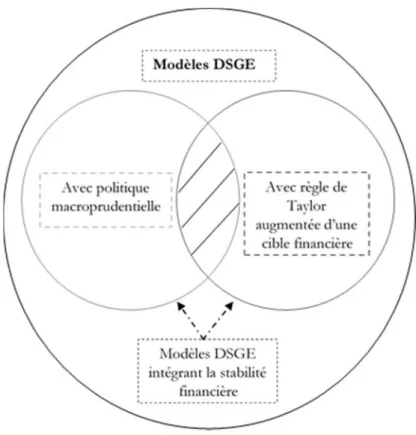
Si l’on tient pour acquise l’hypothèse, aujourd’hui largement partagée dans la littérature (Beau et al., 2011), qu’une PMP est désormais indispensable au maintien de la stabilité financière, alors un policy-mix des politiques monétaire et macroprudentielle devient nécessaire. Deux conceptions polaires de ce policy-mix sont envisageables. Celles-ci relancent le débat quant à l’orientation stratégique « clean » versus « lean » de la politique monétaire en présence de la PMP. Celle selon laquelle le taux d’intérêt pourrait agir en priorité sur la stabilité monétaire mais agir aussi en temps voulu sur la stabilité financière en complément des instruments macroprudentiels relève d’une approche « intégrée » du policy-mix entre politique monétaire et PMP selon une terminologie introduite par Kremers et Schoenmaker (2010) et popularisée par Blanchard (2012) et le FMI (2013a). Dans cette approche, la stabilité monétaire et la stabilité financière sont « intégrées » dans une règle de Taylor « augmentée ». La politique monétaire est orientée « lean » pour soutenir l’instrument macroprudentiel. Le taux d’intérêt et
29
l’instrument macroprudentiel sont alors supposés complémentaires. A l’opposé de cette approche intégrée, l’approche « séparée » (Kremers et Schoenmaker, 2010) ou « découplée » (Stein, 2013) n’envisage pas que le taux d’intérêt puisse répondre à quelque moment que ce soit à la stabilité financière. Sur la base d’une lecture stricte à la fois du principe de séparation, de la règle de Tinbergen et du principe de Mundell, l’approche séparée préconise d’affecter la politique monétaire tout entière à la stabilité monétaire et la PMP tout entière à la stabilité financière.
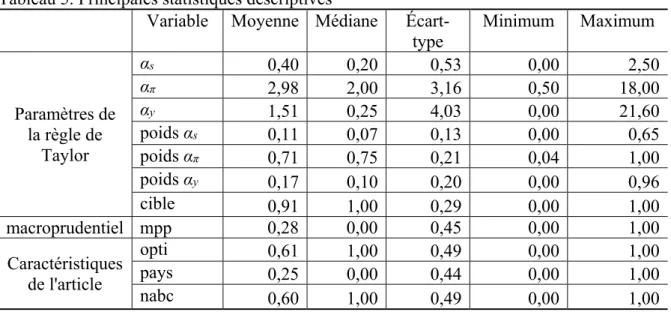
Dans la suite de cet article, nous proposons une méta-analyse d’un sous-ensemble récent de modèles DSGE (Dynamic Stochastic General Equilibrium ou modèles d’équilibre général dynamiques et stochastiques) qui réunissent les caractéristiques permettant d’étudier les modalités de ce policy-mix entre politique monétaire et PMP : ils ont en commun de ne pas exclure l’action combinée de ces deux politiques car ils incorporent à la fois des instruments macroprudentiels pour limiter les fluctuations financières et une règle de Taylor augmentée (RTA) d’un écart financier (les articles excluant l’augmentation de la règle de Taylor n’envisagent pas possible d’articuler les deux politiques via l’action du taux d’intérêt). Les 23 modèles que nous recensons avec ces caractéristiques fournissent 99 observations du coefficient de réponse à l’écart financier dans la règle de Taylor car chaque article envisage plusieurs scénarios (différents chocs, différents instruments macroprudentiels, coordination plus ou moins forte, …). Ce coefficient fut au cœur du débat « clean versus lean » et reste présenté dans la littérature récente comme la charnière du policy-mix entre politique monétaire et PMP (Kiley et Sim, 2014).
Les principales questions que nous posons sont les suivantes : où se situe ce nouveau sous-ensemble de modèles DSGE dans la gamme des policy-mix envisageables entre politique monétaire et PMP ? Les modèles DSGE qui n’interdisent pas l’action combinée de la politique monétaire et de la PMP (via une RTA) envisagent-ils une complémentarité entre le taux d’intérêt et le(s) instrument(s) macroprudentiel(s) pour préserver la stabilité financière ? La nature et la diversité des instruments macroprudentiels retenus influencent-elles la solution de policy-mix ? Le pays considéré et l’institution d’appartenance des auteurs de ces modèles ont-ils également une incidence sur la solution obtenue ?
Notre article se poursuit de la manière suivante. La deuxième section présente les deux approches du policy-mix entre politique monétaire et PMP qui ont émergé dans la littérature. La troisième section fournit un état des lieux des modèles DSGE incorporant à la fois la politique monétaire, sous la forme d’une RTA, et la PMP. La quatrième section explicite la méthodologie de notre étude, nos variables d’intérêt, la relation testée et présente un ensemble de statistiques descriptives des modèles retenus. La cinquième section présente et interprète les résultats obtenus. La dernière section 6 conclut.
Section 2. « Approche séparée » versus « approche intégrée » de la combinaison
entre politique monétaire et politique macroprudentielle
Deux cas polaires de la combinaison entre politique monétaire et PMP ont émergé dans la littérature. Les deux approches ont des fondements théoriques différents, et sous-tendent des conceptions différentes quant aux canaux de transmission, aux instruments utilisés et aux modalités d’affectation de ces derniers. Le tableau 1 en fait la synthèse.
Les promoteurs d’une approche intégrée de ce policy-mix soulignent qu’une règle de Taylor standard accentue les risques financiers via le « canal de la prise de risque » inspiré de Minsky (Borio et Lowe, 2002). Ils soulignent aussi les limites du macroprudentiel (Mishkin, 2011) et l’intérêt d’y associer une RTA, soumettant non pas seulement les banques mais l’ensemble du marché, y compris le shadow banking, à un taux d’intérêt ajusté en fonction des tensions financières. À cet égard est parfois mise en avant la nature plus étroite des instruments
30
macroprudentiels : parce qu’ils sont plus ciblés, ils peuvent aussi être plus facilement contournés, d’où la nécessité de compléter leur action par celle du taux d’intérêt (Angeloni, 2014). De plus, tant que l’efficacité des instruments macroprudentiels n’est pas clairement établie, il peut être tout simplement prudent d’y adjoindre l’action du taux d’intérêt (Agénor et al., 2013).
A l’opposé, Svensson (2012) défend l’approche séparée en mettant l’accent d’un côté sur les limites de l’instrument de taux d’intérêt et de l’autre sur l’efficacité de l’instrument macroprudentiel face à l’instabilité financière. Smets (2013) y voit une nouvelle expression du consensus de Jackson Hole qui privilégie le « cleaning ». On retrouve l’argument standard selon lequel la crédibilité de la banque centrale peut avoir à souffrir d’un double objectif de stabilité monétaire et de stabilité financière (Goodhart et Schoenmaker, 1995). De plus, en l’absence de règle uniforme et clairement établie, la politique macroprudentielle est davantage exposée à des problèmes d’incohérence temporelle, ce qui peut aussi affecter la crédibilité des banques centrales et, par suite, l’efficacité de leur politique monétaire (Ueda et Valencia, 2012). Au sein même des banques centrales, bien que la politique macroprudentielle n’en soit pas encore à un stade opérationnel, les avis sont partagés entre ces deux conceptions. Ainsi Praet (2011) pour la BCE, Olsen (2013) pour la Banque de Norvège et Stein (2013) pour la Fed se rangent plutôt du côté d’une approche intégrée. Mais Ekholm (2013) pour la Banque de Suède, Spencer (2010) pour la Banque de réserve de Nouvelle Zélande, ainsi que Bernanke (2012) pour la Fed préfèrent l’approche séparée.
À chacun de ces deux régimes de policy-mix correspond une représentation de la politique monétaire via la règle de Taylor. Dans l’approche séparée du policy-mix, il n’y a aucune raison d’augmenter la règle de Taylor. L’instrument macroprudentiel est supposé pleinement efficace pour empêcher l’instabilité financière. A l’inverse, dans l’approche intégrée du policy-mix, la règle est augmentée d’une cible financière afin que le taux d’intérêt complète l’action de la politique macroprudentielle, ou au moins pour s’assurer que l’action du taux d’intérêt n’aille pas à l’encontre de la stabilité financière.
En pratique, le choix du policy-mix relèvera sans doute davantage de l’art que de la science. Cependant, la « science », sur laquelle la politique monétaire a au cours des dernières années difficilement trouvé à s’appuyer, tente depuis peu d’opérer sa mue. Les modèles DSGE, qui constituent depuis le début des années 200020le principal outil de modélisation
macroconjoncturelle issu de la théorie macroéconomique, s’efforcent de mieux intégrer les frictions financières.