HAL Id: hal-01691802
https://hal.archives-ouvertes.fr/hal-01691802
Submitted on 24 Jan 2018
HAL is a multi-disciplinary open access
archive for the deposit and dissemination of
sci-entific research documents, whether they are
pub-lished or not. The documents may come from
teaching and research institutions in France or
abroad, or from public or private research centers.
L’archive ouverte pluridisciplinaire HAL, est
destinée au dépôt et à la diffusion de documents
scientifiques de niveau recherche, publiés ou non,
émanant des établissements d’enseignement et de
recherche français ou étrangers, des laboratoires
publics ou privés.
Ionic Liquids: evidence of the viscosity scale-dependence
Quentin Berrod, Filippo Ferdeghini, Jean-Marc Zanotti, Patrick Judeinstein,
Didier Lairez, Victoria Garcia Sakai, Orsolya Czakkel, Peter Fouquet, Doru
Constantin
To cite this version:
Quentin Berrod, Filippo Ferdeghini, Jean-Marc Zanotti, Patrick Judeinstein, Didier Lairez, et al..
Ionic Liquids: evidence of the viscosity scale-dependence. Scientific Reports, Nature Publishing Group,
2017, 7 (1), 8 p. �10.1038/s41598-017-02396-7�. �hal-01691802�
Quentin Berrod
1,2, Filippo Ferdeghini
1,3, Jean-Marc Zanotti
1, Patrick Judeinstein
1,
Didier Lairez
1,4, Victoria García Sakai
5, Orsolya Czakkel
6, Peter Fouquet
6& Doru Constantin
7Ionic Liquids (ILs) are a specific class of molecular electrolytes characterized by the total absence of co-solvent. Due to their remarkable chemical and electrochemical stability, they are prime candidates for the development of safe and sustainable energy storage systems. The competition between electrostatic and van der Waals interactions leads to a property original for pure liquids: they self-organize in fluctuating nanometric aggregates. So far, this transient structuration has escaped to direct clear-cut experimental assessment. Here, we focus on a imidazolium based IL and use particle-probe rheology to (i) catch this phenomenon and (ii) highlight an unexpected consequence: the self-diffusion coefficient of the cation shows a one order of magnitude difference depending whether it is inferred at the nanometric or at the microscopic scale. As this quantity partly drives the ionic conductivity, such a peculiar property represents a strong limiting factor to the performances of ILs-based batteries.
As they show low flammability and electrochemical reactivity, Ionic Liquids (ILs) have been identified as prom-ising electrolytes for batteries1. The combination of a large diversity of anions and cations leads to a flourishing
variety of ILs2, but they all share a common ground: the presence in their diffraction patterns of a so-called
pre-peak in the 0.2–0.5 Å−1 region. This prepeak is the signature of a semi-local (few nm) segregation3 in the liquid.
Molecular Dynamics simulations (MD) suggest that this nano-structuration extends up to a scale one order of magnitude larger4 (few tens of nm). But, while such characteristic size should be easily detectable by Small
Angle Neutron (SANS) or X-Ray (SAXS) Scattering techniques, no SANS or SAXS data report any nanometric spatial organization of pure bulk ionic liquids. A possible explanation is that the local evanescent organization responsible for the prepeak does not induce large enough density fluctuations able to create a contrast between the segregated regions of the liquid.
The ILs structuration has nevertheless been inferred, but rather indirectly, through the assessment of dynam-ical quantities by Quasi-Elastic Neutron Scattering (QENS). It has for example been shown5, 6, that at the
molec-ular scale and short time (few tens of ps) a confinement volume could account for a localization of ILs molecules within nanometric aggregates. But, as QENS probes the system on a local scale (few nm at most) the expected few tens of nm characteristic size of the nanometric structuration remains unreachable.
In the present paper, we ally Time-of-Flight (ToF) QENS, Neutron Spin Echo (NSE), Dynamical Light Scattering based particle-probe rheology (DLS-PBR) and Pulsed Field Gradient Nuclear Magnetic Resonance (PFG-NMR) to reach a coherent structural and dynamical multi-scale view of the ILs physics, from the molecular to the microscopic scales. We first evidence that the transport properties of ILs are scale dependent. Then, we show that DLS-PBR is able to bridge both in space and time the process leading to such a scale dependence of the transport properties. All the experimental approaches used here, probe the spatial dependence of the dynamical modes through a common quantity: Q, the scattering vector (proportional to the inverse of a distance). As it is closely related to the ionic conductivity by the Nernst-Einstein relation, we are interested in a single quantity: the translational diffusion coefficient of the IL. We focus our study on a canonical imidazolium based IL: 1-butyl-3-methyl imidazolium bis(trifluoromethanesulfonyl imide (BMIM-TFSI). The neutron scattering cross-section
1Laboratoire Léon Brillouin, CEA, CNRS, Université Paris-Saclay, CEA Saclay, 91191, Gif-sur-Yvette, Cedex, France. 2Lawrence Berkeley National Laboratory, Energy Storage Group, 1 Cyclotron Road, Berkeley, CA, 94720, USA. 3Laboratoire des Interfaces Complexes et de l’Organisation Nanométrique, ECE-Paris Ecole d’Ingénieurs, 37 Quai
de Grenelle, 75015, Paris, France. 4Laboratoire des Solides Irradiés, École Polytechnique, CEA, CNRS, Université
Paris-Saclay, 91128, Palaiseau, Cedex, France. 5ISIS Neutron and Muon Facility, Rutherford Appleton Laboratory,
Chilton, Didcot, OX11 0QX, UK. 6Institut Laue Langevin, 38042, Grenoble, Cedex, France. 7Laboratoire de Physique
des Solides, CNRS, Univ. Paris-Sud, Université Paris-Saclay, 91405, Orsay, Cedex, France. Quentin Berrod and Filippo Ferdeghini contributed equally to this work. Correspondence and requests for materials should be addressed to J.-M.Z. (email: [email protected])
Received: 17 February 2017 Accepted: 18 April 2017 Published: xx xx xxxx
www.nature.com/scientificreports/
of protons being much larger than the ones of all the isotopes in BMIM-TFSI, QENS and NSE are only sensitive to the self-correlation dynamics of the BMIM cation. We also study a specifically deuterated BMIM cation, in order to validate the neutron model of the cation dynamics we propose.
Results
Neutron scattering: probing the cation CoM long-range diffusion at the molecular scale
(ps-ns/0.1–10 nm).
The relevant quantity we are interested in is the long-range diffusion of the center-of-mass (CoM) of the whole molecule. But, as QENS probes the dynamics on a rather local scale (few Å), the contribution of the molecule side-chains (Fig. 1) is not negligible. At a larger scale, the liquid self-organization constitutes a spatial heterogeneity that also influences the averaged IL dynamics5. We develop a model (SI section 1) able todescribe all those dynamical modes i.e. fast reorientational motions of the side-chains (labeled sc), long-range diffusion of the CoM (lr) and tumbling of the whole molecule around itself (SI section 2). As this is a specificity of this system, we also pay a special attention to the transient localized motion (loc) due to the IL self-organization7.
The total dynamical structure factor (SI section 1.2) of the BMIM cation is:
ω ≈ ω + ω + ω
S Q( , ) I Q L Q1( ) ( , )lr I Q L Q2( ) ( , )loc I Q L Q3( ) ( , )sc (1) where the Ii(Q) are combinations of the form-factors describing the geometry of the motion associated to each of
the dynamical modes and a parameter p is weighting the proportion of the side-chain protons for each of the neat or selectively deuterated sample (Fig. 1a).
In conclusion, the dynamical structure factor describing the model is composed of three Lorentzian relaxa-tions. Each of the HWHM (Half Width at Half Maximum) are related to a unique dynamical mode. In the time domain, as directly accessed by NSE, Eq. (1) can be rewritten as:
≈ − τ + − τ + − τ
I Q t( , ) I Q e1( ) t/ ( )lrQ I Q e2( ) t/ ( )locQ I Q e3( ) t/ ( )scQ (2) where τi = ħ/Γi with i = loc, sc and τlr = (DlrQ2)−1. Dlr is the long-range translational diffusion coefficient inferred
by the neutron methods at the molecular scale (ps-ns / 0.1–10 nm).
Molecular scale dynamics: cation specific deuteration to challenge the robustness of the
neu-tron model.
Figure 2 and Fig. S2 show that the model Eq. (1) fairly well describes the QENS experimental data of the BMIM cations at 298 K. The local dynamics of the side-chains strongly contributes to the neutron spectra. In order to check that this major contribution is well accounted-for by the model, experiments have been performed on a BMIM-TFSI sample with deuterated alkyl side-chains (Fig. 1). While the statistical weight of the alkyl side-chain protons in equation Eq. S4 is p = 0.8 for the fully hydrogenated form of BMIM, it reduces toFigure 1. (a) This study focuses on the multi-scale dynamics of the cation of BMIM-TFSI. On the chemical
structure above the red squares identify the methyl and alkyl side-chains carried by the imidazolium ring. While the quantity of interest here is the long-range translational diffusion coefficient of the center-of-mass of the whole cation, the QENS/NSE signal is very sensitive to the dynamics of the side-chains. The neutron experiments have been carried out on the fully protonated cation, but in order to challenge the robustness of the model we propose, the neutron contribution of the alkyl side-chain (squares filled in grey color) has been hidden by deuteration. Throughout this paper, this selectively deuterated cation sample will be called B(d9) MIM-TFSI. (b) Space and time plot illustrating the scales probed by Time-of-Flight (ToF) Quasi-Elastic Neutron Scattering (QENS), Neutron Spin-Echo (NSE), Pulsed-Field Gradient Nuclear Magnetic Resonance (PFG-NMR) and Dynamic Light Scattering (DLS). The shaded lines indicate the generic space and time scales accessible with these techniques. The scales specifically accessed in the present paper are shown with dotted rectangles. The three regions in time and space covered by the three instrumental conditions used in QENS here are labeled as ToF1, ToF2 and ToF3.
p = 0.5 for the selectively deuterated analog. The fits are in good agreement with the QENS (Figs S2, S3) and NSE (Figs S4, S5) data, for both the hydrogenated and deuterated forms of the BMIM cation. The model is therefore valid for both picoseconds and nanoseconds time ranges. The very good description of three energy resolutions ToF QENS independent data sets of the hydrogenated and deuterated BMIM cations over a broad energy and Q ranges shows the robustness of the model.
The Q dependence of Γloc, the energy associated to the mode describing the translational dynamics of an IL
cation within an aggregate is shown in Fig. 3a. The plateau at small Q is characteristic of a diffusion within a con-fining volume. The physical parameters Dloc, σloc and τ, associated to this localized diffusion can be deduced from
a fit of the data by the Gaussian model (SI section 3). The local dynamics of a cation can then be described as a
Figure 2. (a) ToF spectra (LET, ISIS, Chilton-Didcot, UK) of bulk BMIM-TFSI. The red thick line is the fit by
Eq. (1) and the three dynamical contributions are shown: side-chains (Eq. S4, pink line), local diffusion within an aggregate (Eq. S5, green line) and long-range diffusion of the whole cation (Eq. S8, blue line). (b) Same as (a) but on the sample with selectively deuterated alkyl side-chain: B(d9)MIM-TFSI. (c) and (d) Same sample as (a) and (b) respectively but in the nanosecond time range by NSE (IN11, ILL, Grenoble).
Figure 3. (a) HWHM,Γloc, related to the diffusion of BMIM-TFSI and B(d9)MIM-TFSI within the transient
nanometric IL aggregates (Eq. S6). The full line is the fit of the experimental points with the Gaussian model (see section 3 of the SI text). The local diffusion coefficient of the cation within the BMIM-TFSI nanodomains,
www.nature.com/scientificreports/
jump diffusion with a residence time of about 1 ps within an aggregate of a total size (length of the basis of a Gaussian with standard deviation σloc) of 6 × σloc ≈ 11 Å (Fig. 3b). This transient aggregation process is clearly
depicted by MD simulations4 and is induced by the segregation of the cation polar and non-polar moieties in
distinct domains. If, here, one makes the assumption that such an aggregate is spherical, we can estimate the number of cation (of characteristic size RBMIM), see SI section 2.2) within an aggregate to be of the order of
(3 × σloc /RBMIM)3 15 molecules.
NSE and PFG-NMR: Probing the cation CoM diffusion at the ns/nm and (ms/μm) scale.
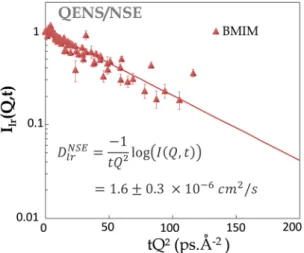
To extract Dlr, the long-range translational diffusion coefficient of the IL cation CoM, we introduce in the NSE data,the contributions of (i) the local diffusion within an aggregate and of (ii) the side-chains tumbling motion, both easily measured by ToF QENS in the ps time-scale. We show that the resulting NSE data contribution can be accounted for by a simple Q/time master curve (Fig. 4) i.e. that the diffusive motion associated with Dlr obeys a
DQ2 law. This is a strong evidence that D
lr is related to a genuine long-range translational motion with a
transla-tional diffusion coefficient DlrNSE. We also probe BMIM-TFSI on the microscopic scale (μm and ms) by PFG-NMR
(Fig. S6). The resulting self-diffusion coefficient, DtNMR = 2.7 ± 0.1 × 10⁻⁷ cm2/s, is 6 times smaller than the
long-range diffusion coefficient values derived from the QENS/NSE data (SI Table 1).
Bridging the molecular and the microscopic scales transport properties: Particle-Probe
Rheology.
As stated in the introduction, the ILs propensity to self-organization can make them resemble to so-called complex fluids i.e. materials exhibiting hierarchical structures encompassing several characteris-tic length-scales and experiencing thermal fluctuations. In all such physical (supercooled liquids, gels8…) oreven biological (crowded cellular environments9) systems, the use of nanoparticle probes10, early suggested by de
Gennes11, has shown tremendous success. In this paper, we introduce the use of nanoparticle probes to access the
viscoelastic properties of ILs. Latex particles (radius RL = 220 ± 5 nm) are highly diluted within a BMIM-TFSI
sample and their translational dynamics is then studied by DLS. If a spherical particle of radius rs is immersed in
a fluid composed of spherical particles of radius rf, the long range diffusivity, Dt, of this particle obeys the
hydro-dynamic relationship: πη = D k T c r (3) t B s s
where kB is the Boltzmann constant, T the temperature, cs is a constant and η the viscosity of the fluid. When the
size of the diffusing particle is significantly larger than those of the medium (rs/rf≫ 1, this is the sticking boundary
limit), cs = 6 and one recovers the famous Stokes-Einstein relation. If the size of the particles are similar (rs/rf ≈ 1
i.e. the slipping boundary limit), cs lies in the range from 3 to 412,13.
Figure 5a shows the time dependence of the Mean-Square Displacement (MSD) <rL W2/ t()> and <rL IL2/ t()> of
the Latex particle respectively immersed in water and in BMIM-TFSI. In water, the Latex nanoparticle MSD is proportional to time (<rL W2/ t()> = .6DtL W/ .t) over the total investigated time range. This is expected for a Fickian
process with a translational diffusion coefficient DtL W/ . At short times, the MSD of Latex in the IL, <r t()>
L IL2/ ,
shows a similar Fickian behavior, but at a time centered at t ≈ 104 μs, the MSD plateaus for about 10 ms. This
evi-dences a transient localization of the Latex particle in a cage of characteristic size <rL IL2/ t()> = 240 nm2. Then for times larger than t = 105 μs it recovers a Fickian diffusion. Such a behavior has already been reported14 in a
diffus-ing wave spectroscopy study of the motion of probe particles embedded in a semi-dilute micelles solution: at very short times the probe is governed by the local viscosity of the solvent, and at longer times, by the stress relaxation
Figure 4. All the BMIM NSE e−t/τ
lr(Q) long-range translational diffusion contribution term of Eq. (2) (SI
section 4) merge on a single master-curve in t.Q2. The slope of this curve is a direct measurement of the BMIM
mechanisms of the micelles. In a way similar to Bellour et al.14, we interpret our data in terms of caged dynamics
of the probe sphere: we see the MSD plateau as due to the dominantly elastic response of the medium followed at longer time by a cage relaxation mechanism. This similarity in the behavior of the probe in BMIM-TFSI and in a micellar system is interesting as a micelle-like structure has been proposed15 for the structure of an other
imida-zolium IL.
Another important information can also be derived from these MSD data: the intercept of the linear depend-encies of <rL IL2/ t()> before and after the localization event at t ≈ 104 μs shows that the Latex particles diffuse with two distinct diffusion coefficients DstL IL/ and D
ltL IL/ at short (st) and long (lt) times. From Eq. (3), it is then also clear
that we have evidenced a time/space scale dependent viscosity of the IL.
From the ratio of the time-dependence of the MSD shown in Fig. 5a, and using Eq. (3) one writes:
η η < > < > = = r t r t D D ( ) ( ) (4) L IL L W tL IL tL W W IL / 2 / 2 / /
where ηW and ηIL are respectively the viscosity of water and of the IL. So far, as we have considered the behavior of
the Latex particles, we have used Eq. (3) in the sticking boundary limit. By combining Eq. (4) with Eq. (3) but now in its slipping boundary limit, we directly assess ∼DtBMIM, the translational diffusion coefficient of the BMIM cation
at the molecular scale:
πη = . .< > < > ∼ D k T c R r t r t 1 ( ) ( ) (5) t BMIM B BMIM BMIM W L IL L W / 2 / 2
where cBMIM is a constant and RBMIM is the radius of the BMIM cation as considered as a sphere. The viscosity of
water16 at 25 °C is η
W = 0.913 cP. The group of Watanabe has performed a thorough study of the physico-chemical
properties of BMIM-TFSI17. They provide an estimate of the two key parameters of Eq. (5): c
BMIM = 3.4 and
RBMIM = 3.3 Å. This later quantity is estimated from the radius of an equivalent sphere matching the 3D structure
of the cation as deduced from ab-initio calculations. For the sake of consistency of our QENS/NSE, NMR and DLS data, we use RBMIM = 2.3 Å (see SI section 2.2). This 30% difference with the value proposed by Tokuda et al.17
seems acceptable as the structure of the BMIM cation (Fig. 1a) is far from spherical. From Eq. (5) the DLS derived MSD experimental values of Fig. 5a can be turned into the quantity we focus on: the long-range translational diffusion coefficient of the BMIM molecule. We write this DLS derived value D∼tBMIM. As shown in Fig. 5b, D∼tBMIM
perfectly bridges the one order of magnitude difference of diffusion coefficient of the BMIM molecule at the molecular scale (as inferred from QENS/NSE) to the one measured at the microscopic scale by PFG-NMR. To the deep of our knowledge, this multi-scale analysis provides the first experimental evidence of the transient localiza-tion of the BMIM calocaliza-tion molecule.
Discussion
Due to their unique physico-chemical properties, Ionic Liquids have been proposed for fundamental and indus-trial applications in fields as different as catalysis, liquid/liquid extraction, processing of bio to nuclear materials,
Figure 5. (a) Dynamic Light Scattering (λDLS = 647 nm, Q = 4.0 × 10⁻³ nm−1): MSD of a nanometric probe
(latex, 220 nm radius) embedded in water (blue) and bulk BMIM-TFSI (red). While in water the particle MSD is proportional to time (pure Fickian diffusion process), in the IL, around 104 μs, the probe experiences a transient
cage-like localization. Then for times larger than 105 μs it recovers a Fickian behavior. This evidences the
transient nanometric structuration of the liquid. (b) We derive, D∼tBMIM (Eq. (5)), the molecular self-diffusion coefficient of the BMIM cation. This DLS microrheology experiment is able to bridge the molecular NSE self-diffusion coefficient at short times and local scale (DlrNSE) to the same quantity as measured at the microscopic
www.nature.com/scientificreports/
to cite a few examples2. When addressing the properties of ILs, two key parameters have to be considered: the
quantity of gas18, 19 and/or water20 solubilized in the IL coming from air and atmospheric moisture. BMIM-TFSI
is known to show CO2 and O2 absorption capabilities21. Also, the viscosity of BMIM-TFSI has been shown to be
strongly dependent on the water content20. In order to minimize any contamination by these impurities, we have
paid special attention to the BMIM-TFSI handling (see Materials and Methods).
We note in particular that, for the particle-probe rheology experiment, the water content introduced in the BMIM-TFSI sample by the latex solution dispersion induces a viscosity change of less than 1%: 0.065 vs 0.064 Pa.s20
for respectively the pure BMIM-TFSI and the BMIM-TFSI sample with a water content of 0.2 × 10⁻³ g/g at 293 K
(see Materials and Methods). To conclude on the absence of impurities in the BMIM-TFSI sample, we also note that the cation self-diffusion coefficient we measure by PFG-NMR (DtNMR = 2.7 ± 0.1 × 10⁻⁷ cm2/s) is perfectly
consistent with the one published earlier by Tokuda et al.17: 2.74 × 10⁻⁷ cm2/s at 298 K.
We experimentally directly show the existence of two distinct viscosities in BMIM-TFSI. Altogether, based on the spatial and dynamical multi-scale analysis presented here, we conclude the following behavior of the IL. At the nm/ns scale, a cation diffuses within BMIM-TFSI nanodomains of characteristic size 6 × σloc = 11.4 ± 1.2 Å with
a diffusion coefficient Dloc = 4.8 ± 0.3 10−5 cm2/s. Then after the dissolution of the transient aggregates, at the tens
of nm and ns probed by NSE, the cation experiences a pure long-range translational diffusion with a diffusion coefficient DlrNSE = 1.6 ± 0.3 × 10⁻⁶ cm2/s. At the μm and ms scale probed by PFG-NMR, the tortuous pathway in
between the aggregates, results in an apparent one order of magnitude (DlrNSE/D
tNMR = 6 ± 1) smaller diffusion
coefficient DtNMR = 2.7 ± 0.1 × 10⁻⁷ cm2/s. A two dimensional view of the IL segregation and an illustration of this
multi-scale transport process are shown on Fig. 6. We need to note that, following a kBT driven density fluctuation
leading to the formation of an aggregate, a cation can be trapped within this aggregate for a transient period of time.
Here, we focus only on the time dependence of the phenomenon, but a promising extension of the method could be the observation of the MSD probe size-dependence (still detected by DLS). The time and MSD loci of the plateau on a MSD vs time plot, as shown in Fig. 5a, should be strongly influenced by the particle size (RP), and we
expect that all the plateau positions should fall on a MSD vs QRP master curve. Such a Guinier-like representation
seems a possible route to directly extract the characteristic size of the IL aggregates.
It should be noted that the particle probe strategy presented here for the characterization of the nanometric self-organization of BMIM-TFSI could be easily generalized. A possible limitation is nevertheless probably the colloidal stability of the probe within the liquid. Also, specific interaction of the ILs with the probe surface have been reported in particular in the case of silica nanoparticles22. In the present case of a Latex probe such
limita-tion of the method can be nevertheless dismissed as the diffusion coefficient as measured with and without Latex probes, by DLS and (NSE/NMR) respectively, are in full agreement.
In electrolytes, the ionic conductivity and the transport properties are directly related by the Nernst-Einstein relation. Hence, since they represent transient energy barriers for the long-range diffusion of the charges, the ILs nanostructuration and the related viscosity fluctuations, that we evidence here, have important detrimental consequences on the ionic conductivity. A direct way to circumvent the spontaneous formation of aggregates within the ILs would be to confine the liquid in a porous material with pores smaller than the characteristic size of the aggregates. Following experimental data23, recent MD results indicate24 that imposing confinement of Figure 6. Two dimensional cross-section artist view (image courtesy of Adrian van Leen, rgbstock.com) of the nanostructuration of an IL and the consequences on the transport properties (see text). Aggregated micelle-like and non-aggregated regions of the liquid are respectively represented as dark and light blue regions. The path of a cation molecule within the system is indicated by a red line. Starting from the confined motion within an aggregate (1), a BMIM cation experiences a long-range diffusion in a non-aggregated part of the system (1) to (2) but at larger scale it labyrinths around the aggregates (1) to (3), resulting in an apparent small diffusion coefficient. The path within an aggregate (1), from (1) to (2), and from (1) to (3) are respectively probed by QENS, NSE, and NMR. The dashed line indicates that the corresponding NMR path extends on a much larger scale than the zoomed region shown here. This picture is a snapshot view of a process that in reality is a dynamical equilibrium where a cation can successively be part of an aggregated or not aggregated region.
Materials and Methods
All the experimental data are measured at 298 K.
BMIM-TFSI.
1-butyl-3-methyl imidazolium bis(trifluoromethanesulfonyl imide (BMIM-TFSI, electrochem-ical grade, Purity ≥ 99.9%, anhydrous, H2O ≤ 0.005%) was purchased from Solvionic. To avoid gas solubility theBMIM-TFSI was transferred from the initial container to a number of 5 ml vials then crimped with a septum. This operation was done in a glove box. The BMIM-TFSI samples used for all the experiments described in the present paper were extracted from these vials using with needles and syringes.
Neutron scattering.
QENS measurements were performed on the LET cold chopper spectrometer (ISIS, Chilton-Didcot, UK)26 in its repetition rate multiplication mode27. With this setting, successive wavelengthbands are selected within each of the incident neutron pulses. For the results shown in this paper, the incident wavelength bands were λ0 = 5.2, 8.0 and 10.8 Å respectively resulting in 81, 22, 13 μeV energy resolutions and
[0.06–2.28], [0.04–1.05] and [0.03–0.75] Å−1 Q ranges. To extend the timescale probed with LET up to 1.5 ns (i.e.
1 μeV resolution), we performed an NSE experiment on the spectrometer IN11 (ILL, Grenoble, France) with an incident wavelength of 5.5 Å. Two positions of the multi-detector have been used (20° and 50°) to cover a total Q range between 0.1 and 1.25 Å−1. Samples were enclosed in Aluminum cylindrical containers sealed with indium.
A flat piece of Vanadium has been used to measure the resolution function and correct the S(Q,ω) spectra for the detectors efficiency.
Particle-probe rheology.
The experimental set-up has been described in a preceding paper28. In thepres-ent study, the polystyrene latex particle (radius 220 ± 5 nm) weight fraction of the initial batch was 5.6 10−2 g/g
as determined by weighing after evaporation of water. A volume of 0.5 μl of the mother latex solution was incor-porated in 1.5 cm3 of BMIM-TFSI and diluted in several steps down to a latex concentration of 0.2 10−3 g/g. The
same procedure was used to prepare the latex solution in water. The light scattering measurements were per-formed with a home made spectrometer using a laser wavelength of λDLS = 647 nm.
PFG-NMR.
The measurements have been performed using a spin echo sequence, and a 1H probe. The BMIMcation self-diffusion coefficient, DS, was determined according to the following equation:
γ δ δ
= − ∆ −
A g A( )/ (0) exp( 2 2 2g DS( /3))
where A, γ, g, δ and Δ stand for the signal areas, the gyromagnetic ratio of the investigated nucleus, the intensity of the magnetic field gradient, the duration of the gradient pulse and the diffusion time respectively. The mag-nitude of the pulsed field gradient was varied as 0 ≤ g ≤ 1000 G/cm; δ was set between 1 ms and 3 ms; Δ was set between 10 ms and 50 ms.
References
1. Larcher, D. & Tarascon, J.-M. Towards greener and more sustainable batteries for electrical energy storage. Nat Chem 7, 19–29, doi:10.1038/nchem.2085 (2015).
2. Hayes, R., Warr, G. G. & Atkin, R. Structure and Nanostructure in Ionic Liquids. Chemical Reviews 115, 6357–6426, doi:10.1021/ cr500411q (2015).
3. Triolo, A., Russina, O., Bleif, H.-J. & Di Cola, E. Nanoscale Segregation in Room Temperature Ionic Liquids. The Journal of Physical
Chemistry B 111, 4641–4644, doi:10.1021/jp067705t (2007).
4. Kirchner, B., Malberg, F., Firaha, D. S. & Hollóczki, O. Ion pairing in ionic liquids. Journal of Physics: Condensed Matter 27, 463002, doi:10.1088/0953-8984/27/46/463002 (2015).
5. Burankova, T., Hempelmann, R., Wildes, A. & Embs, J. P. Collective Ion Diffusion and Localized Single Particle Dynamics in Pyridinium-Based Ionic Liquids. J. Phys. Chem. B 118, 14452–14460, doi:10.1021/jp5092416 (2014).
6. Ferdeghini, F. et al. Nanostructuration of ionic liquids: impact on the cation mobility. A multi-scale study. Nanoscale 9, 1901–1908, doi:10.1039/c6nr07604a (2017).
7. Berrod, Q. et al. QENS investigation of proton confined motions in hydrated perfluorinated sulfonic membranes and self-assembled surfactants. EPJ Web of Conferences 83, 02002, doi:10.1051/epjconf/20158302002 (2015).
8. Khan, M. & Mason, T. G. Trajectories of probe spheres in generalized linear viscoelastic complex fluids. Soft Matter 10, 9073–9081, doi:10.1039/c4sm01795a (2014).
9. Gal, N., Lechtman-Goldstein, D. & Weihs, D. Particle tracking in living cells: a review of the mean square displacement method and beyond. Rheol Acta 52, 425–443, doi:10.1007/s00397-013-0694-6 (2013).
www.nature.com/scientificreports/
10. Mason, T. G. & Weitz, D. A. Optical measurements of frequency-dependent linear viscoelastic moduli of complex fluids. Physical
review letters 74, 1250–1253, doi:10.1103/PhysRevLett.74.1250 (1995).
11. de Gennes, P.-G. Scaling Concepts in Polymer Physics (Cornell University Press, Ithaca, NY, 1979).
12. Sutherland, G. B. B. M. A dynamical theory of diffusion for non-electrolytes and the molecular mass of albumin. Phil. Mag. 9, 781–785, doi:10.1080/14786440509463331 (1905).
13. Cussler, E. L. Diffusion: Mass Transfer in Fluid Systems (Cambridge University Press, Cambridge; New York, 2009), 3 edition edn. 14. Bellour, M., Skouri, M., Munch, J.-P. & Hébraud, P. Brownian motion of particles embedded in a solution of giant micelles. The
European Physical Journal E 8, 431–436, doi:10.1140/epje/i2002-10026-0 (2002).
15. Kofu, M. et al. Heterogeneous Slow Dynamics of Imidazolium-Based Ionic Liquids Studied by Neutron Spin Echo. The Journal of
Physical Chemistry B 117, 2773–2781, doi:10.1021/jp312608r (2013).
16. Krynicki, K., Green, C. D. & Sawyer, D. W. Pressure and temperature dependence of self-diffusion in water. Faraday Discussions of
the Chemical Society 66, 199–208, doi:10.1039/dc9786600199 (1978).
17. Tokuda, H., Hayamizu, K., Ishii, K., Susan, M. A. B. H. & Watanabe, M. Physicochemical Properties and Structures of Room Temperature Ionic Liquids. 2. Variation of Alkyl Chain Length in Imidazolium Cation. The Journal of Physical Chemistry B 109, 6103–6110, doi:10.1021/jp044626d (2005).
18. Anthony, J. L., Anderson, J. L., Maginn, E. J. & Brennecke, J. F. Anion Effects on Gas Solubility in Ionic Liquids. J. Phys. Chem. B 109, 6366–6374, doi:10.1021/jp046404l (2005).
19. Lei, Z., Dai, C. & Chen, B. Gas Solubility in Ionic Liquids. Chem. Rev. 114, 1289–1326, doi:10.1021/cr300497a (2014).
20. Widegren, J. A., Saurer, E. M., Marsh, K. N. & Magee, J. W. Electrolytic conductivity of four imidazolium-based room-temperature ionic liquids and the effect of a water impurity. The Journal of Chemical Thermodynamics 37, 569–575, doi:10.1016/j.jct.2005.04.009
(2005).
21. Bahadur, I., Osman, K., Coquelet, C., Naidoo, P. & Ramjugernath, D. Solubilities of Carbon Dioxide and Oxygen in the Ionic Liquids Methyl Trioctyl Ammonium Bis(trifluoromethylsulfonyl)imide, 1-Butyl-3-Methyl Imidazolium Bis(trifluoromethylsulfonyl)imide, and 1-Butyl-3-Methyl Imidazolium Methyl Sulfate. J. Phys. Chem. B 119, 1503–1514, doi:10.1021/jp5061057 (2015).
22. Nordström, J., Aguilera, L. & Matic, A. Effect of Lithium Salt on the Stability of Dispersions of Fumed Silica in the Ionic Liquid BMImBF4. Langmuir 28, 4080–4085, doi:10.1021/la204555g (2012).
23. Berrod, Q. et al. Enhanced ionic liquid mobility induced by confinement in 1d CNT membranes. Nanoscale 8, 7845–7848, doi:10.1039/c6nr01445c (2016).
24. Ghoufi, A., Szymczyk, A. & Malfreyt, P. Ultrafast diffusion of Ionic Liquids Confined in Carbon Nanotubes. Scientific Reports 6, 28518, doi:10.1038/srep28518 (2016).
25. Berrod, Q., Ferdeghini, F., Judeinstein, P. & Zanotti, J.-M. Nanocomposite membranes for electrochemical devices. Patent FR1552572 (2016).
26. Bewley, R., Taylor, J. & Bennington, S. LET, a cold neutron multi-disk chopper spectrometer at ISIS. Nuclear Instruments and
Methods in Physics Research Section A: Accelerators, Spectrometers, Detectors and Associated Equipment 637, 128–134, doi:10.1016/j. nima.2011.01.173 (2011).
27. Mezei, F. Multi-wavelength data collection strategies in inelastic neutron scattering. Physica B: Condensed Matter 385–386, Part 2, 995–999 (2006).
28. Fadda, G. C., Lairez, D. & Pelta, J. Critical behavior of gelation probed by the dynamics of latex spheres. Physical Review E 63 (2001).
Acknowledgements
The authors thank Priscillia Soudant and Cristina Iojoiu (LEPMI, Grenoble) for providing access to the NMR spectrometer. F.F., Q.B., P.J. and J.M.Z. thank the Programme CEA transverse NTE for funding. Q.B. was supported by an Outgoing CEA fellowship from the CEA-Enhanced Eurotalents program, co-funded by FP7 Marie-Sklodowska-Curie COFUND program (Grant Agreement 600382).
Author Contributions
Q.B., F.F., P.J., J.M.Z., P.F., O.C. performed the NSE experiment at ILL. F.F., P.J., J.M.Z. and V.G.S. performed the QENS experiment at ISIS. F.F., Q.B. and P.J. performed PFG-NMR measurements. F.F. developed the model. F.F. and Q.B. analyzed the QENS and NSE data. D.L. and J.M.Z. performed the DLS experiments. F.F., P.J. and D.C. performed SAXS experiments. J.M.Z. initiated and supervised the project. All the authors contributed to the preparation of the manuscript.
Additional Information
Supplementary information accompanies this paper at doi:10.1038/s41598-017-02396-7
Competing Interests: The authors declare that they have no competing interests.
Publisher's note: Springer Nature remains neutral with regard to jurisdictional claims in published maps and
institutional affiliations.
Open Access This article is licensed under a Creative Commons Attribution 4.0 International
License, which permits use, sharing, adaptation, distribution and reproduction in any medium or format, as long as you give appropriate credit to the original author(s) and the source, provide a link to the Cre-ative Commons license, and indicate if changes were made. The images or other third party material in this article are included in the article’s Creative Commons license, unless indicated otherwise in a credit line to the material. If material is not included in the article’s Creative Commons license and your intended use is not per-mitted by statutory regulation or exceeds the perper-mitted use, you will need to obtain permission directly from the copyright holder. To view a copy of this license, visit http://creativecommons.org/licenses/by/4.0/.