N
4
Ui
NUCLeAR ENGINEERING
HUCLEA.R £tI IEERII4G
READING ROOM
NLL
MASSACHUSETTS INSTITUTE
OF TECHNOLOGY
The 1994 MIT NED-DOE Intern Program
Report MITNE-308
J.E. Meyer, Program Director
Report MITNE-308
J.E. Meyer, Program Director
Report on the 1994 MIT NED-DOE Intern Program
J.E. Meyer, Program Director
November 1994
THE 1994 PROGRAM AND FUTURE PLANS
This reporti describes a special educational program for DOE interns that was offered at MIT in 1994. The program started at the beginning of August and will continue until a time in the Fall Term Final Exam Period (about mid-December). Many details of this program (including lists of day-by-day lecture topics) are supplied in order to clarify the approaches for meeting academic objectives.
In planning future related educational programs, it is clear that several options are available for consideration:
a) August-Fall Basis: This option is based on planning a new program that repeats
essentially the same sequence at the same times of the year. That is, August is used as
a preparation phase and the Fall Term for regular courses. This arrangement seemed
satisfactory in 1994. An improved mathematics coverage should also be considered. This coverage could be achieved by moving the starting date to mid-July to
accommodate mathematics in July or by substituting early-August mathematics for some of the existing subject matter.
b) January-Sprinq Basis: This option is based on a substitution of a preparation phase during January (MIT's Independent Activities Period) for that during August. The Spring Term regular courses would substitute for those in Fall Term. Some adjustment in course selection, or some need to fund additional course sections, would be required. These changes are caused by the present practice of teaching many subjects only once
a year.
c) Master of Engineering Degree Program: For this option, all participants would be accepted in the Nuclear Engineering Department graduate school. Regular courses, a team project, and a practical thesis would be completed. A Master of Engineering Degree would typically be awarded after a stay at MIT of one year. Some details remain undefined for this program, but it is expected that a very satisfying educational approach can be obtained.
THE 1994 PROGRAM
All participants in the 1994 program were DOE employees. They had been hired to become
part of a select group of recent engineering graduates. It is expected that members of the group will, with suitable training, be likely candidates for DOE leadership roles in positions requiring technical competency. After being hired, each group member spends 2% years to get academic training and industry/national laboratory experiences. The NED-DOE Program
1 The MIT NED-DOE acronyms indicate Massachusetts Institute of Technology Nuclear Engineering Department - Department of Energy.
has contributed to a portion of the academic training; the portion is intended to strengthen engineering skills (especially nuclear engineering skills).
The existing NED-DOE Program has two major parts -- the August Program (preparation phase) and the Fall Term Program (regular courses):
- August Program -- This part provides a review of engineering principles at an advanced undergraduate level. It equips participants with fundamentals in preparation for fall term subjects. It permits some students to learn topics outside their previous degree specialty; it permits other students to upgrade skills within their specialty.
The courses in the August Program are specially designed for the NED-DOE Program and are attended only by DOE interns. The courses are taken in a summer session non-degree manner.
- Fall Term Program -- This part utilizes four regular fall term graduate courses in the
School of Engineering. The courses are chosen to be suitable as background for
enhancing technical competency in potential DOE leadership roles.
The interns join regular graduate students during classroom lectures. The interns also complete all course requirements and grading activities. They must be admitted to MIT as "Special Graduate Students" and the courses are completed in a non-degree manner. In 1994, four interns completed the August Program and three continued into the Fall Term Program (the fourth left MIT to participate in other DOE training activities).
Many of the details for participating in, planning, and executing these Programs are provided in the pages that follow.
THE AUGUST PROGRAM
The August Program consists of five courses; each course is indicated in the following pages
by a two-letter symbol. The first three courses are devoted to Engineering Principles; the
next, to Physics Fundamentals; and the fifth, to Radiation Protection:
- Th = Thermodynamics, Fluid Flow, and Heat Transfer (Thermofluids);
- St = Structural Mechanics;
- Mt = Physical Metallurgy;
- Ph = Physics Fundamentals; and
MIT NED-DOE Program
More information on the August Program courses is provided in the Appendix:
- Table 1 gives the number of lectures (1% hours each) and lists the cognizant teaching personnel.
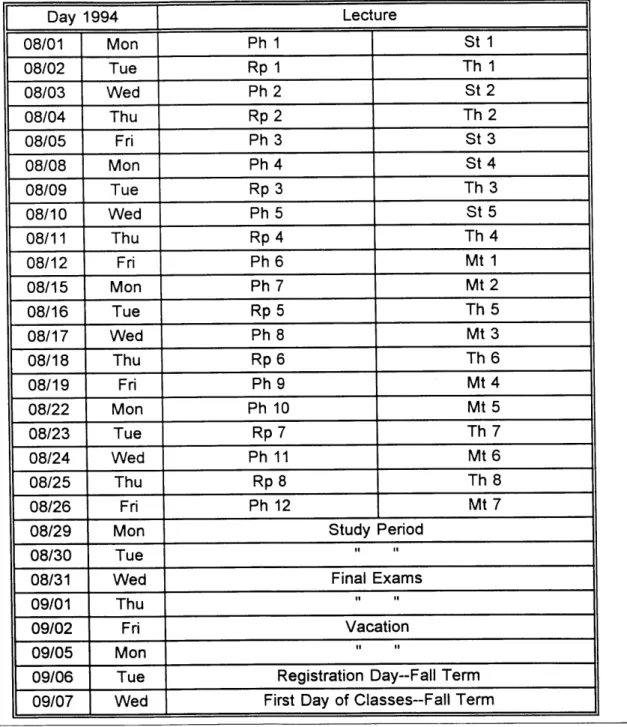
- Table 2 shows the daily schedule for lectures. There are two lectures for each of twenty days.
- Table 3 gives a lecture-by-lecture syllabus for each of the courses.
A graduate student (Gary S. Cerefice) worked both for participants and for lecturers. He
attended all lectures; he was available for answering questions; and he served in a Teaching Assistant role.
THE FALL TERM PROGRAM
The Fall Term Program consists of four courses. They are taken by each program participant after being accepted as a special graduate student. Some regular MIT graduate students also will be enrolled in each of these courses. The courses (and cognizant teaching personnel) are:
- 22.111 = Nuclear Physics for Engineers I (Kevin W. Wenzel, Assistant Professor of Nuclear Engineering);
- 22.312 = Engineering of Nuclear Reactors (Neil E. Todreas, Professor of Nuclear and
Mechanical Engineering);
- 22.77 = Nuclear Waste Management (Man-Sung Yim, Lecturer, Nuclear Engineering);
and
- 22.904 = Management and Organization of Complex Organizations (John S. Carroll, Professor, Sloan School of Management).
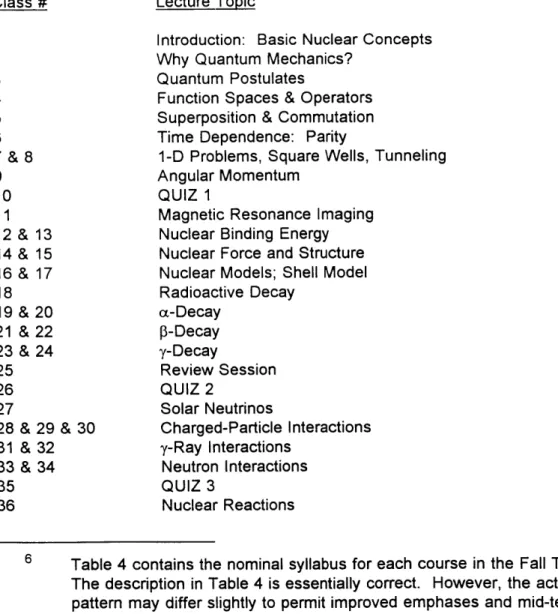
A lecture-by-lecture syllabus for these courses is provided in Table 4 in the Appendix.
As a part of the Fall Term Program, four special seminars have been arranged that cover topics of special DOE interest:
1) "N-Reactor Follies" by Ronald G. Ballanger, Associate Professor, Nuclear Engineering.
2) "DOE New Production Reactor" by Neil E. Todreas, Professor, Nuclear Engineering
and Mechanical Engineering.
3) "Hanford Tanks High Level Waste Issues" by Mujid S. Kazimi, Professor and Head, Nuclear Engineering Department.
4) "Disposition of Plutonium" by Dr. Marvin M. Miller, Senior Research Scientist, Nuclear Engineering.
A graduate student (Sarah A. Abdelkader) is working both for participants and for the program
director. She is available for answering participant questions (both about academic matters and about interactions with the department and MIT). She has made arrangements for the
special seminar series and has gathered material for this report.
CONCLUSIONS ABOUT THE 1994 PROGRAMS
We judge that the August Program provided an appropriate preparation for the Fall Term. The tone and pace of the classes were similar to the regular Fall courses. In two courses
("Physics Fundamentals" and "Principles of Radiation Protection"), the similarity was especially strong. In these cases, the August instructors also taught courses that are part of the Fall Program.
The August Program seemed also to be appropriate for enabling some students to learn topics outside their previous degree specialty and for permitting other students to upgrade skills within their specialty.
The Fall Program utilizes four regular fall term graduate courses in the School of Engineering. The program is presently a little over halfway complete. However, it seems that the course content and the workload are appropriate. The courses are expected to be suitable as
background for enhancing technical competency in potential DOE leadership roles. The participants feel that an aspect to be improved in future versions of these programs relates to mathematical content. Books, notes, and lectures are prepared using the
assumption that each participant has a currently active ability to follow advanced mathematical arguments. It was suggested that some time should be spent at the beginning of the August Program to upgrade mathematical skills. It was also suggested that this topic could be substituted for the Electricity and Magnetism portion of the Physics Fundamentals. These suggestions have been considered when writing the first few paragraphs in this report ("The 1994 Program and Future Plans").
MIT NED-DOE Program
APPENDIX
This Appendix contains four tables with details of the NED-DOE programs: Table 1: August Program Courses and Cognizant Personnel
Table 2: August Program Schedule
Table 3: Curricula of the August Program Courses Table 4: Curricula of Courses in the Fall Term
TABLE I: AUGUST PROGRAM COURSES (and Cognizant Personnel)
Lectures
(1% hrs each)
Enqineerinq Principles
Th = Thermodynamics, Fluid Flow, and Heat Transfer (Thermofluids) 8 (Ali Shajii, Sponsored Research Staff, Plasma Fusion Center)
St = Structural Mechanics 5
(John Meyer, Professor, Nuclear Engineering)
Mt = Physical Metallurgy 7
(Ronald Ballinger, Associate Professor, Nuclear Engineering) Physics Fundamentals
Ph = Electricity & Magnetism, Atomic Physics, and Nuclear Physics 12 (Kevin Wenzel, Assistant Professor, Nuclear Engineering)
Principles of Radiation Protection2
_p = Health Physics, Environmental Problems, and Radioactive Waste
Management
(Man-Sung Yim, Lecturer, Nuclear Engineering; 6 Otto K. Harling, Professor, Nuclear Engineering; 1 Francis X. Masse, Radiation Protection Officer, MIT Medical) 1
Total Lectures August Program 40
2 Underpinnings for Radioactive Waste Management and Environmental Remediation
TABLE 2: AUGUST PROGRAM SCHEDULE3
The two-letter course notations are explained adjacent to Table 1. The numbers indicate the sequence of lectures (e.g., St 1 through St 5 denote the five Structural Mechanics lectures).
Day 1994 Lecture 08/01 Mon Ph 1 St 1 08/02 Tue Rp 1 Th 1 08/03 Wed Ph 2 St 2 08/04 Thu Rp 2 Th 2 08/05 Fri Ph 3 St 3 08/08 Mon Ph 4 St 4 08/09 Tue Rp 3 Th 3 08/10 Wed Ph 5 St 5 08/11 Thu Rp 4 Th 4 08/12 Fri Ph 6 Mt 1 08/15 Mon Ph 7 Mt 2 08/16 Tue Rp 5 Th 5 08/17 Wed Ph 8 Mt 3 08/18 Thu Rp 6 Th 6 08/19 Fri Ph 9 Mt 4 08/22 Mon Ph 10 Mt 5 08/23 Tue Rp 7 Th 7 08/24 Wed Ph 11 Mt 6 08/25 Thu Rp 8 Th 8 08/26 Fri Ph 12 Mt 7
08/29 Mon Study Period
08/30 Tue " " 08/31 Wed Final Exams
09/01 Thu "
09/02 Fri Vacation
09/05 Mon " "
09/06 Tue Registration Day--Fall Term
09/07 Wed First Day of Classes--Fall Term
3 A nominal schedule is given in Table 2 and essentially is as taught. The actual
teaching pattern varied in a minor manner to permit some teaching personnel to satisfy other commitments.
MIT NED-DOE Program
TABLE 3: CURRICULA OF THE AUGUST PROGRAM COURSES4
Thermodynamics, Fluid Flow, and Heat Transfer (Thermofluids): This course was scheduled for two lectures per week for all four weeks of the August Program. Lecture topics are as follows (the classes are numbered Th 1 through Th 8, and each class is 1% hours' duration):
Class #
Lecture TopicTh 1 & Th 2 Th 3 & Th 4 Th 5 & Th 6 Th 7 & Th 8
Heat Transfer by Conduction in Solids. Introduction to Thermodynamics Fluid Dynamics
Complex Systems Involving Both Fluid Dynamics and Heat Transfer Structural Mechanics: This course was scheduled for three lectures during the first week and two lectures during the second week of the August Program.5 Lecture topics are as follows
(the classes are numbered St 1 through St 5, and each class is 1% hours' duration):
Class #
Lecture TopicSt 1
St 2
St 3
St 4 & St 5
Fundamental Mechanical Tests Elasticity Fundamentals
Pressure Vessel Stress Analysis
Design Limits (ASME Code and ASME Code Cases)
Physical Metallurgy: This course was scheduled for one lecture during the second week and three lectures during each of the last two weeks of the August Program. Lecture topics are as follows (the classes are numbered Mt 1 through Mt 7, and each class is 1% hours' duration):
Class # Lecture Topic Mt 1 Materials Selection
Mt 2 Basic Metallurgy
Mt 3 Basic Metallurgy and Radiation Damage Mt 4 Radiation Effects Mt 5 Fuels Mt 6 Structural Materials Mt 7 Environmental Effects 4 5
Table 3 contains the nominal syllabus for each August Program course. The
description in Table 3 is essentially correct. However, the actual teaching pattern
may differ slightly to permit improved emphases and mid-course adjustments.
Note that the Final Exam in this course was given during the third week of the
August Program rather than at the end.
Physics Fundamentals: This course was scheduled for three lectures during each of the four weeks of the August Program. Lecture topics are as follows (the classes are numbered Ph 1 through Ph 12, and each class is 1% hours' duration):
Class # Lecture Topic
--- Electromagnetism
---Ph 1 Introduction to Electromagnetism Ph 2 Maxwell's Equations
Ph 3 Wave Propagation in Free Space Ph 4 Wave Propagation in Material Media
--- Atomic Physics
---Ph 5 Experimental Background and Basis Ph 6 Quantum Mechanics: Photons as Particles Ph 7 Quantum Mechanics: Particles as Waves
Ph 8 Atomic Structure --- Nuclear Physics ---Ph 9 Nuclear Structure Ph 10 Nuclear Properties Ph 11 Radioactive Decays Ph 12 Nuclear Reactions
Principles of Radiation Protection: This course was scheduled for two lectures during each of the four weeks of the August Program. Lecture topics are as follows (the classes are
numbered Rp 1 through Rp 8, and each class is 1% hours' duration): Class # Lecture Topic
--- Health Physics
---Rp 1 Basics of Radiation
Rp 2 Biological Effects of Radiation Rp 3 Radiation Dosimetry
Rp 4 Radiation Detection and Measurements Rp 5 Radiation Protection Standards
--- Environmental Problems and Radioactive Waste Management
---Rp 6 Sources and Uses of Radiation
Rp 7 High Level Radioactive Waste Management Rp 8 Low Level Radioactive Waste Management
MIT NED-DOE Program
TABLE 4: CURRICULA6 OF COURSES IN THE FALL TERM
22.111 Nuclear Physics for Enqineers I This is an advanced level (H-Level) graduate course rated at 12 units. It is required for all regular graduate students in nuclear engineering. The grading basis is:
Homework 35%
Quizzes 35%
Final Exam 30%
Lecture topics are as follows (the classes are numbered 1 through 38 and each class is 1
hour duration):
Class # Lecture Topic
1 Introduction: Basic Nuclear Concepts
2 Why Quantum Mechanics?
3 Quantum Postulates
4 Function Spaces & Operators
5 Superposition & Commutation
6 Time Dependence: Parity
7 & 8 1-D Problems, Square Wells, Tunneling
9 Angular Momentum
10 QUIZ 1
11 Magnetic Resonance Imaging
12 & 13 Nuclear Binding Energy 14 & 15 Nuclear Force and Structure
16 & 17 Nuclear Models; Shell Model
18 Radioactive Decay 19 & 20 a-Decay 21 & 22 p-Decay 23 & 24 y-Decay 25 Review Session 26 QUIZ 2 27 Solar Neutrinos
28 & 29 & 30 Charged-Particle Interactions
31 & 32 y-Ray Interactions
33 & 34 Neutron Interactions
35 QUIZ 3
36 Nuclear Reactions
6 Table 4 contains the nominal syllabus for each course in the Fall Term Program.
The description in Table 4 is essentially correct. However, the actual teaching pattern may differ slightly to permit improved emphases and mid-term adjustments. In addition, one or two unscheduled classes exist in some cases to permit additional improvements in teaching material.
22.111 continued
37 Fission
38 Fusion
FINAL EXAM
22.312 Enqineerinq of Nuclear Reactors This is an advanced level (H-Level) graduate course
rated at 12 units. It provides a thorough drill in the fundamentals of fluid flow, heat transfer, thermodynamics, and structural mechanics with application examples appropriate for nuclear engineering students. The grading basis is:
Homework 20%
Quizzes 40%
Final Exam 40%
Lecture topics are as follows (the classes are numbered 1 through 25, and each class is 1% hours' duration):
Class # Lecture Topic
1 Course Introduction and Reactor Types
2 Thermal Design Principles
3 Reactor Heat Generation (including Zr -Steam, Core-Concrete,
Combustion)
4 thr 7 Reactor Power Cycles
8 & 9 Containment Pressurization
10 thr 12 Thermal Analysis of Fuel Elements
13 QUIZ 1
14 Finish: Thermal Analysis of Fuel Elements Start: Max Core Fuel & Coolant Temperatures
15 Energy Equation
16 Single-Phase Fluid Mechanics
17 Single-Phase Heat Transfer
18 Finish: Single-Phase Heat Transfer and Fluid Mechanics
19 Two-Phase Fluid Mechanics
20 & 21 Two-Phase Heat Transfer
22 QUIZ 2
23 & 24 Elasticity Fundamentals
25 Simple Mechanical Tests and Pressure Vessel Design
MIT NED-DOE Program
22.77 Nuclear Waste Management This is an advanced level (H-Level) graduate course
rated at 12 units. It introduces scientific/engineering aspects of managing spent fuel,
reprocessed high-level waste, uranium mill tailings, low-level wastes, and decommisioning
wastes. The grading basis is:
Homework
10%
Quizzes
70%
Term Project
& Term Paper
20%
Lecture topics are as follows (the classes are numbered 1 through 24 and each class is 1%
hours duration):
Class #
Lecture Topic
1
Course Outline/Sources and Classifications of Radioactive Wastes
2
Nuclear Reactions and Radioactive Decay
3
Regulations/Radiation Protection Standards
4
Radioactive Wastes from Nuclear Fuel Cycle
5
Characteristics of Spent Fuel & Its Management & Disposal
6
Geologic Disposal of High-Level Waste (HLW)
7 & 8
Groundwater Hydrology
9 & 10
Radionuclide Transport
11
Geochemistry
12
Waste Packages
13
QUIZ 1
14
Finish: Waste Package; Start: Waste Forms
15
Repository Thermal Phenomena/HLW Total System; Performance
Assessment
16
Defense Waste; Environmental Remediation
17
Actinide Burning & Transmutation
18
Overview of Management of Low-Level Waste (LLW)
19
LLW Treatment Technologies
20
Performance Assessment of LLW Facilities
21
Decontamination & Decommissioning
22
Current Issues in LLW Management (Current State Compacts Situation,
Waste Minimization, BRC, Mixed Wastes, etc.)
23
QUIZ 2
24 & 25
Term Paper Presentations
22.904 and 15.328 Management and Organization
of
Complex Organizations This is a
graduate level (G-Level) course rated at 6 units. It is a new course that has grown out of MIT
Sloan/NED research aimed at guiding the management of a complex, high-hazard, regulated
industry in a changing environment. The grading basis is:
Class Participation
Term Paper
Lecture topics are
hours' duration):