Active learning for inference and regeneration of
computer programs that store and retrieve data
The MIT Faculty has made this article openly available.
Please share
how this access benefits you. Your story matters.
Citation
Rinard, Martin C., Jiasi Shen, and Varun Mangalick. "Active learning
for inference and regeneration of computer programs that store
and retrieve data." ACM SIGPLAN International Symposium on
New Ideas, New Paradigms, and Reflections on Programming and
Software, October 2018, Boston, MA, USA (ACM), 2018.
As Published
http://dx.doi.org/10.1145/3276954.3276959
Publisher
ACM Press
Version
Author's final manuscript
Citable link
https://hdl.handle.net/1721.1/125749
Terms of Use
Creative Commons Attribution-Noncommercial-Share Alike
Active Learning for Inference and Regeneration of
Computer Programs That Store and Retrieve Data
Martin C. Rinard
MIT EECS & CSAIL USA
Jiasi Shen
MIT EECS & CSAIL USA [email protected]
Varun Mangalick
MIT EECS & CSAIL USA [email protected]
Abstract
As modern computation platforms become increasingly com-plex, their programming interfaces are increasingly difficult to use. This complexity is especially inappropriate given the relatively simple core functionality that many of the compu-tations implement. We present a new approach for obtaining software that executes on modern computing platforms with complex programming interfaces. Our approach starts with a simple seed program, written in the language of the devel-oper’s choice, that implements the desired core functionality. It then systematically generates inputs and observes the resulting outputs to learn the core functionality. It finally automatically regenerates new code that implements the learned core functionality on the target computing platform. This regenerated code contains boilerplate code for the com-plex programming interfaces that the target computing plat-form presents. By providing a productive new mechanism for capturing and encapsulating knowledge about how to use modern complex interfaces, this new approach promises to greatly reduce the developer effort required to obtain se-cure, robust software that executes on modern computing platforms.
CCS Concepts • Software and its engineering → Source code generation; Software development techniques; Software reverse engineering;
Keywords Active Learning, Program Inference ACM Reference Format:
Martin C. Rinard, Jiasi Shen, and Varun Mangalick. 2018. Active Learning for Inference and Regeneration of Computer Programs That Store and Retrieve Data. In Proceedings of the 2018 ACM SIG-PLAN International Symposium on New Ideas, New Paradigms, and
Permission to make digital or hard copies of all or part of this work for personal or classroom use is granted without fee provided that copies are not made or distributed for profit or commercial advantage and that copies bear this notice and the full citation on the first page. Copyrights for components of this work owned by others than the author(s) must be honored. Abstracting with credit is permitted. To copy otherwise, or republish, to post on servers or to redistribute to lists, requires prior specific permission and/or a fee. Request permissions from [email protected]. Onward! ’18, November 7–8, 2018, Boston, MA, USA
© 2018 Copyright held by the owner/author(s). Publication rights licensed to ACM.
ACM ISBN 978-1-4503-6031-9/18/11. . . $15.00
https://doi.org/10.1145/3276954.3276959
Reflections on Programming and Software (Onward! ’18), November 7–8, 2018, Boston, MA, USA. ACM, New York, NY, USA,17pages.
https://doi.org/10.1145/3276954.3276959
1
Introduction
Within the last decade, undergraduate computer science enrollments, both within and outside the major, have dra-matically increased [Zweben and Bizot 2016]. As a result, undergraduates are now acquiring basic programming skills as a normal part of their college education. Indeed, the abil-ity to write (relatively simple) programs, like the abilabil-ity to read, write, and perform basic mathematical reasoning, is now increasingly seen as part of the personal portfolio of a literate person in our culture [Lohr 2017;Smith 2016].
At the same time, the systems on which even simple pro-duction software must execute are becoming increasingly complex. Some decades ago most software executed on a sin-gle machine, with the programming environment providing a few simple abstractions (such as file system interfaces) for accessing the devices attached to that machine. Most soft-ware today, in contrast, is expected to execute in complex, networked, distributed computing platforms. A common sce-nario, for example, is for a program to compute over data stored across many machines in a cloud computing environ-ment to generate results that are then distributed via the Internet for graphical presentation on remote devices.
Modern software environments rely heavily on software packages that help developers deal with the resulting com-plexity. Examples include application server frameworks such as JBoss and IBM WebSphere, key/value storage systems such as Redis, NoSQL databases such as HBase, distributed memory caching systems such as memcached, and cluster computing frameworks such as Spark and MapReduce. While the implementations of such systems encapsulate the other-wise potentially overwhelming complexity of coordinating the actions of the components of large distributed comput-ing systems, the programmcomput-ing interfaces they provide are far from easy to use (as can be seen in the large volume of questions posted to web sites such as Stack Overflow [Stack-Overflow 2018]). Indeed, developers that work with such systems spend much of their time constructing appropriate search terms to find previously developed code that they can copy and adapt for their needs. The complexity of these pro-gramming interfaces can be seen as especially inappropriate
given the relatively simple core functionality that many of the computations implement. At a conceptual level, such computations often simply store and retrieve data or per-form simple computations on the stored data. The complexity comes not from the core functionality that the computation implements, but from the computing platform on which the computation executes.
We propose a new approach for developing software for such computing platforms. Instead of coding to complex programming interfaces that existing software packages ex-port, developers implement the core functionality in a seed program using the programming language of their choice. The seed program may use only the simplest standard pro-gramming interfaces, such as standard text input and output interfaces.
Our system first interacts with the seed program to learn its core functionality. The system then regenerates (a poten-tially augmented version of) the computation that uses so-phisticated software packages to implement the learned core functionality on the new, potentially much more complex computing platform. In effect, the knowledge and expertise required to use the relevant software packages are all encap-sulated in the regenerator. This approach can be particularly productive in a world in which basic programming skills are widely available, but the specialized knowledge and expertise required to productively use specialized software packages is scarcer. This is the case for the world we are now entering as a society: such specialized knowledge of specialized software packages is constantly changing, available to fewer people, and more difficult to use for everyone regardless of their skill level. Our approach is founded on several principles:
• Programs as Specifications: We propose to use pro-grams as (partial, noisy) specifications of the desired core functionality. In comparison with using standard speci-fication languages based on formal logic, programming is a relatively widely available skill within our society (and a skill that promises to become more available over time). In comparison with natural language specifications, programs provide precision and the ability to explore and learn the specification by observing the program as it pro-duces outputs in response to targeted synthesized inputs. • Program Inference via Active Learning: Starting with a seed program that (mostly) implements the desired core functionality, the system uses active learning to reverse engineer the seed program. The result is an inferred repre-sentation of the core functionality that the seed program implements.
In this paper we present a black box inference algorithm that interacts with the seed program by generating in-puts and observing the resulting outin-puts. An advantage of using a black box approach is that the seed program can use any language or implementation methodology. For example, the black box approach readily works with
obfuscated seed programs. Gray box and white box ap-proaches can also be appropriate — they can obtain certain kinds of information more quickly by observing aspects of the implementation, but may require more involved mechanisms that (dynamically or statically) instrument, monitor, and/or analyze aspects of the program and/or its execution [Mendis et al. 2015;Shen and Rinard 2017, 2018a;Wu 2018].
• Noisy, Partial Programs: Developing a fully correct pro-gram that handles every corner case correctly is known to be much more difficult than developing a program that im-plements most of the desired functionality correctly. The inference algorithms are therefore designed to work with such mostly correct programs, in some cases by working with inputs that are unlikely to trigger rare corner cases, in others by identifying and discarding undesirable behav-ior (noise) from the seed program that should not be part of the specification. This approach can reduce developer effort by enabling the developer (of the seed program) to focus on the desired core functionality while omitting er-ror checking and corner case code (potentially with such code inserted automatically during regeneration). • Focused Domains: To make the inference tractable, each
inference algorithm focuses on a specific domain. Ideally, the domain can be finitely testable, i.e., each computation in the domain can be uniquely identified from within all of the computations in the domain by a finite set of inputs. In this paper we capture the domain with a collection of data structures. Another promising approach is to capture the domain via a domain-specific language [Shen and Rinard 2017,2018a;Wu 2018].
• Augmented Regeneration: Working with the learned representation of the core computation, regenerate the program for the target context. This regeneration may involve simply producing a computation that uses the facilities that the target context provides. In most cases, however, we expect that a productive regeneration will augment the core computation with additional capabilities. These may include additional error or security vulnerabil-ity checks, data consistency or cleaning checks, robustness and recovery code, or the generation of a graphical user interface for the program.
• Reinterpretation: Many modern programming languages support a simple and basic model of computation (sequen-tial execution, file input and output, standard data struc-tures, a single address space) that usually enables straight-forward implementation of the desired core functionality. In many cases, however, the goal is to implement this core functionality in a more complex environment — to operate on distributed data, to work with data stored in a relational database or key/value store, to access specialized comput-ing devices, to execute time-consumcomput-ing computations in
parallel, to package the core functionality into an appeal-ing graphical user interface potentially accessed via the Internet, or to access values available via remote sensors. To support such implementations, the regeneration algo-rithm reinterprets standard constructs to translate them into implementations that operate successfully in the new, more complex target context.
1.1 Encapsulated Knowledge
The regenerator encapsulates the knowledge of how to use the complex software components that the regenerated code uses. Over the last several decades, the field has explored a variety of approaches for capturing and communicating this kind of knowledge. Examples include user manuals, text-books, example programs, and, more recently, web sites such as Stack Overflow [StackOverflow 2018]. All of these mecha-nisms require the developer to examine the provided code and modify it to adapt it for their purpose in their system. Regeneration enables the developer to immediately obtain working code that implements the desired core function-ality without the need to examine and/or modify the code (although the developer may very well do so if he or she desires). In this sense the regenerator can provide a more robust encapsulation of the (in some cases quite involved) knowledge required to productively use the powerful but complex target components.
1.2 Current Scope
We initially focus on programs that store, retrieve, and/or delete data because this class of programs combines 1) wide-spread applicability with 2) simple enough semantics to sup-port relatively straightforward inference and regeneration algorithms. We anticipate several use cases:
• New Software: In this use case, the seed implementation is developed from scratch, for example by implementing a simple text-based interface in a widely-taught language such as Python. These use cases typically involve substan-tial reinterpretation and augmentation to re-implement the functionality on more complex production comput-ing environments and/or to provide the system with an enhanced user interface.
• Software Archeology: In this use case, the developer starts with a legacy system that implements the desired functionality. Here one goal is to start with a system that runs in an obsolete or otherwise undesirable computing context to obtain a regenerated version that can operate successfully in a more modern context. Another goal is to start with a system that may have defects or security vulnerabilities to generate a program without defects or vulnerabilities (by, for example, systematically generating appropriate checks and code). Yet another goal is to im-prove performance by replacing an inefficient implemen-tation with a more efficient regenerated implemenimplemen-tation.
Even another goal is to replace a program that has been maintained so intensively that its lifecycle is over and it is no longer feasible to continue to maintain it [Belady and Lehman 1976].
• Targeted Functionality Extraction: In this use case, the seed program implements a range of functionality, only part of which comprises the desired core functional-ity. The developer provides a limited interface specifica-tion that targets only the desired core funcspecifica-tionality, with the program inference system oblivious to the remaining undesired functionality.
1.3 Future Scope
In the longer term, we envision several directions for grow-ing the scope of this idea (some of these directions have already been explored in concurrent research [Shen and Ri-nard 2017,2018a;Wu 2018]).
• Recursive Component Decomposition: Many large ap-plications may have sufficiently complex behavior to make direct inference infeasible. But this behavior may arise via the interaction of multiple inferrable components. A strat-egy that recursively subdivides the application to identify, learn, and regenerate some or all of these components, then composes the regenerated components to obtain a final regenerated application, can enable the application of program inference and regeneration to such applications. One particularly appealing aspect of this approach is that it would enable the appropriately targeted deployment of different learning algorithms to learn different compo-nents that implement different computational patterns. One approach would leave the components in place, ob-serving not just inputs and outputs, but all traffic on com-ponent interfaces. Concurrent research has used this proach to learn and regenerate database-backed web ap-plications [Shen and Rinard 2018a] or to replace Python data structures with a backend database [Wu 2018]. Another approach would extract and learn each compo-nent in isolation [Amidon et al. 2015], enabling the direct application of active learning to each component (instead of working with the interactions that the application gen-erates between components running in place as part of the full application).
• Merging Applications: Learning functionality from mul-tiple applications would enable the regeneration of appli-cations that combine all of the functionality into a single unified regenerated application. This could be particularly useful, for example, for augmenting an existing application with desirable features implemented in other applications. Here inference and regeneration would be an alternative to direct inter-application code transfer [Sidiroglou-Douskos et al. 2017,2015].
• Partial Inference Algorithms: Our current approach uses active learning to uniquely identify the inferred pro-gram within the target computational domain. We antici-pate the development of inference algorithms that aspire only to partially identify the program within this domain. The motivation might be to improve the performance of the inference algorithm or to work with a more general or complex class of computations. In such scenarios the inference algorithm may only aspire to infer the program with a high probability or a concise representation (in com-parison with the other programs that are consistent with the observed inputs and outputs). Here the goal would be to generate inputs and observed outputs that distance the inferred program from other candidate programs that are also consistent with the inputs and observed outputs. The inferred partial models may help debugging or error discovering [Aarts et al. 2013;De Ruiter and Poll 2015]. • New Domains: In this research we focus on programs
that store and retrieve data. We anticipate generalizing the approach to new domains, for example programs that read and write data in more sophisticated ways and pro-grams that perform numerically intensive computations. Applications that access databases comprise a particularly compelling target, with encouraging initial results that highlight the potential of this domain [Shen and Rinard 2017,2018a;Wu 2018].
• Enhanced Regeneration and Reinterpretation: We also expect the program regeneration and reinterpretation algorithms to grow in sophistication to deliver regenerated applications that operate successfully in more complex or challenging environments, with the value of the regener-ation growing with the complexity of the environments. We expect environments characterized by distribution, errors, stringent security or privacy needs, or scale to be particularly compelling regeneration targets.
1.4 User Inputs Versus Active Learning
Instead of using active learning, an alternative approach is to use dynamic monitoring to obtain inputs for interact-ing with the seed program. We implemented a system that observes the inputs, outputs, and database traffic from a run-ning system in normal use and then synthesizes a model of the application from this information [Shen and Rinard 2018b]. Preliminary results indicate that the monitored user inputs may be insufficient for exploring the functionality in rare usage scenarios, especially for more sophisticated applications. When the observations are insufficient, the system may synthesize incorrect programs. These results highlight the utility of active learning in inferring accurate seed program semantics in this context.
1.5 Implications for the Field
This approach promises to substantially reduce the time and effort required to obtain programs that work with complex programming interfaces on modern complex hardware plat-forms. By automating the generation of error, privacy, and security checking code, it promises to improve program ro-bustness and reliability.
But despite these instrumental advantages, perhaps the most important implication is the transformative effect this approach can have on the activities and daily lives of people who work in the field. Modern software development is in-creasingly becoming an activity in which developers spend their time searching for arcane code sequences that (for of-ten poorly understood reasons) happen to deliver something close to the desired functionality. Automating the generation of these code sequences can free developers to focus on the core technical challenges of automating central activities that human society relies on to function smoothly. The pro-fession will (once again) provide the world’s best platform for creative people to spend their days in inspiring technical work.
1.6 Paper Structure
The remainder of the paper is structured as follows. We present an example of a course registration system in Sec-tion2. The seed program is written with a text interface in Python, with the registration information stored in native Python data structures. We present a regeneration for an HTTP-based web server that uses Python, Flask, and SQL. In Section3we present the program inference algorithms. We survey related work in Section4and conclude in Section5.
2
Example
We next present an example that highlights how our pro-posed approach works for a simple student course registra-tion system. We implemented a prototype that successfully infers store, retrieve, and delete operations and their map-pings.
2.1 Command Interface for Seed Program
Our approach starts with a command interface that the user provides for the registration system. The command interface is in the form of operations, or parameterized commands, that the registration system should implement:
• enroll (name, id, year): Enroll a student to take classes. Store the student’s name, id, and graduation year. • id (name) → id: Retrieve the id of the student with the
given name.
• name (id) → name: Retrieve the name of the identified student given the student’s id.
• add (id, class): Add a class to the list of classes for which the student is registered. The student is identified by the student’s id.
• drop (id, class): Drop the specified class from the stu-dent’s registration list. The student is identified by the id.
• classes (id) → class: Retrieve the class or classes for which the identified student is currently registered. Here each operation has a command (enroll, id, name, add, drop, or classes), parameters (name, id, year, or class), and outputs (name, id, or list(class)). The parameter names all identify disjoint sets of (abstract) objects so that, for example, the name parameter of the enroll operation is drawn from the same set of objects as the name parameter of the id operation, while the class parameter (from the add and drop operations) is drawn from a different disjoint set of objects. 2.2 Seed Program
The developer next implements a seed program, written in Python, that implements the core functionality. Python is a widely taught language that many developers find easy to use. The program implements a simple text-based interface that is designed to accept and process one command per line. While a text-based interface may not be as easy to use as a more involved graphical or browser interface, it is much easier to implement and supports text-based program inference systems.
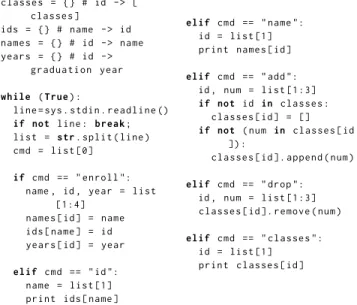
Figure1presents the seed program in our example. The program maintains four data structures: classes, which maps each student id to the list of classes for which the student is registered, ids, which maps student names to corresponding student ids,names, which maps student ids to corresponding names, andyears, which maps student ids to corresponding years of graduation. The main loop reads and implements a command for each line of input. The seed program is quite simple — there is little input validation (for example, the program will accept any string as a student name, student id, class id, or year), little error checking (for example, the code that implements the drop and classes operations does not check if theclasses map has an entry for the providedid, which leaves the program vulnerable to KeyErrors), no corner case checks, and no attempt to provide useful messages to the user of the program. The text-based interface is straightforward to implement using basic Python input and string handling constructs. There is no need for the developer to learn and use more complex Python packages for building HTTP servers, graphical user interfaces, or interacting with database storage systems. 2.3 Program Inference
The program inference algorithm exploits the availability of the seed program to learn the functionality. Unlike most ma-chine learning and program synthesis approaches, which are limited to working with a provided set of input/output pairs, the program inference algorithm can purposefully select the inputs it provides to the seed program to target and resolve
i m p o r t sys classes = {} # id -> [ classes ] ids = {} # name -> id names = {} # id -> name years = {} # id -> graduation year while ( True ):
line=sys. stdin . readline ()
if not line: break ;
list = str. split (line) cmd = list [0]
if cmd == " enroll ":
name , id , year = list [1:4]
names [id] = name ids[name] = id years [id] = year
elif cmd == "id ":
name = list [1] print ids[name]
elif cmd == "name ":
id = list [1] print names [id]
elif cmd == "add ":
id , num = list [1:3]
if not id in classes :
classes [id] = []
if not (num in classes [id
]):
classes [id ]. append (num)
elif cmd == "drop ":
id , num = list [1:3] classes [id ]. remove (num)
elif cmd == " classes ":
id = list [1] print classes [id]
Figure 1. Python seed program for a class registration sys-tem
ambiguities. We next outline how our prototype program inference algorithm exploits this ability (as well as the struc-ture present in the provided interface to the seed program) to learn the core functionality. The inference algorithm is designed to work with programs that have the following sets of properties:
• Key/Value Maps: The program works with a fixed set of maps. Each map contains relations that map a key to a value or to a list of values. Note that the program is not required to implement the maps using any particular data structure or mechanism — because the program in-ference algorithms for this example only generate inputs and observe the resulting outputs, they are oblivious to the particular map implementation technique.
• Store, Retrieve, and Remove Operations: The program implements three kinds of operations, specifically store operations, which store one or more relations between the parameters of the operation into one or more of the maps, retrieve operations, which use the parameter as a key to retrieve and return a value (or list of values) from one of the maps, and remove operations, which remove one or more relations from the maps.
• Initial Empty Maps: When the program runs, it starts with empty maps.
The provided interface distinguishes the retrieve operations, which return values, from the store/remove operations, which return nothing.
2.4 Store/Retrieve Pair Inference
The program inference algorithm first repeatedly executes selected operations with selected parameters starting from empty maps to discover store/retrieve pairs — paired oper-ations in which the first operation stores a relation into a map and the second operation retrieves and returns the corresponding value (or list of values) stored by the first operation (Section3.1). Each store/retrieve pair is mediated by a key/value pair chosen from the parameters of the store operation — the first parameter of this pair is the key of the stored relation; the second parameter is the corresponding value.
The program inference algorithm repeatedly starts with an empty map, executes an enroll operation with a unique name and id, then executes classes, name, and id opera-tions to determine if one of these operaopera-tions returns one of the enroll parameters. If so, the inference algorithm has discovered a store/retrieve pair backed by a map. In the ex-ample the inference algorithm discovers that enroll/name is a store/retrieve pair mediated by the id/name parameters of the enroll operation, enroll/id is a store/retrieve pair mediated by the name/id parameters, and add/classes is a store/retrieve pair mediated by the id/class parameters of the add method.
2.5 Keep, Replace, or List Inference
After the pairs of store/retrieve operations as well as their keys are determined, the inference algorithm next uses this information to determine which store operations accumulate the stored values in lists, which overwrite the old mapping with the new mapping, and which leave the old mapping in place and discard the new mapping (Section3.2). The algorithm executes two store operations that insert different values into the same map under the same key, then executes the corresponding retrieve operation to determine if the retrieve returns both values, the first inserted value only, or the second inserted value only. In our example the inference algorithm determines that the enroll operation overwrites the old mappings and the add operation accumulates the stored values in lists.
2.6 Store/Delete Pair Inference
The next step is to use the store/retrieve pairs to identify store/delete pairs in which the first operation stores a rela-tion and the second operarela-tion removes the relarela-tion (Secrela-tion
3.4). The inference algorithm executes the store operation, then a candidate delete operation, then the corresponding retrieve operation. If the retrieve operation does not return the stored value, then the inference algorithm has discovered a store/delete pair. In our example the inference algorithm determines that the add and drop operations comprise a store/delete pair.
2.7 Map Inference
Finally, the inference algorithm uses the store/retrieve pairs to determine which operations work with the same map and which work with different maps (Section3.5). The basic idea is to execute the seed program twice, once with one store operation and once with another store operation. Both operations insert the same relation, but potentially into dif-ferent maps. Both executions next execute the same retrieve operation (the paired retrieve operation from the first store operation). If both executions return the same value, the inference algorithm concludes that they both accessed the same map (working under the assumption that the retrieve operation always accesses the same map). The code genera-tion algorithm uses the resulting inferred equivalence classes of operations to determine how many maps to generate and which maps each operation accesses.
2.8 Tolerating Seed Program Errors
In any of these steps, the inference algorithm tolerates noise in the seed program when it crashes due to unchecked errors. For example, a Python retrieve operation may crash from a KeyError when attempting to look up a key that does not exist in a map (the classes, name, and id operations). In this situation, the inference algorithm decides that the retrieved value is Nil. Also, a candidate delete operation may crash from a KeyError when attempting to look up a key that does not exist in a map or, when the key does exist, may crash from a ValueError when attempting to remove a value that does not exist in a list (the drop operation). In these situations, the inference algorithm decides that the candidate delete operation does not correspond to the store operation and immediately goes to the next iteration of the closest enclosing loop. This design makes our algorithm robust against certain kinds of noise in the seed program while still learning the core functionality.
2.9 A Web Server with HTTP Interface
Here we present a regenerated program in Python that uses the Flask [Flask 2018] web framework (we also have regen-erated versions in C using Redis, with both text and web interfaces [Rinard and Shen 2017]). Flask is a lightweight, flexible Python web framework for web application back-ends or servers. It is widely used for implementing industry micro-services. The regenerated program utilizes the SQLite3 package for non-volatile data storage. SQLite3 creates a local file which stores all the information associated with given tables and provides SQL access to read or modify the data in the file.
Regenerated based on the specified command interface (Section 2.1), the web server contains routes. Each route allows the web server to handle an HTTP request that imple-ments a command in the seed program. For each command, the inputs and outputs use the JSON data format. Figure2
i mp o r t sqlite3
from flask import * app = Flask ( __name__ ) DATABASE = 'students .db '
def get_db ():
db = getattr (g, '_database ', None )
if db is None :
db = g. _database = sqlite3 . connect ( DATABASE ) db. row_factory = sqlite3 .Row
r et u r n db
def query_db (query , args =()):
cur = get_db (). execute (query , args ) rv = cur. fetchall ()
cur. close ()
r et u r n rv
def write_db (query , args =()):
db = get_db ()
cur = db. execute (query , args ) db. commit ()
cur. close ()
def init_db ():
with app. app_context (): db = get_db ()
with app. open_resource (' schema .sql ', mode ='r ') as f: db. cursor (). executescript (f. read ())
db. commit ()
@app . teardown_appcontext
def close_connection ( exception ):
db = getattr (g, '_database ', None )
if db is not None :
db. close ()
Figure 2. Boilerplate code in regenerated Python/Flask/SQL program
DROP TABLE IF EXISTS students ; C RE A T E TABLE IF NOT EXISTS students (
id INTEGER NOT NULL , name STRING NOT NULL ,
year I N T E G E R NOT NULL,
classes STRING NOT NULL );
Figure 3. Regenerated SQL script to create database tables contains the boilerplate code for building a Flask web server using an SQLite3 database. This code needs to be imple-mented once, then it is systematically regenerated for each seed program. Figure3contains the regenerated SQL script for creating tables in the database. The information about ta-bles and columns are converted from the inferred mappings. This script is executed when a user initializes the database for the web server. Figures4and5present the regenerated HTTP request handlers. Each request handler corresponds to a command in the seed program. They contain the boilerplate code to convert inputs from JSON and convert outputs to JSON. They perform the inferred operations on the database using SQL queries.
In our approach, the knowledge of how to successfully handle URL requests in a web server and of how to suc-cessfully use SQLite, including the specialized knowledge of boilerplate code sequences, is all encapsulated inside the regenerator for automated oblivious reuse by system users.
@app . route ('/ enroll ', methods = ['POST '])
def enroll_mapping ():
name = request .json['name '] id = request .json['id '] year = request .json['year ']
if len( query_db (' SELECT * FROM students WHERE id = ? OR
name = ?', (id , name))) == 0:
write_db (' INSERT INTO students (id , name , year , classes ) VALUES (?, ?, ?, ?) ', (id , name , year , ''))
r e t u r n ('', 200)
@app . route ('/id ', methods = ['POST '])
def id_mapping ():
name = request .json['name '] data = {}
for row in query_db (' SELECT * FROM students WHERE name = ?', (name)):
data['id '] = row['id ']
resp = Response (json. dumps (data), status =200 , mimetype =' application /json ')
r e t u r n resp
@app. route ('/name ', methods = ['POST '])
def name_mapping ():
id = request .json['id '] data = {}
for row in query_db (' SELECT * FROM students WHERE id = ?', (id)):
data['name '] = row['name ']
resp = Response (json. dumps (data), status =200 , mimetype =' application /json ')
r e t u r n resp
Figure 4. HTTP request handlers for commands enroll, id, and name
2.10 Installation, Configuration, and Documentation
In this section we have focused on the source code that the regenerator produces. But in modern computer systems the source code is only part of the solution. In addition to encapsulating the knowledge of how to develop code, the regenerator can also encapsulate knowledge of how to install and configure the relevant subsystems, in the form of natural language narratives or scripts that implement installation and configuratoin.
Our current regenerator implementation produces code without comments or documentation. While many develop-ers may very well use the regenerated code directly without examining it, others may wish to examine, understand, or even modify the code. For these uses, the regenerator can also produce helpful documentation or comments.
3
Program Inference Algorithms
We next present program inference algorithms for programs whose operations store, remove, and delete relations from maps. The algorithms take as inputs the seed programSP, a set of potential store/remove operationsS (each of which may store or remove relations), with each operation of the formsop p1. . . pk (heresop is the name of the operation
@app . route ('/add ', methods = ['POST '])
def add_mapping ():
id = request . json ['id '] num = request . json ['num ']
for row in query_db (' SELECT * FROM students WHERE id = ?', (id)):
classes = row['classes '] + str(num) + ';'
write_db (' UPDATE students SET classes = ? WHERE id = ?', (classes , id))
r et u r n ('', 200)
@app . route ('/drop ', methods = ['POST '])
def drop_mapping ():
id = request . json ['id '] num = request . json ['num ']
for row in query_db (' SELECT * FROM students WHERE id = ?', (id)):
classes = row['classes ']. replace (str(num) + ';', '') write_db (' UPDATE students SET classes = ? WHERE id =
?', (classes , id))
r e t u r n ('', 200)
@app . route ('/ classes ', methods = ['POST '])
def classes_mapping ():
id = request . json ['id '] data = {}
data ['classes '] = []
for row in query_db (' SELECT * FROM students WHERE id = ?', (id)):
data['classes '] = row['classes ']
resp = Response ( json. dumps (data), status =200 , mimetype =' application /json ')
r et u r n resp
Figure 5. HTTP request handlers for commands add, drop, and classes
andp1. . . pkare the names of thek parameters), and a set of potential retrieve operationsR, with each operation of the formrop p → q (here rop is the name of the operation, which takes a single parameterp and returns a value or list of valuesq). The algorithm partitions the operations into S andR based on whether they return a value (operations in R) or not (operations in S). The algorithms are designed to infer the complete functionality of these programs so that the regenerated program can serve as drop-in replacement for the original program.
As presented, the algorithm works with potential retrieve operations that take a single parameter and return a single value or list of values. It is straightforward to generalize the algorithms to work with potential retrieve operations with multiple parameters that may return multiple retrieved values. We also note that the algorithms as currently formu-lated assume that the application conforms to the target class of applications to infer — if presented with an application outside this class of applications, the algorithms will almost certainly fail to infer a correct model of application behavior. The inference algorithms represent the inferred informa-tion with a collecinforma-tion of (conceptual) data structures. Exam-ples include SRP (a set of inferred store/retrieve pairs that
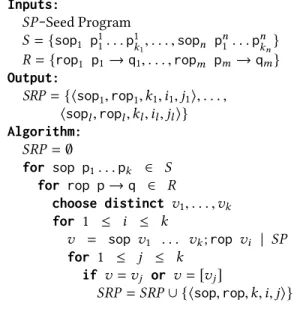
Inputs: SP-Seed Program S = {sop1 p11. . . p1k1, . . . , sopn p n 1. . . p n kn} R = {rop1 p1→q1, . . . , ropm pm →qm} Output: SRP= {⟨sop1, rop1, k1, i1, j1⟩, . . . , ⟨sopl, ropl, kl, il, jl⟩} Algorithm: SRP = ∅ for sop p1. . . pk ∈ S for rop p → q ∈ R choose distinct v1, . . . ,vk for 1 ≤ i ≤ k v = sop v1 . . . vk;rop vi | SP for 1 ≤ j ≤ k if v = vj or v = [vj] SRP = SRP ∪ {⟨sop, rop,k,i, j⟩}
Figure 6. Store/Retrieve Pair SRP Inference Algorithm
records which operations retrieve items stored by other oper-ations, Section3.1), KRL (a set of inferred tuples that records whether operations keep, replace, or accumulate items in-serted under the same key, Section3.2), SDP (a set of inferred store/delete pairs that record which operations delete items, Section3.4), and M (a set of inferred tuples that identify operations that store items into the same map, Section3.5). The regeneration algorithm works with these inferred data structures3.6.
3.1 Store/Retrieve Pair Inference Algorithm
Figure6presents the store/retrieve pair inference algorithm. The algorithm takes as inputs the seed programSP, a set of potential store/remove operationsS (each of which may store or remove relations), with each operation of the form sop p1. . . pk (heresop is the name of the operation and p1. . . pk are the names of thek parameters), and a set of potential retrieve operationsR, with each operation of the formrop p → q (here rop is the name of the operation, which takes a single parameterp and returns a value or list of valuesq). The algorithm partitions the operations into S and R based on whether they return a value (operations inR) or not (operations in S). As presented, the algorithm works with potential retrieve operations that take a single parameter and return a single value or list of values. It is straightforward to generalize the algorithms to work with potential retrieve operations with multiple parameters that may return multiple retrieved values.
The algorithm produces as output a set of store/retrieve pairsSRP, with each pair of the form ⟨sop, rop,k,i, j⟩. Here sop is a potential store operation with k parameters that stores a relation that maps itsi’th parameter to its j’th pa-rameter.rop is a retrieve operation that, when given the
Inputs: SP-Seed Program S = {sop1 p11. . . p1k1, . . . , sopn p n 1. . . p n kn} R = {rop1 p1→q1, . . . , ropm pm →qm}
SRP= {⟨sop1, rop1, k1, i1, j1⟩, . . . , ⟨sopl, ropl, kl, il, jl⟩}
Output:
KRL= {⟨sop1, k1, i1, j1, krl1⟩, . . . , ⟨sopl, kl, il, jl, krll⟩}
Algorithm:
KRL = ∅
for ⟨sop, rop,k,i, j⟩ ∈ SRP
choose distinct v1, . . . ,vk,u1, . . . ,uk
such that vi = ui
v = sop v1 . . . vk;sop u1 . . . uk; rop vi | SP
if v = vj krl= Keep
if v = uj krl= Replace
if v = [vj,uj] krl= List KRL = KRL ∪ {⟨sop,k,i, j, krl⟩}
Figure 7. Keep/Replace/List KRL Inference Algorithm i’th parameter (the key) of a previously executedsop oper-ation, returns thej’th parameter (the stored value) of that operation.
The algorithm itself enumerates all potential store/retrieve pairs to collect all pairs that exhibit the required store/re-trieve behavior. Specifically, it runs the the seed program SP (starting with empty maps) first on a potential store operationsop v1. . . vk, then on a potential retrieve oper-ation rop vi, and collects the resulting valuev that the potential retrieve operation returns. We use the notation v = sop v1. . . vk; rop vi |SP to denote running the seed programSP on these two operations to obtain the returned valuev. If the resulting value v matches one of the parame-tersvi of the potential store operation, then the algorithm has found a store/retrieve pair (that it then collects into the output set of store/receive pairsSRP).
3.2 Keep, Replace, or List Inference Algorithm The keep, replace, or list inference algorithm explores the behavior of the seed program when multiple relations with the same key are stored in the same map. The algorithm infers three different possible behaviors:
• Keep: Keep original relation and drop subsequent stores. • Replace: Replace existing relation with new relation. • List: Accumulate the values from multiple stores into a
list of values stored under the key.
Figure7presents the keep, replace, or list inference al-gorithm. The algorithm takes as inputs the seed program SP, a set of potential store/remove operations S, a set of potential retrieve operationsR, and the store/retrieve pairs SRP from the store/retrieve pair inference algorithm (Fig-ure6). It produces as output a set of tuples ⟨sop,k,i, j, krl⟩,
wheresop is an operation with k parameters that stores
Inputs: SP-Seed Program S = {sop1 p11. . . p1k1, . . . , sopn p n 1. . . p n kn} R = {rop1 p1→q1, . . . , ropm pm →qm}
SRP= {⟨sop1, rop1, k1, i1, j1⟩, . . . , ⟨sopl, ropl, kl, il, jl⟩}
Output:
SCP = {⟨sop1, k1, i1, j1, sop′1, k1′, i′1⟩, . . . , ⟨sopo, ko, io, jo, sopo′, ko′, io′⟩}
Algorithm:
SCP = ∅
for ⟨sop, rop,k,i, j⟩ ∈ SRP choose distinct v1, . . . ,vk
for ⟨sop′ p1 . . . pk′⟩ ∈ S
for 1 ≤ i′ ≤ k′
choose distinct u1, . . . ,uk′
such that vi = ui′
v = sop v1. . .vk;sop′ u1. . .uk′;rop vi | SP
if v = Nil
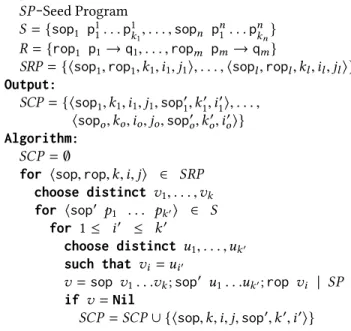
SCP = SCP ∪ {⟨sop,k,i, j, sop′, k′, i′⟩} Figure 8. Store/Clear Pair SCP inference algorithm
a relation into some map. Thei′th parameter is the key and thej’th parameter is the value of this stored relation. krl ∈ {Keep, Replace, List} specifies whether the operation keeps the original relation, replaces the original relation, or accumulates the stores into a list of values.
The algorithm iterates over all of the store/retrieve pairs in SRP (from the store/retrieve pair inference algorithm) to find operations that store relations in some map. It executes the seed programSP, invoking the store operation twice with the same key but different values. It then retrieves the value stored under the key to determine if the store operations kept the first relation, replaced the first relation with the second relation, or accumulated the values into a list stored under the key.
3.3 Store/Clear Pair Inference Algorithm
In addition to storing relations, operations may also remove relations. If an operation removes relations based only on the key, we call the operation a clear relation; if the operation removes relations based on both the key and value, we call the operation a delete operation (Section3.4).
Figure8presents the store/clear pair inference algorithm. The algorithm takes as inputs the seed programSP, a set of potential store/remove operationsS, a set of potential retrieve operationsR, and the store/retrieve pairs SRP from the store/retrieve pair inference algorithm (Figure6).
The algorithm produces as output a set of store/clear pairs SCP, with each pair of the form ⟨sop,k,i, j, sop′, k′, i′
⟩. Here sop is an operation with k parameters that stores a relation that maps itsi’th parameter (the key) to its j’th parameter (the value). sop′is an operation withk′parameters that
Inputs: SP-Seed Program S = {sop1 p11. . . p1k1, . . . , sopn p n 1. . . p n kn} R = {rop1 p1→q1, . . . , ropm pm →qm}
SRP= {⟨sop1, rop1, k1, i1, j1⟩, . . . , ⟨sopl, ropl, kl, il, jl⟩} SCP = {⟨sop1, k1, i1, j1, sop′1, k1′, i1′⟩, . . . , ⟨sopo, ko, io, jo, sopo′, ko′, io′⟩} Output: SDP= {⟨sop1, k1, i1, j1, sop1′, k1′, i′1, j1′⟩, . . . , ⟨sopo, ko, io, jo, sopo′, k ′ o, i ′ o, j ′ o⟩} Algorithm: SDP = ∅
for ⟨sop, rop,k,i, j⟩ ∈ SRP choose distinct v1, . . . ,vk for ⟨sop′ p1 . . . pk′⟩ ∈ S for 1 ≤ i′ ≤ k′, 1 ≤ j′ ≤ k′, i′ , j′ choose distinct u1, . . . ,uk′ such that vi = ui′,vj = uj′ if ⟨sop,k,i, j, sop′, k′, i′⟩ < SCP
v = sop v1. . .vk;sop′ u1. . .uk′;rop vi | SP
if v = Nil or v = [ ]
SDP = SDP ∪ {⟨sop,k,i, j, sop′, k′, i′, j′⟩} Figure 9. Store/Delete Pair (SDP) inference algorithm
clears the stored relation from the map. To clear the relation, the keys, specifically thei′’th parameter ofsop′andi’th parameter ofsop, must have the same value.
The algorithm first uses the inferred store/retrieve pairs SRP to iterate over all operations that insert relations into maps. It then iterates over all potential operations that may clear the stored relation, executing the seed programSP on the two operationssop v1 . . . vk(the operation that stores the relation) andsop′u
1 . . . uk′(the potential clear opera-tion) in sequence. The algorithm then executes the retrieve operationrop vi from the store/retrieve pair to determine if the potential clear operation actually cleared the stored relation. If the retrieve operation returns nothing (v = Nil) after the seed program executes the store and potential clear operation, the algorithm has found a store/clear pair that it then collects into the output set of store/clear pairsSCP. To avoid finding operations that delete relations based on both the key and the value, the algorithm ensures that all of the parametersv1, . . . ,vkandu1, . . . ,uk′are distinct (with the exception of the key parametersvi = vi′) so that the potential clear operation will not be given the value from the stored key/value relation.
3.4 Store/Delete Pair Inference Algorithm
The store/clear pair inference algorithm (Figure8) infers operations that remove relations based on a given key re-gardless of the value to which the key maps. Some operations, however, remove relations based not only on the key, but also
on the value. Such operations are often used, for example, to delete specific values within a list of values accumulated under the same key. We call such operations delete opera-tions (as opposed to the clear operaopera-tions from Section3.3, which remove relations based only on the key, not the value). The add and drop operations from the example in Section2
are one example of a store/delete pair. The store/delete pair inference algorithm infers operations that delete relations based on both the key and the value.
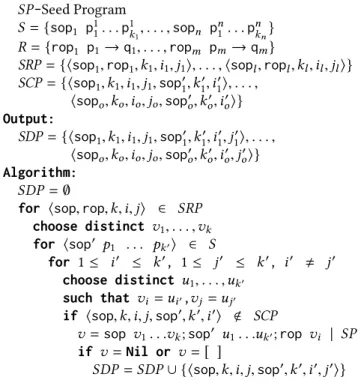
Figure9presents the store/delete pair inference algorithm. The algorithm takes as inputs the seed programSP, a set of potential store/remove operationsS, a set of potential retrieve operationsR, the store/retrieve pairs SRP from the store/retrieve pair inference algorithm (Figure6), and the store/clear pairsSCP from the store/clear pair inference al-gorithm (Figure8).
The algorithm produces as output a set of store/delete pairsSDP, with each pair of the form ⟨sop,k,i, j, sop′, k′, i′, j′⟩. Heresop is an operation with k parameters that stores a relation that maps itsi’th parameter (the key) to its j’th parameter (the value).sop′is an operation withk′ parame-ters that deletes the stored relation from the map. To delete the relation, thei′’th andj′’th parameters ofsop′must be the same as thei’th and j’th parameters of sop, respectively. Delete operationssop′typically work with lists of values stored under the same key to delete single list values while leaving the other values in the list intact. The drop opera-tion in Secopera-tion2is an example of an operation that deletes a relation based on both the key and the value.
The algorithm uses the inferred store/retrieve pairsSRP (Algorithm6) andS to enumerate the possible store/delete pairs. It first runssop v1. . . vk, which inserts the relation, thensop′u
1. . . uk′, which may delete the relation. If then runsrop vi and checks the return value to see if the rela-tion was deleted. It collects pairs in which the relarela-tion was deleted into the output set of inferred store/delete pairsSDP, skipping pairs with a corresponding store/clear pair inSCP — the algorithm only collects store/delete pairs in which both the key and the value must match for the operation to delete the stored relation.
3.5 Map Inference Algorithm
The store/retrieve pair inference algorithm (Figure6) finds operations that insert relations into some map. It does not, however, attempt to determine which operations insert rela-tions into the same map. This information is critical for code regeneration — if two different operations insert relations into the same map, the code regenerator must ensure that the regenerated operations access the same map.
The map inference algorithm finds operations that in-sert relations into the same map. The algorithm enumerates pairs of operations that store relations to find operations that store relations into the same map. It finds these operations by executing the seed programSP twice. The first execution
Inputs: SP-Seed Program S = {sop1 p11. . . p1k1, . . . , sopn p n 1. . . p n kn} R = {rop1 p1→q1, . . . , ropm pm →qm}
SRP= {⟨sop1, rop1, k1, i1, j1⟩, . . . , ⟨sopl, ropl, kl, il, jl⟩}
Output: M= {{⟨sop1 1, k11, i11, j11⟩, . . . , ⟨sopm11 , km11 , im11 , jm11 ⟩}, . . . , {⟨sopn 1, k1n, in1, jn1⟩, . . . , ⟨sopmnn , kmnn , imnn , jmnn ⟩}} Algorithm:
M = {{⟨sop,k,i, j⟩} . ⟨sop, rop,k,i, j⟩ ∈ SRP}
for ⟨sop1, rop1, k1, i1, j1⟩ ∈ SRP
for ⟨sop2, rop2, k2, i2, j2⟩ ∈ SRP
choose distinct v1, . . . ,vk1,u1, . . . ,uk2
such that vi1= ui2, vj1 = uj2 v = sop1 v1 . . . vk1;rop1 vi1 | SP u = sop2 u1 . . . uk2;rop1 vi1 | SP
if v = u
M = Union(M, ⟨sop1, k1, i1, j1⟩, ⟨sop2, k2, i2, j2⟩) Figure 10. Map (M) inference algorithm
executes the first operation, then the corresponding retrieve operation. The second execution executes the second oper-ation, then again the corresponding retrieve operation for the first operation (which retrieves the stored value from the same map that the first operation stored into). If both executions return the same value, the algorithm infers that the two operations store into the same map. The algorithm uses the outputSRP of the store/retrieve inference algorithm to find operations that store relations.
Figure10presents the map inference algorithm. The algo-rithm takes as inputs the seed programSP, a set of potential store/remove operationsS, a set of potential retrieve opera-tionsR, and the store/retrieve pairs SRP from the store/re-trieve pair inference algorithm (Figure6). It represents each map as a set of tuples KRL {⟨sop1, k1, i1, ji⟩, . . . , ⟨sopm, km, im, jm⟩}. Each tuple ⟨sop,k,i, j⟩ represents a store operation sop with k parameters that stores a relation from its i’th parameter to thej’th parameter.
The algorithm works withM, which is a set of sets of tuples. Given a setT ∈ M, all tuples inT represent operations that store into the same map.M partitions the set of tuples (no tuple is in two sets inM). The algorithm initializes M to contain singleton sets of tuples (representing operations that store into a different maps), then unions these sets as it finds pairs of operations that store into the same map. It uses the operation Union(M, ⟨sop1, i1, j1⟩, ⟨sop2, i2, j2⟩), which finds the setsT1,T2∈M that contain ⟨sop1, i1, j1⟩ ∈T1and ⟨sop2, i2, j2⟩ ∈T2, then computes the union ofT1andT2to return (M − {T1,T2}) ∪ {T1∪T2}.
3.6 Regeneration Algorithm
Working with the inferred information, the code regener-ation algorithm performs the following steps. The specific details of each step depend on the precise characteristics of the target computing environment. The code regeneration algorithm encapsulates the knowledge of how to use the com-puting environment for the target computation, with specific implementation decisions about how to best use this environ-ment, such as whether and where to insert caches, left to the implementor of the regeneration code (potentially guided by automated performance measurement experiments on dif-ferent versions of regenerated code executing on the target computing platform).
• Initialization Code: Many computing environments and packages require complex initialization code sequences. The code regeneration algorithm automatically generates this code.
• Map Regeneration: Working with the outputM of the map inference algorithm, the code regenerator generates a map for each set of tuplesT ∈ M. The specific imple-mentation of each map will vary depending on the target computing environment. Examples of potential map imple-mentations include Python data structures, Redis [Redis 2018] maps, and SQL tables.
• Command Loop Regeneration: The regenerated com-mand loop reads each comcom-mand and its parameters, then invokes an (automatically generated) procedure that im-plements the command. Depending on the characteristics of the target computing environment, the code regener-ator can systematically generate (potentially new) input validation checks and recovery code for malformed inputs. • Store Regeneration: For each tuple in the inferred keep-/replace/list set KRL, the code regenerator generates code that stores the inferred relation in the inferred map as de-termined byM. Specifically, for each tuple ⟨sop,k,i, j, krl⟩ ∈ KRL, the regenerated code forsop stores a relation that maps thei’th parameter (the key) to the j’th parameter (the value) in the map for the setT ∈ M, where ⟨sop,k,i, j⟩ ∈ T . krl determines whether the operation keeps, replaces, or accumulates in a list any existing relations with the same key.
• Clear Regeneration: For each tuple in the inferred store/-clear setSCP, the code regenerator generates code that clears relations with the inferred key from the inferred map (as determined byM). Specifically, for each entry ⟨sop,k,i, j, sop′, k′, i′⟩ ∈ SCP, the regenerated code for sop′
clears relations whose key is thei′’th parameter of sop′
from the map for the setT ∈ M, where ⟨sop,k,i, j⟩ ∈ T .
• Delete Regeneration: For each tuple in the inferred store/delete setSDP the code regenerator generates code that deletes relations with the inferred key and value from the inferred map (as determined byM). Specifically, for
elif cmd == " nameByYear ":
id , year = list [1:3]
if years [id] >= year :
print names [id]
elif cmd == " addWithName ":
id , name , num = list [1:3]
if names [id] == name : if not id in classes :
classes [id] = []
if not (num in classes [id ]):
classes [id ]. append (num)
Figure 11. Example Python seed program extensions with boolean conditions
@app . route ('/ nameByYear ', methods = ['POST '])
def nameByYear__mapping ():
id = request . json ['id '] year = request . json ['year '] data = {}
for row in query_db (' SELECT * FROM students WHERE id = ? AND year >= ?', (id , year )):
data ['name '] = row['name ']
resp = Response ( json . dumps ( data ), status =200 , mimetype =' application /json ')
r et u r n resp
@app . route ('/ addWithName ', methods = ['POST '])
def add_mapping ():
id = request . json ['id '] name = request . json['name '] num = request . json ['num ']
for row in query_db (' SELECT * FROM students WHERE id = ? AND name = ?', (id , name)):
classes = row['classes '] + str(num) + ';'
write_db (' UPDATE students SET classes = ? WHERE id = ?', (classes , id))
r et u r n ('', 200)
Figure 12. HTTP request handlers for commands name-ByYear and addWithName
each entry ⟨sop,k,i, j, sop′, k′, i′, j′⟩ ∈SDP, the regener-ated code forsop′clears relations whose key and value are thei′’th andj′’th parameters ofsop′from the map for the setT ∈ M, where ⟨sop,k,i, j⟩ ∈ T .
3.7 Extensions For Conditional Operations
Apart from implementing the algorithms in the previous sections, we also implemented a preliminary version of an extension that infers commands with conditional operations that execute only when certain boolean conditions hold. For example, this extension allows the seed program in Section
2to have additional commands as in Figure11:
• nameByYear (id, year) → name: Retrieve the name of the student with the given id, but only when the student’s graduation year is earlier than the specified year. • addWithName (id, name, class): Add a class to the list
of classes for which the student is registered. The student is identified by the student’s id and validated by providing the correct name.
The nameByYear operation is conditioned on the year pa-rameter being less than or equal to the corresponding value stored by the enroll operation (Figure1). The addWith-Name operation is conditioned on the name parameter be-ing equal to the correspondbe-ing value stored by the enroll operation.
Figure12presents the regenerated HTTP request handlers for these commands, in Python using Flask [Flask 2018]. Each request handler corresponds to a command in the seed program. They contain the boilerplate code to convert inputs from JSON and convert outputs to JSON. They perform the inferred operations on the database using SQL queries. These SQL queries containWHERE clauses that enforce the inferred conditions for an operation to execute.
The extended SRP inference algorithm works with retrieve operations that enforce boolean conditions of the following form. Each input parameter may be compared against at most one existing value stored in a map. The retrieve operation may check if the input parameter is equal to, greater than, greater than or equal to, less than, less than or equal to, or unequal to the stored value. If all these boolean conditions hold, the retrieve operation returns the corresponding value from the map.
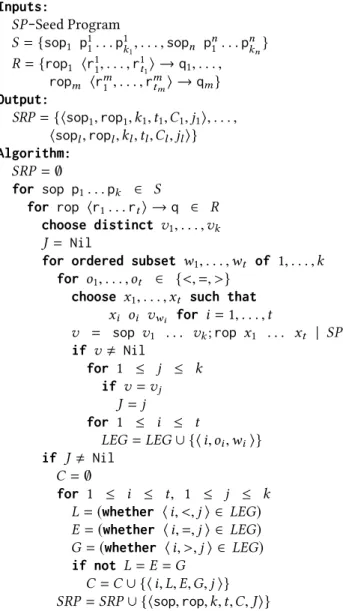
Figure13presents the extended SRP algorithm that in-fers boolean conditions in retrieve operations. The algo-rithm takes as inputs the seed programSP, a set of potential store/remove operationsS, with each operation of the form sop p1. . . pk, and a set of potential retrieve operationsR, with each operation of the formrop ⟨r1, . . . rt⟩ →q. Each retrieve operation takes a list of parametersr1, . . . rt and returns a valueq.
The algorithm produces as outputs a set of store/retrieve pairsSRP, with each pair of the form ⟨sop, rop,k, t,C, J⟩. Heresop is a potential store operation with k parameters that stores theJ’th parameter in a map. rop is a retrieve operation witht parameters that, when given parameters that satisfy the boolean conditions implied byC (see below), returns the J’th parameter (the stored value) of the sop operation. The boolean conditionC contains a set of pairs, with each pair of the form ⟨i, L, E,G, j ⟩ which describes whether the i’th parameter ofrop is allowed to be less than (when L is true), equal to (whenE is true), or greater than (when G is true) thej’th parameter of sop. Only when these conditions hold will therop operation return the stored value.
The algorithm enumerates all potential store/retrieve pairs to collect all pairs that exhibit the required store/retrieve behavior over the same map. Specifically, it runs the seed programSP (starting with empty maps) first on a potential store operationsop v1. . . vk, then on a potential retrieve op-erationrop x1. . . xt, and collects the resulting valuev that the potential retrieve operation returns. We use the same notation as in Section3.1. If the resulting valuev matches one of the parametersvj of the potential store operation, then the algorithm has found a potential store/retrieve pair
(that it then collects into theJ variable for further analy-sis). Here therop parameters x1. . . xt are chosen to differ slightly (the ways they differ are specified byo1. . . ot) from a subset of the values used forv1. . . vk (the correspondence is specified byw1. . . wt). The algorithm exhaustively checks all potential comparison results and collects the observed parameter relations inLEG. LEG contains a set of pairs, with each pair in the form ⟨i, oi, wi⟩ which describes that when thei’th parameter of rop has the oi relation with thewi’th parameter ofsop, the retrieve operation rop successfully returned a value. Then, the algorithm enumerates the infor-mation collected inLEG for each pair of parameters (one for sop and one for rop). If changing their relation has any effect on the execution results, then the algorithm infers that these two parameters has a condition that must be satisfied for the rop operation to return a value. Specifically, the algorithm observes whetherrop executed under three sets of different inputs: when thei’th parameter of rop is less than, equal to, or greater than thej’th parameter of sop. If these three results differ, then the retrieve operation has checked the relation between these two parameters. This result is stored inC.
We next describe how to integrate the boolean condition inference into other parts of the algorithm. In Section3.1, each retrieve operation executes when a given parameter matches the key of an existing record. This key is the pa-rameter of the corresponding store operation for uniquely identifying a record in the map. After extending the algo-rithm to support conditional retrieve operations, we note that the retrieve operations may use more than one parame-ter to identify records. In other words, keys may now contain multiple parameters. Hence, the store operations need to be extended accordingly. A key step is to infer the appropri-ate set of parameters that comprise a key. For example, in each store/retrieve pair, the key used by the store opera-tion may differ from the retrieve operaopera-tion parameters that enforce the equal condition. To address this problem, the algorithm calls the store operation twice, each time using slightly different parameter values. The algorithm then calls the corresponding retrieve operation to check whether the first store operation was overwritten by the second store operation. The algorithm repeats this process and concludes with the minimal set of store operation parameters needed to uniquely identify a record.
TheKRL, SCP, SDP, and M algorithms can also be ex-tended to support the additional functionality for boolean conditionals and multi-parameter keys.
3.8 Discussion
The inference algorithms highlight the utility of working with a seed program instead of a set of given input/output pairs. The ability to repeatedly run the program on chosen sets of inputs and pairs of operations (a form of active learn-ing) enables the algorithms to comprehensively explore the
Inputs: SP-Seed Program S = {sop1 p11. . . p1k1, . . . , sopn p n 1. . . p n kn} R = {rop1 ⟨r11, . . . , r 1 t1⟩ →q1, . . . , ropm ⟨rm1, . . . , r m tm⟩ →qm} Output: SRP= {⟨sop1, rop1, k1, t1,C1, j1⟩, . . . , ⟨sopl, ropl, kl, tl,Cl, jl⟩} Algorithm: SRP = ∅ for sop p1. . . pk ∈ S for rop ⟨r1. . . rt⟩ →q ∈ R choose distinct v1, . . . ,vk J = Nil
for ordered subset w1, . . . , wt of 1, . . . ,k
for o1, . . . , ot ∈ {<, =, >}
choose x1, . . . , xt such that xi oi vwi for i = 1, . . . , t v = sop v1 . . . vk;rop x1 . . . xt | SP if v , Nil for 1 ≤ j ≤ k if v = vj J = j for 1 ≤ i ≤ t
LEG = LEG ∪ {⟨i,oi, wi⟩}
if J , Nil
C = ∅
for 1 ≤ i ≤ t, 1 ≤ j ≤ k L = (whether ⟨i, <, j ⟩ ∈ LEG) E = (whether ⟨i, =, j ⟩ ∈ LEG) G = (whether ⟨i, >, j ⟩ ∈ LEG)
if not L = E = G
C = C ∪ {⟨i, L, E,G, j ⟩} SRP = SRP ∪ {⟨sop, rop,k, t,C, J⟩}
Figure 13. Extended Store/Retrieve Pair Inference Algo-rithm with Boolean Conditions
behavior of the seed program to infer the (conceptual) maps that the program maintains and how the commands manipu-late these maps. There is no need to deal with behavior that is only partially exposed by given input/output pairs.
Because the inference algorithms interact with the seed program only by presenting it with inputs and observing the outputs, the seed program can be implemented in any language and use any mechanism to implement the inferred maps and operations. The approach therefore supports a wide range of developers with a wide range of technical preferences and skills. The inference algorithms also impose essentially no scalability requirements on the seed program — the generated inputs contain at most three operations per