Publisher’s version / Version de l'éditeur:
Plant Cell, Tissue and Organ Culture, 106, 2, pp. 359-362, 2011
READ THESE TERMS AND CONDITIONS CAREFULLY BEFORE USING THIS WEBSITE. https://nrc-publications.canada.ca/eng/copyright
Questions? Contact the NRC Publications Archive team at
[email protected]. If you wish to email the authors directly, please see the first page of the publication for their contact information.
NRC Publications Archive
Archives des publications du CNRC
This publication could be one of several versions: author’s original, accepted manuscript or the publisher’s version. / La version de cette publication peut être l’une des suivantes : la version prépublication de l’auteur, la version acceptée du manuscrit ou la version de l’éditeur.
For the publisher’s version, please access the DOI link below./ Pour consulter la version de l’éditeur, utilisez le lien DOI ci-dessous.
https://doi.org/10.1007/s11240-010-9913-3
Access and use of this website and the material on it are subject to the Terms and Conditions set forth at
A high throughput Brassica napus microspore culture system:
influence of percoll gradient separation and bud selection on
embryogenesis
Bhowmik, Pankaj; Dirpaul, Joan; Polowick, Patricia; Ferrie, Alison M. R.
https://publications-cnrc.canada.ca/fra/droits
L’accès à ce site Web et l’utilisation de son contenu sont assujettis aux conditions présentées dans le site LISEZ CES CONDITIONS ATTENTIVEMENT AVANT D’UTILISER CE SITE WEB.
NRC Publications Record / Notice d'Archives des publications de CNRC:
https://nrc-publications.canada.ca/eng/view/object/?id=f2afe39b-d4ed-4908-91bc-64f3521823f9 https://publications-cnrc.canada.ca/fra/voir/objet/?id=f2afe39b-d4ed-4908-91bc-64f3521823f9
A HIGH THROUGHPUT BRASSICA NAPUS MICROSPORE CULTURE SYSTEM: INFLUENCE OF PERCOLL GRADIENT SEPARATION AND BUD SELECTION ON EMBRYOGENESIS
Pankaj Bhowmik, Joan Dirpaul, Patricia Polowick, Alison M. R. Ferrie
National Research Council - Plant Biotechnology Institute
110 Gymnasium Place, Saskatoon, SK, CANADA, S7N 0W9
Tel: (306) 975-5993
Fax: (306) 975-4839
Abstract
Microspore culture for the purpose of developing doubled haploid plants is routine for numerous plant species; however, the embryo yield is still very low compared with the total available microspore population. The ability to select and isolate highly embryogenic microspores would be desirable for high embryo yield in microspore culture. To maximize the efficiency of canola microspore culture, a combination of bud size selection and microspore fractionation using a Percoll gradient was followed. This approach has consistently given high embryo yields and uniform embryo development. Microspores isolated from buds 1.5 to 4.4 mm in length of Brassica napus genotypes Topas 4079, DH12075, Westar and 0025 formed embryos at different frequencies. The most embryogenic bud size range varied with each cultivar: Topas 4079 3.5-3.9 mm, DH12075 2.0-2.4 mm, and Westar and 0025 2.5-2.9 mm. When the microspores from 2.0-2.4 mm buds of DH12075 were carefully layered on top of a discontinuous Percoll gradient of 10, 20 and 40%, and subsequently spun through the Percoll layers by centrifugation, bands were formed containing populations of microspores of uniform developmental stage. The middle layer of the gradient contained the late uninucleate and early binucleate microspores that were the most embryogenic. In addition, the relationship between the bud size, developmental stage of isolated microspores, Percoll gradient concentration and the
embryogenic frequency of each cultivar were studied. Optimization of these factors is required for each genotype evaluated.
Key Words: Brassica napus, microspore, embryogenesis, Percoll Abbreviations: DAPI - 4'-6-Diamidino-2-phenylindole
The four genotypes studied were chosen based on their importance with respect to other areas of research. Topas 4079 is the microspore embryogenesis model for the Brassica species (Ferrie and Mollers, 2010). The widely studied double haploid line DH12075 is involved in many aspects of Brassica breeding and genomics; consequently, optimizing microspore culture for consistent embryogenesis would be beneficial. Westar is a highly transformable genotype but responds poorly in standard embryogenic conditions (Malik et al., 2008), so is an excellent candidate for embryogenicity improvement. The line 0025 has been reported as a model non-embryogenic genotype (Simmonds and Keller, 1999), and was included as a negative control.
Donor plants of B. napus genotypes Topas 4079, DH12075, Westar, and 0025 were grown in growth cabinets with a 16 h photoperiod at 20°C (day) and 15°C (night) and a light intensity of 400 µmol m-2s-1. Prior to bolting, the
growing temperature was decreased to 10°C (day) and 5°C (night). As described in Ferrie (2003), 50 buds per bud size range (example 1.5-1.9 mm, 2.0-2.4 mm, 2.5-2.9 mm, etc) were surface sterilized and the microspores were released by crushing the buds in ½ strength B5 (Gamborg et al., 1968) with 13% sucrose (pH 6.0) wash media. The microspore suspension was filtered through a 41 µm filter and centrifuged at 150 g for 3 min. The pellet was washed two more times before the microspores were resuspended in NLN (Lichter, 1982) with 13% sucrose and 0.08% glutamine (pH 5.8) at 5 x 10⁴microspores per mL, and cultured at 32°C for 3 days after which they were kept
at 24°C. Embryos were counted 21 days after microspore extraction.
Microspores for Percoll density gradient centrifugation were extracted from 50 2.0-2.4 mm buds of DH12075, resuspended in NLN-13, and carefully transferred onto a 10, 20, and 40% discontinuous Percoll gradient (Percoll was diluted with NLN-13). The microspores were spun at 100 g for 5 min and individual populations were removed from the resulting bands. The microspores were washed with NLN-13 media and plated as above.
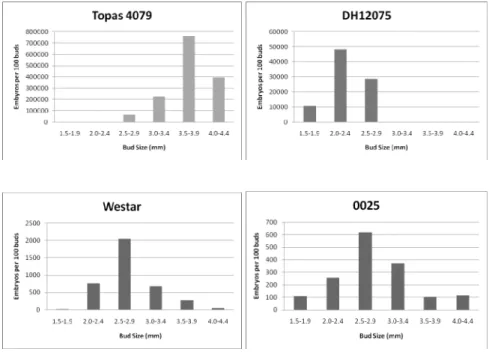
Microspores isolated from 1.5 to 4.4 mm buds of Topas 4079, DH12075, Westar and 0025 formed embryos at various frequencies (Fig. 1). Although both Topas 4079 and DH12075 are very embryogenic cultivars, DH12075 produced embryos in a narrower bud size range than Topas 4079. Westar produced embryos over a wide range of bud sizes, although the embryo yield was very low compared to Topas 4079. The line 0025, previously described as non-embryogenic (Simmonds and Keller, 1999), produced the most embryos at the specific bud size range of 2.5-2.9 mm. Day 21 embryo counts of three replicate experiments containing 2-16 plates (10 mL per plate) of cultured microspores per treatment were used to obtain average numbers of embryos per 100 buds (Fig. 2). Although embryos were obtained from many bud size ranges, the most embryogenic bud size range varied with each cultivar: Topas 4079 3.5-3.9 mm, DH12075 2.0-2.4 mm, and Westar and 0025 2.5-2.9 mm. Also, the quality of the embryos obtained from smaller buds was consistently better than embryos obtained from larger buds. For example, 3.0-3.4 mm buds of Topas 4079 consistently yielded further developed embryos by Day 21 than the larger bud sizes.
As an individual bud may contain microspores of various developmental stages, microspores found within a single bud size range were further separated by centrifugation through a discontinuous Percoll gradient. The concentrations of Percoll used in the gradient were optimized for the microspores obtained from a specific bud size. For example, microspores extracted from 50 buds of 3.0-3.4 mm bud size of Topas separated very well on a gradient consisting of 25, 50 and 100% Percoll. The microspores from 2.0-2.4 mm buds of DH12075 separated on a gradient of 10, 20 and 40% Percoll, but not on the 25, 50, 100% gradient. The number of microspores added onto the gradient affected the resulting banding pattern as well. While the microspores obtained from 50 buds separated on a gradient prepared with 2 mL of each Percoll concentration carefully layered in a 15 mL centrifuge tube, microspores extracted from 100 buds did not separate as well under the same conditions. It was also determined that the smaller diameter of the 15 mL centrifuge tube provided better separation of microspores than a 50 mL centrifuge tube. The centrifugation speed and time was optimized as well in order to form bands containing microspores of different developmental stages. In Figure 3, microspore populations recovered from different bands of the Percoll gradient are shown. Staining with DAPI (Fig. 4) revealed the nuclear stage of the recovered microspores. Generally, the early and mid uninucleate microspores were found in the top layer and the dense, late uninucleate and binucleate microspores congregated in the middle layer.
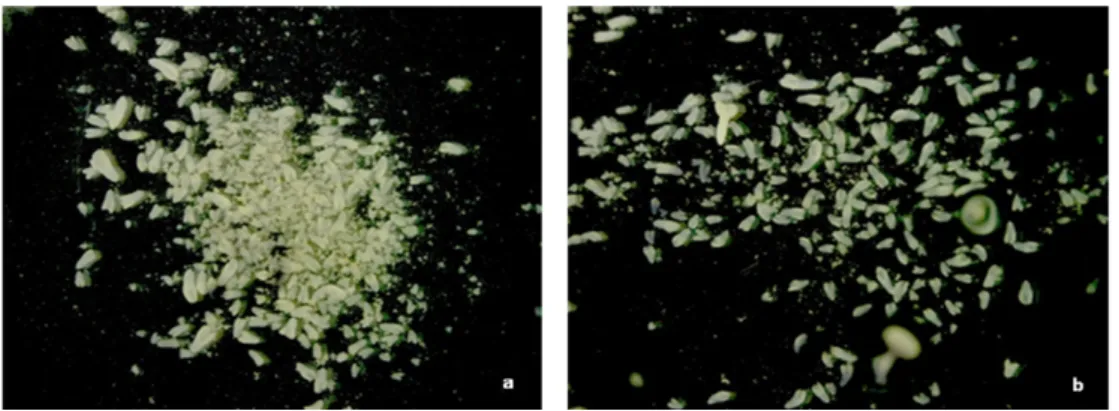
To ensure that the Percoll separation step was not detrimental to microspore embryogenesis, the recovered microspores were washed with NLN-13 and plated for culture. Figure 5 compares the embryos obtained in control plates with those microspores recovered from a separate band of the Percoll gradient. The Percoll treatment resulted in embryos which were more uniform, as the microspores obtained were at approximately the same stage of
development.
These results reflect the importance of bud size selection with respect to embryogenic potential and may lead to microspore derived embryos from other Brassica napus genotypes if previous microspore cultures experiments have focused on the standard bud size of 3-4 mm. The ability to select optimum bud size, and therefore a potentially embryogenic microspore population, would facilitate in depth studies of embryo induction and development in many other crop species.
References
Ferrie AMR. (2003) Microspore culture of Brassica species. Doubled haploid production in crop plants. 205–215. Maluszynski M. Kasha K. J. Forster B. P. Szarejko I. Dordrecht. Kluwer Academic Publishers.
Ferrie AMR and Mollers C. (2010) Haploids and doubled haploids in Brassica spp. for genetic and genomic research.
Plant Cell Tiss Organ Cult. DOI: 10.1007/s11240-010-9831-4
Gamborg OL, Miller RA, and Ojima K. (1968) Nutrient requirements of suspension cultures of soybean root cells.
Exp. Cell Res. 50:151-158
Lichter R. (1982) Induction of haploid plants from isolated pollen of Brassica napus. Z. Pflanzenphysiol. 105:427-434
Malik MR, Wang F, Dirpaul JM, Zhou N, Hammerlindl J, Keller W, Abrams SR, Ferrie AMR, and Krochko JE. (2008) Isolation of an embryogenic line from non-embryogenic Brassica napus cv. Westar through microspore embryogenesis. J. Exp. Bot. 59(10):2857-287327-434ol. 105:427-434
Westar 0025 DH12075 Topas 4079 1.5 – 1.9 mm 2.0 – 2.4 mm 2.5 –2.9 mm 3.0 – 3.4 mm 3.5 – 3.9 mm 4.0 – 4.4 mm G en ot yp e Bud Size (mm)
Fig. 1 Embryos resulting from microspore culture of six bud size ranges in four B. napus genotypes after 21 days in
culture (in 100x15 mm plates).
Fig. 3 DH12075 microspores (a) prior to Percoll separation and microspores recovered from the (b) top and (c)
middle layers of Percoll gradient. Inset images of DAPI staining indicate developmental stages of microspores.
Fig. 4 Images of DAPI staining indicate developmental stages of DH12075 microspores isolated in the (a) top and
(b) middle layers of the Percoll gradient.
Fig. 5 DH12075 embryos from (a) control microspores and (b) microspores separated by Percoll density
centrifugation. Images taken 14 days after microspore extraction.