Dispute Resolution Strategies for Construction Projects
by
D. Sean McCone
B.S., Civil and Environmental Engineering (2000)
University of Illinois Urbana-Champaign
Submitted to the Department of Civil and Environmental Engineering
in Partial Fulfillment of the Requirements for the Degree of
Master of Science in Civil and Environmental Engineering
at the
Massachusetts Institute of Technology
February 2002
© 2002 D. Sean McCone
All rights reserved
MASSACHUSETTS INST: OF TECHNOLOGY
BA
R
0 /
LIBRARIES
The author hereby grants to MIT permission to reproduce and to
C'
distribute publicly paper and electronic copies of this thesis document in whole or in part.
Signature of Author
Certified by
1
itian
McCone
Department of Civil and Environmental Engineering
January 18, 2001
Feniosky Peia-Mora
Associate Professor of Civil
tid
Environmental Engineering
Thesis Supervisor
Oral Buyukozturk
Chairman, Departmental Committee on Graduate Studies
Accepted byDispute Resolution Strategies for Construction Projects
by
D. Sean McCone
B.S., Civil and Environmental Engineering (2000) University of Illinois Urbana-Champaign
Submitted to the Department of Civil and Environmental Engineering in Partial Fulfillment of the Requirements for the Degree of
Master of Science in Civil and Environmental Engineering
ABSTRACT
One of the most important, but often overlooked steps in developing a project is a plan to prevent and handle conflict, a Conflict Management Plan. Leading construction experts have identified Productivity, Innovation, Cost Control, Safety, and Litigation Expenses as critical areas in need of improvement in the construction industry of this next century. In the United States alone, $60 billion are spent every year on lawsuits, of which the construction industry accounts for nearly $5 billion. Various dispute avoidance and resolutions techniques are presented that aim to prevent disputes before they arise and minimize the impacts if they do. These techniques are the tools then used in the Conflict Management Plan.
A Conflict Mitigation Plan looks at each project individually to establish a set of criteria for controlling conflicts. It assesses how much conflict you will encounter, how severe each conflict might be, then presents cost effective ways to avoid conflict and curb these disputes. Similar to the contract documents it should be complete, unbiased, understood, and accepted by all the parties involved. All of the project participants such as the owners, the owner's representatives, designers, lawyers, and contractors are responsible for designing, reviewing and revising it accordingly. No one person or field should be responsible for developing this plan. Designing a conflict mitigation plan compels the owner to contemplate the conflict that might arise. This will allow the owner to allocate these risks and develop a plan to handle discrepancies. By doing this upfront and with each subsequent review, everyone involved has agreed to follow this plan, reducing the push for lengthy, costly court proceedings.
To implement a Conflict Management Plan one must assess the project situation by identifying the sources of conflict that might occur, then analyze the severity and impact each of these conflicts might have. Match the conflict with a corresponding DART, to reduce or avoid the conflict. Draft the plan. Review and revise it as needed.
Thesis Supervisor: Feniosky Pefia-Mora
Acknowledgements
On the technical side, I would like to thank Professor Feniosky Peila-Mora for his guidance in developing the topic and the opportunity to work with him. Throughout my career at MIT I have met numerous individuals that have guided, educated and cultured me, Professor John Miller, the CM club, Phil Helm, and numerous others.
This thesis is dedicated to all of my family for their love and caring. In particular, I would like to express my sincere gratitude to my parents, Fran and Bob. Throughout my years, you have given me the freedom and support that defines who I am. I hope that one day I will be able to repay you for the priceless contribution you have bestowed upon me. Carrie and Brett, thanks for all the encouragement. Kelly, thank you for your love and support, and for enduring the frustration and stress I exuded on you during my extensive studies.
TABLE OF CONTENTS
CH A PTER 1... ... .. ... 10
THE CONSTRUCTION INDUSTRY...10
1.1 ORGANIZATIONAL ISSUES ... 14
1.1.1 Participants and People Issues...14
1.1.2 Project Structure ... ... 16 1.1.3 Process Problem s...22 1.2 PROJECT UNCERTAINTY... 23 1.2.1 External U ncertainties... 24 1.2.2 Internal Uncertainties... 24 1.3 SUMMARY... 25 CH A PTER 2... ---... ---... 26 EV O LU TIO N O F DA RT... 26
2.1.1 Determ ination by the Design Professional ... 27
2.1.2 Arbitration ... 29
2.2 M ODIFICATION OF THE TW O-STEP ADR APPROACH ... 33
2.2.1 FID IC's ADR Contract Conditions... 34
2.2.2 World Bank's ADR Contract Conditions ... 36
2.2.3 Chek Lap Kok A irport's Dispute Resolution System ... 37
2.3 EVOLUTION OF THE PRESENT ADR M ETHODOLOGIES ... 41
2.3.1 Data Supporting the Evolution of ADR... 42
2.3.2 Two Conceptualization M odels of DART ... 45
2.4 THE STATE OF THE LEGAL CONSTRUCTION ARENA ... 50
2.5 SUMMARY... ... 53
CH A PTER 3... 55
STA G E 1: PREV EN TIO N ... . . . ... 55
3.1 EQUI LTABLE R ISK SHARING ... 56
3.1.1 Econom ic Price Adjustm ent ... 59
3.1.2 Geotechnical Baseline Report (GBR) ... 60
3.1.3 Third Party Beneficiary Clause ... 61
3.2 ESCROW BID D OCUMENTS ... 61
3.3 INCENTIVE PROGRAM S ... 62
3.3.1 Cost/Schedule Incentive M atrix... ... 63
3.3.2 Subjective D eterm ination of Fee... ---... ... 64
3.3.3 Superior Tine-M anagement Allowance... 65
3.4 COM PETENT ENGINEERING AND DOCUM ENTATION ... 65
3.4.1 Constructability Analysis ... 65
3.5 COST AND SCHEDULE CONTROL... 66
3.5.11 Cost Statem ent Subm ittal... ... 68
3.5.2 Certified Payroll Subm ittal ... 68
3.5.3 Negotiated Equipm ent and Labor Pricing ... 68
3.5.4 Joint Project Scheduling... ... 69
3.5.5 Schedule Audits... ... ... 69
Forward-Price Change Orders... 70
Right of Refusal on Change-Order Cost Quotations... 71
Sub-Contractor Paym ent Requirem ents... 71
DISPUTE RESOLUTION CLAUSES... 72
TRAINING AND DEVELOPMENT ... 72
SUMMARY... 73 R44..-... -... ... ... --. ...75 3.5.7 3.5.8 3.5.9 3.6 3.7 3.8 CHAPTE PARTNE 4.1 4.2 4.3 4.4 4.5 75 DEFINITION AND BENEFITS OF PARTNERING ... 76
THE PARTNER ING PROCESS... 79
KEY COM PONENTS OF PARTNERING ... 80
THE PARTNERING CONTINUUM ... 83
SUM M ARY ... 90 CHAPTER 5... STAGE 2: NEGOTIATION 5.1 5.2 5.4 5.5 5.6 CHAPTE STAGE 3 6.1 6.2 6.3 6.4 6.5 CHAPTE 92 92 POSITIONS VERSUS INTERESTS ... 93
N EGOTIATIO N STYLES ... 95 STEP NEGOTIA ... 96 STRUCTURED NEGOTIATIONS... 97 FACILITATED NEGOTIATIONS/MEETINGS... 99 SU M M A R Y ... 100 R6... ... 102 : STANDING NEUTRAL. 102 NEUTRAL ADVISOR ... 103
OW NER/AGENCY REVIEW BOARDS...104
DISPUTE REVIEW BOARD ... 105
ON-CALL CONTRACTOR ... 106
SUM M ARY... 107
R7... ... 109
STAGE 4:NON-BINDING DISPUTE RESOLUTION...109
7.1 M EDIATION ... 110
7.2 CONCILIATION ... 116
7.3 ADVISORY ARBITRATION (NON-BINDING ARBITRATION)... 117
7.4 M INI-TRIAL OR EXECUTIVE TRIAL...118
7.5 SUMMARY JURY TRIAL ... 119
7.6 VOLUNTARY SETTLEMENT CONFERENCE (RENT-A-JUDGE)... 120
7.7 SUMMARY ... 121
CHAPTER 8... ... STAGE 5: BINDING DISPUTE RESOLUTION, 124 124 8.1 ADJUDICATOR/EXPERT DETERMINATION... 126 8.2 ARBITRATION... 128 8.2.1 Single Arbitrator... 132 8.2.2 Baseball A rbitration...
132
8.3 SHADOW M EDIATION... 133 8.4 SUMMARY ... 133 RING W.W.w wwwwwwwwwwwwwwwwwwwwwwwwwwwwwwwwwwwwwwwwwwwwwwwwwwwwwwwwwwwwwwwwwwwwwwwwwwwwww ... ... W-w --- w --- w-www w --- w--IJLIL -W a FAL'IL qLF ICHAPTER9.13...5 3
CONFLICT MANAGEMENT PLAN...135
9.1 CONFLICT MANAGEMENT PROCESS... 136
9.2 IDENTIFYING POSSIBLE CONFLICTS...137
9.3 ANALYZING IDENTIFIED CONFLICTS...138
9.3.1 Probability of Occurance...
139
9.3.2
Impact
of Conflict ... ...144
9.3.3 Combined Conflict Exposure ... 145
9.4 DESIGNING THE MANAGEMENT PLAN... 147
9.4.1 Prioritizing and DART Implementation... 148
9.4.2
Identification:
Who is responsible? ... ... 1509.4.3 Cost/Benef
it Issues
...151
9.4.4 Contingen Plan... ... 152 9.5 IMPORTANCEOFREVIEW... 152 9.6 CASE STUDY... 153 9.7 SUMMARY... 155 CHAPTERY10...156 SUMMARY... 156 10.1 FUTURE WORK... 159 CHAPTER 11 .... ... 160 RFERENCES...160LIST OF TABLES
TABLE 1 - RESEARCH ON THE SOURCES OF CONFLICTS AND DISPUTES IN THE CONSTRUCTION INDUSTRY (FENN
ETAL., 1997)... ... 11
TABLE 2-SOURCES OF CONFLICT AND DISPUTE... 12
TABLE 3 - OWNER-CONTRACTOR OBJECTIVE ALIGNMENT (HOWARD ET AL., 1997) ... 13
TABLE 4- RELATIONSHIPS AMONG PARTICIPANTS...21
TABLE 5 - PROBLEMS WITH ARBITRATION IN ABA SURVEY 1988 AND THEIR CONNECTION TO THE FEATURES OF ARBITRATION IDENTIFIED (STIPANOWICH 1996)...32
TABLE 6- SUMMARY OF RESULTS OF SURVEY ON THE USE OF ADR IN US CORPORATIONS (LIPSKY ET AL., 1997) ... 44
TABLE 7-ALLOCATION OF PROJECT RISKS UNDER THE SHARED-RISK APPROACH (FINDLEY, 1997)...58
TABLE 8-OBJECTIVE ALIGNMENT THROUGH INCENTIVE PROGRAM... ... 63
TABLE 9 -PARTNERING LEVELS (BASED ON THOMPSON ET AL., 1998 AND ELLISON ET AL., 1995)...84
TABLE 10 - SUMMARY OF CHARACTERISTICS OF DIFFERENT STANDING NEUTRAL TECHNIQUES... 107
TABLE 11 - MEDIATION AND ARBITRATION DIFFERENCES (LIPSKY ET AL., 1997)... ... 112
TABLE 12 - SOURCES OF CONFLICT AND DISPUTE ... 137
TABLE 13 - PROBABILITY OF ENCOUNTERING STRUCTURE CONFLICT ... 140
TABLE 14 - PROBABILITY OF ENCOUNTERING PROCESS CONFLICT...141
TABLE 15 - PROBABILITY OF ENCOUNTERING PEOPLE CONFLICT... 141
TABLE 16 - PROBABILITY OF ENCOUNTERING EXTERNAL UNCERTAINTY ... 143
TABLE 17 - PROBABILITY OF ENCOUNTERING INTERNAL UNCERTAINTY ... 143
TABLE 18 - EXAMPLES OF IMPACT ON THE PROJECT...145
TABLE 19 - EXAMPLE OF A MITIGATION PLAN LIST... 149
LIST OF FIGURES
FIGURE 1 - CONTRACTUAL SERVICES (GORDON 1991)...17
FIGURE 2 - PROJECT STRUCTURES OF SELECTED DELIVERY SYSTEMS ... 18
FIGURE 3 - TRADITIONAL TWO-STEP DISPUTE RESOLUTION "LADDER" IN CONSTRUCTION PROJECTS...27
FIGURE 4 - STANDARD DISPUTE RESOLUTION PROCESS FOR GOVERNMENT CONSTRUCTION CONTRACTS IN HONG KONG...0.00...37
FIGURE 5 - DISPUTE RESOLUTION PROCESS FOR HONG KONG'S AIRPORT CORE PROGRAM...38
FIGURE 6 - COMPOSITION OF THE DISPUTE REVIEW GROUP FOR THE CHEK LAP KOK AIRPORT PROJECT, HONG KONG... ... 40
FIGURE 7 - CONSTRUCTION INDUSTRY CONFLICT CONTINUUM (FENN ET AL., 1997)...46
FIGURE 8 - PROPOSED TAXONOMY OF ADR TECHNIQUES (FENN ET AL., 1997)...47
FIGURE 9 - DISPUTE RESOLUTION LADDER (FINDLEY, 1997)... 48
FIGURE 10 - DISPUTE RESOLUTION "LADDER" ESTABLISHED IN THE CCDC 2 CONTRACT...49
FIGURE 11-DISPUTE MANAGEMENT TECHNIQUE IN ITALIAN PUBLIC SECTOR CONTRACTS...67
FIGURE 12 - SAMPLE PROJECT CHARTER (ELLISON ET AL., 1995)...83
FIGURE 13 - PARTNERING CONTINUUM (THOMPSON ET AL., 1998)...84
FIGURE 14- STRUCTURE OF AN ULTRA-FAST TRACK HIGH-TECH DESIGN-BUILD PROJECT (MILES, 1996)... 88
FIGURE 15-DIAGRAM OF STEP NEGOTIATIONS SHOWING LEVELS AND COMMUNICATION LINES...97
FIGURE 16 - SPECTRUM OF MEDIATION STYLES IN USE WITHIN THE CONSTRUCTION INDUSTRY IN THE UNITED K INGDOM ... 113
FIGURE 17 - DISPUTE RESOLUTION PROCEDURES IN STANDARD JAPANESE CONTRACTS...115
FIGURE 18 - CONTINUUM OF NON-BINDING DISPUTE RESOLUTION TECHNIQUES...123
FIGURE 19 - ADJUDICATOR PROCEDURE FOR DISPUTE RESOLUTION... 127
FIGURE 20 - CONFLICT MANAGEMENT PROCESS... 136
CHAPTER
1
THE CONSTRUCTION
INDUSTRY
1
A number of causes of disputes in construction projects have been presented in literature. However, a common source of conflict found is the fact that the majority of projects are a one-time experience. Even when companies perform projects of a similar nature and for the same client, differing site conditions, regulations, subcontractors, market conditions, and team members modify the development of the contract.
Construction is significantly different from manufacturing, where the same goods are produced a thousand times. Construction does not allow for the change of one variable while holding the rest fixed in order to study its effects. Furthermore, in any given project, different reasons for a particular dispute will be found depending on who is asked, at what stage of the project the research is conducted, how the survey is administered, or what documentation is available for review. That is why analyzing construction projects post-factum adds complexity and makes the concluding task more difficult.
The rationale behind the efforts to identify the sources of disputes in construction has been the premise that if the origins of the "illness" can be identified, ways to "cure" the industry from unnecessary litigation can be developed. In particular, Stipanowich (1996) described the construction industry as the "...spearhead of experimentation with mechanisms aimed at avoiding disputes by addressing the roots of controversy." Table I summarizes seven different research
efforts conducted during the past decade, and the sources of disputes in construction projects they have identified.
1Chapters 1 through 8 are based on the publication, Carlos E. Sosa. State of the Art Review of
Methodologies for Dispute Avoidance and Resolution in Large Scale Engineering Systems. MIT Thesis. Cambridge, MA. May 1999. They have been adapted and revised with permission of the author.
Table I - Research on the Sources of Conflicts and Disputes in the Construction Industry (Fenn et al., 1997)
Research Author Sources of Conflicts and Disputes in Construction Bristow, 1998 Six Areas: unrealistic expectations; contract documents;
communications; lack of team spirit; and changes.
Conlin et al., 1996 Six Areas: payment; performance; delay; negligence; quality; and administration.
Heath et al., 1994 Seven Areas: contract terms; payment; variations; time; nomination; renomination; and information.
Hewit, 1991 Six Areas: change of scope; change conditions; delay; disruption; acceleration; and termination.
Rhys Jones, 1994 Ten Areas: management; culture; communications; design; economics; tendering pressures; law; unrealistic expectations; contracts; and workmanship.
Semple et al., 1996 Four Areas: acceleration; access; weather; and changes. Sykes, 1996 Two Areas: misunderstandings; and unpredictability.
At first sight, it seems that there are vast sources of construction conflicts and disputes, but if you take a closer look you will see that most of the areas are the same, but identified with different adjectives. This problem requires a set of labels or headings to facilitate the comprehension of the reasons behind construction conflicts and disputes. On this account, Howell
et al. (1988 cited by Vorster, 1993) proposed a nomenclature of elements that summarize four
causes behind conflict in the construction environment: * Incomplete scope definition
* Inappropriate contract type * Poor communication * Uncertainty
However, this classification can be further simplified into to two main areas. This arrangement gathers most of the information presented in Table I and Howell et al.'s model, yet it permits a simpler cataloging of the 'genesis' of construction disputes. This classification is presented herein to accurately group these areas of conflict.
Table 2 - Sources of Conflict and Dispute
Area Discipline Sources of Dispute
Internal/external organizational structure, delivery Structure systems, inappropriate contract type, contract
documents, contract terms, law
Performance, quality, tendering pressures, payment, Organizational Process delays, disruption, acceleration, administration, formal
Issues communication channels, information sharing, reports
and poor communication
Misunderstandings, unrealistic expectations, culture, People language, communications, incompatible objectives,
management, negligence, work habits, and lack of team spirit
Change, variations, environmental concerns, social External impacts, economics, political risks, weather, Uncertainty regulations , and unforeseen site conditions
Incomplete scope definition, errors in design, construction methods and workmanship
This characterization has the additional contribution of supporting the notion that people issues are related to the project structure and process problems. For example, certain project structures align some of the participant's objectives where as others do not. When the parties' objectives and interests are not compatible, their interpretations of contract documents, terms and conditions can be divergent leading to discrepancies and conflicts. In short, all of disciplines within an area are interrelated.
Confirming this notion of a relationship between objectives and disagreements, many participants acknowledge the apparent conflict-prone nature of construction projects on the incompatibility of the parties' initial intents. Each construction party starts with a different set of goals, correlating this information to the high tendency to conflict in this industry. Incompatible objectives are responsible for the frequent disagreements on how to approach and complete a project, leading to adversarial attitudes. Table 3 illustrates the results, when they asked owners and contractors to identify what constituted business success for their companies in construction projects following a traditional Design-Bid-Build approach.
Table 3 - Owner-Contractor Objective Alignment (Howard et al., 1997)
CONTRACTORS OBJECTIVES
" Achieve profit and other financial gains. " Satisfy client and generate repeat business. " Manage cash flow.
* Limit long-term liability.
" Develop employees and create satisfaction.
* Optimize employment level within contractor organization.
CONTRACTORS' AND OWNERS' OBJECTIVES
" Complete the project within budget. " Complete the project within schedule.
" Maintain a high level of quality.
" Execute the project safely, without wasted time or accidents. " Minimize claims and litigation.
OWNERS OBJECTIVES * Meet return on investment goal.
" Minimize plant operating and maintenance costs. " Minimize plant downtime and outages.
* Achieve high product quality.
" Achieve product throughput capacity goals. " Provide design flexibility to meet future demands. " Minimize disruptions to existing operations.
" Avoid negative impact on environment and community. * Reduce project cycle time.
e Exceed internal customer's expectations.
As shown, only in a few responses the owner and contractor shared a set of objectives.
On the one hand, "the owner wishes to obtain maximum quality, functionality, and capacity at a
minimum cost." On the other, "the contractor ... must achieve financial goals that are advanced
by expending the minimum resources required to meet a minimum scope of work" (Howard et al.,
1997). This limited alignment of objectives fosters the development of conflicts and disputes. After reviewing the reasons behind disputes in the construction, it appears that conflict is an intrinsic aspect of this industry, as each project has its own set of organizational issues and project uncertainty. These conditions also make each project unique, making the development of a unique theory on the sources of conflict and dispute in construction a challenging task. Therefore, it remains the responsibility of each project team to assess their specific project
characteristics to develop a joint, creative, and effective approach to deal with and resolve conflicts before they can lead to disputes.
1.1 ORGANIZATIONAL ISSUES
Project, organizational structures can be very complex. Contractual relationships and channels of communication created may be inefficient and create conflict. The structure of a project can reduce or create conflict among the multiple participants. To get a grasp on project structure lets first look at several different "pure" project structures and delivery systems in order to identify participants, their roles, their responsibilities, and their relationships. Next, we can identify potential conflicts in those relationships, to evaluate how the delivery system affects the conflict situation, and therefore, the negotiation process through changes in participants'
relationships.
1.1.1 Participants and People Issues
General characteristics of the major participants on the project, such as the owner, the A/E, the contractor, and the CM, are reviewed here based on their interests, positions and attitudes. Others that need to be considered but not mentioned here include subcontractors, suppliers, unions, lawyers and financial institutions. Between these participants, there are many sources of disputes. Misunderstandings often result in conflict. All owners push for a job to be completed, as soon as possible, with exceptional quality and minimal cost, but sometimes their expectations are too high. Even though a contractor may be performing exceptionally compared to the industry standards, the owner's paranoia may harbor the feeling that contractor is not. As seen, people issues are a major source of conflict. However, projects that encounter monumental challenges and enormous conflicts can be overcome if the participants cooperate and communicate effectively.
Owner
The owner is the inciting party for whom the project is developed. This party is also, in most cases, the source of the financial resources that support the project. It is important to notice the distinction between private and public owners, because the private owner's centracts operate differently from the public ones. The private owner may include individuals, partnerships, corporations, or various combinations thereof Most private owners are the end users who have
the facility built for their own use. Some others may sell, lease or rent the facility to others for a profit. These differences of the owner's position in the "value system" (Porter 1985) may affect his/her strategy and, therefore, his/her interests in a project. On the other hand, in the United States the public sector owners are composed of local, state, or federal governmental bodies. Public projects are paid for by appropriations, bonds, tax levies, or other forms of financing and are built to meet some defined public need. It is interesting that public owners' interests are largely affected by the needs of the public they serve, who is usually not at the table when conflicts occur. Another important point is that the public owner may be subject to restrictions on delivery methods, such as a state law against public owners using design-build. This may sometimes result in contractual relationships that contain unresolved problems, or potential conflicts.
Architect/Engineer (AlE)
The A/E is the party that designs the work and often administers the construction phase of the project on the behalf of the owner and in the absence of a CM. The A/E can occupy a variety of positions with respect to the owner for whom the design is done. It is quite common that the A/E acts as an independent designer under contract with the owner. In some agencies that hold their own in-house designers, the A/E occupies a functional part of the owner's organization. Meanwhile, the A/E may be affiliated with the contractor when the owner contracts with a single party for both design and construction services. Depending upon contracts and organizations, the A/E takes various positions as they relate to both the owner and the contractor. In those cases, the A/iE's interests may differ accordingly from project to project, however, some of his/her inherent interests, such as safety and aesthetics, will not change.
General Contractor (GC)
The GC is the entity that is charged with the responsibility of actually putting construction work in place and performs some or all of the actual work. The GC is the entity that determines the means, methods, techniques, sequence, and procedures to direct the actual construction activities. The subcontractors are responsible to the GC in the same way that the GC is responsible to the owner. Therefore. in the interest of clarity and simplicity here, the discussions on construction forces are confined to the GC. In different contracts, there are a number of ways to price and pay for contracted services of the contractors, which greatly influence one of their greatest interests, profit and risk allocation. It must be noted that recent trends have been for a GC to subcontract all the work for a project and not perform any of the
actual work. For the purpose of this research we define these general contractors as construction managers at risk.
Construction Manager (CM)
The CM may be design firms, contractors, or professional construction managers. Construction management services range from mere coordination of contractors during construction, to broad responsibilities over project planning and design, construction scheduling, cost monitoring, and other management services. Depending upon the scope of work determined by contracts, the CM may have several interests at a time, but most of the times, some interests such as reputation remain at the center of the CM's interest, considering the nature of the professional services it provides.
Roles, Responsibilities, and Relationships
Based upon the characteristics of the major participants in a construction project, their roles, responsibilities, and relationships need to be examined. To examine their relationships however, it must be noted that there exists contractual relationships and communicational relationships among the participants in projects. It is important to maintain the clear distinction between these two types of relationships when we scrutinize the project structures. There may not be a contractual link between the major participants in a project, but only a communication link. This means that, although two parties may sit at opposite ends of the negotiation table, a particular outcome may have to be expressed through contracts held by a third party. The traditional design-bid-build system, for example, places the owner in the middle of any conflict between the designer and the contractor, who only have communicational relationship in the project. Thus, it is critical to understand the contractual relationships and communicational relationships in order to explore the negotiations that will occur as part of the administration of the contract on a particular delivery system. The relationships need to be examined within a delivery system for them to be accurately characterized.
1.1.2 Project Structure
There may be a number of ways to classify project delivery systems. The following seven delivery systems were selected for review so that they can effectively show clear distinctions between the participants' roles, responsibilities, and relationships.
" Pure or Agency Construction Management (PCM) * Construction Management at Risk (CMR)
* Design-Build (D/B) * Turn-Key (TKY)
* Design-Build-Operate (DBO) * Build-Operate-Transfer (BOT)
DBB has been the most frequently used delivery method, often called the "traditional" approach. This assumes that design and construction of the project proceed in sequence, awarding the construction contract after plans and specifications are completed. Most references in this research are targeted toward the DBB delivery system unless noted otherwise. In construction management, a construction manager plays a distinctive role to perform as the owner's agent or sometimes to take construction risks instead of the owner. These two types of construction management, PCM and CMR, are expected to illustrate the effect of risk shift among participants' relationships. Recently some "new" delivery systems packages such as D/B, TKY, DBO, and BOT have become popular. These delivery systems focus on the concept of combining project phases into on one contractual service. Figure 1 is included to define what we mean by "project phases".
Project Phase
Scope of Design Construction Operation & Maintenance
Work
Financing Short-Term Financing Long-Term Financing
Figure 1 -Contractual Services (Gordon 1991)
D/B is a delivery system where both design and construction functions are combined under one contract. TKY can be categorized as one of the modification of D/B, which packages design, construction, and short-term financing. DBO is an extension of the TKY delivery process, but with O&M included over an extended period of time. BOT is a further extension of the DBO model, including long-term financing. Those differences in scope of the contracts are also anticipated to make distinction among each participant's relationship. The models of the project structure followed in these four delivery systems are depicted in Figure 2. Project structures for TKY, DBO and BOT may be illustrated similarly as the one for D/B, except for the differences of extra functional groups involved in their teams, such as O&M forces and financing firms.
Owner
CM ,googol,,, A/E
Trade Trade Trade
Contractor Contractor Contractor
(b) Pure or Agency Construction Management
Owner
CM IN,,,,,,,,,,, A/E
Trade Trade Trade
Contractor Contractor Contractor
(c) Construction Management At Risk
Owner
D/B Entity Construction
H
DesignFunction Function
Sub Sub Sub
Contractor Contractor Contractor (d) Design-Build
Contractual Relationship **,*M*N*,*g Communicational Relationship Internal Relationship
Figure 2 -Project Structures of Selected Delivery Systems
The Traditional Design-Bid-Build
The owner, the A/E, and the contractor are the three major participants in this structure. The project proceeds sequentially, with design reaching full completion prior to conducting bidding and the selection of a contractor.
In this structure, the owner contracts directly and separately with the contractor and the designer. There are formal contractus relationships between the owner and the contractor as well as between the owner and the designer. The owner selects and hires the A/E to whom they may entrust responsibility for design and construction inspection. A lump sum bid is commonly used in this delivery system for both public and private projects. The lump sum and general contractor
I
Owner
A/E
General
+
Contractor
Sub Sub Sub
CotarContractor Contractor (a) Traditional Design-Bid-Build
approach tends to set up a build-in adversarial relationship between the owner and contractor. This typically results from the general contractor's principal interest in delivering the project below the lump sum amount to achieve or increase profit or to encourage change orders or claims for the same reason. The owner's interest may vary depending upon projects, including quality and value of product, delivery schedule, site safety, and environmental impact. However, they are greatly influenced by the major assumption for this system that responsibility and risk are allocated easily by segmenting tasks. The owner also has an emphasis on construction costs that the DBB method pursues through a strong market competition.
The A/E completes the design and develops the general contract documents, interpreting the owner's needs. The general responsibilities beyond those are to administer the owner-contractor contract, functioning as the owner's agent. The owner and A/E are in more of a collaborative position, because the A/E is typically selected on a qualification basis, and occupies the position of primary consultant and fiduciary to the owner. No formal contract exists between the A/E and the contractor. However, despite no contractual relationship, the informal relationship of communication exists between the A/E and the contractor. The adversarial relationship may occur between them, because the contractor has to act on orders from a contractually unauthorized source. From the nature of work and selection base, the AlE's interests
may include profit, aesthetics, relationships, quality, recognition, and otherwise.
The general contractor's role usually starts from the bidding stage, so they play very little or no part in the design phase. They take total charge of the site and construction of the project. They coordinate and supervise the works of the subcontractors who actually undertake most of the construction. They are responsible to the owner for the construction in accordance with plans and desires of the A/E. They normally assume responsibility for all site safety issues. In general, the contractor's interests may include profit, construction time, relationships. and reputation, although profit almost always seems to be one of the top priorities. Construction time, or schedule, is also a key element of the project especially in a situation that time becomes a cost item to the contractor.
Pure or Agency Construction Management (PCM)
The owner is responsible for selecting and hiring the PCM as well as the A/E. The owner's interests may not be different from the ones in DBB, but the choice of a PCM as an agent largely affects the owner's interests. The owner appropriately selects the PCM system, due to its advantages of great flexibility in the schedule and for changes, as well as fiduciary relationship with the contractor both before and during construction, while still providing market competition
for most of the work (Gordon 1991). The role of A/E remains much the same as in the traditional design-bid-build method, but the appearance of a PCM affects the A/E's roles. The A/E is forced to adjust their communication network and their own responsiveness to accommodate the owner-PCM relationship. The owner-PCM does not hold any contracts with trade contractors, nor guarantees any sort of upset price to the owner. For these reasons, the financial risk to the PCM is small but the risk of loss of reputation is very high. Unlike other participants, the PCM in this system may have greater interest on reputation and relationship at the expense of profit since most of the time they have fixed fees. In this light, it is likely that the PCM could undertake the facilitator/mediator role in negotiations when conflicts arise in a project.
Construction Management at Risk
This is often called construction management with a guaranteed maximum price (GMP). Many owners want to reduce their risk by having the CM guarantee a total upset price for the work, a GMP. With a GMP, the process becomes more like the traditional design-bid-build process. This casts relationships into a status somewhere between that of the traditional design-bid-build method and the pure construction management method. In this system, the CM holds all of the trade contracts directly. The CM is responsible for completing the project for a total sum equal to or less than the GMP. Their interest on profit becomes more intensive as project costs approach the ceiling of GMP. This tends to change the CM's attitudes in negotiations during the course of the project.
Design-Build
The owner contracts singularly with the D/B team. The design function and construction function are within one contractual team. The responsibility for design and construction rests with one organization, and there exists only one contract to the owner. This is usually a type of general contractor firm with design function. The design function can be another firm, and the relationship is just as another subcontractor to the prime. Contrary to DBB, the owners may have more emphasis on schedules despite less control and more uncertainty of cost. One of the disadvantages of the system is the loss of control over design and flexibility in changes. The owner must be knowledgeable enough about design and construction to establish the initial parameters, review proposals. and monitor the process, which frequently require the help of an independent consultant.
Analyzing Delivery Methods
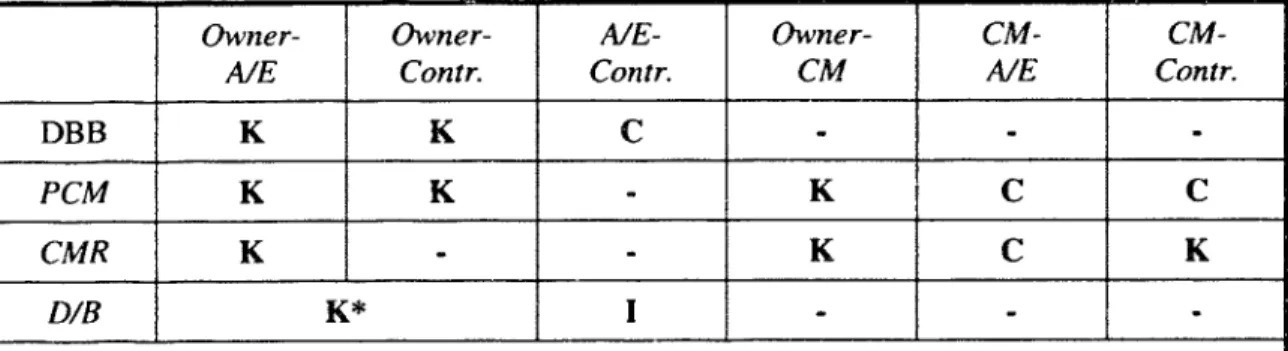
Given the roles, responsibilities, and relationships of major participants, Table 4 illustrates the differences of the relationships among the major participants in the four delivery systems. Depending upon the delivery systems, participants form different relationships: the contractual, communicational, or internal relationships.
Table 4 - Relationships among Participants
Owner- Owner- AE- Owner- CM- CM-AE Contr. Contr. CM AE Contr.
DBB K K C - -
-PCM K K - K C C
CMR K - - K C K
DIB K* I - -
-K: Contractual Relationship; C: Communicational Relationship; I: Internal Relationship; *: Contractual
Relationship between the Owner and the D/B Team
Relationships differ even between the same participants of projects. For example, CM-Trade Contractor relationship changes from the communicational one to the contractual one when the owner shifts his/her risks to CM. The roles and positions may differ significantly, even under the same relationships participants have. For example, one of the A/E's main interests in the DBB contract is to protect his own and the owner's interests, while, in the D/B contract, he/she plays the opposite role as the co-worker of the contractor with the intent of bringing value to the D/B team instead of the owner. The relationships between the CM and the A/E also show the differences between two construction management systems. In PCM, both the CM and the A/E serves the owners as agents and work together in a collaborative manner, while the CMR in practice appears to be a GC and they may have adversarial relationships.
Since the roles and positions that every participant takes are regulated by the contract they agreed on prior to the beginning of the project, different contract types lead to varied positions and interests. Thus, the relationships and interests of participants become extremely complex. It is quite possible that an owner has a fiduciary relationship with a designer in a DBB project, while they have an adversarial relationship with the very same designer in a different D/B project. Moreover, one participant may take two or more distinct roles in a single project that adopts "innovative" hybrid delivery system.
Thus, information on relationships may help the project participants avoid their role and responsibility confusions. This is especially important in a large-scale project, because some participants may hold several different contracts and their roles and responsibilities differ among those contracts. Surveys in American industry show that there is only a 35% overlap between that which top managers expect their close subordinates to do, and that which the subordinates themselves think they should do (Scott et al., 1990). This may apply directly to owners and their relationships with contractors or contractors and their relationships with subcontractors. Role confusion or misunderstanding is almost inevitable, especially under competitive stresses in the context of a large-scale project. Information on roles and relationships may also help in contract planning and formation process, especially when a hybrid type of delivery system is under consideration. The owners or project managers should check the interest inconsistency in allocating multiple responsibilities and risks for hybrid systems.
1.1.3 Process Problems
Interrelated with the project structure are the process problems. The number and types of process problems are endless. The sources of conflict relate to how the project is handled. It focuses on contract administration, contract terms, project management and inefficiencies therein. These process problems may be inherited from the choice of project structure and they may be compounded by people issues.
There has been an abundance of material written on construction contracts.2
This material addresses formation of contracts, implementation of contracts, breech of contracts and other related areas. When a conflict of interest arises, the first move each party makes is to review the contract documents for direction. These documents are not always thorough nor do they address every situation.
Contract Types
Directly relating to project structure is contract type. In this thesis, we will focus on contract types as they differ on the "basis of payment." For this reason the classification of contract types will be based on this characteristic. Lump sum, unit price, guaranteed maximum price, cost plus and fixed fee are all examples of different contract types. Each of these contracts have advantages and disadvantages, and can create conflict. Some of these contract types are
2 One such book is: Collier, Keith. Construction Contracts.
3'd edition. Prentice-Hall Inc. Upper Saddle
sometimes synonymous with certain delivery systems, but make no mistake they are different. Project structure and contract type should be chosen on a project-by-project basis taking into consideration each individual situation.
The lump sum or fixed price contract is the most common type of contract. It is also the most adversarial. The general contractor or design-build entity enters into a contract with the owner for a fixed price. This type of contract compels the contractor to cut corners to reduce costs and make a profit. On the owner's side, it requires the owner to provide for monitoring of the contract for quality and compliance as per the contract documents. With this being the most common form of contract, you can see why the industry is plagued with conflict and claims.
One the opposite end of the spectrum it a cost plus contract. The cost plus contract aligns the objective of the owner and the constructor more so than a fixed price contract. In a cost plus contract, the contractor will perform the work for the owner at the cost to him/her plus a percentage for profit. This ensures that the contractor will not lose any money, shifting more risk to the owner. Knowing this, there is the risk that a contractor might take advantage of the situation, by inflating the costs and therefore increasing their profit. In these cases, proper checks and balances need to be provided to ensure that cost increases represent the reality of the project.
A median between the two is a guaranteed maximum price (GMP). In a GMP contract, the owner will reimburse the contractor for all the costs plus a profit up to a certain price. The GMP contract has the benefit of having a fixed maximum price that the contractor must respect, but still allowing the flexibility of being reimbursed for costs. In short. all these contracting mechanisms try to achieve a balance between the objectives of each participant in terms of risk allocation, quality, schedule and cost, among others.
1.2
PROJECT UNCERTAINTY
Equally important as organizational issues are the uncertainties that are present in all construction projects. Even if the correct delivery method is selected, all the process problems have been eliminated and the people issues disappear, project uncertainty will still exist. External uncertainties are those that must be accounted for, but they may not be able to be directly controlled, as they are the result of external forces. Internal uncertainties are unforeseen circumstances that we attempt to account for, but are often unidentified because of lack of information. The area of project uncertainties is inherent because of the characteristics of the industry.
1.2.1 External Uncertainties
External uncertainties are the result of external forces on the project. They are present in all projects and range form inclement weather, to political risk, to acts of god. They are usually accounted for through insurance policies, contract clauses or other forms of mitigation. In most cases, there is not a person to blame. For example, securing a contract with a government in a country that has a history of political chaos and government overthrows might present the situation where the contract becomes void. After completing half the work and not being compensated, how should the conflict be resolved?
In other instances, Mother Nature seems to find her way onto every jobsite. Rain, snow, wind, fog, extreme temperatures are just some of the factors that impact projects in a negative manner. To combat these uncertainties, it is normal to insert contract clauses that address these issues or identify schedule buffers according to the unworkable days. There are was to proportionate the risks associated with most of the external uncertainties, but they must be identified ahead of time and accounted for in order to avoid conflicts on who is responsible and should pay for it.
1.2.2 Internal Uncertainties
Internal uncertainties range from errors in design, to unforeseen site conditions to an incomplete definition of scope. In large bureaucratic agencies and long duration projects, internal uncertainties in terms of scope seem to be more prevalent. This is evident as projects that start under one administration, who have defined the scope, may be changed by the succeeding administration with a different agenda.
Unforeseen site conditions are a common source of disputes, even if this risk is allocated in the contract documents. A finger pointing game results when lack of investigation on both the part of the owner and the contractors result in. Examples of these include unexpected contaminated soils or the bearing layer for foundations is deeper than expected. Too many times "fast track" projects become engulfed in conflict because all the parties are running in high gear and they overlook minor details that come back to haunt them midway through a project. Not to mentions that errors and omissions in the design are present in all projects. However, their impact could be minimized with proper monitoring and control the common statement heard in the construction industry "No design is ever complete."
Dissimilar to the disciplines in the organizational issues, technical and context uncertainties are not interrelated. Political risks do not result from errors in design. Incomplete scope definition does not breed inclement weather. This is different from the organizational issues, as these characteristics are derived from the premise that these uncertainties are present in every project.
1.3
SUMMARY
The construction industry is unlike any other industry in the world. The global market encompasses over three trillion US dollars. The vast majority of construction projects are one-time individualistic projects, never to be duplicated, developed in an open environment where variables such as weather, soil, political, social and environmental conditions are difficult or impossible to control. It is a highly fragmented industry and involves numerous participants. The largest portion of market share held is amounts under 3%. The relationships and coordination between all the various participants is just one of many causes of conflict. Participants in this industry include owners, engineers, governments, regulation agencies, constructors, unions, suppliers, lawyers and financial institutions to name a few. Their roles and objective in the construction industry vary based on their contractual relationships for each project. Conflict in this industry is inherent of the characteristics of this industry. Industry size, complexity, uniqueness are conflict related characteristics. If we understand the characteristics of the industry causing conflict, we are more apt to develop DART. All conflicts can be grouped into two categories of Organizational Issues and Process Problems.
To understand the organizational issues and project uncertainty that create conflict then evaluate the roles each participant plays in a construction project. After reviewing the delivery systems that are currently used today to define these relationships and evaluating the contractual relationships that each participant holds one should apply this knowledge to the projects, to help reduce potential conflict and aid in developing a Conflict Management Plan (Chapter 9).
CHAPTER 2
EVOLUTION OF DART
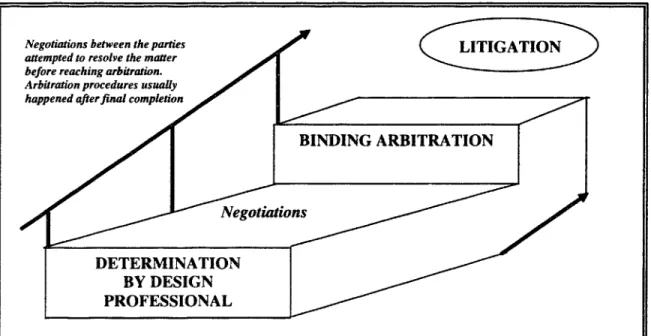
Not so long ago, dispute resolution had two possible definitions for organizations involved in construction. The first was for a design professional to render a non-binding determination, the other was to proceed to binding arbitration. These were the only real options, other than litigation, available to construction teams to unravel disagreements during the execution of the project. All parties used negotiations to fill the gap between these tools; however, they were mostly performed on the basis of experience, business savvy, and opportunity, without any formal procedure that could promote both a faster and more equitable settlement of the dispute. Litigation was considered too expensive and time consuming, so arbitration became the industry standard as the alternative binding procedure. Figure 3 shows the traditional two-step Dispute Resolution "Ladder" (DRL) with the two resolution tools. This idea of a Dispute Resolution "Ladder" is used to organize dispute avoidance and resolution techniques for construction projects, and it is further described in Section 2.3.2.
In this ladder, the design professional played the role of a first step in the process of resolving disputes. The contractor submitted inquiries and disagreements to the design professional representing the owner, and then expected prompt, knowledgeable, and unbiased answers. If either the owner or contractor objected to the determination of this third party, the matter usually escalated and it was left to arbitration. As discussed above, and shown in Figure 3, negotiations were used to fill the "gap" between the first and second step in the ladder. In this stage, either the owner or the contractor has become involved to formally prevent conflicts and disagreement. An exception to this is perhaps attempting to transfer project risks to the opposing party in an effort to limit individual liabilities. Design-Build projects are based in part on this notion of reducing the owner's exposure to design problems, by assigning both the design and the construction responsibility to only one party.
Negotiations between the parties attempted to resolve the matter before reaching arbitration. Arbitration procedures usually happened after final completion
BINDIN Negotiations LITIGATION iG ARBITRATION-f-" DETERMINATION BY DESIGN PROFESSIONAL
Figure 3 - Traditional Two-Step Dispute Resolution "Ladder" in Construction Projects
The second step in the ladder, Arbitration was the preferred alternative to litigation for
the resolution of construction disputes because it offered "...a limited process, a relatively prompt hearing, privacy, informality, and above all, [an] inforned judgment" (Stipanowich, 1996). This
is how arbitration became a "sine qua non of construction contracting," and gained popularity as a standard clause in most contracts. If the first step of the ladder failed to resolve the dispute, arbitration procedures were usually delayed until the project was completed. The two dispute resolution steps of the traditional construction DRL, are discussed in more detail in the following two sections.
2.1.1 Determination by the Design Professional
In "traditional" design-bid--build delivery methods, the resolution of construction disputes has been the responsibility of the p.oject architect/engineer for a long time. It was considered logical that the design professional, who drafted drawings and contract specifications, made determinations with regards to interpretations, and related conflicts between the owner and the contractor. The decisions of the architect/engineer were backed by their profound knowledge of
the technical considerations of the project, something that gave them the authority to resolve almost any matter related to their 'creation'. The decisions of the design professional were usually not final nor binding on the parties, but they provided a fast, knowledge-based, "objective" solution to jobsite disputes.
Nevertheless, as contracts became larger, the technical complexities increased and the number of parties expanded, the quantity, frequency, and size of project disputes also increased. The dollar amount of contract disagreements became larger and delayed completion time brought additional problems. Although it was often assumed by owners that the evaluation of disagreements would always be conducted by their own on-site agent (engineer or architect), the changes described eventually undermined the position of the agents and they were finally considered not in the best position to propose or evaluate the merits of an equitable settlement.
Among the major concerns that led this transformation was the possible conflict of interest as the design professional was not truly neutral. A contractor seeking compensation from the owner because of a contractual problem involving administration, design, and/or contract interpretation elements was not likely to find an objective decision originating from the agent, since this last was an actual part of the condition being claimed (Stipanowich, 1996). Furthermore, in disputes regarding errors or omissions in the contract, the design professionals frequently became a defendant, so their role as an 'unbiased third party resolver' of disputes lost credibility. At that point the owner was left to face what often were disputes that could not be
settled by the people they had assumed would be responsible of doing so during the project. The role of the design professionals as the first step in the DRL has lost significance, especially in large, complex projects where their decisions can be challenged in other forms of binding adjudication, or where they can become a part of the dispute. Although the design professional still remains the primary interpreter of design and specification requirements, their role as a dispute resolution adjudicator has been reduced significantly. Still, the benefits of having an unbiased, knowledgeable third party involved in the resolution of construction disputes is still recognized by the industry (i.e., objectivity, speed, decisions backed by technical know-how, and an understanding of the project) as it will be demonstrated in further examples of third-party ADR techniques. Thus, it can be argued that the concepts of Neutral Advisors (Section 6.1) and Dispute Review Boards (Section 6.3) have been developed by the construction industry as substitutions and improvements of the role played by the design professional in the traditional DRL.
2.1.2 Arbitration
This section presents two cases of early applications of arbitration as a dispute resolution technique, together with the use of arbitration in the construction industry. The two cases provide two important lessons for the use of arbitration in construction dispute resolution. First, the Greek case shows how arbitration was implemented as a dispute resolution system. Then, the use of arbitration in the Middle Ages in England shows how this technique followed a path towards rigidity and formalization as its use increased just like arbitration in construction during the past fifteen years.
Arbitration Experiences in Greece
In an article published in the Dispute Resolution Journal, King et al. (1994) described the use of arbitration by the Greek city-states. The authors reported that by 500 BC arbitration had reached almost universal acceptance throughout Greece, where it was often used to resolve commercial problems between citizens, and as a diplomatic resource between city-states. These early uses of arbitration provide an interesting example of how alternative dispute resolution (i.e., arbitration) has been an integral part in the evolution of human relationships. Furthermore, it appears that the reasons behind the development of arbitration in Ancient Greece are also associated with flexibility, privacy, and economy; the characteristics that allowed arbitration to become a pivotal part of the Traditional DRL. The following case helps illustrate these observations.
According to the article, the Athenian democracy was rooted in the success of commercial arbitrations conducted by Solon, a well-known Athenian lawmaker. At the time, increasing social unrest required a prompt resolution of disputes; something that Solon achieved by proposing knowledge-based, fast, and mutually beneficial resolutions (sometimes the fallback was war). Just like some models in the present time (e.g., expert determination and arbitration), the decisions of a third party neutral were final and not eligible for appeal, as they were considered the judgment of city-state appointee to solve the discords. These characteristics which made arbitration the dispute resolution system in ancient Greece are also the some features that fostered its incorporation in the DRL of the construction industry: fast solutions based on knowledge and experience, flexibility, and finality.
3 Solon's legacy is the codification of the laws that defined Athens's democratic assembly (King et al.,
Arbitration in Old England (602-1698)
Another case of ancient applications of arbitration is found in the history of Old England from the Dark Ages to the end of the Middle Ages, where arbitration was a conciliatory process used as a true alternative to litigation. Arbitration's function was to reconcile the parties and allow them to sustain long-lasting business relationships. Arbitration was embodied in the medieval institution of the "loveday,"4 and was essentially a form of mediation.
"When two merchants found themselves in dispute ... they went to a colleague, and agreed to abide by his decision. In many trades, there was no need for enforcement of awards at law. If a man failed to comply with an arbitral award, [he/she] faced commercial ruin when his peers were no longer prepared to give him credit or to deal in his goods. Chambers of Commerce and trade association v played an active part in
arbitration."
Beresford (1998) However, as disputants began to use arbitration as a substitute to court litigation, arbitration acquired some of the characteristics of the legal system; something that gave raise to a pseudo-adjudicative variety of the technique that grew as the commercial community used it more and more. Consequently, from the late Middle Ages through the early modem period loveday arbitration changed, as potential abuses of the process and evolving notions of community, competition, and individualism contributed to the disappearance of arbitration as a
conciliatory process (Yam, 1995).
It can be seen from this how arbitration evolved from a purely conciliatory process to an adjudicative system, as its use by the business community and the courts increased. This evolution is similar to the one found in the arbitration of construction disputes today.
Arbitration in the Construction Industry
As mentioned in the traditional two-step ladder, if the parties failed to reach an agreement with the design professional, the only alternative was binding arbitration. Arbitration clauses became the standard in agreements between owners, designers, and contractors, functioning as the dispute resolution technique instead of litigation. Standard contract forms issued by professional associations like the American Institute of Architecture (AIA), the Association of General Contractors (AGC). and the Chartered Institute of Builders (CIOB) all incorporated arbitration as their only dispute resolution alternative. International organizations like the World Bank and the Federation Internationale de Ingenieurs-Conseils (FDIC) also supported the use of