Eddy-Mean Flow Interactions
in Western Boundary Current Jets
by
Stephanie N. Waterman
Submitted in partial fulfillment of the
requirements for the degree of
Doctor of Philosophy
at the
MASSACHUSETTS INSTITUTE OF TECHNOLOGY
and the
WOODS HOLE OCEANOGRAPHIC INSTITUTION
SSACHUSETTS INSTITUTE OF TECHNtO4OGY
APR
2 8 2009
LIBRARIES
ACHIVES
February 2009
@
Stephanie N. Waterman, 2009
The author hereby grants to MIT and to WHOI permission to
reproduce and distribute publicly paper and electronic copies of this
thesis document in whole or in part.
Author .... :
Joint Program in Physical Oceanography
Massachusetts Institute of Technology
Woods Hole Oceanographic Institution
January 20, 2009
Certified by..
Certified by..
Steven R. Jayne
Associate Scientist
Thesis Supervisor
Nelson G. Hogg
Scientist Emeritus
Thesis Supervisor
Accepted by
/
-
Raffaele Ferrari
Chair, Joint Committee for Physical Oceanography
Massachusetts Institute of Technology
Woods Hole Oceanographic Institution
Eddy-Mean Flow Interactions
in Western Boundary Current Jets
by
Stephanie N. Waterman
Submitted to the Joint Program in Physical Oceanography - Massachusetts Institute of Technology / Woods Hole Oceanographic Institution
on January 20, 2009, in partial fulfillment of the requirements for the degree of
Doctor of Philosophy
Abstract
This thesis examines the nature of eddy-mean flow interactions in western boundary current jets and recirculation gyre dynamics from both theoretical and observational perspectives. It includes theoretical studies of eddy-mean flow interactions in idealized configurations relevant to western boundary current jet systems, namely (i) a study of the mechanism by which eddies generated from a localized forcing drive mean recirculation gyres through the process of nonlinear rectification; and (ii) a study of the role of eddies in the downstream evolution of a baroclinic jet subject to mixed instabilities. It also includes an observational analysis to characterize eddy-mean flow interactions in the Kuroshio Extension using data from the downstream location of maximum eddy kinetic energy in the jet.
New insights are presented into a rectification mechanism by which eddies drive the recirculation gyres observed in western boundary current systems. Via this mecha-nism, eddies drive the recirculations by an up-gradient eddy potential vorticity flux inside a localized region of eddy activity. The effectiveness of the process depends on the properties of the energy radiation from the region, which in turn depends on the population of waves excited. In the zonally-evolving western boundary cur-rent jet, eddies also act to stabilize the unstable jet through down-gradient potential vorticity fluxes. In this configuration, the role of eddies depends critically on their downstream location relative to where the unstable time-mean jet first becomes sta-bilized by the eddy activity. The zonal advection of eddy activity from upstream of this location is fundamental to the mechanism permitting the eddies to drive the mean flows. Observational results are presented that provide the first clear evidence of a northern recirculation gyre in the Kuroshio Extension, as well as support for the hypothesis that the recirculations are, at least partially, eddy-driven. Support for the idealized studies' relevance to the oceanic regime is provided both by indications that various model simplifications are appropriate to the observed system, as well as by demonstrated consistencies between model predictions and observational results in the downstream development of time-mean and eddy properties.
Thesis Supervisor: Steven R. Jayne Thesis Supervisor: Nelson G. Hogg
Acknowledgments
First and foremost, I thank my thesis advisors Steven Jayne and Nelson Hogg. I have had the honor of being Steve's first student and Nelson's last, and to each I owe much gratitude for all they have contributed towards my education as an oceanographer and a scientist.
I thank my thesis commitee Joe Pedlosky, Glenn Flierl, Jack Whitehead, and Pavel Berloff for their guidance over the years, and my thesis defense chair Breck Owens for his very helpful outsider's perspective. It is hard to imagine a more uniquely qualified team to guide me through this effort, and I feel privileged to have had the opportunity to benefit from their expertise.
I owe thanks to many others who have given me advice and suggestions on this work, among which are Luc Rainville, Genta Mizuta, Raffaele Ferrari, Alan Plumb, Paola Cessi, Peter Rhines, Bill Holland, Susan Lozier, Bo Qui, Meghan Cronin, Chris Hughes, Jonathan Lilly, Tapio Schneider and Kurt Polzin. I thank too various indi-viduals who have been especially encouraging of me: Joe Pedlosky, John Marshall, Geoff Vallis, Shaffer Smith and Rob Scott.
I thank my teachers in the Joint Program, and in particular Joe Pedlosky, Raffaele Ferrari and Glenn Flierl, for teaching me about GFD, instability theory and turbu-lence. I also thank Terry Joyce for first introducing me to observational oceanography. I thank Young-Oh Kwon and Peter Windsor for sharing their computing resources with me, and Ben Carr for being my computer guru.
I also must thank the KESS group for giving me the opportunity to experience the excitement of going to sea, as well as the satisfaction of working with observational data. I thank Keith Bradley for building the beta boat and letting me have fun playing in his GFD lab.
I also thank my fellow PO classmates Kjetil Vage, Tatiana Rykova, Hristina Hris-tova, Sophie Zhang, and Shaoyu Yuan for their years of help and comradeship. I am very grateful too for the support and friendship of the other PO students, Melanie Fewings, Greg Gerbi, Matt Mazloff, Yohai Kaspi, Dave Sutherland, Maxim Nikurasin,
Carlos Moffatt, Katie Silverthore, Beatriz Pena-Molino, Rachel Horwiz and Holly Dail in particular. Tribute must also be paid to the "aesthetics committee" of 1417 for all of their advice in response to my frequent consultation. I thank the students of 12.800 in the fall of 2007 for giving me one of my most rewarding experiences in graduate school.
I thank all of my friends from WHOI and MIT who have given me so much happiness during my years here. It is because of you I am most sad to say goodbye. I thank my parents for their unconditional and unending support through what was a longer-than-average career as a student. Steve, I thank-you for everything you did to make me happy in this chapter, and for all of the happiness the anticipation of the next chapter has given me.
Finally I thank Barry Ruddick, for telling me I should be an oceanographer.
Funding was for this research and my education was provided by the MIT Pres-idential Fellowship and NSF grants OCE-0220161 and OCE-0825550. The financial assistance of the Houghton Fund, the MIT Student Assistance Fund, and WHOI Academic Programs is also gratefully acknowledged.
Contents
1 Introduction
1.1 Background and Motivation . . . . 1.2 Past Work and Present State of Knowledge . . . 1.3 Thesis Objectives ...
1.4 Thesis Outline ...
2 Eddy-Driven Recirculations From A 2.1 Introduction ...
2.1.1 Motivation ... 2.1.2 Past Work ...
2.1.3 Present Work Objectives . . 2.1.4 Chapter Outline ...
2.2 Methodology ...
2.2.1 Analytical Analysis . . . . .
2 NTirn)) rX 1 1 ;miilt+;nnc
Localized, Transient Forcing 25
. . . . 26 . . . . 26 . . . . 27 . . . . 28 . . . . 29 .U ume L r ca . . . . . . . . . . . 2.3 Results: Insights into the Rectification Mechanism 2.3.1 Insights From Analytical Analysis . . . . . 2.3.2 Insights From Numerical Simulations . . . 2.4 Results: Dependence on System Parameters . . . 2.4.1 Effect on Rectification Effectiveness . . . . 2.4.2 Interpretation Via Wave Rectification . . . 2.5 Results: The Effect of Stratification . . . . 2.5.1 Effect on Rectification Effectiveness . . . . . . . . 30 . . . . . 30 . . . . . 31 . . . . . 33 . . . . . 33 . . . . . 34 . . . . . 39 . . . . . 39 . . . . . 39 . . . . . 47 . ... 47
2.5.2 Interpretation via Wave Rectification ... . 49
2.6 Results: The Effect of a Mean Background Flow . ... 55
2.6.1 Effect on Rectification Effectiveness . ... 55
2.6.2 Interpretation via Wave Rectification ... . . . . . 56
2.7 Results: Extension to the Strongly Nonlinear Regime . ... 61
2.7.1 Effect on Rectification Effectiveness . ... 62
2.7.2 Interpretation Via Wave Rectification Modified by Wave-Mean Flow Interactions ... 63
2.8 Summary and Discussion ... 68
3 Eddy-Mean Flow Interactions in the Downstream Evolution of an Idealized Western Boundary Current Jet 73 3.1 Introduction . . . .. . . . .. . . . . . 74
3.1.1 M otivation .. ... ... .. ... ... ... .. ... .. 74
3.1.2 Past W ork ... 76
3.1.3 Present Work Objectives ... ... 78
3.1.4 Chapter Outline ... 79
3.2 M ethodology ... ... 80
3.3 Results: The Barotropic Case . ... ... 83
3.3.1 The Effect of Eddies on the Time-Mean Circulation ... 83
3.3.2 Insights into the Eddy-Driving Mechanism ... ... . . . 91
3.3.3 A Conceptual Description of Eddy-Mean Flow Interactions . 98 3.3.4 The Relative Importance of Eddy Forcing . ... 101
3.3.5 Dependence on System Parameters . ... . . .104
3.4 Results: The Baroclinic Case ... 109
3.4.1 The Effect of Eddies on the Time-Mean Circulation ... 110
3.4.2 Insights into the Eddy-Driving Mechanism . ... 122
3.4.3 A Conceptual Description of Eddy-Mean Flow Interactions . 124 3.4.4 The Roles and Relative Importance of Relative Vorticity vs. Thickness Fluxes in the Eddy Forcing . ... 129
3.4.5 The Relative Importance of Eddy Forcing . .
3.4.6 Dependence on System Parameters . ... 137
3.5 Summary and Discussion ... 142
3.5.1 The Barotropic Case: A summary . ... 142
3.5.2 The Two Layer Case: A summary . ... 143
3.5.3 Some Caveats ... 145
3.5.4 Relevance to Actual Oceanic WBC Jet Systems ... . 147
3.5.5 A Barotropic Ocean Storm Track? . . . 149
4 Eddy-Mean Flow Interactions in the Kuroshio Extension and their Relation to a Simplified Dynamical Model 151 4.1 Introduction ... . ... ... ... . 152
4.1.1 Motivation ... ... . .. ... 152
4.1.2 Past Work ... ... .. ... 153
4.1.3 Present Work Objectives .... ... . ... .. 155
4.1.4 Chapter Outline ... 156
4.2 Data and Processing ... 157
4.2.1 The Kuroshio Extension System Study ... . . 157
4.2.2 Other Sources of Observational Data in the KE Region . . . . 160
4.2.3 Data Processing ... 160
4.3 Results: Eddy-Mean Flow Interactions in KESS . . . ... 162
4.3.1 Mean Jet Structure ... 162
4.3.2 Eddy Variability ... 172
4.3.3 Eddy-Mean Flow Interactions . ... 188
4.4 Results: Relation to a Simplified Dynamical Model . . ... 192
4.4.1 Relevance of Model Design ... . 192
4.4.2 Model - Observations Consistencies . ... 200
4.5 Summary and Discussion ... ... 209
5 Conclusions 219 5.1 Contributions ... ... . 219 134
5.2 Im plications . . . . 5.3 Future W ork . . ... . ... ... .... ... ... ...
A Analytical Analysis for the Rectification Problem B Rectification Laboratory Study
C The C.1 C.2 C.3
Numerical WBC Jet Model M odel Equations ... Numerical M ethod ...
Model Parameters ... .... ... .
D Observational Data Processing Procedures
D .1 Data Return . . . . .. . . . .. . . . . D .2 Data Processing ...
D.3 Definition of a Stream-Coordinate System . . . . D.4 Ring Identification and Removal ... .
E Kuroshio Extension Relevant Linear Stability Calculations
E.1 Calculations . . . . E.2 Results and their Relation to the KESS Observations . ...
222 224 229 233 237 237 239 240 243 243 243 245 249 251 251 252
Chapter 1
Introduction
This thesis is an effort to extend our understanding of the role of eddy variability and eddy-mean flow interactions in the dynamics of western boundary current (WBC) jets and their recirculation gyre systems. It was motivated by the Kuroshio Exten-sion System Study (KESS), which provides an unprecedented suite of observations uniquely suited to study the jet, its eddy variability, and their interactions. As such, there existed a unique opportunity to understand how our theoretical ideas about eddy-mean flow interactions in various idealized configurations apply to the actual oceanic system.
1.1
Background and Motivation
The Gulf Stream (GS) and the Kuroshio Extension (KE) current systems are among the most energetic current systems in the world ocean and are dominant features of the North Atlantic and North Pacific Oceans circulations respectively. After separating from their respective coasts at Cape Hatteras and the Boso peninsula, these WBCs turn eastwards, and flow into the deep ocean. Here they are no longer constrained by topography, and they become free, inertial, unstable jets, characterized by large amplitude meanders and pinched-off eddies (Figure 1-1). These WBC jets are of fundamental importance to the dynamics of steady basin-scale circulations, as regions of enhanced exchange of potential vorticity (PV) and energy, and by acting to restore
Figure 1-1: Instantaneous snapshots of the GS (left) and KE jets (right) (from Sea-WiFS satellite measure of ocean color (left) and sea surface height in the 1/160 global
Naval Research Laboratory (NRL) Layered Ocean Model (NLOM) (right)).
global balances between forcing and dissipation. Understanding their dynamics is fundamental to improving our understanding of the ocean general circulation.
Observations of various types in all oceans indicate that eddy kinetic energy (EKE) is strongly (orders of magnitude) spatially inhomogeneous, reaching maxima in the vicinity of strong currents such as these WBC jets (Ducet and Le-Traon, 2001) (Figure 1-2). The GS and KE regions are prime examples of this, where the meandering of the streams results in an increase in the eddy kinetic and potential energies by orders of magnitude along the climatological mean path of the jet at all depths (Schmitz, 1984; Hogg, 1988; Bower and Hogg, 1992; Malanottte-Rizzoli, 1994). Given such high levels of eddy activity in these regions, our description of WBC jet dynamics clearly needs to include an understanding of the effects of this eddy variability.
An investigation into the role of eddy variability in WBC jet dynamics is important because eddies (defined for the remainder of this discussion as simply the deviation from an appropriately defined temporal mean) can play an important role in the dynamics of the system. Through their fluxes of momentum and vorticity, eddies can be important in determining the character of the mean flow, not only as a source of dissipation but also as a driving force through nonlinear eddy-eddy and eddy-mean flow interactions. In addition, eddy fluxes of active tracers such as temperature, salinity, momentum and PV can significantly influence the overall dynamics of the system. In WBC jet systems in particular, some examples of the anticipated effects
Figure 1-2: Ocean circulation variability (root mean square of variations in dynamic topography) derived from combined observations by the TOPEX/Poseidon, ERS-1 and ERS-2 satellites between October 1992 and November 1998 (from Centre National d'Etudes Spatiales (CNES)).
of eddy variability on system dynamics include:
1. Altering mean jet strength, structure and stability: It has been suggested that eddy
variability may be playing a role in driving the mean jet, given that the observed mean circulation in these regions contains short meridional scales similar to the EKE distribution (Schmitz, 1980) and has a strength several times that expected from wind or buoyancy forcing. Analysis of in situ observations in the GS (Thompson, 1977, 1978; Dewar and Bane, 1989; Hogg, 1992) confirm this, suggesting that eddy variability is not only playing a role in altering the mean jet strength, but also its structure and stability properties, and how these characteristics evolve in time and downstream.
2. Driving recirculations through fluxes of potential vorticity: Eddies also play a
potential role in driving recirculations, the phenomenon through which the down-stream transport of the separated jet is increased many-fold by flanking, weakly depth-dependent gyres (e.g. Richardson, 1985; Hogg, 1992; Schmitz and McCartney, 1993) (Figure 1-3). A number of dynamical explanations have been offered for the existence of these gyres. A consequence of eddy form drag resulting from baroclinic
50'N 45'N 40'N 35'N 4.:WG 3O*N 80"W 75W 70W 65'W 60"W 55*W 50W 45W 40W 35"W
Figure 1-3: Scheme for the recirculation in the GS system that is consistent with transport observations made by current meters. Heavy lines are streamlines. To the north of the central jet is the northern recirculation gyre (NRG) carrying 40-60 Sv and to the south of the jet is the Worthington gyre (WG) also carrying 40-60 Sv (from Sheremet (2002); adapted from Hogg (1992)).
instability in the westward moving Sverdrup flow (Rhines and Holland, 1979) to more direct driving by eddies in the jet itself (e.g. Thompson, 1978; Haidvogel and Rhines,
1983; Spall, 1994; Jayne et al., 1996; Jayne and Hogg, 1999) are potential candidates.
3. Driving deep abyssal motions: In addition, eddy variability appears to be
impor-tant in coupling the strong motions in these baroclinic jets to deep abyssal circula-tions. One of the primary (and unexpected) scientific results of the Synoptic Ocean Prediction Experiment (SYNOP) was the discovery of strong, transient, nearly depth-independent cyclones in the deep ocean that formed beneath the large amplitude GS meander troughs that routinely formed in the GS's path (Shay et al., 1995; Howden, 2000; Watts et al., 2001) (Figure 1-4). While strong velocities in the deep ocean near this location had been observed before (Luyten, 1977; Hogg, 1981), it was not until SYNOP that these flows were clearly seen to be part of well-organized mesoscale cyclones, strongly coupled to the evolution of the GS path in the upper ocean and in particular the troughs of the baroclinic jet.
1013/88
-0.42 -0.315 -0.21 -0.105 0 0.105 dbar
Figure 1-4: Case study of a GS meander trough steepening over a two-week period illustrating the spin-up of a deep cyclone beneath from SYNOP analysis. Four dif-ferent measurements are superimposed: thermocline depth (thin solid lines, contour interval 200 m), the perturbation pressure field at 3500 m (in color), velocity vec-tors at 3500 m (speeds proportioned to the compass arrow), and locations of several RAFOS floats (triangles and squares) (from Howden (2000)).
And these deep eddies, through their fluxes, likely have a significant effect on the mean circulation, both in the baroclinic jet and in the abyssal ocean. Cronin (1996) demonstrated that in the GS statistics of eddy fluxes and their divergences observed during SYNOP, eddies played an important role in affecting the mean flow, controlling both the speed and direction of the time-mean GS jet. In addition, these eddy fluxes are likely to be important in driving the deep recirculation gyres. Hogg (1983, 1985, 1993) examined the issue of eddy effects on the deep circulations from the point of view of vorticity dynamics, and suggested that (given relatively large error bars) lateral relative vorticity and thickness eddy fluxes appear to have gradients of the proper sign and strength to drive a deep recirculation of the right order of
magnitude.
4. Modulating low-frequency variability: Finally, eddies and eddy-mean flow inter-actions are potentially important in modulating the low-frequency variability ob-served in these systems. Both the GS and KE exhibit low-frequency fluctuations in
10/8/88
their transport, the degree of their meandering intensity / EKE, and their associ-ated recirculation structure (e.g. Lee and Cornillon, 1995; Kelly et al., 1996; Qui and Chen, 2005), transitioning back and forth from a state with a weakly meandering jet and strong recirculation to one with a strongly meandering jet and small recircula-tion. There are many possible explanations for the source of this variability ranging from external (e.g. atmospheric) forcing (Qui, 1995) to multiple state equilibria as-sociated with highly inertial dynamics (e.g. McCalpin and Haidvogel, 1996; Berloff and Meacham, 1998; Primeau, 1998; Berloff and McWilliams, 1999; Meacham, 2000). Eddy effects may be important as well. For example, Spall (1996), Qui (2000) and Berloff et al. (2007a) have all shown that the process of eddies fluxing PV away from the detached jet can lead to natural low-frequency oscillations (i.e. even without at-mospheric coupling) in jet/recirculation gyre systems. It is likely that the source of the low-frequency variability in the oceanic system is a complicated mixture from a number of sources, with atmospheric forcing, inertial dynamics, and eddy effects all contributing. An appreciation of any potential roles of eddy effects alone however can be thought of as an important step in sorting out this complicated picture.
In summary, understanding WBC jet dynamics is important in our overall un-derstanding of the large-scale ocean circulation, and given the importance of eddy variability in these systems, this understanding must include an appreciation of the effects of the eddy-mean flow interactions in the system. Eddy effects are potentially of first order importance in altering the strength, structure and stability of the mean jet, driving recirculations, coupling the strong motions in these baroclinic jets to deep abyssal circulations, and finally in modulating the low-frequency variability observed in these systems. An understanding of all of these features, and the role of eddy variability in them, is a necessary part of our overall picture of the WBC jet system.
1.2
Past Work and Present State of Knowledge
Given the importance of WBC jets and their recirculation gyres, work on the subject of their dynamics, and in particular the role that eddy variability may play, has had
40°N 36N 32°N 28N 1999 40ON 32*N 28=N I 40N 36*N 32°N.
.. 2001
135NE 145E 155E 135N135°E 145°E 155°E 165° E 135°E 1450E 1550E 165°E
Figure 1-5: The contrast in the jet's meandering in the strongly meandering state (1999-2001) vs. the weakly meandering state (2002-2004) as seen by superimposed paths of the Kuroshio and Kuroshio Extension defined by the 170-cm contours in the weekly SSH fields. Here paths are plotted every 14 days (from Qui and Chen, 2005).
40WN 36N 32N
2004
4 40ON 36*W32.N
2N 2002 40ON 36*N 32W- 2003
/a long history.
(a) Theoretical Studies
Much has been learned about these systems, and their recirculation gyres in par-ticular, through idealized theoretical studies, i.e. via analytical analysis or a numerical simulation of the solutions of various forms of the simplified equations of motion in simplified configurations. Theoretical studies that lay the foundation onto which the work described here will build can be thought of dividing into the following three categories:
1. inertial theories in which time-mean recirculation gyres can arise from the steady-state time-mean advection of PV alone (e.g. Fofonoff, 1954; Marshall and Nurser, 1986; Greatbatch, 1987; Cessi, 1990)
2. eddy-driven theories in which the effects of a directly prescribed vorticity forcing generates mean rectified flows through eddy-mean flow and eddy-eddy interac-tions (e.g. Haidvogel and Rhines, 1983; Cessi et al., 1987; Malanotte-Rizzoli et al., 1995; Berloff, 2005)
3. unstable jet studies in which the generation of mean recirculations arise from unstable jets in which eddy effects (arising from jet instabilities) and inertial effects can both play a role (e.g. Spall, 1994; Jayne et al., 1996; Beliakova, 1998; Jayne and Hogg, 1999)
Collectively these approaches demonstrate that recirculations can arise from the steady-state inertial terms, or the rectification of eddy fluxes, or potentially both. Steady-state inertial theories show that closed recirculation gyres are steady solutions to the nonlinear equations of motion forced by a balance between the inertial term (the mean advection of PV) and dissipation. At the same time, time-dependent numerical simulations demonstrate that zonal flows and closed recirculations can be generated solely from rectification effects through nonlinear eddy-mean flow and eddy-eddy in-teractions. Finally, rectified mean flows can also result from forcing by an unstable jet.
In this case, mean recirculations to the north and south of the jet are produced by ed-dies, generated by the jet's instability, acting to smooth the PV anomalies associated with the jet, and in the process produce homogenized regions in which essentially in-ertial recirculations can develop. It is interesting that recirculations generated in this way in barotropic models are able to predict recirculation strength quite accurately in spite of their reliance on the barotropic instability mechanism.
(b) Observational Studies
It is challenging to obtain enough observational data to accurately calculate vari-ous eddy statistics. As a consequence, diagnostic studies of the relation between the mean or low-frequency state and eddies using direct observations of the ocean circu-lation have been rare. Some attempts have been made with limited data on regional scales. For example, several investigators have attempted to infer crude properties of the eddy-mean flow interactions in the vicinity of the GS through the analysis of current meter data, attempting to evaluate either quantities related to the effective eddy forcing on the mean (such as the sign of the eddy momentum flux gradients or the eddy vorticity flux divergence), or by examining various terms in the eddy energy budget (e.g. Thompson, 1977, 1978; Dewar and Bane, 1989; Hogg, 1993; Cronin and Watts, 1996; Cronin, 1996). With similar aims, Chester et al. (1994) used acoustic tomography to estimate the eddy potential vorticity flux to diagnose the properties of eddy-mean flow interactions in the GS jet. In general, the overall picture was greatly expanded by SYNOP, that resulted in important new insights into the workings of the meandering jet and its relationship to the surrounding ocean, and a fundamental change in the scientific community's understanding of the interconnected system of currents, recirculations and eddies (see Hogg, 1992; Watts et al., 1995; Johns et al., 1995; Shay et al., 1995; Bower and Hogg, 1996).
Collectively, the work of these investigators demonstrate that eddy variability, in certain circumstances, has an order one importance in the dynamics of the mean GS. Observations suggest that eddies may be playing a role in the net driving of the mean jet by transferring momentum between the jet and the nearby inshore
counter-current via cross-stream momentum flux convergences and divergences, making"eddy-driving" a possible source for the excess momentum needed to drive the mass trans-port in the GS above the expected Sverdrup value (Thompson, 1977, 1978). In the abyssal ocean too, observations suggest eddies play a role in driving mean flows. For example, abyssal ocean measurements by Hogg (1993) suggest that the eddy relative vorticity flux divergence is of the right order of magnitude to drive a recirculation of the observed strength. The role of eddies however appears to have important varia-tions in the vertical, with important implicavaria-tions for an eddy effect on jet stability. In current meter records analyzed by Dewar and Bane (1989), eddies acted to accel-erate flows at abyssal levels but had the opposite effect (acting as a brake) for the mean flow at thermocline depths, a signature of baroclinic energy conversion of the standard type. The eddies therefore were acting not only to drive deep mean flows, but also to alter the structure of the inertial jet which gave rise to them. In this way, eddy variability may be playing a role in the evolving stability of the WBC jet, acting to exchange PV in the cross-stream direction or in the vertical, thereby removing the PV anomaly carried by it and driving the jet towards a state of marginal stability downstream. Cronin and Watts (1996) and Cronin (1996) also suggest that eddy fluxes and their divergences in the GS are playing a role in stabilizing the GS jet. They argue this effect is via episodic large-amplitude trough formation events that are a classic example of eddy-mean flow interactions whereby the GS, a baroclini-cally unstable jet, generates eddies which in turn act back on the mean flow. The eddy effect is to make the flow more barotropic (i.e. stable) through a divergent eddy stretching potential vorticity flux that acts to spin up and accelerate the deep layer flow.
In summary, theoretical and observational studies have both contributed to a detailed understanding of the potential role of eddies in driving recirculation gyres, as well as the role of eddies and eddy-mean flow interactions in real oceanic WBC jets. Despite this however, several questions regarding the essential physics of WBC jet and recirculation gyre systems and, in particular, the role of eddies in their dynamics, are
still unresolved. What are the essential mechanisms of eddy-mean flow interaction in WBC jet configurations and how do they depend on system parameters? How does zonal dependence change our understanding of the zonal-mean eddy-mean flow interaction problem? How does baroclinicity change our understanding of the essential physics of the eddy rectification effects seen in idealized barotropic jet models? What is the relative importance of inertial vs. eddy forcing in WBC jet systems? How representative are the observations of eddy-mean flow interaction in the GS of WBC jets in general? Are the dynamics at play significantly different in the KE? What can improved remote-sensing, in situ observational, and computing abilities relative to the days of SYNOP teach us further about eddy-mean flow interactions in actual WBC jet systems? It is in essence these questions, and the opportunity provided by the new KESS observations in the KE to make progress on them, that motivate the work presented here.
1.3
Thesis Objectives
Motivated by these questions and the KESS dataset, this thesis addresses the nature and the importance of eddy-mean flow interactions in WBC jets and recirculation gyre dynamics from both theoretical and observational perspectives. The objectives are:
1. to examine eddy-mean flow interactions in idealized configurations relevant to WBC jet systems, in particular (i) the mechanism by which eddies drive mean recirculation gyres through the rectification of a localized, transient forcing, and (ii) the role of eddies and eddy-mean flow interactions in the downstream evolution of a baroclinic jet subject to mixed instabilities.
2. to characterize eddy-mean flow interactions in the Kuroshio Extension using KESS observations, satellite data, and data from past observational programs in the region.
studies to the dynamics of the actual Kuroshio Extension jet-recirculation gyre system.
It is the hope that the theoretical approach of studying idealized models will per-mit a more lucid understanding of the essential physics of the system, while the observational analysis can provide the necessary reality check to help understand the relevance of the idealized system and the theoretical framework derived from it to the real oceanic system. Taken together, the goal is to construct a tractable theoretical framework in which to think about eddy-mean flow interactions in WBC jet systems, that gives both an understanding of the dynamics from first principles, as well as an understanding of its relevance to the actual oceanic system.
1.4
Thesis Outline
Work towards achieving these goals is presented in the following three chapters. Chap-ter 2 presents the first of the theoretical studies of eddy-mean flow inChap-teractions in ide-alized configurations relevant to WBC jet systems, that of eddy-driven recirculations from the rectification of a localized, transient forcing. Here new insights into the rec-tification mechanism, as well as explorations into how its effectiveness is influenced by the variation of forcing parameters, stratification, the presence of a mean background flow, and the degree of nonlinearity of the forced wave / eddy field, are presented. Chapter 3 describes the second of the theoretical studies, that of eddy-mean flow interactions in the downstream evolution of an idealized WBC jet. Here a diagnosis of the eddy effect on the time-mean circulation, an examination of the mechanism that permits the eddies to drive the time-mean recirculation gyres, a discussion of the relative importance of eddy vs. steady-state inertial terms, and a comparison of these mechanisms in barotropic, baroclinic and mixed instability jets is given. Fi-nally, Chapter 4 addresses the second and third thesis objectives by presenting the results of the observational study of eddy-mean flow interactions in the KE jet. Here a characterization of the time-mean jet, its eddy variability, and indicators of their interactions during the observational period, as well as an evaluation of the relevance
of the idealized WBC jet study to the oceanic system by considering both the model set-up and its results relative to observations, is given. Note that each of these chap-ters is self-contained and can stand alone, independently describing the problem, the methods, the results, and their implications. Chapter 5 summarizes the conclusions for the thesis as a whole, as well as discussing implications of the work as a whole, and suggesting directions for future research.
Chapter 2
Eddy-Driven Recirculations From
A Localized, Transient Forcing
Abstract
The generation of time-mean recirculation gyres from the nonlinear rectification of a vorticity forcing that is localized in space and oscillatory in time is re-examined both analytically and numerically. I present new insights into the rectification mechanism and explore how its effectiveness is influenced by the variation of forcing parameters, stratification and the presence of a mean background flow. From this exploration emerges an understanding that the effectiveness of the rectification depends on the properties of the energy radiation from the forcing, which in turn depends on the population of the waves that participate in the process. This population is selected by the relation of the forcing parameters to the available free Rossby wave spectrum. An enhanced response is achieved if the parameters of the problem are such to select the Rossby wave with zero zonal group velocity and maximum meridional group velocity which is optimal for producing rectified flows. Although formulated in a weakly nonlinear wave limit, simulations in the fully turbulent (and more oceanically relevant) system suggest that this understanding of the mechanism remains useful in the strongly nonlinear regime with the addition of wave-mean flow interaction that needs to taken into account. The problem is idealized but has general application in the understanding of eddy-eddy and eddy-mean flow interactions as the contrasting limit to that of spatially broad (basin-wide) forcing, and is relevant given many sources of oceanic eddies are localized in space.
2.1
Introduction
The effect of transient eddies on the time-mean state is a fundamental problem in the theoretical studies of the circulation of the atmosphere and ocean. By redistributing momentum, heat, and vorticity in a systematic fashion, eddy flux divergences of momentum and potential vorticity (PV) are capable of having an important impact on the large-scale, time-mean state.
One way eddies can affect the larger scale circulation is through the driving of mean motions. Here I examine this phenomenon through a study of nonlinear recti-fication, the generation of non-zero mean flow from a forcing with zero mean, in an idealized set-up. Specifically I examine the time mean-flow response of a barotropic and equivalently barotropic fluid subject to a simple vorticity forcing that is local-ized in space and oscillatory in time. The emergence of the mean flow is a result of nonlinear terms producing finite time-mean fluxes (Reynolds stresses) of momentum and relative vorticity, whose convergences and divergences act as a driving force for the time-mean flow.
2.1.1
Motivation
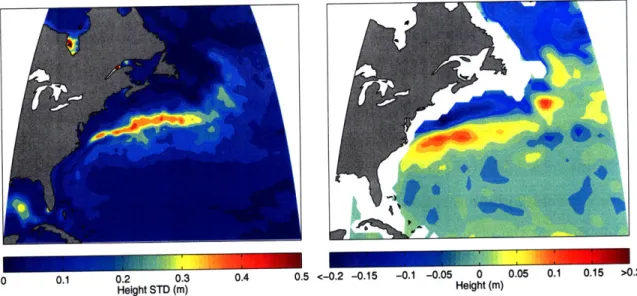
Interest in the problem was originally motivated by its potential relevance to the specific application of the dynamics of deep recirculation gyres observed with the eastward jet extensions of western boundary current (WBC) systems such as the Gulf Stream and Kuroshio (Figure 2-1). One hypothesis for the driving of these abyssal recirculations originating in historic eddy-resolving ocean circulation studies
(e.g. Holland and Rhines, 1980) is through the action of energetic surface eddies in and above the thermocline, which act to provide localized sources and sinks of vor-ticity ("plungers" of Ekman pumping velocity) to the deep ocean through fluctuating thickness fluxes. It is my hope that understanding the details of the idealized rectifi-cation problem considered here will aid in evaluating the relevance of this mechanism to the deep recirculation gyres seen in recent WBC observations (e.g. Hogg, 1992; Bower and Hogg, 1996; Chen et al., 2007; Jayne et al., 2008).
The problem however has more general application in our understanding of wave/eddy rectification from a localized forcing, serving as the contrasting limit to spatially broad (basin-scale) forcing (e.g. Pedlosky, 1965; Veronis, 1966) and important given many sources of ocean eddies are intermittent in space. For example, rectification from localized forcing has potential relevance to the response of the ocean to a spatially localized wind-stress pattern or a spatially localized concentration of eddy activity as say generated by mean-flow instability. More generally, the generation of mean zonal motion by the action of locally forced eddies, as is considered here, has relation to the phenomenon of zonal jet formation, observed to occur spontaneously in turbulent ,-plane flows (e.g. Rhines, 1975, 1977; Williams, 1978). This process has recently received renewed interest given the discovery of deep zonal jets in ocean observations (Maximenko et al., 2005) and ocean GCMs (Richards et al., 2006). Finally, the prob-lem can be considered a small contribution towards improving our understanding of the varied effects of eddies on the large-scale and time-mean state, critical in our search for better ways to parameterize unresolved eddy effects in general circulation models.
2.1.2
Past Work
The work presented here extends earlier studies of eddy-driven mean flow from local-ized forcing, specifically the pioneering laboratory experiments by Whitehead (1975) and numerical simulations by Haidvogel and Rhines (1983) (hereafter HR83). The former was the first experimental demonstration of the generation of mean zonal cur-rents from localized, periodic forcing, whereas the latter examined this phenomenon numerically through simulations of two-dimensional flow on a mid-latitude /-plane.
In their analysis, HR83 make many insights into the rectification mechanism that are important as a starting point for the present study. First, they show the use-fulness of an analytical solution in the form of a time-periodic Green's function in understanding the numerically simulated forced primary wave field. Second, from analysis of their numerical simulations, they propose that the dynamics of the recti-fied circulation is related to the mean eddy PV flux, v'q', that a turbulent Sverdrup
0 0.1 0.2 0.3 0.4 0.5 <-0.2 -0.15 -0.1 -0.05 0 0.05 0.1 0.15 >0.2
Height STD (m) Height (m)
Figure 2-1: Time-mean sea surface height variance (measured by altimetry, source: AVISO) (left) showing a localized concentration of eddy energy along the axis of the Gulf Stream. The time-mean dynamic pressure field at 1000 m (measured by subsurface floats) (source: Jayne (2006))(right) showing the pair of counter-rotating deep recirculation gyres that exist below.
balance (/v = -V v- W) dominates in nearly all parts of the flow, and that regions of counter (up) gradient potential vorticity fluxes provide the propulsion necessary for fluid particles to cross the mean quasi-geostrophic contours. Finally, they show that the strength of the induced circulation has a roughly quadratic dependence on forcing amplitude and forcing scale, and decreases with increasing bottom friction and decreasing forcing period.
2.1.3
Present Work Objectives
The present work seeks to extend this earlier study in a number of different ways. Specifically the work presented here aims to:
1. examine the rectification mechanism in more detail from the perspective of eddy-mean flow interactions (i.e. through examination of the eddy flux convergences of momentum and vorticity, and eddy enstrophy generation).
2. extend the study of parameter variations (both of the forcing (amplitude, fre-quency and length-scale) and the flow (the non-dimensional beta parameter)),
and to understand the mean-flow dependence on forcing parameters in terms of the dynamics of the rectification mechanism.
3. consider the effects of stratification via the use of an equivalently barotropic model.
4. consider the effects of a background mean flow.
5. extend these results from a weakly non-linear limit to the fully nonlinear regime, and to examine which results from the small amplitude limit break-down and why.
Finally, I seek to comment on the potential relevance of the mechanism in driving mean-flows in an oceanic / atmospheric context.
2.1.4
Chapter Outline
This chapter is organized as follows: In Section 2.2, I outline my approach to the problem that includes the use of both an analytical solution and numerical simula-tions. Here details about the model set-up, the numerical method, and the design of the numerical experiments are presented. In Sections 2.3 - 2.7 I present the results. In Section 2.3 I present new insights into the rectification mechanism from both an analytical expansion solution (valid in the weakly nonlinear limit) and from examin-ing the nonlinear eddy-mean flow interaction terms in the fully nonlinear numerical simulations. In Section 2.4 I discuss the results of numerical model parameter studies, describing the dependence of the strength of the mean flow generated on various forc-ing and flow parameters, and interpretforc-ing this dependence in terms of the rectification effectiveness of the population of waves selected by the parameters of the problem. In Sections 2.5 and 2.6 I examine the effects of stratification and a mean background flow respectively, and similarly interpret their effect on rectification effectiveness in terms of the rectification effectiveness of the population of waves they select. Finally, in Section 2.7, I extend the numerical experiments from a weakly nonlinear regime to a strongly nonlinear regime, and examine which aspects of our understanding of the
problem formed from an analysis of the weakly nonlinear case remain valid, and also where and why weakly nonlinear results break-down. In the final section, I summa-rize the lessons learned from the study and discuss its relevance to atmospheric and oceanic applications.
2.2
Methodology
Following HR83, I consider the problem via both analytical and numerical approaches.
2.2.1
Analytical Analysis
To gain insight into the rectification mechanism and the relation between forcing parameters and rectified flow, like HR83, I appeal to an analytical description of the forced waves. To introduce the effects of nonlinearity responsible for the rectification, a solution to the nonlinear equation in terms of an expansion in the amplitude of the forcing is sought. This provides a framework by which to connect the second order mean flow to forcing by the time-mean Jacobian (relative vorticity flux divergence) of the first order, linear forced wave field, a description that is valid in the weakly non-linear limit (see Appendix A for details). I then compare the wave or eddy flux divergence forcing and the mean flow it generates for various linear solutions to the Rossby wave equation for different forcing functions. In particular I consider the time-periodic Green's function solution (for which an analytical form exists and which was considered by HR83) and the solution for a forcing function with a finite spatial extent (a particular solution obtained through the numerical integration of the Green's function convolution integral). As it will be seen, this comparison will demonstrate the critical roles of the forcing extent and the east-west asymmetric radiation of energy in the rectification mechanism. I also generalize the analytical solution of HR83 to include the effects of stratification and comment on its influence on rectification.
2.2.2
Numerical Simulations
To examine the effect of the full nonlinearities on the problem, both in a weakly nonlinear and fully nonlinear regime, I also perform numerical simulations.
The numerical model is essentially the one described in Jayne and Hogg (1999) with the jet inflow and outflow conditions replaced by a prescribed forcing function in the form of a narrow plunger fixed at the center of the basin. It is quasi-geostrophic, barotropic or reduced gravity baroclinic, and on a mid-latitude 0 plane. It solves the potential vorticity equation:
q+ J(V, q) = F(x, y)ew't - RV2 (2.1)
with
q = V27 - u+ p y (2.2)
Bu
0 being the streamfunction, Bu the Burger number (the square of the ratio of the Rossby radius of deformation to the length scale of the motion), and R a non-dimensional bottom friction coefficient.
Various forms of the forcing function F(x, y) were considered. For the mechanism that will be described here, it is important only that the forcing be sufficiently
local-ized in space (an understanding of what "sufficiently locallocal-ized" means will follow as we gain insight into the rectification mechanism). To allow a large range of ampli-tudes to be considered, it was convenient to use a forcing function of the form of a normalized Gaussian:
F(x, y) = A ( L2 ) L2 (e-() ()2 (2.3)
such that at any instant in time, the basin-integral of the PV input due to the forcing is zero. Results presented here will be from a forcing of this form. Note however that the results described remain robust for other forms of F(x, y) including a standard Gaussian as in HR83.
Details on the numerical method can be found in Jayne and Hogg (1999). Briefly, integration in time and space is done using a scheme that is center differenced in the two spatial dimensions (an "Arakawa A-grid") and forward stepped in time using a third-order Adams-Bashforth scheme (Durran, 1991). Advective terms are handled using the vorticity conserving scheme of Arakawa (1966). Dissipative sponge layers, 50 grid points wide, are placed next to all boundaries to absorb all waves leaving the domain. Away from the sponge layers the explicit friction, R = 4x10- 5 (non-dimensional), is chosen to be as low as possible consistent with numerical stability (dimensional values for the dissipation time scale range from ~ 10 years at a non-dimensional 3, = imL2, value of 0.01 to - 100 years at P = 0.15). The non-dimensional grid spacing is 0.2 and the number of grid points is 751 (E-W) by 401 (N-S). With the origin at the center of the domain this puts the western boundary at x = -75 and the northern boundary at y = 40 non-dimensional units.
The governing equation is solved in non-dimensional form with time scaled by the advective time scale, T = u. L and U are typical horizontal length and velocity scales
of the motions respectively. Values for the non-dimensional
3
parameter (0 = 3dimL2 where /dim is the meridional gradient of the earth's planetary voriticty, hence the ratioof the scales of the horizontal gradient in relative vorticity to that of the horizontal gradient in planetary vorticity), as well as non-dimensional forcing parameters A (the forcing amplitude), w (the forcing frequency) and LF (the forcing length scale) are specified. A typical run (around which parameter studies are varied) has a value of 0 of 0.05 and forcing parameters LF = 5.0, w = 0.01 and A = 0.001. Dimensionally these would correspond to (taking a typical velocity scale of U = 1 m/s) a forcing scale LF dim of - 250 km, a forcing period Wdim of - 60 days and a forcing amplitude
Adim corresponding to an Ekman pumping velocity of - lx10- 3 m/s (or equivalently
a wind stress of - 0.4 N/m 2). Hence a typical run has scales typical of oceanic
synoptic scales. For reference, a summary of the suite of numerical experiments varying various parameters that are reported on here, as well as their corresponding dimensional scales to put the experiments in a physical context, are summarized in Table 2.1.
Table 2.1: Summary of Numerical Experiments
Parameter Range of Range of
Non-Dimensional Values Dimensional Scales
/ 0.01 - 0.15 -1 m/s > U < -0.1 m/s w 0.001 - 0.015 ^100 days > T > '10 days LF 1- 15 r50 km < LF r ~750 km Bu- 1 0 - 0.3 infinite > RD _ -100 km U -0.1 - 0.1 ~-1 cm/s < U < ~1 cm/s A 0.001 -0.015 r0.1 N/ms2 < 7 1 N/mS2 1 x 10⁻⁴ m/s < WEk < _1 x 10- 3 m/s
Here Bu- 1 is the inverse Burger number used to vary the importance of stratification, and U is a mean background flow. See Sections 2.5 and 2.6 for more details.
2.3
Results: Insights into the Rectification
Mech-anism
As a first step in the analysis, I attempt to understand the mechanism by which the waves or eddies rectify to produce the time-mean recirculation gyres. Insights are gained from both the analytical expansion solution and an examination of the fully nonlinear solution obtained by numerical simulation.
2.3.1
Insights From Analytical Analysis
An analytical solution in terms of an expansion in the amplitude of the forcing relates the second order mean flow to forcing by the time-mean Jacobian (relative vorticity flux divergence) of the first order, linear forced wave field. In particular, the order amplitude squared rectified flow is given by the zonal integral of the eddy relative vorticity flux divergence of the order amplitude waves (for details see Appendix A). This relation provides a way to relate forcing parameters to properties of the rectified mean-flow valid in a weakly nonlinear limit.
I compare the eddy relative vorticity flux divergence and its zonal integral for wave solutions to the linear forced Rossby wave equation for various forcing functions.
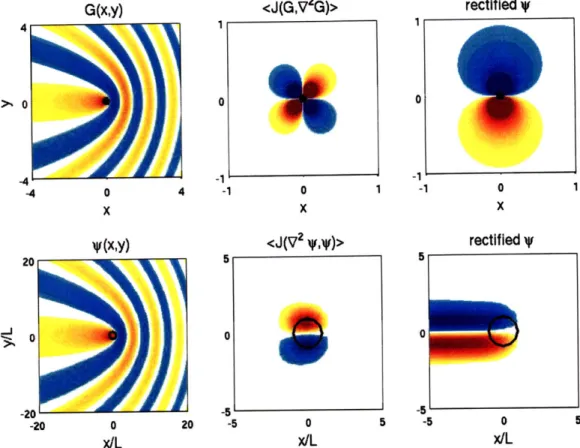
From this I learn that a finite forcing extent is critical to produce rectified flow. As is shown in Figure 2-2, the Green's function solution (i.e. approximating the spatial dependence of the forcing function by a delta function, as considered by HR83 and for which a closed-form solution exists) produces an east-west anti-symmetric pattern of vorticity flux divergence that, because of its exact zonal asymmetry and the dependence of the rectified flow on the zonal integral of the flux divergence, does not produce rectified flow outside the immediate vicinity of the forcing. In contrast, the particular solution for a forcing function with finite spatial extent (here a localized Gaussian spatial dependence) does produce a pattern of vorticity flux divergence whose zonal integral is consistent with the two gyre circulation pattern.
This observation highlights the fact that, at least in the weakly nonlinear limit, it is necessary for the forcing to have a finite length scale in order to generate rectified flow in the far field, a lesson that provides us with a new understanding of the rectification mechanism. It implies that the mechanism that is generating the rectified flow is occurring inside the forcing region (where the Green's function and particular solution differ) and not by the waves in the far field (where they do not). As it will be seen, it is also highlighting the importance of introducing a zonal asymmetry in the wave radiation pattern that is critical to the production of rectified flow, something that will be elaborated on in subsequent sections.
2.3.2
Insights From Numerical Simulations
Examining various eddy-mean flow interaction diagnostic terms from the fully non-linear numerical solutions expands our picture of the mechanism by which the wave or eddy terms produce the rectified flow. In particular, visualization of the nonlin-ear eddy fluxes (Reynolds stresses) of vorticity and momentum provide important insights.
(a) Insights from eddy fluxes of vorticity
Examination of the Reynolds stresses of relative vorticity (Figure 2-3) show that the key to the eddy generation of mean flows is a systematic up-gradient (northward)
<J(G,V2G)> I 0 X <J(V2 M)> -5 0 5 rectified 4( 5 -5 -5 0 5 x/L
Figure 2-2: A comparison of properties of the analytical solutions for 1. a forcing function with a Green's function spatial dependence (top) vs. 2. a forcing function with a Gaussian spatial dependence (bottom). The wave fields (left) show no qual-itative difference, but the two solutions do exhibit a fundamental difference in the vorticity flux divergence patterns (center) and consequently the time-mean rectified flow forced by this flux divergence pattern (right).
V(x,y)
-20 "L
-20 0
x/L
x10 -1 -3 -2 -2 -1 0 1 2 x/L
Figure 2-3: Eddy relative vorticity transport (u'qi
+
v'q' ) (vectors) overlaid on theeddy relative vorticity transport divergence (J(V', V2
0')) (color), which in a small
amplitude limit is understood to force the mean rectified flow through the relation = ~if J(,', V2,')dx. The black circle indicates the plunger radius.
eddy flux of vorticity that occurs inside the forcing region. This eddy transport pro-duces a flux convergence in the northern half and a flux divergence in the southern half of the forced region that is responsible for the forcing of the time-mean recir-culation gyres that extend outside the vicinity of the forcing. Given this picture, I hypothesize that the properties of the mean-flow generated will therefore be closely related to the process of eddy vorticity transport in the vicinity of the plunger.
Understanding rectification as a consequence of up-gradient eddy vorticity trans-port provides further insights into the requirements for rectification. First, given up-gradient transport is permitted only in the forcing region because of the source of vorticity supplied there, one can now understand the requirement for a finite forc-ing extent that one finds in the analytical analysis: with no (specifically meridional) extent to the forcing region, no up-gradient flux is possible. Second, based on eddy enstrophy budget considerations to be outlined below, one can also understand the requirement that the forcing be "sufficiently localized".
The requirement for an up-gradient eddy vorticity transport is equivalent to the requirement that the eddy enstrophy generation term in the eddy enstrophy equation
x10s 1.5 05 ~-0 -0.5 -15 -2 -2 -1 0 1 2
Figure 2-4: Eddy enstrophy destruction (il''*-VZ) (color) which indicates the direction of the eddy vorticity transport relative to the prevailing gradient (positive implies an eddy vorticity flux up the mean vorticity gradient; negative implies an eddy vorticity flux down the mean vorticity gradient).
(-u'(' - Vq) is negative (i.e. eddy enstrophy destruction, -u'(' - Vq, is positive).
This condition is met if the balance of the remaining terms in the time-mean eddy enstrophy budget (-X'(' + U VIC'2, where X' represents the fluctuating relative vorticity forcing) is negative, a condition that is met if (1) the stirring is the same sign as the forcing so x'C' > 0 (i.e. the forcing is "sufficiently localized") and (2) mean advection is small relative to the forcing. Visualization of the eddy enstrophy destruction term for a typical set of parameters (Figure 2-4) confirms that indeed these conditions are met and eddy enstrophy destruction is positive inside the forcing region in the cases where rectified flow is produced. Given this picture, I hypothesize that the rectification mechanism will be robust as long as this enstrophy balance is maintained.
(b) Insights from eddy fluxes of momentum
Examination of the Reynolds stresses of momentum (Figure 2-5) provide an alternative understanding of the rectification mechanism. In this framework, one understands the mean zonal flows to be driven by eddy forces that arise from a systematic eddy flux of zonal momentum towards the forcing region. This pattern of
X 10 -4 -22 -22 -2 -1 0 1 2 /LI
Figure 2-5: Eddy zonal momentum transport (u'u'i +
73v'v'j)
(vectors) overlaid on the negative of the eddy zonal momentum transport divergence (- ui' + A u'v'ii) (color), the latter which can be interpreted as a parameterization of an effective steady zonal eddy force in the prognostic non-eddy-resolving momentum equations of the large-scale or slowly-varying flow.eddy flux is a result of the outward energy radiation of the Rossby waves emanating from the forcing, as first discussed by Thompson (1971). This produces an eddy momentum flux convergence in the forced zone and eddy momentum flux divergences north and south of the forcing. Through the interpretation of this eddy flux divergence quantity as a parameterization of an effective steady zonal eddy force in the prognostic momentum equations of the large-scale or slowly-varying flow in a non-eddy-resolving model, this pattern then translates to a positive (eastward) eddy force at the latitude of the forcing and negative (westward) eddy forces north and south of the forcing. In this way, eddies are seen to act to accelerate the eastward jet at the forced latitudes and drive the flanking westward flows. Given this picture, I hypothesize that the properties of the eddy-driven mean-flow will therefore be closely tied to the properties of the wave energy radiation away from the forcing.
2.4
Results: Dependence on System Parameters
I examine the sensitivity of the rectification mechanism to various system parameters to gain further insight. Specifically I vary the non-dimensional 0 parameter, 3 =
di~mL2 where 3dim is the meridional gradient of planetary vorticity and L and U are typical length and velocity scales of the flow (to be thought of as a measure of the relative importance of the relative vorticity of the flow to the planetary vorticity), the forcing frequency w, and the plunger size L. Results from these parameter studies are presented here.
2.4.1
Effect on Rectification Effectiveness
The most basic result of the parameter studies is the observation that rectification effectiveness (the strength of the mean-flow generated as measured by the maximum time-mean gyre transport, ?Imax - 7
-min) is a function of the various forcing and
environmental parameters. This dependence on 0 and plunger size L in physically relevant parameter ranges is shown in Figure 2-6. A non-monotonic dependence of mean flow strength on both of these parameters generates new questions about what sets which parameter values generate an enhanced response.
2.4.2
Interpretation Via Wave Rectification
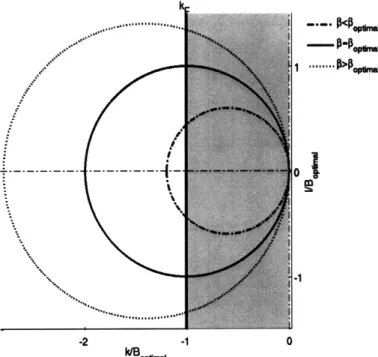
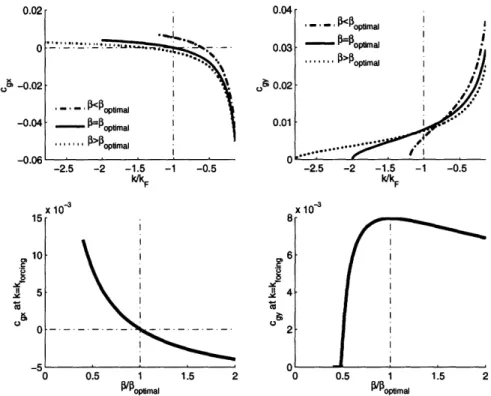
Examining this non-monotonic behavior provides additional understanding of the rectification mechanism. In particular it highlights the importance of the relationship between the scales of the forcing and the free Rossby waves that make-up the response in setting the rectification strength. As it will be shown, a resonant-like response is achieved when the forcing length scale L, is well matched to the spectrum of free Rossby waves the forcing can excite (a function of the dispersion relation and hence
/
and the frequency w). In particular, a maximal response is achieved when the forcing length scale corresponds to the wavelength associated with the wave at the origin of the Rossby wave dispersion circle at k = -I1 = -B where B = 13 (Figure 2-7).0.2 r I I I I I I I I I I I I I I 0.1 * . S a , 0.05 0.15 0.4 r 0.2 4 S S . I I I I I ! I I II 0 * a I
Figure 2-6: Dependence of mean rectified flow strength (4max - 'min) ("rectification effectiveness") on select parameters of the problem: / (top) and forcing length scale
L (bottom). Dashed lines indicate the parameter value corresponding to the peak or
optimal response in the observed non-monotonic dependence of rectified flow strength on each of these parameters.
4x
varying p * varying L 0.3 I I I E ! 0.2- i C I Co I x c x 0 * x x 01 I I x 0 I S x 0 1 2 3 L/BFigure 2-7: Demonstration that the "resonant" response occurs when the forcing length scale L is equal to the wavelength associated with the wave with wavenumbers