EcoGRAFI
2nd International Conference on Bio-based Building Materials &
1st Conference on ECOlogical valorisation of GRAnular and FIbrous materials
June 21th - 23th 2017 Clermont-Ferrand, France
EVALUATING AND UNDERSTANDING THE ACOUSTICAL PROPERTIES OF
BIOBASED MATERIALS
P. Glé1*, E. Gourdon2
1 Laboratoire de Strasbourg, Cerema, Strasbourg, France
2 LGCB-LTDS UMR 5513, ENTPE-Université de Lyon, Vaulx-en-Velin, France *Corresponding author; e-mail: [email protected]
Abstract
Biobased (porous) materials are key solutions to deal with current environmental issues in buildings and other fields. Many studies cover the topic of their performances today, but these studies do not systematically account for the specificities of biobased materials. The goal of this presentation is to make a global review of the acoustical properties of these new materials, and to present an adapted demarch to characterize, model and optimize their performances. Two kind of biobased materials will be principally discussed, fibrous (wools) and granular (loose particles and concrete). The fibers/particles can come from hemp as well as flax, sunflower, colza, miscanthus, and kenaf cultures. In all cases, the final materials (wool, board, concrete, ...) present specificities in comparison with conventional ones. These include a mulitscale porosity, a wide distribution of fiber/grain size, a strong anisotropy and a hygroscopic behavior. These specificities have to be taken into consideration, during the characterization process but also during the modelling step by choosing a suitable model in agreement with the effective microstructural dissipation. This presentation will start with a global review covering last decade publications on the topic, where the different kinds of materials will be classified and analyzed. Then, general guidelines will be proposed on the basis of previous works to handle with these materials acoustical properties. Finally, the different possible ways to optimize these properties will be highlighted with various examples of application.
Keywords:
Acoustics, sound absorption, transmission loss, biobased materials, vegetal wools, vegetal concretes
1 INTRODUCTION
There is nowadays a demand for alternative materials in every fields, from building sector to automotive and aerospace industries, ... The expected characteristics are enhanced multifunctional performances (lightness, mechanical strength, thermal and acoustical properties) [Arnaud 2011], but also increasingly to enable an ecofriendly manufacture and use [Boutin 2005].
Bio-based materials, concentrating plant fibers and aggregates, present a very good compromise between these researched properties, since they have a large porosity and the original plants store carbon dioxid during their growth. As a result, these materials have been largely democratized these last ten years, e.g. with the use of hemp and wood concretes in buildings and noise barriers applications.
Previous works have been carried out to understand the acoustical dissipation in such materials [Oldham 2011, Glé 2013a]. They showed that bio-based materials have several specificities in comparison with conventional ones:
- they are constituted of elongated fibers or particles, which yields to a strong anisotropic behavior,
- their size distribution is more spread that conventional granular/fibrous material [Glé 2013b], - the microstructure is characterized by a distribution of the porosity between binder pores (≈1µm), intra-particle/fiber pores (≈10µm, see Figure 1 (a)) and inter-particle/fiber pores (≈1mm).
Modelling of such materials is now well advanced, and it appears that for most of these multiscale materials, only inter particle/fiber scale accounts in the acoustical dissipation. For this reason, care must be taken to associate the adequate active porosity (different than the global open porosity) in the models.
Finally, this kind of materials enable a large panel of optimization process, from perforation to thickness stratification.
This paper is organized in four section. Section 2 discusses the specificities of biobased materials in comparison with materials conventionally used in buildings. Then Sections 3 to 5 address successively these major step of design that are characterization, modelling, and optimization for acoustical purposes.
2 SPECIFITIES
2.1 Anisotropy
Compared with conventional materials, vegetal wools and vegetal concretes are first characterized by a strong anisotropy.
Concerning wools, fibers are naturally elongated in one dimension (see Fig. 1 (a)). Due to this particularity and to the manufacturing process, wools can be assimilated as parallel layers of fibers. These wools have for this reasons different properties in the cases of an acoustical flow parallel or perpendicular to the fibers. However, in most applications, this flow is perpendicular for vegetal wools.
For granular materials, particles are also elongated with various possible shapes. For instance, the shape of sunflower pith particles can be close from spherical but this is not the case for hemp shiv (Fig. 1 (b)) whose particles can be considered as parallelepiped. For vegetal concretes with such particles, depending on the application (projection, shuttering), particles be can also be oriented in a parallel or perpendicular way compared to acoustical flow, which can have a significant incidence on the acoustical properties.
Fig. 1: Anisotropy due to fibers (a) or particles (b)
2.2 Particle/Fiber size distribution
Another specificity of vegetal particles and fibers is the variability due to the natural origin of these raw materials. This variability includes variation of the annual production characteristics (weather conditions) but also variation due to ground properties, plant species, culture or harvesting conditions…
Beyond this general consideration of variability between materials, variability also exists within these materials. This concerns especially particle or fiber size distribution of loose aggregates or fibers.
The example of hemp shiv is discussed here. Hemp particles shape is assumed to be parallelepiped. So, to describe perfectly a bed of particles, one has to know the distribution of length, width and thickness. This is particularly difficult and could only be made using devices such as 3D tomography.
A more accessible method based on image analysis has been developed [Ceyte 2008] and enables to know the distribution of length and width of the particles.
This data have been compared in Fig. 2 with log-normal distributions, and a perfect agreement has been found.
2.3 Multiscale porosity
As discussed previously in the introduction, fibrous as well as granular biobased materials are generally characterized by several scales of porosity.
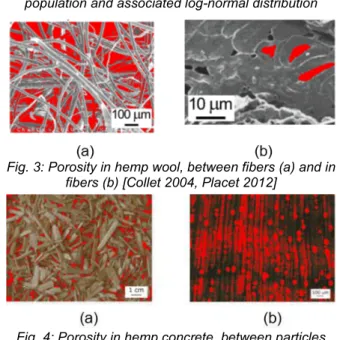
Two examples are illustrated below for hemp wool (Fig. 3) and hemp concrete (Fig. 4).
Fig. 2: Particle size distribution of hemp shiv, population and associated log-normal distribution
Fig. 3: Porosity in hemp wool, between fibers (a) and in fibers (b) [Collet 2004, Placet 2012]
Fig. 4: Porosity in hemp concrete, between particles (a) and in particles (b)
Vegetal fibers and particles are both porous, but with a larger porosity in the case of particles. Hemp particles are for instance characterized by a porosity ranging between 57 and 78% [Glé, 2013a] while hemp fiber porosity lies between 2 and 16% [Placet 2012]. Sunflower pith can even reach intraparticle porosity of 96% [Chabriac 2016].
The related difficulty is on this basis to determine which of these various scales really take part to the acoustical dissipation for the various kind of biobased materials.
3 CHARACTERIZATION
3.1 Acoustical performances
The two basic acoustical performances concern sound absorption and transmission loss. These acoustical properties can be characterized using different ways:
- In situ measurements can be performed to qualify
the performance in a building: This characterization is the more relevant to discuss the performance in use but in this case, the intrinsic performance of the material is generally flooded among noise, side effects and other limitations related to the methods.
- Diffuse fields measurements can also be performed in reverberant rooms to simulate realistic propagation. These methods are standardized and are used to certify materials. However, they are expensive and time-consuming. Besides, the link between diffuse field properties and acoustical behavior is not systematically straightforward. This is why such methods are often used only at the end of the design process of materials.
- Measurements using impedance tubes (Kundt tubes) use normal incidence waves and also enable to characterize sound absorption as well as transmission loss. These devices allow accurate and quick measurements, that can be directly compared to normal incidence computations with porous models.
For biobased materials (and also for more conventional ones), a number of cautions must be taken when measuring acoustical performances in a Kundt tube:
- The size of the aggregates/fibers has to be smaller than tube size to prevent side effects (when possible, a factor 10 between both sizes must be respected) [Montillet 2001].
- Leakages at the periphery of the samples must be avoided (Teflon tape or Vaseline can be used) [ISO 9053].
- The characterization of loose fibers or particles must be preferably done with a tube held vertically to avoid a radial packing in the tube. - Finally, to estimate the range of variation of
performances, it is recommended to repeat measurements on several samples, but also on the two faces of these samples (biobased materials can be very heterogeneous and lack of symmetry can occur due to gradually varying properties).
3.2 Acoustical parameters
Acoustical parameters have to be evaluated to enable the understanding of dissipation phenomena in the various biobased materials. Indeed, the confrontation between experimental data and predictions with acoustical models (based in such parameters) usually helps identifying the relevant behavior.
Acoustical parameters can be deduced following two ways. First, direct characterization methods allow to characterize a number of parameters like open porosity, resistivity, tortuosity. However, some of these methods present limitations with biobased materials:
- Open porosity do not always correspond to the acoustical porosity (See Section 4.1). - Tortuosity measurement device can difficultly
be applied to resistive or very tortuous materials such as granular biobased media. To overcome these limitations, direct measurements can be completed by indirect characterizations. Resistivity or porosity can for instance be deduced from the asymptotic limits of the visco-interial and thermal properties, easily measurable through transmission measurements in Kundt tube (3 or 4 microphones methods [Iwase 1998, Song 2000]). It is also possible to use frequency-dependent relationships (directly issued from acoustical models) to identify the set of acoustical parameters (tortuosity, characteristic lengths,…) leading to an agreement with experimental measurement of these visco-interial and thermal properties [Panneton 2006, Olny 2008].
4 MODELLING
4.1 Multiscale analysis
Acoustical properties of porous materials can be in a first approach predicted under rigid frame hypothesis, from their intrinsic properties: the equivalent dynamic density 𝜌𝑒𝑞 and the bulk modulus 𝐾𝑒𝑞. As explained in previous studies [Glé 2013a], only the inter-particle pores take part into the acoustical dissipation in the case of loose vegetal particles. Concerning vegetal concrete, the same experimental evidences have been highlighted. Besides, due to the porosity considered as well as the pore size within fibers, vegetal wools properties can also be described by inter-fiber properties.
As a result, vegetal concrete or vegetal wools can be described as multi-scale porous media in which only the inter-particle/fiber pores do participate to the acoustical dissipation. Indeed, the contrast of permeability existing between the inter-particle/fiber pores and the smaller size networks is big enough, so that, in the tested frequency range, we are either in the case described by the “double porosity model” [Olny 2003], of a high contrast of permeability with no pressure diffusion effect or in a case where the contribution of the smaller pores can be neglected. Consequently, 𝜌𝑒𝑞 and 𝐾𝑒𝑞 can be described accurately by computing the intrinsic properties of the inter-particle/fiber network 𝜌𝑖𝑛𝑡𝑒𝑟 and 𝐾𝑖𝑛𝑡𝑒𝑟 as described by the following equations, where 𝜔 = 2𝜋𝑓 is the pulsation.
𝜌𝑒𝑞(𝜔) ≈ 𝜌𝑖𝑛𝑡𝑒𝑟(𝜔) 𝐾𝑒𝑞(𝜔) ≈ 𝐾𝑖𝑛𝑡𝑒𝑟(𝜔)
4.2 From acoustical parameters to acoustical properties
Semi-phenomenological models enable to compute the intrinsic properties (𝜌𝑖𝑛𝑡𝑒𝑟 and 𝐾𝑖𝑛𝑡𝑒𝑟) from acoustical parameters such as the porosity 𝜙𝑖𝑛𝑡𝑒𝑟 and the resistivity 𝜎 of the material. Then, knowing these intrinsic properties, the thickness of the material, the boundary conditions and the type of excitation, it is possible to compute the sound absorption 𝛼 and transmission loss 𝑇𝐿[Allard 2009].
Models have been developed and extensively applied to describe porous materials such as granular, fibrous or foam materials. For the example of vegetal concrete, Johnson et al. model[Johnson 1987] can be used to describe the visco-inertial effects and Zwikker and Kosten model [Zwikker 1949] for the thermal effects. This approach has been chosen since it enables with a reduced number of parameters to predict with accuracy the physical phenomena happening into the porous medium. Besides, it has been presented and applied successfully to loose vegetal aggregates and hemp concretes in several papers [Glé 2012, Chabriac 2016]. Their equations are recalled below. 𝜌𝑖𝑛𝑡𝑒𝑟(𝜔) =𝜙𝜌0𝛼∞ 𝑖𝑛𝑡𝑒𝑟[1 − 𝑗𝜎𝜙𝑖𝑛𝑡𝑒𝑟 𝜔𝜌0𝛼∞ √1 + 𝑗 4𝛼∞𝜂𝜌0𝜔 𝜎2Λ2𝜙 𝑖𝑛𝑡𝑒𝑟2 ] 𝐾𝑖𝑛𝑡𝑒𝑟(𝜔) =𝜙𝛾𝑃0 𝑖𝑛𝑡𝑒𝑟(1 + 2(𝛾 − 1) 𝑇(√𝑁𝑃𝑟𝜆√−𝑗) √𝑁𝑃𝑟𝜆√−𝑗 ) −1
𝑇 is the ratio of the Bessel functions of orders 1 and 0, and 𝜆 = √8𝛼∞𝜌0𝜔
𝜌0 is the static density of air (𝑘𝑔. 𝑚−3), 𝜂 its viscosity (𝑃𝑎. 𝑠) and 𝑁𝑃𝑟 its Prandtl number.
As a result, four acoustical parameters have to be determined in the present case, the inter-particle porosity 𝜙𝑖𝑛𝑡𝑒𝑟, the airflow resistivity 𝜎, the high frequency limit of the dynamic tortuosity 𝛼∞ and the characteristic viscous length Λ.
Concerning wools, a similar approach can be used for visco-inertial effects, combined with another model for thermal effects [Lafarge 1997] requiring two additional parameters: the characteristic thermal length Λ′ and the thermal permeability k0′.
4.3 From basic parameters to acoustical parameters
The idea to predict the acoustical parameters from basic parameters is very interesting since this enables to understand the link existing between the degrees of freedom of the material fabrication (characteristics of the aggregates/fibers and of the fabrication process) and its resulting acoustical properties (sound absorption and transmission loss).
In the case of hemp shiv, it was found out[Glé 2012] that four basic parameters are sufficient to describe these properties: the apparent density of the mix 𝜌, the apparent density of the particles 𝜌𝑝𝑎𝑟𝑡𝑖𝑐𝑙𝑒, the characteristic size of the particles 𝑅𝑝𝑎𝑟𝑡𝑖𝑐𝑙𝑒𝑠 and the shape factor 𝑛𝑝𝑎𝑟𝑡𝑖𝑐𝑙𝑒𝑠.
However, extending this modelling to hemp concretes is tricky since the binder itself is porous, and changes dramatically the microstructure of shiv by reducing the inter-particle pore size. The remarks stand also for other types of aggregates having similar shape or concretes [Prieur du Plessis 2008, Boutin 2010]. In a similar way, for fibrous biobased materials, the acoustical parameters are all strongly related to the density of the wool 𝜌, the skeleton density of the fibers 𝜌𝑓𝑖𝑏𝑒𝑟 and the characteristic size of the fibers 𝑅𝑓𝑖𝑏𝑒𝑟𝑠 [Allard 2009]. Studies are currently in progress to investigate possible effects of fiber size distribution shape and orientation.
5 OPTIMIZATION
5.1 Choice of the constituents and manufacturing process
To optimize sound absorption and transmission loss of biobased materials, the first option is to choose the suitable constituents and manufacturing parameters. Indeed it is possible to develop vegetal wools or concretes having a very wide range of sound absorption and transmission loss. This is illustrated in Fig. 5 where the influence of the binder-shiv ratio (B/S) is clearly visible on the acoustical properties of hemp concretes.
This figure shows that hemp concrete has very interesting acoustical properties. Besides, it is important to point out that the thickness is relatively low (5 cm) in comparison to what is commonly used in buildings (between 20 and 35 cm).
Then, depending on the objective which is optimized, different formulations can be chosen. Sound absorption is significantly higher above 500 Hz for low binder-shiv ratio, contrary to the transmission loss which increases with the binder-shiv ratio. Consequently, a compromise is necessary if one wants
to optimize both sound absorption and transmission loss.
To overcome this limit, it is possible to optimize the material in another way, using a multilayer geometry or irregularities.
Fig. 5 -Sound absorption and transmission loss of hemp concretes as a function of their binder-hemp
ratio in normal incidence (thickness=5cm).
5.2 Surface optimization
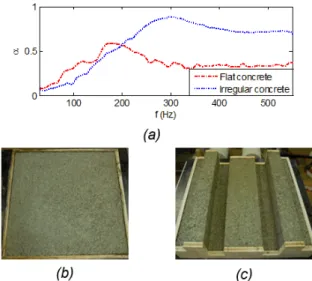
The shape of materials has a significant influence on its sound absorption. It was shown, for example in the case of hemp concrete [Debrabant 2010], that the presence of irregularities on the exposed face of the sample can enhance considerably the sound absorption.
In this work, it was shown that it is possible to enhance acoustical properties with the same amount of material organized in a different way, as shown Fig. 6, where sound absorption of regular (flat) concrete and irregular concrete are compared.
Fig. 6 - Effect of irregularities on the sound absorption in normal incidence of hemp concrete (a), photos of flat
(b) and irregular (c) samples.
5.3 Multilayer systems
A last example of optimization presented in this paper concerns the multilayer structure of the materials. Multilayering can sometimes correspond to a conventional implementation of materials. This is the case for hemp concretes that are systematically coated to protect the materials from impacts or rainfall. Coatings affect both sound absorption and transmission loss properties. Since coatings generally have a large density with a little porous microstructure, sound absorption of hemp concretes decrease, but
transmission loss is of the coated concrete is improved.
Data from [Glé 2013a] shows an increase of weighted transmission loss 𝑇𝐿𝑤 from 30dB (for hemp concrete of 20cm) to 40dB (for same concrete with 2cm coatings on both sides).
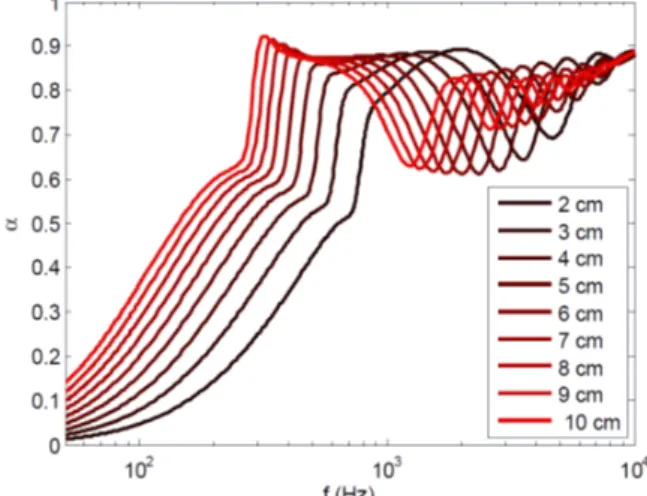
But multilayering can also be used specifically to optimize acoustical performances for a given application. It is for instance possible to enhance sound absorption in a frequency range by adding a resistive (and also possibly perforated) layer over a lighter and more permeable material. Such optimization suits well vegetal wools, typically for ceiling applications. An example is discussed in [Glé 2013a] with mixed hemp-flax wools organized in three layers (facing – absorbing wool – facing). Facings are needled layers of larger density (~200 𝑘𝑔. 𝑚−3). Simulations presenting the effect of the thickness of the absorbing layer (~80 𝑘𝑔. 𝑚−3) are shown Fig. 7.
Fig. 7 - Effect of the thickness of the absorbing layer on the sound absorption of a multilayered vegetal wool
6 CONCLUSION
In this paper, the acoustical properties of biobased materials are discussed. These multifunctional materials are generally characterized by unusual features such as several scales of porosity and strong anisotropy.
In biobased materials, due to the contrast of permeability existing between the various scales of porosity, only inter-particle/fiber pores accounts in the acoustical dissipation. A two steps model is then presented to predict its acoustical properties from basic parameters (manufacturing parameters, raw materials characteristics). Relationships existing between basic parameters and acoustical parameters can be also modelled with simple assumptions. The measured acoustical properties reveal that biobased materials are very interesting, and can be used in buildings to improve sound absorption or transmission loss. Besides, it is shown that these properties can be optimised by using the suitable constituents and manufacturing parameters, and offer a very wide range of sound absorption and transmission loss. Finally, it is also shown that sound absorption and transmission loss of these materials can be significantly improved using optimized surface or multilayering.
7 REFERENCES
[Allard 2009] J-F. Allard et N. Atalla. Propagation of sound in porous media : Modelling sound absorbing materials, second edition. Wiley, 2009.
[Arnaud 2011] L. Arnaud and E. Gourlay. “Experimental study of parameters influencing mechanical properties of hemp concretes”.
Construction and Building Materials, 28, 50-56, 2011.
[Boutin 2005] M-P. Boutin, C. Flamin, S. Quinton, and G. Gosse. Analyse du cycle de vie : Compounds
thermoplastiques chargés fibres de chanvre et Mur en béton de chanvre banché sur ossature bois. Rapport d’´étude INRA Lille, MAP 04 B1 0501, 2005.
[Boutin 2010] C. Boutin and C. Geindreau. “Periodic homogenization and consistent estimates of transport parameters through sphere and polyhedron packings in the whole porosity range”. Physical Review E, 82, 036313, 2010.
[Ceyte 2008] I. Ceyte. Béton de chanvre, définition des caractéristiques mécaniques de la chènevotte,Travail de Fin d’Études. ENTPE, 155 p., 2008.
[Chabriac 2016] P-A. Chabriac et al. Agricultural by-products for building insulation: acoustical characterization and modeling to predict micro-structural parameters. Cons. Build. Mat. 112, pp. 158-167, 2016.
[Collet 2004] F. Collet. Caractérisation hydrique et thermique de matériaux de génie civil à faibles impacts environnementaux. Thèse de doctorat, INSA Rennes, 2004.
[Debrabant 2010] Y. Debrabant. Phénomène de
localisation dans des cavités de mur poreux à géométrie irrégulière, Master recherche, Ecole doctorale MEGA, Lyon, 2010.
[Glé 2012] P. Glé, E. Gourdon et L. Arnaud. Modelling of the acoustical properties of hemp particles. Construction and Building Materials, 2012.
[Glé 2013a] P. Glé. Acoustique des Matériaux du Bâtiment à base de Fibres et Particules Végétales - Outils de Caractérisation, Modélisation et Optimisation, Thèse ENTPE 2013.
[Glé 2013b] P. Glé et al. The effect of particle shape and size distribution on the acoustical properties of mixtures of hemp particles. J. Acoust. Soc. Am. 134 (6), 2013.
[ISO 9053] ISO 9053: Acoustics - Materials for acoustical applications - Determination of airflow resistance, 1991.
[Iwase 1998] T. Iwase, Y. Izumi et R. Kawabata. A new measuring method for sound propagation constant by using sound tube without any air spaces back of a test material. Internoise 98, Christchurch, New Zealand, 4 p., 1998.
[Johnson 1987] D-L. Johnson, J. Koplik, and R. Dashen. “Theory of dynamic permeability and tortuosity in fluid-saturated porous media”. Fluid
Mechanics, 379–402, 1987.
[Lafarge 1997] D. Lafarge, P. Lemarinier, J-F. Allard et V. Tarnow. Dynamic compressibility of air in porous structures at audiblefrequencies. Journal of the Acoustical Society of America, vol. 102 (4), p. 1995– 2006, 1997.
[Montillet 2001] A. Montillet et L. Le Coq. Characteristics of fixed beds packed with anisotropic
particles–Use of image analysis. Powder Technology, vol. 121, no. 2-3, p. 138 – 148, 2001.
[Oldham 2011] D-J. Oldham, C-A. Egan et R-D. Cookson. Sustainable acoustic absorbers from the biomass. Applied Acoustics, vol. 72, p. 350–363, 2011. [Olny 2003] X. Olny and C. Boutin. “Acoustic wave propagation in double porosity media”. Journal of the
Acoustical Society of America, 114(1), 73–89, 2003.
[Olny 2008] X. Olny et R. Panneton. Acoustical determination of the parameters governing thermal dissipation in porous media. Journal of the Acoustical Society of America, vol. 123, no. 2, p. 814–824, 2008. [Panneton 2006] R. Panneton et X. Olny. Acoustical determination of the parameters governing viscous dissipation in porous media. Journal of the Acoustical Society of America, vol. 119 (4), p. 2027–2040, 2006.
[Placet 2012] V. Placet et al. Diameter dependence of the apparent tensile modulus of hemp fibres : A morphological, structural or ultrastructural effect ? Composites : Part A, vol. 43, p. 275–287, 2012. [Prieur du Plessis 2008] J. Prieur Du Plessis and S. Woudberg. “Pore-scale derivation of the ergun equation to enhance its adaptability and generalization”, Chemical Engineering Science 63 (9), 2576 – 2586, 2008.
[Song 2000] B-H. Song et J-S. Bolton. A transfer-matrix approach for estimating the characteristic impedance and wave numbers of limp and rigid porous materials. Journal of the Acoustical Society of America, vol. 107(3), p. 1131–1152, 2000.
[Zwikker 1949] C. Zwikker et C-W. Kosten. Sound Absorbing Materials. Elsevier, New-York, 174 p., 1949.