E-Commerce Cold Chain Fulfillment
byMounir Yakzan
B.E. Computer and Communications Engineering, American University and ARCHIVES
JUL 162015
LIBRARIES
of Beirut, 2009 Jordan NelsonB.A. Business Administration, University of Illinois at Urbana-Champaign, 2010
SUBMITTED TO THE ENGINEERING SYSTEMS DIVISION
IN PARTIAL FULFILLMENT OF THE REQUIREMENTS FOR THE DEGREE OF MASTER OF ENGINEERING IN LOGISTICS
AT THE
MASSACHUSETTS INSTITUTE OF TECHNOLOGY
June 2015
C 2015 Mounir Yakzan and Jordan Nelson. All rights reserved.
The authors hereby grant to MIT permission to reproduce and to distribute publicly paper and electronic copies of this document in whole or in part.
Signatures of the
Signatures of the
Signature redacted
A uthor ... ...
Master of Engineering in Logistics Program, Engineering Systems Division
z/ May 8, 2015
Author...Signature
redacted
Master of Engieeing in Logistics Program, Engineering Systems Division
-, -. May 8, 2015
Certified by ...
Accepted By ...
Signature redacted
... James B. Rice Jr. Deputy Director, Center for Transportation and Logistics- 1Thesis Supervisor
Signature
reaactea
Dr. Yossi Sheffi Director, MIT Center for Transportation and Logistics Elisha Gray II Professor, Engineering Systems Division Professor, Civil and Environmental Engineering Department
E-Commerce Cold Chain Fulfillment
By
Mounir Yakzan And Jordan Nelson
Submitted to the Engineering Systems Division On May 8, 2015 in Partial Fulfillment of the
Requirements for the Degree of Master of Engineering in Logistics
ABSTRACT
A challenging part of E-Commerce for perishable consumer packaged goods (PCPG) is the
fulfillment. Given the fragile nature of the items shipped, they require a low cost, effective cold chain fulfillment method so as to keep integrity, ensure speed at an affordable low cost for the end consumer. Our research, in partnership with one of the big PCPG items, addressed four aspects of the fulfillment process: Shipments routing, return process, competitive research and packaging techniques. Through a research process, we looked at shipment routing techniques for network optimization and density solutions, return process through different nodes in the supply chain, competitive research looking E-Commerce websites that sell PCPG products and
comparing each of them to understand their underlying pricing methods and looked at current packaging techniques, current available and future technologies in packaging. We scored each of the aspects based on three KPIs, speed, quality and cost; we put forth several combinations that focused on each KPI by itself and aimed at maximizing speed or quality or minimizing cost. This research serves to direct focus based on the KPI desired on the aspects that help optimize said KPI and can be generalized to other E-Commerce products requiring cold chain delivery. Thesis Supervisor: James B. Rice Jr.
ACKNOWLEDGEMENTS
We would like to thank the following people for their contributions to our research:
* Our thesis advisor, Jim Rice, for his guidance in the research process
* The MIT SCM Program for facilitating our work and supplementing our knowledge
" Professors Yossi Sheffi, Chris Caplice and Bruce Arntzen for their insightful guidance " My loving family and girlfriend for their incredible support and encouragement (MY) " My family and fiancee for enduring countless hours of progress updates and undying
TABLE OF CONTENTS ABSTRA CT ... 2 A CK N O W LEDG EM EN TS ... 3 TABLE O F CO NTENTS ... 4 LIST O F FIGURES ... 5 LIST O F TABLES ... 6 1. INTRO DUCTIO N ... 7
1.1 A passage from com m erce to E-com m erce:...7
1.2 E-com m erce for consum er goods:... 10
1.3 Purpose of the research: ... 12
2. LITERATUR E REV IEW ... 14
2.1 Introduction to Literature Review ... 14
2.2 Delivery Routing and M onitoring... 14
2.3 R eturn Cycle for D am aged Products... 16
2.4 Evaluating the Current Cold Chain E-Com m erce Industry... 17
2.5 Packaging Innovation and Lim itations ... 18
3. M ETH O D O LO G Y ... 21
3.1 M ethodology for O ptim izing Routing... 21
3.2 M ethodology for Consolidated R eturns ... 22
3.3 M ethodology for Com petitive R esearch...24
3.4 M ethodology for Packaging Review ... 26
4. RESULTS AND DISCU SSIO N ... 27
4.1 R esults and Discussion - R outing Techniques... 27
4.2 R esults and D iscussion - Consolidated R eturns ... 35
4.3 R esults and Discussion -Com petitive R esearch ... 39
4.4 R esults and Discussion - Packaging ... 46
4.5 R esults and Discussion - Com bined Findings ... 49
6. APPENDIX ... 59
LIST OF FIGURES
Figure 1.1 (Meuter et al., 2005) - Diagram of Research Conducted by Meuter et al. ... 8
Figure 1.2 - E-Commerce effects on Pier 1 Imports Revenue ... 10
Figure 1.3 (Handley, 2013) - E-Commerce Increases in Key Industries ... II Figure 1.4 (Lang & Bressolles, 2013) - Description of key performance indicators... 12
Figure 4.1 (Li Xiulil et al, 2014) -Traditional Supply Chain Flow... 28
Figure 4.2 (Li Xiulil et al, 2014) - Supply chain flow leveraging E-Commerce ... 28
Figure 4.3 (Author) - Traditional supply chain flow for perishable goods ... 29
Figure 4.4 (Author) - Supply Chain Flow leveraging E-Commerce for perishable goods ... 29
Figure 4.5 (Author) - Average Temperatures across the United States in summer timeframes.. 31
Figure 4. (Author) - Average freight shipping days from distribution centers of case study com p an y ... 32
Figure 4.7 (Author) - Flow from consumer back to manufacturer in return cycle ... 38
Figure 4.8 (CVS.com) - Example advertisement regarding E-Commerce Shipment ... 41
Figure 4.9 (Target.com) - Checkout information for perishable goods ordered online... 43
Figure 4.10 (Walgreens.com) - Online customer service response to E-Commerce query ... 44
Figure 4.11 (USPS.com) - Example of packaging offered for cold chain delivery with pricing. 46 Figure 4.12 (Uline.com) - Packaging innovation drawing ... 47
Figure 6.1 (Author) Map of winter temperatures throughout the US ... 59
Figure 6.2 (Author) - Pareto Analysis of Online Sales ... 60
Figure 6.3 (Author) - Prevalence Diagram of Online Sales Comments ... 61
LIST OF TABLES 4.1 (Author) 4.2 (Author) 4.3 (Author) 4.4 (Author) 4.5 (Author) 4.6 (Author) 6.1 (Author) 6.2 (Author) 6.3 (Author) 6.4 (Author)
- Benefits and barriers occurring in return nodes... - Competitive shipping rates of PCPG goods across vendors... - Example scorecard choices optimizing on speed ... - Example scorecard choices optimizing on product integrity ... - Example scorecard choices optimizing on price ...
- Example scorecard choices integrating all three factors ... - Data Collected for Shipping Ground Freight Shipping Days ... - Data Collected for Shipping Ground Freight from Drop Ship Partners .... - Temperature Data for United States during Key Months ... - Combined Ground Shipping Days Identifying Shortest Route ... Table Table Table Table Table Table Table Table Table Table 38 40 52 52 52 52 63 65 68 70
1. INTRODUCTION
1.1 A passage from commerce to E-commerce:
E-Commerce retail sales currently constitutes 8% of the total market volume for retail sales, and is expected to grow to 11% by 2018 (Mccrea, 2014). This is a significant growth that affects all areas of the retail industry. In this work, we are focused on the perishable consumer packaged goods that are sold via E-Commerce.
In the past, E-Commerce saw slower growth than current levels mainly for two reasons: the shipping costs that were added to the order cost, and the reluctance to give away credit card information (Jacobsen, 2014). Consumer acceptance of these concerns has waned as online sales grew at a very fast rate, doubling in the 2011-2014 period (Jacobsen, 2014). Two studies were conducted to understand the shift in customer tendency to "try" new ways of shopping,
particularly the online market shopping (Meuter, Bitner, Ostrom, & Brown, 2005). The outcome of the studies showed a correlation with role clarity, motivation, and ability to the use of online ordering (Figure 1.1). This means that the customers who understood the process of online ordering and had access to internet were more likely to use this model versus the classical brick
and mortar model (Meuter et al., 2005). With the newer generations being well versed in technology, the viability of using the E-Commerce channel for shopping is contributing to the growth within the sector.
SignMant uieadd MsEs
M.iMde Anbcodeal Pmiehre
kdkivuml Dknence inoainChMMUCteistims
Key Medk W Okdt e
steny 1I klerlia Teduchnogy anxiety Need fkr iniercion Previous eiqgeience Ag. Perceived rink TechiioDgy anxiety Need for inderaction Ag
canpeabity
knarra
Need for inieadtion None
Sbud 2 Inerlia
Need for wainraeon
Previous expente
Age
Incom Re dkrily
Sex
Perceived risk
Need for inferacdon
Previau. exiperimnce
Age Extrinsic
---Rekuive advantag
Tried
Need for inerection
Previs exlpeence
Sex
FNone
Need tar inlembon
Previous xenc
Age
Ninm
s---- -- - - - --
+---^----Complbxi*
Figure 1.1 (Meuter et al., 2005) - Diagram of Research Conducted by Meuter et al.
Source: Meuter et al., 2005
Research shows that the recent shift in buying preferences is related to the change in the needs and requirements of the consumers. In a survey with more than 100,000 online buyers, 24% required same-day delivery and 6% were willing to take their business elsewhere if the
Techndoigy anxiety Need for iuderaction Previous emperince Ag.
Perceived risk cTmptibiy
website didn't offer this option (Howard, 2014). The evolution of the customer needs mandate a considerable change to the infrastructure and logistics of an online retailer, with a strong role for technology integration within the company inventory systems (Howard, 2014).
Customers are becoming more demanding in terms of delivery speed and expected costs. Research indicates that a small mistake in the order could cost the customer's business for good.
It is important to make sure that the order picking process is perfected by building a strong foundation within the warehouse workers to understand the importance of having a happy customer and how their actions spiral down to the customer (Romaine, 2014).
E-Commerce increases sales opportunities for companies, by opening up new distribution channels, along with new customers. However, the research suggests that ecommerce comes with an increase in costs and decrease the profit margins for the retailers (Thomas, 2014). Figure
1.2 shows how Pier 1 Imports has seen an increase in sales due to E-Commerce, but have seen a 41.2% decrease in net income in the last quarter of 2014 compared to 2013. One could argue that this change in performance is due to an increase in costs associated with the online part of the business as indicated through research (Thomas, 2014).
Figure 1.2 - E-Commerce effects on Pier 1 Imports Revenue
Source: Pier 1 Imports
1.2 E-commerce for consumer goods:
The perishable goods online retail market is one of the most challenging online markets as it adds more constraints to E-Commerce such as temperature control. With the varying customer demand, companies are challenged to learn to adapt quickly to all the changing variables, otherwise research shows they would fail to meet the online fulfillment challenge (Pyne, 2013). Having said that, the online market for groceries and other perishable goods is growing rapidly, and faster than traditional retail channels (Handley, 2013). Research indicates that it is important to keep up with the consumer demands and with the competition's so called "food fight" that is a fight over market share (Handley, 2013) to be able to remain in the fast moving consumer goods business.
The reason people shop for groceries by sales volume
All channels Ecommerce Specific item 15% 6%
Replenishment 37% '1%
Main shop 40% 83%
For tonight 8%
Where we spend our money on groceries
KEY Supermarkets 64% up 2% on 2012 Convenience shops 14% up 3% on 2012 Discounters 12% up 12% on 2012 E-conmerce 5% up 19% on 2012 Other places 9% up 4% on 2012
Figure 1.3 (Handley, 2013) - E-Commerce Increases in Key Industries
Source: Handley, 2013
The world of retail has changed. The challenges from the food retailing continue to increase and research indicates this is due to an increase in customer expectations. Studies mention that if the retailer can't adapt, "the shopper will follow the path of least resistance or the path that is most convenient and pleasing" (Pyne, 2013). Customers have physical product options, but with ecommerce they also have alternatives for the ways they "research, browse, compare, order, pay for, receive, unpack, use, support and/or return the products they desire"
(Pyne, 2013).
Research shows that fulfillment is challenging in the E-Commerce supply chain; this
practice is called E-Fulfillment (Lang & Bressolles, 2013). E-fulfillment is considered to be one
of the most expensive, critical, and challenging operations of Internet retailers. Also, research
the e-Commerce model are timeliness, availability, condition and return (Figure 1.4). We divide those factors into speed, quality, and cost.
Timeliness Speed of delivery, choice of delivery date, delivery within specified time slot, etc.
Avallablity Confirmation of availability, substitute or alternative offer, order tracking and tracing
system, waiting time in case of out-of-stock situations, etc.
Condition Order accuracy, order completeness, order damage in-transit, etc.
Retum Ease of return and return channels options, promptness of collection and of
replacement, etc.
Figure 1.4 (Lang & Bressolles, 2013) - Description of key performance indicators
Source: Lang & Bressolles, 2013
1.3 Purpose of the research:
In our paper, we will examine four aspects of the fulfillment process: routing, product returns, competitive research, and packaging technologies. We will assess different routing
techniques, given the delicacy of delivering perishable consumer product goods (PCPG)
products, we want to make sure we find the best path from business to consumer so that products spend the least time in transit, potentially exposed to extreme temperatures. As an alternative solution in e-commerce, we look at the option of having a consolidated return, whereby all damaged orders fulfilled by drop shippers and third party resellers of the perishable product would be returned to the premises of the perishable product manufacturer in an effort to ensure customer satisfaction is kept high. By looking at the competitive landscape, we can understand where a company stands with respect to the key performance indicators. Reviewing packaging, from what's available on the market, to available alternatives and future technologies helps us develop a perspective regarding the packaging that can be used in an attempt to meet desirable objectives linked to the KPIs (low cost high velocity, high quality low cost, etc.). Finally, we
combine all the factors together and create a matrix that provides suggestions based on the user objectives and focus factors.
2. LITERATURE REVIEW
2.1 Introduction to Literature Review
The literature review was conducted in order to gain further insight on the E-Commerce delivery practices for perishable CPG. The observations were segmented into the key processes and process segments of routing, returns, competitive research, and packaging technology. Areas addressed include, but are not limited to, current industry practices, challenges in execution, technology innovation and network innovation.
2.2 Delivery Routing and Monitoring
The literature suggests that a challenge for perishable CPG (PCPG) companies is that there are limited options in-house to accommodate the needed shipment techniques for small orders shipping in perishable consumer product goods (Napolitano, 2013).
One challenge in the delivery would be the increased costs related to expedited delivery and temperature control (USPS, UPS, Fedex).
Research shows another challenge is in demand becoming increasingly variable, with the advent of mobile and internet ads increasing E-Commerce channel purchasing (Mohammed,
2010). Mobile and internet ads drive demand through a number of different channels that may
have previously been smaller or more consistent (Mohammed, 2010). Not only might the increase in variability of demand cause problems with shipping, but it also might decrease the planning period of the staff needed to fulfill orders (Mccrea, 2014).
The increased variability in demand, coupled with the overall increase in demand has caused a decrease of in-house available shipping capacity for E-Commerce companies
(Napolitano, 2013). PCPG companies turn to third party logistics (3PL) partners for extra
capacity needed to cover for the purchasing variability (Napolitano, 2013). The issue here would be yet another increase in costs coupled with the challenge of trying to reduce that cost, as research shows in-house shipping costs less than outsourcing to 3PLs.
In order to circumvent the aforementioned set of challenges, consumer packaged goods firms might look to leverage a number of technologies to increase profitability. In terms of addressing the temperature and timeline needs, two different solutions have been identified.
First, companies have the option of utilizing RFIDs to transmit real-time data of the inside of the cold chain vehicles (Li Xiulil, Liu Zhaohui2, & Xu Zhikunl, 2014). This could alert companies on current statuses, increase accountability, and identify when the temperature or timing exceeds predetermined specifications.
Second, companies can resort to rerouting vehicles to address the temperature and
timeline needs. The literature suggests that rerouting vehicles has a minimal effect on the overall cost of a system (Li Xiuli 1, Liu Zhaohui2, & Xu Zhikun 1, 2014), but that the rerouting may help in order fulfillment accuracy. Adopting this approach can this leads to customers receiving their orders in a more specific time window, and thus could avoid leaving orders outside in adverse weather.
Additional challenges come with the shorter shelf life of PCPG products especially in attempting to reduce idle time. Companies could look to leverage the internet in their own operations to share channel information on the goods' location to identify where idle time is prevalent and can be eliminated (Lehmann, Reiche, & Schiefer, 2012).
2.3 Return Cycle for Damaged Products
In contrast to traditional, non-perishable items, the literature suggests that temperature sensitive products face additional challenges for returns such as channel availability and disposal protocols (King, 2015). Companies use 3PL providers to handle the cold chain solution for returns given the inconsistency of returns (King, 2015). At this point, the major online retailers
such as Amazon and Walmart do not widely offer delivery returns through cold chain solutions. Many of the product returns are made through regular package delivery service; the regular package delivery service does not traditionally monitor product integrity, a custom perishable product return protocol appears to be necessary.
Recently, there has been growth in the third party cold chain demand in the south of China due to E-Commerce demand and the establishment of network distribution points (King,
2015). Despite the growing usage of the technology, cold-chain services are still expensive and
being used for pharmaceutical or medical supply delivery. The network infrastructure would need to grow in order to be a viable model for cold chain delivery and returns (King, 2015).
Product returns are said to suffer from inconsistency in nature; this uncertainty represents a challenge for firms attempting to optimize their delivery networks (Bajor & Babik, 2014). The logistics of returning products is different from the logistics of selling products suggests that the return is not as easy to forecast.
The literature indicates that the cost of return of PCPG products would be near or above the cost of delivering a new item. Literature shows that the returned individual orders and perishables has a low salvage value; other markets may be able to salvage certain items making returns less costly (Bajor & Babid, 2014).
2.4 Evaluating the Current Cold Chain E-Commerce Industry
The E-Commerce industry is growing faster than traditional brick-and-mortar channels and literature suggests consumers are turning to E-Commerce to save time in their busy schedules (Thomas, 2014).
Literature also suggests that the E-Commerce sector is increasing revenue while lowering profit (Thomas, 2014). Segmentation is indicated as a possibility to identify if there are particular
industries or practices that can maintain or increase profitability through the online sector.
Literature talks of a challenge that may be presented to international E-Commerce in online channels are being accessed in developing countries from almost any location through a host of devices such as phones and tablets (Liu Yulingl, 2014). Literature also suggests that significant investment would be needed to satisfy multi-channel demand. Shareholders might be reluctant to invest with the E-Commerce strategy as the profits shared through earnings may be less than if the company would achieve the same revenue through traditional means.
Literature shows that an indicator for the growth of E-Commerce can be seen through the expansion of drop shippers (PCPG1.com Executive, personal communication, March 20, 2015). Drop shippers consolidate sporadic demand from multiple companies and might hold the
products in inventory for immediate shipping. Drop shippers are currently having a growth level estimated at 15% to 20% and have been looking to expand their network (PCPG1.com
Executive, personal communication, March 20, 2015). The use of drop shippers suggests that many manufacturers of the PCPG products are not achieving economies of scale for
Many factors are driving the consumer to use E-Commerce, literature suggests the
increased level of convenience is considered as an important factor (Jacobsen, 2014). Consumers would save time to have an item delivered directly to their door rather than going out to the store to buy that item. Literature points to E-Commerce companies such as Amazon, EBay, or
Walmart as drivers of consumer expectations towards free shipping and faster delivery (Jacobsen, 2014). There are also a number of other factors such as increasing transportation costs, more crowded urban areas, and ubiquitous availability of common items that contribute to the value addition for the consumer (Jacobsen, 2014).
The expectations are claimed to be driven by a form of game theory, as one of the big players will cut delivery costs or lead-time and use it as a marketing piece over their competitors. Howard has conducted research showing that next-day shipping is shifting from a nice-to-have to a need-to-have from consumers (Howard, 2014). Howard also claims that consumers expect that the retail locations and online channels carry the same items - driving the need to combine demand planning and forecasting for both channels. Finally, the trend of E-Commerce utilization is predicted to grow with the increased purchasing power of millennials (Jacobsen, 2014). As millennials become the majority earners in respect to the gross domestic product (GDP), the utilization of purchase channels might closely mirror their preferences. This generation is suggested to have been primed to leverage E-Commerce and this trend.
2.5 Packaging Innovation and Limitations
Studies suggest that the growing use of E-Commerce is increasing competition and therefore pressure on companies to develop innovative packaging techniques at a low cost. Tyler claims that research is critical to staying competitive, particularly in the to the CPG industry, as price pressures combined with E-Commerce usage can limit profitability (Tyler, 2010).
Many firms have reached out to third party companies and internal research and development teams to find cost saving solutions in cold chain delivery. The article by Tyler cites the example of Kraft switching from aluminum foil wrapping to a plastic flow pack saved over 2,600 tons shipped annually while providing the same product protection - an innovation identified by third parties. The innovation continues as a third party working on Kraft's behalf has applied for a patent to keep unattended products within the target temperature zone in conditions up to 40 degrees Celsius (Tyler, 2010).
Literature shows that there have been a variety of packaging innovations in key areas such as longevity and freshness conservation (Mahalik, 2014). Among the numerous exploration areas, researchers have found the need to implement an active packaging environment to produce the ideal conditions to increase longevity. Smart packaging uses nanosensors to warn of spoilage, pressure changes, temperature, moisture and danger of oxidization. Packaging can also create an artificial atmosphere that has reduced oxygen and increased carbon dioxide levels to control for spoilage and temperature change (Mahalik, 2014).
Other packaging technologies can be used to minimize temperature effect and even enhance thermal resistance. An example of the thermal resistance technology is the Coolshield Thermal Bubble Roll (Mura, Carta, Roggero, Cheli, & Greppi, 2014). The technology can protect from vapor, moisture and temperature fluctuations. The material is only 3/16 of an inch and utilizes metalized bubble cushions and protects not only the atmospheric integrity but structural integrity as well. This product might be a solution to many E-Commerce cold chain solutions in terms of doorstep delivery. Literature suggests that without widespread adoption, new packaging technologies might not be able to reach enough production scale to achieve lower costs.
A residual benefit found by research of the increased information flow and sensor
technology is that the shared information can promote better supplier relationships in terms lowering safety stock and decreasing idle time. These relationships can be utilized to gain a better price with the shipper given that the shipped item being in prime condition is audited for key metrics such as quality and temperature (Pereira de Abreu, Cruz, & Paseiro Losada, 2012).
Some limitations to the research findings were identified. The items must be compliant with government regulation. Third party researchers may push compliance onto the
commissioning company so third party results may not be completely accurate (Mura, Carta, Roggero, Cheli, & Greppi, 2014).
3. METHODOLOGY
Several methods were used to examine the routing optimization, consolidated returns,
competition and packaging. These methods are outlined for each area of inquiry separately in the following section.
3.1 Methodology for Optimizing Routing
Objective: Routing techniques and in-vehicle practices are important in optimizing the cold
chain delivery practice - particularly in the last mile. The goal of our optimal routing research was to understand better what techniques were available both in practice and in theory that could optimize cold chain delivery. Traditionally, routing has been optimized to have the least number of miles to deliver to a set of customers, but knowing that there are other costly variables,
alternative methods were explored.
Many companies look to outsource services to carry out the delivery despite the high costs and consumer issues. A literature review allowed the surveying of a number of innovative techniques. Subsequently, an examination of the operations for the case study company was conducted to evaluate the shipping landscape should distribution centers serve as delivery points.
A limited competitive review was completed to understand the last mile delivery practices and
any potentially competitive advantages. Finally, we explored smaller, more agile, companies with innovative solutions.
Key Metrics: Selected metrics discussed in the literature review were evaluated: Overall System
Overall System Efficiency vs. Standard Model: The efficiency of the cold chain model after
routing changes could only be indexed against the standard efficiency of regular routing.
Customer Service Level: In the PCPG industry, the delivery of the product is typically fulfilled
through a third party carrier (). The consumer tends to attribute the condition of the product to the brand of the product rather than the carrier or big box retailer (Thesis Partner Executive, personal communication, October 13, 2014). This metric can effectively show how consumers are viewing the orders and thus the sentiment towards the brand.
Spoilage: This metric is used to note any damage in the product. This metric encompasses the
traditional mishandling of defects, but also captures the problems that may arise from a
temperature inaccuracy or delay in shipping. PCPG products have a very strict window in which they need to be shipped resulting in higher spoilage rates than other CPG items.
Research Method: The main method of data collection was through data collection from
relevant literature, 3PL and shipped websites. Currently, there are very few 3PL companies that utilize cold chain in last mile delivery. The data came from multiple industries, with the primary
source being pharmaceutical companies. Additionally, data was collected from actual shipments through purchases of PCPG products from a number of retailers. The shipments were monitored
and delivery performance and methods were tracked. Finally, a brief interview was conducted with a PCPG delivery provider who operates in large metro areas such as Boston.
3.2 Methodology for Consolidated Returns
Objective: Returns occur for several reasons, whether products received are damaged, spoiled, wrongly picked... Typically, the product is returned through the reverse supply chain
returns section is to identify details about the reverse supply chain and alternate methods of returns.
Key Metrics: The metrics were obtained by surveying competitive companies for their methodologies and academic research. Selected metrics were decided based on the key areas addressed in learnings as well as company insights.
Cost per Error: Each error in E-Commerce has a price attached through resending the product, returning the defective product, and loss of goodwill. Different products have different costs per
error associated. Assessing the cost for the PCPG market is important in evaluating the returns system.
Network Availability: In many cases, the network to return a product is not available and providing an alternative may be costly. The network availability needs to be considered when
evaluating options.
Ease of Return: The cost of the return may be prohibitive on the side of the company, but there is a second cost on the consumer side. As mentioned earlier, the goodwill towards a brand is
attributed to the producing company rather than the shipper and an unpleasant return cycle may have negative effects. The ease of return is a heuristic metric, but needs to be considered.
Research Method: Data was collected through research both through academic readings and
company websites. The academic journals were mainly utilized to get an idea of the breadth of offerings in the return space and learn about different industries, as some practices may be applicable for PCPG. Companies in the PCPGmarket were studied to learn about the current practices in the industry. There was also research conducted to learn the method of return for
products with similar delivery instructions but higher price points to evaluate products with a lower return to base price ratio.
3.3 Methodology for Competitive Research
Objective: To better understand the online market for ordering PCPG items. A comparison of the largest E-Commerce websites that offered PCPG products in their portfolio was conducted.
For a fair comparison, a set of metrics was set based on an analysis of the biggest issues faced in online ordering of PCPG (Thesis Partner Executive, personal communication, October 13, 2014), in addition to an analysis of 4589 qualitative comments and reviews from clients that have purchased through E-Commerce sites PCPG products.
Key Metrics: The metrics created were based on an analysis of 4589 qualitative comments from clients that have purchased from the thesis partner online from two of the biggest E-Commerce websites. The analysis was done by a third party, and highlighted the main strengths and weaknesses that were confronted by the thesis partner in the online market with the two E-Commerce websites. The main issues found were to be:
Price: 161 out of 4589 customers were price sensitive and found the product to be overpriced
(total basket, including shipping).
Deterioration: 172 out of 4589 customers had issues with the deterioration of the products due
to exposure to high temperatures.
Packaging: 79 out of 4589 customers had received products with a damaged packaging.
Minimum price at which the shipping is free. To understand how much a customer needed to order before receiving free shipping.
Cost to ship for an order of 20$. Since not all orders for PCPG products exceed the mark at which shipping is free, this metric shows how much a customer would have to pay for a smaller order.
Price of the same product across the different E-Commerce sites. The challenge was to find the same product being sold on different sites. This was difficult since different sites had different products sold. Also, competitors' websites didn't offer certain PCPG products; in that case, the products chosen were with similar in the shape, weight and target audience.
Shipping Method. Since there were issue with product deterioration because of high
temperatures and damaged packaging, it was important to understand the shipping technique the online retailers used to ship their PCPG products.
Delivery time. This is a metric to understand the service level. It also correlates to the PCPG deteriorating, since the longer an order needs in transit, the more likely it is to be exposed to high temperatures and hence to deterioration.
The form of guarantee that the website offers to its consumers in case of damaging or product deterioration.
Research Method: The choice of online retailers was based on the size of the e-commerce sites,
and their involvedness in the perishable consumer packaged goods market. Given their
experience in the subject matter, and the extent of their regional coverage in the United States, the below companies were chosen for the study. To mask the identity of certain companies,
* Amazon " Amazon Fresh. " Walmart. " CVS. * Target. " Staples. " PCPG1.com. " PCPG A. * PCPG B. " PCPG C. " PCPG2.com.
3.4 Methodology for Packaging Review
Objective: One of the main components that factored in the proper delivery of PCPG is the packaging. Part of this paper is to survey the technologies for packaging so as to understand the available methods that could keep PCPG from deteriorating in high temperatures, or being crushed during transportation.
Research Method: To understand the packaging techniques available, research was conducted on online6 retailers' websites. A survey of research papers and a web search on current
technologies that can be used, and a survey of research papers on future technologies were important to understand alternative methods that can be used in packaging.
Retailers' websites: The research was conducted on the websites for retailers, by examining the shipping policies to understand the shipping methods employed by each of the considered retailers.
Current technologies: a survey of research papers on current technologies, as well as a web search of current technologies that help isolate temperature and protect the shipments.
Future technologies: a survey of research papers on future technologies that can be used to prevent product deterioration from temperature and protect shipments.
4. RESULTS AND DISCUSSION
4.1 Results and Discussion - Routing Techniques
Radio frequency Identification (RFID) tags can be used in conjunction with routing technologies to create a cold chain optimal delivery practice. Research indicated that goods can be routed based on consumer preferences on delivery and tracked with the RFID technology. Many consumers may choose to deliver a PCPG good at a time when they are at home and the item does not sit in the sun waiting to be brought inside. A delivery window, would likely show increases in customer satisfaction and product quality. An example of the traditional agricultural goods distribution is compared to an online-integrated service implementing RFID technology and efficient routing is in Figure 4.1.
Traditional Supply Chain Products Wholesale market Distribution business Wholesale market in sales area
Retailer, the farmers
market
Chain store, supermarket Catering enterp ises.
canteens
Figure 4.1 (Li Xiulil et al, 2014) -Traditional Supply Chain Flow
Source: Li Xiulil et al
Supply Chain Leveraging E-Commerce
cooperatives The electronic
... commerce enterprise City distribution center ~~ Products base
+.---Figure 4.2 (Li Xiulil et al, 2014) - Supply chain flow leveraging E-Commerce
Source: Li Xiulil et al
As seen above, many nodes in the supply chain are eliminated when leveraging E-Commerce. When one eliminates a node, careful study is required to also consider not just the flow role of the node but also the non-flow services provided, such as information, custom
Agricultural Customers The consumer group organs and units A ...
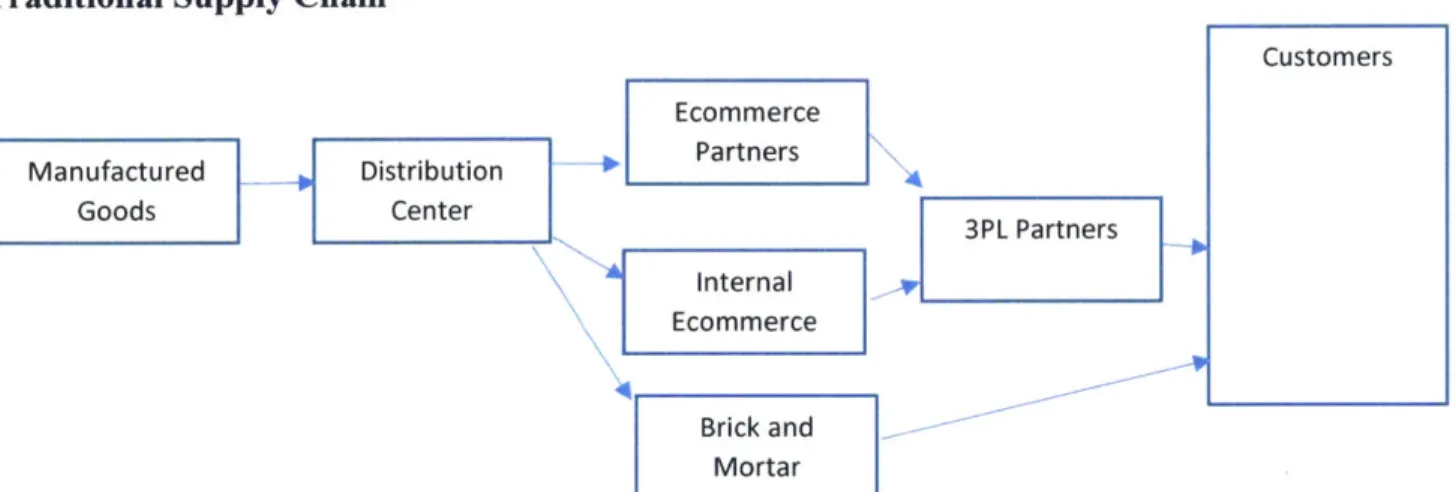
handling, additional packaging, etc. A study of the routing indicates that effective routing without eliminating nodes in the supply chain would have a limited effect on the transportation efficiency - potentially only a 6-10% increase. Using a model that leverages E-Commerce (Figure 4.2), this paper highlights a simplified view of how the PCPG industry could operate while leveraging E-Commerce and efficient routing. Taking into account that the case study company does not own a fleet for delivery and including the 3rd party logistics company (3PL) in
the model:
Traditional Supply Chain
Ecommerce
Manufactured Distribution Partners
Goods Center 3PL Partners
Internal Ecommerce
Brick and Mortar
Figure 4.3 (Author) - Traditional supply chain flow for perishable goods
Source: Author
Supply Chain Leveraging E-Commerce
Manufactured __ Distribution 3PL Partners
Goods Center
Drop-Ship
Opportunities
Figure 4.4 (Author) - Supply Chain Flow leveraging E-Commerce for perishable goods
Source: Author
Customers
As shown above, the PCPG manufacturer would be able to remove potential sources for damage and spoilage while leveraging an E-Commerce option. Drop-Shippers will also be leveraged in this model, as platforms for brick-and-mortar companies would outsource the packaging and shipping of PCPG goods to limit nodes in the supply chain. Should a last mile logistics company route the perishable goods to be delivered at the desired time, the results show there would be a limited risk for spoilage.
PCPG companies can leverage the existing network of distribution centers to serve the United
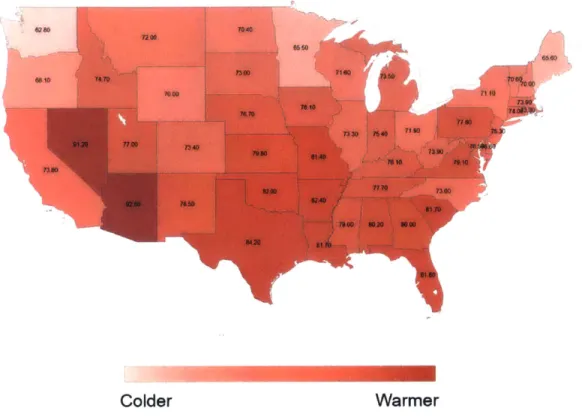
States population within a limited delivery window. In the event that the distribution centers would be able to process E-Commerce goods and smaller shipment sizes, two major factors would need to be considered: shipment duration and temperature. The product will deteriorate if it reaches a temperature of 70 degrees Fahrenheit. Cross-referencing yearly temperature averages and freight shipping estimates, allows to create visual maps of the current shipping environment:
Summer Temperatures
Colder Warmer
Figure 4.5 (Author) - Average Temperatures across the United States in summer timeframes
Freight Shipping Days to Continental United States
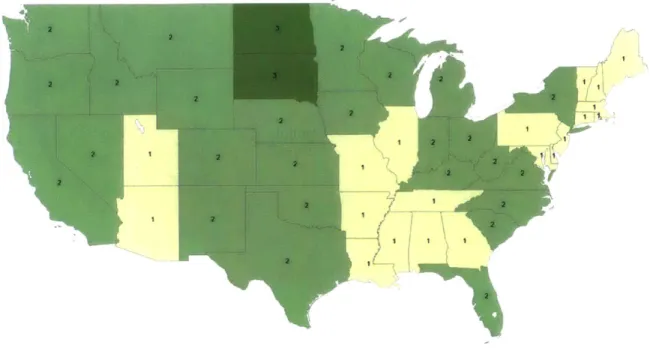
Figure 4.6 (Author) - Average freight shipping days from distribution centers of case study company
Source: Author
Figures 4.5 and 4.6 show elevated temperatures in summer months that may cause a risk of product deterioration indicating that effective routing could be useful. The southern states are most at risk of product deterioration because of exposure to elevated temperatures on any given day during the summer season. Outside of the summer months, the temperature for most states are not above the 70 degree threshold, but prolonged exposure may cause lowered product integrity. The second graph shows that most states would be within one or two shipping days
from a DC, indicating that effective routing may be possible, especially in high population areas where volume could be leveraged and routing would have a minimal effect on efficiency.
When evaluating competitors, research is focused on the practice and costs for similar goods. Starting with practices, many different companies use the large delivery services to
deliver their goods. Even predominantly online retailers, such as Amazon, would ship goods with the United States postal service. Another common practice was the utilization of drop shippers -a sep-ar-ate comp-any th-at would p-ack-age -and ship on beh-alf of -a ret-ailer. The drop shipping community in the PCPG market is rather small and does not have a large national presence. One of the largest PCPG drop shippers has three locations for shipping; it would take three days or longer for a number of states to be reached via traditional freight. For most boutique and drop
ship options, the goods would be priced at twice the level of a retail location and include a hefty shipping charge. The shipping charge would cover the cost of materials and increased shipping rate to encompass the goods in temperature-controlled packaging. Many instances show that the
shipping costs were more than half the price of the good - showing that the shipping market has a way to go to reduce costs for the cold chain demand.
Companies operating on a smaller scale or within a constrained geography have proved to be successful for delivery of PCPG or cold chain goods. Starting with smaller scale
companies, profitable models have been found when the manufacturing and logistics are internal. Fresh Diet, a meal delivery service, is able to be profitable by creating the meals in centrally located kitchens and distributing the goods through company owned vehicles. The vehicles are scheduled to drive during night hours to avoid major traffic and ensure cooler temperatures upon delivery without sunlight. The main uncertainty about this model regarding scalability is
contained in the forecasting of the goods and the viability for lower price points. Fresh Diet mainly delivers on a subscription model and can plan routes and purchases according to fairly regular forecasts. A source for PCPG products is impulse buy - a practice that is somewhat
unpredictable. The lower price points of PCPG goods may also be an issue as delivery costs for a purchase under a dollar, no matter how efficient the delivery method may be, would likely be unprofitable. The nighttime departure of trucks for morning pickup proposed a potentially viable model should a PCPG company purchase a private fleet for E-Commerce delivery. Additionally, other grocery delivery models, such as Peapod, have shown to be profitable in high volume industries. The key to these deliveries is the amount of delivers per particular unit. Peapod delivery services only operates within larger metropolitan areas as driving a cold chain vehicle is more costly for traditional grocery goods with lower margins. The lower price point would also pose a problem, but the model saturation and utilization of high population areas point to innovation in cold chain delivery.
Within the cold chain shipping space, routing might be a competitive advantage to capture growing demand. So far, companies haven't been able to leverage the cold chain service on a macro scale, as the energy requirements of the cold chain vehicles are cost prohibitive for low value goods. Companies can use available information and infrastructure to choose the most cost-efficient options to offer consumers and prepare for future industry development. Vehicle routing techniques must account for the amount of time in transit and amount of time on the doorstep of the customer. Delivery of goods from locations three days away by freight may become cost prohibitive when the consumer expects goods to be priced at a level similar to brick-and-mortar stores. This may lead to a conclusion that only higher value goods, having higher profit margins, would be able to be shipped to sparsely populated locations. A possibility would be to partner with existing cold chain services that could carry PCPG items for lower costs. This would limit the location delivery and require consumers to pick up the options at location or to transfer carriers. With ample purchasing power, the PCPG company may be able to
have the PCPG goods delivered later in the routes limiting the amount of time the product is exposed to higher temperatures. Private fleets can be leveraged to use specific departure times to deliver to high volume areas, assuming the consumer can be educated to look for packages at all hours or different timeframes. In summary, a course of action to limit cold chain delivery costs would be to leverage the natural weather and driving distance from shippers to avoid cold chain
services when unnecessary. Supplementing with an educated approach to the items made available in regards to profitability may result in a significant cost saving.
4.2 Results and Discussion - Consolidated Returns
Consolidated returns are an often overlooked area within the cold chain E-Commerce activities. The return process must provide a way to effectively and easily dispose of the product without compromising the brand. The larger the E-Commerce segment becomes the more critical returns become for a more successful E-Commerce company. To better understand product returns, a survey of literature and a competitive analysis was conducted.
Literature shows that returns, for the large part, are inconsistent and aren't usually forecasted by companies. Product returns can be done through a physical location where the product is sold, no matter the channel for the purchase. For example, a consumer can purchase a
sweater online and bring that same sweater into a retail outlet to get store credit or a refund. The multichannel option could be considered for increased ease of return. In the CPG sector, the product would expire, or come near to expiration, before the product could be repackaged. The
cost for cold chain delivery would also double the high costs incurred getting the product to the consumer. There are a number of reasons in which a company would want a defective product back: remove contaminated product from circulation, repackaging, validation of errors, error
product from circulation, meaning the full return of the product would not be absolutely necessary.
There are also obstacles with returning a product - ensuring the correct methodology and entering the product information into a database are the some of those obstacles. Should a package be returned, it might need to be delivered via cold chain. In markets with critical mass, there have been instances of cold chain delivery services being able to pick up products from consumer homes. These examples are largely limited to higher value products such as
pharmaceuticals. The product might also need to be scanned for a special code that would allow the shipper to identify some information about the product such as any special shipping
directions that might be needed. Many examples in literature have shown that low cost products are returned by regular mail service and destroyed before getting back to the manufacturer. This is a viable option, but still leaves the risk of the shipper improperly disposing of the item.
Competitively, there does not seem to be an industry standard for returning PCPG goods. There are many different methods ranging from processes that are relatively low effort to long, intricate processes that may be a barrier for some consumers. It appears that even the return process with the least effort requires a number of steps that may make a busy consumer wary of returning the product. The finality of the delivered good to the consumer along with the difficult return process may be a barrier for some consumers to purchase items all online. Starting with the most convenient for the consumer, there is a fairly common practice of allowing consumers with complaints to keep the damaged good to dispose of on their own. This might take place with a number of online retailers that do not directly handle their shipping processes. Many factors contribute to this decision; the cost and integrity of the returned good are considered. For a low cost item, the cost of returning the good and disposing of it may be prohibitive, making it more
price effective to ignore the reverse supply chain. Companies may want to put in place a
checking system to ensure that some consumers are not falsely claiming damaged goods to keep the product for free.
Next, a practice for the industry is to have the consumer return the item to the company. This commonly involves the consumer repackaging the good, printing out a label and choosing a carrier to send the item back to the origin. In certain cases, the label for return may be included with the original package. The consumer may also be responsible to pay for the shipping to return the item back to the origin; this may be a larger burden on the consumer. In the event of the case study company, this price may be larger than 50% of the purchase price. Additionally, the timeframe for getting a new good or having the account credited is highly variable. Account credits may take up to two billing cycles (the equivalent of a month) after the item has been returned. Should the item be of high value, the consumer might need to take additional precautions to ensure that the company receives the returned product. If the company doesn't receive the package, the consumer may have paid more than the cost of the item and not be reimbursed.
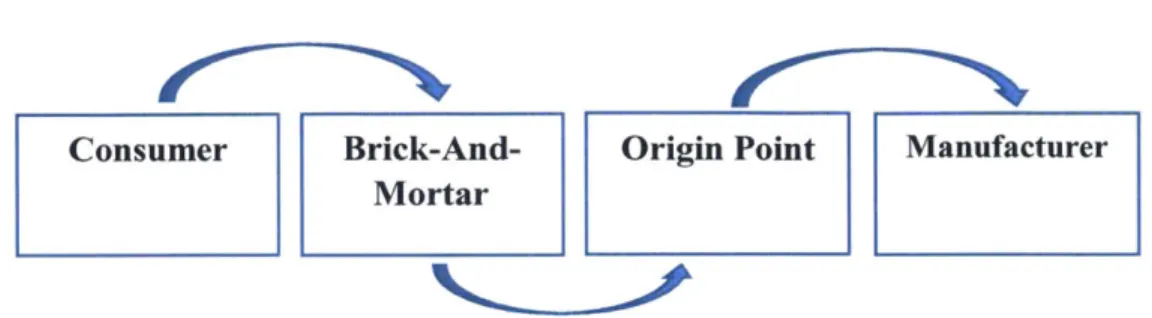
A model for returns combines the brick-and-mortar establishments and the online
platforms. Companies with a larger presence online as well as in consumer locations offer the option to return the item either to the retail location or through the postal service. This flexibility might be more appealing to customers. The consumer would no longer have to worry about the parcel carrier delivering the item to an incorrect location and thus costing the consumer the price of the good. There is also less ambiguity in terms of process if there are trained retail personnel at the location to assist the consumer. Finally, on the company end, the information for returns (disposal protocol, redistribution, etc.) can be checked by the personnel and dealt with
accordingly. The highly variable and largely unpredictable nature of the returns can be dealt with more efficiently with extra capacity of employees at the retail location.
CONSUMER RETURN POINT
Consumer Brick-And- Origin Point Manufacturer Mortar
Figure 4.7 (Author) - Flow from consumer back to manufacturer in return cycle
Low ambiguity Gives consumer Infrastructure to Infrastructure to
Benefits Low cost options redistribute already in redistribute already in
No need for reverse Low cost place place
supply chain Dedicated process Dedicated staff Largely company owned per returned good Dedicated process per Immediate feedback of
returned good errors
Opportunity for More pressure on Shipping cost to Shipping cost to
Barriers consumer retail staff consumer consumer
misinformation Locations must be Delayed payment to Delayed payment to Auditing staff needed somewhat ubiquitous consumer consumer
Devaluation of Variable Demand Variable Demand
product Diversified skills of staff
Table 4.1 (Author) - Benefits and barriers occurring in return nodes
Source: Author
For the PCPG industry, many of the manufacturers do not have a ubiquitous presence for many consumers - many of the companies only have a few locations. The PCPG industry might have to bear the risk of brand devaluation through both third party shipping and a complicated return process. In the current landscape, a tiered system might prove to be prudent for return practices. Low price, fast moving items, can be disposed of at the consumer level. Inevitably, fast moving items can have dedicated support staff for quality assurance, but there would still be an
additional burden to check for fraud in the claims. For slower moving, high priced items, the company may require that the product be returned to the origin or manufacturing location. This would limit the total amount of products that are at risk of being fraudulently claimed as defective. Seemingly, an option for both the consumer and the company would be to have the multi-channel return through brick-and-mortar as well as the postal service. PCPG companies that have a long-standing relationship with the retailers may be able to lower rates slightly to communicate returns to physical outlets. Should the company be able to leverage this agreement with a number of brick and mortar locations, the location presence may be more ubiquitous than even highly present corner retailers such as CVS or Walgreens. The PCPG industry could then save money on return practices as well as increase positive interactions with retail outlets. One challenge would be how to integrate the information systems from both the PCPG company and the retail outlets to be able to adequately monitor and reimburse both parties.
4.3 Results and Discussion -Competitive Research
The research conducted was to understand the model used in E-Commerce for PCPG products. There is a difference in pricing strategies between different E-Commerce websites. For the sake of comparison, all costs calculated in the table are for shipping to the Cambridge, MA area.
Website MPFS 20$ cost Packaging Method ETA UM Guarantee
Free return of Walgreens $25.00 $5.99 Regular Packaging 2-7 $4.19 damaged items
Free return of
CVS $49.00 $5.49 Regular Packaging 5-7 $4.39 damaged items
Free return of
Amazon $35.00 $10.00 Regular Packaging 5-7 $2.89 damaged items
Free return of Walmart $50.00 $4.97 Regular Packaging 7-1 1 $3.54 damaged items
Free return of
Target $25.00 $37.75 Regular Packaging 3-5 N/A damaged items
Free return of
Staples $50.00 $9.95 Regular Packaging 1-7 N/A damaged items
Cooled packaging
-PCPGI.com N/A $14.80 Styrofoam peanuts 3-6 $5.50 None
Cooled packaging - Free return of
PCPG A $75.00 $10.95 Styrofoam peanuts 3-6 N/A damaged items
PCPG B
Cooled packaging - Free return of
PCPG C $65.00 $7.95 Styrofoam peanuts 3-6 N/A damaged items
PCPG2.com $200.00 $13.26 Regular Packaging 5-8 $6.00 None
Source: Author
MPFS is the minimum price for free shipping, the price at which the website offers free shipping for PCPG products.
ETA is the time it takes for an order to arrive using the regular shipping option from the
website. Choosing expedited shipping is also an option, but shipping costs would increase and wasn't considered in the analysis.
UM was used to have a sense of perspective on the cost of PCPG products between the
different websites. Similar products were chosen from the different sites for this purpose. Differences in prices were upwards of 100% between the different websites.
E-Commerce websites that offer a large variety of products other than PCPG products offered the best MPFS rates, ranging between $25 and $50. The companies in question are Walgreens, CVS, Amazon, Walmart, Target and Staples. Amazon prime would have a different scheme than Amazon; should a person have a prime membership, they would be eligible to send most PCPG products either as an add-on to a shipment or to be shipped for free.
Source: CVS.com
PCPG websites like PCPG A and PCPG C have a slightly higher minimum price. This is
because they take special care of their packaging; they add Styrofoam peanuts and icepacks when they judge necessary. This helps protect the PCPG product from damage along the way, but also increases costs for shipping the products.
PCPG1.com and PCPG2.com had the highest MPFS point, PCPG1.com didn't offer free shipping and PCPG2.com offered as a special promotion shipping over $200. Although the reason behind the high MPFS couldn't be determined, certain factors seem to be correlated to this large increase. Both websites were specialized in only specific PCPG products. The websites were created only for online sales of PCPG. The online market for CPG and FMCG constitutes only 1% of total sales of PCPG products (adage, 2014). Both websites operate from one
warehouse, and so shipping to certain regions might be costlier than have distribution centers spread across the country and being able to dispatch from closer locations. The two websites have much smaller volumes than the large websites like Amazon and Walmart, and as such might have less leverage with shipping companies.
PCPG orders sometimes don't exceed $20, and so understanding how much websites charge for
shipping an order that costs around $20 is important. To ensure fairness, products chosen were similar in size and volume. All items were also ordered to the Cambridge, MA area, so the shipping costs might be different for other areas and if other products with different weights and volumes are ordered.
Four different pricing tiers were identified between the websites:
$8 to $11 for Amazon, Staples PCPG A and PCPG C.
$13 to $15 for PCPG1.com and PCPG2.com. Here again costs are higher than the other
websites.
$37.75 for Target. A whopping high cost for one of the biggest online retailers that offers free shipping for orders above $25.
summary
subtotal:
I No*&)
estimated shipping:
,awiffh REDcwI for0 semard shipping
estimated tax:
your total:
$19.95 * $37.75 $0.00$57.70
Wy -f&W MOs '1on t oi* m &bn bob
)OEI amw agtn.dn to mwform~ & conditons
-cy-va
PNy.-Figure 4.9 (Target.com) - Checkout information for perishable goods ordered online
Source: Target.com
Next, the packaging methods that are used by the e-commerce websites were examined. Most websites shipped their orders via third party shippers like UPS, USPS and FedEx.
Al A[ IA i
WNHtA11Hi Live Chat
I Please wait while we find an agent to assist you
HI! My name is Kristine B. How may I help you?
Customer: Pm trying to order chocolates
customer: tut rm worried they would mel
Kristina B: 1 wdl be glad to assist you!
Kratina B: If you receive your order and they are not satisfactory, you may return them to your local Watgreens or mail them back for a full refund.
Customer: Wee, I'm kind of trying to avoid this hassle.
Customer: how do you ship the groceries and chocolates to avoid damaging or melting hem?
Kritbna B: All eaems are shipped by standard mai. It there was a peoblem with them being delivered, then they would not be available oniine, so you can be sure that they will be
received the way you Intend. If you are sill concerned, you may purchase chocolates from your local Walgreens as well.
Customer; Thank you!
KrIstina B: You are very welcome! Thank you for contacting Walgreens.com. Following the cOmplein of this chat there will be a short survey and we would greatly appreciate your
feedback. Have a great day and be well. If you have a locai store or pharmacy *sue pleate use one of our feedback form http/Iwww.walgreens.comVmktg/contac lcontact-us-landing jso
sEma
SHIPPING COST:
Shipping charges are calculated using UPS, FedEx, and USPS shipping tables and are based on package weight and size, delivery
distance and shipping method. Shipping costs approximately double for every upgrade (e.g., UPS Overnight will cost roughly twice
that of UPS 2 Day). Unfortunately, weight plays a significant factor in determining shipping costs and bulk candy has a high shipping-to-product-cost ratio. For example:
If you purchase a diamond for $1,000, shipping is likely going to be approximately $20, (2% of the diamond price). On the other
hand, if you purchase $1,000 worth of candy, your shipping cost will likely be $200 (20% of the cost of the candy). Products such as jewelry, CDs, electronics, clothing, and flowers are light; therefore, their shipping costs will not represent a large percentage of their total order cost. Sweets, for better or for worse, outweigh the competitionI
Figure 4.10 (Walgreens.com) - Online customer service response to E-Commerce query
Source: Walgreens.com
Most E-Commerce sites don't have special packaging for delicate PCPG products to prevent them from deteriorating due to higher temperatures. E-Commerce sites package PCPG products like any other product and ship them to the consumers. PCPG A, PCPG C, PCPG1.com and PCPG2.com did however take special measures, being PCPG specialists, by including ice packages and Styrofoam peanuts, amongst other materials to ensure the products don't
deteriorate from high temperatures or get damaged in transit. PCPG2.com and PCPG1.com did include a page on their websites to explain how to avoid product deterioration when ordering products. By choosing express shipping during warmer periods, and having a policy of holding
shipping on Thursday and Friday so as to avoid long wait times in transportation hubs where temperatures are not controlled like in their warehouses, they would reduce risk of product deterioration.
ETAs were quite similar between the websites, depending on which third party shippers were contracted, and the average waiting time for the products was around 5 days (calculated based on average of each delivery window). The ETAs are also based on choosing the normal shipping method and not expedited shipping which can reduce the transit time to two days or one day but would tremendously increase shipping costs.
The UM metric shows how different E-Commerce websites are using different pricing methods for their PCPG products. Every website had a different strategy and used different markup for the PCPG products. This may seem odd, as online stores are easy to shift between,
compared to the hassle of having to go to different physical stores to find the best prices, changing websites to find a lower price is very simple. What was expected was a similar price between all websites, as lower websites might drive market price lower. Findings however were that similar website categories (CVS andWalgreens are similar, PCPG1.com and PCPG2.com are
similar) had similar pricing, different from the other websites.
The guarantee is what the website offers in case a customer receives a damaged product.
All websites offer a free exchange of the products received, which is a normal practice, except
for PCPG1.com and PCPG2.com. The latter don't offer any guarantee, and refuse to replace damaged products.