Dictating Nanoparticle Assembly via
Systems-Level Control of Molecular Multivalency
The MIT Faculty has made this article openly available.
Please share
how this access benefits you. Your story matters.
Citation
Santo, Peter J. et al. “Dictating Nanoparticle Assembly via
Systems-Level Control of Molecular Multivalency.” Journal of the American
Chemical Society, 141, 37 (August 2019): 14624–14632 © 2019 The
Author(s)
As Published
10.1021/JACS.9B04999
Publisher
American Chemical Society (ACS)
Version
Author's final manuscript
Citable link
https://hdl.handle.net/1721.1/127784
Terms of Use
Article is made available in accordance with the publisher's
policy and may be subject to US copyright law. Please refer to the
publisher's site for terms of use.
Dictating Nanoparticle Assembly via Systems-Level Control of
Mo-lecular Multivalency
Peter J. Santos, Zhen Cao, Jianyuan Zhang†, Alfredo Alexander-Katz, and Robert J. Macfarlane*
Department of Materials Science and Engineering, Massachusetts Institute of Technology, 77 Massachusetts Avenue, Cam-bridge, Massachusetts 02139, United StatesABSTRACT: Nanoparticle assembly can be controlled by multivalent binding interactions between surface ligands, indicating that more precise control over these interactions is important to design complex nanoscale architectures. It has been well-established in natural materials that the arrangement of different molecular species in three dimensions can affect the ability of individual supramo-lecular units to coordinate their binding, thereby regulating the strength and specificity of their collective mosupramo-lecular interactions. However, in artificial systems, limited examples exist that quantitatively demonstrate how changes to nanoscale geometry can be used to rationally modulate the thermodynamics of individual molecular binding interactions. As a result, the use of nanoscale design features to regulate molecular bonding remains an underutilized design handle to control nanomaterials synthesis. Here, we demon-strate a polymer-coated nanoparticle material where supramolecular bonding and nanoscale structure are used in conjunction to dictate the thermodynamics of their multivalent interactions, resulting in emergent bundling of supramolecular binding groups that would not be expected if considering the molecular structures alone. Additionally, we show that these emergent phenomena can controllably alter superlattice symmetry by using mesoscale particle arrangement to alter the thermodynamics of supramolecular bonding behav-ior. The ability to rationally program molecular multivalency via a systems-level approach therefore provides a major step forward in the assembly of complex artificial structures, with implications for future designs of both nanoparticle and supramolecular-based materials.
Introduction
Nanoparticle assembly is commonly regulated by multivalent intermolecular binding events between surface ligands, where the collective interaction of multiple surface-bound molecules dictates the overall thermodynamics of interparticle bonding.1
A significant amount of effort has therefore been put forth in examining how alterations to these molecular interactions affect nanoparticle behavior, and many strategies have been devel-oped to control particle arrangements by finely tuning the mo-lecular structures that guide nanoparticle assembly.2–5 However,
while the manipulation of molecular bonding has been shown to be a powerful means to control the thermodynamics of na-noscale assembly, it is also true that the nana-noscale arrangement of these molecular binding groups can affect the overall strength of the bonds being formed.6–9 In other words, not only can
changes to molecular geometry alter material ordering at larger length scales, but changes to these larger scale structures can also cause alterations to molecular behavior. Indeed, manipu-lating the relative positions of individual chemical moieties is a common design principle used in nature to control the strength and specificity of multivalent intermolecular interactions in-cluding avidity in antibody-antigen binding,10 substrate
selec-tivity at the active site of catalytic enzymes,11 and strong yet
dynamic carbohydrate-regulated cell adhesion.12 While
syn-thetic materials typically try to general hierarchical ordering from small length scales upwards (e.g. changes to molecular motifs causing different nanoscale behaviors), these examples in nature demonstrate that structural hierarchy can also work in
the opposite direction, where large-scale organization alters the behavior of individual building blocks (e.g. nanoscale organi-zation affecting molecular multivalency). Methods to control hierarchical organization via interplay between structures both up and down multiple length scales simultaneously can be re-ferred to as a “systems” approach to materials development. In principle, it should be possible to develop a systems-level approach to nanoparticle assembly, where structural features at the length scales of individual molecular bonds, nanoscale par-ticle geometry, and mesoscale arrangement of parpar-ticles serve as integrated design handles to control the assembly process.13–15
For example, a systems-level approach to nanomaterials syn-thesis could use multivalent supramolecular bonding to dictate how nanoscale particles form into mesoscale lattices, but also simultaneously use the nanoparticle coordination environment within those lattices to regulate the multivalency of molecular interactions and alter the strength of these bonds. The advantage of such a complex materials synthesis method would be the ability to more finely tune both particle assembly and supramo-lecular bonding by design features both above and below the length scales of the nanoparticle bonds themselves. In order to realize this goal, however, it is important first to understand how nanoscale structure affects the thermodynamics of these multivalent interactions in a rational manner. In this work, the hierarchical nature of a nanoparticle building block is used to methodically modify the degree to which supramolecular groups act collectively, and therefore control the overall inter-action strength between nanoparticles.
This enables a systems-level approach to materials synthesis, where nanoscale geometry influences molecular organization, and those design parameters in conjunction control mesoscale architecture, affording simultaneous control of material struc-ture across multiple length scales in a programmable manner. Results and Discussion
We have recently demonstrated a new nanoparticle-based building block capable of directed assembly via complementary hydrogen bonding motifs called the Nanocomposite Tecton (NCT).16 NCTs consist of rigid nanoparticle cores
functional-ized with deformable polymer chains in a dense brush architec-ture (Figs. 1, S1-S5, S8; NCTs examined here consist of gold nanoparticles coated in polystyrene brushes, suspended in tolu-ene). All polymer chains on the NCTs terminate in either a dia-minopyridine or thymine group (DAP and Thy, Scheme S1), which constitute a complementary supramolecular pair.17,18
Complementary sets of NCTs can form many DAP-Thy com-plexes that behave as a collective nanoscale bond linking NCTs together into large superlattices. Indeed, with appropriate ther-mal annealing, NCTs can even form crystalline lattices with long-range ordering.
Each nanoscale NCT-NCT bond within these lattices is a mul-tivalent structural feature, where the multivalency number (N) is the number of monovalent DAP-Thy complexes that act in a coordinated manner when two adjacent NCTs form an interpar-ticle bond.19,20 As a result, the free energy driving NCT
assem-bly can be regulated by modifying NCT structure at either the molecular or nanometer length scales; the former controls the strength of each individual monovalent supramolecular com-plex, while the latter regulates how many supramolecular inter-actions constitute a multivalent NCT-NCT bond. These syn-thetically independent design handles at different size regimes make NCTs ideal for exploring how both nanoparticle assembly and the multivalency of individual NCT-NCT bonds are af-fected by changes in structure at both the chemical and nanome-ter length scales. The ability to rationally program multivalency as a function of nanoscale structural features is therefore the first step in understanding and using this systems-level ap-proach to materials design.
Initial work has demonstrated that the collective binding en-thalpy of an NCT-NCT bond is significantly greater than an in-dividual DAP-Thy complex,16 a hallmark of a multivalent
inter-action. However, the calculated values of multivalency for these NCT systems are surprisingly low. For example, NCTs consist-ing of 26 nm particle cores functionalized with ~1000 polymer chains exhibit a multivalency value of only 10. While it is pos-sible that each multivalent NCT-NCT bond consists of only 10 DAP-Thy complexes, the high local concentration of 100s of DAP and Thy groups between particles makes this explanation of a low multivalency number unlikely. An alternative reason for this low value of N could be that the total number of DAP-Thy complexes comprising each NCT-NCT bond is signifi-cantly greater than 10, but there exists a structural feature in between the nanoscale shape of the NCT and the individual mo-lecular groups that regulates the number of complexes that can act in a coordinated, multivalent manner. More simply, each NCT-NCT bond consists of a large number of DAP-Thy com-plexes, but these complexes are arranged in tiny “bundles”, and only complexes within a single bundle could be considered to
Figure 1. Typically, hierarchical structuring is understood as mo-lecular structures causing the organization of larger length scale motifs, but these larger motifs can also influence how the smaller length scale components of a material behave. For example, NCTs functionalized with DAP or Thy terminated polymer chains engage in supramolecular bonding determined by the chemical identity of the ligands (molecular structures, bottom). The binding groups cluster into supramolecular bundles due to differences in intermo-lecular forces between the head groups, polymer chains, and sol-vent molecules (supramolecular structures), and this bundling al-lows multiple molecular groups to act multivalently. Multiple bun-dles arranged around a nanoparticle surface (nanoscale structures) thereby drive the formation of ordered arrays of nanoparticles (mesoscale structure). However, the organization of particles within a mesoscale lattice can in turn affects the nanoscale arrange-ment of polymer chains surrounding each particle, and these alter-ations affect polymer chain dynamics, which thereby modulate the thermodynamics of the bundled molecular bonds. As a result, the structure of the entire system must be considered simultaneously to fully understand the different levels of hierarchical organization.
be multivalent (Fig. 1b, right panel). Prior work has demon-strated that given an appropriate driving force, small molecule ligands on the surface of nanoparticles will indeed bundle to-gether.21,22 Similarly, polymer brushes on nanoparticles have
also been shown to engage in bundling when exposed to a strong antisolvent.23 Based on these prior observations, we
hy-pothesize that the driving force behind bundling of supramolec-ular complexes here could be differences in the chemical poten-tial between individual DAP and Thy groups and the surround-ing solvent molecules. Nonpolar polymers modified with telechelic polar moieties are known to form reverse micelles in low polarity solvents (Fig. S11), which would be consistent with small clusters forming at the ends of the polymer brush.24
If such bundling were indeed dictating the multivalency in these NCT systems, the presence of these “bundle bonds” would therefore represent a systems-level emergent phenomenon where the nanoscale sizes and shapes of the NCT could be used to regulate thermodynamics of supramolecular complexation.
Because the positions of individual chain ends on an NCT can-not be readily measured due to their small size, their poor elec-tron density contrast with the surrounding polymer and solvent, the presence of the significantly larger and more electron dense nanoparticle cores, and the transient nature of supramolecular complexes, the bundle bond hypothesis was first examined us-ing molecular dynamics simulations to determine the most probable arrangement of individual DAP-Thy complexes within a multivalent NCT-NCT bond (Fig. 2). A full atomistic description of NCTs would be computationally prohibitive, but a coarse-grained model with a consistent mapping of the geom-etry, volume fraction, and interaction parameters between ex-periments and simulations (see SI for details, Figs. S12, S20) is sufficient to provide insight into the configuration of the multi-valent NCT-NCT bond interface.21,22
In a typical simulation where a pair of complementary NCTs is allowed to reach equilibrium, DAP and Thy groups that are not part of a supramolecular complex are randomly positioned at the periphery of the particles. However, DAP-Thy complexes that are part of a multivalent NCT-NCT bond do indeed coa-lesce into “bundles” that dynamically change shape throughout the simulation (Fig. 2a, Fig. S13-S15). Thus, each multivalent NCT-NCT bond consists of multiple “bundle bonds”, where the degree of multivalency is determined by the number of DAP-Thy complexes that comprise a single bundle. Because the bun-dles are only found at the interface of NCTs connected via a multivalent NCT-NCT bond (Fig. 2b), these data not only con-firm the presence of the bundle bonds, but also demonstrate that it is the act of forming a nanoscale NCT-NCT bond itself that drives supramolecular bundle formation. NCTs therefore pre-sent a previously unexplored opportunity to systematically study how nanoscale structure can be used to modulate molec-ular multivalency.
It is also important to note that this bundling behavior is distinct from previous examples of spontaneous symmetry breaking in the ligands of nanoparticles being assembled. These differences stem from the fact that the bundles of supramolecular com-plexes observed here are significantly smaller than the cross-section of the overall NCT bond, and any given NCT-NCT bond therefore consists of multiple bundles. Moreover, the DAP-Thy connections are dynamic, and the exact sizes and shapes of the bundles are constantly changing. As a result, the bundling phenomenon is not entirely identical to the “patchi-ness” observed in other systems such as those that are aniso-tropically functionalized23,25 or that form soft skyrmions via
lig-and rearrangement,26 as the overall surface of the NCT would
still be considered to be largely isotropic even with the bundling phenomena occurring (vide infra). This distinction means that NCTs are affecting material structuring at a level in between an individual molecular bond and an overall nanoparticle structure. The obvious question that therefore arises is whether design handles at both the molecular and nanoscale can be used in con-junction to modulate the collective size and dynamic behavior of these bundle bonds.
In order to properly answer this question, it is important to un-derstand how the thermodynamics of NCT assembly change as a function of different nanoscale structural features. In a stand-ard multivalent bond between NCTs, the strength of each supra-molecular complex (each monovalent binding event) is de-scribed by the free energy equation:
ΔGs = ΔHs – TΔSs (1)
Figure 2. Molecular dynamics simulations of NCT assembly. (a) The equilibrium structure of modeled NCTs shows the presence of bundles that emerge at the interface of two complementary NCTs. The dots in the inset denote positions of individual supramolecular groups at the NCT-NCT interface; the different colors denote al-gorithmically defined bundles that dictate the degree of multiva-lency (see SI for clustering analysis). (b) A pair distribution func-tion (PDF) analysis of the distance between supramolecular groups both at and away from the NCT-NCT interface. At the in-terface, the supramolecular binding groups associate into bundles, resulting in a distinct spike in the PDF, which corresponds with the radius of the bundles. The absence of this peak away from the interface confirms that it is the act of forming the nanoscale NCT-NCT bond that drives formation of this emergent structural fea-ture.
where ΔGs, ΔHs, and ΔSs are the Gibbs free energy, enthalpy, and entropy associated with the formation of a single DAP-Thy complex. The strength of a multivalent “bundle bond” is there-fore:
ΔGm = ΔHm – TΔSm (2)
where ΔGm, ΔHm, and ΔSm are the Gibbs free energy, enthalpy, and entropy of the collective bundle. By definition, the ratio be-tween the enthalpy values of these reactions is the value of mul-tivalency (i.e. N = ΔHm/ΔHs). More simply, the multivalency number N is the average number of groups within a given bun-dle.
The most significant contribution to ΔHm is expected to be the hydrogen bonds formed between DAP-Thy pairs, as these are by far the strongest types of interactions involved in the for-mation of a DAP-Thy complex. Additional enthalpic contribu-tions such as dispersion forces or polymer mixing within the brush may also be possible, but these are expected to play a much smaller role in dictating the thermodynamics of NCT as-sembly due to the fact that they are significantly weaker than the hydrogen bonding interactions (additional discussion in SI). The most significant contribution to ΔSm is expected to come from the reduction in polymer configurations upon forming a DAP-Thy complex that restricts the motion of the two adjoined polymer chains.
The value of ΔHs for each DAP-Thy complex within a bundle bond can be assumed to be constant based on prior evidence in simpler molecular systems.19 Thus, ΔH
m should be ΔHs multi-plied by the number of DAP-Thy complexes that comprise a bundle bond (i.e. ΔHm = NΔHs). However, ΔSs is not equivalent for all polymers within a bundle bond, as different polymers will have different amounts of conformational confinement upon the formation of a DAP-Thy complex, depending on where they are anchored on the surface of the nanoparticle core. As a result, expressing the value of ΔGm as a function of N, ΔHs, and ΔSs becomes:
ΔGm = N(ΔHs) – T (∑ ΔS𝑁𝑖 𝑖) (3)
where values of ΔSi are the entropy changes associated with the different polymer linkers being tethered together via DAP-Thy complexes. As noted above, while there may be additional con-tributions to this simple approximation, such thermodynamic parameters are small enough so as to not significantly affect the conclusions drawn here, and these assumptions should hold for systems like the NCTs that possess long ligands and directional enthalpic interactions.27,28
Based on these thermodynamic parameters, a “bundle bond” therefore represents a collection of DAP and Thy groups where the entropy penalty for linking any given pair of polymer chains comprising that bundle is less than the strength of the DAP-Thy
Figure 3. Thermodynamics of bundle bond formation are controlled via nanoscale design handles. (a) The thermodynamics of bundle bond formation are dictated by the number of supramolecular groups that can cluster together, as well as the entropy penalty associated with confining polymer chain motion upon forming a supramolecular complex. In the case of a smaller particle with a short polymer the number of supramolecular bonds is limited (left). When a longer polymer is used (right) the multivalency increases, but with an added entropic penalty. (b) Thermal melt analysis shows increases in ΔHm and Tm with increasing nanoparticle diameter (decreased particle curvature). A
decrease in NCT curvature results in a higher density of supramolecular binding groups, and therefore a larger number of hydrogen bonds can bundle together (c) NCT Tm decreases with increasing polymer length for all particle sizes examined (black traces), but the collective
complex that is formed. In other words, if a polymer chain has to stretch so much to become a part of a bundle that the TΔSi is greater than ΔHs, that polymer will not be a part of that multi-valent bundle.
This interplay between enthalpy and entropy explains why bun-dles of DAP and Thy groups only emerge within an NCT-NCT bond, as the enthalpy benefit of generating a supramolecular complex is necessary to offset the entropic penalty of restricting polymer motion; the reduced chemical potential of clustering the polar head groups is not enough on its own to drive this be-havior. Additionally, it indicates that changes to NCT structure at the nanoscale should affect multivalency by altering the ex-tent to which polymer chain conformations are restricted upon formation of a bundle bond. Therefore, because the design of NCTs can be easily varied, a series of well controlled experi-ments can provide further support of the bundle bond hypothe-sis, and provide insights into the relationship between nanoscale structure and multivalency.
For example, changing the nanoscale shape of an NCT by mod-ifying particle core diameter is observed to increase the temper-ature at which NCT-NCT bonds break, as well as values of N and ΔHm. The thermodynamics of NCTs were studied by mon-itoring the dissociation of particles with UV-Vis spectroscopy, and the resulting thermal transition was fit to the Van’t Hoff equation to extrapolate relevant thermodynamics values (see supporting information, Figs S6, S7, S20 for further details).29
The increase in Tm and ΔHm with increasing nanoparticle core diameter can be explained as a function of changes to particle nanoscale curvature. When two curved surfaces approach one another, different sets of points on the opposing surfaces are not necessarily equidistant. Additionally, the polymer chains ex-tending perpendicularly from the curved surface are not all ini-tially aligned in the same direction as the NCT-NCT bond (Fig. 3a, left). As a result, polymer chains further from the NCT-NCT bond axis need to stretch in order to form a DAP-Thy complex, while polymers directly at the center of the bond will likely compress in order to allow more polymer chain ends to reach one another and form supramolecular complexes (Fig. 3a, right).The more curved the particle surface, the greater the var-iation in compression and stretching as a function of where the polymers are grafted to the surface. The values of ΔSi resulting from tethering polymer chains via a supramolecular complex would therefore be expected to vary more as a function of lateral distance between binders when NCT particle cores have more curved surfaces. As a result, lowering particle curvature by in-creasing particle diameter enables a larger number of polymer chains to bundle together and act multivalently. In other words, the value of N at which ∑𝑁𝑖 𝛥𝑆𝑖 overcomes ΔHm is higher for larger diameter cores. This larger value of N correlates to larger bundle bonds and (based on equation 3) explains the fact that values of ΔHm and Tm increase with particle core size, asymp-totically approaching the limit corresponding to a flat surface (Fig. 3b).
Increasing the height of the polymer brush can also use na-noscale geometric influence to modify NCT bonding thermo-dynamics, but would be expected to have more complex effects on multivalency and bundle bond formation. As polymer length increases, the number of conformations (and thus entropy) of each polymer chain should also increase. This means that teth-ering two longer polymer chains together should result in a larger entropy penalty, indicating that the value of N at which
ΣTΔSi exceeds ΔHm should decrease, resulting in lower Tm. Ex-periments demonstrate that Tm does indeed decrease with in-creasing polymer length for all systems studied (Fig. 3c). How-ever, while NCTs with larger particle diameters (26, 36, 50 nm) also show a corresponding decrease in N, NCTs with smaller particle diameters (12 and 16 nm) exhibit values of N that in-stead increase with increasing polymer length.
These data indicate that the number of DAP-Thy complexes that comprise a bundle bond is actually increasing, which can be ex-plained as a function of polymer packing density. Short poly-mers grafted onto particles form a dense concentrated brush, but longer polymers extend further off of the particle surface into a semidilute brush regime.30,31 The transition from the
concen-trated to semidilute regimes is dependent on the degree of par-ticle curvature, with larger spheres requiring longer polymer lengths to become semidilute. Polymer chain ends in this semi-dilute regime can occupy a greater number of conformations, which in turn allows a greater number of DAP groups to bind to complementary Thy groups on adjacent particles (Fig. 3a). However, this would also mean that, when comparing two NCT systems with the same bundle bond size, smaller particle cores would require greater amounts of polymer chain confinement in order to form the bundles. These opposing thermodynamic ef-fects explain the contrasting trends in ΔHm as a function of pol-ymer length on small and large nanoparticle cores. The greater surface curvature of the small cores inherently allows for more polymer flexibility and enables the formation of larger bundle bonds with increasing polymer length (increasing ΔHm and N), but also requires greater polymer deformation to form these bundles (larger values of ΔSi, which results in a decreased Tm despite the larger N).
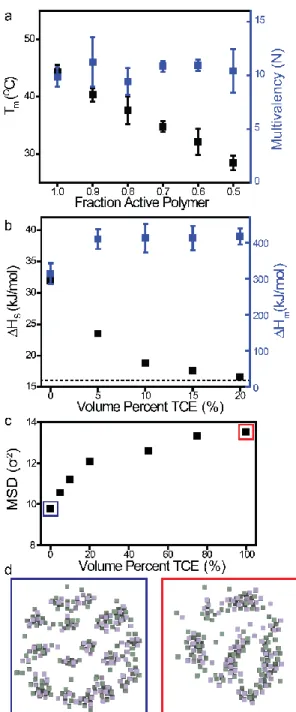
In order to further show that the multivalent behavior observed in NCTs is an effect of nanostructure-induced bundle bonds and not just an increased local concentration of DAP and Thy groups at the particle surface, NCTs were co-loaded with con-trolled ratios of “active” polymers terminating in a supramolec-ular binding group and “inert” polymers without any such func-tionality (Fig. S9-S10). In conventional model systems that ex-plain multivalency solely due to increased local concentration of binding groups, reducing the number of active chains would be predicted to lower the degree of multivalency. However, in the NCT system, the values of N and ΔHm did not exhibit any significant change as a function of density of DAP and Thy groups (Fig. 4a, Figure S10). These unexpected results imply that, above a critical fraction of active polymer chains, the local bonding structure of an NCT-NCT connection must be con-stant, meaning that the size and the shapes of the bundle bonds do not change as a function of the number of “active” polymers within the range studied. The lower melting temperatures for the coloaded samples must therefore arise from a greater poly-mer entropy penalty for NCT bonding, as greater deformation would be required to maintain a constant multivalency. The im-portance of this finding is to reiterate the initial discovery that the act of forming a nanoscale bond results in an emergent struc-ture (the bundle bond), where this new structural motif is the determinant factor of the entire system’s multivalency. The data and simulations presented above therefore indicate that the de-gree of multivalency in an NCT-NCT bond is indeed a complex interplay of building block structure across length scales, and
that nanoscale structure can be used to modulate bundle bond behavior.
Nevertheless, because each bundle bond still consists of multi-ple individual supramolecular commulti-plexes, it is also important to consider the effects of altering the molecular composition of the system. While this can be achieved via chemical alterations to the DAP or Thy complexes (as has been examined in previous molecular models32), it is also possible to modify the overall
structure and chemical behavior of an NCT via alterations to the solvent environment. Individual hydrogen bonding interactions typically weaken in more polar solvents, which would be ex-pected to reduce the value of ΔHs.33 However, the chemical po-tential between DAP and Thy groups and their local environ-ment would also decrease when increasing solvent polarity, re-ducing the driving force for forming the bundles, which could lead to larger bundle bonds and greater multivalency.24
Variable temperature NMR experiments performed on small molecule DAP and Thy analogues demonstrate that adding a more polar solvent (1,1,2,2-tetrachloroethane, TCE) does in-deed decrease ΔHs for individual DAP-Thy complexes. This en-thalpy change reaches a minimum value at ~20% TCE, due to preferential solvation34,35 of the moderately polar DAP-Thy
complex (Fig. S18-19). However, although ΔHs decreases with increasing solvent polarity, the collective ΔHm of an NCT bond actually increases when TCE is added (Fig. 4b). Because each individual hydrogen bond is weaker, the increase in ΔHm indi-cates that N must dramatically increase in the more polar sol-vent: bundles in the more polar solvents exhibit multivalencies up to ~250% of their value in pure toluene (N = 10 in toluene but 25 in 20% TCE for the system in fig. 4b). Simulations con-firm that adding TCE increases both average bundle bond size and the rate at which DAP-Thy complexes exchange between adjacent bundles (Fig. S16-S17). This enhanced mobility af-fords each supramolecular group a greater number of counter-parts on a neighboring particle with which it can complex, en-hancing NCT multivalency (Figs. 4c, 4d). Thus, although each individual hydrogen bond weakens with increased solvent po-larity, the increased multivalency results in higher collective binding strength between NCTs. As a result, the hierarchical or-dering of an NCT-NCT bond is dictated (and can be controlled) by a complex and integrated set of design variables across mul-tiple size regimes. Alterations to molecular composition of the solvent change the enthalpic driving force for bundle bond for-mation, while alterations to NCT nanoscale structure alter its associated entropic penalty. NCTs therefore represent a multi-valent supramolecular system that, just like natural systems, can only be regulated and understood by considering material struc-ture at the molecular and nanoscale simultaneously.
Importantly, the fundamental understanding of NCT bond be-havior from the experiments above potentially allows for the development of new design principles for systems-level control of assembly as a function of these integrated molecular and na-noscale handles. Prior work has shown that NCTs with symmet-ric particle sizes and polymer lengths form ordered, crystalline CsCl-type lattices upon thermal annealing.16 A crystalline
lat-tice is hypothesized to be the thermodynamically favored state because it maximizes the number of NCT bonds that can form and minimizes the entropic penalty associated with polymer confinement upon binding. This implies that manipulating the overall morphology of the “bundled” bonds could allow new phases to be achieved, as these enthalpic and entropic factors
Figure 4. NCTs exhibit a maximum multivalency, implying satu-rated bonding behavior. (a) Decreasing the fraction of polymer chains that have a supramolecular binding group decreases NCT Tm, but with no significant change in ΔHm. (b) The bundling ef-fect is hypothesized to originate from the polar supramolecular binding groups phase segregating from the nonpolar toluene sol-vent. Introducing a polar solvent (1,1,2,2 tetrachloroethane, TCE) weakens individual supramolecular bonds (black data, dotted line represents the DAP-Thy binding strength in 100% TCE), but sur-prisingly increases the binding enthalpy for the collective NCT-NCT interaction (blue data). (c) Molecular dynamics simulations show that increasing solvent polarity decreases the restrictive ef-fect on the supramolecular binding groups. This can be quantified by measuring the mean square displacement (MSD) of the binding groups, which is shown to increase with increasing TCE. (d) Posi-tions of supramolecular groups at a modeled NCT-NCT interface show smaller, less multivalent bundles in low polarity solvent (blue), and larger, more diffuse bundles in higher polarity solvent (red).
that determine which crystal phase is thermodynamically pre-ferred are inherently linked to the sizes and shapes of the bun-dles. As a result, alterations to nanoscale NCT architecture could be used to regulate both the thermodynamics of supramo-lecular complex formation and the mesoscale coordination en-vironment of particles within a lattice.
For example, an asymmetric NCT system consisting of comple-mentary large (20 nm diameter core and 12 kDa polymer) and small (12.5 nm core and 7 kDa polymer) NCTs was found to assemble into a lattice isostructural with Th3P4 after thermal
an-nealing. The formation of this lattice symmetry is surprising, since it has a lower nanoparticle valency and thus fewer in-terparticle connections than CsCl-type lattices. It has been pos-tulated in other nanoparticle assembly methods36,37 that the
Th3P4 phase is favored over CsCl because it alleviates strain in
linkers that are sterically limited in their mobility. This strain on the ligands induced by assembly also connects to the previ-ously described bundling behavior, as increasing polymer strain correlates negatively with the amount of multivalency. In tolu-ene, the strong driving force for segregation of the DAP and Thy groups drives the formation of small bundles (N ~10 as shown above), which restrict the motion of the supramolecular binding groups. Increasing the solvent polarity would be ex-pected to increase molecular bond mobility and soften na-noscale polymer coronae, expanding the size of the supramo-lecular bundle bonds and increasing the multivalency of the NCT. In more polar solvents, the higher enthalpic driving force
from the collective supramolecular interaction should be able to overcome the entropy penalty of straining the polymers, and fa-vor an alternate superlattice structure. To clarify, the collective supramolecular interaction of multiple molecular binding groups arranged around a nanoscale scaffold would result in a mesoscale superlattice architecture, but this mesoscale organi-zation would also control the amount of nanoscale polymer re-organization needed to maintain the lattice, thereby affecting the supramolecular bundle sizes and thus collective molecular thermodynamics—a true “systems” approach to material design (Figure 1).
Adding TCE to NCT solutions during thermal annealing does indeed favor the formation of the 4% denser CsCl lattice (Fig. 5), demonstrating that a single set of NCT building blocks can be driven down two different assembly pathways using solely changes to solvent composition. The significance of this result is that the hierarchical ordering in this system cannot be prede-termined by simply summing up the interactions of individual molecular binding groups, or considering the larger lattices and NCT bonds to be just a consequence of the behavior of individ-ual molecules. Rather, these structures are indeed an example of a systems-level design process, where the morphology at each length scale (molecular, nano, and meso) is both an effect and a cause of behavior at the others.
It is important to again note that this system-derived change in NCT coordination environment is different than prior particle assembly schemes that use "patchy" particles23,25,38. These
methods typically control particle coordination numbers by breaking the overall symmetry of the ligand shell around a par-ticle. Here, the overall ligand shell surrounding the particles re-mains largely isotropic at the nanoscale, as each NCT-NCT bond consists of multiple emergent bundle bonds that are smaller than the length scale of the collective NCT-NCT inter-actions. Instead of altering the nanoscale symmetry of the par-ticle building blocks, these bundles regulate the degree of mul-tivalency to dictate the equilibrium lattice symmetry. The for-mation of these two unique superlattices and the ability to drive a single set of NCT building blocks to either crystallographic symmetry therefore demonstrates the potential for materials de-sign using a combination of integrated handles across multiple size regimes.
Conclusion
In order to fully mimic the complexity of naturally occurring materials made via directed assembly, it is imperative to under-stand how the interactions between design features at multiple length scales dictate material structure. The systems-level de-sign methodology presented here represents a unique platform for exploring the thermodynamics of multivalent behavior in a manner that is more similar to a natural system than a simple molecular model. While this work focuses on the first steps of controlling material structure and molecular assembly in a sys-tems-level approach, the modularity of the NCT design poten-tially allows future exploration of different design handles (e.g. polymer compositions, supramolecular binding group struc-tures, particle shapes) to further imitate and explore many dif-ferent types of multivalent natural systems that use nanoscale structure to modulate their behavior and hierarchical ordering across multiple length scales. The understanding gained from the experiments performed here and these future investigations is critical for multiple fields where materials require
sophisti-Figure 5. Solvent composition manipulates NCT superlattice crys-tal structure. (a) Schematic diagram showing the unit cell of a Th3P4-type NCT superlattice and 8 unit cells of CsCl-Type lattices,
which occupy a similar volume. (b) Small angle x-ray scattering measurements of NCT superlattices in toluene with 0 to 10 volume percent 1,1,2,2 tetrachloroethane (TCE) as a cosolvent. The top and bottom dashed patterns are simulated. Increasing TCE modu-lates the bundle bond size, which then alters the resulting mesoscale structure of the NCTs.
cated structures and interactions between features at the molec-ular, nano-, and macroscopic length scales, including catalysis, interface science, and biomimetics. Studying the interplay be-tween molecular makeup and nanoscale spatial organization
therefore presents a powerful opportunity for programming hi-erarchical ordering and material behavior beyond the limita-tions of current reductionist design approaches.
ASSOCIATED CONTENT Supporting Information
Materials and Methods Scheme S1 and S2 Figures S1-S20 Tables S1-S8 Supplementary References 1-15 NMR Spectra AUTHOR INFORMATION Corresponding Author
*Correspondence to: [email protected]. Present Addresses
†Present address: Department of Chemistry and Chemical Biology, Rutgers, the State University of New Jersey, 123 Bevier Rd, Piscataway, New Jersey 08854, United States. Author Contributions
The manuscript was written through contributions of all authors. All authors have given approval to the final version of the manu-script.
Funding Sources
This material is based upon work supported in part by the U. S. Army Research Office under grant number W911NF-18-1-0197. This work was primarily supported by an NSF CAREER Grant, award number CHE-1653289 and made use of the MRSEC Shared Experimental Facilities at MIT, supported by the NSF un-der Award DMR 14-19807. P.J.S. acknowledges support by the NSF Graduate Research Fellowship Program under Grant 1122374. A.A.-K. acknowledges financial support from the De-partment of Energy BES award # ER46919 for performing the simulation work.
ACKNOWLEDGMENT
Special thanks to Dr. Byeongdu Lee for helpful discussions.
REFERENCES
(1) Badjić, J. D.; Nelson, A.; Cantrill, S. J.; Turnbull, W. B.; Stoddart, J. F. Multivalency and Cooperativity in Supramolecular Chemistry. Acc. Chem. Res. 2005, 38 (9), 723–732. https://doi.org/10.1021/ar040223k.
(2) Kuna, J. J.; Voïtchovsky, K.; Singh, C.; Jiang, H.; Mwenifumbo, S.; Ghorai, P. K.; Stevens, M. M.; Glotzer, S. C.; Stel-lacci, F. The Effect of Nanometre-Scale Structure on Interfacial En-ergy. Nat. Mater. 2009, 8 (10), 837–842. https://doi.org/10.1038/nmat2534.
(3) Huang, M.; Hsu, C.-H.; Wang, J.; Mei, S.; Dong, X.; Li, Y.; Li, M.; Liu, H.; Zhang, W.; Aida, T.; et al. Selective Assemblies of Giant Tetrahedra via Precisely Controlled Positional Interactions.
Sci-ence 2015, 348 (6233), 424–428.
https://doi.org/10.1126/sci-ence.aaa2421.
(4) Xia, Y.; Nguyen, T. D.; Yang, M.; Lee, B.; Santos, A.; Pod-siadlo, P.; Tang, Z.; Glotzer, S. C.; Kotov, N. A. Assembly of Self-Limiting Monodisperse Supraparticles from Polydisperse Nanoparti-cles. Nat. Nanotechnol. 2011, 6 (9), 580. https://doi.org/10.1038/nnano.2011.121.
(5) Jishkariani, D.; Diroll, B. T.; Cargnello, M.; Klein, D. R.; Hough, L. A.; Murray, C. B.; Donnio, B. Dendron-Mediated Engineer-ing of Interparticle Separation and Self-Assembly in Dendronized Gold Nanoparticles Superlattices. J. Am. Chem. Soc. 2015, 137 (33), 10728– 10734. https://doi.org/10.1021/jacs.5b06306.
(6) laRica, R. de; Fratila, R. M.; Szarpak, A.; Huskens, J.; Velders, A. H. Multivalent Nanoparticle Networks as Ultrasensitive Enzyme Sensors. Angew. Chem. Int. Ed. 2011, 50 (25), 5704–5707. https://doi.org/10.1002/anie.201008189.
(7) Prasad Thelu, H. V.; K. Albert, S.; Golla, M.; Krishnan, N.; Ram, D.; Murty Srinivasula, S.; Varghese, R. Size Controllable DNA Nanogels from the Self-Assembly of DNA Nanostructures through Multivalent Host–Guest Interactions. Nanoscale 2018, 10 (1), 222– 230. https://doi.org/10.1039/C7NR06985E.
(8) Fu, J.-H.; Lee, Y.-H.; He, Y.-J.; Chan, Y.-T. Facile Self-As-sembly of Metallo-Supramolecular Ring-in-Ring and Spiderweb Struc-tures Using Multivalent Terpyridine Ligands. Angew. Chem. Int. Ed.
2015, 54 (21), 6231–6235. https://doi.org/10.1002/anie.201501507.
(9) Vial, S.; Nykypanchuk, D.; Yager, K. G.; Tkachenko, A. V.; Gang, O. Linear Mesostructures in DNA–Nanorod Self-Assembly.
ACS Nano 2013, 7 (6), 5437–5445. https://doi.org/10.1021/nn401413b.
(10) Deyev, S. M.; Lebedenko, E. N. Multivalency: The Hall-mark of Antibodies Used for Optimization of Tumor Targeting by De-sign. BioEssays 2008, 30 (9), 904–918. https://doi.org/10.1002/bies.20805.
(11) Gouin, S. G. Multivalent Inhibitors for Carbohydrate-Pro-cessing Enzymes: Beyond the “Lock-and-Key” Concept. Chem. – Eur.
J. 2014, 20 (37), 11616–11628.
https://doi.org/10.1002/chem.201402537.
(12) Pieters, R. J. Intervention with Bacterial Adhesion by Mul-tivalent Carbohydrates. Med. Res. Rev. 2007, 27 (6), 796–816. https://doi.org/10.1002/med.20089.
(13) Zhao, H.; Sen, S.; Udayabhaskararao, T.; Sawczyk, M.; Kučanda, K.; Manna, D.; Kundu, P. K.; Lee, J.-W.; Král, P.; Klajn, R. Reversible Trapping and Reaction Acceleration within Dynamically Self-Assembling Nanoflasks. Nat. Nanotechnol. 2016, 11 (1), 82–88. https://doi.org/10.1038/nnano.2015.256.
(14) Jones, M. R.; Macfarlane, R. J.; Prigodich, A. E.; Patel, P. C.; Mirkin, C. A. Nanoparticle Shape Anisotropy Dictates the Collec-tive Behavior of Surface-Bound Ligands. J. Am. Chem. Soc. 2011, 133 (46), 18865–18869. https://doi.org/10.1021/ja206777k.
(15) Walker, D. A.; Leitsch, E. K.; Nap, R. J.; Szleifer, I.; Grzyb-owski, B. A. Geometric Curvature Controls the Chemical Patchiness and Self-Assembly of Nanoparticles. Nat. Nanotechnol. 2013, 8 (9), 676–681. https://doi.org/10.1038/nnano.2013.158.
(16) Zhang, J.; Santos, P. J.; Gabrys, P. A.; Lee, S.; Liu, C.; Macfarlane, R. J. Self-Assembling Nanocomposite Tectons. J. Am.
Chem. Soc. 2016, 138 (50), 16228–16231. https://doi.org/10.1021/jacs.6b11052.
(17) Simundza, G.; Sakore, T. D.; Sobell, H. M. Base-Pairing Configurations between Purines and Pyrimidines in the Solid State: V. Crystal and Molecular Structure of Two 1:1 Hydrogen-Bonded Com-plexes, Methyluracil: 9-Ethyl-8-Bromo-2,6-Diaminopurine and 1-Ethylthymine: 9-Ethyl-8-Bromo-2,6-Diaminopurine. J. Mol. Biol.
1970, 48 (2), 263–278. https://doi.org/10.1016/0022-2836(70)90160-9.
(18) Lehn, J.-M. Supramolecular Chemistry — Molecular Infor-mation and the Design of Supramolecular Materials. Makromol. Chem.
Macromol. Symp. 1993, 69 (1), 1–17. https://doi.org/10.1002/masy.19930690103.
(19) Mammen, M.; Choi, S.-K.; Whitesides, G. M. Polyvalent In-teractions in Biological Systems: Implications for Design and Use of Multivalent Ligands and Inhibitors. Angew. Chem. Int. Ed. 1998, 37 (20), 2754–2794. https://doi.org/10.1002/(SICI)1521-3773(19981102)37:20<2754::AID-ANIE2754>3.0.CO;2-3.
(20) Huskens, J.; Mulder, A.; Auletta, T.; Nijhuis, C. A.; Ludden, M. J. W.; Reinhoudt, D. N. A Model for Describing the Thermodynam-ics of Multivalent Host−Guest Interactions at Interfaces. J. Am. Chem.
Soc. 2004, 126 (21), 6784–6797. https://doi.org/10.1021/ja049085k.
(21) Guo, P.; Sknepnek, R.; Olvera de la Cruz, M. Electrostatic-Driven Ridge Formation on Nanoparticles Coated with Charged End-Group Ligands. J. Phys. Chem. C 2011, 115 (14), 6484–6490. https://doi.org/10.1021/jp201598k.
(22) Donakowski, M. D.; Godbe, J. M.; Sknepnek, R.; Knowles, K. E.; Olvera de la Cruz, M.; Weiss, E. A. A Quantitative Description
of the Binding Equilibria of Para-Substituted Aniline Ligands and CdSe Quantum Dots. J. Phys. Chem. C 2010, 114 (51), 22526–22534. https://doi.org/10.1021/jp109381r.
(23) Choueiri, R. M.; Galati, E.; Thérien-Aubin, H.; Klinkova, A.; Larin, E. M.; Querejeta-Fernández, A.; Han, L.; Xin, H. L.; Gang, O.; Zhulina, E. B.; et al. Surface Patterning of Nanoparticles with Pol-ymer Patches. Nature 2016, 538 (7623), 79–83. https://doi.org/10.1038/nature19089.
(24) Narumi, A.; Miura, Y.; Otsuka, I.; Yamane, S.; Kitajyo, Y.; Satoh, T.; Hirao, A.; Kaneko, N.; Kaga, H.; Kakuchi, T. End-Function-alization of Polystyrene by Malto-Oligosaccharide Generating Aggre-gation-Tunable Polymeric Reverse Micelle. J. Polym. Sci. Part Polym.
Chem. 2006, 44 (16), 4864–4879. https://doi.org/10.1002/pola.21582.
(25) Zhang, Z.; Glotzer, S. C. Self-Assembly of Patchy Particles.
Nano Lett. 2004, 4 (8), 1407–1413. https://doi.org/10.1021/nl0493500.
(26) Travesset, A. Soft Skyrmions, Spontaneous Valence and Se-lection Rules in Nanoparticle Superlattices. ACS Nano 2017, 11 (6), 5375–5382. https://doi.org/10.1021/acsnano.7b02219.
(27) Batista, C. A. S.; Larson, R. G.; Kotov, N. A. Nonadditivity of Nanoparticle Interactions. Science 2015, 350 (6257), 1242477. https://doi.org/10.1126/science.1242477.
(28) Liepold, C.; Smith, A.; Lin, B.; de Pablo, J.; Rice, S. A. Pair and Many-Body Interactions between Ligated Au Nanoparticles. J.
Chem. Phys. 2019, 150 (4), 044904. https://doi.org/10.1063/1.5064545.
(29) Jin, R.; Wu, G.; Li, Z.; Mirkin, C. A.; Schatz, G. C. What Controls the Melting Properties of DNA-Linked Gold Nanoparticle As-semblies? J. Am. Chem. Soc. 2003, 125 (6), 1643–1654. https://doi.org/10.1021/ja021096v.
(30) Choi, J.; Dong, H.; Matyjaszewski, K.; Bockstaller, M. R. Flexible Particle Array Structures by Controlling Polymer Graft Archi-tecture. J. Am. Chem. Soc. 2010, 132 (36), 12537–12539. https://doi.org/10.1021/ja105189s.
(31) Milner, S. T.; Witten, T. A.; Cates, M. E. Theory of the Grafted Polymer Brush. Macromolecules 1988, 21 (8), 2610–2619. https://doi.org/10.1021/ma00186a051.
(32) Beijer, F. H.; Sijbesma, R. P.; Vekemans, J. A. J. M.; Meijer, E. W.; Kooijman, H.; Spek, A. L. Hydrogen-Bonded Complexes of Di-aminopyridines and Diaminotriazines: Opposite Effect of Acylation on Complex Stabilities. J. Org. Chem. 1996, 61 (18), 6371–6380. https://doi.org/10.1021/jo960612v.
(33) Li, C.-P.; Du, M. Role of Solvents in Coordination Supra-molecular Systems. Chem. Commun. 2011, 47 (21), 5958–5972. https://doi.org/10.1039/C1CC10935A.
(34) Amenta, V.; Cook, J. L.; Hunter, C. A.; Low, C. M. R.; Vinter, J. G. Influence of Solvent Polarity on Preferential Solvation of Molecular Recognition Probes in Solvent Mixtures. J. Phys. Chem. B
2012, 116 (49), 14433–14440. https://doi.org/10.1021/jp310379h.
(35) Bagno, A.; Campulla, M.; Pirana, M.; Scorrano, G.; Stiz, S. Preferential Solvation of Organic Species in Binary Solvent Mixtures Probed by Intermolecular 1H NOESY NMR Spectroscopy. Chem. –
Eur. J. 1999, 5 (4), 1291–1300.
https://doi.org/10.1002/(SICI)1521-3765(19990401)5:4<1291::AID-CHEM1291>3.0.CO;2-M.
(36) Thaner, R. V.; Eryazici, I.; Macfarlane, R. J.; Brown, K. A.; Lee, B.; Nguyen, S. T.; Mirkin, C. A. The Significance of Multivalent Bonding Motifs and “Bond Order” in DNA-Directed Nanoparticle Crystallization. J. Am. Chem. Soc. 2016, 138 (19), 6119–6122. https://doi.org/10.1021/jacs.6b02479.
(37) Wang, M. X.; Brodin, J. D.; Millan, J. A.; Seo, S. E.; Girard, M.; Olvera de la Cruz, M.; Lee, B.; Mirkin, C. A. Altering DNA-Programmable Colloidal Crystallization Paths by Modulating Particle Repulsion. Nano Lett. 2017, 17 (8), 5126–5132. https://doi.org/10.1021/acs.nanolett.7b02502.
(38) Zhu, H.; Fan, Z.; Yu, L.; Wilson, M. A.; Nagaoka, Y.; Eg-gert, D.; Cao, C.; Liu, Y.; Wei, Z.; Wang, X.; et al. Controlling Nano-particle Orientations in the Self-Assembly of Patchy Quantum Dot-Gold Heterostructural Nanocrystals. J. Am. Chem. Soc. 2019. https://doi.org/10.1021/jacs.9b01033.