Received January 16, 2009 Address for correspondence: ERIK VON ELM
E-mail: [email protected]
The role of correspondence sections in post-publication
peer review: A bibliometric study of general and internal
medicine journals
ERIK VON ELM,a,b SIMON WANDEL,a,c PETER JÜNIa,c a Institute of Social and Preventive Medicine (ISPM), University of Bern,
Finkenhubelweg 11, CH-3012 Bern, Switzerland
b German Cochrane Centre, Department of Medical Biometry and Statistics, University Medical Centre, Freiburg, Germany
c Clinical Trials Unit (CTU), Bern University Hospital, Bern, Switzerland
Scientific journals claim that correspondence sections are for post-publication peer review. We compared the conditions for submission and the bibliometrics of letters-to-editors published in leading medical journals in 2002 and 2007 using journal-derived information and data from PubMed and Journal Citation Reports. The median time limit for letter submissions decreased from 6 to 3.5 weeks, the median word limit from 400 to 350. The median number of letters per published article was near one in both years. Only about half of the letters were followed by an author reply in either year. Electronic response systems were available for four journals in 2007.
Introduction
Two years ago, we submitted a letter to the editor of a leading specialty journal in response to a published medical study. This study suggested an association of sports with cancer and created angst among those practising a particular type of sports. In our letter, we questioned the methods and statistical analyses and asked for clarifications. The letter was rejected; one reviewer’s comment was that “if the concern is the amount of press generated by the original article, then the best solution is not to re-create the media attention by having it appear in the journal again.” We appealed and re-submitted a revised version, which was also rejected. When we contacted the authors directly their response by e-mail did not address our specific concerns.
Stimulated by this experience, we asked ourselves what barriers may exist for open debate and effective post-publication peer review in correspondence sections. The value of a submitted correspondence is a matter of editorial judgement, and there is often no one correct answer as to publish it or not [4]. Many journals claim that their correspondence section serves as a forum for discussion of previously published research and post-publication peer review. We aimed at analysing the formal conditions
for submissions of letters in leading general and internal medicine journals, in particular with regard to restrictions in time windows for submission and word counts. We used bibliometric data to study additional characteristics of correspondence sections. We compared the situation in 2007 to five years earlier.
Methods
From the Journal Citation Report 2006 (Thompson Corporation, Toronto, Canada), we identified the ten journals that were ranked highest for their impact factor in the category “General & Internal Medicine”. We accessed the author instructions of these journals available online in January 2008, and extracted information including the time window for submission of letters after publication of articles, applicable word limits, and information about the journals’ electronic response system, if any. We compared the current information with previously published data from the year 2002 [2]. If a journal was not included in the previous evaluation [2] we checked the journal’s author instructions published in 2002. If the required information was no longer available, we asked the editorial offices. For each journal, we compared between the years 2002 and 2007 the number of letters published per article and the proportion of letters followed by a published author reply. The number of published letters was obtained using the PubMed search engine (National Library of Medicine, Bethesda, USA) with a restriction to publication type “Letter” and the year of interest. We downloaded all entries to an electronic database and manually checked for each letter whether it referred to a previous publication in the same journal and whether it was followed by a reply by the article’s authors. We excluded research letters, case reports, errata, updates on previous publications, and general commentaries indexed as letters in PubMed. For entries linked to author replies, the National Library of Medicine confirmed upon request that, if an author addresses several letters in one single response, all the PubMed indexed letters are routinely linked to this single reply.
We then used the Journal Citation Reports (JCR) Science Edition (Thompson Corporation, Toronto, Canada) of the years 2002 and 2007 to determine the number of “citable items” (i.e. original or review articles) in the included journals. Data collection from PubMed was done in February and March 2008; JCR data were last updated in October 2008. As has been observed by other researchers recently [12], the numbers of citable articles per journal and year are not consistent between Thomson data sources: data published in the annual JCR differ from those available in the Web of Science. For consistency, we decided to only use JCR data. We determined the average number of letters per citable article for each journal and year of interest and calculated the differences between 2002 and 2007 with their corresponding 95% confidence intervals. Finally, we determined the proportion of letters followed by a published PubMed indexed author reply.
Results
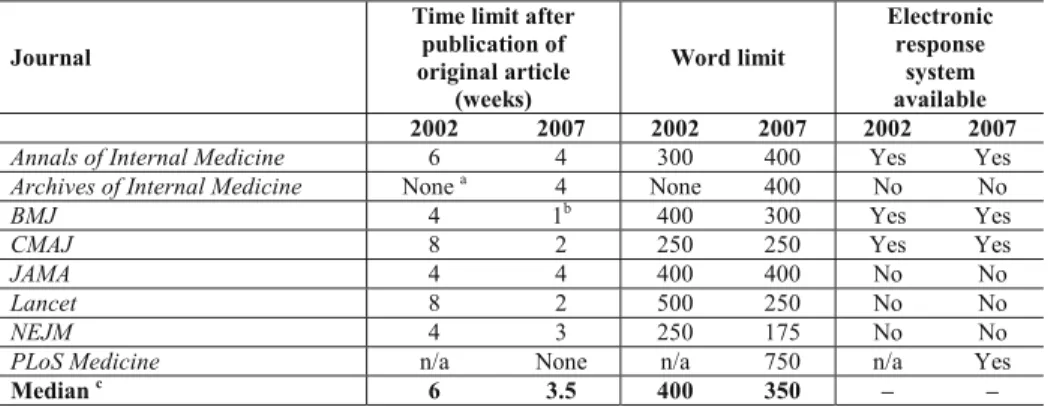
Eight [25, 27–31, 33, 35] out of the ten selected journals regularly published letters to the editors (Table 1). Two journals, Annual Review of Medicine [26] and Medicine [32] did not accept correspondence relating to their published material and could not be used for further analyses. One journal, PLoS Medicine [35], was founded in 2004, and only data from 2007 were included. Table 1 presents the conditions for letter submissions in 2002 and 2007. The median time window for letter submission was 6 weeks in 2002 (range 4 to unlimited) and 3.5 weeks (range 1 to unlimited) in 2007. Four journals had shortened this time window [25, 29, 31, 33], one journal by one week [33], one by two weeks [25] and two by six weeks [29, 31]. One journal [28] with a time window of four weeks in 2002 did no longer specify any restriction in 2007, but editorial staff reported to select letters for the print edition from the electronic responses posted on the journal’s website typically within five days. One journal introduced a new time window [27], and for another journal [30] the restriction remained unchanged.
Table 1. Conditions for post-publication peer review in leading general and internal medicine journals in 2002 and 2007
Journal
Time limit after publication of original article (weeks) Word limit Electronic response system available 2002 2007 2002 2007 2002 2007
Annals of Internal Medicine 6 4 300 400 Yes Yes
Archives of Internal Medicine None a 4 None 400 No No
BMJ 4 1b 400 300 Yes Yes
CMAJ 8 2 250 250 Yes Yes
JAMA 4 4 400 400 No No
Lancet 8 2 500 250 No No
NEJM 4 3 250 175 No No
PLoS Medicine n/a None n/a 750 n/a Yes
Median c 6 3.5 400 350 – –
Note: Two of the ten included journals (Annual Review of Medicine and Medicine) do not publish letters in response to their published material.
n/a = not applicable;
a There were no formal editorial rules for submitted letters in 2002.
b Early response letters are usually selected within the first five days. Electronic responses and author replies are possible after this delay and available on the journal website as clarified in the rubric of the letters section of BMJ print version.
cNo restriction was interpreted as above the maximum of the observed values (i.e. infinity).
The median word limit was 400 in 2002 (range 250 to unlimited) and 350 in 2007 (range 175 to 750) (Table 1). Of the seven journals with data from both years, one [25] allowed longer letters in 2007 than five years earlier. Three [28, 31, 33] imposed stricter word limits, and one [27] introduced a new restriction. In two journals [29, 30], word
limits were unchanged. Three journals [25, 28, 29] had an electronic response system in both years allowing readers to comment on articles without temporal restrictions. PLoS
Medicine [35], as an online-only journal, allowed such electronic responses since its
start in 2004.
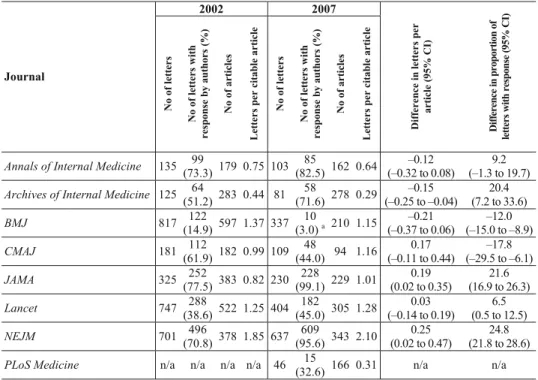
Table 2. Number of letters and articles published in leading general and internal medicine journals in 2002 and 2007 2002 2007 Journal No of le tt ers N o o f l ette rs w ith re sp ons e by author s (%) No of art icles Let te rs p er ci ta bl e art icl e No of le tt ers N o o f l ette rs w ith re sp ons e by author s (%) No of art icles Let te rs p er ci ta bl e art icl e Di ff eren ce i n l et ters p er art icle ( 95% CI ) Dif fe ren ce in p rop ort ion of let te rs wit h res pons e ( 95% CI )
Annals of Internal Medicine 135 (73.3)99 179 0.75 103 (82.5)85 162 0.64 (–0.32 to 0.08) –0.12 (–1.3 to 19.7) 9.2 Archives of Internal Medicine 125 (51.2)64 283 0.44 81 (71.6)58 278 0.29 (–0.25 to –0.04) –0.15 (7.2 to 33.6) 20.4 BMJ 817 (14.9)122 597 1.37 337 (3.0) 10 a 210 1.15 (–0.37 to 0.06) –0.21 (–15.0 to –8.9) –12.0 CMAJ 181 (61.9)112 182 0.99 109 (44.0)48 94 1.16 (–0.11 to 0.44) 0.17 (–29.5 to –6.1) –17.8 JAMA 325 (77.5)252 383 0.82 230 (99.1)228 229 1.01 (0.02 to 0.35) 0.19 (16.9 to 26.3) 21.6 Lancet 747 (38.6)288 522 1.25 404 (45.0)182 305 1.28 (–0.14 to 0.19) 0.03 (0.5 to 12.5) 6.5 NEJM 701 496 (70.8) 378 1.85 637 609 (95.6) 343 2.10 0.25 (0.02 to 0.47) 24.8 (21.8 to 28.6) PLoS Medicine n/a n/a n/a n/a 46 (32.6)15 166 0.31 n/a n/a Presented are for each year: the number of published letters in response to original publications based on PubMed, the number of letters with author reply based on PubMed, the number of “citable articles” based on Journal Citation Report Science Edition 2002 and 2007, and the average number of letters per citable article (ratio of letters to citable articles).
a Authors’ replies usually arrive after selection of early responses for BMJ print version. Consequently, they are neither indexed in PubMed nor captured by the number of responses presented here.
CI = confidence interval; n/a = not applicable
In PubMed we retrieved a total of 5542 entries indexed as letters published in 2002 or 2007. We excluded 564 entries (10.2%) that did not meet inclusion criteria. In 2002, a total of 3031 letters were published in seven included journals, and in 2007 there were 1947 letters in eight included journals. In each of the seven journals with data from both years, the absolute number of citable articles per year and the number of published letters per year decreased over time [25, 27–31, 33] (Table 2). In 2002, the median number of letters per citable article was 0.99, with a range from 0.44 [27] to 1.85 [33].
In 2007, the median was 1.08, with a range from 0.29 [27] to 2.10 [33]. In three journals [25, 27, 28], the average number of letters per article decreased over time. In one journal [31], the number was almost unchanged and in three journals [29, 30, 33] it increased (Table 2). In 2002, the proportion of letters with a published response by the authors of the original article ranged from 14.9% [31] to 77.5% [30] in seven journals (median 61.9%), and in 2007 from 3.0% [28] to 99.1% [30] in eight journals (median 58.3%) (Table 2). This proportion decreased in two [28, 29] and increased in five journals [25, 27, 30, 31, 33]. The overall proportion of answered letters was 47.3% in 2002, and 63.4% in 2007.
Discussion
Leading general and internal medicine journals applied more restrictive conditions for letter submission in 2007 as compared to 2002. The median time window decreased from 6 weeks to 3.5 weeks. The median word limit decreased slightly; three journals actually decreased their word limit and one without such a restriction in 2002 had introduced one by 2007. There was no clear trend regarding the number of letters published per citable article and the proportion of letters followed by a published author reply. Overall, only about half of letters were followed by a PubMed indexed author reply.
We selected general and internal medicine journals with a high journal impact factor; this choice may have limited the generalisability of our findings. A larger sample of journals including those publishing other types of biomedical or other research would be needed to obtain a representative sample. Further, issues of post-publication peer review including the motivation for submitting correspondence likely differs between smaller and more prestigious journals. To determine the number of published letters and author replies we relied on the PubMed database but had to exclude about 10% of the entries indexed as letters. This indicates that the assignment of publication types in PubMed is not always reliable. Conversely, we may have missed eligible letters that were not indexed as such in PubMed. We used the counts of original articles and reviews as published in the Journal Citation Reports to obtain the journals’ numbers of “citable articles” per year as a denominator. We may have overestimated the number of letters in response to “citable articles” since some included letters may have been triggered by publications other than articles and reviews. Clearly, alternative definitions of a denominator for the number of original articles are possible but have other disadvantages. Finally, we acknowledge that the electronic response systems introduced by half of the journals offer additional opportunities to respond to published research and that post-publication peer review in these forums is not reflected by our data. However, the status of electronic responses to journal articles (as compared to formal letters to the editor) varies from journal to journal. Electronic responses are not properly
indexed in electronic literature databases and not yet considered fully equivalent to printed correspondence by the scientific community [16]. For the present study, we therefore refrained from including additional data about these sources.
Results in context
In 2007, several journals including Lancet and New England Journal of Medicine allowed only very short delays for letters in response to published articles. Such tight time windows can hardly be met by many readers, particularly by those relying on print versions circulated around departments or arriving with a delay by mail or by those retrieving articles months or years after publication through literature searches [6, 17]. In addition, these restrictions limit the opportunities of researchers from resource-limited settings to participate in post-publication peer review disproportionately. Concern about restrictions on letters has been voiced before [2, 3]. Unfortunately, we found that many journals have tightened their respective policies in the recent past.
Some of the included journals apply drastic restrictions on the length of letters. The
New England Journal of Medicine limited letters to only 175 words, and the Lancet and CMAJ to 250 words. Constructive criticism is often difficult to develop in such few
words. In addition to word limits, journals sometimes restrict the content of letters, for instance, by asking authors to “include one or two points about the journal article” [33]. New word limits have been justified as a means “to help concentrate writers' minds, making for punchier critiques” [18]. Insufficient space may be one of the reasons why many letters do not discuss more complex methodological questions. However, the content of letters to the editor have received only little attention from methodologists and empirical researchers, so far [5, 7, 13, 14]. In an analysis of letter content in the
Medical Journal of Australia only two of 43 letters criticised statistical methods [7].
Similarly, only four of 115 letters published in the Nederlands Tijdschrift voor
Geneeskunde included criticism on study methods [14]. It was beyond the scope of this
study to analyse the full text of the more than 5000 included letters for content. The proportion of letters with an author reply varied widely across journals. This suggests that some journals actively seek such author replies while others do not. Even if an author replies, the content of the response may not be subject to editorial or peer review before publication. Consequently, there is little control over whether authors appropriately address the specific concerns expressed in a letter [20, 24]. Empirical evidence suggests that, in many cases, the criticism made in correspondence is not answered by the authors of original papers [13].
A recent survey of journal editors indicated that their decisions may be influenced by considerations relating to the journal’s bibliometric performance and the relative contribution of a journal’s sections to the journal impact factor [8]. Correspondence sections and the citations related to their content play a role in the calculation of this
indicator: While these citations count towards the numerator the letters themselves are not considered original items and do not count to the denominator [21]. If citations of non-original items (such as letters) are excluded from the calculation, the corrected journal impact factor could be shown to be substantially lower for some journals [12].
Ethical implications
“Cogent criticisms from readers should be published unless editors have convincing reasons why they cannot be. Authors of criticised material should usually be given the opportunity to have a response published” [9]. Despite these generally accepted editorial standards, only about half of the letters examined by us received a formal author reply indexed in PubMed. It has been argued that the failure to address the criticism voiced in published correspondence may lead to a distortion of scientific knowledge [13]. In the past, letters to the editor have led to the detection of serious flaws and the retraction of articles [15, 19]. Monitoring and critical review of author replies may therefore be considered an important editorial task to ensure the proper functioning of post-publication peer review. However, editorial policies are diverging regarding the space conceded to correspondence sections and whether letters and author replies should be peer-reviewed also [23].
Post-publication peer review can be performed without time constraints by many peers with diverse expertise. In fact, “peer review does not stop when the ink has dried on the printed page” [1]. In contrast, traditional pre-publication peer review allows only a few specifically recruited experts to comment, usually within tight deadlines. Still there is little academic reward for researchers to spend time and effort on this critical task [22]. Consequently, it cannot be valued highly enough if researchers invest their time and effort into post-publication peer review. With the advent of electronic publishing, some journals have started to experiment with innovative ways to encourage reader participation: The BMJ started an electronic response system already a decade ago [10, 11]. However, since only a smaller part of the electronic communications is selected for the print issue, only few of them are followed by an author reply. The Public Library of Science (PLoS) experiments with electronic annotation in the article text and has introduced a rating system for published articles [36]. The specialist journal
Pediatrics gave its electronic response items the promising name “P3R” which stands
for “Post-Publication Peer Review” [34]. While the possibilities of electronic publishing raise hopes for improved post-publication peer review, many researchers still do not take advantage of these innovations and continue to publish more traditional articles, even in electronic journals [16]. Several important questions remain: How can journals achieve that electronic correspondence is fully visible and searchable e.g. in electronic
databases? How can electronic forums be protected against misuse without creating undue workload for editorial staff? How can journals ensure that criticism from post-publication peer review is adequately addressed by the authors?
Self-correction and debate are features that the scientific community is proud of. If correspondence sections are more than just a figurehead of discursive culture, they deserve a proper role in scientific publishing. The little space conceded to publish letters should not become more restricted in the future if correspondence sections are to be used efficiently for post-publication peer review.
*
We thank Fitore Sallahaj for help with data extraction from online databases and Elizabeth Wager for helpful comments on an early draft of this manuscript.
References 1. Peers reviewed. Lancet, 1 (1989) : 1115–1116.
2. ALTMAN D. G., Poor-quality medical research: what can journals do? JAMA, 287 (2002) 2765–2767. 3. ALTMAN D. G., Unjustified restrictions on letters to the editor. PLoS Med., 2 (2005) e126; discussion
e152.
4. BHOPAL R. S, TONKS A., The role of letters in reviewing research. BMJ, 308 (1994) 1582–1583. 5. BOYTON R. J, ARNOLD P.C., An audit of the BMJ’s correspondence columns. BMJ, 301 (1990)
1419–1420.
6. BUTLER C., Old letters, new rules. Lancet, 361 (2003) 706.
7. CASWELL A., Letters to the editor 1991. An audit of the MJA’s correspondence columns. Med. J. Aust., 157 (1992) 63–64.
8. CHEW M., VILLANUEVA E. V., VAN DER WEYDEN M. B., Life and times of the impact factor: retrospective analysis of trends for seven medical journals (1994–2005) and their Editors’ views. J. R. Soc. Med., 100 (2007) 142–150.
9. COMMITTEE ON PUBLICATION ETHICS (COPE). Code of conduct for editors of biomedical journals. Available at: http://publicationethics.org./code-conduct (2007).
10. CROSSAN L., DELAMOTHE T., Letters to the editor: the new order. Please respond to articles using website, email, or disk-but not paper. BMJ, 316 (1998) 1406–1410.
11. DAVIES S., New edicts for letters to the editor – Be electronic, bold, and concise – no more than 300 words. BMJ, 326 (2003) 63–64.
12. GOLUBIC R., RUDES M., KOVACIC N., MARUSIC M., MARUSIC A., Calculating impact factor: how bibliographical classification of journal items affects the impact factor of large and small journals. Sci. Eng. Ethics., 14 (2008) 41–49.
13. HORTON R., Postpublication criticism and the shaping of clinical knowledge. JAMA, 287 (2002) 2843–2847.
14. MAHESH S., KABOS M., WALVOORT H. C., OVERBEKE A. J., Significance of letters published in the Dutch Journal of Medicine, 1997/98. Ned Tijdschr Geneeskd, 145 (2001) 531–535.
15. MARIC C., HARRIS P. J., ALCORN D., Notice of retraction of article. Clin. Exp. Pharmacol. Physiol., 31 (2004) 657–658.
16. MARON N. L., SMITH K. K., Current Models of Digital Scholarly Communication. Results of an Investigation Conducted by Ithaka for the Association of Research Libraries. Association of Research Libraries. Washington, DC, 2008. Available at: www.arl.org
18. MULLAN Z., Letters or lectures? Lancet, 367 (2006) 1042.
19. O’CONNOR P., Changes in renal medullary volume account for the relationship between arterial pressure and renal medullary interstitial cell lipid granule content. Clin. Exp. Pharmacol. Physiol., 31 (2004) 658; author reply 657.
20. RENNIE D., Freedom and responsibility in medical publication: setting the balance right. JAMA, 280 (1998) 300–302.
21. SEGLEN P. O., Why the impact factor of journals should not be used for evaluating research. BMJ, 314 (1997) 498–502.
22. STANG A., POOLE C., SCHMIDT-POKRZYWNIAK A., Pre-peer review, peer review, and post-peer review: Three areas with potential for improvement. J Clin Epidemiol, 61 (2008) 309–310.
23. WORLD ASSOCIATION OF MEDICAL EDITORS (WAME). Policies on Letters to the Editor. March 2, 2007 to March 7, 2007. Available at:
http://www.wame.org/wame-listserve-discussions/policies-on-letters-to-the-editor
24. WORLD ASSOCIATION OF MEDICAL EDITORS (WAME). Case Consultation: Authors Do Not Respond to Critical Letters to the Editor. May 2003. Available at: http://www.wame.org/ethics-resources/. (2003).
Journal information
25. Annals of Internal Medicine. Philadelphia. American College of Physicians. ISSN: 0003-4819. Authors instructions available at: http://www.annals.org/shared/author_info.shtml#manuscriptpreparation 26. Annual Review of Medicine. Palo Alto. Annual Reviews. ISSN: 0066-4219. Authors instructions
available at: http://arjournals.annualreviews.org/help?context=additionalInformation#Authors.
27. Archives of Internal Medicine. Chicago. American Medical Association. ISSN: 0003-9926. Author instructions available at: http://archinte.ama-assn.org/misc/authors.dtl.
28. BMJ: British Medical Journal. London. British Medical Association. ISSN: 0959-8146. Authors instructions available at: http://resources.bmj.com/bmj/authors.
29. CMAJ: Canadian Medical Association Journal. Ottawa. Canadian Medical Association. ISSN: 0820-3946. Authors instructions available at: http://www.cmaj.ca/authors/index.shtml.
30. JAMA: Journal of the American Medical Association. Chicago. American Medical Association. ISSN: 0002-9955. Authors instructions available at: http://jama.ama-assn.org/misc/authors.dtl.
31. Lancet. London. Lancet Publishing Group. ISSN: 0140-6736. Authors instructions available at: http://www.thelancet.com/authors/lancet/authorinfo
32. Medicine. Baltimore. Lippincott Williams & Wilkins. ISSN: 0025-7974. Authors instructions available at: http://www.editorialmanager.com/md/.
33. New England Journal of Medicine. Boston, Massachusetts Medical Society. ISSN: 0028-4793. Author instructions available at: http://authors.nejm.org/Misc/LetterInstrx.asp.
34. Pediatrics. Elk Grove Village, IL. American Academy of Pediatrics. ISSN: 0031-4005. Author instructions available at: http://pediatrics.aappublications.org/.
35. PLoS Medicine. San Francisco. Public Library of Science. ISSN: 1549-1277. Authors instructions available at: http://journals.plos.org/plosmedicine/guidelines.php.
36. PLoS ONE. San Francisco. Public Library of Science. ISSN: 1932-6203 Author instructions available at: http://www.plosone.org/static/commentGuidelines.action.