Letters to the Editor Economic Allocation and Value Corrected Substitution
Letters to the Editor: Comments
H I
Economic Allocation and Value-Corrected Substitution
Comments to 'Economic Allocation in LCA' by Frank Werner and Klaus Richter
In a recent paper, "Economic allocation in LCA: A case study about aluminium window frames" (Int. J. LCA 5 (2) 79- 83), Frank Werner & Klaus Richter worked out a method for solving the multifunctionality problem as this results from the recycling of (post-use) materials, in an example on alu- minium window frames.
In the method, the worked-up material substitutes for virgin material, in line with the substitution procedure as specified in step 1 of the allocation chapter in ISO 14041. The authors add a new element, which is to correct this substitution for the lower value of the recycled material as compared to that of the virgin material. The value is expressed in money terms. Although aluminium prices fluctuate, the price ratio between primary aluminium and different types of secondary aluminium is quite stable. So, in cases like that of aluminium window frames, this method can be applied quite straight forwardly.
This useful contribution to the substitution procedure has been named 'economic allocation' by the authors. This name may easily lead to confusion, as in ISO step 3 on alloca- tion, the option of partitioning the process according to economic principles is mentioned explicitly. For this type of partitioning, it is quite logical and common to use the term "economic allocation". As step 1 of ISO, regarding the avoidance of allocation, specifically mentions substitu- tion, it seems wise to change the name the authors gave into the value-corrected substitution method. I discussed this with the authors. They agree that this is a more appro- priate term for their method. Economic allocation can re- main what it was: one way to fill in ISO step 3.
Gjalt Huppes CML, Leiden University, NL
Letters to the Editor: Reply
I I
Economic Allocation and Value-Corrected Substitution
R e p l y t o t h e ' L e t t e r t o t h e E d i t o r ' b y G j a l t H u p p e s
The comment by Gjalt Huppes on the appropriate naming of the allocation procedure described in our article 'Eco- nomic allocation in LCA: A case study about aluminium window frames' (WERNER and RICHTER, 2000) as 'value-cor- rected substitution' is very welcome for several reasons:
First of all, it describes the underlying principle in a much
more concise way and leaves the terminus 'economic allo- cation' to an allocation procedure borrowed from economic cost accounting.
Fig. 1 shows the status of both the value-corrected substitu- tion and the economic allocation within the stepwise alloca- tion procedure for reuse and recycling according to (EN ISO ]4041, Chap. 6.4).
Secondly, it gets obvious that closed loop recycling has to be considered a special case of open loop recycling, as all the material actually leaves the system under study (apart from the closed loop situation in a strict sense). Some more ex- planations on this point:
The standard EN ISO 14041 distinguishes between allocation for closed material cycles (closed loop) and allocation for open material cycles (open loop) (EN ISO 14041, Chap. 6.4.3):
A closed loop allocation procedure applies to closed loop product systems. It also applies to open loop product sys-
/
I
\
]"
thus avo~ng allocation 9]
ISubtraction due to the subs'diuUon I
of prthl~y produc'(Jon (and fin~J J Value corrected substitution
d~po~) , " ,
, ( ~ o s e d oop r~-y~ rig')
+
Allocation using: : physical properties
economic vakJe . Economic allocation number of subsequent uses
('open loop recycling' )
Fig. 1 : Stepwise allocation procedure for allocating elementary flows re- lated to recycling and reuse according to EN ISO 14041: 1998, Chap.6.4
terns where no changes occur in the inherent properties of the recycled material. In such cases, the need for allocation is avoided since the use of secondary material displaces the
Int. J. LCA 5 (4) 189 - 190 (2000)
ecomed oHblishers, D-86899 L a n d s b e r q Germany and Ft. Worth/TX, USA ~ Tokyo, Japan * Mumbai. India 9 Seoul. Korea
Economic Allocation and Value Corrected Substitution
Letters to the Editor
use of virgin (primary) material. However, the first use of virgin materials in applicable open loop product systems may follow an open loop allocation procedure outlined below. An open loop allocation procedure applies to open loop prod- uct systems, where the material is recycled into other prod- uct systems and the material undergoes a change to its in- herent properties. The allocation procedures for the shared unit processes mentioned in 6.4.2 should use the following as the basis for allocation:
- Physical properties, - economic value
(e.g. scrap value in relation to primary value), or - the number of subsequent uses of the recycled material
6..).
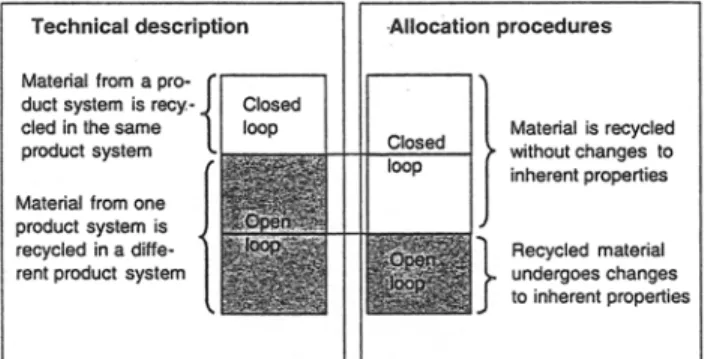
From a modeller's point of view, the above definitions lead to a rather misleading concept: for calculability reasons only, an open loop material flow is considered closed loop, al- though the material is actually leaving the system under study. This distinction between a technical description of a prod- uct system and the allocation procedures for recycling is also addressed in ISO 14041, Fig. 4:
Fig. 2: Distinction between a technical description of a product system and
allocation procedures for recycling as undertaken in ISO 14041, Chap. 6.4.3
From a methodological point of view, the closed loop situa- tion can be considered a special case of an open loop situation where the inherent material properties are not changed; or, as described in (ISO T R 14049, Chap. 8.3.2): if the import and export of secondary raw material (...) are equivalent.
Furthermore, it can be argued that, considering the closed loop situation as a special case of the open loop situation, the sec- ondary material exported from the system is replacing pri- mary material in a subsequent product system (and not in the system actually considered as assumed mathematically in the calculation of the closed loop procedure, see Fig. 2). In a closed loop situation (with equivalent imports and exports), the replacement is complete. In the open loop situation the material undergoes changes in its inherent properties (or de- valuation) within the product system. Therefore the replace- ment of primary material can only be partial. Environmen- tal burdens associated with this incomplete substitution due to the changed material properties - not only the virgin ma- terial production, but consequently also the final disposal
(see ISO 14041, Chap. 6.4.3) - should be allocated to the product system causing them.
Thus, using the value-corrected substitution approach, open loop recycling (in a technical sense) can be addressed in the same, consistent way, can be the inherent properties of a material - or its value - changed ('open loop recycling') or unchanged ('closed loop recycling').
Third, the determination of the value conservation factor is not necessarily based on prices, as it is done in the for- mula below:
[system A + B ] - & * [system B']
with: PSM PPM B' PSM with ~ = PPM
: value conservation factor : price of secondary material : price of primary material
: process or system to be substituted in the future given the fact that the price ratio 0~ is stable and that the prices PrM and PsM correlate highly over time
Of course, physical or chemical units can theoretically be used for the calculation of the value conservation factor c~. Still, prices are supposed to be the only parameter suitable and ap- plicable for the description of the value {or 'quality', or 'func- tionality') of a material over the whole material cascade. This is especially true for metals for which the performance and functionality is determined by a variety of alloy components. Independently of taking prices, or physical or chemical units, for the calculation of the value conservation factor, the set- ting of the system boundaries and thus the handling of the recycling processes are of crucial importance. It determines the processing stage of the material and therefore the physi- cal or chemical properties, as well as its prices used for allo- cation. As a rule of thumb, it can be said that the value conservation factor (x should be stable over time. Addition- ally, in the case of using prices for the determination of cq the time series of the two prices should correlate highly. Sys- tem boundary settings should be made accordingly to reach the highest possible over-all consistency.
References
WERNER, F. and RICHTER, K. (2000): Economic Allocation in LCA: A Case Study About Aluminium Window Frames. Int. J. LCA 5 (2) 79-83
EN ISO 14041 (1998): Environmental Management - Life Cycle Assessment - Goal and Scope Definition and Inventory Analysis (ISO/EN 14041:1998). European Committee for Standardiza- tion (CEN), Brussels
TR ISO 14'049 (2000): Environmental Management - Life Cycle Assessment - Examples of Application of ISO 14041 to Goal and Scope Definition and Inventory Analysis (ISO/TR 14049:2000). International Standard Organisation (ISO), Geneva
Frank Werner and Klaus Richter EMPA DQbendorf, Switzerland
![Fig. 1 shows the status of both the value-corrected substitu- tion and the economic allocation within the stepwise alloca- tion procedure for reuse and recycling according to (EN ISO ]4041, Chap](https://thumb-eu.123doks.com/thumbv2/123doknet/14847563.628109/1.918.470.821.669.992/corrected-substitu-economic-allocation-stepwise-procedure-recycling-according.webp)