AGUASAN
LEARNING FROM A REMARKABLE
COMMUNITY OF PRACTICE
This is the final report of the project “Learning from AGUASAN” funded by the Swiss Agency for Development and Cooperation (SDC)
For further information please contact: François Münger, Senior Water Advisor, SDC [email protected]
Manuel Flury, Head Thematic Service Knowledge and Research, SDC [email protected]
or one of the following members of AGUASAN:
Karl Wehrle, Sector Coordinator Water and Environmental Sanitation, Skat Foundation [email protected]
Franz Gähwiler, in charge working area Rural Infrastructure, Helvetas [email protected]
Christian Zurbrügg, Programm Officer Solid Waste Management, SANDEC [email protected]
Published by Swiss Agency for Development and Cooperation (SDC) Orders SDC Distribution Centre
Phone +41 (0)31 322 44 12 Fax +41 (0)31 324 13 48
www.deza.admin.ch (Services/Publications) [email protected]
Author Urs Karl Egger, Skat Foundation, [email protected] Layout Martin Läng, Skat Consulting
Print Niedermann Druck, St. Gallen
Edition 1000 copies
September 2004
Acknowledgements
This study would not have been possible without the support of many people. First of all I would like to thank Armon Hartmann, Manuel Flury and François Münger from SDC for supporting me to carry out this project and for their helpful contributions. I extend my thanks also to the AGUASAN group that critically assisted me in finding the right way. Valuable insights were given to me from all the interviewees, and I would like to thank them for spending their time for this project. Last but not least I would like to thank my colleagues from Skat – Karl Wehrle, Roger Schmid and Julian Jones. Working with them was for me an excellent example of how an organisation may successfully collect, validate and further develop its knowledge.
Preface
Dear Reader,
I am proud to introduce this brochure telling the story of AGUASAN. This informal group first started to meet more than 20 years ago. It brings together several Swiss public institutions and NGOs who are concerned with water supply and sanitation issues in developing countries, with SDC prominent amongst them. Throughout the lifespan of the group, the members of AGUASAN have met regularly and enthusiastically, four times each year. They meet to share experiences and information related to the sector, to discuss successes, problems and innovative solutions, and they participate actively in the search of practical recommendations. The relevance of the outputs, the stability of the membership and the regularity of the exchanges are in contrast with the group’s informa-lity. AGUASAN’s 20-year history is characterised by minimal formal regulation and activities have been based on the voluntary participation of members.
The AGUASAN story is not a story about a small and private Swiss water mafia. Time and time again, AGUASAN has managed to involve water specialists from all over the globe in its annual workshops; it has succeeded in making regular contributions at an international level towards developments in the field of water resources, particularly in the water and sanitation sub-sector.
Specific performance outcomes associated with AGUASAN are the result of strong connections between sector practitioners working with various organisations (NGOs, universities, SDC, and others). These strong relationships build a sense of trust and mutual obligation, based on a common language shared by all members.
It is the common interests and the culture of shared learning which have kept the AGUASAN group together for such a long time. The collaboration is defined more by knowledge than by task, and it persists because group members understand the value of active participation.
AGUASAN is not just a water network, nor is it simply a collection of relationships. AGUASAN has a definite identity as a community and has thus shaped the identity of its members. It exists because sharing in its well-defined domain leads to learning, which in turn fuels a common commitment to fight against poverty.
This brochure reviews 20 years of AGUASAN in an attempt to find out more about why such an informal set-up has been so successful for so long. The conclusions show that AGUASAN is an impressive “community of practice” - one which can serve as a good example for establishing similar groups in other sectors and fields of interest.
Swiss Agency for Development and Cooperation (SDC)
Dora Rapold
Assistant Director-General, Head of
Content
1 Introduction...6
1.1 Knowledge – A Prerequisite for Development 6
1.2 Communities of Practice – A Promising Way for Knowledge Sharing 6
1.3 AGUASAN – An Often-Cited Example 7
1.4 Objectives of the Project 7
1.5 Who was Behind this Project? 8
1.6 Methodology 8
2 The Beginnings of AGUASAN ...12
2.1 Stimulated by an External Request 12
2.2 First Meeting in September 1983 12
3 Domain...13
3.1 From 1983 to 2004 13
3.2 Domain with High Relevance for Members 15
4 Community ...16
4.1 The Core Group 16
4.2 Expansion of the Group 16
4.3 No Regular Participation of the Private Sector 17
4.4 Integration Procedure 18
4.5 AGUASAN’s External Links 18
4.6 A Considerable Degree of Independence 18
4.7 Balancing the Interests 19
4.8 A Community with Spirit 19
5 Practice...21
5.1 AGUASAN Meetings 21
5.2 AGUASAN Workshops 22
6 Outcome and Impact ...24
6.1 A Golden Opportunity for Knowledge Sharing 24
6.2 A Sounding Board and Multiplier for SDC 24
6.3 With International Impact 24
6.4 A Community for Sharing not for Producing 25
7 Conclusions ...26 7.1 Key Factors for the Longstanding Success of AGUASAN 26
7.2 Thoughts for Further Reflection 27
8 Appendix ...29
8.1 Abbreviations 29
8.2 Questionnaire 30
8.3 Interviewees 32
1 Introduction
1.1 Knowledge – A Prerequisite for Development
Information and knowledge are basic prerequisites for the evolution of developing
countries in the East and South. Information and knowledge are also important for efficient and effective development cooperation aiming at poverty alleviation. In the SDC strategy 2010 information and knowledge are mentioned as basic elements. Guiding lines are the assessment of experiences together with partner organizations, and the implementation of gained insights in common learning processes.
It has been discussed in business administration for some time now how efficiency and innovation can be increased, and risks reduced, by a better handling of information and knowledge. Meanwhile, many large companies have started initiatives in this respect. Also in development cooperation, a number of organisations have started to explore the
potentials of improved knowledge sharing.
1.2 Communities of Practice – A Promising Way for Knowledge Sharing
These initiatives have already undergone many phases. Initially, the new information and communication technologies were in the focus of many strategies. In the last few years, attention has been paid increasingly to soft factors like culture or trust, and to personal networks. Communities of practice (CoP) are considered as a particularly successful way of common learning. Wenger/Dermott/Snyder (2002) define CoPs as follows:
„Communities of practice are groups of people who share a concern,
a set of problems, or a passion about a topic, and who deepen their knowledge and expertise in this area by interacting in an ongoing basis”.
Nowadays, communities of practice are a widespread form of knowledge sharing and learning in development cooperation. There is one important distinction that has to be made: There are communities of practice within organisations and across organisations (see Figure 1).
Figure 1: CoP within and across various types of organisations
Despite the many similarities of these two types of communities of practice, there are also important differences that have to be considered like competition, or different
1.3 AGUASAN – An Often-Cited Example
A look back at Swiss development cooperation reveals that many groups for knowledge and experience exchange that could be called communities of practice have existed for quite some time. One of them, often mentioned as an excellent example, is AGUASAN, the community of practice for water supply and sanitation.
AGUASAN is a community of practice across Swiss organisations borne by a core group of committed practitioners and researchers working in the field of water supply and sanitation. The community emerged in 1984 from informal meetings of IRCWD (SANDEC), SDC, Helvetas and SKAT. Since then AGUASAN pursues mainly two activities: meetings and workshops.
AGUASAN Meetings AGUASAN Workshops
Four one-day meetings a year In Bern, at SDC
Professionals of Swiss
organisations involved in water supply and sanitation in developing countries 10 to 15 participants Exchanging and knowledge
sharing
One week in June every year In Gersau, at Lake of Lucerne International workshop for
project field staff, desk officers, researchers, experts and consultants
25 to 35 participants In-depth reflection and
exchange on an actual topic of water supply and sanitation
Figure 2: AGUASAN meetings and workshops
AGUASAN is nowadays in a transition phase. In the next years some members of the core group will quit AGUASAN due to retirement. This is also one of the reasons why the AGUASAN community expressed its wish to look back and to develop new perspectives.
1.4 Objectives of the Project
Since its establishment AGUASAN has accumulated two types of knowledge: Knowledge of water supply and environmental sanitation;
Knowledge of how a community of practice works and how it should be organised. The project “Learning from AGUASAN” focused on the second type of knowledge and strived to identify the success factors of AGUASAN as a community of practice, and what can be learned from this experience for other communities of practice.
The project focused mainly on the AGUASAN meetings and not on the annual workshops. However, as there are close connections between the two activities, the project will also refer to the workshops.
The main objectives of the project were:
To collect knowledge and experiences of AGUASAN members; To secure their knowledge for the future;
To learn from AGUASAN by making the knowledge of AGUASAN members
available to other people and communities of practice, and to use it for training and coaching;
To give interested people an idea of what a community of practice is;
To motivate potentially interested people to participate in or to establish new communities of practice.
1.5 Who was Behind this Project?
The project was funded by the Division for Social Development (SoDev) of the Thematic and Technical Resources Department of the Swiss Agency for Development and
Cooperation (SDC). Advisors to the project were François Münger, Senior Water Advisor (SoDev), and Manuel Flury, Knowledge Advisor of the Thematic Service Knowledge and Research.
1.6 Methodology
1.6.1 Theoretical Framework
Theoretical background for the project was the book “Cultivating Communities of Practice” by Wenger/Dermott/Snyder (2002). Based on their ideas the following framework shaped the setting for the project:
Domain Community Practice
Area of shared inquiry or issues and topics • Members • Relationships • Roles • Motivation • Group climate • Communication • Methods • Stories • Tools • Documents • Cases Current Situation Output Outcome Impact Initiation Development over time AGUASAN
Process over time
Context
According to Wenger/Mc Dermott/Snyder1 a community of practice is combination of three structural elements:
The domain of knowledge, which defines the area of shared inquiry the set of issues discussed in the community;
The community, the members of a community, the social fabric, their motivation, and interactions;
The practice, the set of frameworks, ideas, tools, information, styles, language, stories and documents that the community members share.
The community is subject to a process and changes itself as time goes by. The community is initiated and develops over time to the current shape.
The community is also embedded in a political, environmental, social and economical context that is ever evolving. There is a mutual interaction between the community and its surrounding context.
Finally, every community of practice has some kind of output, outcome and impact. These three terms are defined as follows2:
Outcome: Results of a programme or project relative to its objectives that are generated by its respective partners’ outputs.
Output: The tangible products (goods, services) of a programme or project. Impact: Positive and negative, primary and secondary long-term changes or
effects produced by a programme or project, directly or indirectly, intended or unintended.
The project did not systematically assess the output, outcome and impact of AGUASAN, as the project focused on how AGUASAN was working as a community of practice. Nevertheless, section 6 will give a general assessment of these issues.
1.6.2 Procedure
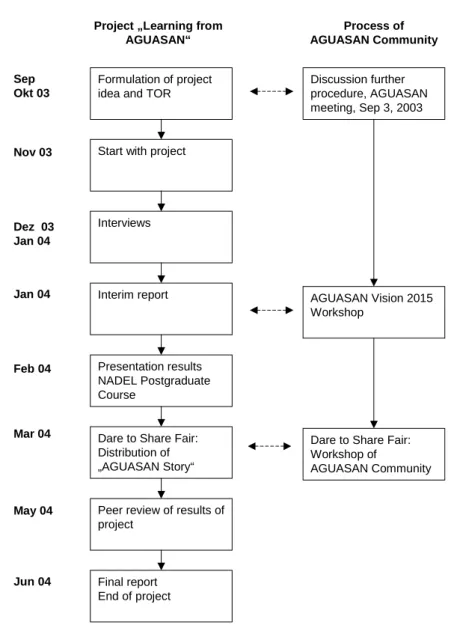
Two different processes gave the project its structure: The process of the project
“Learning from AGUASAN” itself, and secondly, the AGUASAN community expressed its wish to enter into a group process to look back and to develop new perspectives for AGUASAN’s future. The two processes interact (See Figure 4).
The process of the project “Learning from AGUASAN” followed a classical assessment approach:
Analysis of document and reports
Development of methodological framework
13 interviews with current and former AGUASAN members. The criteria for the selection of the interviewees were: Participation in at least five AGUASAN meetings; one former and one current member of the founding organisations are interviewed.
1 Wenger, Etienne; McDermott, Richard; Snyder, William M.: Cultivating Communities of Practice – A Guide to Managing Knowledge. Boston, Massachusetts: Harvard Business School Press, 2002.
2 SDC: 27 most relevant terms related to evaluation and controlling in use in SDC – English glossary, February 2002.
To gain further insights and to validate the interim results the project was presented and discussed at various meetings:
AGUASAN Vision 2015 Workshop, Zurich, January 12, 2004
NADEL postgraduate course on “Knowledge Management and Knowledge Processes in Development Cooperation”, Zurich, February 4, 2004
Dare to Share Fair, SDC, Bern, March 31, 20043
Peer Review Meeting, SDC, Bern, May 6, 20044
The results of the project are documented in two publications5:
AGUASAN Story: A short publication describing AGUASAN, the history and how it works. Target group is a wide audience of practitioners who would like to know what AGUASAN is or who would like to get some ideas for their own community of practice.
Final Report: The final report describes the project “Learning from AGUASAN” in more detail. Target group are practitioners, knowledge management specialists and researchers who are interested in knowledge management and communities of practice.
3 Roger Schmid produced a poster for the Dare to Share Fair. A copy of this poster can be found in the back cover of this report.
4 For the results see 9.3 of the appendix
5 For orders of the AGUASAN Story please send an e-mail to [email protected]. For orders of the Final Report contact SDC Distribution Centre, Phone +41 (0)31 322 44 12, Fax +41 (0)31 324 13 48, e-mail: [email protected]. Both publications are also available for download on
Project „Learning from AGUASAN“
Process of AGUASAN Community
Formulation of project idea and TOR
Start with project
Interviews Final report End of project Discussion further procedure, AGUASAN meeting, Sep 3, 2003 AGUASAN Vision 2015 Workshop Interim report Jan 04 Nov 03 Sep Okt 03 Dez 03 Jan 04
Dare to Share Fair: Distribution of „AGUASAN Story“ Mar 04 Presentation results NADEL Postgraduate Course Feb 04
Dare to Share Fair: Workshop of
AGUASAN Community
Peer review of results of project
May 04
Jun 04
2
The Beginnings of AGUASAN
AGUASAN has already a quite long history and may be one of the oldest communities of practice in development cooperation.
2.1 Stimulated by an External Request
AGUASAN dates back to the beginning of the 1980s when a UNDP funded “Global Project on Low Cost Water Supply and Sanitation” was started. The World Bank was given the responsibility for the coordination of this project and a multidisciplinary team was created - the „Technical Advisory Group” (TAG). During the course of this project, the TAG wanted to produce a slide show on adapted technologies and the members were interested to learn more about what was going on in Switzerland.
As the coordinator of the TAG already had contacts, he got in touch with IWRCD (now SANDEC), the Department for Water and Sanitation in Developing Countries at the Swiss Federal Institute for Environmental Science and Technology (EAWAG). IWRCD and the TAG planned to hold a meeting and the representative of IRCWD invited also four other colleagues he knew through his work: one colleague from DEH (now SDC, the Swiss Agency for Development and Cooperation), one from the Swiss NGO Helvetas (Swiss Association for International Cooperation), one from EPFL (Swiss Federal Institute of Technology in Lausanne) and one from SKAT (The Swiss Centre for Appropriate Technology – now Skat Foundation).
2.2 First Meeting in September 1983
On May 3, 1983 two representatives of the TAG met with this small group of Swiss experts working on water supply and sanitation issues. The meeting was lively and
interesting. They shared their views and ideas and during the meeting it was felt by all that the group should meet more regularly. They decided to get back together for a second time, and in this way the first AGUASAN meeting took place on September 29, 1983 in the offices of IWRCD in Dübendorf - a village in the suburbs of Zurich. This was the start for a community that has continued to meet four times each year for one day for knowledge sharing – right up to the present date. Initially, they called themselves the “Water Supply and Sanitation” group, but they changed the name in January 1985 to “AGUASAN – Swiss Committee for Water Supply and Sanitation in Developing Countries”.
3 Domain
The focus of AGUASAN is and always has been on drinking water supply and sanitation. This does not mean, however, that the group neglected peripheral or crosscutting issues related to this focus. AGUASAN was open and members adjusted their areas of interest again and again in response to new developments.
3.1 From 1983 to 2004
Over the last 20 years, the development context – and corresponding approaches – has changed considerably. This constantly changing environment has influenced the evolution of AGUASAN. In 1980, the United Nations declared the first international water decade (1980 – 1990) and numerical targets for “water for all” were formulated. To achieve those objectives, new and adapted technologies were needed; this was the starting point for AGUASAN. In the mid-eighties, the issue of maintenance for the new (and already failing) infrastructure became more important.
Figure 5: The 80’s of AGUASAN
At the beginning of the 1990s, the social sides of water supply and sanitation rose to prominence under the banners of community development and gender. Around 1995, the concept of “integrated water resources management” (IWRM) started to emerge.
Regarding IWRM, AGUASAN was not sure how it could take up this much broader issue without losing its identity altogether. Finally, the group decided to maintain its focus on water supply and sanitation issues but to remain in tune with broader influences (such as IWRM) to preserve the relevance of AGUASAN. In 1997, IWRM was chosen as the topic for the annual AGUASAN workshop “Less Water for more People”.
Figure 6: The 90’s of AGUASAN
Since 2000 the device has been “from declaration to implementation”. Various ways are discussed and also explored how water supply and sanitation in developing countries could be improved. High on the agenda are governance issues like decentralisation, public-private partnerships, public investments and full-cost pricing. Due to decaying infrastructure, the long-term sustainability and maintenance of existing infrastructure becomes again an important issue. Besides the still existing gaps in water supply
environmental sanitation gets more attention and integrated approaches that are centred on the household level get en vogue.
Figure 7: 2000 onwards
3.2 Domain with High Relevance for Members
Right from the beginning, there was a deliberate distribution of thematic interests between the members. At the first AGUASAN meeting, it was decided that EPFL would be
responsible for all literature and information on sanitation issues in French language, and IRCWD would carry the same responsibility for resources in German. Skat was
designated as being responsible for literature and information on the thematic issue of water supply. Later, STI was considered as the resource centre for health issues and CDE became the group’s champion for water resources in general.
There have been several discussions about whether AGUASAN should widen its focus to include broader issues related to the central theme. Each time, the outcome was the same – the group remained convinced that “a cobbler should stick to his last” and decided to keep its focus. By keeping this focus, the content of meetings always had a high
relevance for all participants, helping them in their work and motivating them to participate further. If occasions arose where a topic from beyond the central theme needed to be discussed, specialised external contributions were invited.
4 Community
4.1 The Core Group
AGUASAN is a community of individuals and not of organisations. Although AGUASAN clearly identifies their members with the organisations they are working for they were not seen as official representatives. In the first few years, the membership of AGUASAN consisted mainly of the representatives of SDC, Helvetas, SKAT and SANDEC who had also founded the community. With the exception of the representative of EPFL, these founding members still form the core of the group. They have remained strongly committed to AGUASAN and have put heart and soul into ensuring uninterrupted exchange as the group matured and evolved.
4.2 Expansion of the Group
Over time, AGUASAN gradually enlarged its membership along the lines of its thematic interests, becoming a larger and more interdisciplinary group. In 1989, a researcher from the ETHZ – the Swiss Federal Institute of Technology in Zurich joined the group. In August 1990 the group expressed the wish to integrate and to welcome women as permanent participants but it was quite difficult to find women in Switzerland who are professionally involved in the field of water supply and sanitation. Finally, in 1991 the first woman – a social scientist from the University of Zurich - became a member of
AGUASAN. Several other women were contacted by AGUASAN but the success rate was low. Some joined the group for a while but most of them left the group again for various
reasons that are not related to the AGUASAN.
SKAT
SANDEC
NADEL
Visitors Working Groups International ConferencesAGUASAN started as a group of engineers and with the integration of the social scientist of the University of Zurich the group started to open up to other professions. This was also the background for another expansion in the mid-nineties. The group wanted to discuss water and sanitation issues in a wider context and asked the Swiss Tropical Institute (STI), the World Health Organisation (WHO) and the Centre for Development and Environment (CDE) at the University of Bern to join the group. In 2001, also a
representative from NADEL – the Postgraduate Course on Developing Countries at the Swiss Federal Institute of Technology - joined the group.
The organisations represented in AGUASAN have not always been represented by the same person. Because of changes in the organisation, job rotation or other reasons the representatives of some organisations changed from time to time. This, however, happened more or less without major frictions and AGUASAN integrated those new members quickly.
4.3 No Regular Participation of the Private Sector
AGUASAN is a very informal group but one point had to be regulated by a written paper – the criteria for membership. This shows how sensitive communities of practice can be with membership matters – and in particular communities across organisations.
According to an internal paper the membership criteria are as follows:
“AGUASAN is an informal group of specialists working in the water and sanitation sector. Any person or organisation wanting to become a member has to be proposed by at least one actual member and has to be accepted by all members of AGUASAN.
In order to be eligible, the following criteria have to be fulfilled:
Broad and practical experience in the water, sanitation and waste disposal
sector in the third world countries (including Eastern Europe)
Field of activity predominantly related to development countries /
development issues
Practical experience in at least two continents
Good methodological and professional knowledge related to development
and cooperation issues
The member pledges to participate regularly at the AGUASAN meetings over
an extended time period. If participation is ensured by alternate members of an institution, then they are responsible for bringing each other up-to-date to ensure continuity
Members are sponsored and supported by the respective institutions”
From the beginning, it was clear to the group that private consultants or companies should not be regular members of AGUASAN. The group was afraid that such members would mainly lurk for mandates of SDC and that competition within the group could be created – something that could hamper open discussions and knowledge sharing. However, it was considered as “too problematic” to write down the exclusion of the private sector in the membership criteria that are cited above. Nevertheless, it was not the intention to exclude the private sector completely from AGUASAN and the group has maintained a regular exchange through invited guests.
4.4 Integration
Procedure
The procedure to take up new members in the group is also written down in the internal paper (see above). Everybody has the possibility to suggest to the group new members. These proposals are discussed in the group and if everybody agrees the new member is taken up.
AGUASAN is born by the members of the core group and some of them are still founding members. As some of them will retire in the next years the group has started to integrate new and younger members in the group. This integration has to be seen as a process where the new members learn as “apprentices” from the established members the “unwritten” rules of the group and become gradually familiar how the group works.
AGUASAN, however, has always been very careful not to enlarge the group too much, as everybody has been afraid that the informal character of the group would get lost if the there were too many members. AGUASAN started off with an informal character and a small size to ensure that all members would have enough time for discussion during a one-day, face-to-face meeting. The 2004 incarnation of AGUASAN with 15 to 20 members – there is no sharp demarcation of membership – has reached now a critical size for this type of interaction; for the group to become any larger and still serve its members well, new modes for knowledge sharing would be necessary.
4.5 AGUASAN’s External Links
The circle of professionals within AGUASAN seems to be quite closed at first glance and AGUASAN has even been referred to as the “water mafia” – although usually with tongue firmly in cheek. In fact, the group has always sought external exchange with others. Firstly, there is an outer circle of participants that attend meetings only irregularly.
Secondly, from the beginning AGUASAN has invited guests for presentations and topical discussion at almost every meeting. The range of guests is rich in diversity. It includes representatives of international organisations and institutes, members of pensioners voluntary associations working for development cooperation, and ‘less conventional’ people – including a water diviner and a rainmaker.
Through its members, AGUASAN is also well connected to developments going on in international alliances such as the Global Water Partnership. Since its first contacts with the TAG in 1983, AGUASAN has kept close contacts with the Water and Sanitation Programme (WSP) of the World Bank. Moreover, AGUASAN members were actively involved in establishing the Water and Sanitation Collaborative Council (WSSCC) in 1990, and AGUASAN decided which of their members would participate in which thematic working group. The participants of the WSSCC working groups reported back regularly at AGUASAN meetings to ensure that the entire group was informed about what was
happening inside each of the Council’s focus areas.
4.6 A Considerable Degree of Independence
Although (or perhaps because) AGUASAN is interconnected to many organisations, the group has been able to keep a considerable degree of independence. No community is fully independent; there are always external influences at play. But the organisations making up AGUASAN more or less took their hands off and gave their representatives free rein to exercise their creativity. This independence made it possible to build up an atmosphere of trust – the basic condition for true knowledge sharing. It gave the members
the freedom to look left and right and to explore ideas without restrictions. The
independent reflection that takes place within AGUASAN is also possible because the group’s constituents are financially supported – some with programme or core funding from SDC – in such a way that they can dedicate time to the community without having to show a direct impact resulting from their participation. This also means that the group’s members were not forced to compete with each other for mandates from SDC.
4.7 Balancing the Interests
AGUASAN is quite a heterogeneous community of practitioners and researchers with different professional backgrounds and from different organisations or institutions, e.g. SDC – a public administration, SANDEC – a research institution, Helvetas – an NGO, or SKAT – a resource centre for development cooperation. None the less, the AGUASAN community has managed to balance the varying interests of its members quite well. In particular one member of AGUASAN is and always has been in a different position, even if not all the community members explicitly perceive this in this way: the Swiss Agency for Development and Cooperation (SDC) is by far the most powerful organisation of Swiss development cooperation represented in AGUASAN in terms of political power and financial resources. Most organisations represented in AGUASAN get considerable core funding or have mandates from SDC. They stress however, that they never got a mandate form SDC because they were a member of AGUASAN. Yet it cannot be denied that by participating in AGUASAN meetings the community members knew the
representatives of SDC, its work and its strategy very well. As the members of AGUASAN have got their funding through different channels up to now, they are not in direct
competition to each other. Even when SDC started to organise tenders in the late 90s this didn’t influence the work of AGUASAN. On the other hand it can be said that the
representatives of SDC in the AGUASAN community handled their power in a responsible way. They even – unconsciously – overcompensated their potential power by stepping back a bit in the group and acting in a diplomatic way.
SKAT is also a special case in the AGUASAN community. Most members of AGUASAN have a bigger organisation in the background with enough core funding to support the participation in AGUASAN meetings. SKAT has a backstopping mandate from SDC for water supply and sanitation and funds its participation in the AGUASAN meetings and the work for the community like writing of minutes or preparation of meetings from the
resources of this mandate. On the other hand SKAT has also a higher responsibility for the group, provides the AGUASAN workshop reports and other resources on its website, and steps in if necessary.
4.8 A Community with Spirit
What holds AGUASAN together? First of all, it’s the passion that the professionals who make up the group share – in particular those of the core group - for their work and for the theme of water supply and sanitation in developing countries. A strong, intrinsic motivation can be felt while talking with the members of AGUASAN. They love to share their ideas with other professionals and they appreciate the high quality of discussions during the AGUASAN meetings. Moreover, the AGUASAN meetings always are an excellent opportunity to discuss other issues during lunchtime or on the train trip to the meeting or back home.
But the relevance of the content is not the only reason why this community is thriving. AGUASAN also has cultivated a unique community spirit that holds the group together. The members are always looking forward to meeting their colleagues; some consider each other as friends. This community spirit was also supported by the common lunches on the occasion of the AGUASAN meetings or special social events during the AGUASAN workshops.
In AGUASAN - like every community of practice - individuals with different backgrounds and interest come together. There are always hierarchies in communities, but the
hierarchy among the members in AGUASAN is very flat - in fact it is more a distribution of functions and roles. Some members are more active than others; there are members that are often quite expressive; others may be more introspective. It is important for the group spirit that nobody goes to the meetings just to gain without giving something back to the group - there is a win-win-situation for everybody. Everybody feels that he or she benefit from the AGUASAN meetings.
Finally, it has to be mentioned that that group cultivated from the beginning a positive attitude towards critical discussion. The interdisciplinarity of the group also led to many critical reflections and kept the discussions lively. Many of the exchanges during AGUASAN meetings have been quite controversial but none have ever set off
irreconcilable conflicts. In the history of AGUASAN there are a few issues that led to hard discussions but the group always found ways – like for example separate meetings – to settle these disputes.
5 Practice
5.1 AGUASAN
Meetings
One of the core activities of the AGUASAN community are the AGUASAN meetings during one day four times a year in the premises of SDC6. These meetings are the opportunity for sharing knowledge among the community members during the year.
5.1.1 Always a Full Agenda
The agenda is always full and issues to be discussed are never lacking. Even on the rare occasions when there are only a few agenda points, time gets very short. There are some agenda points that come up more or less systematically at meetings. One such recurrent theme is “mission reports”. Around the 10th AGUASAN meeting the group decided that sharing the outcome of assignments would help to stay focused and relevant - by keeping in close contact with what’s really going on in developing countries. Based on the personal involvement of several AGUASAN members in certain developing countries, a close follow-up of development issues was possible. This was particularly true for Lesotho, where several AGUASAN members were involved in various water supply projects as they were subjected to the successive influences of decentralisation, the adoption of the sector wide-approach (SWAP) and privatisation. Those developments were closely monitored and regularly discussed at the meetings.
Another regular item on the agenda: researchers are invited to present the latest results of their endeavours. Other returning agenda points include the annual AGUASAN
workshops, the policy of SDC in the water sector, and a variety of long-running topics like the development of SODIS (a household water disinfection system using just sunlight and PET bottles). Certain topics and countries have regularly commanded more of the group’s attention, mainly because of the preoccupations of its members. The recurrence of these priorities underlines the way AGUASAN works – it is a true community that is led by the interests of its constituents and it supports them in doing their work better.
5.1.2 A Few Clear Rules
AGUASAN was always quite an informal group and many members think that this is one of the reasons for its continued success. The members share a common passion for a range of thematic issues and not for administrative procedures. Nevertheless, the group has a few unwritten rules to guide it. Right from the outset, the group members decided that they would meet every four months (later changed to every three months) for one day. And this rule was really taken seriously: so far, AGUASAN meetings have always taken place according to plan - with just one exception - since the group was established in 1983.
6
Until the beginning of the nineties the meetings were organised in rota once in the premises of SDC in Bern, once in the offices of Helvetas in Zurich. Later all meetings took place in Bern, because SDC was considered as more centrally located in particular for participants from the western part of Switzerland.
The responsibility for setting the agenda, chairing each meeting, and taking the minutes rotates among the members. The member who takes the minutes at one meeting is responsible for collecting the agenda points for the next meeting and will then chair it, selecting a new volunteer for recording the minutes. The group shares these
administrative responsibilities evenly. Although these rules are informal, the members are well aware of them and work together in a disciplined way. Up to now, the minutes for every meeting have been compiled.
The members of AGUASAN expect from each other an active participation in the
meetings. If somebody wants to be a member of AGUASAN, he or she has to make a firm commitment from the outset to give as well as to take. The members of the core group have participated at almost every meeting – over a twenty-year period! Many of them are very busy professionals, but the dates of the AGUASAN meetings are sacred in their agendas. They participate because AGUASAN is an important source of knowledge, a community for knowledge sharing, and a stable institution in fast changing times. For all other members participation in the AGUASAN meetings is a part of their job and therefore funded by the organisation they are working for. This means that the
organisation has to be ready to provide the time that the member can attend the
AGUASAN meetings. So far all organisations have been in the financial situation to fund the participation of their representatives in the AGUASAN meetings. Most of them have core funding from SDC or other institutions, or large research programmes from which the time and money can be taken. One exception in this regard is SKAT who has a
backstopping mandate from SDC for water and sanitation and can fund its participation from the resources of this mandate.
5.2 AGUASAN
Workshops
Something would be missing in the AGUASAN picture if the annual workshops did not get a mention. These famous, 5-day workshops take place each year in Rotschuo, an ideal retreat at the borders of the lake Lucerne in Switzerland. Already at the second
AGUASAN meeting in January 1984, SKAT proposed that the group should organise annual workshops on water supply and sanitation issues in developing countries. The idea was to have a forum for in-depth exchange, reflection and learning, bringing together project field staff, desk officers, researchers, experts and consultants. These workshops would also be an opportunity for the community to open up by inviting participants from developing countries.
The first workshop took place in July 1984. Ironically, it had to be abandoned after 3 days due to exceptionally heavy rain, causing flooding and threatening severe landslides into the lake. Clearly, the sorcerer’s apprentices had much to learn before they would master their subject! That’s also why the group started to number the workshops only in 1985. However, following on from this rather jerky start, 5-day AGUASAN workshops have taken place in June each year, right up to the present date.
The workshops are always organised by representatives of the core group of AGUASAN: SDC, SKAT, Helvetas and SANDEC. SKAT always takes the lead and gets a mandate from SDC to organise the workshop. Each year, this group teams up with an external facilitator to choose a “hot” topic for the workshop and to carefully prepare and structure the event. For this careful preparation process always several meetings during the period
between one workshop and the next are held. The results of every workshop have been summarised in a comprehensive workshop report7.
In general, about 25 to 35 participants attend the workshop. Participants have to apply for the participation in the workshop and are carefully selected, as there are often too many applications. The organisers have always wanted to keep the number of participants small as this allows an intensive exchange and learning process.
AGUASAN workshops have always been funded by SDC. Yet, this financial support has been disputed several times, as the costs were considered as too high. In general it can be said, however, that the workshops justify the costs although a systematic assessment hasn’t been made up to now: so far the organising committee always has come up with an actual issue and the workshops were an intensive learning event for the participants. Moreover, with this longstanding financial support, SDC is not just supporting the workshops; it is also contributing to the AGUASAN community as a whole.
Over the years, the workshops have become the yearly “moment fort” for the community. The workshops are an excellent occasion for AGUASAN to explore new issues and trends by listening to contributions and by discussing case studies through group work. The workshops produced several times innovative ideas and thematic inputs that considerably influenced the work of AGUASAN, its constituents and its partners. Last but not least, the workshops refresh the spirit and cohesion of the community, and AGUASAN is revitalised for further work.
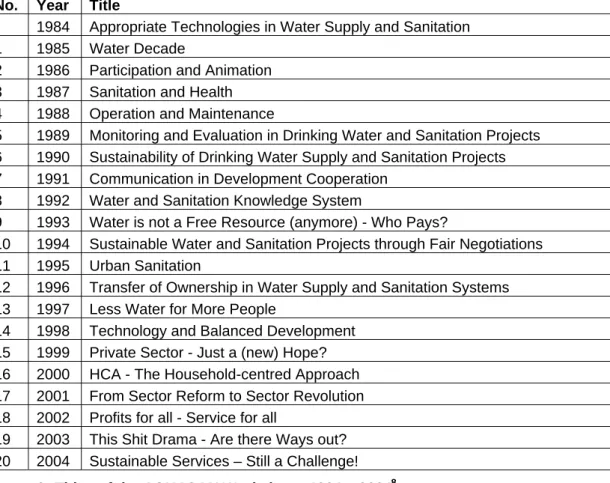
No. Year Title
1984 Appropriate Technologies in Water Supply and Sanitation 1 1985 Water Decade
2 1986 Participation and Animation 3 1987 Sanitation and Health 4 1988 Operation and Maintenance
5 1989 Monitoring and Evaluation in Drinking Water and Sanitation Projects 6 1990 Sustainability of Drinking Water Supply and Sanitation Projects 7 1991 Communication in Development Cooperation
8 1992 Water and Sanitation Knowledge System
9 1993 Water is not a Free Resource (anymore) - Who Pays?
10 1994 Sustainable Water and Sanitation Projects through Fair Negotiations 11 1995 Urban Sanitation
12 1996 Transfer of Ownership in Water Supply and Sanitation Systems 13 1997 Less Water for More People
14 1998 Technology and Balanced Development 15 1999 Private Sector - Just a (new) Hope? 16 2000 HCA - The Household-centred Approach 17 2001 From Sector Reform to Sector Revolution 18 2002 Profits for all - Service for all
19 2003 This Shit Drama - Are there Ways out? 20 2004 Sustainable Services – Still a Challenge!
Figure 9: Titles of the AGUASAN Workshops 1984 – 20048
7 Reports are available from the Skat Foundation. Please send an e-mail to [email protected]. Some reports can also be downloaded from the website: www.skat-foundation.org/publications
8
6
Outcome and Impact
What has AGUASAN achieved over twenty years? Was it really worth all the time that the AGUASAN members spent at those meetings?
6.1 A Golden Opportunity for Knowledge Sharing
The first simple answer is if AGUASAN had generated no benefit for its members, they wouldn’t have continued to participate. For them, the participation represented a golden opportunity to access valuable information first-hand, to learn from practical experiences at first hand, a sounding board with which to explore new ideas, an excellent networking opportunity by meeting with working colleagues on a regular basis, and a door to other organisations and networks. In addition, this good network made it possible to get a very quick response if necessary.
6.2 A Sounding Board and Multiplier for SDC
Benefits from AGUASAN radiate well beyond the immediate circles of the group
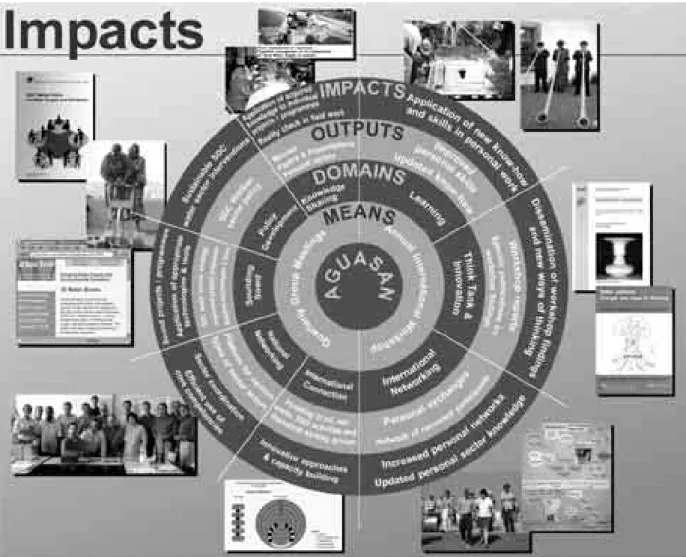
members, stretching into the water and sanitation sector as a whole. For SDC, AGUASAN represents an excellent opportunity to solicit informal feedback from a comprehensive selection of skilled practitioners and researchers on a range of new ideas. Since SDC is an active bilateral donor in the international arena of development - with a particular interest in water supply and sanitation issues and only limited internal capacity – AGUASAN’s influence is potentially far reaching. The community has also acted as a multiplier, making it possible for SDC to enhance its impact in the water and sanitation sector with only very limited internal capacity. In addition, the group supported SDC with the coordination in the sector9. AGUASAN’s ongoing partnership with SDC is embodied in SDC’s water sector policy, as the group made considerable contributions to the drafting of this important document.
6.3 With International Impact
The impact of AGUASAN was not limited to its partnership with SDC. AGUASAN had via a group member from SANDEC and SDC always a strong link to international bodies like the World Bank and the Water and Sanitation Collaborative Council (WSSCC). Moreover, by actively participating in international workshops and working groups like in those of the WSSCC the members of AGUASAN were able to share the AGUASAN way of thinking with the water and sanitation community as a whole.
As there was a very intensive knowledge exchange during the AGUASAN meetings and the AGUASAN workshops, most group members knew quite well what is going on and also what the position of SDC is. The knowledge sharing in the group was so effective that SDC even could send members of the AGUASAN group as de facto representatives of SDC to international meetings or conferences.
9
AGUASAN was even mentioned once in the answer to an “Interpellation” by National Councillor Ruth Gonseth (submitted on the 5th May 2001; answered on the 5th October 2001). In reference to an
“International Water Convention” she wanted to know whether the federal administration is willing to work with NGOs. The answer states that there is no group coordinating all water activities of the federal administration. NGOs, however, are represented in the AGUASAN group of SDC and they also had the opportunity to participate in international conferences.
Figure 10: Impact of AGUASAN
6.4 A Community for Sharing not for Producing
What may be surprising is that AGUASAN never produced any publications in its behalf other than the minutes of meetings. The group does not operate a website or an online discussion platform. This apparent lack of identifiable output perfectly reflects the
understanding of AGUASAN: it is a face-to-face community for learning and sharing, and not a tool for producing something. It is the individual members of AGUASAN who then produce something or offer their enhanced services. AGUASAN provides an excellent network that helps to get information very quickly; it is a forum for sharing what is produced, and a think tank to develop new ideas.
7 Conclusions
The story of the AGUASAN community of practice is really extraordinary. For over twenty years, the members of this community have continued to meet with outstanding regularity. At a time when everything becomes faster and where reliability and continuity seem to fade away, AGUASAN has acted like an anchor - a stable pillar in the rough sea of development cooperation. The community avoided obsolescence and it did not get
bogged down in ideological positions. New and younger members replaced those who left the group or retired. The community still is thriving and very lively. The “Vision 2015 Workshop” in February 2004 was an impressive demonstration that the community would like to continue its work. Many ideas were developed and first decisions for the next steps forward were taken.
7.1 Key Factors for the Longstanding Success of AGUASAN
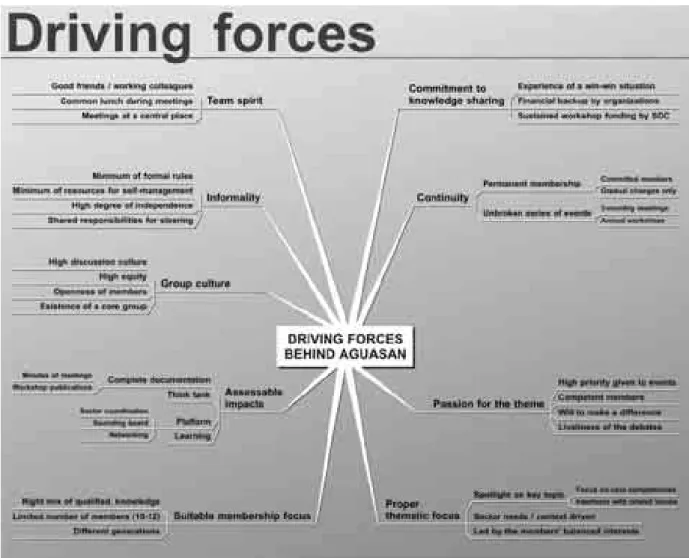
What are the reasons for this exceptional track record? What is the secret behind this community? As with many lively and complex organisms – and a community of practice is comparable with a complex organism in many ways – it is quite hard to tell, even with the benefit of hindsight. Is it only by fortunate coincidence, or did the members just have a lucky hand? There is no simple answer. As Figure 11 shows, various driving forces made AGUASAN a longstanding success.
A few of those driving forces have been of major importance10:
First of all, AGUASAN always was born by a core group of committed members who have a passion for their work, and who have a sense of duty for AGUASAN. Without such a commitment every community of practice would fail.
The example of AGUASAN shows that informal groups without statutes, legal and organisational structures, and other formalities can be sustainable in the long run as long as the personal relationships work well. For AGUASAN this informality was even one of the success factors.
AGUASAN has a clear thematic focus: water and sanitation. By keeping this focus AGUASAN has remained relevant for the group members.
AGUASAN is a group of working colleagues with a good community spirit and an open discussion culture. This made it possible to address also critical issues. One of the success factors of AGUASAN is its independency. Although various
organisations would have been in the situation to influence AGUASAN this did not happen. AGUASAN has developed in this way a “safe space” where everybody can present ideas and critical issues without being afraid to be sacked.
All organisations that are represented in AGUASAN are in such a financial
situation – most of them funded through different channels from SDC – that allows their representatives in AGUASAN to devote at least four days a year to the community. The interviews confirmed that it would not be possible for
representatives of fully private consultancies or freelance consultants to spend that much time for knowledge sharing.
Decisive for the longstanding success of AGUASAN is also the continuing and reliable participation of SDC at meetings – notably the most important player in Swiss development cooperation, and the longstanding financial support of the workshops.
The key factors mentioned above are first of all valid for AGUASAN. Every community of practice is unique and there is no blueprint that fits all CoPs. Nevertheless, many of the points mentioned above will also have to be considered by other communities of practice.
7.2 Thoughts for Further Reflection
During the project a multitude of questions were raised about knowledge management and its costs and benefits, the role of SDC and its partners, or the usefulness of communities of practice.
The example of AGUASAN shows that communities of practice can make a considerable contribution to knowledge sharing in a specific thematic or technical area. AGUASAN played an important role to develop a common understanding of water and sanitation in Swiss development cooperation. The group also contributed to a better coordination in the sector as well as with international organisations. Although the project made no
systematic analysis of the impact it can be said that AGUASAN has led to more effective and efficient activities in the water and sanitation sector of development cooperation. On the other side, it has to be stated that this increase in effectiveness and efficiency could only be achieved with a considerable input of time and funding. Knowledge sharing is not cost free.
10
Another critical point concerns the knowledge sharing strategy of SDC. There is no doubt that knowledge sharing between SDC and its partners and among them is of major importance for efficient and effective development cooperation. The interviews showed, however, that competition among the partners in Swiss development cooperation is
increasing. In particular for the younger generation of AGUASAN competition is an issue – but not always with a negative connotation.
The increasing competition is one of the results of the declared strategy of SDC to tender mandates. On the one hand SDC has to take a neutral position to all possible institutions and to treat them in an equal way. On the other hand, SDC has to maintain a close and trustful relationship with its partners if it would like to share actively its knowledge and experiences with others and to learn from its partners. In the worst case the tendering of mandates and the resulting increasing competition between the partners of SDC can lead to the destruction of external communities of practice or to the prohibition of new ones. To handle this inherent conflict is and will be a challenge for SDC.
8 Appendix
8.1 Abbreviations
CDE Centre for Development and Environment, University of Bern CoP Community of Practice
DEH Direktion für Entwicklungshilfe – now Swiss Agency for Development and Cooperation, SDC
EPFL Swiss Federal Institute of Technology, Lausanne ETHZ Swiss Federal Institute of Technology, Zurich HCA Household centred approach
IRCWD WHO-International Reference Centre for Wastes Disposal associated with the Swiss Federal Institute for Water Resources and Water Pollution Control - now SANDEC
IWRM Integrated water resources management
NADEL Postgraduate Course on Developing Countries, Swiss Federal Institute of Technology, Zurich
NGO Non-governmental organisation
SANDEC Department of Water and Sanitation in Developing Countries at the Swiss Federal Institute for Environmental Science and Technology (EAWAG) SDC Swiss Agency for Development and Cooperation
SKAT Swiss Centre for Appropriate Technology – now Skat Foundation and Skat Consulting
SODIS A household water disinfection system using just sunlight and PET bottles STI Swiss Tropical Institute
TAG Technical Advisory Group of the World Bank WHO World Health Organisation
8.2 Questionnaire
111 General Information from Interviewee
1.1 Have you ever participated in AGUASAN meetings? How often and in which time period?
1.2 Do you still participate in AGUASAN meetings? Why?
1.3 Have you ever participated in AGUASAN workshops? If yes, how often and in which workshops (years)?
1.4 Do you still participate in AGUASAN workshops? If yes or no, Why?
2 Initiation of AGUASAN
2.1 Are you one of the founding members of AGUASAN? If yes, 2.2 Who took the initiative for AGUASAN?
2.3 What were the reasons that AGUASAN was initiated? 3 Domain
3.1 What issues and topics does AGUASAN care about? 3.2 How did the issues/topic change over time?
3.3 Who defines the topic?
3.4 Which are the issues/topics today?
3.5 How did the context – development cooperation and water and sanitation in development cooperation – influence the domain of AGUASAN?
4 Community 4.1 Members
4.1.1 Did the number of members change over time? If yes, how?
4.1.2 Did the type of members (SDC, researchers, consultants, NGOs, etc.) change over time? If yes, how?
4.1.3 How does the gender balance look like? Did it change over time? 4.1.4 How were newcomers introduced into AGUASAN?
4.1.5 Are there criteria for membership in the group?
4.1.6 Who decides or decided who can become a member of the group? 4.1.7 Did members leave the group? If yes, for what reasons?
4.2 Roles and contributions
4.2.1 What roles do the different members play? (e.g. contributor, facilitator, commentator, listener, organiser, reporter,…)
4.2.2 Do all members of AGUASAN contribute to AGUASAN in the same way? 4.2.3 Is there a core group? If yes, who is in the core group?
4.2.4 Is there a wider circle of participants? If yes, why? 4.2.5 Did the roles change over time? If yes, why? 4.3 Motivation
4.3.1 Why do the members participate in the AGUASAN meetings? 4.3.2 How did AGUASAN balance the needs of their members? 4.3.3 Did the motivation change over time? If yes, why?
4.4 Communication
4.4.1 How do the members of the community connect to and communicate with each other?
11
4.4.2 How does AGUASAN deal with conflicts?
4.4.3 Did the way of communication change over time? If yes, why? 4.5 Group climate
4.5.1 How do you judge the working climate in the group?
4.5.2 What kinds of activities generated energy and developed trust? 4.5.3 Did the group climate change over time? If yes, why?
4.6 Rules
4.6.1 What explicit or hidden rules and agreements does the group have? 4.7 Funding
4.7.1 How do AGUASAN and its members fund their participation? 4.7.2 Was funding ever a problem?
4.7.3 Did the funding situation change over time? 5 Practice
5.1 What tools does AGUASAN have? Minutes, reports, knowledge bases, websites, stories, etc.
5.2 Which stories should AGUASAN members now? 5.3 Meetings
5.3.1 Who organises the meetings? 5.3.2 Who facilitates the meetings?
5.3.3 Are minutes taken? If yes, by whom?
5.3.4 Which are the structural elements of the meetings (discussion, presentations, etc.)?
6 Assessment
6.1 What are the outputs of AGUASAN? (Produkte oder Leistungen)
6.2 What is the outcome of the AGUASAN for SDC? for individual work? for development cooperation?
6.3 What is the long-term impact of AGUASAN for water supply and sanitation in development cooperation?
6.4 Evaluations of AGUASAN
6.4.1 Does AGUASAN regularly assess its outputs, outcome and impact? If yes, how? 6.4.2 Does AGUASAN reflect on their work? If yes, how?
8.3 Interviewees
Thirteen current and former AGUASAN members were interviewed. The criteria for the selection of the interviewees were: Participation in at least five AGUASAN meetings; one former and one current member of each founding organisation was interviewed. In addition, an interview was held with Tonino Zellweger, the longstanding facilitator of the AGUASAN workshops.
Organisations Founding Organisation
Former member Actual member
DEZA yes Paul Peter (interim member) Armon Hartmann
François Münger
ETH/Nadel no Martin Fritsch Ruedi Raumgartner
Skat yes Karl Wehrle
EPFL yes Laurent Kräyenbühl12 ---
STI no --- Michael Hobbins, Kaspar Wyss
CDE no --- Urs Wiesmann
University of Zurich no --- Corinne Wacker
SANDE yes Roland Schertenleib Chris Zurbrügg
Helvetas yes Albert Bürgi Franz Gähwiler
Tonino Zellweger Long standing facilitator of AGUASAN workshops
12
8.4 Results of the Peer Review
Below are the results of the peer review of the results of the “Learning from AGUASAN” project. The peer review took place on May 6, 2004 in Bern.
Participants
Skat Foundation: Urs Karl Egger
SDC: François Munger, Hansruedi Pfeiffer, Thomas Zeller, Paul Peter, Manuel Flury
What are aspects to be considered by other Communities of Practice?
AGUASAN is a sort of a "congregation". CoPs develop a practice and might even need explicit rules for adherence, admittance and exclusion of members.
AGUASAN is characterised by a "fruitful" composition of its members. The members bring in different and complementary backgrounds, networks and professional competencies. Heterogeneity in the composition of the members and a good anchorage in a particular profession are prerequisites for exchange and learning.
AGUASAN has kept its focus on water and sanitation issues, despite proposals to include wider issues such as integrated water resources management. CoPs need to clarify their practice and to adjust this practice to the dynamics in the environment. They need to focus on topics that are closely related to the competencies of the members.
AGUASAN is a community of practitioners in political and strategic aspects of water and sanitation issues. It grew out of a community of technical people and, with the time being and new issues cropping up, included people from other disciplines. Their practice is sharing experiences in view of concerted efforts within the mother organisations and other networks. CoPs may adjust their community and their practice according to the changes in the field of work.
AGUASAN was born 21 years back. Most members of the core group still take part. The quarterly meetings are “not negotiable”, only one out of more than 80 meetings was cancelled. Continuity is a must and a basic strength for a successful CoP.
The "birth" of AGUASAN has been stimulated by an external request. An externally driven momentum can be a privileged start for a community.
AGUASAN's workshops are "moments forts" for generation of new knowledge. Every CoP requires such privileged moments where own and external experiences are (peer)
reviewed and new insights are derived.
SKAT holding a backstopping mandate from SDC acts as the internal driver of
AGUASAN. If nothing goes, SKAT (re-)launches the work. Besides of secretarial capacity and of a committed core group, CoPs need such a "hub" to "energize" the community. AGUASAN considers itself an "Island in the sea of competition". "Knowledge sharing" is the power, not knowledge per se. CoPs are made for collaboration and sharing, even if individual members do compete in particular fields. Commitment and integrity of the individual members are key values in this respect.
The members of AGUASAN and their organisations respectively cover the costs of participation (5 – 10 working days per year for core group members). SDC funds the workshops. Participating in CoPs is not free of charge. For projects donor funding is a prerequisite.
For its workshops AGUASAN chooses socially attractive venues and working methods. "Social aspects" are indispensable elements of a life of a CoP.
What are aspects to be considered by SDC in "promoting" Communities of
Practice?
SDC needs to differentiate
between CoPs that relate to institutional needs and those that relate to individuals' needs, or in other words: between “promoting” CoPs and “providing an enabling environment” for CoPs;
between internal and cross- or inter-organisational CoPs.
Electronic platforms are not (yet) CoPs. Electronic platforms might be appropriate means for communication and learning.
Sponsoring CoPs and their projects is indispensable for the continuity of CoPs, be they cross-organisational or internal ones.
AGUASAN was "used" by SDC in order to run a "Sectoral Service". CoPs can have strategic roles to assume for any thematic service.
CoPs might be composed of persons with their individual interests and persons that represent interests of their mother organisations. In the latter case these persons require substantial autonomy in their participation and action and may not be mandated to “preach the organisation’s gospel”.
CoPs cannot be "ordered"; they are no task forces.
Monitoring of the impact of CoP's efforts can go along with research, with peer reviews or simply by the label and recognition a CoP has. Alternatively, investing in a CoP can be considered investing in "research and development" with a particular resource allocation. Do not try to repeat AGUASAN!