Prosodic differences between Germans and
German-speaking Swiss in L2
Ingrid HOVE
University of ZurichCette recherche étudie dans quelle mesure l'origine géographique d’un locuteur influence son accent dans une langue étrangère. L’anglais et le français parlés par des Allemands et des Suisses alémaniques sont examinés à travers une expérience de perception et d’analyses phonétiques. L’expérience de perception démontre que les participants sont bien capables d'indiquer si une phrase est lue par un Allemand ou un Suisse alémanique; les participants de langue maternelle allemande y réussissent le mieux. L’analyse prosodique permet d'observer de nettes différences entre les deux groupes de locuteurs. Dans la lecture des phrases françaises, les Suisses alémaniques ont tendance à accentuer la première syllabe des mots, en montant avec leur intonation et en prolongeant la durée des voyelles. Les Allemands, en revanche, accentuent par une intonation fortement montante la dernière syllabe des mots.
1.
Introduction
When we hear a person speaking with a foreign accent it is often quite easy to divine the speaker’s mother tongue if it is a language we are at least vaguely familiar with. The question which underlies the study presented in this paper is the following: Does a person’s accent allow the listener to divine more than just the speaker’s native language, namely, can he or she be located geographically within the linguistic area? The aim of this study was to find out whether Germans and German-speaking Swiss can be told apart due to their accent in English and French and, if so, to investigate some of the prosodic features which may contribute to this distinguishability.
Different studies have explored similar questions. In a perception experiment Kolly (2013) presented the subjects with excerpts in Standard German and in French spoken by people from St. Gall and Berne. The native speakers of Swiss-German performed well in assigning the origin of a speaker for the texts in Standard German; the other results also showed tendencies of recognition.
Boula de Mareüil et al. (2008) examined the identification of regional and foreign accents in French. They found that the identification of the origin of a speaker was based mainly upon segmental information. In contrast, prosodic features did not lead to clear tendencies of identification.
Leemann and Siebenhaar (2008) tested the recognition of dialectal prosody with four Swiss-German dialects. The results of their perception experiment with
speech material devoid of segmental cues show that regional dialects can be identified based solely on prosodic cues.
Avanzi et al. (2012) and Barquero Armesto (2012) found prosodic differences between French spoken by native speakers and French spoken by speakers of Swiss-German and Spanish respectively.
2. Method
and
data
The study consists of two parts: on the one hand, there is a perception experiment and, on the other hand, there is the phonetic analysis of the recordings.
The data consists of the recordings of five speakers from Germany and five speakers from German-speaking Switzerland. The German speakers are from the northern or central part of Germany, namely Hamburg (2), Kassel, Mönchengaldbach and Cologne. The Swiss speakers are from St. Gall, Zurich, Zurich-Aargau, Berne and the Valais. Each speaker reads the text The north wind and the sun in German, English and French. The recordings were made with a Zoom H2 in a quiet office.
The aim of the perception experiment is to show whether or not Germans and German-speaking Swiss can be told apart due to their accent in English and French. In order to test this, ten excerpts were cut out of the French recordings and ten out of the English recordings. The excerpts are very short, they only last between 1.5 and 3 seconds. Half of the excerpts are from German speakers, half from Swiss speakers.
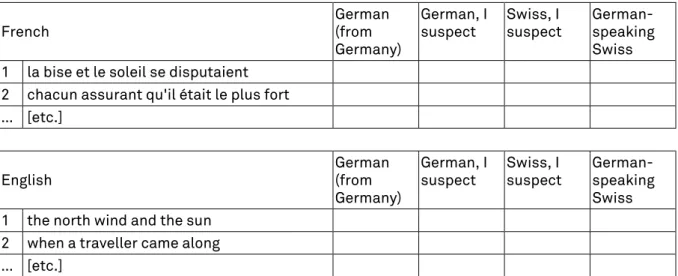
The participants of the perception experiment were told that the speakers were either Germans or German-speaking Swiss. The questionnaire contains the orthographic transcription of each excerpt. Each excerpt was played only once. The participants then had a few seconds to check the box indicating the presumed origin of the speaker and their degree of certainty. The following figure shows part of a translated questionnaire; the complete version is attached in the appendix.
French German (from Germany) German, I suspect Swiss, I suspect German-speaking Swiss 1 la bise et le soleil se disputaient
2 chacun assurant qu'il était le plus fort … [etc.] English German (from Germany) German, I suspect Swiss, I suspect German-speaking Swiss 1 the north wind and the sun
2 when a traveller came along … [etc.]
Table 1: Part of the translated questionnaire for the participants of the perception experiment
The participants of the perception experiment were also asked to specify features of which they believe that they distinguish the accents of Germans from Swiss. Furthermore, they declared their native language(s) and their level of competence in English and French.
On the whole, 200 subjects participated in the experiment. Most of the participants were students at the University of Zurich.
In the second part of the study the recordings were analyzed phonetically. These analyses were carried out with the entire recordings, not only with the excerpts chosen for the perception experiment.
The participants’ answers to the question as to wherein the Germans and the German-speaking Swiss differ in their eyes have not yet been fully analyzed. They shall be presented in a later publication.
The following section will first present the results of the perception experiment, then the results of the phonetic analyses.
3. Results
3.1
Results of the perception experiment
In this section, the results of the perception experiment are presented and the factors which have an influence upon the proportion of correct assignments are discussed.
In general, the 200 participants identified the excerpts quite well. 77% of the French excerpts and 85% of the English excerpts were assigned correctly to speakers from Germany or Switzerland respectively. This is significantly above chance; significance was tested by means of a one-way chi-square test (χ2 = 18’102; df = 2; p < .0001 for French; χ2 = 29’936; df = 2; p < .0001 for English).
Figure 1: Proportions of the French and English excerpts which the participants assigned correctly or falsely to German or Swiss speakers respectively
The most important factor which has an influence upon the proportion of correct assignments is the native language of the participants. The 149 participants whose native language is German perform much better (French 81%; / English 90% correct assignments) than the 41 speakers1 of another language (64% / 66% correct assignments), though even in the latter group the proportion of correct answers is significantly above chance (χ2 = 453; df = 2; p < .0001 for French; χ2 = 572; df = 2; p < .0001 for English). A closer look at the participants whose native language is German shows that those participants who claim that both Swiss German and the variety of German spoken in Germany are their native languages perform best. Since this is only the case for 7 speakers, however, this result should not be overrated, even if it does seem plausible.
Participants whose native language is the language spoken in the excerpts perform below average. The 5 native speakers of French only assign 72% of the French excerpts correctly and the 8 native speakers of English only get 65% of the English excerpts right2.
Furthermore, the connection between competence and performance was tested. This was done by using cross tables. For both languages the chi-square values were highly significant (χ2 = 47.6; df = 4; p < .0001 for French; χ2 = 26.6; df = 3; p < .0001 for English3). This means that there must be significant deviations between the count and the expected count in one or more categories. For French, the standard residual for people who say they do not speak French is 5.4 for the wrong and -3.0 for the correct answers, which means that these participants
1 The total is lower than 200 because 10 participants did not fill out the part about their native
language and their L2-competence.
2
Despite the small size of both groups the numbers are still significant: χ2 = 48.4; df = 2; p < .0001 for the French speakers judging the French excerpts; χ2 = 45.5; df = 2; p < .0001 for the English speakers judging the English excerpts.
3
The degree of freedom is lower for English since the two lowest categories of competence were put together.
more often give a wrong answer and less often a correct answer when judging the origin of the speaker of a French excerpt. For English, people who judge their competence level of English as poor or average give more wrong answers than expected (standard residual 3.1 and 2.5), people who consider their English as very good (but not excellent or as their mother tongue) give significantly less wrong answers (standard residual -2.5) (cf. Hove [accepted] for details).
In conclusion, it seems that participants with a low level of competence in French or English perform below average when judging the excerpts in the respective language. However, people who consider their competence of French or English as excellent or for whom it is the mother tongue do not perform above average when deciding whether an L2-speaker is from Germany or Switzerland. Overall, the competence level of French and English does not have a very strong influence upon a subject’s performance in the perception experiment.
3.2
Results of the phonetic analysis on the prosodic level
This section discusses the findings of the phonetic analysis of the suprasegmental features. Before doing so, however, it must be pointed out that this is an exploratory study. The features described here are ones that look promising for further research but they are by far not the only ones to be noted. A more detailed and systematic analysis would surely offer additional insights.
3.2.1 Duration
In this section the duration of consonants and vowels will be looked at. As to the consonants, for the German language, in particular for the Swiss German dialects, a lot of research has been done on geminates. It is well documented that most Swiss German dialects have geminate consonants (e.g. Hotzenköcherle, 1965: 182-203; Willi, 1996). When speaking the standard variety of German, which has no geminates, most Swiss tend to pronounce intervocalic consonants after a short accented vowel with a longer duration than consonants in other positions (Christen et al., 2010: 183). This can also be observed in the German recordings of the present corpus: In words such as Sonne ('sun') or stritten ('argued') both the absolute duration of the intervocalic consonants [n] and [t] as well as their relative duration in comparison to the preceding vowel is higher for the Swiss than for the Germans.
In the French version of The northwind and the sun intervocalic [k] and [s] appear in the phrase chacun assurant [qu’il était le plus fort]. The measurements revealed that the Swiss do not pronounce these intervocalic consonants with a longer duration than the Germans. This might be due to the accentuation, a factor discussed on the following pages.
In the English text there is no word in which an intervocalic fortis consonant occurs after a short accented vowel.
In the French text the duration of the vowels was examined as well. Using the two disyllabic words tombés and d’accord as examples, the duration of both vowels in each word was measured. The following figure shows the relative duration of the second (last) vowel in relation to the first vowel for each of the two words.
Ils sont tombés d’accord, que…
Germans: 1 : 2.0 1 : 1.9 Swiss: 1 : 0.9 1 : 1.9
Figure 2: The relative duration of the last vowel compared to the first vowel in two disyllabic French words pronounce by speakers from Germany or Switzerland
In both words, the Germans pronounce the second vowel about twice as long as the first one. For the Swiss speakers the relative duration between the two vowels is also about 1 : 2 in the second word, which is at the end of a phrase. However, in the word tombés they pronounce both vowels with almost the same duration; the first vowel is even slightly longer than the final one. In the word tombés, which is in the middle of a phrase, the Swiss accentuate the first syllable, [tɔ̃], while the Germans accentuate the final syllable, [be].
All speakers emphasize the final syllable of the phrase, d’accord, by pronouncing it with a longer vowel. This can be due to the fact that the final syllable in French is accentuated (see below) or it can be due to the more universal phenomenon of phrase-final lengthening.
3.2.2 Intonation
A similar pattern can be seen when looking at the intonation patterns. The following figure shows the intonation patterns of a German and a Swiss speaker for the same phrase, ils sont tombés d’accord. The graph was produced by using the intonation curves of the computer programs Praat (Boersma/Weenink) and Prosogram (Mertens). The height of the box represents 100 Hz4.
4
For this phrase (as well as for the one depicted in figure 4) a ToBI label would not bring out the important difference between the two pronunciations. In both cases the word tombés would be annotated with the label L+H* ; however, it would not show that the prominent syllable to which this tone applies is in one case the second, in the other case the first syllable of the word tombés.
Figure 3: Intonation patterns of a German and a Swiss speaker for a French phrase with two disyllabic words
Both in the word tombés as well as in d’accord the German speaker from Mönchengladbach pronounces the first syllable with a low or falling pitch while rising strongly on the second syllable, thereby accentuating it. In contrast, the Swiss speaker from Berne produces the first syllables of both words with a rising pitch, whereas the second syllables are spoken with a steady high pitch.
Even if these are only two speakers and there is a lot of variation, both pitch patterns seem to be typical for their group.
The examination of trisyllabic words also reveals fundamental differences in the pitch movements of Germans and Swiss. The phrase looked at is un voyageur qui s’avançait.
Figure 4: Intonation patterns of a German and a Swiss speaker for a French phrase with two trisyllabic words
As in the disyllabic words, the speaker from Germany pronounces the last syllable of the words voyageur and s’avançait with a strong rise in pitch. The Swiss
German speaker: (Cologne)
Swiss speaker: (St. Gall)
un vo ya geur qui s’a van çait
German speaker: (Mönchengladbach)
Swiss speaker: (Berne)
speaker from St. Gall has a rising pitch on the first two syllables of each word while the last syllable is spoken in a lower pitch.
Vieru et al. (2011) found pitch rises on maintained word-final schwas in German5 speakers of French, whereas English Italian and native French speakers show pitch falls in the same contexts.
The French language does not have an accent on words, it has an accent at the end of a phrase (Schmid, 2009: 49). Native speakers of German – a language with a word accent – tend to impose a word accent on their pronunciation of French. It is highly interesting to note that they do this in different ways: The German speaking Swiss tend to accentuate French words on the first syllable in the way many German words are accented. The Germans, on the other hand, accentuate French words on the last syllable. The accentuation of the end of a phrase in French is presumably perceived as a wordfinal accentuation and is therefore also applied to words which are not at the end of a phrase.
These differences in pattern are difficult to explain. They might have something to do with a fact that has also been observed in German: In foreign words such as
Büro or Apostroph, in names (eg. Neptun, Merkur) and in acronyms (eg. FDP, ARD), speakers from Switzerland are much more likely to accentuate the first syllabe than the Germans, who usually accentuate the last syllable (Christen et al., 2010: 247f.; Sieber, 2001: 495f.).
It is interesting to note here that Woehrling et al. (2008) found a tendency toward initial stress in the French-speaking Swiss Canton de Vaud. This hints at the possibility that there might be a regional component to stress which interacts across languages.
Avanzi et al. (2012) compared the pronunciation of French by native speakers and speakers of Swiss-German. They found differences in accent and phrasing: the number of prominences was higher for the Swiss-German speakers than for the native speakers of French. Barquero Armesto’s (2012) findings for Spanish learners of French are similar.
The speakers realize the accentuation by increasing the duration of the syllable in question and by pronouncing it with a rising pitch. Remarkably, the accentuated syllable is not necessarily realized with an increased intensity.
For the English text the examination of the pitch revealed many differences between the speakers, but no patterns were found which could be considered as typical either for the Germans or the Swiss.
Some Swiss speakers did show striking rises on accented syllables but they were neither systematic nor exclusive to their group. At best, when speaking English, the Swiss speakers might produce syllables with a striking rise in pitch more
5 The origin of the German speakers is not specified. However, since it is said that they started studying French at 17 it is unlikely that they are from German-speaking Switzerland where French is taught at the latest from the 7th school year on.
frequently than the Germans but this would need to be looked into more thoroughly.
3.2.3 Intensity
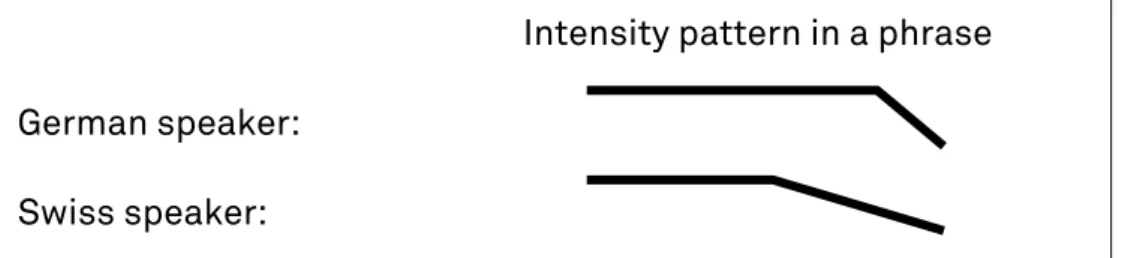
The third prosodic feature which was examined was intensity. In the French texts no systematic differences between speakers from Germany and Switzerland were found. In the English texts there might be a slight tendency for Swiss speakers to start a decrease of the intensity earlier than the Germans. Schematically, this feature would look like this:
Figure 5: Recurring intensity patterns of German and Swiss speakers in English phrases6
These patterns were found in phrases such as wrapped in a warm cloak or in the title The northwind and the sun. They were also found in the German texts. However, their occurrence was far from systematic. In addition, even when listening to two clear cases this difference is not a perceptually salient feature.
3.3
Results of the phonetic analysis on the segmental level
The differences in pronunciation between Germans and Swiss speaking English and French are presented in detail in Hove (submitted) and are therefore only summarized here.
When speaking English, native speakers of German often have problems pronouncing [ð] and [θ] since these sounds do not exist in German. Though in the majority of the words these sounds are produced correctly, in those cases in which they are replaced by a familiar sound there is a difference in strategy: while the Swiss replace these dental fricatives with the plosives [d] and [t], Germans most often replace them with the alveolar fricatives [z] and [s]. These variants are never used by Swiss speakers.
Another source of error is the distribution of [v] and [w]. Germans tend to replace [w] by [v] in words such as wind; in contrast, Swiss often replace [v] with [w] in words such as traveller. There is also some variation in the pronunciation of the r
6 This graph is presented here in an abstract and admittedly vague manner because the absolute values are not comparable. As mentioned, the recordings were made in an office; the distance between the microphone and the mouth of the speaker was not always the same.
German speaker: Swiss speaker:
sounds. Among Germans, uvular realizations can occur and in a few cases Swiss speakers produced an alveolar [r]. Cases of final devoicing can be found for Germans whereas a few cases of across-word assimilation appear in texts spoken by Swiss readers.
In French as well as in English a noticeable difference between the speaker groups is the fact that the Swiss have trouble with the lenes [b], [d], [g], [ʒ] and [dʒ] which they often devoice partially or totally.
Both in the English and in the French texts the Germans produce many more glottal stops than the Swiss and in general the Germans aspirate the plosives more strongly.
4.
Conclusion / Discussion
The results of the perception test show that people with the same native language but who speak a different variety of this language can be told apart by their foreign accent. In this study, the two groups are speakers from Germany and from German-speaking Switzerland who can be told apart based on their accent in French or in English.
Previous studies have shown that even within German-speaking Switzerland speakers of different dialects can be differentiated based on their L2-accent (Kolly, 2013) or based on prosodic features (Leemann & Siebenhaar, 2008). The findings of the present study indicate that at the same time there must be similarities between the L2 speech of speakers of different Swiss dialects which allow listeners to identify them as Swiss and keep them apart from speakers from Germany.
The phonetic analysis of the recordings of the Germans and the Swiss speaking French and English reveal some systematic differences on the segmental level. These cannot on their own account for the high rate of correct attributions since the excerpts are only about two seconds long and many of them do not contain sound variants which were found to be typical for one or the other speaker group. Therefore, there must also be differences on the prosodic level. Many differences were found between the speakers; however, the high within-speaker variability and between-speaker variability make it difficult to find systematic prosodic differences between the two speaker groups. Though certain tendencies such as the different stress and pitch pattern in French were found, much more research is necessary to find features indicative of a certain accent. New technologies (cf. Jilka, 2000; Boula de Mareüil &Vieru-Dimulescu, 2006; Grabe, 1998) might prove to be helpful in this process.
I would like to give my thanks to the people who participated in this study by reading the texts or by judging the excerpts. I also thank my colleagues at the Phonetics Laboratory in Zurich Stephan Schmid, Volker Dellwo, Jürg Strässler, Adrian Leemann, Marie-José Kolly and Dieter Studer for
their help and their suggestions, Adrian Leemann and Sandra Schwab for organizing the workshop and the publication, and Aurore Bettinville for her help with the statistics.
Bibliography
Avanzi, M. et al. (2012): Accentual Transfer from Swiss-German to French. A Study of 'Français Fédéral'. In: Proceedings of Interspeech 2012, Portland (USA).
Barquero Armesto, M. (2012): A comparative study on accentual structure between Spanish learners of French interlanguage and French native speakers. In: Proceedings of Speech Prosody, Shanghai, 2012, 250-253.
Boersma, P. & Weenink, D.: Praat: doing phonetics by computer. Version 5.2.17, retrieved march 2011 from http://www.praat.org
Boula de Mareuil, P. & Vieru-Dimulescu, B. (2006): The contribution of prosody to the perception of foreign accent. In: Phonetica, 63, 247-267.
Boula de Mareuil, P. et al. (2008): Accents étrangers et régionaux en français. Caractérisation et identification. In: Traitement Automatique des Langues, 49(3), 135-162.
Christen, H. et al. (2010): Hochdeutsch in aller Munde. Eine empirische Untersuchung zur gesprochenen Standardsprache in der Deutschschweiz. Stuttgart (Franz Steiner Verlag). Fitzpatrick-Cole, J. (1999): The alpine intonation of Bern Swiss German. In: ICPhS99, 941-944. Grabe, E. (1998): Pitch accent realization in English and German. In: Journal of Phonetics, 26,
129-143.
Hirschfeld, U., Kelz, H. P. & Müller, U. (Hg.): Phonetik International. Von Afrikaans bis Zulu. Kontrastive Studien für Deutsch als Fremdsprache. Bonn: Popp (retrieved October 2011 from http://www.phonetik-international.de/p-phonetik).
Hotzenköcherle, R. (Hg.) (1965): Sprachatlas der deutschen Schweiz. Bd. II: Lautgeographie: Vokalquantität, Konsonantismus. Bearb. v. D. Handschuh, R. Hotzenköcherle & R. Trüb. Bern u.a. (Francke).
Hove, I. (forthcoming): Mit deutschem Akzent sprechen. Analyse der Unterschiede zwischen Deutschschweizern und Deutschen, die Französisch und Englisch sprechen. In: D. Huck (Hg.): Alemannische Dialektologie: Dialekte im Kontakt. Beiträge zur 17. Arbeitstagung für alemannische Dialektologie in Straßburg (Elsass / Frankreich), 26.-28.10.2011. Stuttgart (Franz Steiner Verlag), ZDL-Beiheft.
Jilka, M. (2000): The Contribution of Intonation to the Perception of Foreign Accent. Doctoral Dissertation, Arbeiten des Instituts für Maschinelle Sprachverarbeitung (AIMS) Vol. 6(3), University of Stuttgart. (retrieved July 2011 from http://ifla.uni-stuttgart.de/institut/mitarbeiter/jilka/papers/diss.pdf).
Kolly, M.-J. (2013): Akzent auf die Standardsprachen: Regionale Spuren in “Français fédéral” und “Schweizerhochdeutsch”. In: Linguistik online, 58/1, 37-76.
Leemann, A. & Siebenhaar, B. (2008): Perception of Dialectal Prosody. In: Proceedings of Interspeech 2008, Brisbane, Australia, 22.-26.9.2008, 524-527.
Leemann, A. (2007): Acoustic analysis of Swiss English vowel quality. Bern (retrieved January 2012 from
http://www.isw.unibe.ch/unibe/philhist/isw/content/e4267/e4385/e5406/e5427/e5988/Lee mann-MAThesis(2006)_ger.pdf)
Magen, H.S. (1998): The perception of foreign-accented speech. In: Journal of Phonetics, 26, 381-400.
Mertens, P.: Prosogram 2.9. Transcription of prosody using pitch contour stylization based on a tonal perception model and automatic segmentation, retrieved june 2012 from http://bach.arts.kuleuven.be/pmertens/prosogram/
Schmid, S. (2009): Einführung in die allgemeine Phonetik und Phonologie für Studierende der Romanistik. Zürich: Phonetisches Laboratorium.
Sieber, P. (2001): Das Deutsche in der Schweiz. In: G. Helbig et al. (Hg.), Deutsch als Fremdsprache. Ein internationales Handbuch. Berlin & New York (de Gruyter), 491-504.
Stock, E. (2000): Zur Intonation des Schweizerhochdeutschen. In: M. Habermas, P. Müller & B. Naumann (Hg.), Wortschatz und Orthographie in Geschichte und Gegenwart. Tübingen (Niemeyer), 299-314.
Ulbrich, Ch. (2005): Phonetische Untersuchungen zur Prosodie der Standardvarietäten des Deutschen in der Bundesrepublik Deutschland, in der Schweiz und in Österreich. Frankfurt am Main (Lang).
Vieru, B., Boula de Mareüil, P. & Adda-Decker, M. (2011): Characterisation and identification of non-native French accents. In: Speech Communication, 53, 292-310.
Willi, U. (1996): Die segmentale Dauer als phonetischer Parameter von ‚fortis’ und ‚lenis’ bei Plosiven im Zürichdeutschen: eine akustische und perzeptorische Untersuchung. Stuttgart (Franz Steiner).
Woehrling, C. et al. (2008): A corpus-based prosodic study of Alsatian, Belgian and Swiss French. In: 9th Annual Meeting of the International Speech Communication Association, Brisbane, 780-783.
Appendix
Nordwind und Sonne
Einst stritten sich Nordwind und Sonne, wer von ihnen beiden wohl der Stärkere wäre, als ein Wanderer, der in einen warmen Mantel gehüllt war, des Weges daherkam. Sie wurden einig, dass derjenige für den Stärkeren gelten sollte, der den Wanderer zwingen würde, seinen Mantel abzunehmen. Der Nordwind blies mit aller Macht, aber je mehr er blies, desto fester hüllte sich der Wanderer in seinen Mantel ein. Endlich gab der Nordwind den Kampf auf. Nun erwärmte die Sonne die Luft mit ihren freundlichen Strahlen, und schon nach wenigen Augenblicken zog der Wanderer seinen Mantel aus. Da musste der Nordwind zugeben, dass die Sonne von ihnen beiden der Stärkere wäre.
La bise et le soleil
La bise et le soleil se disputaient, chacun assurant qu'il était le plus fort. Quand ils ont vu un voyageur qui s'avançait, enveloppé dans son manteau, ils sont tombés d'accord, que celui qui arriverait le premier à le lui faire ôter serait regardé comme le plus fort. Alors, la bise s'est mise à souffler de toute ses forces, mais plus elle soufflait, plus le voyageur serrait son manteau autour de lui. Finalement, elle renonça à le lui faire ôter. Alors, le soleil commença à briller et au bout d'un moment le voyageur, réchauffé, ôta son manteau. Ainsi, la bise a du reconnaître que le soleil était le plus fort.
The north wind and the sun
The north wind and the sun were disputing which was the stronger, when a traveller came along wrapped in a warm cloak. They agreed that the one who first succeeded in making the traveller take his cloak off should be considered stronger than the other. Then the north wind blew as hard as he could, but the more he blew the more closely did the traveller fold his cloak around him; and at last the north wind gave up the attempt. Then the sun shone out warmly, and immediately the traveller took off his cloak. And so the north wind was obliged to confess that the sun was the stronger of the two.