Strategic Framework 2013–2017
Global Programme Food Security
Table of Contents
1. The global food security challenge and response
5
2. Commitment and mission of the GPFS
6
3. Programmatic components and approaches of the GPFS
8
4. Working modalities of the GPFS
15
5. Partners of the GPFS
16
6. Human resources, budget, monitoring and communication of the GPFS
18
Annex 1 | Food security and nutrition: a matter of definition
20
Annex 2 | From a national to a global concern
22
Annex 3 | Indicative budget for the GPFS (2013–2017)
25
1. The global food security
challenge and response
Food security and nutrition is a major global chal-lenge. Three quarters of the one billion of hun-gry people live in rural areas of agriculture-based economies, which are, and will be most affected, by demographic growth, environmental challenges as well as changing consumption patterns in emerg-ing economies that increase the demand for animal products.
For the 70 per cent of the world’s poor people who live in rural areas, agriculture is the main source of income and employment. To that adds the increas-ing number of under- and malnourished people both in rural and increasingly urbanised environments with drastic consequences on human development. Food insecurity (definition see Annex 1) is one of the root causes for migration and political instabilities. About 80 per cent of the food consumed in Asia and Sub-Saharan Africa is produced by an estimated 500 million smallholder farms. They support almost 2 billion people who depend on them for their food security. Increasing the availability of nutritious food through higher sustainable agricultural productivity, reduction of food loss and waste, preserving natural resources as well as creating rural jobs is a challenge that has to be addressed in an inclusive way. Global food markets remain open with poor people suffering most in times of instabilities. The global food price crisis in 2007–2008 showed the fragility of the global food system, by pushing an additional 100 million people worldwide into poverty and hun-ger. Furthermore, the crisis triggered political riots and major geopolitical changes. It highlighted the intrinsic fragility of all countries, notably because of the global interconnectedness of the food system and the dependence on trade for food security. The increased and higher volatility of staple food prices further evidenced the specific vulnerability of low-income, net-food importing states and of their pop-ulations. To address root causes of food insecurity, inadequate nutrition, and extreme poverty more ef-fectively, common coherent frameworks are needed and a structural change of the agricultural sector is inevitable. Approaches to cope with the increasing demand for food have to be reviewed taking into account the development and implementation of regional and national policies.
With the start of the Millennium new instruments and global mechanisms have been developed, bringing together governments, international de-velopment agencies, regional organisations, civil
society and private sector (Annex 2). While in the early 2000 high priority was given to the Millennium Development Goal (MDG) 1 to eradicate hunger and poverty, steady progress has been made for several years at the global level, mainly owing to the success achieved in emerging economies. Several affected countries have increased the level of their investment in agriculture, food security and rural development, in particular in Africa via the Comprehensive Africa Agricultural Development Programme (CAADP), but not to the commitment level expected. The G8 has engaged substantially after the L’Aquila summit in 2009 and has established the New Alliance for Food Security and Nutrition. A number of industrialised countries prioritized food security after decades of neglect and pledged to increase their official devel-opment assistance (ODA) allocations in related sec-tors, even though this has not yet led to substantial increases (OECD, 2013). Concerted contributions of the private sector (particularly through the WEF’s New Vision for Agriculture) and civil society organi-sations (such as Farmers’ Organiorgani-sations, NGOs) to the search for global solutions to hunger and food insecurity have gained recognition. The private sec-tor is generally fostering its presence in developing countries engaging with own sustainability strate-gies.
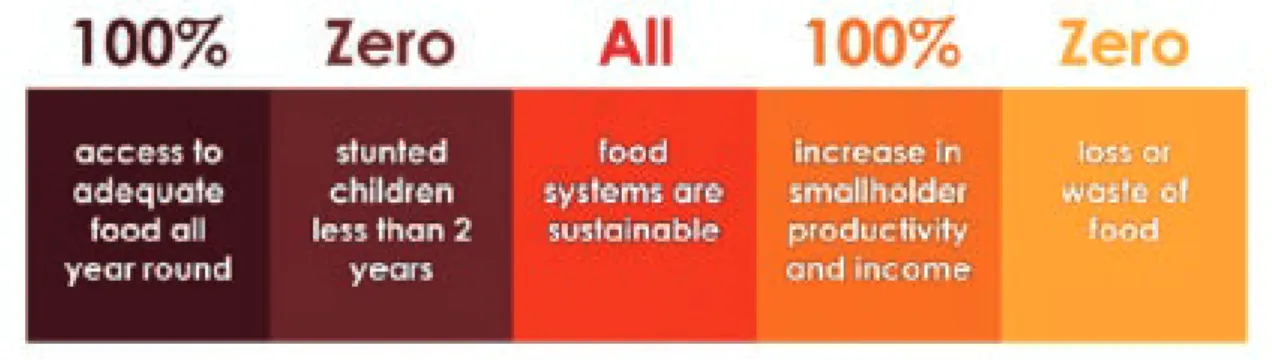
Within the international landscape, the High Level Task Force (HLTF) on the Global Food Security Crisis managed to gather more than 20 different multi-lateral institutions and agencies under a common conceptual framework to improve the quality and the efficiency of its response. The reformed Com-mittee on World Food Security (CFS) has produced tangible results with the adoption of the Voluntary Guidelines on the Responsible Governance of Ten-ure of Land, Fisheries and Forests in the Context of National Food Security to address land govern-ance challenges. The International Assessment of Agricultural Knowledge, Science and Technology for Development (IAASTD) endorsed by Switzerland gave direction on how agricultural knowledge, sci-ence and technology can be used to reduce hunger and poverty. The CGIAR has completed a substantial reform for international agricultural research for de-velopment and is now working with global research programmes and a more effective governance struc-ture. At the Rio+20 summit in 2012, the UN Secre-tary General launched the Zero Hunger Challenge composed of five components (Annex 2) expanding the global understanding of food security with in-creasing importance of nutrition aspects.
2. Commitment and
mission of the GPFS
SDC’s Global Programme Food Security (GPFS) rep-resents an innovative initiative of Switzerland in addressing food security and nutrition challenges on global level. It is based on SDC’s mission to re-duce poverty through five strategic objectives (Bill to Parliament 2013–2016): (1) Prevent and overcome crises, conflicts and disasters; (2) Provide access to resources and services for all; (3) Promote sustain-able economic growth; (4) Support transition to democratic, market-based systems; and (5) Shape a development-promoting, environmentally friendly and socially responsible globalisation – and on the overarching goal for development cooperation in developing countries: Global sustainable develop-ment to reduce poverty and global risks.
Commitment
A world free of hunger and
malnutrition to which smallholders
contribute with healthy food
accessible to all while increasing
their income and safeguarding the
environment.
Mission
• Induce change in public and institutional policies, private standards and practices on food securi-ty and nutrition by influencing the international agenda and by increasing public awareness. • Guide Switzerland’s contribution to and its
part-nerships with multilateral organisations in the field of agricultural research for development and rural development (i.e. CGIAR, IFAD, UNCCD), as well as leading SDC’s global food security policy dialogue with respective multilateral institutions and networks.
• Increase the coherence and effectiveness of Switzerland’s efforts to improve global food se-curity and nutrition by leveraging support and expertise within the Swiss federal administration, Swiss public and private institutions.
• Promote institutional learning, knowledge ma-nagement and awareness building within SDC and disseminate information, research results and political and scientific developments on food se-curity and nutrition.
The GPFS provides the basis and thematic input for Switzerland’s multilateral and bilateral development position related to agriculture and food security and works complementary to other SDC units. The pre-sent updated strategic framework for the GPFS de-fines specific orientations and priorities for its global engagement, describes its role as a thematic know-ledge broker within SDC, puts the SDC Agriculture and Food Security (A+FS) Network in the context of the thematic responsibility that GPFS has for the strategic orientation within the whole of SDC. It draws on the findings of the SDC-SECO Report on Effectiveness in the Agricultural Sector 2010 and is based on the findings of an internal Mid-Term Re-view conducted early 2013. The framework takes due consideration of SDC’s longstanding institution-al engagement, experience and know-how. Switzer-land’s Development Cooperation allocates resources above DAC-average for agriculture and food secu-rity. It is therefore able to draw on expertise, results, and approaches from which other actors can and should benefit.
In 2008, SDC adopted the Joint Donor Concept for Rural Development elaborated by the Global Donor Platform for Rural Development (GDPRD), as the main thematic guidance in the field of agriculture and food security. In 2012, GPFS initiated a process of reviewing the Joint Donor Concept within the GDPRD, with the objective to use the platform for exchange amongst donors on policies and priorities, and to adapt it to the changing and evolving inter-national context in agriculture, rural development, food security and nutrition. This process helped to integrate into the Joint Donor Concept the dimen-sion of resilience in food security, the links between humanitarian aid and development cooperation in fragile contexts and protracted crises, as well as ref-erences to climate change and nutrition security.
Since its inception in October 2008, the GPFS has selected specific priority areas and initiated innova-tive partnerships, notably on rural advisory services, ecological agriculture, postharvest management and land governance. In these areas, GPFS has con-tributed to influencing the setting, or the implemen-tation, of global or continental frameworks. It has established an outreach representation within the Swiss Embassy in Addis Ababa for increased policy dialogue and closer monitoring of regional initiatives in Africa. The GPFS has reinforced relevant linkages and complementarities with SDC’s operational De-partments, as well as with the Federal Office for Agriculture (FOAG) and the Swiss Permanent Repre-sentation to FAO, IFAD and WFP in Rome.
3. Programmatic components
and approaches of the GPFS
The GPFS considers food security as a basic
human right including all four dimensions of
food security: availability, stability, access and
utilisation of food. The GPFS strategy is to
posi-tively shape the transformation of the global
food system: increase in a sustainable manner
the production and productivity of
smallhold-ers, reduce food losses, increase stability and
access to food, improve nutrition through a
diverse diet, and improve the food security
and nutrition of low income food deficit
pop-ulations, particularly women and vulnerable
groups.
The GPFS addresses the challenge of global food security and nutrition from a
global perspective through four components:
SUSTAINABILITY of agricultural
PRODUCTION AND INNOVATION
systems
Competing claims on
NATURAL RESOURCES
Stable ACCESS to sufficient
NUTRITIOUS FOOD
POLICY COHERENCE for
food security and nutrition
Component 1:
Sustainability of agricultural production and innovation systems
Strong efforts are required to support and promotesocially, economically and ecologically sustainable increases in agricultural productivity and produc-tion. Meeting increasing food demands in a world with declining quantities and quality of land, water, biodiversity and fossil fuel on which agricultural pro-duction depends, constitutes together with chang-ing consumption habits a major challenge. Poverty is strongly negatively correlated with agri-cultural productivity. Climate change amplifies this challenge in fragile ecosystems leaving rural people extremely vulnerable in many contexts. Smallholder farmers globally represent the majority of producers and consumers and therefore shall be the primary beneficiaries of agricultural innovations. Supporting and strengthening innovative agricultural research and innovation systems that include skills and needs of smallholders is thus crucial to maintain and fur-ther strengthen smallholders in sustainable
diversi-fied production systems that minimizes loss of food along the value chain and enhances its nutritional value. This requires interactive collaboration be-tween stakeholders in agricultural systems at global, regional and national levels to contribute signifi-cantly to a strengthened resilience of smallholders in food insecure and climate change affected environ-ments. The use of new technologies is as important as the consequent implementation of new know-ledge in agro-ecological approaches.
“All the maize for my home consumption comes from my aflasafe™- treated field. I will buy aflasafe™ to keep my family healthy. When I take my maize to the market, buyers rush for it because the quality looks better. The grains look clean.” lhaji Al-Hassan Abdoulahi, farmer in Kaduna State, Nigeria
COMPONENT 1: SUSTAINABILITY OF AGRICULTURAL PRODUCTION AND INNOVATION SYSTEMS Policy Impact Hypothesis: Agricultural research and innovation systems respond to the needs of smallholder
farmers, in particular to women and the most vulnerable, in order to strengthen their capacity to access and use innovation to sustainably produce safe and diversified nutritious food
Policy engagement: CGIAR, AIRCA, GFRAS, GCARD, AU’s NEPAD (CAADP), ASEAN, FAO, IFAD Target 1.1: Strengthen Agricultural Research for Development (AR4D)
Activity lines Expected outcomes
• Strengthen the international agricultural research partnership and system at global, regional, and national levels
• Assess and scale-up the potential of selected innova-tions improving the sustainability, productivity and impact of agricultural production systems on food security and nutrition. This includes organic agricul-ture, nutrition-sensitive agriculagricul-ture, innovative crop improvement, postharvest technologies and preserva-tion of pollinators
• Gradually build up a global plant health surveillance system based on functional, responsive and sustain-able national plant protection systems
• The CGIAR, AIRCA and international research for de-velopment partners effectively support national agri-cultural research and innovation systems in generating the knowledge and evidence required to address rural poverty, food security, nutrition and health and sus-tainable management of natural resources challenges • Research delivers knowledge and evidence that
can be scaled-up and policy choices are influenced for a diversified and more climate change resilient agriculture, a significant uptake of more sustainable and efficient technologies, and improved income for smallholder farmers and nutrition of poor populations • Smallholder women and men farmers have access to
sustainable plant protection knowledge supported by an effective crop health surveillance system to adopt sustainable coping strategies to assure their harvest
Target 1.2: Strengthen Agricultural Innovation Systems
Activity lines Expected outcomes
• Support global and regional networks and pro-grammes which strengthen agricultural innovation systems and promote effective rural advisory service delivery
• Collaborate with private sector companies to promote service delivery to smallholders as well as sustainable and equitable value chains
• Innovative and effective systems of rural advisory services delivery are promoted by strengthened rural advisory service networks and international partner institutions
• Enhanced awareness and active engagement of private sector companies to sustainable rural develop-ment outcomes
Component 2:
Competing claims on natural resources
Secure access to and use of natural resources suchas land, water, and agro-genetic resources are crucial for food security and poverty reduction. Demo graphic and economic growth, as well as ur-banisation and associated societal processes have added pressure on natural resources, resulting in negative economic, social and environmental out-comes, and socially unacceptable phenomenon such as “land grabbing”. The sustainable use of natural resources provides a sound basis for food and shel-ter, production and environmental services. Due to human induced bio-physical processes (such as land degradation, loss of agro-biodiversity, and climate change) the natural resource base has been severely depleted. Since secure access to and control over natural resources are key requisites for their sustain-able use, regulatory frameworks need to be put in place, enforced and monitored at all levels to ensure
that the legitimate tenure rights of smallholders and other vulnerable rural populations are duly recog-nized. Supporting participatory and multi-stake-holder processes generally lead to adequate regu-latory frameworks to ensure that natural resources, including land, forests and water, are managed in a sustainable manner.
“On the other side of the valley trees are planted far away from each other. So the soil falls apart. On our side trees are closer to each other so they hold the soil. We planted trees to stop erosion and fill up the gully and for firing. This is what prevents soil erosion and flooding and protects us from heavy storms.”
Iskandar Mirzoev, farmer in Tajikistan
COMPONENT 2: COMPETING CLAIMS ON NATURAL RESOURCES
Policy Impact Hypothesis: Conducive regulatory frameworks are in place and enforced to ensure access to natural
resources and their sustainable management by smallholder farmers and other vulnerable rural population groups
Policy engagement: CFS, UNCCD, FOs, ILC, FAO, IFAD
Target 2.1: Improve the formulation and implementation of regulatory frameworks on governance of land and other natural resources from a food security perspective
Activity lines Expected outcomes
• Promote inclusive frameworks on governance of land and natural resources
• Engage with public and private sector investors on the implementation of the principles for responsible agricultural investment (rai)
• Support selected activities of the Global Action Plan derived from the International Treaty for Plant Genetic Resources for Agriculture (ITPGRFA) to prevent further loss of the global agro-biodiversity base
• Implementation of regulatory frameworks leads to more equitable land governance, as well as to im-proved food security
• Public and private sector agricultural investment im-proves food security and the livelihood of local com-munities respecting legitimate tenure and resource use rights
• National seed systems including the local knowledge base and genetic resources are in place, adapted, available and affordable for smallholders
Target 2.2: Improve networking, the formulation of policies and awareness building to combat desertifi-cation and to fight other forms of land degradation
Activity lines Expected outcomes
• Support the implementation of the UNCCD strategic plan to combat desertification and other forms of land degradation through bio-physical, technological and policy measures
• Effective use of natural resources for affected popula-tions through effective networking, information exchange, use of approved SLM tools and appropriate policy elaboration
Target 2.3: Promote technological and financial approaches to reduce water consumption of agricultural production
Activity lines Expected outcomes
• Scale-up tested water saving technologies through catalytic projects linking researchers, policy makers and practitioners
• Innovative and financially sustainable practices in Integrated Water Resources Management are scaled up and contribute to smallholders’ food security
Component 3:
Stable access to sufficient nutritious food
The current global attention to ensuring positivenutrition outcomes of development interventions, in particular but not exclusively for mothers and children, offers a unique opportunity to induce transformative changes in agri-food systems to ensure stability of access to nutritious food for all. The promotion of diverse agri-food systems gener-ates additional co-benefits which improve longer-term resilience of smallholder farmers’ livelihoods to external shocks such as political and economic instability, price volatility, climatic variability and extreme weather events. In this context, country-owned strategies and programmes for food security and nutrition that consider all policy sectors such as agriculture, education, public health, employment, natural resources management and social security are key to ensuring stable access to safe, nutritious and sufficient food for all. Increasing availability of food by reducing food loss and waste is crucial to sustain the natural resource base and increase farm-ers’ income. Applying the Voluntary Guidelines on the Right to Adequate Food in the Context of National Food Security at all levels has been an
ef-fective instrument to reduce the number of hungry and malnourished people in various countries. In light of the acceleration of global and regional economic integration, supportive measures such as adopting multi-sectorial policy frameworks that are cognizant of the needs, vulnerability and capacities of smallholders is of paramount importance, be it at national, regional, continental or global levels. All stakeholders, including representatives of the groups most affected by food insecurity, shall fully participate in these processes to increase their voice and ownership and to foster accountability. “Metal silos have helped make life easier because when there is not a good harvest or when there is a drought I have already enough food stored for two years. So I would say my farm has profited from the use of metal silos because at the end of the year I will have food to feed my family regardless of weather.” Cecilia Wangui Ndung’u, a farmer in Embu, Kenya
COMPONENT 3: STABLE ACCESS TO SUFFICIENT NUTRITIOUS FOOD
Policy Impact Hypothesis: Smallholder farmers including the most vulnerable and marginalized have access to
nutritious and diversified diets and are enabled to participate in the shaping of the transformation of increased sustainability and resilience of agri-food systems
Policy engagement: CFS, UN, AU, ASEAN, SAARC, RFOs, FAO, IFAD, WFP Target 3.1: Support improved dietary diversity
Activity lines
Expected outcomes
• Support programmes and projects that foster dietary diversity with smallholder farmers’ sourced food • Support scalable integrated action in nutrition-
sensitive agriculture, as well as complementary interventions in sustainable agri-food system, social security, public health and education
• Improved dietary diversity for all, with a focus on women and children under the age of two and schoolchildren
• Adoption of gender-sensitive food security and nutri-tion policies, programmes and frameworks that are shaped around smallholders’ needs and capabilities
Target 3.2: Reduce postharvest losses at household and community levels
Activity lines
Expected outcomes
• Identify and bring good practices of postharvest man-agement to scale and advocate for a conducive policy environment at all levels
• Enhance sharing of knowledge on scalable, affordable and sustainable programmes addressing postharvest losses at community level
• Appropriate national and regional policy and regula-tory frameworks on reducing postharvest losses in food supply chains are implemented and domestic and international support for programmes addressing postharvest losses at household and community level are sustained
• Knowledge on successful and sustainable approaches in reducing postharvest losses is available and utilized
Target 3.3: Improve resilience of smallholder farmers to climate change and external shocks
Activity lines
Expected outcomes
• Test and bring to scale innovative approaches that improve livelihoods and rural populations’ response and adaptive capacities to external shocks
• Support efforts to tackle climate risk in agriculture-based economies
• Smallholders and rural poor have access to adapted inputs, services and safety nets
• Pooled contingency funding mechanism is available to governments for improved responses to extreme climate events
Target 3.4: Increase participation and influence of food insecure groups on food security policies and normative frameworks at all levels
Activity lines
Expected outcomes
• Strengthen collective capabilities of farmers’ organisa-tions to enable them to participate in an effective manner in policy processes
• Support improved linkages and collaboration among civil society organisations (farmers’ organisations, consumers, NGOs, health promotion groups)
• Farmers’ organisations are effective in representing the interests of their members in policy processes at all levels
• Increased participation and mutual accountability on food security and nutrition policies, programmes and frameworks at all levels
Component 4:
Policy coherence for food security and nutrition
Improved policy coherence as well as effectiveand efficient coordination mechanisms addressing food security and nutrition are urgently needed at all levels. Innovative collaboration modalities have been successfully implemented among multilateral institutions since 2008, notably through the High Level Task Force for Food Security and Nutrition. The Committee on World Food Security has been reformed to become the foremost inclusive interna-tional multi-stakeholder platform for food security and nutrition. Synergized and effective support to scale up nutrition-related interventions at country level has been implemented through the Scaling Up Nutrition Movement (SUN) endorsed by more than 40 governments, UN system institutions, civil society organisations and private sector networks. Furthermore, a rights-based “food security lens” needs to be mainstreamed in relevant policy sectors and frameworks: international trade and investment regulations shall take into account the contribution of transparent and equitable trade to international
food availability and the specific needs of vulner-able populations in low-income net-food import-ing countries. Implementation of these mechanisms can benefit from SDC’s operational experience. In-creased policy coherence to achieve food security at global, regional and country levels demands a similar active engagement regarding food-security related policy issues in Switzerland.
“Within the committee of the World Food Security a whole range of different stakeholders, farmers, civil society, governments, private sector, research institutions, development banks and UN agencies come together, negotiate and agree on principles for responsible agriculture investments that everybody will stick up for.”
David Nabarro, Special Representative of the UN Secretary-General for Food Security and Nutrition
COMPONENT 4: POLICY COHERENCE FOR FOOD SECURITY AND NUTRITION
Policy Impact Hypothesis: Smallholders and food insecure populations benefit from a supportive enabling
envi-ronment through food security and nutrition sensitive policies and institutions
Policy engagement: HLTF, CFS, governing bodies of multilateral organisations, Switzerland
Target 4.1: Improve the effectiveness of the global architecture for food security and nutrition Activity lines Expected outcomes
• Support a better coordinated, more inclusive and more effective global architecture for food security and nutrition
• Monitor and provide input to the systemic coherence of global food security architecture
• Enhanced relevance, better coordination and increased inclusiveness of the UN system for food security and nutrition
• Global, continental and national policy processes lead to a more favourable enabling environment for small-holders and food insecure populations
Target 4.2: Advocate for an international trade and investment regime that targets food security and nutrition, particularly in low income food deficit countries
Activity lines Expected outcomes
• Bring an agriculture and food security perspective into Swiss trade positions and policies
• Build evidence of impact of sector policies on food insecure smallholder farmers
• Swiss trade positions and policies factor in the need for adequate framework conditions for agriculture and food security in low income food deficit countries • Food security is explicitly and adequately addressed in
the international trade and investment regimes
Target 4.3: Promote the integration of a food-security lens in Swiss policy sectors Activity lines Expected outcomes
• Contribute to policy coherence for development on food security issues within the Swiss Federal Administration
• Food security-related issues increasingly addressed in sector policies and discussions
The GPFS engages in all components with different levels of intensity and depth, according to opportu-nities, its internal capacities and financial resources. Flexibility for strategic decisions is also necessary. For each component, an impact hypothesis, and a sub-structure with possible activity lines and expected outcomes have been identified based on the criteria: (a) Guidance by SDC Board of Directors for Global Programmes; (b) potential for testing, replication, up-scaling and mainstreaming; and (c) comparative advantage and leverage of Swiss know-how. Syner-gies and complementarities between components will also be exploited, if available.
The following approaches are applied
across all components:
Put smallholder (farmers) in the centre: The ge-neric term “farmer” includes men and women agri-culturalists and pastoralists. Smallholders manage 80 per cent of the farmland in Sub-Saharan Africa and Asia and their households are characterized by family-focused production and consumption pat-terns, and depend on limited external inputs. Small-holders are most vulnerable to climate change, suf-fering from limited integration in national, regional and global governance processes and are marginal-ized in agricultural transformation processes and in their access to rural services. However, their poten-tial to build in resilience in their coping mechanisms is generally high.
Promote gender equality and women’s empow-erment: Women comprise up to 50 per cent of the agricultural labour force in developing countries with increasing additional responsibility of reproductive tasks in rural livelihoods and household/farm leader-ship. Women are important drivers of change to-wards more sustainable production systems, varied and healthier diets, provided they have equal access to education and health, rural advisory and financial services, productive resources and markets. Accord-ing to FAO, doAccord-ing so, total agricultural production in developing countries would increase by 2.5 to 4 per cent, which in turn would reduce the number of hungry people by 12 to 17 per cent or 100 to 150 million people.
Adapt and reduce the effect of climate change: The effect of climate change is undeniable, jeopard-izing livelihoods and entire production systems as well as availability and access to food. Developing climate-resilient production systems and livelihoods requires strengthening the absorptive, adaptive and transformative capacities of smallholders to assure global food security.
4. Working modalities
of the GPFS
Policy
While most global policy processes are covered by the GPFS team based at SDC headquarters, it also works through its regional representation in Addis Ababa to engage in direct policy dialogue with Afri-can policy partners and to follow-up relevant Africa-wide policy processes. In the exceptional cases of Ethiopia and India, the GPFS maintains a food se-curity and nutrition dialogue at the national level through the respective SDC representation. The GPFS collaborates closely with the Permanent Rep-resentation of Switzerland to FAO, IFAD and WFP in Rome and other Swiss missions in a strategic man-ner.
Innovations
The GPFS operational engagement provides a criti-cal mass of experiences at all levels to engage cred-ibly in evidence-based policy influencing. While its ambition is to reach out on a global level, GPFS’s operational activities are focussed to Sub-Saharan Africa as well as to South and South-East Asia, where food and nutrition insecurity is highest. In-novative approaches and partnerships are especially crucial in fragile situations. GPFS works directly with operational and institutional partners and seeks complementarity and synergies to SDC country rep-resentations where available.
Knowledge Management
The A+FS network is an important instrument of GPFS for knowledge management and for providing strategic orientation on agriculture and food secu-rity within SDC. The A+FS network is hosted and facilitated by the GPFS. With its network Focal Point, the GPFS further connects SDC with other donors, through coordination and relevant international knowledge platforms. The network’s role has re-cently been strengthened particularly in the context of the new Bill 2013-2016, which defines agriculture and food security as one of SDC’s priority themes supported by a global programme. The network provides SDC with an instrument to draw on its own and direct partner’s operational experiences. It fos-ters collaboration and promotes joint initiatives and knowledge exchange in-house. It also contributes to internal institutional learning while communicating externally about its activities. The GPFS contributes to shaping and implementing the activities of the A+FS network, together with the A+FS members from SDC’s Regional Cooperation, Humanitarian Aid, and Cooperation with Eastern Europe Depart-ments at headquarters and in field offices, but also SDC partners and Swiss NGOs. The mandate of the A+FS network is summarised as follows:
• To promote learning and enhance professional and methodical knowledge
• To provide theme-related operational advice to the SDC organisational units
• To capitalise on experience and formulate good practices
• To link global initiatives and global policy dialog with field-related activities and vice versa.
The A+FS network has identified the following the-matic priorities: rural advisory services, land gov-ernance, climate resilient small-scale agriculture, postharvest management, impact measurement for domains including agriculture and food security as well as pastoralism. Many of these topics are explicit components of the strategic orientation of the GPFS.
5. Partners of the GPFS
International and global partners
The GPFS maintains a varied range of international and global partners according to its multilateral and operational portfolio. It is actively engaged with in-ternational and multilateral partners and/or in policy influencing processes with the following institu-tions, bodies and networks:
i. Institutional responsibility of Switzerland’s con-tribution to the Consortium of the Global Part-nership for International Agricultural Research for Development (CGIAR), the International Fund for Agricultural Development (IFAD), the Centre of Applied Bioscience International (CABI). The GPFS hosts Switzerland’s Focal Point for the UN Convention to Combat Desertification (UNCCD), one of the three Rio Conventions.
ii. The GPFS maintains SDC’s dialogue with the Global Donor Platform on Rural Development (GDPRD), a thematic network of bilateral and multilateral development agencies.
iii. The GPFS manages SDC’s contribution to the Global Forum on Rural Advisory Services (GFRAS) and participates as an observer in the Governing body of the International Land Coalition (ILC), a global alliance of grassroots and international in-stitutions that promotes a stronger commitment to a pro-poor land governance agenda. The GPFS is also member of the Steering Committee of the AU’s Ecological Organic Agriculture Initiative. iv. The GPFS supports the work of the Office of the
UN Special Representative of the Secretary-Gen-eral for Food Security and Nutrition and leads the Swiss inputs to the work streams and sessions of the Committee on World Food Security, in close cooperation with the Federal Office for Agricul-ture.
v. GPFS is member of the European Initiative for Agricultural Research for Development (EIARD), which it chaired during 2011-2013. GPFS is also a member of the European Research Area – Ag-ricultural Research for Development, where it is engaged in coordination and at programme level.
Partners in Switzerland
With regard to Swiss Federal Administration, in ad-dition to providing inputs to IKEZ, the GPFS collabo-rates closely with the Federal Office for Agriculture (FOAG), with which it assumes a shared responsi-bility for the Permanent Representation of Switzer-land to FAO, IFAD and WFP in Rome. It also takes part in the work of the Comité National Suisse de la FAO (CNS-FAO), and works jointly with FOAG on food security-related advocacy and knowledge sharing activities in Switzerland. GPFS also interacts selectively with the Federal Office for the Environ-ment (FOEN) and the State Secretariat for Economic Affairs (SECO). Within the Federal Department of Foreign Affairs, a close link is established with the Human Rights Section of Human Security Division on the topic of the “Right to Food”. The GPFS is a member of both the Swiss Forum on International Agriculture Research (SFIAR) and the Swiss Forum for Rural Advisory Services (SFRAS), and it nurtures regular work relationships to the main competence and research centres for AR4D in Switzerland. It also relates to Swiss non-governmental organisations and institutions involved in food security and nutri-tion, agriculture and rural development.
Private sector
The GPFS supports the emergence of stable, ef-fective and performing networks of membership-based farmers’ organisations, as well as consumers’ organisations, in Africa and in Asia. Furthermore, it directly addresses different components of domestic and international private sector throughout activities derived from its core issues and from the respective entry points. Thus, GPFS also engages in a flexible and selective manner in public-private development partnerships with Swiss or internationally based global private sector stakeholders (such as insurance companies, food industry, the SAI-platform or the WEF) ready to share a common agenda, through en-gaging in defining and testing food security-relevant guidelines and standards, as well as in creating part-nerships in research or value chains which benefit the GPFS’ main target groups.
Partners within SDC
The GPFS continues to foster complementary and coherent approaches with other SDC domains. In close collaboration with Global Institutions Divison it brings SDC field-based experiences to the glob-al level and ensures that SDC operations are ade-quately connected to global and regional debates, platforms and networks. Due to the cross-cutting nature of several issues addressed by SDC’s Global Programmes, the GPFS will systematically coordinate its engagement with the Global Programmes on Climate Change (GPCC) and Water Initiatives (WI) and seek for common engagements. Particularly in component four there are cross-linkages to SDC’s Analysis and Policy Division and in its multilateral engagements a collaboration with Global Institu-tions Division is required. The GPFS collaborates with
SDC’s Humanitarian Aid Department, Employment and Income, Health, and Education Focal Points, and participates in the respective relevant SDC Net-works. Being aware of the key role that women play in improving food security, the GPFS actively partici-pates and contributes to the SDC gender network. Furthermore, the A+FS network has developed a solid collaboration with other SDC networks to ad-dress specific cross-linkages, given the complex and multisectoral nature of agriculture and food secu-rity issues: the debate on resilience is of interest to most of the SDC networks, but especially for A+FS, DRR, CC&E, C&HR (fragile contexts), RésEAU, and in a lesser extent E+I (insurance schemes) and Qual-ity Assurance; nutrition is at a crossroad for A+FS, Health and Education, but also with Humanitarian Aid Department; land governance is of interest to A+FS, dlgn, C&HR networks of SDC.
6. Human resources, budget, monitoring
and communication of the GPFS
Working mainly from SDC headquarters, the GPFS team consists of a Head, a Deputy Head, Programme Managers, Financial Administration and Programme Assistance and hosts the A+FS Focal Point. Since 2011, the GPFS has opened a regional representa-tion in Addis Ababa with one internarepresenta-tional staff and one national staff support, to cover the whole con-tinent with a focus on Sub-Saharan Africa. The GPFS collaborates closely with the Permanent Representa-tion of Switzerland to FAO, IFAD and WFP in Rome, in accordance to the established terms of reference with one staff directly linked to GPFS.
By 2016 GPFS’s indicative annual budget amounts a total of CHF 55 million, of which CHF 30 million for bilateral (including multi-bilateral) and CHF 25 million for multilateral cooperation. A breakdown of the planned financial resources according to the programme’s core issues is presented in Annex 3.
In order to ensure proper guidance and response to the rapidly changing nature of the global context, as well as to fit beyond 2016 SDC’s strategic and financial engagement regarding Switzerland’s inter-national cooperation, a review of the GPFS will be conducted in early 2016.
With targeted communication measures GPFS wants to strengthen the public’s awareness of the Swiss contribution to improving global food securi-ty. The communication objectives, target audiences, key messages and actions are developed in a com-munication concept.
Annex 1 | Food security and nutrition:
a matter of definition
The definition of food security has evolved over the last 30 years to reflect changes in thinking, knowl-edge and practice. The World Food Conference in 1974 defined food security in terms of food supply: assuring the availability and price stability of basic food stuffs at the international and national levels. Since then, the definition has been progressively re-vised to include the individual and household levels, the distinction between chronic food insecurity, as-sociated with problems of continuing or structural poverty and low incomes, and transitory food inse-curity, which involves periods of intensified pressure caused by natural disasters, economic shocks or conflict. On-going discussions within the Commit-tee on World Food Security have aimed at further integrating nutrition into consideration by coining the concept of “food and nutrition security”.
Ethical and human rights dimension of food security have gradually come into focus. In 1996, a milestone was set with the consideration of the Right to Ad-equate Food at the World Food Summit. It pointed the way towards the possibility of a rights based ap-proach to food security. In 2004, the FAO Council adopted the “Voluntary Guidelines for the Progres-sive Realisation of the Right to Adequate Food in the Context of National Food Security”. Since then, the Right to Food has been promoted in various ref-erence documents of global relevance such as the Declaration of the Summit on World Food Security (2009), the Updated Comprehensive Framework for Action (2010) and the Global Strategic Framework for Food Security and Nutrition (2012).
GPFS‘ working definition of…
Food security
Exists when all people at all times have both physical, social and economic access to sufficient, safe and nutritious food that meets their dietary needs and food preferences for an active and healthy life. According to this definition, food security is composed of four pillars: availability, stability of supply, access and utilization. In its focus on individuals, food security also embraces their energy, protein and nutrient needs for life, activity, pregnancy, growth and long-term capabilities.
Food insecurity
Exists when people lack access to sufficient amounts of safe and nutritious food, and therefore are not consuming enough for an active, healthy, and reproductive life. This may be due to the unavailability of food, inadequate purchasing power or inappropriate utilization at household level.
Undernutrition
The result of prolonged low levels of food intake and/or low absorption of food consumed. Gener-ally applied to energy (or protein and energy) deficiency, but it may also relate to vitamin and mineral deficiencies.
Undernourishment or chronic hunger
The status of persons, whose food intake regularly provides less than their minimum energy require-ments. The average minimum energy requirement per person is about 1800 kcal per day. The exact requirement is determined by a person’s age, body size, activity level and physiological conditions such as illness, infection, pregnancy and lactation.
Malnutrition
A broad term for a range of conditions that hinder good health, caused by inadequate or unbalanced food intake or from poor absorption of food consumed. It refers to both undernutrition (food depriva-tion) and overnutrition (excessive food intake in relation to energy requirements).
The concept of “Food sovereignty” is not firmly anchored in international discourse, but it is often misunderstood with “self-sufficiency”. A commonly found definition reads: It asserts the right of people and sovereign states to democratically determine their own agricultural and food policies.
The global debate on food security has been shaped by the targets set in Millennium Development Goal 1 to be reached by 2015, whereby the eradication of extreme poverty and hunger by 2015 has been monitored through three sub-targets with specific indicators:
1. Reduce by half the proportion of people living on less than a dollar a day, to be measured through the proportion of population below USD 1 (at purchasing power) per day, the poverty gap ra-tio and the share of poorest quintile in nara-tional consumption.
2. Achieve full and productive employment and de-cent work for all, including women and young people, to be measured through growth rate of GDP per person employed, employment-to-population ratio, proportion of employed peo-ple living below USD 1 (purchasing power) per day, proportion of own-account and contributing family workers in total employment.
3. Reduce by half to proportion of people who suf-fer from hunger, to be measured through the prevalence of underweight children under five years of age, proportion of population below minimum level of dietary energy consumption.
Figure: 2013 Global Hunger Index (GHI) by Severity. GHI combines three equally
weight-ed indicators in one index:
• Undernourishment: the proportion of undernourished people as a percentage of the population (reflecting the share of the population with insufficient caloric intake) • Child underweight: the proportion of children younger than age five who are
under-weight (that is, have low under-weight for their age, reflecting wasting, stunted growth, or both), which is one indicator of child under-nutrition
• Child mortality: the mortality rate of children younger than age five (partially reflecting the fatal synergy of inadequate caloric intake and unhealthy environments)
Annex 2 | From a national
to a global concern
In the period from the end of the 1950s that culmi-nated with a food price peak and subsequent first World Food Summit in 1974, food security in de-veloping countries was to be assured by a blend of locally based social safety nets and state owned do-mestic systems of production, procurement, storage and distribution of grains at controlled prices. These systems, put in place after decolonisation, could not impede a series of famines.
Ever since the 1970s, land reforms and changes in tenure rights in East Asia allowed to lift hundreds of millions of peasants out of poverty, whilst green rev-olution technologies invigorated production world-wide. World food exports jumped from USD 220 billion in 1980 to a peak of USD 910 billion in 2007. Increased trade coincided with a reduction in cereal prices as a result of continued productivity increases based on agricultural mechanisation, use of new va-rieties, fertilizers and irrigation. Most tradable cereal production concentrated in few emerging and in the developed countries.
In developing countries as a response to Structural Adjustment Programs, the 1980s and 1990s wit-nessed disengagement of governments in steering food security issues at domestic level, as well as an increased reliance on trade. At the same time, low transport costs, subsidised agricultural production in Northern countries, international food aid and increased supply from emerging countries allowed to keep world agricultural product prices low and therefore to mask the productive and distributive fragility of the poorest developing countries. When prices started to increase in 2005 – at unprecedented volatility fired by the imbalances of the global finan-cial system – around 30 chronic net food import countries were dramatically hit. The structural char-acter of their plight and of food security as a global concern became apparent.
In the meantime, effects of climate change and global competition on natural resources such as land and fossil fuel, but also new insights on trade mechanisms and economic, ecological and social sustainability have led to a series of adaptations in the global institutional and normative architecture related to food security and nutrition.
The Milestones towards
a Global Partnership on
Agriculture and Food Security
Since the 2008 food price spike, the call for interna-tionally coordinated measures and a comprehensive global strategy for global food security has been re-peated in various policy fora, starting with G8 Sum-mit statements. In 2009, the G8 asked for a Global Partnership on Agriculture and Food Security that would engage all relevant actors, as advocated in the L’Aquila statement1, which was endorsed by 30
countries in 2009, opening the way for the Declara-tion of the Summit on World Food Security2, held in
Rome in November 2009. Thus, Heads of State com-mitted themselves “to take urgent action to eradi-cate hunger from the world ... [and] … set the world on a path to achieving the progressive realisation of the right to adequate food in the context of na-tional food security”. Other declarations have since followed like the G20 Pittsburgh summit (2009) and the G20 Cannes summit with a special focus on food security. In 2012, G8 and African leaders committed to a New Alliance for Food Security and Nutrition, with the aim to increase domestic and for-eign private investments in African agriculture, take innovations that can enhance agricultural productiv-ity to scale, and reduce the risk borne by vulnerable economies and communities. The New Alliance in-tends to achieve sustained and inclusive agricultural growth and raise 50 million people out of poverty over the next 10 years. In 2013, G8 put an empha-sis on raising the standards of transparency in the extractive industries as well as on increasing trans-parency in land governance, as entry points for im-proving food security and nutrition in developing countries.
The UN High Level Task Force
and the reformed Committee
on World Food Security
As a consequence of a renewed political commit-ment for food security, the UN system established the High Level Task Force on the Global Food Se-curity Crisis (HLTF) in April 2008. The task force is placed under the chairmanship of the UN Secretary-General, with FAO Director General as Vice Chair. Heads of 23 UN institutions (incl. Bretton Woods institutions and specialised agencies) form its mem-bership. The task force Secretariat has offices in Rome, Geneva and New York. The HLTF is not a per-manent body. Its mandate is limited to “energize” national leadership in assessing food security, pre-paring a strategic response as well as helping in pro-viding the link to possible external financing. In October 2009, the UN Secretary-General ap-pointed a Special Representative for Food Security and Nutrition (SRSG) to assist him in supporting country-led actions for food security and nutrition through comprehensive approaches, coordinated strategies, a strong role for multilateral agencies and increased international assistance.
The HLTF produced a Comprehensive Framework for Action (CFA), revised in 2010, which divides urgent actions related to immediate needs of vul-nerable populations and medium to long term ac-tions. Immediate needs have to be covered through emergency food assistance, smallholder farmer food production boosting, adjustment of trade and tax policies and management of macro-economic implications; long term objectives have to concen-trate on the expansion of social protection systems, smallholders food production growth, improvement of international food markets and development of a consensus on biofuels production and the strength-ening of a global information and monitoring sys-tems related to food needs. In 2013, the Terms of Reference for the HLTF for 2013 and 2014 were adapted to better reflect the collective interests of its members to advance the comprehensive vision set out by the UN Secretary-General in his Zero Hun-ger Challenge (see below).
The Rome-based Committee on World Food Secu-rity (CFS), an institutional body created in FAO after the 1974 food crisis was reformed in 2009 to ensure that the voices of all stakeholders were heard in the global debate on food security and nutrition. The vi-sion of the reformed CFS is to be the most inclusive international and intergovernmental platform for all stakeholders to work together in a coordinated way to ensure food security and nutrition for all. The CFS was reformed to address short-term crises but also long-term structural issues. It reports annually to ECOSOC.
The High Level Panel of Experts on Food Security and Nutrition (HLPE) was created in October 2009 as an essential part of the CFS reform. The Steer-ing Committee of the HLPE is appointed by the CFS and it selects and manages Project Teams that pro-vide scientific knowledge-based analysis and advice. HLPE reports are produced independently from the CFS on a yearly basis and its findings and recom-mendations serve as a basis for CFS discussions during its annual sessions. Within few years, the CFS has gained credibility and recognition, notably through its inclusiveness and its innovative working modalities. In 2012, it adopted the Global Strategic Framework for Food Security and Nutrition, as well as the Voluntary Guidelines on the Responsible Gov-ernance of Tenure of Land, Fisheries and Forests in the Context of National Food Security3.
The World Bank’s efforts
converged into the setting
up of a new Trust Fund
In April 2010, the World Bank established the Global Agriculture and Food Security Program (GAFSP) a multi donor trust fund benefiting from ten donors with a total of USD 1.3 billion pledged as of mid-2013. The resources received amounted to approxi-mately USD 960 million. The GAFSP has been ac-tive in 25 eligible and committed countries so far to scale-up agricultural and food security assistance on a coordinated basis.
The Zero Hunger Challenge
Eliminating hunger and malnutrition implies further investments in agriculture, rural development, de-cent work, social protection and equality of oppor-tunity. Such a complex, long-term and multi-sector endeavour will make a major contribution to peace and stability and to the eradication of poverty. It will contribute to better nutrition for all – especially women from the beginning of pregnancy and chil-dren under the age of two. Therefore, the United Nations Secretary-General launched the Zero Hun-ger Challenge (ZHC) at the UN Rio+20 Conference on Sustainable Development to encourage the leadership by many from government, civil society, business, labour unions and farmers’ organisations, consumer groups and the scientific community. Through the ZHC, UN Secretary-General has en-couraged these stakeholders to scale up their ef-forts and turn the vision of an end to hunger into a reality by striving for results and by being account-able for their efforts – particularly to those who are hungry.
The ZHC is built upon five pillars:
The post-2015 process
So far, food security and nutrition has been an un-disputed topic in the global processes initiated to set the future of the MDGs and to establish Sustain-able Development Goals, commonly referred to as the post-2015 development framework. However, it is not clear yet how related targets and indicators, combining food security, nutrition, and sustainable natural resource management will be concretely ex-pressed in the future framework.
The Private Sector
In the global fight against hunger and malnutrition, the role of private sector is crucial at all levels, start-ing with smallholders themselves, who are by far the largest source of investment in agriculture. Large-scale private investment may also offer opportuni-ties, but requires governance. Since the global food security crisis, global private sector companies have expanded their presence in so far neglected
geo-graphic areas. In 2010, a significant number of glob-al companies active in various sectors developed the “New Vision for Agriculture” under the framework of the World Economic Forum. Stakeholders like Unilever with their “Sustainable Living Plan” and Syngenta’s “Good Growth Plan” engage in the mul-tiple dimensions of food security. While the integra-tion of food security and of sustainability concerns can be noted, these global actors have also reduced the space for emerging small and medium-size pri-vate sector companies in developing countries. Such concentration does not only exist in the seed sector, since it has been observed in agricultural investment among others, drawing new actors such as invest-ment funds and insurance companies on the fore-front. In that context, the participation of private sector in the preparation of globally accepted prin-ciples for responsible agricultural investments (rai) within the Committee on World Food Security (CFS) is urgently needed to foster responsible agricultural investments and to protect the resource and access rights of poor rural populations.
Annex 3 | Indicative Budget
for the GPFS (2013–2017)
Bilateral
Component 2013 2014 2015 2016 2017
1) Sustainable Production Systems 5‘889‘314 8'800'000 10'000'000 11'500'000 11'500'000
2) Competition on Nat. Resources 4'056'605 4'000'000 5'500'000 6'500'000 6'500'000
3) Stable Access to Food 7'495'009 8'300'000 7'500'000 9'000'000 9'000'000
4) Policy Coherence 3'205'514 1'500'000 1'700'000 1'700'000 1'700'000 FS General, KM, A+FS-Network 1'113'137 1’000'000 1'300'000 1’300'000 1'300'000 Total Bilateral 21'759'579 23'600'000 26'000'000 30'000'000 30'000'000 Multilateral Institution 2013 2014 2015 2016 2017 CGIAR 15'500'000 15'500'000 15'500'000 16'800'000 16'800'000 IFAD 9'500'000 9'500'000 9'500'000 10'000'000 10'000'000 UNCCD 748'200 950'000 710'000 1'000'000 800'000 Total Multilateral 25'748'200 25'950'000 25'710'000 27'800'000 27'600'000 Total GPFS 47‘507‘779 49’550’000 51’710’000 57’800’000 57’600’000
Annex 4 | List of Acronyms
A+FS Agriculture and Food Security Network of SDCA&P Analysis and Policy Division of SDC AIRCA Association of International Research and
Development Centers for Agriculture (CABI, CATIE, AVRDC, ICBA, ICIMOD, ICIPE, IFDC, INBAR and CFF)
AR4D Agricultural Research for Development ASEAN Association of Southeast Asian Nations
AU African Union
C&HR Conflict and Human Rights Network of SDC CAADP Comprehensive Africa Agriculture Development
Programme
CC&E Climate Change and Environment Network of SDC CFA Comprehensive Framework for Action
CFS Committee on World Food Security (FAO) CGIAR Global Partnership for International Agricultural
Research for Development
CHF Swiss franc
CNS-FAO Comité National Suisse pour la FAO
DAC Development Assistance Committee of the OECD dlgn Decentralisation and Local Governance Network
of SDC
DRR Disaster Risk Reduction
E&I Employment and Income Network of SDC ECOSOC United Nations Economic and Social Council EIARD European Initiative for Agricultural Research for
Development
FAO Food and Agriculture Organisation (UN) FOs Farmers’ Organisations
FOAG Federal Office for Agriculture (German: BLW; French: OFAG) FOEN Federal Office for the Environment
(German: BAFU; French: OFEV)
GAFSP Global Agriculture and Food Security Programme GCARD Global Conference on Agricultural Research for
Development
GDPRD Global Donor Platform on Rural Development GFRAS Global Forum for Rural Advisory Services
GHI Global Hunger Index
GPCC SDC Global Programme Climate Change GPFS SDC Global Programme Food Security
HLTF High Level Task Force on the Global Food Security Crisis
HLPE High Level Panel of Experts on Food Security and Nutrition
IFAD International Fund for Agricultural Development (UN)
IKEZ Inter-Departementales Komitee für internationale Entwicklung und Zusammenarbeit
ITPGRFA International Treaty for Plant Genetic Resources for Agriculture
KM Knowledge Management
MDG Millennium Development Goals
NGOs/CSOs Non-Governmental Organisations / Civil Society Organisations
NEPAD New Partnership for Africa’s Development ODA Official development assistance
OECD Organisation for Economic Co-operation and Development
RésEAU Water Network of SDC
RFOs Regional Farmers’ Organisations
SAARC South Asian Association for Regional Cooperation SAI Sustainable Agriculture Initiative
SDC Swiss Agency for Development and Cooperation SECO State Secretariat for Economic Affairs
SFIAR Swiss Forum for International Agricultural Research
SFRAS Swiss Forum for Rural Advisory Services SLM Sustainable Land Management
SRSG Special Representative for Food Security and Nutrition
SUN Scaling-Up Nutrition Movement UN United Nations Organisation
UNCCD UN Convention to Combat Desertification
USD US Dollar
WB World Bank
WEF World Economic Forum
WFP World Food Programme (UN)
WI SDC Global Programme Water Initiatives WTO World Trade Organisation
Imprint
Editor:
Federal Department of Foreign Affairs FDFA
Swiss Agency for Development and Cooperation SDC
3003 Bern Design:
Visual Communication FDFA, Bern Illustrations:
Graphics by pluswert, 4001 Basel Photos:
Simon Weidmann, Karl Schuler, Hanspeter Liniger, Peter Bieler Orders:
www.sdc.admin.ch (heading “Publications”) Specialist contact:
Swiss Agency for Development and Cooperation SDC Global Programme Food Security