HAL Id: hal-01236707
https://hal.inria.fr/hal-01236707
Submitted on 2 Dec 2015HAL is a multi-disciplinary open access archive for the deposit and dissemination of sci-entific research documents, whether they are pub-lished or not. The documents may come from teaching and research institutions in France or abroad, or from public or private research centers.
L’archive ouverte pluridisciplinaire HAL, est destinée au dépôt et à la diffusion de documents scientifiques de niveau recherche, publiés ou non, émanant des établissements d’enseignement et de recherche français ou étrangers, des laboratoires publics ou privés.
Distributed under a Creative Commons Attribution| 4.0 International License
Inconsistencies Detection in Bipolar Entailment Graphs
Elena Cabrio, Serena Villata
To cite this version:
Elena Cabrio, Serena Villata. Inconsistencies Detection in Bipolar Entailment Graphs. Second Italian Conference on Computational Linguistics - CLiC-it 2015, Dec 2015, Trento, Italy. �hal-01236707�
Inconsistencies Detection in Bipolar Entailment Graphs
Elena Cabrio1 and Serena Villata2
2 CNRS,1,2University of Nice Sophia Antipolis, France
[email protected]; [email protected]
Abstract
English. In the latest years, a number of real world applications have underlined the need to move from Textual Entailment (TE) pairs to TE graphs where pairs are no more independent. Moving from sin-gle pairs to a graph has the advantage of providing an overall view of the issue dis-cussed in the text, but this may lead to pos-sible inconsistencies due to the combina-tion of the TE pairs into a unique graph. In this paper, we adopt argumentation theory to support human annotators in detecting the possible sources of inconsistencies.
Italiano. Negli ultimi anni, in svari-ate applicazioni sta sorgendo la necessit`a di passare da coppie di Textual Entail-ment (TE) a grafi di TE, in cui le cop-pie sono interconnesse. Il vantaggio dei grafi di TE `e di fornire una visione glob-ale del soggetto di cui si sta discutendo nel testo. Allo stesso tempo, questo pu`o gener-are inconsistenze dovute all’integrazione di pi`u coppie di TE in un unico grafo. In questo articolo, ci basiamo sulla teo-ria dell’argomentazione per supportare gli annotatori nell’individuare le possibili fonti di inconsistenze.
1 Introduction
A Textual Entailment (TE) system (Dagan et al., 2009) automatically assigns to independent pairs of two textual fragments either an entailment or a contradiction relation. However, in some real world scenarios like analyzing costumer reviews about a service or product, these pairs cannot be considered as independent. For instance, all the re-views about a certain service need to be collected
into a single graph, to understand the overall prob-lems/merits of the service. The combination of TE pairs into a unique graph may generate inconsis-tencies due to the wrong relation assignment by the TE system, which could not have been iden-tified if TE pairs were considered independently. The detection of such inconsistencies is usually left to human annotators, which later correct them. The need of processing such graphs to support an-notators is therefore of crucial importance, partic-ularly when dealing with big amounts of data. Our research question is How to support annotators in detecting inconsistencies in TE graphs?
The term entailment graph has been introduced by (Berant et al., 2010) as a structure to model entailment relations between propositional tem-plates. Differently, in this paper we consider bipo-lar entailment graphs(BEGs), where two kinds of edges are considered, i.e., entailment and contra-diction, to reason over the graph consistency.
We answer the research question by adopting abstract argumentation theory (Dung, 1995), a reasoning framework used to detect and solve inconsistencies in the so-called argumentation graphs, where nodes are called arguments, and edges represent a conflict relation. Argumentation semantics allows to compute consistent sets of ar-guments, given the conflicts among them.
We define the BEGincs (BEG-Inconsistencies) framework, which translates a BEG into an argu-mentation graph. It then provides to the annota-tors sets of arguments, following argumentation semantics, that are supposed to be consistent. If it is not the case, the TE system wrongly assigned some relations. Moving from single pairs to an overall graph allows for the detection of inconsis-tencies otherwise undiscovered. BEGincs does not identify the precise relation causing the inconsis-tency, but providing annotators with the consistent arguments sets, they are supported in narrowing the causes of inconsistency.
2 BEGincs framework
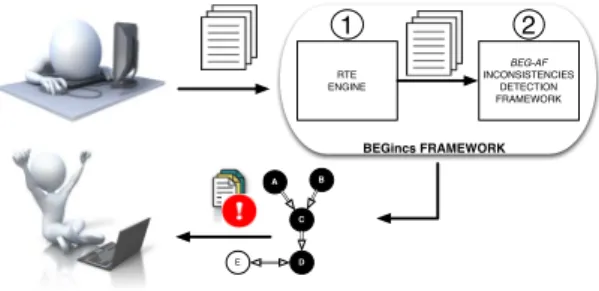
TE is a directional relation between two textual fragments. In various real world scenarios, these pairs cannot be considered as independent, and they need to be collected into a single graph. We define therefore a new framework involving en-tailment graphs, where pairs of textual fragments connected by semantic relations are also part of a graph that provides an overall view of the state-ments’ interactions (bipolar entailment graphs). Definition 1. A bipolar entailment graph is a tu-ple BEG = hT, E, Ci where T is a set of text fragments, E ⊆ T × T is an entailment relation between text fragments, andC ⊆ T × T is a con-tradiction relation between text fragments. This opens new challenges for TE, that originally considers the pairs as “self-contained” (i.e., the meaning of one text has to be derived from the meaning of the other). One challenge consists in checking BEGs to identify possible inconsisten-cies due to wrong relation assignments by the TE system. Figure 1 shows the architecture of the BE-Gincs framework to support human annotators in detecting inconsistencies in TE graphs.
RTE ENGINE BEG-AF INCONSISTENCIES DETECTION FRAMEWORK 1 2 BEGincs FRAMEWORK A E D C B
Figure 1: The BEGincs framework architecture.
Annotators provide the dataset to be checked as input of the BEGincs framework, which consists of two main modules: (1) a TE module, takes as input the dataset of text fragments, and returns the pairs annotated with the entailment or contradic-tion relacontradic-tions; and (2) a BEG-AF Inconsistencies Detection module, which translates the received BEGs into an argumentation framework such that argumentation semantics can be applied to retrieve consistent sets of arguments. The BEGincs frame-work returns through a user interface the starting BEGs highlighted with the consistent sets of text fragments. Checking them, annotators are able to detect errors in the annotation produced by the TE module (they will find inconsistent arguments in the returned sets), and correct the erroneous pairs.
2.1 Argumentation theory
An abstract argumentation framework (AF) (Dung, 1995) represents conflicts among elements called arguments. It is based on a binary attack relation among them, whose role is determined only by their relation with the other arguments. An AF encodes, through the attackrelation, the existing conflicts within a set of arguments. It identifies then the conflict out-comes, i.e. which arguments should be accepted (“they survive the conflict”) and which arguments should be rejected, according to some reason-able criterion. (Dung, 1995) presents several acceptability semantics that produce zero, one, or several consistent sets of accepted arguments. Such set of accepted arguments does not contain an argument conflicting with another argument in the set (conflict free). Following from this notion, an admissible set of arguments is required to be both internally coherent (conflict-free) and able to defend its elements. In BEGincs, we adopt admissibility based semantics. Roughly, an argu-ment is accepted if all the arguargu-ments attacking it are rejected, and it is rejected if there is at least an argument attacking it which is accepted. The sets of accepted arguments computed using an acceptability semantics are called extensions, and the addition of another argument from outside the set will make it inconsistent.
2.2 Inconsistencies detection
To reuse abstract argumentation results and se-mantics for inconsistencies detection, we need to represent both the entailment and the contradiction relations of the bipolar entailment graph under the form of attacks between abstract arguments in an argumentation graph (Definition 2).
Definition 2. A BEG-based argumentation frame-work is a tuplehA, ⇒, ⇔i where A is a set of text fragments called arguments,⇒ is a binary entail-ment relation on A (⇒ ⊆ A × A), and ⇔ is a binary contradiction relation onA (⇔ ⊆ A × A). The set of arguments is{a, b, . . . ∈ A}.
BEG-AFs’ consistent sets of arguments contain the text fragments that do not conflict with other fragments in the set (they are coherent). BEGincs uses the consistent sets of arguments computed following admissibility based argumentation se-mantics to support annotators in detecting incon-sistencies. We need then to define the semantics of the entailment and contradiction relations in the
BEG-based argumentation framework (i.e. the be-havior these relations have to satisfy in terms of conflict, since the only relation between arguments in abstract argumentation is the conflict relation). Example 1.
T1: Natural gas vehicles run on natural gas, so emit significant amounts of greenhouse gases into the atmosphere, albeit smaller amounts than gasoline-fueled cars. To combat global warming, we should be focusing our energies and invest-ments solely on 0-emission electric vehicles. H: On the surface, natural gas cars seem alright, but the topic becomes a bit different when they are competing against zero emission alternatives (e.g. electric cars).
In Example 1, the text (T 1) entails the hypoth-esis (H), i.e., T 1 ⇒ H. Entailment is a direc-tional relation (Dagan et al., 2009), that holds if the meaning of H can be inferred from the mean-ing of T , as interpreted by a typical language user. In the pair, T is more specific than H (i.e., the more specific argument entails the more gen-eral one). In the argumentation setting, we have to reason over this feature to identify which con-straints it poses in terms of conflicts among the text fragments. In particular, the following con-straints emerge from the entailment relation: as-suming T entails H holds, then (i) if there is a text fragment T1 which contradicts H (negative
TE) then T1 contradicts also T (T ≡ T1 does
not entail H ≡ T ), and (ii) if there is a text frag-ment T2which contradicts T then T2does not
nec-essary contradict H too. These two constraints hold when a TE pair is inserted into an entailment graph. As a consequence, from the arguments’ acceptance viewpoint: given that T ⇒ H, every time argument H is rejected, argument T is re-jected too. We model the entailment relation such that, given that T entails H, T is accepted only if H is accepted too (Definit. 3)1.
Definition 3. Given a BEG-based argumentation framework hA, ⇒, ⇔i, a translated BEG-based argumentation framework (BEG-AF) is a tuple hA, 7−→i such that the set of arguments A is {a, b, . . . ∈ A} ∪ {Xa,b, Ya,b, Ea,b | a, b ∈ A},
whereXa,b, Ya,bare the dummy arguments
corre-sponding to the contradiction relation andEa,bis
the dummy argument corresponding to the entail-ment relation, and7−→ is a binary conflict relation
1See (Cabrio and Villata, 2013) for a comparison of the entailmentwrt the support relation (Boella et al., 2010).
overA such that: b 7−→ Ea,b7−→ a iff a ⇒ b. We have now to define the semantics of the con-tradictionrelation (i.e., negative TE) in BEGs, see Example 2. (Marneffe et al., 2008) claims that contradiction occurs when two sentences i) are ex-tremely unlikely to be true simultaneously, and ii) involve the same event. Starting from these con-siderations, the following constraint holds for the contradiction pairs: T and H conflict with each other (i.e. it is not possible to have both in a co-herent and consistent set of arguments).
Example 2.
T2: Natural gas is the cleanest transportation fuel available today. If we want to immediately begin the process of significantly reducing greenhouse gas emissions, natural gas can help now. Other alternatives cannot be pursued as quickly.
H: On the surface, natural gas cars seem alright, but the topic becomes a bit different when they are competing against zero emission alternatives (e.g. electric cars).
Definition 4 models contradiction in BEG-AFs. The attack in (Dung, 1995) is directed from an ar-gument to another arar-gument while our contradic-tion leads to a cycle of attacks.
Definition 4. Given a BEG-based argumenta-tion framework hA, ⇒, ⇔i, a BEG-AF is a tuple hA, 7−→i such that A is the set of arguments, and 7−→ is a binary conflict relation over A such that: a 7−→ Xa,b7−→ Ya,b7−→ b, and
b 7−→ Xb,a7−→ Yb,a7−→ a, iff a ⇔ b.
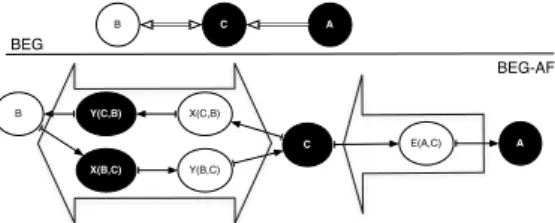
Figure 2 summarizes the translation procedure, which is the core of our framework. We start with a BEG consisting of three text fragments (i.e., ar-guments A, B, C) from Ex. 1 and 2, where T1 is A, T2 is B, and H is C. The BEG is then translated into a BEG-AF where dummy arguments are in-troduced to express the semantics of the relations of entailment and contradiction, e.g., dummy ar-gument EA,Crepresents the relation A entails C in
the AF. The only relation allowed in a BEG-AF is the conflict relation 7−→. Therefore we have that a BEG-AF is a standard abstract AF, and we can apply admissibility based argumentation se-mantics to retrieve consistent sets of arguments. Acceptability semantics return the extension of the BEG-AF (i.e., the black nodes in Fig. 2), where ar-guments C,A are accepted, and dummy arar-guments are filtered out from the set of accepted ones.
We prove now that our BEG-AF actually satis-fies the semantics of the entailment relation.
A C B B X(B,C) Y(B,C) C Y(C,B) X(C,B) A E(A,C) BEG BEG-AF
Figure 2: Translation from a BEG to a BEG-AF.
Proposition 1 (Semantics of entailment). Given a BEG-AF, if it holds thatT ⇒ H and text fragment T is accepted, then fragment H is accepted too. Proof. We prove the contrapositive. If it holds that T ⇒ H and text fragment H is not accepted, then text fragment T is not accepted. Assume that T ⇒ H and assume that argument H is not ac-cepted, then dummy argument ET ,H is accepted.
Consequently, T is not accepted, i.e., rejected. We need to add two nodes, i.e., dummy argu-ments Xa,b and Ya,b, to represent a contradiction
while we only need one node, i.e., dummy argu-ment Ea,b, to represent entailment, since
preserv-ing the semantics of a contradiction holdpreserv-ing be-tween two text fragments means that the two text fragments cannot be together in a consistent set of arguments. To avoid the two being both ac-cepted, we need to introduce two dummy argu-ments so that: a (accepted) 7−→ Xa,b (rejected),
Xa,b 7−→ Ya,b (accepted), and Ya,b 7−→ b
(jected). In this way, if a is accepted then b is re-jected, and viceversa. A unique dummy argument between a and b would not ensure such behavior.
Existing works combine NLP and argumenta-tion theory, e.g. (Ches˜nevar and Maguitman, 2004; Carenini and Moore, 2006; Wyner and van Engers, 2010; Feng and Hirst, 2011) with different pur-poses. However, only our previous work (Cabrio and Villata, 2012) combines TE with AF, but here our goal is to introduce a framework for inconsis-tencies detection in TE annotations.
3 Experimental setting
Data set. We added 60 pairs to the Debatepedia dataset2(extracted from a sample of Debatepedia3 debates (Cabrio and Villata, 2012)), resulting in 160 pairs as training set, and 100 pairs as test set (balanced wrt to entailment/contradiction).
2
The only available dataset of T-H pairs combined into bipolar entailment graphs.
3http://idebate.org/
Evaluation. First step: we assess the perfor-mances of the TE system to correctly assign the TE relations to the pairs of arguments in the dataset. Second step: we evaluate how much such performances impact on the flattening of the BEG-AF, i.e., how much a wrong assignment of a rela-tion to a pair of arguments is propagated in the AF. It is actually to detect such wrong assignments that the BEGincs framework has been conceived.
To recognize TE, we tested several algorithms from the EOP4, i.e. BIUTEE (Stern and Da-gan, 2011), TIE5and EDITS (Kouylekov and Ne-gri, 2010). BIUTEE obtained the best results on Debatepedia (configuration exploiting all avail-able knowledge resources): Acc:0.71, Rec:0.94, Pr:0.66, F-meas:0.78. As baseline we use a token-based version of the Levenshtein distance algorithm, i.e. EditDistanceEDA in the EOP (Acc:0.58, Rec:0.61, Pr:0.59, F-meas:0.59).
Then, we consider the impact of the best TE configuration on the arguments acceptability. We use admissibility-based semantics to identify the accepted arguments both on i) the goldstandard entailment graphs of Debatepedia topics, and ii) on the graphs generated using the relations assigned by BIUTEE. On the 10 Debatepedia graphs, BEGincs avg pr:0.68, avg rec:0.91, F-meas:0.77. BIUTEE mistakes in relation assign-ment propagate in the AF, but results are promis-ing. The incons. detection module takes ∼1 sec. to analyze a BEG of 100 nodes and 150 relations.
4 Concluding remarks
We have presented BEGincs, a new formal frame-work that, translating a BEG into an argumenta-tion graph, returns inconsistent set of arguments, if a wrong relation assignment by the TE system occurred. These inconsistent arguments sets are then used by annotators to detect the presence of a wrong assignment, and if so, to narrow the set of possibly erroneous relations. If no mistakes are produced in relation assignment, by definition BE-Gincs semantics return consistent arguments sets.
Assuming that in several real world scenarios TE pairs are interconnected, we ask to the NLP community to contribute in the effort of building suitable resources. In BEGincs, we plan to verify and ensure transitivity of BEGs.
4
http://bit.ly/ExcitementOpenPlatform 5http://bit.ly/MaxEntClassificationEDA
References
J. Berant, I. Dagan, and J. Goldberger. 2010. Global learning of focused entailment graphs. In ACL, pages 1220–1229.
G. Boella, D. M. Gabbay, L. W. N. van der Torre, and S. Villata. 2010. Support in abstract argu-mentation. In P. Baroni, F. Cerutti, M. Giacomin, and G. R. Simari, editors, COMMA, volume 216 of Frontiers in Artificial Intelligence and Applications, pages 111–122. IOS Press.
E. Cabrio and S. Villata. 2012. Natural language ar-guments: A combined approach. In Procs of ECAI, Frontiers in Artificial Intelligence and Applications 242, pages 205–210.
E. Cabrio and S. Villata. 2013. A natural language bipolar argumentation approach to support users in online debate interactions;. Argument & Computa-tion, 4(3):209–230.
G. Carenini and J. D. Moore. 2006. Generating and evaluating evaluative arguments. Artif. Intell., 170(11):925–952.
C. I. Ches˜nevar and A.G. Maguitman. 2004. An ar-gumentative approach to assessing natural language usage based on the web corpus. In Procs of ECAI, pages 581–585.
I. Dagan, B. Dolan, B. Magnini, and D. Roth. 2009. Recognizing textual entailment: Rational, evalua-tion and approaches. Natural Language Engineer-ing (JNLE), 15(04):i–xvii.
P.M. Dung. 1995. On the acceptability of arguments and its fundamental role in nonmonotonic reason-ing, logic programming and n-person games. Artif. Intell., 77(2):321–358.
V. Wei Feng and G. Hirst. 2011. Classifying argu-ments by scheme. In Procs of ACL-2012, pages 987–996.
M. Kouylekov and M. Negri. 2010. An open-source package for recognizing textual entailment. In Procs of ACL 2010 System Demonstrations, pages 42–47. M.C. De Marneffe, A.N. Rafferty, and C.D. Manning.
2008. Finding contradictions in text. In Procs of ACL.
A. Stern and I. Dagan. 2011. A confidence model for syntactically-motivated entailment proofs. In Pro-ceedings of RANLP 2011.
A. Wyner and T. van Engers. 2010. A framework for enriched, controlled on-line discussion forums for e-government policy-making. In Procs of eGov 2010.