HAL Id: hal-02080528
https://hal.archives-ouvertes.fr/hal-02080528
Submitted on 26 Mar 2019
HAL is a multi-disciplinary open access
archive for the deposit and dissemination of
sci-entific research documents, whether they are
pub-lished or not. The documents may come from
teaching and research institutions in France or
abroad, or from public or private research centers.
L’archive ouverte pluridisciplinaire HAL, est
destinée au dépôt et à la diffusion de documents
scientifiques de niveau recherche, publiés ou non,
émanant des établissements d’enseignement et de
recherche français ou étrangers, des laboratoires
publics ou privés.
Characterization, Integration and Operation of a 100-W
Solid State Amplifier in the Advanced-VIRGO
Pre-Stabilized Laser System
Frédéric Cleva, Jean-Pierre Coulon, Fabien Kéfélian
To cite this version:
Frédéric Cleva, Jean-Pierre Coulon, Fabien Kéfélian. Characterization, Integration and Operation of
a 100-W Solid State Amplifier in the Advanced-VIRGO Pre-Stabilized Laser System. CLEO Europe
2019, Jun 2019, Munich, Germany. �hal-02080528�
Characterization, Integration and Operation of a 100-W Solid State
Amplifier in the Advanced-VIRGO Pre-Stabilized Laser System
Frédéric Cleva, Jean-Pierre Coulon, Fabien Kéfélian
ARTEMIS, Université Côte d’Azur, Observatoire de la Côte d’Azur, CNRS, F-06300 Nice, France
VIRGO is a 3-km-arm laser interferometer for gravitational wave detection in the 20 Hz - 5 kHz frequency band. Its second-generation version, Advanced VIRGO, aims at reducing the detector noise by a factor of ten compared to the first generation, with the progressive deployment of new technologies and equipement [1]. The first detections of gravitational waves with VIRGO were made in August 2017 [2]. For its next scientific observations with an increased sensitivity, a pre-stabilized laser system twice as powerful has been developed. It comprises a new 100-W solid-state amplifier pumped at 878.7 nm. It is the first time such amplifier is integrated in a gravitational wave detector, LIGO detectors using a 70 W amplifier pumped at 808 nm. Power noise, long term power stability, frequency noise, beam jitter and transverse mode quality have been extensively studied and compared to Advanced VIRGO requirements.
The pre-stabilized laser system, emitting a continuous wave at 1064 nm, is based on a 17 W laser oscillator, injection locked onto a low frequency noise 500 mW source, followed by the new 100 W amplifier and a 1.6-m-perimetre bow-tie shape Fabry-Perot cavity acting as a spatial and temporal mode cleaner. The optical amplifier, manufactured by neoLASE, is based on four Nd3+ :YVO
4 crystals pumped longitudinally each with 50 W at
878,7 nm coming from volume Bragg grating diode lasers. The pump light is transported by 20 meters of multi-mode fibers deployed between two separate rooms for acoustic and electromagnetic contamination reasons. The first test and characterization campaign was performed in Nice in 2017 followed by the integration at the VIRGO site. The system has been working continuously for commissioning for more than one year.
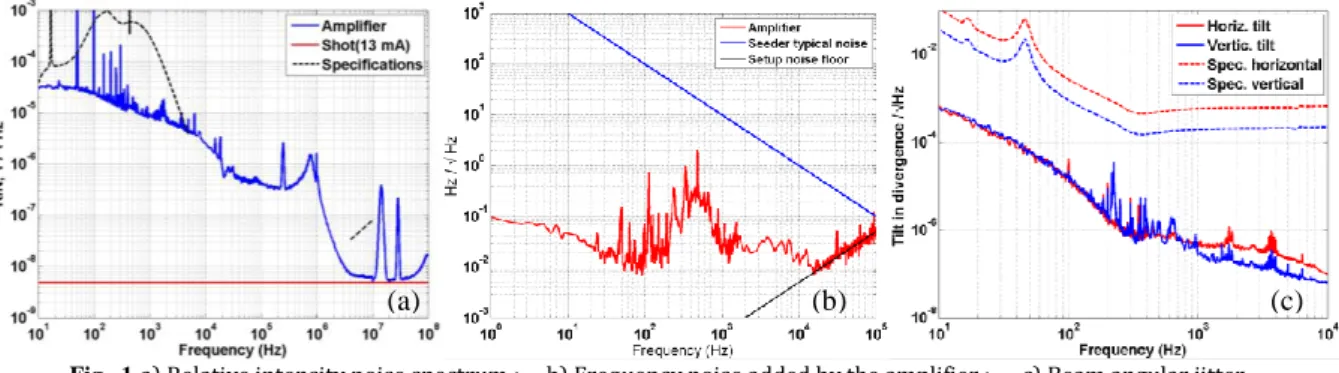
The amplifier delivers 96 W with 17 W input and reaches 100 W with increased input power. No global decrease of the amplifier output power has been so far observed. The relative intensity noise spectrum (Fig. 1-a) is below 10-4(10 Hz/f)1/2 Hz-1/2 in the detection band and limited by 13 mA photocurrent shot noise (510-9 Hz -1/2) in the 5-10 MHz band used for modulation. Further power noise reduction is realized by combining passive
filtering from Fabry-Perot mode cleaners and active power stabilization with an acousto-optic modulator in transmission to reach 210-9 Hz-1/2 in the detector band. The spectrum of the frequency noise added by the
amplifier (Fig. 1-b) was measured with a heterodyne interferometer and is lower than 310-1 Hz/Hz1/2, far below
the master laser oscillator. Those performances are compliant with Advanced VIRGO specifications [1].
Fig. 1a) Relative intensity noise spectrum ; b) Frequency noise added by the amplifier ; c) Beam angular jitter
The spatial beam properties of the amplifier output are another important aspect for the laser system. The output power and transverse beam profile were characterized as a function of the input beam waist size and position, and were found strongly dependent on the injection parameters. During the preliminary test and characterization campaign, the beam modal content was analysed with a Fabry-Perot cavity, giving for the optimized input beam configuration a TEM 00 content above 85 %. The temporal fluctuations of the beam transverse and angular (Fig. 1-c) position were measured with a pair of 4 quadrants photodiodes. The noise spectra, normalized respectively by the waist size and the divergence, are lower than 10-3(1 Hz/f) Hz-1/2 in the
detector band, one order of magnitude below the VIRGO specifications. After the complete integration on site, which required unrolling the 20-m pump transport fibers, we noticed a reduction of the modal content. After a new optimization effort, the output power was 92 W with a fundamental modal content of 80%. Further investigations have shown that the way the pump transport fibers are handled and stressed impacts their output beam shape and consequently may impact pump and signal overlap. Solutions to this unexpected issue are currently under investigations.
1 F. Acernese et al., "Advanced VIRGO: a second-generation interferometric gravitational wave detector," CQG. 32, 024001 (2015). 2 P. B. Abbott et al., "GW170814 : A three-detector observation of gravitational waves from a binary black hole coalescence," Phys. Rev. Lett. 119, 141101 (2017).