Developing a Server OEM Strategy during Technology Commoditization by
Kristie A. Burnham B.S. Mechanical Engineering Worcester Polytechnic Institute, 1991
Submitted to the Sloan School of Management and the Department of Civil Engineering in Partial Fulfillment of the Requirements for the Degrees of
Master of Science in Management and
Master of Science in Civil and Environmental Engineering in Conjunction with the Leaders for Manufacturing Program at the
Massachusetts Institute of Technology May 10, 2002
© 2002 Massachusetts Institute of Technology All rights reserved
S ig n a tu re o f A uth o r ... I...7 ... Sloan School of Management Department of ivil and Environmental Engineering May 10, 2002 Certified by... Certified by... A ccepted by ... Accepted MASSACHUSETTS INSTITUTE OF TECHNOLOGY E .. ... Charles H. Fine Chrysler Leaders for Manufacturing Professor Thesis Supervisor
...
David Simchi-Levi Professor of Civil and Environmental Engineering Thesis Supervisor
...
Margaret Andrews Executive Director of Master's Program Sloan School of Management
...
Oral Buyukozturk Chairman of Committee on Graduate Studies epartment of Civil and Environmental Engineering
Developing a Server OEM Strategy during Technology Commoditization by
Kristie A. Burnham
Submitted on May 10, 2002 to the Sloan School of Management
and the Department of Civil and Environmental Engineering, in partial fulfillment of the Requirements for the Degrees of
Master of Science in Management and
Master of Science in Civil and Environmental Engineering
ABSTRACT
Commoditization of technology is a business dynamic that affects the competitive nature of the computer industry. The intensity of competition increases the importance of product strategy and sustainable competitive advantage. Traditionally, outsourcing of some portion
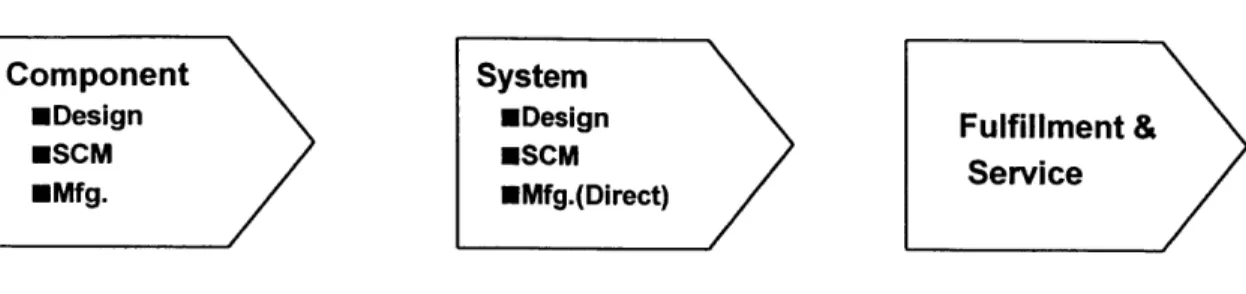
of the manufacturing to contract manufacturers was part of any Original Equipment Manufacturer's (OEM) manufacturing strategy. This thesis project, at Dell Computer Corporation, was to explore the opportunity to outsource the design of some of the server components and to suggest a methodology for implementation of this strategy.
The development of the Enterprise Services Group (ESG) Server OEM Strategy included evaluation of the business model, core competencies, product portfolio, competitive market position, and current supply chain design for server products. The literature review explores published frameworks for making sourcing decisions and also explores the topic of
standardization. The strategy that was developed defines the OEM sourcing model and considerations for successful implementation, including product and source selection, competitive landscape and organizational considerations.
Thesis Supervisors:
Charles H. Fine, Chrysler Leaders for Manufacturing Professor David Simchi-Levi, Professor of Civil and Environmental Engineering
ACKNOWLEDGEMENTS
The author gratefully acknowledges the support and resources made available by the Leaders for Manufacturing program, a partnership between MIT and manufacturing companies. This project would not have been possible without the support and learning provided by the LFM program and my classmates.
I would like to acknowledge the support and guidance of my two thesis advisors, Charlie Fine from the Sloan School of Management and David Simchi-Levi from the Department of Civil and Environmental Engineering.
I would also like to extend my sincere gratitude to the Dell Computer Corporation for the sponsorship of my project and for the support of the LFM program. I would especially like to thank Jens Gruenkemeier for his support and mentorship during the internship. I would also
like to extend my thanks to Ken St. Cyr, Mollie Chang, and Lori Keith for the advice, information and support they provided. This thesis would not have been possible without their valuable assistance during my internship at Dell. I would also like to thank Debika
Ingham and Micah Samuels, who were fellow LFM -Dell interns, it was great to be at the same internship location together.
I also wish to thank my classmates - who have taught me the most during my two years at MIT. Their wealth of knowledge, experience and humor will always be a part of my
memorable experiences at MIT.
My heartfelt gratitude goes to my family, especially my mother and father, who have supported me always.
TABLE OF CONTENTS
ABSTRACT ... 2
ACKNOW LEDG EM ENTS ... 3
LIST O F FIGURES ... 7
1. INTRODUCTION AND OVERVIEW ... 8
1.1. Project Description... 8
1.2. Scope and Lim itations... 9
1.3. Thesis O verview ... 9
2. COMPANY BACKGROUND ... 10
2.1. Chapter O verview ... 10
2.2. Com pany O verview ... 10
2.3. Com pany History and Position... 10
2.4. Dell's Com petitive Advantage - Direct M odel... 11
2.5. M arket conditions... 12
2.6. Product O verview ... 13
2.7. Organizational structure... 14
2.8. Current supply chain g ... 16
2.9. Sum m ary ... 16
3. PROJECT DEFINITION & BACKG ROUND ... 17
3.1. Chapter Overview ... 17
3.2. Changing industry structure - com m oditization... 17
3.3. Casual Loop diagram of Commoditization / Industry dynamics ... 21
3.4. Product Description... 23
3.5. Server - Storage Infrastructure Relationship... 23
3.6. Customer Requirements - Performance, Availability, and Scalability ... 24
3.7. Com ponent Technology... 25
3.8. Project Definition... 27
3.9. Enterprise System s Group (ESG) Strategy ... 27
3.10. W hite-box t du t ... 28
3.11. OEM , DMp ... 29
3.12. Project Approach... 30
4. LITERATURE REVIEW / BENCHMARKING... 32
4.1. Introduction...32
4.2. Strategic Fram eworks... 33
4.3. M ake/Buy Decision ... 35
4.4. Standard vs. Unique Design Com ponents ... 39
4.5. Clock speed...42
4.6. Supplier relationships... 42
4.7. Im portance of Product & Com ponent Design ... 43
4.8. Autom otive Strategic Sourcing Fram ework ... 44
4.9. HDD Industry - Effects of Disruptive Technology... 46
4.10. Benchm arking ... 47
4.11. Consum er Product Group's OEM strategy ... 47
4.12. Sum m ary... 50
5. M ETHODOLOGY FOR THE DESIGN OF THE STRATEGY ... 51
5.1. Introduction...51
5.2. Proposed M odels... 51
5.3. Value Chain ... 53
5.4. Potential Benefits... 54
5.5. Definition of Core Competency ... 56
5.6. Custom er Needs... 57
5.7. Customer needs translated to Product Architecture ... 58
5.8. Definition of M arket Segm ents... 58
5.9. Supplier Capability ... 59
5.10. Engineering / Product Architecture Considerations... 59
6. DECISION CRITERIA I ANALYSIS...61
6.1. Decision variables... 61
6.2. Industry Trends... 61
6.3. Core com petencies... 63
6.4. M odel Definition / Clarification... 64
6.5. M arket segm entation ... 66
6.6. Analysis of Expected Benefits- Economic Value Analysis ... 67
6.7. Strategic Benefits... 69
6.8. Sum m ary ... 74 7. CONCLUSION ...
7.1. Introduction... 76
7.2. Im plem entation Status ... 76
7.3. Second Source Selection... 77
7.4. Competitive Landscape ... 78
7.5. Organizational Aspects... 79
LIST OF FIGURES
Figure 1. High Level O rganizational Chart... 15
Figure 2. Com m oditization Curve ... 18
Figure 3. Causal Loop Diagram of Commoditization Curve Dynamics ... 21
Figure 4. Source: IDC Server Tracker CY2000, Disk Storage Systems Market...28
Figure 5. Foster, Richard N. 'Payoff from technology investment follows S-curve' ... 35
Figure 6. Effect of OEM/ODM barriers on perceptions of OEM ... 48
Figure 7. EM-ODM-OEM Continuum Relationship ... 52
Figure 8. High Level Value Chain... 54
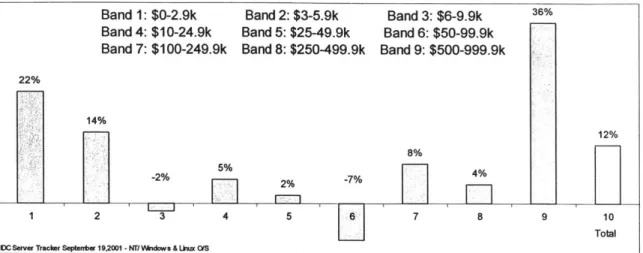
Figure 9. IDC Server Tracker September 19, 2001 - NT Windows & Linux o/s...62
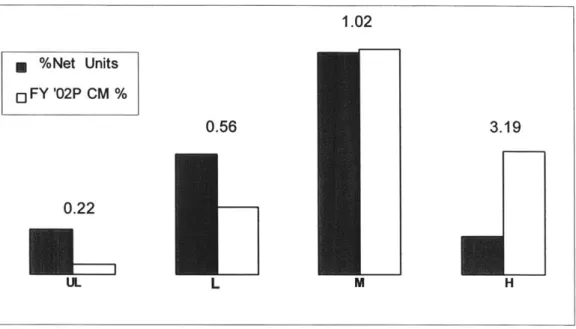
Figure 10. Dell Server Segments - % Net Units vs. FY'02 Projected Contribution Margins63 Figure 11. Definitions for EM - ODM - OEM Business models ... 65
Figure 12. Matrix of Market Segment vs. Product Characteristic ... 66
Figure 13. Economic benefits of the EM-ODM-OEM models...68
Figure 14. Strategic benefits at the high and low-end segments ... 71
Figure 15. Potential Benefits High end market segment... 73
1. INTRODUCTION AND OVERVIEW
The work presented in this thesis was completed as a part of a six and a half-month internship in the World Wide Procurement organization at Dell Computer Corporation in Austin, Texas. This internship is a result of the partnership between Dell Computer Corporation and the Leaders for Manufacturing fellows program at the Massachusetts Institute of Technology.
Companies in any industry are faced with a choice of deciding what competitive advantage their business model and products will have that will allow them to have a sustained competitive advantage. In the computer industry, commoditization of technology is a prevalent business dynamic. The effect of commoditization on the industry is evidenced by the lack of differentiation from a hardware perspective. Computer technology
commoditization has contributed the competitive intensity of the industry and has had a limiting effect on margins. Commoditization has lead to an increased focus on reducing costs and the evaluation of the value chain for further cost improvement opportunities.
1.1. Project Description
The objective of the project was to determine what the sourcing strategy should be for the server product line. The Enterprise System Group (ESG) had traditionally designed some of the components (motherboard and chassis) and all system level server products in house. Once the design was complete, a contract manufacturer would be selected to manufacture the Dell designed components. As a part of the sourcing strategy the goal was to determine if Dell should continue to design the components and also to consider if they should be designing the system. At the start of the project, the option to outsource the system design
was being challenged as a viable option to consider given the business strategy. The scope of this project was to explore this opportunity to outsource design and suggest a framework for the implementation of this concept so that Dell's core competencies were leveraged for future competitive advantage.
1.2. Scope and Limitations
The scope of the project was to understand the value chain for server products that Dell is currently offering in the market. Industry structure and trends will be evaluated to
understand the potential opportunities, risks and the strategic impact of the different scenarios.
1.3. Thesis Overview
This document will begin with a brief overview of the Dell Computer Corporation, including an overview of the company, its history, the business model and current market position. Chapter 3 will contain a brief discussion of the products that Dell -Enterprise Services Group (ESG) offers, current supply chain design, and the effects of the current industry trends with a detailed description of the project. Chapter 4 presents a discussion of relevant
literature on the 'make/buy' decision and standardization of various products. Also, included will be an example of a make/buy decision in a different group as well as an internal
company example of Dell's success/ failure with the standardization of a product. Chapter 5 will present the methodology for the design of the strategy and the subsequent Chapter 6 will provide the framework for the decision analysis. Chapter 7 gives an overview of the
relevant implementation and organizational issues. The final section, Chapter 8, will discuss the key findings of the project as well as opportunities for future study.
2. COMPANY BACKGROUND
2.1. Chapter Overview
This section will provide a detailed overview of the company, both from a historical perspective as well as its current position in the industry. The changing market will be examined and the industry dynamics that affect Dell's competitive position. Dell's markets will be examined and aligned with competitors product offering. Dell's competitive
advantage has been attributed to their business model, which will also be discussed in this chapter. A high level view of organizational structure will be presented as well as an overview of Dell's current supply chains.
2.2. Company Overview
Dell is the world's number one computer systems company based on market share. Dell offers a complete portfolio of products and services, which includes; laptops and desktops computers, workstations, servers, storage devices, appliances and switches including the software and services associated with the products. Dell has established this leadership with a focus on the customer experience by directly selling product to the consumer without a sales channel. Much of the growth was due to Dell's strategy to initially sell computers on-line to corporations with less emphasis on the average home user. Dell has grown to be a $32 billion business that employs approximately 35,000 people, globally.
2.3. Company History and Position
Michael Dell, CEO, started the company in 1983 during his freshman year at the University of Texas in Austin. Dell began assembling IBM clones, to customer specifications which may have included additional memory or specific chipsets that were not offered in the
mainstream market systems, etc. By May of 1984, Dell had decided to postpone his collegiate career to pursue the PC venture full time. In 1988, the company went public offering stock. By 1992, Dell joined the list of Fortune 500 companies becoming one of the five largest computer makers in the world. During 1996, computers were being sold via the
company website and four years later sales over the Internet were $50 million per day. During 2001, Dell captured the lead position in global market share and also aggressively pursued additional market share by initiating an aggressive price war. During this growth, Dell's product offering has been expanded from desktop computers to include notebooks, workstations, servers, storage and switches including the respective software and services
to accompany them. Dell's mission statement is 'to be the most successful computer company in the world at delivering the best customer experience in markets we serve'.
2.4. Dell's Competitive Advantage - Direct Model
Dell's advantage in the marketplace is a result of Dell's business model. The direct
business model encompasses the entire value chain from the time the order is placed by the customer through to the delivery of the hardware to the customer. The following are
attributes of the model as seen through the natural progression of an order:
" The customer places the order directly with Dell, not a reseller, either through the
web, through sales over the phone or face-to-face with a sales representative. If the order is not entered via the web then the sales representative enters the order.
" Dell receives the inventory to build the orders as they are received from the
customers on a 2-hour delivery cycle from the suppliers.
* The order is then pulled, kitted and built to customer requirements. Software is downloaded into the system and the system is tested. The system is then delivered to the customer when the order is complete.
The advantage of this type of business model is that inventory is lower than that of the value chain that includes a reseller who must have inventory on the store shelf. This allows Dell to have a negative cash conversion cycle since supplier terms and customer payment terms overlap in Dell's favor. Another unique aspect is that Dell can introduce new technology faster since it does not need to empty the channel of old technology prior to new technology introduction. In addition, since Dell has a direct one-to one contact with the consumer they can receive feedback about the product that is unfiltered by a third party reseller. The lack of the reseller link in the value chain eliminates any non-value added mark-ups on the product. The model has given Dell an advantage and in the current market has allowed them to continue to grow and operate profitably.
2.5. Market conditions
Currently, the players in the computer industry, including Dell, are being affected by the following conditions:
" Price war behavior by many of the competitors thus causing intensified competition
and some consolidation.
" A slowing of the world economy.
" Slower technology adoption.
" Continued cross-subsidization between products to offset the effects of technology
commoditization by many of the major players in the industry.
The recession-like characteristics of the economy during the calendar year of 2001 has slowed the explosive growth of the computer industry which was experiencing double digit growth for several years preceding 2001. This has resulted in slowing demand and excess capacity. Dell decided that this was an opportune time to launch a price war hoping to
combination of the world economy, Dell's low cost business model and the price war tactics has caused Dell to gain market share during an unlikely time. This has been a profitable time for the corporation unlike many of its competitors. Much commentary has appeared in the press concerning the profitability of the industry and the lasting effects of the price war on industry margins. Consolidations through mergers, acquisitions and bankruptcy have
also increased during the year.
Another factor that is credited with fueling the computer industry growth during the recent years was the new millennium and the need for many corporations to upgrade systems to become compliant. New technology upgrades being driven by business needs also appears to be slowing during this time and the average corporate market is slowing its demand for new technology since the current technology is adequate for most purposes.
With the increase in competition and the declining margins due to the price war, another dynamic that affects Dell is a competitor's ability to compete by cross subsidizing across products. Examples of this in the computer industry include HP printer cartridges and IBM's consulting services. These two manufacturers can compete aggressively and possible take a loss with some products by subsidizing the revenues with profits from product lines where there is less competition. With both of these examples these companies are less affected by the price war. In these segments where Dell cannot compete, competitors are able to charge higher margins in these segments to offset negative profitability in other products. The following section will explain the markets in which Dell is a participant.
2.6. Product Overview
Dell offers the following products and services to its customers, the major components of the product offering are:
* Desktops - 'Optiplex' brand for the corporate customers that need a high reliability in a networked environment. 'Dimension' brand for the home and small business user requires the ability to incorporate new technology.
" Workstations- 'Precision' brand name offers customized solutions for more complex
computing environments.
" Notebooks - Like Desktops there is a brand for corporate; 'Latitude' and the
'Inspiron' for the individual or small business user.
* Servers - 'PowerEdge' brand name is designed to run on standard operating software and comprised of an Intel processor. Servers were introduced by Dell in
1996 and were designed to provide a reliable, available and serviceable solution to the customer. Appliances are servers that are targeted at specific web-hosting applications.
" Storage - 'PowerVault' brand was introduced in 1998 and is leveraging standard
technology to meet customer's storage needs.
* Switches - 'PowerConnect' brand introduced in 2001.
* 'Premier' services - consists of consulting, deployment and support for Dell's product portfolio.
As discussed in the company overview, Dell began as a PC maker and has increasingly been entering new complementary markets where its business model can be leveraged.
2.7. Organizational structure
With multiple products and customers and suppliers dispersed around the world the
coordination of many activities becomes necessary. Dell has a hybrid matrix organizational structure. The company has a level of senior vice presidents who report directly into the
Office of the Chairman. At this top level are the vice presidents for each international region, for the Americas, for Product Development, and for the individual support groups, of which World Wide Procurement is one. Under the Americas group are seven sales segments headed by vice presidents, VP Americas Manufacturing, and VP Service. The sales segments are organized by customer type (e.g. military, education, etc.). World Wide Procurement (organized by commodity or supplier), various other support groups, and the Product Development Group (organized by product) matrix across each sales segment. Figure 1 graphically depicts a high level view of the organization.
Office of CEO
Corp Investor Dell WW Manufacturing Corporate Fn lTAdmin ICorp
Brand Reain etrs & Cuatomer Strtg Fiance
I/
HR ILegal (Mpo Com W rcrmnStrategy Reain etrs Experience 1 aeg 1 Se 1 om WWPourmn
AMERICAS
BSD (inSD PAD OaWare lCanada & Americas inti Latin America) I Education & Healthcare Government Global I I LCA I
Americas Manufacturing
Nashville Manufacturing I Austin Manufacturing
Americas Services
PRODUCT DEVELOPMENT GROUPS
Client Product Group (CPG) Enterprise Systems Group (ESG)
INTERNATIONAL REGIONS
EMEA (Europe, Middle East, and Africa) Asia Pacific (includes Japan)
Figure 1. High Level Organizational Chart
This project work was sponsored by a sub-segment of the World-wide Procurement - OEM Server group. The supply chain at Dell is the coordination of all the activities, including manufacturing, between customer order and the delivery to the customer.
2.8. Current supply chain design
Dell has major manufacturing facilities in 6 locations globally;
" Americas: Austin, Texas, Nashville, TN
" Europe: Limerick, Ireland,
* Asia: Xiaman, China, Panang, Malaysia
" South America: Eldorado do Sul, Brazil
Dell's goal is to have minimal inventory and to 'Build to Order' once the customer has placed an order. To support this it is necessary for suppliers to set up hub locations at each of the Dell manufacturing facilities. With the current business model Dell negotiates and controls multiple levels of the entire supply chain. Dell, or any OEM, has market power that is greater than the supplier so they will negotiate the pricing for components that the supplier consumes in their manufacturing.
2.9. Summary
Based on various performance indicators and company growth, Dell is a successful
company. In order to maintain this level of performance, Dell is constantly driven to change and improve as the industry evolves in order to maintain its advantage.
3. PROJECT DEFINITION & BACKGROUND
3.1. Chapter Overview
This chapter will focus on the background for this project and the dynamics in the industry that make the project pertinent to Dell at this point in time. The technology of the products will also be discussed as well as the importance of the relationship between Servers and Storage products. The industry structure as well as the Dell Enterprise Systems Group's (ESG) position will be examined. This will be the basis for this project's motivation and definition.
3.2. Changing industry structure - commoditization
Commoditization, in high technology, results in an increase in the number, availability, and similarity of products in a given category. Since there is little or no differentiation of
hardware, competitors focus on price and service as differentiation points. Commoditization is not just about reduced prices and margins for hardware but also typically drives the standardization of the hardware. This aspect is attractive for Dell since they are a
technology integrator. Dell recently has been referred to as the 'Anti-Technology company' in the popular press (Red Herring, 2001). The following graphic shows an aspect of a corporation's financial success as the technology becomes commoditized.
Proprietary orage Commodkization
Servers
Gross Margin otebooks
Compe Itors' higher OpInc allows F r Cross-Subs Idation 0
0
00/0 Work---Dell
Advanta Fully Commodiftzed ions Desktopse of the Deli Direct model
_-- .* .
Volume
---..
Note: Bubble size Indicates ratio between Dell (grey) and largest non-Dell (white) player in the market
Figure 2. Commoditization Curve
Figure 2 depicts a curve that transitions from proprietary hardware through a
commoditization phase, until the product is considered commoditized on the horizontal axis. The horizontal axis shows the three phases: proprietary, commoditization and fully
commoditized. As this transition happens it is also assumed that volume is increasing as you move to the right along the horizontal axis. The vertical axis shows the effect of this transition on the product's gross margin. Conceptual bubbles for the markets that Dell is a
competitor in is displayed along this curve that show the level of commoditization for each product group. Dell's market position, relative to its nearest competitor is depicted by the size of the gray bubble relative to the competitor's white bubble. Dell's market position is more dominant for those products that have moved down the commoditization curve. This chart considers the hardware and the software as a part of the product that is displayed in
-- --
I---OpInc
the chart. If the chart was for only hardware servers in particular would be considered more commoditized.
The lower half of this chart shows the Operating Income for a Dell competitor that is a technology innovator, with the typical characteristics that include: intensive R&D budgets,
high development budgets, proprietary hardware solutions, unpredictable demand and lower return on investment when all projects are considered. These developers of technology typically introduce product with proprietary elements. After a product is developed and
introduced to the market, the market is assessed based on market attractiveness by other potential entrants. Some of the competencies exhibited by the technology innovators are the ability to differentiate their product through technology. But if the market is seemingly attractive competitors will enter and some effects might be standardization and increased competition, both will reduce margins.
Dell's business strategy is not to be a technology innovator but instead to leverage
standardized hardware solutions. This minimizes the need to do research and development at least not at the scale of a technology innovator. This changes the slope of the operating income line and enables Dell to have an advantage over the 'technology innovator' as a product moves down the curve. It should be noted that Dell is at a disadvantage at the top of the curve. The direct business model allows Dell to differentiate from the competitors through pricing as well as other customer experience criteria. One of the difficulties that Dell has encountered along the way with this approach is competitor's ability to cross-subsidize between products or offset declining margins on commoditized products with higher margins on proprietary products. This position with regard to commoditization is built on the
following assumptions:
" Available profits increase as a product moves down the 'commoditization curve'
since the market expands as pricing is reduced since the product is attractive to a larger market. The increase in volume will create a larger profit pool even though on a unit basis it may be less.
* More competitors will enter the market as the product moves down the curve, increasing the importance of differentiation through non-hardware features. * A low cost business model is critical to success once commoditization begins and
the company that ramps up to volume the quickest will capture market share while maintaining profitability.
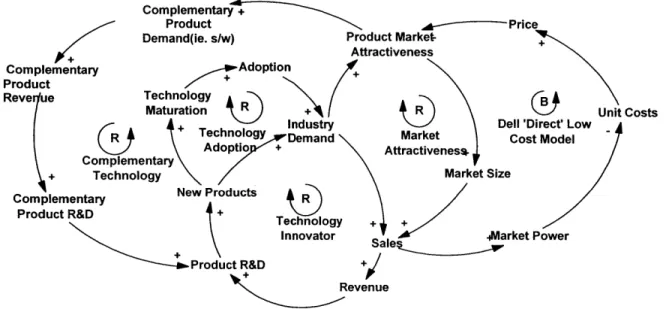
This strategy and the ensuing price war has generated concern that computers are becoming fully commoditized and that it will become a low margin product similar to other electronic consumer products. The following causal loop diagram was developed to potentially understand the relationship between the developers of proprietary solutions and those that commoditized products through standard technology solutions. Also, the diagram proposes one possible explanation for the reason why computers will not become like other electronic consumer products at least in the short term.
3.3. Casual Loop diagram of Commoditization / Industry dynamics
Complementary +
Product .--- Price
Demand(ie. s/w) Product Market- +
Attractiveness
Complementary +Adoption +
Product
Reve ue Technology
Maturation R + R Unit Costs
+ Industry Dell 'Direct' Low
Technology Demand Market Cost Model
Adoptio + Attractiveness.
Complementary
+ Technology Market Size
Complementary New Products R
Product R&D + Technology + +
Innovator S.Market Power
Product R&D
Revenue
Figure 3. Causal Loop Diagram of Commoditization Curve Dynamics
This loop diagram proposes to show some of the same dynamics discussed above with the commoditization curve discussion.
'Technology Innovator' loop - shows that the successful innovator invests money in R&D, thus developing new products that create industry demand, leading to sales and revenue that is invested in future R&D reinforcing the technology innovation cycle.
'Technology Adoption' loop - shows the relationship between new products and the subsequent technology maturation as the technology is used and adopted. As the technology matures and becomes adopted, not only lead users but also the mainstream
'Market Attractiveness' loop - As demand for the new technology increases, the
attractiveness of the market to potential entrants also increases. This facilitates the desire to be able to enter the market with standard technology that is readily available. As new
players enter the market, competition increases and prices drop, expanding the market size thus increasing sales.
Dell 'Direct' Low Cost Model loop - As sales increase, the market power of the player controlling market share increases enabling them to reduce unit costs through efficiencies and power of negotiations. The reduction in unit costs allows Dell to reduce prices, which has a negative effect on 'Market Attractiveness' from a competitive standpoint.
'Complementary Technology' loop - As the product market attractiveness increases complementary product demand also increases, this increases complementary product revenue that can then be invested in complementary product R&D. This increase in
complementary product R&D can also drive product R&D since new hardware solutions will be needed to facilitate the use of new software or microprocessors, chipsets, etc.
In Figure 3, there is a link between the technologies that are developed and adopted and those products that become standardized. This relationship seems to benefit both the integrator and the innovator. The innovator would likely rest if not continually pushed and would lose the motivation to develop new technologies. The integrator is dependent on the innovator to develop products that can be standardized for the masses. These dynamics reinforce the concept that commoditization of new technology will continue and that the introduction of new complementary product technology will continue to drive hardware development. It may be that this continuous process of developing new hardware
(components included) creates the capability for more capable software and that the new software pushes the need for more capable hardware. Dell has also continued to add new products to its portfolio. Following is a brief description of the products.
3.4. Product Description
The Enterprise Systems Group (ESG) at Dell is responsible for server, storage and switch products and solutions. Dell has entered all of these markets since 1996, with its entry into switches as recent as mid-2001. This section will provide a brief glimpse of the technology and some of the specific industry background and trends.
Servers
Servers are not unlike a personal computer (PC) except for some of the product features that distinguish them. A server allows multiple users to share resources on a network. The components that make up a server will be designed to distinguish them from PC
components in three primary areas: performance, scalability and reliability. Also, similar to PC's customers have accepted products that are built with standard components (Intel architecture) and this has spurred growth in the low-end server market segment. Server appliances have also carved a niche in the server market due to the special needs for servers used by web hosting companies.
Storage
Dell entered the storage market in 1998. This is a natural step since it is necessary to provide a storage device for a server in a network environment. This market has
experienced significant growth and has, in contrast to PC's, a forecast for continued steep growth in the near future. It is also important to note that the storage technology is the least standardized technology of the current markets that Dell is a participant in. Also the link between servers and storage is also not standardized as well as the respective software solutions.
3.5. Server - Storage Infrastructure Relationship
The interdependence of server and storage devices has fluctuated over time. Initially IBM had a captive market for storage that worked with its servers. During the 1980's this
dependence was challenged and broken by the efforts of EMC. By 1993, EMC was selling more storage for IBM systems than IBM. With the continued shift to open standards and diminishing margins in the server arena, several server suppliers entered the storage market. Server OEM suppliers promoted RAID (Redundant Array of Independent Disks) technology, which created a swing back to the dependence of the storage device to be from the same supplier as the server. To better understand server and storage products, as well as to provide background to the strategy, customer driven product feature will be discussed.
3.6. Customer Requirements - Performance, Availability, and Scalability The criteria for purchase of a server can be grouped into three main categories for
enterprise products; availability, reliability, and scalability. Each of these may be summed into an overall dimension, which the industry refers to as 'Total Cost of Ownership' (TCO).
Performance
For a server, performance is the main characteristic that encompasses how the server will function including speed and power of data transfer. This is a function of the type and number of processors, amount of memory and chipset that is included in the design. Additionally, emphasis is placed on the space that the server will need. In the data center
environment servers will be rack mounted and floor space is expensive and therefore a consideration in the design of the individual servers. This leads to thermal constraints of cooling the many processors.
Availability
Another facet of total cost of ownership is the metric used to compare the reliability of servers and equate that to dollars for the owners of server/ storage products. Because of the nature of application of servers and the negative impact of down time, some servers
have redundancy built into the system. Design for serviceability is also a differentiation criterion between products since this will impact the amount of time a server will stay down once it is down.
Scalability
Yet another facet of TCO is scalability. As a business owner you would want a system that can grow with the business since it is difficult to forecast network needs and changes. Clustering of standard servers will allow the user to realize benefits from having groups of servers that can often perform tasks that would require larger, more costly proprietary solutions. This highlights the importance of the server management software and its importance to be compatible with many hardware providers technology.
3.7. Component Technology
Within the computer industry, there are multiple strategies that have been deployed but an important consideration is whether to vertically integrate and perform the tasks required to develop the component technology internally or outsource the design and manufacture of a component. A classic example of a large player that has decided to remain vertical in a very horizontal industry is IBM. Despite the large number of component suppliers, ensuring adequate competition and continued development of new technology, IBM continues to design hard drives, chips and various other components. Other large and smaller 'white box' players have decided to be systems integrators of the component technologies. This is interesting from the standpoint that they have much lower R&D costs but are also
dependent on component technology that may be developed by competitors Motherboard
The motherboard is the 'brains' of the server system and as such is a key component. The motherboard incorporates the processors and the chipsets. Intel is the dominant supplier for
processors as well as some chipsets. Dell has a history of only incorporating Intel processors into their designs but will utilize chipsets from various suppliers. Chipset selection is closely tied with time to market and cost criterion. The motherboard components (chips) may be dictated by server management software requirements.
Chassis
If the motherboard is the brains then the chassis is the 'body'. The 'look and feel' of the chassis is an important attribute to the customer since it is the part of the system that is seen and physically interacted with. During the server assembly process there are several
chassis attributes that are for the facilitation of the assembly process. Also, features like tool-less access and other features are to support the installation and service process if required in the field. This is in support of the TCO concept that the server customer
requires. From our discussion of performance, scalability, availability and component technology it is evident that TCO is quite different from acquisition cost.
Peripherals
This is defined as components that are part of the server system and are modular
components that may be part of the actual configuration of the system. Typical examples include network interface cards (NIC), floppy disk drives (FDD), hard disk drive (HDD), etc. These are commodity-like products and there is commonality between peripherals for
servers, storage, desktop, and laptop computers. The manufacturer of the overall system verifies that available peripherals will work with the system versus the peripheral supplier
testing to ensure that there component will work with all the system solutions. Software
Server management software is not standardized. Speculation is that this will happen but the timing is unknown. This is the key differentiator between the solutions in the Window NT
particular server management software is designed it may require specific hardware components as a part of the hardware architecture design.
3.8. Project Definition
The increase in the commoditization of the computer industry, including servers, implies that there is a decreasing degree of differentiation at the hardware level and that cost and other product features become much more important. At the start of the internship Dell had decided to outsource the design of some of the server components that had been
traditionally designed in house. There were recognized potential benefits to do this for some products but the most effective application of the model had not been determined. The project was to focus on developing a strategic framework for the entire server business to determine which products could and should be OEM'd so that tactical plans could be more effectively determined for products. The project was a joint effort between engineering and procurement with input form the marketing and quality organizations. The project was sponsored by the Enterprise Systems Group, which encompasses the server, storage and switch products.
3.9. Enterprise Systems Group (ESG) Strategy
This strategy for the ESG group was established, and as such the strategy that was in question as a part of this project needed to be synchronous with the ESG business strategy. Some of the highlights of that strategy are the following:
" Grow revenue by entering into new markets. * Focus on cost leadership.
The market entry aspect references Dell's current market offering and the fact that there are markets that Dell does not compete in at the low end as well as at the high end. Also, this refers to the opportunity to enter or have a larger presence in global markets.
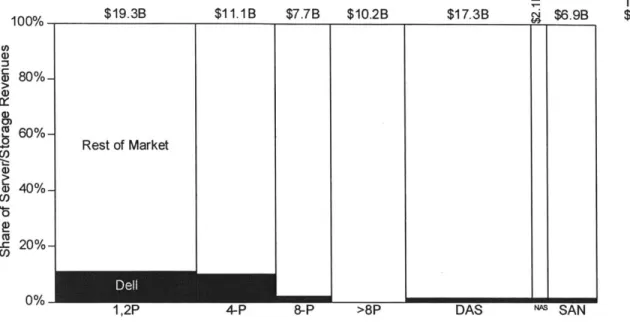
Total= 100%- $19.3B $11.1B $7.7B $10.2B $17.3B cj $6.9B $74.7B 80%- 60%-Rest of Market 40%-C,) 20%I -1,2P 4-P 8-P >8P DAS SAN
Figure 4. Source: IDC Server Tracker CY2000, Disk Storage Systems Market
Dell has chosen to participate in the SIAS market for servers/storage limiting them to Intel architecture vs. the Unix architecture. Likewise the software is limited to the Microsoft and Linux products. Figure 4, above, graphically shows a representation of this market and Dell's respective share in each market. For calendar year 2000, Dell is less than 5% of this market. This is one of the catalysts for the OEM strategy for servers. OEM is viewed as a market entry mechanism as well as a way to supplement current resources so that more products can be brought to the market. Thus expanding the product portfolio without adding engineering and other support people.
3.10. White-box computer industry
In the computer industry there are many large OEM's such as Dell, HP, Compaq, IBM etc. There are also many other computer sellers that are referred to as 'white-box' makers that are less recognized brands that offer standardized solutions. Some of these companies not
only integrate standard components but, in the case of server products, may design some motherboards and chassis to be incorporated in their own design. Examples of companies that fit into this category are Acer, Quanta, Compal, Arima, Inventec and Mitac. Many of the dominant white-box manufacturers are located or have operations in Taiwan. The major difference between the OEM and the 'white-box' computer maker is brand. An aspect of this includes the testing that is done by the OEM to ensure that multiple peripherals are
compatible with the system. A 'white-box' solution would not include this guaranteed functionality. Surprisingly 'white box' manufacturers have significant market share in some segments.
3.11. OEM, ODM and EM relationships
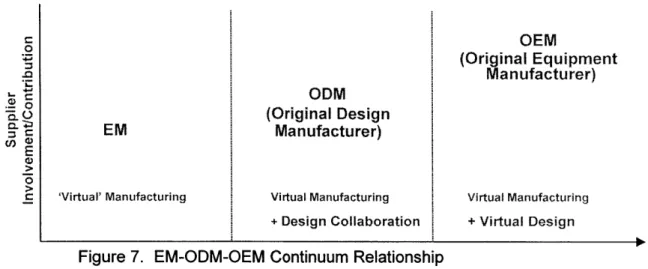
Original Equipment Manufacturer (OEM), Original Development Manufacturer (ODM) and External Manufacturer all refer to the amount of supplier involvement in the manufacturing and design process and refer to different sourcing models in most industries, regardless of product. It is possible to think of these three models as a continuum with variations
positioned in between the pure definitions. An example may be a high touch ODM project that very similar to an EM structure project. The definitions are as follows:
" External Manufacturing (EM) - This refers to the outsourcing of the manufacture
of an internally designed component. In the computer industry this is also commonly called contract manufacturing. The OEM, in this case Dell, would design motherboard or chassis and then contract out the manufacturing.
" Original Development Manufacturer (ODM) - This outsourcing model involves
the outsourcing of some aspects of the design of the component. A scenario that would fit into this model most commonly is finding a supplier, maybe a 'white box'
company, that has designed a standard component that is similar in functionality to what is need for the product. The two parties would then work together to 'tweak' the design so that it could be used with minor modifications.
Original Equipment Manufacturer (OEM) - This model involves outsourcing the manufacturing as well as the design of the component. The product is likely sold to multiple customers and is a standardized design product. For the computer industry hard drives would be an example of this.
3.12. Project Approach
This project involved laying out a framework for deciding which of the outsourcing models should be used for server products and if the same model was not used for all products the
criterion for making the decision. The beginning of the project was spent learning the products that were offered and the marketplace for the products. Two avenues were used for this learning, exploring the web (internal and external) and interviews with people in the Dell organization. This project crossed functional lines and while the project was chartered by the Procurement organization, clearly other major stakeholders included Engineering, Marketing and Quality.
3.13. Summary
Commoditization, fierce competition and continual exploration of new ways to do things are the driving forces for the motivation for this strategy. Commoditization can be combated numerous ways but from this brief introduction, Dell unlike its competitors is not trying to stop or slow down commoditization. In contrast, Dell is trying to understand how
commoditization may affect them and their competition and then use it to their advantage. This project develops a server OEM strategy by exploring of these issues.
4. LITERATURE REVIEW / BENCHMARKING
4.1. Introduction
The development of this strategy appeared to be a 'make -buy' decision however most examples that were considered in the literature are the decision to outsource the
manufacturing of internally designed components. This seems to be a popular trend since it allows a corporation to shed the capital assets associated with manufacturing therefore improving the short-term financial health. A literature review seemed appropriate since many lessons could be learned from other make-buy decisions as well as leverage the thinking that pertained to the methodology of making that decision.
Several sources of relevant information that included strategic sourcing decisions and make -buy decisions were found in literature. Also, the literature search included looking for
methodologies for making strategic decisions and the process for such decisions. The literature search included the following components:
* Historical frameworks for strategic decisions
" Outsourcing - Make vs. Buy decision frameworks
" Vertical/Horizontal Integration - Modular vs. Integral Product Architecture
" Using standard vs. uniquely designed components
* The effect of industry/ technology clock-speed on decisions
4.2. Strategic Frameworks
Strategy is one of the most vaguely defined concepts of business today. Many thoughts on how to formulate a strategy exist as well as many definitions. Even more literature exists that provide a post mortem analysis of less than perfectly formulated strategies. Among the literature there are several common threads that are correlated with this project, including:
* Definition of core competency
" Technology Innovation 'S' Curve
" Rivalry
* Sustainable Advantage
" Portfolio Analysis
" Value Chain Analysis
Strategy is defined by Fred Gluck as 'an integrated set of action that result in a sustained competitive advantage' (Gluck, 2000). This may be through a 'positioning' strategy by focusing on the competition, though product innovation or by leveraging an advantaged business model. Others have taken a 'core competency' approach meaning they define those activities that create value to the customer and then seek to do these activities better and put less importance on the activities that the customer does not value. Yet another, less competition centric, thought by Roberto Baron is to develop a system for anticipating
product innovation to maximize shareholder return vs. trying to defeat the competition. Instead of accepting the rules of the market as they are the competitor seeks to shape and change the market (Baron, 1980).
Core competencies are the set of activities that the firm carries out that cannot be completed by others because they are not capable or they are those activities completed by the firm
because they are of significant value to the customer and therefore a larger proportional reward can be obtained for completing them. Prahalad and Hamel refer to core
competencies as the internal attributes that have the following characteristics; provides opportunity in multiple markets, customers think it is important and it is difficult for competitors to imitate (Prahalad and Hamel, 1990). In parallel if the firm is wasting
resources on an activity that could be accomplished by others, this may be a poor use of the firm's resources, therefore limiting maximum benefit of its resources.
Technology innovation is also an important strategic factor in some industries and the ability to anticipate or drive innovation may be of significant strategic and competitive benefit. Richard Foster asserts that it is the company that can play the 'attacker' in the innovation war that will receive the 'ultimate competitive advantage' (Foster, 1986). The 'S' curve illustrated below in Figure 5 shows that initial investment only yields minimal comparable rewards. However, at some point the performance rewards accelerate and the investment pays off assuming that the marketplace adopts the technology. Finally, the performance of the technology will plateau at some point at which time is ripe for a new technology to enter. It is the anticipation of this point and the development of the new technology that may benefit the company that is able to anticipate and identify the new technology. The ability for a company to concentrate on its existing business while at the same time identifying and developing a 'disruptive technology' is the issue that Clayton Christensen examines
(Christensen, 1997). An analysis of the disk drive industry shows that it is not easy to accomplish incremental product improvements for existing customers and develop new technology.
L
Fundamental Limit of the Technology
Investment in a particular technology
Figure 5. Foster, Richard N. 'Payoff from technology investment follows S-curve'
Rivalry and sustainable advantage are both examined in Michael Porters 'Five Forces' framework. The model contends that any strategy that is formulated should position the
company with respect to competitors by taking the following five components into consideration; threat of entry, supplier power, buyer power, rivalry, and the threat of
substitution (Porter, 1980). Porter shows that by understanding the industry forces and then matching the company's strengths and weakness, a company can formulate a strategy. Porter also asserts that the forces in this model should also be forecasted so that the changing industry dynamics may be predicted. For this project, the five forces analysis shows that rivalry is extremely high in this industry as evidenced by the current price wars. It is this competitive threat that is the underlying force for most of the businesses activities.
4.3. Make/Buy Decision
A summary of the research will be presented to answer the question of how value chains are constructed and the subsequent sourcing decisions should be made. This literature supports the notion that if the manufacture or design contributes to the competitive
advantage when done in house then strategically it should be completed internally. In many cases the make-buy decision is considered for a small portion of the value chain such as manufacturing. Much has been written about how to determine if something is strategically important and if it is lessons that can be learned form others who have made mistakes by outsourcing something of strategic importance and the implication of not making prudent decisions when doing this.
The concept of core competency is important to the sourcing or make-buy decision since literature advocates the concept that the firm should dedicate resources to the processes that are the core competency of the firm and outsource those activities that are not a core competency. This is based on the assumption that there is a capable supply base. The core competency issue will be addressed again in the methodology section with specifics pertaining to this project.
The value chain is the set of the activities required to create a product from raw material through delivery to the customer. For a specific industry each company must understand what differentiates them from the competitor and what it is that the customer values. If one player in a value chain can control other elements of the chain without actually owning them they will have an advantage. A way to do this is to own a link in the chain that cannot be cost effectively duplicated (Percival, 1999). An example of this in the computer industry is
Intel with their development of a brand and technology innovation. The photolithography equipment and other capital assets make it difficult for others to enter their markets.
In fact, it is this analysis of determining what to make or to buy that Fine and Whitney assert may need to be the core competence of the corporation (Fine and Whitney, 1996). With the constant evolution of technology and the increasingly complexity of products, it is unlikely that any corporation will be completely vertically integrated. Therefore, they will need to
outsource some crucial elements of their product. It is the skill of determining what to outsource that is considered the most valuable skill. The Fine/Whitney article examines the effect of product development and product architecture on the ability to outsource the component or product. The matrix presented in the article has dependence on capacity on the vertical axis and the dependence for knowledge on the horizontal axis. Building on the type of dependence a second matrix is constructed that also considers the product
architecture. If a component of a product is outsourced, the other proposed factor that needs to be considered is whether it is decomposable or integral in the product architecture. The dependence for knowledge could be very dangerous if the outsourced item is integral in the final product architecture, since you don't understand what you are buying or how to integrate it (Fine& Whitney, 1996).
An article by Venkatesan tries to simplify the make /buy sourcing decision by saying that a company should apply the following principles:
" Focus on making those components that are critical to the product and that the
company is good at making.
" Outsource where suppliers have a comparative advantage - greater scale, lower
cost structure, or stronger performance incentives.
" Use outsourcing to generate employee commitment to improve manufacturing
performance.
raises the issue of fear to outsource since competitors may also outsource from the same supplier therefore this component will no longer be a point of differentiation. Venkatesan defines 'architectural knowledge' as the process of evaluating the customer needs and the translation to product attributes. This will not be easily copied even if components are sourced from the same supplier. However, if the design is sourced to the supplier by giving them a performance specification this may accelerate the loss of architectural knowledge.
Because of this potential outsourcing consequence it is vital to systematically determine what components are core to the product and to maintain knowledge even if the
manufacturing is outsourced. Along with the potential loss of knowledge it is equally dangerous to over invest resources in commodity like components. An important last point
of the Venkatesan article is that reexamining the categorization of commodity or strategic components should be review on a periodic basis in order to capture changes in strategic elements of any industry (Venkatesan, 1992).
Markides and Berg argue that outsourcing should not be undertaken for short-term financial gains such as lower labor rates or temporary reductions in COGS (Markides & Berg, 1988).
Much has been written about the US manufacturer's inability to be competitive with manufacturing operations in the US due to non-competitive labor rates. This issue will be discussed as a part of the methodology section. Many articles highlight the misconception of the lower labor rate with the offsetting management cost to manufacture outside of the US. This further highlights the need to carefully consider any outsourcing decision to ensure that it is being made for the right reasons as well as taking all cost, both tangible and
intangible into account along with strategic advantages that may outweigh short-term cost improvements.
4.4. Standard vs. Unique Design Components
In a competitive industry, emphasis will be put on effective cost cutting measures. The computer industry is no exception and with cost of goods sold representing a significant portion (50-70%) of the total cost, standardization is an important consideration.
Standardization may refer to the reduction of components or the commonality of
components across products. Another type of standardization is the commoditization of technology, which yields one accepted standard for a product. An example of this in the computer industry is the LCD flat panel for laptop computers. The standardization of this product will be discussed in the benchmarking section. Given that it is advantageous from a cost standpoint to drive commoditization it is necessary to understand the types of
standardization. Utterback examines the standardization process and several historical examples. Many firms can enter the market prior to there being a dominant design since customers have yet to commit and the development of the product is still in process. At the time of a 'dominant' design introduction this signals that there is customer loyalty to one design and all competitors must begin to adhere to it (Utterback, 1996). The formation of these standards is not a well-paved path.
Utterback presents factors that have allowed firms to capture the dominant design. Collateral assets may be market channels, brand, or switching costs that enable a firm to capture the market. Second, industry regulation, a standard may be determined through government intervention. Third, strategic maneuvering may enable a firm to capture the dominant design. An example is the VHS tape becoming dominant over beta even though it was technologically inferior by establishing alliances. Fourth, market learning is the firm
ability to convince the customer that their solution satisfies all of the customer's
but they become dominant such as the QWERTY keyboard. From this we learn that there is not a defined path to creating a standard and that in history there have been many failures in this arena.
In the computer industry, as well as others, there are those that resist the standardization of products since it all but eliminates differentiation at the hardware level and shifts the focus of the customer to other product attributes. This is difficult for those that have invested in
differentiation. Another aspect of this industry is that the consumer drives the
standardization since they total cost of ownership for a standardized system is less than for a custom system. In addition to the lower costs for standardized components, it is also likely that there will be multiple competitive suppliers for the component. Standardization lowers
cost therefore enlarging the market and increasing the ROI for a quality investment in the standard component. Dell is recognized in literature for utilizing Industry Parts
Standardization whereas HP is recognized for their use of Parts Commonality in their products and optimization of their supply chain (Jaruzelski et al, 2001). Industry Parts Standardization is the concept of using components that are offered by many suppliers in the marketplace. Parts Commonality, in contrast, is the use of a component in multiple
designs, thus reducing the number of parts across multiple products. This article lists the benefits of Industry Parts Standardization as:
" Lower cost components due to higher production volume
" Lower cost of obsolescence, since excess can be sold back into the supply base
* Increased part availability
" Lower design cost
" Shorter design time
" Discounts for higher volume purchases
* Protection from demand forecasting error, since parts can be used on multiple products
* Common inventories and assembly procedures facilitating plant consolidations * Fewer inventory items reducing operational complexity
* Fewer parts to manage and fewer parts to qualify
There are many reasons why the total cost of ownership for a standard system is less than that of a proprietary custom system including, based on a survey conducted by IDC funded by Dell:
* Initial setup time and deployment of a new standard system requires less time and training of IT personnel.
* Increased compatibility when interfacing with other business partners for e-commerce applications.
* Decreased prices for hardware, since differentiation is based on price and service instead of hardware differentiation.
* Maintenance of the system is simplified. If all standard equipment is deployed the IT support personnel only need to master one standard system.
IT personnel costs represent the largest component of the maintenance of any IT budget. So any reduction in the number of people or the amount of time spent to deploy or maintain the system will represent significant savings. Standard components also make it easier for the system to be scalable since a particular brand will not have to be utilized when additional
capacity is needed. Another benefit of standard hardware is that there is an increase in software solutions for the systems. Standard server technology is called 'Standard Intel