HAL Id: hal-00111659
https://hal.archives-ouvertes.fr/hal-00111659
Submitted on 6 Nov 2006HAL is a multi-disciplinary open access
archive for the deposit and dissemination of sci-entific research documents, whether they are pub-lished or not. The documents may come from
L’archive ouverte pluridisciplinaire HAL, est destinée au dépôt et à la diffusion de documents scientifiques de niveau recherche, publiés ou non, émanant des établissements d’enseignement et de
Constraints on MOND from the lensing cluster
MS2137-23
Raphael Gavazzi
To cite this version:
Raphael Gavazzi. Constraints on MOND from the lensing cluster MS2137-23. New Astronomy Re-views, Elsevier, 2002, 46, pp.783G. �hal-00111659�
hal-00111659, version 1 - 6 Nov 2006
Constraints on MOND from the lensing
cluster MS2137-23
R. Gavazzi
aaInstitut d’Astrophysique de Paris, 98bis Boulevard Arago, 75014 Paris, FRANCE
Abstract
The cluster of galaxies MS2137-23 presents the most constrained lensing configu-ration of gravitational images ever detected in a distant cluster of galaxies. With a set of two arc systems with known redshifts and many other arclets spread between ≈ 30 h−1 kpc and 1 h−1 Mpc, MS2137-27 is well suited to probe its mass profile
and to challenge theoretical expectations from CDM scenario with more speculative alternatives, like MOND models. In this note, I describe the recent lensing analy-sis I carried out on this cluster using together arcs and CHANDRA X-ray data. Even with this unique data set, I cannot reject neither an isothermal model nor an NFW model. The MOND model is not compatible with the observations, unless a significant fraction of the baryonic matter has not been detected by CHANDRA. The need for much more baryons in the MOND model than for the dark matter paradigm implies significant dynamical differences between these models which can be explored at very large radial distance. In particular, MOND lensing signal be-comes isotropic beyond 1 h−1 Mpc, in contrast with collisionless DM halos which produce elliptical potentials. This difference can in principle be used to test MOND prescriptions, regardless the exact relation between matter and the gravitational deflection law assumed for MOND.
Key words: Dark Matter, Strong Lensing, clusters of galaxies, Cluster, individual : MS2137-23, MOND
1 Introduction
Numerical simulations (Navarro, Frenk, & White, 1997), in the CDM paradigm, predict that dark matter halos follow a universal density profile. The pro-file property depends on cosmological parameters, the redshift of the sys-tem and its total mass. However, density profiles as simple as isothermal
spheres are still consistent with observations. The peculiar case of flat rotation curves in spiral galaxies first motivated the introduction of isothermal dark matter halos. However, these observations are also explained in the MOND framework by modifying Newtonian gravity in the limit of weak accelerations (a < a0 ∼ 1.2 10−8cm.s−2). Under this assumption, beyond a critical limiting
radius rm depending on the system mass, gravitational interaction scales as
r−1. Hence, in the MOND context, flat rotation curves are simply explained
without the need of exotic dark matter. Such a behavior has strong conse-quences, in particular for lensing.
Because gravitational lensing probes projected gravitational potential without regard on the nature of the various deflecting mass components, it is in princi-ple an interesting tool to explore alternative theoretical models, like MOND. If clusters of galaxies, through strong and weak lensing models, are constrained enough to produce accurate potential reconstructions over a wide radial range, one can make strong statements on gravity theories or the dark matter dis-tribution properties. MOND phenomenology is still unable to arise from an auto-consistent relativistic geometrical theory but, as General Relativity which predicts a deflection angle twice the Newtonian value, MONDian lensing for-malism generally assumes the same relation. The MOND representation of lensing in structures gives the same results as isothermal DM halos, as in ro-tation curve modeling. The more evident way to reject MOND is therefore to probe discrepancies between the observable baryonic matter distribution and the gravitational mass properties, like its geometry or its total mass.
The lensing cluster of galaxies MS2137-23 (Fort et al., 1992) is an interesting candidate to explore the properties of its gravitational potential on scales rang-ing from 1 kpc to 1 Mpc. This cluster shows multiple strongly distorted images (a tangential arc lying at ∼ 100 kpc, a rare radial arc at ∼ 20 kpc) near the center. The position and the shape of these arcs are well constrained by high-resolution HST images, while weak lensing analysis can be carried out thanks to new very deep and multi-color VLT/FORS observations (r ≤ 1 Mpc). This X-ray emitting cluster has also recently been observed with CHANDRA (Allen, Schmidt, & Fabian, 2002) and appears to be well relaxed. Join to-gether, lensing, optical and X-ray data permit to build the most constrained lensing model ever done for a distant cluster of galaxies. I discuss these models in the contexts of CDM scenario as well as a MOND interpretation.
In this paper, I assume a Ωm = 0.3, ΩΛ = 0.7, H0 = 100 h km.s−1.kpc−1
2 Gravitational lensing in Newtonian-GR versus MOND gravity
The bending of a light-ray by a matter distribution located between a source and the observer can be expressed by a transformation between a source plane point and its corresponding image in the lens plane:
~θs = ~θi− ~∇θiφ(~θi) (1)
where φ is the 2D projected lens gravitational potential, in units of c22DDolosDls,
with Dol, Dls and Dos are respectively the observer-lens, lens-source and
observer-source angular distances.
Locally, the transformation Jacobian defines the useful quantities :
µ−1 = 1 − ∂xxφ −∂xyφ −∂xyφ 1 − ∂yyφ = 1 − κ − γ1 −γ2 −γ2 1 − κ + γ1 . (2)
κ is the gravitational convergence, such that ∇2φ = 1
2κ measures the isotropic
beam deformation. γ = γ1 + iγ2 is the complex shear which measures the
anisotropic term, or the gravitational distortion. det [µ] is the magnification relating a surface element in the source plane to its image.
In the Newton theory, the potential is always related to the mass density through the Poisson equation (∇2Φ = 4πGρ). Once projected along a line of sight it writes ∇2φ = 1 2κ def = 1 2 Σ Σcrit , (3)
where Σ is the projected surface density and Σcrit is defined as the critical
surface density Σcrit= c2/(4πG)Dos/(DlsDol).
In the MOND theory, the gravitational acceleration is modified : µ(g/a0) g = −
GM(r)
r2 (4)
with µ(x) = 1 when x ≫ 1 and µ(x) = x when x ≪ 1. Thus, the Pois-son equation cannot be expressed easily. It is also difficult to express its 2D projection because of the non-local relation between mass and potential. How-ever, as for rotation curve of galaxies, in a MOND description gravitational lensing can be described as in General Relativity (GR), by adding a massive
component (dark halo) with a slope ρ(r) ∝ r−2. Hence, MONDian lensing
can be expressed in terms of the conventional formalism, if an “effective” sur-face density is defined. When expressed by either ρN(r) or ΣN(R), it is the
density profile that would, under the assumption of Newtonian mechanics, produce both the same rotation curve and the same deflection law as the MOND predictions. Given that a point-mass has an asymptotically constant rotation velocity of vc = (GMa0)1/4 in MOND, the addition of an isothermal
component, such that ρN(r) ≃ ρ(r) + s a0M(r) G 1 4πr2, (5)
as a reasonable approximation to many MONDian deflectors of true mass M. Through this relation, it is possible to interpret our analysis in terms of MOND, rather than assuming dark matter. If so, only a baryonic mass compo-nent should be able to fit the density ρ of Eq.(5), with the parameters deduced from a lensing + X-ray analysis.
3 Cluster of galaxies MS2137
3.1 Observations
MS2137-23 is a rich cD cluster of galaxies located at zl = 0.313. The
inner-most region (< 5’) does not show any substructures and has regular visible appearance, as expected for a dynamically relaxed gravitational system. A single dominant cD galaxy occupies the central region. Optical data provide its azimuthal light distribution and show that its diffuse light component is almost elliptical. The stellar component reveals a small twist of the isophotes’ orientation between the radial and tangential arcs. From North to East, the position angle is P A ≃ (71 ± 4)◦.
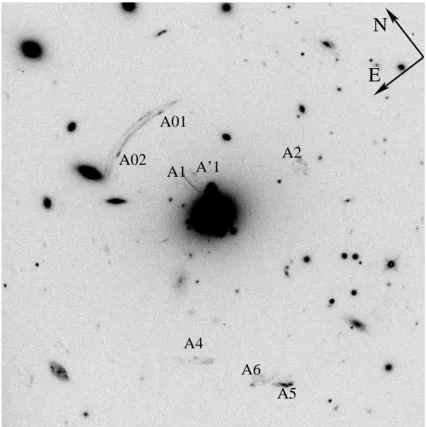
The lens generates a tangential arc (A01-A02) associated with two other counter-images A2 and A4 positioned around the cD galaxy. A01 and A02 are twin image with reverse parity. They are two merging “partial” images of the source element located inside the tangential caustic line. A non-singular potential should create a fifth demagnified image located near the center. The cD galaxy brightness peak hampers its detection without a complex image subtraction.
The lens also gives rise to a radial arc A1 partially embedded in the cD stellar diffuse component. This arc is associated with a bright image, referenced as
A6 A5 A1 A’1 A2 A01 A02
E
N
A4Fig. 1. Overview of the lensing configuration. The three arcs systems {A01,A02,A2,A4}, {A1,A5} and {A’1,A6}. The central cD galaxy. This F702 HST field is 56 × 56 arcsec wide.
A5. As explained by Hammer et al. (1997), the diffuse objet A6 near A5 is probably another counter-arc associated to the diffuse object A’1 located close to the radial arc A1. This configuration is possible only if the {A6,A’1} redshift is significantly lower than {A1,A5}.
New wide field multiband VLT data (see Gavazzi et al (2002) for a detailed description) were used to get the photometric redshift of arcs : both radial and tangential arcs turn out to be at zs≃ 1.61 ± 0.05.
Recent CHANDRA observations of MS2137 (Allen, Schmidt, & Fabian, 2002) provide important new constraints on the halo density profile. The authors confirm its apparent relaxed shape, but pointed out the presence of a strong cooling flow inside the innermost region. Thus, a simple isothermal parameter-ization of the dark matter profile, assuming hydrostatic equilibrium probably over-simplifies the central potential well. Allen, Schmidt, & Fabian (2002) modeled the X-ray emission and derived a gas mass fraction fgas ≃ 0.11 which
is almost constant between 10 and 100 arcsec. The MS2137 radial proper-ties inferred from X-rays data reveal that the luminosity profile presents a rc ≈ 7 arcsec core radius and an asymptotic slope α ∼ 1.17 consistent with
isothermal profile for dark matter and a β ∼ 0.61 index. The X-isophotes are remarquably elliptical and do not show substructures. The orientation of gas is
almost constant : P AX = 58◦± 7◦, except a sharp isophotal twist inside 7
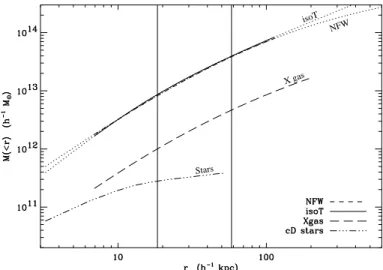
arc-sec from the center (where ellipticity looses meaning and orientation is difficult to determine). A comparison of the stars and intra-cluster gas distributions is represented in 2. A new characteristic feature is the global misalignment be-tween diffuse stellar component and hot intra-cluster gas. This result suggests that the light distribution does not match exactly the DM distribution. This point is confirmed by strong lensing models which are detailed in the next section.
3.2 Strong lensing modeling
The lens is modeled by two different types of mass distributions : a softened elliptical isothermal profile, or an elliptical NFW universal profile of the form ρ(r) = ρc(z)δc
r/rs(1+r/rs)2 projected in κ(r) = 2κs
1−F (r/rs)
(r/rs)2−1
1. Both are consistent with
arcs observations with a comparable χ2. Results are summarized in table 1.
Free parameters are respectively (central velocity dispersion σv, core radius rc)
and (κs, rs), ellipticity ǫ and position angle θ0. We first centered the potential
on the center of the cD galaxy. This assumption is verified a posteriori by relaxing its position around the first best fit models. The 95.5%CL allowed distance to the cD center is less than 1 kpc.
NFW isothermal (isoT) κs= 0.6 ± 0.2 σv= 1015 ± 16 km/s rs= 80 ± 10 h−1kpc = 25 ± 4′′ rc= 11 ± 2 h−1kpc = 3.3 ± 0.5′′ ⇒ ( c = 11.7 ± 2.1 r200= 940 ± 200 h−1kpc ǫ = 0.24 ± 0.01 ǫ = 0.23 ± 0.01 θ0= 57.4◦±0.8◦ θ0= 58.4◦±1.0◦ Table 1
Final models. Einstein radius is the same in the two best models : RE = (18.0 ±
1.3) arcsec = (58 ± 4) h−1kpc. For both, the total mass inside is M (r < R
E) =
(3.9 ± 0.5)1013h−1M
⊙.
As (Mellier et al., 1993; Hammer et al., 1997) argued, the isothermal profile core radius is necessarily finite, otherwise a constant α = 2 slope is inconsistent with radial arcs. The NFW model is however slightly more concentrated than numerical ΛCDM predictions. This might results from complex dissipative cooling of baryons inside the core of the cluster which pulled down the matter. On those scales, the physics of each matter component is hard to with present-day resolution of numerical simulations. (For a more detailed discussion, see
1 F(x) = 1 q x2 −1 tan−1px2− 1 f or x >1 1 q 1−x2 tanh−1 p 1 − x2 f or x <1 1 f or x= 1
Gavazzi et al (2002). See also e.g. Blumenthal et al (1986); Keeton (2001)) Nevertheless, figure 2 reveals discrepancies outside the cluster area probe by the radial and the tangential arc. The use weak lensing discussed in the next section can help to probe the mass profile on larger scale. In the innermost region, the expected discrepancies between both models can be tested by look-ing for the fifth demagnified image associated to the tangential arc system {A01,A02,A2,A4}. Unfortunately, because it is demagnified by a factor 5 (resp. 10) in the isothermal (resp. NFW) model, the cD stellar light peak hampers its detection. We used a spatial high-bandpass filtering to remove the dif-fuse cD component. Then using together color indications, we find a marginal detection of this image at the location expected by isothermal and NFW mod-els. This detection is however not conclusive. In the future, high resolution in narrow-band filter spectro-imagery should confirm/reject the detection and should provide important constraints regarding the central cusp/core problem in dark matter profiles.
The potential inferred from strong lensing shows the same misalignment (∆ϕ = 13◦±4◦) as X-ray isophotes with respect to the diffuse stellar component of the
cD galaxy. This asymmetry may provide interesting clues about the MOND models against the dark matter paradigm. If baryons are the only source of gravity, the potential must show the same azimuthal symmetry. In contrast, this symmetry requirement is not needed for dark matter halos. It is therefore interesting to see that, as it stands from the lens model, the geometry of the hot baryonic contribution does not rule out the MOND model.
X gas NFW isoT
Stars
Fig. 2. Various mass contributions in the cluster center. Stellar contribution is de-duced from the I band luminosity profile (with an applied K-correction of 0.23 and a mass-to-light ratio of ΥI= 2). Hot gas contribution arises from (Allen, Schmidt, &
Fabian, 2002). Upper curves result from the strong lensing modeling. Right vertical line indicates the Einstein radius, the left one the radial arc position.
3.3 Weak lensing analysis
The new VLT photometry allowed us carry out a weak lensing analysis of MS2137-23 and to reconstruct its mass map over the whole FORS 7′30 × 7′30
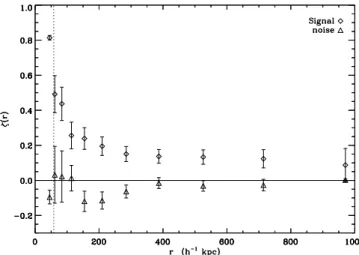
field around the cD galaxy. Multiband UBVRI and VLT/ISAAC JK images were used to build a catalogue of background with an accurate photometric redshift information (Pell´o et al., 2001). The mass map shows that the po-tential keeps the orientation and the shape inferred from the strong lensing model far beyond 1 arcmin from the center. In order to check the validity of the strong lensing models, we compute the ζ-statistic to measure the azimuthaly-averaged radial profile.
The ζ-statistic is derived from the measurement of individual tangential el-lipticity of galaxies (averaged inside annuli to reduce the noise introduced by intrinsic ellipticity of galaxies). It is defined by
ζ(r) = ¯κ(r′
< r) − ¯κ(r < r′
< rout) (6)
With this definition, beyond the radius rout, the density is assumed to drop
significantly. Due to the mass-sheet degeneracy, the projected mass profile is only known through the invariance transformation (1 − κ) → λ(1 − κ) (see e.g. Schneider, Ehlers, & Falco (1992)). From the definition of ζ(r), only a lower limit of the total mass given by πr2ζ(r)Σ
crit is available, where Σcrit =
c2 4πG DD lsDol Dos E−1
(averaged over the sample redshift distribution).
Fig. 3. ζ-statistic result for MS2137. Diamonds represent the true signal. Triangles represent the same analysis after a π/4 rotation of all galaxies to only reveal noise. Vertical dotted line indicates the Einstein radius.
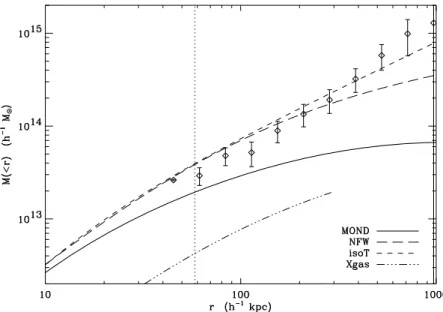
The discrepancies between strong lensing and weak lensing (see fig 4) are very small. Thus, the global lensing mass looks robust. The model an be improved
by a full maximum likelihood parameterized analysis of the weak lensing sam-ple, but it will not change the conclusions. Except at large radius, the weak lensing profile is consistency with both an isothermal or a NFW model. Be-yond 600 h−1 kpc, the isothermal model seems favoured, but uncertainties
produce by systematics (PSF anitropy corrections) make the two last points more questionnable. Note that before rejecting NFW profiles, one should in-clude the “adiabatic” contraction influence of baryons modifying universal profiles and prohibiting a simple analytic fit on the whole radial range.
Fig. 4. Various mass contributions in the cluster intermediate scales. Upper curves result from the two strong lensing models of table 1. Overplotted the weak lensing mass estimate (diamonds). One can see the good agreement between strong and weak lensing near the Einstein radius (dotted vertical line). (thick) MOND baryonic mass profile inferred to explain both strong and weak lensing signal.
4 Discussion in MOND framework & conclusion
A detailed review on lensing in the MOND theory can be found in (Mortlock et al., 2001a,b; Qin et al, 1995). For the purpose here, we only use equation (5) to calculate the MOND baryonic mass distribution known the isothermal DM halo profile needed in Newtonian grativy to explain multiple arcs, and consequently weak lensing signal.
By inverting relation (5) we find the MOND baryonic mass profile shown in figure 4. The mass discrepancy between the observed X-ray emitting gas and the MOND prediction put the MOND model in a difficult position. However, one could imagine that some massive cold gas contributes to 3 times the observed hot gas inside 200 kpc, and even more than 5 times inside 50 kpc.
A similar problem has already been noticed in previous studies of X-ray clus-ters. But it refers to X-ray analyses assuming isothermality and hydrostatic equilibrium of the gaz, which is not the case here. Note that even with a baryonic content 3 times larger than the hot X-ray component, the MOND-expected central amount of gas does not to contradict the baryon fraction pre-dicted by the Big Bang Nucleosynthesis, because beyond ∼ 1 Mpc the baryonic mass is almost constant. This mass corresponds to an homogeneous collapse of a sphere of canonical radius r ∼ 20 h−1kpc, with density Ω
bh2 ∼ 0.03.
One can assume that the missing gas fraction exists under a cooler phase, as suggested by observed cooling flows or under an unknown other form. Such an amount of central high-density gas could be tested by its consequencies on the fifth demagnified image in the near future when high spatial resolutions observations will be available.
The analysis of MS2137-23 illustrates how one can use observations of lensing clusters to challenge modified gravity theories against orthodox dark mat-ter scenario. We show that isothermal profiles and consequently MOND are consistent with the whole constraints on the range 10 kpc . r . 1 Mpc. However, MOND models overpredict baryonic mass observed from the hot X-ray-emmitting ICM phase. A more promising lensing test for MOND phe-nomenology is given in Hoekstra et al. (this proceeding) concerning galaxy-galaxy lensing and particularly, large scale potential symmetry with regards to the observable matter distribution. MOND predicts an isotropic lensing signal far enough from baryonic concentrations, independently of the exact radial relation potential-mass distribution.
We thank the organizers for the invitation and B. Fort and Y. Mellier for fruitfull discussions and careful reading of this research note.
References
Allen, S. W., Schmidt, R. W., & Fabian, A. C. 2002, MNRAS, 334, L11 Blumenthal, G. R., Faber, S. M., Flores, R., & Primack, J. R. 1986, ApJ, 301,
27
Fort, B., Le Fevre, O., Hammer, F., & Cailloux, M. 1992, ApJl, 399, L125 Gavazzi, R., Fort, B., Mellier, Y., Dantel-Fort, M., Pell´o, R. 2002, in
prepara-tion.
Hammer, F., Gioia, I. M., Shaya, E. J., Teyssandier, P., Le Fevre, O., & Luppino, G. A. 1997, ApJ, 491, 477
Keeton, C. R. 2001, ApJ, 561, 46
Navarro, J. F., Frenk, C. S., & White, S. D. M. 1997, ApJ, 490, 493 Mellier, Y., Fort, B., & Kneib, J. 1993, ApJ, 407, 33
Milgrom, M. 1999, Dark matter in Astrophysics and Particle Physics, 443 Mortlock, D. J. & Turner, E. L. 2001, MNRAS, 327, 557
Mortlock, D. J. & Turner, E. L. 2001, A&A, 327, 552
Pell´o, R. et al. 2001, Astrophysics and Space Science Supplement, 277, 547 Qin, B., Wu, X. P., & Zou, Z. L. 1995, A&A, 296, 264
Schneider, P., Ehlers, J. ;., & Falco, E. E. 1992, Gravitational Lenses, XIV, 560 pp. 112 figs.. Springer-Verlag Berlin Heidelberg New York. Also Astronomy and Astrophysics Library,