arXiv:hep-ex/9705012v1 17 May 1997
Precision Determination of the Neutron Spin Structure Function g
n 1 K. Abe21 , T. Akagi18,21, B. D. Anderson7 , P. L. Anthony18 , R. G. Arnold1 , T. Averett5 , H. R. Band23 , C. M. Berisso9 , P. Bogorad15 , H. Borel6 , P. E. Bosted1 , V. Breton3 , M. J. Buenerd18 , G. D. Cates15 , T. E. Chupp10 , S. Churchwell9 , K. P. Coulter10 , M. Daoudi18 , P. Decowski17 , R. Erickson18 , J. N. Fellbaum1 , H. Fonvieille3 , R. Gearhart18 , V. Ghazikhanian8 , K. A. Griffioen22 , R. S. Hicks9 , R. Holmes19 , E. W. Hughes5 , G. Igo8 , S. Incerti3 , J. R. Johnson23 , W. Kahl19 , M. Khayat7 , Yu. G. Kolomensky9 , S. E. Kuhn13 , K. Kumar15 , M. Kuriki21 , R. Lombard-Nelsen6 , D. M. Manley7 , J. Marroncle6 , T. Maruyama18 , T. Marvin16 , W. Meyer4 , Z.-E. Meziani20 , D. Miller12 , G. Mitchell23 , M. Olson7 , G. A. Peterson9 , G. G. Petratos7 , R. Pitthan18 , R. Prepost23 , P. Raines14 , B. Raue13 , D. Reyna1 , L. S. Rochester18 , S. E. Rock1 , M. V. Romalis15 , F. Sabatie6 , G. Shapiro2 , J. Shaw9 , T. B. Smith10 , L. Sorrell1 , P. A. Souder19 , F. Staley6 , S. St. Lorant18 , L. M. Stuart18 , F. Suekane21 , Z. M. Szalata1 , Y. Terrien6 , A. K. Thompson11 , T. Toole1 , X. Wang19 , J. W. Watson7 , R. C. Welsh10 , F. Wesselmann13 , T. Wright23 , C. C. Young18 , B. Youngman18 , H. Yuta21 , W.-M. Zhang7 , and P. Zyla20 1American University, Washington, DC 20016
2
University of California, Berkeley, CA 94720
3
LPC IN2P3/CNRS, Univ. Blaise Pascal, F-63170 Aubiere Cedex, France
4
University of Bonn, Nussallee 12 D-5300 Bonn, Germany
5
California Institute of Technology, Pasadena, California 91125
6
DAPNIA, Saclay, 91191 Gif-sur-Yvette Cedex, France
7
Kent State University, Kent, OH 44242
8
University of California, Los Angeles, CA 90024-1547
9
University of Massachusetts, Amherst, MA 01003
10
University of Michigan, Ann Arbor, MI 48109
11
National Institute of Standards and Technology, Gaithersburg, MD 20899
12
Northwestern University, Evanston, IL 60201
13
Old Dominion University, Norfolk, VA 23529
14
University of Pennsylvania, Philadelphia, PA 19104-6317
15
Princeton University, Princeton, NJ 08544
16
Southern Oregon State College, Ashland, OR 97520
17
Smith College, Northampton, MA 01063
18
Stanford Linear Accelerator Center, Stanford, CA 94309
19
Syracuse University, Syracuse, NY 13210
20
Temple University, Philadelphia, PA 19122
21
Tohoku University, Aramaki Aza Aoba, Sendai, Miyagi, Japan
22
College of William and Mary, Williamsburg, VA 23187
23
University of Wisconsin, Madison, WI 53706 (E154 Collaboration)
We report on a precision measurement of the neutron spin structure function gn
1 using deep
inelastic scattering of polarized electrons by polarized3
He. For the kinematic range 0.014< x <0.7 and 1 (GeV/c)2 < Q2 < 17 (GeV/c)2 , we obtainR0.7 0.014 g n 1(x)dx=−0.036 ± 0.004 (stat) ± 0.005 (syst) at an average Q2 =5 (GeV/c)2
. We find relatively large negative values for gn
1 at low x. The
results call into question the usual Regge theory method for extrapolating to x=0 to find the full neutron integralR1
0 g n
1(x)dx, needed for testing quark-parton model and QCD sum rules.
Deep inelastic scattering (DIS) of polarized leptons by polarized nucleons has been the cornerstone for studying the internal spin structure of the proton and neutron. Although the first experiments [1,2] found large asym-metries in the spin-dependent scattering of electrons by protons, consistent with the early quark-parton model (QPM) predictions [3], subsequent experiments [4–6] per-formed at higher energies found that the proton asymme-tries at low values of Bjorken x disagreed with the early QPM predictions. In fact, higher energy proton measure-ments were inconsistent with one of the QPM sum rules
derived by Ellis and Jaffe [7] based upon an unpolarized strange sea. First measurements of spin-dependent scat-tering of polarized leptons off polarized neutrons found small negative asymmetries, and, along with the pro-ton results, provided the first tests of the fundamental Bjorken Sum Rule [8]. However, the neutron results suf-fered either from large statistical uncertainties at low x [9,10], or from a limited beam energy [11,12]. This Let-ter reports on a precision measurement of the neutron spin structure function gn
1 performed at the Stanford
electrons scattered from polarized3
He to achieve x values as low as 0.014. The present experiment (E154), which collected 108
events in October and November of 1995, builds on the experience from the previous SLAC3
He ex-periment (E142) [11] performed at a lower beam energy. The E154 results provide a new insight into the low x
behavior of gn 1.
The asymmetries Ak(A⊥) measured in DIS of
lon-gitudinally polarized electrons by lonlon-gitudinally (trans-versely) polarized nucleons can be used to find the nu-cleon spin structure function g1 [13], namely
g1(x, Q 2 ) = F2(x, Q 2 ) 1 + γ 2 2xD′(1 + R(x, Q2))[Ak+ tan(θ/2)A⊥], where Q2
is the squared four-momentum transfer of the virtual photon; x is the fraction of nucleon momentum carried by the struck quark; γ and D′ are factors
de-pending on the scattered electron’s initial and final en-ergies and the electron scattering angle θ; F2(x, Q
2
) is the unpolarized nucleon spin structure function and R(x, Q2
) = σL/σT is the longitudinal to transverse virtual
photoabsorption cross section ratio. The asymmetries Ak(A⊥) may also be used to find the virtual
photon-nucleon asymmetries A1(x, Q 2
).
Polarized electrons were obtained using a strained GaAs cathode illuminated by circularly polarized light from a flashlamp-pumped Ti:sapphire laser [14]. The electron spin direction was reversed randomly on a pulse-to-pulse basis by reversing the helicity of the laser light. The electrons were subsequently accelerated to 48.3 GeV and directed to the experimental hall. The charge per pulse ranged from 3 to 9 x 10¹⁰
electrons, yielding an average current ranging from 0.5 to 2 µA for a pulse rep-etition rate of 120 Hz and a pulse width of 250 ns. The beam polarization was measured to be 0.82 ± 0.02 over the duration of the experiment using a single arm Møller polarimeter [15] located upstream of the target.
The polarized3
He target consisted of double-chamber glass cells [16] filled with ∼9.5 atm of3
He (as measured at 20◦C). The 30 cm long cells were constructed of Corning
1720 glass. The lower chamber had ∼50 µm inverted end windows through which the electron beam passed. Ap-proximately 50 torr of nitrogen gas was also present in the cells to aid in optical pumping. The3
He nuclei were po-larized in the upper chamber by spin-exchange collisions with optically-pumped polarized rubidium atoms [17,18]. Three 20 W diode lasers and four Argon-ion pumped Ti:sapphire lasers continuously polarized the rubidium atoms in the upper chamber of the target cell. The target spin direction was reversed approximately once a week throughout the experiment. NMR techniques [19] cali-brated by proton NMR and by frequency shift techniques [20], were used to measure the polarization of the3
He nu-clei. The polarization ranged as high as 0.48 and was on average 0.38 ± 0.02 over the duration of the experiment. The systematic uncertainty in the target polarization was dominated by the water calibration for the NMR tech-nique and by uncertainties in the polarization gradients
and3
He density for the frequency shift technique.
Two new single-arm spectrometers, at central scatter-ing angles of 2.75◦ and 5.5◦, were used to analyze
scat-tered electrons [21]. Each spectrometer utilized a pair of threshold ˇCerenkov counters operating with nitrogen at a pressure of 0.10 (0.14) atm in the 2.75◦(5.5◦) arm,
corre-sponding to a pion energy threshold of approximately 19 (16) GeV. Ten (eight) planes of hodoscopes were used for tracking in the 2.75◦ (5.5◦) spectrometer. Tracking
res-olution resulted in a momentum determination ranging from ± 2% at low momentum to ± 4% at high momen-tum. The momentum resolution was useful for reduc-ing the contamination from hadronic backgrounds to the electron sample. At the rear of each spectrometer a 200 block lead glass calorimeter was arranged in a fly’s eye configuration [22] which gave an energy resolution of 3% + (8/pE(GeV) )%. Only events with scattered electron energies greater than 10 GeV were used in the analysis, corresponding to Q2
> 1 (GeV/c)2
for the 2.75◦
spec-trometer.
For each beam pulse, the experiment collected informa-tion from the hodoscope and calorimeter multihit TDCs and the calorimeter ADCs. The four ˇCerenkov counters were each read out by a Flash ADC that recorded the pulse shape in 1 ns time slices covering the full beam pulse. Events were analyzed as electron candidates if they passed a low-threshold in both ˇCerenkov counters in coincidence with an energy cluster in the lead glass. Events were tracked using the lead glass centroid cluster position and hits in the hodoscope planes. The tracks, combined with information on the spectrometer optics, were used to determine the particle’s momentum. Track-ing efficiency was measured to be on the order of 90%. Events were also classified by the energy deposition in the calorimeter. When the ratio of the energy deposited in the calorimeter to the momentum determined from track-ing for an event was less than 80%, the event was rejected as a pion candidate. Typically 0.5 (0.2) electrons and 5 (2) pions were recorded per pulse in the 2.75◦(5.5◦)
spec-trometer. Selected events were binned in x and tagged per pulse with the relative beam and target spin direc-tions.
-1 -0.8 -0.6 -0.4 -0.2 0 0.2 10-2 10-1 1 Q2 = 5 GeV2 E154 E142
g
1n xFIG. 1. Results for gn
1 versus x from SLAC Experiment
E154 compared to Experiment E142 evaluated at Q2
= 5 (GeV/c)2
. Shaded region corresponds to 1 σ systematic un-certainties.
Contamination of hadronic background in the electron sample was measured to be 3 ± 2 % for the lowest x val-ues and decreased at higher valval-ues. Furthermore, since the hadron asymmetries were found to be approximately 1/3 the size of the electron asymmetries, the total effect of hadron contamination was very small. On the other hand, a relatively large contamination of the DIS electron sample originates from electrons produced from charge-symmetric decays of hadrons. The rates from this back-ground were determined from running with the spectrom-eter polarity reversed to measure positrons. The rates for the non-DIS electron event background were on the order of 15% at the lowest scattered electron energies and fell rapidly with increasing energy. The measured asymme-tries from these runs were found to be consistent with zero.
The fraction of DIS events that come from polarized
3
He as compared to the full target cell is called the dilution factor. It was determined from known unpo-larized nucleon structure functions, measured glass cell window thicknesses and the density of gas in the target cells (material method). The dilution factor was also de-termined by comparing rates from the polarized target to rates from a dummy cell with different gas pressures (rate method). This method has the advantage of tak-ing into account possible beam halo effects. Results were obtained using the material method, and the rate pro-cedure was used to assign systematic uncertainties. On average, the dilution factor was found to be 0.55 ± 0.03.
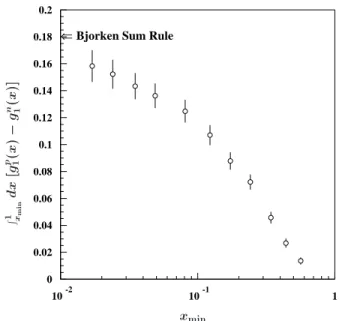
0 0.02 0.04 0.06 0.08 0.1 0.12 0.14 0.16 0.18 0.2 10-2 10-1 1
⇐Bjorken Sum Rule
R 1 x min dx [ g p 1 ( x ) g n 1 ( x )] xmin
FIG. 2. Difference between the measured proton [5,6] and neutron [This experiment] integrals calculated from a mini-mum x value, xmin up to x of 1. The value is compared to
the theoretical prediction from the Bjorken sum rule which makes a prediction over the full x range. For the prediction, the Bjorken sum rule is evaluated up to third order in αs
[23,24] and at Q2
= 5 (GeV/c)2
. Error bars on the data are dominated by systematic uncertainties and are highly corre-lated point-to-point.
After corrections for hadronic and pair-symmetric backgrounds, dilutions and polarizations, the asymme-tries Ak and A⊥ were formed. The asymmetries were
corrected for radiative processes to find the single-photon exchange Born results [25–28]. Uncertainties in the ra-diative corrections were estimated by varying the input models over a range consistent with the measured data.
Corrections due to the nuclear wave function of the po-larized3
He nucleus were applied [29–32] using the recent proton data [5,6] to evaluate the proton contributions; however these contributions had only a small impact on the results. No other corrections were made for the fact that the polarized neutron is embedded in the3
He nu-cleus.
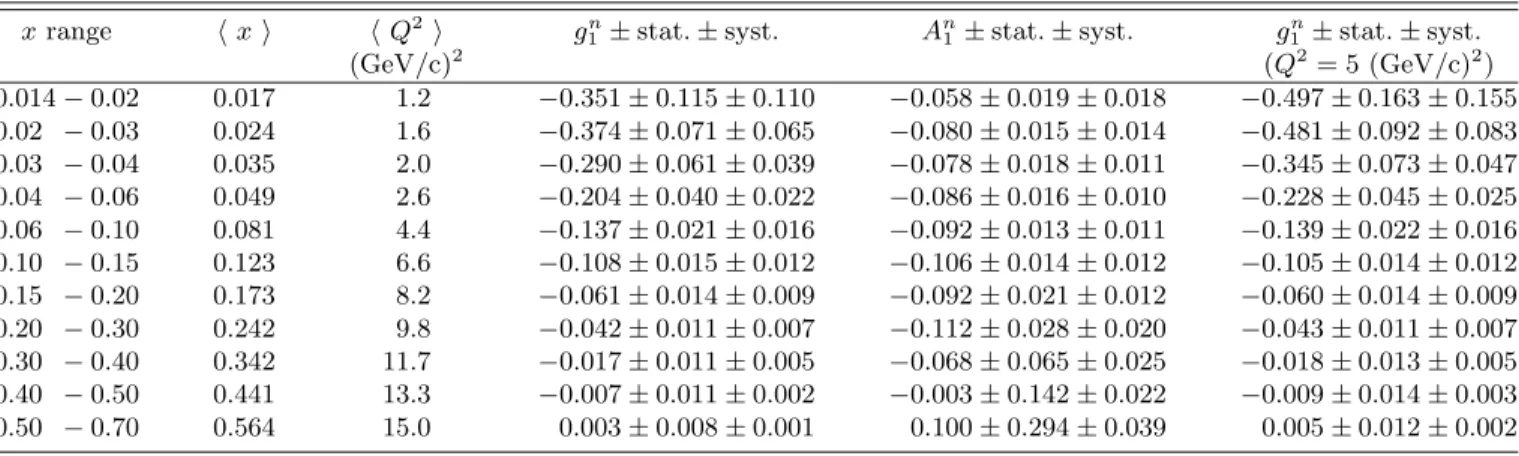
Results for An
1 and g1n are presented in Table 1, and
gn
1 is plotted in Fig. 1 along with the results of the
SLAC E142 experiment [11]. The results from both ex-periments are evolved to Q2
= 5 (GeV/c)2
under the assumption that g1/F1 is independent of Q2. Within
experimental uncertainties, this assumption is supported by a comparison of our data to all existing measurements [9–12,33,34]. Good agreement with the E142 results is seen in the overlapping x range. Over the range of this experiment, we find a neutron spin structure function in-tegral ofR0.7
0.014g n
1(x)dx = −0.036 ± 0.004 (stat.) ± 0.005
(syst.).
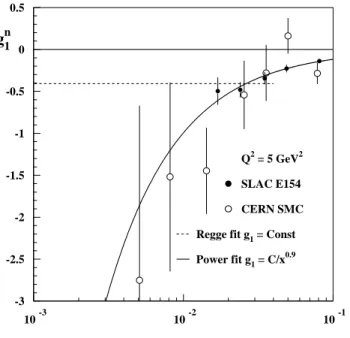
A notable feature of Fig. 1 is the strong x-dependence observed at low x, a result that is incompatible with the
simplest Regge theory interpretation [35,36] that gn 1 is
constant with x in this region. The strong x-dependence also implies that the unmeasured small-x region can make a major contribution to the integralR1
0 g n
1(x)dx and
re-course must be made to models in order to evaluate the full integral. The result is that the value extracted for the integral is subject to considerable model uncertainty. For example, a Regge theory extrapolation with func-tional form gn 1 ∼x−α, −0.5 < α ≤ 0, yields R1 0 g n 1(x)dx
= −0.041 ± 0.004 ± 0.006, even though this description is successful in fitting only the three lowest x points at x < 0.04. In contrast, a fit to the x < 0.1 data with an unconstrained power-law yields R1
0 g n
1(x)dx = −0.2.
No uncertainty can be given for this later analysis, since the fitted value of α is 0.9 ± 0.2, and the integral di-verges for α = 1. Figure 3 summarizes the results of the fits described above to the low x data region. If we fit an unconstrained power law to the measured gn
1 values
without evolving to Q2
= 5 GeV2
, we find α is 0.7 ± 0.2. In short, the new data do not adequately constrain the low-x region such that the integral of gn
1 can be reliably extracted. x x -3 -2.5 -2 -1.5 -1 -0.5 0 0.5 10-3 10-2 10-1 Q2 = 5 GeV2 SLAC E154 CERN SMC Regge fit g1 = Const Power fit g1 = C/x0.9
g
1nx
FIG. 3. Results for gn
1 versus x for the low x region from
SLAC experiment E154 compared to the CERN SMC exper-iment. The data is evolved to Q2
= 5 (GeV2
/c2
). Fits that impact the low x extrapolation (discussed in the text) are presented.
We have also used the present precision neutron results down to xmin= 0.014 along with the proton results from
SLAC E143 experiment (0.03 < x) [6] and the CERN SMC experiment (0.014 < x < 0.03) [5] to compare to the Bjorken sum rule prediction. The difference between proton and neutron spin structure functions integrated over x from xmin to x=1 is shown in Fig. 2. One sees
that the difference in the integral of g1 for the proton
and neutron falls only 1.9 standard deviations below the Bjorken sum rule prediction when the data is integrated down to x of 0.014. Presumably the rest of the integral comes from the remaining unmeasured low x region.
In conclusion, we have found relatively large negative values of gn
1 at low x. One possible explanation for this
behavior can be associated with sea and gluon spin con-tributions [37–39]. A breakdown in the simple Regge the-ory description at low x is also a possible consequence. Further precision data using proton and deuteron targets over the same kinematic range are expected to be of great use in unraveling the behavior of the nucleon spin struc-ture functions at moderately low x (down to x ≈ 0.01). High precision low x measurements of the nucleon spin structure functions are still needed to understand how gn
1 converges at low x and to extract the neutron integral
R1 0 g
n 1(x)dx.
We thank the personnel of the SLAC accelerator de-partment for their efforts which resulted in the successful operation of the E154 Experiment. This work was sup-ported by the Department of Energy; by the National Sci-ence Foundation; by the Kent State University Research Council (GGP); by the Jeffress Memorial Trust (KAG); by the Centre National de la Recherche Scientifique and the Commissariat a l’Energie Atomique (French groups); and by the Japanese Ministry of Education, Science and Culture (Tohoku).
[1] M. J. Alguard et al., Phys. Rev. Lett 37, 1258 (1976); 37, 1261 (1976).
[2] G. Baum et al., Phys. Rev. Lett. 51, 1135 (1983). [3] R. D. Carlitz and J. Kaur, Phys. Rev. Lett. 37, 673
(1977).
[4] J. Ashman et al., Phys. Rev. Lett. B206, 364 (1988); Nucl. Phys. B328, 1 (1989).
[5] D. Adams et al., Phys. Lett. B329, 399 (1994). [6] K. Abe et al., Phys. Rev. Lett. 74, 346 (1995).
[7] J. Ellis and R. L. Jaffe, Phys. Rev. D9, 1444 (1974); D10, 1669 (1974).
[8] J. D. Bjorken, Phys. Rev. 148, 1467 (1966); Phys. Rev. D1, 1376 (1970).
[9] D. Adams et al., Phys. Lett. B357, 248 (1995). [10] D. Adams et al., Phys. Lett. B396, 338 (1997).
[11] P. L. Anthony et al., Phys. Rev. Lett. 71, 959 (1993); Phys. Rev. D54, 6620 (1996).
[12] K. Abe et al., Phys. Rev. Lett. 75, 25 (1995).
[13] See reference 11 for Phys. Rev. D. article for definitions of kinematic factors and unpolarized structure functions. [14] T. Maruyama et al., Phys. Rev. B46, 4261 (1992); R.
Alley et al., Report No. SLAC-PUB-6489, 1994.
[15] H. Band et al., SLAC-PUB-7370 (1997), submitted to Nucl. Instr. Methods.
[16] T. E. Chupp et al., Phys. Rev. C45, 915 (1992). [17] M. A. Bouchiat, T. R. Carver and C. M. Varnum, Phys.
Rev. Lett. 49, 25 (1960).
[18] T. E. Chupp et al., Phys. Rev. C36, 2244 (1987). [19] A. Abragam, Principles of Nuclear Magnetism (Oxford
University Press, New York, 1961).
[20] N. R. Newbury et al., Phys. Rev. A48, 558 (1993); A. S. Barton et al., Phys. Rev. A49, 2766 (1994).
[21] Yu. G. Kolomensky, PhD thesis, University of Mas-sachussetts (February 1997).
[22] H. Borel et al., IEEE Trans. Nucl. Sci., Vol. 42, No. 4, 529 (1995) and Erratum, IEEE Trans. on Nucl. Sci, Vol. 42, No. 6, 8347 (1995).
[23] S. A. Larin and J. A. M. Vermaseren, Phys. Lett. B172, 109 (1986).
[24] Particle Data Group, R.M. Barnett et al., Phys. Rev. D53, 6100 (1996).
[25] T. V. Kuchto and N. M. Shumeiko, Nucl. Phys. B219, 412 (1983).
[26] I. V. Akushevich and N. M. Shumeiko, J. Phys. G: Nucl.
Part. Phys. 20, 513 (1994).
[27] L. W. Mo and Y. S. Tsai, Rev. Mod. Phys. 41, 205 (1969).
[28] Y. S. Tsai, Report No. SLAC-PUB-848 (1971). [29] C. Ciofi degli Atti et al., Phys. Rev. C48, 968 (1993). [30] B. Blankleider and R. M. Woloshyn, Phys. Rev. C29,
538 (1984).
[31] J. L. Friar et al., Phys. Rev. C42, 2310 (1990).
[32] R.-W. Shulze and P. U. Sauer, Phys. Rev. C48, 38 (1993).
[33] K. Abe et al., Phys. Lett. B364, 61 (1995).
[34] K. Ackerstaff et al., hep-ex/9703005 (1997), submitted to Phys. Lett..
[35] R. L. Heinmann, Nucl. Phys. B64, 429 (1973). [36] J. Ellis and M. Karliner, Phys. Lett. B213, 73 (1988). [37] R. D. Ball, S. Forte and G. Ridolfi, Phys. Lett. B378,
255 (1996).
[38] M. Gluck et al., Phys. Rev. D53, 4775 (1996).
[39] T. Gehrmann and W. J. Stirling, Phys. Rev. D53, 6100 (1996). TABLE I. Results on An 1 and g n 1 at the measured Q 2 , along with gn 1 evaluated at Q 2 = 5 (GeV/c)2 assuming that gn 1/F n 1 is independent of Q2 . x range h x i h Q2 i gn 1 ± stat. ± syst. A n 1 ± stat. ± syst. g n 1 ± stat. ± syst. (GeV/c)2 (Q2 = 5 (GeV/c)2 ) 0.014 − 0.02 0.017 1.2 −0.351 ± 0.115 ± 0.110 −0.058 ± 0.019 ± 0.018 −0.497 ± 0.163 ± 0.155 0.02 − 0.03 0.024 1.6 −0.374 ± 0.071 ± 0.065 −0.080 ± 0.015 ± 0.014 −0.481 ± 0.092 ± 0.083 0.03 − 0.04 0.035 2.0 −0.290 ± 0.061 ± 0.039 −0.078 ± 0.018 ± 0.011 −0.345 ± 0.073 ± 0.047 0.04 − 0.06 0.049 2.6 −0.204 ± 0.040 ± 0.022 −0.086 ± 0.016 ± 0.010 −0.228 ± 0.045 ± 0.025 0.06 − 0.10 0.081 4.4 −0.137 ± 0.021 ± 0.016 −0.092 ± 0.013 ± 0.011 −0.139 ± 0.022 ± 0.016 0.10 − 0.15 0.123 6.6 −0.108 ± 0.015 ± 0.012 −0.106 ± 0.014 ± 0.012 −0.105 ± 0.014 ± 0.012 0.15 − 0.20 0.173 8.2 −0.061 ± 0.014 ± 0.009 −0.092 ± 0.021 ± 0.012 −0.060 ± 0.014 ± 0.009 0.20 − 0.30 0.242 9.8 −0.042 ± 0.011 ± 0.007 −0.112 ± 0.028 ± 0.020 −0.043 ± 0.011 ± 0.007 0.30 − 0.40 0.342 11.7 −0.017 ± 0.011 ± 0.005 −0.068 ± 0.065 ± 0.025 −0.018 ± 0.013 ± 0.005 0.40 − 0.50 0.441 13.3 −0.007 ± 0.011 ± 0.002 −0.003 ± 0.142 ± 0.022 −0.009 ± 0.014 ± 0.003 0.50 − 0.70 0.564 15.0 0.003 ± 0.008 ± 0.001 0.100 ± 0.294 ± 0.039 0.005 ± 0.012 ± 0.002