HAL Id: hal-03006126
https://hal.archives-ouvertes.fr/hal-03006126
Submitted on 16 Nov 2020
HAL is a multi-disciplinary open access
archive for the deposit and dissemination of sci-entific research documents, whether they are pub-lished or not. The documents may come from teaching and research institutions in France or abroad, or from public or private research centers.
L’archive ouverte pluridisciplinaire HAL, est destinée au dépôt et à la diffusion de documents scientifiques de niveau recherche, publiés ou non, émanant des établissements d’enseignement et de recherche français ou étrangers, des laboratoires publics ou privés.
Gender Differences in Public Code Contributions: a
50-year Perspective
Stefano Zacchiroli
To cite this version:
Stefano Zacchiroli. Gender Differences in Public Code Contributions: a 50-year Perspective. IEEE Software, Institute of Electrical and Electronics Engineers, In press, �10.1109/MS.2020.3038765�. �hal-03006126�
Gender Differences in Public
Code Contributions: a 50-year
Perspective
Stefano Zacchiroli
Universit ´e de Paris and Inria, France
Abstract—Gender imbalance in information technology in general, and Free/Open Source Software specifically, is a well-known problem in the field. Still, little is known yet about the large-scale extent and long-term trends that underpin the phenomenon. We contribute to fill this gap by conducting a longitudinal study of the population of contributors to publicly available software source code. We analyze 1.6 billion commits corresponding to the development history of 120 million projects, contributed by 33 million distinct authors over a period of 50 years. We classify author names by gender and study their evolution over time.
We show that, while the amount of commits by female authors remains low overall, there is evidence of a stable long-term increase in their proportion over all contributions, providing hope of a more gender-balanced future for collaborative software development.
GENDER IMBALANCEin science is an
estab-lished and well-known phenomenon: women are underrepresented in STEM [3] and even more so in computing [6]. In the field of software development, Free/Open Source Software (FOSS) projects have been studied from the perspective of gender imbalance using various approaches.
Survey-based studieshave repeatedly reported low women participation. Surveys up to 2003 [2] reported 95–99% man dominance in FOSS; a 2013 survey [10] observed a ratio of 10% women respondents. These surveys targeted FOSS con-tributors at large (with no restriction on project affiliation), relied on participant self-selection, and reached a maximum of several thousand us-able responses each. Specific FOSS communities have also been studied for gender imbalance, e.g., Debian [7] or KDE [9], with similar results.
Quantitative studiesof byproducts of collabo-rative FOSS development have analyzed selected projects to quantify gender imbalance in: mailing
lists [5], support forums [14], GitHub teams [15] and pull requests [13]. They have confirmed the under-representation of female contributors in FOSS and also found evidence of measurable biases against them.
Paper contributions
A piece of knowledge that is still missing is a large-scale analysis of public code contributions, to establish a global breakdown of contributions by gender and to verify if long-term trends about gender participation exist in FOSS development. This paper contributes to fill these gaps. Specif-ically, we will address the following research questions:
RQ1. What is the overall breakdown by gender in contributions and contributors to public source code?
RQ2. Is there a long-term trend in the proportion of contributions and contributors to public source code by gender?
or disputing past results on gender imbalance, this time at the unprecedented scale of public code. If stable trends were to be observed, they might also provide insights about what to expect in the future, informing policy making.
In order to answer the research questions we conduct a longitudinal study of the popula-tion of contributors to publicly available source code over a period of 50 years. To that end we retrieve the commits of more than 120 mil-lion collaborative projects from Software Her-itage [1], totaling 1.6 billion commits. We then classify author names by gender using a frequency-based approach implemented on top of GENDER-GUESSER[12]. Finally we aggregate results by authors and number of commits, and analyze their evolution over time.
Replication package
A replication package for this paper is avail-able from Zenodo at https://zenodo.org/record/ 4140789 (DOI:10.5281/zenodo.4140789).
DATASET AND METHODOLOGY
We have retrieved from Software Heritage [1], [8] a snapshot of all the commits the project has archived until 2020-05-13. It consists of 1 661 391 281 commits (1.66 B), unique by SHA1 identifier, harvested from about 120 mil-lion public projects coming from major devel-opment forges (GitHub, GitLab, etc.) and source code distributions (Debian, PyPI, NPM, NixOS, etc.). For each commit we have its identifier, timestamp, and author full name.
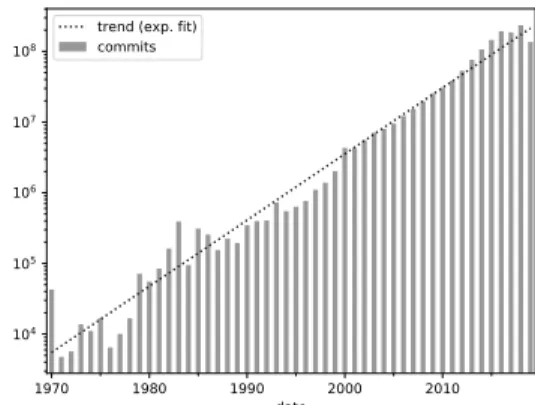
We removed from the corpus commits with implausible timestamps, i.e., commits before the Unix epoch and commits “in the future” w.r.t. the date of the snapshot, with a tolerance of 1 day. Doing so excluded only 11 M commits (0.66% of the corpus). Figure 1 shows the number of commits in the corpus over time. It exhibits the already observed [11] exponential growth of public code (the notch for 2020 is a binning artifact due to the incompleteness of that year in the corpus).
The initial set of distinct authors associated to all commits consists of 33 660 524 (33.7 M) names. As most version control systems (VCS) do not store encoding information, author names in the dataset are raw byte sequences. We
con-1970 1980 1990 2000 2010 date 104 105 106 107
108 trend (exp. fit)commits
Figure 1: Total number of yearly commits by all authors. The log scale on the Y-axis highlights the exponential growth of public code.
verted them to Unicode strings, trying the popu-lar UTF-8 encoding and successfully converting 33 657 517commits (99.991%).
We then filtered out implausible names such as: email addresses (used by mistake by authors in lieu of their name), names consisting only of blank characters, overlong names (more than 100 characters), and names containing more than 10% non-letter characters. This filtering reduced the corpus to 26 M authors after having removed: 7.5 M non-letter, 150 K emails, 25 K blank, and 31 overlong names. Finally we converted names to lowercase and normalized spaces, obtaining 13.2 M unique author strings.
Detecting the gender of a name is difficult in general [12] and even more so at this scale, geographic diversity, and lack of curation. As-signing a gender to a name also reinforces the gender binary, contributing to the marginalization of individuals who do not identify as men or women. A better approach is to ask authors for self-identification, but doing so is unfeasible at this scale. We hence delegate gender inference to automated tooling and we use the results only in aggregate form to study long-term trends. Throughout the paper we make no claim about gender identity (as in: the personal sense of one’s own gender) and only discuss gender trends to the extent of which they can be inferred from author names.
Based on the results of a recent thorough benchmark of gender detection tools [12] we
have chosen GENDER-GUESSER, because it shines on heterogeneous inputs. GENDER-GUESSER is im-plemented in Python and is open source (https:// pypi.org/project/gender-guesser/). This last point is particularly relevant: alternatives based on com-mercial APIs might give better accuracy, but would hinder replicability.
GENDER-GUESSER takes as input a Unicode
string, which is supposed to be a first name, and returns the detected gender as one of 6 possible values, depending on the tool’s certainty about the result: {male, mostly male, unknown, mostly female, female, andy} (the last one for unisex names).
Authors in our corpus are not split into first v. family name, but that distinction is not mean-ingful anyway in all the world cultures repre-sented in the corpus [4]. Hence, to determine the gender of an author we apply a majority criterion. We use GENDER-GUESSER to determine the gender of each blank-separated word in the author name as a string. Then, if a strict majority of words are detected as belonging to one gender (no matter how strongly) we associate that gender to the entire author name; otherwise its gender will remain unknown, formally:
Ma = {w ∈ a|guess(w) ∈ {male,mostly male}}
Fa = {w ∈ a|guess(w) ∈ {female,mostly female}} where a is an author name from our author corpus, w a word in that string, and guess(w) denotes the invocation of GENDER-GUESSER. The gender of an author name a is then determined as follows: GG(a) = ♂ if |Ma| > |Fa| ♀ if |Fa| > |Ma| ? otherwise
We can now partition the commit corpusCin the sets of commits by male authors, by female authors, or by authors for which we could not determine a gender, as follows:
C♂ = {c ∈ C | GG(c) = ♂} C♀ = {c ∈ C | GG(c) = ♀} C? = {c ∈ C | GG(c) = ?}
We have computed these sets in practice, by running GENDER-GUESSER on each word in author names and determining the majority gender for each of them. male authors 22.5% (3.0M) female authors 4.1% (0.5M) unknown 73.4% (9.7M) (a) authors male authors 47.7% (630.2M) female authors 3.9% (51.3M) unknown 48.5% (640.6M) (b) commits
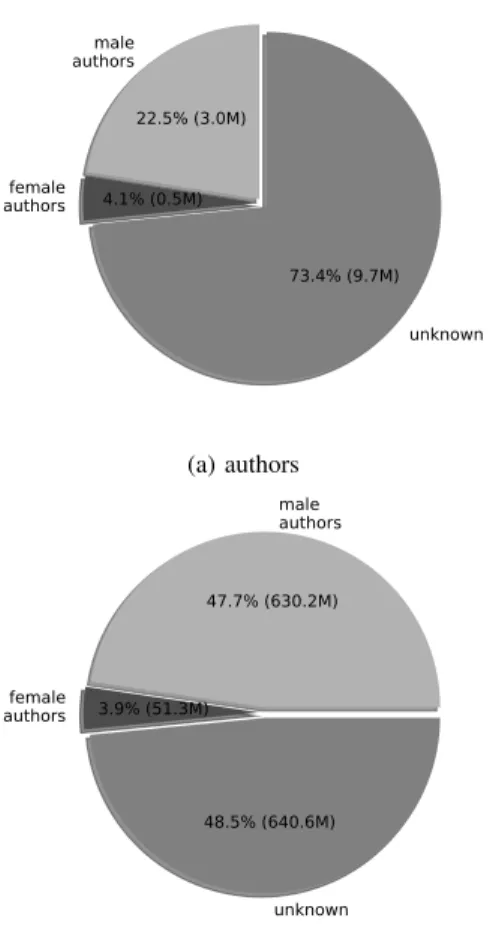
Figure 2: Breakdown of authors and authored commits by gender
RESULTS
Figure 2 shows the overall breakdown of detected genders in the studied corpus (RQ1). We were able to detect a gender for 3.5 M author names, or 26.6% of the author corpus. Author names with a detected gender account for 682 M commits, or 51.6% of the commit corpus. We have verified that the ratio of commits for which a gender could not be determined remains within 30–50% over time. Also, it has been shrinking for the past 20 years, during which the vast majority of commits have been produced (due to the exponential growth of the dataset).
Focusing on the author names for which we could determine a gender, 3 M (84.6%) are male authors v. 0.5 M (15.4%) female authors. In terms of contributions, commits by male authors are 630 M (92.5% of commits for which we could determine a gender) v. 51.3 M (7.5%) by female
1970 1975 1980 1985 1990 1995 2000 2005 2010 2015 year 101 103 105 107
commits by male authors commits by female authors
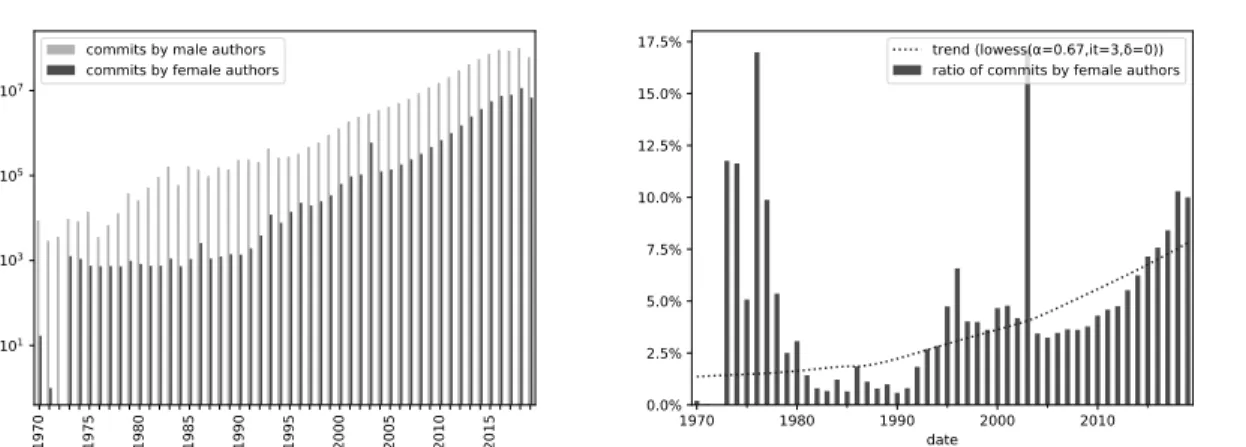
(a) total number of yearly commits by author gender (note the log scale on the Y-axis)
1970 1980 1990 2000 2010 date 0.0% 2.5% 5.0% 7.5% 10.0% 12.5% 15.0%
17.5% trend (lowess( =0.67,it=3, =0)) ratio of commits by female authors
(b) proportion of commits by female authors (on the total of commits for which gender could be determined)
Figure 3: Commits breakdown by detected gender over time
authors. In terms of diversity the picture is pretty dire: male authors have contributed more than 92% of public code commits over the past 50 years.
To answer RQ2, Figure 3a shows the evolu-tion over time of commits authored by gender, excluding commits by authors for which we could not determine a gender. Consistently with the breakdown by gender in the corpus as a whole, we observe that the yearly totals of commits by female authors have lagged behind commits by male authors by significant margins for half a century.
However, female authors are increasingly con-tributing to public code. Figure3bhighlights this, showing the 50-year evolution of the ratio of commits by female authors over the total of com-mits for which we could determine a gender. The figure shows both yearly ratios as percentages and a locally weighted scatterplot smoothing moving regression over the entire period. The ratio of commits by female authors has grown steadily over the past 50 years, reaching in 2019 for the first time 10% of all contributions to public code.
Note also how the growth trend in the ratio of female-authored commits is steeper over the last 15 years (2005–2019) than before. This is signif-icant because, due to the exponential growth of public code, those years have contributed the vast majority of commits to the entire corpus—and hence also contributed the most to the ongoing
“catch up” in the total amount of commits by female authors v. commits by male authors.
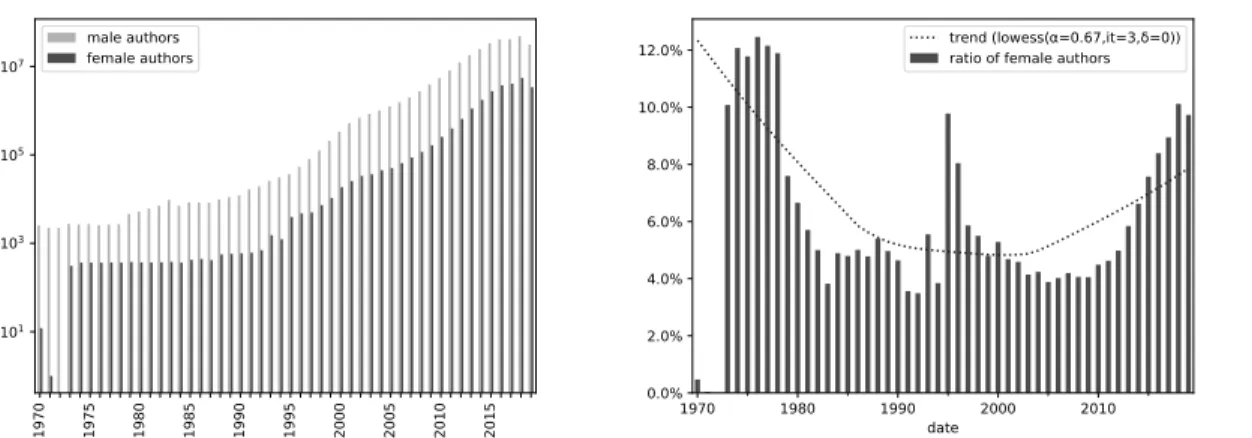
Figure 4 shows the yearly evolution of the number of active authors by gender, i.e., authors that have contributed at last one commit in a given year. In particular, Figure 4b confirms the significant growth of active female authors from around 4% in 2005 to more than 10% of all public code authors in 2019. If this trend is to continue, gender diversity among public code commits authors will increase significantly over the next few years.
DISCUSSION
To the best of our knowledge this is the first longitudinal gender study performed on public code at this scale—both in terms of population size and observed time period. The main trade-off in working at this scale is that we could not rely on curated gender information, e.g., author-provided information or interviews with them. Also, we had to work with non-parsed author names, leading to the need of using automated tools and heuristics.
Construct validity
The approach used for gender detection is crude. It is easy to come up with examples of family names composed by multiple words that are also common first names associated to a given gender, which will win majority over the gender detected for the actual first name. We do not expect this to happen often though. In general, family names are
1970 1975 1980 1985 1990 1995 2000 2005 2010 2015 year 101 103 105 107 male authors female authors
(a) total number of yearly authors by gender (note the log scale on the Y-axis) 1970 1980 1990 2000 2010 date 0.0% 2.0% 4.0% 6.0% 8.0% 10.0%
12.0% trend (lowess( =0.67,it=3, =0))ratio of female authors
(b) proportion of female authors (on the total of authors for which gender could be determined)
Figure 4: Breakdown of authors with at least 1 yearly commit by detected gender over time
reported as unknown byGENDER-GUESSER, not con-tributing to shifting the detected author gender in either direction. We have verified this empirically during experiment design. Doing it more exten-sively would boil down to validating the accuracy of GENDER-GUESSER itself, which has already been done in the literature [12], supporting our tool choice.
A related threat is posed by usernames used instead of full names, which happen in old VCSs like CVS and Subversion. Previous considerations about family names apply to this case too. Also, 98.2% of the repositories in Software Heritage are from VCSs that support author full names (e.g., Git, Mercurial), so we do not expect this problem to be statistically significant.
Author names for which we could not deter-mine a gender might impact our results. Given how unknown responses by GENDER-GUESSER do not affect gender assignment to authors, we con-sider this loss of coverage an acceptable conse-quence of our tool choice. As it is customary, we have excluded unknown gender authors from analysis. We could still determine author gender for almost 700 M commits, which remains an unprecedented scale for gender imbalance studies. Qualitatively, the consistency of the observed trends with recent survey-based work [10] about the increase of women participation in FOSS further supports our results and vice-versa.
External validity
We do not claim to have analyzed the entire body of collaboratively developed software. We have nonetheless analyzed the largest publicly available corpus of commits coming from pub-lic version control system repositories. We do not think a much larger coverage is achievable without, for instance, adding large non-public forges (e.g., coming from large-scale inner source practices) to our sample, which would hinder replicability and impact on corpus diversity.
CONCLUSION
We have conducted the first large-scale longi-tudinal study of gender imbalance among authors of collaboratively developed, publicly available code. The study spans 1.6 billion commits har-vested from 120 million projects and contributed by 33 million authors over a period of 50 years. Results give a mixed message about gender diversity in public code collaboration. Overall, contributions by female authors remain scarce: less that 8% of commits for which we could detect a gender, confirming decades of gender imbalance in Free/Open Source Software (FOSS). On the other hand, contributions by female authors appear to be on the rise and are rising faster than those by male authors. In 2019 and for the first time in half a century commits by female authors have reached 10% of yearly contributions to public code. Looking at active FOSS authors over time we find evidence of a similar sustained
growth and increasing speed. If the trend of the past 15 years is to continue, FOSS authors and their contributions might soon reach a level of gender diversity comparable to other fields.
The goal of this study was, on purpose, broad and longitudinal. As future work we intend to maintain the longitudinal angle, but drill down into specific software ecosystems to check if sig-nificant differences in gender participation trends exist and, if so, why. Our results also hint at other differences in participation by gender— e.g., commits per person over time and weekly participation patterns—which we also intend to explore in future work.
ACKNOWLEDGMENTS
The author would like to thank Jesus M. Gonzalez-Barahona for insightful discussions on this study, as well as Molly de Blanc and Antoine Pietri for comments on early versions of this paper.
REFERENCES
1. Jean-Franc¸ois Abramatic, Roberto Di Cosmo, and Ste-fano Zacchiroli. Building the universal archive of source code. Communications of the ACM, 61(10):29–31, September 2018.
2. Paul A David and Joseph S Shapiro. Community-based production of open-source software: What do we know about the developers who participate? Information Economics and Policy, 20(4):364–398, 2008.
3. Catherine Hill, Christianne Corbett, and Andresse St Rose. Why so few? Women in science, technology, engineering, and mathematics. ERIC, 2010.
4. Richard Ishida. Personal names around the world. https://www.w3.org/International/questions/ qa-personal-names, 2011.
5. Victor Kuechler, Claire Gilbertson, and Carlos Jensen. Gender differences in early free and open source soft-ware joining process. In 8th International Conference on Open Source Systems, OSS 2012, volume 378 of IFIP Advances in Information and Communication Technology, pages 78–93. Springer, 2012.
6. Jane Margolis and Allan Fisher. Unlocking the club-house: Women in computing. MIT press, 2002. 7. Mathieu O’Neil, Mahin Raissi, Molly de Blanc, and
Stefano Zacchiroli. Preliminary report on the influence of capital in an ethical-modular project: Quantitative data from the 2016 debian survey. Journal of Peer Production, (10), 2017.
8. Antoine Pietri, Diomidis Spinellis, and Stefano Zac-chiroli. The Software Heritage graph dataset: public software development under one roof. In 16th Inter-national Conference on Mining Software Repositories, MSR 2019, pages 138–142, 2019.
9. Yixin Qiu, Katherine J. Stewart, and Kathryn M. Bar-tol. Joining and socialization in open source women’s groups: An exploratory study of KDE-Women. In 6th In-ternational Conference on Open Source Systems, OSS 2010, volume 319 of IFIP Advances in Information and Communication Technology, pages 239–251. Springer, 2010.
10. Gregorio Robles, Laura Arjona Reina, Jes ´us M. Gonz ´alez-Barahona, and Santiago Due ˜nas Dom´ınguez. Women in free/libre/open source software: The situation in the 2010s. In 12th International Conference on Open Source Systems, OSS 2016, volume 472 of IFIP Advances in Information and Communication Technology, pages 163–173. Springer, 2016.
11. Guillaume Rousseau, Roberto Di Cosmo, and Stefano Zacchiroli. Software provenance tracking at the scale of public source code. Empirical Software Engineering, 25(4):2930–2959, 2020.
12. Luc´ıa Santamar´ıa and Helena Mihaljevic. Comparison and benchmark of name-to-gender inference services. PeerJ Computer Science, 4:e156, 2018.
13. Josh Terrell, Andrew Kofink, Justin Middleton, Clarissa Rainear, Emerson Murphy-Hill, Chris Parnin, and Jon Stallings. Gender differences and bias in open source: Pull request acceptance of women versus men. PeerJ Computer Science, 3:e111, 2017.
14. Bogdan Vasilescu, Andrea Capiluppi, and Alexander Serebrenik. Gender, representation and online partici-pation: A quantitative study. Interacting with Computers, 26(5):488–511, 2014.
15. Bogdan Vasilescu, Daryl Posnett, Baishakhi Ray, Mark GJ van den Brand, Alexander Serebrenik, Premkumar Devanbu, and Vladimir Filkov. Gender and tenure diversity in GitHub teams. In 33rd annual ACM conference on human factors in computing systems, CHI’15, pages 3789–3798, 2015.
Stefano Zacchiroli is Associate Professor of
Com-puter Science at Universit ´e de Paris on leave at Inria, France. His research interests span formal methods, software preservation, and Free/Open Source Soft-ware engineering. He is co-founder and CTO of the Software Heritage project. Contact him [email protected].