HAL Id: hal-01815549
https://hal.archives-ouvertes.fr/hal-01815549
Submitted on 14 Jun 2018
HAL is a multi-disciplinary open access
archive for the deposit and dissemination of
sci-entific research documents, whether they are
pub-lished or not. The documents may come from
teaching and research institutions in France or
abroad, or from public or private research centers.
L’archive ouverte pluridisciplinaire HAL, est
destinée au dépôt et à la diffusion de documents
scientifiques de niveau recherche, publiés ou non,
émanant des établissements d’enseignement et de
recherche français ou étrangers, des laboratoires
publics ou privés.
Mars Organic Molecule Analyzer (MOMA) Flight
Model Qualification
William Brinckerhoff, Veronica Pinnick, Ryan Danell, Friso van Amerom,
Ricardo Arevalo, Andrej Grubisic, Xiang Li, Caroline Freissinet, Zhiping Chu,
Marco Castillo, et al.
To cite this version:
William Brinckerhoff, Veronica Pinnick, Ryan Danell, Friso van Amerom, Ricardo Arevalo, et al.. Mars
Organic Molecule Analyzer (MOMA) Flight Model Qualification. 48th LPSC Lunar and Planetary
Science Conference, Mar 2017, Houston, United States. �hal-01815549�
MARS ORGANIC MOLECULE ANALYZER (MOMA) FLIGHT MODEL QUALIFICATION. William B.
Brinckerhoff4, Veronica T. Pinnick1, Ryan M. Danell2, Friso H. W. van Amerom3, Ricardo D. Arevalo, Jr.1, Andrej
Grubisic1, Xiang Li1, Caroline Freissinet1, Zhiping Chu1, Marco Castillo1, Chris Johnson1, Cyril Szopa4, Fabien
Stalport5, Arnaud Buch6, Tristan Allain5, Noel Grand5, Francois Raulin5, Walter Goetz7, Harald Steininger7, Fred
Goesmann7, and the MOMA Team1-8, 1NASA Goddard Space Flight Center, 8800 Greenbelt Rd., Greenbelt, MD
20771; 2Danell Consulting, Inc., Winterville, NC; 3Mini Mass Consulting, Hyattsville, MD; 4Laboratoire
Atmos-phères, Milieux, Observations Spatiales (LATMOS), Guyancourt, France; 5Laboratoire Interuniversitaire des
Sys-tèms Atmosphériques (LISA), Univ. Paris-Est, Créteil, France; 6Laboratoire de Génie des Procédés et Matériaux
(LGPM), École Centrale Paris, Chatenay-Malabry, France; 7Max Planck Institut für Sonnensystemforschung (MPS),
Göttingen, Germany; 8Laser Zentrum Hannover e.V. (LZH), Hannover, Germany. Introduction: The Mars Organic Molecule
Ana-lyzer (MOMA) investigation on the 2020 ExoMars rover will examine the molecular composition of sam-ples acquired from depths of up to two meters below the martian surface, where organics may have been protected from radiative and oxidative degradation [1,2]. The clay-rich rock exposures accessible in Oxia
Planum, the preferred landing zone, will provide an
excellent opportunity to sample ancient material for organics analysis. MOMA incorporates both pyrolysis-gas chromatography/mass spectrometry (pyr-GCMS) and laser desorption mass spectrometry (LDMS) modes of operation, and is designed to work in concert with the other investigations in the rover’s Pasteur Payload, particularly the Raman [3] and MicrOmega [4] instruments that analyze common drill samples presented on a carousel. With two modes, MOMA detects compounds over a wide range of molecular weight, volatility, and mineralological association [5].
Implementation of GCMS and LDMS Modes:
GCMS mode is operated analogously to the Sample Analysis at Mars (SAM) investigation on Curiosity. Samples are sealed into ovens and heated to 850° C. Analyte gases, entrained in He, flow through the GC system to the MS. The GC includes two cooled hydro-carbon traps (Tenax and Carbosieve) that are opened after major water evolution (above 100° C) but prior to organic thermodesorption (from ~300° C up to > 500° C). Trapped organics are injected onto one of four columns and eluted over a temperature ramp to the MS electron ionization (EI) source. GCMS analyzes com-pounds of high-to-moderate volatility (enthalpies of vaporization !HV ≤ 50 kJ mol-1) such as alkanes,
amines, and lighter carboxylic and amino acids and aromatic species. Derivatization agent present in some ovens enables detection of the higher !HV and polar
species over the full GCMS m/z range of 50-500 Da. In LDMS mode, molecules are desorbed and ion-ized directly from powder samples with a pulsed UV laser (266 nm, 1 ns duration) at Mars ambient pres-sures. Parent molecular cations, and their fragments, enter the MS through a fast aperture valve that closes
after ions are trapped, permitting the ion trap pressure to reduce to <10-3 Torr where the detectors can be
op-erated. LDMS mode is designed to analyze compounds of moderate-to-low volatility (enthalpies of vaporiza-tion !HV ≥ 40 kJ mol-1) such as heavier carboxylic
acids, aromatic species, chain-like compounds, and macromolecular organics. The nature of LDI permits some fraction of large “parent” molecules to desorb intact. As previously demonstrated, the pulsed LDMS mode is not strongly affected by the potentially oxidiz-ing effects of heat-evolved perchlorates, simplifyoxidiz-ing analysis of nonvolatile organics [6].
Flight System Intergration and Test: The various
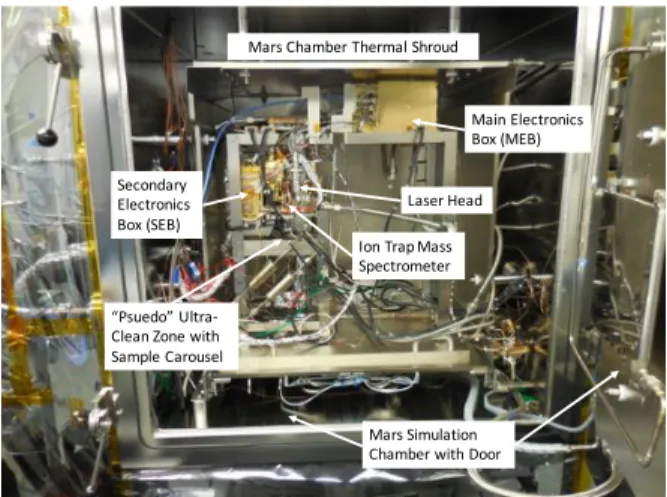
flight instrument subsystems have been functionally tested and qualified at their respective institutions in preparation for flight model (FM) integration, test, and delivery to the rover in 2017. The flight MS completed earlier [7] has been integrated with an engineering model of the laser and with a commercial (Thermo) GC for both bench and Mars environmental chamber testing (Fig. 1) under stringent contamination and planetary protection controls.
Main%Electronics% Box%(MEB) Laser%Head Ion%Trap%Mass% Spectrometer Secondary% Electronics% Box%(SEB) “Psuedo”%Ultra@ Clean%Zone%with% Sample%Carousel Mars%Chamber%Thermal%Shroud Mars%Simulation% Chamber%with%Door
Fig. 1 Flight linear ion trap MS assembly with laser in Mars
environment simulation chamber to match mechanical, ther-mal, pressure, and contamination level that MOMA will experience on the ExoMars rover. Configuration supports either external commercial GC, via gas feedthroughs, or flight model GC within the existing mechanical structure.
2385.pdf Lunar and Planetary Science XLVIII (2017)
Preliminary tests of the GCMS mode using calibration gases have demonstrated as-expected functional per-formance in for resolution, acquisition rate, sensitivity, and fragmentation patterns. A four-component hydro-carbon mix (butane, pentane, hexane, and benzene) was injected at the appropriate concentrations and rate onto the 20 m " 0.25 mm " 0.25 µm Restek CLP GC column, matching Mars-like MOMA pyrolysis and GC operation, to test GC-specific trapping and retention characteristics (Figure 2). The spectrum in the lower plot was found to closely match the fragmentation pat-tern known for hexane during its column elution. The limit of detection (LOD) requirement of 1 pmol s-1 is
readily met and will be revisited for different com-pounds and with higher fidelity GC configurations.
Butane' Pentane' Hexane' Benzene' MOMA'FLT'Total'Ion' Chromatogram' 41' 56'57' 71' 86' MOMA'FLT'GCMS'Hexane' Spectrum'
Fig. 2 Flight MOMA GCMS total ion chromatogram (top)
shows nominal detection of hydrocarbons in He. The hexane GC peak is sampled with multiple EI spectra such as shown (bottom) with its characteristic fragmentation pattern.
The flight Tapping Station, which seals pyrolysis ovens on the carousel, and the flight GC have been assembled (Figure 3) and are undergoing functional testing. A flight GCMS coupling is planned, but lim-ited to the activities critical to verify MOMA/GCMS without significant contamination exposure. Additional end-to-end characterization will be conducted using the engineering units and, as in the case of the Sample Analysis at Mars (SAM) investigation, a testbed model assembled from spare flight components.
Tapping' Sta*on' Oven' GC' Module' He'Tank'
Fig. 3 The flight models of the Tapping Station (left; to seal
pyrolysis ovens) and the GC subsystem (right) have been assembled and are undergoing “ultra-clean” functional tests.
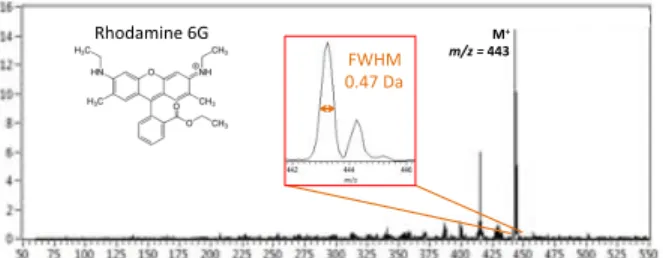
The flight model has been tested in LDMS mode, initially with the engineering unit laser, verifying ion transmission, sensitivity, resolution, and accuracy re-quirements over the mass range up to 1000 Da. A cali-bration target of solid CsI will be delivered to Mars with MOMA and used to track and correct any drift of m/z position or mass bias of sensitivity. Only the most trace-level concentrations of selected organics are used, rarely, to perform critical verification of the MOMA limit of detection for nonvolatile compounds in the FM. Figure 4 demonstrates the flight MS readily produces an accurate spectrum of the aromatic Rho-damine 6G calibrant, present at 50 femtomoles per mm2, with a signal-to-noise ratio over 100 at the base
peak of m/z 443. As such the observed performance in this test is more than 1000 times better than the overall LDMS requirement of 1 pmol mm-2 Additional tests of
the FM with other selected gases and samples are un-derway to complete the verification of all operational parameters, including use of MS/MS and SWIFT pro-tocols [8]. In parallel, the engineering unit LDMS is used to characterize and develop libraries of the re-sponse to a range of Mars-relevant mineral matrices [9]. Following a thorough cleaning and continued background and procedural blank tracking scans, the flight laser will be integrated to the flight ion trap MS, and the full system will undergo final Mars thermal vacuum testing prior to delivery to the rover.
M+#
m/z$=#443#
Rhodamine*6G*
FWHM* 0.47*Da*
Fig. 4 Flight mass spectrometer in laser desorption/ionization
mode achieves ~femtomole per mm2 limit of detection per
spectrum for a nonvolatile aromatic organic compound.
References: 1. Pavlov, A.A. et al. (2012) GRL 39, L13202. 2. Quinn, R.C. et al. (2013) Astrobiology 13, 515-520. 3. Rull, F. et al. (2013) LPS 44, 3110. 4. Pi-lorget, C. et al. (2012) 3rd Conf. Early Mars, 7006. 5.
Goesmann, F. et al. (2017) Astrobiology, Submitted. 6. Li, X. et al. (2014) Astrobiology 15, 104-110. 7. Pin-nick, V. et al. (2016) LPS 47, 2770. 8. Arevalo, R. et al. (2014) LPS 45, 2894. 9. Goetz, W. et al. (2017) LPS
48 (this volume).
Acknowledgments: MOMA is jointly supported
by DLR, CNES, and NASA. The MS development is supported by NASA’s Mars Exploration Program (Program Executive, David Lavery; Program Scientist, Mitch Schulte; Mission Manager, Peter Doms).
2385.pdf Lunar and Planetary Science XLVIII (2017)